

Submitted:
25 February 2026
Posted:
28 February 2026
You are already at the latest version
Abstract
Building details are often treated as technical externalities, subordinate to form, image and architectural narrative. Reading details as liminal spaces reverses that hierarchy. The joint concentrates transitions between inside and outside, public and private, ex-posure and protection, and those transitions are constructed as intervals, experienced through thickness, reveal, edge condition, shadow, touch and the small resistances that accompany crossing.
The article develops its analysis through archival hand-drawn detail drawings from the Azrieli Architectural Archive. It defines building details as both technical assem-blies and threshold devices, points where architecture becomes accountable to percep-tion as well as to climate, labor, regulation and everyday use. A semiotic reading of large-scale sheets shows how line weight, hatching, notation and layout encode priori-ties, marking boundaries between what must be precisely resolved and what may re-main adjustable. The archive is treated as a laboratory of “detail families,” recurring junction types such as windows, stairs and envelope edges that reveal office-specific languages of joining.
Two case studies, by the architects Ram Karmi and Arieh Sharon with Eldar Sharon, show how micro-variations in depth, overlap and edge control tune thresholds, pro-ducing perceptual tipping points where comfort can shift into irritation, calm into un-ease and openness into vulnerability. Although grounded in a local archive, the argu-ment addresses a broader condition of contemporary practice: standardization and digital production chains can relocate authorship and responsibility away from the joint, precisely where buildings most affect everyday conduct. The paper proposes a liminal literacy of detailing as both a historiographic method and a design ethic aimed at making threshold decisions legible, contestable and accountable in present-day workflows.
Keywords:
architectural details
; liminality
; detail drawings
; thresholds
; transitions
Introduction: From Construction Detail to Liminal Space
Architectural discourse and practice often privilege façades, morphology and total images of buildings, while construction details are treated as technical residue (Forty 1989). Yet many decisive negotiations occur at the millimetric scale, in joints and thresholds that bodies cross and surfaces meet and touch. Detail drawings provide unusually direct evidence of those negotiations as working artifacts. The sheets instruct construction, but they also record what an office chose to make explicit, what it left implicit and where it concentrated care and risk.
Two propositions guide the argument of this paper. First, building details are not only solutions to performance requirements. Details also operate as micro-manifestos, especially in window and door assemblies where thickness, reveal, and threshold articulation stage openness and protection, transparency and control, and the hierarchy between inside and outside. Therefore, small adjustments at the joint can produce disproportionate shifts in experience (Stevens 1957).
Second, the concept of liminality provides the hinge in this paper, by defining the threshold state of transition. Liminality describes the condition of being between states, and building details repeatedly materialize such in-between zones, interior and exterior, public and private, safe and exposed, structure and finish. These transitions are constructed and inhabited. The threshold is experienced through pressure on a step, contact with a rail, a temperature shift at a reveal and a shadow line that thickens or thins the boundary. Archival drawings make these zones readable because they render passage as an interval with depth, sequence and rules, rather than as a set of lines.
Three research questions structure the inquiry: How do archival detail drawings use graphic conventions to show thresholds as zones of passage rather than just lines between spaces? Which “detail families” (for example windows, stairs, walls) repeat across projects and offices, and how do small variations within them shape how spaces feel, for example legible, calm or secure? And, why do very small decisions at joints have such large effects on experience, and what kinds of architectural responsibility are taken or avoided at these thresholds?
This article makes three contributions: a way to read archival detail sheets as evidence of liminal thinking; a comparative method of “detail families” that makes office-specific joining languages legible; and a bridge from mid-century hand-drawn detailing to contemporary conditions of standardization and digital workflows.
Urgency comes from the current separation between design discourse and the millimetric work where buildings become livable and accountable. Standardization and digital production chains can distribute authorship across protocols, products, and consultants, making threshold decisions harder to see, argue over, or revise as architectural propositions. A liminal reading addresses that gap by treating the joint as a site where theory and practice meet, and where small adjustments can produce disproportionate shifts in experience.
The Impact of a Detail
A building detail is often introduced as a technical document, a zoomed-in drawing that instructs construction (Merriam-Webster, “detail drawing”). That definition is accurate but incomplete. A detail is first a resolved assembly, a precise account of how parts meet, how loads transfer, how water is shed, how air is sealed and how materials accommodate movement so construction can be executed reliably. At this level the detail translates design intent into dimensions, fixings, layers, tolerances, sequencing and performance criteria (Emmitt 1999).
A second definition is central to the argument. A detail can be defined as a threshold device, the smallest site where architectural intention becomes accountable to climate, labor, regulation and everyday use. What appears minor in plan becomes decisive in experience because architecture is encountered through edges, joints, textures, temperatures and small resistances. Details mediate comfort, safety and atmosphere through calibrations that often remain below conscious notice (Evans 1997). For example, a drawing of the entrance detail captures this threshold intelligence: the lower step projects beyond the brick wall and the landing is shaped to catch dirt from shoes before one enters the interior (Figure 1).
Detail drawings also have a distinct representational status. They operate at large scales, typically between 1:20 and 1:5 and sometimes at 1:1. At these scales the drawing stops describing overall form and begins describing contact: wall meets slab, window meets opening, roof meets parapet, hand meets rail. The sheet condenses decisions that cannot remain ambiguous, fixing what must align and what may deviate, what is continuous and what is separated, what is exposed and what is concealed. In that sense the detail sheet functions as a kind of architectural writing, a grammar of junction-making that carries technical and cultural values (Frascari 1984). For example, the amount of information on the sheet varies, but it is organized to make the design idea and its execution easy to grasp (Figure 2).
Different kinds of details clarify this grammar. Some address hidden parts of the building, interfaces, subframes and fixings that are drawn to be reliable and remain out of view. Others work as repetitive systems, facade modules, shading devices, precast connections and cladding joints that are drawn in series and give the elevation a regular rhythm. A third group can be read as signature details, recurring choices about reveals, edges, profiles, expressed joints and drainage grooves that show an office’s preferred way of working and project an ethos of precision, restraint or care (Frampton 1995). Architects’ offices developed unique details, especially for furniture, light fixtures and even mailboxes, as a way of maintaining control over the overall design (Figure 3).
Liminality unifies these types; it describes the in-between condition of thresholds, spaces in which passing from one state to another becomes a concrete experience (Turner 1967). A threshold is never only an abstract boundary (Sack 2024), it is a constructed condition in which multiple systems collide and must be negotiated into workable agreement. Detailing therefore operates across scales rather than beneath them. Architectural experience is shaped by urban arrangements and by building form, yet judgments about comfort, dignity and legibility are often decided in millimeters, at the joint where the macro claims of a project are supported or undermined by the micro realities of contact, wear and performance.
Liminality as a Framework
Liminality names a condition of transition, classically theorized as “betwixt and between” in ritual of passage, where meaning intensifies because roles, boundaries, and expectations are temporarily reconfigured. Architectural thresholds produce a comparable intensification, not as metaphor but as construction. The in-between becomes a made interval with depth, sequence, and rules, and the joint is one of its primary material instruments. The concept aligns with Aldo van Eyck’s notion of the in-between as an active domain that reconciles opposed terms rather than merely separating them, which helps specify liminality here as an architectural condition rather than an imported analogy (Sack 2024). It also resonates with Louis Kahn’s insistence that the joint is where architecture declares its values, since the joint organizes how parts meet, how loads, weather, and tolerances are negotiated, and how experience is staged at the meeting of elements (Kahn, 1975). Marco Frascari provides the hinge to detail culture by treating the detail as a bearer of narrative and intention, making the joint legible as both assembly and discourse (Frascari 1984). Taken together, these frames clarify how liminality is used in this paper: as a lens for reading building details and detail drawings as constructed intervals where technical, perceptual, and ethical stakes concentrate, and where accountability becomes visible at the scale of the millimeter.
In this article, the concept of liminality is applied to building details, treating details as places where transition is materialized through assembly. A threshold is never only a line in a plan (Van Gennep 1960). Thickness, reveal, seal, profile and junction geometry produce a zone in which the body negotiates comfort, control and meaning. Framing the detail as a threshold device clarifies why details can shape experience disproportionately, even when they appear minor. Architects decide whether a window reveal is thick or thin and how the window frame sits in the wall (Figure 4). These small choices shape glare and shade and how protected or exposed the boundary feels. They also decide the profile and height of a handrail, which affects the intimacy of touch and the confidence of movement on the stair (Boettger 2014).
Liminality shifts attention from the detail as an isolated technical solution to the detail as a site where multiple conditions intersect (Allen and Rand 2011). Liminal zones are where different logics meet and must be reconciled: climate with comfort, movement with safety, structure with finish, economy with maintenance (Newman 2021).
Detailing operates across scales because it links the project’s large claims about form, program and presence to the small decisions that make performance, durability and touch workable at the joint. Liminality therefore offers a vocabulary for describing how details shape everyday conduct and perception at points where architecture is most intensely inhabited (Ng and Lim 2018). Details are structured as in-between spaces that either visibly separate conditions or enable transitions between them, functioning as conceptual or physical zones between elements, for example in shutter and window assemblies (Figure 5). Liminality is already present in representation, because the detail sheet marks boundaries between what must be precisely resolved and what may remain adjustable. Revisions, corrections and variants on the hand-drawing sheets strengthen the point by showing the threshold as a site of negotiation rather than a settled line.
Perception provides further justification; small physical changes can cross perceptual thresholds and produce large shifts in experience, while the mind reads wholes through parts, so one anomalous detail can alter perceived stability, harmony or safety (Figure 6). Thresholds are perceptually charged because attention intensifies during crossing and the body becomes more sensitive to friction, glare, temperature shifts and tactile uncertainty (Mostafavi and Leatherbarrow 1993).
Genealogy of Liminal Detailing
A genealogy of detailing places the detail-as-liminal-space within an established tradition rather than presenting it as a new claim. Shifts in drawing culture, production, and professional organization repeatedly relocate meaning and responsibility into the joint, even when discourse foregrounds form or image (Ford 1990). In the nineteenth-century École des Beaux-Arts, detail drawings already carried a double status as instruction and cultural object, with the joint serving as a primary site where competence and authority were displayed (Drexler 1977; Penanrun, Delaire and Roux 1907). Modernism recoded this relationship: at the Bauhaus, the detail became a pedagogical instrument tied to materials, industry, and fabrication logic, shifting emphasis from ornamental finish toward system and discipline (Gropius 1975; Schuldenfrei 2010). Standardization then pushed the micro-scale into the foreground as an explicit agenda, framing dimensions and tolerances as formative elements that choreograph bodily movement across boundaries (Neufert 1970). Mid-century construction cultures intensified these dynamics through repetition and code-aligned legibility, while later tectonic discourse made explicit what practice long enacted, treating the junction as the place where construction and narrative meet and where ethics attach to making (Frampton 1995).
Built work can be read through this lens as well. Frank Lloyd Wright’s glass corners and frameless junctions between glass and stone walls, and Le Corbusier’s treatment of the door jamb to visually blend interior and exterior elements, produce in-between conditions in which a person is physically inside yet feels partially outside, occupying a threshold space. Such emotions could not manifest without meticulous attention to detail.
Contemporary practice, shaped by thicker envelopes and layered performance requirements, concentrates more demands at the boundary, making the liminal zone denser and more consequential. Within this lineage, the Azrieli Architectural Archive drawings can be read as liminal artifacts that record how architects calibrate thresholds through millimetric decisions.
Method: Archive, Selection and Comparative Reading
The Azrieli Architectural Archive at the Tel Aviv Museum of Art holds architects’ drawings from the early twentieth century to the present, with a concentration in the mid-twentieth century.1 Some offices preserved substantial bodies of detail drawings, yet archival volume does not necessarily reflect an office’s attitude toward detailing because the holdings also reflect later preservation choices by architects and families. The study examined more than 350 detail drawings. Comparable junctions were then assembled into “detail families,” stable categories that enable systematic comparison across projects and decades (Appendix A, table).
Within the archive, some details operate as execution instructions, while others include elaborate annotation, meticulous specification, and axonometric or perspective views that suggest a broader intended audience than contractors alone. Historic drawings often attend even to what might seem minor or arbitrary, such as a window screen detail (Figure 7). The analysis does not foreground local political context. Instead, it reads the drawings in visual and operative terms, treating them as part of the architectural discourse of their time, and as a methodological template that can be extended beyond the present archive. The archive also functions as a laboratory because thresholds recur across buildings, allowing recurring problems to be studied through recurring solutions. Detail families make patterns, habits, and calibrated deviations legible and allow office-specific “languages” of joining to be traced through repeated choices about reveal depths, edge conditions, exposure or concealment, and separations between layers.
A three-layer strategy structures the analysis. First, graphic reading examines scale, precision, conventions, and page organization to identify a hierarchy of care, where boundaries are thickened, where continuity is insisted upon, and where separation is staged. Second, comparative reading places different offices’ solutions for the same family side by side to describe office language as a consistent way of staging transitions, while distinguishing office ethos from broader construction culture shaped by codes, standard products, and material availability. Third, contextual cross-reading connects drawings to specifications, correspondence, minutes, and project records where available to clarify accountability, negotiation, and constraints such as budget, fabrication, maintenance, and regulation. Across these layers, micro-variations in reveal depth, offsets, slopes, drip edges, and hand-contact surfaces are tracked as tuning operations that recalibrate transitions, making boundaries more protective or more open, more tactile or more distant, and more legible or more ambiguous. Where possible, the method extends to an “as drawn / as built / as modified” reading by comparing archival intent with later repairs and additions that often cluster at thresholds.
Perceptual Thresholds at the Joint
A joint is where architecture touches the body most directly. A railing, a door threshold or a window frame may appear minor, yet each functions as a physical stimulus that shapes sensory experience. (Figure 8) The experience of a building is not that of a single neutral whole, it is built up through repeated encounters with edges, surfaces, temperatures, shadows, resistances and tactile cues. At the scale of the detail the question is rarely only whether it works. A more precise question emerges: at what point does a junction cross from merely adequate to perceptually resonant, calm or safe?
Psychophysics offers a vocabulary for why small changes matter. Heinrich Weber and Gustav Fechner (1966) suggest that very small physical differences, in millimeters, slight shifts in tone or subtle variations in texture can cross a perceptual threshold and produce a disproportionately large change in experience. A minimal adjustment can shift how a space feels, from secure to unstable, ordered to chaotic, comfortable to irritating. Stanley Smith Stevens’ power law (1957) sharpens the point by emphasizing nonlinear response across sensory modalities such as light, temperature and touch. The same physical change does not always feel the same. Once a stimulus crosses the point at which the body begins to register it, experience can change sharply.
The logic becomes clearer when tied to thresholds. A few degrees’ change in the angle of a shutter can reduce glare enough to transform perceived comfort. At the boundary, perception is already heightened. Crossing intensifies attention; minor calibrations at the joint can therefore tip the experience of passage, pause or contact.
Gestalt psychology adds a second layer, shifting attention from stimulus intensity to perceptual organization. Psychophysics and Gestalt are used here as a reading protocol for construction drawings, where thresholds are treated as sequences of cues rather than single lines. The analysis tracks how line weight, hatch, notation density and sheet layout direct attention to certain interfaces while suppressing others, and how repetition across detail families acts as a perceptual training device that stabilizes expectations. One emphasized or anomalous detail can shift the perceptual balance of an entire environment (Wertheimer 1938), while small deviations can also signal risk, hierarchy or intensified performance demands (Figure 9). Figure-ground effects are identified where poche, shadow lines and layer stacking make boundaries appear thick, recessed or continuous, so the drawing does not only document assembly, it scripts how continuity, separation and transition will be perceived at the built interface.
Archival detail drawings are crucial evidence for these dynamics because they preserve micro-decisions that buildings later naturalize. Careful inspection reveals variations in line thickness, corner radius, reveal depth, slopes, offsets and alignments. Such changes are rarely arbitrary, they often indicate iterative refinement, a practice of tuning. Even if mid-century architects did not describe their work in the language of psychophysics, the drawings show an acute awareness of thresholds through repeated adjustments in dimension and proportion. A shift in edge condition can alter tactile confidence, visual comfort and the perceived thickness of a boundary. Reading these sheets therefore uncovers more than technical information. It reveals a latent perceptual intelligence embedded in detailing, a search for the point at which material form meets human experience.
Perceptual thresholds at the joint therefore function as a bridge concept for the article. They connect millimetric evidence in the archive to a claim about architectural experience: details shape how boundaries are sensed and interpreted. The joint emerges not as a secondary technical matter but as a primary site where architecture becomes embodied, where small calibrations govern passage, comfort and the meaning of the threshold.
Case Studies
Two architects' office collections in the Azrieli Architectural Archive are examined in the case studies: Ram Karmi’s office and the office of Arieh and Eldar Sharon. The offices were selected based on the size of their collections, the informational richness of the sheets and the period they cover. The analysis tracks recurring transition logics in their details, and treats these as evidence that liminality operates as a material condition produced through depth, overlap, edge control and the choreography of contact. The two offices hand-drawings study shows how threshold experience is tuned where elements meet and how the smallest adjustments often carry the largest perceptual consequences.
Ram Karmi: Lady Davis Amal School, Tel Aviv as Liminal Transition of Details
Ram Karmi’s approach to detailing developed in continuity with the practice of his father, Dov Karmi, and matured during the 1960s and 1970s, when Brutalism prevailed in international architectural discourse. Rough surfaces, exposed structure and disciplined joints formed a shared architectural language (Karmi-Melamede 2019; Yagid-Haimovitz 2010). Karmi's work shows sustained attention to concrete detailing, both precast and cast-in-place, and consistent care for joints, tolerances and the legibility of assembly. Although the discussion here focuses on a single building, similar commitments to junction-making appear in projects such as Beit El-Al, Tel Aviv (1963), Merkaz HaNegev, Beer Sheva (1966) and Beit Hadar-Dafna, Tel Aviv (1971).
The school, inaugurated in 1972, offers an intensive demonstration of this detail culture (Figure 10 and Figure 11). Attention to the joint extends across interior spaces, exterior faces and the plaza, shaping walls, floors, stairs, ceilings and rails. Experience is organized through transitions, and details amplify those transitions by giving each zone a distinct material and spatial identity. Ceilings provide a clear example: in classrooms, reinforced-concrete waffle slabs integrate lighting within the structural grid (Figure 12). Even the fiberglass mould used for the concrete ceiling was drawn at a 1:1 scale (Figure 13). Beyond structural efficiency, the repeated grid produces a perceptual rhythm that stabilizes orientation and organizes the ceiling plane overhead (Letzter 2024).
In laboratories, the ceiling takes the form of an inverted barrel vault (Figure 14). Curved rows are separated by flat slabs, while fluorescent fixtures deliver softer, more diffuse artificial light. The change in ceiling type registers as an atmospheric shift at the moment of movement. Section drawings clarify that the laboratory ceiling is conceived as a repeatable unit rather than a singular sculptural gesture (Figure 15). The inverted profile is stabilized through consistent edge conditions at its springing points and by a carefully articulated perimeter where the roof build-up meets the wall. Graphic emphasis concentrates at these junctions, suggesting that the experiential difference between classroom and laboratory is engineered at the joint as much as through overall form.
Concrete surfaces intensify this threshold logic; reinforced concrete walls combine with precast elements, and exposed material carries the grain of timber formwork. The horizontal and vertical imprint reads as a calibrated field of shadow and texture, especially around window zones where light meets surface. For example, the classrooms' walls tilt inward, subtly altering enclosure and directing attention toward openings. Such shifts operate at the threshold, where geometry can change the felt balance between stability and movement, openness and containment.
Also the entrance portal can be interpreted as a liminal device. A welcoming staircase leads to a prismatic concrete gate element above the entrance, while integrated light fixtures mark the school’s threshold. Outside, concrete rails frame the staircase on both sides, and before the portal. The threshold is marked where the concrete rails terminate before the portal, continuing inside as steel rails (Figure 16). Interruption and continuation produce a deliberate transition between exterior guidance and interior order, reinforced by lighting along the sides of the portal. Further detail sheets extend this logic across the envelope. Repeated elements form a graded boundary, and sections show how offsets, fixings and thickness determine whether the facade reads as porous, protective or inert.
The building can thus be read as a celebration of detail, not as ornament but as an insistence that architectural experience is made at the joint. Movement from exterior to interior, and from shared zones to classrooms and laboratories, is choreographed through tuned changes in light, texture and orientation, securing the project’s experiential coherence.
Arieh and Eldar Sharon: Modular Envelopes and Liminal Depths
The Sharon office presents a sustained trajectory in which detailing moves from disciplined modernist clarity toward more experimental geometry that demands new joints, new edges and new thresholds. The practice begins with Arieh Sharon, a Bauhaus graduate, and the establishment of his Tel Aviv office. When Eldar Sharon joined in the mid-1960s, the inherited rationalism remained, yet it was redirected through the spatial ambitions of the period (Neuman 2023). Structuralist and Metabolist currents encouraged angled surfaces, envelopes and systems composed of repeatable units rather than stable orthogonal boxes. Once walls tilt and envelopes fold, invention concentrates at the joint, because geometry becomes inhabitable through the way elements meet.
The office’s drawings make that shift legible through recurring detail families that stage liminality as thickness, overlap and calibrated in-between space. Sharon’s detail sheets develop a cellular geometry of triangular elements, with plan and axonometric clusters accompanied by small section sketches of panel edges and corners, as seen in the prefabricated fiberglass living unit project (Figure 17). Graphic emphasis falls on meeting lines, rigidifying edges and connection logic that preserves continuity across modules. The unit can be read as both architectural and object-like, positioned between building and product. That ambiguity produces a liminal condition in itself. The capsule is an engineered enclosure that must still negotiate ground contact, openings and occupation through precise edge decisions.
Another family addresses screens and facade filters, as seen in projects such as the Sackler (today "Gray") Faculty of Medical and Health Sciences, Tel Aviv University (1973) (Figure 18), Beit America-Israel (1973) (Figure 19) and the Gilo neighborhood housing in Jerusalem (1976). Concrete vertical slats and ribbed members appear in elevation and axonometric fragments, anchored by brackets and edge profiles. These are not merely decorative devices, they construct depth in front of a plane, turning the facade into a liminal field where the gaze is held between interior and exterior (Figure 20). Transparency becomes conditional: light is modulated through repetition, and privacy is achieved without full opacity. Seriality produces rhythm, while corners and shifts in spacing mark charged moments of transition. Facade design also reshapes interior experience when walls tilt inward. In the Sackler project, for example, the sections show repetitive precast elements that produce capsule-like interior surfaces facing outward (Figure 21).
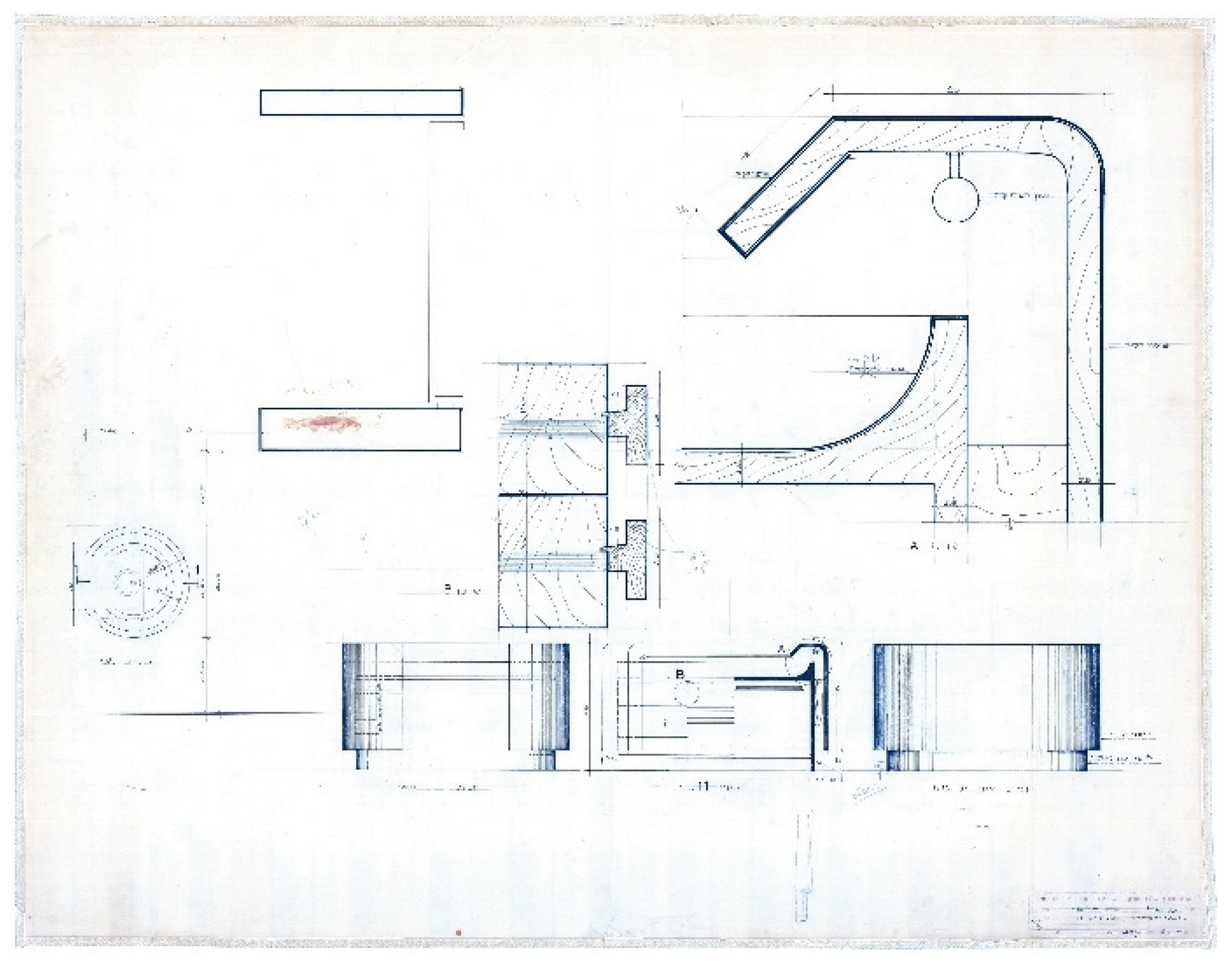
Another family grounds the office language at the scale of the body. Chairs and benches, carefully dimensioned in profile, appear in early drawings and treat posture as a design problem (Figure 22). Over the years, furniture details were maintained and updated in response to new materials and changing tastes. More sophisticated profiles, curvature, thickness and support become micro-decisions that govern comfort and attention. The same intelligence that organizes screens and seams appears here in tactile form (Figure 23).
Taken together, the drawings describe an office language defined by modular thinking and thickened boundaries. Liminal space is produced through depth, repeated interval, hinge and seam. Architectural experience is tuned where elements meet, and the smallest transitions often carry the largest perceptual consequences.
Discussion: Toward a Liminal Literacy of Detailing
The analysis points to three implications for contemporary practice. First, detailing concentrates architectural responsibility at points of contact and passage. Millimetric decisions in: stairs, handrails, thresholds, sills, reveals, and parapets shape whether a boundary is experienced as generous or harsh, legible or confusing, safe or exposed. Evaluation therefore shifts from mere correctness toward an ethics of transition, asking how joints regulate comfort, dignity, and control in everyday life.
Second, liminal decisions are not only built, they are also communicated. Representation does not simply transmit information (Franchini 2014); line weight, hatch, notation, and layout establish a hierarchy of attention and accountability, defining which boundary matters most, where continuity is demanded, and where tolerance is permitted. Notes and tags translate intent into instruction and responsibility, marking what must be resolved and what can be delegated. Revisions and alternative versions strengthen the point, since they reveal the threshold as a contested zone where design desire, construction logic, and institutional constraints are negotiated.
Third, assembling details as “families” enables comparison without reducing offices to style. Repetition becomes evidence of stable priorities (Franchini 2024): a family is less a catalog of parts than a typology of transitions. When similar junction problems recur across projects, the archive shows how practices repeatedly choose where to thicken the boundary, where to separate layers, and where to expose assembly or conceal it. Office language emerges through recurring decisions about reveal depth, edge condition, shadow lines, and layer separation, while broader shifts in regulation and construction culture push some solutions toward standardization without eliminating office-specific tuning.
Together, these findings support a liminal literacy of detailing that treats the joint as more than a late-stage technical requirement. Instead, the joint is a primary site where architecture becomes accountable to everyday life, and where claims about openness, care, durability, and civic presence are either confirmed or contradicted.
Further research should examine changes when detail communication moves from sheets to digital environments, and how BIM (Building information modeling) protocols and AI-assisted workflows redistribute authorship, liability, and the visibility of liminal decisions in the detail. When details are no longer fixed to a drawing scale, digital zoom changes how scale is understood and used.
Conclusion
Building details are often treated as technical externalities, subordinate to form, image and architectural narrative. Reading details as liminal spaces reverses that hierarchy. The joint is where architecture becomes accountable because it concentrates transition between inside and outside, public and private, exposure and protection. These are not abstract oppositions, they are constructed intervals, experienced through thickness, reveal, edge condition, shadow, touch, and the small resistances that accompany crossing. Liminality clarifies why the millimetric scale carries disproportionate stakes: thresholds are where perception intensifies, where comfort can tip into irritation, calm into unease, and openness into vulnerability. If liminality concentrates at the joint, then drawing matters because it is where that concentration becomes legible. Keeping the detail drawable, in any medium, keeps accountability attached to the threshold.
Detail drawings preserved in the Azrieli Architectural Archive provide evidence for this claim. They show threshold thinking not as an afterthought but as a disciplined practice of negotiation. Line weight, hatching, notation density, and page organization establish hierarchies of attention and responsibility, making visible what must be fixed precisely and what may remain adjustable. Corrections, variants, and repeated assemblies show detailing as calibration rather than mere specification. The archive therefore allows the detail to be read as both instruction and discourse, a semiotic field where architectural values are written into the joint.
The comparative lens of detail families strengthens the argument. Recurrent junction problems, window assemblies, sills, stair nosings, parapets, and handrails show how offices develop distinctive languages of joining, expressed through consistent choices about separation and continuity, shading and exposure, protection and openness. These languages are not only aesthetic, they are ethical and perceptual. They shape how boundaries are felt and how buildings are maintained over time, as repair and retrofit pressures often concentrate at liminal zones.
Current detailing culture often routes decisions through digital toolchains that can hide threshold choices behind product defaults, liability partitions and checklist thinking. A liminal literacy reasserts the joint as a site of authorship and critique, keeping transitions visible as design decisions whether drawn by hand or modeled digitally. That shift reframes detailing as a primary ethical task, not a downstream technical service.
Approaching details as liminal spaces reframes architectural history and practice alike. The joint is not the place where architecture ends. It is the place where architecture happens, where technical assembly, embodied experience, and cultural meaning converge, and where the smallest decisions carry the largest consequences.
Figures
* All figures are courtesy of the Azrieli Architectural Archive, Tel Aviv Museum of Art.
Appendix A
Appendix A. Table.
summarizes the comparative method, showing how each “detail family” concentrates specific transition logics and how small geometric choices (reveal depth, drip edges, brackets, rail profiles) repeatedly stage liminal conditions across offices.
| 1 | Azrieli Architectural Archive, website: https://azrieliarchitecturalarchive.com/
|
References
- Allen, Edward; Rand, Patrick. Architectural Detailing: Function, Constructibility, Aesthetics, 3rd ed.; John Wiley & Sons: Hoboken, NJ, 2011. [Google Scholar]
- The Architecture of the École des Beaux-Arts; Drexler, Arthur, Ed.; The Museum of Modern Art: New York, 1977. [Google Scholar]
- Emmitt, Stephen. Architectural Management in Practice, 3rd ed.; Wiley: Hoboken, NJ, 1999. [Google Scholar]
- Evans, Robin. “Translations from Drawing to Building.”. In Translations from Drawing to Building and Other Essays; Architectural Association: London, 1997; pp. 153–193. [Google Scholar]
- Fechner, Gustav T. Elements of Psychophysics; Adler, Helmut E., Translator; Holt, Rinehart and Winston: New York, 1966. [Google Scholar]
- Ford, Edward R. The Details of Modern Architecture; MIT Press: Cambridge, MA, 1990; Vol. 1, pp. 1890–1932. [Google Scholar]
- Forty, Adrian. Of Cars, Clothes and Carpets: Design Metaphors in Architectural Thought. The First Banham Memorial Lecture. Journal of Design History 1989, 2(1), 1–14. [Google Scholar] [CrossRef]
- Frampton, Kenneth. Studies in Tectonic Culture: The Poetics of Construction in Nineteenth and Twentieth Century Architecture; Cava, John, Ed.; MIT Press: Cambridge, MA, 1995. [Google Scholar]
- Franchini, Alberto. Phenomenology of the (No) Detail. IUAV Giornale dell’Università 2014, 140 (July), 15. [Google Scholar]
- Franchini, Alberto. Thamesmead: Prefabrication between Utopia and Dystopia. In Between Conventional and Experimental: Mass Housing and Prefabrication in Modernist Architecture; Hess, Regine, Gitler, Inbal Ben-Asher, Fainholtz, Tzafrir, Allweil, Yael, Eds.; Leuven University Press: Leuven, 2024; pp. 161–182. [Google Scholar]
- Frascari, Marco. “The Tell-the-Tale Detail.” In Theorizing a New Agenda for Architecture: An Anthology of Architectural Theory, 1965–1995, edited by Kate Nesbitt, 500–514; Originally published in; Princeton Architectural Press: New York, 1984; Volume VIA 7, 1984, pp. 23–37. [Google Scholar]
- Gropius, Walter. “Bauhaus Manifesto and Program.”. In Programs and Manifestoes on 20th-Century Architecture, edited by Ulrich Conrads; MIT Press: Cambridge, MA, 1975 [1919]; pp. 49–53. [Google Scholar]
- Karmi-Melamede, Ada. Aba Sheli, Dov Karmi [My Father, Dov Karmi]; Babel and Tel Aviv Museum of Art: Tel Aviv, 2019. [Google Scholar]
- Kahn, Louis. Light is the Theme: Louis I. Kahn and the Kimbell Art Museum: Comments on Architecture; Kimbell Art Foundation: Fort Worth, 1975. [Google Scholar]
- Letzter, Jonathan. The Brutalist Figure-Grid: Exploring New York Brutalism. Architecture 2024, 4(2), 316–341. [Google Scholar] [CrossRef]
- Merriam-Webster. Detail Drawing. In Merriam-Webster.com Dictionary; Accessed; Merriam-Webster: Springfield, MA, n.d.; (accessed on 17 January 2026). [Google Scholar]
- Mostafavi, Mohsen; Leatherbarrow, David. On Weathering: The Life of Buildings in Time; MIT Press: Cambridge, MA, 1993. [Google Scholar]
- Neufert, Ernst. Architects’ Data, 1st English ed.; Archon Books: Hamden, CT, 1970. [Google Scholar]
- Neuman, Eran. Arieh Sharon and Modern Architecture in Israel: Building Social Pragmatism; Routledge: Abingdon, Oxon and New York, 2023. [Google Scholar]
- Newman, P. D. The Liminal Chamber. Southern California Research Lodge, November 15, 2021; 2021. [Google Scholar]
- Ng, Veronica; Lim, Jia Pey. Tracing Liminality: A Multidisciplinary Spatial Construct. Journal of Engineering and Architecture 2018, 6(1), 76–90. [Google Scholar]
- de Penanrun, L.-T. David; Delaire, Emile A.; Roux, Louis F. Les Architectes Élèves de l’École des Beaux-Arts, 1793–1907; Librairie de la construction moderne: Paris, 1907. [Google Scholar]
- Ramsey, Charles George; Sleeper, Harold Reeve. Architectural Graphic Standards, 6th ed.; John Wiley & Sons: New York, 1970. [Google Scholar]
- Sack, Oliver. ‘A Symbol with What Architecture Means as Such and Should Accomplish’: On Aldo van Eyck’s Concept of the ‘In-Between’ and Its Connection with the Dimension of Raumbildung. ARENA Journal of Architectural Research 2024, 9(1), Article 4. [Google Scholar] [CrossRef]
- Schuldenfrei, Robin. The Irreproducibility of the Bauhaus Object. In Bauhaus Construct: Fashioning Identity, Discourse and Modernism; JeffreySaletnik, Schuldenfrei, Robin, Eds.; Routledge: London, 2010; pp. 37–63. [Google Scholar]
- Stevens, Stanley Smith. On the Psychophysical Law. Psychological Review 1957, 64(3), 153–181. [Google Scholar] [CrossRef] [PubMed]
- Turner, Victor. Betwixt and Between: The Liminal Period in Rites de Passage. In The Forest of Symbols: Aspects of Ndembu Ritual; Cornell University Press: Ithaca, NY, 1967; pp. 93–111. [Google Scholar]
- Van Gennep, Arnold. The Rites of Passage; Vizedom, Monika B.; Caffee, Gabrielle L., Translators; University of Chicago Press: Chicago, 1960. [Google Scholar]
- Wertheimer, Max. “Laws of Organization in Perceptual Forms.”. In A Source Book of Gestalt Psychology, edited by Willis D. Ellis; Routledge & Kegan Paul: London, 1938; pp. 71–88. [Google Scholar]
- Yagid-Haimovitz, Meira. Dov Karmi, Architect-Engineer: Public Domestica; Tel Aviv Museum of Art: Tel Aviv, 2010. [Google Scholar]
Figure 1.
Arieh Sharon, dining hall entrance details: axonometric view, 1:200, 29.6.40.
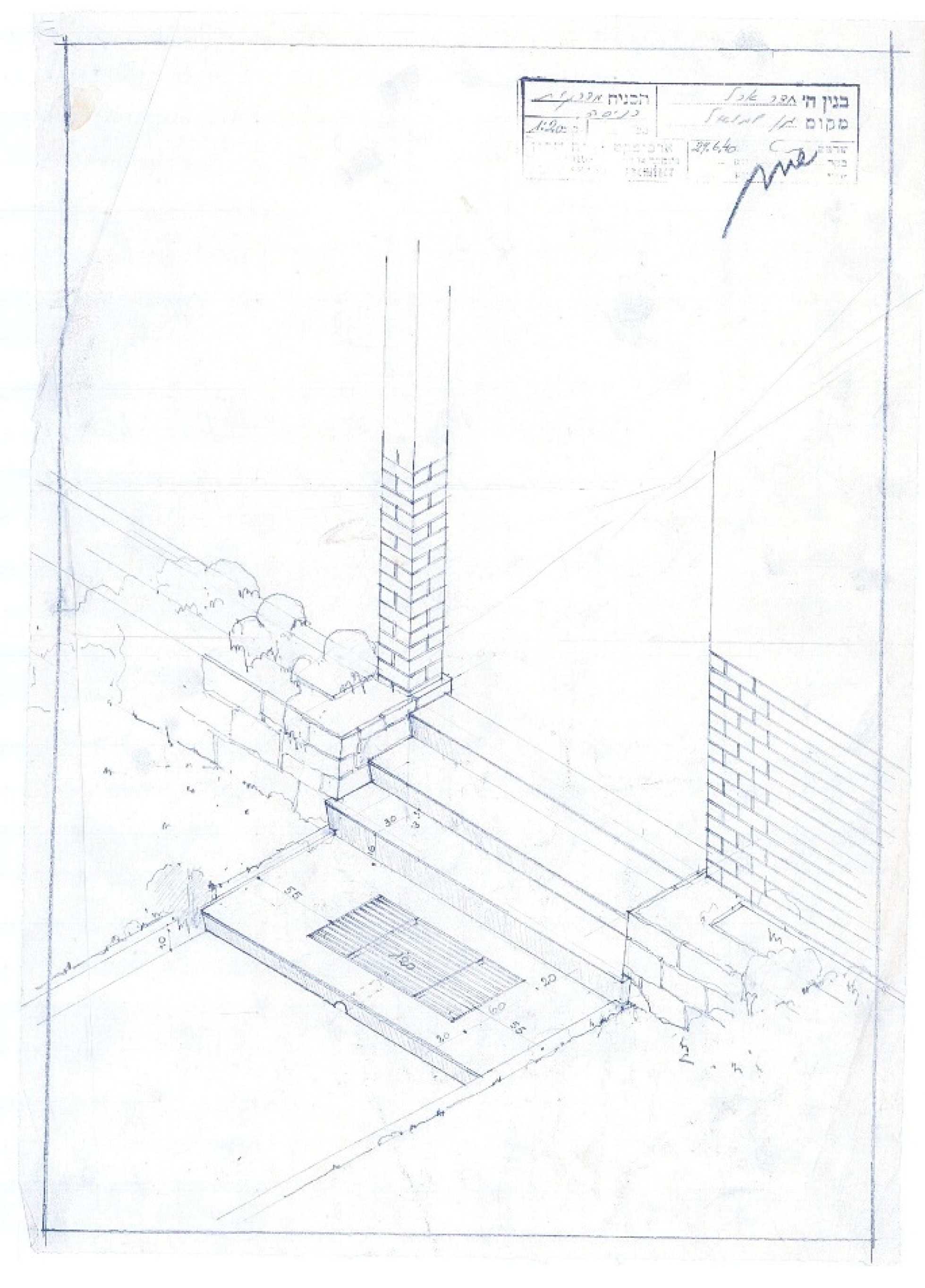
Figure 2.
Arieh and Eldar Sharon, fiberglass panels details: plan, section and axonometric view, 1:20/1:1, 12.1.72.
Figure 2.
Arieh and Eldar Sharon, fiberglass panels details: plan, section and axonometric view, 1:20/1:1, 12.1.72.
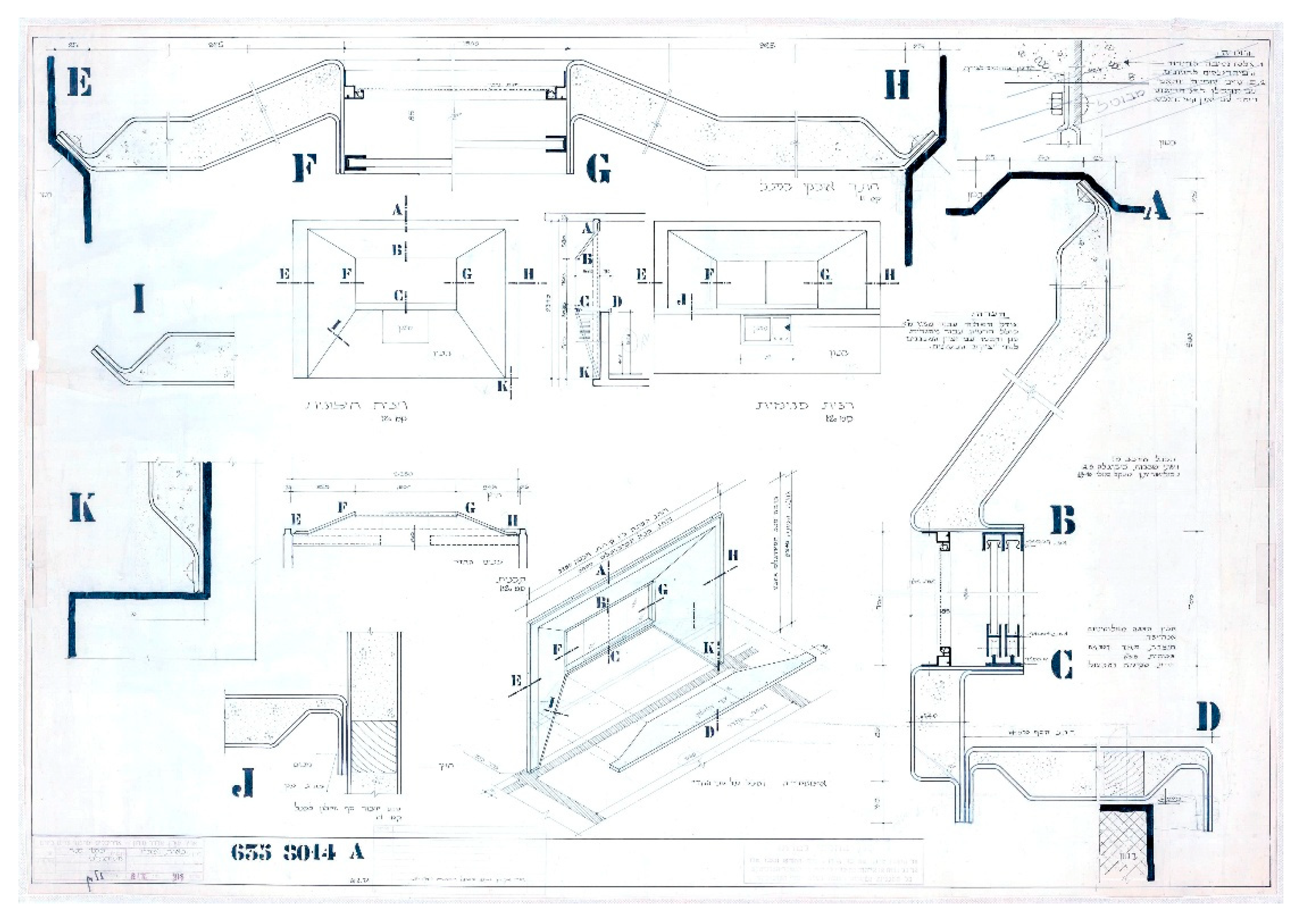
Figure 3.
Dov Karmi, mailbox detail: section and front view, 1:5/1:1 22.5.47.
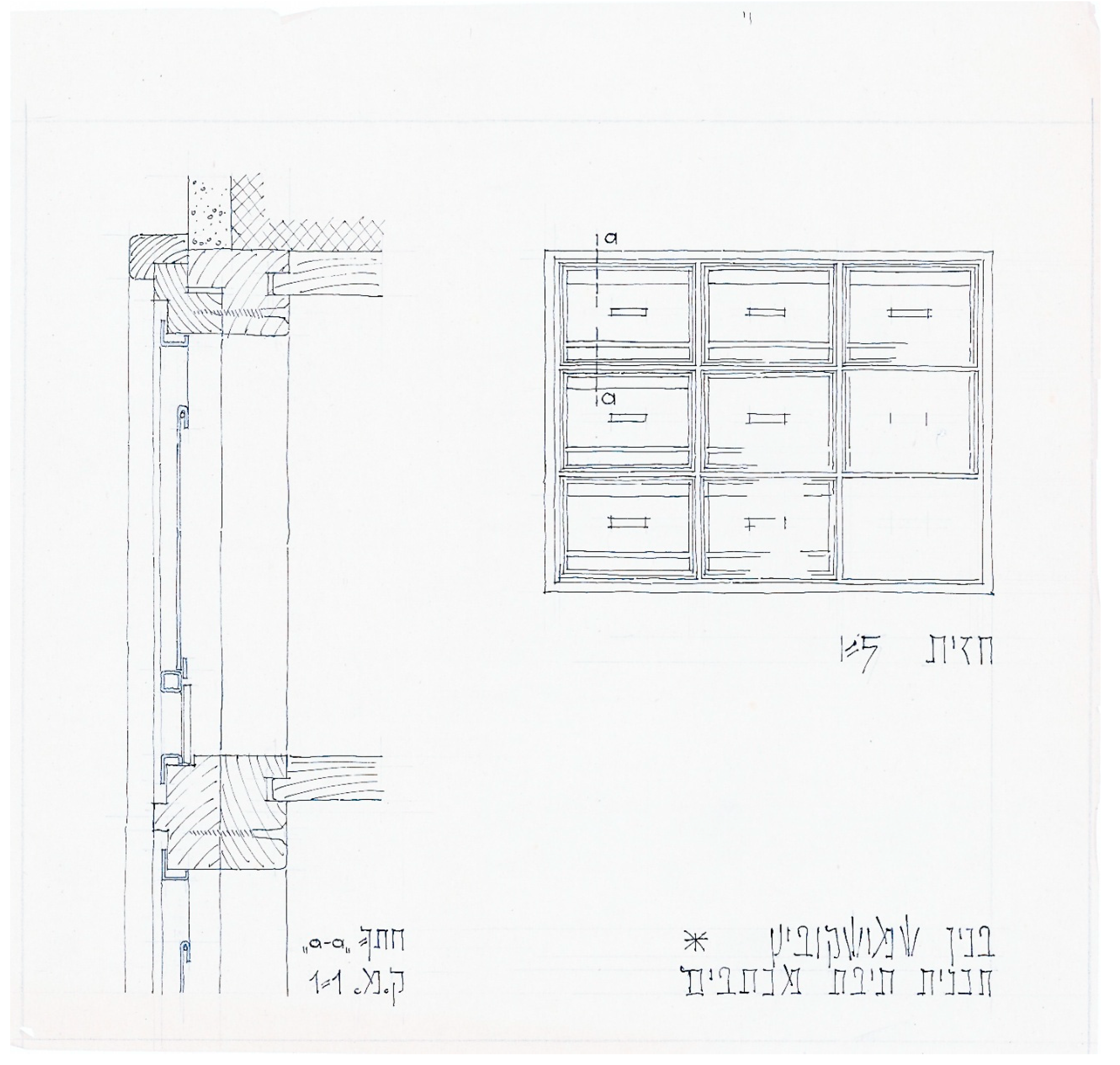
Figure 4.
Nahum Zolotov, glass wall and entrance door: plan and sections, 1:50/1:1, 26.12.76.
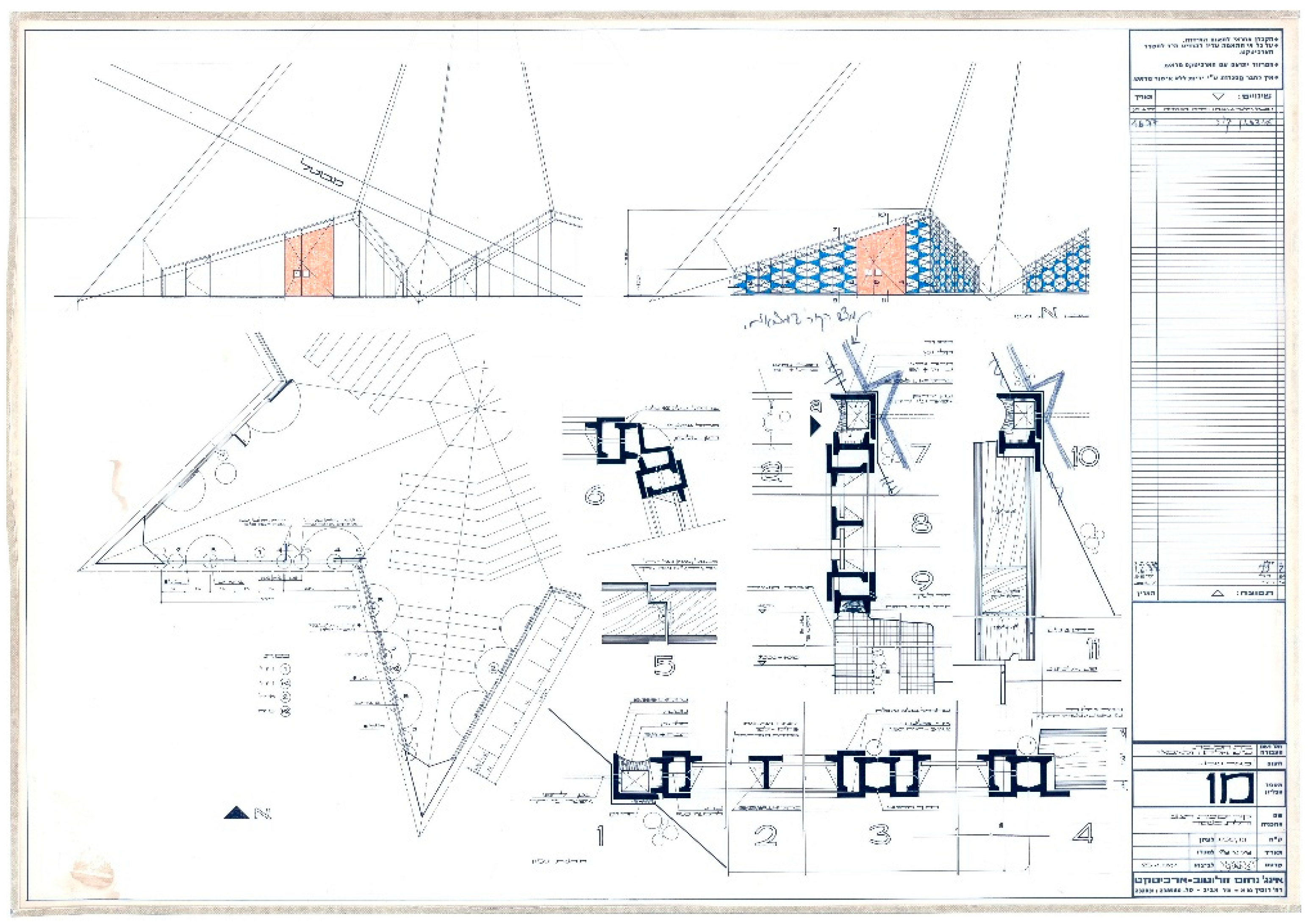
Figure 5.
Arieh and Eldar Sharon, window with aluminum shutter: section, plan and front view, 1:25/1:20, 28.5.68.
Figure 5.
Arieh and Eldar Sharon, window with aluminum shutter: section, plan and front view, 1:25/1:20, 28.5.68.

Figure 6.
Dov Karmi, spiral staircases: plan, section and axonometric view, 1:10/1:1, 25.6.59.
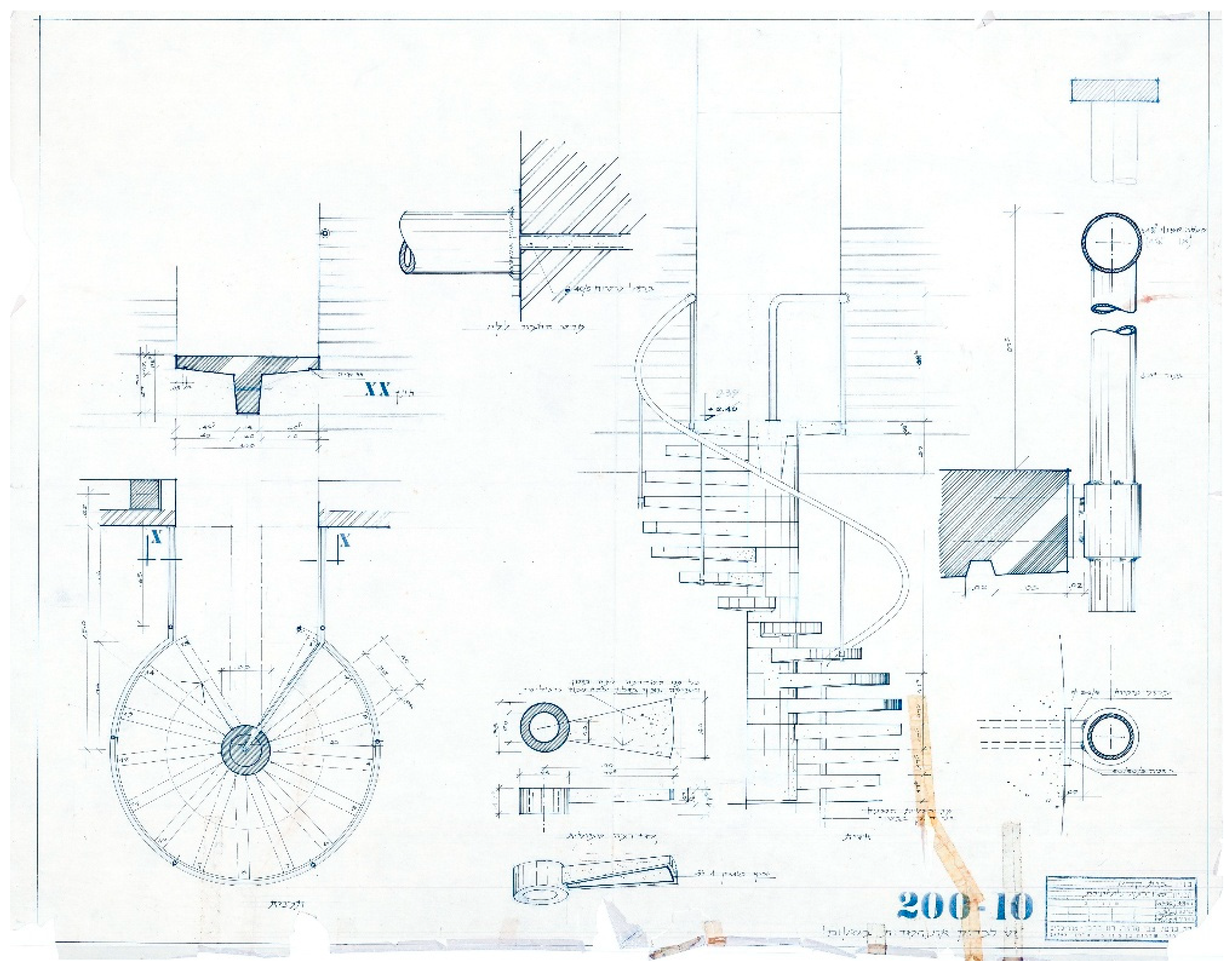
Figure 7.
Dov Karmi, window screen: section, front view and axonometric view, 1:20/1:2, 3.9.59.
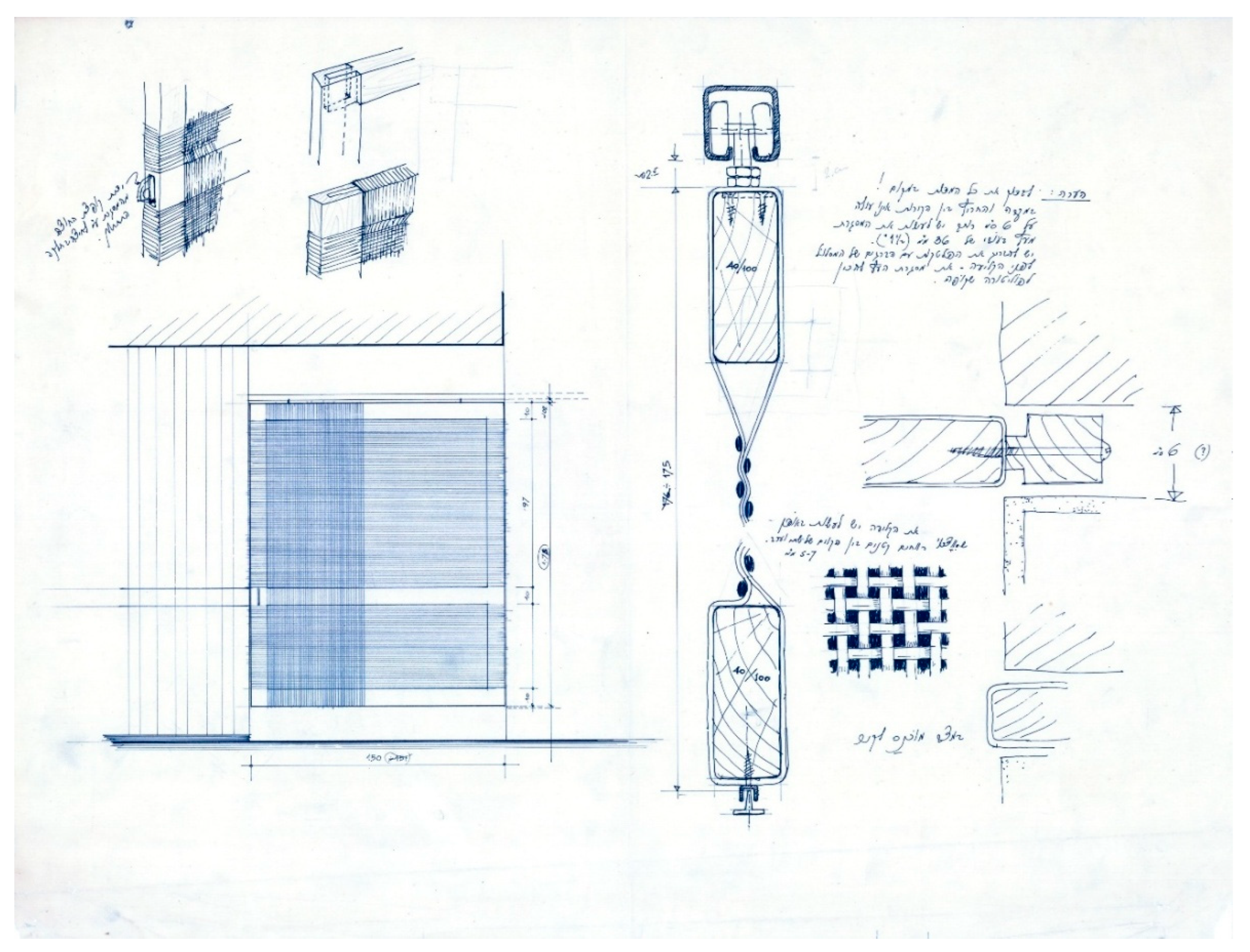
Figure 8.
Dov Karmi, doors and partitions: plan, section and view, 1:20/1:1, 15.1.61.
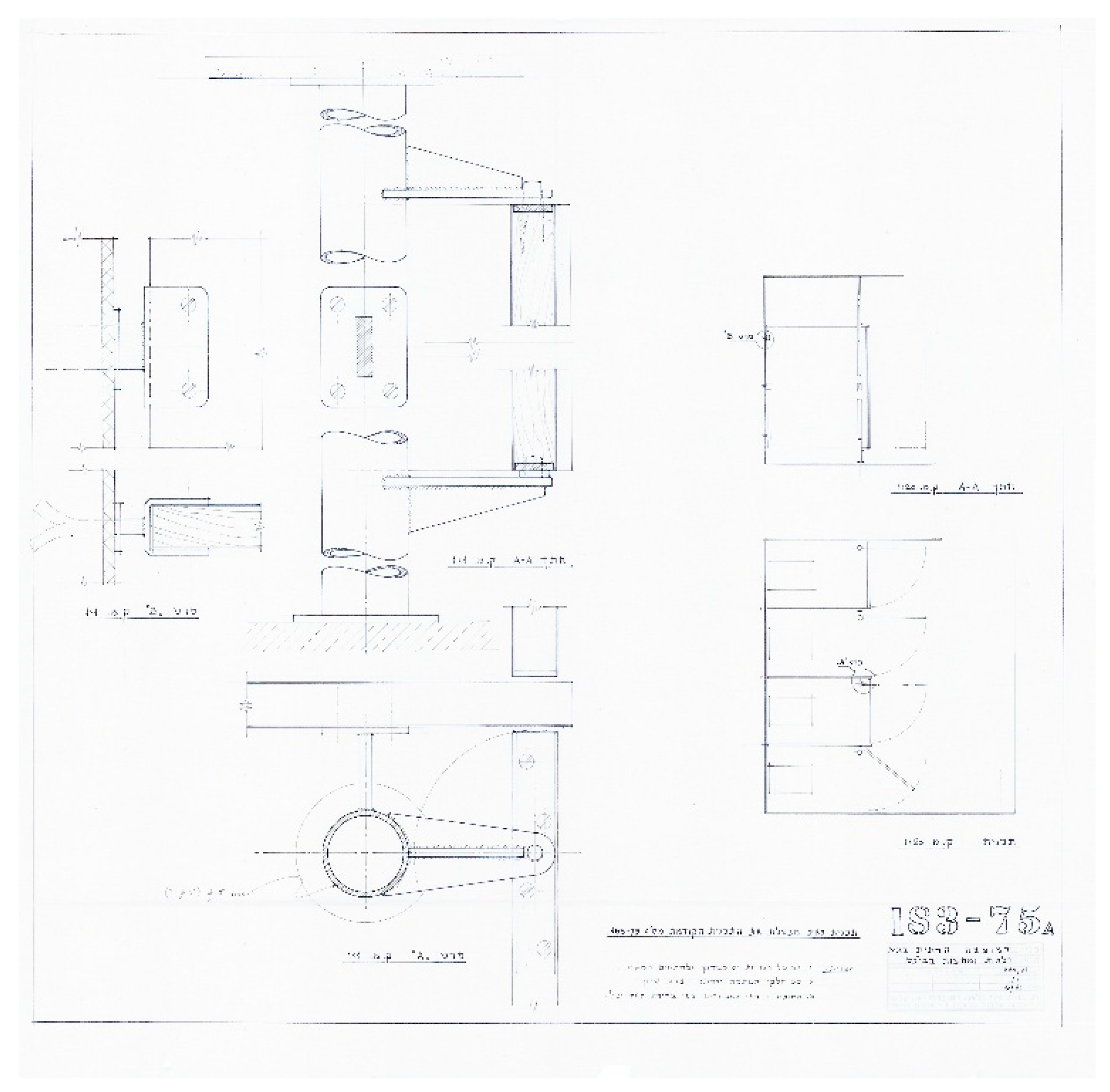
Figure 9.
Werner Joseph Witkover, handrails: plans and sections, 1:20/1:1, 19.7.85.
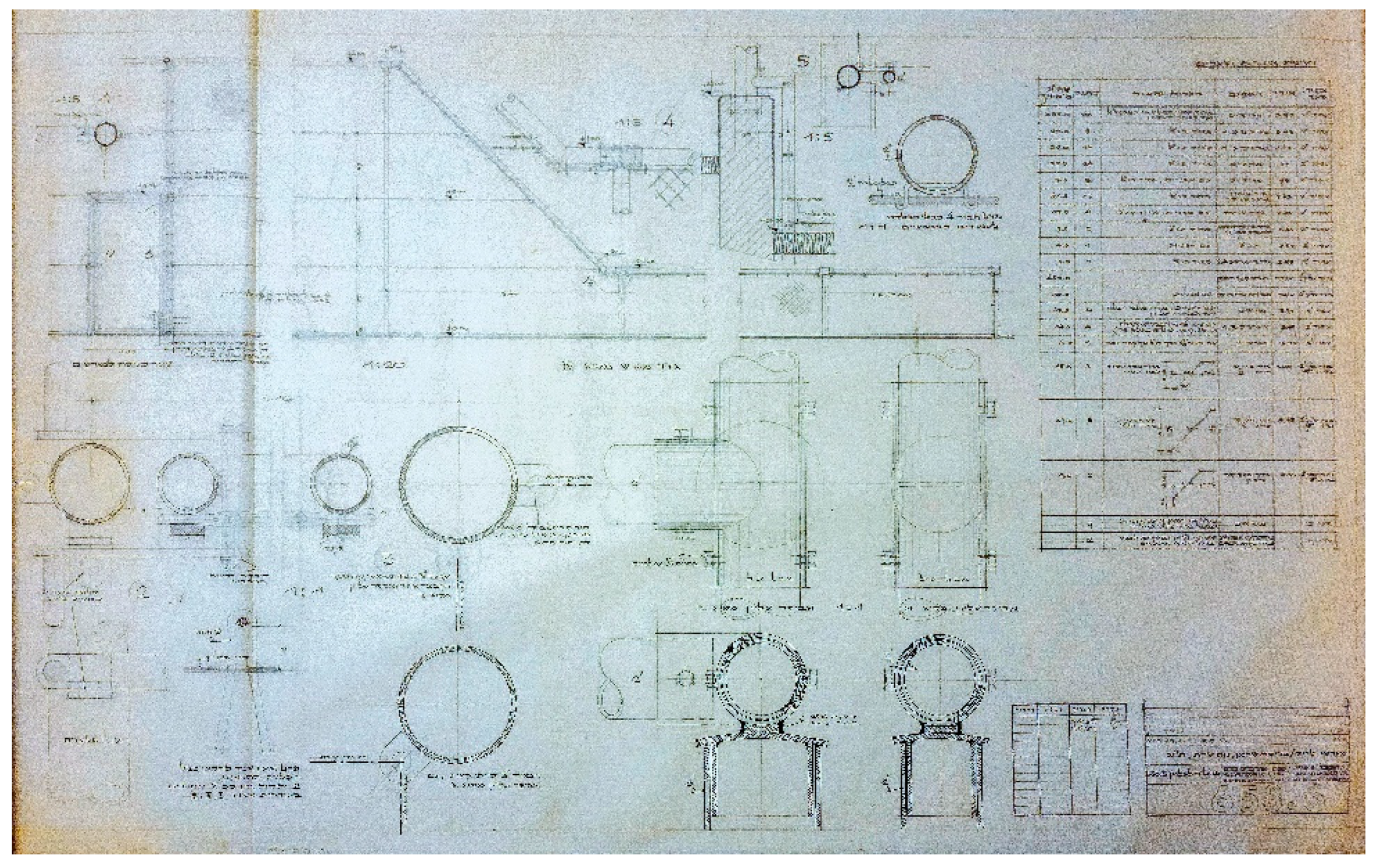
Figure 10.
Ram Karmi, Lady Davis school: Laboratories façade, photographer unknown, 1973.
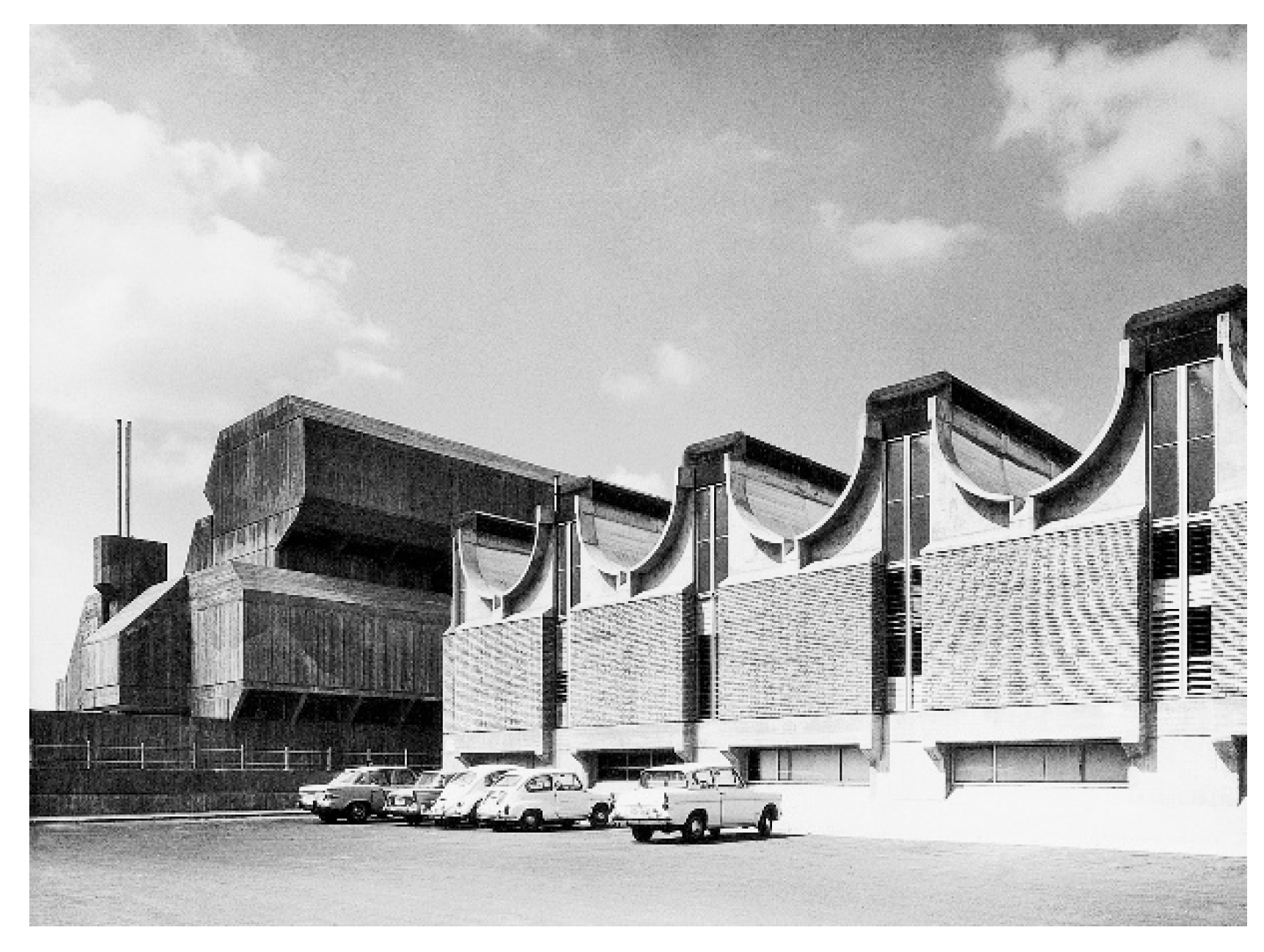
Figure 11.
Ram Karmi, Lady Davis school: view of the plaza, photographer unknown, 1973.
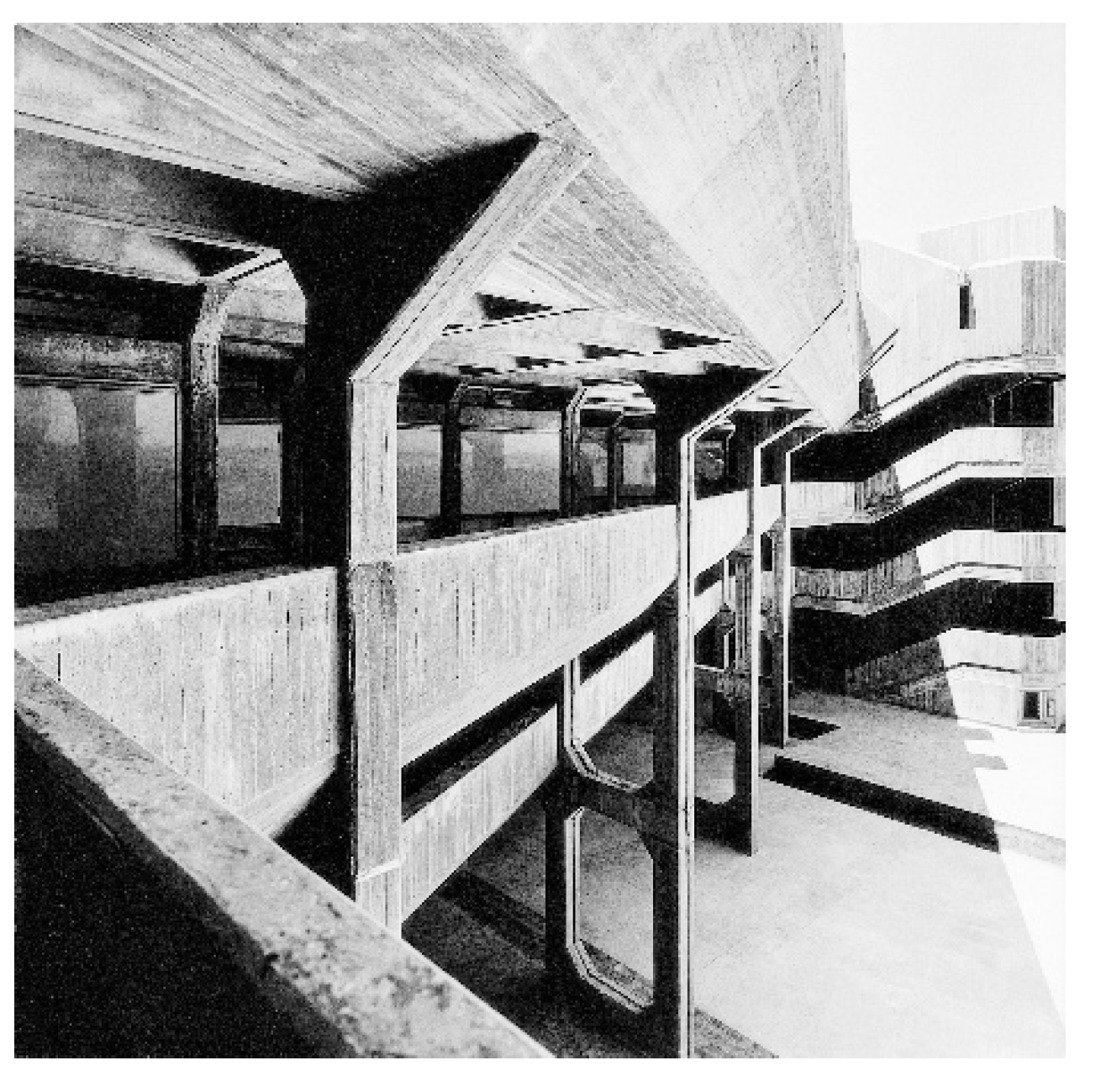
Figure 12.
Ram Karmi, Lady Davis school: classroom with the waffle slabs, photographer unknown, 1973.
Figure 12.
Ram Karmi, Lady Davis school: classroom with the waffle slabs, photographer unknown, 1973.
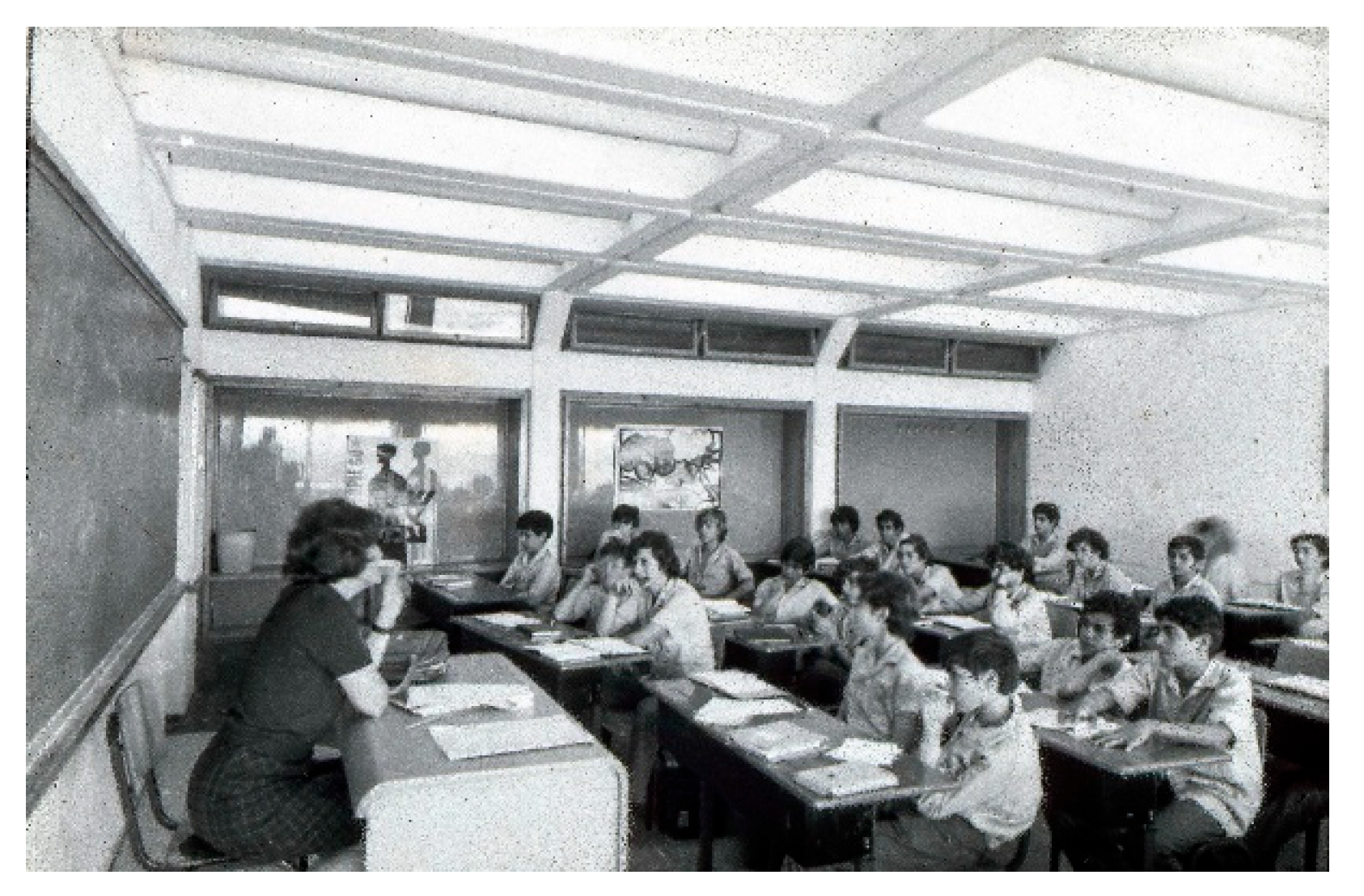
Figure 13.
Ram Karmi, Lady Davis school: fiberglass molding panels, 1:1, 1.12.68.
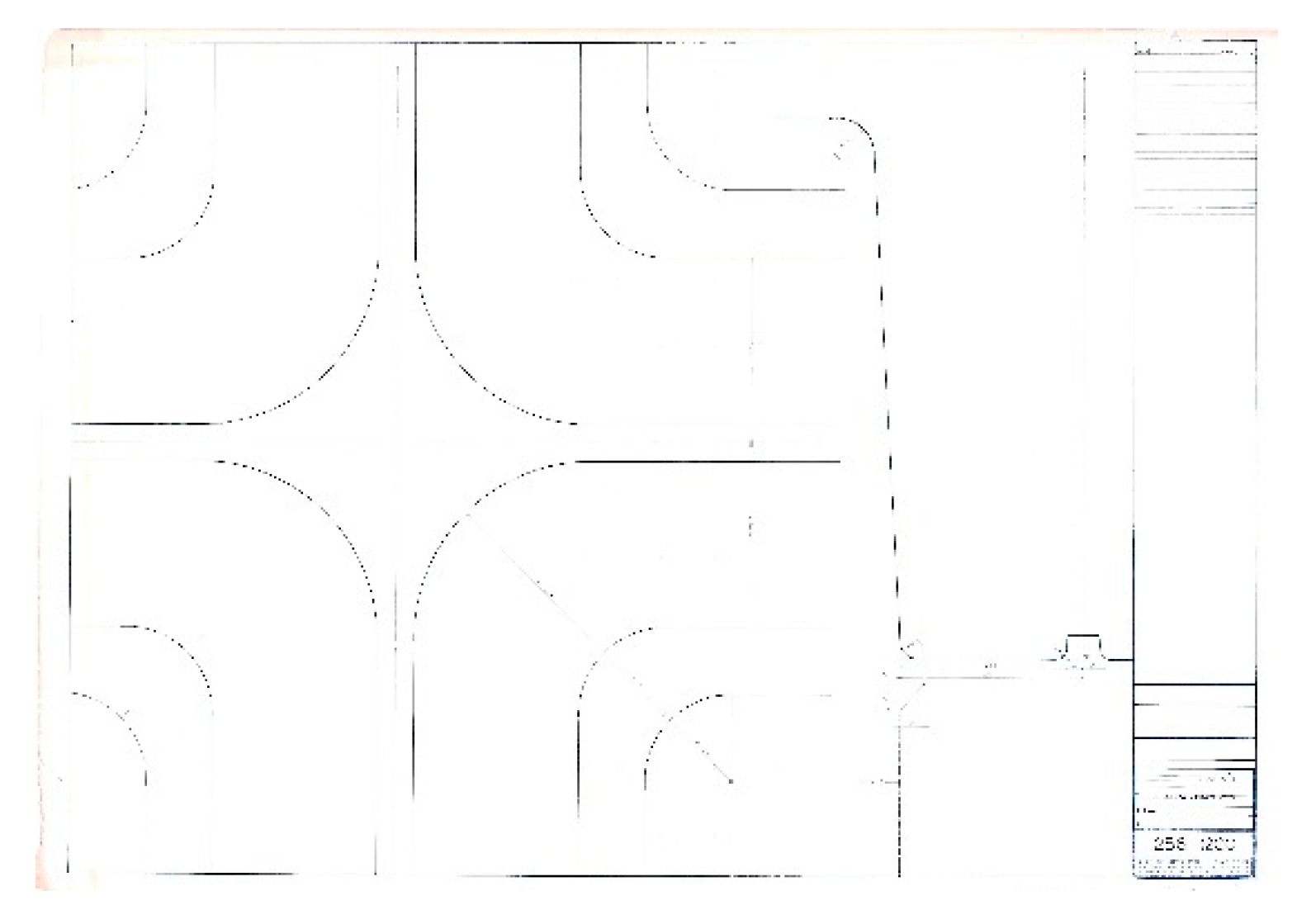
Figure 14.
Ram Karmi, Lady Davis school: laboratories inverted barrel vault. Photographer unknown, 1973.
Figure 14.
Ram Karmi, Lady Davis school: laboratories inverted barrel vault. Photographer unknown, 1973.
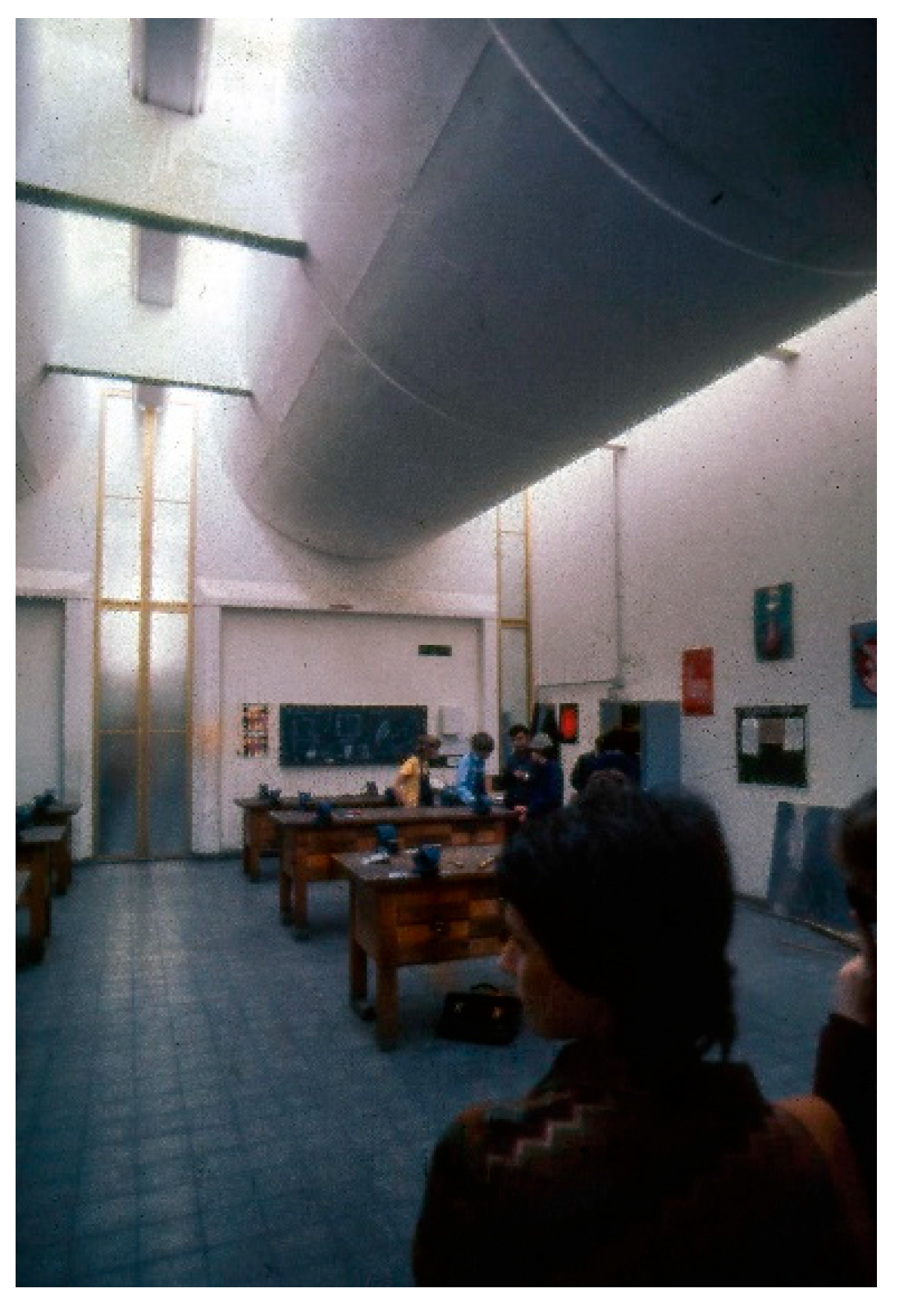
Figure 15.
Ram Karmi, Lady Davis school: laboratories inverted barrel vault: section, 1:20, 16.11.69.
Figure 15.
Ram Karmi, Lady Davis school: laboratories inverted barrel vault: section, 1:20, 16.11.69.
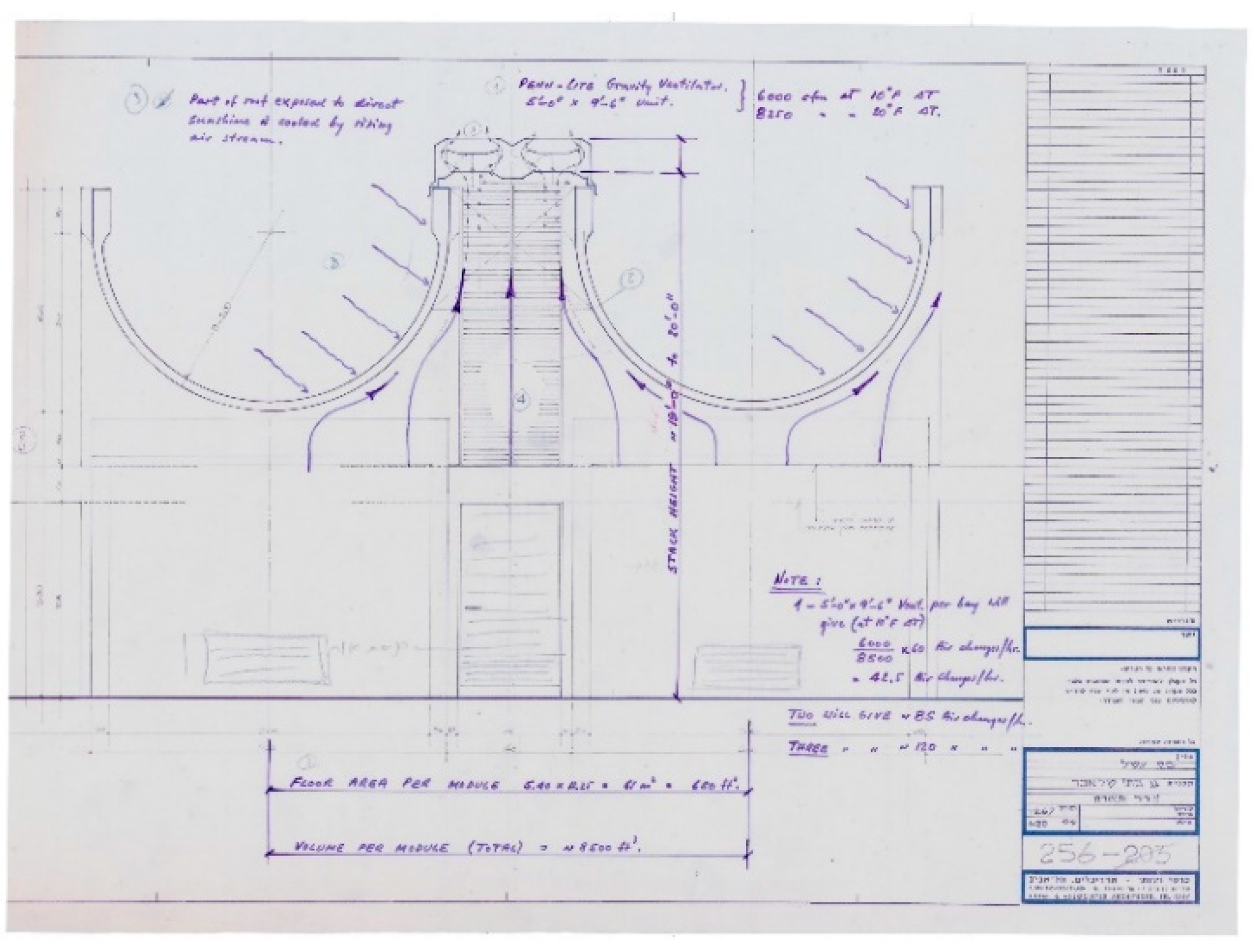
Figure 16.
Ram Karmi, Lady Davis school: eastern entrance portal, 1:50, 31.5.71.
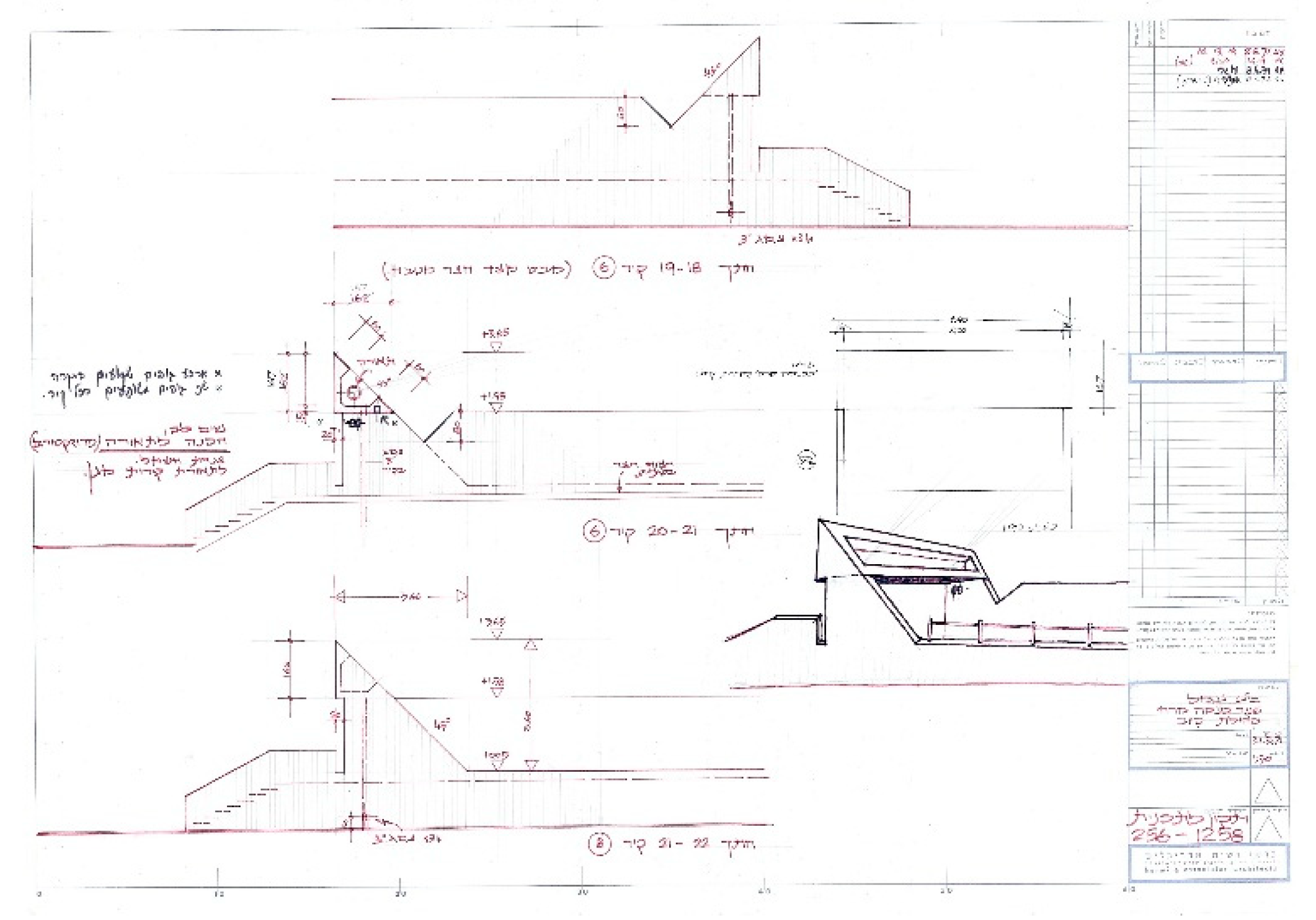
Figure 17.
Arieh and Eldar Sharon, prefabricated fiberglass living unit: plans and sections, 1:5/1:1, 1970s.
Figure 17.
Arieh and Eldar Sharon, prefabricated fiberglass living unit: plans and sections, 1:5/1:1, 1970s.
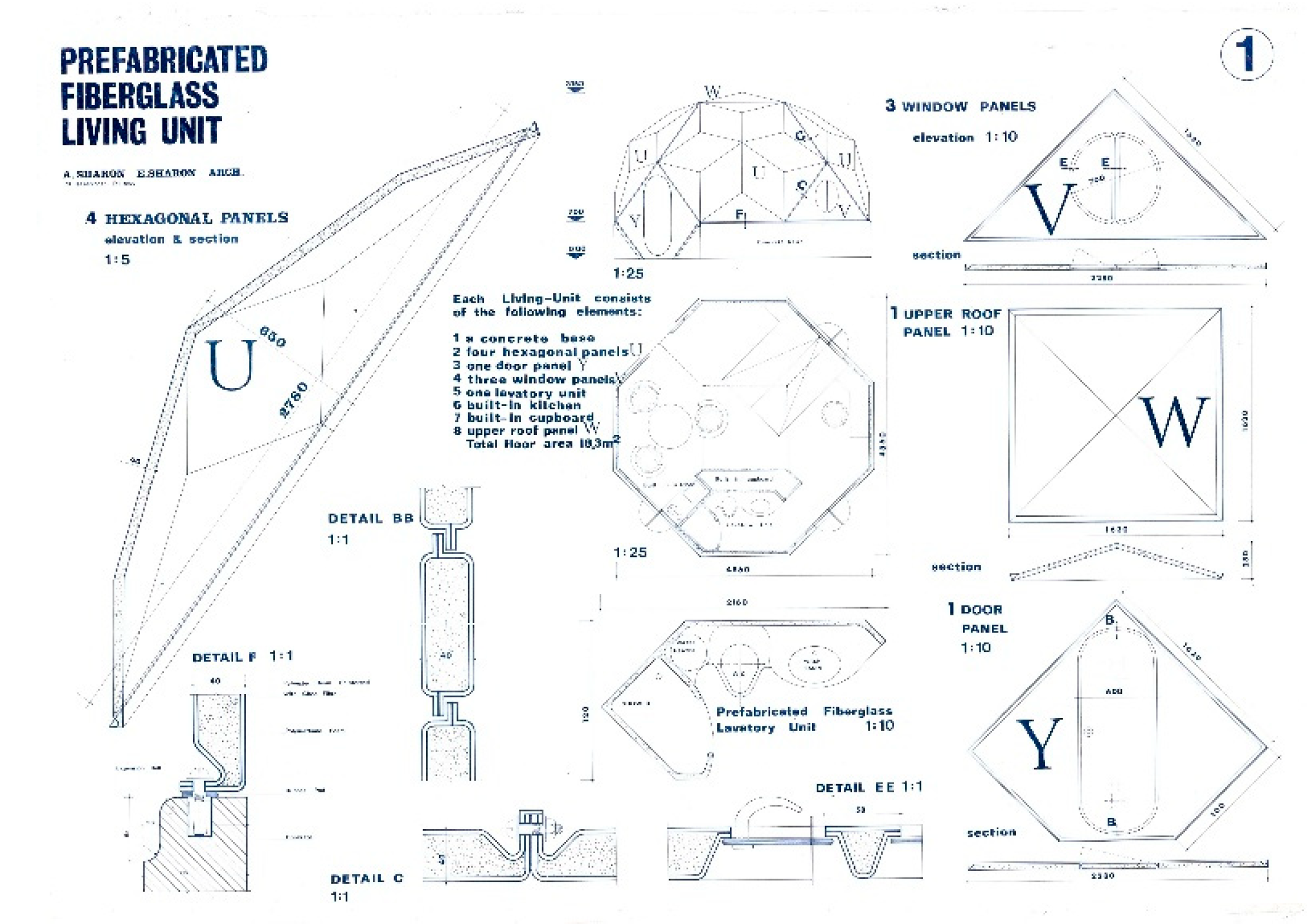
Figure 18.
Arieh and Eldar Sharon, Sackler faculty: shading detail on facades, Paul Gross, 1975.
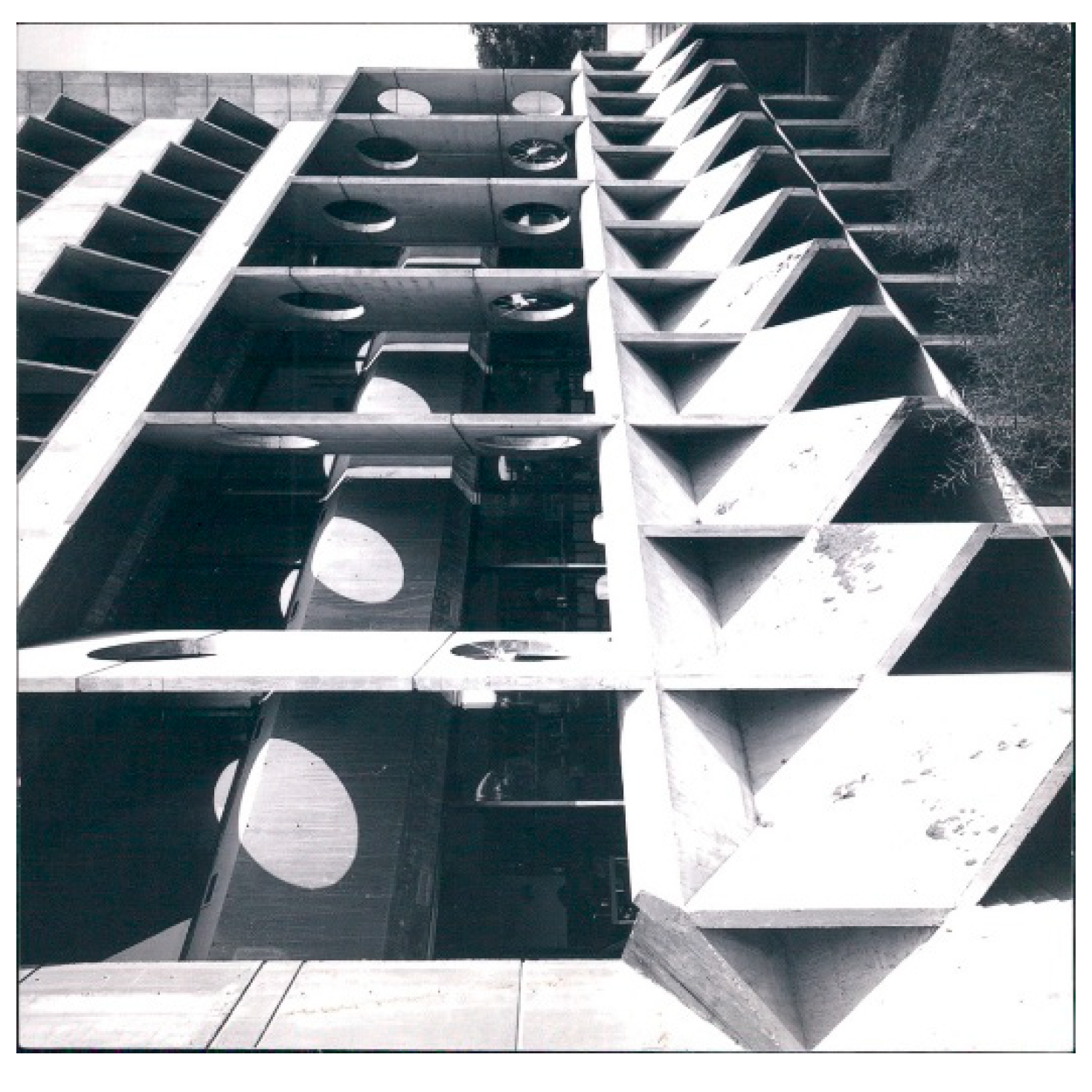
Figure 19.
Arieh and Eldar Sharon, Beit America-Israel: Shading detail, photo: Ran Erde, 1975.
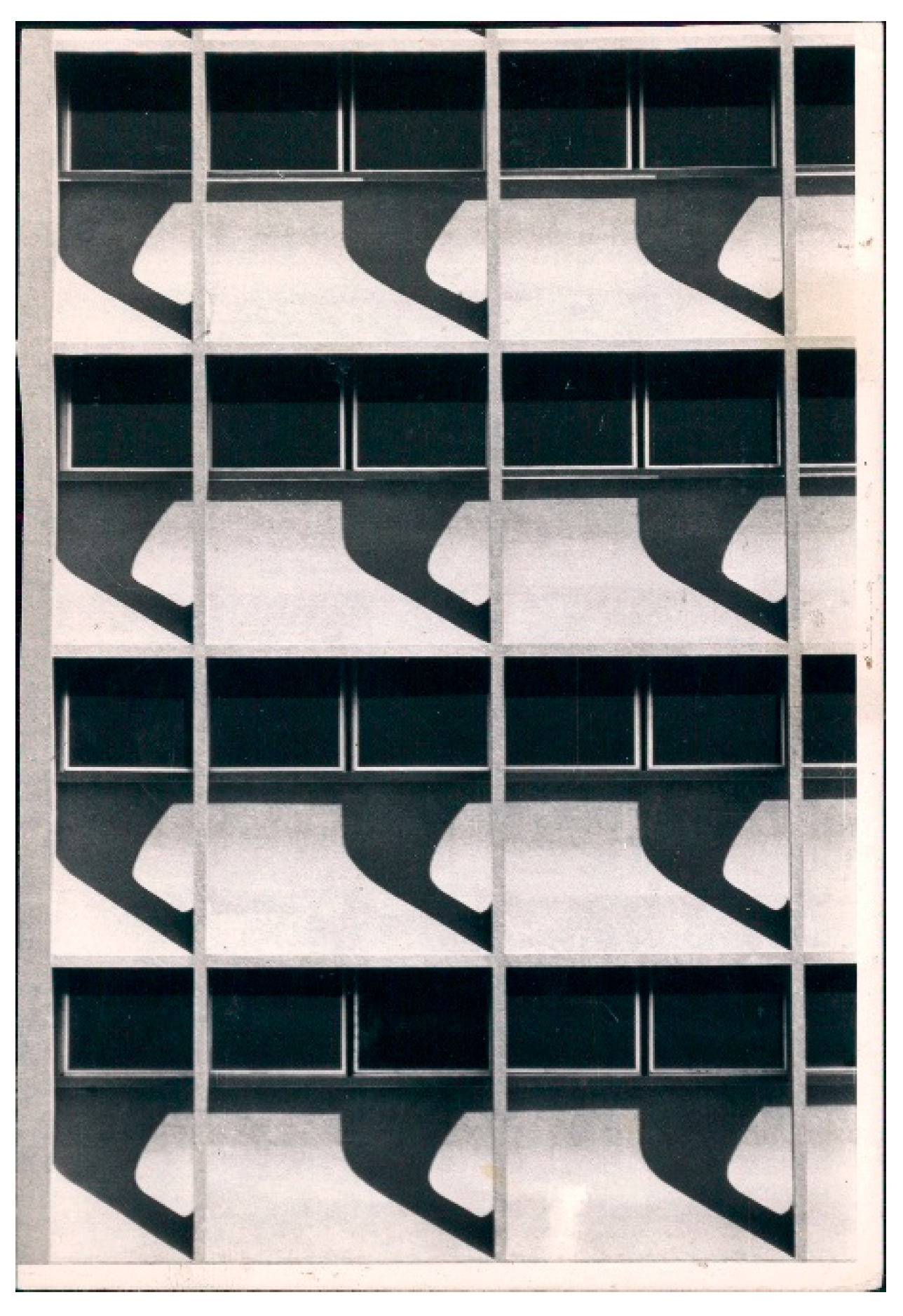
Figure 20.
Arieh and Eldar Sharon, Beit America-Israel: Shading detail section and front view, 1:10, 21.6.67.
Figure 20.
Arieh and Eldar Sharon, Beit America-Israel: Shading detail section and front view, 1:10, 21.6.67.
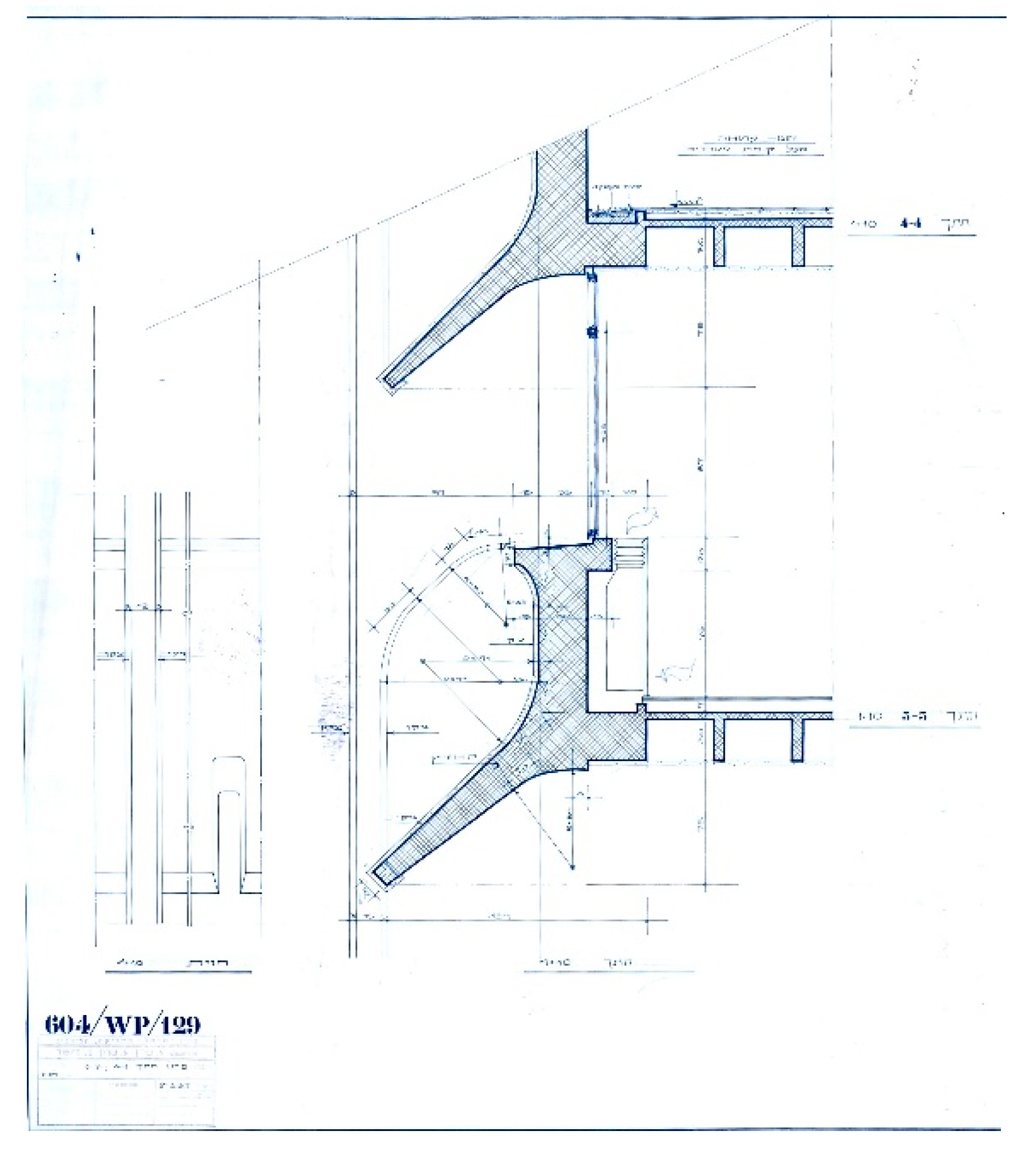
Figure 21.
Arieh and Eldar Sharon, Sackler faculty: main façade details: section and elevation, 1:20, 4.8.68.
Figure 21.
Arieh and Eldar Sharon, Sackler faculty: main façade details: section and elevation, 1:20, 4.8.68.
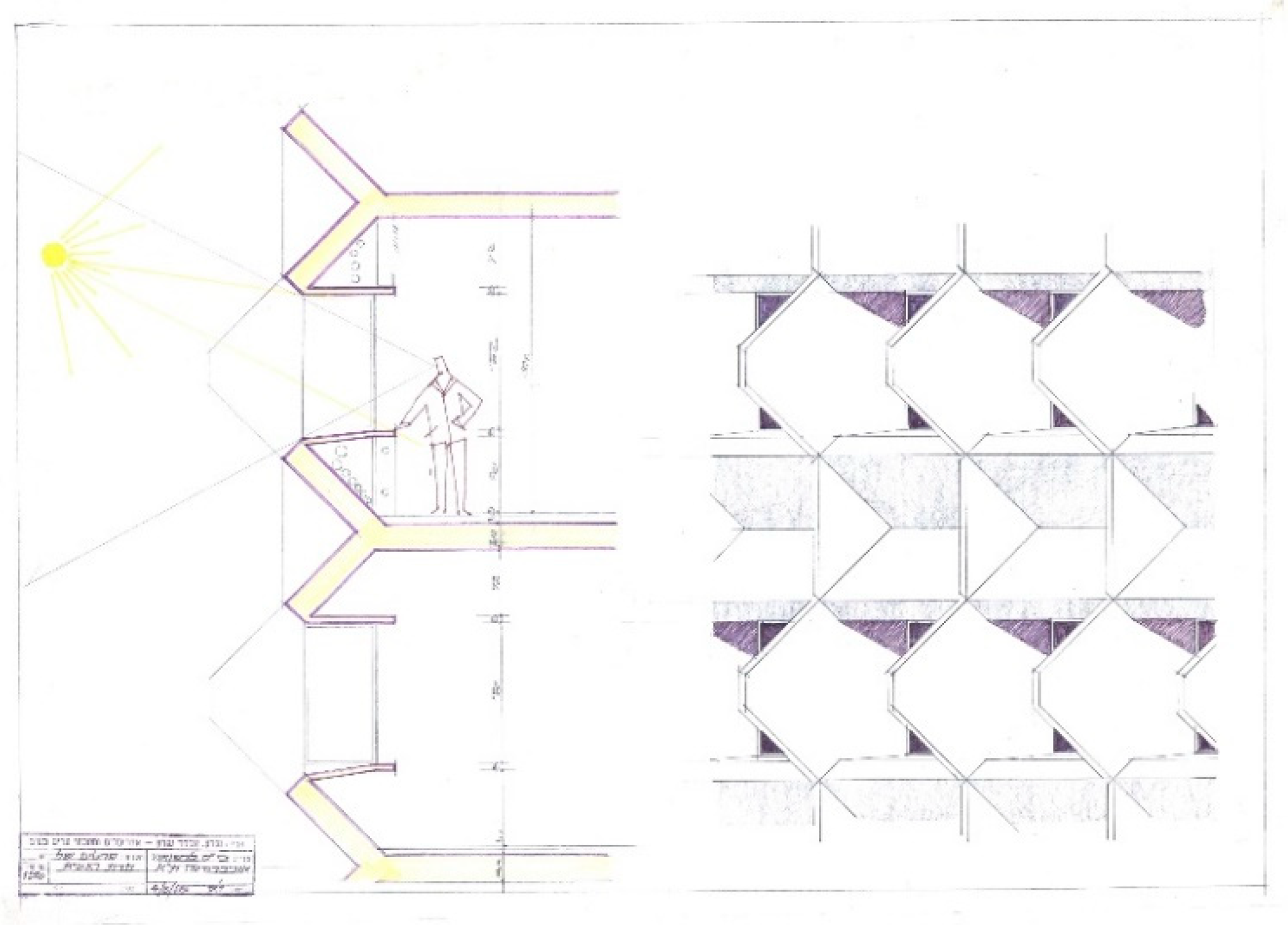
Figure 22.
Arieh Sharon, wooden chair detail: plan, sections and axonometric view, 1:10/1:5, 5.10.52.
Figure 22.
Arieh Sharon, wooden chair detail: plan, sections and axonometric view, 1:10/1:5, 5.10.52.
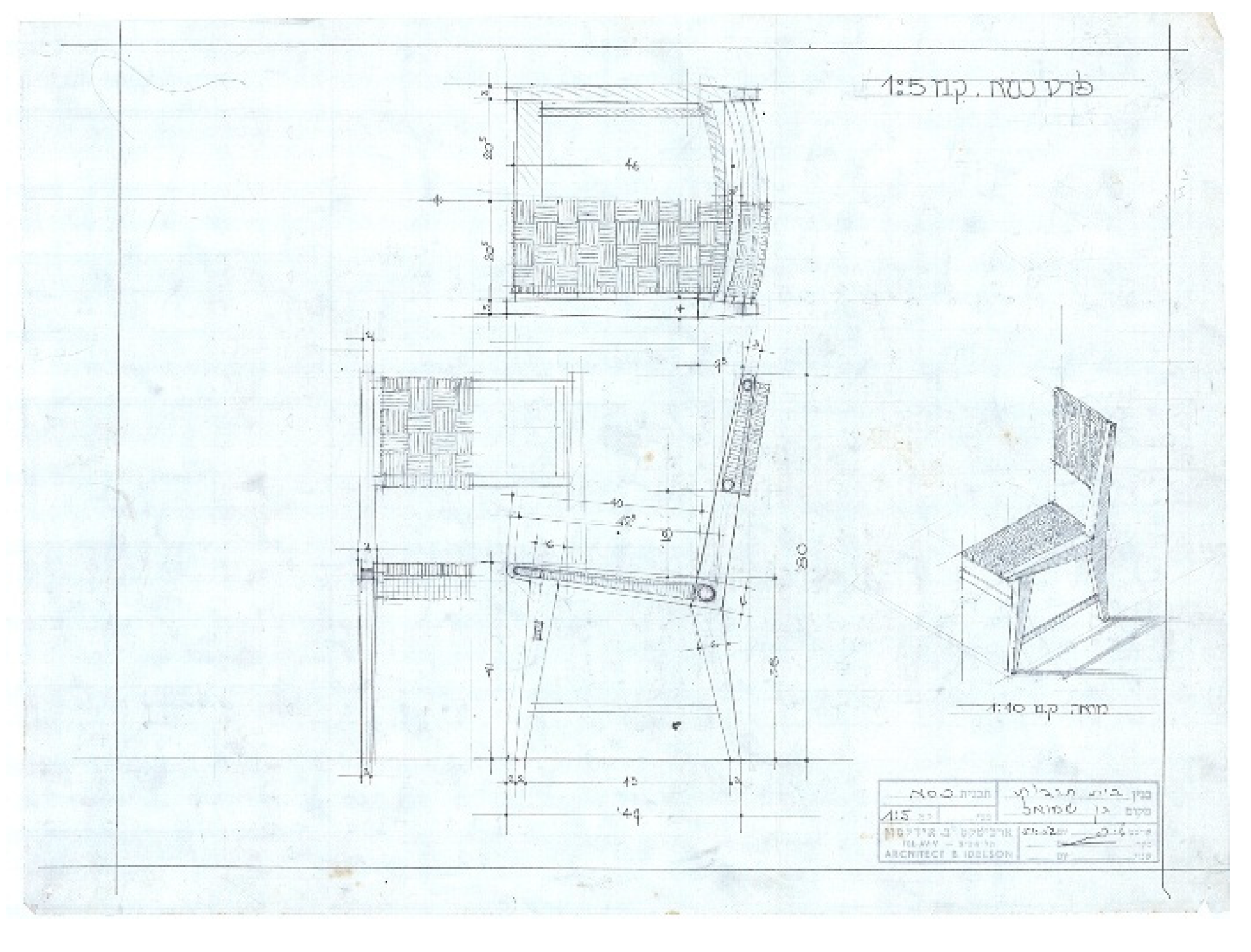
Figure 23.
Arieh and Eldar Sharon, Beit America-Israel: information desk: plan, sections and elevations, 1:20/1:10/1:1, 24.9.70.
Figure 23.
Arieh and Eldar Sharon, Beit America-Israel: information desk: plan, sections and elevations, 1:20/1:10/1:1, 24.9.70.
Disclaimer/Publisher’s Note: The statements, opinions and data contained in all publications are solely those of the individual author(s) and contributor(s) and not of MDPI and/or the editor(s). MDPI and/or the editor(s) disclaim responsibility for any injury to people or property resulting from any ideas, methods, instructions or products referred to in the content. |
© 2026 by the authors. Licensee MDPI, Basel, Switzerland. This article is an open access article distributed under the terms and conditions of the Creative Commons Attribution (CC BY) license (http://creativecommons.org/licenses/by/4.0/).
Copyright: This open access article is published under a Creative Commons CC BY 4.0 license, which permit the free download, distribution, and reuse, provided that the author and preprint are cited in any reuse.


