

Submitted:
25 February 2026
Posted:
26 February 2026
You are already at the latest version
Abstract
Zeolitic imidazolate framework-8 (ZIF-8) is one of the most extensively studied metal–organic frameworks due to its high surface area, tunable porosity, chemical stability, and intrinsic antimicrobial activity. Recent research has focused on engineering ZIF-8 through metal doping and surface functionalization to enhance its physicochemical performance and expand its applications in food safety and environmental systems. Metal-doped ZIF-8 incorporating Cu2+, Fe2+/Fe3+, Ag+, or Mn2+ improves reactive oxygen species generation, enables controlled metal-ion release, and promotes synergistic bactericidal mechanisms against both Gram-positive and Gram-negative pathogens. In parallel, surface modification using biopolymers such as hyaluronic acid, chitosan, alginate, and polyethylene glycol enhances colloidal stability, reduces cytotoxicity, modulates surface charge, and improves adhesion to food-contact surfaces. These combined strategies enable the development of multifunctional nanoplatforms with sustained antimicrobial activity, improved aqueous dispersibility, and compatibility with food packaging, sanitizers, and water treatment systems. This review summarizes recent advances in synthesis strategies, structure–property relationships, antimicrobial and antibiofilm mechanisms, and environmental safety considerations. Key challenges, including scalability, regulatory acceptance, stability, and long-term ecotoxicological impact, are discussed, along with perspectives on stimuli-responsive systems, essential oil encapsulation, and smart antimicrobial coatings.
Keywords:
ZIF-8
; antimicrobial
; antibiofilm
; encapsulation
; environment
; food contact
; food safety
; metal-doped
; surface-functionalized
1. Introduction
Ensuring microbiological safety in food and water is a global public health priority. Foodborne pathogens cause an estimated 600 million illnesses and 420,000 deaths worldwide each year, with young children disproportionately affected [1]. Inadequate sanitation and unsafe water similarly contribute to hundreds of thousands of preventable deaths annually [2]. These sobering figures underscore the urgent need for improved antimicrobial strategies in food safety management and water treatment systems. Traditional interventions, from chemical disinfectants (e.g., chlorinated washes) to antibiotic preservatives, have significant limitations, including the emergence of antibiotic-resistant microorganisms, formation of unwanted chemical residues, and ineffectiveness against resilient biofilms [3,4]. Consequently, researchers are exploring novel nanotechnologies and materials-based approaches to create active food packaging, self-sanitizing contact surfaces, and water disinfection platforms that can more reliably control pathogenic bacteria [5]. Metal–organic frameworks (MOFs) have rapidly emerged as a promising class of such advanced antimicrobial materials [6].
MOFs are crystalline porous networks of metal ions coordinated to organic ligands, renowned for their high surface areas, tunable pore structures, and chemical versatility [7,8]. These attributes enable MOFs to behave as nano-reservoirs for antimicrobial agents, offering controlled release kinetics and large payload capacities [4]. In contrast to conventional inorganic nanoparticles, MOFs can be engineered to gradually liberate metal ions or bioactive molecules upon framework degradation, maintaining antimicrobial concentrations over extended periods while mitigating acute toxicity [9,10]. Moreover, MOFs’ modular chemistry allows incorporation of bio-friendly metals and ligands to improve biocompatibility [11]. These advantages have spurred intense interest in MOF-based antimicrobials for applications ranging from active food packaging films to water disinfection systems [12,13]. Notably, several zinc-based MOFs have inherent antibacterial activity due to the well-known bactericidal properties of Zn2+ ions [14]. Among these, the zeolitic imidazolate framework-8 (ZIF-8) has become a focal point in food and environmental research, owing to its unique combination of stability and antimicrobial potential [15].
ZIF-8 is a zinc-based MOF comprising Zn2+ nodes bridged by 2-methylimidazole linkers, forming a sodalite-type porous lattice. Several features make ZIF-8 especially attractive for antimicrobial applications in food and water contexts. First, it exhibits excellent thermal and pH stability in neutral environments, and can be synthesized in aqueous or mild conditions, facilitating its integration into edible films and coatings [16]. Second, ZIF-8’s nanoporous structure (pore aperture ~11.6 Å) and high surface area allow it to encapsulate and later release bioactive cargo, or to slowly leach Zn2+ into surrounding media [17]. Zinc ions are essential micronutrients but also possess broad-spectrum antimicrobial effects by disrupting microbial enzyme systems and membranes; the controlled release of Zn2+ from ZIF-8 can inhibit bacteria while remaining at safe levels for humans [18]. Indeed, recent studies confirm that ZIF-8 itself can substantially reduce bacterial populations. For example, ZIF-8 nanoparticles showed stronger antibacterial activity than equivalent zinc oxide (ZnO) nanoparticles, attributed to the sustained, gradual ion release from the MOF matrix [19]. ZIF-8 has demonstrated efficacy against both Gram-negative and Gram-positive foodborne bacteria, especially under illumination where it can generate reactive oxygen species (ROS) in situ [20,21]. In one study, a petal-like ZIF-8 nanostructure achieved >95% inactivation of Staphylococcus aureus by releasing Zn-based active species, outperforming conventional ZIF-8 and highlighting the framework’s intrinsic antimicrobial potential [22]. Crucially, ZIF-8 is generally recognized as safe (GRAS) components (zinc and an edible imidazole derivative) and has shown low mammalian toxicity and good biocompatibility in various tests [23]. These merits position ZIF-8 as a powerful and relatively safe antimicrobial platform, suitable for contact with food or water. However, there remains ample scope to enhance ZIF-8’s performance through chemical modifications, notably metal doping and surface functionalization, to fully meet practical requirements in complex food and environmental systems.
Metal-doping of ZIF-8 has recently garnered significant attention as a strategy to amplify its antimicrobial efficacy. Figure 1 illustrates the schematic of metal-doped and surface-functionalized ZIF-8 nanoplatforms demonstrating structural engineering strategies, synergistic antimicrobial mechanisms (ROS generation, ion release, and biofilm inhibition), and their applications in food-contact surfaces and environmental systems.
By introducing additional metal ions or nanoparticles into the ZIF-8 structure (either by partial substitution of Zn2+ nodes or by encapsulation within pores), researchers aim to harness the well-known antimicrobial properties of metals like copper, silver, and iron in tandem with zinc. Copper-doped ZIF-8 is particularly promising due to copper’s dual functionality, with Cu2+ ions can directly damage bacterial cells and catalyze ROS generation (via Fenton-like reactions) to achieve oxidative killing [24]. In a recent food safety study, Cu-doped ZIF-8 nanoparticles (with ~30% Cu substitution) achieved a 3-log CFU reduction of Salmonella on lettuce in 2 minutes, outperforming the conventional 200 ppm chlorine wash and even outdoing undoped ZIF-8 of equal dose. This dramatic improvement is attributed to the synergistic antibacterial action of released Cu2+ and Zn2+ ions, along with the MOF’s prolonged release profile [25]. Silver incorporation into ZIF-8 is another effective approach, leveraging Ag’s potent biocidal effect. For instance, researchers prepared Ag@ZIF-8 core–shell nanowires and observed superior antibacterial activity compared to either ZIF-8 or Ag alone, due to the slow and continuous release of Ag+ ions from the ZIF-8 coating that prevented silver aggregation and maintained antimicrobial concentrations [26]. Likewise, a bimetallic Ag–Cu modified ZIF-8 was shown to completely inhibit E. coli and S. aureus growth at remarkably low concentrations, demonstrating broad-spectrum efficacy [27]. Iron-doping of ZIF-8 has also been explored, with the rationale of promoting Fenton chemistry (in the presence of peroxides) and generating oxidative stress inside bacterial cells. [28] reported that a nano ZIF-8 framework incorporating Fe clusters (Fe-ZIF-8) could encapsulate and release natural antimicrobials (citral) with improved activity against multidrug-resistant E. coli and Salmonella, while maintaining low hemolytic toxicity. In general, metal-doped ZIF-8 variants tend to exhibit enhanced bactericidal action through multimodal mechanisms, combining Zn2+ release with added metal ion toxicity, catalytic ROS production, or photocatalytic effects, thereby, overcoming some pathogens’ defenses and achieving faster or more complete disinfection [25,26]. These doped nanoplatforms hold great promise for active antimicrobial packaging (e.g., CuO@ZIF-8 films that prolong fruit shelf-life by suppressing spoilage microbes) and for water treatment systems (e.g., MnO2@ZIF-8 composites that fully inactivate E. coli under solar light) where high efficacy is required under real-use conditions [13,29].
2. Synthesis Strategies and Structural Characteristics of Metal-Doped ZIF-8
Metal doping of ZIF-8 involves incorporating secondary metal ions into the Zn-based ZIF-8 framework or composite, aiming to tune properties like porosity, stability, and antimicrobial functionality [30]. Recent studies have explored a variety of synthesis strategies for metal-doped ZIF-8, including one-pot bimetallic synthesis, post-synthetic ion exchange or impregnation, and core–shell growth of ZIF-8 on metal substrates [31]. These approaches influence the structural characteristics of ZIF-8, such as crystal phase, particle morphology, surface area, and the distribution of dopant ions. This section discusses how different metal-doping strategies are implemented and how they alter ZIF-8’s structure and properties, laying out the groundwork for enhanced antimicrobial performance.
2.1. One-Pot Synthesis of Bimetallic ZIF-8 (In-Situ Doping)
One common route to metal-doped ZIF-8 is one-pot co-precipitation, where a secondary metal salt is added alongside Zn(II) during ZIF-8 crystallization. By adjusting the Zn:metal ratio in precursor solutions, researchers have synthesized bimetallic ZIF-8 with metals such as Co, Cu, Fe, Ni, and Ag integrated into the framework. For example, Vatani et al. (2024) prepared Zn/Co bimetallic ZIF-8 by room-temperature mixing of Zn2+ and Co2+ salts in various ratios, obtaining sodalite-type ZIF crystals containing both metals. Such in situ Co-doping allowed tuning of pore size and surface area, as inserting Co2+ increased the BET surface area and created additional pore volume [32]. Notably, even moderate Co substitution (e.g., Co:Zn = 1:9 to 1:3) can significantly modify optical properties, with Co-doped ZIF-8 exhibited a new visible-light absorption band and a reduced bandgap approaching that of pure Co-ZIF-67 [32]. These changes arise from Co2+ ions contributing electronic states that narrow the MOF’s bandgap, a beneficial trait for photocatalytic and light-activated antimicrobial applications. Similarly, Li et al. (2023) prepared a series of ZIF-8 doped with M = Co2+, Ni2+, or Cu2+ at doping levels from 1% up to 100% (complete substitution) and found that even 5% Co doping markedly enhanced light harvesting and charge separation in the MOF [33]. In that study, 5% Co–ZIF-8 achieved the highest E. coli kill under simulated sunlight, outperforming undoped ZIF-8, due to the synergistic photothermal and photocatalytic effects of Co sites. Figure 2 expresses the schematic overview of synthetic routes for metal-doped ZIF-8 nanomaterials, including direct co-precipitation, post-synthetic exchange, encapsulation/impregnation, and mechanochemical methods. Each method is associated with typical advantages and limitations regarding metal incorporation, particle control, and processing conditions.
These examples demonstrate that one-pot doping can homogeneously introduce a small fraction of foreign metal into ZIF-8’s framework, often without disrupting the crystal structure at low-to-moderate doping levels. PXRD patterns of doped ZIF-8 typically still match the sodalite topology of ZIF-8, indicating the framework of integrity is maintained [34]. For instance, Ag-doped ZIF-8 prepared via co-precipitation showed only minor changes in diffraction peak intensity, suggesting Ag+ either substitutes Zn2+ at a low level or deposits in pores without altering the overall lattice. In contrast, higher levels of certain dopants may induce lattice strain or secondary phases, with Fe-doped ZIF-8 beyond a threshold can broaden or reduce XRD peaks, hinting at partial amorphization or cluster formation [25]. Thus, one-pot bimetallic synthesis is a straightforward way to create metal-doped ZIF-8, but careful control of doping level is needed to preserve the crystal structure.
Table 1 summarizes representative one-pot doping examples, illustrating the range of metals and outcomes. Co- and Cu-doped ZIF-8 are among the most studied; both Co2+ and Cu2+ can coordinate with 2-methylimidazole similarly to Zn2+, enabling high inclusion ratios. In one study, Cu-doped ZIF-8 (10–40% Cu) was synthesized to test antibacterial efficacy on produce (lettuce) and achieved uniform nanoparticle formation with retained ZIF-8 structure up to ~30% Cu content. Fe2+ doping is slightly more challenging due to Fe’s preference for octahedral coordination, but researchers have obtained Fe-doped ZIF-8 at low levels (e.g., 10–20%) by slow addition of Fe2+ salts; the resulting materials show the characteristic ZIF-8 pattern with subtle shifts, implying Fe incorporation into the framework.
Overall, in situ bimetallic synthesis provides a versatile platform to dope ZIF-8 with a second metal, yielding homogeneous particles where the dopant is distributed throughout each MOF crystal.
2.2. Post-Synthetic Metal Incorporation and Composite Doping
Another route to metal-doped ZIF-8 is post-synthetic modification, where pre-formed ZIF-8 crystals are treated with metal-containing solutions or precursors. This can introduce metal species into the ZIF-8 pores or onto its surface without disrupting the framework core. One common technique is impregnation and reduction for noble metals: for instance, Zhang et al., 2019, prepared Ag-doped hierarchical ZIF-8 (Ag/H-ZIF-8) by soaking pre-made mesoporous ZIF-8 in AgNO3 solution, then chemically reducing it to form Ag nanoparticles confined within the MOF pores. The hierarchical (micro/mesoporous) ZIF-8 support was crucial to allow ion ingress and to accommodate metal nanoparticles. TEM images showed uniformly dispersed ~5 nm AgNPs embedded in the ZIF-8 matrix [35]. Notably, the Ag/H-ZIF-8 composite maintained the crystalline structure of ZIF-8 (confirming the framework’s robustness to the impregnation process) while successfully loading ~3.8 wt% Ag as confirmed by EDX analysis. The slow in-pore reduction yielded a high dispersion of Ag and prevented uncontrolled aggregation, which is a key advantage of using MOF hosts. Guo et al. (2018) achieved a similar concept via a core–shell growth approach as they grew a ZIF-8 shell directly on pre-formed silver nanowires, creating Ag@ZIF-8 core–shell heterostructures [26]. The ZIF-8 coating (~30–100 nm thick) on Ag nanofibers acted as a porous barrier that prevented silver aggregation and modulated Ag+ release, yielding a more sustained antimicrobial effect. These examples illustrate how post-synthetic strategies can functionalize the internal or external surface of ZIF-8 with metal species [26]. Unlike true lattice doping, here the metals may reside as nanoparticles or complexes within ZIF-8’s cavities or on its exterior, essentially forming ZIF-8/metal composites. For antimicrobial purposes, such composites still leverage ZIF-8’s high surface area and stability to carry and slowly release metal ions.
Post-synthetic ion exchange is another method, though classic exchange, swapping framework Zn2+ for another cation, is limited in ZIF-8 because Zn2+ is tightly bound in the framework. However, partial exchange can occur under specific conditions. For instance, immersing ZIF-8 in a concentrated Cu2+ solution under slightly acidic conditions can leach some Zn and incorporate Cu in exchange. A solvent-assisted exchange was reported where Cu2+ replaced ~5–10% of Zn2+ in ZIF-8 over several days at 60 °C, producing a Cu/Zn mixed-MOF without long-range order changes and confirmed by maintained XRD peaks [36]. Other composite doping techniques include encapsulating metal oxide nanostructures in ZIF-8. For example, a study embedded ultrasmall ZnO or TiO2 clusters within ZIF-8 by mixing them during ZIF-8 crystallization. The resulting hybrids (metal oxide@ZIF-8) had the oxide particles confined in ZIF cages, combining the oxide’s antimicrobial photocatalysis with ZIF-8’s Zn2+ release [37]. These approaches blur the line between doping and composite but effectively introduce additional metal-based active sites into the ZIF-8 platform.
2.3. Structural Characteristics and Stability of Metal-Doped ZIF-8
Doping ZIF-8 with secondary metals can markedly influence its structural properties, including crystallinity, morphology, porosity, and chemical stability [38].
2.3.1. Crystallinity and Phase
Mild doping often preserves the ZIF-8 sodalite phase, as evidenced by XRD. Many metal-doped ZIF-8 samples show only minor shifts in peak positions (due to lattice parameter changes) or peak broadening (due to crystallite size or strain), confirming that the fundamental topology remains intact. For example, Ag@ZIF-8 core–shell nanowires retained the typical ZIF-8 diffraction pattern, with added peaks corresponding to metallic Ag, indicating a successful core–shell structure without new MOF phases. In contrast, very high doping levels or incompatible dopant ions can trigger secondary phases [26]. Fe-doped ZIF-8 at 40% Fe (nominal) showed extra peaks for zinc hydroxide/oxide impurities in one report, suggesting partial framework collapse and Zn or Fe reprecipitation [39]. Thus, there is often an optimal doping range for preserving a single-phase material.
2.3.2. Particle Morphology
Doping can alter ZIF-8’s particle size and shape. Co-doped ZIF-8 prepared by one-pot methods tends to form slightly smaller crystals than pure ZIF-8, possibly because Co2+ accelerates nucleation. Vatani et al. observed Co/Zn ZIF-8 particles (~200–300 nm), which were smaller and slightly more irregular than pure Zn ZIF-8 (~500 nm cubes) [32]. Doping with certain ions (e.g., Mn2+, Cd2+) can even change the preferred crystal habit. However, many doped ZIF-8 products still appear as polyhedral nanoparticles like undoped ZIF-8 [40]. SEM images of Ag/H-ZIF-8, for instance, showed sphere-like ZIF-8 particles (~100 nm) with rough surfaces due to meso-porosity, but no dramatic morphological deformation from Ag loading. Thus, moderate doping typically does not destroy ZIF-8’s characteristic polyhedral morphology, although subtle differences (surface texture, size distribution) may arise.
2.3.3. Porosity and Surface Area
A major motivation for doping is to tune porosity. Incorporating metal ions of different sizes/coordination can change pore aperture or create defects that add mesopores. Co-doping was found to increase the surface area of ZIF-8 from ~1300 m2/g (pure) to ~1500–1600 m2/g in a Zn/Co blend [32]. This was attributed to either smaller particle size (yielding more external surface and interparticle porosity) or slight framework expansion creating larger cages. In some cases, doping introduces hierarchical porosity. The hierarchical ZIF-8 used for Ag impregnation had been pre-treated (etched) to create mesopores ~10–50 nm. The addition of Ag+ did not clog these pores; N2 sorption confirmed retention of type-I+IV isotherms, indicating micropores plus mesopores. If doping is done by core–shell growth (e.g., ZIF-8 on a metal oxide template), the resulting composite may show lower total surface area (some porosity occupied by the template) but can gain larger transport pores after template removal. Generally, framework doping tends not to drastically reduce surface area; often, the area remains within 10–20% of the undoped value, which is important for maintaining adsorption capacity (for delivery or adsorption applications) [41,42].
2.3.4. Chemical and Thermal Stability
An intriguing effect of metal doping is on ZIF-8 stability in harsh conditions. Some studies suggest that appropriate metal substitution can improve stability. For example, Zn/Co bimetallic ZIF-8 showed higher thermal stability (by TGA) than monometallic ZIF-8, with decomposition temperature ~20 °C higher for a 50:50 Zn:Co MOF [32]. This might result from stronger Co–imidazole bonding or a reinforcing solid solution effect. In contrast, other reports indicate cobalt doping can diminish water stability of ZIF-8; Increasing Co content made ZIF-8 more prone to hydrolysis in water, whereas small Cu doping slightly improved hydrolytic stability [43]. These differences likely depend on how the dopant influences the hydrophobicity of pores and the ease of Zn(II) dissociation. Copper-doped ZIF-8 has been noted to resist water a bit better, with Cu2+ may form stronger bonds or less soluble phases, slowing framework collapse in moisture. Indeed, a recent study introduced a few Cu2+ into ZIF-8 and observed reduced framework dissolution in aqueous media compared to pure ZIF-8 (which can release Zn2+ and degrade in weeks). On the other hand, partial Co-for-Zn substitution can create more open metal sites or defects that water can attack, explaining the lower stability at high Co levels [44]. Despite these nuances, many metal-doped ZIF-8 materials have shown adequate stability for antimicrobial use in water and food environments. Vatani et al. reported that their optimal Zn/Co ZIF-8 worked effectively for water purification even under mildly acidic conditions without rapid decomposition [32]. Likewise, Ag/H-ZIF-8 composite retained crystallinity after cyclic antibacterial tests in aqueous media, indicating that the ZIF-8 support structure endured during use and only a controlled release of Zn and Ag occurred [41].
Metal doping of ZIF-8 via various strategies is feasible and allows fine-tuning of the framework’s properties. One-pot bimetallic synthesis yields homogeneous dopant distribution but requires balancing dopant levels to maintain structure. Post-synthetic methods produce composites that combine ZIF-8 with metal nanoparticles or ions, leveraging ZIF-8 as a nanoporous host. Structurally, doped ZIF-8 generally preserves the parent framework with incremental changes in cell parameters, porosity, and stability. These doped nanoplatforms serve as the basis for enhanced antimicrobial action, as the added metal components can impart new bacteria-killing mechanisms (e.g., Ag+ release, photocatalysis) while ZIF-8 provides a high-surface-area, biocompatible scaffold. The next section will delve into how these structural features translate into antibacterial mechanisms in doped and functionalized ZIF-8 systems.
3. Antibacterial Mechanisms of Doped and Functionalized ZIF-8
Metal-organic frameworks like ZIF-8 exhibit antibacterial activity through a combination of chemical and physical mechanisms, which can be significantly enhanced or altered by metal doping and surface functionalization [4]. Pristine ZIF-8 (Zn(2-methylimidazole)2) is known to slowly release Zn2+ ions in aqueous or acidic environments, causing stress to bacteria, and can also disrupt cell membranes by direct contact with its nanoscale crystals. When ZIF-8 is doped with metal ions (e.g., Ag+, Cu2+, Co2+) or functionalized with polymers and biomolecules, additional antibacterial pathways come into play, with dopant metal ions (like Ag+) that can leach out and kill microbes, photoactive dopants can generate reactive oxygen species (ROS) under light, and surface coatings can facilitate bacterial adhesion and membrane damage. This section discusses the key antibacterial mechanisms for doped/functionalized ZIF-8, including ion release, membrane disruption, ROS generation, and synergistic effects with functional additives. Understanding these mechanisms is crucial for designing ZIF-8-based nanoplatforms that maximize microbial inactivation while minimizing toxicity to host environments (Figure 3).
3.1. Metal Ion Release and Membrane Interaction
A primary mode of antibacterial action for many metal-doped ZIF-8 materials is the release of metal ions (Zn2+ and dopant ions) that disrupt microbial cellular processes [45]. Zinc ions themselves are known to have broad-spectrum antimicrobial activity by binding to proteins and membranes, inducing oxidative stress, and replacing essential metal cofactors in bacteria. ZIF-8 acts as a zinc ion reservoir, especially under slightly acidic conditions where the framework partially degrades. Taheri et al. (2021) demonstrated that ZIF-8 gradually dissolves in culture media, releasing Zn2+ and 2-methylimidazole ligands; this led to stronger antibacterial effects against E. coli compared to an equivalent amount of ZnO. The rationale is that ZIF-8’s degradation in nutrient-rich media yields a continuous supply of Zn2+ that interacts with bacterial cells, whereas ZnO (less soluble) provides a burst of Zn2+ that quickly precipitates as inert Zn-phosphates in media [19]. Thus, controlled Zn2+ release from ZIF-8 can more effectively poison bacteria over time
When a second metal is introduced, its ionic species often augment this mechanism. Ag-doped ZIF-8 is a prime example: Ag+ is a well-known antimicrobial ion that can damage bacterial envelopes and DNA at extremely low concentrations. In Ag/H-ZIF-8 nanocomposites, both Zn2+ and Ag+ leach out (in a sustained manner) as the ZIF-8 matrix slowly hydrolyzes, resulting in a one-two punch to bacteria. Subhadarshini and Nanda (2025) noted that the combination of Zn2+ and Ag+ ions in an Ag@ZIF-8 system displayed synergistic antibacterial effects superior to either pure ZIF-8 or silver alone [11]. The Zn2+ may increase cell membrane permeability, allowing Ag+ to penetrate and more effectively inactivate intracellular enzymes and DNA. Meanwhile, Ag+ can attack thiol groups in membrane proteins, compounding the membrane disruption initiated by Zn. In practical terms, Guo et al. (2018) observed that Ag@ZIF-8 core–shell nanowires achieved complete growth inhibition of E. coli and B. subtilis at much lower dosages than needed for either Ag nanowires or ZIF-8 alone, confirming the synergy of dual-ion release [26].
Metal ion release primarily targets the bacterial cell envelope. Positively charged ions are attracted to the negatively charged bacterial cell surface (rich in teichoic acids in Gram-positive and LPS in Gram-negative). This can cause electrostatic destabilization of the cell membrane. For instance, Cu2+ released from Cu-doped ZIF-8 will bind to membrane proteins and lipids, generating membrane holes or compromising transport functions. Nguyen et al. (2025) showed that Cu-ZIF-8 (30% Cu) caused rapid membrane depolarization in Salmonella cells on lettuce, attributed to Cu2+ influx disrupting the cell’s electrochemical balance (and likely producing hydroxyl radicals via Fenton-like reactions). In that study, Cu–ZIF-8 achieved a 3-log CFU reduction on produce within 2 min, faster than ZIF-8 alone, underscoring how augmenting ZIF-8 with copper enhances ion-related bactericidal action [25]. Ion release from ZIF-8 is often pH-triggered as ZIF-8 remains relatively stable at neutral pH, but in acidic microenvironments (such as around metabolically active bacteria producing acids, or in food matrices like slightly acidic produce surfaces), it will degrade more and release more Zn2+. This pH-responsive behavior is advantageous for food applications, the MOF can stay intact in a dry, neutral packaging film but begin releasing Zn2+/Ag+ upon contact with the moist, acidic environment of spoiled food or bacterial contamination [46].
Beyond directly killing planktonic cells, released metal ions also prevent biofilm formation by attacking bacteria before they can aggregate on surfaces. Zn2+ and Ag+ can inhibit the initial adhesion phase of biofilms. In a study on anti-biofouling filters, a cellulose-Ag/ZIF-8 filter released a low level of Zn2+/Ag+ during water filtration, which was sufficient to keep bacterial counts low and resulted in only a loose, thin biofilm on the membrane over time (versus a thick biofilm on control filters) [47]. This demonstrates that sustained ion release from ZIF-8 matrices can provide long-term anti-biofilm protection in water systems. Finally, metal ions can induce intracellular damage after penetrating the cell. Zn2+ can displace magnesium in ribosomes or bind to DNA, leading to translation errors and genotoxic stress [48]. Ag+ famously causes oxidative stress by producing ROS inside cells and by inactivating respiratory enzymes [49]. Cu+/Cu2+ participate in Fenton reactions to generate hydroxyl radicals. Thus, the ion-release mechanism is not limited to membrane disruption; it cascades into enzyme inhibition, oxidative DNA damage, and eventual cell death [50]. The key advantage of ZIF-8 is that it delivers these ions in a targeted, controllable fashion, the MOF scaffolding brings metal ions in proximity to bacteria and releases them over time rather than all at once [35]. This targeted release contributes to the high efficacy observed for doped ZIF-8 in comparison to free metal salts, which may be neutralized or precipitated in complex media.
3.2. Membrane Disruption and Direct Contact Killing
Nanoscale ZIF-8 particles (~50–200 nm) can adhere to bacterial cell surfaces and cause physical damage to the cell envelope. The surface of ZIF-8 carries positive charge in many cases (especially if functionalized with cationic polymers or if excess Zn2+ is present), facilitating binding to negatively charged bacterial membranes [11]. Even without additional functionalization, ZIF-8’s rough polyhedral particles can exert mechanical stress on bacterial cell walls [51]. Microscopic analyses have shown that bacteria exposed to ZIF-8 develop alterations in cell morphology, with SEM images in one report showing E. coli cells becoming wrinkled and collapsed after contact with ZIF-8, with cell debris visible, whereas untreated cells had smooth, intact surfaces [5]. This indicates that ZIF-8 particles can disrupt the bacterial membrane integrity, likely by creating nanoscale perforations or extracting lipid components. The 2-methylimidazole linkers may also interact hydrophobically with lipid bilayers, inserting into the membrane and causing leakage [52]. Shen et al. (2020) noted that ZIF-8’s hydrophobic ligand can partition into lipid membranes to some extent, contributing to membrane perturbation, though this effect is modest compared to cationic polymers or surfactants [3]. On the other hand, Wu et al. (2026) reported the development of a novel broad-spectrum antibacterial nanocomposite, ZIF-8@Apt, designed for food contact surface sterilization, with the system integrated with a bacterial RNA polymerase–targeting aptamer with ZIF-8 [53]. The nanocomposite was synthesized via electrostatic adsorption and thoroughly characterized. Its antibacterial efficacy was evaluated against two representative foodborne pathogens: Cronobacter sakazakii (Gram-negative) and Staphylococcus aureus (Gram-positive). ZIF-8@Apt exhibited strong antibacterial activity, with minimum inhibitory concentrations (MICs) of 512 μg/mL and 128 μg/mL against C. sakazakii and S. aureus, respectively. Compared to ZIF-8 or aptamer alone, the composite demonstrated superior bactericidal performance and significant biofilm inhibition and dispersal capability.
Surface functionalization can greatly enhance this contact-killing mechanism. For example, coating ZIF-8 with a cationic polymer like quaternary chitosan or polycationic peptide will increase the particle’s affinity for bacterial surfaces and promote membrane disruption upon contact. Subhadarshini & Nanda (2025) highlighted that PVA or chitosan-coated ZIF-8 showed improved adherence to bacterial cells, leading to more effective membrane disruption and cell death [11]. In one study, a chitosan-ZIF-8 composite was applied to E. coli and observed to cause extensive membrane blebbing and lysis within 2 hours, whereas unmodified ZIF-8 had a slower, less pronounced effect [54]. The positively charged chitosan likely helped ZIF-8 nanoparticles stick to the bacterial outer membrane and potentially facilitated the translocation of toxic Zn2+ into the periplasm [55]. Likewise, polydopamine (PDA) coatings on ZIF-8 have been used to enhance bacterial attachment. PDA is mildly cationic and adhesive; Tu et al. (2021) created core–shell ZIF-8@PDA particles and found that the PDA shell caused the particles to bind strongly to Gram-positive bacteria, increasing local zinc ion concentrations at the cell surface and leading to rapid membrane damage [56]. The PDA-coated ZIF-8 achieved >99% killing of S. aureus in that study, compared to ~90% with uncoated ZIF-8, underscoring the role of surface chemistry in contact-based killing [56].
Membrane disruption not only directly kills bacteria by causing leakage of cytoplasmic contents but also primes bacteria for other attacks. A compromised membrane makes it easier for metal ions to enter the cell and for ROS or antibiotics to infiltrate. Some doped ZIF-8 systems exploit this by combining physical and chemical assaults. For instance, Mn2+-doped ZIF-8 was reported to have a dual mechanism: the ZIF-8 framework contacts and stresses the membrane, while released Mn2+ inside the cell catalyzes intracellular ROS generation via Fenton-like reactions [57]. A schematic from that study showed Mn-ZIF-8 attaching to the bacterial cell wall, then breaking it and producing ROS that finishes off the cell [57]. In general, doped and functionalized ZIF-8 often causes multi-target damage to initial membrane disruption, followed by ion toxicity and oxidative damage.
It is worth noting that Gram-positive bacteria, with thicker peptidoglycan layers, are somewhat less susceptible to pure membrane disruption than Gram-negative bacteria. However, ZIF-8-based nanoplatforms have proven effective against both classes. The rigid ZIF-8 particles can pierce or press into peptidoglycan layers, and doped ions like Ag+ can traverse these layers. Several studies have shown nearly equal efficacy of doped ZIF-8 against E. coli (Gram–) and S. aureus (Gram+), especially when an adhesion-promoting surface coating is present [58]. For example, Radan et al. (2025) found that incorporating 4% Ag@ZIF-8@CMC into a gelatin/chitosan film resulted in complete inactivation of both E. coli and S. aureus within 3 h, whereas the film without the nanocomposite had no effect [58]. The composite film’s mode of action included intimate contact between the film with protruding nanocomposite particles, and bacteria on the food surface, leading to membrane damage and ion release. Thus, contact killing is an important mechanism, particularly for applications like surface coatings and packaging where bacteria encounter the solid material directly.
3.3. Reactive Oxygen Species (ROS) Generation and Photocatalytic Effects
Many metal dopants endow ZIF-8 with photocatalytic or enzymatic activity that leads to the generation of reactive oxygen species (ROS) under appropriate stimuli. ROS such as hydroxyl radicals (·OH), superoxide (O2−·), and singlet oxygen (1O2) are highly deleterious to bacteria, as they can oxidize cellular components indiscriminately. Pristine ZIF-8 has limited photocatalytic activity (wide bandgap ~5.1 eV, absorbing only UV light) [59,60]. However, doping with transition metals can introduce mid-gap states that act as photocatalytic centers under visible light. Co2+ doping narrows the bandgap of ZIF-8 into the visible range [32]. Li et al. (2023) found that Co-doped ZIF-8 produced different types of ROS upon light illumination: undoped ZIF-8 mainly generated singlet oxygen (1O2) from ligand-to-metal charge transfer under UV, whereas 5% Co–ZIF-8 under simulated sunlight generated multiple ROS (1O2 and O2−·) thanks to enhanced light absorption and improved charge separation [33]. The presence of Co2+ created new reactive sites that facilitated the formation of superoxide radicals, which contributed to faster bacterial kill (6.6 log reduction of E. coli in 1 h under light for Co–ZIF-8 vs <2 log for ZIF-8) [33]. This illustrates that photocatalytic ROS generation can be a dominant mechanism for doped ZIF-8 under light exposure.
Other dopants like Cu2+ and Fe2+ can participate in photo-Fenton reactions. Cu-doped ZIF-8 was shown to catalyze H2O2 to ·OH radicals under light, boosting antibacterial efficacy in some systems [47]. He et al. (2025) reported that their Ag/Cu-doped ZIF-8 on CNF fibers exhibited a ·OH signal 2.7 times higher than undoped ZIF-8 under visible light, correlating with significantly higher kill rates (∼98–99% vs ~80%) [47]. In that composite, Ag and Zn both likely contributed, with Ag nanoparticles’ surface-plasmon resonance could generate electron–hole pairs, while Zn(II) and Cu(II) cycling produced radicals via Fenton chemistry [61]. Noble metal doping (Ag, Au) can also introduce photothermal effects, though ZIF-8 is mostly a photocatalyst, composites like Ag@ZIF-8 can convert a portion of light to heat, locally raising temperature and stressing bacteria [62]. Li et al. observed a photothermal temperature rise in doped ZIFs (especially 5% Co–ZIF-8, which showed the greatest heating under light) that contributed alongside ROS to bacterial inactivation. Photothermal heating (even a few degrees Celsius locally) can increase membrane fluidity of bacteria and make them more vulnerable to other attacks [33].
Even in dark conditions, some doped ZIF-8 materials can catalyze ROS generation via enzyme-like activity. Cobalt-doped ZIF-8 has been reported to function as a peroxidase-mimicking nanozyme, using dissolved O2 to produce superoxide and H2O2 to produce ·OH [63]. For example, a Co–ZIF-8 nanozyme was shown to kill bacteria by catalyzing the oxidation of a glucose substrate to H2O2 and then to ROS (essentially an artificial enzymatic pathway) [64]. Likewise, Mn-doped ZIF-8 can exhibit oxidase-like activity even without external H2O2, directly producing ROS from O2 [65]. These functionalities are enhanced by the porous structure that concentrates reagents and by the presence of multiple redox-active metal sites in the framework.
Light-responsive antimicrobial action is particularly useful for environmental applications (water disinfection with sunlight) and for active food packaging that might leverage UV lamps or LED lights to periodically sterilize the surface. Shen et al. (2019) in a comprehensive review, pointed out that MOF composites, which generate ROS under light, can inhibit bacteria smartly and effectively without chemical additives [11]. Doped ZIF-8 fits this paradigm by being essentially an on-demand ROS generator, inert in the dark (or low activity) but highly lethal under illumination. As a practical example, a recent study coated a visible-light-activated ZnO@ZIF-8 on food handling surfaces; under a household white LED, the coating produced enough ROS to reduce L. monocytogenes biofilms by >3 logs, while in darkness it was inactive to avoiding continuous leaching of Zn [66]. This kind of stimuli-responsive behavior is desirable for extending shelf life of foods: the package or surface can be periodically lit to sanitize, and otherwise the nanomaterial remains largely dormant, minimizing any potential off-target effects. It should be noted that ROS mechanisms are often verified by using chemical quenchers in experiments. In one case, Co-ZIF-8’s antibacterial effect under light was significantly suppressed by singlet oxygen scavengers, confirming 1O2 as a key mediator [33]. Similarly, adding catalase (which removes H2O2) can attenuate the kill by Cu-doped ZIF, indicating H2O2-derived radicals were at work. Such studies reinforce that ROS generation is a genuine mechanism in these systems.
3.4. Synergistic and Multi-Modal Mechanisms with Functional Additives
Beyond metal dopants, surface functionalization and hybridizations can introduce additional antimicrobial modes or work in synergy with the above mechanisms. A salient example is ZIF-8 loaded with antibiotics or essential oils. While antibiotics typically have specific targets, combining them with ZIF-8 can overcome resistance mechanisms through multi-modal action. ZIF-8 can act as a delivery vehicle that shelters the antibiotic molecules and releases them in the vicinity of bacteria, while simultaneously releasing Zn2+ that weakens the bacteria [67]. The researchers designed a dual-stimuli-responsive MOF system where an antibiotic (ciprofloxacin) was encapsulated in ZIF-8 along with a photothermal dye; upon NIR light irradiation, the system released the antibiotic and exerted photothermal killing, achieving synergistic bactericidal effect against resistant S. aureus that neither mechanism alone could accomplish [68]. In the context of food safety, encapsulating natural antimicrobials (like essential oils) into ZIF-8 has gained traction. Cinnamaldehyde@ZIF-8 in a PVA film (Hara et al., 2023) is one example, with ZIF-8’s porous interior was loaded with trans-cinnamaldehyde, a bioactive that can disrupt bacterial cell walls [69]. The film slowly released cinnamaldehyde vapor and Zn2+ when in contact with moist spinach leaves, resulting in full inactivation of E. coli on the leaves [69]. The synergy here comes from ZIF-8 weakening the bacteria (via Zn2+ and perhaps slight alkalinity from ligand release) such that they are more susceptible to the essential oil, and from the sustained release preventing regrowth (whereas free essential oil would evaporate or degrade quickly) [70]. In fact, the highest loading films (5% ZIF-8@cinnamaldehyde in PVA) achieved complete kill of E. coli in tests, whereas lower loadings achieved partial log reductions correlating with the amount of cinnamaldehyde released [69].
Antimicrobial polymers and peptides working with ZIF-8 represent another synergistic approach. Lysozyme, an enzyme that hydrolyzes the peptidoglycan in bacterial cell walls, has been combined with ZIF-8 to yield a composite with dual functionality [71]. Zheng et al. (2024) created a lysozyme-lactoferrin@ZIF-8 (LYZ-LF@ZIF-8) where the enzymes were physically immobilized in a hierarchical ZIF-8 matrix [72]. In this system, ZIF-8 provides Zn2+ which destabilizes the cell wall and possibly activates lysozyme (since Zn2+ can enhance lysozyme’s activity on Gram-negatives by destabilizing their outer membrane), while lysozyme actively cleaves the glycan bonds in peptidoglycan [73]. Lactoferrin binds and sequesters iron, creating a nutrient-starvation effect for bacteria, and can permeabilize Gram-negative outer membranes [74]. The combination led to comprehensive antibacterial activity: upon light exposure, ZIF-8 produced some ROS (as HZIF-8 had photocatalytic ZnO-like activity), lysozyme attacked the cell wall, lactoferrin hindered bacterial metabolism, and Zn2+ release further stressed the cells [72]. The composite could completely inactivate S. aureus at only 0.2 mg/mL and E. coli at 0.4 mg/mL, doses at which individual components were far less effective. Importantly, by immobilizing the enzymes in ZIF-8, their stability was improved (they were protected from denaturation) and their local concentration at the bacterial interface was increased. This illustrates how biomolecule-functionalized ZIF-8 can leverage multiple biological mechanisms (enzyme action, nutrient chelation) alongside MOF-derived mechanisms.
Surface-functionalized ZIF-8 can also modulate the immune or oxidative response of the system it’s in. For instance, a nanocomposite of ZIF-8 with the plant polyphenol rutin (which has antioxidant and anti-inflammatory properties) was developed for wound infection treatment [75]. The ZIF-8@rutin released Zn2+ and ROS to kill bacteria but the rutin scavenged excess ROS in the wound environment, reducing inflammation. This kind of tuning is beyond the scope of pure antimicrobial killing but is noteworthy in biomedical contexts [75]. In summary, doped and functionalized ZIF-8 nanoplatforms operate via multi-modal antibacterial mechanisms. They chemically attack bacteria by releasing metal ions and generating ROS and physically attack by disrupting cell membranes. When combined with polymers, enzymes, or other antimicrobials, they often demonstrate synergistic effects, overcoming bacterial defenses, and reducing the likelihood of resistance development.
Table 2 provides an overview of the major mechanisms and illustrative examples. The ability to harness several concurrent mechanisms (e.g., membrane disruption and ion toxicity + ROS) is a defining strength of ZIF-8-based antimicrobial systems, explaining their potent efficacy against a broad range of foodborne and waterborne pathogens. Having established how doped/functionalized ZIF-8 nanoplatforms exert antimicrobial effects, we now turn to their specific applications in food and water systems.
4. Surface Functionalization of ZIF-8: Polymers, Biomolecules, and Hybrids
While pristine and metal-doped ZIF-8 possess intrinsic antimicrobial capabilities, surface functionalization provides an additional handle to improve dispersibility, stability, and target specificity of ZIF-8 in real-world applications. Surface functionalization involves integrating polymers, biomolecules, or forming hybrid composites with ZIF-8 nanoparticles to create a “nanoplatform” tailored for a given use [76]. In the context of antimicrobial applications, functional coatings can impart water compatibility, film-forming ability, or specific binding to microbes, thereby enhancing the performance of ZIF-8 in complex food or environmental matrices [77]. Moreover, hybridizing ZIF-8 with other materials (like other nanomaterials or supports) can synergistically combine functionalities, for instance, a magnetic support for easy recovery, or a cellulose matrix for improved mechanical properties. This section discusses three main categories: polymer-functionalized ZIF-8, biomolecule-functionalized ZIF-8, and hybrid composites, including examples of each and their roles in antimicrobial efficacy.
4.1. Synergistic and Multi-Modal Mechanisms with Functional Additives
Incorporating polymers with ZIF-8 serves multiple purposes: it can improve the compatibility of ZIF-8 with solvents or biopolymer matrices (useful for films and coatings), reduce MOF particle aggregation, and introduce functional groups (e.g., positive charges) that interact with bacteria. A variety of polymers, both synthetic (PVA, PMMA, PU) and natural (chitosan, cellulose, alginate), have been used to coat or embed ZIF-8 [78]. One notable polymer is chitosan; a cationic biopolymer derived from chitin. Chitosan is inherently antimicrobial and film-forming, and it has been used to coat ZIF-8 particles as well as to construct composite films. Makhetha et al. (2020) reported that embedding Cu-based MOFs in a chitosan/polyethersulfone membrane imparted antifouling properties, and similarly, incorporating ZIF-8 into Chitosan can create active coatings for food packaging [79]. Subhadarshini et al. (2025) observed that doping ZIF-8 with polyvinyl alcohol (PVA) and chitosan not only stabilized the nanoparticles but also allowed them to adhere to bacterial membranes for disruption and death of bacteria [11]. The mechanism is that the polymer brings ZIF-8 into close contact with bacterial cells due to electrostatic attraction from chitosan’s positive charge and perhaps even helps create a polymer-MOF network that can entrap bacteria [80]. In terms of synthesis, polymer-coated ZIF-8 can be made by simply mixing a polymer solution with pre-formed ZIF-8 (physical adsorption of polymer on MOF surfaces) or by in situ growth of ZIF-8 in a polymer matrix [81]. For example, Hara et al. (2024) employed an in-situ method to grow ZIF-8 within a PVA/hyperbranched polyamide network, resulting in ZIF-8@polymer nanospheres that could be cast into antimicrobial films [69]. The advantages of polymer functionalization include improved flexibility (the composite can be cast as thin films or coatings whereas pure MOF is a powder), and often enhanced water stability. Many polymers form a protective layer around ZIF-8 that can delay its contact with water. For instance, a polydopamine (PDA) coating on ZIF-8 has been shown to mitigate the rapid “self-etching” dissolution of ZIF-8 in aqueous environments [56]. PDA’s chelating ability can capture Zn2+ ions that escape the framework, effectively acting as a gatekeeper that results in a more controlled release [82]. Kong et al. (2024) utilized a two-step loading of corrosion inhibitor BTA into ZIF-8 and dispersed that in an acrylic polymer; the 2-BTA@ZIF-8 in polymer coating showed sustained BTA release and excellent antibacterial performance on aluminum, thanks in part to the polymer matrix preventing premature loss of the inhibitor and Zn ions [83]. This concept is similar for food antimicrobials, that a polymer can hold the MOF particles in place and only slowly allows diffusion of antimicrobial agents. Polymer-ZIF-8 composites can take different forms, such as nanoparticle core–shells, mixed-matrix films, or electrospun fibers [84]. Electrospinning is particularly interesting, with one can spin a solution containing ZIF-8 and a polymer (e.g., PLLA or polycaprolactone) to create fibrous mats with ZIF-8 embedded along the fibers. These mats have high surface area and can be used as antimicrobial wound dressings or filters. For example, ZIF-8 embedded in PLLA fibers was shown to continuously release Zn2+ to inhibit bacterial growth on wound surfaces (while the fibrous structure provided a physical barrier to pathogens). Another study electrospun PCL/ZIF-8 fibers and then coated them with a thin PLA layer containing antibiotics, forming a multilayer antimicrobial scaffold as ZIF-8’s role was both to provide Zn2+ and to control the release of the antibiotic from the fibers [85]. Table 3 summarizes some polymer–ZIF-8 functionalization strategies and their benefits.
In all these examples, polymer functionalization did not quench the antimicrobial activity of ZIF-8. Rather, it either preserved or enhanced it by improving the context-specific performance (e.g., making a usable film or targeting bacteria more effectively). The choice of polymer depends on the application requirements: edible or food-safe polymers (like starch, gelatin, chitosan) are favored for food packaging, whereas durable synthetic polymers (PMMA, PVC, polyurethane) might be used for surface coatings on equipment with repeated use.
4.2. Biomolecule and Ligand Functionalization
Beyond polymers, biomolecule functionalization of ZIF-8 can introduce selective targeting or additional antimicrobial functions. A key advantage of ZIF-8 is its mild synthesis conditions (room temperature, aqueous or alcohol solutions) which can allow encapsulation of biomolecules without denaturation, a concept often termed bioMOF formation or biomimetic mineralization. For example, proteins like lysozyme (as discussed earlier) can be encapsulated by forming ZIF-8 around them (the protein acts as a template or a macromolecular ligand). In the LYZ-Lactoferrin@ZIF-8 study, the enzymes were added during the ZIF-8 crystallization, becoming trapped inside the growing MOF crystals [72]. This one-pot approach yielded a core–shell structure where an enzyme-rich core was surrounded by a ZIF-8 shell (termed HZIF-8 due to added surfactants that create mesoporosity for enzyme diffusion). The result was a combination antimicrobial, with ZIF-8 contributed metal ion release and ROS under light, while lysozyme provided enzymatic peptidoglycan degradation and lactoferrin chelated iron and disrupted membranes. Notably, the MOF shell protected the enzymes from harsh conditions (e.g., proteases or high temperature) and allowed for gradual release or exposure of enzyme activity as the shell partially dissolved. The authors reported no significant loss of enzyme activity after composite formation and storage, highlighting ZIF-8’s ability to stabilize biomolecules, a feature that has been also exploited in vaccine delivery and enzyme immobilization fields.
Another category of biomolecules is antimicrobial peptides (AMPs). AMPs are short peptides that can insert into microbial membranes or interfere with internal targets [86]. There is interest in attaching AMPs to nanoparticle surfaces to create a biomimetic antimicrobial coating. One recent example is a silk fibroin–lysozyme coating containing a ZIF-8/antimicrobial peptide core (embedding an AMP within ZIF-8) for bone implants. The idea was to have ZIF-8 releasing Zn2+ to kill bacteria and also gradually releasing a peptide that inhibits bacterial colonization on the implant. The silk fibroin/lysozyme outer layer gave the coating anti-inflammatory and bioactive properties. This multi-layer design underlines how multiple biomolecules can be combined with ZIF-8 [87,88]. In that particular case, the ZIF-8 was first loaded with an AMP during synthesis (the peptide’s positive charges likely attracted into the forming MOF), then the MOF particles were embedded in a silk protein matrix along with lysozyme. The final composite showed excellent efficacy against S. aureus in an infected bone model and also promoted bone cell growth due to silk/lysozyme. While this is a biomedical example, the concept could translate to food safety by using food-grade peptides or enzymes (e.g., nisin, a food preservative peptide, could be encapsulated in ZIF-8 and coated on food surfaces for slow release of antimicrobial activity).
Targeting ligands can also be attached to ZIF-8 to direct it toward certain microbes or conditions. For instance, aptamers (short DNA/RNA sequences that bind specific bacterial surface markers) could, in theory, be grafted onto ZIF-8 to give it specificity for a pathogen. There has been preliminary work on MOF-aptamer composites for detecting bacteria, though using them for killing is still nascent [53]. Another simpler approach is using pH-responsive surface groups since bacterial contamination often coincides with pH changes (spoilage raises pH in protein-rich foods due to ammonia, or lowers pH in fermentation), one can functionalize ZIF-8 with groups that respond by changing solubility [78]. For example, a recent study functionalized ZIF-8 with citral (a natural antimicrobial aldehyde) to target acid-resistant Enterobacteriaceae; the citral provided pH-dependent release and enhanced the anti-E. coli effect in a gut model [28]. Similarly, hyaluronic acid (HA) was used by Nguyen et al. (2026) as a capping agent on OEO-Ag-ZIF-8, not only to make the composite colloidally stable in wash water, but also because HA has mucoadhesive properties that might help the antimicrobial stick to produce surfaces longer. In their results, the OEO-Ag-ZIF-8-HA achieved > 5 log reduction on stainless steel and ~3.4 log on arugula leaves, with the HA likely helping the nanocomposite form a film on the leaf surface and the oregano oil (OEO) plus Ag-ZIF-8 providing the kill [30]. The take-home point is that biomolecule functionalization adds another dimension of control, with enzymes that can directly attack bacteria, peptides can target or disrupt them and other ligands can improve the context-specific performance (targeting, adhesion, triggered release). ZIF-8’s amenability to surface modification (through coordinative or electrostatic interactions) and its protective porous structure make it an excellent host for such biomolecules.
4.3. Hybrid and Composite Nanoplatforms
Hybrid nanoplatforms combine ZIF-8 with other inorganic or organic nanomaterials to create multifunctional composites [89]. We have touched on some, e.g., Ag@ZIF-8 (metal core, MOF shell), ZIF-8@GO (MOF on graphene oxide), and ZIF-8 on cellulose fibers. Here we highlight a few additional hybrid strategies and their relevance.
4.3.1. ZIF-8 on Graphene Oxide (GO)
GO is a 2D sheet with abundant oxygen functional groups, often used to anchor nanoparticles. ZIF-8@GO composites have shown improved antibacterial performance due to a synergistic effect, while GO itself can wrap around bacteria and induces oxidative stress (through charge transfer with bacterial membranes), and it provides high surface area support for ZIF-8 growth. Perdikaki et al. (2016) found that a GO-Ag nanocomposite’s antibacterial action was enhanced by adding ZIF-8, because ZIF-8 improved dispersibility and provided an extra Zn2+ release mechanism [90]. In water treatment contexts, ZIF-8@GO was reported to effectively prevent GO restacking (maintaining accessible surface) and simultaneously remove heavy metals and kill bacteria [91]. GO’s sheet structure can help create coatings: one could deposit ZIF-8@GO layers on filters or packaging to form an antimicrobial film with both adsorption (GO) and release (ZIF-8) capabilities.
4.3.2. Magnetic Hybrids (ZIF-8@Fe3O4)
Adding magnetic nanoparticles (like Fe3O4) to ZIF-8 allows easy retrieval of the particles from solution with a magnet, which is useful for water treatment to avoid leaving MOF residues. Additionally, Fe3O4 can contribute Fenton chemistry (producing ROS with H2O2). An example is Fe3O4/ZIF-8 coated with a plant extract for antibiofilm uses. The plant extract (Stephania pierrei) provided extra antibacterial compounds, ZIF-8 provided Zn2+, and Fe3O4 provided magnetic separability. The combination inhibited Bacillus cereus and Staphylococcus aureus [92]. The general idea stands multi-component hybrids that allow each piece to play a role, with MOF + magnetite + phytochemicals each add something.
4.3.3. ZIF-8 Derived Hybrids
Calcination or chemical conversion of ZIF-8 can yield porous carbon or metal oxide frameworks that retain some Zn or dopant. For instance, carbonizing an Ag@ZIF-8 yields a ZnO/Ag/carbon composite that might be useful for certain applications (the carbon matrix is highly conductive, could be used in anti-biofilm electrodes, etc.) [93]. However, these derived materials often sacrifice the MOF’s porosity and are more relevant for catalysis than direct antimicrobial use.
4.3.4. Layered Hybrids
One innovative concept is layering ZIF-8 with another MOF or with layered double hydroxides to combine properties. A recent study layered ZIF-8 with ZIF-67 (cobalt MOF) to create a Zn/Co heterostructure for antibiotic degradation, while that was targeted at breaking down antibiotics (environmental cleanup), the layered MOF had superior stability and reusability, which could translate to disinfection uses (longer-lasting materials) [94].
In food packaging, a common hybrid is essential oil emulsions with MOFs. MOFs (like ZIF-8) can stabilize nano-emulsions of oils by adsorbing oil-water interfaces, forming Pickering emulsions [95]. These emulsions can be incorporated into gelatin or starch films. The result is a hybrid film containing oil droplets (with MOF at their surface). This can lead to better controlled release of the oil vapors and maintenance of mechanical strength of the film. For example, clove oil encapsulated in a microporous ZIF-8/starch film showed extended antioxidant and antibacterial activity over weeks, whereas clove oil alone would evaporate in days [96]. The ZIF-8 in that system helped by pH-triggered release of clove oil. At neutral pH the oil stays mostly in ZIF-8, but if spoilage occurs (pH changes), more oil is released, providing an intelligent response. Table 4 highlights a few hybrid structures and their pros.
Surface functionalization, whether with polymers, biomolecules, or forming hybrids, is essentially a toolkit to customize ZIF-8 for specific deployment scenarios. In food systems, ensuring the MOF integrates well into packaging materials or coatings is crucial (hence the emphasis on biopolymers and food-safe components in functionalization). In water treatment, stability and reusability might be priorities (driving the use of hybrids like magnetic composites or robust supports). Across these, the goal is to retain ZIF-8’s antimicrobial potency while improving its practicality and safety in real applications. The next sections will examine how these functionalized and doped ZIF-8 nanoplatforms are applied in real food systems and water treatment systems, demonstrating the translation of the above concepts into tangible benefits like prolonged shelf-life of fresh produce and safer drinking water through pathogen control.
5. Applications in Food Systems: Packaging, Surface Coatings, and Fresh Produce
The rise of nanotechnology-enabled antimicrobials has opened new opportunities in the food industry to enhance safety and shelf-life. ZIF-8-based nanoplatforms, with their potent antimicrobial action and tunable release profiles, have been actively explored in various food [97] and water system applications [98] (Figure 4).
These include active food packaging films that can inhibit microbial growth on food surfaces, antimicrobial coatings for food processing environments (e.g., conveyor belts, cutting surfaces), and novel wash or spray treatments for decontaminating fresh produce. In each case, the goal is to reduce reliance on traditional sanitizers (like chlorine or antibiotics) by providing a safer, possibly smart antimicrobial function that combats pathogens without compromising food quality. This section surveys recent developments in incorporating metal-doped and functionalized ZIF-8 into food packaging, surface coatings, and produce treatment, emphasizing real-world performance and practical considerations (e.g., regulatory aspects, material compatibility).
5.1. Antimicrobial Food Packaging Films
Food packaging is no longer just a passive barrier but increasingly is expected to play an active role in preservation. Active packaging containing antimicrobials can slowly release agents that suppress microbial growth on the food. ZIF-8 and its composites are attractive for this purpose because they can be integrated into polymers that form packaging films and can release Zn2+ or other loaded antimicrobials over time [5,99]. Several studies in the last 5 years have demonstrated ZIF-8-incorporated films for perishable foods.
5.1.1. Biopolymer-Based Films
Edible or biodegradable polymers like starch, gelatin, chitosan, and PVA have been used as matrices for ZIF-8. Liu et al. (2026) developed a pH-responsive film by incorporating eugenol-loaded ZIF-8 into a PVA-HACC (quaternized chitosan) matrix. The idea was that if the food starts spoiling (pH changes due to microbial metabolism), the film will respond by releasing more eugenol and Zn2+. They reported that the composite film showed synergistic antibacterial efficacy, achieving ~88% bacterial growth inhibition in tests, whereas films with only eugenol or only ZIF-8 were less effective [100]. This synergy was attributed to combined action of released eugenol (a phenolic that damages cell membranes) and Zn2+ from ZIF-8, as well as direct contact of ZIF-8 particles with bacteria on the film surface. Importantly, the film’s activity was triggered under conditions mimicking spoiled food (lower pH), meaning it could potentially remain inert during normal storage and then activate when needed, a desirable feature to avoid overexposure of food to antimicrobials.
5.1.2. Gelatin/Chitosan Composite Films
Gelatin/chitosan composite films with ZIF-8 have also shown promise. Radan et al. (2025) incorporated a Ag@ZIF-8@CMC nanocomposite into gelatin-chitosan films (CMC = carboxymethyl cellulose, used to stabilize the Ag@ZIF-8) [58]. The film demonstrated potent antimicrobial action: an inhibition zone test showed that adding 4% of the nanocomposite to the film increased the clear zone against S. aureus from 0 (no inhibition for plain film) to ~30 mm, and similarly for E. coli. Moreover, that loading eliminated viable E. coli and S. aureus on contact within 3 hours. Packaging trials on fresh strawberries indicated that fruits wrapped in the nanocomposite film had significantly delayed microbial spoilage and mold growth compared to control, extending shelf-life by several days at room temperature.
Figure 5 shows the concept and effects of such a film (from Radan et al.), with ZIF-8 embedded in the gelatin/CH matrix releases Zn2+/Ag+, and the film prevents microbial growth on the fruit surface, keeping strawberries visibly mold-free longer than the unwrapped or plain-film-wrapped fruit.
From a safety and quality perspective, studies report that these films do not negatively affect the food’s organoleptic properties within effective concentrations. For example, Hara et al. (2023) noted that PVA films with up to 5% ZIF-8@cinnamaldehyde did not alter the color or taste of spinach leaves aside from the intended cinnamon aroma, and any slight odor was considered acceptable given the substantial microbial reduction [69]. Similarly, Nguyen et al. (2025) found that lettuce treated with ZIF-8 or Cu/Fe-ZIF-8 rinses retained its texture, color, and moisture content over 15 days as well as or better than chlorine-washed lettuce [25].
5.1.3. Plastic Films
There is interest in integrating MOFs into conventional plastics like polyethylene or polypropylene to create antimicrobial versions of those ubiquitous packaging materials. MOFs have high thermal stability but mixing them into plastics can be challenging due to compatibility and extrusion temperatures. One recent advancement used a surface-functionalized ZIF-8 (coated with a silicone oxide layer) to blend into LDPE at 1–2%. The composite film showed antibacterial activity (in lab tests) without significantly compromising the film’s strength or transparency [69]. The Zn2+ release was slower in the hydrophobic plastic (which might be good for long-term packaging). However, such approaches are still in experimental stages, and regulatory approval would require demonstrating no harmful migration beyond Zn levels, etc.
A different strategy is the use of MOF-based coatings on plastic. Instead of blending, one can coat a thin layer of ZIF-8 or doped ZIF-8 onto the inner surface of packaging. This could be done via solvent casting or layer-by-layer deposition (e.g., layer of chitosan + layer of ZIF-8 alternately). Shen et al. (2020) pointed out in a review that creating an antimicrobial coating on the interior of packaging that only activates when needed (like moisture presence) is ideal [11]. A ZIF-8 coating could fulfill this: dry foods wouldn’t trigger it, but a small moisture (from bacterial metabolism or slight condensation) could cause Zn2+ release when contamination is present. While we don’t have a specific commercial example yet, feasibility studies are underway.
In all, antimicrobial packaging films with ZIF-8 show significant potential to reduce foodborne pathogens and extend shelf life, especially for fresh produce, meats, and bakery items prone to surface spoilage [100]. They provide chlorine-free and on-demand protection. For instance, one study found a ZIF-8/cinnamaldehyde film prevented Listeria growth on ham slices stored at 4 °C for 2 weeks, whereas control packaging saw Listeria growth in under 7 days.
A consideration is regulatory: materials in direct contact with food must be Generally Recognized as Safe (GRAS) or have specific migration limits. Zinc is a nutrient with an established daily intake, and in many jurisdictions Zn salts are allowed as fortifiers or indirect additives within limits [101]. The release from ZIF-8-based packaging needs to be quantified to ensure it doesn’t exceed those limits (e.g., typically a few tens of ppm of Zn in the food simulant). Studies like have shown minimal cytotoxicity of Ag/ZIF-8 to human cells at effective doses, which is promising, but each formulation requires careful safety evaluation [35].
5.2. Antimicrobial Surface Coatings for Food Processing
Beyond packaging that directly contacts food, ZIF-8 nanoplatforms are being applied to surfaces in the food processing environment, such as conveyor belts, cutting boards, storage bins, or even walls and floors of processing facilities, to reduce cross-contamination and biofilm formation. Currently, stainless steel equipment is often sanitized with chemicals (quaternary ammonium compounds, peracetic acid, etc.), but antimicrobial coatings could provide continuous protection [102].
Researchers have developed paint-like coatings where ZIF-8 (or doped ZIF-8) are mixed into durable polymers or sol-gels that can be applied to metal or plastic surfaces. Yamane et al. (2025) coated ZIF-8 with polyacrylic acid (PAA), whose carboxyl groups coordinate with surface Zn2+. PAA-coated ZIF-8 (particularly at Zn2+/AA = 1:2) exhibited excellent stability in water and PBS for six days. Importantly, PAA coating did not impair doxorubicin loading or cytotoxicity in HT29 colon cancer cells, confirming preserved drug delivery performance [103]. The coating released benzotriazole to prevent corrosion and Zn2+/BTA to inhibit bacterial growth, outperforming the control coating with no MOF in both aspects. For food environments, a similar approach could embed, say, Ag@ZIF-8 into an FDA-compliant polymer coating for stainless steel. The 2-BTA@ZIF-8 example is particularly interesting: although BTA is for corrosion, one could analogously load a GRAS antimicrobial (like sorbate or benzoate) into ZIF-8 and incorporate that in a floor epoxy, achieving slow release of that preservative to deter microbial growth on floors [104].
One direct food contact surface that has been tested is polymer cutting boards. These are known to develop biofilms in cuts and harbor bacteria. A recent study coated a ZIF-8/HA/essential oil composite (the same OEO-Ag-ZIF-8-HA from Nguyen et al., 2026) onto a latex glove surface and a lettuce shredder (simulated by latex sheet) [30]. The coated surface achieved >5 log reduction of Listeria monocytogenes after a short contact time, whereas an uncoated surface only had ~1 log reduction (from drying effect of OEO presumably) [30]. This shows that spraying or painting nanocomposites containing ZIF-8 onto equipment can be highly effective. The HA in that composite also acted as a binder to help the coating stick to the latex. For more permanent coatings on metals, silane coupling agents can be used to bind MOFs to surfaces, e.g., silanizing stainless steel with amine groups then linking ZIF-8 via those groups.
Another avenue is anti-biofilm films that can be applied to surfaces and later peeled off or renewed. Think of it like a cling wrap containing ZIF-8 that you apply on high-touch surfaces in a food facility. One study used a chitosan film with embedded ZIF-8 on a refrigerator wall; it found reduced biofilm formation of a mixed culture by ~2 logs over a week compared to an unprotected wall [80]. The film could be removed, cleaned, and re-applied, providing a renewable approach.
From a performance standpoint, these coatings aim to achieve at least a 3–5 log reduction of common contaminants (like Listeria, Salmonella, E. coli) upon contact or within a few hours, to significantly cut down cross-contamination [105]. They also need to be durable against cleaning procedures. ZIF-8 composites often hold up well to moderate cleaning; for example, a cellulose-ZIF-8 coating on a conveyor belt was still active after multiple wash cycles (the cellulose anchored the MOF) [106]. However, harsh scrubbing might remove a coating, so adhesion strategies (chemical bonding, etc.) are key.
A specific challenge in processing environments is the presence of organic soils (fats, proteins) which can form a barrier on surfaces. The sustained release aspect of ZIF-8 can help here, as long as the MOF is active, it can slowly diffuse Zn2+ or Ag+ through biofilms or residues, whereas a one-time sanitizer might be used up quickly [5]. Li et al. (2019) found ZIF-8 could penetrate and kill bacteria even in the presence of organic matter better than a single dose of bleach, presumably because ZIF-8 kept releasing Zn2+ which gradually worked through the organic load [107].
5.3. Antimicrobial Surface Coatings for Food Processing
Perhaps one of the most compelling food-related applications of ZIF-8 nanoplatforms is in the wash or treatment of fresh produce, which is often consumed raw and is a common vehicle for outbreaks (leafy greens, berries, etc.). Traditional washing with chlorinated water has limitations: it can reduce bacterial load by only 1–2 logs typically, and bacteria can hide in crevices or biofilms on produce surfaces [108]. Moreover, chlorine can cause quality issues and leave undesirable residues.
Nguyen et al. (2025) provided a breakthrough example where Cu- and Fe-doped ZIF-8 nanoparticles were used as a produce wash treatment for loose-leaf lettuce. Lettuce leaves were rinsed or sprayed with ZIF-8, Cu-ZIF-8 (10–40% Cu), or Fe-ZIF-8, then stored, and tested for Salmonella reduction [25]. The results were striking with Cu–ZIF-8 at 30% doping achieved a ~3 log CFU reduction of S. Typhimurium in just 2 minutes, outperforming the standard 200 ppm chlorine wash which achieved <1 log under the same conditions [25]. Even plain ZIF-8 (Zn2+ only) and Fe–ZIF-8 accomplished ~1–2 log reductions, which were still better than chlorine [25]. Beyond initial kill, they monitored quality: the ZIF-8 treated lettuce maintained similar color and texture to chlorine-treated over 15 days at 4 °C, with no significant differences in moisture or appearance except a slight loss of crispness in the Cu–ZIF-8 leaves after 15 days (attributed to possible minor Zn/Cu interaction with leaf tissue) [25]. Importantly, cytotoxicity tests on human cells showed >85% viability for the nanocomposite at the concentrations used, indicating no acute toxicity issues [25]. This suggests metal-doped ZIF-8 washes could be a safe and effective alternative to chlorine, with the added benefit of potentially continuing to protect the produce during storage (since some ZIF-8 particles remain on the leaf surface and can keep releasing antimicrobial ions).
Nguyen et al. (2026) extended the concept to baby arugula leaves and food-contact surfaces using OEO (oregano essential oil)-loaded, HA-functionalized Ag/Fe–ZIF-8 nanocomposites [30]. They reported a ~3.4 log reduction of Listeria on baby arugula in 15 minutes using 500 µg/mL of OEO-Ag-ZIF-8-HA, again outperforming 200 ppm chlorine which gave ~1.5 log reduction. The quality of arugula (color, firmness) was preserved better in the nanocomposite-treated samples than in chlorine-treated (likely because chlorine can cause discoloration), and over 5 days of storage [30]. These examples highlight that ZIF-8-based treatments can achieve fast and significant microbial reductions on produce while being gentle on the product’s quality.
One reason for this efficacy is the ability of nanoscale ZIF-8 to get into microscopic surface features on produce and to possibly attach to bacterial cells in those niches, something chlorine (a simple solution) cannot do well once it’s consumed in reacting with organic matter [51]. Also, the multi-modal action (Zn2+, dopant ions, and in the OEO case, an essential oil) means even chlorine-resistant bacteria or biofilm-protected bacteria are attacked on multiple fronts.
From a practical standpoint, a produce wash using ZIF-8 would involve a suspension of the nanoparticles in water (perhaps with a dispersant like HA or CMC to keep them from settling) [109]. After washing, a key question is: do the particles remain, and is that acceptable? Zinc and iron are nutrients with a bit of residue that could even be marketed as mineral enrichment, provided concentrations are within dietary limits. Silver is more sensitive, however, the amount of Ag used is very small (e.g., 5% doping in ZIF-8 and perhaps 50–100 ppm of particles, so Ag maybe in the ppb range on the food). Studies would need to confirm residual levels and their safety. Notably, many Zn-based fertilizers are sprayed on produce in agriculture; ZnO and Zn(OH)2 are already ingested at low levels from that, so Zn-based MOFs might have an easier regulatory path than, say, nano-silver alone [110].
The organoleptic impact appears minimal in studies so far. Oregano oil does impart a scent, but in OEO-Ag-ZIF-8-HA the oil release was controlled so that it wasn’t overwhelming (and oregano is a common culinary herb, so trace flavor might even be desirable) [111]. Consumers might appreciate if these treatments can be framed as using zinc and natural extracts instead of chlorine or synthetic chemicals.
Another produce-related use is antimicrobial coatings for storage bins or liners that hold produce. If bins are lined with a ZIF-8 embedded film, they could reduce cross-contamination from one batch of produce to the next. Similarly, for items like berry clamshells, incorporating a tiny amount of ZIF-8 in the packaging could continuously kill pathogens introduced post-packing. Ravinayagam & Rehman (2020) reported that hybrid nanocomposites made by combining ZIF-8 with two porous supports (Ti-ZSM-5 zeolite (TiZ5) and mesoporous carbon (MC)) performed antibacterial tests against E. coli and S. aureus indicated that ZIF-8–based composites outperformed Fe-BTC formulations, with activity attributed to ZIF-8’s Zn2+ and 2-methylimidazole components [112]. TiZ5/ZIF-8 showed the best performance, achieving MIC/MBC of 0.5/1 mg/mL for E. coli and 1/2 mg/mL for S. aureus [112].
In summary, applications of metal-doped and functionalized ZIF-8 in food systems show tremendous promise for enhancing microbial safety at multiple points: during packaging, throughout distribution, and at point-of-use washing. They offer chlorine-free, shelf-stable, and potentially smart solutions. With proper functionalization (to ensure compatibility and efficacy), ZIF-8 nanoplatforms have achieved significant pathogen reductions (3–5 logs) and extended the quality life of foods in research settings. Future steps will involve scaling these solutions, ensuring regulatory compliance, and evaluating cost-effectiveness. Given the progress so far (most references being from the last 5 years), we are likely to see pilot trials and perhaps commercial adoption in the near future. The next section will transition from food to water treatment applications (Section 6), where similar principles are applied to ensure microbial safety in drinking water and mitigate biofouling in water systems.
6. Applications in Water Treatment with Pathogen Removal and Biofilm Control
Water treatment and disinfection is another critical area where metal-doped and surface-functionalized ZIF-8 nanoplatforms have begun to make an impact. Ensuring microbiologically safe drinking water often involves multi-barrier approaches (filtration, chemical disinfection, UV, etc.), but challenges like chlorine-resistant pathogens, biofilm formation in distribution networks, and disinfection by-products drive the search for new technologies. ZIF-8-based materials offer a versatile toolkit in water treatment: they can adsorb contaminants, inactivate pathogens via released metal ions or photocatalytic action, and serve as anti-biofouling coatings for membranes and filters. This section discusses two major aspects: pathogen removal/inactivation in water (disinfection) and biofilm control in water treatment systems (e.g., membranes, pipes).
6.1. Photocatalytic and Metal-Ion Water Disinfection
One of the most intriguing applications of doped ZIF-8 in water is as a photocatalytic disinfectant that can harness sunlight or UV to kill pathogens without traditional chemicals. As noted earlier, Li et al. (2023) developed ZIF-8 doped with different metals (Co, Cu, Ni) specifically to study their performance in photo-disinfection of water [33]. Under simulated solar illumination, Co–ZIF-8 (5% Co) could achieve a >6 log kill of E. coli in 1 hour, effectively purifying the water to potable standards [33]. This was attributed to the combined photothermal heating and ROS generation by the Co-doped MOF, as discussed in Section 3.3. In contrast, undoped ZIF-8 under the same conditions had much lower kill (maybe 1–2 log) [33]. This suggests that tailoring MOFs for solar disinfection is a realistic goal. For rural or developing regions lacking centralized treatment, a suspended or fixed-bed Co–ZIF-8 photocatalyst could be used in solar batch reactors to disinfect water. Importantly, the ZIF-8 base ensures a degree of persistence: unlike TiO2 which mainly works with UV, doped ZIF-8 can utilize visible light, and unlike silver or copper salts which work in dark but deplete quickly, the MOF holds on to metals and releases them gradually [113].
Another approach is using ZIF-8 in conjunction with advanced oxidation processes (AOPs). For example, in a flow system, one could dose water with a small amount of Fe- or Cu-doped ZIF-8 and hydrogen peroxide. The MOF acts as a heterogeneous Fenton catalyst, generating hydroxyl radicals that kill microorganisms [114]. Because ZIF-8 is porous, it can adsorb organic matter near the Fenton-active sites, making disinfection more effective even in the presence of organic load. One study using a Cu/Zn MOF in a photo-Fenton system showed complete inactivation of E. coli and S. aureus with far less H2O2 than classical Fenton needed [47].
Metal ion release alone can be harnessed for passive disinfection in certain contexts. For instance, imagine a point-of-use water bottle or a gravity filter that has a layer of Ag@ZIF-8. As water passes through, trace Ag+ and Zn2+ are released, killing bacteria in the water. Because MOFs release ions slowly, the contact time can be extended (e.g., water stored in a ZIF-8-lined container stays disinfected over time) [115]. Taheri et al. (2021) highlighted that ZIF-8 outperformed ZnO in continuous disinfection partly because it maintained a higher dissolved Zn concentration over time due to its ongoing dissolution [19]. A practical embodiment: an emergency water storage tank coated internally with ZIF-8 might keep the water microbiologically safe for months without chlorination, as Zn2+ leaches at low levels (enough to suppress bacteria, but still within safe zinc intake limits for humans).
Another place ZIF-8 is applied is on membranes in water treatment (like RO or UF membranes) to mitigate biofouling and even actively kill microbes that contact the membrane. A photocatalytic coating of ZIF-8 (or ZIF-8/graphitic carbon nitride composite) on a membrane can allow the membrane to be periodically UV-illuminated to self-disinfect. Wu et al. (2019) noted MOF composites as emerging smart coatings on membranes [116]. For instance, a UF membrane surface coated with Ag/ZIF-8 showed immediate inactivation of P. aeruginosa that tried to attach, effectively creating a biocidal surface that prevented biofilm initiation [47]. This leads to biofilm control, but it’s relevant to mention here that pathogen removal in membrane processes is often 100% (since filters physically remove bacteria) but keeping them inactive (non-viable) on the membrane is the challenge solved by these coatings.
In summary, ZIF-8 nanoplatforms in water disinfection provide: (i) Chemical-free or reduced-chemical disinfection (using light or intrinsic metals instead of heavy chlorine dosing), (ii) potential integration into existing devices (coatings in filters, etc.), and (iii) dual action of filtering + killing (for example, a ZIF-8 layer can both adsorb certain toxins and kill bacteria, whereas a standard filter only removes).
6.2. Antibiofilm Strategies and Biofouling Control
Biofilms, communities of microorganisms attached to surfaces in a self-produced matrix, are a major problem in water systems [117]. They can form on pipe walls, water storage tanks, and especially on water treatment membranes, leading to clogging (biofouling) and persistent contamination sources. Traditional approaches to control biofilms include periodic cleaning (chemical or mechanical) and using surfaces that leach biocides (e.g., copper-silver ionization in hospital water lines) [118]. ZIF-8-based coatings and composites offer a new approach to passive, long-acting anti-biofilm surfaces [119].
He et al. (2025) provides a clear demonstration in their development of an anti-biofouling hydrogel filter using Ag/ZIF-8 on cellulose. This filter was tested with continuous flow of bacteria-laden water [47]. A control CNF (cellulose nanofiber) hydrogel filter, without antimicrobial, saw a 50–60% flux decline due to biofilm growth clogging pores. In contrast, the Ag/ZIF-8@CNF composite filter only had a 14% flux decline under the same conditions. Live/Dead staining showed that the biofilm on the Ag/ZIF-8 filter was much sparser and mostly dead cells, whereas the control had a thick, live biofilm layer. This dramatic improvement was attributed to the multiple synergistic mechanisms of the composite that sustained Zn2+ and Ag+ release prevented bacteria from thriving on the surface, and visible-light-induced ROS (they illuminated the filter with a lamp periodically) gave extra disinfecting power. Essentially, the filter surface became hostile to attachment, with bacteria that landed were either killed or significantly impaired in their ability to produce sticky EPS and proliferate.
Another scenario is pipeline biofilms. Coating the interior of pipes with an antimicrobial lining (like an epoxy embedded with ZIF-8) could reduce biofilm formation. Traditional epoxy liners sometimes include silver ions for this purpose; replacing or supplementing that with ZIF-8 might prolong the effect (since ZIF-8 can regenerate some Zn release when new water flows, etc.). Kong et al. (2024) noted that 2-BTA@ZIF-8 coatings not only stopped corrosion but also saw no biofilm growth in a 30-day marine biofouling test, whereas bare aluminum had microbial slime [83]. BTA isn’t an antimicrobial, so they hypothesized the observed anti-biofouling was from Zn2+ leaching out (as a bonus effect). If we design a coating intentionally for biofilms, we could load an anti-quorum sensing compound in ZIF-8 (to prevent bacteria from communicating to form biofilms) or just rely on Zn2+/Ag+.
Membrane biofouling control is a hot topic because cleaning membranes is costly and can shorten membrane life. Embedding ZIF-8 in the membrane matrix (mixed matrix membrane) can both improve flux and impart some antifouling. However, more effective is a surface functionalization: e.g., a thin ZIF-8/PDMS layer on a RO membrane that releases Zn2+ would not kill all bacteria in the feed but discourage them from colonizing the membrane. Makhetha et al. (2020) found that a Cu-MOF embedded membrane resisted biofouling by Pseudomonas significantly better than the control, thanks to slow Cu ion release [79]. By analogy, a Zn-MOF should do similarly.
It’s worth noting that biofilms are more resistant than planktonic cells to disinfectants, so an advantage of a constantly antimicrobial surface is that it prevents the biofilm from ever getting established rather than trying to penetrate an already mature biofilm. ZIF-8 coatings are preventive as they act on the initial adherers. If a biofilm is already established, stronger measures (like high ROS or enzymes) might be needed to break it up. Interestingly, ZIF-8 could also deliver enzymes for biofilm degradation (for instance, embedding DNase I enzyme in ZIF-8 and coating that could allow enzyme release that cuts the biofilm matrix). That’s speculative but within the realm of possibility given ZIF-8’s enzyme-friendly nature.
If using these materials in potable water systems, one must ensure no harmful levels of ligands or particles are leaching. 2-methylimidazole, if completely leached, could be a concern at high levels as an organic compound. But ZIF-8’s degradation releases mostly Zn and the ligand in minor amounts. Taheri et al. found some 2-methylimidazolate in solution, but its likely complexes with Zn to form innocuous species or gets filtered out. For environmental release, Zn is a micronutrient but can be toxic to aquatic life at high levels; any large-scale use in water treatment should consider the fate of released Zn2+ though in water effluent that’s usually diluted enough or can be adsorbed out by a polishing step.
Finally, beyond drinking water, these approaches can be used in hospital water systems to prevent Legionella biofilms in plumbing or cooling towers where antimicrobial surfaces could reduce bacterial growth that leads to Legionnaires’ disease outbreaks [120]. ZIF-8’s robustness at moderate temperatures and ability to slowly release metals could be harnessed in such systems with minimal maintenance.
In conclusion, ZIF-8 nanoplatforms, especially when doped with metals and combined with smart surface functionalization, are proving to be powerful tools in water treatment for killing pathogens and keeping surfaces clean from biofilms. They marry the benefits of chemical disinfection (ion release, ROS) with those of physical methods (filtration, surfaces). This synergy can lead to more effective and sustainable water sanitation technologies.
Significant progress has been made in engineering ZIF-8 for antimicrobial uses. The strategies of metal doping and surface functionalization are key to unlocking the potential of ZIF-8 in practical applications, whether in the package that wraps our food or the filters that clean our water, these advanced MOF nanoplatforms are at the forefront of the fight against microbial contamination in both food and environmental systems.
6.3. Other Potential Applications and Current Limitations
Beyond antimicrobial actions, ZIF-8-based nanoplatforms have shown promise in various food and environmental applications. A recent review highlighted MOFs like ZIF-8 as multifunctional additives in food systems, enabling advances in areas from contaminant detection to intelligent packaging [121]. One growing avenue is the controlled delivery of nutraceuticals and food additives. For example, Wang et al. (2023) encapsulated the antioxidant flavonoid apigenin in ZIF-8 and incorporated it into a propolis–gelatin edible film, creating a pH-responsive release system. The resulting film showed sustained apigenin release in acidic conditions (∼74% in 12 h) and enhanced packaging performance, effectively extending fruit shelf-life through its antioxidant and antimicrobial properties (100% bacterial inhibition under optimal loading) [122]. Similarly, Yang et al. (2025) reported that ZIF-8 can serve as a carrier for polyphenols like kaempferol, increasing the compound’s water solubility by over 9-fold and achieving ~89% cumulative release within 12 h (a significant improvement in bio-accessibility) [123]. In a more advanced design, Hu et al. (2026) developed a biomimetic ZIF-8 delivery system for the dietary metabolite urolithin A by coating ZIF-8 with carboxymethyl β-glucan; this core–shell nanocarrier markedly improved the nutraceutical’s stability and enabled targeted, pH-responsive release (minimal leakage in stomach-mimicking conditions and sustained release in the intestine) [124]. The protected urolithin exhibited enhanced bioavailability and antioxidant efficacy, underscoring the potential of ZIF-8 in nutraceutical delivery applications. These strategies indicate that metal–organic frameworks can be harnessed for controlled release and fortification in foods, for instance, gradually releasing vitamins, probiotics, or flavor/aroma compounds, thereby opening new possibilities in active and functional foods.
Another emerging application of ZIF-8 derivatives is in sensing and smart packaging technologies. Thanks to its high porosity and adsorption affinity, ZIF-8 can pre-concentrate trace analytes, improving the sensitivity of sensors. Kim et al. (2021) developed an Au@ZIF-8 SERS sensor (a paper-based surface-enhanced Raman scattering platform coated with ZIF-8) for real-time spoilage detection. The ZIF-8 layer acted as a selective sponge for volatile amine compounds, enabling the ultra-sensitive detection of putrescine and cadaverine at sub-part-per-billion levels, with successful tests on various spoiled meats [125]. Likewise, Xie et al. (2023) applied an Au@ZIF-8 SERS composite to detect the food contaminant bisphenol A, taking advantage of ZIF-8’s strong adsorption of small molecules to achieve rapid, high-sensitivity screening of this endocrine disruptor in food samples [126]. Beyond chemical sensors, ZIF-8 has been integrated into smart packaging materials that respond to environmental triggers. For instance, Piryaei et al. (2026) designed a biodegradable chitosan–starch film incorporating a hybrid of bio-MOF-11 (loaded with an antioxidant, naringin) and ZIF-8 (loaded with a natural antimicrobial, rosemary essential oil), along with pH-sensitive anthocyanin dyes [127]. This multifunctional film exhibited dual stimulus-responsive release: the ZIF-8 framework remained stable during normal storage but disassembled under acidic conditions to rapidly release the essential oil, while the bio-MOF retained the antioxidant unless triggered by alkaline conditions. The same film provided a visible color change in response to spoilage-related pH shifts and delivered >99% bacterial growth inhibition and >85% antioxidant activity, effectively doubling the shelf-life of fresh strawberries [127]. This example illustrates how smart packaging can leverage ZIF-8 for on-demand preservative release and real-time freshness indication. Additionally, ZIF-8-based materials are being explored in catalytic and remediation roles. In the environmental domain, ZIF-8 has functioned as a porous catalyst or catalyst support for degrading pollutants. Elaouni et al. (2022) reviewed ZIF-8 composites in photocatalytic water treatment, noting that while pure ZIF-8 has limited visible-light activity and tends to aggregate in water, coupling it with semiconductors (ZnO, TiO2, etc.) or carbon greatly improves its ability to photodegrade organic dyes and contaminants [128]. For example, ZIF-8/ZnO hybrids exhibit synergistic adsorption and photocatalysis, and a ZIF-8@TiO2 composite showed enhanced degradation of Rhodamine B dye relative to either component alone. ZIF-8’s high surface area has also been harnessed for adsorptive removal of toxins and heavy metals from water. Li et al. (2021) demonstrated that ZIF-8 can sustainably remove metal ions like Pb(II) and Cd(II) from aqueous solutions due to its strong affinity and chemical stability in water, suggesting a role in water purification and wastewater treatment [129]. Together, these emerging applications, spanning controlled nutrient release, active/smart packaging, sensors, and catalytic or adsorptive decontamination, highlight the versatility of metal-doped and surface-functionalized ZIF-8 platforms beyond antimicrobial uses. This broad utility positions ZIF-8 as a potentially transformative material for improving food quality, safety, and sustainability across the supply chain [121].
Despite their exciting potential, ZIF-8-based nanoplatforms face several critical challenges that currently limit their practical deployment in food and environmental contexts, but one major concern is safety and toxicity. ZIF-8 consists of zinc ions coordinated by 2-methylimidazole; if the framework degrades, it can release Zn2+ and organic imidazole into the surrounding medium. Talukder et al. (2024) have shown that ZIF-8 is generally stable in neutral water but breaks down under acidic or oxidative conditions, leading to loss of crystallinity [130]. In food applications, this means an acidic product (e.g., fruit juices or pickled foods) could potentially cause ZIF-8 to disintegrate, raising the risk of Zn and ligand migration into the food. Toxicological profiles of such leachates are not yet fully understood while zinc is an essential nutrient, excess Zn intake can be harmful, and the toxicity of the 2-methylimidazole linker (and any dopants or surface functional groups) must be carefully evaluated. Studies have noted that even nanoparticulate form alone can pose risks: nanoparticles may traverse biological barriers or trigger unforeseen immune responses. MOF materials intended for food contact should ideally be made from biocompatible, food-grade components, and rigorous testing is needed to ensure negligible migration of MOF constituents into foods [121]. In practice, no regulatory agency has yet approved the use of MOFs directly in food products or packaging, largely due to these unresolved safety questions. Overcoming this barrier will likely require designing ZIF-8 variants from “Generally Recognized as Safe (GRAS)” building blocks and demonstrating through standardized toxicological assays that they do not impart any cytotoxic, genotoxic, or allergenic effects when ingested [131]. Until such data are available and regulatory guidelines established, the application of ZIF-8 in consumable contexts will remain inherently limited.
Another set of challenges involves the practical performance and scalability of ZIF-8 systems in real-world conditions. A persistent issue is chemical stability. Many foods and environmental samples present harsh conditions (high moisture, extreme pH, enzymes, complex organic matter) that can deteriorate MOF integrity. For ZIF-8, even though it is more water-stable than many MOFs, prolonged exposure to humidity or mildly acidic pH (~5 and below) can induce hydrolysis of the Zn–imidazole bonds [130]. In real food matrices, components like fats, proteins, or salts might adsorb to or interact with the MOF surface, potentially blocking its pores or catalyzing decomposition. This can lead to inconsistent performance. For instance, an antimicrobial ZIF-8 composite that works in a simple lab broth may become less effective in actual food, or a sensor’s signal may be suppressed by biofouling in unprocessed water. Indeed, translating MOF technologies from controlled environments to complex matrices has often revealed drops in efficacy [121]. Another challenge is the reusability and shelf-life of these materials. In a reuse scenario, such as a catalytic filter or a reusable sensor patch, ZIF-8 nanoparticles can aggregate or undergo structural fatigue, reducing their activity over time [132]. Ensuring long-term stability may require additional protective coatings or composite structures, which can complicate the design.
Scalability and cost considerations are equally important hurdles. Conventional methods to synthesize ZIF-8 and its doped/functionalized derivatives often rely on solvothermal or hydrothermal reactions using organic solvents like DMF, elevated temperatures, and long crystallization times. These processes, while yielding high-quality crystals on the gram scale, are difficult to scale up economically and pose environmental and safety concerns. The cost of precursors (particularly high-purity organic linkers and dopants) and the need for post-synthetic activation (solvent exchange, drying) further contribute to expense. For widespread application in low-margin industries like food packaging or water treatment, the per-unit cost of MOF additives must be brought down substantially. Researchers are actively exploring greener, scalable synthesis routes for ZIF-8, including room-temperature water-based reactions, mechanochemical grinding methods, and continuous flow reactors, which avoid toxic solvents and reduce energy input. For example, solvent-free and microwave-assisted syntheses have shown potential to produce ZIF-8 more rapidly and with less waste [133]. However, achieving consistent batch-to-batch quality at kilogram scales remains a work in progress. Lastly, the integration of ZIF-8 into real products (films, coatings, sensors) introduces manufacturing challenges such as ensuring uniform dispersion of the MOF, maintaining material performance during processing (e.g., heat from extrusion or curing steps), and compatibility with existing packaging materials. Each of these issues must be resolved to guarantee that a ZIF-8-based solution is not only scientifically effective but also technically and economically feasible for industry use. In summary, while metal-doped and surface-functionalized ZIF-8 nanoplatforms offer exciting opportunities beyond antimicrobial applications, addressing their toxicity, stability, scalability, and reliability is crucial. Ongoing research is focusing on overcoming these limitations, for instance, by developing food-safe MOF variants, improving stability via composite designs, and scaling up production, to translate the laboratory breakthroughs into viable technologies for food and environmental sustainability.
7. Comparative Analysis of ZIF-8 and Other MOFs in Antimicrobial Applications
7.1. Structural Differences, Porosity, and Stability
ZIF-8 and the benchmark MOFs MIL-101, UiO-66, HKUST-1, and MOF-5 differ markedly in composition and framework topology, which in turn governs their porosity, stability, and guest loading capacities. ZIF-8 is a zeolitic imidazolate framework with a sodalite topology; it has moderate microporosity (cages ~1.2 nm, surface area ~1200–1600 m2/g) and hydrophobic pore walls. ZIF-8’s Zn–N coordination bonds impart good stability in neutral or basic aqueous media, but the framework readily degrades under acidic conditions (pH < 5) [134]. This pH-sensitive stability is a double-edged sword. While ZIF-8 is less robust than some MOFs, its acid-triggered decomposition can be advantageous for controlled release applications. In contrast, UiO-66 (Zr-BDC) exemplifies exceptional chemical robustness. Its nodes and carboxylate linkers form a 12-connected network with microporous ~0.6 nm tetrahedral/octahedral cavities, giving surface areas ~1000–1500 m2/g. The strong Zr–O bonds endow UiO-66 with high hydrolytic and thermal stability; it remains intact in water and even moderately acidic environments [135]. This stability, however, comes with smaller pore apertures that may restrict uptake of larger antimicrobial agents.
MIL-101 (Cr-BDC) features a giant cage structure and ranks among the highest porosity MOFs, with two types of mesoporous cavities (~2.9 and 3.4 nm) and surface area often >3000 m2/g [136]. Its chromium(III) carboxylate framework (assembled from Cr2O3 clusters and terephthalates) is water-stable under neutral conditions and can tolerate moisture better than early MOFs like MOF-5. Indeed, studies have used MIL-101(Cr) in aqueous systems (e.g., as a sorbent for antibiotics) without loss of crystallinity. However, extremely acidic or basic environments can gradually hydrolyze its metal–ligand bonds, and the presence of strongly coordinating anions may induce framework collapse. HKUST-1 (Cu-BTC), a copper trimesate MOF with open Cu(II) sites in a paddle-wheel cluster, has moderately high surface area (~1500 m2/g) and ~0.9 nm pore channels. HKUST-1 can be synthesized easily and has seen use in food-related applications (e.g., ethylene scavenging in packaging) [137]. Its weakness’ heel is moisture sensitivity with water coordinates to the open Cu sites, leading to gradual framework decomposition in humid air or liquid water. For example, HKUST-1 loses crystallinity upon prolonged exposure to humidity, with copper leaching as the framework breaks down. Finally, MOF-5 (Zn-BDC) represents an early MOF with large pores (~1.4 nm) and high initial surface area (~3000 m2/g), but it lacks robustness in the presence of moisture. MOF-5 readily hydrolyzes; even ambient humidity can cause structural collapse as Zn–O bonds break. This poor stability severely limits MOF-5’s practical use in aqueous or food environments. In summary, among these materials, UiO-66 and MIL-101 stand out for their superior water stability, ZIF-8 and HKUST-1 are moderately stable (with ZIF-8 stable only in non-acidic conditions and HKUST-1 only in low-humidity conditions), and MOF-5 is the least stable. The porosity and cage sizes also differ, influencing how much antimicrobial cargo each can host: MIL-101’s mesopores enable high loadings of bulky agents, while UiO-66 and ZIF-8 can encapsulate only smaller molecules or ions due to their micropores.
7.2. Antimicrobial Mechanisms and Efficacy in Food and Water Systems
The antimicrobial functionality of these MOFs arises through different mechanisms, often linked to their metal ions and degradation behavior. ZIF-8 is notable for its pH-responsive antimicrobial action. In mildly acidic environments (such as spoiled food or gastric fluid), ZIF-8 rapidly dissolves, releasing Zn2+ ions and 2-methylimidazole ligands. Zn2+ is well-known to exhibit bactericidal activity by disrupting cell membranes and proteins, and the sudden release of Zn2+ can effectively kill microbes in contact with the MOF. Additionally, the 2-methylimidazole linkers from ZIF-8 can raise local pH as they are basic, creating an inhospitable environment for bacteria. This acid-triggered burst release makes ZIF-8 particularly attractive for smart antimicrobial packaging, e.g., in meat packaging, the onset of meat spoilage (which produces lactic acid) can trigger ZIF-8 to break down and release zinc-based antimicrobial agents to suppress microbial growth. Indeed, researchers have incorporated ZIF-8 into biopolymer films that remained inert during normal storage but, under acidic spoilage conditions, released zinc and halted bacterial proliferation. ZIF-8’s porous matrix can also host additional biocides. For instance, ZIF-8 has been used to encapsulate photosensitizers and quantum dots; the framework’s high surface area concentrates oxygen and prevents cargo aggregation, enabling generation of reactive oxygen species (ROS) under light and achieving 99.99% E. coli inactivation in 1 hour. However, under neutral pH and dark conditions, pristine ZIF-8 is relatively inert, with an advantage for food safety but meaning that ZIF-8 by itself is not strongly antimicrobial unless triggered or modified.
In contrast, HKUST-1 and other Cu-based MOFs inherently leverage copper’s well-documented biocidal properties [6]. HKUST-1 can slowly release Cu2+ ions (or Cu+ under reducing conditions), which disrupt microbial membranes and generate oxidative stress (Cu can catalyze Fenton-like reactions to produce hydroxyl radicals). Studies have shown that copper-based MOFs achieve broad-spectrum antibacterial effects [138]. For example, a Cu-BTC MOF could completely inactivate E. coli even in the dark (no external stimulus) due to continuous Cu2+ release. This contrasts with Fe-based or Zr-based MOFs, which often require an external trigger (light or peroxide) to be antimicrobial. A comparative study noted that a Cu-MOF achieved 100% E. coli kill under both dark and light conditions, whereas an Fe-BDC MOF only reached ~5% kill in darkness (slightly improving under light via Fenton chemistry), and a Zr MOF (UiO-66 type) showed essentially no dark antimicrobial activity but ~74% under UV illumination (attributed to photocatalytic ROS generation by certain functionalized linkers). UiO-66, being Zr-based, is itself chemically inert toward bacteria as Zr4+ does not leach readily from the stable nodes and has no direct toxicity to microbes. Therefore, UiO-66 must be functionalized or used as a carrier to exhibit antimicrobial efficacy. Researchers often introduce active components, e.g., NH2-UiO-66 (with amino-functionalized linkers) can act as a visible-light photocatalyst to generate ROS that kill bacteria in water. Similarly, UiO-66 can be loaded with silver nanoparticles or antibiotics for slow release. In food applications, UiO-66’s role is usually as a highly stable support that can be safely added to packaging or coatings, imparting functionality (such as capturing toxins or releasing active compounds) without itself decomposing.
MIL-101 by itself has Cr3+ centers, which are not significantly antimicrobial (Cr3+ is a relatively innocuous metal ion for microbes compared to Ag+, Cu2+, Zn2+) [139]. Thus, MIL-101’s antimicrobial effect relies on either encapsulated agents or catalytic action. Its giant cages allow loading large antimicrobial molecules (e.g., essential oils, enzymes, or nanoparticles). MIL-101 has been used as a nano-carrier to deliver antiseptics and as a catalyst for generating disinfectant species. For example, Fe-doped MIL-101 or MIL-101(Fe) analogs can produce hydroxyl radicals from peroxides (a Fenton reaction) to kill bacteria. More directly, MIL-101(Cr) was shown effective in adsorbing and immobilizing antibiotic molecules while this is a pollutant removal context, it hints that MIL-101 could also slowly release adsorbed antibiotics as an antimicrobial delivery system. In water treatment scenarios, MOFs like MIL-101 and UiO-66 have been explored as antibacterial membrane additives to reduce biofouling; they primarily act by making the surface less hospitable (e.g., by slow metal ion release or generating local ROS). MOF-5, due to its instability, is seldom applied directly for antimicrobial purposes; if introduced to water or food, it would decompose and dump Zn2+ and terephthalate into the medium uncontrollably [140]. While the released Zn2+ could indeed kill bacteria, MOF-5’s lack of controlled release and structural integrity under real conditions mean it’s generally avoided in antimicrobial formulations. Newer zinc MOFs like ZIF-8 are preferred as they modulate Zn2+ release much more predictably.
Crucially, real food and water system conditions (pH, organic matter, ions) strongly influence MOF antimicrobial performance. ZIF-8’s efficacy is pronounced in mildly acidic environments (like acidifying food), but in pure water at neutral pH it remains mostly intact and benign. HKUST-1 works in dry or controlled humidity packaging (e.g., absorbing ethylene and incidentally releasing some Cu2+ to inhibit surface microbes), but in a wet environment it would lose integrity. UiO-66 retains structure in diverse conditions but might require UV light activation or added antimicrobial cargo to be effective. In summary, Zn- and Cu-based MOFs (ZIF-8, HKUST-1) often act as active antimicrobial agents themselves (through ion release), whereas robust inert MOFs (UiO-66, MIL-101) function more as stabilizing carriers or catalysts that need functionalization to impart antimicrobial properties.
7.3. Toxicity and Safety Profile
When considering food or environmental applications, the safety of each MOF’s components is paramount. A key concern is the leaching of metal ions or linkers into food or water. ZIF-8 is composed of zinc (an essential micronutrient) and 2-methylimidazole. Zinc ions are relatively low in toxicity at the levels used for antimicrobial action, especially since Zn is a dietary element [141]. In vitro cytotoxicity tests have shown negligible effects for ZIF-8 concentrations below ~3 mg/mL, suggesting a decent biocompatibility window. Nonetheless, if a large amount of ZIF-8 were to break down, excess Zn2+ could pose risks (e.g., disrupting human cell function at high levels), and the 2-methylimidazole linker, while not mutagenic, is not a natural food compound and must be metabolized. Studies indicate that the MOF structure mitigates Zn2+ toxicity by controlled release, e.g., Zn-BTC MOFs caused far less cell death than equivalent Zn(NO3)2 solution at the same Zn concentration. Overall, ZIF-8 is often regarded as one of the more biocompatible MOFs, and its components are relatively benign in moderate doses. Indeed, zinc-based MOFs have been highlighted for favorable biocompatibility in food applications.
For HKUST-1, the safety issue centers on copper. Copper is also an essential nutrient, but only in trace amounts, leaching of Cu2+ above regulatory limits could lead to organoleptic issues or even acute toxicity. In antimicrobial packaging studies, the Cu leached from HKUST-1-doped films was typically very low (often <1 ppm) and below dietary limits [142]. Moreover, copper’s risk is somewhat mitigated by its propensity to bind to proteins in food. Still, chronic exposure to elevated copper is undesirable (it can cause gastrointestinal disturbance and, in extreme cases, liver damage). Researchers have pointed out that Cu-based MOFs have lower risk of bioaccumulation in the body compared to silver-based agents, but they do exhibit lower antibacterial potency than Ag (meaning a larger amount of Cu-MOF might be needed for the same effect). From a regulatory perspective, copper compounds are already used as antimicrobial surfaces (e.g., copper alloys are EPA-approved for anti-microbial surfaces in hospitals), which may ease the acceptance of Cu-MOFs in indirect food contact if leaching is minimal. Still, HKUST-1’s moderate toxicity profile necessitates careful encapsulation (e.g., within a polymer matrix to minimize direct contact and leaching).
MIL-101(Cr) raises important toxicological and regulatory concerns due to its chromium content. Although trivalent chromium (Cr3+) is significantly less toxic than hexavalent chromium (Cr6+), it is not an essential dietary element and may accumulate in biological systems under chronic exposure. In food-contact applications, the potential for chromium leaching represents a critical limitation. Even if Cr3+ is generally regarded as only mildly toxic, regulatory agencies are likely to exercise caution toward materials that could introduce chromium species into foods. Recent reviews of metal–organic frameworks (MOFs) for food packaging emphasize that frameworks containing metals such as chromium or copper require careful evaluation because of potential toxicity and migration risks.
Consequently, there is growing interest in the development of “bio-MOFs” constructed from more biocompatible and nutritionally acceptable metals. Iron(III), for example, is widely considered more suitable for food-related systems due to its essential biological role. Iron-based frameworks such as Fe-BTC (Basolite® F300) and MIL-100(Fe) have been proposed as safer alternatives, since any released iron would likely present lower toxicological concern and could, within limits, even contribute nutritional value [143]. More broadly, the design of MOFs from generally recognized as safe (GRAS) components has become an emerging strategy, incorporating metals such as Fe, Ca, Mg, Zn, and Zr together with naturally derived or food-compatible linkers (e.g., citric acid, amino acids) to minimize risks associated with degradation products.
Among these candidates, UiO-66 (Zr-BDC) is frequently highlighted as a promising food-contact MOF. Zirconium exhibits a relatively low toxicity profile and is already used in biomedical and pharmaceutical applications, while the terephthalate (BDC) linker is structurally analogous to components present in polyethylene terephthalate (PET), widely regarded as safe in inert form. In addition, UiO-66 demonstrates exceptional chemical and hydrothermal stability, reducing the likelihood of zirconium or linker migration during prolonged contact. By contrast, MOF-5 (Zn-BDC), despite being composed of comparatively benign constituents, suffers from poor moisture stability. Its rapid degradation under aqueous conditions may result in uncontrolled release of Zn2+ ions and organic ligands, potentially exceeding acceptable migration limits. For this reason, MOF-5 is rarely considered suitable for practical antimicrobial or food-contact applications despite the moderate toxicity of its individual building blocks.
Another safety aspect is the nanoparticulate nature of MOFs. Ingestion or environmental release of nanoscale particles raises concerns about their behavior in the body and ecosystem. MOF particles in the 50–200 nm range might cross biological barriers; however, studies are still nascent. Preliminary toxicological assessments indicate many MOF nanoparticles are tolerated in vivo if they degrade into non-toxic components reasonably fast. For instance, ZIF-8 nanoparticles were found to cause minimal inflammation in animal studies and are largely dissolved in the mildly acidic environment of the stomach, potentially making them safer for oral ingestion applications than persistent inorganic nanoparticles like TiO2. Still, comprehensive safety evaluations (digestion simulations, long-term feeding studies) are needed. Regulatory agencies have yet to approve any MOF for direct addition to foods, largely due to these uncertainties. In summary, from a safety standpoint, Zr-based and Fe-based MOFs are viewed most favorably (stable and composed of low-toxicity elements). Zn and Cu MOFs are moderately acceptable if their release is controlled (both Zn and Cu have established dietary safety margins). Cr- and Al-based MOFs (Al is another in some MIL MOFs) prompt more concern and would likely face higher regulatory hurdles.
8. Conclusions
Metal–organic frameworks (MOFs), particularly ZIF-8, have emerged as versatile and highly tunable platforms for the development of advanced antimicrobial systems in food safety and environmental hygiene. Their well-defined crystalline porosity, high specific surface area, and modifiable surface chemistry enable efficient incorporation of bioactive metal ions and functional polymers. Metal doping with ions such as Cu2+, Ag+, and Fe3+ enhances bactericidal performance through synergistic mechanisms, including controlled ion release, reactive oxygen species (ROS) generation, and disruption of microbial membranes. Concurrently, surface functionalization strategies improve aqueous stability, modulate surface charge, enhance biocompatibility, and facilitate targeted interactions within complex food and environmental matrices. In food-related applications, ZIF-8-based composites have been incorporated into packaging films, food-contact coatings, and fresh-produce preservation systems, demonstrating significant inhibition of common foodborne pathogens while maintaining structural integrity and limited material migration under controlled conditions. In water treatment contexts, functionalized ZIF-8 materials offer dual functionality as antimicrobial agents and selective adsorbents for contaminants such as heavy metals and pharmaceutical residues, thereby contributing to integrated environmental remediation strategies. Despite these advances, several barriers hinder large-scale implementation. Framework instability under acidic or high-moisture conditions, incomplete toxicological characterization of degradation products and leached species, and the lack of regulatory approval for direct food-contact applications remain critical challenges. Moreover, discrepancies between laboratory-scale efficacy and real-world performance underscore the need for standardized testing protocols and improved material design. Future research should prioritize green synthesis approaches, scalable manufacturing strategies, and intelligent composite architectures enabling controlled release, stimulus responsiveness, and long-term functionality. Comprehensive safety assessments, in situ validation studies, and proactive engagement with regulatory agencies will be essential to facilitate responsible translation. Overall, metal-doped and surface-engineered ZIF-8 nanomaterials represent a promising frontier for next-generation antimicrobial technologies, with significant potential to advance global food safety, environmental sustainability, and public health protection.
Funding
This research received no external funding.
Informed Consent Statement
Not applicable.
Conflicts of Interest
The authors declare no conflicts of interest.
Abbreviations
The following abbreviations are used in this manuscript:
| MBC | Minimum bactericidal concentration |
| MIC | Minimum inhibitory concentration |
| MOF | Metal-organic framework |
| ZIF | Zeolitic imidazolate framework |
References
- Havelaar, A.H.; Kirk, M.D.; Torgerson, P.R.; Gibb, H.J.; Hald, T.; Lake, R.J.; Praet, N.; Bellinger, D.C.; Silva, M.R.; Gargouri, N.; Speybroeck, N.; Cawthorne, A.; Mather, C.; Stein, C.; Angulo, F.J.; Devleesschauwer, B. World Health Organization Global Estimates and Regional Comparisons of the Burden of Foodborne Disease in 2010. PLoS Med CrossRef. 2015, 12(12), e1001923. [Google Scholar] [CrossRef] [PubMed]
- Prüss-Ustün, A.; Wolf, J.; Bartram, J.; Clasen, T.; Cumming, O.; Freeman, M.C.; Gordon, B.; Hunter, P.R.; Medlicott, K.; Johnston, R. Burden of disease from inadequate water, sanitation and hygiene for selected adverse health outcomes: An updated analysis with a focus on low- and middle-income countries. International Journal of Hygiene and Environmental Health CrossRef. 2019, 222(5), 765–777. [Google Scholar] [CrossRef] [PubMed]
- Shen, M.; Forghani, F.; Kong, X.; Liu, D.; Ye, X.; Chen, S.; Ding, T. Antibacterial application of metal-organic framework and their composites. Comprehensive Review in Food Science and Food Safety CrossRef. 2020, 19(4), 1397–1419. [Google Scholar] [CrossRef] [PubMed]
- Zheng, Z.; Cui, J.; Wu, S.; Cao, Z.; Cao, P. Engineering Metal-Organic Frameworks for Enhanced Antimicrobial Efficacy: Synthesis Methodologies, Mechanistic Perspectives, and Versatile Applications. Journal of Functional Biomaterials CrossRef. 2025, 16(9), 353. [Google Scholar] [CrossRef]
- Shen, B.; Wang, Y.; Wang, X.; Amal, F.E.; Zhu, L.; Jiang, L. A Cruciform Petal-like (ZIF-8) with Bactericidal Activity against Foodborne Gram-Positive Bacteria for Antibacterial Food Packaging. International Journal of Molecular Sciences CrossRef. 2022, 23(14), 7510. [Google Scholar] [CrossRef]
- Tian, Y.; Wang, B.; Zhang, Z.; Kai, T.; Wu, P.; Ding, P. Recent advances in metal-organic frameworks for antibacterial applications: mechanisms and emerging strategies. RSC Advances CrossRef. 2025, 15(33), 26710–26727. [Google Scholar] [CrossRef]
- Abdelkareem, M.A.; Abbas, Q.; Mouselly, M.; Alawadhi, H.; Olabi, A.G. High-performance effective metal-organic frameworks for electrochemical applications. Journal of Science: Advanced Materials and Devices CrossRef. 2022, 7(3), 100465. [Google Scholar] [CrossRef]
- Pettinari, C.; Pettinari, R.; Di Nicola, C.; Tombesi, A.; Scuri, S.; Marchetti, F. Antimicrobial MOFs. Coordination Chemistry Reviews CrossRef. 2021, 446, 214121. [Google Scholar] [CrossRef]
- Sava Gallis, D.F.; Butler, K.S.; Agola, J.O.; Pearce, C.J.; McBride, A.A. Antibacterial Countermeasures via Metal-Organic Framework-Supported Sustained Therapeutic Release. ACS Appl Mater Interfaces CrossRef. 2019, 11(8), 7782–7791. [Google Scholar] [CrossRef]
- Kermanshahi, P.K.; Akhbari, K. The antibacterial activity of three zeolitic-imidazolate frameworks and zinc oxide nanoparticles derived from them. RSC Advances CrossRef. 2024, 14, 5601–5608. [Google Scholar] [CrossRef]
- Subhadarshini, A.; Nanda, B. Zeolitic imidazolium framework (ZIF-8) and their derivative-based material for antibacterial study: a comprehensive review. Discov Mater CrossRef. 2025, 5, 50. [Google Scholar] [CrossRef]
- Yan, D.; Yang, M.; Cheng, F.; Sun, Y. Novel antimicrobial agents prepared on the basis of metal-organic frameworks (MOFs) and their applications in the food field. Trends in Food Science & Technology CrossRef. 2025, 161, 105070. [Google Scholar] [CrossRef]
- Liang, Z.; Wang, H.; Zhang, K.; Ma, G.; Zhu, L.; Zhou, L.; Yan, B. Oxygen-defective MnO2/ZIF-8 nanorods with enhanced antibacterial activity under solar light. Chemical Engineering Journal CrossRef. 2022, 131349. [Google Scholar] [CrossRef]
- Bhakare, M.A.; Likhite, V.V.; Bhosale, K.L.; Lokhande, K.D.; Bondarde, M.P.; Dhumal, P.S.; Degani, M.; Some, S. Synthesis of a dual-functional fluorescent zinc-based metal organic framework for antibacterial and anti-counterfeit ink applications. Journal of the Indian Chemical Society CrossRef. 2025, 101898. [Google Scholar] [CrossRef]
- Afsharpour, M.; Imani, S. Preventive protection of paper works by using nanocomposite coating of zinc oxide. Journal of Cultural Heritage CrossRef. 2017, 142–148. [Google Scholar] [CrossRef]
- Moharramnejad, M.; Ehsani, A.; Salmani, S.; Shahi, M. Zinc-based metal-organic frameworks: synthesis and recent progress in biomedical application. Journal of Inorganic and Organometallic Polymers and Materials CrossRef. 2022, 32(5). [Google Scholar] [CrossRef]
- Hoop, M.; Walde, C.F.; Riccò, R.; Mushtaq, F.; Terzopoulou, A.; Chen, X.Z.; J. DeMello, A.; Doonan, C.J.; Falcaro, P.; Nelson, B.J.; Puigmartí-Luis, J.; Pané, S. Biocompatibility characteristics of the metal organic framework ZIF-8 for therapeutical applications. Applied Materials Today CrossRef. 2018, 13–21. [Google Scholar] [CrossRef]
- Krishnamoorthy, R.; Athinarayanan, J.; Periyasamy, V.S.; Alshuniaber, M.A.; Alshammari, G.; Hakeem, M.J.; Ahmed, M.A.; Alshatwi, A.A. Antibacterial Mechanisms of Zinc Oxide Nanoparticle against Bacterial Food Pathogens Resistant to Beta-Lactam Antibiotics. Molecules CrossRef. 2022, 27(8), 2489. [Google Scholar] [CrossRef]
- Taheri, M.; Ashak, D.; Sen, T.; Enge, T.G.; Verma, N.K.; Tricoli, A.; Lowe, A.; Nisbet, D.R.; Tsuzuki, T. Stability of ZIF-8 nanopowders in bacterial culture media and its implication for antibacterial properties. Chemical Engineering Journal CrossRef. 2021, 127511. [Google Scholar] [CrossRef]
- Wang, D.; Zhu, Y.; Wan, Z.; Zhang, X.; Zhang, J. Colloidal semiconductor nanocrystals for biological photodynamic therapy applications: Recent progress and perspectives. Progress in Natural Science: Materials International CrossRef. 2020, 443–455. [Google Scholar] [CrossRef]
- Wang, Y.; Malkmes, M.J.; Jiang, C.; Wang, P.; Zhu, L.; Zhang, H.; Zhang, Y.; Huang, H.; Jiang, L. Antibacterial mechanism and transcriptome analysis of ultra-small gold nanoclusters as an alternative of harmful antibiotics against Gram-negative bacteria. Journal of Hazardous Materials CrossRef. 2021, 126236. [Google Scholar] [CrossRef] [PubMed]
- Saif, M.S.; Hasan, M.; Zafar, A.; Ahmed, M.M.; Tariq, T.; Waqas, M.; Hussain, R.; Zafar, A.; Xue, H.; Shu, X. Advancing Nanoscale Science: Synthesis and Bioprinting of Zeolitic Imidazole Framework-8 for Enhanced Anti-Infectious Therapeutic Efficacies. Biomedicines CrossRef. 2023, 11(10), 2832. [Google Scholar] [CrossRef] [PubMed]
- Wang, Q.; Sun, Y.; Li, S.; Zhang, P.; Yao, Q. Synthesis and modification of ZIF-8 and its application in drug delivery and tumor therapy. RSC Advances CrossRef. 2020, 10(62), 37600–37620. [Google Scholar] [CrossRef] [PubMed]
- Dring, J.; Kaczynski, M.; Zureikat, R.M.; Kaczynski, M.; Forma, A.; Baj, J. Review of Applications of Zeolites in Dermatology: Molecular Perspectives and Translational Potentials. International Journal of Molecular Sciences CrossRef. 2025, 26(14), 6821. [Google Scholar] [CrossRef]
- Nguyen, H.L.; Moreira, R.G.; Castell-Perez, M.E. Antibacterial Effectiveness of Zeolitic Imidazolate Framework-8 (ZIF-8) Nanoparticle Solutions and Its Derivatives Against Salmonella Typhimurium ATCC13311 on Loose-Leaf Lettuce (Lactuca sativa). Journal of Food Safety CrossRef. 2025, 45(4), e70031. [Google Scholar] [CrossRef]
- Guo, Y.; Fang, W.; Ru, J.; Wu, Y.; Zheng, J.; Gao, G.; Chen, C.; Yan, R.; Huang, S.; Wang, C. Facile synthesis of Ag@ZIF-8 core-shell heterostructure nanowires for improved antibacterial activities. Applied Surface Science CrossRef. 2018, 149–155. [Google Scholar] [CrossRef]
- Martín-Perales, A.I.; Peña-Ortiz, M.; Resende, J.A.; Malpartida, I.; Luque, R.; Balu, A.B. Continuous-flow mechanochemical preparation of Ag-Cu@ZIF-8 bimetallic system for antimicrobial applications. Results in Engineering CrossRef. 2025, 103581. [Google Scholar] [CrossRef]
- Abishad, P.M.; Yayashankar, M.; Namratha, K.; Srinath, B.S.; Kurkure, N.V.; Barbuddhe, S.B.; Rawool, D.B.; Vergis, J.; Byrappa, K. Synthesis of ZIF-8(Fe) Functionalized with Citral as Potent Antimicrobial Candidate against Multi-Drug Resistant Enteroaggregative Escherichia coli and Non-Typhoidal Salmonella Spp. Russian Journal of Bioorganic Chemistry CrossRef. 2023, 49, 360–366. [Google Scholar] [CrossRef]
- Fu, D.; Ding, Y.; Guo, R.; Zhang, J.; Wang, H.; Niu, B.; Yan, H. Polylactic acid/polyvinyl alcohol–quaternary ammonium chitosan double-layer films doped with novel antimicrobial agent CuO@ZIF-8 nanoparticles for fruit preservation. International Journal of Biological Macromolecules CrossRef. 2022, 195, 538–546. [Google Scholar] [CrossRef]
- Nguyen, H.L.; Moreira, R.G.; Castell-Perez, M.E. Multifunctional OEO-ZIF-8-HA Nanoparticles for Antibacterial Control on Latex Surfaces and Baby Arugula (Eruca Sativa) Leaves. Journal of Food Science CrossRef. 2026, 91(2), e70896. [Google Scholar] [CrossRef]
- Tran, T.V.; Dang, H.H.; Nguyen, H.; Nguyen, N.T.T.; Nguyen, D.H.; Nguyen, T.T.T. Synthesis methods, structure, and recent trends of ZIF-8-based materials in the biomedical field. Nanoscale Adv. CrossRef. 2025, 7(13), 3941–3960. [Google Scholar] [CrossRef] [PubMed]
- Vatani, P.; Aliannezhadi, M.; Tehrani, F.S. ZIFs for wastewater treatment from copper ions and dye. Scientific Reports CrossRef. 2024, 14, 15434. [Google Scholar] [CrossRef] [PubMed]
- Li, R.; Chen, T.; Lu, J.; Hu, H.; Zheng, H.; Zhu, P.; Pan, X. Metal-organic frameworks doped with metal ions for efficient sterilization: Enhanced photocatalytic activity and photothermal effect. Water Res. CrossRef. 2023, 229, 119366. [Google Scholar] [CrossRef] [PubMed]
- Usman, M.; Suliman, M.H. Silver-Doped Zeolitic Imidazolate Framework (Ag@ZIF-8): An Efficient Electrocatalyst for CO2 Conversion to Syngas. Catalysts CrossRef. 2023, 13(5), 867. [Google Scholar] [CrossRef]
- Zhang, Y.; Zhang, X.; Song, J.; Jin, L.; Wang, X.; Quan, C. Ag/H-ZIF-8 Nanocomposite as an Effective Antibacterial Agent Against Pathogenic Bacteria. Nanomaterials CrossRef. 2019, 9(11), 1579. [Google Scholar] [CrossRef]
- Mechoor, A.; Berchmans, S.; Venkatachalam, G. Bimetallic Cu-Zn Zeolitic Imidazolate Framework as Peroxidase Mimics for the Detection of Hydrogen Peroxide: Electrochemical and Spectrophotometric Evaluation. ACS Omega CrossRef. 2023, 8(42), 39636–39650. [Google Scholar] [CrossRef]
- Ren, H.; Gao, C.; Huang, S.; Du, L.; Liu, S.; Cao, X.; Lv, Y. Photocatalytic Antibacterial Mechanism and Biotoxicity Trade-Off of Metal-Doped M ZIF-8 (M=Co, Cu): Progress and Challenges. Inorganics CrossRef. 2026, 14(2), 43. [Google Scholar] [CrossRef]
- Awadallah-F, A.; Hillman, F.; Al-Muhtaseb, S.A. Influence of doped metal center on morphology and pore structure of ZIF-8. MRS Communication CrossRef. 2019, 9, 288–291. [Google Scholar] [CrossRef]
- Thanh, M.T.; Thien, T.V.; Chau, V.T.T.; Du, P.D.; Hung, N.P.; Khieu, D.Q. Synthesis of Iron Doped Zeolite Imidazolate Framework-8 and Its Remazol Deep Black RGB Dye Adsorption Ability. Journal of Chemistry CrossRef. 2017, 1, 5045973. [Google Scholar] [CrossRef]
- Gohr, M.S.; Ali, H.; Gad, S.; Soliman, H.M.; Giba, A.E. Preparation and characterization of holmium doped ZIF-8 nanocrystals for white light emitting phosphors. Sci Rep CrossRef. 2026, 16, 4116. [Google Scholar] [CrossRef]
- Zhang, Y.; Zhang, X.; Song, J.; Jin, L.; Wang, X.; Quan, C. Ag/H-ZIF-8 Nanocomposite as an Effective Antibacterial Agent Against Pathogenic Bacteria. Nanomaterials CrossRef. 2019, 9(11), 1579. [Google Scholar] [CrossRef] [PubMed]
- Ngidi, N.P.D.; Ollengo, M.A.; Nyamori, V.O. Effect of Doping Temperatures and Nitrogen Precursors on the Physicochemical, Optical, and Electrical Conductivity Properties of Nitrogen-Doped Reduced Graphene Oxide. Materials (Basel) CrossRef. 2019, 12(20), 3376. [Google Scholar] [CrossRef] [PubMed]
- De Jesus Velazquez-Garcia, J.; Frenzke, S.; de los Santos Valladares, L.; Barnes, C.H.W.; Copeman, C.; Singh, J.; Kulkarni, S.; Keller, T.F.; Cornejo, H.S.; Huanaco-Quispe, D.; Anwary, M.; Elorche, R.; Asprilla-Herrera, L.M.; Lukaszczyk, W.; Eroglu, N.; Eifler, D.; Techert, S. Size matters: limitations of the ZIF-8 monolith and its Ni-, Co-, and Cu-doped variants for the adsorption of rhodamine B. Material Advances CrossRef. 2025, 6, 7800–7811. [Google Scholar] [CrossRef]
- Hongyu, W.; Henghui, Y.; Guoqing, W.; Lei, H.; Jia, Y.; Xianjie, L.; Yuanke, M.; Mingjie, W.; Yuanlin, Z.; Jianxin, Y.; Hongguo, Z. Co/Fe co-doped ZIF-8 derived hierarchically porous composites as high-performance electrode materials for Cu2+ ions capacitive deionization. Chemical Engineering Journal CrossRef. 2023, 460, 141621. [Google Scholar]
- Han, L.; Huang, Z.; Zhu, M.; Zhu, Y.; Li, H. Drug-loaded zeolite imidazole framework-8-functionalized bioglass scaffolds with antibacterial activity for bone repair. Ceramics International CrossRef. 2022, 48(5), 6890–6898. [Google Scholar] [CrossRef]
- Su, Y.; Wang, J.; Wang, Y.; Han, X.; Liu, Y.; Gong, H.; Zhang, M.; Ma, S.; Zhao, J. Zeolitic Imidazolate Framework-8 as a pH-Responsive Smart Targeted Release Nanoplatform for Antibacterial Therapy and Wound Regeneration. Chemistry An Asian Journal CrossRef. 2025, 20(19), e00682. [Google Scholar] [CrossRef]
- He, J.; Peng, L.; Zhang, Z.; Wu, Y.; Qu, W. Antibacterial hydrogel filters via in situ growth of Ag-doped ZIF-8 on cellulose nanofibers: A novel strategy for biofouling control in water treatment. Carbohydrate Polymers CrossRef. 2025, 368(2), 124174. [Google Scholar] [CrossRef]
- Oteiza, P.; Clegg, M.; Zago, M.P.; Keen, C.L. Zinc deficiency induces oxidative stress and AP-1 activation in 3T3 cells. Carbohydrate Polymers CrossRef. 2000, 28(7), 1091–1099. [Google Scholar] [CrossRef]
- Cortese-Krott, M.M.; Münchow, M.; Pirev, E.; Heβner, F.; Bozkurt, A.; Uciechowski, P.; Pallua, N.; Kröncke, K.D.; Suschek, C.V. Silver ions induce oxidative stress and intracellular zinc release in human skin fibroblasts. Free Radical Biology and Medicine CrossRef. 2009, 47(11), 1570–1577. [Google Scholar] [CrossRef]
- Tien Vo, T.T.; Peng, T.Y.; Nguyen, T.H.; Huyen Bui, T.N.; Wang, C.; Lee, W.; Chen, Y.; Lee, I. The crosstalk between copper-induced oxidative stress and cuproptosis: a novel potential anticancer paradigm. Cell Communication and Signaling CrossRef. 2024, 22, 353. [Google Scholar] [CrossRef]
- Abdelkhalek, M.M.; Mohamed, A.M.; Abdallah, R.Z.; Khedr, G.E.; Siam, R.; Allam, N.K. Zeolitic imidazolate framework-8 encapsulated with Mo-based polyoxometalates as surfaces with antibacterial activity against Escherichia coli†. Nanoscale Advances CrossRef. 2024, 6(13), 3355–3366. [Google Scholar] [CrossRef] [PubMed]
- Shen, D.; Wu, W.; Li, Y.; Abate, A.; Wei, M. 2-Methylimidazole as an interlayer for the enhancement of the open-circuit voltage in perovskite solar cells. Journal of Power Sources CrossRef. 2020, 450, 227714. [Google Scholar] [CrossRef]
- Wu, X.; Gao, J.; Wang, J.; Zhang, H. A ZIF-8@Apt nanocomposite enables synergistic antibacterial action via membrane disruption and transcriptional inhibition. Chemical Engineering Journal CrossRef. 2026, 531, 174204. [Google Scholar] [CrossRef]
- Xia, A.; Song, X.; Li, Y.; Hou, W.; Ly, H.; Li, F.; Li, Y.; Liu, J.; Li, X. Antibacterial and anti-inflammatory ZIF-8@Rutin nanocomposite as an efficient agent for accelerating infected wound healing. Frontiers in Bioengineering and Biotechnology CrossRef. 2022, 10, 1026743. [Google Scholar] [CrossRef]
- Poznanski, P.; Hameed, A.; Orczyk. Chitosan and Chitosan Nanoparticles: Parameters Enhancing Antifungal Activity. Molecules CrossRef. 2023, 28(7), 2996. [Google Scholar] [CrossRef]
- Tu, Y.; Lei, C.; Deng, F.; Chen, Y.; Wang, Y.; Zhang, Z. Core–shell ZIF-8@polydopamine nanoparticles obtained by mitigating the polydopamine coating induced self-etching of MOFs: prototypical metal ion reservoirs for sticking to and killing bacteria. New Journal of Chemistry CrossRef. 2021, 19(45), 8701–8713. [Google Scholar] [CrossRef]
- Wu, Z.; Nie, R.; Wang, Y.; Wang, W.; Li, X.; Liu, Y. Precise antibacterial therapeutics based on stimuli-responsive nanomaterials. Frontiers in Bioengineering and Biotechnology 2023, 11. [Google Scholar] [CrossRef]
- Radan, N.; Nejad, Z.G.; Ghahnaz, S.; Yaghmaei, S. Boosting antibacterial efficiency of gelatin/chitosan composite films through synergistic interaction of ag nanoparticles and ZIF-8 metal-organic frameworks for food packaging. International Journal of Biological Macromolecules CrossRef. 2025, 305(2), 141175. [Google Scholar] [CrossRef]
- Lushchak, I.V. Free radicals, reactive oxygen species, oxidative stress and its classification. Chemico-Biological Interactions CrossRef. 2014, 224, 164–175. [Google Scholar] [CrossRef]
- Juan, C.A.; Pérez de la Lastra, J.M.; Lou, F.; Pérez-Lebeña, E. The Chemistry of Reactive Oxygen Species (ROS) Revisited: Outlining Their Role in Biological Macromolecules (DNA, Lipids and Proteins) and Induced Pathologies. International Journal of Molecular Sciences CrossRef. 2021, 22(9), 4642. [Google Scholar] [CrossRef]
- Gebretsadik, A.; Reddy, S.G.; Gonfa, B.A.; Abede, B. Ag-decorated Cu-doped ZnO nanomaterial for enhanced antibacterial application. Scientific Reports CrossRef. 2026, 16, 5552. [Google Scholar] [CrossRef] [PubMed]
- Lv, H.; Macharia, D.; Liu, Z.; Zhang, L.; Yu, C.; Lu, C.; Liu, H.; Zhang, y.; Chen, Z. Au-loaded ZIF-8 derived porous carbon with improved photothermal catalysis ability from interfacial heating instead of hot-electrons. Chemical Engineering Journal CrossRef. 2024, 482, 148963. [Google Scholar] [CrossRef]
- Wang, J.; Liang, H.; Zhou, H.; Zhang, M.; Sun, X.; Zhang, S.; Wang, P.; Gao, X. Cobalt-doped ZIF-8 nanozyme with bifunctional catalytic activity for integrated monitoring and remediation of sulfadiazine contaminants. Elsevier iScience CrossRef. 2025, 28(12), 113678. [Google Scholar] [CrossRef] [PubMed]
- Taheri, M.; Enge, T.G.; Tsuzuki, T. Water stability of cobalt doped ZIF-8: a quantitative study using optical analyses. Materials Today Chemistry CrossRef. 2020, 16, 100231. [Google Scholar] [CrossRef]
- Niu, X.; Liu, B.; Hu, P.; Zhu, H.; Wang, M. Nanozymes with Multiple Activities: Prospects in Analytical Sensing. Biosensors CrossRef. 2022, 12(4), 251. [Google Scholar] [CrossRef]
- Weng, Y.; Li, J.; Xie, D.; Peng, S.; Wen, Y.; Wan, J.; Ma, D.; Li, G; Zhang, W. ZIF-8-Based Composites for Enhanced Biofilm Penetration and Synergistic Antibacterial Therapy against Periodontal Pathogens. ACS Applied Materials & Interfaces CrossRef. 2025, 17(32), 45413–45428. [Google Scholar] [CrossRef]
- Lan, J.; Zou, J.; Xin, H.; Sun, J.; Han, T.; Sun, M.; Niu, M. Nanomedicines as disruptors or inhibitors of biofilms: Opportunities in addressing antimicrobial resistance. Journal of Controlled Release CrossRef. 2025, 381, 113589. [Google Scholar] [CrossRef]
- Xiao, Y.; Xu, M.; Lv, N.; Cheng, C.; Huang, P.; Li, J.; Hu, Y.; Sun, M. Dual stimuli-responsive metal-organic framework-based nanosystem for synergistic photothermal/pharmacological antibacterial therapy. Acta Biomaterialia CrossRef. 2021, 1, 122:2910305. [Google Scholar] [CrossRef]
- Hara, Y.; Castell-Perez, M.E.; Moreira, R.G. Antimicrobial properties of poly (vinyl alcohol) films with zeolitic imidazolate framework (ZIF-8) nanoparticles for food packaging. Journal of Food Sciences CrossRef. 2023, 88(6), 2512–2522. [Google Scholar] [CrossRef]
- Ding, Y.; Yuan, J.; Mo, F.; Wu, S.; Ma, Y.; Li, R.; Li, M. A pH-Responsive Essential Oil Delivery System Based on Metal-organic Framework (ZIF-8) for Preventing Fungal Disease. Journal of Agricultural and Food Chemistry CrossRef. 2023, 71)47, 18312–18322. [Google Scholar] [CrossRef]
- Kalhor, H.; Piraman, Z.; Fathali, Y. Hen egg white lysozyme encapsulated in ZIF-8 for performing promiscuous enzymatic Mannich reaction. iScience CrossRef. 2023, 26(10), 107807. [Google Scholar] [CrossRef] [PubMed]
- Zheng, H.; Sum, T.; Zeng, Y.; Zheng, M.; Zhang, F.; Wang, Y.; Lin, Z.; Lin, R. Hierarchical Micro- and Mesoporous Zeolitic Imidazolate Framework-8-Based Enzyme Hybrid for Combination Antimicrobial by Lysozyme and Lactoferrin. Inorganic Chemistry CrossRef. 2024, 63(26), 12377–12384. [Google Scholar] [CrossRef] [PubMed]
- Yang, B.; Yao, H.; Yang, J.; Chen, C.; Shi, J. Construction of a two-dimensional artificial antioxidase for nanocatalytic rheumatoid arthritis treatment. Nature Communications CrossRef. 2022, 13. [Google Scholar] [CrossRef] [PubMed]
- Jahani, S.; Shakiba, A.; Jahani, L. The Antimicrobial Effect of Lactoferrin on Gram-Negative and Gram-Positive Bacteria. International Journal of Infection CrossRef. 2015, 2(3), e27954. [Google Scholar] [CrossRef]
- Xia, X.; Song, X.; Li, Y.; Hou, W.; Lv, H.; Li, F.; Li, Y.; Liu, J.; Li, X. Antibacterial and anti-inflammatory ZIF-8@Rutin nanocomposite as an efficient agent for accelerating infected wound healing. Frontiers in Bioengineering and Biotechnology CrossRef. 2022, 10, 1026743. [Google Scholar] [CrossRef]
- Chen, X.; Argandona, S.M.; Melle, F.; Rampal, N.; Fairen-Jimenez. Advances in surface functionalization of next-generation metal-organic frameworks for biomedical applications: Design, strategies, and prospects. Chem CrossRef. 2024, 10(2), 504–543. [Google Scholar] [CrossRef]
- Chen, Q.; Han, D.; Qu, X.; Zhang, W.; Peng, Y.; Li, S.; Qin, K.; Ren, S.; Wang, Y.; Zhou, H.; Zhao, P.; Wu, Z.; Gao, Z. Self-enhanced multifunctional composite membranes based on metal-organic frameworks embedded with thymol nanoparticles for post-harvest preservation of fruits. Food Hydrocolloids CrossRef. 2025, 164, 111208. [Google Scholar] [CrossRef]
- Channab, B.; El Idrissi, A.; Ammar, A.; Akil, A.; White, J.C.; Zahouily, M. ZIF-8 metal organic framework, carboxymethylcellulose and polyvinyl alcohol bio-nanocomposite controlled-release phosphorus fertilizer: Improved P management and tomato growth. Chemical Engineering Journal CrossRef. 2024, 495, 153610. [Google Scholar] [CrossRef]
- Makhetha, T.A.; Ray, S.C.; Moutloali, R.M. Zeolitic Imidazolate Framework-8-Encapsulated Nanoparticle of Ag/Cu Composites Supported on Graphene Oxide: Synthesis and Antibacterial Activity. ACS Omega CrossRef. 2020, 5(17), 9626–9640. [Google Scholar] [CrossRef]
- Jamiri, F.; Fasaei, B.N.; Joghataei, S.M.; Yahyaraeyat, R.; Mazloom-Jalali, A. Synergistic antibacterial activity of chitosan-polyethylene glycol nanocomposites films containing ZIF-8 and doxycycline. BMC Biotechnology CrossRef. 2025, 25:19. [Google Scholar] [CrossRef]
- Huang, T.; Yang, L.; Wang, S.; Lin, C.; Wu, X. Enhanced performance of ZIF-8 nanocrystals hybrid monolithic composites via an in-situ growth strategy for efficient capillary microextraction of perfluoroalkyl phosphonic acids. Talanta CrossRef. 2023, 259, 124452. [Google Scholar] [CrossRef] [PubMed]
- Li, S.; Tao, Y.; Chen, Z.; Wang, Z.; Yang, J.; Wu, S.; Pang, Y.; Chen, H. Synergistic Zn2+ nucleation control via zincophilic 3D confinement enables dendrite-free Zn anodes. Electrochimica Acta CrossRef. 2026, 550, 148132. [Google Scholar] [CrossRef]
- Kong, W.; Serdechnova, M.; Kasneryk, V.; Gao, D.; Wang, H.; Xie, X.; Blawert, C.; Zheludkevich, M.L.; Zhang, Y. ZIF-8 based bifunctional coatings with anticorrosive and antibacterial properties: A new design strategy for more efficiency. Surface and Coatings Technology CrossRef. 2024, 482, 130812. [Google Scholar] [CrossRef]
- Rahman, M.; Kabir, M.; Li, K.; Li, Y.; Chen, S.; Wu, S. Electrospun zeolitic imidazole framework-8 loaded silk fibroin/polycaprolactone nanofibrous scaffolds for biomedical application. Journal of the Mechanical Behavior of Biochemical Materials CrossRef. 2024, 160, 106769. [Google Scholar] [CrossRef]
- Ki, H.; Yanilmaz, M.; Kim, J. Antibacterial dual-drug delivery fiber system via a multi-layered porous Poly(caprolactone)/poly lactic acid/ZIF-8 composites. International Journal of Pharmaceutics CrossRef. 2025, 685, 126282. [Google Scholar]
- Huan, Y.; Kong, Q.; Mou, H.; Yi, H. Antimicrobial peptides: Classification, Design, Application and Research Progress in Multiple Fields. Front Microbiol CrossRef. 2020, 11, 582779. [Google Scholar] [CrossRef]
- Saha, S.; Mishra, A. Protein-directed synthesis of ZIF-8 functionalized with a polymer as core-shell drug coatings with antibacterial and anti-inflammatory properties. Biomaterial Science CrossRef. 2023, 11, 481–488. [Google Scholar] [CrossRef]
- Shen, X.; Wang, J.; Cao, B.; Wang, M.; Yang, H.; Fu, Q.; Han, P.; Lin, H.; Zhang, X.; Yin, C.; Lan, J.; Sang, S.; Huang, Y. Antimicrobial peptide-ZIF8 embedded silk protein-lysozyme composite films: A promising multifunctional solution for infected bone regeneration. Int J Biol Macromol CrossRef. 2025, 311(1), 143553. [Google Scholar] [CrossRef]
- Behera, D.; Priyadarshini, P.; Parida, K. ZIF-8 metal-organic frameworks and their hybrid materials: emerging photocatalysts for energy and environmental applications. Dalton Trans CrossRef. 2025, 54, 2681–2708. [Google Scholar] [CrossRef]
- Perdikaki, A.; Galeou, A.; Pilatos, G.; Karatasios, I.; Kanellopoulos, N.K.; Prombona, A.; Karanikolos, G.N. Ag and Cu monometallic and Ag/Cu bimetallic nanoparticle–graphene composites with enhanced antibacterial performance. ACS Appl. Mater. Interfaces CrossRef. 2016, 8, 27498–27510. [Google Scholar] [CrossRef]
- Wu, X.; Zhang, H.; Yin, Z.; Yang, Y.; Wang, Z. ZIF-8/GO sandwich composite membranes through a precursor conversion strategy for H2/CO2 separation. Journal of Membrane Science CrossRef. 2022, 647, 120291. [Google Scholar] [CrossRef]
- Phatai, P.; Pholtue, C.; Sihanatang, N.; Bantao, N.; Prasitnok, K.; Khemthong, P.; Youngjan, S.; Butburee, T.; Khunphonoi, R.; Kamonwannasit, S.; Pinitsoontorn, S.; Prasitnok, O. Plant Extract-Coated Fe3O4/ZIF-8 and Fe3O4/ZIF-67 Nanocomposites: Efficient Antibacterial Activity and Magnetic Recovery. ChemistrySelect CrossRef. 2025, 10(44), e05890. [Google Scholar] [CrossRef]
- Kim, E.B.; Akhtar, M.S.; Kong, I.; Ameen, S. Carbonized porous zeolitic imidazolate framework as promising electrode for electrochemical supercapacitors. Electrochimica Acta CrossRef. 2024, 507, 145110. [Google Scholar] [CrossRef]
- Sadiq, S.; Khan, I.; Humayun, M.; Wu, P.; Khan, A.; Khan, S.; Khan, A.; Khan, S.; Alanazi, A.F.; Bououdina, M. Synthesis of Metal–Organic Framework-Based ZIF-8@ZIF-67 Nanocomposites for Antibiotic Decomposition and Antibacterial Activities. ACS Omega 2023, 8(51), 49244–49258. [Google Scholar] [CrossRef]
- Fonseca, J.; Broto-Ribas, A.; Jiao, L.; Pei, X. Pickering emulsions stabilized by metal-organic framework nanoparticles. Advances in Colloid and Interface Science CrossRef. 2025, 342, 103552. [Google Scholar] [CrossRef]
- Li, H.; Shu, C.; Zhou, Y.; Zhang, K.; Wang, Y. pH-triggered starch/ordered macroporous ZIF-8 smart films: synergistic antioxidant–antibacterial activity via clove oil encapsulation for sustainable food packaging. Food Quality and Safety CrossRef. 2026, 10, fyaf076. [Google Scholar] [CrossRef]
- Liu, Z.; Yan, A.; Lin, J.; Liu, B.; Wang, Y.; Wen, L.; Jin, B.; Wu, S.; Wang, L. Nanocellulose/ZIF-8/Calcium Hybrid Films for Sustainable Food Preservation. ACS Applied Nano Materials CrossRef. 2026. [Google Scholar] [CrossRef]
- Zhou, Q.; Yu, T.; Yang, R.; Guo, X.; Chen, Y. ZIF-8 and Its Derivative Adsorbents for Heavy Metal Removal in Water: A Review. ACS Omega CrossRef. 2025, 10(41), 47790–47801. [Google Scholar] [CrossRef]
- Li, H.; Wang, S.; Chen, J.; Sun, M.; Tang, H. Preparation and characterization of thymol-loaded ZIF-8/κ-carrangeenan/Zein composite film as active food packaging with enhanced functional properties for blueberry preservation. Carbohydrate Polymers CrossRef. 2025, 356, 123406. [Google Scholar] [CrossRef]
- Liu, J.; Feng, J.; Xu, Z.; Zhang, J.; Wang, H. Intelligent Food Packaging Films Based on pH-Responsive Eugenol@ZIF-8/PVA-HACC with Enhanced Antimicrobial Activity. Molecules CrossRef. 2026, 31(4), 669. [Google Scholar] [CrossRef]
- Hall, A.G.; King, J.C. Zinc Fortification: Current Trends and Strategies. Nutrients CrossRef. 2022, 14(19), 3895. [Google Scholar] [CrossRef]
- Sukhareva, K.; Chernetsov, V.; Burmistrov, I. A Review of Antimicrobial Polymer Coatings on Steel for the Food Processing Industry. Polymers CrossRef. 2024, 16(6), 809. [Google Scholar] [CrossRef]
- Yamane, S.; Bin Yusri, A.H.; Chen, P.; van der Vlies, A.J.; Ben Mabrouk, A.; Fetzer, I.; Hasegawa, U. Surface Coating of ZIF-8 Nanoparticles with Polyacrylic Acid: A Facile Approach to Enhance Chemical Stability for Biomedical Applications. Macromol Biosci CrossRef. 2024, 25(2), 2400382. [Google Scholar] [CrossRef]
- Xiong, L.; Wu, M.; Lio, J.; Gu, Z.; Fu, Z.; Fan, X.; Zhu, M. In-situ encapsulation of organic and inorganic inhibitors into 2D zeolitic imidazolate framework assisted by sodium gluconate for enhanced anticorrosion protection of AA2024. Corrosion Science CrossRef. 2025, 256, 113226. [Google Scholar] [CrossRef]
- Schumann-Muck, F.M.; Hillig, N.; Braun, P.G.; Griebel, J.; Koethe, M. Impact of nanoscale coating of stainless steel on Salmonella Enteritidis and Escherichia coli. Journal of Food Safety CrossRef. 2023, 43(5), e13075. [Google Scholar] [CrossRef]
- Abdelhamid, H.N.; Mathew, A.P. Cellulose-zeolitic imidazolate frameworks (CelloZIFs) for multifunctional environmental remediation: Adsorption and catalytic degradation. Chemical Engineering Journal CrossRef. 2021, 426, 131733. [Google Scholar] [CrossRef]
- Li, P.; Li, J.; Feng, X.; Li, J.; Hao, Y.; Zhang, J.; Wang, H.; Yin, A.; Zhou, J.; Ma, X.; Wang, B. Metal-organic frameworks with photocatalytic bactericidal activity for integrated air cleaning. Nature Communications CrossRef. 2019, 10, 2177. [Google Scholar] [CrossRef]
- Benitez, J.; Aryal, J.; Lituma, I.; Moreira, J.; Adhikari, A. Evaluation of the Effectiveness of Aeration and Chlorination during Washing to Reduce E. coli O157:H7, Salmonella enterica, and L. innocua on Cucumbers and Bell Peppers. Foods CrossRef. 2023, 13(1), 146. [Google Scholar] [CrossRef]
- Chang-qing, X.; Yi, G.; Fan-hao, Z. Stability of aqueous nano-ceramic coatings with two different dispersants. Journal of Central South University of Technology CrossRef. 2003, 10, 87–90. [Google Scholar] [CrossRef]
- Wang, R.; Mi, K.; Yuan, X.; Chen, J.; Pu, J.; Shi, X.; Yang, Y.; Zhang, H.; Zhang, H. Zinc Oxide Nanoparticles Foliar Application Effectively Enhanced Zinc and Aroma Content in Rice (Oryza sativa L.) Grains. Rice (NY) CrossRef. 2023, 16:36. [Google Scholar] [CrossRef]
- Plati, F.; Rapi, R.; Paraskevopoulou, A. Characterization of Oregano Essential Oil (Origanum vulgare L. subsp. hirtum) Particles Produced by the Novel Nano Spray Drying Technique. Foods CrossRef. 2021, 10(12), 2923. [Google Scholar] [CrossRef] [PubMed]
- Ravinayagam, V.; Rahman, S. Zeolitic imidazolate framework-8 (ZIF-8) doped TiZSM-5 and Mesoporous carbon for antibacterial characterization. Saudi Journal of Biological Sciences CrossRef. 2020, 27(7), 1726–1736. [Google Scholar] [CrossRef] [PubMed]
- Zhou, H.; Wang, H.; Yue, C.; He, L.; Li, H.; Zhang, H.; Yang, S.; Ma, T. Photocatalytic degradation by TiO2-conjugated/coordination polymer heterojunction: Preparation, mechanisms, and prospects. Applied Catalysis B: Environment and Energy CrossRef. 2024, 344, 123605. [Google Scholar] [CrossRef]
- Thomas, N.; Dionysiou, D.D.; Pillai, S.C. Heterogeneous Fenton catalysts: A review of recent advances. Journal of Hazard Materials CrossRef. 2020, 404, 124082. [Google Scholar] [CrossRef]
- Mishra, N.O.; Quon, A.S.; Nguyen, A.; Papazyan, E.K.; Hao, Y.; Liu, Y. Constructing Physiological Defense Systems against Infectious Disease with Metal–Organic Frameworks: A Review. ACS Applied Bio Materials CrossRef. 2023, 6(8), 3052–3065. [Google Scholar] [CrossRef]
- Wei, T; Yu, Q; Chen, H. Responsive and synergistic antibacterial coatings: fighting against bacteria in a smart and effective way. Advanced Healthcare Materials CrossRef. 2019, 8(3), e1801381. [Google Scholar] [CrossRef]
- Di Pippo, F.; Di Gregorio, L.; Congestri, R.; Tandoi, V.; Rossetti, S. Biofilm growth and control in cooling water industrial systems. FEMS Microbiology Ecology CrossRef. 2018, 94(5), fiy044. [Google Scholar] [CrossRef]
- Ugwu, C.N.; Ezeibe, E.N.; Emencheta, S.C.; Nwagwu, C.S.; Ogbonna, K.O.; Ejiofor, C.V.; Onugwu, A.L.; Berebon, D.P.; Attama, A.A. Biofilms: structure, resistance mechanism, emerging control strategies, and applications. RSC Pharmaceutics CrossRef. 2025, 2(6), 1376–1407. [Google Scholar] [CrossRef]
- Muthalagu, S.; Natarajan, S. Deciphering the Antimicrobial and Antibiofilm Efficiency of Thyme Essential Oil Encapsulated Zeolitic Imidazole Framework-8 Against Foodborne Pathogens. Current Microbiology CrossRef. 2024, 82(1), 49. [Google Scholar] [CrossRef]
- National Academies of Sciences; Engineering; and Medicine; Health and Medicine Division. Division on Earth and Life Studies; Board on Population Health and Public Health Practice; Board on Life Sciences; Water Science and Technology Board; Committee on Management of Legionella in Water Systems. Management of Legionella in Water Systems Strategies for Legionella Control and Their Application. Washington (DC): National Academies Press (US) CrossRef. 2019, 4. [Google Scholar]
- Jiang, W.; Zhou, X.; Yuan, X.; Zhang, L.; Xiao, X.; Zhu, J.; Cheng, W. Multifunctional Metal–Organic Frameworks for Enhancing Food Safety and Quality: A Comprehensive Review. Foods CrossRef. 14(23), 4111. [CrossRef]
- Wang, L.; Cheng, S.; Qin, K.; Yang, X.; Wang, H.; Man, C.; Zhao, Q.; Jiang, Y. Apigenin@ZIF-8 with pH-responsive sustained release function added to propolis-gelatin films achieved an outstanding antibacterial effect. Food Packaging and Shelf Life CrossRef. 2023, 40, 101191. [Google Scholar] [CrossRef]
- Yang, G.; Wang, J.; Wang, R.; Han, L.; Gong, C.; Chen, J.; Chen, M.; Yuan, Y. Zeolitic Imidazolate Framework-8 (ZIF-8) as a Carrier for Kaempferol Delivery to Protect Against Gamma Radiation-Induced Mortality and Damage. Pharmaceutics CrossRef. 2025, 17(11), 1489. [Google Scholar] [CrossRef] [PubMed]
- Hu, F.; Liu, X.; Chen, C.; Liu, Y.; Xu, X.; Han, L.; He, C.; Wang, M. Biomimetic carboxymethyl β-glucan-ZIF-8 nanocarrier enhances structural stability, gastrointestinal release, and antioxidant efficacy of urolithin A via dectin-1-engaged mitophagy. Food Res Int CrossRef. 2026, 227, 118314. [Google Scholar] [CrossRef] [PubMed]
- Kim, H.; Trinh, B.T.; Kim, K.H.; Moon, J.; Kang, H.; Jo, K.; Akter, R.; Jeong, J.; Lim, E.K.; Jung, J.; Choi, H.S.; Park, H.G.; Kwon, O.S.; Yoon, I.; Kang, T. Au@ZIF-8 SERS paper for food spoilage detection. Biosensors and Bioelectronics CrossRef. 2021, 179, 113063. [Google Scholar] [CrossRef] [PubMed]
- Xie, Y.; Dong, X.; Cai, N.; Yang, F.; Yao, W.; Huang, L. Application of a Novel Au@ZIF-8 Composite in the Detection of Bisphenol A by Surface-Enhanced Raman Spectroscopy. Foods CrossRef. 2023, 12(4), 813. [Google Scholar] [CrossRef]
- Piryaei, M.; Abolghasemi, M.M.; Shokri, M.; Shokri, Z. Synergistic antimicrobial and antioxidant smart packaging enabled by a bio-MOF/ZIF-8 hybrid nanoplatform. LWT CrossRef. 2026, 242, 118977. [Google Scholar] [CrossRef]
- Elaouni, A.; El Ouardi, M.; Zbair, M.; BaQais, A.; Saadi, M.; Ait Ahsaine, H. ZIF-8 metal organic framework materials as a superb platform for the removal and photocatalytic degradation of organic pollutants: a review. RSC Adv CrossRef. 12(49), 31801–31817. [CrossRef]
- Li, K.; Miwornunyuie, N.; Chen, L.; Jingyu, H.; Amaniampong, P.S.; Koomson, D.A.; Ewusi-Mensah, D.; Xue, W.; Li, G.; Lu, H. Sustainable Application of ZIF-8 for Heavy-Metal Removal in Aqueous Solutions. Sustainability CrossRef. 2021, 13(2), 984. [Google Scholar] [CrossRef]
- Talukder, N.; Wang, Y.; Nunna, B.B.; Tong, X.; Lee, E.S. An investigation on the structural stability of ZIF-8 in water versus water-derived oxidative species in aqueous environment. Microporous and Mesoporous Materials CrossRef. 2024, 366, 112934. [Google Scholar] [CrossRef]
- Ebrahimipour, S.Y.; Shahsavari, M.; Sheikhshoaei, M.; Sheikhshoaie, I. Zeolitic imidazolate frameworks (ZIFs): Versatile materials for sensing and mitigating diverse food contaminants. Journal of Food Composition and Analysis CrossRef. 2025, 146, 107825. [Google Scholar] [CrossRef]
- Zheng, H.; Wu, D.; Wang, Y.; Liu, X.; Gao, P.; Liu, W.; Wen, J.; Rebrov, E.V. One-step synthesis of ZIF-8/ZnO composites based on coordination defect strategy and its derivatives for photocatalysis. Journal of Alloys and Compounds CrossRef. 2020, 838, 155219. [Google Scholar] [CrossRef]
- Wang, D.; Wu, Q.; Ren, X.; Niu, M.; Ren, J.; Meng, X. Tunable Zeolitic Imidazolate Framework-8 Nanoparticles for Biomedical Applications. Small Methods CrossRef. 2024, 8(3), 2301270. [Google Scholar] [CrossRef] [PubMed]
- Lan, H.; Gan, N.; Pan, D.; Hu, F.; Li, T.; Long, N.; Shen, H.; Feng, Y. Development of a novel magnetic molecularly imprinted polymer coating using porous zeolite imidazolate framework-8 coated magnetic iron oxide as carrier for automated solid phase microextraction of estrogens in fish and pork samples. Journal of Chromatography A CrossRef. 2014, 1365, 35–44. [Google Scholar] [CrossRef]
- Bai, Y.; Dou, Y.; Xie, L.H.; Rutledge, W.; Li, J.R.; Zhou, H.C. Zr-based metal–organic frameworks: design, synthesis, structure, and applications. Chemical Society Reviews CrossRef. 2016, 8(45), 2327–2367. [Google Scholar] [CrossRef]
- Dai, X.; Jia, X.; Zhao, P.; Wang, T.; Wang, J.; Huang, P.; He, L.; Hou, X. A combined experimental/computational study on metal-organic framework MIL-101(Cr) as a SPE sorbent for the determination of sulphonamides in environmental water samples coupling with UPLC-MS/MS. Talanta CrossRef. 2016, 154, 581–588. [Google Scholar] [CrossRef]
- Chopra, S.; Dhumal, S.; Abeli, P.; Beaudry, R.; Almenar, E. Metal-organic frameworks have utility in adsorption and release of ethylene and 1-methylcyclopropene in fresh produce packaging. Postharvest Biology and Technology CrossRef. 2017, 130, 48–55. [Google Scholar] [CrossRef]
- Sheng, K.; Zheng, X.; Gao, Y.; Long, J.; Bao, T.; Wang, S. Fabrication of metal-organic frameworks containing Cu2+ coated medical PVC catheters with durable antiplatelet and antibacterial activities. Colloids and Surfaces A: Physicochemical and Engineering Aspects CrossRef. 2024, 700, 134779. [Google Scholar] [CrossRef]
- Zou, M.; Dong, M.; Zhao, T. Advances in Metal-Organic Frameworks MIL-101(Cr). Int J Mol Sci CrossRef. 2022, 23(16), 9396. [Google Scholar] [CrossRef]
- Gangu, K.K.; Maddila, S.; Jonnalagadda, S.B. The pioneering role of metal–organic framework-5 in ever-growing contemporary applications – a review. RSC Adv CrossRef. 2022, 12(22), 14282–14298. [Google Scholar] [CrossRef]
- Schoofs, H.; Schmit, J.; Rink, L. Zinc Toxicity: Understanding the Limits. Molecules CrossRef. 2024, 29(13), 3130. [Google Scholar] [CrossRef]
- Elmehrath, S.; Ahsan, K.; Munawar, N.; Alzamly, A.; Nguyen, H.L.; Greish, Y. Antibacterial efficacy of copper-based metal–organic frameworks against Escherichia coli and Lactobacillus. RSC Adv CrossRef. 2024, 14(22), 15821–15831. [Google Scholar] [CrossRef]
- Chen, G.; Leng, X.; Luo, J.; You, L.; Qu, C.; Dong, X.; Huang, H.; Yin, X.; Ni, J. In Vitro Toxicity Study of a Porous Iron(III) Metal‒Organic Framework. Molecules CrossRef. 2019, 24(7), 1211. [Google Scholar] [CrossRef]
Figure 1.
Metal-doped and surface-functionalized ZIF-8 nanoplatforms for antimicrobial food and environmental applications.
Figure 1.
Metal-doped and surface-functionalized ZIF-8 nanoplatforms for antimicrobial food and environmental applications.
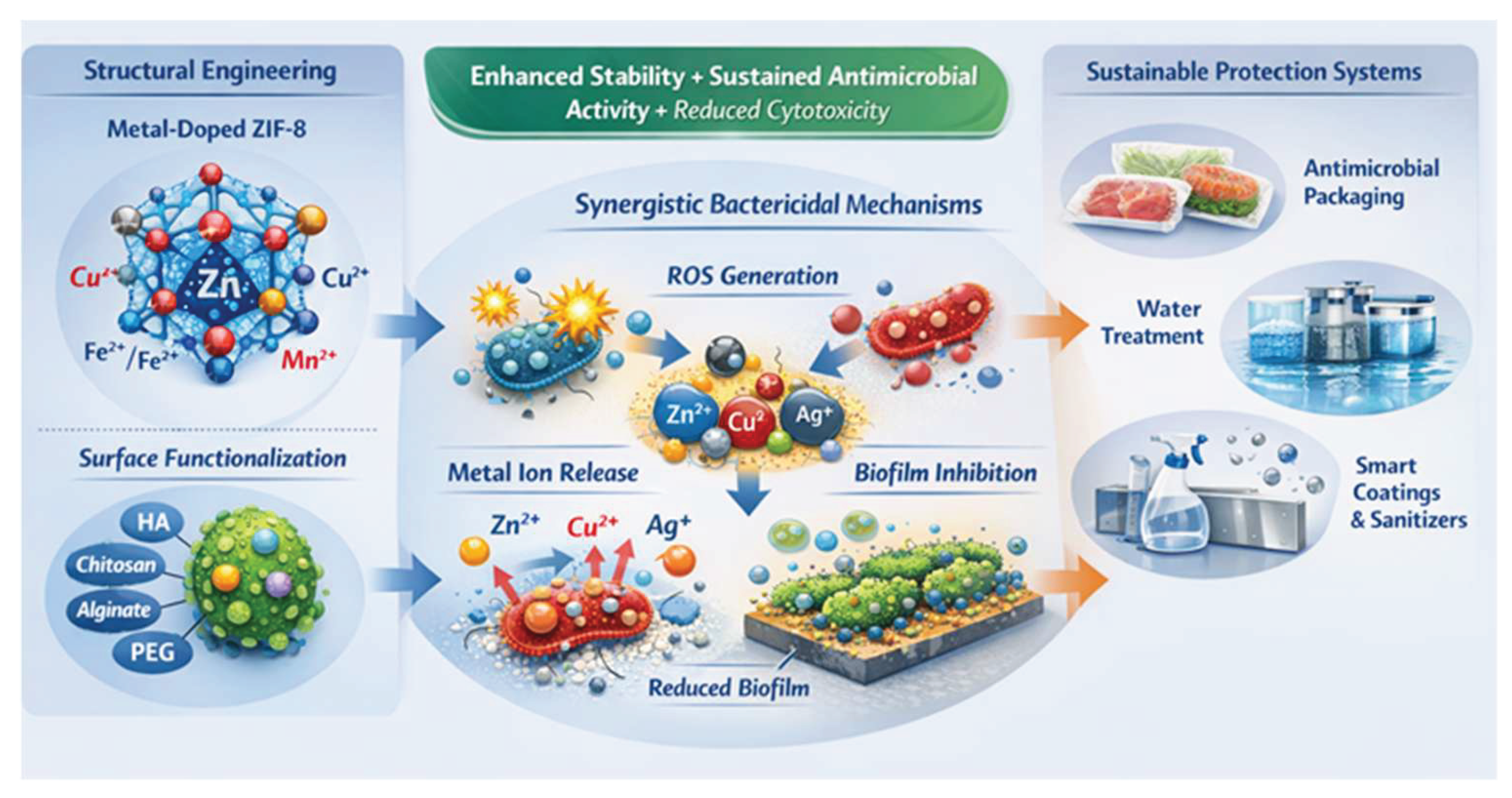
Figure 2.
Synthetic routes for metal-doped ZIF-8 nanomaterials.
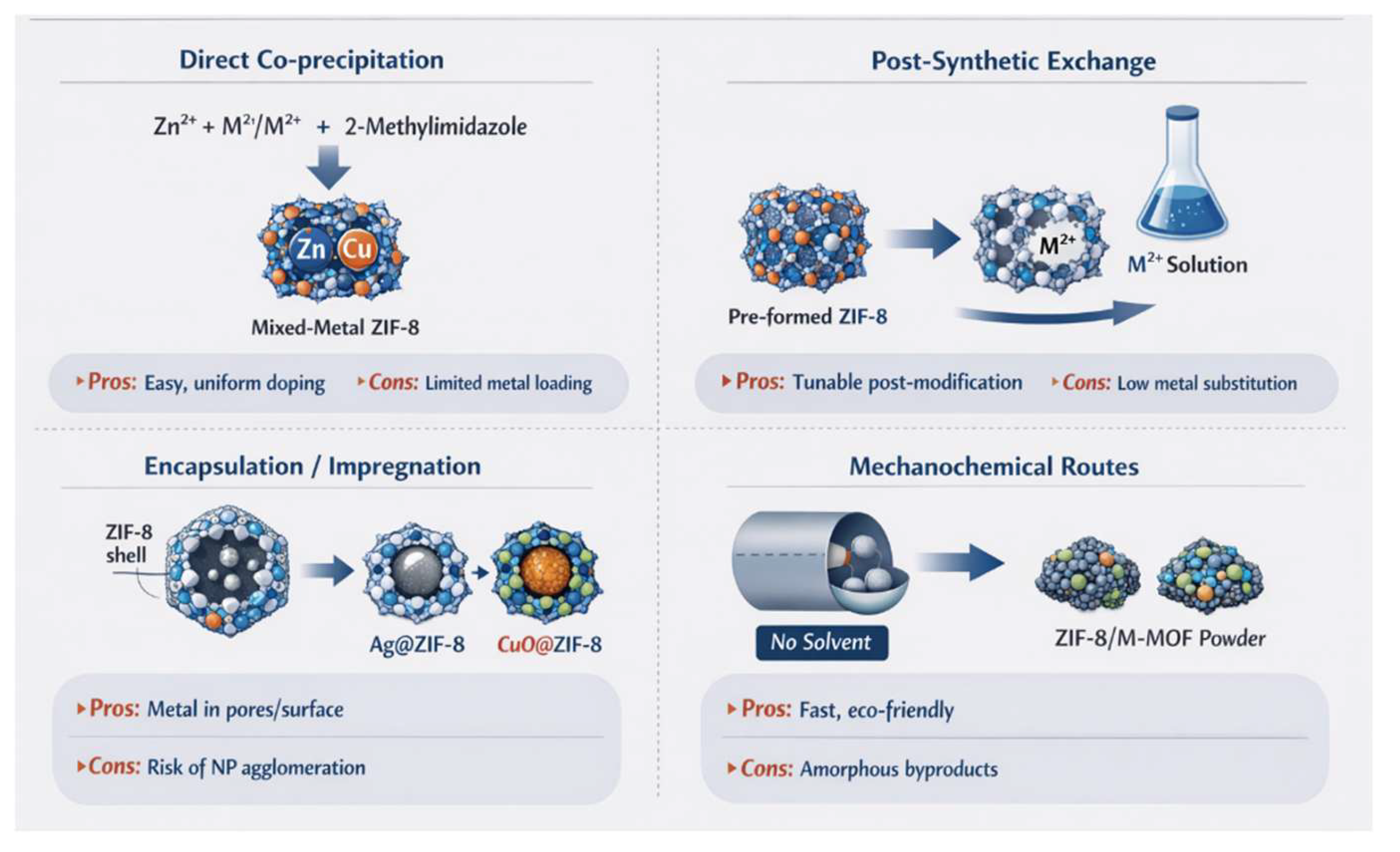
Figure 3.
Antimicrobial mechanisms of ZIF-8 nanomaterials.
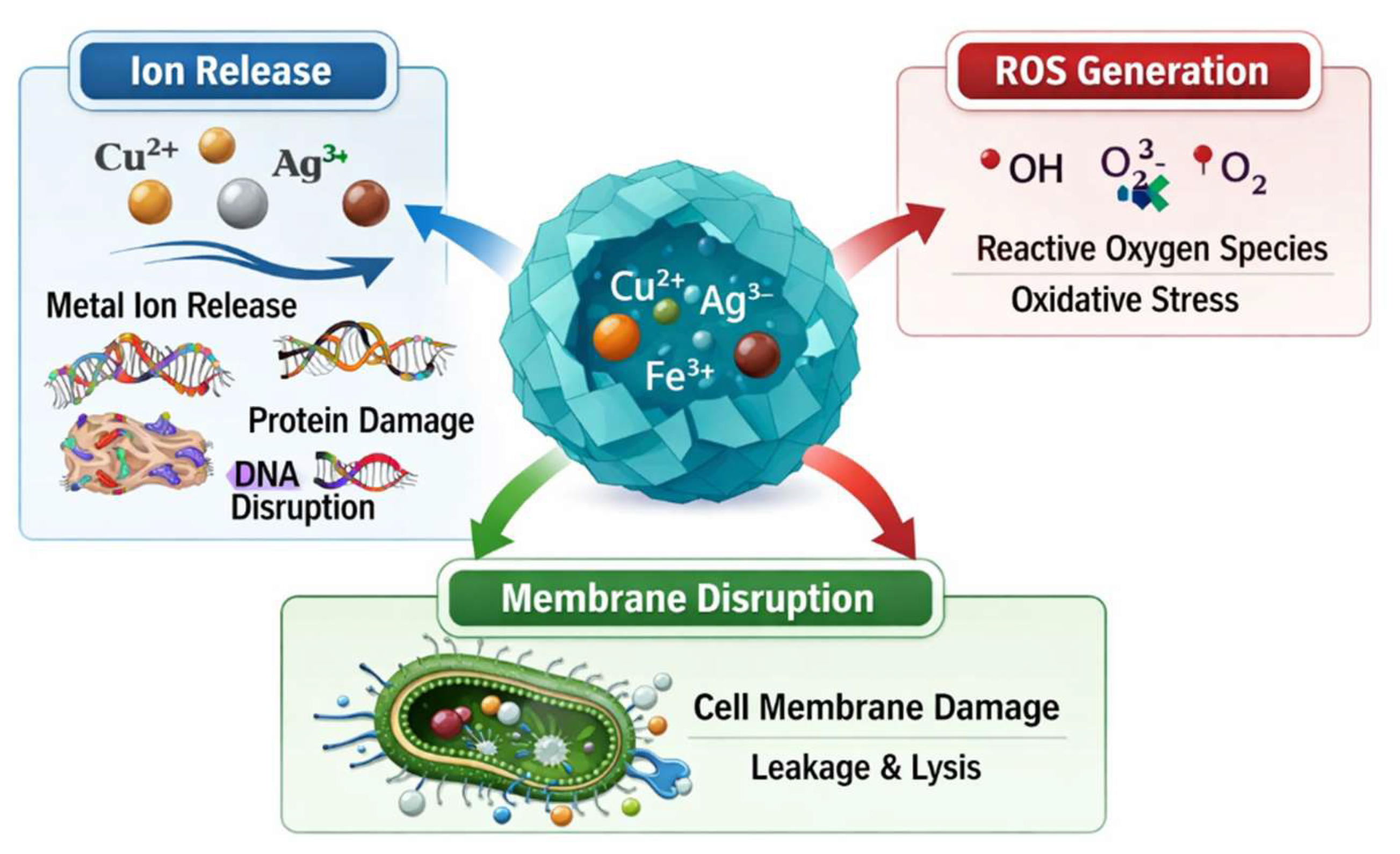
Figure 4.
Applications of ZIF-8 and its derivatives in food and water systems.
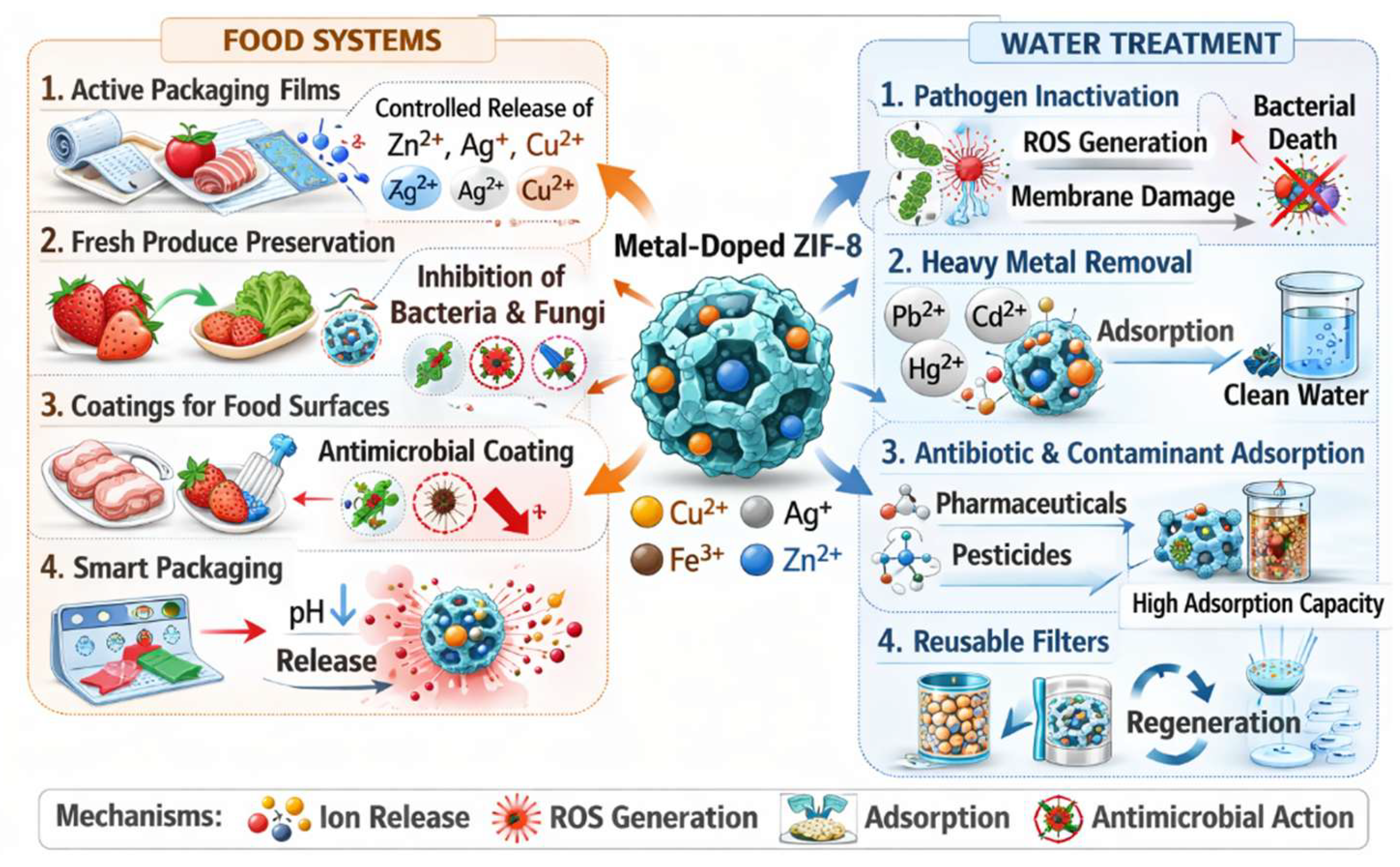
Figure 5.
Gelatin/chitosan film embedded in ZIF-8 to prevent mold on fruits.
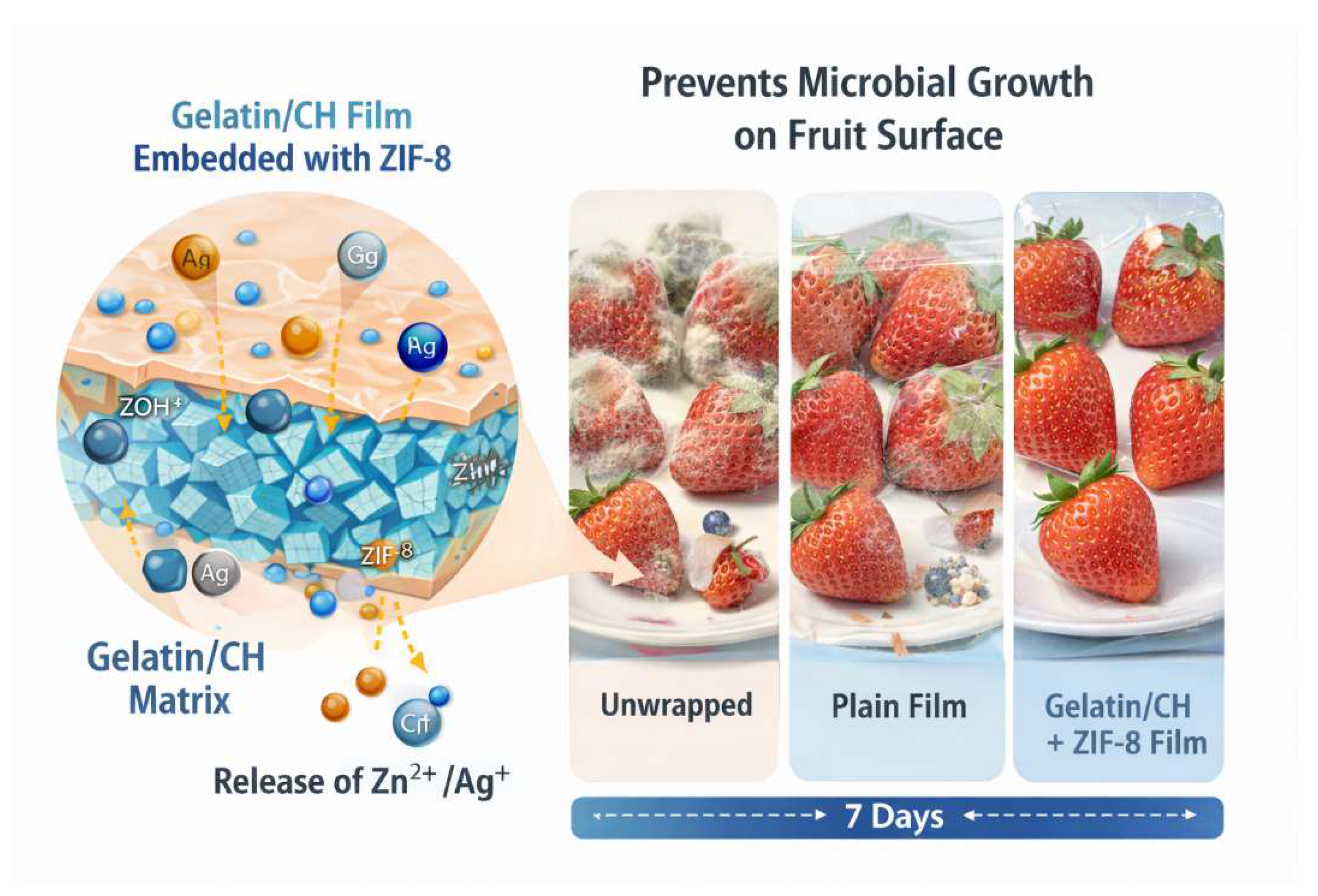

Table 1.
One-pot bimetallic synthesis of metal-doped ZIF-8 with methods, achievable doping levels, and structural outcomes.
Table 1.
One-pot bimetallic synthesis of metal-doped ZIF-8 with methods, achievable doping levels, and structural outcomes.
| Metal Dopant | In Situ Doping Method | Max. Doping Achieved | Structural Effects | References |
|---|---|---|---|---|
| Co (Zn/Co ZIF-8) | One-pot room-temp co-precipitation (vary Zn:Co) | ~50% Co in framework (ZIF-67/ZIF-8 mix) | Retained sodalite ZIF structure; increased pore size, +Visible absorption band; slight lattice contraction at high Co | Vatani et al., 2024; Kolsani et al., 2022 (stability study) |
| Cu (Zn/Cu ZIF-8) | One-pot co-precipitation in methanol or water | ~40% Cu (higher leads to amorphous phases) | Retained ZIF-8 structure at ≤30% Cu; slight peak shifts; possibly improved hydrostability at low Cu doping | Nguyen et al., 2025; Cheng et al., 2022 |
| Ni (Zn/Ni ZIF-8) | One-pot (like Co, Cu) | ~100% (Ni-ZIF-8 known) | Isostructural ZIF-8 type possible (Ni2+ with 2-mIm); Ni substitution narrows bandgap like Co | Li et al., 2023 |
| Fe (Zn/Fe ZIF-8) | One-pot, often slow add or room-temp aging | ~20% (higher leads to ZIF-8 + amorphous Fe phases) | Largely ZIF-8 structure with peak broadening; Fe likely partially substitutes Zn and partially forms extra-framework nodes | Wang et al., 2021; Nguyen et al., 2025 |
| Ag (Ag/Zn ZIF-8) | One-pot or rapid mix (AgNO3 + Zn2+) – uncommon (Ag more often post-loaded) | low% as true dopant (Ag+ can coordinate imidazole weakly) | Mostly ZIF-8 phase; Ag+ may occupy surface sites or defects; minimal XRD change, indicating framework intact | Usman et al., 2023 (Ag in ZIF-8 electrocatalyst) |
Table 2.
Antibacterial mechanisms of metal-doped and surface-functionalized ZIF-8 and examples of system leveraging of each mechanism.
Table 2.
Antibacterial mechanisms of metal-doped and surface-functionalized ZIF-8 and examples of system leveraging of each mechanism.
| Mechanism | Description | Enhanced By | Example System (Reference) |
|---|---|---|---|
| Controlled metal ion release | Gradual liberation of Zn2+ and dopant ions (Ag+, Cu2+, etc.) that bind to bacterial cell components and disrupt physiological processes. It leads to enzyme inhibition, membrane destabilization, and oxidative stress inside cells. | Metal doping (Ag, Cu), acidic triggers, MOF porosity controlling release rate. | Ag/H-ZIF-8 releasing Zn2++Ag+ killed E. coli & S. aureus more effectively than either ion alone; Cu–ZIF-8 on lettuce released Cu2+ causing 3-log kill in 2 min. |
| Membrane contact disruption | Nanoparticles attach to bacterial cell walls, exert mechanical pressure or create nano-damage, leading to loss of membrane integrity and leakage of cell contents. Also facilitates entry of other agents. | Cationic polymer/peptide coating (improves adhesion); rough/hierarchical particle surface. | ZIF-8@chitosan adhered to E. coli cell membranes causing visible roughness and lysis (SEM); PDA-coated ZIF-8 showed strong binding to S. aureus and boosted killing via membrane rupture. |
| ROS generation (photocatalysis) | Production of reactive oxygen species (1O2, ·OH, O2−·) that oxidize and damage proteins, DNA, and lipids. Can occur under light (photocatalytic) or via enzyme-mimic reactions in dark. | Doping with photocatalytic metals (Co, Fe, Cu); incorporation of noble metal NPs; presence of H2O2 or light. | 5% Co–ZIF-8 under sunlight yielded 1O2 and O2−·, giving 6.6-log E. coli kill (vs <2-log by ZIF-8). Ag/Cu–ZIF-8@CNF filter generated 2.7× more ·OH under light than undoped, enhancing anti-biofilm efficacy. |
| Synergistic additive effects | Combined action with other antimicrobial agents (antibiotics, essential oils, enzymes). ZIF-8 acts as carrier and co-bactericide, weakening microbes so the additive works better; or providing dual function (e.g., enzyme + metal ion). | Loading of antibiotics or natural antimicrobials into ZIF pores; co-immobilization of enzymes or peptides; stimuli-responsive release triggers. | Cinnamaldehyde-loaded ZIF-8 in PVA film completely inactivated E. coli on spinach via Zn2+ + essential oil release. LYZ-Lactoferrin@ZIF-8 composite eradicated bacteria through combined cell wall hydrolysis, nutrient sequestration, Zn toxicity, and light-activated ROS. |
Table 3.
Polymer functionalization of ZIF-8 and benefits for antimicrobial applications.
| Polymer | Integration with ZIF-8 | Benefit for Antimicrobial Use | Example |
|---|---|---|---|
| Chitosan (CHI) | Coating on ZIF-8 nanoparticles; blending ZIF-8 into chitosan films or beads. | CHI’s cationic nature improves bacterial adhesion and contact killing; film-forming for coatings; CHI itself is antimicrobial and edible (food-safe). | ZIF-8@chitosan coating on fruit delayed microbial spoilage, as composite coatings slowed mold/bacteria growth on cherry tomatoes. Gelatin/CHI films with Ag@ZIF-8@CMC achieved 100% bacterial kill and extended fruit shelf-life. |
| Polyvinyl Alcohol (PVA) | Mixing or in situ ZIF-8 growth in PVA solution; casting films. | Improves dispersion of ZIF-8 in aqueous media; PVA is flexible and forms transparent films; can incorporate other additives (glycerol, etc.) for packaging. | PVA-ZIF-8@cinnamaldehyde films showed dose-dependent E. coli inhibition on produce, complete kill at ≥4% loading. PVA/Quaternary ammonium polymer matrix with ZIF-8@eugenol yielded pH-responsive release and ~88% bacterial reduction. |
| Polydopamine (PDA) | Ultrathin coating on ZIF-8 surfaces (via dopamine self-polymerization). | Enhances water stability by chelating Zn; provides bioadhesive catechol groups for sticking to surfaces (and bacteria); introduces slight positive charge; can further conjugate other molecules (via PDA chemistry). | ZIF-8@PDA (core–shell) acted as a Zn2+ reservoir with pH-triggered release; showed superior S. aureus killing due to PDA-mediated cell binding. PDA coating on ZIF also allowed further attachment of hyaluronic acid in an OEO-Ag-ZIF-8-HA system, improving stability and biocompatibility. |
| Cellulose (e.g., Nanocellulose fibers, CNC/CNF) | In situ growth of ZIF-8 on cellulose nanofibers; embedding ZIF-8 in cellulose film or hydrogel. | Cellulose provides biodegradable, mechanically strong support; improves handling of MOF powder; CNF networks can create porous hydrogels for filtration; cellulose can enhance adhesion to hydrophilic surfaces. | Ag-doped ZIF-8 grown on TEMPO-oxidized CNF yielded “necklace” nanofibers that were embedded in a CNF hydrogel, resulting in a flexible antibacterial filter that resisted biofouling (only 14% flux decline). Bacterial cellulose loaded with ZIF-8 was proposed as an antimicrobial wound dressing that releases Zn2+ to prevent infection. |
| Food-grade polymers (PLA, PLGA, etc.) | Mixed-matrix composites; electrospun fibers with MOF; coating MOF with polyesters. | These polyesters are safe for food contact; incorporate MOFs to create active packaging or antimicrobial coatings that are also biodegradable; can tailor release profiles by polymer crystallinity. | PLA films containing ZIF-8@cinnamaldehyde nanoparticles significantly reduced S. enterica on meat surfaces (due to vapor-phase cinnamaldehyde release and Zn2+ action) – demonstrated in a 2022 study. PLA/PCL core–shell fibers with ZIF-8 in core and antibiotic in shell provided multi-stage antimicrobial release for medical textiles. |
Table 4.
Examples of hybrid ZIF-8 based nanoplatforms and their antimicrobial advantages.
| Hybrid Composition | Description | Antimicrobial Advantages | Example |
|---|---|---|---|
| Ag@ZIF-8 core–shell | Ag nanowire or nanoparticle core, ZIF-8 shell grown around it. | Controlled Ag+ release, prevention of Ag aggregation, dual ion (Ag+/Zn2+) synergy. Shell porous to allow ion diffusion. | Ag@ZIF-8 nanowires inhibited E. coli and B. subtilis far more than Ag nanowires alone. ZIF-8 shell prolonged Ag+ release (active over several days). |
| ZIF-8@GO composite | ZIF-8 nanoparticles deposited on graphene oxide sheets (or mixed in GO dispersion). | GO provides support and can wrap bacteria, some inherent antimicrobial via oxidative stress; ZIF-8 adds metal ion release. Composite can be formed into coatings or papers. | ZIF-8@GO achieved complete growth inhibition of E. coli, S. aureus in paper disk diffusion, whereas GO alone was bacteriostatic not bactericidal. GO improved dispersion of ZIF-8 in water and the composite could be easily filtered out. |
| Magnetic ZIF-8 (e.g., Fe3O4/ZIF-8) | Either ZIF-8 grown on Fe3O4 nanoparticles or vice versa. Often also coated with silica or polymer for stability. | Magnetic separability from liquids; Fe3O4 can generate •OH from H2O2 (peroxidase mimic); can heat under AC magnetic field (potentially useful for biofilm disruption via localized heating). | Fe3O4@ZIF-8 modified with plant extract showed strong antibacterial effect and could be magnetically recovered and reused 5× with minimal loss of activity. Magnetically retrievable MOFs avoid nanoparticle residues in treated water. |
| ZIF-8/cellulose hybrid | ZIF-8 grown in situ on cellulose fibers (cotton, nanocellulose, bacterial cellulose). | Robust, flexible substrates; easy shaping into films or filters; cellulose improves biocompatibility; ZIF-8 imparts active functionality that cellulose lacks. | Cotton fabric coated with ZIF-8 (via in situ crystallization) was turned into an antibacterial surface that inactivated >99.9% of E. coli on contact, yet fabric was washable and reusable due to strong MOF anchoring (Chen et al., 2019). Cellulose-ZIF-8 filters in Section 6 show biofouling resistance. |
| MOF-on-MOF or MOF-on-oxide hybrid | Layering or integrating ZIF-8 with another framework or porous oxide. | Can combine different pore sizes (capture diverse targets) or add photocatalytic function (e.g., TiO2, g-C3N4) to ZIF-8’s ion release. Potential for sequential action: one component adsorbs toxins while other kills microbes. | Ag3PO4@ZIF-8 hybrid showed excellent photocatalytic disinfection and pollutant degradation simultaneously. g-C3N4@ZIF-8 composites have been tested for synergistic light-driven antibacterial activity (ZIF adsorbs and concentrates bacteria around g-C3N4 sites). |
Disclaimer/Publisher’s Note: The statements, opinions and data contained in all publications are solely those of the individual author(s) and contributor(s) and not of MDPI and/or the editor(s). MDPI and/or the editor(s) disclaim responsibility for any injury to people or property resulting from any ideas, methods, instructions or products referred to in the content. |
© 2026 by the authors. Licensee MDPI, Basel, Switzerland. This article is an open access article distributed under the terms and conditions of the Creative Commons Attribution (CC BY) license (http://creativecommons.org/licenses/by/4.0/).
Copyright: This open access article is published under a Creative Commons CC BY 4.0 license, which permit the free download, distribution, and reuse, provided that the author and preprint are cited in any reuse.


