

Submitted:
25 February 2026
Posted:
26 February 2026
You are already at the latest version
Abstract
Water quality plays a central role in determining the environmental performance and sustainability of pond-based tropical aquaculture systems. This study aimed to evaluate the relative environmental sustainability of different tropical pond-based aquaculture systems by identifying multivariate water quality patterns that allow their discrimination and comparison under commercial production conditions. Four pond-based production systems were evaluated: an aquaponic system (APS), a recirculating aquaculture system (RAS), a conventional earthen pond system (CEP), and an integrated rice–chame system (RCS). Eleven physicochemical water quality variables were monitored throughout the production cycle under real commercial conditions to characterize system functioning and environmental dynamics. Multivariate discriminant analysis was applied to identify the variables with the highest discriminatory power and to evaluate the ability of water quality patterns to correctly classify observations among production systems. The results revealed a clear multivariate separation between the technologically intensive systems (APS and RAS) and the less intensive and integrated systems (CEP and RCS), reflecting distinct water quality structures and environmental functioning. Variables associated with mineralization and nutrient dynamics, including electrical conductivity, salinity, total hardness, and ammonium, contributed most strongly to system discrimination. The discriminant functions achieved a high overall correct classification rate, demonstrating the robustness of the multivariate approach. These findings demonstrate that water quality variables provide consistent environmental signatures for distinguishing tropical pond-based aquaculture systems and offer an operational framework for assessing their relative environmental sustainability. Discriminant analysis emerges as a valuable tool for system characterization and comparative evaluation, supporting environmentally informed management and optimization of chame aquaculture under tropical conditions.
Keywords:
tropical aquaculture
; pond systems
; Dormitator latifrons
; water quality
; multivariate analysis
1. Introduction
Tropical aquaculture has become an emerging activity worldwide, with a clear predominance of pond-based systems, both in terms of production volume and number of producers [1,2,3]. These systems contribute substantially to food sovereignty and rural income generation in developing countries and vulnerable rural communities [4,5]. However, their expansion and intensification have revealed structural tensions between increasing productivity and maintaining environmental sustainability, particularly in low-resource contexts with limited access to advanced technologies [6,7].
In aquaculture, environmental sustainability is closely linked to water quality dynamics due to the intensive use of water resources, the strong interaction between water and sediments, and the progressive accumulation of nutrients and organic matter associated with feed inputs and cultured biomass [6,7,8,9]). Production intensification amplifies these processes, increasing the risk of environmental degradation both within the production system and in receiving water bodies through effluent discharge [10,11]. In tropical regions, these dynamics are further modulated by climatic conditions that promote high metabolic rates and rapid chemical transformations, making the sustainable management of pond systems a persistent structural challenge [6,7].
Water quality constitutes a functional integrator of the environmental sustainability of pond-based aquaculture systems, as it simultaneously reflects the interaction between system design, management practices, organic loading, and the physical, chemical, and biological processes that regulate system functioning [12]. Unlike partial indicators, water quality responds directly to matter and energy fluxes associated with aquaculture production, synthesizing multiple dimensions of the environmental performance of the system [8,10,13]. From this perspective, environmental sustainability can be understood as the capacity of aquaculture systems to maintain adequate and stable water quality while managing waste without generating negative environmental impacts within the system or the surrounding ecosystem [6,8,9].
Key water quality parameters, such as dissolved oxygen, pH, temperature, alkalinity, conductivity, and inorganic nitrogen forms, are embedded in interaction networks governed by interconnected biogeochemical and biological processes [8,13]. In tropical systems, these interactions are particularly pronounced due to high temperatures and elevated metabolic activity, resulting in strong temporal and spatial variability in water quality parameters [12,14,15].
Environmental sustainability in aquaculture systems is commonly assessed through the individual analysis of water quality parameters, interpreted in isolation against threshold values and reference ranges. This approach is widely applied in recent studies on pond-based and tropical aquaculture systems [11,16,17]. However, in pond aquaculture systems, water quality parameters exhibit strong interdependencies and joint responses to management practices, while variable collinearity and temporal variability complicate result interpretation under real and commercial production conditions [18,19].
Multivariate analysis facilitates the integrated assessment of multiple interdependent variables, enabling the identification of emergent patterns and the reduction of data dimensionality without significant loss of relevant information [20]. In aquaculture research, the application of multivariate approaches in environmental studies has proven effective for discriminating production systems and synthesizing complex information into interpretable patterns and functional gradients, overcoming limitations associated with traditional univariate analyses [19,20,21].
In this context, tropical aquaculture systems provide a particularly suitable framework for evaluating environmental sustainability through multivariate water quality patterns, due to the coexistence of a wide diversity of production designs, levels of intensification, and degrees of technological input under comparable environmental conditions [3,6,22]. Pond-based systems range from conventional low-technology schemes to more intensive and integrated systems, including recirculating aquaculture systems, aquaponics, and integrated production models, reflecting different relationships between technological control, resource use, and ecological functioning [1,4,23]. The use of native species tolerant to environmental variability, such as Dormitator latifrons, further enables the assessment of environmental sustainability while minimizing the influence of species sensitivity, thereby reinforcing the interpretation of observed patterns associated with system design and management rather than local context or species-specific biology [24,25,26].
Research integrating multiple physicochemical parameters under real commercial production conditions remains scarce in tropical pond aquaculture, where environmental sustainability assessments have traditionally relied on univariate or partial approaches. In response to this gap, the present study developed an integrative multivariate framework to identify reproducible structural patterns of water quality as comparative indicators of environmental sustainability across tropical production systems. Accordingly, the objective was to evaluate the relative environmental sustainability of different tropical pond aquaculture systems by identifying multivariate water quality patterns that enable their discrimination and comparison under real production conditions.
2. Materials and Methods
2.1. Study Area and Experimental Design
This study was conducted in Manabí Province, Ecuador, a region characterized by a tropical climate with a mean annual temperature of approximately 25 °C, annual rainfall ranging between 838.7 and 2400 mm, and relative humidity values of 78% to 82% [27].
Four production systems culturing Dormitator latifrons (chame) were evaluated to assess physicochemical water quality: (i) an aquaponic system (APS) implemented at the agricultural facilities of ESPAM-MFL, located in Bolívar Canton (UTM Zone 17S, WGS84; EPSG:32717: 590589.90 m E, 9908726.07 m N); (ii) a recirculating aquaculture system (RAS) established in the agro-industrial area of ESPAM-MFL (UTM Zone 17S, WGS84; EPSG:32717: 590544.52 m E, 9908698.78 m N); (iii) a conventional earthen pond system (CEP) located in the Bachillero–Tosagua area (UTM Zone 17S, WGS84; EPSG:32717: 586168.84 m E, 9915021.26 m N); and (iv) an integrated rice–chame system (RCS) situated at the site known as “El Corozo”, Calceta, in Bolívar Canton (UTM Zone 17S, WGS84; EPSG:32717: 591893.85 m E, 9905909.84 m N) (Figure 1).
The study followed a comparative observational design, focusing on the analysis of pond-based aquaculture systems operating under real production conditions rather than a controlled experiment under standardized settings [4,6]. This approach has been widely applied in environmental sustainability studies in aquaculture, as it allows the evaluation of commercial systems while capturing the inherent variability associated with management practices and operational contexts [6,22,23]. The production systems analyzed represented a real gradient of intensification and technological input, ranging from conventionally managed earthen ponds to more intensive and mixed systems, including recirculating aquaculture, aquaponics, and integrated production schemes. Comparing systems along intensification gradients under real production conditions has been recognized as an appropriate approach for assessing differences in environmental performance and sustainability in aquaculture [1,3,4].
This research adopted a comparative observational design to characterize the functional performance of pond-based aquaculture systems operating under real commercial conditions. Rather than standardizing environmental variables within controlled experimental settings, the approach prioritized the capture of naturally occurring variability linked to system design, management practices, and operational dynamics across different production stages. Such observational data are essential to adequately represent time-varying mechanisms and real-world intervention dynamics, thereby facilitating the identification of structural water quality patterns that reflect the inherent heterogeneity of production systems. This type of design is widely applied in aquaculture and socio-ecological research, where strict experimental standardization may limit the ability to capture the actual functioning of complex production systems (Troell et al., 2014; Henriksson et al., 2018; Partelow et al., 2025; Hernán and Robins, 2020).
Observational data collected across different stages of a process are often necessary to adequately represent time-varying mechanisms and real-world intervention dynamics, thereby facilitating the capture of greater heterogeneity among production systems [28]. This type of design is common in aquaculture and socio-ecological systems, where full sampling standardization may reduce the ability to capture the actual functioning of production systems [14,18,19]. Previous studies have emphasized that a deeper understanding of variability is essential for identifying structural patterns and systemic responses in complex aquatic systems [14,20,29]. In this sense, the application of multivariate statistical methods enabled the integration of heterogeneous and unbalanced datasets, focusing on the identification of emergent patterns and structural relationships among variables rather than on direct comparisons of individual mean values [19,20,21].
The basic unit of analysis was each individual water sample, whereas comparisons were conducted at the production system level. This approach is consistent with studies that have evaluated functional differentiation among systems based on multiple internal observations, allowing the assessment of both internal system coherence and differentiation among production models [7,20,21].
2.2. Production Systems and Animal Management
All experimental systems cultured chame (Dormitator latifrons), a native species widely used by rural communities in the study area, thereby reflecting the real operational and commercial conditions of each production modality [30]. Stocking densities ranged between 10 and 15 chame fingerlings m⁻³ in all ponds and tanks, and fish were reared during the production period from April to October 2024.
Fish were fed once daily with commercial feed, with rations adjusted weekly according to estimated biomass [31]. During the grow-out phase, a diet containing 22% crude protein was used, whereas a feed with 35% crude protein was supplied during the fattening phase. These protein levels are commonly applied in the culture of native and omnivorous tropical fish species in pond-based systems. In the conventional earthen pond system (CEP), feeding was conducted manually and evenly distributed, following the producer’s usual practices, due to pond size and the operational constraints inherent to this type of system [24,26,32].
The aquaponic system (APS) consisted of twelve in-ground ponds lined with geomembrane, each with an approximate capacity of 1 m³. The ponds were connected to a nutrient film technique (NFT) hydroponic module through a gravity-driven recirculation system assisted by a 1000 L·h⁻¹ pump (Figure 2a). This configuration is consistent with previously described small-scale tropical aquaponic pond systems, in which water quality represents the functional core of fish–plant integration [33,34]. The cultivated plant species were lettuce (Lactuca sativa) and basil (Ocimum basilicum), both compatible with aquaculture production [34,35].
The recirculating aquaculture system (RAS) was composed of twelve geomembrane-lined ponds with an approximate volume of 0.9 m³ each (Figure 2b). Water treatment was carried out using a gravel and activated carbon filter, with a recirculation flow rate of 600 L·h⁻¹ and an estimated hydraulic retention time of 1.7 h. The system configuration was consistent with standard small-scale RAS designs [36,37].
The conventional earthen pond system (CEP) was developed in two earthen ponds of 216 and 189 m2, respectively, supplied with groundwater and oxygenated through gravity-driven water inflow via piping (Figure 2c), following common practices for tropical pond aquaculture [8,12].
The integrated rice–chame system (RCS) was implemented in a rectangular pond with an approximate capacity of 27 m³. The pond was excavated and compacted, lined with geomembrane, and reinforced with a surface clay layer (Figure 2d). This system followed integrated rice–fish production principles previously described for tropical agro-aquatic systems [4,38,39].
2.3. Water Sampling and Quality Parameters
Water quality monitoring was conducted twice per week, during morning and afternoon periods. Five water samples were collected per sampling event and subsequently analyzed in the laboratory. The monitored parameters are listed in Table 1 and were measured following procedures described in Standard Methods for the Examination of Water and Wastewater [40].
Samples were systematically collected at fixed points within each pond or tank following an “English flag” spatial sampling scheme, widely used in aquatic system studies to capture horizontal variability and minimize biases associated with spatial heterogeneity within water bodies [12,13].
A total of 3,544 water samples were collected at an approximate depth of 5 cm, processed, preserved, and transported according to the procedure described by Mera Velez and Vélez Espinosa [41]. Sample analyses were conducted at the Environmental Chemistry and Soils Laboratory of the Escuela Superior Politécnica Agropecuaria de Manabí Manuel Félix López (ESPAM-MFL). Physical water parameters, including pH, temperature, total dissolved solids, and electrical conductivity, as well as dissolved oxygen, were measured in situ using a portable multiparameter probe and an oximeter (Hanna Instruments). The remaining water quality parameters were determined following standardized laboratory methods detailed in Table 1.
2.4. Statistical Analysis
Water quality parameters were analyzed using descriptive and inferential statistical methods. Data were first tested by one-way analysis of variance (ANOVA), and statistically significant differences were accepted at p < 0.05. When significant effects were detected, mean values were compared using Tukey’s Honest Significant Difference (HSD) post hoc test to identify which production systems contributed to observed differences.
For chloride and phosphate concentrations, a Student’s t-test was applied instead of ANOVA, as these parameters were only measured in the APS, RAS and RCS systems due to the hydrological dynamics and biogeochemical characteristics of open pond systems with water exchange. Pearson’s correlation coefficients were calculated to evaluate relationships among water quality parameters.
Discriminant analysis was performed using the full set of water quality variables to assess system differentiation. Prior to the discriminant analysis, the assumption of homogeneity of covariance matrices was assessed using Box’s M test. The classification performance of the model was subsequently evaluated through leave-one-out cross-validation (LOOCV), allowing for an internal validation of the discriminant functions and providing a more robust estimation of classification accuracy. The analysis included the classification matrix, the examination of Mahalanobis distances to assess group separation, and the spatial distribution of water samples using canonical scatterplots. Aquaculture system type (APS, RAS, CEP and RCS) was established as the grouping variable. A direct variable entry method was applied with a significance threshold of p < 0.05.
Subsequently, the selection of the most discriminant variables was refined using Snedecor’s F statistic, Wilks’ Lambda, and the 1–Tolerance criterion. High F values indicated strong separation among group means with internal homogeneity, while low Wilks’ Lambda values reflected high discriminatory power among systems. Variables exhibiting high tolerance values (1–Tolerance) were retained to minimize redundant information.
All statistical analyses were performed using Statistica 12.0 software for Windows (StatSoft Inc., Tulsa, OK, USA).
3. Results
3.1. Water Quality Patterns
Physicochemical water quality parameters showed highly significant differences among production systems (p < 0.001) (Table 2). Multiple range analysis revealed contrasting patterns among systems for most parameters. The APS and RAS systems exhibited significantly higher pH values and lower thermal variability compared with the CEP and RCS systems. In contrast, dissolved oxygen concentrations were significantly lower in APS and RAS, whereas the highest values were recorded in RCS and CEP.
Regarding ionic water load, the CEP system presented the highest concentrations of total dissolved solids, salinity, and electrical conductivity, followed by RCS, while APS and RAS showed significantly lower and statistically similar values. Turbidity differed significantly among systems, with higher values observed in APS and RCS and the lowest turbidity levels recorded in the RAS system.
With respect to inorganic nutrients, APS showed the highest concentrations of nitrates, phosphates, and ammonium, whereas RAS maintained the lowest levels of nitrogenous compounds. Finally, total alkalinity and total hardness were significantly higher in the CEP and RCS systems, clearly differentiating them from APS and RAS (p < 0.001). These differences were accompanied by greater dispersion of values associated with these parameters. Overall, high intra-system variability was observed for most of the water quality variables evaluated.
Correlation analysis among water quality variables revealed the presence of a marked mineralization gradient (Table S1). Total dissolved solids (TDS), electrical conductivity, and salinity showed very strong positive correlations with each other (r ≥ 0.98), as well as with total hardness, indicating that these variables are governed by a common physicochemical control associated with dissolved salt and mineral concentrations. In contrast, pH exhibited moderate to strong negative correlations with these variables (r ranging from −0.59 to −0.68). Water temperature showed a moderate relationship with dissolved oxygen, reflecting expected thermal effects on oxygen solubility. Inorganic nutrients (nitrites and ammonium) did not show significant (p > 0.05) correlations with most of the parameters analyzed.
3.2. Discriminant Analysis of Water Quality Parameters
Discriminant analysis revealed a clear separation among the four pond-based aquaculture systems based on their physicochemical water quality profiles. Multivariate discriminant analysis revealed a strong and consistent separation among the four pond-based aquaculture systems, achieving a cross-validated classification accuracy of 94.64%, thereby confirming the existence of reproducible system-specific water quality signatures that reflect differences in environmental functioning and sustainability. All variables included in the model contributed significantly (p < 0.001) to system discrimination, as indicated by very low Wilks’ lambda values and highly significant F-tests (Table 3).
Electrical conductivity, total dissolved solids, turbidity, phosphates, chlorides, dissolved oxygen, nitrates, and temperature exhibited the highest discriminant power, reflecting their strong contribution to differentiating water quality patterns among systems. Variables such as pH, ammonium, total hardness, and salinity, while still statistically significant, showed comparatively lower discriminant contributions. Tolerance analysis revealed collinearity among electrical conductivity, salinity, and total dissolved solids, which is expected given their shared physicochemical control and common association with water mineralization processes.
The classification matrix indicated a high overall correct classification rate (94.64%), confirming the robustness of the discriminant model (Table 4). The integrated rice–chame system (RCS) achieved 100% correct classification, while the conventional earthen pond system (CEP) reached 99.88%, indicating highly consistent physicochemical signatures for these systems. The aquaponic (APS) and recirculating aquaculture systems (RAS) also showed high classification accuracy, with only minor misclassifications between these two systems.
Overall, the discriminant functions demonstrated a strong capacity to distinguish pond-based aquaculture systems based on integrated water quality patterns, supporting the use of multivariate approaches to evaluate differences in environmental performance among production models.
Cluster analysis revealed the presence of two main groups among the evaluated systems. The conventional earthen pond system (CEP) was clearly separated at a high linkage distance, indicating a markedly distinct multivariate water quality profile. In contrast, the aquaponic system (APS) and the recirculating aquaculture system (RAS) clustered together at a very low linkage distance, reflecting their high degree of similarity. The integrated rice–chame system (RCS) joined this cluster at a higher linkage distance, suggesting that although it shares certain characteristics with more intensive systems, it maintains distinct features (Figure 3a).
Canonical discriminant analysis further confirmed a clear separation among aquaculture systems. The conventional earthen pond system (CEP) was completely segregated along the first canonical root, indicating a markedly different physicochemical profile. The integrated rice–chame system (RCS) formed a distinct cluster primarily separated along the second canonical root, highlighting its unique characteristics relative to APS and RAS, which exhibited partial overlap in the canonical space (Figure 3b).
4. Discussion
4.1. Water Quality Patterns and Intensification Gradient in Tropical Pond-Based Systems
The combined application of variance analysis and discriminant analysis confirmed the existence of structural differences among tropical pond-based aquaculture systems, expressed through consistent and system-specific water quality patterns. While one-way ANOVA and post hoc tests revealed significant differences in most individual physicochemical parameters, discriminant analysis integrated this multivariate information and demonstrated that each production system exhibited a characteristic physicochemical signature associated with its design and management practices. These findings indicated that water quality patterns can function as system-level descriptors of environmental performance more efficiently than isolated or univariate measurements.
The high classification accuracy of the discriminant model indicates that observed differences were not driven by isolated fluctuations in single variables, but rather by relatively stable functional configurations determined by interactions among water use, organic loading, chemical processes, and management strategies. In this context, water quality acts as an integrative indicator synthesizing multiple dimensions of environmental system functioning, including resource-use efficiency, nutrient assimilation capacity, and control of potential environmental impacts [8,9,13].
The use of water quality as an indicator of environmental sustainability in aquaculture is widely supported in literature, as it is directly linked to both the welfare of cultured organisms and the ecological stability of the production system [4,6,7]. The multivariate patterns identified here provide an operational framework for comparative sustainability assessment in tropical pond systems under commercial conditions.
The identified water quality patterns reflect a clear gradient of production intensification and environmental control among the evaluated systems. Conventional earthen pond systems (CEP) and integrated rice–chame systems (RCS) rely largely on natural ecological processes and strong water–sediment interactions, whereas more technologically intensive systems, such as aquaponics (APS) and recirculating aquaculture systems (RAS), incorporate hydraulic and biological control mechanisms aimed at stabilizing physicochemical water conditions.
In lower-intensification systems, water quality was primarily driven by the natural dynamics of the aquatic ecosystem, resulting in greater temporal and spatial variability and increased accumulation of dissolved salts and nutrients. These patterns have been widely described for extensive and semi-intensive tropical systems [8,10,12]. Nevertheless, such systems often exhibit high buffering capacity and a degree of resilience derived from their integration with local ecological processes [4].
In contrast, APS and RAS exhibited a higher degree of technical control over the aquatic environment through recirculation, filtration, and aeration. This enhanced control reduces the accumulation of solids and nitrogenous compounds but increases dependence on operational management, biofilter efficiency, and the balance between organic loading and treatment capacity. When these elements are not properly adjusted, functional limitations may arise despite the technological sophistication of the systems [42,43,44].
Discriminant analysis positioned APS and RAS in close proximity within the multivariate space, reflecting structural similarities associated with recirculation and hydraulic control, whereas CEP and RCS were clearly differentiated from each other and from the technologically intensive systems. This pattern indicates that, in addition to the level of intensification, the type of productive integration and the degree of interaction with the sediment play a key role in shaping water quality patterns [10,13]. From a sustainability perspective, these results highlight trade-offs between environmental control, technological dependence, resource use, and system resilience [5,6]. Rather than indicating superiority of a specific model, the patterns illustrate how different configurations redistribute environmental pressures within the production system.
The differences observed among production systems result from the combined action of physical, chemical, and biological processes rather than from the isolated influence of individual parameters. In this study, three key processes were identified as determinants of the multivariate patterns observed: (i) thermal and dissolved oxygen regulation, (ii) mineralization and ionic balance, and (iii) nutrient transformation and fate.
Water temperature and dissolved oxygen, which are closely interrelated, directly influenced fish metabolism and the rates of biogeochemical processes. In open and semi-natural systems (CEP and RCS), greater exposure to solar radiation promoted higher thermal variability and, indirectly, a wider range of dissolved oxygen concentrations associated with photosynthesis and respiration processes [8,14]. In contrast, APS and RAS exhibited greater thermal stability but lower mean dissolved oxygen concentrations, associated with high biological demand resulting from recirculation and nitrification processes [43,45].
The mineralization gradient constituted one of the main axes of differentiation among systems. In CEP and RCS, the accumulation of dissolved salts and minerals was associated with prolonged water–sediment contact and limited water renewal, increasing system buffering capacity but also overall mineralization levels [10,12]. Conversely, in APS and RAS, pond impermeabilization and hydraulic control reduced direct substrate influence, resulting in lower and more homogeneous mineralization values, although still dependent on inflow water quality and management practices [36,44].
Nutrient dynamics reflected the balance among excretion, organic matter mineralization, nitrification, and biological assimilation. Low ammonium and nitrate concentrations in RAS indicate efficient biofilter-driven nitrification [45], whereas in CEP nutrient accumulation was associated with organic matter mineralization within sediments under conditions of limited water exchange [8,10]. In APS, elevated inorganic nutrient concentrations suggest limitations in nitrogen conversion and export processes, while in RCS, reduced nitrate levels highlight the role of crop cultivation as an active nutrient sink [35,38,46]. These differentiated nutrient pathways reinforce the interpretation of water quality as a functional expression of system metabolism.
The integrated and semi-closed systems evaluated in this study exhibited distinct water quality patterns that reflect their specific environmental functioning and their intermediate position along the intensification gradient. The integrated rice–chame system showed a physicochemical profile clearly differentiated from conventional earthen ponds, as confirmed by discriminant analysis, highlighting the functional role of rice cultivation as an active component in regulating the aquatic system. Nutrient assimilation by plant biomass and the influence of the rhizosphere on microbial processes contributed to modifying nutrient availability and buffering nutrient accumulation [4,38].
Aquaponic systems exhibited partial nutrient removal but also elevated turbidity and nutrient coexistence, suggesting that integration efficiency depends strongly on hydraulic balance, biofilm performance, and plant uptake capacity [33,35,46]. These findings indicate that integration alone does not automatically enhance environmental sustainability; its effectiveness depends on the degree of functional coupling among biological components.
4.2. Sustainability Implications, Management Strategies, and Study Limitations
Our findings indicate that the environmental sustainability of pond-based aquaculture systems is reflected in integrated water quality patterns that capture the combined functioning of the production system. The complementary application of ANOVA and discriminant analysis showed that each production model exhibits a distinct physicochemical signature associated with its design, level of intensification, and management strategies. This result, derived directly from empirical evidence, confirms that water quality constitutes an operational and comparative indicator of environmental sustainability under real production conditions, consistent with established sustainability concepts in aquaculture [4,6,7,8]. In this context, the identified multivariate patterns allow inference of trade-offs among environmental control, system stability, resource use, and technological dependence, which are widely recognized in recent sustainability assessments of aquaculture systems [5].
Based on the results obtained and in agreement with the specialized literature, a set of general management recommendations can be proposed for tropical pond-based aquaculture systems. First, water quality monitoring should adopt integrated approaches that simultaneously consider variables related to oxygen dynamics, temperature, mineralization, and nutrient balance, moving beyond traditional univariate assessments [12,20]. Second, management of organic loading and the balance between system inputs and assimilation capacity emerges as a critical factor to prevent progressive nutrient accumulation and environmental degradation, particularly in systems with limited water renewal [8,10].
The results further highlight the importance of adapting management strategies to each specific production system, rather than applying generalized solutions with limited effectiveness. Environmental sustainability depends not only on structural system design but also on coherence among intensification level, technological availability, and the operational capacity of producers, as emphasized in recent frameworks for sustainable aquaculture governance and management [5,6]. Sustainability also emerges from the interaction between system design, management decisions, and local operational constraints [47].
In conventional earthen pond systems (CEP), the observed patterns indicate high mineralization and a strong influence of water–sediment interactions. In these systems, practices such as strategic water exchange, organic load control, sediment management, and supplemental aeration may contribute to improving water quality stability and reducing the risk of environmental degradation [8,12]. These recommendations are consistent with the results of this study, in which salt and nutrient accumulation was associated with limited environmental control capacity.
In recirculating aquaculture systems (RAS), the low concentrations of nitrogenous compounds observed confirm the efficiency of biofiltration processes, while simultaneously highlighting the high oxygen demand associated with nitrification and microbial respiration. Accordingly, optimization of aeration, regular maintenance of biofilters, and adjustment of pH and alkalinity are key practices to sustain environmental performance in these systems [43,44,45].
In aquaponic systems (APS), the identified patterns suggest that fish–plant integration does not automatically result in improved water quality. The literature indicates that the success of these systems depends on a precise balance among organic loading, plant assimilation capacity, and microbial efficiency [34,35]. In this sense, the present results point to the need to reinforce mechanical filtration, optimize fish–plant ratios, and maintain physicochemical conditions compatible with the simultaneous requirements of fish, plants, and nitrifying bacteria.
In integrated rice–chame systems (RCS), the clear functional differentiation observed supports the role of rice cultivation as an active nutrient sink and a modulator of system dynamics. Previous studies have highlighted that appropriate management of irrigation, sediment, and cropping calendars is essential to maximize the environmental benefits of these systems without compromising aquaculture productivity [4,38]. The results of this study confirm that such systems can enhance environmental sustainability, provided that a balanced integration between both productive components is maintained.
These findings help focus future research on sustainability in aquaculture. First, they help prioritize multivariate approaches over univariate assessments when comparing production systems, as they effectively capture the emerging structural patterns that arise from interdependent environmental processes. Second, comparative analyses under real-world commercial conditions provide crucial insight into operational heterogeneity that can remain hidden in highly standardized experimental settings. Third, integrating discriminant techniques with other statistical procedures (SEM) can strengthen the robustness and transferability of sustainability indicators across different contexts.
This research was conducted under real-world commercial production conditions, which inherently involve variability in management intensity, hydraulic configurations, and operating timeframes across systems. While this design enhances ecological validity and external relevance, it may limit strict experimental comparability. The assessment focused on physicochemical water quality parameters; additional sustainability dimensions such as production output, energy consumption, and effluent characterization were beyond the scope of the present study. Future research integrating these complementary indicators could provide a more comprehensive multidimensional evaluation of sustainability in tropical pond-based aquaculture systems.
5. Conclusions
Tropical pond-based aquaculture systems exhibit clear structural differences in water quality parameters associated with production design, level of intensification, and management strategies. The combined application of analysis of variance and discriminant analysis enabled the identification of reproducible multivariate patterns that characterize each system, confirming that water quality constitutes an integrated and operational indicator of environmental sustainability under real production conditions.
The results indicate that environmental sustainability depends on the dynamic balance among physical, chemical, and biological processes, particularly those related to thermal and oxygen regulation, system mineralization, and nutrient dynamics. In this context, conventional and integrated systems showed a stronger influence of natural ecological processes and sediment interactions, whereas more technologically intensive systems exhibited greater capacity for environmental control, albeit with increased dependence on operational management and technological efficiency.
Furthermore, the findings demonstrate that productive integration can substantially modify water quality dynamics; however, its environmental performance is heterogeneous and strongly dependent on the degree of functional integration among system components. Overall, these results confirm the value of multivariate approaches for the comparative assessment of sustainability in tropical pond-based aquaculture systems and provide a robust basis for guiding management decisions and the design of more sustainable production models adapted to real-world conditions and operational constraints.
Supplementary Materials
The following supporting information can be downloaded at Preprints.org, Tabla S1. Coeficientes de correlación de Pearson for physico-chemical parameters in ponds of aquaculture systems from Ecuador.
Author Contributions
Conceptualization and methodology, all authors; Formal analysis, software, data curation, data processing, A.G-M., A.G., and C.B.; Statistical analysis, A.G-M. and A.G.; Validation and investigation, A.G-M., A.G. and C.R.D-V.; Supervision, project administration, A.G., and C.R.D-V.; Data acquisition, C.R.D-V. and F.P-M.; All authors have been involved in developing, writing, commenting, editing and reviewing the manuscript. All authors read and approved the final manuscript. All authors have read and agreed to the published version of the manuscript.
Funding
This research was funded by Engineering Career, Higher Polytechnic School of Agriculture of Manabí Manuel Félix López ESPAM-MFL (CUP 9188000.0000.386887).
Institutional Review Board Statement
Ethical review and approval were waived for this study because no specific institutional animal ethics committee was required for routine aquaculture research conducted under commercial conditions. The experimental procedures complied with the applicable national legislation on the use of animals for research and were carried out in accordance with animal welfare standards. A formal statement confirming compliance with national regulations and animal welfare principles was issued by the Coordinator of the Research Group “Gestión Integrada de Recursos Naturales y Biodiversidad para el Desarrollo Sostenible”.
Informed Consent Statement
Not applicable.
Data Availability Statement
The data presented in this study are available from the corresponding author upon reasonable request.
Acknowledgments
The authors thank research project “Integrated Agricultural, Agro-industrial and Natural Resource Management Program for Planning Zone 4 – Pacific for Sustainable Development” (CUP 91880000.0000.386887) by competitive scientific and technological research funds from Agricultural Polytechnic of Manabi “ESPAM MFL” (Ecuador).
Conflicts of Interest
The authors declare no conflicts of interest.
References
- Bostock, J.; McAndrew, B.; Richards, R.; Jauncey, K.; Telfer, T.; Lorenzen, K.; Little, D.; Ross, L.; Handisyde, N.; Gatward, I.; Corner, R. Aquaculture: Global status and trends. Philos. Trans. R. Soc. B 2010, 365, 2897–2912. [Google Scholar] [CrossRef]
- FAO. (2022). El estado mundial de la pesca y la acuicultura 2022. In El estado mundial de la pesca y la acuicultura 2022. Roma. 288 p. Available online: https://doi.org/10.4060/cc0461es (accessed on 10 February 2026).
- Partelow, S.; Nagel, B.; Gentry, R.; Gephart, J.; Rocha, J.C. Archetypes of aquaculture development across 150 countries. Aquaculture 2025, 595, 741484. [Google Scholar] [CrossRef]
- Troell, M.; Naylor, R.L.; Metian, M.; Beveridge, M.; Tyedmers, P.H.; Folke, C.; Arrow, K.J.; Barrett, S.; Crépin, A.-S.; Ehrlich, P.R.; et al. Does aquaculture add resilience to the global food system? Proc. Natl. Acad. Sci. USA 2014, 111, 13257–13263. [Google Scholar] [CrossRef]
- Troell, M.; Costa-Pierce, B.; Stead, S.; Cottrell, R.S.; Brugere, C.; Farmery, A.K.; Little, D.C.; Strand, Å.; Pullin, R.; Soto, D.; et al. Perspectives on aquaculture’s contribution to the Sustainable Development Goals. J. World Aquac. Soc. 2023, 54, 882–905. [Google Scholar] [CrossRef]
- Ahmed, N.; Turchini, G.M. The evolution of the blue-green revolution of rice-fish cultivation for sustainable food production. Sustain. Sci. 2021, 16, 1375–1390. [Google Scholar] [CrossRef]
- Garlock, T.M.; Asche, F.; Anderson, J.L.; Eggert, H.; Anderson, T.M.; Che, B.; Chávez, C.A.; Chu, J.; Chukwuone, N.; Dey, M.M.; et al. Environmental, economic, and social sustainability in aquaculture: The aquaculture performance indicators. Nat. Commun. 2024, 15, 5274. [Google Scholar] [CrossRef]
- Boyd, C. E.; Tucker, C. S. Pond aquaculture water quality management. Springer. 1998. [Google Scholar] [CrossRef]
- Páez-Osuna, F. The environmental impact of shrimp aquaculture: Causes, effects, and mitigating alternatives. Environ. Manag. 2017, 60, 954–970. [Google Scholar] [CrossRef]
- Hargreaves, J.A. Nitrogen biogeochemistry of aquaculture ponds. Aquaculture 1998, 166, 181–212. [Google Scholar] [CrossRef]
- Yang, P.; Zhao, G.; Tong, C.; Tang, K.W.; Lai, D.Y.F.; Li, L.; Tang, C. Assessing nutrient budgets and environmental impacts of coastal land-based aquaculture systems in southeastern China. Agric. Ecosyst. Environ. 2021, 322, 107662. [Google Scholar] [CrossRef]
- Boyd, C.E. Water Quality: An Introduction; Springer: Cham, Switzerland, 2020. [Google Scholar]
- Wetzel, R.G. Limnology: Lake and River Ecosystems, 3rd ed.; Academic Press: San Diego, CA, USA, 2001. [Google Scholar]
- Oberle, M.; Salomon, S.; Ehrmaier, B.; Richter, P.; Lebert, M.; Strauch, S.M. Diurnal stratification of oxygen in shallow aquaculture ponds in central Europe and recommendations for optimal aeration. Aquaculture 2019, 501, 482–487. [Google Scholar] [CrossRef]
- Duan, J.; Zhang, Y.; Li, X.; Liu, H.; Chen, Y. Multivariate assessment of water quality dynamics in pond aquaculture systems under different management regimes. Aquaculture 2024, 585, 740771. [Google Scholar] [CrossRef]
- Hossain, M.B.; Lipi, J.A.; Pingki, F.H.; Sarker, M.M.; Nur, A.-A.-U.; Islam, M.M.; Albeshr, M.F.; Arai, T. Traditional fish farming based on indigenous knowledge in homestead ponds can uplift socioeconomic status and sustainability. Sustainability 2023, 15, 13583. [Google Scholar] [CrossRef]
- Haque, A.B.M.M.; Khan, M.A.; Hossain, M.M.; Hossain, M.E.; Nahiduzzaman, M.; Islam, M.S. Improved aquaculture management practices and their impact on small-scale rural aquaculture farmers in Bangladesh. Aquaculture 2025, 594, 741459. [Google Scholar] [CrossRef]
- Dixon, W.; Chiswell, B. Review of aquatic monitoring program design. Water Res. 1996, 30, 1935–1948. [Google Scholar] [CrossRef]
- Wenning, R.J.; Erickson, G.A. Interpretation and analysis of complex environmental data using chemometric methods. TrAC Trends Anal. Chem. 1994, 13, 446–457. [Google Scholar] [CrossRef]
- Legendre, P.; Legendre, L. Numerical Ecology, 3rd ed.; Elsevier: Amsterdam, The Netherlands, 2012. [Google Scholar]
- Johnson, R.A.; Wichern, D.W. Applied Multivariate Statistical Analysis, 6th ed.; Pearson: Upper Saddle River, NJ, USA, 2007. [Google Scholar]
- Henriksson, P.J.G.; Tran, N.; Mohan, C.V.; Chan, C.Y.; Rodriguez, U.P. Indonesian aquaculture futures—Evaluating environmental and socioeconomic potentials and constraints. J. World Aquac. Soc. 2018, 49, 857–876. [Google Scholar] [CrossRef]
- Dompreh, E.B.; Wang, Q.; Su, J.; Dam Lam, R.; Barman, B.K.; Rossignoli, C.M.; Gasparatos, A. Differentiated characteristics, sustainability performance and preferences among small-scale aquaculture producers: Implications for sustainable intensification. Sustain. Sci. 2025. [Google Scholar] [CrossRef]
- Diana, J.S. Aquaculture production and biodiversity conservation. BioScience 2009, 59, 27–38. [Google Scholar] [CrossRef]
- Aguirre, W.E.; Alvarez-Mieles, G.; Anaguano-Yancha, F.; Burgos Morán, R.; Cucalón, R.V.; Escobar-Camacho, D.; Jácome-Negrete, I.; Jiménez-Prado, P.; Laaz, E.; Miranda-Troya, K.; et al. Conservation threats and future prospects for the freshwater fishes of Ecuador: A hotspot of Neotropical fish diversity. J. Fish Biol. 2021, 99, 192–210. [Google Scholar] [CrossRef]
- Aréchiga-Palomera, M.A.; Nieves-Rodríguez, K.; Chong-Carrillo, O.; Nolasco-Soria, H.; Peña-Marín, E.; Álvarez-González, C.; Martínez-García, R.; López-Ramírez, S.; Ortiz-Galindo, J.L.; Vega-Villasante, F. Dormitator latifrons (Richardson, 1844), a Pacific fat sleeper: Review of published research, commercial importance and aquaculture potential. Lat. Am. J. Aquat. Res. 2022, 50, 451–460. [Google Scholar] [CrossRef]
- González, M.A.; Rodríguez, J.M.; Angón, E.; Martínez, A.; García, A.; Peña, F. Characterization of morphological and meristic traits and their variations between two populations (wild and cultured) of Cichlasoma festae. Arch. Tierz. 2016, 59, 435–444. [Google Scholar]
- Hernán, M.A.; Robins, J.M. Causal Inference: What If; Chapman & Hall/CRC: Boca Raton, FL, USA, 2020. [Google Scholar]
- Duan, N.; Yu, X.; Jiang, Z.; Chen, H.; Feng, H.; Kang, Y.; Ma, H.; Zhu, H. Impacts of an intensive traditional mariculture model on offshore environments as evidenced by dissolved organic matter and bacterial communities. Water Res. 2024, 267, 122530. [Google Scholar] [CrossRef]
- Gonzalez-Martinez, A.; Lopez, M.; Molero, H.M.; Rodriguez, J.; González, M.; Barba, C.; García, A. Morphometric and meristic characterization of native chame fish (Dormitator latifrons) in Ecuador using multivariate analysis. Animals 2020, 10, 1805. [Google Scholar] [CrossRef]
- Rodríguez, J.; Angón, E.; González, M.; Perea, J.; Barba, C.; García, A. Allometric relationship and growth models of juveniles of Cichlasoma festae (Perciformes: Cichlidae), a freshwater species native to Ecuador. Rev. Biol. Trop. 2017, 65, 1185–1193. [Google Scholar] [CrossRef]
- Tacon, A.G.J.; Metian, M. Fish matters: Importance of aquatic foods in human nutrition and global food supply. Rev. Fish. Sci. 2013, 21, 22–38. [Google Scholar] [CrossRef]
- Goddek, S.; Delaide, B.; Mankasingh, U.; Ragnarsdottir, K.V.; Jijakli, M.H.; Thorarinsdottir, R. Challenges of sustainable and commercial aquaponics. Aquac. Int. 2015, 23, 1–20. [Google Scholar] [CrossRef]
- Goddek, S.; Joyce, A.; Kotzen, B.; Burnell, G.M. (Eds.) Aquaponics Food Production Systems; Springer: Cham, Switzerland, 2019. [Google Scholar] [CrossRef]
- Wongkiew, S.; Hu, Z.; Chandran, K.; Lee, J.W.; Khanal, S.K. Nitrogen transformations in aquaponic systems: A review. Aquac. Eng. 2017, 76, 9–19. [Google Scholar] [CrossRef]
- Timmons, M.B.; Ebeling, J.M. Recirculating Aquaculture; Cayuga Aqua Ventures: Ithaca, NY, USA, 2010. [Google Scholar]
- Summerfelt, S.T.; Penne, C.R. Design and Management of Conventional Recirculating Aquaculture Systems; Wiley-Blackwell: Hoboken, NJ, USA, 2018. [Google Scholar]
- Frei, M.; Becker, K. Integrated rice–fish farming: A new paradigm for sustainable agriculture. Agric. Ecosyst. Environ. 2005, 37, 187–206. [Google Scholar] [CrossRef]
- López Vera, M.R. Caracterización del Chame (Dormitator latifrons) de la Subcuenca del Carrizal, Manabí, Ecuador. Master’s Thesis, University of Córdoba, Córdoba, Spain, 2017. [Google Scholar]
- APHA. Standard Methods for the Examination of Water and Wastewater, 23rd ed.; American Public Health Association: Washington, DC, USA, 2017. [Google Scholar]
- Mera Vélez, A.G.; Vélez Espinoza, J.J.; Delgado Villafuerte, C.R. Evaluación de la calidad de agua en sistemas acuapónicos para la producción de chame (Dormitator latifrons) en el área Agropecuaria, ESPAM-MFL, 2025. (Unpublished data).
- Eding, E.H.; Kamstra, A.; Verreth, J.A.J.; Huisman, E.A.; Klapwijk, A. Design and operation of nitrifying trickling filters in recirculating aquaculture: A review. Aquac. Eng. 2006, 34, 234–260. [Google Scholar] [CrossRef]
- Martins, C.I.M.; Eding, E.H.; Verdegem, M.C.J.; Heinsbroek, L.T.N.; Schneider, O.; Blancheton, J.-P.; Roque d’Orbcastel, E.; Verreth, J.A.J. New developments in recirculating aquaculture systems in Europe: A perspective on environmental sustainability. Aquac. Eng. 2010, 43, 83–93. [Google Scholar] [CrossRef]
- Badiola, M.; Mendiola, D.; Bostock, J. Recirculating aquaculture systems (RAS) analysis: Main issues on management and future challenges. Aquac. Eng. 2012, 51, 26–35. [Google Scholar] [CrossRef]
- Chen, S.; Ling, J.; Blancheton, J.-P. Nitrification kinetics of biofilm as affected by water quality factors. Aquac. Eng. 2006, 34, 179–197. [Google Scholar] [CrossRef]
- Estim, A.; Saufie, S.; Mustafa, S. Water quality remediation using aquaponics sub-systems as biological and mechanical filters in aquaculture. J. Water Process Eng. 2019, 30, 100566. [Google Scholar] [CrossRef]
- Sa’adah, W.; Hanani, N.; Muhaimin, A.W. Linking Livelihood Assets to Technical Efficiency: Empirical Evidence from Pond-Based Grouper Aquaculture in the Coastal Area of Lamongan, Indonesia. Sustainability 2026, 18, 1738. [Google Scholar] [CrossRef]
Figure 1.
Geographic location of the four aquaculture systems considered in this study.
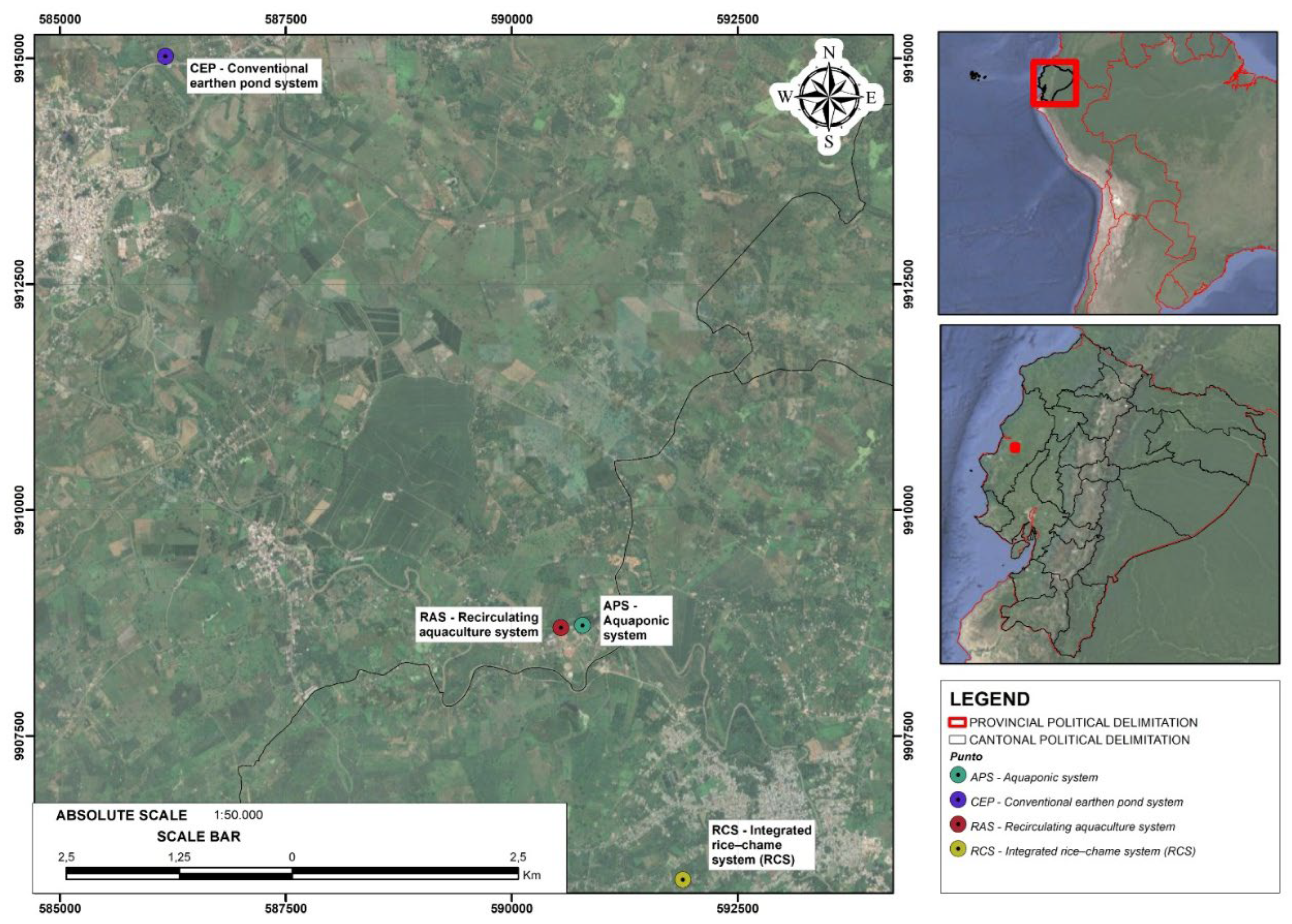
Figure 2.
Ponds of the four chame (Dormitator latifrons) production systems evaluated: (a) aquaponic system (APS), (b) recirculating aquaculture system (RAS), (c) conventional earthen pond system (CEP), and (d) integrated rice–chame system (RCS).
Figure 2.
Ponds of the four chame (Dormitator latifrons) production systems evaluated: (a) aquaponic system (APS), (b) recirculating aquaculture system (RAS), (c) conventional earthen pond system (CEP), and (d) integrated rice–chame system (RCS).
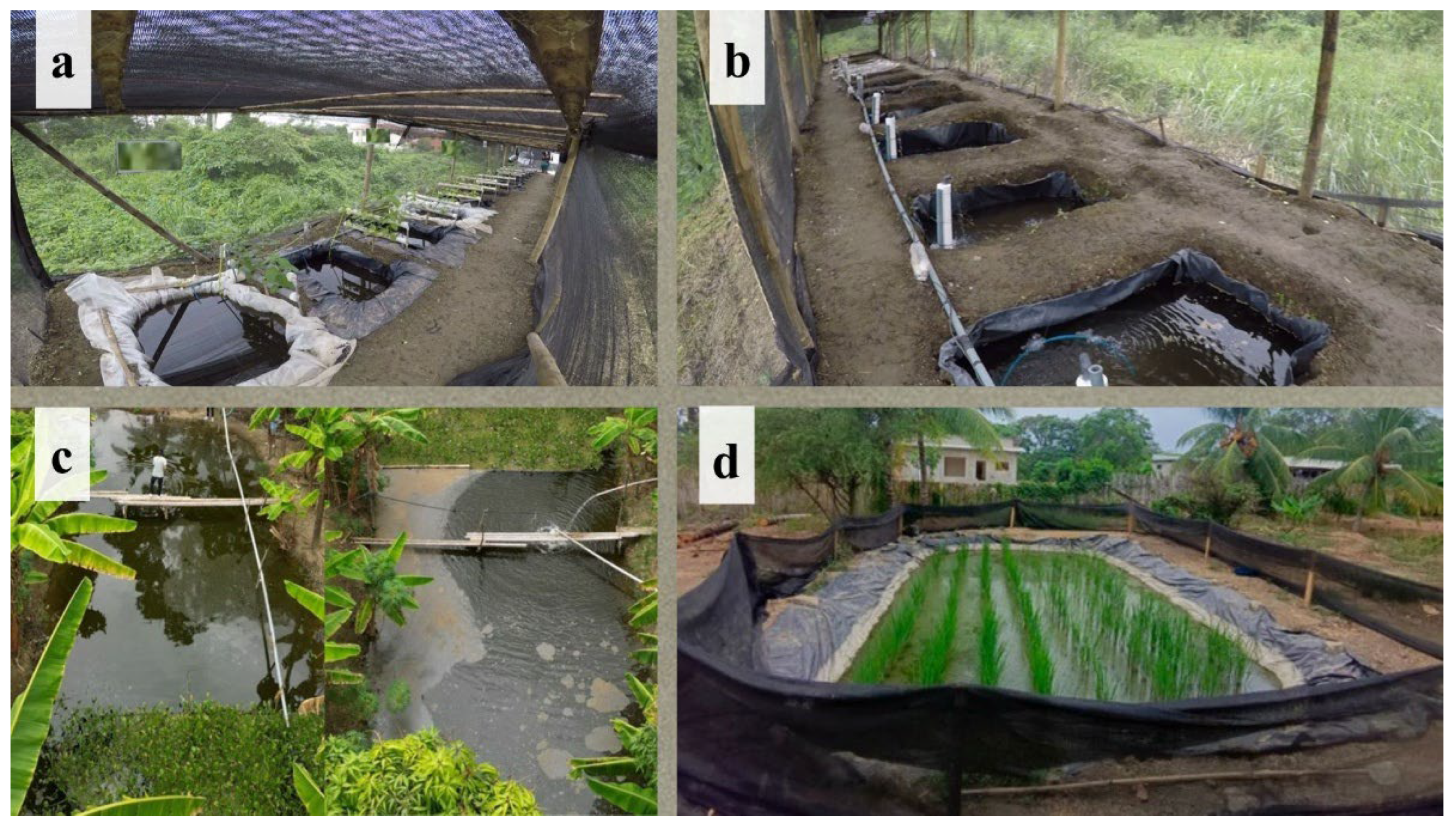
Figure 3.
(a) Cluster analysis based on Mahalanobis distances and (b) scatterplot of individual observation scores obtained from the canonical discriminant functions using physicochemical water quality parameters of four aquaculture systems in Ecuador. APS: aquaponic system; RAS: recirculating aquaculture system; CEP: conventional earthen pond system; RCS: integrated rice–chame system.
Figure 3.
(a) Cluster analysis based on Mahalanobis distances and (b) scatterplot of individual observation scores obtained from the canonical discriminant functions using physicochemical water quality parameters of four aquaculture systems in Ecuador. APS: aquaponic system; RAS: recirculating aquaculture system; CEP: conventional earthen pond system; RCS: integrated rice–chame system.
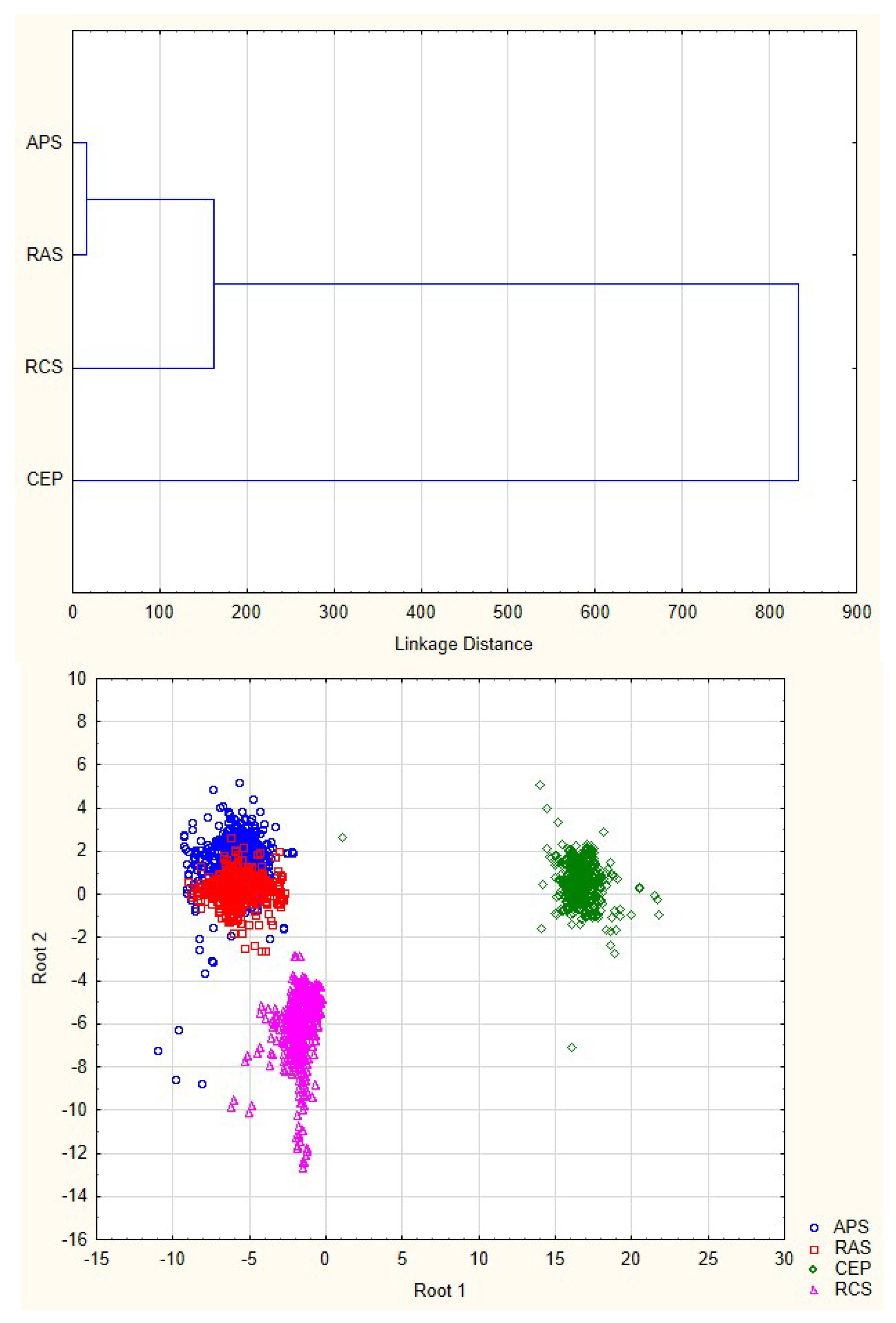

Table 1.
Physicochemical water quality parameters and analytical methods applied.
| Parameter | Analytical Method 1 |
| pH | Potentiometry |
| Turbidity (NTU) | Turbidimetry |
| Temperature (°C) | Temperature probe |
| Salinity (mg L⁻¹) | Conductimetry |
| Alkalinity (mg L⁻¹) | Volumetric titration |
| Dissolved oxygen (mg L⁻¹) | Oximetry |
| Color (UPC) | Spectrophotometry |
| Nitrites (mg L⁻¹) | Spectrophotometry |
| Phosphates (mg L⁻¹) | Spectrophotometry |
| Total dissolved solids (mg L⁻¹) | Conductimetry |
| Total hardness (mg L⁻¹) | Volumetric titration |
| Electrical conductivity (mS cm⁻¹) | Conductimetry |
1 [40].
Table 2.
Physicochemical water quality parameters measured in ponds from four aquaculture systems in Ecuador (mean ± SD and coefficient of variation).
Table 2.
Physicochemical water quality parameters measured in ponds from four aquaculture systems in Ecuador (mean ± SD and coefficient of variation).
| Parameters | Aquaculture Systems 1 | P_value | ||||
|
All (n = 3,544) |
APS (n = 1152) |
RAS (n = 1152) |
CEP (n = 840) |
RCS (n = 400) |
||
| pH | 7.94±0.01 (4.21) | 8.02±0.01 (2.33) b | 8.14±0.01 (2.39) a | 7.55±0.01 (4.52) d | 7.97±0.01 (3.58) c | < 0.001 |
| Total dissolved solids, mg/l | 890.06±9.97 (66.67) | 522.42±2.54 (16.50) c | 529.01±2.44 (15.63) c | 1.928.42±4.74 (7.12) a | 808.13±2.78 (6.87) b | < 0.001 |
| Temperature, °C | 27.40±0.03 (5.53) | 27.07±0.02 (2.44) c | 26.35±0.02 (3.12) d | 28.99±0.06 (5.61) a | 28.08±0.08 (5.41) b | < 0.001 |
| Dissolved oxygen, mg/l | 4.87±0.03 (40.63) | 3.88±0.01 (12.02) d | 4.06±0.02 (12.81) c | 5.79±0.09 (44.18) b | 8.12±0.08 (19.25) a | < 0.001 |
| Salinity, ppm | 1094.40±12.42 (67.57) | 644.25±3.40 (17.91) c | 638.07±3.35 (17.81) c | 2.391.06±4.65 (5.64) a | 982.11±2.81 (5.73) b | < 0.001 |
| Electrical conductivity, mS/cm | 1.70±0.02 (67.99) | 1.00±0.01 (17.91) c | 0.99±0.01 (17.79) c | 3.74±0.01 (5.71) a | 1.52±0.00 (5.73) b | < 0.001 |
| Turbidity, NTU | 8.72±0.14 (98.51) | 10.89±0.26 (82.46) b | 4.22±0.09 (70.42) d | 6.38±0.11 (51.79) c | 20.34±0.62 (61.19) a | < 0.001 |
| Chlorides, mg/l | 40.78±0.64 (92.76) | 39.94±0.95 (80.71) c | 48.25±0.62 (43.55) b | n.m. | 107.33±0.91 (17.05) a | < 0.001 |
| Alkalinity, mg/l | 176.03±4.98 (168.36) | 65.71±0.48 (24.69) c | 79.96±3.11 (132.21) c | 163.37±4.57 (81.05) b | 797.00±25.56 (64.14) a | < 0.001 |
| Colour, Pt/Co | 121.51±1.55 (76.06) | 202.54±2.83 (47.48) a | 83.80±1.70 (68.72) b | 85.86±1.57 (52.85) b | 71.65±4.20 (117.10) c | < 0.001 |
| Nitrate, mg/l | 0.61±0.04 (397.16) | 1.15±0.04 (130.15) a | 0.13±0.00 (54.66) b | 0.82±0.16 (560.40) b | 0.03±0.00 (31.41) c | < 0.001 |
| Phosphates, mg/l | 7.15±0.10 (80.57) | 12.56±0.14 (38.05) a | 8.73±0.02 (9.69) b | n.m. | 2.00±0.04 (44.90) c | < 0.001 |
| Ammonium, mg/l | 1.61±0.03 (101.34) | 2.08±0.06 (94.24) b | 0.59±0.01 (45.75) d | 2.49±0.06 (70.77) a | 1.32±0.03 (40.70) c | < 0.001 |
| Total hardness, mg/l | 764.93±9.24 (71.92) | 521.37±3.26 (21.22) b | 488.43±4.40 (30.58) c | 1.663.39±13.31 (23.18) a | 375.89±8.95 (47.63) d | < 0.001 |
1 APS = Aquaponic System; RAS = Recirculation System; CEP = Convectional System; RCS = Integrate Rice-Chame System; a, b, c, d superscript letters indicate significative differences amongst species (p < 0.05); n.m. = not measured in the conventional earthen pond system (CEP).
Table 3.
Discriminant functions of physicochemical water quality parameters in four pond-based aquaculture systems in Ecuador.
Table 3.
Discriminant functions of physicochemical water quality parameters in four pond-based aquaculture systems in Ecuador.
| Parameters | Wilks’ Lambda | Partial Lambda | F-remove | p-level | Toler | 1-Toler |
| Electrical conductivity | 0.00 | 0.99 | 9.99 | < 0.001 | 0.01 | 0.99 |
| Turbidity | 0.00 | 0.77 | 354.19 | < 0.001 | 0.87 | 0.13 |
| Phosphates | 0.00 | 0.83 | 241.20 | < 0.001 | 0.92 | 0.08 |
| Chlorides | 0.00 | 0.78 | 328.78 | < 0.001 | 0.90 | 0.10 |
| Colour | 0.00 | 0.76 | 369.63 | < 0.001 | 0.74 | 0.26 |
| Total dissolved solids | 0.00 | 0.68 | 564.08 | < 0.001 | 0.48 | 0.52 |
| Dissolved oxygen | 0.00 | 0.87 | 179.33 | < 0.001 | 0.79 | 0.21 |
| Nitrates | 0.00 | 0.82 | 253.04 | < 0.001 | 0.52 | 0.48 |
| Turbidity | 0.00 | 0.85 | 199.39 | < 0.001 | 0.78 | 0.22 |
| Temperature | 0.00 | 0.82 | 254.61 | < 0.001 | 0.87 | 0.13 |
| pH | 0.00 | 0.88 | 159.13 | < 0.001 | 0.89 | 0.11 |
| Ammonium | 0.00 | 0.94 | 78.73 | < 0.001 | 0.85 | 0.15 |
| Total hardness | 0.00 | 0.97 | 36.62 | < 0.001 | 0.80 | 0.20 |
| Salinity | 0.00 | 0.99 | 6.67 | < 0.001 | 0.01 | 0.99 |
Table 4.
Classification matrix of physicochemical water quality parameters for four pond-based aquaculture systems in Ecuador.
Table 4.
Classification matrix of physicochemical water quality parameters for four pond-based aquaculture systems in Ecuador.
| System 1 | Percent | APS | RAS | CEP | RCS |
| APS | 84.81 | 977 | 171 | 0 | 4 |
| RAS | 98.78 | 14 | 1138 | 0 | 0 |
| CEP | 99.88 | 1 | 0 | 838 | 0 |
| RCS | 100.00 | 0 | 0 | 0 | 400 |
| Total | 94.64 | 992 | 1309 | 838 | 404 |
1 APS = Acuaponic system; RAS = Recirculation system; CEP = Convenctional system; RCS = Integrated rice-chame system.
Disclaimer/Publisher’s Note: The statements, opinions and data contained in all publications are solely those of the individual author(s) and contributor(s) and not of MDPI and/or the editor(s). MDPI and/or the editor(s) disclaim responsibility for any injury to people or property resulting from any ideas, methods, instructions or products referred to in the content. |
© 2026 by the authors. Licensee MDPI, Basel, Switzerland. This article is an open access article distributed under the terms and conditions of the Creative Commons Attribution (CC BY) license (http://creativecommons.org/licenses/by/4.0/).
Copyright: This open access article is published under a Creative Commons CC BY 4.0 license, which permit the free download, distribution, and reuse, provided that the author and preprint are cited in any reuse.


