

Submitted:
19 February 2026
Posted:
26 February 2026
You are already at the latest version
Abstract
The pharmaceutical industry is undergoing a significant transformation driven by digitalization and the adoption of Industry 4.0 principles. Among the most promising innovations is digital twin technology, which creates dynamic virtual replicas of physical manufacturing processes that enable real-time simulation, monitoring, prediction, and optimization. This review article examines the convergence of digital twin technology with established process validation frameworks in pharmaceutical manufacturing, with particular emphasis on the three-stage lifecycle approach outlined in the United States Food and Drug Administration (FDA) Process Validation Guidance and the International Council for Harmonisation (ICH) quality guidelines Q8 (R2), Q9 (R1), Q10, and Q13. The paper explores how digital twins can enhance each stage of process validation, from process design (Stage 1) through process qualification (Stage 2) to continued process verification (Stage 3), by providing mechanistic and data-driven models that improve process understanding, reduce development timelines, and support real-time decision-making. Key enabling technologies, including Process Analytical Technology (PAT), Internet of Things (IoT) sensor networks, machine learning algorithms, and cloud computing platforms, are discussed in the context of their integration with digital twin architectures. Case studies from both small molecule and biologic manufacturing are presented to illustrate practical applications. The article further addresses regulatory considerations, data integrity requirements, model validation challenges, and the ethical implications of adopting AI-augmented digital twins in GMP-regulated environments. Finally, future research directions, including the integration of quantum computing, multi-omics data, and federated learning approaches, are proposed. This review aims to provide pharmaceutical scientists, engineers, and regulatory professionals with a comprehensive roadmap for leveraging digital twin technology to achieve robust, compliant, and efficient manufacturing processes.
Keywords:
digital twin
; process validation
; pharmaceutical manufacturing
; process analytical technology
; quality by design
; continuous process verification
; FDA
; ICH guidelines
; industry 4.0
; continuous manufacturing
1. Introduction
1.1. Background and Context
Pharmaceutical manufacturing operates within one of the most stringently regulated environments in modern industry. The imperative to ensure product quality, safety, and efficacy demands that manufacturing processes are designed, qualified, and continuously verified throughout their commercial lifecycle [1]. Historically, process validation in the pharmaceutical sector has relied on a prescriptive, testing-intensive paradigm in which a fixed number of conformance batches were produced and evaluated against predefined acceptance criteria. This approach, while effective in demonstrating process capability at a specific point in time, offered limited insight into the dynamic behavior of manufacturing processes and provided minimal predictive capability for identifying emerging trends or potential deviations before they resulted in out-of-specification (OOS) outcomes [2].
The publication of the FDA’s 2011 Process Validation Guidance marked a paradigm shift by introducing a lifecycle-based approach comprising three distinct stages: Stage 1 (Process Design), Stage 2 (Process Qualification), and Stage 3 (Continued Process Verification, or CPV) [3]. This framework, aligned with ICH Q8(R2) on Pharmaceutical Development, ICH Q9(R1) on Quality Risk Management, and ICH Q10 on Pharmaceutical Quality System, emphasizes the importance of building quality into the product through comprehensive process understanding rather than relying solely on end-product testing [4]. The subsequent publication of ICH Q13 on Continuous Manufacturing of Drug Substances and Drug Products in 2022 further reinforced the integration of advanced process control, Process Analytical Technology (PAT), and model-based approaches into pharmaceutical manufacturing [5].
Concurrently, the broader manufacturing sector has been undergoing a digital transformation commonly referred to as Industry 4.0, characterized by the convergence of cyber-physical systems, the Internet of Things (IoT), cloud computing, big data analytics, and artificial intelligence (AI) [6]. Central to this transformation is the concept of the digital twin, a dynamic virtual representation of a physical system that is continuously updated with real-time data to mirror its behavior, predict its performance, and optimize its operation [7]. Originally conceptualized by Dr. Michael Grieves at the University of Michigan in 2002 and subsequently advanced by NASA for spacecraft lifecycle management, digital twin technology has been adopted across aerospace, automotive, energy, and other advanced manufacturing sectors [8].
Despite these advances, the pharmaceutical industry has been comparatively slow to adopt full-scale digital twin implementations. A comprehensive literature review by Chen et al. (2020) noted that although the pharmaceutical sector has embraced Quality by Design (QbD) principles and is undergoing digitalization, there has not yet been a fully realized digital twin application in pharmaceutical manufacturing [9]. This gap represents both a challenge and an opportunity. The pharmaceutical industry generates petabytes of data annually from process monitoring, analytical testing, and quality systems, yet an estimated 70% of this data remains underutilized [10]. Digital twins offer a framework for transforming this latent information into actionable process intelligence.
1.2. Objectives and Scope
The objective of this review is to provide a comprehensive examination of how digital twin technology can be integrated with established pharmaceutical process validation frameworks to enhance manufacturing efficiency, product quality, and regulatory compliance. Specifically, this article aims to: (a) define the foundational concepts, architecture, and enabling technologies of pharmaceutical digital twins; (b) map digital twin capabilities to each stage of the FDA process validation lifecycle; (c) review case studies and industry applications demonstrating practical implementations; (d) analyze the regulatory landscape, data integrity considerations, and model validation requirements; and (e) identify future research directions and emerging technologies that will shape the next generation of pharmaceutical manufacturing. The scope encompasses both small molecule (chemical) and biologic (biopharmaceutical) manufacturing processes, including batch and continuous manufacturing modalities.
2. Literature Review
2.1. Evolution of Process Validation in Pharmaceuticals
The concept of process validation in pharmaceuticals has evolved significantly over the past four decades. The FDA’s original 1987 Guideline on General Principles of Process Validation defined process validation as establishing documented evidence that a specific process will consistently produce a product meeting its predetermined specifications and quality attributes [11]. This guidance established the traditional three-batch validation paradigm that dominated pharmaceutical manufacturing practice for over two decades. However, this approach had inherent limitations: it provided only a snapshot of process performance, did not account for process variability over time, and offered no mechanism for incorporating emerging scientific understanding into the validated state [2].
The 2011 revision fundamentally restructured process validation as a lifecycle activity aligned with product and process understanding. Stage 1 (Process Design) encompasses the collection of knowledge and understanding of the manufacturing process, including the identification of critical process parameters (CPPs) and critical quality attributes (CQAs) through systematic experimentation, typically using Design of Experiments (DoE) methodologies as described in ICH Q8(R2) [4]. Stage 2 (Process Qualification) evaluates whether the process design can be reproduced reliably at commercial scale, incorporating facility and equipment qualification (Installation Qualification, Operational Qualification, and Performance Qualification) as well as Process Performance Qualification (PPQ) [3]. Stage 3 (Continued Process Verification) provides ongoing assurance that the process remains in a state of control throughout its commercial lifecycle through statistical monitoring of critical parameters and quality attributes [3].
This lifecycle approach was further reinforced by EMA’s process validation guidelines and the integration of ICH Q12 on Product Lifecycle Management, which collectively emphasize the importance of knowledge management, continuous improvement, and the use of science-based and risk-based approaches throughout the product lifecycle [12]. The regulatory environment has thus created a natural synergy with digital twin technology, which is fundamentally predicated on continuous data acquisition, model-based process understanding, and predictive analytics.
2.2. Digital Twin Technology: Definitions and Architecture
A digital twin in the pharmaceutical manufacturing context can be defined as a virtual representation of a physical manufacturing process, product, or system that integrates real-time sensor data, process models (mechanistic, empirical, or hybrid), and historical knowledge to simulate, predict, and optimize the behavior of its physical counterpart [7]. The essential components of a pharmaceutical digital twin include: (a) the physical system comprising manufacturing equipment, raw materials, and process streams instrumented with sensors and PAT tools; (b) the virtual model layer incorporating mathematical representations of process dynamics, kinetics, thermodynamics, and quality relationships; (c) the data communication infrastructure enabling bidirectional information flow between the physical and virtual domains; and (d) the analytics and decision support layer providing predictive capabilities, optimization algorithms, and visualization tools [9].
Grieves and Vickers (2017) established a taxonomy of digital twin maturity levels that has been widely adopted: Digital Twin Prototype (DTP), which is constructed before the physical entity exists; Digital Twin Instance (DTI), which is linked to a specific physical entity; and Digital Twin Aggregate (DTA), which combines data and models from multiple instances for fleet-level or process-level optimization [8]. In pharmaceutical manufacturing, a DTP might be used during process design (Stage 1) to simulate and optimize process parameters virtually before committing to physical experiments. A DTI would represent a specific production line or bioreactor, continuously synchronized with real-time data during commercial manufacturing. A DTA could aggregate data across multiple manufacturing sites, product lines, or campaigns to identify cross-process trends and optimize platform processes [13].
The modeling approaches employed in pharmaceutical digital twins span a continuum from first-principles (mechanistic) models to purely data-driven (empirical) models, with hybrid models combining elements of both becoming increasingly prevalent. Mechanistic models, grounded in fundamental chemical engineering and biological principles such as mass and energy balances, reaction kinetics, and transport phenomena, offer the advantage of interpretability and the ability to extrapolate beyond the training data domain [14]. Data-driven models, including machine learning algorithms such as random forests, support vector machines, and neural networks, can capture complex nonlinear relationships in high-dimensional data without requiring explicit mechanistic knowledge [15]. Hybrid models leverage the strengths of both approaches by embedding mechanistic constraints within data-driven frameworks, thereby improving prediction accuracy while maintaining physical consistency [10].
2.3. Enabling Technologies
2.3.1. Process Analytical Technology (PAT)
PAT, as defined in the FDA’s 2004 PAT Framework Guidance, is a system for designing, analyzing, and controlling manufacturing through timely measurements of critical quality and performance attributes of raw and in-process materials and processes [16]. PAT tools serve as the sensory apparatus of a digital twin, providing the real-time data streams necessary for model calibration, updating, and validation. Common PAT implementations in pharmaceutical manufacturing include near-infrared (NIR) spectroscopy for blend uniformity and content uniformity monitoring, Raman spectroscopy for polymorphic form identification and reaction monitoring, focused beam reflectance measurement (FBRM) for particle size distribution, and in-line ultraviolet (UV) spectroscopy for concentration monitoring in biologics purification [17]. The integration of PAT with digital twins enables a closed-loop control architecture in which the digital twin processes real-time PAT data, updates its internal models, generates predictions, and issues corrective control actions to maintain the process within the established design space [5].
2.3.2. Internet of Things (IoT) and Sensor Networks
The IoT provides the connectivity backbone for digital twin implementations by enabling the acquisition and transmission of data from distributed sensors, equipment, and systems across the manufacturing floor. In pharmaceutical manufacturing, IoT-enabled sensors monitor environmental conditions (temperature, humidity, differential pressure), equipment operating parameters (agitation speed, flow rates, column pressures), and utility systems (purified water, clean steam, compressed air) [18]. Edge computing architectures allow for local data preprocessing and anomaly detection before transmitting consolidated information to cloud-based digital twin platforms, reducing latency and bandwidth requirements while maintaining data integrity [6]. The integration of IoT with digital twins provides the continuous data stream necessary for real-time model updating and predictive maintenance, enabling the transition from reactive to proactive quality management.
2.3.3. Artificial Intelligence and Machine Learning
AI and machine learning (ML) algorithms serve as the analytical engine of pharmaceutical digital twins, enabling pattern recognition, predictive modeling, and optimization in complex, high-dimensional process data. Supervised learning algorithms, including gradient boosting machines and deep neural networks, are employed for predicting CQAs from CPPs and raw material attributes [15]. Unsupervised learning methods, such as principal component analysis (PCA) and clustering algorithms, are used for process monitoring, fault detection, and the identification of abnormal operating conditions during continued process verification [19]. Reinforcement learning approaches are emerging as tools for adaptive process control, where the digital twin learns optimal control strategies through interaction with simulated process environments [10]. The integration of explainable AI (XAI) methods, such as SHAP (SHapley Additive exPlanations) values and LIME (Local Interpretable Model-agnostic Explanations), is increasingly important in regulatory contexts where transparency and interpretability of model-based decisions are required [20].
2.4. Digital Twins in the Context of ICH Quality Guidelines
The ICH quality guidelines provide a comprehensive framework that is highly compatible with digital twin implementations. ICH Q8(R2) introduces the concepts of Quality by Design (QbD), design space, and the Quality Target Product Profile (QTPP), all of which can be enhanced through digital twin simulation and optimization [4]. The design space, defined as the multidimensional combination and interaction of input variables and process parameters that have been demonstrated to provide assurance of quality, can be more thoroughly explored and characterized using digital twin simulations than through physical experimentation alone [21]. ICH Q9(R1) on Quality Risk Management provides the risk-based framework for prioritizing which process parameters and quality attributes to include in the digital twin model, using tools such as Failure Mode and Effects Analysis (FMEA) and Ishikawa diagrams [22]. ICH Q10 on Pharmaceutical Quality System establishes the knowledge management and continual improvement infrastructure that digital twins both depend upon and contribute to [23]. Most recently, ICH Q13 on Continuous Manufacturing explicitly recognizes the role of process modeling, including digital twins, in understanding process dynamics, establishing control strategies, and supporting regulatory submissions for continuous manufacturing processes [5].
3. Digital Twins Across the Process Validation Lifecycle
3.1. Stage 1: Process Design
During process design, digital twins function primarily as Digital Twin Prototypes (DTPs), enabling virtual experimentation and process optimization before committing to costly and time-consuming physical experiments. In small molecule manufacturing, mechanistic models of unit operations such as chemical synthesis, crystallization, filtration, drying, blending, granulation, and compression can be developed using first-principles engineering models and calibrated with laboratory-scale experimental data [14]. These models allow scientists to explore the design space virtually, identifying critical interactions between process parameters and their effects on CQAs such as dissolution rate, content uniformity, particle size distribution, and polymorphic form.
A seminal study by Ierapetritou and colleagues demonstrated that integrated process models (also termed end-to-end digital twins) connecting multiple unit operations in a continuous direct compression process could predict tablet CQAs with sufficient accuracy to support design space definition and control strategy development [24]. The study showed that by combining population balance models for granulation, discrete element method (DEM) simulations for blending, and finite element analysis for tablet compression, the digital twin could identify previously unrecognized parameter interactions that would not have been detected by univariate experimentation alone. This finding directly supports the ICH Q8(R2) recommendation that design spaces should account for multivariate interactions among process parameters [4].
In biopharmaceutical manufacturing, digital twins of cell culture processes (e.g., Chinese Hamster Ovary (CHO) cell bioreactors for monoclonal antibody production) incorporate kinetic models of cell growth, nutrient consumption, metabolite production, and product quality attribute formation (e.g., glycosylation profiles, charge variants, aggregation) [25]. Oberleitner et al. (2022) demonstrated a holistic DoE approach using an integrated process model that connected upstream bioreactor, harvest, and downstream purification operations, enabling the identification of critical parameter interactions spanning unit operation boundaries [26]. Such end-to-end digital twins are particularly valuable during process design because they reveal how upstream perturbations propagate through the process to affect final drug substance quality, knowledge that is essential for establishing robust control strategies.
3.2. Stage 2: Process Qualification
Process qualification represents the transition from laboratory/pilot scale to commercial manufacturing, requiring demonstration that the process design can be reliably executed at production scale under conditions representative of routine commercial manufacturing. Digital twins contribute to this stage by reducing the risk of scale-up failure through predictive simulation of full-scale process behavior based on models developed and validated at smaller scales [7].
During facility and equipment qualification (IQ/OQ/PQ), digital twins can simulate equipment operating envelopes, predict critical utility requirements, and identify potential failure modes before physical qualification runs are executed. For example, computational fluid dynamics (CFD) digital twins of large-scale bioreactors can predict mixing times, oxygen transfer rates, and shear stress distributions at production scale, allowing engineers to verify that the commercial-scale equipment will maintain the critical environmental conditions established during process design [27]. This virtual pre-qualification reduces the number of physical qualification runs required, accelerating the qualification timeline while improving confidence in the outcome.
During Process Performance Qualification (PPQ), digital twins serve a dual purpose. First, they can be used to establish scientifically justified acceptance criteria for PPQ batches by predicting the expected range of process performance under normal operating variability. This addresses a common challenge in PPQ design: determining how many batches are sufficient and what constitutes acceptable performance [3]. Second, digital twins can augment PPQ data by providing model-based predictions of quality attributes that are difficult or expensive to measure directly, such as residual host cell protein levels in biologics or the rate of degradant formation under long-term storage conditions [28]. The combination of physical PPQ data and digital twin predictions provides a more comprehensive demonstration of process understanding than either approach alone, aligning with the FDA’s expectation that process qualification should demonstrate a high degree of assurance that the manufacturing process will consistently produce products meeting quality attributes [3].
3.3. Stage 3: Continued Process Verification
Continued Process Verification (CPV) is the stage where digital twins arguably deliver the greatest value, as they transform CPV from a retrospective data review exercise into a proactive, predictive quality management system. Traditional CPV approaches typically involve periodic (e.g., quarterly or annual) review of control charts and trend analyses of CPPs and CQAs [29]. While effective for detecting gradual process shifts, this approach has inherent latency in detecting emerging trends and limited ability to predict future process performance.
A digital twin-enabled CPV system continuously ingests real-time PAT and sensor data, updates its internal models, and generates forward-looking predictions of process trajectory and product quality. Ondracka et al. (2023) described an AI-powered continued process verification system for bioreactor processes that used a digital twin model to detect process deviations earlier than conventional statistical process control (SPC) methods, reducing the risk of batch failure and improving overall process yield [19]. The system combined mechanistic models of cell growth kinetics with machine learning models trained on historical batch data to generate batch-specific quality predictions in real time.
Furthermore, digital twins support the concept of adaptive control during CPV, where the virtual model continuously evaluates the current process state against the design space and recommends corrective actions when the process trajectory approaches design space boundaries. Marschall et al. (2022) proposed specification-driven acceptance criteria for the validation of biopharmaceutical processes, where the digital twin defines process-specific acceptance boundaries based on the predicted relationship between process parameters and final product quality rather than on fixed, arbitrary specifications [30]. This approach represents a significant advancement in pharmaceutical quality assurance, moving from reactive deviation management to proactive process steering.
4. Case Studies and Industry Applications
4.1. Digital Twins in Continuous Solid Oral Dosage Manufacturing
Continuous manufacturing of solid oral dosage forms has been one of the earliest and most successful areas of digital twin implementation in pharmaceuticals. The integration of digital twins with continuous direct compression, wet granulation, and roller compaction processes has demonstrated significant improvements in process understanding, real-time release testing (RTRT), and control strategy robustness. Vertex Pharmaceuticals received FDA approval for the continuous manufacturing of Orkambi (lumacaftor/ivacaftor) tablets, utilizing PAT-enabled real-time monitoring that embodies several digital twin principles [31]. The process incorporates in-line NIR spectroscopy for blend monitoring, automated weight and thickness control for tablets, and a model-based control strategy that adjusts process parameters in response to real-time quality measurements.
Janssen Pharmaceuticals (Johnson & Johnson) has also implemented continuous manufacturing with integrated process modeling for the production of Prezista (darunavir) tablets, demonstrating that the digital twin approach can reduce manufacturing cycle times from approximately two weeks to less than one day while simultaneously improving product quality consistency [32]. These implementations demonstrate that the digital twin concept is not merely theoretical but has been successfully translated into commercial pharmaceutical manufacturing, with demonstrable benefits in efficiency, quality, and regulatory compliance.
4.2. Digital Twins in Biopharmaceutical Manufacturing
In biopharmaceutical manufacturing, digital twins have been applied to both upstream (cell culture) and downstream (purification) processes. A particularly compelling application is the use of integrated process models as recommender systems during manufacturing. As described by Korber Pharma’s implementation of end-to-end digital twins for monoclonal antibody production, the digital twin integrates models across fermentation, harvest, and purification unit operations, enabling operators to predict the impact of upstream deviations on final product quality and receive recommended corrective actions in real time [33]. In one illustrative example, when a deviation in bioreactor seeding density was detected, the digital twin predicted the resulting change in OOS probability at the end of the process and suggested compensatory parameter adjustments in downstream operations to mitigate the impact, effectively converting a potential batch failure into a controlled, adaptive response.
Additionally, process analytical technology-based digital twins have been shown to enhance production quality while reducing out-of-specification batches in biologics manufacturing. Research by Wasalathanthri et al. (2020) demonstrated the application of multi-attribute method (MAM) mass spectrometry combined with digital twin models for real-time monitoring of critical quality attributes during monoclonal antibody production, including glycosylation profiles, charge variants, and aggregation levels [34]. These implementations highlight the potential of digital twins to support the transition from traditional lot-release testing to real-time release testing (RTRT) in biopharmaceutical manufacturing, a paradigm strongly encouraged by both FDA and EMA.
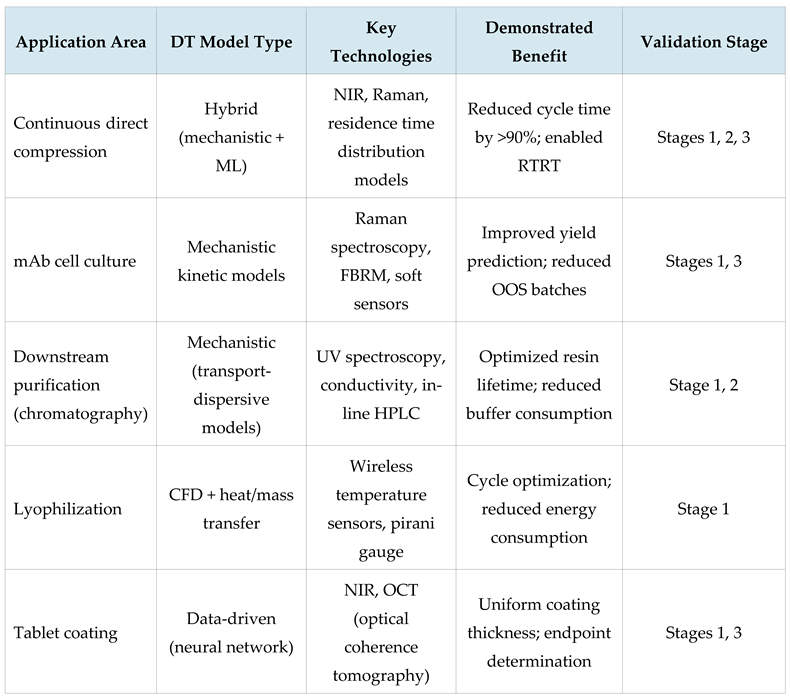
4.3. Comparative Analysis of Digital Twin Implementations

Table 1.
Comparative Summary of Digital Twin Implementations in Pharmaceutical Manufacturing.
 |
5. Regulatory Considerations and Data Integrity
5.1. Regulatory Landscape for Digital Twins in Pharmaceutical Manufacturing
The regulatory framework governing the use of digital twins and computational models in pharmaceutical manufacturing is evolving rapidly. The FDA has signaled its support for model-based approaches through several initiatives, including the 2004 PAT Framework, the 2011 Process Validation Guidance, and the 2023 Discussion Paper on Using Artificial Intelligence and Machine Learning in the Development of Drug and Biological Products [35]. The FDA’s MAPP 5016.1 on Applying ICH Q8(R2), Q9(R1), and Q10 explicitly acknowledges the potential use of mathematical models, including multivariate models, as surrogates for traditional testing when supported by appropriate validation evidence [36]. The EMA has similarly recognized the role of modeling and simulation in regulatory submissions, establishing the Model Informed Drug Development (MIDD) framework and publishing reflection papers on the use of modeling in pharmaceutical quality dossiers [37].
ICH Q13 on Continuous Manufacturing provides the most explicit regulatory guidance on process modeling in pharmaceutical manufacturing, describing how models can be used to understand process dynamics, establish design spaces, support control strategies, and enable real-time release testing [5]. The guideline recognizes that continuous processes inherently require more sophisticated control strategies and that process models, when properly validated, can serve as integral components of the regulatory control strategy. However, the guideline also emphasizes that model validation must be rigorous, including demonstration of model accuracy, precision, robustness, and the establishment of model maintenance procedures to ensure continued validity over the product lifecycle [5].
5.2. Model Validation and Qualification
The validation of digital twin models for use in GMP-regulated pharmaceutical manufacturing presents unique challenges that extend beyond traditional software validation and Computer System Validation (CSV) or Computer Software Assurance (CSA) paradigms. Model validation in this context must address several dimensions: (a) scientific validity, demonstrating that the model is based on sound scientific principles and correctly represents the underlying process mechanisms; (b) predictive accuracy, quantifying the model’s ability to predict process behavior and product quality within defined limits of uncertainty; (c) robustness, demonstrating that model performance is maintained across the range of expected input variability, including raw material variability, environmental fluctuations, and equipment aging; and (d) transferability, confirming that models developed at one scale or site can be applied at different scales or sites with appropriate recalibration [38].
The ASTM E2968-14 Standard Guide for the Application of Continuous Process Verification in Pharmaceutical and Biopharmaceutical Manufacturing provides relevant guidance on the statistical methods and acceptance criteria that can be applied to model-based CPV systems [39]. Additionally, the ISPE GAMP 5 Second Edition guidance on records and data integrity offers a risk-based framework for assessing the criticality and integrity requirements of model inputs, outputs, and parameters [40]. A risk-based approach to model validation, aligned with ICH Q9(R1) principles, would stratify models according to their impact on product quality decisions: models used for regulatory release decisions would require the most rigorous validation, while models used for process optimization or troubleshooting would require less formal qualification [22].
5.3. Data Integrity in Digital Twin Environments
Data integrity is a cornerstone of pharmaceutical GMP compliance, and the integration of digital twins introduces new considerations for ensuring the ALCOA+ (Attributable, Legible, Contemporaneous, Original, Accurate, Complete, Consistent, Enduring, Available) principles are maintained throughout the data lifecycle [41]. In a digital twin environment, data flows continuously from physical sensors through communication networks, data historians, model engines, and visualization platforms, creating multiple potential points of failure or manipulation. Ensuring data integrity in this context requires a comprehensive approach encompassing validated data acquisition systems, secure data transmission protocols, tamper-evident audit trails, and version-controlled model configurations [40].
The FDA’s 2018 Data Integrity and Compliance With Drug CGMP Guidance emphasizes that data integrity systems should be designed to prevent, detect, and address data manipulation, and that electronic data systems should maintain complete audit trails [42]. For digital twin implementations, this means that all model inputs (sensor data, manual entries, material attributes), model parameters (calibration constants, algorithm weights), and model outputs (predictions, recommendations, control actions) must be captured in a secure, audit-trailed system that ensures traceability and accountability. Additionally, model versioning and change control procedures must be established to document and justify any modifications to the digital twin models, ensuring that the validated state is maintained throughout the product lifecycle [40].
6. Challenges and Limitations
6.1. Technical Challenges
Several technical barriers impede the widespread adoption of digital twins in pharmaceutical manufacturing. Data integration remains a primary challenge, as pharmaceutical manufacturing environments typically employ a heterogeneous landscape of equipment, sensors, and information systems that use different data formats, communication protocols, and sampling frequencies [9]. Legacy equipment, which constitutes a significant proportion of installed manufacturing capacity, may lack the digital interfaces necessary for real-time data acquisition, requiring retrofit solutions that add complexity and cost. Additionally, the computational requirements of high-fidelity mechanistic models, particularly CFD simulations and molecular dynamics calculations, can exceed the real-time performance requirements of production digital twins, necessitating model reduction techniques or surrogate modeling approaches that may sacrifice accuracy for speed [14].
Model accuracy and generalizability present another significant challenge. Pharmaceutical processes are inherently variable due to batch-to-batch differences in raw materials, environmental conditions, and equipment wear. Digital twin models must be sufficiently robust to accommodate this variability while maintaining predictive accuracy across the full operating range. The phenomenon of concept drift, where the relationship between input variables and output responses changes over time due to equipment aging, raw material supplier changes, or other factors, requires continuous model monitoring and periodic recalibration [10]. Determining appropriate model maintenance frequencies and recalibration triggers is an area that requires further research and regulatory clarity.
6.2. Organizational and Cultural Challenges
The adoption of digital twin technology requires a significant organizational transformation that extends beyond technology implementation. Pharmaceutical companies must develop cross-functional teams that combine expertise in process engineering, data science, quality assurance, regulatory affairs, and information technology [6]. The traditional organizational silos that separate these functions can impede the collaborative approach required for successful digital twin implementation. Furthermore, the pharmaceutical industry’s inherently conservative culture, driven by stringent regulatory requirements and the high cost of compliance failures, can create resistance to adopting novel technologies whose regulatory acceptance is still evolving [43]. Building organizational competency in data science, model development, and digital infrastructure management requires sustained investment in training, recruitment, and knowledge management systems.
6.3. Regulatory Uncertainty
While regulatory agencies have expressed support for model-based approaches and digital transformation, the specific requirements for validating and maintaining digital twin models in GMP environments remain to be fully defined. Questions regarding the level of model validation evidence required for different applications, the acceptable uncertainty bounds for model-based predictions used in quality decisions, and the regulatory expectations for model maintenance and lifecycle management require further clarification through regulatory guidance, industry standards, and pilot programs [35]. The absence of harmonized international standards for pharmaceutical digital twin validation creates additional complexity for global manufacturers operating across multiple regulatory jurisdictions [37].
7. Future Directions
7.1. Emerging Technologies
Several emerging technologies are poised to significantly enhance the capabilities of pharmaceutical digital twins in the coming decade. Quantum computing, while still in its early stages of practical application, offers the potential to solve complex optimization and simulation problems that are intractable with classical computing architectures, such as molecular dynamics simulations of protein folding and drug-excipient interactions at the atomic level [44]. Federated learning approaches, which enable the training of machine learning models across multiple sites or organizations without sharing raw data, could address the data privacy and intellectual property concerns that currently limit collaborative model development in the pharmaceutical industry [45].
The integration of multi-omics data (genomics, proteomics, metabolomics) with manufacturing digital twins represents another frontier, particularly in biopharmaceutical manufacturing where cellular-level understanding is critical for process control. By incorporating transcriptomic and metabolomic data into bioreactor digital twins, manufacturers could gain deeper insight into the relationship between cellular physiology, process conditions, and product quality attributes, enabling more precise process control and earlier detection of process deviations [46]. Additionally, the concept of the dark factory, where autonomous digital twin-controlled manufacturing systems operate with minimal human intervention, represents the ultimate vision for pharmaceutical Industry 4.0, although significant regulatory and technical hurdles must be overcome before fully autonomous GMP manufacturing becomes a reality [47].
7.2. Convergence with Continuous Manufacturing
The convergence of digital twin technology with continuous manufacturing represents a particularly promising direction for pharmaceutical manufacturing. Continuous manufacturing processes, by their nature, generate continuous data streams that are ideally suited for digital twin integration. ICH Q13 explicitly recognizes the role of process modeling and real-time control in continuous manufacturing, creating a regulatory pathway for the integration of digital twins into commercial manufacturing operations [5]. As the industry transitions from batch to continuous manufacturing for both small molecule and biologic products, digital twins will become essential tools for understanding residence time distributions, managing material traceability, controlling process dynamics, and implementing real-time release testing. The combination of continuous manufacturing, PAT, and digital twins represents a paradigm where the traditional distinction between process validation stages becomes increasingly blurred, moving toward a model of continuous, real-time process assurance [32].
7.3. Standardization and Regulatory Evolution
The development of industry standards and best practices for pharmaceutical digital twins is essential for broader adoption. Organizations such as ISPE, PDA (Parenteral Drug Association), ASTM International, and the BioPhorum Operations Group are actively developing guidance documents and frameworks for the implementation of digital technologies in pharmaceutical manufacturing [39]. The evolution of Computer System Validation (CSV) toward the risk-based Computer Software Assurance (CSA) paradigm, as articulated in the FDA’s 2022 draft guidance, provides a more flexible and scalable framework for validating the software components of digital twin systems [48]. Future regulatory development should focus on establishing clear expectations for model validation evidence, defining the role of digital twin outputs in regulatory decision-making, and creating mechanisms for post-approval model updates that balance innovation with patient safety [35]. Collaborative initiatives between regulatory agencies, industry, and academia will be essential for developing the scientific foundations, regulatory frameworks, and workforce competencies needed to realize the full potential of digital twin technology in pharmaceutical manufacturing.
8. Conclusion
Digital twin technology represents a transformative opportunity for pharmaceutical manufacturing, offering the potential to fundamentally enhance process understanding, improve product quality, reduce development timelines, and support regulatory compliance across the entire product lifecycle. By creating dynamic virtual replicas of manufacturing processes that integrate real-time data, mechanistic knowledge, and machine learning algorithms, digital twins provide a platform for predictive, adaptive, and continuous quality assurance that aligns naturally with the lifecycle-based process validation framework established by the FDA and ICH guidelines.
This review has demonstrated that digital twins can add value at every stage of the process validation lifecycle: enhancing design space exploration and control strategy development during Stage 1 (Process Design); reducing scale-up risk and augmenting process qualification evidence during Stage 2 (Process Qualification); and enabling proactive, real-time process monitoring and adaptive control during Stage 3 (Continued Process Verification). Case studies from continuous solid dosage manufacturing and biopharmaceutical production illustrate that these benefits are being realized in commercial practice, with demonstrated improvements in manufacturing efficiency, product quality consistency, and regulatory compliance.
However, significant challenges remain, including technical barriers related to data integration and model accuracy, organizational challenges related to cross-functional competency development, and regulatory uncertainties regarding model validation requirements and the role of digital twin outputs in quality decisions. Addressing these challenges will require sustained collaboration between pharmaceutical manufacturers, technology providers, regulatory agencies, and academic institutions. As enabling technologies continue to advance, including AI, IoT, cloud computing, and potentially quantum computing, and as the regulatory framework evolves to accommodate model-based approaches, digital twins are poised to become an indispensable component of next-generation pharmaceutical manufacturing. The convergence of digital twin technology with continuous manufacturing, real-time release testing, and personalized medicine represents a future in which pharmaceutical production is more efficient, more flexible, and more reliably able to deliver high-quality therapeutic products to patients worldwide.
References
- U.S. Food and Drug Administration. Guidance for Industry: Process Validation: General Principles and Practices. 2011. Available online: https://www.fda.gov/files/drugs/published/Process-Validation--General-Principles-and-Practices.pdf.
- Sangshetti, J. N.; Deshpande, M.; Zaheer, Z.; Shinde, D. B.; Arote, R. Quality by design approach: Regulatory need. Arabian Journal of Chemistry 2017, 10, S3412–S3425. [Google Scholar] [CrossRef]
- U.S. Food and Drug Administration. Process Validation: General Principles and Practices, Revision 1. Center for Drug Evaluation and Research (CDER), Center for Biologics Evaluation and Research (CBER). Center for Veterinary Medicine (CVM), 2011. [Google Scholar]
- International Council for Harmonisation. ICH Q8(R2): Pharmaceutical Development. 2009. Available online: https://database.ich.org/sites/default/files/Q8_R2_Guideline.pdf.
- International Council for Harmonisation. ICH Q13: Continuous Manufacturing of Drug Substances and Drug Products. 2022. Available online: https://database.ich.org/sites/default/files/ICH_Q13_Guideline_2022_1116.pdf.
- Maharjan, R.; Shrestha, S.; Lee, J. C.; Jeong, S. H. Digital twins in pharmaceutical and biopharmaceutical manufacturing: A literature review. Processes 2023, 10(9), 1927. [Google Scholar] [CrossRef]
- Grieves, M.; Vickers, J. Digital twin: Mitigating unpredictable, undesirable emergent behavior in complex systems. In Transdisciplinary Perspectives on Complex Systems; Springer, 2017; pp. 85–113. [Google Scholar] [CrossRef]
- Grieves, M. Digital twin: Manufacturing excellence through virtual factory replication. In White Paper; Florida Institute of Technology, 2014. [Google Scholar]
- Chen, Y.; Yang, O.; Sampat, C.; Bhalode, P.; Ierapetritou, M.; Muzzio, F. J. Digital twins in pharmaceutical and biopharmaceutical manufacturing: A literature review. Processes 2020, 8(9), 1088. [Google Scholar] [CrossRef]
- BioProcess International. AI-enabled digital twins in biopharmaceutical manufacturing. In BioProcess International; 2025; Available online: https://www.bioprocessintl.com/information-technology/ai-enabled-digital-twins-in-biopharmaceutical-manufacturing.
- U.S. Food and Drug Administration. Guideline on General Principles of Process Validation. In Center for Drug Evaluation and Research; 1987. [Google Scholar]
- International Council for Harmonisation. ICH Q12: Technical and Regulatory Considerations for Pharmaceutical Product Lifecycle Management. 2019. Available online: https://database.ich.org/sites/default/files/Q12_Guideline_Step4_2019_1119.pdf.
- Fischer, R.-P.; Volpert, A.; Antonino, P.; Ahrens, T. D. Digital patient twins for personalized therapeutics and pharmaceutical manufacturing. Frontiers in Digital Health 2024, 5, 1302338. [Google Scholar] [CrossRef] [PubMed]
- Badr, S.; Sugiyama, H. A PSE perspective for the pharmaceutical industry: Data-driven and mechanistic models for manufacturing, design and development. Current Opinion in Chemical Engineering 2020, 27, 122–127. [Google Scholar] [CrossRef]
- Kolluri, S.; Lin, J.; Liu, R.; Zhang, Y.; Zhang, W. Machine learning and artificial intelligence in pharmaceutical research and development: A review. The AAPS Journal 2022, 24(1), 19. [Google Scholar] [CrossRef]
- U.S. Food and Drug Administration. Guidance for Industry: PAT - A Framework for Innovative Pharmaceutical Development, Manufacturing, and Quality Assurance. 2004. Available online: https://www.fda.gov/media/71012/download.
- Simon, L. L.; Pataki, H.; Marosi, G.; Meemken, F.; Hungerbuhler, K.; Baiker, A.; Experiment, D. Assessment of recent process analytical technology (PAT) trends: A multiauthor review. Organic Process Research & Development 2015, 19(1), 3–62. [Google Scholar] [CrossRef]
- Arden, N. S.; Fisher, A. C.; Tyber, K.; Yu, L. X. Industry 4.0 for pharmaceutical manufacturing: Preparing for the smart factories of the future. International Journal of Pharmaceutics 2021, 602, 120554. [Google Scholar] [CrossRef] [PubMed]
- Ondracka, A.; et al. CPV of the future: AI-powered continued process verification for bioreactor processes. PDA Journal of Pharmaceutical Science and Technology 2023, 77(3), 146–165. [Google Scholar] [CrossRef] [PubMed]
- Lundberg, S. M.; Lee, S. I. A unified approach to interpreting model predictions. Advances in Neural Information Processing Systems 2017, 30, 4765–4774. [Google Scholar]
- International Council for Harmonisation. ICH Q8, Q9, and Q10 Questions and Answers (R4). 2011. Available online: https://www.fda.gov/media/78668/download.
- International Council for Harmonisation. ICH Q9(R1): Quality Risk Management. 2023. Available online: https://database.ich.org/sites/default/files/ICH_Q9-R1_Guideline_Step4_2023_0119.pdf.
- International Council for Harmonisation. ICH Q10: Pharmaceutical Quality System. 2008. Available online: https://database.ich.org/sites/default/files/Q10_Guideline.pdf.
- Ierapetritou, M.; Muzzio, F.; Reklaitis, G. Perspectives on the continuous manufacturing of powder-based pharmaceutical processes. AIChE Journal 2016, 62(6), 1846–1862. [Google Scholar] [CrossRef]
- Narayanan, H.; Luna, M. F.; von Stosch, M.; Cruz Bournazou, M. N.; Polotti, G.; Glassey, J.; Sokolov, M. Bioprocessing in the digital age: The role of process models. Biotechnology Journal 2020, 15(1), 1900172. [Google Scholar] [CrossRef]
- Oberleitner, T.; Zahel, T.; Pretzner, B.; Herwig, C. Holistic design of experiments using an integrated process model. Bioengineering 2022, 9(11), 643. [Google Scholar] [CrossRef]
- Nienow, A. W. Reactor engineering in large scale animal cell culture. Cytotechnology 2006, 50(1-3), 9–33. [Google Scholar] [CrossRef]
- Rathore, A. S.; Winkle, H. Quality by design for biopharmaceuticals. Nature Biotechnology 2009, 27(1), 26–34. [Google Scholar] [CrossRef]
- Patel, R.; Patel, A. Revolutionizing drug development: AI-driven predictive modeling for accelerated small molecule and biologic therapeutics. Well Testing 2024, 33(S2), 668–691. [Google Scholar]
- Marschall, L.; et al. Specification-driven acceptance criteria for validation of biopharmaceutical processes. Frontiers in Bioengineering and Biotechnology 2022, 10, 1010583. [Google Scholar] [CrossRef]
- Lee, S. L., O’Connor, T. F., Yang, X., Cruz, C. N., Chatterjee, S., Madurawe, R. D., ... & Woodcock, J. Modernizing pharmaceutical manufacturing: From batch to continuous production. Journal of Pharmaceutical Innovation 2015, 10(3), 191–199. [CrossRef]
- Schaber, S. D.; Gerogiorgis, D. I.; Ramachandran, R.; Evans, J. M. B.; Barton, P. I.; Trout, B. L. Economic analysis of integrated continuous and batch pharmaceutical manufacturing: A case study. Industrial & Engineering Chemistry Research 2011, 50(17), 10083–10092. [Google Scholar] [CrossRef]
- Korber Pharma. Advantages of digital twins along the pharmaceutical product life cycle. 2024. Available online: https://www.koerber-pharma.com/en/blog/advantages-of-digital-twins-along-the-pharmaceutical-product-life-cycle.
- Wasalathanthri, D. P.; et al. Technology outlook for real-time quality attribute and process parameter monitoring in biopharmaceutical development: A review. Biotechnology and Bioengineering 2020, 117(10), 3182–3198. [Google Scholar] [CrossRef] [PubMed]
- U.S. Food and Drug Administration. Using Artificial Intelligence and Machine Learning in the Development of Drug and Biological Products: Discussion Paper. 2023. Available online: https://www.fda.gov/media/167973/download.
- U.S. Food and Drug Administration. MAPP 5016.1: Applying ICH Q8(R2), Q9(R1), and Q10. 2022. Available online: https://www.fda.gov/media/79615/download.
- European Medicines Agency. Regulatory Science Strategy to 2025. EMA/110706/2020. 2020. Available online: https://www.ema.europa.eu/en/documents/regulatory-procedural-guideline/ema-regulatory-science-2025-strategic-reflection_en.pdf.
- Thombre, A. G.; et al. Regulatory considerations for the use of models in pharmaceutical development. Journal of Pharmaceutical Sciences 2023, 112(3), 661–673. [Google Scholar] [CrossRef]
- ASTM International. ASTM E2968-14: Standard Guide for Application of Continuous Process Verification to Pharmaceutical and Biopharmaceutical Manufacturing. 2014. [CrossRef]
- ISPE. GAMP 5: A Risk-Based Approach to Compliant GxP Computerized Systems, Second Edition; International Society for Pharmaceutical Engineering, 2022. [Google Scholar]
- World Health Organization. WHO Technical Report Series, No. 996, Annex 5: Guidance on Good Data and Record Management Practices. 2016. [Google Scholar]
- U.S. Food and Drug Administration. Data Integrity and Compliance With Drug CGMP: Questions and Answers. 2018. Available online: https://www.fda.gov/media/119267/download.
- Bächle, M.; et al. Embracing resilience in pharmaceutical manufacturing: Digital twins - forging a resilient path in the VUCA maze. Journal of Manufacturing Technology Management 2022, 35(6), 1159–1183. [Google Scholar] [CrossRef]
- Cao, Y.; Romero, J.; Aspuru-Guzik, A. Potential of quantum computing for drug discovery. IBM Journal of Research and Development 2018, 62(6), 6:1–6:20. [Google Scholar] [CrossRef]
- Rieke, N.; et al. The future of digital health with federated learning. NPJ Digital Medicine 2020, 3, 119. [Google Scholar] [CrossRef] [PubMed]
- Kremling, A.; et al. Understanding carbon catabolite repression in Escherichia coli using quantitative models. Trends in Microbiology 2015, 23(2), 99–109. [Google Scholar] [CrossRef] [PubMed]
- Maharjan, R.; et al. Transformative roles of digital twins from drug discovery to continuous manufacturing: Pharmaceutical and biopharmaceutical perspectives. Journal of Pharmaceutical Innovation 2024. [Google Scholar] [CrossRef] [PubMed]
- U.S. Food and Drug Administration. Computer Software Assurance for Production and Quality System Software (Draft Guidance). 2022. Available online: https://www.fda.gov/media/161521/download.
Disclaimer/Publisher’s Note: The statements, opinions and data contained in all publications are solely those of the individual author(s) and contributor(s) and not of MDPI and/or the editor(s). MDPI and/or the editor(s) disclaim responsibility for any injury to people or property resulting from any ideas, methods, instructions or products referred to in the content. |
© 2026 by the authors. Licensee MDPI, Basel, Switzerland. This article is an open access article distributed under the terms and conditions of the Creative Commons Attribution (CC BY) license.
Copyright: This open access article is published under a Creative Commons CC BY 4.0 license, which permit the free download, distribution, and reuse, provided that the author and preprint are cited in any reuse.