

Submitted:
24 February 2026
Posted:
27 February 2026
You are already at the latest version
Abstract
Digital knowledge governance is critical for innovation, inter-institutional coordina-tion and evidence-informed decision-making in complex regional networks. This study analyses the determinants of prospective adoption of two knowledge-management mechanisms promoted within the Amazon cooperation context—the Observatorio Re-gional Amazónico (ORA) and the Red de Centros de Investigaciones Amazónicas (REDCIA)—by adapting the Unified Theory of Acceptance and Use of Technology (UTAUT) to a pre-implementation phase and operationalizing constructs through a Knowledge–Attitudes–Practices (KAP) survey. Using secondary survey data from a purposive, non-probability sample of 162 respondents across Amazon Cooperation Treaty Organization (OTCA) member countries and institution types, we estimate penalized ordinal logistic regression models for behavioral intention (complete cases: 144 for Observatorio Regional Amazónico (ORA); 143 for Red de Centros de Investigaciones Amazónicas (REDCIA)) and examine robustness when controlling for country and organization type. Results indicate generally high stated intention to use both mechanisms; however, social influence is the only consistently statistically significant predictor in both models, while performance expectancy and perceived facilitating conditions (modelled as barriers) show limited discriminatory power, consistent with ceiling effects in perceived usefulness. These findings suggest that implementation should prioritize institutional legitimacy, visibility, and peer-based mobilization (e.g., mandates and champions), while future longitudinal research should reassess whether technical and organizational constraints become more salient post-deployment.
Keywords:
Unified Theory of Acceptance and Use of Technology (UTAUT)
; Knowledge–Attitudes–Practices (KAP) survey
; technology adoption
; intergovernmental cooperation
; digital platforms
1. Introduction
Knowledge management through digital systems and technologies is fundamental to supporting innovation, inter-institutional coordination, and decision-making in complex organizational networks. In this context, the adoption of regional technological platforms such as the Amazon Regional Observatory (ORA) and the Network of Amazon Research Centers (REDCIA) represent a strategic opportunity to strengthen governance and cooperation among Amazonian countries (Excelencia Corporativa, 2020; Ziviani et al., 2025). However, understanding the factors and mechanisms that drive technology adoption in intergovernmental organizations remains limited, particularly in contexts of international cooperation and sustainability (Dwivedi et al., 2019a). Recent studies underscore the need to understand and manage the institutional, social, and technological conditions that shape the acceptance of emerging technologies in complex organizational environments (Venkatesh et al., 2003, 2016). Accordingly, examining which factors determine the intention to use systems such as ORA and REDCIA constitutes a salient challenge for the strategic planning of the Amazon Cooperation Treaty Organization (OTCA) and other regional bodies.
To address this issue, the study adopts the Unified Theory of Acceptance and Use of Technology (UTAUT) as an explanatory framework. This model integrates individual and contextual determinants that influence behavioral intention to use, and it has been applied across diverse organizational and institutional settings to analyses decisions regarding technology adoption (Venkatesh et al., 2003). In more recent contexts, UTAUT has proven useful for examining the acceptance of digital platforms in multi-actor scenarios characterized by coordination rules, where institutional legitimacy and social dynamics may be decisive (Handayani, 2023; Tűrkeș et al., 2020).
Nevertheless, given the sui generis nature of Amazonian cooperation, this study complements UTAUT’s behavioral approach with the KAP (Knowledge, Attitudes and Practices) survey methodology. KAP surveys, frequently used in diagnostic studies and user-centered design, make it possible to operationalize actors’ cognitive and attitudinal dimensions in relation to emerging technologies (Chuang et al., 2020). This methodological integration facilitates the translation of expectations and perceived barriers reported by Amazonian experts and institutions into measurable constructs within the technology acceptance model, providing a holistic perspective that links “knowing” and “feeling” with the intention to act (Dwivedi et al., 2019a).
From a prospective perspective, this study proposes an adaptation of the UTAUT model to assess technologies that have not yet been implemented. In this setting, the construct “Effort Expectancy” is excluded because potential users do not yet interact with an operational interface and, therefore, their evaluations may be speculative or poorly informed (Venkatesh et al., 2003, 2016). Instead, Performance Expectancy, Social Influence and Facilitating Conditions are prioritized as determinants of intention to use in pre-implementation phases, as suggested by recent applications of prospective approaches to technology adoption (Ali Quaosar et al., 2024; Dwivedi et al., 2019b). Within this framework, the study examines prospective intention to use ORA and REDCIA in institutions linked to the OTCA, identifying determinants associated with perceived strategic usefulness (PE), social–institutional pressure/legitimation (SI), and enabling conditions and barriers (FC). Given that both mechanisms were in the pre-implementation phase, the analysis focuses on intention rather than actual use and employs KAP items as proxies for UTAUT constructs. The resulting evidence is intended to inform design and implementation decisions that increase the likelihood of adoption and reduce the risk of underutilization, thereby providing inputs for regional digital governance and for the continuity of evidence-based policies supporting Amazonian socio-environmental sustainability.
1.1. Study Aim and Contribution
The central objective of this research is to analyses the determinants that influence prospective adoption intention for two strategic knowledge-management mechanisms in the Amazon Basin: ORA and REDCIA (Santillán et al., 2023). The study addresses two distinct yet complementary levels of analysis:
A. Intergovernmental level (ORA): it examines intention to use a platform conceived as an official forum and reference hub for Amazonian environmental observation, designed to align governmental decision-making with scientific and technical information (Excelencia Corporativa, 2020; Santillán et al., 2023).
B. Collaborative level (REDCIA): it analyses intention to use a scientific and technological collaboration network aimed at connecting research centers and academic actors across the region, strengthening information exchange and capacity-building for applied research (González-Tamayo et al., 2024; Santillán et al., 2023).
From a methodological perspective, this study contributes to the Information Systems (IS) literature by adapting the Unified Theory of Acceptance and Use of Technology (UTAUT) to a context in which technologies remain in the design stage (pre-implementation phase), in line with calls to contextualize its application according to the system life cycle (Dwivedi et al., 2019a). Unlike the traditional application of UTAUT—which evaluates technologies that are already operational and relies on users’ direct experience to anticipate use behavior—this study proposes an ex ante predictive model for ORA and REDCIA (Hasanah et al., 2024; Venkatesh et al., 2003).
This adaptation entails a novel integration of the KAP (Knowledge, Attitudes and Practices) survey methodology with UTAUT’s structural constructs (Chuang et al., 2020; Dwivedi et al., 2019a). Whereas KAP surveys enable the diagnosis of cognitive gaps and actors’ latent expectations prior to technological rollout (Li et al., 2026), the UTAUT model structures these perceptions into robust predictive variables (Performance Expectancy, Social Influence, and Facilitating Conditions) (Venkatesh et al., 2003). This methodological hybridization makes it possible to overcome the limitations of assessing “ease of use” (Effort Expectancy) in intangible systems, redirecting the analysis towards perceived strategic usefulness and the enabling conditions required for future adoption (Oumran et al., 2021).
1.2. Practical Contribution for the OTCA and Regional Policy
In applied terms, the findings provide evidence to anticipate the conditions under which regional knowledge-management mechanisms may be accepted prior to implementation. This enables the design, prioritization of functionalities, and implementation approach to be aligned to maximize the likelihood of adoption, particularly in institutional settings characterized by multiple actors and asymmetric capacities (Oumran et al., 2021). Accordingly, the practical contributions focus on:
User-centered design: aligning the functionalities of ORA and REDCIA with the real demands for collaboration and information identified within the scientific and governmental community (OECD, 2020).
Change management: designing implementation strategies that do not focus solely on technical infrastructure (Facilitating Conditions) but also integrate actions to manage social influence and strengthen the perceived value (Performance Expectancy) among key actors (Dwivedi et al., 2019a; Li et al., 2026).
Sustainability of cooperation: underpinning knowledge-management policies that go beyond data availability by fostering a culture of effective exchange and information sovereignty in the Amazon (Santillán et al., 2023; Santoro et al., 2018).
Moreover, this research addresses significant gaps in the literature on technology adoption in contexts of international cooperation and e-government (Afieroho et al., 2023; Hasanah et al., 2024). First, it extends the applicability of the UTAUT model beyond corporate or mass-consumption environments (Dwivedi et al., 2020; Venkatesh et al., 2003), applying it to a complex diplomatic and scientific ecosystem in which adoption is shaped by geopolitical dynamics and data-sovereignty concerns (OECD, 2019). Second, it responds to calls for studies that link cognitive and attitudinal dimensions (the KAP approach) with ordinal logistic regression models at early stages of technological development (Liao et al., 2022). Whereas the existing literature tends to examine adoption post-implementation (Hasanah et al., 2024), this study validates the relevance of assessing “prospective intention” as a critical predictor of the viability of regional information infrastructures in developing countries (Dwivedi et al., 2020; Rejali et al., 2023).
2. Theoretical Framework
The adoption of information systems in complex contexts requires robust theoretical frameworks that integrate multiple perspectives on human behavior. The Unified Theory of Acceptance and Use of Technology (UTAUT), developed by Venkatesh et al. (2003), emerged as an integrative synthesis of eight preceding theoretical models, including the Theory of Reasoned Action, the Technology Acceptance Model, the Theory of Planned Behavior, and the Diffusion of Innovations Theory (Dahmani & Ben Youssef, 2023; Dwivedi et al., 2019b; Lal et al., 2024; Venkatesh et al., 2003), among others. This model has consistently demonstrated superior explanatory power, predicting up to 70% of the variance in behavioral intention to use, thereby substantially outperforming its predecessors, whose predictive capacity typically ranged between 30% and 40% (Dwivedi et al., 2019b; Hashem, 2025; Masudin et al., 2023; Venkatesh et al., 2003).
UTAUT posits that behavioral intention (BI) and actual use behavior are determined by key constructs that capture both technological perceptions and the social and organizational dynamics surrounding adoption (Husni & Madurapperuma, 2025; Namahoot & Boonchieng, 2023; Venkatesh et al., 2003). Owing to its versatility, the model has been extensively validated across diverse domains, including e-government (Afieroho et al., 2023; Hasanah et al., 2024; Mphahlele et al., 2025), health systems (Almojaibel et al., 2025; Oumran et al., 2021; Sheikhtaheri et al., 2024), and knowledge management in developing countries (Lal et al., 2024; Mphahlele et al., 2025; Ronaghi & Forouharfar, 2020).
2.1. Determinant Constructs of the Proposed Model
For this study, three exogenous constructs from the original model were selected, aligned with the institutional nature of the Amazon Regional Observatory (ORA) and the Network of Amazon Research Centers (REDCIA):
A. Performance Expectancy (PE): defined as the degree to which an individual believes that using the system will help them achieve gains in job performance or complete tasks more efficiently (Dwivedi et al., 2019b; Lescevica et al., 2013; Venkatesh et al., 2003). In the literature, this construct has consistently been shown to be the strongest predictor of adoption intention, subsuming concepts such as perceived usefulness and relative advantage (Abrahão et al., 2016; Dendrinos & Spais, 2024; Dwivedi et al., 2019b; Escobar-Rodríguez & Carvajal-Trujillo, 2014).
B. Social Influence (SI): refers to the degree to which an individual perceives that other important people (colleagues, supervisors, or the scientific community) believe that he or she should use the new system (Dwivedi et al., 2019b; Venkatesh et al., 2003, 2003). This factor is critical in environments where technology adoption is subject to institutional regulations, peer pressure, or governmental mandates, operating through mechanisms of compliance and internalization (Dendrinos & Spais, 2024; Tűrkeș et al., 2020).
C. Facilitating Conditions (FC): represent an individual’s perception of the availability of adequate technical and organizational infrastructure to support system use (Dwivedi et al., 2019b; Venkatesh et al., 2003). Unlike other models, UTAUT and its extensions suggest that facilitating conditions may directly influence use of behavior, particularly where infrastructure constitutes a critical prerequisite in regions affected by digital divides (Dahmani & Ben Youssef, 2023).
2.2. Rationale for the Exclusion of Effort Expectancy
Although Effort Expectancy, defined as the degree of ease associated with using a system, is a core component of UTAUT (Lescevica et al., 2013; Venkatesh et al., 2003), this study adopts a parsimonious sub-model that excludes this construct for methodological and contextual reasons. First, both ORA and REDCIA were in the design and pre-implementation phase; therefore, at the time of this study, potential users had not interacted directly with the interface, meaning that any assessment of “ease of use” would be speculative and lack an empirical basis (Lescevica et al., 2013; Venkatesh et al., 2003). Second, the literature indicates that the influence of Effort Expectancy is mainly significant in the early stages of adoption and tends to diminish as users gain experience, or when systems are used in mandatory professional contexts, where usefulness (PE) prevails over ease (Ayaz & Yanartaş, 2020; Hashim et al., 2022; Tűrkeș et al., 2020). Prior studies in the context of document management systems and government platforms have reported that Effort Expectancy had no significant effect on intention to use, suggesting that professionals prioritize functionality and institutional support over interface simplicity (Abu-Shanab & Ben Salah, 2022; Ayaz & Yanartaş, 2020; Hashim et al., 2022).
2.3. Operationalization Using the KAP (Knowledge, Attitudes and Practices) Approach
For this study, to compensate for the lack of direct interaction with systems that have not yet been implemented and to capture the cognitive, attitudinal and behavioral dimensions of the actors involved, UTAUT is integrated with a KAP (Knowledge, Attitudes and Practices) survey. KAP studies enable the characterization of gaps and predispositions prior to an intervention and are useful for inferring adoption conditions in ex ante stages (Liao et al., 2022). Within this framework, KAP is used as a measurement strategy to operationalize the constructs of the proposed model.
A. Attitudes (linked to PE and BI): these are operationalized through items capturing the appraisal of expected benefits (e.g., access to official/scientific information, support for decision-making and collaboration) and willingness to engage in regional initiatives. This approach is consistent with evidence from UTAUT reviews highlighting the role of attitudinal evaluations as a bridge between expectations and intention to use (Dwivedi et al., 2019a).
B. Knowledge (linked to FC): this is measured through self-reported technological competencies and knowledge of information sources and institutional information frameworks. Conceptually, these elements reflect resources and perceived control that condition the capacity for adoption, aligning with the notion of facilitating conditions and with perceived behavioral control (Ajzen, 1991).
C. Practices (linked to SI): these are assessed through existing habits of searching for, using and sharing information, as well as collaboration. In cooperation contexts, recurrent practices can express norms and environmental expectations (peer pressure, sharing culture, social learning), components associated with social influence and knowledge-network dynamics (Chiu et al., 2006; Dei & Van Der Walt, 2020; Wang & Noe, 2010; Zhang, 2022).
2.4. Background in Contexts of Cooperation and Development
The application of UTAUT has moved beyond the corporate domain, demonstrating its robustness in non-commercial sectors and in developing countries. Research on e-government systems and public health in emerging economies has confirmed that Performance Expectancy and Facilitating Conditions are critical determinants, given infrastructure constraints and the need for perceived efficiency (Afieroho et al., 2023; Dwivedi et al., 2019b; Mphahlele et al., 2025; Ronaghi & Forouharfar, 2020). Likewise, studies on the adoption of academic and scientific collaboration platforms (e.g., MOOCs, learning management systems) have validated that Social Influence and perceived relevance to professional performance are stronger predictors than ease of use in higher education and research settings (Gonzalez-Tamayo et al., 2024; Lal et al., 2024; Oumran et al., 2021; Wu et al., 2025). This body of evidence supports the suitability of the model for analyzing international cooperation mechanisms such as that of the OTCA.
2.5. Structural Model Synthesis for ORA and REDCIA
In sum, this study proposes a UTAUT sub-model to estimate the prospective behavioral intention to use (BI) ORA and REDCIA from Performance Expectancy (PE), Social Influence (SI), and Facilitating Conditions (FC), while preserving the explanatory logic of the original framework (Venkatesh et al., 2003). In a pre-implementation context, the KAP approach is incorporated as a measurement strategy to capture cognitive and attitudinal perceptions relevant to future adoption, particularly where FC encompasses perceived resources and barriers consistent with perceived behavioral control (Ajzen, 1991; Venkatesh et al., 2003).
The model’s formal specification, together with the empirical operationalization of PE, SI, and FC through KAP items and the dependent variables specific to ORA and REDCIA, are presented in Section 3 (Methods and Materials).
3. Materials and Methods
This study adopts a quantitative, non-experimental, cross-sectional design with an explanatory purpose, aimed at identifying determinants of prospective adoption intention regarding ORA and REDCIA. To this end, it uses information derived from a KAP (Knowledge, Attitudes and Practices) survey administered to stakeholders affiliated with public, private, and academic institutions in the Amazon region, consolidated as a secondary dataset for the estimation of ordinal models.
3.1. Model Specification
The study adopts a UTAUT sub-model, adapted to a prospective adoption context for digital initiatives that have not yet been implemented. Given that ORA and REDCIA were not operational at the time of data collection, the analysis focuses on behavioral intention (BI) rather than actual use (use behavior), consistent with UTAUT applications in pre-implementation settings (Venkatesh et al., 2003, 2016; Dwivedi et al., 2019b; Ali Quaosar et al., 2024).
Accordingly, the general structure of the model to be employed is as follows:
where PE, SI, and FC correspond to the UTAUT constructs defined in Section 2.1 (Venkatesh et al., 2003) and are empirically operationalized through KAP items following the procedure described in “Operationalization of UTAUT constructs from a KAP survey”, including mechanism-specific recoding and aggregation.
However, as each mechanism has its own distinctive features (see Table 1), two parallel models were specified, each with its corresponding dependent variable:
: level of interest in the development and use of the Amazon Regional Observatory.
: level of interest in the development and use of the Network of Amazon Research Centers.
3.2. KAP Survey and Data Used
The study drew on the results of a KAP (Knowledge, Attitudes and Practices) survey, originally designed to characterize the expectation profile, interests, and informational practices of potential users of regional information systems related to the Amazon. KAP surveys are widely used in exploratory and diagnostic research because they integrate cognitive, attitudinal, and behavioral dimensions within user-centered design contexts (Santillán et al., 2023).
The initial instrument was structured into three main modules:
- Knowledge, aimed at identifying the level of familiarity with regional initiatives, information sources, and knowledge production.
- Attitudes, focused on expectations, interest, and willingness towards regional collaborative initiatives.
- Practices, centered on habits of searching for, monitoring, and using information, as well as informal exchange networks.
However, during implementation the KAP instrument was adjusted and expanded to improve its suitability for the multinational context and the study’s analytical objectives (Santillán et al., 2023). The main modifications included reordering certain questions, minor wording refinements to specific items, adding additional questions for sociodemographic and institutional profiling, and disaggregating multiple-response blocks to facilitate statistical analysis. These changes to the final instrument were precisely what subsequently enabled its alignment with the constructs of the UTAUT model.
For the administration of the KAP survey, the population of interest comprised representatives of public, private, academic, and civil-society institutions working on Amazon-related issues, including biodiversity, knowledge management, scientific research, regional cooperation, and public policy.
The survey was administered to an intentional non-probability sample, comprising participants from a wide range of institutions, including government bodies, universities and research centers, non-governmental organizations, multilateral organizations, and specialized networks from OTCA member countries. This diversity made it possible to capture a broad and heterogeneous view of perceptions and expectations regarding the ORA and REDCIA initiatives. A total of 162 responses were obtained in three languages—Spanish (122), English (24), and Portuguese (16)—from eight countries: Bolivia, Brazil, Colombia, Ecuador, French Guiana, Peru, Suriname, and Venezuela (Excelencia Corporativa, 2020).
It should be noted that, at the time of administration, participation in the study was voluntary. Data was collected anonymously and used exclusively for research purposes by OTCA at the time. No sensitive data was collected, and the confidentiality of participants’ information was guaranteed. For the purposes of the present study, these data are treated as a secondary source, and the authors did not collect additional information.
3.3. 4 Operationalization of UTAUT Constructs from a KAP Survey
To obtain appropriate metrics for estimating model [1], we selected those questions and their corresponding items from the KAP survey that are directly related to the dependent and independent variables of each model for ORA and REDCIA, and we defined scale transformations for subsequent modelling.
For the dependent variables, Behavioral Intention (BI), we considered the items comprising KAP question 20 and assigned a score to each response (1 = Low interest, 2 = Moderate interest, 3 = High interest), as shown in Table 2 below:
With respect to the PE (Performance Expectancy) construct, the different items comprising KAP question 13 were grouped into theoretical sub-dimensions of PE and their responses were then recorded (slightly important = 1, neither very nor slightly important = 2, and very important = 3) (Table 3). Subsequently, their scores were averaged to generate the following variables for model [1]:
The disaggregation of PE into sub-dimensions reflects the need to capture nuances in expected value associated with (i) access to information, (ii) decision-making support and (iii) collaboration, consistent with the informational and cooperative nature of the mechanisms analyzed. For the SI (Social Influence) construct, the two items corresponding to Question 21 were considered for each mechanism (ORA and REDCIA). Subsequently, responses were recorded following a procedure analogous to that applied in Question 20 (see Table 4).
Finally, the FC (Facilitating Conditions) construct was analyzed. In the context of the KAP instrument, this is identified in Question 15 as “barriers” (Table 5). In this case, the number of options selected by each respondent was counted, yielding the total number of barriers identified in each case.
Additionally, country of origin and the type of institution to which the respondent belongs were included as control variables. The latter was recorded into four categories (governmental, international organizations, academia/research, and civil society/private sector) to ensure statistical stability and conceptual coherence in the estimated model.
Following the above modifications, two datasets were constructed—one for each mechanism, ORA and REDCIA. Records with missing values were also removed using a complete case criterion, resulting in 144 and 143 fully valid observations, respectively (approximately 11.7% missing cases). Nevertheless, given the number of predictor variables, the final sample size in each case provides sufficient variability for the estimation of the statistical models employed (more than 10 observations per each of the eight predictor variables). All statistical analyses were conducted using RStudio.
4. Results
4.1. Descriptive Analysis
First, the results of the descriptive analysis are presented for each of the models considered (Table 6 and Table 7).
For the ORA model:
For the REDCIA model:
In both models, the dependent variables and display values close to the maximum of 3, suggesting a high stated intention to use both ORA and REDCIA (slightly higher for the latter). The sub-dimensions of Performance Expectancy (PE) show high means and low heterogeneity, indicating favorable perceptions and a strong level of agreement regarding the expected benefits. By contrast, Social Influence (SI) exhibits greater variability and, descriptively, appears more pronounced for REDCIA than for ORA. Finally, reflects the perceived presence of relevant barriers to the implementation of both initiatives. Overall, the descriptive results portray a favorable scenario of ex ante acceptance, albeit with perceived obstacles that could affect effective implementation (see Figure 1).
To explore the bivariate association between the dependent variables and their predictors, Spearman’s rank correlation coefficient (ρ) and its level of significance (p-value) were computed. The results indicate that the variables related to Performance Expectancy (PE) and facilitating conditions (operationalized as barriers through ) do not exhibit statistically significant correlations with intention to use (Table 8). By contrast, social influence ( and ) shows a positive correlation, supporting its inclusion as a central predictor in both models. The lack of correlation for PE and may be attributable to the low variability (ceiling effect) observed in the descriptive statistics, rather than to a substantive lack of reliance.
Finally, correlations among the predictor variables within the PE construct were examined to detect potential collinearity. Although moderate correlations were identified (ρ < 0.64 in the most extreme case), these do not indicate severe collinearity for the statistical model to be employed.
4.2. Estimation of the ORA Model
Given that the dependent variable is ordinal, an ordinal logistic regression approach was used to estimate the model specified for this case, expressed as:
To estimate the model, it was verified that the distribution of is imbalanced, with a high frequency at the highest score. This feature, combined with a strong association with , yielded indications of quasi-separation. Therefore, an ordinal model with penalized estimation was employed to obtain finite and more stable estimates. The resulting estimates are as follows:

Table 9.
Penalized estimates of the ordinal model.
| Variable | Estimation | P value |
| −0.83 | 0.35 | |
| 0.06 | 0.93 | |
| 0.32 | 0.71 | |
| −1.40 | 2.9e−05 | |
| 0.01 | 0.93 |
As expected, the variables related to PE and were not statistically significant, whereas the predictive capacity of Social Influence for intention to use the ORA mechanism is corroborated. The odds ratio associated with SI (exp(−1.40) ≈ 0.25) indicates a substantive change in the relative odds between adjacent levels of intention to use; within the ordinal modelling framework, this result is consistent with a higher probability of being in higher levels of BI as perceived social influence increases. Overall, at this prospective stage, intention to use ORA appears to be driven primarily by social factors, while PE and display limited discriminatory power within this sample.
4.3. Estimation of the REDCIA Model
Considering the foregoing results, the same penalized ordinal logistic regression approach was used to estimate the model given by:
Once the model had been estimated, the results were found to be consistent with those of the ORA model, as shown in Table 10:
Again, the variables associated with the PE and FC constructs are not statistically significant, whereas Social Influence emerges as the predominant predictor of intention to use REDCIA (odds ratio for SI = 0.07). This pattern reinforces the centrality of social factors in individuals’ willingness to participate in collaborative research networks. Finally, when comparing goodness-of-fit metrics, the REDCIA model presents a lower AIC than the ORA model (AIC = 176.6 for ORA and AIC = 124.7 for REDCIA), suggesting greater parsimony within each estimated specification.
4.4. Influence of the Control Variables
In a third analysis, two potential control variables were incorporated: country and type of institution. Following a procedure equivalent to that used for the previous models, versions with controls for ORA and REDCIA were estimated to use penalized ordinal logistic regression, according to the following models:
The results obtained are presented in Table 11:
As can be inferred from Table 11, once contextual control variables (country and type of institution) are incorporated, Social Influence remains the main determinant of intention to use in both mechanisms, suggesting that the social effect is robust to contextual differences. In the ORA model, Facilitating Conditions do not exhibit a statistically significant effect. In the REDCIA model, institutional barriers show a negative effect with marginal significance (p = 0.099); this finding should therefore be interpreted cautiously and treated as exploratory evidence. Likewise, the dimensions of Performance Expectancy continue to show no statistically significant associations, and no statistically significant differences by country or organizational type are observed within this sample.
5. Discussion
This study aimed to analyze the determinants of prospective adoption intention for the ORA and REDCIA mechanisms within the context of the Amazon Cooperation Treaty Organization (ACTO). By applying an extended UTAUT model to KAP survey data collected during a pre-implementation phase, the results reveal a sui generis pattern of technology acceptance in which social factors prevail over utilitarian expectations or infrastructural conditions.
5.1. The Primacy of Social Influence in Regional Cooperation
The most compelling finding of this study is the prominent role of Social Influence (SI) as the only statistically significant predictor of intention to use, both at the intergovernmental level (ORA) and at the academic–collaborative level (REDCIA). This result partially contrasts with the general UTAUT literature, in which Performance Expectancy is often the strongest predictor in voluntary and consumer-oriented contexts (Venkatesh et al., 2003). However, it is consistent with Venkatesh et al.’s (2003) original proposition that Social Influence becomes more salient during the early stages of adoption and in contexts characterized by strong mandates or subjective norms.
In the case of ORA, the statistical significance of Social Influence (p-value) aligns with its institutional and “normative use” character. As a mechanism driven by Ministry of Foreign Affairs mandates and ministerial agreements (Excelencia Corporativa, 2020; Proyecto Regional para la Gestión, Monitoreo y Control de Especies de Fauna y Flora Silvestres Amenazadas por el Comercio, 2022), actors’ intentions appear to be shaped more by political legitimacy and institutional compliance pressures than by an individual technical evaluation of the tool. This suggests that ORA adoption does not follow a market logic, but rather a logic of institutional isomorphism, whereby institutions adopt technologies to align with the norms and expectations of their regional diplomatic environment (Venkatesh et al., 2003).
For REDCIA, although it is conceived as a “voluntary use” network and a community of practice, the strong influence of SI suggests that the motivation to participate is linked to prestige and a sense of belonging within the Amazonian scientific community (Excelencia Corporativa, 2020). In academic networks, peer influence and the need for visibility function as powerful social norms (Dwivedi et al., 2020), which helps explain why the perception that “important others” value the network strengthens intentions to join, irrespective of immediate functional benefits.
5.2. The Performance Expectancy Paradox: Ceiling Effects on Design Phases
It is noteworthy that Performance Expectancy (PE) operationalized as the value of information and decision-making did not reach statistical significance, despite displaying very high descriptive means. This pattern can be interpreted as a ceiling effect that is characteristic of pre-implementation phases for technologies of high public interest (Yu et al., 2021). In this study, there is an almost unanimous consensus regarding the strategic importance of Amazonian information (high and homogeneous PE), which reduces the variance required for the variable to act as a discriminator of intention to use within the regression model.
From a theoretical standpoint, this implies that, at the conceptual design stage, users tend to idealize the system’s usefulness. Because respondents have not yet interacted with an operational ORA or REDCIA, their performance appraisal reflects a shared aspiration rather than a differentiated, experience-based assessment (Hasanah et al., 2024; Venkatesh et al., 2003). Accordingly, although PE is high, it does not explain why some respondents report higher intention to use than others; that variance is instead explained by social pressure.
5.3. Facilitating Conditions and the Intention–Viability Gap
The lack of statistical significance for Facilitating Conditions (FC)—measured as perceived barriers—suggests that adoption intention in this context is resilient to, or largely independent of, perceived technical obstacles. Actors report a strong will to participate (high BI) even while recognizing multiple infrastructural barriers (high ). This contrasts with evidence from e-government studies in developing-country contexts, where infrastructural deficits often suppress behavioral intention (Dwivedi et al., 2019a; Nurtanto et al., 2025).
One plausible explanation is that, because the outcome reflects a prospective (political and strategic) intention, respondents may assume that technical barriers (e.g., connectivity and equipment) will be addressed institutionally during implementation of the ACTO project, thereby decoupling their desire to participate from current feasibility. This highlights a potential risk of an intention–behavior gap: strong contemporary political motivation may not translate into effective use unless facilitating barriers are resolved prior to operational rollout (Venkatesh et al., 2003).
5.4. Implications for the Management of ORA and REDCIA
From a practical perspective, these results suggest that OCTA’s implementation strategy should not focus solely on technical functionality (since usefulness is largely taken for granted), but rather on political and relational management.
To ensure the success of ORA, it is crucial to reinforce mandates and the political visibility of the mechanism, leveraging Social Influence to sustain commitment among national institutions.
For REDCIA, reputation and collaboration incentives should be designed to strengthen community belonging, given that peer influence appears to be the primary driver of engagement.
Overall, this study supports the usefulness of an extended UTAUT model with a KAP-oriented approach for ex ante diagnostics in international cooperation. It shows that, within Amazonian science diplomacy, technology is initially adopted as a social and political construct (SI), and only subsequently as a functional tool (PE, FC).
6. Conclusions
The present study examined the determinants of prospective adoption intention for the Amazon Regional Observatory (ORA) and the Network of Amazonian Research Centers (REDCIA) through an adaptation of the UTAUT model during a pre-implementation phase. The empirical findings support three fundamental conclusions that contribute both to technology-adoption theory in multilateral organizations and to OCTA’s operational strategy.
First, Social Influence (SI) emerges as the dominant—and the only statistically significant—predictor of intention to use across both mechanisms, outweighing technical and infrastructural considerations. For both ORA (intergovernmental level) and REDCIA (academic level), the motivation to adopt these platforms appears to stem not from an individual assessment of immediate operational usefulness, but from perceptions of normative relevance and prestige within the diplomatic and scientific communities. This finding corroborates theoretical propositions suggesting that, in early adoption stages and institutionalized settings, “social mandate” and institutional isomorphism operate as primary drivers of behavioral intention.
Second, the study evidences a ceiling effect in Performance Expectancy (PE). Although respondents recognize the high strategic value of Amazonian information (high mean scores in the KAP survey), this variable does not explain variance in intention to use within the regression model. This implies that, in the current Amazonian cooperation landscape, the perceived utility of the technology is taken for granted and has become a conceptual commodity; consequently, differentiation in adoption intention depends less on persuading users what the system is “for” than on managing which relevant actors endorse its use. Similarly, the non-significance of Facilitating Conditions (FC) suggests that political willingness to participate is resilient to perceived infrastructural barriers, as actors assume that such gaps will be institutionally addressed during implementation.
Third, from a methodological perspective, the research validates the relevance of integrating the KAP (Knowledge, Attitudes and Practices) approach with the UTAUT structural model for ex ante diagnostics. This hybridization enabled the modelling of technology acceptance in the absence of a tangible artefact, demonstrating that political attitudes and prior collaborative practices are effective proxies for estimating future adoption in complex systems.Final del formulario
6.1. Practical Implications and Future Research Directions
For the Amazon Cooperation Treaty Organization, these findings—derived from an ex ante diagnostic conducted prior to implementation—provide guidance and remain relevant for the initial operational and consolidation phase of ORA and REDCIA. Expected performance appears to have been “taken for granted” by stakeholders (high performance expectancy), meaning that successful rollout depends not only on the platform’s technical sophistication, but also on change management centered on political–institutional legitimacy. In this regard, it is recommended to strengthen mandates and visible signals of support from the Ministries of Foreign Affairs, as well as to increase the visibility and empowerment of “champions” (opinion leaders) within the scientific network, to activate Social Influence, which emerges as the critical lever for driving adoption and sustaining use.
As a limitation, the study’s cross-sectional design and ex ante nature are acknowledged, which precludes assessing effective use under real operating conditions. Therefore, now that the systems are in operation, future research should adopt a longitudinal, post-implementation approach to determine whether, with user experience and operational stabilization, Effort Expectancy and Facilitating Conditions become more relevant predictors of observed use, as suggested by the literature on the temporal evolution of UTAUT determinants (Venkatesh et al., 2003). Such work would help to close the gap between initial institutional intention and sustained usage behavior.
Author Contributions
Conceptualization, G.H.-E., B.M.-M. and D.S.-A.; methodology, G.H.-E.; software, S.C.-P. and P.S.-C.; validation, G.H.-E., S.C.-P. and P.S.-C.; formal analysis, S.C.-P. and P.S.-C.; investigation, P.S.-C.; resources, P.S.-C.; data curation, P.S.-C. and S.C.-P.; writing—original draft preparation, G.H.-E. (theoretical and methodological framing and discussion), B.M.-M. (theoretical contribution) and D.S.-A. (theoretical contribution, conclusions, and future research directions); writing—review and editing, B.M.-M. and G.H.-E.; visualization, S.C.-P.; supervision, G.H.-E.; project administration, G.H.-E.; funding acquisition, not applicable. All authors have read and agreed to the published version of the manuscript.
Funding
Please add: “This research received no external funding”.
Institutional Review Board Statement
Not applicable. This research relied exclusively on secondary data generated by the study “Analysis, development and compilation of information (mapping of actors and research initiatives) for the RedCIA module of the Amazon Regional Observatory (ORA)” under the Amazon Regional Observatory (ORA). No human participants were recruited or directly involved, and no personal identifiable information was processed.
Informed Consent Statement
Not applicable, as the study did not involve the collection of primary data from human participants.
Data Availability Statement
No new data was created in this study. The analysis was conducted using secondary data produced by the study “Analysis, development and compilation of information (mapping of actors and research initiatives) for the RedCIA module of the Amazon Regional Observatory (ORA)”. Access to the underlying dataset is subject to third-party restrictions and the data-governance provisions of the Organización del Tratado de Cooperación Amazónica (OTCA); therefore, the data are not publicly available. Aggregated or derived data supporting the findings of this article may be made available by the corresponding author upon reasonable request, conditional on prior authorisation from the data owner and the relevant project authorities.
Acknowledgments
We are deeply grateful to the Amazon Cooperation Treaty Organization (ACTO) for its openness and generosity in authorizing us to use the data from the Knowledge, Attitudes, and Practices (KAP) survey, originally collected in 2023 for the conceptual design of the Regional Amazon Observatory (ORA). This unprecedented study in the region, which surveyed 170 opinion leaders from the nine Amazon basin countries, served as the foundation for the analysis presented here.
Conflicts of Interest
The authors declare no conflicts of interest.
Abbreviations
The following abbreviations are used in this manuscript:
| ACTO | Amazon Cooperation Treaty Organization |
| AIC | Akaike Information Criterion |
| APC | Article Processing Charge |
| BI | Behavioral Intention |
| FC | Facilitating Conditions |
| IS | Information Systems |
| KAP | Knowledge–Attitudes–Practices |
| ORA | Observatorio Regional Amazónico |
| OTCA | Organización del Tratado de Cooperación Amazónica |
| OECD | Organisation for Economic Co-operation and Development |
| PE | Performance Expectancy |
| REDCIA | Red de Centros de Investigaciones Amazónicas |
| SI | Social Influence |
| UTAUT | Unified Theory of Acceptance and Use of Technology |
References
- Abrahão, R. D. S.; Moriguchi, S. N.; Andrade, D. F. Intention of adoption of mobile payment: An analysis in the light of the Unified Theory of Acceptance and Use of Technology (UTAUT). RAI Revista de Administração e Inovação 2016, 13(3), 221–230. [Google Scholar] [CrossRef]
- Abu-Shanab, E. A.; Ben Salah, I. When Users Enjoy Using the System: The Case of AIS. Journal of Information Technology Research 2022, 15(1), 1–15. [Google Scholar] [CrossRef]
- Afieroho, P.; Perkins, R.; Zhou, X. (Thomas); Hoanca, B.; Protasel, G. Adopting e-government to monitor public infrastructure projects execution in Nigeria: The public perspective. Heliyon 2023, 9(8), e18552. [Google Scholar] [CrossRef]
- Almojaibel, A. A.; AlAbdulKader, A. M.; Al-Bsheish, M. A.; Aldhahir, A. M.; Alghamdi, S. M.; Almaghlouth, F. I.; Alqahtani, A. S.; Alqahtani, J. S.; Alqurashi, Y. D.; Alsubaiei, M. E.; Jabour, A. M.; Jarrar, M. K.; Sreedharan, J. K.; Al Humoud, S. Y. Acceptance of telehealth in the Kingdom of Saudi Arabia: An application of the UTAUT model. Clinical eHealth 2025, 8, 162–174. [Google Scholar] [CrossRef]
- Ayaz, A.; Yanartaş, M. An analysis on the unified theory of acceptance and use of technology theory (UTAUT): Acceptance of electronic document management system (EDMS). Computers in Human Behavior Reports 2020, 2, 100032. [Google Scholar] [CrossRef]
- Chuang, J.-H.; Wang, J.-H.; Liou, Y.-C. Farmers’ Knowledge, Attitude, and Adoption of Smart Agriculture Technology in Taiwan. International Journal of Environmental Research and Public Health 2020, 17(19), 7236. [Google Scholar] [CrossRef]
- Dahmani, M.; Ben Youssef, A. Unraveling the Determinants of Platform Economy Adoption in Developing Countries: An Extended Application of the UTAUT2 Model with a Privacy Calculus Perspective. Platforms 2023, 1(1), 34–52. [Google Scholar] [CrossRef]
- Dendrinos, K.; Spais, G. An investigation of selected UTAUT constructs and consumption values of Gen Z and Gen X for mobile banking services and behavioral intentions to facilitate the adoption of mobile apps. Journal of Marketing Analytics 2024, 12(3), 492–522. [Google Scholar] [CrossRef]
- Dwivedi, Y. K.; Rana, N. P.; Jeyaraj, A.; Clement, M.; Williams, M. D. Re-examining the Unified Theory of Acceptance and Use of Technology (UTAUT): Towards a Revised Theoretical Model. Information Systems Frontiers 2019a, 21(3), 719–734. [Google Scholar] [CrossRef]
- Dwivedi, Y. K.; Rana, N. P.; Jeyaraj, A.; Clement, M.; Williams, M. D. Re-examining the Unified Theory of Acceptance and Use of Technology (UTAUT): Towards a Revised Theoretical Model. Information Systems Frontiers 2019b, 21(3), 719–734. [Google Scholar] [CrossRef]
- Dwivedi, Y. K.; Rana, N. P.; Tamilmani, K.; Raman, R. A meta-analysis based modified unified theory of acceptance and use of technology (meta-UTAUT): A review of emerging literature. Current Opinion in Psychology 2020, 36, 13–18. [Google Scholar] [CrossRef]
- Escobar-Rodríguez, T.; Carvajal-Trujillo, E. Online purchasing tickets for low cost carriers: An application of the unified theory of acceptance and use of technology (UTAUT) model. Tourism Management 2014, 43, 70–88. [Google Scholar] [CrossRef]
- Corporativa, Excelencia. Configuración conceptual del Sistema de Información y Gestión del Conocimiento de la Organización del Tratado de Cooperación Amazónica (Producto 2). 2020. [Google Scholar]
- Gonzalez-Tamayo, L. A.; Maheshwari, G.; Bonomo-Odizzio, A.; Krauss-Delorme, C. Successful business behaviour: An approach from the unified theory of acceptance and use of technology (UTAUT). The International Journal of Management Education 2024, 22(2), 100979. [Google Scholar] [CrossRef]
- Hasanah, D.; Anggiani, S.; Usman, B. UTAUT Model Mediated by Government Information System to the Intention to Use of Indonesian Local Government. ADPEBI International Journal of Business and Social Science 2024, 4(1), 15–32. [Google Scholar] [CrossRef]
- Hashem, G. Examining intention to use crowd logistics: A synergy of unified theory of acceptance and use of technology and social exchange theory. Sustainable Futures 2025, 9, 100687. [Google Scholar] [CrossRef]
- Hashim, M. Z.; Che Razak, R.; Muhammad, N.; Mansor, F. A.; Wan Azib, W. N. H. The Determinants of Digital Workplace Adoption: A Conceptual Framework. International Journal of Academic Research in Business and Social Sciences 2022, 12(10), Pages 477–492. [Google Scholar] [CrossRef]
- Husni, A.; Madurapperuma, W. Antecedents of data analytics adoption: A systematic literature review from 2018-2024. 2025. [Google Scholar]
- Lal, V.; Kumbhar, V.; Varaprasad, G. Novel extension of the UTAUT model to assess e-learning adoption in higher education institutes: The role of study-life quality. Knowledge Management & E-Learning: An International Journal 2024, 42–64. [Google Scholar] [CrossRef]
- Lescevica, M.; Ginters, E.; Mazza, R. Unified Theory of Acceptance and Use of Technology (UTAUT) for Market Analysis of FP7 CHOReOS Products. Procedia Computer Science 2013, 26, 51–68. [Google Scholar] [CrossRef]
- Li, X.; Wang, C.; Ma, Z. Influencing factors of user acceptance and adoption of e-government AI assistants: An empirical study based on the extended UTAUT2 model. Telematics and Informatics Reports 2026, 21, 100293. [Google Scholar] [CrossRef]
- Liao, X.; Nguyen, T. P. L.; Sasaki, N. Use of the knowledge, attitude, and practice (KAP) model to examine sustainable agriculture in Thailand. Regional Sustainability 2022, 3(1), 41–52. [Google Scholar] [CrossRef]
- Masudin, I.; Restuputri, D. P.; Syahputra, D. B. Analysis of Financial Technology User Acceptance Using the Unified Theory of Acceptance and Use of Technology Method. Procedia Computer Science 2023, 227, 563–572. [Google Scholar] [CrossRef]
- Mphahlele, N. S.; Kekwaletswe, R. M.; Seaba, T. R. Model to explain use of E-Government service change. Telematics and Informatics Reports 2025, 17, 100190. [Google Scholar] [CrossRef]
- Namahoot, K. S.; Boonchieng, E. UTAUT Determinants of Cashless Payment System Adoption in Thailand: A Hybrid SEM-Neural Network Approach. Sage Open 2023, 13(4), 21582440231214053. [Google Scholar] [CrossRef]
- Nurtanto, M.; Nawanksari, S.; Sutrisno, V. L. P.; Syahrudin, H.; Kholifah, N.; Rohmantoro, D.; Utami, I. S.; Mutohhari, F.; Hamid, M. A. Determinants of behavioral intentions and their impact on student performance in the use of AI technology in higher education in Indonesia: A SEM-PLS analysis based on TPB, UTAUT, and TAM frameworks. Social Sciences & Humanities Open 2025, 11, 101638. [Google Scholar] [CrossRef]
- OECD. Enhancing Access to and Sharing of Data: Reconciling Risks and Benefits for Data Re-use across Societies; OECD Publishing, 2019. [Google Scholar] [CrossRef]
- OECD. The OECD digital government policy framework: Six dimensions of a digital government. In OECD Public Governance Policy Papers No. 02; OECD Public Governance Policy Papers; 2020; Vol. 02. [Google Scholar] [CrossRef]
- Oumran, H. M.; Atan, R. B.; Binti Nor, R. N. H.; Abdullah, S. B.; Mukred, M. Knowledge Management System Adoption to Improve Decision-Making Process in Higher Learning Institutions in the Developing Countries: A Conceptual Framework. Mathematical Problems in Engineering 2021, 2021, 1–15. [Google Scholar] [CrossRef]
- Proyecto Regional para la Gestión, Monitoreo y Control de Especies de Fauna y Flora Silvestres Amenazadas por el Comercio Informe-Anual-2021-OTCA 2022. 2022.
- Rejali, S.; Aghabayk, K.; Esmaeli, S.; Shiwakoti, N. Comparison of technology acceptance model, theory of planned behavior, and unified theory of acceptance and use of technology to assess a priori acceptance of fully automated vehicles. Transportation Research Part A: Policy and Practice 2023, 168, 103565. [Google Scholar] [CrossRef]
- Ronaghi, M. H.; Forouharfar, A. A contextualized study of the usage of the Internet of things (IoTs) in smart farming in a typical Middle Eastern country within the context of Unified Theory of Acceptance and Use of Technology model (UTAUT). Technology in Society 2020, 63, 101415. [Google Scholar] [CrossRef]
- Santillán, P.; Santillán, S.; Vásquez, J.; Gómez, S. ¿Quién está haciendo qué por la Amazonía? Metesocial 2023. [Google Scholar]
- Santoro, G.; Vrontis, D.; Thrassou, A.; Dezi, L. The Internet of Things: Building a knowledge management system for open innovation and knowledge management capacity. Technological Forecasting and Social Change 2018, 136, 347–354. [Google Scholar] [CrossRef]
- Sheikhtaheri, A.; Taheri Moghadam, S.; Dehnad, A.; Tatarpoor, P. Factors influencing nurses’ acceptance of patient safety reporting systems based on the unified theory of acceptance and use of technology (UTAUT). Informatics in Medicine Unlocked 2024, 49, 101554. [Google Scholar] [CrossRef]
- Tűrkeș, M. C.; Căpușneanu, S.; Topor, D. I.; Staraș, A. I.; Hint, M. Ștefan; Stoenica, L. F. Motivations for the Use of IoT Solutions by Company Managers in the Digital Age: A Romanian Case. Applied Sciences 2020, 10(19), 6905. [Google Scholar] [CrossRef]
- Venkatesh, V.; Morris, M. G.; Davis, G. B.; Davis, F. D. User Acceptance of Information Technology: Toward A Unified View1. MIS Quarterly 2003, 27(3), 425–478. [Google Scholar] [CrossRef]
- Wu, Q.; Li, S.; Xin, S.; Hou, Q.; Li, P. A study on students’ behavioural intention and use behaviour of artificial intelligence-generated content in physical education: Employing an extended the unified theory of acceptance and use of technology model. Journal of Hospitality, Leisure, Sport & Tourism Education 2025, 36, 100547. [Google Scholar] [CrossRef]
- Yu, L.; Chen, Z.; Yao, P.; Liu, H. A Study on the Factors Influencing Users’ Online Knowledge Paying-Behavior Based on the UTAUT Model. Journal of Theoretical and Applied Electronic Commerce Research 2021, 16(5), 1768–1790. [Google Scholar] [CrossRef]
Figure 1.
Frequency of intention-to-use responses for ORA and REDCIA.
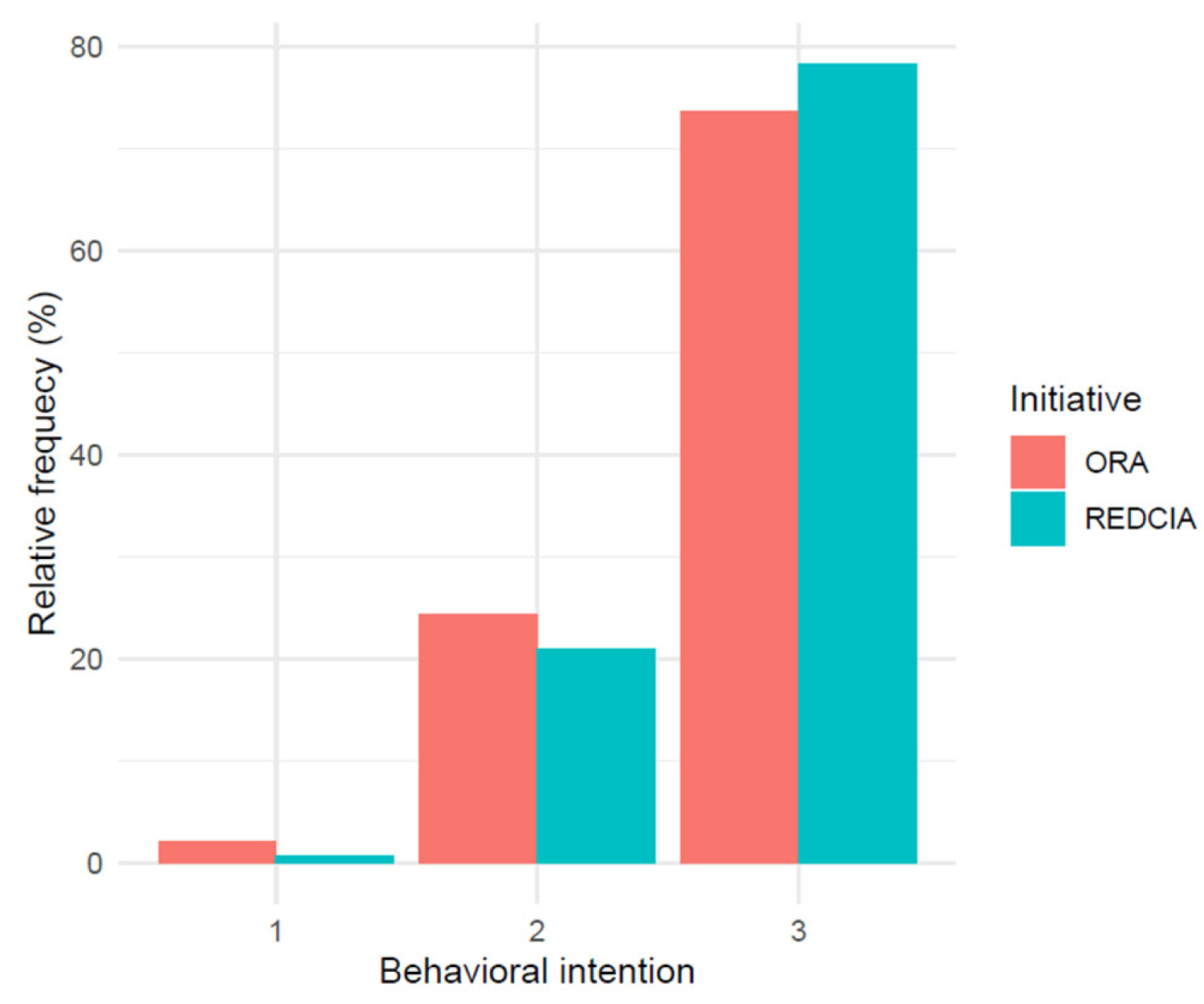
Table 1.
Characteristics of the ORA and REDCIA mechanisms proposed for implementation within the OTCA.
Table 1.
Characteristics of the ORA and REDCIA mechanisms proposed for implementation within the OTCA.
| ORA | REDCIA |
| Intergovernmental | Open network |
| Information-oriented approach | Collaborative approach |
| Institutional authority | Community of practice |
| Mandatory use | Voluntary use |
Table 2.
Items for the dependent variables Behavioral Intention (BI).
| Construct | Variable | KAP Items |
| BI (ORA) | P20_1 | |
| BI (REDCIA) | P20_2 |
Table 3.
Items for the PE (Performance Expectancy) variable.
|
Sub-dimension PE |
Variable | P13 items |
| PE_InfoQuality (valor de información) | High-quality reviewed information; official information; “all the information on a topic”; geospatial information. | |
| PE_Decision/Alert (impact on public decision-making) | Information critical for decision-making/public policy; early warnings. | |
| PE_Redes/Collaboration | Professional networks; integrating alliances; sharing experiences; regional/international initiatives; social impact through collaboration |
Table 4.
Items for the SI (Social Influence) variable.
| Construct | Variable | Items |
| SI (ORA) | P21_1 | |
| SI (REDCIA) | P21_2 |
Table 5.
Items for FC (Facilitating Conditions) variable.
| Construct | Variable | Items |
| FC (general barriers) | P15 |
Table 6.
Descriptive results for the ORA model.
| Variables | mean | sd | median | min | max | skew | kurtosis |
| 2.72 | 0.5 | 3 | 1 | 3 | -1.44 | 1.08 | |
| 2.78 | 0.31 | 2.86 | 1 | 3 | -2.27 | 7.35 | |
| 2.82 | 0.33 | 3 | 1 | 3 | -2.53 | 8.18 | |
| 2.82 | 0.28 | 3 | 1.33 | 3 | -2.15 | 6.13 | |
| 2.66 | 0.53 | 3 | 1 | 3 | -1.21 | 0.44 | |
| 5.69 | 1.99 | 5 | 2 | 11 | 1.56 | 1.21 |
Table 7.
Descriptive results for the REDCIA model.
| Variables | mean | sd | median | min | max | skew | kurtosis |
| 2.78 | 0.43 | 3 | 1 | 3 | -1.56 | 1.14 | |
| 2.79 | 0.3 | 2.86 | 1 | 3 | -2.36 | 8.12 | |
| 2.82 | 0.33 | 3 | 1 | 3 | -2.54 | 8.17 | |
| 2.82 | 0.28 | 3 | 1.33 | 3 | -2.19 | 6.3 | |
| 2.76 | 0.48 | 3 | 1 | 3 | -1.74 | 2.14 | |
| 5.69 | 1.99 | 5 | 2 | 11 | 1.55 | 1.17 |
Table 8.
Spearman’s ρ coefficient and its level of significance (p-value).
| Dep. Var. | ||||
| Predictor | ρ | p-value | ρ | p-value |
| 0.16 | 0.42 | 0.03 | 1 | |
| 0.04 | 1 | −0.02 | 1 | |
| 0.09 | 1 | 0.03 | 1 | |
| SI_* | 0.46 | 0 | 0.58 | 0 |
| −0.02 | 1 | 0.1 | 1 | |
Table 10.
Penalized estimates of the ordinal model.
| Variable | Estimation | P value |
| −0.864 | 0.59 | |
| 1.00 | 0.31 | |
| 0.02 | 0.99 | |
| −2.69 | 3.9e−08 | |
| *0.2624 | 0.092 |
Table 11.
Estimation of the ORA and REDCIA models incorporating country and type of institution.
| Estimate | Pr(>|z|) | Estimate | Pr(>|z|) | |
| -0.6941 | 0.45023 | -0.9749 | 0.439 | |
| -0.2617 | 0.72798 | 0.9189 | 0.36 | |
| 0.5532 | 0.56453 | -0.0778 | 0.949 | |
| -1.2385 | 0.00019 | -2.4371 | 1.10E-06 | |
| -0.0468 | 0.64348 | -0.2589 | 0.099 | |
| CountryBrasil | 1.2353 | 0.23782 | 0.4456 | 0.735 |
| CountryColombia | 0.4394 | 0.68943 | -0.1852 | 0.893 |
| CountryEcuador | 0.4768 | 0.63233 | 0.6297 | 0.583 |
| CountryGuyana | 0.6162 | 0.65964 | 2.1135 | 0.158 |
| CountryPerú | -0.6437 | 0.58997 | 0.062 | 0.961 |
| CountrySurinam | 0.8476 | 0.47767 | 0.1647 | 0.91 |
| CountryVenezuela | 0.4325 | 0.67463 | 0.2712 | 0.818 |
| type_instGobierno | 0.1064 | 0.8332 | 0.583 | 0.393 |
| type_instOrganismos_Internacionales | -0.0689 | 0.92684 | 0.5123 | 0.581 |
| type_instSociedad_Civil_Privado | 0.3546 | 0.6174 | 0.2699 | 0.799 |
Disclaimer/Publisher’s Note: The statements, opinions and data contained in all publications are solely those of the individual author(s) and contributor(s) and not of MDPI and/or the editor(s). MDPI and/or the editor(s) disclaim responsibility for any injury to people or property resulting from any ideas, methods, instructions or products referred to in the content. |
© 2026 by the authors. Licensee MDPI, Basel, Switzerland. This article is an open access article distributed under the terms and conditions of the Creative Commons Attribution (CC BY) license (http://creativecommons.org/licenses/by/4.0/).
Copyright: This open access article is published under a Creative Commons CC BY 4.0 license, which permit the free download, distribution, and reuse, provided that the author and preprint are cited in any reuse.


