
Submitted:
20 February 2026
Posted:
23 February 2026
You are already at the latest version
Abstract
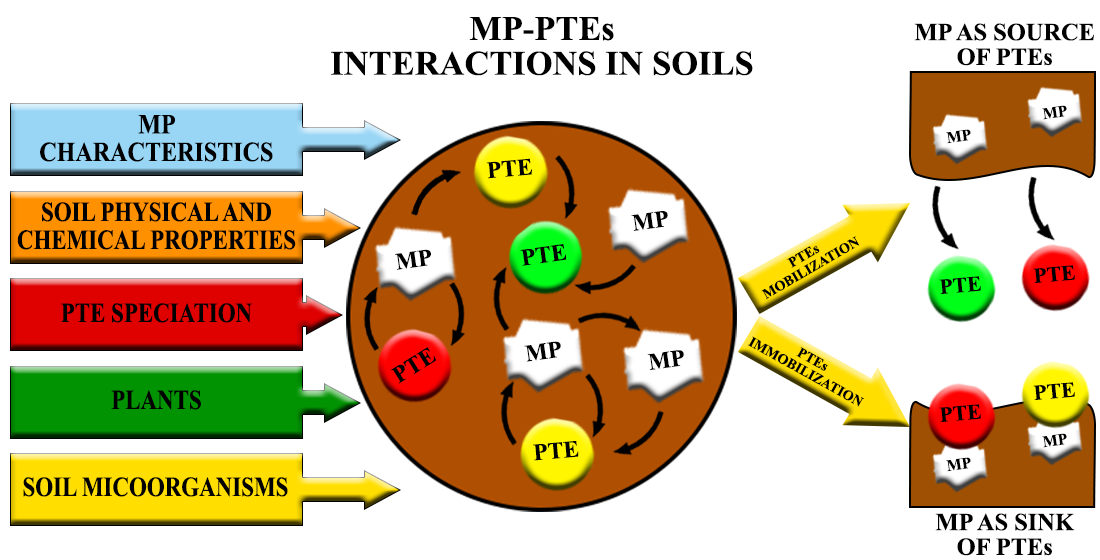
Soil is among the environmental compartments increasingly affected by microplastics (MPs) contamination, mainly coming from industrial activities, agricultural practices, atmospheric or waterborne transport, and improper waste disposal. Despite the increasing attention to the fate of MPs in soil over the last years, research in this area is still limited compared to aquatic ecosystems. The introduction of MPs into the soil environment can modify both the soil properties and the interactions among soil components, plants and microorganisms, thus affecting also the mobility and availability of other contaminants, such as potentially toxic elements (PTEs). This review critically examines the complex dynamics between MPs and PTEs in the soil ecosystem, in particular in agricultural soils, and the conditions under which MPs can act as a source or a sink of PTEs. Indeed, microplastics can adsorb or complex PTEs on their surfaces, thus reducing their mobility and availability, or release/mobilize PTEs after their degradation or as micro/nano-vectors of PTEs. Understanding such mechanisms is relevant to evaluating the environmental risks associated with the co-presence of MPs and PTEs in soil, a situation very likely to occur in most contaminated sites as well as in soils strongly affected by anthropogenic activities.
Keywords:
heavy metals
; plastics
; soil ecosystem
; plants
; microorganisms
; soil properties
; metal mobility
; plastic degradation
; potentially toxic metals
; biodegradation
Copyright: This open access article is published under a Creative Commons CC BY 4.0 license, which permit the free download, distribution, and reuse, provided that the author and preprint are cited in any reuse.


