

Submitted:
21 February 2026
Posted:
27 February 2026
You are already at the latest version
Abstract
Nature-based tourism (NBT) is increasingly promoted as a means to contribute to conservation efforts. However, there is limited understanding of the relationship between environmental education and awareness, and conservation attitudes and practices in this form of tourism that centers around green spaces. This study, therefore, aimed to explore this relationship using data from tourism operators and local communities in the Mexican Caribbean, and provide useful insights for environmental sustainability in tourism destinations that depend on nature as a critical resource. The study employed a triangulation approach, which involved examination of two sets of data. Firstly, household-level survey information from local communities participating in nature-based tourism. Secondly, data from semi-structured in-depth interviews with tour companies operating within the Mexican Caribbean, as well as focus group discussions with key informants including, academicians, public sector stakeholders and other opinion leaders in the tourism industry. Household surveys determined associations between potential predictor variables (environmental education and awareness, local community involvement, costs and benefits distribution) and conservation perspectives and practices in nature-based tourism. Semi-structured interviews and focus group discussions explored participants' attitudes, experiences and views on environmental education and awareness, nature-based tourism, attitudes and practices towards conservation. Findings demonstrated that direct benefits from nature-based tourism are significant, but do not guarantee positive conservation attitudes and practices among the local communities. Other factors (indirect benefits), such as environmental education and awareness could be more effective in achieving environmental sustainability and quality in nature-based tourism. It was also found that several tourism operators lack formal environmental education and awareness programs. The study recommends that the entire cycle of using natural resources for tourism purposes and tourists’ interaction with nature be anchored on adequate environmental education and awareness. This research contributes to valuable insights into debates, practices and policy developments related to nature-based tourism as a mechanism for environmental sustainability in biosphere reserves and tourism destinations.
Keywords:
nature-based tourism
; environmental education
; conservation attitudes
; tourism sustainability
; Mexican Caribbean
1. Introduction
Nature-based tourism is an increasingly growing segment of the global tourism industry representing approximately 20% of the global tourism market [1] with a growth rate of 10–12 percent per year [64]. This trend is evident in Costa Rica, where 25% of the country’s land is reserved for protected areas, attracting millions of tourists every year and generating the much needed revenue [2]. However, there is an ongoing debate around its potential to drive environmental sustainability. Proponents argue that participants are more inclined to engage in activities that do not compromise environmental wellbeing of the places they visit [2,3,4]. However, authors such as Peters & Fuchs [5], Breiby et al. [6], Nolan [7], Walter [8] and Newsome & Moore [9] view this argument as quite simplistic and not based upon empirical research. Similar to other forms of tourism activities that have a direct relationship with the environment, nature-based tourism produces a negative environmental impact. Consequently, those involved in these activities should develop a holistic approach to protect the basic resource upon which the sector depends [10]. The approach should entail a deep understanding of issues such as carrying capacity [11,12], impact on the ecosystem [13], ecological risk assessment [14], preservation of the landscape [15], the need for leisure activities in healthy environments and sustainable use of the natural resources [10]. It has been argued that educating tourists and making them aware of the natural environment around them is critical in generating pro-environmental behavior [62] or environmentally sustainable behavior [63]; which are crucial components of tourism sustainability. It is through environmental education that problems related to environmental sustainability can be ameliorated. The envisaged education should focus on all parties involved in tourism activities, especially tourists, practitioners, the local community and tourism professionals [16].
Nature-based tourism in developing countries, if left to continue in its actual form which is disorganized and uncontrolled without any serious considerations of environmental education, may eventually cause more harm than good [17,18]. The natural resources which form the basic attraction for the sector may be destroyed, and this has adverse implications for nature conservation, local and regional development and overall sustainability. Despite the immense support for environmental education and awareness as an important component (management tool) for nature-based tourism and the argument by scholars and practitioners that education is, or should be, a critical part of nature-based visitor experiences [17,19,20,21,22,23,24,25,26,27], there are only a handful of destinations in developing countries with environmental education programs [2,23,28,29].
However, this is not the case in all countries, there are some which have made great strides in incorporating environmental education in their nature-based tourism activities [30,31]. A good example of a success story is the year-round project dubbed Eco-Tourism and Environmental Education in Monteverde, Costa Rica where tourism activities are organized to teach about nature and its functions [2]. This activities are directed at both tourists and the locals; the two groups of participants are taught about human actions that endanger biodiversity and how communities can care for ecosystems while promoting socioeconomic and cultural sustainability, minimizing biodiversity loss as well as air, soil and water pollution [2].
Costa Rica’s example is an isolated case since the script is different in many developing countries, the majority of major parks and reserves in destinations that depend almost entirely on nature-based tourism, such as Tanzania, Kenya and South Africa, do not have formal programs aimed at fostering environmental education [32]. This is despite environmental interpretation being a significant visitor management tool that helps tourists to understand the delicate relationship between the natural environment and human action, see for example [9,33,34,35,36,37,38,39]. The aforementioned challenge is not only present in park management and related tourism activities, but there is also a weak element of environmental education in the learning process for tourism professionals. Literature reveals that tourism programs have very few courses related to environmental education [40,41]. Based on this reality, it is therefore important to examine the existence and usefulness of environmental education and awareness-based visitor management techniques in nature-based tourism activities, as well as strategies that enhance beneficial tourist–nature interaction. Integrating environmental education with nature-based tourism activities could increase visitor enjoyment and understanding and encourage positive attitudes and practices towards the environment. Additionally, those involved in the tourism industry, like tour operators could be more environmentally sensitive and supportive of the conservation initiatives.
Against this backdrop, this research examines the existence of environmental education and awareness strategies and programs in the nature based tourism activity as well as possible solutions to ameliorate existing challenges in the Mexican Caribbean. The study provides useful insights into environmental sustainability in biosphere reserves and tourism destinations that depend on nature as a critical resource. To set a basis for comprehensive analysis of the phenomenon at hand, authors argue that environmental sustainability in nature-based tourism can only be achieved if there is a concerted effort and commitment to integrate lessons about the environment in the learning experience for visitors in the actual tourism activity, as well as local communities and tourism professionals.
2. Literature Review
Linking nature based tourism activity with environmental education and awareness
Thapa and others [60] defined nature-based tourism as any kind of recreational activity that takes place in natural areas, for example adventure tourism, ecotourism, wildlife tourism, bird watching, sustainable tourism, protected area tourism. Other authors like [1] consider nature-based tourism as any consumptive and non-consumptive activity where the main attraction is nature or outdoor activities in the context of nature: enjoying landscapes, natural scenarios, and fauna and flora; outdoor recreation and adventure (e.g., rafting, backpacking, and cycling); hunting and fishing; nature conservation volunteer tourism among others. In addition to the aforementioned activies, other categories and types of nature-based tourism are identified: geotourism [62,63], rural tourism, mountain tourism, outdoor tourism/outdoor recreation, active tourism, wilderness tourism, dark sky tourism, and botanical and garden tourism [61] where the main motivation of the tourists is the observation and appreciation of nature as well as the traditional cultures prevailing in natural areas.
In practice, nature-based tourism and environmental education are generally treated as two different concepts; however, if one thinks of education in its broadest context as a social process through which people learn cultures and not just a school process, then it is possible to conclude that nature-based tourism is an educational activity. In fact, Root-Bernstein et al. [42] consider nature-based tourism as a component of environmental education and argue that the two oughts to complement each other. Unfortunately, tourism practitioners among them tour operators, managers of protected areas, guides or interpreters in several tourism destinations have failed to incorporate and build their practice within the context of environmental education and awareness, see for example [25,41,43,44]. They often treat nature-based tourism as an activity that is independent from the learning process. Considering its wider context, education is a set of processes and activities by which a group ensures that its members acquire culturally organized and historically accumulated social experiences. Accordingly, nature-based tourism can be conceptualized as a socio-cultural activity with a strong educational component.
When tourists visit a national park, museum, botanical garden, zoo or an area of natural or cultural interest, they do it voluntarily with the main intention of spending quality time and having fun; their intention is not primarily to learn about environments, in other words, it is not an educational tour per se. However, it is both an opportunity and an obligation for the organizers to provide an educational experience. This has many advantages including increasing the value of the tourist experience and educating the tourists about the need to be environmentally sensitive. Ultimately, this has a long term effect of reducing the negative environmental impacts. Nolan [7], Spenceley [45] and Orams [26] consider the educational dimension as an added value to the nature-based tourism product. They argue that practitioners dedicated to this form of tourism should aim at promoting environmental awareness among user groups.
While the main motivation behind tourists’ engagement in certain activities is predominantly recreation and entertainment, experiences that take place in the context of NBT are likely to have strong environmental content. It is increasingly common for leisure activities to be accompanied by information as an additional service; however, this is not enough. As Moghimehfar [46] observes, some of the nature-based tourists may already be environmentally sensitive, especially those engaged in activities such as eco-tourism and agro-tourism. However, this does not automatically mean they have sufficient knowledge and sensitivity to articulate conservation issues and understand the socio-ecological problems facing the tourism sector. Information about animal species, their habits, their characteristics, behaviors and relationships, given during tourist experiences such as game viewing can serve to improve service and increase interest and awareness among tourists, thereby helping them to respect the site and minimize the environmental impacts.
An example is diving; this activity is predominantly a sporting activity. However, when developed as a nature-based tourism activity, issues related to environmental education become paramount. Guides may ignore the interpretive process of the landscape, geography, flora and fauna during these activities [47]. In many cases, the divers find delight in watching fish and coral, but have no explanation of what they are seeing, the envi-ronmental problems affecting the ecosystem and little or no consideration of the consequences of their own activities. Some of these guides may be highly committed to the protection of the marine environment but find it difficult to play that interpretative role and articulate their activist interests through sound environmental education processes and techniques that go beyond loading tourists with purely ecological terms and con-cepts [47]. The interpretative experience must be both informative and entertaining.
Some countries in the developing world have been able to effectively combine the two activities; nature based tourism and environmental education. For instance, in Monte-verde Costa Rica, there are educational activities directed to the local population. The biosphere reserve engages educational institutions adjacent to the area by organizing events and talks centredon environmental issues such as climate change, waste management and circular economy [2]. Fieldwork is also organized for primary, high school and university students to enable them to participate in group activities that enhance learning about nature through outdoor lectures and recreational activities such as hiking. Additionally, there are community volunteers involved in providing educational and interpretative information about the biosphere reserve to tourists. They take guests around and share informative literature about the area’s unique environmental characteristics, threats to the environment and possible contributions by tourists through their actions. As shown in a study by [65], awareness prgrams and interventions using physical education can serve as a meaningful strategy for promoting environmental care and sustainability and turn young tourists into tomorrow’s responsible consumers and travelers who respect and protect nature.
It is also important to observe the success of environmental education and awareness in a destination. Success in a destination such as a national park is not guaranteed by the mere existence of a program; it all depends on the way such a program is designed and implemented. Insights from educational psychology [48] have proven that the cognitive processes involved in teaching and learning are complex and consequently, prompting changes in attitudes, practices and behavior is difficult. Another factor is the diversity of the recipients of such an exercise. Tourists may, for example, have different ages, levels of education, cultural backgrounds, languages, which makes simple communication between them and tour guides a frustrating task. Additionally, it is quite difficult to turn tourists into “greenies”; these are mainly on holiday, and the last thing they want on their agenda is environmental lessons. Nature-based tourism professionals like tour guides find it quite difficult to execute the mandate of environmental educators owing to the fact that they always have to do this in an extremely limited time frame and to an audience that is non-captive, that is, it becomes very difficult to make tourists listen, participate and remain in the program without getting bored. There are also frequent distractions that often occur, like tourists taking photos or turning to see a passing animal. Generally, edu-cating tourists is a difficult task; authors, such as Cheung & Fok [18] and Foretell [39] have little faith in the potential of environmental education in managing nature based tourism activity.
The issues of environmental education are particularly important for developing countries, given that they face unique environmental challenges compared to the countries in the developed world. Problems related to environmental degradation are different for each group of these countries. For the developed countries, the problems revolve around cli-mate change, the destruction of the ozone layer and acid rain, while developing countries face problems related to biodiversity conservation, poverty, food and energy [49]. These differences can also be seen in the policy priorities for the different countries. In the developed world, environmental education focuses on climate change, while in developing countries policies focus on nature conservation and human activity [49]. It is important to clarify that we are not trying to legitimize environmental education as the sole objective of nature-based tourism activities, our recommendation entails combining the two activities to achieve environmental sustainability.
Another important point to consider is the scope of environmental education; when we talk about the environment, we not only refer to nature but to the relationship between society and nature. Sometimes concepts related to nature-based tourism, like ecotourism, are misconceived as tourism-centred on “conservation”, forgetting that the environmental problems are not limited to the protection of nature per se, but must entail social objectives. It is therefore important that environmental education goes beyond the discussion of aspects of biology, ecology and natural history to include topics such as the impact and consequences of human activities on biodiversity loss, the importance of indigenous knowledge in conservation, the importance of environmental services and the relationship between consumption and destruction of nature.
Theoretical foundations of the present study
Associations between awareness, conservation perspectives and practices and perceived direct and indirect benefits from nature-based tourism activities can be explained by the Social Exchange Theory (SET). This theory is derived from the work of American sociologist Homans in his 1958 article titled “Social Behaviour as Exchange” [50]. In the article, Homans proposed that social behaviour might be understood through exchange processes between regular social interactions and economic transactions. Later, other scholars such as Blau, Emerson, Thibaut and Kelley contributed to the refinement and advancement of the theory [51].
In general, SET is based on the premise that relationships are characterised by rewards and costs [50]. Accordingly, from a tourism perspective, the theory is used to conceptualise residents’ support for tourism in their communities [52,53]. It suggests that residents’ support for tourism and its impacts will be influenced by the rewards and costs of tourism for themselves and their communities [53]. Those who regard tourism and its impacts more positively are more likely to support tourism, while those who perceive tourism costs to outweigh the tourism benefits are more likely to have limited support for tourism [52], see Figure 1.
Most studies have applied SET to investigate residents’ attitudes toward tourism development [53,54]. However, despite the wide application, it remains unclear how effective the theory has been in explaining this relationship [55]. Furthermore, most studies focus on residents’ perspectives and a small part on tourists, while neglecting other stakeholders’ perspectives, such as those of tour operators. For instance, [56] examine how residents of nature-based tourism destinations become supportive of sustainable tourism development without incorporating tour operators’ perspectives. Yet, the tour operators, as intermediaries between tourists, play a central role in shaping residents’ experiences and attitudes [57]. The researchers attempted to overcome these limitations by considering both the residents’ and tour operators’ perspectives in understanding conservation attitudes and practices in nature-based tourism. We argue that, together, they can provide a comprehensive understanding and advance the body of knowledge on the theory.
3. Materials and Methods
The researchers adopted a triangulation approach, which allowed the examination of two sets of data. Firstly, household-level survey information from local communities that participate in nature-based tourism. The objective in this part of the study was to measure local attitudes and practices towards conservation as a test of how effective en-vironmental education and awareness have been so far. Quantitative analysis was used to determine associations between potential predictor variables (environmental educa-tion and awareness, local community involvement, costs and benefits distribution) and conservation perspectives and practices in nature-base tourism.
Secondly, data were collected using semi-structured, in-depth interviews with tour companies operating within the Mexican Caribbean. The following line of questions were central to the interview process:
- How the companies understood and practiced environmental education and awareness
- Whether these companies have programs to foster environmental education, either directed at tourists or local population
- Their opinion about the importance of fostering environmental education and awareness within the tourism industry
- Any challenges they have faced in their effort to foster environmental education and awareness
- Any specific actions or strategies that the tour company has put in place to reduce negative impacts on the environment
- If they believe that their tour services contribute to environmental conservation, and what evidence is there to support their response
- If the tour companies feel responsible for educating tourists during their visit or even the local community about environmental issues.
Additionally, the researchers held focus group discussions with key informants in-cluding academicians, public sector stakeholders and other opinion leaders in the tour-ism industry. Thematic analysis was necessary in this part of the study to adequately analyse attitudes, experiences and views of the respondents in relation to environmental education and awareness, nature-based tourism, attitudes and practices towards conservation.
The purposive sampling technique was used to select 20 interview respondents (tour company managers). Focus group discussions involved 4 tourism scholars, 4 hospitality managers in the Mexican Caribbean, 5 community leaders and 3 public service officers from Quintana Roo State Ministry of Tourism (Secretaría de Turismo - SEDETUR). The survey sample size was 381 respondents drawn from a target population of 3522 households. A sampling technique proposed by Cochran [58] and often used in social science research was used to calculate the sample size, as shown below:
Where:
n= sample size
z= statistical constant at 95% confidence level (1.96)
p= approximate number of households estimated to be involved in nature based tourism
q= proportion of failure (1-p)
e= precision (5% or 0.05).
In using the formula, Cochran [50] clarified that if there is little or no information about the target population, as was the case in the present study, where it is not clear how many households in the Mexican Caribbean are involved in nature-based tourism, 50% will be used [50]. Therefore, 0.50 was applied as the proportion of the households with the required characteristics for the study, the statistical constant was 1.96 and the precision was at the 0.05 level, giving a sample size of 381 as shown below:
4. Results and Discussion
After transcription and the thematic analysis of the responses generated through interviews and focus group discussion, several themes emerged. The first question which sought to examine tour operators’ understanding and practice of environmental education and awareness generated several answers including “making tourists understand how to take care of the environment”, “changing attitudes and beliefs of the tourists to make them more environmentaly aware and friendly”. This finding supports the diversity of meanings assigned to the concept [42]. It was surprising to find out that some managers (six out of the twenty interviewed) did not have any idea of environmental education, they viewed the understanding and practice of this concept as a responsibility of the academic world and non-profits. One of them responded “You scholars and activists know these things better than us, you are supposed to be telling me what environmental education means….you know some of us are not scholars and also tourists do not come here for classes, they come to enjoy and have fun”.
On whether these companies have programs to foster environmental education either directed at tourists or local population, only five of the twenty managers mentioned “encouraging tourists to be responsible in their interactions with nature”. This finding cpoincides with an earlier observation in literature that tourism practitioners have failed to incorporate and build their practice within the context of environmental education and awareness [25,41,43,44]. Reminding tourists to pick up litter seemed to be a major aspect of environmental education, one in which the tour operators led by example. One manager mentioned, “I encourage all my guides and drivers to carry some bag or a sack, and pick any kind of litter they find or generate during the trip…when tourists see this, they do the same, this is a way of teaching by action”. One manager said that he always asks the tourists if they really needed printed information for example tickets and brochures instead of electronic materials. On probing the manner in which interpretation was carried out, it was clear that a number of the managers have little understanding of this important visitor management tool [33], their understanding is limited to giving biological information to tourists in form of descriptions of places and the flora and fauna there in. Evidently, operators find it difficult to play the interpretative role in nature-based tourism activities through sound environmental education processes and techniques that go beyond providing ecological information [47].
Eleven of the managers did not demonstrate taking any specific action to reduce negative environmental impacts, two of the managers talked of their firms sticking to the provisions of Leave No Trace code and that they do everything possible to make their tourists understand this. One of the two managers said, “Each of my tour employees is responsible for the coordination of their group, they are expected to teach the tourists environmental responsibility by example – so they check the tourism site or accommodation place various times to be sure that there is no litter left on the ground…..we also encourage our clients to buy environmental friendly souvenirs...I would not encourage my tourists to buy a souvenir made of parts from an endangered species”.
Eight of the managers mentioned time factor, tourist interest and the diversity of the tourist groups as some of the biggest factors hindering the effective practice of environmental education and awareness. One of them said “You know, the majority of these tourists are here for a very short time and they don’t want to be bothered with lectures about the environment……then you have a mixed group with young men and elderly men, these two groups do not have the same information interests, so how do you balance that, it is difficult, young tourists don’t like a lot of talking and teachings during the tour, older ones can be more understanding”. Time was identified in literature as a factor hindering effective execution of environmental education, tourists have limited time to experience destinations and guides may find it difficult to engage a non-captive audience that is not interested in learning without getting bored [18,39].
Most of the managers admitted to not having a specific environmental education and awareness program or even formal interpretation services for the tourists, results indicate that most of the educational activities are ad hoc and focus on specific aspects like minimizing littering in the tourism sites. One manager of fishing tours explained his environmental education approach as: “It’s more of a show me how to do it and I will perfectly do it approach for my tour firm…so you catch a fish and release it, then the tourists learns and understands that this is just a sporting activity that is not meant to harm the fish species neither is it a fish harvesting competition…. It just has to be part of you every single day…most of my tour guides have internalized conservation and it seems to be part of their normal routine and most of the time starting right from the time they drive into the destination….. I always tell them, get to interact and understand the people you accompany a little bit more, find out why they chose the tour with our company, what they expect to get from the tour and this is the perfect time to tell them a little about our commitment to conservation principles and what we expect of them to foster that course”.
Five of the managers recognized that environmental education for the tourists is paramount to the quality of the NBT services and experiences they offer and also contributes to the overall sustainability of the industry. In literature, it was found that environmental education has a long term effect of reducing the negative environmental impacts in tourism [7]. One of the respondents said that “he aims at making environmental education and awareness part of the daily routine in his firm”. However, he admitted that it has been an uphill task to achieve this objective because of the limited interest among the tourists. He said “We cannot do anything if the tourists do not want this kind of information….you know that we are in business and we have to do what the tourists want”. Only four managers see a great opportunity in environmental education and awareness, one said “… make tourists familiar with nature and the ecosystem and they will learn to love, protect and make use of it with minimum or no impact…after all this is the basic resource upon which our businesses depend on, so we have to make a choice, teach tourists to protect it or literally go out of business”. Another respondent said “Of course we agree with the environmentalists about the need for education in environmental conservation and stewardship, it is paramount to our survival – the more the tourists learn about the need to protect our ecosystems, the better our businesses get – if they are educated about being responsible with the environment then they eventually help us to protect these valuable resources….imagine if all this beautiful flora and fauna diminished as a result of careless actions by the tourists, what will we do? What business will we have yet this is what we depend on”. Previous studies [26,45] considered the educational dimension as an added value to the nature-based tourism product and experience.
Environmental education and awareness as a predictor of conservation attitudes and practices among the local community
This quantitative part of the study sought to examine associations between potential predictor variables and conservation perspectives and practices in nature based tourism from a local community perspective. To achieve a broader understanding of this relationship, both perceived direct and in-direct benefits from nature based tourism were included as predictor variables. However, the particular focus of this study is about environmental education and awareness as an indirect benefit, as well as local community involvement, interactions and idea exchange with tourists, training and capacity building and how they shape local community attitudes and actions towards the environment.
Table 1 shows a summary of tourism benefits (direct and indirect) as a predictor of conservation practices and attitudes. Cross tabulations were performed between perceived direct and indirect benefits from nature based tourism and the conservation-oriented statements in the right-hand columns to determine χ2 values and levels of significance. The second column of the table shows responses that would generally be likely from a local community member with positive conservation perspectives in relation to the conservation-oriented affirmations. The first row (Possible conservation attitude/perspective) show what association one would expect to find between perceived direct and indirect benefits from NBT the affirmations about conservation.
Those cells marked with “ECA” show conservation perspectives that were predicted, “UCA” denotes unpredicted ones and “NCT” denotes no clear trend. Significance levels of p<0.05, 0.01, and 0.001 are represented by “*,” “**,” and “***,” respectively. Results of the Chi square tests show that benefit distribution is a strong indicator and predictor of conservation attitudes and practices. It is clear from the findings that greater participa-tion of the local community members in nature based tourism and adequate distribution of benefits are more likely to encourage positive attitudes and responsible practices to-wards the environment. Also, direct economic benefits alone, either through employment or sale of souvenirs are not enough to motivate positive perspectives and practices to-wards the environment. Other indirect benefits like environmental education and awareness, interaction and exchange of ideas with tourists, training and capacity building as a result tourism and infrastructure, motivate and influence attitudes and behaviour.
.
Local communities in the Mexican Caribbean seemed to understand the necessity of engaging in practices that do not compromise the wellbeing of natural resources upon which they rely, however, they found it difficult to balance conservation objectives and the fulfilment of their socioeconomic needs and aspirations. In places where nature based tourism has not been a sustainable economic alternative, members of the local community have not abandoned negative environmental practices. Generally, local community members’ perspectives towards natural resource use are convenience based; the majority sees use as acceptable if they perceive benefits (both direct and indirect). For example, those with higher income from nature based tourism activities often disagreed with allowing statement that “members of the local community should be able to clear forest land for nature based tourism ventures like accommodation with minimal or no governmental restrictions, while those who are more engaged in agricultural activities like bee keeping showed support for enhanced restrictions. These findings are highly consistent with previous literature that suggests a positive relationship between the perceived benefits and costs of tourism and the local community’s attitudes and reactions towards the industry [53,54]. As indicated earlier, the Social Exchange Theory explains this relationship in a matrix system of measuring outcomes, taking into account the actions of others, rewards and costs, comparing results, dependence and control. In essence, it suggests that an individual is most probably willing to select exchanges if the outcome is rewarding or valuable, and the negative results do not outweigh the benefits [51]. In this sense, conservation attitudes and practices are seen as a trade-off between the perceived benefits and costs of economic activities as well as the level of involvement/participation and control.
The study found a high percentage (71%) of respondents who feel that, due to un-employment or limited income, it is sometimes necessary to engage in economic activi-ties that imply intense use of natural resources, often not in line with principles of con-servation, lack of employment is fairly high in some areas of the Mexican Caribbean. On the contrary, few (32%) members of the local community (most of them not directly de-pendent on natural resources) are in disagreement with the association between lack of employment and the need to engage in resource intense economic activities.
Generally speaking, residents who are neither employed nor have relatives engaged in the nature based tourism sector, had negative conservation perspectives across the statements shown in Table 1, a finding discussed below in detail, this difference is significant at p<.05. Additionally, cross tabulations also showed respondents with higher responsibility in nature based tourism related activities, relative to those with lower responsibility, showing less interest in doing economic activities like large scale farming or fishing if they had enough capital, this difference is significant at p<.10.
An emerging concern in the management of nature based tourism destinations is what is known as “conservation back-fire”. A typical example may be a case where members of a local community adjacent to a biosphere reserve use increased income from nature based tourism activities to engage in resource-intense activities like large scale farming or clearing forests for tourism facilities and ventures. Biosphere reserve management theories assume that increased income would automatically replace the interest to use natural resources unsustainably. Critics view such argument as narrow, observing that members of the local communities do not have fixed income needs, for a rural landowner, more income would mean an opportunity to be involved in large scale farming or logging or employment of additional people to work on his or her farm. In the present study, this was not the case; most respondents (77%) disagreed that they would engage in resource-intense activities like large scale farming or fishing if they had more money.
5. Conclusions
The issues of environmental education are particularly important for the developing countries given that they face unique environmental challenges compared to the countries in the developed world. Problems related to environmental degradation are different for each group of these countries, for the developed countries, the problems revolve around climate change, the destruction of the ozone layer, acid rain among others while developing countries face problems related to biodiversity conservation, poverty, food, energy among others. These differences can also be seen in the policy priorities for the different countries; in the developed world, environmental education focuses on climate change while the developing countries have their policies focused on nature conservation and human activity. It is important to clarify that we are not trying to legitimize environmental education as the sole objective of nature based tourism activities, our recommendation entails combining the two activities to achieve environmental sustainability.
The paper has demonstrated the importance formal environmental education and awareness programs to influence attitudes and practices of both tourists and local communities and contribute to the sustainability of nature-based tourism activity: trips close to or inside parks, forests, lakes, the sea, or rural areas to participate in activities using resources that are compatible with the natural quality of those places [1]. The above findings can be summurised as follows:
5.1. Theoretic Contributions
Based on the conceptual framework and subsequent results, there is a clear link between conservation perspectives and practices and perceived direct and indirect benefits from nature-based tourism activities. Findings from this study contribute to the theoretical constructs of the Social Exchange Theory which explains the relationship between perceived benefits and costs of tourism and the local community’s attitudes and reactions. It suggests that an individual is most probably willing to select exchanges if the outcome is rewarding or valuable, and the negative results do not outweigh the benefits. In this sense, conservation attitudes and practices are seen as a trade-off between the perceived benefits and costs of economic activities as well as the level of involvement/participation and control.
Using empirical insights from the Mexican Caribbean, this study highlights the crucial role played by tour operators and the local community as agents of environmental education and awareness in nature based tourism. As indicated in literature, tourism can be both beneficial and harmful to the environment and in equal proportions, this often depends on the way tourism professionals and operators act especially in activities related to nature. Some of the dangers posed by uncontrolled tourism activity in protected areas include: uncontrolled fishing and illegal hunting; trophy and souvenir collection from the natural heritage; feeding animals without authorization; pollution and leaving of residues in inappropriate places; firewood collection; noises in wildlife habitats among others [26,29,43,59]. Tourism professionals and operators should therefore be able to understand that every action in the industry has an impact; they need to understand how to act responsibly in order to produce more good than harm. It is also common for a tourist to buy a tour package from a tour operator with the main intention of learning about the environment and get frustrated because the tour lacks the interpretative and educative component, tour guides may know the places visited, but are unable to address and interpret issues concerning the environment. Actually very few professional guides or specialists sampled in the present study were adequately prepared to delve deeply into related to the environment and its wellbeing. It is equally common to come across ecotourism advertisements in the region of study with the main marketing line and promise being fun and relaxation, and nothing about environmental education yet one of the characteristics that distinguish ecotourism from any other form of NBT is the educational component.
5.2. Managerial Contributions
Without well designed and coordinated efforts to educate these stakeholder groups about the need to use the environment responsibly, nature-based tourism is unlikely to produce negative impacts that may eventually compromise the basic resource upon which the sector depends. The traditional perception that nature-based tourists are already sensitive and will automatically care about their actions to the environment is false. Structured environmental education programs, grounded on educational psychology, can help to positively influence tourist behavior; visitors taken through such a program can be motivated to become environmentally sensitive and encourage positive attitudes and actions among the local community members towards the environment. It was found that integrating environmental education and interpretation in NBT is a condito sin qua non because the activity entirely depends on the wellbeing of natural resources and also, there are related ecological impacts.
Tour guides can make use of visitor management tools like signage and interpretation to educate and create awareness among tourists and to influence their attitudes towards conservation. Minimal impact environmental education programs like Leave No Trace (referenced earlier in the article), accompanied by adequate interpretative information provided to tourists through different mechanisms can further the objective of creating awareness among tourists about the importance of taking care of the nature based tourism sites they visit and the consequences of their actions [9,37].
It was also found that integration of environmental education in the learning process of the tourism professionals and operators can be an important contribution to the achievement of environmental sustainability, this integration will not only contribute to training of professionals and operators that are more connected to the needs of society, but can also convert them into environmental educators.
New paradigms of tourism training seek to give the learners a deep understanding of the reality that surrounds the industry. As observed by Steven et al. [4], Long et al. [31], Tubb [24], Orams [41] and Foretell [39], problems facing the industry like environmental sustainability can be effectively tackled if NBT professionals and operators receive relevant training that gives them sufficient knowledge to understand and overcome them. This recognition stems from a common finding that, there is a limited component of environmental education in travel and tourism training and education, as seen throughout the present study, environmental education and awareness is much more than the transmission of knowledge, there is a greater emphasis on the transmission of values, attitudes and the understanding of current environmental problems; this problem is more pronounced in developing countries. Environmental education can contribute to the training of professionals with an integrated view of reality and converting them into future environmental educators.
Future professionals in the tourism industry should be able to act as an environmental educators and awareness creators. Therefore, it is of critical importance to tailor tourism programs in a way that responds to this demand and encourage students to take greater interest in environmental issues. Some of the necessary topics that could be considered for coverage in training include: ethics in environmental conservation, environmental issues versus socioeconomic needs of the local communities, environmental impacts of NBT and tourism sustainability in general.
6. Limitations and Future Research
One key limitation and consideration for future research is related to the scope and the context which could be expanded. The present study relied on data from tour operators and members of the local community to explore the effectiveness of environmental education and awareness in nature-based tourism. However, it would be interesting to look at these issues from the tourists’ perspective. Additionally, the scope can be expanded to include other players in the tourism sector, for example, hospitality operators may have different perspectives and experiences in relation to environmental education and awareness.
Also, future studies can build on existing literature to explore different factors influencing the success or failure of environmental education and awareness intervention programs in specific nature based tourism activities among tourists, like the case of [62,63] that looked at environmentally sustainable behavioral intentions and Tourists’ pro-environmental behavior in geotourism respectively. Useful insights can also be drawn from [5] that explored human-nature relationships based on the environmental values that individuals hold and their impact on sense-making.
Author Contributions
Conceptualization, J.M.-T.C., K.O.-M., E.G.-S. and M.-V.V.; methodology, J.M.-T.C., K.O.-M., E.O.-M. and M.-V.V.; formal analysis, J.M.-T.C., K.O.-M., E.O.-M. and M.-V.V.; investigation, J.M.-T.C., K.O.-M., E.O.-M. and M.-V.V.; writing—original draft preparation, J.M.-T.C., K.O.-M., E.O.-M. and M.-V.V.; writing—review and editing, J.M.-T.C., K.O.-M., E.O.-M. and M.-V.V.; visualization, J.M.-T.C., K.O.-M., E.O.-M. and M.-V.V. All authors have read and agreed to the published version of the manuscript.
Funding
This research was funded by CONHACYT (The Mexican National Council for Science and Technology, now renamed as SECIHTI – Ministry of Cience, Humanities, Technology and Innovation) through grant number 1114563 to the first author.
Institutional Review Board Statement
The study was reviewed and approved by the Graduate Committee (Claustro Doctoral), which serves as the Ethics Committee of Tecnológico Nacional de México/Instituto Tecnológico de Cancún, based on the university guidelines for graduate studies.
Informed Consent Statement
Informed consent was obtained from all subjects involved in the study.
Data Availability Statement
Data is contained within the article and supplementary materials. Further inquiries can be directed to the corresponding author.
Conflicts of Interest
The authors declare that there are no conflicts of interest that may affect third parties in relation to the publication of this article.
References
- Silva, S.; Silva, L.F.; Vieira, A. Protected Areas and Nature-Based Tourism: A 30-Year Bibliometric Review. Sustain. 2023, 15, 11698. [Google Scholar] [CrossRef]
- Amici, A. A.; Nadkarni, N. M.; Lackey, N. Q.; Bricker, K. S. Conservation, education, and adventure tourism: A case study of adventure parks as potential venues for communication in Monteverde, Costa Rica. J. Ecotou. 2022, 21, 230–245. [Google Scholar] [CrossRef]
- Chen, X.; Cheung, L. T. O. Balancing nature-based tourism and sustainable well-being: exploring aesthetic quality, environmental benefits, and pro-environmental behaviour. A. Pacif. J. Tour. Res. 2025, 30, 809–830. [Google Scholar] [CrossRef]
- Steven, R.; Morrison, C.; Castley, J. G. Birdwatching and avitourism: a global review of research into its participant markets, distribution and impacts, highlighting future research priorities to inform sustainable avitourism management. J. Sustain. Tour. 2015, 23, 1257–1276. [Google Scholar] [CrossRef]
- Peters, A.; Fuchs, M. A relational exploration of tourists’ environmental values and their perception of restrictions in protected nature. J. Sustain. Tour. 2025, 33, 28–45. [Google Scholar] [CrossRef]
- Breiby, M. A.; Øian, H.; Aas, Ø. Good, bad or ugly tourism? Sustainability discourses in nature-based tourism. In Nordic perspectives on nature-based tourism, 1st ed.; Fredman, A., Haukeland, J.V., Eds.; Edward Elgar: Cheltenham, UK, 2021; pp. 130–142. [Google Scholar] [CrossRef]
- Nolan, K. A. Improving socio–economic stability and natural sustainability of coral reef ecosystems through mitigation, ecotourism and education. International J. Soc. Entrepren. Innov. 2014, 3, 29–38. [Google Scholar] [CrossRef]
- Walter, P. Theorising visitor learning in ecotourism. J. Ecotour. 2013, 12, 15–32. [Google Scholar] [CrossRef]
- Newsome, D.; Moore, S.A.; Dowling, R.K. Natural area Tourism: Ecology, Impacts and Management; Channel View Publications: Bristol, UK, 2012; Volume 58, Available online: https://www.degruyterbrill.com/document/doi/10.21832/9781845413835/html.
- Donici, D. S.; Dumitras, D. E. Nature-based tourism in national and natural parks in Europe: A systematic review. For. 2024, 15, 588. [Google Scholar] [CrossRef]
- Skiniti, G.; Lilli, M.; Skarakis, N.; Tournaki, S.; Nikolaidis, N.; Tsoutsos, T. A holistic approach for tourism carrying capacity estimation in sensitive ecological areas. Environ. Dev. Sustain. 2024, 26, 31971–31995. [Google Scholar] [CrossRef]
- Pulido-Fernández, J. I.; Carrillo-Hidalgo, I.; López-Sánchez, Y.; Casado-Montilla, J. Assessing social carrying capacity of tourists in protected natural areas. Curr. Iss. Tour. 2025, 28, 1062–1078. [Google Scholar] [CrossRef]
- McCool, S. F.; Mandic, A. A Social-Ecological Systems Perspective on Working toward Resilience in Nature-Based Tourism Planning. Tour. Plann. Dev. 2025, 22, 632–654. [Google Scholar] [CrossRef]
- Rao, J.; Ouyang, X.; Pan, P.; Huang, C.; Li, J.; Ye, Q. Ecological Risk Assessment of Forest Landscapes in Lushan National Nature Reserve in Jiangxi Province, China. For. 2024, 15, 484. [Google Scholar] [CrossRef]
- Yang, N.; Zhang, T.; Li, J.; Feng, P.; Yang, N. Landscape ecological risk assessment and driving factors analysis based on optimal spatial scales in Luan River Basin, China. Ecol. Indic. 2024, 169, 112821. [Google Scholar] [CrossRef]
- Walker, K.; Moscardo, G. Encouraging sustainability beyond the tourist experience: ecotourism, interpretation and values. J. Sustain. Tour. 2014, 22, 1175–1196. [Google Scholar] [CrossRef]
- Yfantidou, G.; Kouli, O.; Morela, E.; Kouli, E. Enhancing Environmental Awareness in Tourism Through Movement: A Physical Education Approach. Educ. Sci. 2025, 15, 297. [Google Scholar] [CrossRef]
- Cheung, L. T.; Fok, L. Assessing the Role of Ecotourism Training in Changing Participants’ Pro-Environmental Knowledge, Attitude and Behaviour. A. Pac. J. Tour. Res. 2014, 19, 645–661. [Google Scholar] [CrossRef]
- Sumanapala, D.; Wolf, I. D.; Weiler, B. Enhancing Tour Guide Training for Delivering Nature-Based Tourism Experiences in a Developing Country. J. Qual. Assur. Hosp. Tour. 2025, 26, 464–488. [Google Scholar] [CrossRef]
- Samal, R.; Dash, M. Stakeholder engagement in advancing sustainable ecotourism: an exploratory case study of Chilika Wetland. Discov. Sustain. 2024, 5, 50. [Google Scholar] [CrossRef]
- Fredman, P.; Margaryan, L. 20 years of Nordic nature-based tourism research: a review and future research agenda. Scan. J. Hosp. Tour. 2021, 21, 14–25. [Google Scholar] [CrossRef]
- Lemes, M. T.; Nunes, J. R.; Nunes, P. A.; Oliveira, S. S. Contribution of Ecotourism and Environmental Education at a resort located in the city of Nobres (MT, Brazil). Rev. Bras. Ecotur. 2014, 7, 151–167. Available online: https://www.cabidigitallibrary.org/doi/full/10.5555/20143170480.
- Imran, S.; Alam, K.; Beaumont, N. Environmental orientations and environmental behaviour: Perceptions of protected area tourism stakeholders. Tour. Manag. 2014, 40, 290–299. [Google Scholar] [CrossRef]
- Tubb, K. N. An evaluation of the effectiveness of interpretation within Dartmoor National Park in reaching the goals of sustainable tourism development. J. Sustain. Tour. 2003, 11, 476–498. [Google Scholar] [CrossRef]
- Powell, R. B.; Ham, S. H. Can ecotourism interpretation really lead to pro-conservation knowledge, attitudes and behaviour? Evidence from the Galapagos Islands. J. Sustain. Tour. 2008, 16, 467–489. [Google Scholar] [CrossRef]
- Orams, M. B. A. Conceptual model of tourist-wildlife interaction: the case for education as a management strategy. T. Aust. Geogr. 1996a, 27, 39–51. [Google Scholar] [CrossRef]
- Wheeller, B. Ecotourism: a ruse by any other name. In Progress in Tourism, Recreation and Hospitality Management, 1st ed.; Cooper, C.P., Lockwood, A., Eds.; CABI: London, UK, 1994; Volume 6, pp. 3–11. Available online: https://www.cabidigitallibrary.org/doi/full/10.5555/19951803377.
- Cheung, L. T.; Fok, L.; Tsang, E. P.; Fang, W.; Tsang, H. Y. Understanding residents’ environmental knowledge in a metropolitan city of Hong Kong, China. Environ. Educ. Res. 2015, 21, 507–524. [Google Scholar] [CrossRef]
- Kimmel, J.R. Ecotourism as environmental learning. T. J. Environ. Educ. 1999, 30, 40–44. [Google Scholar] [CrossRef]
- Shen, S.; Yang, F.; Sotiriadis, M.D. Experiential consumption dimensions and pro-environment behaviour by Gen Z in nature-based tourism: a Chinese perspective. Tour. Rev. 2024, 79, 877–902. [Google Scholar] [CrossRef]
- Long, J.; Vogelaar, A.; Hale, B. W. Toward sustainable educational travel. J. Sustain. Tour. 2014, 22, 421–439. [Google Scholar] [CrossRef]
- Børresen, S. T.; Ulimboka, R.; Nyahongo, J.; Ranke, P. S.; Skjaervø, G. R.; Røskaft, E. The role of education in biodiversity conservation: Can knowledge and understanding alter locals’ views and attitudes towards ecosystem services? Environ. Educ. Res. 2023, 29, 148–163. [Google Scholar] [CrossRef]
- Lee, T. H.; Jan, F. H.; Chen, J. C. Influence analysis of interpretation services on ecotourism behavior for wildlife tourists. J. Sustain. Tour. 2023, 31, 1233–1251. [Google Scholar] [CrossRef]
- Juma, L. O.; Khademi-Vidra, A. Nature interpretation as an environmental educational approach in visitor management; the application dilemma for different target groups at Masai Mara National Reserve, Kenya. Sustain. 2022, 14, 2935. [Google Scholar] [CrossRef]
- Chiu, Y. T. H.; Lee, W. I.; Chen, T. H. Environmentally responsible behavior in ecotourism: Antecedents and implications. Tour. Manag. 2014, 40, 321–329. [Google Scholar] [CrossRef]
- Beaumont, N. Ecotourism and the conservation ethic: recruiting the uninitiated or preaching to the converted? J. Sustain. Tour. 2001, 9, 317–341. [Google Scholar] [CrossRef]
- Mihalič, T. Environmental management of a tourist destination: A factor of tourism competitiveness. Tour. Manag. 2000, 21, 65–78. [Google Scholar] [CrossRef]
- Uysal, M.; Jurowski, C.; Noe, F.P.; McDonald, C.D. Environmental attitude by trip and visitor characteristics: US Virgin Islands National Park. Tour. Manag. 1994, 15, 284–294. [Google Scholar] [CrossRef]
- Foretell, P. H. If Leviathan has a face, does Gaia have a soul?: incorporating environmental education in marine eco-tourism programs. Oce. Coast. Manag. 1993, 20, 267–282. [Google Scholar] [CrossRef]
- Berjozkina, G.; Melanthiou, Y. Is tourism and hospitality education supporting sustainability? World. Hosp. Tour. Them. 2021, 13, 744–753. [Google Scholar] [CrossRef]
- Orams, M. B. A. Using interpretation to manage nature-based tourism. J. Sustain. Tour. 1996b, 4, 81–94. [Google Scholar] [CrossRef]
- Root-Bernstein, M.; Root-Bernstein, M.; Root-Bernstein, R. Tools for thinking applied to nature: an inclusive pedagogical framework for environmental education. Ory. 2014, 48, 584–592. [Google Scholar] [CrossRef]
- Sakellari, M. Film tourism and ecotourism: mutually exclusive or compatible? Int. J. Cult. Tour. Hosp. Res. 2014, 8, 194–202. [Google Scholar] [CrossRef]
- Lee, W. H.; Moscardo, G. Understanding the impact of ecotourism resort experiences on tourists’ environmental attitudes and behavioural intentions. J. Sustain. Tour. 2005, 13, 546–565. [Google Scholar] [CrossRef]
- Spenceley, A. Responsible tourism: Critical issues for conservation and development, 1st ed.; Routledge: New York, USA, 2010; Available online: https://www.routledge.com/Responsible-Tourism-Critical-Issues-for-Conservation-and-Development/Spenceley/p/book/9781849710701.
- Moghimehfar, F.; Halpenny, E. A.; Ziaee, M. How big is the gap? Comparing the behaviours and knowledge of mountain hikers with ecotourism ideals: A case study of Iran. J. Ecotour. 2014, 13, 1–15. [Google Scholar] [CrossRef]
- Garcia, O.; Cater, C. Life below water; challenges for tourism partnerships in achieving ocean literacy. J. Sustain. Tour. 2022, 30, 2428–2447. [Google Scholar] [CrossRef]
- Kirschner, P. A.; Hendrick, C. How learning happens: Seminal works in educational psychology and what they mean in practice, 2nd ed.; Routledge: London, UK, 2024; Available online: https://www.routledge.com/How-Learning-Happens-Seminal-Works-in-Educational-Psychology-and-What-They-Mean-in-Practice/Kirschner-Hendrick/p/book/9781032498393.
- Yadav, S. K.; Banerjee, A.; Jhariya, M. K.; Meena, R. S.; Raj, A.; Khan, N.; Sheoran, S. Environmental education for sustainable development. In Natural resources conservation and advances for sustainability, 1st ed.; Jhariya, M.K., Meena, R.S., Banerjee, A., Meena, S.N., Eds.; Elsevier: London, UK, 2022; pp. 415–431. [Google Scholar] [CrossRef]
- Homans, G.C. Social behaviour as exchange. Amer. J. Socio. 1958, 63(6), 597–606. [Google Scholar] [CrossRef]
- Molm, L.D. The social exchange framework. In Contemporary social psychological theories, 1st ed.; Burke, P.J., Ed.; Stanford University Press: Stanford, USA, 2006; p. pp. 24-45 pp.24-45. [Google Scholar]
- Nunkoo, R.; So, K.K.F. Residents’ support for tourism: Testing alternative structural models. J. Trav. Res. 2016, 55, 847–861. [Google Scholar] [CrossRef]
- Doğantekin, A. Social exchange theory and tourism. In Routledge handbook of social psychology of tourism, 1st ed.; Gursoy, D., Çelik, S., Eds.; Routledge: London, UK, 2022; pp. 61–67. Available online: https://www.taylorfrancis.com/chapters/edit/10.4324/9781003161868-6/social-exchange-theory-tourism-ali-do%C4%9Fantekin.
- Nunkoo, R. Toward a more comprehensive use of social exchange theory to study residents’ attitudes to tourism. Proc. Econ. Finan. 2016, 39, 588–596. [Google Scholar] [CrossRef]
- García, F.A.; Vázquez, A.B.; Macías, R.C. Resident’s attitudes towards the impacts of tourism. Tour. Manag. Perspec. 2015, 13, 33–40. [Google Scholar] [CrossRef]
- Han, S.; Ramkissoon, H.; You, E.; Kim, M.J. Support of residents for sustainable tourism development in nature-based destinations: Applying theories of social exchange and bottom-up spillover. J. Outd. Recr. Tour. 2023, 43, 100643. [Google Scholar] [CrossRef]
- Saarinen, J.; Rogerson, C.; Manwa, H. Tourism and Millennium Development Goals: tourism for global development? Curr. Iss. Tour. 2011, 14, 201–203. [Google Scholar] [CrossRef]
- Cochran, W. G. Sampling techniques, 3rd ed.; John Wiley & Sons: New York, USA, 1977. [Google Scholar]
- Packer, J.; Ballantyne, R.; Hughes, K. Chinese and Australian tourists’ attitudes to nature, animals and environmental issues: Implications for the design of nature-based tourism experiences. Tour. Manag. 2014, 44, 101–107. [Google Scholar] [CrossRef]
- Thapa, K.; King, D.; Banhalmi-Zakar, Z.; Diedrich, A. Nature-based tourism in protected areas: a systematic review of socio-economic benefits and costs to local people. Int. J. Sustain. Dev. Wor. Ecol. 29 2022, 625–640. [Google Scholar] [CrossRef]
- Donici, D.S.; Dumitras, D.E. Nature-Based Tourism in National and Natural Parks in Europe: A Systematic Review. For. 2024, 15, 588. [Google Scholar] [CrossRef]
- Zheng, X.; Lin, Y.; Cheng, X.; Ahn, Y.-j.; Chi, X. An Investigation into the Formation of Tourists’ Pro-Environmental Behavior in Geotourism: Balancing Tourism and Ecosystem Preservation. Sustain. 2025, 17, 1422. [Google Scholar] [CrossRef]
- Xie, M.; Chi, X.; Han, H. A complexity theory in geotourism: traveler environmentally sustainable behaviors in global geoparks. J. Trav. Tour. Markt. 2024, 41, 1021–1037. [Google Scholar] [CrossRef]
- Karacaoğlu, S. Travel Characteristics, Typologies, and Motivations of Nature-Based Tourists: A Literature Review. In The Routledge Handbook of Nature Based Tourism Development, 1st ed.; Mandić, A., Walia, S.K., Eds.; Routledge: London, United Kingdom, 2023; pp. 372–382. [Google Scholar]
- Yfantidou, G.; Kouli, O.; Morela, E.; Kouli, E. Enhancing Environmental Awareness in Tourism Through Movement: A Physical Education Approach. Educ. Sci. 2025, 15, 297. [Google Scholar] [CrossRef]
Figure 1.
A conceptual framework of associations between conservation perspectives and practices and perceived direct and indirect benefits from nature-based tourism activities.
Figure 1.
A conceptual framework of associations between conservation perspectives and practices and perceived direct and indirect benefits from nature-based tourism activities.
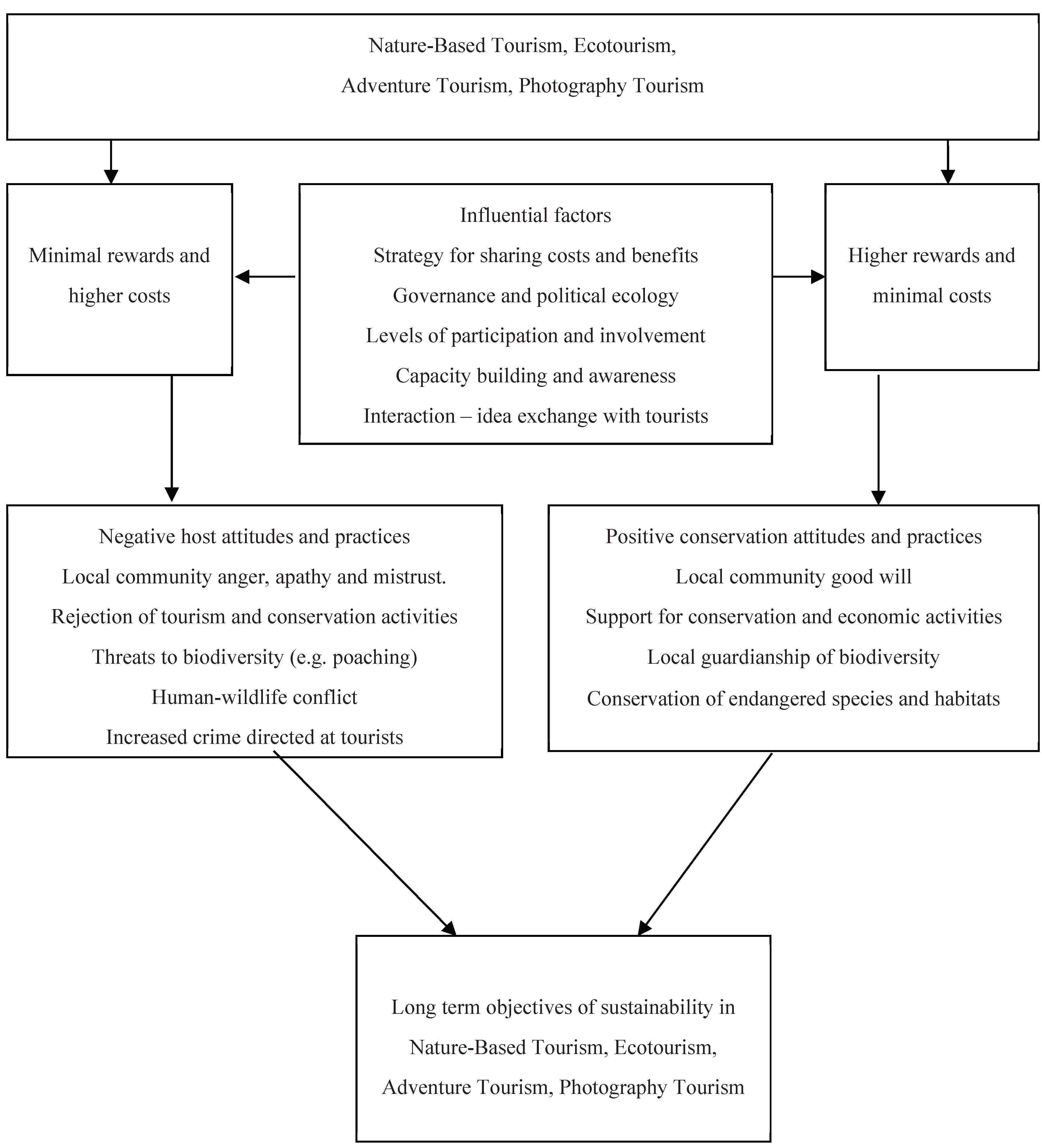

Table 1.
Summary of associations between conservation perspectives and practices and perceived direct and indirect benefits from nature based tourism as potential predictors.
Table 1.
Summary of associations between conservation perspectives and practices and perceived direct and indirect benefits from nature based tourism as potential predictors.
| Perceived indirect benefits from nature based tourism | |||||||||
| Most dominant conservation response | Respondent’s economic situation |
Respondent’s well-being |
Respondent’s employment status |
Respondent’s responsibility level in NBT related activities | Indirect income from NBT activities | Environmental education, Interaction/Ideas Exchange with tourists | Environmental awareness, training and capacity building | Infrastructure as a result of tourism | |
|
Predicted conservation attitude/perspective. Conservation attitudes are expected with: |
Better economic standard as a result of NBT |
Higher quality of life |
Family members work in the NBT sector | More involvement in NBT related activities | Earns income indirectly from NBT activities | Gets an opportunity to interact or exchange ideas with tourists | Benefits from training and capacity building related to tourism | Benefits from improved infrastructure as a result of tourism | |
| More than anything else, natural resources (flora and fauna) exist to be used for fulfilling our socioeconomic needs |
Disagree |
ECA ** |
ECA |
NCT |
ECA |
ECA * |
ECA ** |
ECA |
ECA |
| Due to unemployment or limited income, it is sometimes necessary to engage in activities like clearing forest land. | Disagree | ECA * | NCT | NCT | ECA | NCT | ECA | ECA | NCT |
| Due to unemployment or limited income, it is sometimes necessary to engage in activities like large scale fishing. | Disagree | ECA | ECA | UCA *** | ECA * | NCT | ECA | ECA * | ECA * |
| Members of the local community should be able to clear forest land for nature based tourism ventures like accommodation with minimal or no governmental restrictions |
Disagree |
ECA |
ECA |
ECA * |
NCT |
ECA * |
ECA ** |
ECA * |
ECA ** |
| The option of conserving forest land would greatly reduce our income opportunities. | Disagree | ECA | ECA | ECA | NCT | ECA * | ECA *** | ECA ** | ECA ** |
| I do not see any problem in massive fishing, if one needs money. | Disagree | ECA | NCT | UCA | ECA | NCT | ECA * | NCT | NCT |
| I Would engage in resource-intense activities like large scale farming or fishing if I had enough capital. |
Disagree |
NCT |
NCT |
ECA |
ECA |
ECA |
ECA *** |
ECA *** |
ECA ** |
| Reserve management and conservation organizations value ecosystems than human life. |
Disagree |
ECA |
ECA |
NCT |
NCT |
NCT |
NCT |
ECA * |
NCT |
| Massive fishing would be just fine if fish populations were higher. | Disagree | NCT | UCA | ECA | NCT | NCT | ECA | ECA | ECA |
| It is not good to clear forests, this works against conservation efforts. | Agree | NCT | UCA | NCT | NCT | NCT | NCT | NCT | NCT |
| Attracting tourism is the key reason for conserving our environment | Disagree | ECA | ECA | ECA | NCT | ECA | ECA | ECA | NCT |
| The key benefit of our natural resources in the region is tourism. | Disagree | ECA * | ECA | UCA | ECA | ECA | ECA ** | NCT | ECA * |
| Forest land exists to be used for income generation. | Disagree | ECA *** | ECA | UCA | NCT | NCT | ECA | NCT | ECA |
* Key: n (sample size) = 381; ECA=expected conservation attitude, UCA=unexpected conservation attitude, NCT=no clear trend. Significance Levels: *refers to p<.05; **refers to p<.01 and ***refers to p<.001.
Disclaimer/Publisher’s Note: The statements, opinions and data contained in all publications are solely those of the individual author(s) and contributor(s) and not of MDPI and/or the editor(s). MDPI and/or the editor(s) disclaim responsibility for any injury to people or property resulting from any ideas, methods, instructions or products referred to in the content. |
© 2026 by the authors. Licensee MDPI, Basel, Switzerland. This article is an open access article distributed under the terms and conditions of the Creative Commons Attribution (CC BY) license (http://creativecommons.org/licenses/by/4.0/).
Copyright: This open access article is published under a Creative Commons CC BY 4.0 license, which permit the free download, distribution, and reuse, provided that the author and preprint are cited in any reuse.


