

Submitted:
15 February 2026
Posted:
16 February 2026
You are already at the latest version
Abstract
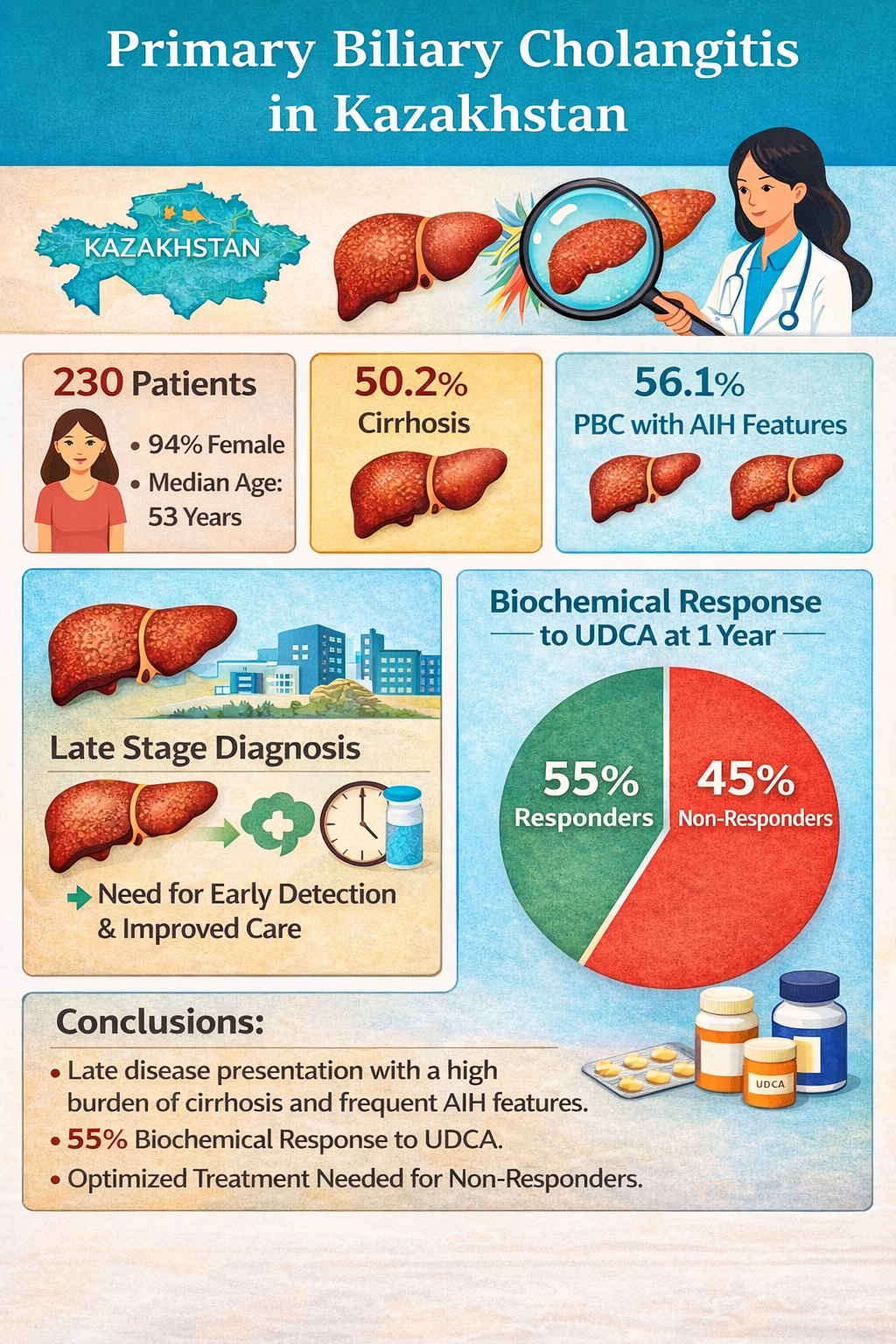
Background/Objectives: Primary biliary cholangitis (PBC) is a chronic immune-mediated cholestatic liver disease with increasing global prevalence. However, the data from Central Asia are lacking. We aimed to describe the clinical, serological, and treatment characteristics of PBC patients in Kazakhstan. Methods: This was a multicenter retrospective observational study across seven hepatology centers in Kazakhstan, including adults diagnosed with PBC between 2014 and 2022. Clinical presentation, laboratory parameters, autoimmune comorbidities, liver disease severity, and ursodeoxycholic acid (UDCA) treatment response were assessed. Biochemical response at 1 year was evaluated using Paris-1 and Barcelona criteria. Results: A total of 230 patients were included; 93.9% were female and 91.3% were of Asian ethnicity, with a median age at diagnosis of 53 years. Cirrhosis was present in 50.2% at diagnosis. PBC with AIH features was identified in 56.1% of patients and was associated with higher rates of cirrhosis, portal hypertension complications, ANA positivity, and higher elastography indices compared with isolated PBC. Overall, approximately 55% of patients achieved a biochemical response to UDCA at 1 year, with similar response rates between PBC and PBC with AIH features groups. Conclusions: This first comprehensive study of PBC in Kazakhstan demonstrates late disease presentation with a high burden of cirrhosis and frequent AIH features. Despite advanced disease, about half of patients achieved biochemical remission on UDCA. These findings underscore the need for earlier diagnosis and optimized management strategies for PBC in Kazakhstan and similar settings in Central Asia.
Keywords:
primary biliary cholangitis
; autoimmune hepatitis
; epidemiology
; Kazakhstan
1. Introduction
Primary biliary cholangitis (PBC) is a chronic immune-mediated cholestatic liver disease with rising incidence and prevalence worldwide [1]. Recent global meta-analyses estimate a pooled prevalence of approximately 18 per 100,000 population and an incidence of 1.8 per 100,000 person-years, with considerable geographic variability across regions [2]. Rates are lowest in the Asia–Pacific region and higher in Europe and North America [3,4]. PBC also commonly overlaps with other autoimmune diseases: up to 73% of patients have extrahepatic autoimmune manifestations – most often Sjögren’s syndrome, autoimmune thyroid disease or systemic sclerosis [5].
Contemporary national cohorts from the Netherlands and Sweden show increasing prevalence over time, female predominance, and diagnosis typically in the fifth to seventh decades of life, often with early-stage biochemical abnormalities [6,7]. In recent years, improved diagnostics have revealed rising PBC incidence in Asian populations. Despite these insights, epidemiological and clinical data from Central Asia remain completely absent.
Kazakhstan, a large upper-middle-income country in Central Asia with changing health-system capacities, has no published descriptive studies of PBC. Given ethnic, environmental, and healthcare-access differences, data from Europe and North America may not reflect the clinical profile of PBC in Kazakhstan. Understanding local patterns of disease presentation, biochemical severity, autoimmune comorbidities, and treatment response is critical for establishing evidence-based management pathways. To date, published data on primary biliary cholangitis in Kazakhstan are limited to a small interventional cohort of advanced ursodeoxycholic acid (UDCA) - refractory patients and isolated case reports, with no comprehensive descriptive studies reporting demographic, immunologic, and clinical characteristics of PBC patients in routine hepatology practice [8,9,10,11,12].
Therefore, we conducted a descriptive study of patients with PBC across multiple centers in Kazakhstan. The primary objective of this study was to describe the profile of Kazakh PBC patients, including disease presentation, comorbidities, and treatment outcomes. In addition, we hypothesized that due to healthcare and demographic differences, many patients present at later disease stages. Thus, the secondary objective was to compare the subgroup of patients with isolated PBC to those with PBC with autoimmune hepatitis (AIH) features, in order to elucidate any differences in presentation or response to therapy.
2. Materials and Methods
2.1. The Study Population
We conducted a multicenter retrospective observational study of adult patients (≥18 years) with confirmed PBC across seven hepatology centers in Kazakhstan. The study period was January 2014 through May 2022.
The diagnosis of PBC was considered if the patient fulfilled at least two of the following diagnostic criteria as recommended by the American Association for the Study of Liver Disease guidelines: 1) a positive AMA serology (titer ≥1:40 by immunofluorescence); 2) persistent increase of the serum alkaline phosphatase (ALP) levels; and 3) a liver histology showing nonsuppurative lymphocytic cholangitis with interlobular bile duct damage [13]. The diagnosis was established based on serological data and/or a liver biopsy. All patients were examined by ultrasound and indirect liver elastography. PBC with AIH features was established using ANA positivity (ANA ≥1:160) in the diagnostic titer in patients with PBC.
Patients in whom the diagnosis could not be confirmed or who had another etiology of liver disease were excluded. AMA status was assessed by indirect immunofluorescence. All AMA positive patients had titers ≥ 1:40. All centers adhered to uniform diagnostic criteria and data collection protocols.
2.2. Data Collection
De-identified clinical data were extracted retrospectively from medical records at each center by trained physicians. Collected variables included demographics (age, sex, ethnicity), lifestyle factors (smoking, alcohol use), diagnosis details (year of first symptoms, year of PBC diagnosis, and AIH features was present), and relevant comorbidities (other autoimmune disorders such as Hashimoto thyroiditis, Sjögren’s syndrome, rheumatoid arthritis, or CREST syndrome). Baseline liver disease status (cirrhosis and any features of portal hypertension) at diagnosis was recorded, as were key symptoms (pruritus, fatigue, peripheral edema). Laboratory data included liver enzymes – alanine transferase (ALT), aspartate aminotransferase (AST), alkaline phosphatase (ALP), and gamma-glutamyltransferase (GGT) – as well as total bilirubin and immunoglobulins, when available. Serological status for AMA (including M2 subtype) and anti-nuclear antibody (ANA) was recorded for each patient. The presence and titer of AMA was assessed by indirect immunofluorescence (titer ≥1:40 considered positive, in line with diagnostic standards). Data on PBC treatment with UDCA were collected, including the weight-based dose. All patients were managed with standard-dose UDCA (target dose 13–15 mg/kg/day) as first-line therapy. Treatment adherence was noted (fully adherent vs. dose interruptions). For patients on UDCA ≥12 months, we assessed the biochemical response to therapy at 1 year. Biochemical response was evaluated by two widely used criteria: the Paris-1 criterion and the Barcelona criterion. Patients meeting either criterion at 1 year were classified as responders under that definition. The duration of follow-up was defined from the date of diagnosis to the last recorded clinic visit for each patient.
2.3. Ethics
All procedures were conducted in accordance with the ethical standards of the Helsinki Declaration and the study was approved by the local ethical сommittee of Asfendiyarov Kazakh National Medical University (protocol number 3(94), approval date 25.03.2020).
2.4. Statistical Analysis
Continuous variables were assessed for normality (Shapiro–Wilk test). Normally distributed continuous variables are presented as mean ± standard deviation (SD); non-normal variables as median with interquartile range (IQR). Categorical variables are summarized as counts and percentages. Group comparisons between patients with PBC alone vs. PBC with AIH features were conducted using the chi-square test or Fisher’s exact test for categorical variables, and Student’s t-test or Wilcoxon two-sample test for continuous variables, as appropriate. Pairwise deletion was applied to missing data. A two-tailed p < 0.05 was considered statistically significant. All statistical analyses were performed using SAS OnDemand for Academics (version 3.81, Cary, NC, USA).
3. Results
According to Table 1, a total of 230 patients were included in the analysis. The cohort was predominantly Asian (91.3%) and female (93.9%). The prevalence of current or past smoking and alcohol consumption was low (4.6% and 2.3%, respectively). Regarding diagnosis, 56.1% of patients had PBC with AIH features, while 43.9% had PBC alone. Cirrhosis was present in approximately half of the cohort (50.2%). Features of portal hypertension were common, with ascites observed in 16.2%, esophageal varices in 29.8%, and hepatic encephalopathy in 24.5% of patients. Extrahepatic autoimmune conditions were observed in a subset of patients, including Hashimoto’s thyroiditis (13.0%), Sjögren’s syndrome (8.7%), rheumatoid arthritis (4.8%), and CREST syndrome/scleroderma (2.6%). Disease-related symptoms were frequent: pruritus was observed in 64.8% of patients, and fatigue in 79.0%, whereas peripheral edema was present in 16.4%. Serologically, AMA or AMA-M2 positivity was detected in 78.4%, and ANA positivity in 43.6% of patients. Most patients demonstrated good treatment adherence, with 82.4% fully adhering to therapy. The median age of the cohort was 55.5 years, with a median age at diagnosis of 53 years. The median body mass index was 23.81 kg/m2, and the median time to diagnosis was 16 months. Disease severity indices were generally low to moderate, with a median elastography index of 3. Liver biochemistry indices showed wide variability, including median ALP, ALT, and GGT indices of 270, 51.7, and 151.1 respectively. The mean daily dose of ursodeoxycholic acid was 1000 mg, while non-invasive fibrosis scores showed substantial dispersion (FIB-4: 2.03; APRI: 0.80).
According to Table 2, baseline demographic characteristics were comparable between patients with PBC and those with PBC with AIH features. Cirrhosis was more frequent in the PBC with AIH features group than in the PBC alone group (59.7% vs 37.4%, p = 0.0012). Similarly, hepatic encephalopathy (30.2%, p = 0.0209) and esophageal varices (37.2%, p = 0.0054) were more common in the PBC with AIH features group than PBC alone group, whereas the prevalence of ascites did not differ between groups (p =0.9342). The frequency of extrahepatic autoimmune diseases was comparable across groups, including Hashimoto’s thyroiditis, Sjögren’s syndrome, rheumatoid arthritis, and CREST syndrome (all p > 0.05). Pruritus, fatigue, and peripheral edema were common in both groups, with no statistically significant differences. Serological profiles showed a marked contrast: ANA positivity was substantially higher in the PBC with AIH features group (63.0% vs 15.7%, p < 0.0001), while AMA/AMA-M2 positivity did not differ significantly between groups. Treatment adherence was high and comparable. Patients with PBC with AIH features demonstrated higher indices of liver disease severity with elastography indices of median 4 vs 2 (p = 0.0004). Among biochemical parameters, AST levels were modestly higher in the PBC with AIH features group (p = 0.0451), while ALT, ALP, GGT, and ursodeoxycholic acid dose were similar. Non-invasive fibrosis scores showed a trend toward higher values in the PBC with AIH features group, with APRI approaching statistical significance (p = 0.0542).
According to Table 3, at 1-year of follow-up, overall biochemical response rates were consistent across Paris-1 and Barcelona (55.77% vs 55.09%, respectively). Similarly, at 1-year, biochemical response rates were comparable between PBC and PBC with AIH features patients using both Paris-1 (57.3% vs 54.6%) and Barcelona criteria (53.9% vs 56.0%).
4. Discussion
This study provides the first comprehensive analysis of PBC patients in Kazakhstan, revealing both expected consistencies with international data and notable differences. We found that Kazakh PBC patients are predominantly female with a mean diagnosis age in the early 50s, which is consistent with the known epidemiology of PBC [14,15]. The majority of our patients had no history of alcohol overuse, and few were smokers, aligning with studies that PBC etiology is unrelated to these traditional liver risk factors and may instead be linked to other environmental triggers such as prior infections in genetically susceptible individuals [16,17].
Despite these similarities, our findings also highlight important differences in disease presentation that likely reflect healthcare and genetic factors unique to this region. Notably, fully half of our cohort already had cirrhosis at the time of PBC diagnosis. This rate is substantially higher than that reported in contemporary studies from North America or Europe, where only about 10–20% of patients have cirrhosis at diagnosis due to earlier detection of asymptomatic cases [18]. The high prevalence of advanced fibrosis in our patients suggests that PBC is often recognized late in its course in Kazakhstan. Possible contributing factors include limited routine liver enzyme screening, delayed referral of asymptomatic cholestatic lab abnormalities, or reduced awareness leading patients to present only once symptoms (fatigue, pruritus) or complications (ascites, variceal bleeding) develop.
Another striking finding is the high proportion of PBC with AIH features syndrome in our cohort. Features were identified in 56% of patients, far exceeding the 5–15% frequency reported in most Western series [19,20,21]. This discrepancy may have several explanations. Firstly, the advanced stage of disease at presentation could predispose to PBC with AIH features. There is evidence that PBC patients can develop features of AIH over time if cholestatic injury is longstanding [22,23]. In our cohort, the long diagnostic delay and high rate of cirrhosis mean many patients had prolonged uncontrolled cholestasis, which may have triggered or unmasked autoimmune hepatitis features by the time of diagnosis. From a practical standpoint, the high frequency of PBC with AIH features patients in Kazakhstan calls for vigilance in monitoring PBC patients for hepatitic activity.
The PBC with AIH features group in our study had significantly higher ANA positivity and more aggressive disease than isolated PBC. This aligns with reports that PBC with AIH features patients often experience a more severe course than PBC or AIH alone [24]. Nonetheless, when treated appropriately, their outcomes can be favorable. In our cohort, PBC with AIH features patients did not show a higher 1-year treatment failure rate compared to PBC alone patients, suggesting that UDCA therapy was beneficial.
Our study also sheds light on the serological profile of PBC in our population. We observed a somewhat lower prevalence of AMA positivity (78% overall) than typically described in European/North American cohorts, where 90–95% of PBC patients are AMA-positive [25]. Notably, AMA-negative PBC has been reported at higher rates in some East Asian studies, up to 15% in China [26], and our finding of 22% AMA-negative is within the context of a predominantly Asian (Kazakh) cohort.
The first-year treatment response to UDCA in our cohort was modest and aligns with international experience. By either Paris-1 or Barcelona criteria, about 55% of patients achieved a complete biochemical response after 1 year on UDCA. This implies that 45% of patients had an inadequate response, a proportion in line with the upper range of what is reported globally, in Western cohorts, 20–40% are UDCA non-responders depending on criteria [27,28]. The lack of difference in UDCA response rates between PBC with AIH features group and pure PBC patients in our study is notable. This could be partly because PBC with AIH features patients who respond to UDCA represent those with less aggressive bile duct disease hence surviving long enough to manifest AIH features.
The results offer a benchmark for clinicians in Central Asia regarding what patient profiles to expect and highlight areas for improvement in. We also acknowledge limitations: the retrospective design may introduce information bias (e.g., under-reporting of mild symptoms or comorbidities), and missing data for certain variables (IgG levels, biopsy findings in some patients) required us to rely on available subsets for analysis. Furthermore, while we compared PBC with and without AIH features, we did not have a separate isolated AIH control group – thus our conclusions on AIH features are specific to differences from classic PBC, not from pure AIH. Lastly, genetic studies were beyond our scope, but future research might investigate if unique genetic or environmental factors underlie the high PBC and AIH features rate observed.
In a broader context, our findings reinforce that PBC in Kazakhstan shares many features with PBC elsewhere, but patients here are presenting later in the disease course. This has clinical implications: there is a window of opportunity to intervene earlier, which could be achieved by raising awareness among primary care and general physicians to check cholestatic liver enzymes and AMA in patients (particularly middle-aged women) with vague symptoms like fatigue or pruritus. The association of PBC with other autoimmune diseases also means multidisciplinary collaboration (with endocrinologists, rheumatologists, etc.) is important for comprehensive care.
5. Conclusions
In conclusion, this study characterizes for the first time the clinical profile of primary biliary cholangitis in Kazakhstan, revealing a disease that predominantly affects middle-aged women and often presents at an advanced stage with frequent PBC with AIH features. Our PBC cohort had a high rate of cirrhosis and autoimmune features at diagnosis, likely reflecting delayed case detection and perhaps unique regional factors. Nevertheless, about half of patients achieved biochemical remission on UDCA, consistent with global experience, while the remainder will require additional therapies to improve their prognosis. These findings highlight an urgent need for earlier diagnosis and intervention in PBC patients in Kazakhstan and similar settings in Central Asia. By increasing awareness of PBC among healthcare providers and ensuring availability of second-line treatments for UDCA non-responders, we can potentially change the disease course – improving survival and quality of life for PBC patients in this region. Ultimately, our study underscores that while PBC is a global disease with well-established therapies, local population characteristics and healthcare infrastructure greatly influence patient outcomes, and strategies tailored to the regional context are essential to optimize care.
Author Contributions
Conceptualization A.G., A.N., K.A., A.R. and B.I.; methodology A.G., A.N., K.A., A.R., S.M., L.Y., D.S. and B.I.; formal analysis A.G. and A.N.; investigation A.G., A.N., K.A., A.R., S.M., L.Y., D.S. and B.I.; resources S.M, L.Y., and D.S.; data curation A.G., A.N., K.A., A.R., S.M., L.Y., D.S. and B.I.; writing—original draft A.G.; writing—review and editing A.G., A.N., K.A., A.R., S.M., L.Y., D.S. and B.I.; visualization A.G.; supervision A.N. and K.A. All authors have read and agreed to the published version of the manuscript.
Funding
This research received no external funding.
Institutional Review Board Statement
The study was conducted in accordance with the Declaration of Helsinki, and approved by the Local Ethics Committee of Asfendiyarov Kazakh national medical university, Almaty, Republic of Kazakhstan (protocol code 3 (94), date of approval 25.03.2020).
Informed Consent Statement
Informed consent was obtained from all subjects involved in the study.
Data Availability Statement
The data presented in this study are available on request from the corresponding author due to institutional and national data protection regulations that restrict public sharing of health data.
Acknowledgments
The authors express their gratitude for the administrative and technical support provided by Institute of gastroenterology hepatology and metabolism Interna Clinic. The authors are also grateful to Mukhtar Kulimbet for his support in manuscript preparation.
Conflicts of Interest
The authors declare no conflicts of interest.
Abbreviations
The following abbreviations are used in this manuscript:
| PBC | Primary biliary cholangitis |
| PBC + AIH | Primary biliary cholangitis with autoimmune hepatitis features |
| UDCA | Ursodeoxycholic acid |
| AIH | Autoimmune hepatitis |
| AST | Aspartate aminotransferase |
| ALT | Alanine transaminase |
| ALP | Alkaline phosphatase |
| GGT | Gamma-glutamyl transferase |
| IQR | Interquartile range |
| SD | Standard deviation |
| AMA/AMA-M2 | Antimitochondrial M2 antibody |
| ANA | Antinuclear antibody |
| BMI | Body mass index |
References
- Trivella, J; John, BV; Levy, C. Primary biliary cholangitis: Epidemiology, prognosis, and treatment. Hepatol Commun. 2023, 7(6), e0179. [Google Scholar] [CrossRef] [PubMed] [PubMed Central]
- Tan, JJ; Chung, AH; Loo, JH; Quek, JWE; Sharma, S; Singh, CL; Yap, RXJ; Tay, WX; Smith, MK; Lytvyak, E; Mason, A; Montano-Loza, AJ; Wong, YJ. Global Epidemiology of Primary Biliary Cholangitis: An Updated Systematic Review and Meta-analysis. Clin Gastroenterol Hepatol Epub ahead of print. 2025, S1542-3565(25)00418-5. [Google Scholar] [CrossRef] [PubMed]
- Lv, T; Chen, S; Li, M; Zhang, D; Kong, Y; Jia, J. Regional variation and temporal trend of primary biliary cholangitis epidemiology: A systematic review and meta-analysis. J Gastroenterol Hepatol. 2021, 36(6), 1423–1434. [Google Scholar] [CrossRef] [PubMed]
- Gazda, J; Drazilova, S; Janicko, M; Jarcuska, P. The Epidemiology of Primary Biliary Cholangitis in European Countries: A Systematic Review and Meta-Analysis. Can J Gastroenterol Hepatol 2021, 2021, 9151525. [Google Scholar] [CrossRef] [PubMed] [PubMed Central]
- Chalifoux, SL; Konyn, PG; Choi, G; Saab, S. Extrahepatic Manifestations of Primary Biliary Cholangitis. Gut Liver 2017, 11(6), 771–780. [Google Scholar] [CrossRef] [PubMed] [PubMed Central]
- de Veer, RC; van Hooff, MCB; Werner, E; Beuers, U; Drenth, JPH; Cuperus, FJC; van Hoek, B; Veldt, BJ; Klemt-Kropp, M; van Meer, S; Verdonk, RC; Flink, HJ; Vrolijk, JM; Gevers, TJG; Ponsioen, CY; Ter Borg, MJ; Soufidi, K; Boersma, F; de Jonge, HJM; Wolfhagen, FHJ; Baak, LC; Onderwater, SL; van Bergeijk, JD; van Putten, PG; de Bruin, GJ; Adang, RPR; Aparicio-Pages, MN; de Boer, W; Borg, FT; van Soest, H; Janssen, HLA; Hansen, BE; Erler, NS; van der Meer, AJ. Dutch PBC Study Group. Incidence and prevalence of primary biliary cholangitis in the Netherlands - A nationwide cohort study. JHEP Rep. 2024, 6(8), 101132. [Google Scholar] [CrossRef] [PubMed] [PubMed Central]
- Marschall, HU; Henriksson, I; Lindberg, S; Söderdahl, F; Thuresson, M; Wahlin, S; Ludvigsson, JF. Incidence, prevalence, and outcome of primary biliary cholangitis in a nationwide Swedish population-based cohort. Sci Rep. 2019, 9(1), 11525. [Google Scholar] [CrossRef] [PubMed] [PubMed Central]
- Saparbay, J; Spatayev, J; Sharmenov, A; Aytbayev, S; Uristenova, A; Mukazhanov, A; Zhexembayev, A. Liver Transplantation: A 10-Year Low-Volume Transplant Center Experience in Kazakhstan. Ann Transplant. 2021, 26, e931786. [Google Scholar] [CrossRef] [PubMed] [PubMed Central]
- Melling, N; Hohenberger, W; Yedibela, S. Opisthorchiasis mimicking primary biliary cirrhosis as an indication for liver transplantation. J Hepatol. 2009, 50(5), 1057–9. [Google Scholar] [CrossRef] [PubMed]
- Saipiyeva, D; Askarov, M; Jafari, N; Zhankina, R; Heath, PR; Kozina, L; Boltanova, A; Omarbekov, A; Ilyassov, N; Tuganbekov, T; Mussin, NM; Kaliyev, AA; Sultangereyev, Y; Rahmanifar, F; Mahdipour, M; Bakhshalizadeh, S; Shirazi, R; Tanideh, N; Tamadon, A. Bone Marrow and Peripheral Blood Mononuclear Cell Phenotype Changes after Cultivation and Autologous Infusion in Patients with Primary Biliary Cholangitis. Iran J Med Sci. 2024, 49(9), 559–572. [Google Scholar] [CrossRef] [PubMed] [PubMed Central]
- Semenova, Y; Beyembetova, A; Shaisultanova, S; Asanova, A; Sailybayeva, A; Altynova, S; Pya, Y. Evaluation of liver transplantation services in Kazakhstan from 2012 to 2023. Sci Rep. 2024, 14(1), 9304. [Google Scholar] [CrossRef] [PubMed] [PubMed Central]
- Doszhan, A; Tostanovskaya, N; Shaimardanova, G; Kozina, L; Imambayeva, G; Nauryzbayeva, A. Primary Biliary Cholangitis with Associated Raynaud Syndrome Treatment Outcome: a Case Report. J CLIN MED KAZ. 2025, 22(5), 119–22. [Google Scholar] [CrossRef] [PubMed]
- Lindor, KD; Bowlus, CL; Boyer, J; Levy, C; Mayo, M. Primary Biliary Cholangitis: 2018 Practice Guidance from the American Association for the Study of Liver Diseases. Hepatology 2019, 69(1), 394–419. [Google Scholar] [CrossRef] [PubMed]
- Angelara, M; Papachristou, K; Papatheodoridi, M; Nasiri-Ansari, N; Karagiannakis, DS; Androutsakos, T. Primary biliary cholangitis. Treatment options in 2025. A narrative review. Front Immunol 2025, 16, 1698833. [Google Scholar] [CrossRef] [PubMed] [PubMed Central]
- Trivedi, PJ; Hirschfield, GM. Recent advances in clinical practice: epidemiology of autoimmune liver diseases. Gut 2021, 70(10), 1989–2003. [Google Scholar] [CrossRef] [PubMed]
- Mantaka, A; Koulentaki, M; Samonakis, D; Sifaki-Pistolla, D; Voumvouraki, A; Tzardi, M; Kouroumalis, E. Association of smoking with liver fibrosis and mortality in primary biliary cholangitis. Eur J Gastroenterol Hepatol 2018, 30(12), 1461–1469. [Google Scholar] [CrossRef] [PubMed]
- Zhang, Y; Shi, Y; Wu, R; Wang, X; Gao, X; Niu, J. Primary biliary cholangitis is more severe in previous hepatitis B virus infection patients. Eur J Gastroenterol Hepatol 2018, 30(6), 682–686. [Google Scholar] [CrossRef] [PubMed]
- European Association for the Study of the Liver. EASL Clinical Practice Guidelines: The diagnosis and management of patients with primary biliary cholangitis. J Hepatol. 2017, 67(1), 145–172. [Google Scholar] [CrossRef] [PubMed]
- Freedman, BL; Danford, CJ; Patwardhan, V; Bonder, A. Treatment of Overlap Syndromes in Autoimmune Liver Disease: A Systematic Review and Meta-Analysis. J Clin Med. 2020, 9(5), 1449. [Google Scholar] [CrossRef] [PubMed] [PubMed Central]
- Costa, V; Moreira, M; Costa, R; Fontes, J. Primary Biliary Cholangitis Overlap With Autoimmune Hepatitis? A Case Report. J Med Cases 2021, 12(4), 131–133. [Google Scholar] [CrossRef] [PubMed] [PubMed Central]
- Surdea-Blaga, T; Cărăguț, RL; Caraiani, C; Spârchez, Z; Al Hajjar, N; Dumitrașcu, DL. Overlap syndrome of autoimmune hepatitis and primary biliary cholangitis complicated with atypical hepatocellular carcinoma: a case report. J Med Case Rep. 2023, 17(1), 328. [Google Scholar] [CrossRef] [PubMed] [PubMed Central]
- Rodrigues Barbosa, B; Pereira, L; Campante, F; Pona, AP. Chronic Liver Disease, Not Everything Is What It Seems: Autoimmune Hepatitis/Primary Biliary Cholangitis Overlap Syndrome. Cureus 2024, 16(1), e51630. [Google Scholar] [CrossRef] [PubMed] [PubMed Central]
- Sohal, A; Nikzad, N; Kowdley, KV. Overlap syndromes in autoimmune liver disease: a review. Transl Gastroenterol Hepatol 2025, 10, 33. [Google Scholar] [CrossRef] [PubMed] [PubMed Central]
- Jayabalan, D; Huang, Y; Calzadilla-Bertot, L; Janjua, M; de Boer, B; Joseph, J; Cheng, W; Hazeldine, S; Smith, BW; MacQuillan, GC; Wallace, MC; Garas, G; Adams, LA; Jeffrey, GP. Predictors of survival in autoimmune liver disease overlap syndromes. World J Hepatol. 2024, 16(9), 1269–1277. [Google Scholar] [CrossRef] [PubMed] [PubMed Central]
- Angelara, M; Papachristou, K; Papatheodoridi, M; Nasiri-Ansari, N; Karagiannakis, DS; Androutsakos, T. Primary biliary cholangitis. Treatment options in 2025. A narrative review. Front Immunol 2025, 16, 1698833. [Google Scholar] [CrossRef] [PubMed] [PubMed Central]
- You, H; Duan, W; Li, S; Lv, T; Chen, S; Lu, L; Ma, X; Han, Y; Nan, Y; Xu, X; Duan, Z; Wei, L; Jia, J; Zhuang, H; Chinese Society of Hepatology; Chinese Medical Association. Guidelines on the Diagnosis and Management of Primary Biliary Cholangitis (2021). J Clin Transl Hepatol. 2023, 11(3), 736–746. [Google Scholar] [CrossRef] [PubMed] [PubMed Central]
- Yang, C; Guo, G; Li, B; Zheng, L; Sun, R; Wang, X; Deng, J; Jia, G; Zhou, X; Cui, L; Guo, C; Zhou, X; Leung, PSC; Gershwin, ME; Shang, Y; Han, Y. Prediction and evaluation of high-risk patients with primary biliary cholangitis receiving ursodeoxycholic acid therapy: an early criterion. Hepatol Int. 2023, 17(1), 237–248. [Google Scholar] [CrossRef] [PubMed] [PubMed Central]
- Gao, Y; Li, L; Li, B; Zhan, Y. Response Rate and Impact on Lipid Profiles of Obeticholic Acid Treatment for Patients with Primary Biliary Cholangitis: A Meta-Analysis. Can J Gastroenterol Hepatol 2021, 2021, 8829510. [Google Scholar] [CrossRef] [PubMed] [PubMed Central]

Table 1.
Baseline characteristics of patients (N=230).
| Characteristics | Frequency | Percent (%) |
| Ethnicity | ||
| Asian | 210 | 91.30 |
| Other | 20 | 8.70 |
| Gender | ||
| Female | 216 | 93.91 |
| Male | 14 | 6.09 |
| Main diagnosis | ||
| PBC | 101 | 43.91 |
| PBC with AIH features | 129 | 56.09 |
| Smokers | 10 | 4.59 |
| Alcohol consumers | 5 | 2.29 |
| Cirrhosis, yes | 108 | 50.23 |
| Ascites, yes | 37 | 16.23 |
| Hepatic encephalopathy, yes | 56 | 24.45 |
| Oesophageal varices, yes | 68 | 29.82 |
| Hashimoto’s thyroiditis, yes | 30 | 13.04 |
| Sjögren’s syndrome, yes | 20 | 8.70 |
| Rheumatoid arthritis, yes | 11 | 4.78 |
| CREST syndrome/scleroderma, yes | 6 | 2.61 |
| Pruritus, yes | 147 | 64.76 |
| Fatigue, yes | 180 | 78.95 |
| Peripheral edema, yes | 37 | 16.37 |
| AMA/AMA-M2 | ||
| Negative | 46 | 21.60 |
| Positive | 167 | 78.40 |
| ANA | ||
| Negative | 114 | 56.44 |
| Positive | 88 | 43.56 |
| Treatment adherence | ||
| Adhered fully | 168 | 82.35 |
| Adhered with violations | 36 | 17.65 |
| Age, years | 55.5 (18-84) | 17* |
| Age at diagnosis, years | 53 (18-84) | 15* |
| BMI, kg/m2 | 23.82 (16.4-46) | 4.65* |
| Time to diagnosis, months | 16 (0-132) | 24* |
| Elastography, kPa | 3 (0-4) | 3* |
| ALT, U/L | 51.74 (8.09-641) | 59.9* |
| AST, U/L | 55.9 (9.7-288) | 50.5* |
| ALP, U/L | 270 (45-1815) | 296.6* |
| GGT, U/L | 151.1 (10-1521) | 208* |
| Ursodeoxycholic acid, mg | 1000 (500-2250) | 250* |
| FIB 4 | 2.03 (0.37-26.19) | 2.46* |
| De Ritis | 1 (0.36-16.33) | 0.51* |
| APRI | 0.80 (0.10-13.62) | 0.98* |
Values are presented as no (%), median (min-max); PBC, primary biliary cholangitis; PBC + AIH, primary biliary cholangitis with autoimmune hepatitis features; AMA/AMA-M2, antimitochondrial M2 antibody; ANA, antinuclear antibody; BMI, body mass index; ALT, alanine transaminase; AST, aspartate aminotransferase; ALP, alkaline phosphatase; GGT, gamma-glutamyl transferase; SD, standard deviation, *, IQR (interquartile range).
Table 2.
Characteristics of patients between primary biliary cholangitis and primary biliary cholangitis with autoimmune hepatitis features groups (N=230).
Table 2.
Characteristics of patients between primary biliary cholangitis and primary biliary cholangitis with autoimmune hepatitis features groups (N=230).
| Characteristics | PBC | PBC+ AIH features | p-value |
| Ethnicity | 0.9184 | ||
| Asian | 92 (91.09) | 118 (91.47) | |
| Other | 9 (8.91) | 11 (8.53) | |
| Gender | 0.9345 | ||
| female | 95 (94.06) | 121 (93.80) | |
| male | 6 (5.94) | 8 (6.20) | |
| Smoking | 0.2550 | ||
| no | 87 (95.60) | 121 (95.28) | |
| yes | 4 (4.40) | 6 (4.72) | |
| Alcohol consumption | 0.2350 | ||
| no | 91 (98.91) | 122 (96.83) | |
| yes | 1 (1.09) | 4 (3.17) | |
| Cirrhosis | 0.0012 | ||
| no | 57 (62.64) | 50 (40.32) | |
| yes | 34 (37.36) | 74 (59.68) | |
| Ascites | 0.9342 | ||
| no | 84 (84.00) | 107 (83.59) | |
| yes | 16 (16.00) | 21 (16.41) | |
| Hepatic encephalopathy | 0.0209 | ||
| no | 83 (83.00) | 90 (69.77) | |
| yes | 17 (17.00) | 39 (30.23) | |
| Esophageal varices | 0.0054 | ||
| no | 79 (79.80) | 81 (62.79) | |
| yes | 20 (20.20) | 48 (37.21) | |
| Hashimoto’s thyroiditis | 0.7445 | ||
| no | 87 (86.14) | 113 (87.60) | |
| yes | 14 (13.86) | 16 (12.40) | |
| Sjogren’s syndrome | 0.4006 | ||
| no | 94 (93.07) | 116 (89.92) | |
| yes | 7 (6.93) | 13 (10.08) | |
| Rheumatoid arthritis | 0.2406 | ||
| no | 96 (95.05) | 123 (95.35) | |
| yes | 5 (4.95) | 6 (4.65) | |
| Crest syndrome/scleroderma | 0.2888 | ||
| no | 99 (98.02) | 125 (96.90) | |
| yes | 2 (1.98) | 4 (3.10) | |
| Pruritus | 0.4766 | ||
| no | 32 (32.65) | 48 (37.21) | |
| yes | 66 (67.35) | 81 (62.79) | |
| Fatigue | 0.0909 | ||
| no | 26 (26.26) | 22 (17.05) | |
| yes | 73 (73.74) | 107 (82.95) | |
| Peripheral edema | 0.1587 | ||
| no | 85 (87.63) | 104 (80.62) | |
| yes | 12 (12.37) | 25 (19.38) | |
| АМА/АМА-М2 | 0.1434 | ||
| negative | 24 (26.37) | 22 (18.03) | |
| positive | 67 (73.63) | 100 (81.97) | |
| ANA | <0.0001 | ||
| negative | 70 (84.34) | 44 (36.97) | |
| positive | 13 (15.66) | 75 (63.03) | |
| Treatment adherence | 0.9827 | ||
| adhered full | 75 (82.42) | 93 (82.30) | |
| adhered with violations | 16 (17.58) | 20 (17.70) | |
| Age, years | 55 (20–75) | 56 (18–84) | 0.4091 |
| Age at diagnosis, years | 53.5 (20–75) | 53 (18–84) | 0.6808 |
| BMI, kg/m2 | 23.70 (16.44–34.14) | 23.95 (16.49–46.00) | 0.6579 |
| Time to diagnosis, months | 16 (0–132) | 16 (0–132) | 0.7074 |
| Elastography, kPa | 2 (0–4) | 4 (0–4) | 0.0004 |
| ALT, U/L | 46.99 (8.09–418) | 52.8 (9–641) | 0.1206 |
| AST, U/L | 47.22 (9.7–288) | 61.72 (15.2–282) | 0.0451 |
| ALP, U/L | 265.55 (45–955) | 275 (65–1815) | 0.6764 |
| GGT, U/L | 164.7 (12.56–1086) | 137 (10–1521) | 0.896 |
| Ursodeoxycholic acid dose, mg | 1000 (500–2250) | 1000 (500–1500) | 0.7931 |
| FIB-4 | 1.80 (0.38–17.68) | 2.14 (0.37–26.19) | 0.1522 |
| DE RITIS | 0.99 (0.36–16.33) | 1.03 (0.39–3.83) | 0.5575 |
| APRI | 0.64 (0.10–7.98) | 0.88 (0.14–13.63) | 0.0542 |
Values are presented as no (%) and median (min-max); PBC, primary biliary cholangitis; PBC + AIH, primary biliary cholangitis with autoimmune hepatitis features; AMA/AMA-M2, antimitochondrial M2 antibody; ANA, antinuclear antibody; BMI, body mass index; ALT, alanine transaminase; AST, aspartate aminotransferase; ALP, alkaline phosphatase; GGT, gamma-glutamyl transferase; SD, standard deviation.
Table 3.
Overall and in group response to ursodeoxycholic acid dose treatment at 1 year according to Paris 1 and Barcelona criteria.
Table 3.
Overall and in group response to ursodeoxycholic acid dose treatment at 1 year according to Paris 1 and Barcelona criteria.
| Response Criteria |
Overall response at 1year |
Response at 1 year | ||||
| PBC | PBC with AIH features | |||||
| Available data (n) | Cohort Response n (%) | Available data (n) | Cohort Response n (%) | Available data (n) | Cohort Response n (%) | |
| Paris-1 | 208 | 116 (55.77) | 89 | 51 (57.30) | 119 | 65 (54.62) |
| Barcelona | 216 | 119 (55.09) | 91 | 49 (53.85) | 125 | 70 (56.00) |
Values are presented as no (%); PBC, primary biliary cholangitis; AIH, autoimmune hepatitis.
Disclaimer/Publisher’s Note: The statements, opinions and data contained in all publications are solely those of the individual author(s) and contributor(s) and not of MDPI and/or the editor(s). MDPI and/or the editor(s) disclaim responsibility for any injury to people or property resulting from any ideas, methods, instructions or products referred to in the content. |
© 2026 by the authors. Licensee MDPI, Basel, Switzerland. This article is an open access article distributed under the terms and conditions of the Creative Commons Attribution (CC BY) license.
Copyright: This open access article is published under a Creative Commons CC BY 4.0 license, which permit the free download, distribution, and reuse, provided that the author and preprint are cited in any reuse.


