

Submitted:
14 February 2026
Posted:
26 February 2026
You are already at the latest version
Abstract
Early warning systems support hazard detection, forecasting, and communication, yet U.S. Gulf Coast warning practice often treats hazards, coastal ecosystem change, and vulnerability constraints as separate domains. This paper maps operational early warning systems for climate hazards across Louisiana, Texas, Mississippi, Alabama, and Florida, and assesses whether ecosystem protective functions and social vulnerability are integrated into warning thresholds, dissemination design, and response planning. Web of Science Core Collection and Scopus were searched (timespan limit 2020 to 2026), alongside targeted searches of NOAA/NWS/NHC, FEMA IPAWS, CDC/ATSDR Social Vulnerability Index, IOOS (GCOOS), USGS, and state coastal agencies including CPRA. Searches ran from 15 September 2025 to 18 January 2026. Three independent reviewers screened records and resolved disagreements by consensus. Data were charted using a standardized matrix covering hazard focus, geography, lead organizations, products, dissemination channels, ecosystem indicators, equity features, and governance arrangements. 861 records were identified; 440 duplicates were removed and 421 abstracts were screened. Full text was unavailable for 300 records, leaving 121 reports assessed for eligibility. Ninety were excluded for lacking U.S. Gulf Coast focus and six Spanish language reports were excluded, resulting in 25 sources for charting and synthesis. Socio-ecological integration was inconsistently operationalized, with uneven documentation of how ecosystem condition and vulnerability constraints informed thresholds, accessible messaging, and preparedness supports. End-to-end warning effectiveness can be strengthened through interoperable interfaces between monitoring programs, warning operations, and emergency management, paired with equity and accessibility workflows that translate forecasts into feasible protective actions.
Keywords:
early warning systems
; Gulf Coast
; social vulnerability
; coastal monitoring
; nature-based protection
; governance
; coastal Resilience
; climate change
Introduction
Relative sea level rise, subsidence, and accelerating coastal hazards place the U.S. Gulf Coast among the most exposed regions in North America. Global sea level rise and local land motion combine to raise water levels, expand flood extents, and increase storm surge depth across urbanized and rural shorelines (Ohenhen et al., 2024; Sweet et al., 2022; Wang et al., 2024). Wetland loss and coastal development further alter protective functions and can increase hurricane damage when surge reaches densely built areas (Al-Attabi et al., 2023). These interacting drivers create hazards that shift across time scales, from hours for tropical cyclone landfall to decades for marsh conversion and chronic inundation. Recent synthesis work on Gulf regions emphasizes that anthropogenic factors such as energy infrastructure, land-use change, and coastal development can amplify climate impacts and compound coastal risk pathways (Damoah et al., 2024).
Early warning systems reduce mortality and economic losses when risk knowledge, monitoring, communication, and response capacity align with local exposure patterns and decision timelines. International guidance frames multi-hazard early warning as four linked pillars: risk knowledge, monitoring and forecasting, warning dissemination and communication, and preparedness to respond (United Nations Office for Disaster Risk Reduction & World Meteorological Organization, 2024). The Early Warnings for All initiative calls for universal access to these pillars and identifies governance, financing, and capacity building as enabling conditions for warning services that reach high vulnerability communities (United Nations, 2023; World Meteorological Organization, 2024).
Operational warning services along the Gulf Coast rely on continuous forecast production and warning issuance by the National Weather Service (NWS) and the National Hurricane Center (NHC). NHC documentation describes storm surge products and the Potential Storm Surge Flooding Map as core tools for communicating inundation risk during tropical cyclones (National Hurricane Center, n.d.-b, n.d.-a). NWS documentation describes impact-based decision support briefings, flood inundation mapping services, and heat forecast tools that translate forecasts into decision support for emergency management and the public (National Weather Service, 2024, n.d.-a, n.d.-b). In parallel, coastal observing and restoration programs publish water level, shoreline change, and wetland condition indicators through NOAA coastal water level services, the Annual High Tide Flooding Outlook, the Integrated Ocean Observing System (IOOS) regional network, and Louisiana’s Coastwide Reference Monitoring System (Coastal Protection and Restoration Authority, 2023, n.d.; Integrated Ocean Observing System, n.d.-a, n.d.-b; National Oceanic and Atmospheric Administration [NOAA], n.d.). Program documentation for these monitoring systems emphasizes data access and restoration evaluation and does not describe routine procedures that translate ecosystem indicators into NWS coastal flood warning thresholds or evacuation trigger guidance. Alert distribution depends on FEMA’s Integrated Public Alert and Warning System and Wireless Emergency Alerts, while federal oversight documents persistent barriers to multilingual and accessible alerting across agencies and jurisdictions (Federal Communications Commission, 2026; Federal Emergency Management Agency [FEMA], n.d.-a, n.d.-b; U.S. Government Accountability Office [GAO], 2026).
This scoping review addresses four embedded research questions. Which operational early warning systems and related platforms support climate-relevant hazard detection, forecasting, dissemination, and response across the U.S. Gulf Coast? How do Gulf Coast systems incorporate ecosystem loss, coastal monitoring, and nature-based protective functions within early warning pillars? How do Gulf Coast systems incorporate social vulnerability in warning dissemination, preparedness, and response design? Which policy and governance gaps limit integration, and which actions can strengthen socio-ecological warning practice?
Existing literature frequently documents forecasting capability, tool development, or vulnerability metrics in isolation. Fewer sources describe how operational early warning practice integrates these components into a coherent workflow that connects monitoring signals to decision thresholds, accessible dissemination, and feasible protective actions. This study is novel in that it maps operational early warning systems and governance arrangements used in the U.S. Gulf Coast and evaluates whether ecosystem loss indicators and social vulnerability considerations are operationalized across the early warning chain. The study contributes (1) an inventory of operational systems and platforms and their functions by early warning pillar, (2) a structured synthesis of socio-ecological integration features and gaps, and (3) implementation oriented recommendations focused on interoperability, accessible dissemination, and measurable equity outcomes.
Materials and Methods
The review followed the scoping study framework described by Arksey and O’Malley (2005), with methodological refinements that emphasize clarity of purpose, team-based screening, and analytic interpretation (Levac et al., 2010). The approach also drew on updated JBI guidance for scoping evidence syntheses, including structured data charting and transparent reporting (Peters et al., 2020). Reporting followed the Preferred Reporting Items for Systematic Reviews and Meta-Analyses extension for Scoping Reviews (PRISMA-ScR) (Tricco et al., 2018).
The review defined an operational early warning system as a sustained system or platform that supports one or more early warning pillars through routine monitoring, forecast production, alert dissemination, or organized response support for climate-relevant hazards. The review defined Gulf Coast coverage as Louisiana, Texas, Mississippi, Alabama, and Florida, including coastal adjacent counties.
The review searched Web of Science Core Collection and Scopus, complemented by targeted searches of authoritative federal and state portals, regional observing program sites, and technical reports. The evidence window was bounded to January 1, 2020 through January 18, 2026 to capture current operational practice. Search terms combined Gulf Coast place names with early warning, hurricane, storm surge, flood inundation, coastal monitoring, wetland loss, social vulnerability, and alerting systems. Screening applied inclusion criteria that required (a) operational relevance to detection, forecasting, dissemination, or response and (b) relevance to U.S. Gulf Coast hazards or implementation. The review excluded sources that addressed non-operational models without Gulf Coast linkage or that lacked evidence on system functions.
The review charted data into an extraction matrix that captured hazards, geographic scope, lead organizations, data streams, products, dissemination channels, equity features, ecosystem indicators, and governance arrangements. The synthesis classified systems by pillar contributions and socio-ecological integration features.
Protocol and Registration
A protocol was not registered.
Eligibility Criteria
Sources were eligible if they (a) described an operational early warning system, platform, or workflow supporting at least one early warning pillar (risk knowledge; monitoring and forecasting; dissemination and communication; preparedness to respond), (b) were explicitly relevant to Louisiana, Texas, Mississippi, Alabama, or Florida (including coastal-adjacent counties), and (c) were published between January 1, 2020 and January 18, 2026. The paper included peer-reviewed research articles and authoritative grey literature (federal and state program documentation, technical reports, and standards/guidance documents). The paper included English-language sources and excluded sources not available in full text. This paper excluded non-operational modeling studies without an implementation pathway and sources that did not provide evidence on system functions, products, decision thresholds, dissemination channels, or response supports.
Information Sources
This paper searched Web of Science Core Collection and Scopus and conducted targeted searches of authoritative public databases and program portals relevant to Gulf Coast hazards and warning operations. Targeted sources included NOAA and National Weather Service resources (including National Hurricane Center products and documentation), FEMA IPAWS documentation, CDC and ATSDR Social Vulnerability Index documentation, IOOS program resources including GCOOS, USGS hazard and monitoring resources, and state coastal agency documentation (including the Coastal Protection and Restoration Authority). Searches were conducted between September 15, 2025 and January 18, 2026. The final search was completed on January 18, 2026. Targeted portal searching was used because operational system details are frequently documented in agency and program materials that are not consistently indexed in bibliographic databases.
Search Strategy
Database: Web of Science Core Collection.
Final searched date: January 18, 2026.
Timespan limit: 2020 to 2026.
Search fields: Topic (TS).
Search string:
TS = ((“early warning system*” OR “warning system*” OR “impact-based forecast*” OR “impact-based warning*” OR “emergency alert*” OR “wireless emergency alert*” OR IPAWS OR “Integrated Public Alert” OR “storm surge” OR “flood inundation” OR “high tide flood*” OR hurricane* OR “extreme heat” OR “coastal flooding”) AND (“Gulf Coast” OR Louisiana OR Texas OR Mississippi OR Alabama OR Florida) AND (“social vulnerab*” OR SVI OR equity OR equitable OR accessib* OR multilingual OR “language access” OR “risk communication” OR “evacuation” OR “preparedness” OR wetland* OR subsidence OR “ecosystem loss” OR “nature-based” OR “coastal restoration” OR “coastal change”)).
Note. Equivalent terms and syntax were adapted for Scopus. Targeted portal searching was used to capture operational documentation that is frequently not indexed in bibliographic databases.
Selection of Sources of Evidence
Records were imported and de-duplicated prior to screening. Three independent reviewers screened titles and abstracts against eligibility criteria. Full-text reports were then assessed for eligibility by three independent reviewers. Disagreements at both stages were resolved through discussion until consensus was reached.
PRISMA-ScR flow (reported in Methods): Records identified from databases and other sources (n = 861). Duplicates removed (n = 440). Abstracts screened (n = 421). Records excluded because full text was unavailable (n = 300). Full-text reports assessed for eligibility (n = 121). Full-text reports excluded because they were not focused on the U.S. Gulf Coast (Louisiana, Texas, Mississippi, Alabama, Florida) (n = 90). Reports eligible for synthesis (n = 31). Full-text reports excluded because they were Spanish language sources (n = 6). Sources of evidence included for charting and synthesis (n = 25).
Data Charting Process
This paper developed a structured charting form aligned to the review questions and early warning pillars. The team pilot-tested the form on an initial subset of sources and refined variable definitions prior to full charting. Data were charted by the review team using the standardized form. Disagreements were resolved through consensus. When key operational details were unclear, the paper documented missingness and verified details against primary program documentation when feasible.
Data Items
Charted variables included hazard domain(s), geographic scope, lead organization(s) and governance arrangements, early warning pillar contribution(s), monitoring/data streams, products and decision-support outputs, warning thresholds or trigger logic (if described), dissemination channels and alerting infrastructure, multilingual/accessibility features (if described), incorporation of social vulnerability measures (if described), incorporation of ecosystem indicators and nature-based protective functions (if described), and implementation constraints and interoperability issues.
Critical Appraisal
Because this scoping review aimed to map operational systems and documentation, the paper did not conduct a formal critical appraisal of included sources. This paper recorded source type (peer-reviewed vs program documentation) and reported operational claims only when supported by included evidence and primary documentation.
Synthesis of Results
This paper synthesized charted data using a mapping approach. This paper grouped systems and sources by hazard focus and early warning pillar(s), then coded whether sources described operationalized integration of ecosystem indicators/protective functions and social vulnerability/accessibility considerations in warning thresholds, dissemination design, or response planning. This paper summarized cross-cutting governance and interoperability gaps and linked them to implementable actions. Figure 1 summarizes the workflow.
Citation and access dates for web sources: For web-based agency and program pages that are updated over time, sources are cited as n.d. when a stable publication date is not clearly stated. In these cases, the access date is provided in the reference entry to support transparency and replicability.
Results
PRISMA-ScR selection summary: The search yielded 861 records across Web of Science, Scopus, and targeted public databases and portals. After removal of 440 duplicates, 421 abstracts were screened. Of these, 300 records were excluded because full text was unavailable, leaving 121 full-text reports assessed for eligibility. Ninety full-text reports were excluded because they were not focused on the U.S. Gulf Coast, leaving 31 reports eligible for synthesis. Six reports were excluded because they were Spanish language sources, resulting in 25 sources of evidence included for charting and synthesis.
Table 1 inventories 11 operational early warning systems and related platforms that support climate-relevant hazard detection, forecasting, dissemination, and response across the U.S. Gulf Coast. Table 1 supports the interpretation of the operational landscape by separating program outputs from implementation requirements. The “Primary EWS pillar functions” column specifies whether a platform produces forecasts, authenticates and distributes alerts, or supplies decision support that emergency managers use during protective action decisions. The “Notes on ecosystem and vulnerability integration” column reports whether source documentation describes routine use of ecosystem indicators, vulnerability indices, multilingual content design, or accessibility practices in warning workflows, rather than treating these factors as background context. Because many platforms operate nationally while implementation occurs locally, Table 1 distinguishes federal production functions from jurisdiction-specific practices such as evacuation routing, shelter operations, and targeted assistance planning.
Table 1 indicates that the Gulf Coast warning stack combines forecast production and hazard-specific guidance, alert authentication and distribution infrastructure, and local decision support and protective action planning. The sections below interpret these components by operational function and then assess whether documentation specifies linkages to ecosystem condition and social vulnerability.
Meteorological and Hydrologic Warning Operations
National Hurricane Center (NHC) and National Weather Service (NWS) operations support tropical cyclone, storm surge, rainfall, river flooding, and extreme heat warnings along the Gulf Coast. NHC products include track and intensity forecasts, watches and warnings, storm surge products, and the Potential Storm Surge Flooding Map used to communicate inundation risk (National Hurricane Center, n.d.-b, n.d.-a). NWS offices issue local warnings and provide decision support products, including flood inundation mapping services that translate forecast river stages into spatial extents, as well as impact-based decision support briefings for emergency management and critical infrastructure operators (National Weather Service, 2024, n.d.-a). NWS heat forecast tools provide operational guidance for heat risk communication and protective actions during extreme heat events (National Weather Service, n.d.-b). NHC and NWS product documentation describe hazard thresholds and protective actions, but do not specify adjustments to warning thresholds based on wetland condition, shoreline retreat, or marsh elevation deficits.
Storm surge guidance provides a concrete example of impact-oriented products that connect hazard magnitude to evacuation and protective action decisions. National Hurricane Center documentation describes storm surge products and the Potential Storm Surge Flooding Map as tools that depict the depth of water above ground, which supports decision discussions that depend on expected inundation rather than wind categories alone (National Hurricane Center, n.d.-a, n.d.-b). These products can support locally specific briefings when emergency managers pair projected depth ranges with evacuation zone boundaries, critical facility inventories, and transportation constraints documented in local plans. Source documentation does not typically describe routine adjustments of impact interpretation based on ecosystem protective function, such as marsh condition or shoreline retreat, even though such changes can alter surge penetration and erosion exposure.
Flood warning operations depend on forecast production and on translation tools that depict the likely water extent at familiar landmarks. National Weather Service flood inundation mapping services consolidate inundation maps and water information products that link gauge stages and forecasts to expected flood footprints (National Weather Service, n.d.-a). These maps can reduce interpretation error by showing which roads, neighborhoods, and critical facilities intersect with the forecast flood extent. Operational guidance also describes impact-based decision support services as a sustained practice of providing actionable, decision-ready information to core partners across preparedness, response, and recovery phases (National Weather Service, 2024). Along the Gulf Coast, compound flooding can occur when rainfall and river discharge coincide with elevated coastal water levels, because surge timing and high tides can slow drainage and shift flood extents beyond what upstream gauges alone represent.
Heat warning practice illustrates how protective outcomes depend on the feasibility of action. National Weather Service heat forecast tools emphasize products intended to support interpretation of near-term heat conditions and associated health risk (National Weather Service, n.d.-b). These tools can support operational decisions such as opening cooling centers, adjusting outdoor work guidance, and staging emergency medical services. However, documentation in the reviewed evidence base more often describes tool availability than implementation protocols that ensure access for populations with limited indoor cooling, limited transportation, or higher prevalence of chronic health conditions that increase heat vulnerability.
Evidence on hurricane risk communication tools indicates that interpretation and response vary by audience, which increases the need for locally contextualized impact narratives and redundant dissemination. Analyses of hurricane risk communication tools document variability in how audiences interpret forecast graphics, uncertainty, and probabilistic products (Cass et al., 2023). This finding carries operational significance for the Gulf Coast because national forecast products reach heterogeneous audiences across languages, literacy levels, and media access patterns. The inventory, therefore, distinguishes forecast production from dissemination and action support. Subsequent sections assess whether program documentation links forecast products to multilingual messaging routines, accessible formats, and targeted assistance for populations facing evacuation constraints.
Coastal Monitoring and Ecosystem Indicators
Coastal observing systems provide inputs that support situational awareness and, in some cases, coastal flood messaging, including water level gauges, ocean buoys, and remote sensing products. NOAA’s Annual High Tide Flooding Outlook provides routine projections of high tide flooding potential, and NOAA coastal water level services provide monitoring data used by multiple coastal stakeholders (National Oceanic and Atmospheric Administration [NOAA], n.d.). IOOS documentation describes the regional association structure and the Gulf of America Coastal Ocean Observing System (GCOOS) as a Gulf region data integration node (Integrated Ocean Observing System, n.d.-a, n.d.-b). In Louisiana, the Coastal Protection and Restoration Authority (CPRA) maintains CRMS, which tracks wetland elevation change, vegetation, hydrology, and salinity indicators and supports restoration performance evaluation and coastal risk assessments (Coastal Protection and Restoration Authority, n.d.).
Peer-reviewed evidence links wetland loss and land subsidence to higher storm surge depth and higher damages, which indicates that ecological conditions can materially modify surge impacts (Al-Attabi et al., 2023; Wang et al., 2024). CRMS and IOOS program materials do not describe operational pathways that convert wetland condition indicators into NWS warning issuance thresholds or into standardized protective action guidance.
Sea level rise scenario guidance provides a baseline for coastal flood interpretation and planning. The NOAA technical report on sea level rise scenarios provides updated mean projections and extreme water level probabilities for U.S. coastlines and explicitly emphasizes the role of local factors that modify relative sea level, including vertical land motion and subsidence (Sweet et al., 2022). Because relative sea level rise increases the probability of nuisance flooding and raises storm surge baselines, scenario outputs can inform both long-horizon adaptation and near-term seasonal preparedness communication, particularly for jurisdictions that experience repeated roadway inundation and recurrent disruptions.
The annual high tide flooding outlook serves as a recurring national product that approximates a slow-onset warning for chronic inundation. NOAA describes the annual outlook as a forecast-based assessment of expected high tide flooding frequency at U.S. coastal locations based on seasonal water level patterns and observed sea level trends (National Oceanic and Atmospheric Administration, n.d.). Along the Gulf Coast, this outlook can support operational planning when agencies link projected nuisance flooding frequency to transportation routing, critical facility access, and staging of public works resources during seasons of higher baseline water levels.
Land subsidence and urban exposure studies highlight why ecosystem monitoring and land motion indicators matter for operational impact interpretation. A Nature analysis describes subsidence as a mechanism contributing to coastal exposure in U.S. cities, with implications for infrastructure durability and recurrent inundation (Ohenhen et al., 2024). A complementary modeling study links subtle subsidence to higher future storm surge risk, which can alter expected surge penetration and increase exposure for coastal communities (Wang et al., 2024). These studies indicate that monitoring of elevation change, shoreline position, and wetland condition can shift the interpretation of the same storm surge forecast across locations.
State coastal restoration programs produce ecosystem monitoring outputs that can function as risk modifiers when warning practice operationalizes them. Louisiana’s 2023 Coastal Master Plan describes scenario-based future conditions and uses them to guide restoration and risk reduction decisions (Coastal Protection and Restoration Authority, 2023). The Coastwide Reference Monitoring System supplies monitoring indicators that track wetland condition across coastal Louisiana, including variables relevant to salinity stress, vegetation condition, and hydrologic change (Coastal Protection and Restoration Authority, n.d.). Operational warning documentation rarely specifies how emergency management integrates such indicators into warning thresholds or protective action triggers, despite the relevance of wetland conditions to surge attenuation and to chronic inundation pathways.
Regional observing systems expand the availability of near-real-time coastal and ocean data that can support situational awareness and coastal hazard interpretation. The Integrated Ocean Observing System identifies regional associations such as the Gulf of America Coastal Ocean Observing System as nodes that deliver observations, modeling, and data services relevant to coastal hazards (Integrated Ocean Observing System, n.d.-a, n.d.-b). These data streams can support the interpretation of coastal water levels, wind-driven setup, and other variables that influence localized flooding. The reviewed documentation more often describes data access and program scope than explicit decision thresholds that connect observations to evacuation triggers, protective infrastructure actions, or public-facing impact-based messages.
Empirical evidence linking wetland loss, coastal development, and storm surge damages underscores the need for operational coupling. A Hurricane Ike case study indicates that wetland loss and coastal development can increase storm surge damages, supporting the claim that changes in ecosystem protective function can alter impacts for a given storm surge hazard (Al-Attabi et al., 2023). An operational implication follows: warning practice gains accuracy and credibility when impact narratives and protective action guidance reflect current ecosystem condition and land change, rather than relying on static assumptions about protective buffering. Table 2 later identifies governance and interoperability actions that can translate ecosystem monitoring into repeatable warning workflows.
Social Vulnerability and Warning Dissemination Design
National indices support characterization of vulnerability and risk and appear in preparedness planning, including the CDC/ATSDR Social Vulnerability Index and FEMA’s National Risk Index (Centers for Disease Control and Prevention/Agency for Toxic Substances and Disease Registry, 2024; Federal Emergency Management Agency [FEMA], n.d.-c). Operational alert dissemination uses FEMA’s Integrated Public Alert and Warning System and Wireless Emergency Alerts to authenticate and distribute alerts through multiple channels (Federal Emergency Management Agency, n.d.-a, n.d.-b). FCC documentation describes multilingual Wireless Emergency Alerts capabilities, and GAO reporting identifies coordination, capacity, and system integration challenges that limit multilingual weather alert delivery at scale (Federal Communications Commission, 2026; U.S. Government Accountability Office [GAO], 2026).
Peer-reviewed evidence also shows that residents interpret hurricane risk communication tools differently and report different intended protective actions, which supports pre-scripted messaging variants tied to local constraints rather than a single uniform message template (Cass et al., 2023).
The CDC and ATSDR Social Vulnerability Index provides tract-level measures that support identification of communities likely to need additional support before, during, and after hazardous events (Centers for Disease Control and Prevention/Agency for Toxic Substances and Disease Registry, 2024). FEMA’s National Risk Index provides a complementary national product that combines hazard exposure and expected annual loss with measures of social vulnerability and community resilience (Federal Emergency Management Agency, n.d.-c). These tools can support prioritization of outreach, evacuation assistance, and recovery staging when jurisdictions connect the indices to specific operational actions.
Alert delivery infrastructure shapes whether warning messages reach the public through trusted channels and in time to support protective action. FEMA describes the Integrated Public Alert and Warning System as the national capability that authenticates and distributes alerts through multiple pathways, including Wireless Emergency Alerts (Federal Emergency Management Agency, n.d.-a, n.d.-b). Operational documentation, therefore, distinguishes between the distribution infrastructure and the content design practices that determine accessibility, clarity, and actionability.
Federal policy and oversight documents identify multilingual alerting as an implementation challenge that affects warning effectiveness for linguistically diverse communities. The Federal Communications Commission describes multilingual Wireless Emergency Alerts as a policy and implementation focus area that involves alerting across languages (Federal Communications Commission, 2026). The Government Accountability Office reports that agencies face challenges related to multilingual weather alerts and identifies planning and coordination gaps that limit systematic implementation (U.S. Government Accountability Office, 2026). These sources support a specific operational inference: dissemination infrastructure alone does not guarantee multilingual access, because effective implementation requires pre-event planning, message templates, translation workflows, and coordination across agencies and vendors.
Warning practice also requires accessibility for people with disabilities and for people using assistive technologies. The evidence base in this scoping inventory includes vulnerability indices and dissemination infrastructure documentation, but it includes fewer sources that specify routine accessibility testing of alert templates, routine use of alternative formats, or monitoring of message reach across disability status. This absence represents a documentation gap rather than proof that jurisdictions lack accessibility practice; however, it limits the ability of agencies to identify reproducible approaches and to scale accessible warning operations across the region.
International guidance frames warning effectiveness as an end-to-end system performance problem rather than a forecast-only problem. The Early Warnings for All action plan emphasizes integrated capabilities that span risk knowledge, monitoring and forecasting, dissemination, and preparedness and response (United Nations, 2023; World Meteorological Organization, 2024). The global status report on multi-hazard early warning systems similarly emphasizes that capacity gaps persist in reaching those at greatest risk (United Nations Office for Disaster Risk Reduction & World Meteorological Organization, 2024). Within the Gulf Coast context, the inventory indicates that hazard detection and forecast production capacity exist, but documentation more often treats vulnerability indices as planning layers than as inputs to dissemination workflows. Operational integration would require clear linkages between vulnerability maps and dissemination design decisions, including prioritized outreach, redundant channels for outage conditions, and structured assistance plans for evacuation and shelter access.
Across hazard domains, the inventory documents extensive federal forecast production and warning guidance, supplemented by translation tools such as inundation maps and decision support services. In parallel, the inventory documents ecosystem monitoring networks and coastal scenario products that describe evolving exposure and protective function. Few sources describe repeatable operational workflows that convert ecosystem indicators and vulnerability indices into warning triggers, message content decisions, and assistance plans that increase action feasibility. The discussion interprets this pattern as an integration and governance problem and uses the socio-ecological practice model in Figure 2 and the barrier action mapping in Table 2 to specify implementable pathways.

Table 2.
Governance gaps that limit socio-ecological integration and actionable responses.
| Gap | Operational consequence | Action | Primary actors |
| Fragmented data standards across agencies and programs | Limits interoperability across NWS warnings, coastal observing, restoration monitoring, and local emergency management tools | Adopt shared data standards and APIs that link observing, forecast, and vulnerability layers for Gulf Coast hazards; expand open documentation and version control | NOAA, FEMA, state coastal agencies, IOOS regional associations |
| Undocumented linkage between ecosystem condition metrics and warning thresholds | Reduces ability to anticipate surge amplification from wetland loss and subsidence in operational briefings and triggers | Develop operational trigger guidance that references wetland condition, elevation change, and relative sea level rise; integrate indicators into decision support briefings | NWS, NHC, CPRA and state equivalents, USGS |
| Inconsistent multilingual and accessible alert implementation | Creates disparate warning reach for communities with LEP and people with disabilities | Standardize multilingual templates in IPAWS; test message readability and accessibility; monitor reach by language and disability relevant proxies | FEMA, FCC, state and local emergency management |
| Short term funding cycles for local warning capacity | Constrains staffing for warning coordination, community outreach, and sustained evaluation | Align funding with multi year resilience goals; support local warning coordinators and community based organizations for dissemination planning | State legislatures, FEMA grant programs, NOAA programs |
| Unspecified accountability for equitable warning outcomes | Prevents systematic improvement when warnings fail to reach high vulnerability communities | Track warning performance metrics by tract level vulnerability; publish after action dashboards; link corrective actions to preparedness plans | State emergency management, local governments, public health agencies |
Note. The barrier and action mapping synthesizes findings on end-to-end warning requirements (United Nations, 2023; United Nations Office for Disaster Risk Reduction, & World Meteorological Organization, 2024), dissemination infrastructure through IPAWS and Wireless Emergency Alerts (Federal Emergency Management Agency, n.d.-a, n.d.-b), and documented multilingual alert implementation challenges (Federal Communications Commission, 2026; U.S. Government Accountability Office, 2026).
Discussion
Across the 11-system operational inventory (Table 1), continuous forecast and warning operations concentrate in meteorological and hydrologic services, while ecosystem monitoring and vulnerability metrics primarily appear in planning, assessment, and restoration documentation rather than as reproducible triggers within operational warning translation and dissemination. This pattern helps explain why ecosystem loss and access constraints remain weakly represented in evacuation decision rules and alert templates, despite evidence that wetland loss, subsidence, and chronic flooding modify expected impacts. The synthesis model (Figure 2) and governance gap mapping (Table 2) identify practical integration points that do not require new forecasting science, including linking monitoring indicators to impact narratives, standardizing accessibility and multilingual workflows, and formalizing interfaces between monitoring programs, warning offices, and emergency management.
The results indicate a layered warning architecture in which national centers and forecast offices produce and update hazard guidance continuously, while local agencies translate that guidance into evacuation decisions, shelter activation, and protective action messaging. This division of labor aligns with the National Weather Service description of impact-based decision support services, which emphasizes decision-ready information tailored to partner timelines and operational decisions (National Weather Service, 2024). The inventory also indicates that translation tools such as inundation maps can reduce interpretation error by connecting forecasts to familiar locations and infrastructure, which supports more consistent communication under time pressure (National Weather Service, n.d.-a). Therefore, the evidence supports a specific conclusion: the Gulf Coast possesses a forecast backbone and translation toolset capable of supporting impact-oriented briefings when local implementation specifies decision thresholds and roles.
At the same time, the inventory indicates that warning practice often treats coastal ecosystems as contextual information rather than as operational determinants of expected impact. Sea level rise scenario guidance and high tide flooding outlook products describe changes in baseline water levels that raise the starting point for storm surge and nuisance flooding (National Oceanic and Atmospheric Administration, n.d.; Sweet et al., 2022). Peer-reviewed evidence further links wetland loss and coastal development to higher storm surge damages, which implies that static assumptions about protective buffering can misrepresent likely consequences for the same hazard magnitude (Al-Attabi et al., 2023). Because subsidence can increase exposure and raise storm surge risk over time, evidence on land motion reinforces the need to treat elevation change and shoreline position as operational risk modifiers, not only as long-horizon planning variables (Ohenhen et al., 2024; Wang et al., 2024). An operational integration pathway follows: warning systems can incorporate ecosystem and land change indicators into impact narratives and into the selection of protective actions, such as identifying routes and facilities likely to experience earlier overtopping or isolation.
Coastal restoration and monitoring programs already produce variables that can support this integration, but documentation rarely describes their routine use in warning workflows. The Louisiana Coastal Master Plan formalizes scenario-based thinking for risk reduction and restoration decisions, and the Coastwide Reference Monitoring System provides systematic measurements of wetland condition (Coastal Protection and Restoration Authority, 2023; Coastal Protection and Restoration Authority, n.d.). Regional observing capacity through the Integrated Ocean Observing System and its Gulf regional association supports access to ocean and coastal data streams relevant to coastal water levels and nearshore conditions (Integrated Ocean Observing System, n.d.-a, n.d.-b). However, the reviewed documentation more often describes data access and program scope than decision thresholds that connect those observations to evacuation triggers, infrastructure protection actions, or public-facing impact explanations. This pattern points to a translation and governance problem: agencies hold relevant data, but operational practice lacks shared protocols that define how to use the data under time constraints.
Social vulnerability integration (SVI) shows a parallel pattern. The SVI and the National Risk Index provide standardized measures that support identification of communities likely to face constraints in evacuation, shelter access, medical continuity, and recovery (Centers for Disease Control and Prevention/Agency for Toxic Substances and Disease Registry, 2024; Federal Emergency Management Agency, n.d.-c). FEMA’s IPAWS provides authentication and distribution capacity, including Wireless Emergency Alerts, but dissemination outcomes depend on content design, language access, and accessibility practices implemented by alert originators (Federal Emergency Management Agency, n.d.-a, n.d.-b). Federal oversight identifies multilingual weather alerts as an unresolved implementation challenge that requires planning and coordination rather than ad hoc translation during emergencies (Federal Communications Commission, 2026; U.S. Government Accountability Office, 2026). Therefore, the inventory supports a bounded inference: warning infrastructure exists, but documentation and policy constraints limit systematic operationalization of vulnerability metrics into dissemination routines and assistance plans.
Risk communication research reinforces this inference by documenting that interpretation varies across audiences, and that product design influences behavior. Evidence on hurricane risk communication tools indicates that audiences interpret forecast graphics and uncertainty differently, which elevates the importance of message framing, redundancy, and locally specific action guidance that matches community constraints (Cass et al., 2023). Within Gulf Coast contexts characterized by linguistic diversity and uneven transportation access, dissemination design should specify not only what hazard occurs, but also what actions remain feasible for households with limited mobility or resources. A warning that describes expected inundation depth without specifying evacuation transport options, shelter accessibility, or continuity-of-care guidance can increase awareness while still failing to increase safety for the highest-risk tracts identified by vulnerability indices.
Figure 2 provides a synthesis model that specifies where integration can occur without requiring new forecasting science. The model positions ecosystem condition indicators and vulnerability and accessibility constraints as inputs to impact translation, message design, and preparedness triggers. The model also positions interoperability and governance as cross-cutting conditions because integration requires data sharing, defined roles, and performance measurement. International guidance supports this framing by defining early warnings as an end-to-end system and by emphasizing coordinated action across risk knowledge, monitoring, and forecasting, dissemination, and preparedness and response (United Nations, 2023; United Nations Office for Disaster Risk Reduction, & World Meteorological Organization, 2024; World Meteorological Organization, 2024).
Two implications follow for Gulf Coast practice and for research. First, implementation can proceed through protocol development that links existing datasets and indices to defined actions, rather than through the creation of new tools in isolation. Second, performance measurement should move beyond message issuance counts and forecast accuracy and should incorporate indicators of reach, accessibility, comprehension, and action feasibility, particularly for high vulnerability tracts. The barrier action mapping in Table 2 operationalizes these implications by identifying specific governance gaps and corresponding implementation actions that agencies can assign, fund, and evaluate.
Figure 2 presents a socio-ecological early warning practice model that treats governance, interoperability, and equity metrics as cross-cutting conditions for the four early warning pillars. The model places ecosystem indicators and social vulnerability measures within risk knowledge, then links them to monitoring triggers, message design, and response planning.
Policy and Governance Gaps and Actions
Table 2 summarizes governance barriers that limit socio-ecological integration and specifies actions that align with Early Warnings for All enabling conditions, including governance, financing, and capacity building (United Nations, 2023; United Nations Office for Disaster Risk Reduction & World Meteorological Organization, 2024).
Governance barriers appear in the reviewed evidence base as missing decision rights, missing interoperability routines, and mismatched mandates across agencies that hold relevant data. For example, coastal restoration agencies maintain monitoring and scenario products that describe changing exposure and protective function, while emergency management agencies maintain warning issuance and evacuation authority. Without formal protocols that specify how coastal indicators inform warning impact translation or protective action triggers, operational practice relies on informal coordination that varies by jurisdiction and event.
Dissemination governance presents a parallel issue. IPAWS supports authenticated alert distribution, but local alert originators determine message content, language access, and accessibility practices (Federal Emergency Management Agency, n.d.-a, n.d.-b). Federal documentation identifies multilingual alerting as a policy and implementation topic, and federal oversight reports challenges that limit systematic multilingual weather alert delivery (Federal Communications Commission, 2026; U.S. Government Accountability Office, 2026). Therefore, governance improvements must address both the technical alert pipeline and the administrative processes that produce accessible and translated message content.
International guidance emphasizes that early warning effectiveness depends on coordination across the full end-to-end system, including preparedness and response capability, not only on detection and forecasting (United Nations, 2023; United Nations Office for Disaster Risk Reduction, & World Meteorological Organization, 2024). In the Gulf Coast context, Table 2 synthesizes five cross-cutting governance gaps and corresponding actions needed to operationalize socio-ecological risk information in warning workflows. It translates this principle into region-relevant governance barriers and specific actions that agencies can assign, fund, and evaluate.
Table 2 supports implementation planning by mapping each barrier to an operationally specific response rather than to an aspirational goal. The “Barrier” column states the integration failure as a workflow problem, such as the absence of defined thresholds for ecosystem indicators or the absence of standardized translation workflows for multilingual messaging. The “Actionable response” column specifies implementable steps such as establishing standing data-sharing agreements, defining indicator thresholds tied to protective action triggers, and maintaining pre-approved accessible and multilingual templates for hazards with rapid onset. These actions align with end-to-end early warning requirements and with documented challenges in multilingual alert implementation (United Nations, 2023; U.S. Government Accountability Office, 2026).
Limitations
This scoping review has several limitations. First, the geographic scope was restricted to the U.S. Gulf Coast (Louisiana, Texas, Mississippi, Alabama, and Florida). Operational warning systems and governance arrangements outside this region may differ, and findings may not generalize to other coastal settings. Second, a large proportion of screened records were excluded because full text could not be retrieved. This may introduce selection bias if inaccessible sources systematically differ from accessible sources in content, quality, or operational relevance. Third, targeted portal searching was used to capture government and program documentation not reliably indexed in bibliographic databases. Although this approach improves coverage of operational evidence, targeted searching can be sensitive to portal structure, keyword choice, and indexing practices, and it may miss relevant materials in less visible repositories. Fourth, Spanish language sources were excluded. This decision may have reduced coverage of operational documentation relevant to multilingual Gulf Coast communities and may underrepresent evidence disseminated in Spanish.
Conclusion
Gulf Coast warning operations maintain continuous forecast production and warning issuance for meteorological and hydrologic hazards, yet operational documentation seldom specifies how coastal monitoring indicators and vulnerability indices enter warning workflows as repeatable triggers for impact translation, dissemination design, and assistance planning. The inventory identifies nationally standardized products for storm surge depth interpretation and for flood extent visualization, as well as dissemination infrastructure that authenticates and distributes alerts. The inventory also identifies scenario guidance and monitoring programs that describe changing baseline conditions and protective function along the Gulf Coast, including relative sea level rise scenarios, high tide flooding outlooks, and wetland monitoring networks. Peer-reviewed evidence indicates that wetland loss and coastal development can increase storm surge damages, reinforcing the operational need to treat ecosystem change as an impact modifier rather than as context. Dissemination governance documents identify multilingual weather alerts as an unresolved implementation issue, which elevates the importance of pre-event translation workflows and accessibility testing that agencies can reproduce across events. Figure 2 and Table 2 translate these findings into an implementable socio-ecological warning practice agenda that emphasizes protocol development, interoperability, and measurable equity outcomes. Agencies can strengthen warning effectiveness by defining indicator thresholds that connect ecosystem condition and vulnerability patterns to specific protective actions, by standardizing accessible and multilingual templates for rapid-onset hazards, and by evaluating warning reach and action feasibility in high vulnerability tracts using consistent metrics. Future research can test whether ecosystem-informed impact narratives and vulnerability-informed dissemination plans improve protective action uptake and reduce harm under compound hazard conditions documented across the region.
Supplementary Materials
Not applicable. No supplementary materials are provided.
Author Contributions
Conceptualization, B.D.; Methodology, B.D.; Formal Analysis, B.D.; Writing—Original Draft Preparation, B.D.; Writing—Review and Editing, B.D. The author has read and agreed to the published version of the manuscript.
Funding
This research received no external funding.
Institutional Review Board Statement
Not applicable.
Informed Consent Statement
Not applicable.
Data Availability Statement
No new data was generated for this study. All sources included in the scoping review are cited in the manuscript.
Acknowledgments
During the preparation of this manuscript, the author used Grammarly to improve readability. The author reviewed and edited all suggestions and takes full responsibility for the content of this publication.
Conflicts of Interest
The author declares no conflict of interest.
References
- Al-Attabi, Z., Xu, Y., Tso, G., & Narayan, S. (2023). The impacts of tidal wetland loss and coastal development on storm surge damages to people and property: A Hurricane Ike case-study. Scientific Reports, 13(1), 4620. [CrossRef]
- Arksey, H., & O’Malley, L. (2005). Scoping studies: Towards a methodological framework. International Journal of Social Research Methodology, 8(1), 19–32.
- Cass, S., Emrich, C. T., & Cutter, S. L. (2023). Identifying trends in interpretation and responses to hurricane risk communication tools. International Journal of Disaster Risk Reduction, 94, 103752. [CrossRef]
- Damoah, B., Adu, E. O., Ofori, E., & Apraku, A. (2024). Aggravation of climate change crisis in Gulf Regions of United States: A review of anthropogenic factors. Journal of Ecohumanism, 3(4), 438–449. [CrossRef]
- Centers for Disease Control and Prevention/Agency for Toxic Substances and Disease Registry. (2024). CDC/ATSDR social vulnerability index (SVI). https://www.atsdr.cdc.gov/placeandhealth/svi/index.html.
- Coastal Protection and Restoration Authority. (2023). Louisiana’s comprehensive master plan for a sustainable coast (2023 Coastal Master Plan). Retrieved February 10, 2026, from https://coastal.la.gov/the paper’s-plan/2023-coastal-master-plan/.
- Coastal Protection and Restoration Authority. (n.d.). Coastwide reference monitoring system (CRMS). Retrieved February 10, 2026, from https://cims.coastal.louisiana.gov/.
- Federal Communications Commission. (2026). Multilingual wireless emergency alerts. Retrieved February 10, 2026, from https://www.fcc.gov/multilingual-wireless-emergency-alerts.
- Federal Emergency Management Agency. (n.d.-c). National Risk Index for natural hazards. Retrieved February 10, 2026, from https://www.fema.gov/flood-maps/products-tools/national-risk-index.
- Federal Emergency Management Agency. (n.d.-a). Integrated public alert and warning system (IPAWS). Retrieved February 10, 2026, from https://www.fema.gov/emergency-managers/practitioners/integrated-public-alert-warning-system.
- Federal Emergency Management Agency. (n.d.-b). Wireless emergency alerts. Retrieved February 10, 2026, from https://www.fema.gov/emergency-managers/practitioners/integrated-public-alert-warning-system/public/wireless-emergency-alerts.
- Integrated Ocean Observing System. (n.d.-a). Gulf of America - GCOOS. Retrieved February 10, 2026, from https://ioos.noaa.gov/regions/gcoos/.
- Integrated Ocean Observing System. (n.d.-b). Regions. Retrieved February 10, 2026, from https://ioos.noaa.gov/regions/.
- Levac, D., Colquhoun, H., & O’Brien, K. K. (2010). Scoping studies: Advancing the methodology. Implementation Science, 5, 69. [CrossRef]
- National Hurricane Center. (n.d.-a). Potential storm surge flooding map. Retrieved February 10, 2026, from https://www.nhc.noaa.gov/pdf/PDD-PotentialStormSurgeFloodingMap.pdf.
- National Hurricane Center. (n.d.-b). Storm surge products. Retrieved February 10, 2026, from https://www.nhc.noaa.gov/surge/products.php.
- National Oceanic and Atmospheric Administration. (n.d.). Annual high tide flooding outlook. Retrieved February 10, 2026, from https://tidesandcurrents.noaa.gov/high-tide-flooding/annual-outlook.html.
- National Weather Service. (2024). Impact-based decision support services (IDSS). https://www.weather.gov/about/idss.
- National Weather Service. (n.d.-a). Flood inundation mapping services. Retrieved February 10, 2026, from https://water.noaa.gov/.
- National Weather Service. (n.d.-b). Heat forecast tools. Retrieved February 10, 2026, from https://www.weather.gov/safety/heat-tools.
- Ohenhen, L. O., Tahvildari, N., & Arefi, M. (2024). Disappearing cities on U.S. coasts. Nature, 631, 33–36. [CrossRef]
- Peters, M. D. J., Godfrey, C., McInerney, P., Munn, Z., Tricco, A. C., & Khalil, H. (2020). Updated methodological guidance for the conduct of scoping reviews. JBI Evidence Synthesis, 18(10), 2119–2126. [CrossRef]
- Sweet, W. V., Kopp, R. E., Weaver, C. P., Obeysekera, J., Horton, R. M., Thieler, E. R., & Zervas, C. (2022). Global and regional sea level rise scenarios for the United States: Updated mean projections and extreme water level probabilities along U.S. coastlines (NOAA Technical Report NOS 01). National Oceanic and Atmospheric Administration. https://oceanservice.noaa.gov/hazards/sealevelrise/sealevelrise-tech-report.html.
- Tricco, A. C., Lillie, E., Zarin, W., O’Brien, K. K., Colquhoun, H., Levac, D., Moher, D., Peters, M. D. J., Horsley, T., Weeks, L., Hempel, S., Akl, E. A., Chang, C., McGowan, J., Stewart, L., Hartling, L., Aldcroft, A., Wilson, M. G., Garritty, C., Lewin, S., Godfrey, C. M., Macdonald, M. T., Langlois, E. V., Soares-Weiser, K., Moriarty, J., Clifford, T., Tunçalp, Ö., & Straus, S. E. (2018). PRISMA Extension for Scoping Reviews (PRISMA-ScR): Checklist and explanation. Annals of Internal Medicine, 169(7), 467–473. [CrossRef]
- United Nations. (2023). Early warnings for all: Executive action plan 2023–2027. https://www.un.org/en/climatechange/early-warnings-for-all.
- United Nations Office for Disaster Risk Reduction, & World Meteorological Organization. (2024). Global status of multi-hazard early warning systems 2024. https://www.undrr.org/publication/global-status-multi-hazard-early-warning-systems-2024.
- World Meteorological Organization. (2024). Early warnings for all. Retrieved February 10, 2026, from https://public.wmo.int/en/the paper’s-mandate/early-warnings-all.
- Wang, K., Chen, J., Valseth, E., Wells, G., Bettadpur, S., Jones, C. E., & Dawson, C. (2024). Subtle land subsidence elevates future storm surge risks along the Gulf Coast of the United States. Journal of Geophysical Research: Earth Surface, 129(9), e2024JF007858. [CrossRef]
- U.S. Government Accountability Office. (2026). Agencies face challenges related to multilingual weather alerts, and AI project needs better planning (GAO-26-107680). https://www.gao.gov/assets/gao-26-107680.pdf.
Figure 1.
PRISMA-ScR flow diagram for identification, screening, eligibility, and inclusion. Note. The workflow follows the scoping framework described by Arksey and O’Malley (2005) and incorporates methodological refinements that emphasize iterative calibration and transparent linkage between charted data and synthesis (Levac et al., 2010; Peters et al., 2020).
Figure 1.
PRISMA-ScR flow diagram for identification, screening, eligibility, and inclusion. Note. The workflow follows the scoping framework described by Arksey and O’Malley (2005) and incorporates methodological refinements that emphasize iterative calibration and transparent linkage between charted data and synthesis (Levac et al., 2010; Peters et al., 2020).
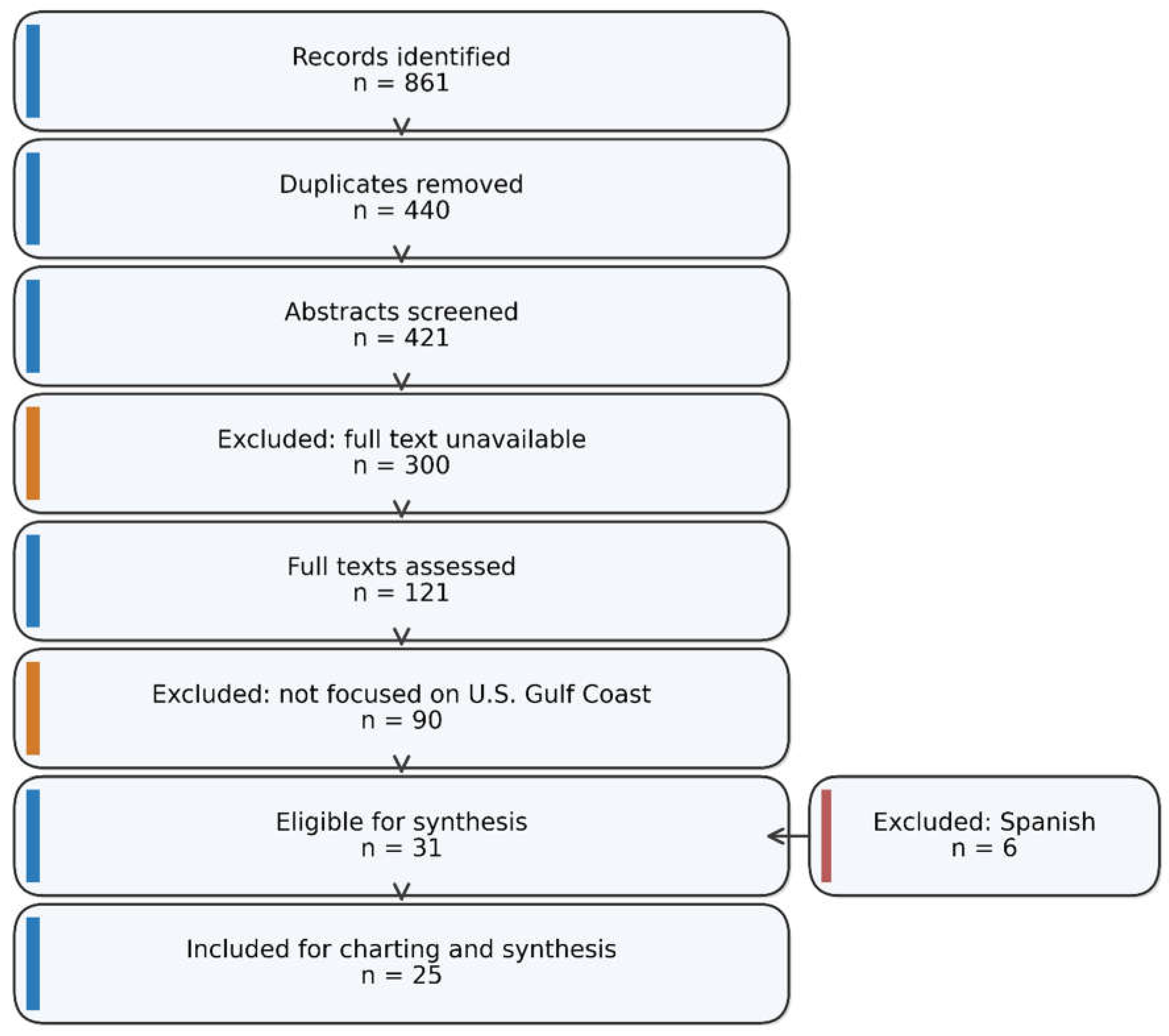
Figure 2.
Socio-ecological early warning practice model for Gulf Coast hazards. Note. The model positions ecosystem condition indicators and social vulnerability and accessibility constraints as operational inputs to impact translation, dissemination design, and preparedness triggers. The model aligns with the Early Warnings for All end-to-end framing and emphasizes governance and interoperability as cross-cutting requirements for scaling practice across agencies and jurisdictions (United Nations, 2023; World Meteorological Organization, 2024).
Figure 2.
Socio-ecological early warning practice model for Gulf Coast hazards. Note. The model positions ecosystem condition indicators and social vulnerability and accessibility constraints as operational inputs to impact translation, dissemination design, and preparedness triggers. The model aligns with the Early Warnings for All end-to-end framing and emphasizes governance and interoperability as cross-cutting requirements for scaling practice across agencies and jurisdictions (United Nations, 2023; World Meteorological Organization, 2024).
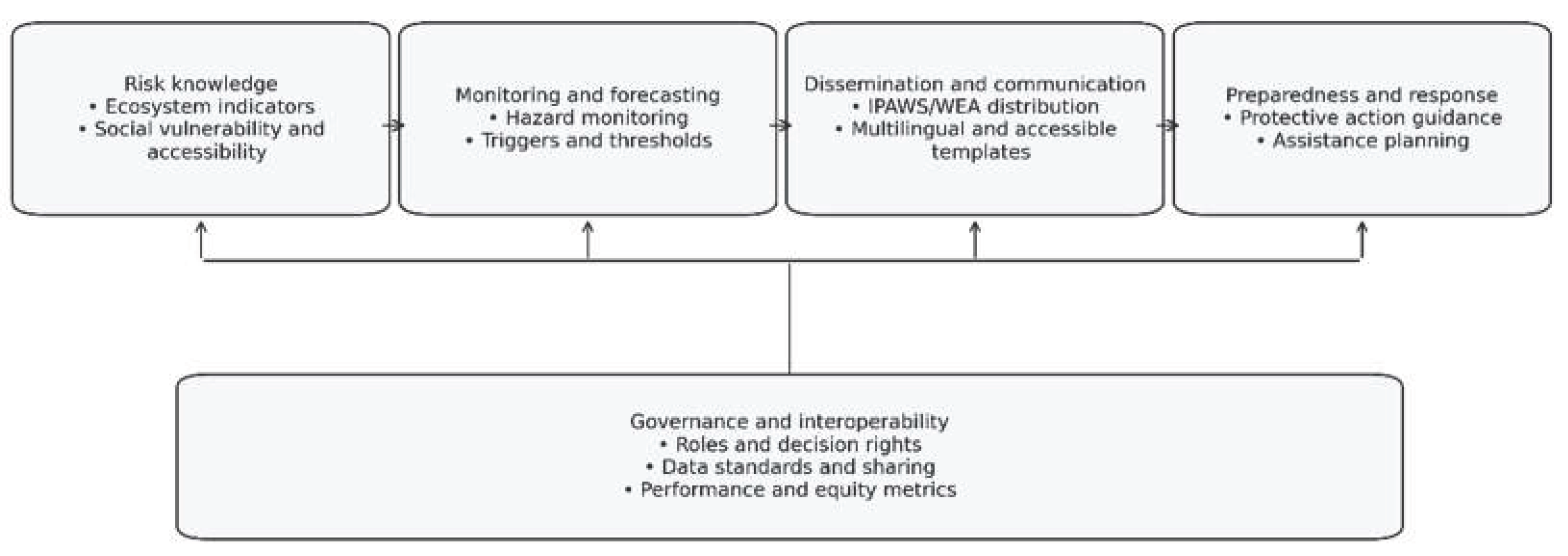
Table 1.
Operational early warning systems and related platforms supporting Gulf Coast climate-relevant hazards.
Table 1.
Operational early warning systems and related platforms supporting Gulf Coast climate-relevant hazards.
| Hazard focus | System or platform | Lead organization(s) | Primary pillar contributions | Example source |
| Tropical cyclones and storm surge | Track forecast, watches, warnings, storm surge products | National Hurricane Center (NOAA) | Monitoring and forecasting; dissemination; decision support | (National Hurricane Center, n.d.-b) |
| Tropical cyclones and storm surge | Potential Storm Surge Flooding Map | National Hurricane Center (NOAA) | Monitoring and forecasting; dissemination | (National Hurricane Center, n.d.-a) |
| Multi-hazard weather | Impact Based Decision Support Services | National Weather Service (NOAA) | Risk knowledge; dissemination; preparedness support | (National Weather Service, 2024) |
| Riverine and flash flooding | Flood Inundation Mapping (FIM) and Flood Inundation Mapping program | National Weather Service (NOAA) | Risk knowledge; dissemination; preparedness support | (National Weather Service, n.d.-a) |
| Coastal flooding | High Tide Flooding Outlook and CO-OPS water level monitoring | NOAA Center for Operational Oceanographic Products and Services | Monitoring and forecasting; risk knowledge | (National Oceanic and Atmospheric Administration, n.d.) |
| Extreme heat | HeatRisk guidance | National Weather Service (NOAA) | Risk knowledge; dissemination | (National Weather Service, n.d.-b) |
| Coastal observing | Gulf of America Coastal Ocean Observing System (GCOOS) (formerly Gulf of Mexico Coastal Ocean Observing System) | IOOS regional association | Monitoring and forecasting inputs; data services | (Integrated Ocean Observing System, n.d.-a) |
| Coastal restoration monitoring | Coastwide Reference Monitoring System (CRMS) | CPRA and partners | Risk knowledge; ecosystem monitoring | (Coastal Protection and Restoration Authority, n.d.) |
| Social vulnerability | CDC/ATSDR Social Vulnerability Index (SVI) | CDC/ATSDR | Risk knowledge; equity targeting | (Centers for Disease Control and Prevention/Agency for Toxic Substances and Disease Registry, 2024) |
| Alert dissemination | Integrated Public Alert and Warning System (IPAWS) and Wireless Emergency Alerts | Federal Emergency Management Agency; FCC | Dissemination; preparedness support | (Federal Emergency Management Agency, n.d.-a, n.d.-b; Federal Communications Commission, 2026) |
| Composite risk dashboard | National Risk Index | Federal Emergency Management Agency | Risk knowledge; planning support | (Federal Emergency Management Agency, n.d.-c) |
Note. The inventory draws from program documentation for storm surge products and the Potential Storm Surge Flooding Map (National Hurricane Center, n.d.-a, n.d.-b), impact-based decision support services (National Weather Service, 2024), flood inundation mapping services (National Weather Service, n.d.-a), heat forecast tools (National Weather Service, n.d.-b), and alert dissemination infrastructure through IPAWS and Wireless Emergency Alerts (Federal Emergency Management Agency, n.d.-a, n.d.-b).
Disclaimer/Publisher’s Note: The statements, opinions and data contained in all publications are solely those of the individual author(s) and contributor(s) and not of MDPI and/or the editor(s). MDPI and/or the editor(s) disclaim responsibility for any injury to people or property resulting from any ideas, methods, instructions or products referred to in the content. |
© 2026 by the authors. Licensee MDPI, Basel, Switzerland. This article is an open access article distributed under the terms and conditions of the Creative Commons Attribution (CC BY) license (http://creativecommons.org/licenses/by/4.0/).
Copyright: This open access article is published under a Creative Commons CC BY 4.0 license, which permit the free download, distribution, and reuse, provided that the author and preprint are cited in any reuse.