
Submitted:
14 February 2026
Posted:
26 February 2026
You are already at the latest version
Abstract
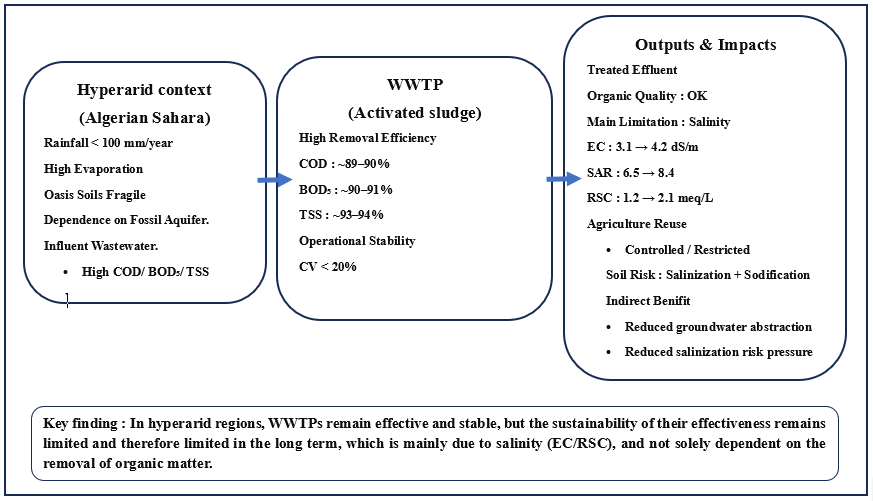
Wastewater treatment plants (WWTPs) are increasingly considered a key and importante infrastructure for environmental protection and combating climate change in regions suffering from severe water scarcity. This work aims to provide a comprehensive and integrated evaluation of the performance of WWTPs in arid and hyperarid contexts, based on two representative experiences in the Algerian Sahara. The evaluation is based on an analysis of treatment performance (COD, BOD₅, TSS), operational stability, and the agricultural suitability of the wastewater (electrical conductivity, SAR, RSC), in addition to the indirect effects on groundwater protection. The results show high and stable organic matter removal rates (>85-90%), demonstrating the effectiveness of biological processes under harsh and hostile climatic conditions. Despite this, residual salinity and sodium carbonate remain the two main factors limiting the extent of long-term agricultural reuse, even with effective treatment. The international comparative analysis highlights the systemic nature of this separation in hyperarid environments and seeks to confirm the need to consider wastewater treatment plants as truly integrated environmental barriers.
Keywords:
wastewater treatment plants
; hyperarid
; reuse
; salinity
; groundwater
; climate change
Copyright: This open access article is published under a Creative Commons CC BY 4.0 license, which permit the free download, distribution, and reuse, provided that the author and preprint are cited in any reuse.


