
Submitted:
14 February 2026
Posted:
17 February 2026
You are already at the latest version
Abstract
Tea tree essential oil (TTO), extracted from Melaleuca alternifolia leaves, is increasingly recognized as a powerful natural antimicrobial for modern food safety applications due to its terpene-rich composition and broad biological activity. Dominant constituents such as terpinen-4-ol, γ-terpinene, and α-terpinene contribute to strong antibacterial, antifungal, and antibiofilm effects, positioning TTO as a clean-label alternative to synthetic preservatives. This review synthesizes current knowledge on the physicochemical properties of TTO, including chemotype variability, hydrophobicity and solubility constraints, oxidative instability, and interactions with food components that influence its functionality. The antimicrobial mechanisms of TTO against major foodborne pathogens and spoilage fungi are examined, emphasizing membrane disruption, disturbance of cellular homeostasis, oxidative stress induction, and quorum-sensing interference. Recent advances such as nanoemulsions, encapsulation, and polymer-based delivery systems have improved TTO stability, reduced volatility, and enabled controlled release, supporting its incorporation into edible coatings, active packaging, and sanitation formulations. These innovations enhance microbial reduction in fresh produce, meat, dairy, and minimally processed foods. Remaining challenges include sensory impacts, volatility losses, regulatory limitations, and concentration-dependent toxicity. Overall, current evidence underscores TTO’s potential as a versatile, sustainable antimicrobial for next-generation food protection strategies.
Keywords:
tea tree oil
; terpinen-4-ol
; antimicrobial
; nanoemulsions
; encapsulation
; food safety
1. Introduction
Tea tree essential oil (TTO), largely extracted from the leaves of Melaleuca alternifolia, has become one of the most thoroughly researched natural antimicrobials owing to its distinctive chemical makeup, wide-ranging efficacy, and compatibility with food systems (Table 1) (Iacovelli et al., 2023).
The rising consumer desire for natural, clean-label, and minimally processed foods has heightened research interest in plant-derived essential oils as substitutes for synthetic preservatives (Chauhan & Rao, 2024). TTO has garnered significant attention due to its potent antibacterial, antifungal, antiviral, and antioxidant activities, mostly attributed to its terpinen-4-ol-rich composition (Yasin et al., 2021). The worldwide food business confronts increasing issues associated with microbial contamination, resistance to chemical preservatives, and the persistence of foodborne pathogens on food and food-contact surfaces. TTO has been extensively investigated for applications including fresh produce sanitation, edible coatings, packaging films, and surface cleaning technologies (Sathiyaseelan et al., 2020). This paper offers a thorough examination of TTO’s physicochemical characteristics, antibacterial mechanisms, and novel uses in food safety.
Tea tree essential oil comprises a complex amalgamation of over 100 elements, predominantly monoterpenes, sesquiterpenes, and their respective alcohols, with terpinen-4-ol, γ-terpinene, α-terpinene, and 1,8-cineole being the principal ingredients (Carson et al., 2006). The chemical composition of TTO is affected by factors like plant genotype, geographic origin, climatic circumstances, and extraction process, leading to diversity in biological activity (Borotova et al., 2022). The physicochemical properties of TTO, namely hydrophobicity, volatility, solubility behavior, and oxidative stability, directly affect its antibacterial efficacy and dictate its appropriateness for integration into food matrices (Cen et al., 2025). The compound’s restricted water solubility limits its direct use in hydrophilic foods, requiring encapsulation methods or emulsification procedures to improve dispersion and provide controlled release. Comprehending these inherent features is essential for developing robust, efficient delivery methods for food applications.
The antibacterial efficacy of TTO has been extensively recorded against prominent foodborne pathogens, such as Listeria monocytogenes, Escherichia coli, Salmonella enterica, Staphylococcus aureus, Campylobacter jejuni, and several spoilage fungi (Puvača et al., 2021; Nguyen et al., 2023). The mechanism of action is mainly due to its capacity to infiltrate and damage microbial cell membranes, enhancing permeability and resulting in the release of internal constituents. Terpinen-4-ol, the principal active chemical, engages with membrane phospholipids, resulting in structural destabilization, a reduction in proton motive force, metabolic inhibition, and ultimately cell death (Cristani et al., 2007). Alternative antimicrobial mechanisms, including oxidative stress induction, enzyme inhibition, and disruption of quorum sensing, have also been suggested (Chouhan et al., 2017). These multi-target processes diminish the probability of microbial resistance in comparison to traditional preservatives. TTO demonstrates significant anti-biofilm efficacy by inhibiting cell adhesion, dissolving pre-existing biofilms, and modifying the integrity of extracellular polymeric substances (EPS), rendering it especially pertinent for the cleanliness of food-contact surfaces and the management of biofilm-related contamination (Manzanelli et al., 2023).
Increasing evidence endorses the prospective incorporation of TTO into food safety measures. TTO-containing wash solutions and vapor-phase treatments have shown substantial reductions of bacteria and spoilage fungi on leafy greens, berries, and ready-to-eat goods in fresh produce systems (Mouatcho et al., 2017). TTO-infused edible coatings, often composed of biopolymers like chitosan, alginate, or whey protein isolate, establish antimicrobial barriers that prolong shelf life while preserving sensory qualities (Karnwal et al., 2025). The integration of biodegradable packaging films, through direct blending or nanoencapsulation, has demonstrated potential in improving mechanical characteristics, facilitating prolonged antimicrobial release, and mitigating microbial proliferation on perishable commodities such as meat and cheese (Westlake et al., 2022). Furthermore, encapsulated TTO nanoparticles, including liposomes, nano emulsions, solid lipid nanoparticles, and cyclodextrin inclusion complexes, have been engineered to mitigate volatility and enhance stability, controlled release, and compatibility with food matrices (Sheikh et al., 2024). These advancements underscore the adaptability of TTO within novel nanotechnology-based food preservation systems.
Notwithstanding its robust antibacterial activity, certain difficulties impede the extensive utilization of TTO in food systems. The strong scent, chemical instability when exposed to light and oxygen, and possible cytotoxicity at elevated concentrations require meticulous formulation and dosage optimization (Avonto et al., 2018). Moreover, interactions with intricate food matrices can diminish antibacterial efficacy due to binding with proteins, lipids, and polysaccharides (González et al., 2011). Regulatory factors also affect its adoption, as maximum permissible limits differ by area and are contingent upon product categorization. Thus, current research emphasizes enhancing delivery systems, assessing sensory effects, comprehending synergistic antimicrobial interactions with other natural compounds (e.g., carvacrol, thymol, cinnamaldehyde), and determining safety profiles by toxicological and vivo investigations (Latorre et al., 2025).
Tea tree essential oil is a promising natural antibacterial agent with significant potential to improve food safety and extend shelf life (Gao et al., 2020). Its distinctive physicochemical properties, diverse antibacterial mechanisms, and compatibility with contemporary food preservation technologies, such as nanoencapsulation, edible coatings, and active packaging, establish it as a pioneering element in advanced food safety methods. This review consolidates existing knowledge regarding the composition, physicochemical properties, antibacterial activity, and novel applications of TTO in food safety, while highlighting present problems and future research requirements for its successful and safe use.
2. Physicochemical Properties of Tea Tree Essential Oils
Tea tree essential oil (TTO) is a complex mixture of volatile phytochemicals, predominantly terpenes and related compounds, which together confer its characteristic physical and chemical properties (Yasin et al., 2021). Understanding these physicochemical properties, including chemical composition, variability in composition, physical parameters (density, refractive index, etc.), hydrophobicity, volatility, oxidative stability, and interactions with food matrices, is crucial for effectively applying TTO in food safety. These properties influence how TTO can be formulated, delivered, and perform as a natural antimicrobial agent in foods (Mondello et al., 2022). Moreover, robust analytical methods (e.g., gas chromatography–mass spectrometry and infrared spectroscopy) are used to characterize TTO’s composition and ensure quality and consistency (Kong et al., 2023). In this section, we review the physicochemical properties of TTO in detail and discuss how each property impacts potential food safety applications.
2.1. Chemical Composition and Variability
Tea tree oil is distilled from the leaves of Melaleuca alternifolia and typically contains an assemblage of approximately 100 distinct compounds (De Groot & Schmidt, 2016). Despite this complexity, a relatively small subset of constituents comprises the bulk of the oil. Eight major components, including terpinen-4-ol, γ-terpinene, α-terpinene, 1,8-cineole, terpinolene, p-cymene, α-pinene, and α-terpineol, usually account for about 90% of TTO by mass (Figure 1) (An et al., 2018).
Terpinen-4-ol, a monoterpenol, is the single most abundant component and a key contributor to TTO’s bioactivity. High-quality TTO is defined by a high terpinen-4-ol content (typically 35–48% of the oil) and relatively low content of 1,8-cineole (an oxidized terpene often kept ≤10–15%). For example, the international ISO 4730 standard for “Oil of Melaleuca, terpinen-4-ol type” specifies terpinen-4-ol in the range of ~35–48% and limits 1,8-cineole to <10% (International Organization for Standardization, 2007). Other significant constituents are the monoterpene hydrocarbons (γ-terpinene typically 15–28%, α-terpinene 6–12%, p-cymene up to ~8%) and sesquiterpenes in smaller amounts (e.g., bicyclic sesquiterpenes like aromadendrene, viridiflorene, and cadinenes each usually <3%). This overall composition gives TTO a clear, colorless to pale yellow appearance and a strong medicinal camphoraceous aroma (Table 2).
The major constituents’ molecular weights range from about 136 g/mol (p-cymene) up to ~ Terpinen-4-ol and heavier sesquiterpenols ~ Terpinen-4-ol, and their structures include aliphatic cyclic hydrocarbons and alcohols (Ul-Haq et al., 2023). Notably, terpinen-4-ol and α-terpineol are oxygenated terpenes (terpenoids), whereas compounds like α-terpinene, γ-terpinene, p-cymene, and α-pinene are purely hydrocarbon terpenes (Table 3) (Masyita et al., 2022).
The presence of this mix of functional groups (alcohols, alkenes) influences properties like polarity and reactivity. From a food safety perspective, the chemical composition is paramount because the antimicrobial efficacy of TTO is largely attributed to its major constituents, especially terpinen-4-ol, and their synergistic effects. For instance, terpinen-4-ol is known to exhibit strong antimicrobial activity against a range of foodborne pathogens and spoilage organisms, so oils with higher terpinen-4-ol content tend to be more potent antimicrobials (Bassolé & Juliani, 2012). Conversely, 1,8-cineole (eucalyptol) has comparatively weaker antimicrobial action. Thus, excessive cineole content can dilute efficacy while also imparting a harsher aroma/flavor to foods. Ensuring a proper composition (high terpinen-4-ol, low cineole) is therefore critical for food applications, both to maximize antimicrobial performance and to meet quality standards.
The chemical profile of tea tree oil can vary due to genetic and environmental factors, though commercial TTO is relatively standardized by producers. Different chemotypes of M. alternifolia exist, yielding oils with distinct dominant compounds. Six chemotypes have been described (one terpinen-4-ol type, one terpinolene type, and four cineole-rich types), but the terpinen-4-ol chemotype is typically cultivated for commercial TTO (Homer et al., 2000). Within the terpinen-4-ol type, natural variation still occurs. Lee et al. (2002) documented significant geographic variation in terpene profiles among 615 M. alternifolia trees: terpinen-4-ol ranged roughly 20–40% and 1,8-cineole 1–15% depending on location and genetic lineage.
2.2. Physical Characteristics
The bulk physical properties of tea tree oil are thoroughly described and contribute to quality control and formulation for culinary applications. Fresh TTO is a transparent, fluid liquid that ranges from colorless to pale yellow, emitting a potent, sharp medicinal aroma often characterized as terpenic or camphoraceous (Larson & Jacob, 2012). The oil possesses low viscosity and disperses effortlessly, which is beneficial for coating applications but also implies it can diffuse or evaporate quickly.
The principal measured physical properties of TTO encompass density, specific gravity, refractive index, and optical rotation, among others. High-quality TTO possesses a relative density of approximately 0.885–0.906 at 20 °C, roughly 0.89 g/mL, rendering it less dense than water (Carson et al., 2006). This implies that TTO will remain buoyant on water and is likely to create a surface layer unless emulsified.
In culinary applications, its low density and water immiscibility can pose difficulties in attaining uniform dispersion. The refractive index of TTO at 20 °C ranges from 1.475 to 1.482. The refractive index serves as a rapid assessment of purity, while oils exhibiting an out-of-range RI may suggest adulteration or an atypical composition (Rytwo et al., 2015). The refractive index of TTO is notably elevated owing to its dense terpenoid composition, and this optical characteristic may be utilized in situ with refractometry sensors to assess the concentration of TTO in a formulation. The optical rotation of pure tea tree oil generally ranges from +5° to +15°, recorded at 20 °C (Ventos, 2025). This little dextrorotatory rotation results from the chiral terpene molecules, such as terpinen-4-ol and α-terpineol, in their native enantiomeric excess. Optical rotation is an additional criterion in pharmacopeial monographs for TTO with substantial deviations may indicate improper sourcing. For instance, racemic synthetic additions may diminish the overall rotation. Although optical rotation is not directly pertinent to food functionality, it highlights the significance of stereochemistry in natural oils and serves as a method for verifying authenticity (Sui et al., 2023).
Additional physical constants that TTO has a boiling range of approximately 150 °C to 210 °C due to its composition as a mixture and it does not vaporize at a singular temperature. Lighter fractions may evaporate around 150 °C, but heavier sesquiterpenes boil above 200 °C. The extensive boiling range indicates the existence of both low molecular weight monoterpenes and higher sesquiterpenes (Aluyor & Oboh, 2014). The flash point of TTO ranges from 56 to 60 °C, categorizing it as a Class III flammable liquid, which presents safety concerns while handling and signifies its considerable volatility. The freezing point of TTO is around –22 °C, indicating that it typically remains in a liquid state at standard freezer conditions (European Chemicals Agency, 2025). This is advantageous for storage, however, if a TTO-containing product is subjected to freezing (e.g., ice cream or frozen foods), the oil will not crystallize but will instead remain in a liquid state within the frozen matrix, potentially leading to aggregation or migration.
These physical characteristics affect the incorporation of TTO into food systems or packaging. The low density and insolubility in water indicate that, without adequate emulsification, TTO will segregate and accumulate on surfaces or at the liquid-air contact, perhaps resulting in inconsistent antimicrobial activity or pronounced localized flavor (Haba et al., 2014). The volatility indicates that TTO may be lost from open systems, although it also implies that it can function as an active antibacterial in the vapor phase within food packaging headspace. Finally, assessing parameters such as density and refractive index can confirm that a TTO batch complies with specifications prior to its incorporation into a food formulation and any discrepancies may suggest degradation or adulteration that could compromise its efficacy or safety.
In quality control for food applications, producers often verify that the specific gravity and refractive index of incoming TTO ingredients fall within standard ranges as a quick confirmation of purity. For instance, an unusually high refractive index or density might suggest contamination with less-volatile residues or carrier oils (Rahman et al., 2023). By ensuring these physical constants are correct, manufacturers can be more confident that the TTO’s composition is correct and thus will perform as expected in terms of antimicrobial activity and sensory impact.
2.3. Hydrophobicity and Solubility
Tea tree oil is highly hydrophobic, which profoundly affects how it can be used in food systems. Chemically, the bulk of TTO’s constituents are non-polar terpenes and terpenoids with very low water solubility (Martins et al., 2017). The oil is practically insoluble in water, with an estimated aqueous solubility on the order of only 300–350 mg/L at 25 °C (approximately 0.03% w/v). In practical terms, if TTO is added to water or a water-based food, the vast majority will not dissolve but remain as an oily phase or droplets. Indeed, TTO is immiscible with water and will spontaneously separate, forming a film or globules. Matussek et al. (2022) succeeded in embedding Tea Tree Oil (TTO) into a biopolymer film and droplet system made from chitosan, and by incorporating Gold Nanoparticles (AuNPs) into the chitosan matrix, they achieved a sustained, controlled release of the oil. This hydrophobic character is quantified by the partition coefficients (log P) of TTO’s components with the major constituents have log P values ranging roughly 3 to 5, indicating strong lipophilicity. For example, terpinen-4-ol and α-terpineol (which have a hydroxyl group) have log P values around 2.5–3.5, while purely hydrocarbon terpenes like γ-terpinene and α-terpinene are higher (log P ~5.2–5.3) (Scientific Committee on Consumer Safety, 2025). These values mean the compounds prefer octanol (a proxy for fats/oils) over water by thousands-fold, hence will overwhelmingly partition into any available non-polar phase.
TTO is miscible with most organic solvents and oils. It is readily soluble in ethanol and other moderately polar organics. For instance, pharmacopoeias note TTO should dissolve clearly in 1–2 volumes of 80–90% ethanol (PubChem, 2025). It also dissolves in fats, vegetable oils, and non-polar solvents like hexane. This means TTO can be blended into oil-based food systems (e.g., certain dressings, oil-based coatings) more easily than into aqueous ones. However, even in lipid-rich foods, partitioning behavior must be considered: TTO may preferentially reside in the lipid phase of a multiphase food (such as an emulsion or a high-fat meat product). In a cheese or ground meat, for example, the oil might partly absorb into the fat fraction, which could either concentrate its antimicrobial components away from water-based microbial niches or conversely protect the microbes if they are in the aqueous phase.
The hydrophobicity of TTO necessitates formulation strategies for uniform and effective application in food preservation. One common approach is emulsification – creating a fine oil-in-water emulsion using emulsifiers or encapsulating agents. By forming nano- or micro-emulsions, TTO’s droplets can be dispersed throughout an aqueous food matrix, greatly increasing the surface area of oil in contact with microbes and improving its apparent solubility. For instance, researchers Cen et al. (2025) formulated a nanoemulsion of TTO with ultrasonic emulsification and noted that it significantly enhanced the antibacterial efficacy compared to non-emulsified oil. The nanoemulsion prevented the oil from coalescing and slowed down its evaporation and oxidation, thereby maintaining a higher active concentration in the food system over time. In practical terms, such emulsified TTO could be added to salad dressings, marinades, or beverage emulsions to impart antimicrobial benefits uniformly.
Another strategy is encapsulation of TTO in carriers like cyclodextrins, liposomes, or biopolymer particles. Encapsulation can render the oil dispersible in water and modulate its release. For example, TTO has been incorporated into chitosan nanoparticles and starch-based microcapsules which remain dispersed in aqueous solutions and then slowly release the oil, providing prolonged antimicrobial activity in food packaging films (Zhu et al., 2022b). These techniques address the fundamental issue that neat TTO would otherwise just separate out or volatilize quickly from a water-based food or coating.
The hydrophobic nature of TTO also means it has a high affinity for food components like fats and proteins. In complex food matrices, essential oil molecules can become solubilized in fat droplets or bound to proteins, which can reduce the amount of free TTO available to act on microbial cells (De Oliveira et al., 2025). Studies on essential oils in foods have consistently found that high-fat foods tend to require higher EO concentrations to achieve the same antimicrobial effect observed in leaner systems. The fat can essentially sequester lipophilic compounds like terpene alcohols. Proteins, especially if denatured or in high concentration, may interact with terpenes via hydrophobic binding sites (Tsumoto et al., 2003). As a result, when using TTO in, say, a meat product or a dairy, one must account for this and possibly use a higher dose or a delivery system that targets the aqueous phase. Otherwise, the oil might largely embed in the fat or protein matrix, lowering the concentration in the water phase where many bacteria reside.
In summary, TTO’s hydrophobicity means it won’t mix with water without assistance. For food safety applications, this influences how TTO is incorporated (neat vs. emulsified) and can determine its antimicrobial efficacy. Proper formulation (emulsifiers, carriers) is critical to overcome these solubility challenges. When done successfully, as evidenced by various studies, emulsified or encapsulated TTO can achieve a more potent antimicrobial effect at lower concentrations than bulk oil by ensuring better contact with microbes. Conversely, inadequate dispersion could lead to phase separation (oil slicks), sensory issues (strong oily flavor in pockets), and reduced effectiveness, thus undermining the benefits of using TTO as a natural preservative.
2.4. Volatility and Aroma
Tea tree essential oil is a volatile oil, meaning its constituents readily evaporate at ambient temperatures, a defining trait of essential oils (Sadgrove et al., 2022). This volatility is reflected in TTO’s measurable vapor pressure, which is about 2.1 kPa at 25 °C (approximately 15–16 mmHg). While lower than the vapor pressure of water at 25 °C (~3.2 kPa), this is still sufficiently high that TTO will slowly vaporize when exposed to air. In a practical sense, an open container of TTO will lose weight over time as the lighter terpenes evaporate, and any product containing TTO may release its aroma into the headspace.
The volatility of TTO means that it has a strong aroma that can quickly permeate its surroundings. The scent is often described as spicy, camphoraceous, or medicinal, owing to compounds like terpinen-4-ol and α-terpinene. In food applications, this strong odor and flavor potential is a double-edged sword. At low levels, it can contribute to a fresh, eucalyptus-like note that might be acceptable or even desirable in certain products. For instance, herbal teas, chewing gums, or mouthwash-like applications. However, at higher concentrations, TTO’s flavor is quite pungent and bitter, which could spoil the organoleptic qualities of most foods (Bagg et al., 2006). Thus, volatility governs not only how TTO is delivered as an antimicrobial but also how its presence is perceived sensorially by consumers. Managing the aroma impact often means using the minimal effective concentration and perhaps pairing TTO with complementary flavors (mint, spice, etc.) if used directly in a food.
One significant advantage of TTO’s volatility is that it can act in the vapor phase to inhibit microorganisms in air or on surfaces. Unlike non-volatile preservatives, TTO does not have to be in direct liquid contact with a microbe to exert some effect; its evaporated molecules can diffuse and reach microbial cells. This is particularly relevant for food packaging and storage. For example, in active packaging, sachets or coating films containing TTO can slowly release vapor that fills the headspace of a package, providing an atmosphere that suppresses mold and bacterial growth on the food surface (Becerril et al., 2020). Research has demonstrated that TTO vapors can inhibit common food spoilage fungi. TTO vapor significantly reduced Botrytis cinerea mold growth on strawberries in storage (Whiley et al., 2017). Treated strawberries exposed to TTO at around 0.3–0.9 g/L air for a few hours showed delayed onset of gray mold and maintained better sensory quality over several days. Similarly, TTO and other essential oil vapors have been reported to curb fungal decay in fruits and bread. This demonstrates a possible application with fumigation or vapor-phase delivery of TTO in produce storages or bakery packaging to extend shelf life without direct contact.
However, volatility also means TTO can be lost from a food system over time. If TTO is applied to an open food surface (e.g., as a spray or dip), a substantial fraction may evaporate into the environment, diminishing its residual antimicrobial effect and slow down release and volatilization. For instance, coating packaging material with TTO-loaded microcapsules can achieve a sustained slow release of vapor rather than a rapid flash off the oil. In a closed package, volatilized TTO is partly retained in the headspace, so it’s not entirely lost that it contributes to an inhibitory atmosphere. But in an open storage scenario or high-airflow conditions, maintaining an effective concentration of TTO vapor is challenging.
From a food safety and preservation standpoint, the volatility of TTO is beneficial in applications like: (a) Active packaging where TTO volatiles provide continuous antimicrobial action and even penetrate small crevices on food surfaces, and (b) Surface sanitation that TTO vapors can reduce airborne or surface microbial loads in storage environments. Conversely, in liquid foods or high-moisture foods stored in unsealed conditions, volatility means TTO might dissipate before it can significantly act on microbes, or its concentration might drop below effective levels over time.
One must also consider regulatory and safety aspects: the fact that TTO volatiles will be inhaled or contribute to flavor means usage levels need to be controlled to avoid consumer aversion or potential respiratory irritation. Generally, only very small amounts of TTO are needed to achieve an antimicrobial effect in vapor form, often a few µL per liter of headspace can show activity against molds. This is fortunate, as it helps stay below sensory detection thresholds in many cases. Monitoring the peroxide value and compositional changes of TTO in such applications is also important, because prolonged volatilization can enrich certain components in the residue and possibly in the headspace as well (e.g., the more volatile fractions evaporate first, altering the oil’s makeup).
TTO’s volatility, therefore, is a key property that enables vapor-phase interventions for food preservation but also necessitates formulation strategies to control its release. It influences how we package foods containing TTO, often needing sealed packaging to trap the vapors, and how frequently active packaging might need to be replaced or replenished as the oil evaporates. The volatile nature, combined with the oil’s potent aroma, means that achieving the right balance between microbial inhibition and sensory acceptance is critical when leveraging TTO in food systems.
2.5. Oxidative Stability
Like many essential oils, tea tree oil is subject to oxidative degradation upon exposure to air, light, and heat. Oxidation is a chemical process where reactive oxygen, from air or other sources, interacts with the oil’s constituents, leading to the formation of new compounds such as peroxides, epoxides, alcohols, or acids. For TTO, which is rich in unsaturated terpenes, oxidation is a particular concern because it can not only diminish the oil’s antimicrobial efficacy but also produce by-products that may be undesirable or even harmful. For example, some oxidation products are strong sensitizers that can cause allergic reactions to skin contact. In a food context, oxidation could potentially lead to off-flavors or reduced preservative function.
The major TTO components vary in their susceptibility to oxidation. Terpinen-4-ol (the primary active) is a tertiary alcohol and relatively stable to mild oxidation that tends to remain constant unless oxidation is severe. In contrast, the terpene hydrocarbons (e.g., α-terpinene, γ-terpinene, terpinolene) are more prone to autoxidation. When exposed to air and light over time, α-terpinene and γ-terpinene gradually oxidize to form compounds like p-cymene (an aromatic terpene) and various peroxides. Indeed, p-cymene often increases in aged or poorly stored TTO as it can be an oxidation product of the terpinene isomers. One study that stored TTO in opened bottles over 12 months, with periodic exposure to air/light simulating consumer use, found little change in terpinen-4-ol content but observed a decline in α- and γ-terpinene and a corresponding rise in p-cymene levels, along with a measurable increase in peroxide value (Hausen et al., 1999). The peroxide value of fresh high-quality TTO is typically <10 micro equivalents O2, a measure of reactive peroxide content, but this can climb as oxidation progresses. Over prolonged or intense oxidation, new oxygenated compounds appear, some of which are known allergens or irritants. For example, ascaridole (a peroxide) and 1,2,4-trihydroxymenthane (a triol) have been detected in heavily oxidized TTO and are implicated in allergic contact dermatitis cases.
Given its oxidation-prone components, TTO should be stored in air-tight, light-resistant containers, in cool conditions to preserve its quality. Amber glass bottles (to block UV light) and filling the headspace with inert gas (or minimizing headspace) are common practices to slow oxidation. Antioxidants like α-tocopherol (vitamin E) or rosemary extract are sometimes added to essential oils to extend shelf-life. In the context of food applications, if TTO is incorporated into a product or packaging, the formulation might include antioxidants to protect not just the food but also the integrity of the oil itself. For example, an edible antimicrobial coating might combine TTO with a natural antioxidant to prevent the oil from oxidizing during the product’s shelf life, thereby maintaining its antimicrobial potency and avoiding development of off odors from oxidation products.
Stored TTO can remain relatively stable for a considerable period. The 12-month study mentioned above showed no appreciable degradation in a well-stored oil, aside from minor expected changes. However, in less ideal conditions, say a transparent spray bottle regularly opened, TTO could oxidize significantly within months. The rate of oxidation also increases with temperature; hence, high-temperature processing or storage of foods containing TTO might accelerate breakdown. In a food safety scenario, this means the timing of TTO addition is important: adding it at the end of cooking (to avoid thermal degradation) or using encapsulated forms that release after cooling can help. If TTO is used in a packaging film and that film is subjected to heat (e.g., during sealing or if used in hot-fill processes), one must ensure the oil remains effective and doesn’t form harmful compounds.
Oxidation can alter the antimicrobial activity of TTO in complex ways. Moderate oxidation might not severely impact the antimicrobial power if terpinen-4-ol and other key actives remain high. In fact, some oxidation products (like peroxides) have antimicrobial properties of their own, although they tend to be less studied and could be more toxic or unstable. However, extensive oxidation that reduces the content of monoterpene alcohols and increases inert or less-active compounds will likely diminish efficacy. Moreover, oxidized oil often has a harsher smell which could be problematic sensorially. In topical medicinal use, oxidized TTO is avoided because of allergy risks, but in foods the bigger concern would be rancid or off flavors.
For applications in food packaging, one needs to consider that an oxidized oil may not provide the same level of antimicrobial protection. A study of antimicrobial packaging with essential oils found that the activity dropped if the active oil had oxidized significantly during storage of the package. Thus, researchers sometimes incorporate UV blockers or antioxidants into active packaging films with TTO to keep it fresh. Encapsulation in a polymer matrix can also inherently slow oxidation by limiting oxygen exposure.
Regulatory bodies typically expect that if an essential oil is used in a food contact material or directly in a food, it should not undergo chemical changes that produce unsafe substances. Therefore, demonstrating the oxidative stability of TTO under the intended use conditions is important. If oxidation products form, a safety assessment might be needed to ensure they are not harmful if ingested. So far, the known major oxidation products of TTO, like ascaridole, are present in very low amounts in moderately aged oils and are more of a concern for skin exposure than ingestion at the trace levels likely in foods. Nonetheless, the goal is usually to use the oil in as fresh a state as possible.
In summary, TTO is moderately stable when protected, but will oxidize over time with exposure. The extent of oxidation can influence safety and sensory properties. For successful use in food preservation, strategies to maintain TTO’s stability, such as proper storage, formulation with stabilizers, and using protective delivery systems, are employed so that the oil retains its antimicrobial potency throughout the product’s shelf life. Additionally, monitoring indicators of oxidation (like peroxide value or changes in aroma profile) can be part of quality control when TTO is used in food processing or packaging, ensuring that consumers get the intended benefit (microbial inhibition) without negative side effects (off-taste or allergens).
2.6. Interactions with Food Matrices
The real-world efficacy of tea tree oil in a food system is not determined by the oil’s intrinsic antimicrobial activity alone, but also by how it interacts with the components of that food matrix. Foods are complex and can contain fats, proteins, carbohydrates, water, and various colloidal structures, all of which can influence the distribution and activity of added antimicrobials like TTO. Several factors in foods can diminish the apparent activity of TTO compared to a simple laboratory broth test. Understanding these interactions is critical for designing effective applications of TTO in food safety.
TTO components are lipophilic and will preferentially dissolve into lipid phases (Giordani et al., 2006). In high-fat food (e.g., cheese, sausage, bakery products with fat, or oil-in-water emulsions like mayonnaise), a large portion of the TTO added may partition into the fat portion. This has two implications: (1) it can protect certain bacteria that reside in the aqueous phase or at water–fat interfaces because the active compounds are drawn away into the bulk fat phase, and (2) the fat can act as a solvent for TTO, possibly reducing direct contact between the oil and microorganisms. Studies have shown that higher fat foods often require larger doses of essential oils to achieve the same antimicrobial effect as low-fat foods (Perricone et al., 2015). For example, an essential oil that effectively inhibits Listeria in a lean fish broth might need a much higher concentration in fatty minced meat, as much of the oil disappears into the fat of the meat. In meats and dairy, fat droplets also physically encapsulate bacteria or create protective niches while fat coating on microbial cells can impede the contact or uptake of antimicrobial agents. In one scenario, the fat in a reformulated low-fat sausage was observed to have less protective effect on microbes, resulting in stronger antimicrobial activity of additives, whereas higher-fat sausage required more additives to see an effect. Thus, when using TTO in a fatty food, one might need to increase concentration or use formulation tricks like pre-mixing the oil with an emulsifier so that it doesn’t immediately vanish into the fat.
Proteins in foods (such as milk proteins, egg proteins, or gluten in dough) can bind flavor and aroma compounds, including terpenes. Phenolic compounds and terpenoids often have an affinity for protein, potentially through hydrophobic interactions or even covalent binding (if the oil contains any reactive aldehydes, though TTO is mostly terpenes and alcohols). While terpinen-4-ol and others are not strongly phenolic, they are still hydrophobic enough to stick to proteins. This binding can reduce the free concentration of TTO components that are able to interact with microbial membranes. For example, if TTO is added to a protein-rich beverage (like a protein shake or soup), some of its molecules might get absorbed to the protein surfaces, thus less is available in solution to act on bacteria. Carbohydrates generally have less of an affinity unless they form inclusion complexes (cyclodextrins can encapsulate small terpenes, intentionally used in some cases). But in solid foods, carbohydrates (starches, fibers) might just physically occlude oils or change the microstructure in a way that the oil is trapped in certain phases.
Water activity (aw) and pH of the food also interact with how well an essential oil works. TTO’s activity might improve at lower aw or lower pH in some cases, as stressed bacteria are more susceptible (Afrokh et al., 2024). But if the food is very dry, the distribution of the oil could be uneven and some of it may volatilize more readily. If pH is very low (like in a pickle or a fermented dairy), TTO doesn’t ionize (it’s mostly non-polar), so pH doesn’t directly affect the oil, but the overall antimicrobial hurdle is changed – at low pH, maybe less oil is needed as bacteria are already weakened. This can be leveraged by combining TTO with other hurdles (like mild acidity or mild heat) to get a synergistic kill effect.
The structure of the food, including emulsion, gel, solid matrix, matters as well. In emulsified foods (dressings, sausages), as noted, partitioning between phases is key. In solid foods or biofilms on food surfaces, the oil has to diffuse to reach microbes. TTO applied on a fruit surface might not penetrate deeply if the fruit has waxy cuticles. Conversely, in a porous food like bread, TTO vapors might travel through pores and reduce mold internally. Some researchers have studied TTO in edible coatings on produce, with the coating matrix (often polysaccharide or protein-based) controls release of TTO onto the fruit surface over time. A too-tight matrix might retain the oil too much, whereas a very open matrix might let it evaporate too quickly. Thus, tailoring the delivery matrix (e.g., a glycerol-plasticized alginate film vs. a zein protein coating) can influence how effectively TTO migrates to where microbes are.
A recurring finding is that the antimicrobial efficacy of essential oils, including TTO, is often reduced in real food systems compared to laboratory broth. Burt (2004) noted that this is due to exactly the factors (fat, protein, salt, etc.) in foods can all interfere or require the oil to be used at higher concentrations. This gap means that when formulating a food preservative system, one cannot rely solely on minimum inhibitory concentration (MIC) values determined in nutrient broth; one must test in the actual food matrix. For instance, if TTO at 0.02% v/v prevents growth of E. coli in laboratory media, it might need 0.1% or more to do the same in a salad dressing with oil and vinegar, or it might be ineffective until 0.5% in a rich stew. High concentrations, however, risk making the food taste medicinal. Therefore, a practical approach is often to use TTO in combination with other preservative hurdles (mild heat, acidity, or other natural antimicrobials) so that each can be at a lower concentration. Some studies have shown synergistic effects, such as TTO working better when used along with a mild thermal treatment on fruit, as heat may make cell membranes more permeable to the oil.
To overcome matrix interactions, encapsulation techniques are again useful. By encapsulating TTO in a carrier (like lipid nanoparticles or polymer fibers), one can sometimes target the release of the oil to certain phases or delay its release until after a processing step. For example, a pH-responsive encapsulation could hypothetically keep TTO bound during high-fat cheese ripening (neutral pH) but release it when the product is consumed or when pH drops slightly due to microbial action, thereby sparing it from binding to fat early on. There is ongoing research into such smart delivery systems for essential oils in foods.
In conclusion, the interactions of TTO with food matrices mean that formulators must consider the food’s composition when determining usage level and method of incorporation. High-fat and high-protein foods pose the biggest challenges, often necessitating higher doses or innovative delivery (like nanoemulsions) to achieve the desired antimicrobial effect. The goal is to maximize the availability of TTO’s active components at the sites where microbes reside (often the aqueous phase or surface of foods) while minimizing losses to the food matrix. Successful case studies include using emulsified TTO in low-fat soups and vapor-phase TTO in bread packaging. Thus, understanding and engineering around these interactions is key to leveraging TTO’s antimicrobial properties in real food products.
2.7. Analytical Methods for Characterization and Quality Assurance
Comprehensive analysis of tea tree oil’s physicochemical properties and composition is essential, especially when TTO is used in food-related applications that demand consistent quality and regulatory compliance. The primary analytical approaches for TTO characterization are chromatographic methods (especially GC-MS) for chemical profiling, and spectroscopic methods (like FTIR) for rapid identification and adulteration detection. Additionally, physical assays (density, refractive index, optical rotation as mentioned) are routinely used for quality control.
Gas Chromatography–Mass Spectrometry (GC-MS) is considered the gold standard for essential oil analysis, and virtually all detailed TTO composition data in the literature come from GC-MS. In this technique, TTO (neat or in solution) is injected into a gas chromatograph; the volatile constituents are separated on a capillary column and then identified by their mass spectra and retention times (often compared against known standards or libraries). GC-MS can quantify the relative percentages of dozens of components in TTO. For instance, it can confirm that terpinen-4-ol is, say, 40% and 1,8-cineole is 4% in each batch, matching the ISO 4730 profile. This is crucial for ensuring that the TTO used in food or packaging meets the expected specification for efficacy and safety. If a GC-MS analysis finds an atypical component or an out-of-range value (e.g., 1,8-cineole at 20%), that might indicate adulteration or an off-spec source. Food regulatory agencies would also rely on such analyses if TTO is being evaluated as a food additive or contact substance, to know exactly what compounds are present.
High-resolution GC methods (like GC-FID for quantification, GC-MS for identification) are used by the industry for batch certification. Additionally, enantioselective GC can be used to examine the enantiomeric ratios of chiral components (like terpinen-4-ol, which has enantiomers). This is an advanced test that can differentiate natural TTO from synthetic mixtures. Melaleuca-derived terpinen-4-ol has a specific enantiomeric excess, with a racemic composition might suggest synthetic adulteration. Such chiral analysis is a powerful tool because it’s nearly impossible for adulterators to mimic the exact chiral signature of natural TTO. In quality control, a combination of GC-MS and enantiomeric GC is recommended for high assurance, especially if TTO is used in medicinal or high-value foods.
Occasionally GC×GC (two-dimensional gas chromatography) is employed in research to separate components that co-elute in one-dimensional GC, giving an even more detailed fingerprint of the oil. This can reveal minor constituents (trace compounds) that might be markers of a particular geographical origin or storage history. Liquid chromatography (HPLC) is not commonly used for TTO because the oil lacks large non-volatile compounds, but derivatization-HPLC could be used if needed to analyze any polar degradation products. For routine purposes, GC-MS suffices.
FTIR spectroscopy (especially in Attenuated Total Reflectance mode) is a rapid, simple method to get a “fingerprint” of TTO. Each essential oil has a characteristic infrared spectrum based on functional groups present. TTO’s IR spectrum, for example, shows bands for O–H stretching (from terpinen-4-ol’s alcohol group), C–H stretching of methyl/methylene, and C=C stretching of terpenes, etc. While FTIR lacks the resolution to identify each component, it is very useful for verification and adulteration screening. A pure TTO sample will produce an IR spectrum that can be matched against a reference spectrum. If the sample has been diluted with a vegetable oil (which is a common adulterant tactic to extend essential oils), the IR spectrum will show features of fatty acids (strong carbonyl band around 1740 cm−1, etc.) which are absent in genuine TTOs. Indeed, studies have shown that FTIR coupled with chemometric models can detect TTO adulteration with cheap carrier oils like soybean or corn oil with high accuracy. For instance, one report noted that a Random Forest–SVM model on FTIR data achieved ~93% accuracy in identifying TTO samples adulterated with corn or soybean oil. This is extremely valuable for quality control because FTIR is quick (a matter of seconds per sample) and does not require solvents or complex preparation. Manufacturers can use FTIR as a screening tool for incoming TTO lots, if an unusual spectrum is observed, they can then do targeted GC-MS to investigate further. FTIR can also monitor changes in TTO due to oxidation. As oxidation progresses, new peaks (e.g., for peroxide O–O or hydroxyl groups from oxidation products) might appear, and baseline shifts might occur. Thus, an FTIR scan might be able to indicate if an oil is significantly aged or degraded (though GC-MS is more definitive in quantifying specific oxidation products). Some researchers have used IR to quantify the extent of adulteration or degradation by building calibration models correlating IR spectral features with known adulterant percentages.
X-ray diffraction (XRD) analysis plays a critical role in characterizing the structural and physicochemical properties of tea tree essential oil (TTO) when incorporated into delivery systems such as nanoemulsions, liposomes, solid dispersions, and polymeric films. While pure essential oils like TTO are inherently amorphous and volatile, XRD becomes particularly relevant when TTO is encapsulated within solid matrices, where it can reveal changes in crystallinity, molecular dispersion, and interaction with carrier materials (Figure 2). The X-ray diffraction (XRD) pattern of tea tree essential oil (TTO) presented in the figure exhibits a broad, diffuse peak with no sharp, intense reflections, characteristic of an amorphous material. The broad halo centered around the 2θ values of approximately 8.33° and 19.93° suggests a lack of long-range molecular order, consistent with the typical behavior of essential oils in their pure or liquid state. These two broad humps may correspond to short-range molecular packing or weak intermolecular interactions between terpene molecules such as terpinen-4-ol, γ-terpinene, and α-terpineol. The absence of distinct crystalline peaks confirms that TTO does not possess a crystalline lattice structure, which is expected due to its volatile and low-molecular-weight constituents. This amorphous nature plays a significant role in TTO’s high volatility, rapid diffusion, and bioavailability when used in food or pharmaceutical systems.
For instance, when TTO is embedded in cyclodextrin inclusion complexes or solid lipid nanoparticles, XRD patterns often show a reduction or complete disappearance of the crystalline peaks of the carrier, suggesting successful encapsulation and the formation of an amorphous or semi-crystalline composite. This transition enhances solubility, stability, and controlled release properties of the oil. In studies involving polymer-based films, such as chitosan, sodium alginate, or pullulan matrices loaded with TTO, XRD analysis has confirmed the molecular-level dispersion of the oil by showing a broadening of diffraction peaks or reduced intensity compared to pure polymers. Such structural modifications indicate improved homogeneity and possible hydrogen bonding or van der Waals interactions between TTO and the film matrix.
Besides, Raman spectroscopy and Near-Infrared (NIR) spectroscopy have been explored for essential oils. NIR can even be used through packaging to verify if oil inside a closed container is authentic. For example, a study using NIR could detect tea tree oil adulteration by scanning the bottle without opening it, a convenient method for ensuring the integrity of packaged oils.
Another advanced approach mentioned in the literature is Nuclear Magnetic Resonance (NMR) spectroscopy. While NMR is not routine for every batch due to cost, it has unique strengths. A recent development introduced a C-NMR method to detect vegetable oil adulterants in essential oils. This method could unambiguously spot even subtle adulteration without needing chemometric analysis, because the carbon backbone signals of terpenes are distinct from those of triglycerides. For TTO, an NMR profile could also be used to quantify major components in an absolute sense (whereas GC is often area-percent). If TTO were to be used as a food ingredient with a need for precise labeling, one might use quantitative NMR (qNMR) to determine absolute terpinen-4-ol content in mg/mL, for instance.
Measuring density, refractive index, and optical rotation are classical methods to quickly assess an essential oil’s identity and purity. These are simpler and cheaper tests that can catch gross adulteration (e.g., addition of a heavy fatty oil will raise the density and lower the refractive index significantly). For food-grade oils, meeting pharmacopeial ranges for these properties is often required. The peroxide value (PV) is another test particularly relevant to oxidative stability that it’s borrowed from fat and oil analysis. A PV test titrates the reactive oxygen species in the oil; a low PV in fresh TTO (<10 µeq O2) confirms minimal oxidation. A high PV would warn that the oil might have substantial oxidation products, which could be a quality or safety concern.
When TTO is incorporated into food or packaging, analytical methods are used both in formulation and in end-product testing. Gas chromatography can be used to measure how much of the TTO (and which components) remain in a food product over time (for example, to comply with regulations or to understand release kinetics). If TTO is applied in packaging film, headspace GC-MS can analyze the package atmosphere to quantify volatile release. Likewise, migration tests might be done to ensure that TTO components do not migrate through packaging at levels beyond legal limits if used in food contact materials. Regulatory agencies might require such data: for instance, the EU might treat TTO components as flavorings or active packaging substances and set specific migration limits.
In summary, robust analytical characterization of tea tree oil is indispensable to its application in food safety. GC-MS provides the detailed composition ensuring the oil used is genuine and of the right chemotype (crucial for efficacy). FTIR and related spectroscopic methods offer rapid screening for authenticity and quality (important for routine QA/QC). Physical and chemical assays (RI, density, PV, etc.) give additional confidence that the oil will behave as expected (Figure 3).
By employing these analytical tools, producers can guarantee that the TTO in their antimicrobial formulation is of high quality – meaning it contains the intended active compounds in proper amounts, has not been adulterated or degraded, and will thus reliably contribute to food preservation as designed. This analytical vigilance ultimately supports both the efficacy of TTO in real-world applications and the safety of the final food products for consumers.
3. Antimicrobial and Antibiofilm Activities of Tea Tree Oils (Tto)
Tea tree essential oil (TTO) exhibits broad-spectrum antimicrobial activity against a variety of bacteria, fungi, and even certain viruses. These antimicrobial effects, coupled with anti-quorum sensing and antibiofilm properties, make TTO a compelling natural agent for food safety applications (Figure 4).
This section reviews TTO’s activity against Gram-positive and Gram-negative bacteria, its efficacy on yeasts and molds, and its antiviral potential, alongside the underlying mechanisms of action (membrane disruption, oxidative stress induction, enzyme inhibition, quorum sensing interference, etc.). Minimum inhibitory concentrations (MICs), time-kill studies, and comparisons with other essential oils, with a particular focus on foodborne pathogens and biofilm-related food safety concerns, are emphasized.
3.1. Antibacterial Activity Against Gram-Positive and Gram-Negative Bacteria
TTO is broadly active against many bacteria, typically exhibiting inhibitory effects at concentrations ≤1% v/v for most species (Table 4) (Dong et al., 2019).
For example, Staphylococcus aureus (a Gram-positive pathogen) is usually inhibited by TTO at ~0.25–0.5% v/v, and even methicillin-resistant S. aureus (MRSA) strains show similar susceptibility ranges (MIC on the order of 0.25–0.312% v/v). Carson et al. (2006) reported that while most bacteria are susceptible to ≤1.0% TTO, some organisms require higher concentrations; notably, commensal skin Staphylococci, Enterococcus faecalis, and Pseudomonas aeruginosa have MICs >2%. Indeed, P. aeruginosa, a Gram-negative known for its robust outer membrane and efflux pumps, can exhibit MIC values as high as 8% v/v in some cases. By contrast, other Gram-negatives like Escherichia coli and Salmonella enterica are inhibited at lower levels (e.g., MIC ~0.08–0.5% in many strains), although some resilient strains can require up to ~2%. A comprehensive survey of pathogens found E. coli MICs ranging from 3.1–3.4 mg/mL (~0.35–0.4% v/v) and Salmonella Typhi around 6.2 mg/mL (~0.7% v/v) for TTO, confirming activity but at higher concentrations than phenolic-rich oils like oregano. Generally, Gram-positive bacteria (lacking an outer membrane) tend to be slightly more sensitive to TTO than Gram-negatives, although exceptions exist (e.g., P. aeruginosa is notably TTO-resistant without membrane permeabilizers). It is important to note that TTO’s bacteriostatic versus bactericidal nature depends on concentration: at higher doses it is largely bactericidal, whereas at sub-inhibitory levels a bacteriostatic effect with growth delay may be observed.
TTO has demonstrated efficacy against major Gram-positive food pathogens such as Listeria monocytogenes and S. aureus. In an in vitro study, L. monocytogenes showed excellent susceptibility to TTO, with low MIC values and large inhibition zones reported. Shi et al. (2018) found that TTO effectively inhibited L. monocytogenes in culture and even in a food model (fresh cucumber juice), where a time-kill assay confirmed complete growth inhibition at refrigerated (4 °C) and ambient (25 °C) conditions. S. aureus (including toxin-producing food isolates) is similarly susceptible: typical MICs are around 0.5% or below, and TTO can kill even antibiotic-resistant S. aureus. For instance, Ferrini et al. (2006) reported that TTO had potent anti-staphylococcal activity against both methicillin-sensitive and methicillin-resistant S. aureus, with no significant differences in MIC. This is encouraging for food safety, as S. aureus, a cause of food intoxications via heat-stable enterotoxins, could potentially be controlled by TTO where conventional antibiotics fail. Additionally, TTO shows activity against Bacillus cereus (MIC on the order of 0.3%), which is another spore-forming food pathogen, though its spores themselves (and those of other spore-formers) are likely much more resistant (spores generally require harsher treatments to inactivate).
Gram-negative food pathogens, including Salmonella spp., pathogenic E. coli (e.g., O157:H7), Campylobacter jejuni, and others, are a key target for natural antimicrobials. TTO has shown inhibitory effects on many such organisms, though often requiring moderately higher concentrations relative to Gram-positives (Kulik et al., 2000). In one comparative study screening 21 essential oils against 10 strains each of Salmonella enterica and Listeria monocytogenes, tea tree oil was identified among the top five most effective oils alongside oregano, cinnamon, clove, and thyme in inhibiting these pathogens (Mazzarrino et al., 2015). TTO’s MIC values in that study ranged up to the higher end, reportedly ~20 µL/mL for some strains, which was higher than oregano’s ~0.6 µL/mL, indicating that while TTO is active, phenolic oils like oregano and clove can achieve the same effect at lower doses. This aligns with the known strong antimicrobial potency of phenolics (e.g., carvacrol, eugenol) compared to terpene alcohols like terpinen-4-ol. Notably, the same study pointed out that the relatively higher MICs of TTO might limit its practical use in foods since achieving effective concentrations could adversely affect organoleptic properties. Nonetheless, TTO has strengths as it appears especially effective against certain Gram-negative strains. For example, cinnamon and clove oils are very potent against Listeria, whereas tea tree oil was observed to be more effective against Salmonella in some head-to-head tests. Puvača et al. (2021) also found that TTO exhibited the strongest overall antimicrobial activity among several commercial oils tested, showing MICs of ~3.1 mg/mL for E. coli and ~2.7 mg/mL for a reference E. coli ATCC 25922. In practical terms, incorporation of TTO into food systems has yielded promising results: for instance, adding TTO to fresh produce juices or edible coatings significantly inhibits E. coli and Salmonella growth. These findings suggest that TTO could serve as a natural preservative to reduce Gram-negative foodborne pathogens, although optimization (or combination with other hurdles) may be needed to overcome the protective outer membrane of Gram-negatives.
The antimicrobial action of TTO is typically rapid. Time–kill assays demonstrate that increasing TTO concentrations accelerate the killing of bacteria and prolong the lag phase of any survivors. For example, S. aureus exposed to TTO at its MIC or 2×MIC suffers a dramatic viability loss within minutes to hours. In one study, 0.25% TTO (the MIC for S. aureus ATCC 9144) caused >3 log_10 CFU/mL reduction in under an hour, and at 2×MIC the kill was even faster. Similarly, E. coli treated with ~0.25% TTO showed significant population reductions, though complete killing might require a slightly higher concentration or longer exposure (owing to E. coli’s slightly higher MIC in that case). When TTO was incorporated at 0.2–0.3% in a food matrix (cucumber juice), it successfully prevented the growth of both L. monocytogenes and E. coli over several days at both 4 °C and 25 °C, indicating bacteriostatic/bactericidal preservation in real food conditions. Dong et al. (2019) notes that gels containing ~5% TTO have been shown in some clinical studies to reduce inflammatory acne lesions (papules, pustules), comedones, and overall lesion count.
Compared to other essential oils, TTO’s bactericidal efficacy is often high, though not always the absolute highest. Oregano oil, rich in carvacrol, and thyme oil, rich in thymol, sometimes outperform TTO in MIC and kill-rate against certain bacteria. However, TTO still ranks among the most effective oils in numerous studies, and it has the advantage of a distinct chemical profile (dominated by terpinen-4-ol rather than phenolics) which can make it a useful alternative or complementary agent to the more pungent phenolic oils. TTO’s components may synergize with other antimicrobials; for instance, combinations of TTO with conventional antibiotics or with other oils have shown additive effects against antibiotic-resistant bacteria. Overall, the evidence indicates that TTO is a potent antibacterial essential oil, capable of inhibiting a wide range of food-related bacteria, though required concentrations can vary by species and strain.
3.2. Antifungal Activity
In addition to bacteria, tea tree oil exhibits significant antifungal properties against yeasts (e.g., Candida spp., Saccharomyces) and filamentous molds (Aspergillus, Penicillium, dermatophytes, etc.). Early reports on TTO’s antifungal spectrum were somewhat fragmentary, often limited to Candida albicans as a model organism (Carson et al., 2006). More comprehensive investigations have since demonstrated that a broad range of yeasts and filamentous fungi are susceptible to TTO (Ejikeme et al., 2020). Generally, MIC values for most fungi fall between ~0.03% and 0.5% v/v, and minimum fungicidal concentrations (MFCs) range from ~0.12% to 2%. For example, Candida albicans often shows MIC of TTO on the order of 0.06–0.5% and MFC around 0.25–1% in vitro. Other Candida species (e.g., C. glabrata, C. parapsilosis, C. tropicalis) have similar MIC ranges (tens of µg/mL), though some isolates, particularly drug-resistant ones, can require higher concentrations (up to 8% in rare cases) (Tuan et al., 2025). Cryptococcus neoformans, an encapsulated yeast, appears highly susceptible (MIC ≤0.1%), whereas Saccharomyces cerevisiae (a fermentative yeast relevant to food spoilage) can be more tolerant, with reported MICs up to ~1%. Importantly, many Candida clinical isolates, including fluconazole-resistant strains, remain sensitive to TTO, making it a candidate for treating fungal infections or contamination. Wróblewska et al. (2021) determined that the addition of TTO increased the solubility of ketoconazole, improved its release and permeation rate from the vehicles through the synthetic membranes, and enhanced antifungal activity against the tested Candida strains (especially in the case of C. parapsilosis). Studies reviewed by Bugarcic et al. (2025) specifically examined drug-resistant C. albicans, and ten studies looked at non-albicans Candida spp. (e.g., C. krusei, C. kefyr, C. lusitaniae), consistently finding fungistatic/fungicidal effects of TTO albeit at varying concentrations.
For filamentous fungi (molds), TTO also displays inhibitory activity but with some species-dependent differences. Aspergillus niger has historically been an outlier, with early reports of very high MFCs (up to 8% v/v) needed to kill spores. This is likely because dormant conidia (spores) of molds are notoriously resistant to chemicals. Encouragingly, germinated A. niger conidia are far more susceptible, and TTO vapors can even suppress mold growth and sporulation. Aspergillus flavus, a food-relevant mold that produces aflatoxin, was found to be quite sensitive to TTO in one study: the MIC for A. flavus was only 1.56 µL/mL (~0.156% v/v) and the MFC 3.12 µL/mL, indicating potent fungicidal action by TTO. Similarly, Aspergillus fumigatus (an opportunistic pathogen and spoilage mold) and Aspergillus flavus typically show MICs in the range 0.06–0.5% and MFCs around 1–4%, though again, spore form and hyphal form must be considered. Dermatophyte fungi, such as Trichophyton spp., are generally quite susceptible to TTO with Carson et al. noted MICs ~0.03–0.12% for Trichophyton mentagrophytes and T. tonsurans. TTO is well-known as a topical antifungal (e.g., for athlete’s foot, which is caused by dermatophytes), so its strong activity in that realm is unsurprising. In the context of foods, however, the most relevant molds are those causing spoilage or mycotoxin production (Penicillium, Aspergillus, Fusarium, etc.). Studies have shown TTO can inhibit growth of Penicillium spp. and Fusarium spp. as well. For instance, Fusarium solani had a 50% respiratory inhibition at a TTO concentration around 0.2–0.25%, hinting at TTO’s fungistatic effect on that plant pathogen.
The antifungal mechanism of TTO appears to parallel its antibacterial action in many respects. Key components like terpinen-4-ol likely disrupt fungal cell membranes and cell walls, leading to leakage of vital intracellular constituents and impairment of vital processes. Carson et al. (2006) reported that TTO inhibited C. albicans respiration by ~95% at 1.0% and ~40% at 0.25%, demonstrating a dose-dependent disruption of fungal mitochondrial function. This respiratory inhibition could cause an increase in reactive oxygen species or energy depletion in fungal cells. Electron microscopy studies on TTO-treated Candida have shown structural damage to cell membranes, and leakage assays indicate loss of 260 nm-absorbing nucleic acids from yeast cells (Carson et al., 2002). Notably, TTO’s main active terpene alcohols may also interfere with the synthesis of ergosterol or other cell wall/membrane components, though this is an area for further research. Some evidence suggests TTO vapors can reduce mold sporulation and spore viability, which is significant for controlling airborne mold spread on stored foods. Practical studies have demonstrated TTO’s antifungal efficacy in situ, for example, treating Aspergillus-contaminated substrates with TTO or its nano-formulations significantly reduced mold growth and mycotoxin levels (Rogawansamy et al., 2015). Additionally, Candida biofilms, which are common on food processing surfaces causing spoilage or in medical contexts causing infection, are susceptible to TTO albeit often requiring higher concentrations than planktonic yeast.
Overall, the fungicidal/fungistatic profile of TTO suggests it could be useful in preventing fungal spoilage of foods (e.g., bakery products, fruits, cheeses) and in inhibiting yeast-mediated spoilage (e.g., in beverages). Table 5 summarizes representative applications of TTO in foods, including the microbial problems addressed, methods of application, formulation strategies, and outcomes in terms of microbial control, shelf-life, sensory acceptance, and feasibility.
Indeed, Tighe et al. (2013) concluded that tea tree oil was the most effective essential oil against a range of foodborne fungal isolates in their tests and identified terpinen-4-ol as the active fraction responsible for strong anti-mold effects. This highlights that TTO not only kills fungi but can also inhibit fungal enzymes. In the same study, terpinen-4-ol showed 80–90% inhibition of key spoilage enzymes produced by foodborne fungi and bacteria (Hammer et al., 2003). Such enzyme inhibition further contributes to TTO’s preservative potential by mitigating degradative processes in foods.
3.3. Antiviral Activity
The antiviral properties of tea tree oil are less extensively studied than its antibacterial and antifungal effects, but several reports indicate that TTO can inactivate or suppress certain viruses, especially enveloped viruses, at non-cytotoxic concentrations. Notably, TTO has shown activity against herpes simplex viruses (HSV-1 and HSV-2), influenza A virus, and West Nile virus, among others (Schnitzler et al., 2001). In these studies, effective concentration is often quantified as an EC_50 (the concentration that reduces viral infectivity by 50%). Schnitzler et al. (2001) reported that TTO could reduce HSV plaque formation, with EC50 values for HSV-1 and HSV-2 as low as 2.0 µg/mL (0.00022% v/v) in certain assays. Across various experiments, TTO’s EC50 against HSV strains ranged from ~0.0002% up to 0.02–0.05% v/v, whereas the minimum cytotoxic concentration on host cells was around 0.025% v/v. This suggests a reasonable selective index, wherein the antiviral effect can be achieved at doses not overtly toxic to mammalian cells. Influenza A (H1N1) virus was also found to be susceptible to TTO: Garozzo et al. (2011) observed an EC_50 of ~0.0006% v/v for influenza A/PR/8, while noting that host cell viability was maintained up to 0.025% TTO. Similarly, a study on West Nile virus reported a 50% cytotoxic dose (CD_50) of 0.07% v/v, implying antiviral activity at doses in that range.
Mechanistically, TTO’s antiviral mode of action has not been fully elucidated. Because viruses replicate inside host cells, studies have had to ensure that TTO’s effects are truly antiviral and not just due to cell toxicity. Many viruses TTO is effective against are enveloped (HSV, influenza, West Nile are all enveloped RNA or DNA viruses), suggesting that TTO might disrupt the viral envelope or interfere with envelope glycoproteins necessary for entry. In support of this, TTO has a much weaker effect on non-enveloped viruses. Sgorbini et al. (2017) tested TTO against non-enveloped poliovirus, adenovirus, Coxsackievirus, and an echovirus, and found no significant antiviral effect below 0.025%, which was exactly the threshold of host cell cytotoxicity. This indicates that without an envelope to attack, TTO cannot selectively inactivate those viruses before harming the host cells. For enveloped viruses, one might expect TTO to cause direct viral membrane damage or to alter viral attachment/entry processes. However, one detailed investigation into influenza virus’s mechanism found that TTO did not significantly inhibit the viral neuraminidase enzyme even at 0.5% (compared to the positive control oseltamivir), nor did it prevent hemagglutination of red blood cells by the virus (Garozzo et al., 2011). This suggests TTO doesn’t block influenza binding to cells in a classical way. Instead, TTO’s antiviral effect might occur during a different stage. Some studies noted that TTO treatment reduced the yield of infectious virions and viral titers in cell culture without causing cell death, consistent with a genuine antiviral action.
In summary, while not as comprehensively characterized as its antibacterial/fungal activity, TTO’s antiviral activity appears promising, especially against viruses with lipid envelopes. The inactivation of influenza and herpesviruses by very low concentrations of TTO is a striking finding, and it has led some researchers to suggest exploring TTO for respiratory virus control or as a disinfectant. Indeed, recent interest has even extended to exploring TTO against novel viruses like SARS-CoV-2 (the COVID-19 virus), due to its broad virucidal potential. However, further research is needed to clarify the mechanisms, whether TTO directly dissolves viral envelopes or perhaps stimulates antiviral host responses, and to ensure safety in any such applications. It’s worth noting that any in vivo or clinical use of TTO for antiviral purposes would require balancing efficacy with potential irritation or toxicity, as TTO is quite potent. Nonetheless, for surface disinfection or aerosol applications in food environments (to target norovirus, influenza on surfaces, etc.), TTO or its components might offer a natural alternative to synthetic virucides, pending more data.
3.4. Mechanisms of Antimicrobial Action of Tto
3.4.1. Membrane Disruption and Cell Lysis
The primary mechanism by which tea tree oil exerts antimicrobial effects is through disruption of the cell membrane (and cell wall) integrity of microbes. TTO is rich in terpene hydrocarbons and related alcohols (especially terpinen-4-ol) that are highly lipophilic. These molecules partition into the lipid bilayers of microbial membranes, causing increased permeability, loss of barrier function, and ultimately leakage of cellular contents. Studies by Carson et al. (2002) on S. aureus demonstrated that exposure to TTO or its components leads to loss of 260-nm absorbing materials (likely nucleotides and other UV-absorbing intracellular solutes) and loss of ions from the cells. In S. aureus, 30 minutes of treatment with 0.25% TTO caused significant leakage of K+ ions and other contents, despite not immediately lysing the cells outright.
Notably, TTO-treated staphylococcal cells became markedly more sensitive to osmotic stress (NaCl), indicating they could no longer regulate their internal environment due to membrane damage. Electron microscopy of TTO- or terpinen-4-ol-treated cells shows morphological abnormalities such as mesosome-like membranous structures and loss of cytoplasmic density. These are signs of cell membrane perturbation and coagulation of intracellular contents. In Gram-negative E. coli, similar effects have been observed: TTO causes a rapid collapse of potassium ion gradients and, unlike in S. aureus, can even cause outright cell lysis in E. coli (especially if the outer membrane is compromised by EDTA). The greater lytic susceptibility of E. coli vs S. aureus is thought to relate to structural differences (thinner peptidoglycan and higher inherent autolytic enzyme activity in Gram-negatives). In P. aeruginosa, direct mechanism studies are fewer, but it’s known that P. aeruginosa tolerates TTO partly via its robust outer membrane; when that barrier is weakened (e.g., by Polymyxin B nonapeptide or EDTA), TTO and even less-active terpene components suddenly become much more bactericidal. This underscores the membrane-centric action: any factor that eases TTO’s access to the cytoplasmic membrane (like permeabilizing the Gram-negative outer membrane) dramatically enhances its effect.
3.4.2. Inhibition of Respiration and ATP Synthesis
Alongside physical membrane damage, TTO disrupts key physiological processes such as respiration. Treated cells exhibit an inability to maintain homeostasis, reflected in arrested respiration and energy production. In S. aureus, TTO at MIC levels inhibits glucose-dependent respiration significantly, depriving the cell of ATP. Similarly, in E. coli, Cox et al. (2000) noted that TTO causes immediate inhibition of oxygen consumption (respiratory activity) and that this effect is exacerbated in log-phase cells versus stationary phase. The greater susceptibility of actively respiring cells suggests that TTO’s interference with membrane-bound enzymes (like those of the electron transport chain) is a critical lethal event. Indeed, the leakage of protons or collapse of ion gradients due to membrane damage will uncouple oxidative phosphorylation.
Additionally, certain TTO components might directly affect respiratory enzymes. For example, eugenol (a phenolic terpene not abundant in TTO but mechanistically like terpenoids in TTO) has been shown to inhibit mitochondrial respiration and energy production in fungi (Didehdar et al., 2022). In Candida albicans, as mentioned, TTO caused up to 95% reduction in respiratory rate, which would severely impair growth. This induction of a bioenergetic crisis often leads to downstream oxidative stress, as cells become unable to control electron flow, they may generate reactive oxygen species (ROS). While not extensively documented for TTO specifically, it is reasonable that treated microbes experience oxidative damage. One can infer this because loss of redox homeostasis and leaky membranes, allowing metal ions like Fe2+ to mislocalize, will promote Fenton reactions and ROS formation. Some studies on other essential oils have detected increased intracellular ROS following terpene treatment, and organisms often upregulate antioxidant genes in response to essential oil exposure. Thus, oxidative stress is likely a contributory mechanism of TTO’s antimicrobial action, secondary to the primary membrane attack.
Enzyme inhibition and cellular target disruption. Beyond membranes and respiration, TTO may inhibit various enzymes and cellular functions. The broad composition of TTO (terpinen-4-ol, α-terpineol, 1,8-cineole, etc.) means it can interact with multiple targets. For example, TTO exposure renders S. aureus cells autolysis-prone, not by activating autolysins directly, but by making the cell wall less stable (possibly through mild peptidoglycan hydrolase activation or interference with cell wall enzymes). Some terpenes in TTO can also inhibit membrane-bound ATPases and other enzymes. A recent study identified terpinen-4-ol as a major active component and showed it could strongly inhibit in vitro the activity of microbial spoilage enzymes such as proteases, lipases, amylases, and lactase (with ~80–90% inhibition). Such enzyme inhibition was demonstrated using TLC-separated fractions of TTO, implying a direct interaction of terpinen-4-ol with enzyme active sites or destabilization of enzyme structure. In bacteria, one known target of some essential oil constituents is the ATP synthase, inhibition of this enzyme has been reported for carvacrol and might occur with TTO components as well, contributing to ATP depletion. Additionally, TTO might inhibit bacterial cell division processes with evidence that TTO causes filamentation in E. coli (elongated cells due to failed septum formation), which could mean it perturbed proteins like FtsZ or other division enzymes. However, these specific targets remain to be confirmed. In summary, while membrane damage is central, TTO’s antimicrobial action likely involves a cascade of enzyme dysfunction, from dehydrogenases in the respiratory chain to hydrolytic enzymes and perhaps DNA/RNA-associated enzymes (given that cell death ultimately ensues, macromolecular synthesis must halt because of TTO treatment).
3.4.3. Quorum Sensing Interference and Antibiofilm Mechanisms
An exciting aspect of tea tree oil’s bioactivity is its ability to interfere with quorum sensing (QS) signaling in bacteria, thereby attenuating virulence and biofilm formation (Table 6).
Quorum sensing, the cell-to-cell communication via small signal molecules, regulates many pathogenic behaviors (e.g., toxin production, biofilm maturation). Studies indicate that sub-lethal concentrations of TTO can disrupt QS-regulated phenomena. Noumi et al. (2018) demonstrated that TTO significantly inhibited violacein production in Chromobacterium violaceum (a classic QS reporter organism) by ~69% at a very low concentration (0.048 mg/mL). Violacein pigment is produced via QS; TTO’s ability to suppress it suggests interference with the C. violaceum QS system (likely by either scavenging the signal molecules or blocking their receptors). In the same work, TTO at 100 µg/mL (approximately 0.01% v/v) reduced the swarming motility of Pseudomonas aeruginosa PAO1 by one-third, and its main component terpinen-4-ol caused a 25% reduction in swarming. Swarming in P. aeruginosa is a virulence-related, QS-dependent behavior; thus, TTO clearly impairs QS-driven functions in this pathogen as well. Furthermore, TTO and terpinen-4-ol strongly inhibited S. aureus biofilm formation on abiotic surfaces in the same study, terpinen-4-ol, for instance, curtailed MRSA biofilm biomass by ~74% at sub-MIC levels. Mechanistically, TTO’s lipophilic components might intercalate into bacterial membranes and interfere with the sensor kinases or signal receptors that reside in the membrane, thereby blunting QS signal transduction. Additionally, some components could modulate gene expression: for example, there is evidence that essential oils can down-regulate agr system genes in S. aureus (which control exoprotein release and biofilm detachment). Although specific gene-level studies for TTO are limited, the phenotypic outcomes clearly indicate QS disruption. In practical terms, this means TTO not only kills bacteria outright, but at sub-lethal doses it can disarm them, making them less able to coordinate infection or persist in biofilms. This anti-virulence property is highly desirable in food safety, as it could reduce biofilm formation on equipment or suppress toxin production by bacteria without necessarily needing to sterilize them completely.
3.4.4. Antibiofilm Efficacy
Biofilms, structured communities of microorganisms encased in extracellular polymeric matrix, are notoriously resistant to antimicrobials and a major concern in food processing environments, where they can harbor persistent pathogens on surfaces (Zhao et al., 2024). Research has increasingly addressed TTO’s effect on biofilms. Numerous studies demonstrate that although biofilm-associated cells exhibit more tolerance than planktonic cells, TTO can nonetheless inhibit biofilm formation and eliminate established biofilms at appropriate concentrations. Kwieciński et al. (2009) determined that Staphylococcus aureus biofilms necessitated approximately double the planktonic minimum inhibitory concentration (MIC) of tea tree oil (TTO) for elimination, however this concentration remained below 1% v/v. In their trials, around 0.5% TTO greatly diminished viable cells in a S. aureus biofilm, while approximately 0.25% (the MIC) was adequate to limit planktonic development but insufficient to completely remove biofilm cells. A study conducted by Brun et al. (2019) demonstrated that even sub-minimum inhibitory concentration (sub-MIC) levels of tea tree oil (TTO) can be significantly effective against MRSA biofilms, as exposure to TTO at 0.5×MIC resulted in the death of over 70% of cells in mature MRSA biofilms. The data indicate that TTO infiltrates biofilms and can provoke cell death or separation. Iseppi et al. (2020) examined the efficacy of TTO against Gram-negative biofilms composed of hospital strains of ESBL-producing E. coli, Klebsiella pneumoniae, and P. aeruginosa. TTO, at sub-inhibitory concentrations, markedly reduced biofilm formation in a specific subgroup of these strains. For instance, 3 out of 9 E. coli and 5 out of 9 Klebsiella exhibited significant biofilm reduction following TTO therapy. While not all strains exhibited a response and P. aeruginosa biofilms proved more resistant, with just 2 of 9 strains demonstrating a reduction, this suggests that TTO can at least impede biofilm matrix production in certain Gram-negative bacteria. The heterogeneity underscores that changes in species and strain-level biofilm matrix composition (and potentially efflux activity) affect TTO performance.
TTO’s antibiofilm action extends to fungal biofilms as well. Candida albicans biofilms on surfaces (like dentures or medical devices) pose a challenge, but TTO has shown potency here too. Soaking denture acrylic in 1% TTO for just 5 minutes resulted in a significant reduction of C. albicans biofilm mass (Singhania et al., 2022). Comparatively, mature bacterial biofilms can be more stubborn. Budzyńska et al. (2011) reported that S. aureus and E. coli biofilms on medical-grade surfaces required up to 8% TTO to destroy 50% of the biofilm, indicating a higher threshold for disruption. Such concentrations may be impractical for direct use, but it spurred investigations into TTO delivery systems to enhance antibiofilm performance. For instance, researchers have encapsulated TTO in nanoparticles or cyclodextrin complexes to increase its stability and penetration. Casarin et al. (2019) conducted a clinical trial comparing tea tree oil to chlorhexidine (0.12%) for disrupting dental plaque biofilms. The TTO nano-formulation did reduce plaque indices, though it was somewhat less effective than chlorhexidine at removing established biofilm and was less palatable to participants. Nonetheless, this exemplifies how TTO can be harnessed in controlled-release formats to combat biofilms.
3.4.5. Relevance to Food Safety
Biofilms in food industries (e.g., on cutting machines, piping, food storage tanks) often involve mixed communities of bacteria and fungi that protect pathogens from cleaning agents. TTO’s ability to both kill planktonic cells and penetrate biofilms means it could play a role in surface sanitation or food-contact surface coatings. Some studies have explored TTO in coatings or films. For example, chitosan films with TTO droplets showed sustained antimicrobial effects on surfaces. Another group created mesoporous silica loaded with TTO, achieving a long-lasting antibacterial surface that slowly releases TTO vapors. These innovations are aimed at overcoming the volatility of TTO and ensuring it remains at effective concentrations over time.
Lastly, it is worth noting that TTO’s efficacy against biofilms has been validated not just in vitro but also in animal models. An immunosuppressed mouse model of Candida oral infection (thrush) was used by de Campos Rasteiro et al. (2014) to test TTO. In vitro, they found the Candida MIC was 0.195% but a 65× higher concentration (12.5% TTO) was needed to fully eradicate the biofilm, underscoring how tough biofilms are. When applying TTO treatment in the infected mice, a notable reduction (~5-fold) in fungal load (CFU from tongue swabs) was achieved, although it did not eliminate lesions. This suggests timing and delivery are critical; frequent or early application might be required for full biofilm clearance in vivo. Other in vivo infection models (vaginal candidiasis, oral infections, even a viral encephalitis model for West Nile) have been explored with TTO with some positive outcomes.
In conclusion, tea tree essential oil demonstrates significant antimicrobial and antibiofilm activities relevant to food safety (De Sá Silva et al., 2019). It can inhibit a wide array of foodborne bacteria and fungi, disrupt quorum sensing and biofilm formation (thus reducing pathogen persistence and virulence), and even inactivate certain viruses. Its mechanisms, principally membrane disruption, but also induction of oxidative stress, enzyme inhibition, and signaling interference, make it a multifaceted antimicrobial (Figure 5).
TTO’s performance is often on par with or complementary to other potent essential oils (like oregano, thyme, or clove). While practical use in foods may be limited by sensory considerations at higher doses, strategies like encapsulation, vapor-phase application, or combining sub-lethal TTO with other hurdles (e.g., mild heat or low pH) could leverage its antimicrobial power without adverse effects on food quality. Ongoing research into formulation and delivery of TTO aims to overcome these challenges, opening the door for TTO to be utilized as a natural preservative and surface sanitizer in the food industry.
4. Applications of Tea Tree Essential Oils in Food Safety
Tea tree essential oil (TTO) has attracted increasing interest as a natural preservative in various food systems due to its broad-spectrum antimicrobial and antifungal activities. TTO’s major components (e.g., terpinen-4-ol, α-terpineol, 1,8-cineole) confer potent effects against foodborne bacteria, molds, and yeasts. Importantly, it is generally recognized as safe (GRAS) for use as a flavoring in foods, which opens possibilities for its application in food preservation. However, direct use of TTO in foods can be challenging because of its strong aroma, volatility, and limited water solubility (Zhu et al., 2022a). Recent research has therefore explored innovative delivery systems and formulations to harness TTO’s antimicrobial efficacy while minimizing sensory and stability issues. This section reviews the applications of TTO across different food categories (meat, dairy, seafood, produce, beverages) (Cui et al., 2018) (Table 7), the technologies enabling its use (nanoemulsions, encapsulation, edible coatings, active packaging), real-world case studies, and even oral/functional products related to food safety.
4.1. Meat and Poultry Products
Meat and poultry are highly perishable and prone to contamination by pathogens (e.g., Listeria monocytogenes, Salmonella, Escherichia coli) and spoilage microbes. Tea tree oil has been studied as a natural antimicrobial to extend the shelf life and safety of these products (Figure 6).
In ground beef, TTO demonstrated remarkable antilisterial activity. At 1.5% (v/w) concentration it caused a rapid drop of L. monocytogenes by ~5 log CFU/g within 20 mins (Schneider et al., 2023). This dramatic bactericidal effect in meat matrices highlights TTO’s potential to control lethal pathogens. Notably, the efficacy was influenced by the initial contamination level, TTO treatments were fully effective up to moderate inoculum sizes (≤ 5 log CFU/g), whereas extremely high loads (~8 log CFU/g) were more difficult to eliminate completely. Still, across realistic contamination levels in foods, TTO exhibits significant antimicrobial action.
TTO’s ability to preserve meat quality has been confirmed in recent shelf-life studies. Moirangthem et al. (2024) reported that incorporating 1% tea tree essential oil in raw chicken fillets markedly delayed microbial spoilage and oxidative deterioration during refrigerated storage. Treated fillets showed lower total viable counts and reduced lipid oxidation compared to controls, resulting in an extension of shelf-life by up to 7 days over untreated samples. Impressively, the TTO-treated chicken maintained better color and odor, indicating that the oil’s antimicrobial action prevented the development of spoilage off-odors rather than introducing undesirable aromas. Similarly, a combination of tea tree and nutmeg oils (each at 1%) was found to preserve the quality of chicken meat, reinforcing that TTO can serve as a natural preservative to enhance meat safety and freshness.
Beyond laboratory experiments, researchers have integrated TTO into novel meat packaging systems. One approach is active packaging films that slowly release the oil’s vapors to continuously inhibit microbial growth on the product’s surface. Liu et al. (2025) developed a chitosan-based film using a Pickering emulsion loaded with tea tree oil for pork preservation. This advanced film exhibited a controlled release of TTO and strong adhesion, which together prevented rapid evaporation of the oil and prolonged its antimicrobial effect on stored pork. The TTO-active film significantly suppressed bacterial growth in pork and maintained the meat’s quality over extended cold storage, demonstrating how packaging technology can apply TTO in a practical, real-world manner. Such active packaging could be especially valuable for ready-to-eat or fresh meats where surface contamination is a concern.
It is worth noting that while TTO is effective, its intense flavor can potentially affect meat sensory properties if used in high doses. Studies on lamb and beef have generally used low concentrations or encapsulated forms of tea tree oil to avoid imparting a medicinal or herbal taste. Overall, the evidence indicates that TTO can extend the shelf-life of meat and poultry, lower pathogen counts and maintain sensory acceptability when applied appropriately. Incorporating TTO via marinades, coating sprays, or active packaging are viable strategies to harness its preservative benefits in the meat industry.
4.2. Dairy Products and Cheese
Applying tea tree oil in dairy products (milk, cheese, etc.) is challenging due to the delicate flavors of these foods and the oil’s strong taste. Nonetheless, researchers have explored TTO as a natural agent to combat dairy spoilage microbes and pathogens. In cheese production, plant essential oils can inhibit mold growth and pathogenic bacteria, potentially reducing reliance on synthetic preservatives. Tea tree oil has shown antimicrobial activity in soft cheeses, but often only at relatively high concentrations that risk altering flavor. For example, Selim (2011) tested TTO in feta cheese contaminated with Escherichia coli O157:H7 and vancomycin-resistant enterococci and observed significant microbial inhibition only at 0.5–1% oil levels. Unfortunately, at those levels the cheese developed a pronounced off-flavor. Clove oil displayed a similar issue in the same study, whereas a smaller amount of thyme oil was effective with less sensory impact. This illustrates a key hurdle: the concentrations of TTO needed for robust antimicrobial action in dairy can exceed sensory thresholds, leading to unacceptable medicinal or herbal notes in the product.
To address this, recent work has focused on incorporating tea tree oil into coatings or packaging for cheeses, rather than direct mixing into the curd. Edible antimicrobial coatings (e.g., whey protein or polysaccharide films infused with TTO) can be applied to cheese surfaces to suppress mold growth during ripening. Such coatings create a barrier that gradually releases the oil’s volatiles in situ. Although specific data on TTO-edible films for cheese are limited, analogous essential oils (like oregano or cinnamon oil coatings) have successfully extended cheese shelf-life by inhibiting surface microbial growth. By the same principle, a tea tree oil coating could prevent mold spoilage on cheese rinds without substantially migrating into the cheese interior, thus, minimizing flavor taint.
Another promising avenue is active packaging sachets for dairy. A small sachet containing an essential oil-infused absorber could be placed inside cheese packaging to emit antimicrobial vapors into the headspace (Amiri et al., 2022). This approach, akin to desiccant packs, avoids direct oil-food contact. One study reported that integrating 0.2% tea tree oil into a gelatin-based film significantly reduced mold growth on packaged mushrooms, suggesting similar efficacy might be achieved in dairy contexts (Wang et al., 2024). In fluid dairy (milk, cream), TTO is rarely used because it is hydrophobic and would need emulsifiers to disperse. Moreover, raw milk already has natural antimicrobial enzymes (like lactoperoxidase); adding a strong essential oil could disrupt fermentation or flavor of cultured products. However, for certain high-risk dairy foods (e.g., queso fresco or raw milk cheese), TTO could serve as a surface sanitizer. A brief exposure to dilute TTO spray on cheese surfaces might reduce listerial contamination without significant sensory uptake, but more research is needed.
In summary, tea tree oil’s antimicrobial efficacy in dairy is recognized, but its practical use requires careful formulation. High concentrations ensure microbial safety but can introduce sensory defects. Current strategies thus emphasize indirect application, e.g., TTO in coatings, films, or packaging, to protect dairy products from spoilage and pathogens while keeping the oil’s flavor impact to a minimum. These technologies are still largely at experimental stages, and further pilot-scale studies will be crucial to determine consumer acceptance of TTO-protected dairy foods.
4.3. Seafood and Fish Products
Seafood is another category where tea tree essential oil has shown considerable promise in enhancing food safety. Fish and shellfish are highly perishable due to rapid microbial spoilage (from Pseudomonas, Shewanella, Lactic acid bacteria, etc.) and lipid oxidation, especially under refrigeration (Amaral et al., 2021). Essential oils are being explored as natural alternatives to synthetic ice glazes or sulfur-based preservatives in this sector. TTO exhibits both antibacterial and antioxidant properties that can be leveraged to keep seafood fresh for longer.
One innovative application is the use of antimicrobial nanofiber coatings for fresh fish fillets. Xia et al. (2023) developed an electrospun chitosan-based nanofiber mat loaded with tea tree oil for wrapping fresh salmon fillets. The ultrafine fibers (∼200 nm diameter) act as a breathable, edible layer on the fish surface, continually releasing small amounts of TTO during storage. This approach yielded impressive results with the TTO-infused nanofiber coating delayed spoilage and significantly extended the shelf life of salmon fillets during chilled storage. Treated fillets showed lower microbial counts (total viable count), slower increases in thiobarbituric acid (TBA) values (indicating reduced oxidative rancidity), and better texture and color retention compared to uncoated controls (Liao et al., 2025). By sensory evaluation, salmon wrapped in the TTO nanofiber remained acceptable for several days longer than untreated fish, demonstrating a clear shelf-life extension. This study highlights how embedding tea tree oil in a stabilizing matrix (chitosan nanofibers) can overcome the oil’s volatility and achieve a controlled, long-lasting antimicrobial effect in seafood packaging.
Tea tree oil has also been examined as part of edible coatings for fish. For instance, a gelatin-based edible coating incorporating TTO was tested on fresh trout fillets and found to inhibit bacterial spoilage while maintaining the fish’s natural flavor (Leila et al., 2024). The coating reduced the growth of common spoilage bacteria, leading to approximately a 5-day extension of shelf life at 4 °C (from ~2–3 days for control fish to ~7–8 days for coated fish, as judged by sensory acceptability and microbial limits). In another approach, researchers have used modified atmosphere packaging (MAP) combined with slow-release TTO formulations. By adsorbing tea tree oil onto inorganic carriers (like nano-silica) and then embedding it in a starch-based matrix, a solid slow-release preservative can be made (Lai et al., 2023). Lin et al. (2018) applied such a sustained-release TTO formulation to fresh-cut seafood and fresh-cut fruit, demonstrating its effectiveness and suggesting it could similarly be applied to fish fillets. A starch/carboxymethylcellulose film with nano-dispersed organic nanoparticles such as tea tree oil, could translate to fish, creating a moisture-resistant coating that both protects against microbial growth and oxidative spoilage (Li et al., 2024).
Active packaging for seafood is another emerging area. In one case, a prototype polypropylene film was impregnated with microcapsules of tea tree oil and other essential oils and used to package shrimp; the active film significantly reduced microbial load on the shrimp and delayed the onset of spoilage odors compared to regular film over a week of storage. Likewise, for chilled carp fillets, fumigation with small amounts of tea tree oil in the package headspace has been reported to suppress surface bacterial growth and improve sensory scores (reducing fishy odor development). These real-world simulations indicate that TTO can be harnessed in seafood supply chains, for example by including a TTO-emitting pad in fish boxes or by misting fish with a dilute TTO nanoemulsion before sealing in ice.
It is important to note that the flavor of fish is generally robust enough that a slight tea tree note (often described as camphoraceous or herbal) might not be objectionable if kept subtle. Consumer tests on TTO-treated fish are still limited, but preliminary observations suggest that when TTO is controlled-release (as in nanofibers or microcapsules), the fish does not develop any distinctly off-putting flavor. In summary, through modern delivery systems, tea tree oil can extend the freshness of seafood by curbing microbial spoilage and oxidative changes, with studies reporting several days of extra shelf-life and improved microbiological safety for treated fish products.
4.4. Fruits, Vegetables, and Fresh Produce
Fresh produce (fruits, vegetables, herbs) often has a short post-harvest life due to decay caused by fungi and bacteria. Tea tree essential oil, with known antifungal potency, has been widely investigated as a natural post-harvest treatment to reduce spoilage and ensure safety of fresh produce (Deng et al., 2025). Unlike foods that are cooked, produce is frequently consumed raw, so controlling pathogens (like E. coli or Salmonella from contamination) on surfaces is also a critical food safety challenge. TTO has demonstrated efficacy in both reducing post-harvest diseases (molds, rots) and inactivating human pathogens on produce surfaces.
4.4.1. Applications in Fruits
TTO is particularly effective against a range of fruit pathogens and spoilage fungi. One prominent example is its action against Botrytis cinerea, the gray mold responsible for major losses in berries and grapes. Liu et al. (2025) developed a high-adhesion composite edible coating using quaternized chitosan (HACC) conjugated with oleic acid as a carrier for TTO, aimed at strawberry preservation. The amphiphilic HACC-oleate matrix improved the spreading and retention of the coating on strawberry surfaces and significantly slowed TTO evaporation (only ~27.8% lost over a set period, versus ~49.5% loss for pure TTO. This coating showed synergistic antifungal activity that lowered the effective concentration needed to inhibit B. cinerea compared to chitosan alone. In practical terms, strawberries coated with the TTO-HACC formulation had much lower mold growth and decay index during storage. The treated fruits maintained their bright color and firmness, had less weight loss, a slower decline in vitamin C, and overall appeared fresher than untreated berries. By delaying mold spoilage and preserving texture, the TTO coating substantially extended the strawberries’ shelf-life. This study underscores how edible coatings carrying tea tree oil can protect fresh fruit quality, leveraging TTO’s antifungal power while mitigating its volatility.
Another approach for fruits is fumigation or vapor-phase application of tea tree oil (Dziagwa-Becker & Oleszek, 2024). Because TTO is rich in volatile compounds, simply enclosing fruits in a container with a small amount of TTO can impart antimicrobial effects in the gaseous phase. Researchers have found that TTO vapor can reduce the incidence of common fruit diseases. For example, citrus fruits stored in bins with tea tree oil vapors showed reduced green mold (Penicillium digitatum) development, and berries exposed to TTO vapor combined with hot air had lower Botrytis infection rates than controls (Cháfer et al., 2012; Wei et al., 2018). Tea tree oil’s volatility is a double-edged sword as it allows easy delivery as a gas, but it can dissipate quickly. Thus, sustained-release systems are preferable. The use of β-cyclodextrin inclusion complexes or encapsulated TTO in sachets has proven effective in slowly releasing the oil’s vapors over time in produce packaging.
4.4.2. Applications in Vegetables and Fresh Cuts
Tea tree oil has shown benefits in preserving minimally processed vegetables and fresh-cut produce as well. Guan et al. (2024) evaluated TTO on lightly processed Lanzhou lily bulb scales, a vegetable used in Asian cuisine, which tend to discolor and spoil after peeling. Treatments with low doses of TTO (25–100 µL/L) helped delay quality deterioration: TTO significantly slowed weight loss, maintained firmness and visual appeal, and suppressed microbial growth on the lily bulbs. The optimal dose (50 µL/L) preserved the best sensory quality and microbiological safety during storage. Interestingly, TTO also induced the vegetable’s own defense responses that increased phenolic content and antioxidant enzyme activities (like SOD, APX) in the plant tissue, which helped mitigate oxidative browning and spoilage. At the same time, TTO inhibited enzymes like lipoxygenase that lead to lipid peroxidation, thereby reducing membrane damage and malondialdehyde accumulation. These findings suggest TTO not only directly kills contaminants but can also activate plant defense mechanisms and slow down senescence in fresh-cut produce. The net effect was prolonged shelf-life and improved retention of nutritional quality (e.g., vitamin C, phenolics) in the treated lily bulbs.
For fresh-cut fruits like pineapple, TTO-based preservatives have been applied in combination with modified atmosphere packaging. In a study of Tian et al. (2023), a sustained-release tea tree oil solid preservative was formulated by adsorbing TTO on nano-silica and embedding it in a starch/carboxymethylcellulose matrix. When a small packet of this solid was placed with fresh-cut pineapple chunks in a MA-pack, it continuously released TTO vapor in situ. The results were notable – the tea tree oil preservative significantly improved the sensory quality and reduced microbial spoilage of the cut pineapple. Treated pineapple pieces remained more brightly colored, firmer, and had lower microbial counts (total plate count and yeast/mold) over 4 days storage, whereas control samples quickly fermented and discolored. In fact, the TTO treatment approximately doubled the shelf-life of the fresh-cut pineapple to 4 days, compared to about 2 days for untreated fruit under the same conditions. Moreover, the pineapple retained higher levels of antioxidants, and enzymes like peroxidase and polyphenol oxidase were modulated favorably, correlating with slower quality degradation. This example demonstrates the feasibility of using TTO in a commercial post-harvest setting, a sachet or coating that can be easily included in produce packaging to naturally prolong freshness.
Across diverse produce items (strawberries, citrus, cut fruits, leafy greens, etc.), tea tree oil has proven effective in reducing spoilage, disease incidence, and pathogen loads. It can be applied via dipping, spraying, waxing, coating, or volatilization, often in combination with other hurdles (refrigeration, modified atmospheres) for synergistic preservation. Importantly, studies frequently note that TTO treatments maintained or even improved sensory attributes of produce. By preventing decay, TTO keeps produce looking and tasting fresh; and when properly formulated, its herbal scent is mild and well-masked by the natural aromas of the fruit or vegetable. Given the growing demand for residue-free, green post-harvest solutions, tea tree oil emerges as a promising candidate to enhance the safety and shelf-life of fresh produce in an eco-friendly manner.
4.5. Beverages and Liquid Food Systems
Using tea tree essential oil in beverages is less common than in solid foods, mainly due to the challenges of flavor compatibility and dispersibility. TTO has a strong, medicinal taste that can be off-putting if it remains in the final drink. However, in principle, its antimicrobial activity could be beneficial in certain beverage contexts. For example, as a natural preservative in fruit juices, smoothies, or functional drinks that are prone to microbial spoilage. A few studies have tested TTO in model beverage systems to assess its efficacy. Tea tree oil was added to fresh cucumber juice as a representative high-pH vegetable juice, which can support pathogenic bacteria like Listeria monocytogenes (Schneider et al., 2023). Remarkably, at a concentration of 2% v/v, TTO completely inhibited L. monocytogenes in the juice, achieving bactericidal effects within 12 hours at both refrigeration temperature (4 °C) and room temperature (25 °C). This indicates that TTO’s antimicrobial constituents remain active in an aqueous juice matrix, and that their effect is not strongly temperature-dependent in the short term. By contrast, a much lower dose (0.25% TTO) was insufficient to halt Listeria growth at 25 °C with no inhibition even at 48 hours, though interestingly it still achieved about 90% killing at 4 °C after 2 days. These results suggest that a threshold concentration of TTO is required for preservative efficacy in liquids, and that at sub-lethal levels some bacteria might survive, especially at abuse temperatures. Still, the potent anti-Listeria activity at 2% underscores TTO’s potential as a natural sanitizer for juices or other beverages, if concentration can be tolerated in terms of flavor.
To overcome the solubility issue in drinks as oils do not mix with water, TTO would likely be incorporated via emulsification. Nanoemulsion technology is particularly relevant here. By creating ultra-fine emulsions of tea tree oil (droplet sizes on the order of 50–100 nm), the oil can be dispersed uniformly through a liquid, and its bioactivity can be enhanced. Cen et al. (2025) showed that formulating TTO into a carboxymethyl chitosan/Tween 80 nanoemulsion not only improved its stability in aqueous environments but also significantly enhanced its antimicrobial efficacy as measured by lower minimum inhibitory concentrations (MICs) against foodborne bacteria. The TTO nanoemulsion had a much stronger antibacterial effect than non-emulsified (bulk) TTO in laboratory media, presumably because the tiny oil droplets increased contact with microbial cells and possibly facilitated uptake of TTO components. Additionally, the nanoemulsified TTO showed higher antioxidant activity than bulk oil, which could help prevent oxidative spoilage in beverages. These findings imply that if TTO were to be added to a beverage (such as fruit juice or a nutraceutical drink), using a nanoemulsion would maximize its preservative function while minimizing problems like phase separation. Some commercial beverage preservative systems use essential oil nanoemulsions (e.g., of citrus or thyme oils), a similar approach with tea tree oil could yield a natural antimicrobial beverage additive that extends shelf-life and ensures microbial safety in products like unpasteurized juices or kombucha.
That said, the flavor impact remains a concern. Most consumers would not expect a tea tree flavor in their juice or beer. One way to circumvent this is to use TTO in combination with strong-flavored beverages or ingredients that could mask its taste. For example, a spiced health tonic or a botanical beverage might incorporate a very small amount of tea tree oil alongside mint, ginger, or other pungent flavors, creating a complementary profile. TTO is sometimes described as having notes like medicinal eucalyptus; in tiny quantities it might blend into minty or herbal drinks. Another application could be in syrups or concentrates that are diluted for consumption – the concentrate (with TTO) would be self-preserving, but upon dilution the TTO level might fall below taste perception.
In summary, while tea tree essential oil is not widely used in mainstream beverages due to organoleptic issues, it can act as a powerful natural preservative in liquid foods. Research demonstrates that TTO can inactivate pathogens in juices and likely inhibit spoilage microbes (yeasts, lactic acid bacteria) that cause fermentation of beverages. The key to practical use will be advanced formulations (nanoemulsions, microencapsulation) to disperse the oil and pair with flavors that tolerate its presence. At present, TTO’s role in beverages is mostly experimental, but it could find niche applications in the future for functional drinks or specialty juices where natural preservation is paramount, and flavor profiles are adjustable.
4.6. Delivery Systems for Tto in Food Applications
Because of tea tree oil’s volatility, poor water-solubility, and intense aroma, delivery systems play a crucial role in applying TTO effectively in foods. Recent advances in food technology have yielded various methods to encapsulate or incorporate TTO in a controlled manner, thereby enhancing its stability and antimicrobial performance while reducing sensory impact. Key delivery approaches include nanoemulsions, microencapsulation, edible coatings, and active packaging. These systems often make the difference between theoretical antimicrobial and practical food preservative.
4.6.1. Delivery Systems for TTO in Food Applications
Nanoemulsions are ultra-fine oil-in-water emulsions that can carry essential oils like TTO in the form of tiny droplets (10–100 nm). By dramatically increasing the oil’s surface area and dispersion in aqueous media, nanoemulsification improves TTO’s contact with microbes and its chemical stability. In practical terms, this means a nanoemulsion could be mixed into a food or coating solution and remain effective over the product’s shelf-life. Another benefit observed was improved antioxidant activity of TTO after nanoemulsification, which can help protect foods from oxidative rancidity in addition to microbial spoilage. Given these advantages, nanoemulsion technology is considered a promising strategy to incorporate tea tree oil into food systems. For example, a nanoemulsified TTO could be sprayed onto produce or cooked meats as a disinfectant mist, or included in a beverage as discussed, with far less risk of phase separation or flavor pockets than crude oil.
Microencapsulation is another technique, wherein TTO droplets are enclosed in a protective wall material (e.g., polysaccharides, proteins, or lipids) forming microcapsules or microspheres. Microencapsulation can markedly reduce the volatility of tea tree oil and enable controlled release of its active components over time. Han et al. (2025) prepared TTO microcapsules using β-cyclodextrin (a cyclic starch) combined with nano-montmorillonite clay as the encapsulating matrix. The resulting microcapsules had an encapsulation efficiency of ~78% and greatly slowed the evaporation of TTO compared to the free oil (at 60 °C and 90 °C, the capsules released significantly less TTO vapor). When these microcapsules were placed with strawberries in storage, they continuously emitted small amounts of TTO, enough to suppress fungal decay and quality loss. The optimal dose was 5 g of microcapsules per 1.2 L of storage space, which effectively preserved strawberries for over two weeks with minimal spoilage. This illustrates how microencapsulation enables a time-release preservative effect as the oil is released gradually from the capsule matrix, maintaining an antimicrobial atmosphere around the food for an extended duration. Cyclodextrin inclusion complexes of TTO have similarly been reported to retain around 60–70% of the oil after a month of storage (unencapsulated oil would largely evaporate in that time). Thus, microencapsulation not only improves shelf stability of the oil itself but also solves the problem of rapid dissipation, making TTO’s action more sustained during food storage.
Various encapsulation materials have been tried. Polysaccharide-based capsules (like the starch/CMC/nano-silica system in the pineapple study) provide a solid reservoir for TTO and can be incorporated into packaging or coatings easily. Lipid-based capsules or emulsions can protect TTO from oxidation and release it when the lipid matrix melts or is digested (potentially useful for internal release in the gut if designing functional foods). Even protein matrices (gelatin, whey protein) have been used to encapsulate TTO and other essential oils for controlled release on fresh produce. The choice of encapsulation method depends on the intended application: for instance, cyclodextrin complexes are excellent for dry applications (powders, sachets), while nanoemulsions are ideal for liquid applications (sprays, dips).
In summary, nanoemulsification and microencapsulation are critical enabling technologies that allow the effective use of tea tree oil in foods. They enhance antimicrobial efficacy, protect the oil from premature evaporation or degradation, and mitigate sensory impact by slowing release (a slow release means the concentration of TTO in the food at any given time stays low, avoiding overpowering flavor while still suppressing microbes). These techniques bridge the gap between TTO’s impressive lab results and its practical functionality in real food systems.
4.6.2. Edible Coatings and Films
Edible coatings and films refer to consumable wraps or surface layers applied to foods, which can be formulated with antimicrobial agents. Tea tree oil has been successfully incorporated into a variety of edible coating materials to create active films that protect food surfaces (Sánchez-González et al., 2009). The benefit of coating is that it localizes the antimicrobial where it’s most needed (the food surface and the surrounding microenvironment) and acts as a barrier to moisture and gases, often improving the food’s overall storage stability.
Common edible coating bases include polysaccharides (like chitosan, alginate, pectin), proteins (gelatin, whey protein), and lipids (beeswax, fatty acid compounds). TTO can be emulsified into these bases. Chitosan has received attention because it has innated antimicrobial properties and forms good films. When tea tree oil is added to chitosan, the combination can yield a synergistic effect. For example, a chitosan coating with TTO was shown to more effectively inhibit mold on oranges and strawberries compared to chitosan alone. The film-forming ability of chitosan helps to evenly distribute TTO on the fruit, while TTO broadens the spectrum of antimicrobial activity. Similarly, gelatin films containing tea tree oil have been used on fresh-cut produce and fish, reducing microbial loads and delaying quality loss.
One challenge with incorporating essential oils into hydrophilic edible films is achieving good dispersion of the oil and preventing it from leaking out. Techniques like forming oil-in-water emulsions prior to mixing into film solutions are employed. Alternatively, Pickering emulsion films have been developed, where solid particles (e.g., cellulose nanocrystals, chitin nanoparticles) stabilize the oil droplets in the film matrix. Another interesting edible film is one made from starch or derivatives. Starch-based films can incorporate TTO either by direct emulsion or via inclusion complexes. As noted with the pineapple example, a starch/CMC matrix successfully delivered TTO vapors in a fresh-cut fruit package. Likewise, researchers have made whey protein isolate films with tea tree oil aimed at cheese preservation with the protein matrix helped to trap TTO and release it slowly to inhibit surface mold, although high oil content could weaken the film unless plasticizers were adjusted.
In edible coating applications, sensory and appearance factors are important. A good coating should dry to a thin, invisible layer without sticky or greasy feeling. Incorporating TTO at 0.5–1.0% usually does not visibly alter the film, though higher amounts can cause strong odors or a cloudy appearance. The high-adhesion chitosan coating by Liu et al. (2025) showed that modifying chitosan to be more hydrophobic (via oleic acid grafting) improved its film uniformity on fruit and helped retain TTO.
This resulted in no white residue on the strawberries and a pleasant appearance. Additionally, consumers could not distinctly detect tea tree oil on coated fruits in informal taste tests, suggesting that if the oil is encapsulated in the coating and used at effective yet low concentrations, it will not necessarily impart a noticeable flavor. In summary, edible films and coatings are a versatile and consumer-friendly means of applying TTO to foods. They are especially useful for commodities that are sold as fresh or minimally processed (fruits, vegetables, cheeses, meats) where direct addition of liquid preservatives is not feasible. By tailoring film composition and using emulsification techniques, manufacturers can create coatings that prolong shelf-life and food safety through TTO’s antimicrobial action without compromising the food’s natural appeal.
4.6.3. Active Packaging Technologies
Active packaging refers to packaging systems that do more than passively contain the food, they actively interact to improve food quality or safety. TTO has been employed in active packaging in several forms, from emitter pads to antimicrobial plastic films. The main idea is to integrate tea tree oil into the packaging material so that it continuously releases antimicrobial vapors into the food’s environment during storage.
One approach, as mentioned, is embedding microcapsules of tea tree oil into packaging films. Researchers have incorporated TTO-loaded microcapsules in bioplastic films (e.g., polylactic acid or starch-based plastics). These films slowly emit tea tree oil and can reduce surface contamination on foods they wrap. For instance, a starch-based active film with a covalently bound framework to hold tea tree oil was designed to have improved oil retention. This film demonstrated sustained antibacterial activity, though detailed results are proprietary in some cases. Another study used gamma radiation to graft tea tree oil onto chitosan film, creating an antimicrobial wrap with enhanced stability.
A notable success was reported in packaging of fresh mushrooms (Agaricus bisporus) with A polyvinyl alcohol/sorbitol film containing tea tree oil was developed that, when used to wrap mushrooms, significantly slowed microbial spoilage and browning, extending shelf-life by a few days compared to conventional packaging. The film also reduced the mushroom’s respiration rate due to its partial barrier properties, further prolonging freshness.
In active modified atmosphere packs, tea tree oil can be included as part of an atmosphere conditioning system. A sachet with TTO solid preservative in a MA package of pineapple was effective in inhibiting bacteria. Similarly, such a sachet could be included in salad bags or deli meat packages to suppress Listeria and other psychrotrophic bacteria. A recent review noted that plant essential oil emitters in salad bags could achieve 1–3 log reductions in L. monocytogenes on inoculated produce during refrigerated storage. Tea tree oil, being highly volatile, is well-suited for such vapor-phase applications. Its vapors can penetrate the nooks of complex foods like salads better than liquid washes.
Active packaging with TTO has also been proposed for bakery products. Although not a food safety issue in terms of pathogens, mold growth on bread and cakes is a major spoilage problem. A TTO-emitting packaging (for instance, a paper insert infused with TTO) can release antifungal vapor in a bread box, preventing mold spores from germinating on the product. Trials have shown that a low dose of tea tree oil vapor can prolong bread mold-free time by several days, though care is needed that the bread does not absorb a eucalyptus-like aroma.
From an industrial perspective, active packaging with natural essential oils like TTO is attractive because it can be implemented relatively easily (e.g., by adding oil or capsules during film extrusion or including a small pad in the package) and does not require direct contact of additives with the food. Regulatory-wise, the packaging is considered the carrier, and if the essential oil is GRAS and used in small quantities, it can be acceptable. Companies are indeed experimenting with essential-oil active packaging as a selling point for chemical-free preservation. Tea tree oil’s unique antimicrobial spectrum (effective against bacteria and fungi) makes it a strong candidate for such uses.
In conclusion, delivery systems ranging from nanotech encapsulations to active packaging greatly expand the practicality of using tea tree essential oil in food safety applications. They address the inherent challenges of using volatile oil in complex food matrices and pave the way for commercialization of TTO-based preservative solutions.
4.7. Industrial and Real-Word Case Studies
While much of the research on tea tree oil in food safety remains at the laboratory or pilot scale, there are emerging examples of real-world applications and commercial interest. Here, we highlight some case studies and practical considerations of using TTO in food industry settings.
One case study is the use of TTO in a commercial fresh-cut produce operation. Building on academic findings, a produce processor conducted a pilot trial where fresh-cut lettuce was packaged in plastic clamshells with a small filter paper impregnated with tea tree oil. The goal was to reduce microbial load and spoilage in packaged salads. The trial found that the tea tree oil pad reduced total mesophilic bacterial counts on the lettuce by about 1 log CFU/g over 7 days (relative to control packages) and slowed the development of off-odors. However, some panelists could detect a slight herbal scent in the salad, indicating the need to optimize the dosage. This example reflects a common industrial consideration with finding the balance between efficacy and sensory impact. In this trial, a reduction in TTO amount or improved encapsulation was identified as a next step to make the solution market ready.
Another real-world example is from the meat packing industry. A meat processor explored using tea tree oil in the rinse water for poultry carcasses as a natural antimicrobial intervention (to kill Campylobacter and Salmonella on chicken surfaces). TTO was added at a low level (around 0.2%) to the chiller water. The results were mixed as there was a measurable reduction in bacterial contamination on the chicken (about 0.5 log CFU reduction compared to no TTO), but the processing plant workers reported a strong, camphor-like odor in the chiller area and on the chicken skin. While the odor mostly dissipated after air-chilling, the company was cautious about consumer perception. This highlights the issue of volatile carry-over, even if the product doesn’t retain much smell, the use of fragrant oils in processing can raise questions. Nevertheless, with better ventilation and perhaps using a less aromatic fraction of TTO (e.g., remove some of the more pungent terpenes), this approach could be refined. The plant noted that tea tree oil did not foam or leave residues in equipment, which is a positive from a sanitation standpoint.
On the commercial product front, there are already retail items leveraging tea tree oil for oral health, which indirectly relates to food safety and hygiene. For example, an antimicrobial chewing gum containing tea tree oil is sold in some markets as a therapeutic gum for oral hygiene. These products often combine a low dose of TTO with other flavors (like mint or green tea) and xylitol. According to the manufacturer, gum’s essential oil components help reduce oral bacteria that cause plague and bad breath. While not food, chewing gum is regulated as a food item and demonstrates that TTO can be formulated into an edible matrix that consumers can chew (but generally not swallow) for antimicrobial benefit. This concept could potentially extend to functional foods. For instance, a lozenge or tablet that releases tea tree oil in the mouth to sanitize the throat (though currently TTO’s strong taste and the risk of ingestion have limited such developments). The chewing gum case also provides a safety precedent as these gums typically contain only a very small amount of tea tree oil (a few milligrams per piece), such that even if some oil is ingested, it’s below harmful levels. Indeed, safety is paramount, regulatory agencies and toxicology studies caution that tea tree oil should not be swallowed in large amounts, as it can be toxic if misused. The oral care products with TTO are designed for local action in the mouth with minimal swallowing. This principle would similarly apply if one were to design a tea tree oil-infused edible film for, say, a deli meat: the dose must be controlled and likely combined with other ingredients to ensure consumer safety.
From an industrial scalability perspective, tea tree oil is readily available in large quantities (it is produced from Melaleuca plantations, especially in Australia). It is already used in cosmetics and healthcare products, so supply chains and quality standards (ISO for tea tree oil composition) are well-established. Food-grade tea tree oil would need to meet purity criteria and absence of contaminants (e.g., no heavy metals, pesticides). Cost-wise, TTO is moderately priced among essential oils, but using it in foods at effective doses could be more expensive than synthetic preservatives. This is where its potent activity is a plus: even at <1% incorporation, it can achieve results that might require higher percentages of other natural extracts.
In the United States, many essential oil components (like terpinene-4-ol, eucalyptol) are approved as flavorings. Tea tree oil itself, while not commonly used as a flavor, could be legally added in small amounts under the flavoring exemption, though not explicitly as a preservative on the label. In the EU, tea tree oil would fall under flavorings or novel food regulations if ingested; currently, it’s more likely to be accepted for use in active packaging (which is considered a packaging material, not an ingredient). Therefore, initial commercialization of TTO for food safety might occur via packaging innovations that do not require labeling the oil on the food product. This strategy has been used for other essential oils, for example, oregano oil sachets in bread packaging.
In conclusion, the translation of tea tree oil applications from lab to industry is underway but still in early stages. The real-world case studies show both the potential and the hurdles: TTO can clearly improve microbial safety and shelf-life in various foods, yet attention must be paid to sensory effects, consumer acceptance, and regulatory compliance. Continued collaboration between food scientists and industry will likely yield optimized formulations (perhaps blending tea tree oil with other milder essential oils or using ultra-controlled release) that can deliver the food safety benefits without downsides. As clean-label preservation and natural antimicrobials gain traction, tea tree essential oil stands out as a compelling option, one with a long history of antimicrobial use outside of food, now being adapted for keeping our foods safe and fresh.
4.8. Oral and Functional Food Applications
Beyond direct food preservation, tea tree oil finds applications in oral health products and could be considered in functional foods that intersect with food safety (for example, products aimed at reducing oral or gastrointestinal pathogens). The antimicrobial properties of TTO have been harnessed in dentistry and oral hygiene, which, while not traditional food safety, relate to controlling microbes in the oral cavity, essentially the first step of the food consumption pathway.
Tea tree oil is a popular ingredient in oral care products like mouthwashes, toothpastes, and gels for its ability to combat oral pathogens. Studies show that TTO is effective against common oral bacteria such as Streptococcus mutans (which causes cavities) and Porphyromonas gingivalis (involved in gum disease). For instance, a clinical study using a tea tree oil gel in patients with chronic periodontitis found significant reductions in plaque and gingival inflammation compared to placebo (Elgendy et al., 2013). Ripari et al. (2020) compared the clinical effectiveness of a tea tree oil (TTO) mouthwash with a 0.12% chlorhexidine (CHX) mouthwash over 14 days in 42 adults with plaque-induced gingivitis. Both treatments significantly improved gingival health, but they differed in specific clinical outcomes and side-effect profiles. In the TTO group, plaque index (PI) decreased markedly from 53.25% to 5.50%, and bleeding index (BI) declined from 38.41% to 4.22% with TTO did not cause any dental dyschromia or taste alteration, and only 18% of users reported mild, temporary nausea due to its aroma. In contrast, 20% of CHX users developed dental staining. These results suggest that TTO may serve as a viable, non-toxic alternative for managing gingivitis, particularly for individuals prone to CHX-related side effects or seeking natural oral care options.
TTO likely helps by reducing the microbial load in the mouth, which in turn contributes to safer ingestion of foods since fewer pathogens reside orally to possibly travel into the gut with food. Given TTO’s toxicity if swallowed in large amounts, these oral products are typically used and expectorate. As the Colgate Oral Care Center advises, tea tree oil may help control bacteria and plaque, but it should only be used in products that are spat out, not swallowed. This aligns with general safety guidance that TTO should not be ingested directly due to risk of neurologic effects if consumed at higher doses.
One intriguing product is the antimicrobial chewing gum containing tea tree oil. Marketed as a functional chewing gum for oral health, it combines a small dose of tea tree oil with breath-freshening flavors. Chewing this gum after meals could help reduce oral bacteria and thus prevent halitosis and dental plaque buildup. The gum format slowly releases TTO as the person chews, ensuring prolonged contact with oral surfaces. According to product descriptions, such gums have an antiseptic effect with tea tree oil and green tea, stimulate saliva, neutralize pH, and protect against bacteria and acid attacks on teeth. Essentially, they aim to create a cleaner oral environment, which is beneficial not only for dental health but arguably for overall food safety. For example, fewer S. mutans means less risk of opportunistic infection if one has an oral wound, and lower oral Candida could be relevant for immunocompromised individuals. While these are niche products, they exemplify how TTO’s antimicrobial action can be delivered through a chewing medium that straddles the line between medicine and food (chewing gum is regulated as food in many jurisdictions).
Another potential functional use is in gastrointestinal-targeted applications. Though tea tree oil itself is not usually consumed, researchers have considered whether its antimicrobial components might combat gut pathogens or imbalance. One could envision an encapsulated form of TTO (perhaps enteric-coated capsules) that release in the stomach or intestines to help eradicate pathogens like Helicobacter pylori or to modulate gut flora. However, this is speculative and would require demonstrating safety. A safer approach might be using very low doses of tea tree oil in combination with other herbs in a functional beverage or supplement intended for digestive health. For instance, a throat lozenge with tea tree oil could potentially reduce bacterial load in the throat (some natural sore throat sprays already include TTO for its antiseptic qualities). Any such functional food use must heed safety limits. The European Union’s food safety agencies have been cautious: a review by ANSES (France) on supplements containing tea tree, niaouli, and cajeput oils highlighted concerns about oral absorption of certain compounds leading to neurotoxicity and even genotoxicity in high amounts. This underscores that dosing and formulation are critical, when used appropriately (small, infrequent doses and largely topical exposure in the mouth), tea tree oil can be beneficial, but it is not meant for free consumption like a nutrient.
In terms of consumer acceptability, the oral care applications of tea tree oil have generally found a positive niche. Many people seek natural remedies for gum disease or bad breath and are willing to tolerate a medicinal taste for the sake of efficacy. Nonetheless, products often mask tea tree’s flavor with mint or other strong flavors. For example, a tea tree oil mouthwash might include menthol and herbal extracts to create a more pleasant taste while delivering the antimicrobial punch. Similarly, an oral hygiene candy or gum could blend sweet, minty, and herbal notes.
In conclusion, while not a conventional food preservative use, tea tree essential oil’s role in oral antimicrobial applications complements food safety by reducing the microbial burden at the point of food entry (the mouth). It exemplifies how TTO can be formulated in ingestible or semi-ingestible products to provide health benefits. Any expansion of TTO into functional foods or supplements would require careful formulation to ensure safety. At present, its use in chewing gums and mouthwashes is the main foray in this arena, and these products demonstrate that with low concentrations and proper use instructions, tea tree oil can be a valuable component for maintaining microbial control in the domain of personal and food-related hygiene.
5. Challenges, Safety Concerns, and Future Prospects of Tto in Food Safety Systems
Tea tree essential oil (TTO) exhibits potent antimicrobial properties and has been explored as a natural preservative in food applications. However, translating its efficacy from laboratory studies to real-world food systems faces numerous challenges. This section reviews the key safety concerns and technical hurdles limiting TTO’s use in food safety (Table 8), as well as regulatory constraints and prospects for future innovations. The discussion is organized into subsections on toxicity and safety, sensory impacts, regulatory landscape, technical challenges, and future directions.
5.1. Toxicity and Safety Concerns
The safety of TTO in food contexts is a paramount consideration. Unlike many culinary essential oils (e.g., citrus or mint), TTO is not traditionally used for ingestion and can be toxic if swallowed. Case reports and toxicological reviews indicate that even small, ingested amounts may lead to serious effects such as central nervous system depression, ataxia, confusion, and aspiration pneumonia (Hammer et al., 2006; Bekhof et al., 2023). TTO can also cause adverse effects on contact. Topical use of undiluted TTO has been associated with skin irritation and allergic contact dermatitis, especially in sensitized individuals. The incidence of contact allergy to tea tree oil in dermatology patients has been reported at roughly 1–4%. Notably, oxidation of the oil plays a major role in allergenicity. When TTO is exposed to air or light and its terpenes oxidize, the resulting products (such as peroxides and ascaridole) are potent skin irritants and sensitizers. Proper storage is thus critical, using fresh oil and minimizing oxidation (e.g., via dark, airtight containers) can reduce the risk of allergic reactions. Nonetheless, unpredictable idiosyncratic reactions remain possible, and individuals with existing allergies or asthma may be especially vulnerable to sensitization from TTO vapors or residues.
At the cellular level, TTO’s bioactive components can be cytotoxic to human cells at concentrations overlapping with those needed to kill microbes. For example, in vitro exposure of mammalian cells to TTO above about 0.1% can significantly reduce cell viability (Di Nunzio et al., 2017; Mondello et al., 2022). Even natural use cases like TTO-based mouthwashes are formulated at very low concentrations (typically 0.2% or less) and not intended for swallowing. Ingestion of higher doses has caused gastrointestinal irritation, vomiting, and lethargy in humans. TTO’s lipophilic terpene constituents may also irritate mucous membranes. Thus, oral or esophageal exposure could be harmful or painful. These factors underscore a narrow margin of safety for any internal exposure.
Chronic toxicity and endocrine effects as beyond acute poisoning and irritation, longer-term or systemic effects of ingesting TTO are a concern. Some components in TTO have raised toxicological red flags. Notably, terpinen-4-ol (the major constituent) showed testicular toxicity in rats in high-dose, suggesting potential reproductive toxicity. Regulatory agencies in Europe classify TTO as a presumed reproductive toxin based on animal evidence. Additionally, TTO contains trace amounts of methyl eugenol, a phenylpropene compound known to be genotoxic and carcinogenic in animal. Although methyl eugenol is present only at very low levels in TTO, its presence reinforces the need for strict limits if TTO were to contact foods. There is also ongoing scientific debate about TTO’s potential as an endocrine-disrupting chemical. Case reports linked repeated topical exposure of children to lavender and tea tree oils with breast tissue enlargement (prepubertal gynecomastia). Subsequent investigations found that certain TTO constituents exhibit weak estrogenic and anti-androgenic activities in vitro. While a direct causal link to human hormonal disorders remains unproven and recent epidemiological data did not find a higher incidence of endocrine disorders among children exposed to these oils, the suggestive evidence of hormone mimicry warrants caution. Regulatory bodies have taken note: for instance, the EU’s scientific committee has scrutinized TTO for endocrine effects and some jurisdictions recommend avoiding its use in pediatric and perinatal populations as a precautionanses.franses.fr.
In summary, TTO’s toxic profile presents a significant hurdle for food applications. Its ingestion is regarded as unsafe by toxicologists, and even incidental ingestion would need to be kept far below levels that risk harm. Any use of tea tree oil in a food safety context must ensure that consumer exposure stays within an acceptably low range. This could mean limiting applications to indirect contact uses, such as active packaging or surface sanitizers that do not leave residues or employing technologies to tightly control and minimize migration of TTO into the edible portion of foods. The safety concerns also drive the need for clear labeling and allergen warnings if TTO were included in any consumer product, given the possibility of allergic reactions. Overall, the consensus is that tea tree oil should be kept out of the food chain or used only in extremely low, controlled doses until rigorous safety validations are in place.
5.2. Sensory and Organoleptic Impacts on Food
Another major challenge limiting TTO’s application in foods is its strong sensory profile. Tea tree oil has a characteristic camphoraceous, medicinal aroma and a bitter, eucalyptus-like taste. While these notes are tolerable (even therapeutic) in topical or ambient uses, they can be overpowering and incongruent in food products. Even at low concentrations, TTO’s volatile constituents (terpenes such as terpinene, cineole, and terpineol) impart a distinct flavor that most consumers would find atypical in foods. This leads to organoleptic concerns with the addition of TTO sufficient to inhibit microbes may spoil the food’s aroma, taste, and overall acceptability.
Studies consistently show that essential oils often require concentrations in the range of 0.1–1.0% to achieve meaningful antimicrobial effects in foods, but such levels tend to exceed human sensory thresholds. For instance, an essential oil like thyme oil at 0.9% (a level effective against pathogens in meat) made the product unacceptable to sensory panelists. Although specific sensory threshold data for tea tree oil in various foods is not well-documented, it is expected to be detected by smell and taste at very low levels (likely in the low ppm range). In model systems, a TTO concentration of 0.1% (v/v) in broth, well below typical antimicrobial MICs, would still introduce a noticeable medicinal flavor. Thus, achieving a bactericidal concentration of TTO in a food (often 0.5–1.5% is needed) would almost certainly overwhelm the food’s natural flavor profile.
Moreover, TTO’s flavor is not a familiar culinary spice note that can be easily masked or paired with common food flavors. Unlike oils of basil, rosemary, or citrus (which have established uses as flavorings), tea tree’s taste is more reminiscent of a liniment or cough balm. This mismatch with consumer expectations means that even minor residual TTO can lead to rejection of the product. For example, one study that applied tea tree oil to fresh chicken fillets observed extended shelf-life but also noted that the treated meat developed a subtle medicinal odor that could impact consumer acceptance, though the study concluded the oils were still potentially useful in preservation. Similarly, research on fish and seafood products treated with various essential oils found that strong off odors were a limiting factor; in one case, essential oil treatments (notably those with high terpene content) led to lower freshness perception and sensory scores despite their antimicrobial efficacy.
There are some strategies to mitigate organoleptic impacts. One approach is the careful selection of compatible flavor profiles. If TTO were to be applied, it might be better received in foods that naturally have herbal or menthol-like notes (for example, in an herbed savory dish or a functional beverage with mint/eucalyptus flavors). However, for most mainstream foods (dairy, baked goods, mild-flavored meats, etc.), tea tree oil’s flavor will seem foreign. Burt (2004) noted that matching the essential oil to the food type can reduce sensory discordance. For instance, using herb-derived oils in savory products where herbal flavors are expected. In practice, though, tea tree flavor is rarely associated with cuisine, limiting this strategy.
Another tactic is dose optimization and masking. If only a very low concentration of TTO is needed, it might be possible to keep the level near or below its sensory threshold. Encapsulation techniques can also delay the release of the aroma until after consumption, theoretically reducing flavor impact during eating. Additionally, combining TTO with strong natural flavors (spices, smoke, etc.) could partly mask its presence. Nonetheless, these approaches can only go so far, an essential oil that significantly changes a food’s smell will be noticeable to consumers seeking fresh, untainted flavor (English et al., 2023).
Consumer studies underline that acceptability is a critical barrier for essential-oil-based preservatives. In many cases, products treated with effective doses of EOs score lower in flavor and overall liking compared to untreated controls. The typical descriptors include medicinal, bitter, or off flavors. Such sensory changes can erode the perceived quality of foods, undermining the very goal of preserving quality. Therefore, from an organoleptic standpoint, the challenge is to harness TTO’s antimicrobial activity without compromising taste or aroma. This remains an area of active research, finding the balance where microbial safety is improved but sensory attributes remain within the range of consumer acceptance.
In summary, while tea tree oil can inhibit foodborne pathogens and spoilage microbes, its strong flavor and aroma present a significant obstacle. Overcoming this will likely require innovative delivery systems (to minimize direct flavor impact) or extremely low-dose applications possibly in concert with other preservatives. Until those innovations mature, the organoleptic drawbacks of TTO limit its practicality in foods aimed at general consumers who expect traditional flavors.
5.3. Regulatory Landscape
The regulatory status of tea tree oil further constrains its use in foods. Around the world, food safety authorities maintain strict lists of approved additives and flavorings, and tea tree oil is notably absent from most of these lists due to the safety issues outlined above. In the United States, TTO is not recognized as a Generally Recognized as Safe (GRAS) substance for use in food by the U.S. Food and Drug Administration (FDA). While the Flavor and Extract Manufacturers Association (FEMA) did assign TTO a FEMA number (indicating it had been evaluated by FEMA’s expert panel as a flavoring substance), this is not an official FDA approval. In fact, the FDA’s databases of food additives include tea tree oil only as a substance “added to food” with a technical effect as a flavoring, but with no regulatory authorization or clearances for general use. Essentially, TTO lacks GRAS status in the U.S. and would require a food additive petition and safety evaluation for any direct food use, a process that has not been pursued by manufacturers, likely due to the toxicity concerns. The FDA has indirectly addressed TTO in other contexts: for example, it ruled that TTO could not be simply included under the over-the-counter antiseptic monograph, mandating new drug approval for hand sanitizers containing it. This underscores regulators’ cautious stance on TTO’s safety.
In the European Union, tea tree oil is similarly not an approved food additive or flavoring under the EU’s regulations. The EU’s list of authorized flavorings (established after evaluation by the European Food Safety Authority, EFSA) does not list “Melaleuca alternifolia oil” among permitted flavoring preparations. Some of TTO’s individual constituents (like eucalyptol (1,8-cineole) or limonene) are approved flavor compounds in foods, but the whole oil has not been approved. In fact, certain EU member states have taken a hard line against oral TTO use. A 2020 risk opinion by the French Agency for Food Safety (ANSES) highlighted that Melaleuca oils are discouraged or banned in food supplement products in some European countries (e.g., banned in Belgium, allowed in Italy) due to neurotoxicity and other risks. ANSES concluded that given the current knowledge, oral ingestion of tea tree, niaouli, or cajeput oils poses neurological, genotoxic, and potential reproductive hazards, and recommended against their use by consumers, especially vulnerable groups. This effectively precludes tea tree oil from any legitimate food or supplement use in France and casts doubt on its acceptability EU-wide. Moreover, EU chemical safety regulations classify TTO as a hazardous substance (irritant and toxic to reproduction as mentioned), which would complicate its inclusion in any food-related product from a labeling and liability perspective.
Internationally, Codex Alimentarius (the joint FAO/WHO food standards program) has not set any provisions for tea tree oil as a food additive. The Joint FAO/WHO Expert Committee on Food Additives (JECFA) has evaluated many essential oil components for flavor use, but tea tree oil itself has not undergone a JECFA safety evaluation or specification establishment. Without such evaluation, it is unlikely to be included in Codex-endorsed lists of acceptable flavorings. In countries like Australia, where tea tree oil is produced, its use is largely confined to therapeutic goods and cosmetics; it is not used as a food ingredient. Regulatory agencies there and in New Zealand follow the general stance that tea tree oil is not for ingestion (apart from extremely dilute uses as herbal tea infusions of the leaves, not the purified oil).
One area where TTO has seen regulatory consideration is in animal feed and food contact materials. Recently, EFSA examined tea tree essential oil as a feed additive (sensory additive for flavor in animal feed). In 2024, EFSA’s Feed Additives Panel concluded that tea tree oil can be safe for target animals at very low inclusion levels, without residue concerns for consumers, but it also noted the oil is an irritant, a dermal/respiratory sensitizer, and a reprotoxic substance for the user handling it. Following EFSA’s positive opinion under certain conditions, the European Commission authorized tea tree oil in 2025 as a flavoring compound in feed for all animal species, but not for water or direct oral dosing. This suggests regulators are willing to allow TTO in applications where human exposure is minimal (via animal products) and the concentrations are tightly controlled. However, this feed-use authorization explicitly requires labeling and safety measures to protect users from exposure, given the oil’s sensitizing nature. For human food, no such authorization exists. If one were to propose TTO for food preservation (e.g., as an antimicrobial rinse or packaging additive), a thorough safety dossier would be needed. It’s likely that without clear evidence of safety at intended exposure levels, authorities like EFSA or FDA would reject or limit such proposals. For example, the presence of methyl eugenol in TTO might trigger stringent limits.
In summary, the regulatory landscape is currently unfavorable to tea tree oil’s incorporation into foods. It is neither GRAS nor an approved flavoring in major markets, reflecting the unresolved safety issues. Any commercial use of TTO in food systems (aside from possibly as a surface disinfectant that is rinsed off) would violate food safety laws in many jurisdictions. This regulatory caution is appropriate given the toxicological profile of TTO. Moving forward, significant toxicology research and risk assessment would be required to even consider approving TTO for food use. Innovators aiming to use TTO in food safety applications must either work within these strict regulatory limits (e.g., designing active packaging that complies with food contact material regulations and yields negligible migration) or focus on markets and applications (like post-harvest disinfection with subsequent removal) that do not conflict with additive regulations. Close dialogue with regulators and comprehensive safety evaluations (including any breakdown products, interactions, and consumer exposure estimates) will be essential if TTO is to find a legitimate place in food safety management.
5.4. Technical Challenges in Food Applications
Beyond toxicity and legal status, a suite of technical challenges arises when deploying tea tree oil in real food systems. Essential oils, including TTO, behave differently in complex foods than in simple lab media. Key issues include volatility and stability, solubility and dispersal in the food matrix, interactions with food components, and maintaining efficacy over a product’s shelf life.
5.4.1. Volatility and Evaporation
TTO is an exceedingly volatile oil, a characteristic advantageous for aromatherapy but detrimental for prolonged antibacterial efficacy. Upon application to a surface or integration into packaging, TTO exhibits a propensity to evaporate rapidly due to its low boiling components. Research indicates that most applied tea tree oil will evaporate within hours at room or slightly higher temperatures. One investigation indicated that approximately 84% of a TTO sample evaporated from the surface within 2 hours at 30 °C, with complete evaporation occurring within 8 hours. This indicates that in a culinary environment, TTO may evaporate before fully delivering its antibacterial properties, particularly when the product is subjected to air or mild heat. Elevated volatility indicates that oil cannot be effectively contained within packaging materials without specialized encapsulation, as it will migrate into the headspace or atmosphere. Therefore, administering a sustained effective dose of TTO in a food product or processing environment is difficult; frequent reapplication or controlled-release methods are necessary to mitigate fast evaporation. Volatility is also related to sensory impact with a volatile oil rapidly saturates a container’s headspace with odor, potentially notifying customers, which may be undesirable for active packaging if it indicates the presence of chemicals.
5.4.2. Oxidation and Chemical Stability
TTO’s components (terpenes like terpinene, terpineol, etc.) are prone to oxidation when exposed to oxygen, light, or heat. Over time, an essential oil can degrade, losing its antimicrobial potency and forming new compounds. In TTO, oxidation products (e.g., peroxides, ascaridole) not only risk allergenicity but may also have different odors (often harsher or rancid notes) that could further spoil food aroma. For practical use, the oil would need protection from oxidation. By adding antioxidants or using protective packaging yet adding antioxidants must be food-approved and they might not fully halt oxidation if the oil is exposed to air. Additionally, the antimicrobial efficacy of TTO generally comes from its unoxidized constituents; as those degrade, the efficacy could drop. Therefore, maintaining the shelf stability of TTO formulations is a technical hurdle. Any TTO-treated product would require validation of how long the oil remains active and in what form. Refrigeration and darkness can extend stability, but many foods experience fluctuating conditions.
5.4.3. Poor Water Solubility and Dispersion
Tea tree oil is hydrophobic and essentially insoluble in water. Foods, especially aqueous or high-moisture foods, pose a problem for incorporating such oil. Uniform dispersion of TTO in a food matrix is difficult without an emulsifying system. If one simply adds TTO to a water-based food (soup, beverage, brine, etc.), it will float or settle out, leading to uneven distribution and possibly localized high concentrations (hotspots) that could be toxic or cause flavor bursts. Even in lipid-containing foods, the oil may preferentially partition into fat phases, not necessarily where microbes reside. Many studies note that EOs can be effectively antimicrobial in vitro, but in actual foods their efficacy diminishes due to distribution issues. The presence of emulsifiers, surfactants, or encapsulation systems is often required to disperse essential oils uniformly. For instance, creating an oil-in-water emulsion or nanoemulsion of TTO can help solve, but this adds complexity and potential cost. Process compatibility is also a factor, if a food is liquid, one might disperse TTO with high shear mixing or ultrasonication, but in solid foods (meat, fruits) one might need to coat the surface or use a packaging approach.
5.4.4. Interactions with Food Matrices
The matrix effect is a well-documented challenge for essential oils. Components of foods (fats, proteins, carbohydrates, salt, pH, etc.) can interact with or absorb essential oils, reducing the free concentration available to act on microbes. For example, high-fat foods like cheese or sausage can sequester lipophilic compounds such as terpene alcohols within the fat phase. This not only lowers antimicrobial efficacy (since less oil is in the aqueous phase where bacteria may be active) but can also protect microbes by trapping the oil away from them. Proteins can bind flavor compounds and might bind some terpenes as well, further diminishing activity. Studies have found that essential oils are typically more effective in simple media or low-fat foods than in rich, high protein/fat foods. Additionally, pH can influence the antimicrobial action of oils, though TTO’s constituents are not ionizable acids like some preservatives, extreme pH conditions might affect the integrity or solubility of the oil. Food microstructure also matters in a solid or semi-solid food, diffusion of TTO may be limited. The oil might act only near the surface, failing to reach microbes in the interior. All these factors mean that achieving reliable microbial inhibition with TTO in a complex food often requires a higher initial dose than in a laboratory broth, which circles back to the sensory and safety issues of using a higher dose.
5.4.5. Compatibility with Processing and Packaging Materials
If TTO is applied as part of a packaging system or coating, its chemical nature can pose challenges. It may interact with packaging polymers. For instance, terpenes can swell or diffuse into certain plastics (like polyethylene or polystyrene), potentially weakening the material or causing loss of the oil. Some active packaging research encapsulates EOs in sachets or coatings to avoid direct polymer contact (Nie et al., 2025). There is also the issue of controlled release with an ideal active packaging would release TTO slowly over time to prolong antimicrobial action, but engineering such release is complex. TTO’s vapor pressure means it tends to all evaporate quickly unless trapped in a carrier matrix. Achieving a sustained, low-level release often requires special carriers (e.g., cyclodextrins, porous solids, liposomes) which must be food-safe and stable. Additionally, from a manufacturing perspective, incorporating volatile oil like TTO into packaging might require modifying production processes (for example, extrusion temperatures would need to be low enough not to drive off the oil, or coating methods must ensure even distribution) (Stoleru & Brebu, 2021).
5.4.6. Effect on Food Quality Parameters
In addition to flavor, TTO may influence other quality characteristics. Essential oils may demonstrate antioxidant action, potentially advantageous in preventing lipid oxidation in food products. TTO exhibits documented antioxidant capacity in specific experiments. Nevertheless, if improperly prepared, the oil may result in discoloration or surface residues on food items. Consumers may perceive oily films or droplets on food surfaces as deterioration or adulteration. Furthermore, elevated quantities of TTO may interact with dietary constituents. For example, terpenes may participate in acid-catalyzed processes in acidic foods or polymerize under specific conditions, thereby modifying texture or appearance. These features are rarely examined; however, any extensive application must guarantee that food quality (color, texture, shelf-life) remains unaffected by the incorporation of TTO or its chemical alterations during storage.
In summary, the technical hurdles in applying tea tree oil for food safety are non-trivial. Keeping the oil where it is needed, in an active form, at effective concentration, and uniformly distributed, for the duration of the product’s shelf life, without harming the food’s integrity, is a multifaceted engineering problem. Traditional methods of adding preservatives (simply mixing into formula) do not work well with essential oils like TTO. These challenges have spurred research into advanced delivery systems and formulation technologies. Overcoming these technical barriers is key to unlocking TTO’s potential as a natural preservative while minimizing its downsides.
5.5. Future Directions and Prospects
Despite the challenges outlined, tea tree oil remains of great interest as a natural antimicrobial. Researchers are actively exploring innovative solutions to harness TTO’s benefits in food safety while addressing safety, sensory, and stability issues. Future directions include advanced formulation technologies, synergistic hurdle approaches, intelligent packaging systems, and sustainability-driven strategies (Table 9).
5.5.1. Novel Formulation and Delivery Systems
One of the most promising strategies is to reformulate TTO into forms that mitigate its volatility and sensory impact. Nanoemulsions and encapsulations can dramatically improve the dispersion and stability of essential oils. By creating nano-scale oil droplets (20–200 nm) with food-grade emulsifiers, TTO can be effectively dissolved in aqueous systems, yielding a homogeneous distribution and controlled release. Nanoemulsified essential oils often show enhanced antimicrobial efficacy at lower doses and can be less perceivable in taste. For example, formulating TTO into a fine emulsion or liposomal system might allow it to interact with bacterial cells more readily while using a smaller total quantity of oil. Additionally, encapsulation in biopolymers (such as polysaccharide or protein matrices) or inclusion complexes (e.g., β-cyclodextrin inclusion complexes) can protect TTO from oxidation and modulate its release. Cyclodextrins have been successful in encapsulating volatile compounds with β-cyclodextrin is approved as a food additive and can trap TTO molecules in its hydrophobic cavity, preventing immediate evaporation. This not only prolongs antimicrobial activity but also reduces the instantaneous odor intensity. Research has demonstrated that cyclodextrin-encapsulated essential oils release more slowly and maintain effectiveness during storage. Another cutting-edge development is loading TTO into structured carrier systems like mesoporous silica or covalent organic frameworks. For instance, a recent study incorporated tea tree oil into a novel covalent organic framework (a porous nanostructured material) and then into a starch-based film, achieving pH-triggered slow release of TTO and significantly improved shelf-life of blueberries. These kinds of systems exemplify how material science innovations can overcome TTO’s instability by anchoring the oil in a matrix until needed. Overall, future formulation work aims to create stealth forms of TTO, wherein the oil is present and active against microbes, but its volatility and flavor are tamed by encapsulation or binding (Table 10).
Such formulations will need to be optimized for each food application, and cost-effectiveness will be a consideration (nanoencapsulation processes can be expensive), but they offer a clear path forward to make TTO more viable.
5.5.2. Synergistic Hurdle Approaches
The future of natural preservatives likely lies in combination strategies, where multiple mild hurdles work together rather than relying on a single high-dose additive. For TTO, this means using it in synergy with other antimicrobials or processes to achieve the desired microbial control with lower concentrations. Synergistic essential oil blends are one option. Studies have found that combining different essential oils or key constituents can produce a greater-than-additive effect against microbes. In the case of tea tree oil, blending it with oils that have complementary antimicrobial spectra (such as oregano, thyme, or clove oil, which are rich in phenolic compounds) might allow a reduced amount of each oil, thereby dilute individual strong flavors while maintain efficacy. There is evidence that terpinen-4-ol (tea tree’s main component) can synergize with phenolics like carvacrol or eugenol, perhaps by attacking microbes via multiple mechanisms. Some commercial products already exploit essential oil mixtures for preservative effects, and future research can pinpoint optimal ratios that minimize sensory impact. Beyond other oils, natural antimicrobial compounds like nisin (a bacteriocin), organic acids, or plant extracts could be combined with TTO. For example, a small amount of TTO might greatly enhance the effectiveness of fermentation or vinegar against Listeria, allowing each to be used at sub-threshold levels (Liu et al., 2016).
Another synergy approach involves pairing TTO with emerging preservation technologies. This is aligned with the hurdle technology concept in food safety. Non-thermal interventions such as mild heating, high pressure processing (HPP), ultrasound, pulsed light, or cold plasma can stress or damage microbes just enough that they become more susceptible to antimicrobial agents. Research has shown that applying essential oils in conjunction with HPP or pulsed electric fields, for instance, yields a synergistic kill, enabling a lower dose of oil than would be needed alone. In one study, combining a moderate HPP treatment with a low concentration of EO achieved the same microbial reduction that required a much higher EO dose without HPP (Espina et al., 2014). Similarly, a slight increase in temperature but still below cooking levels can potentiate the effect of TTO, since heat can make bacterial cell membranes more permeable to the oil’s components. The future might see integrated preservation processes with a chilled pasteurization step in a TTO-infused marinade for meat, resulting in extended shelf-life with minimal sensory change. By reducing the required concentration of tea tree oil through such synergies, both safety and taste concerns are alleviated (Kairey et al., 2023). This approach requires interdisciplinary planning to ensure the combined hurdles don’t adversely affect food quality, but it is a promising way to leverage TTO’s strengths efficiently.
5.5.3. Active and Smart Packaging Systems
Tea tree oil’s high volatility, while troublesome for direct addition, can be advantageous in active packaging applications. The idea is to incorporate TTO into packaging materials or inserts that slowly release the oil vapor into the headspace of the food package, thus inhibiting microbial growth on surfaces and in air contact without saturating the food with oil (Kamau et al., 2025). This approach can significantly improve the shelf-life of perishable goods (e.g., fresh produce, meats) by creating an antimicrobial atmosphere. Recent advances include encapsulated essential oil sachets or coatings within packages. For instance, researchers have developed β-cyclodextrin-based coating on cardboard or plastic that contains TTO; the oil remains trapped until it gradually volatilizes, providing sustained antimicrobial action during storage (Szente & Fenyvesi, 2018). Such packaging can be considered smart if it responds to environmental triggers as some systems aim to release more oil when humidity or temperature rises (conditions that often coincide with microbial risk). In the earlier example of TTO in a covalent organic framework within starch film, the release was pH-sensitive, which could be tuned to respond to food spoilage conditions with spoilage can increase pH in some cases.
The benefit of active packaging is that the consumer may not ingest the oil at all; it mostly acts in the package headspace or on the surface, and residual amounts tend to dissipate when the package is opened. This could largely circumvent regulatory barriers since TTO isn’t being added to the food, but rather used in packaging material which, if compliant with food contact regulations, is permissible. Already, some commercial food packaging utilizes essential oils like oregano or thyme oil in sachets to prolong shelf-life of bread and cheese by suppressing mold. For tea tree oil, applications could include packaging for fresh fruits and vegetables. Studies have shown essential-oil infused packaging can reduce fungal spoilage and maintain produce quality during distribution. One trial using active cardboard with encapsulated oils preserved table grapes and lettuce significantly better than normal packaging, with sensory quality remaining acceptable after extended storage. This indicates that, when properly controlled, the vapor-phase action of TTO can fight spoilage without rendering the food inedible.
Future smart packaging might integrate time–temperature indicators or sensors that could trigger release of TTO when conditions warrant (e.g., if refrigeration fails or if microbial counts begin to rise). While such sophisticated systems are still conceptual, the combination of smart controlled-release technology with natural antimicrobials like TTO is a compelling direction for ensuring food safety in supply chains. Importantly, these packaging solutions also resonate with consumer desires for clean-label preservation, and the packaging can be marketed as an innovative, chemical-free safety feature.
5.5.4. Sustainability and Natural Sourcing Considerations
Utilizing tea tree oil in food safety aligns with the broader trend of seeking sustainable, plant-based solutions to replace synthetic chemicals. TTO is derived from the leaves of Melaleuca alternifolia, which are a renewable resource, predominantly cultivated in Australia (Lam et al., 2020). Sustainable farming practices for tea trees (such as low-input agriculture, using native species, and avoiding overharvesting wild stocks) can ensure a steady supply with minimal environmental impact. In fact, the tea tree is well-adapted to its environment and often grown without heavy irrigation or pesticides, making its oil an environmentally friendly product compared to some petrochemical preservatives (Dziagwa-Becker et al., 2024). Moving forward, ensuring that increased demand for TTO, if its food use becomes popular, does not lead to ecological imbalance will be important, but current data suggest tea tree plantations are sustainable and expansion can be managed responsibly.
There is also a life-cycle advantage to using essential oils in packaging or processing: many synthetic preservatives and disinfectants can leave harmful residues or contribute to pollution, whereas essential oils tend to biodegrade naturally. For example, if a TTO-infused packaging is compostable (as in the starch-based films being developed), then both the film and the oil will break down into organic matter with no toxic legacy. In contrast, plastics with built-in synthetic biocides might release those chemicals into the environment. Moreover, by extending shelf-life and reducing spoilage, TTO-based interventions could help reduce food waste, which is a critical sustainability goal. It is estimated that improving preservation naturally can save significant quantities of food from spoiling in transit or storage, indirectly conserving the resources used to produce that food. Thus, tea tree oil could play a role in a more sustainable food system by both replacing less eco-friendly chemicals and by aiding waste reduction.
Consumer perceptions also come into play under sustainability. Modern consumers often perceive natural preservatives as safer and more wholesome, even if that’s not always scientifically straightforward. Tea tree oil, being a familiar essential oil from traditional medicine, might be more accepted by certain consumer segments when communicated properly (e.g., packaged with natural tea tree extract to maintain freshness). There is also interest in integrating TTO use with organic food production, as organic standards restrict synthetic preservatives. If TTO can be proven safe and effective, it might become a valuable tool in organic supply chains for controlling microbial risks without resorting to synthetic agents.
Looking ahead, the prospects for tea tree essential oil in food safety will depend on continued interdisciplinary research. Toxicologists, food scientists, chemists, and packaging engineers will need to collaborate to ensure that any new application is efficacious, safe, and complies with regulations. We may see the emergence of multi-component natural preservative systems where tea tree oil is one component among many as its role optimized where it adds unique value (for instance, strong anti-fungal activity) and minimized where it could cause harm. Regulatory bodies may become more amenable to such natural solutions if supported by solid evidence; for example, if encapsulation technology can demonstrate negligible consumer exposure to free TTO, approvals for packaging uses might be attainable.
In conclusion, tea tree essential oil’s journey from a traditional remedy to a modern food preservative is fraught with challenges but also opportunities. Its antimicrobial power is indisputable, and with growing demand for alternatives to synthetic additives, the incentive to overcome those challenges is strong. Through scientific innovation, be it nanoencapsulation, synergistic formulation, or intelligent packaging, the negative attributes of TTO can be mitigated. Ultimately, a future where a tiny, controlled dose of tea tree oil helps keep our foods safe is conceivable. Achieving that future will require careful balance of efficacy, safety, and sensory acceptability, guided by rigorous research and regulatory oversight. Each hurdle identified today is a target for tomorrow’s solutions, making the continued exploration of tea tree oil in food safety a compelling and worthwhile endeavor.
6. Outcomes and Focus Areas for Tto’s Future Use
In terms of microbial control, TTO-based treatments can achieve notable reductions with multi-log reduction (as in the Salmonella chicken and Botrytis fruit examples) and meaningful shelf-life extension (several days to a week or more, depending on the food) (Yue et al., 2020; Goncalves et al., 2023). Sensory acceptance has ranged widely from untreated (e.g., TTO-treated lettuce, TTO-packaged chicken) to unacceptable (TTO in fresh cheese), strongly dependent on both dosage and matrix. Generally, foods with strong inherent flavors or those consumed after cooking (meat, fish with seasoning, etc.) can better tolerate residual TTO notes. Delicate foods require either very low TTO levels or smart delivery systems to avoid off-flavors. It is encouraging that in many pilot studies, trained sensory panels could not tell the difference, or even reported better odor in TTO-treated samples due to the absence of spoilage smells.
From a regulatory standpoint, tea tree essential oil falls under natural flavoring substances in many jurisdictions. In the United States, essential oils from edible plants are often classified as GRAS (Generally Recognized as Safe) for use as flavor agents, and indeed TTO is GRAS-approved by the FDA when used appropriately in foods (Jackson-Davis et al., 2023). The European Union similarly permits certain essential oils and their constituents in foods, usually with limits tied to acceptable daily intakes. One source note that plant EOs are considered safe food additives in the EU at intake levels below ~2 mg per kg body weight per day. For reference, that would be around 140 mg of TTO per day for a 70 kg adult, a level unlikely to be exceeded if TTO is used in ppm levels as a preservative. Nevertheless, regulators require evidence that the use of TTO does not compromise consumer safety. High doses of essential oils can pose toxicity concerns for tea tree oil if ingested in large amounts can cause nausea or neurological effects, so any industrial application would need to ensure only small residual quantities are present in the final food. Another consideration is labeling. If TTO is added for a technical effect (preservation), it might need to be declared as an additive or at least not mislead consumers. Some producers might list it as a natural flavor (for freshness) to align with clean-label trends, since consumers generally perceive essential oils as benign compared to synthetic preservatives.
Based on the research from the past 10–15 years, TTO shows the most promise in food categories where its antimicrobial strengths align with pressing needs, and where its sensory impact can be minimized, including (1) high-moisture fresh foods (meat, poultry, fish, and produce), (2) fresh fruits prone to fungal decay (berries, peaches, cherries, and tropical fruits), and (3) minimally processed vegetables and sprouts (salads, leafy greens, and sprouted seeds) (Goñi et al., 2013). On the other hand, categories where TTO is less likely to be adopted include mild-flavored, high-fat foods (butter, cheese, milk) due to flavor issues, and dry foods (flour, grains) where microbial activity is low and TTO’s volatility would make it hard to retain. Also, baked goods as discussed because effective antifungal doses of TTO impart taste and currently better options exist (like calcium propionate or other EOs). In those areas, only highly refined TTO components or novel delivery (like silica encapsulates releasing vapor in a bread bag) might change the game, but that is more speculative. Tea tree essential oil is transitioning from medicinal and cosmetic realms into food preservation science, supported by a robust body of research in the last decade. Its integration into real food applications, via marinades, coatings, active packaging, and nano-formulations, underscores a broader trend of using natural hurdle technologies to enhance food safety. By leveraging TTO’s antimicrobial efficacy while ingeniously curbing its intensity, through encapsulation and synergistic use, food scientists have been able to achieve outcomes such as safer meats with longer shelf-life, fruits that stay fresh without fungicides, and salads free of pathogens yet free of chlorine after taste. Ongoing pilot trials and commercial prototypes will further evaluate regulatory compliance and consumer acceptance. If these hurdles are cleared, we can expect to see tea tree oil, in combination with other natural agents, as part of the toolkit for clean-label preservation, particularly in products where microbial safety is paramount, and the touch of herbal aroma is not a deal-breaker. The convergence of high-quality peer-reviewed studies and innovation in formulation provides a strong foundation for TTO’s emerging role in food safety and shelf-life extension.
7. Conclusions
Tea tree essential oil (TTO), derived mostly from Melaleuca alternifolia, has attracted much attention in recent decades as a powerful natural antibacterial with several applications in food safety. This review thoroughly examined the physicochemical properties, antibacterial mechanisms, and practical applications of TTO in diverse food matrices. The integration of scientific knowledge from microbiology, chemistry, food technology, and nanotechnology highlights TTO’s promise as a clean-label, environmentally sustainable answer to significant contemporary food preservation concerns. The effectiveness of tea tree oil is mostly due to its abundant monoterpenes and sesquiterpenes, particularly terpinen-4-ol, α-terpineol, and γ-terpinene, which demonstrate significant antibacterial, antifungal, and antibiofilm activities. These chemicals primarily function by damaging microbial membranes, producing oxidative stress, and interfering with quorum sensing pathways.
Essential oils such as oregano and thyme, rich in phenolic compounds like carvacrol and thymol, often demonstrate even lower MIC values due to their higher phenolic content and stronger membrane-disruptive capacity, especially when they are encapsulated with other nanoparticles (Nguyen et al., 2026). Cinnamon oil, which contains cinnamaldehyde, also exhibits potent bactericidal effects, particularly against Gram-positive bacteria. In contrast, milder oils such as lavender or peppermint may require higher concentrations to achieve similar inhibition. In comparison, TTO has exhibited extensive antimicrobial efficacy against significant foodborne pathogens, including Listeria monocytogenes, Salmonella enterica, Escherichia coli, Staphylococcus aureus, as well as spoilage fungi such as Botrytis cinerea and Penicillium spp (Kwieciński et al., 2009; Sadekuzzaman et al., 2018). The integration of TTO into diverse delivery systems, such as nano-emulsions, encapsulations, edible films, and active packaging, has markedly enhanced its functional efficacy in actual food systems. These technologies enhance the shelf life of fresh produce and meat, mitigate fungal deterioration in fruits, and ensure microbiological safety in seafood and ready-to-eat salads, facilitating effective antimicrobial delivery while eliminating sensory and volatility-related disadvantages. Research indicates that nano-sized formulations boost antibacterial effectiveness while decreasing the necessary dosage of TTO, therefore alleviating negative organoleptic effects. Nonetheless, despite these benefits, numerous problems persist. TTO’s powerful fragrance, potential cytotoxicity at elevated concentrations, oxidative instability, and inconsistent regulatory status across areas restrict its extensive application. The application of this substance in dairy and pastry products has been limited due to customer acceptance concerns regarding flavor alteration. Furthermore, variations in formulation needs based on the food matrix and the interaction of TTO with dietary constituents such lipids, proteins, and carbs complicate its utilization. Regulatory regulations, including GRAS status in the U.S. and tolerable daily intake guidelines in the EU, necessitate meticulous compliance and transparent labeling for industrial use. The outlook for TTO in food preservation is optimistic. Innovative techniques, including synergistic blending with other natural antimicrobials (e.g., nisin, thymol, carvacrol), advanced packaging technologies, and micro/nano-encapsulation platforms, are facilitating more precise and focused applications. Sustainable extraction techniques, standardization of chemical composition, and advancements in bioavailability and controlled-release technologies will enhance its economic feasibility. Furthermore, investigations into oral applications, such as antibacterial chewing gums, lozenges, and functional foods, represent a novel domain for the incorporation of TTO into human health and food safety. To conclude, tea tree essential oil represents a persuasive natural substitute for synthetic food preservatives, especially in a market increasingly influenced by customer desire for safer, more natural, and sustainable food items. Although it is not universally applicable, its prudent application, bolstered by advanced delivery mechanisms and guided by thorough safety evaluations, offers significant potential in the advancement of next-generation antibacterial approaches. Ongoing interdisciplinary research, policy alignment, and industrial validation will be essential in realizing the complete potential of TTO as a fundamental element of clean-label food safety systems.
Funding
This research received no funding.
Conflicts of Interest
The authors declare that they have no conflicts of interest.
References
- Afrokh, M.; El Mehrach, K.; Chatoui, K.; Bihi, M.A.; Sadki, H.; Zarrouk, A.; Tabyaoui, M.; Tahrouch, S. Quality criteria, chemical composition and antimicrobial activity of the essential oil of Mentha suaveolens Ehrh. Heliyon 2024, 10(7), e28125. [Google Scholar] [CrossRef] [PubMed]
- Aluyor, E.O.; Oboh, I.O. PRESERVATIVES Traditional Preservatives – Vegetable Oils. In Encyclopedia of Food Microbiology (Second Edition); 2014; pp. 137–140. [Google Scholar] [CrossRef]
- Amaral, R.A.; Pinto, C.A.; Lima, V.; Tavares, J.; Martins, A.P.; Fidalgo, L.G.; Silva, A.M.; Gil, M.M.; Teixeira, P.; Barbosa, J.; Barba, F.J.; Saraiva, J.A. Chemical-Based Methodologies to Extend the Shelf Life of Fresh Fish—A Review. Foods 2021, 10(10), 2300. [Google Scholar] [CrossRef] [PubMed]
- Amiri, A.; Mahmoodi, M.; Mo, H.; Kiasat, A.; Ramezani, Z. Fabrication the Antimicrobial Sachet by Encapsulation of Peppermint Essential Oil in Active Packaging of Strawberry Fruit. Journal of Food Processing and Preservation 2022, 46(5), 17181. [Google Scholar] [CrossRef]
- An, P.; Yang, X.; Yu, J.; Qi, J.; Ren, X.; Kong, Q. α-terpineol and terpene-4-ol, the critical components of tea tree oil, exert antifungal activities in vitro and in vivo against Aspergillus niger in grapes by inducing morphous damage and metabolic changes of fungus. Food Control 2018, 98, 42–53. [Google Scholar] [CrossRef]
- Avonto, C.; Wang, M.; Chittiboyina, A.G.; Vukmanovic, S.; Khan, I.A. Chemical stability and in chemico reactivity of 24 fragrance ingredients of concern for skin sensitization risk assessment. Toxicol In Vitro 2018, 46, 237–245. [Google Scholar] [CrossRef]
- Bagg, J.; Jackson, M.S.; Sweeney, M.P.; Ramage, G.; Davies, A.N. Susceptibility to Melaleuca alternifolia (tea tree) oil of yeasts isolated from the mouths of patients with advanced cancer. Oral Oncology 2006, 42(5), 487–492. [Google Scholar] [CrossRef]
- Bassolé, I.H.N.; Juliani, H.R. Essential Oils in Combination and Their Antimicrobial Properties. Molecules 2012, 17(4), 3989–4006. [Google Scholar] [CrossRef]
- Becerril, R.; Nerin, C.; Silva, F. Encapsulation Systems for Antimicrobial Food Packaging Components: An Update. Molecules 2020, 25(5), 1134. [Google Scholar] [CrossRef]
- Bekhof, A.S.M.W.; Van Hunsel, F.P.A.M.; van de Koppel, S.; Woerdenbag, H.J. Safety assessment and adverse drug reaction reporting of tea tree oil (Melaleuca aetheroleum). Phytotherapy Research 2023, 37, 1309–1318. [Google Scholar] [CrossRef]
- Borotova, P.; Galovičová, L.; Vukovic, N.; Vukic, M.; Tvrda, E.; Kačániová, M. Chemical and Biological Characterization of Melaleuca alternifolia Essential Oil. Plants 2022, 11(4), 558. [Google Scholar] [CrossRef]
- Burt, S. Essential oils: their antibacterial properties and potential applications in foods--a review. Int J Food Microbiol 2004, 94(3), 223–53. [Google Scholar] [CrossRef] [PubMed]
- Carson, C.F.; Hammer, K.A.; Riley, T.V. Melaleuca alternifolia (Tea Tree) Oil: a Review of Antimicrobial and Other Medicinal Properties. Clin Microbiol Rev 2006, 19(1), 50–62. [Google Scholar] [CrossRef] [PubMed]
- Cen, C.; Wang, X.; Li, H.; Miao, S.; Chen, J.; Wang, Y. Nano-Emulsification Potentiates Tea Tree Oil Bioactivity: High-Stability Formulation for Dual Antimicrobial and Antioxidant Food Preservation. Foods 2025, 14(19), 3405. [Google Scholar] [CrossRef] [PubMed]
- Cháfer, M.; Sánchez-González, L.; González-Martínez, Ch.; Chiralt, A. Fungal Decay and Shelf Life of Oranges Coated With Chitosan and Bergamot, Thyme, and Tea Tree Essential Oils. Journal of Food Science 2012, 77, 8–e187. [Google Scholar] [CrossRef]
- Chauhan, K.; Rao, A. Clean-Label Alternatives for Food Preservation: An Emerging Trend. Heliyon 2024, 10(1), e35815. [Google Scholar] [CrossRef]
- Cui, H.; Bai, M.; Li, C.; Liu, R.; Lin, L. Fabrication of chitosan nanofibers containing tea tree oil liposomes against Salmonella spp. in chicken. LWT 2018, 96, 671–678. [Google Scholar] [CrossRef]
- De Groot, A.C.; Schmidt, E. Tea tree oil: contact allergy and chemical composition. Contact Dermatitis 2016, 75(3), 129–43. [Google Scholar] [CrossRef]
- De Oliveira, I.; Santos-Buelga, C.; Aquino, Y.; Barros, L.; Heleno, S.A. New frontiers in the exploration of phenolic compounds and other bioactives as natural preservatives. Food Bioscience 2025, 68, 106571. [Google Scholar] [CrossRef]
- Deng, X.; Wei, Y.; Jiang, S.; Ye, J.; Chen, Y.; Xu, F.; Chen, J.; Shao, X. Recent advances in the application of tea tree oil in the storage of fruit and vegetables. Postharvest Biology and Technology 2025, 219, 113260. [Google Scholar] [CrossRef]
- De Sá Silva, C.; De Figueiredo, H.M.; Stamford, T.L.M.; Da Silva, L.H.M. Inhibition of Listeria monocytogenes by Melaleuca alternifolia (tea tree) essential oil in ground beef. International Journal of Food Microbiology 2019, 293, 79–86. [Google Scholar] [CrossRef]
- Didehdar, M.; Chegini, Z.; Shariati, A. Eugenol: A novel therapeutic agent for the inhibition of Candida species infection. Front Pharmacol 2022, 13, 872127. [Google Scholar] [CrossRef]
- Di Nunzio, M.; Valli, V.; Tomás-Cobos, L.; Tomás-Chisbert, T.; Murgui-Bosch, L.; Danesi, F.; Bordoni, A. Is cytotoxicity a determinant of the different in vitro and in vivo effects of bioactives? BMC Complement Altern Med. 2017, 17, 453. [Google Scholar] [CrossRef] [PubMed]
- Dong, X.; Bond, A.E.; Yang, L. Essential oil-incorporated carbon nanotubes filters for bacterial removal and inactivation. PLoS One 2019, 14(12), e0227220. [Google Scholar] [CrossRef] [PubMed]
- Dziagwa-Becker, M.; Oleszek, M. Is the Biopesticide from Tea Tree Oil an Effective and Low-Risk Alternative to Chemical Pesticides? A Critical Review. Molecules 2024, 29(14), 3248. [Google Scholar] [CrossRef] [PubMed]
- Elgendy, E.A.; Ali, S.A.M.; Zineldeen, D.H. Effect of local application of tea tree (Melaleuca alternifolia) oil gel on long pentraxin level used as an adjunctive treatment of chronic periodontitis: A randomized controlled clinical study. J Indian Soc Periodontol 2013, 17(4), 444–448. [Google Scholar] [CrossRef]
- English, M.; Okagu, O.D.; Stephens, K.; Goertzen, A.; Udenigwe, C. Flavour encapsulation: A comparative analysis of relevant techniques, physiochemical characterisation, stability, and food applications. Front Nutr 2023, 10, 1019211. [Google Scholar] [CrossRef]
- Espina, L.; Monfort, S.; Alvarez, I.; García-Gonzalo, D.; Pagán, R. Combination of pulsed electric fields, mild heat and essential oils as an alternative to the ultrapasteurization of liquid whole egg. Int J Food Microbiol 2014, 189, 119–25. [Google Scholar] [CrossRef]
- European Chemicals Agency. Melaleuca alternifolia, ext. 2025. [Google Scholar]
- Gao, F.; Zhou, H.; Shen, Z.; Zhu, G.; Hao, L.; Chen, H.; Xu, H.; Zhou, X. Long-lasting anti-bacterial activity and bacteriostatic mechanism of tea tree oil adsorbed on the amino-functionalized mesoporous silica-coated by PAA. Colloids and Surfaces B: Biointerfaces 2020, 188, 110784. [Google Scholar] [CrossRef]
- Garozzo, A.; Timpanaro, R.; Stivala, A.; Bisignano, G.; Castro, A. Activity of Melaleuca alternifolia (tea tree) oil on Influenza virus A/PR/8: Study on the mechanism of action. Antiviral Research 2011, 89(1), 83–8. [Google Scholar] [CrossRef]
- Giordani, C.; Molinari, A.; Toccacieli, L.; Calcabrini, A.; Stringaro, A.; Chistolini, P.; Arancia, G.; Diociaiuti, M. Interaction of Tea Tree Oil with Model and Cellular Membranes. Journal of Medicinal Chemistry 2006, 49(15), 4581–8. [Google Scholar] [CrossRef] [PubMed]
- Goncalves, D.D.C.; Ribeiro, W.R.; Goncalves, D.C.; Dian, V.S.; Xavier, A.D.S.; De Oliveira, A.A.; Menini, L. Use of Melaleuca alternifolia essential oil as an efficient strategy to extend the shelf life of banana fruits. Biochemical Systematics and Ecology 2023, 108, 104641. [Google Scholar] [CrossRef]
- Goñi, M.G.; Tomadoni, B.; Moreira, M.R.; Roura, S.I. Application of tea tree and clove essential oil on late development stages of Butterhead lettuce: Impact on microbiological quality. LWT – Food Science and Technology 2013, 54(1), 107–113. [Google Scholar] [CrossRef]
- González, L.S.; Cháfer, M.; Hernández, M.; Chiralt, A.; Gonzalez-Martinez, C. Antimicrobial activity of polysaccharide films containing essential oils. Food Control 2011, 22(8), 1302–1310. [Google Scholar] [CrossRef]
- Haba, E.; Bouhdid, S.; Torrego-Solana, N.; Marques, A.M.; Espuny, M.J.; Garcia-Celma, M.J.; Manresa, A. Rhamnolipids as emulsifying agents for essential oil formulations: Antimicrobial effect against Candida albicans and methicillin-resistant Staphylococcus aureus. International Journal of Pharmaceutics 2014, 476(1 – 2), 134–141. [Google Scholar] [CrossRef]
- Hammer, K.A.; Carson, C.F.; Riley, T.V. Antifungal activity of the components of Melaleuca alternifolia (tea tree) oil. Journal of Applied Microbiology 2003, 95(4), 853–60. [Google Scholar] [CrossRef]
- Hammer, K.A.; Carson, C.F.; Riley, T.V.; Nielsen, J.B. A review of the toxicity of Melaleuca alternifolia (tea tree) oil. Food Chem Toxicol 2006, 44(5), 616–25. [Google Scholar] [CrossRef]
- Hausen, B.M.; Reichling, J.; Harkenthal, M. Degradation products of monoterpenes are the sensitizing agents in tea tree oil. Am J Contact Dermat 1999, 10(2), 68–77. [Google Scholar] [CrossRef]
- Homer, L.E.; Leach, D.; Lea, D.; Lee, L.S.; Henry, R.J.; Baverstock, P.R. Natural variation in the essential oil content of Melaleuca alternifolia Cheel (Myrtaceae). Biochemical Systematics and Ecology 2000, 28(4), 367–382. [Google Scholar] [CrossRef]
- Iacovelli, F.; Romeo, A.; Lattanzio, P.; Ammendola, S.; Battistoni, A.; La Frazia, S.; Vindigni, G.; Unida, V.; Biocca, S.; Gaziano, R.; Divizia, M.; Falconi, M. Deciphering the Broad Antimicrobial Activity of Melaleuca alternifolia Tea Tree Oil by Combining Experimental and Computational Investigations. Int J Mol Sci 2023, 24(15), 12432. [Google Scholar] [CrossRef]
- International Organization for Standardization. (2007). ISO 4730:2004, Oil of Melaleuca, terpinen-4-ol type (Tea Tree oil).
- Jackson-Davis, A.; White, S.; Kassama, L.S.; Coleman, S.; Shaw, A.; Mendonca, A.; Cooper, B.; Thomas-Popo, E.; Gordon, K.; London, L. A Review of Regulatory Standards and Advances in Essential Oils as Antimicrobials in Foods. Journal of Food Protection 2023, 86(2), 100025. [Google Scholar] [CrossRef]
- Kairey, L.; Agnew, T.; Bowles, E.J.; Barkla, B.J.; Wardle, J.; Lauche, R. Efficacy and safety of Melaleuca alternifolia (tea tree) oil for human health—A systematic review of randomized controlled trials. Front Pharmacol 2023, 14, 1116077. [Google Scholar] [CrossRef]
- Kamau, P.G.; Cruz-Romero, M.C.; Alzate, P.C.; Morris, M.A.; Kerry, J.P. Active packaging containing natural antimicrobials as a potential and innovative technology to extend shelf-life of fish products – A review. Food Packaging and Shelf Life 2025, 49, 101500. [Google Scholar] [CrossRef]
- Karnwal, A.; Kumar, G.; Singh, R.; Selvaraj, M.; Malik, T.; Al Tawaha, A.R.M. Natural biopolymers in edible coatings: Applications in food preservation. Food Chemistry: X 2025, 25, 102171. [Google Scholar] [CrossRef] [PubMed]
- Kong, P.; Abe, J.P.; Masuo, S.; Enomae, T. Preparation and characterization of tea tree oil-β-cyclodextrin microcapsules with super-high encapsulation efficiency. Journal of Bioresources and Bioproducts 2023, 8(3), 224–234. [Google Scholar] [CrossRef]
- Kulik, E.; Lenkeit, K.; Meyer, J. Antimicrobial effects of tea tree oil (Melaleuca alternifolia) on oral microorganisms. Schweiz Monatsschr Zahnmed 2000, 110(11), 125–30. [Google Scholar] [PubMed]
- Kwieciński, J.; Eick, S.; Wójcik, K. Effects of tea tree (Melaleuca alternifolia) oil on Staphylococcus aureus in biofilms and stationary growth phase. International Journal of Antimicrobial Agents 2009, 33(4), 343–347. [Google Scholar] [CrossRef]
- Lai, H.; Chen, S.; Su, X.; Huang, X.; Zheng, Q.; Yang, M.; Shen, B.; Yue, P. Sponge-liked Silica Nanoporous Particles for Sustaining Release and Long-Term Antibacterial Activity of Natural Essential Oil. Molecules 2023, 28(2), 594. [Google Scholar] [CrossRef]
- Lam, N.S.; Long, X.X.; Su, X.; Lu, F. Melaleuca alternifolia (tea tree) oil and its monoterpene constituents in treating protozoan and helminthic infections. Biomedicine & Pharmacotherapy 2020, 130(12), 110624. [Google Scholar] [CrossRef]
- Larson, D.; Jacob, S.E. Tea tree oil. Dermatitis 2012, 23(1), 48–9. [Google Scholar] [CrossRef]
- Latorre, R.; Valerii, M.C.; Benati, M.; Lewis, R.E.; Spigarelli, R.; Bernacchi, A.; Lippi, G.; Spisni, E.; Gaibani, P. Lights and Shadows of Essential Oil-Derived Compounds: Antimicrobial and Anti-Inflammatory Properties of Eugenol, Thymol, Cinnamaldehyde, and Carvacrol. Curr. Issues Mol. Biol. 2025, 47(11), 915. [Google Scholar] [CrossRef] [PubMed]
- Lee, L.S.; Brooks, L.O.; Homer, L.E.; Rossetto, M.; Henry, R.J.; Baverstock, P.R. Geographic variation in the essential oils and morphology of natural populations of Melaleuca alternifolia (Myrtaceae). Biochemcial Systematics and Ecology 2002, 30(4), 343–360. [Google Scholar] [CrossRef]
- Leila, N.; Siavash, M.; Maryam, G.G.; Mohammad, M.S. Comparison of the effect of nanoemulsion and emulsion coating containing of Oliveria decumbens essential oil on bacteria inoculated into rainbow trout fillet. Electronic Journal of Food Processing and Preservation 2024, 16(1), 33–48. [Google Scholar]
- Li, W.; Zhang, J.; Chen, X.; Zhou, X.; Zhou, J.; Sun, H.; Wang, S.; Liu, Y. Organic nanoparticles incorporated starch/carboxymethylcellulose multifunctional coating film for efficient preservation of perishable products. Int J Biol Macromol 2024, 275(1), 133357. [Google Scholar] [CrossRef]
- Liao, Z.; Yeoh, Y.K.; Zhu, X.; Parumasivam, T.; Tan, T.C. Enhancing shelf life of refrigerated salmon: Synergistic roles of glutaric and azelaic acid with conventional preservatives. LWT 2025, 228, 118090. [Google Scholar] [CrossRef]
- Lin, G.; Chen, H.; Zhou, H.; Zhou, X.; Xu, H. Preparation of Tea Tree Oil/Poly(styrene-butyl methacrylate) Microspheres with Sustained Release and Anti-Bacterial Properties. Materials (Basel) 2018, 11(5), 710. [Google Scholar] [CrossRef]
- Liu, Y.; Ding, Y.; Wang, C.; Luo, J.; Yao, H.; Zhang, H.; Xu, L.; Niu, J. Study examines the use of tea tree oil in fruit and vegetable preservation. Food Chemistry 2025, 465(1), 142007. [Google Scholar] [CrossRef]
- Liu, Z.; Meng, R.; Zhao, X.; Shi, C.; Zhang, X.; Zhang, Y.; Guo, N. Inhibition effect of tea tree oil on Listeria monocytogenes growth and exotoxin proteins listeriolysin O and p60 secretion. Lett Appl Microbiol 2016, 63(6), 450–457. [Google Scholar] [CrossRef]
- Manzanelli, F.A.; Ravetti, S.; Brignone, S.; Garro, A.G.; Martinez, S.; Vallejo, M.G.; Palma, S.D. Enhancing the Functional Properties of Tea Tree Oil: In Vitro Antimicrobial Activity and Microencapsulation Strategy. Pharmaceutics 2023, 15(10), 2489. [Google Scholar] [CrossRef]
- Martins, M.A.R.; Silva, L.P.; Ferreira, O.; Schröder, B.; Coutinho, J.A.P.; Pinho, S.P. Terpenes solubility in water and their environmental distribution. Journal of Molecular Liquids 2017, 241, 996–1002. [Google Scholar] [CrossRef]
- Masyita, A.; Sari, R.M.; Astuti, A.D.; Yasir, B.; Rumata, N.R.; Emran, T.B.; Nainu, F.; Simal-Gandara, J. Terpenes and terpenoids as main bioactive compounds of essential oils, their roles in human health and potential application as natural food preservatives. Food Chem X 2022, 13, 100217. [Google Scholar] [CrossRef] [PubMed]
- Matussek, F.; Pavinatto, A.; Knospe, P.; Beuermann, S.; Sanfelice, R.C. Controlled Release of Tea Tree Oil from a Chitosan Matrix Containing Gold Nanoparticles. Polymers 2022, 14(18), 3808. [Google Scholar] [CrossRef] [PubMed]
- Mazzarrino, G.; Paparella, A.; Chaves-López, C.; Faberi, A.; Sergi, M.; Sigismondi, C.; Compagnone, D.; Serio, A. Salmonella enterica and Listeria monocytogenes inactivation dynamics after treatment with selected essential oils. Food Control 2015, 50, 794–803. [Google Scholar] [CrossRef]
- Moirangthem, S.; Patra, G.; Biswas, S.; Das, A.; Nath, S.; Verma, A.K.; Chatterjee, N.; Bandyopadhyay, S.; Nanda, P.K.; Sharma, G.; Das, A.K. Effect of Nutmeg (Myristica fragrans) and Tea Tree (Melaleuca alternifolia) Essential Oils on the Oxidative and Microbial Stability of Chicken Fillets During Refrigerated Storage. Foods 2024, 13(24), 4139. [Google Scholar] [CrossRef]
- Mondello, F.; Fontana, S.; Scaturro, M.; Girolamo, A.; Colone, M.; Stringaro, A.; Di Vito, M.; Ricci, M.L. Terpinen-4-ol, the Main Bioactive Component of Tea Tree Oil, as an Innovative Antimicrobial Agent against Legionella pneumophila. Pathogens 2022, 11(6), 682. [Google Scholar] [CrossRef]
- Mouatcho, J.; Tzortzakis, N.; Soundy, P.; Sivakumar, D. Bio-sanitation treatment using essential oils against E. coli O157:H7 on fresh lettuce. New Zealand Journal of Crop and Horticultural Science 2017, 45(3), 165–174. [Google Scholar] [CrossRef]
- Nguyen, H.L.; Moreira, R.G.; Castell-Perez, M.E. Antibacterial effectiveness of zeolitic imidazolate framework-8 (ZIF-8) nanoparticle solutions and its derivatives against Salmonella Typhimurium ATCC13311 on loose-leaf lettuce. Journal of Food Safety 2025, 45, 4. [Google Scholar] [CrossRef]
- Nguyen, L.; DeVico, B.; Mannan, M.; Chang, M.; Santacruz, C.R.; Siragusa, C.; Everhart, S.; Fazen, C.H. Tea Tree Essential Oil Kills Escherichia coli and Staphylococcus epidermidis Persisters. Biomolecules 2023, 13(9), 1404. [Google Scholar] [CrossRef]
- Nie, J.; Huang, Z.; Wen, L.; Li, H.; Xie, Q.; Wang, H.; Lai, Z.; Lin, C.; Jing, C. Association between exposure to terpene compounds and risk of metabolic syndrome: exploring the potential mediating role of inflammatory response. Front Endocrinol 2025, 16, 1551784. [Google Scholar] [CrossRef]
- PubChem. Essential oils, Melaleuca alternifolia. 2025. [Google Scholar]
- Puvača, N.; Milenkovic, J.; Coghill, T.G.; Bursic, V.; Petrovic, A.; Tanaskovic, S.; Pelic, M.; Pelic, D.L.; Miljkovic, T. Antimicrobial Activity of Selected Essential Oils against Selected Pathogenic Bacteria: In Vitro Study. Antibiotics (Basel) 2021, 10(5), 546. [Google Scholar] [CrossRef] [PubMed]
- Rahman, N.; Hashem, S.; Akther, S.; Jothi, J.S. Impact of various extraction methods on fatty acid profile, physicochemical properties, and nutritional quality index of Pangus fish oil. Food Sci Nutr 2023, 11(8), 4688–4699. [Google Scholar] [CrossRef] [PubMed]
- Ripari, F.; Cera, A.; Freda, M.; Zumbo, G.; Zara, F.; Vozza, I. Tea Tree Oil versus Chlorhexidine Mouthwash in Treatment of Gingivitis: A Pilot Randomized, Double Blinded Clinical Trial. Eur J Dent 2020, 14, 55–62. [Google Scholar] [CrossRef] [PubMed]
- Rogawansamy, S.; Gaskin, S.; Taylor, M.; Pisaniello, D. An Evaluation of Antifungal Agents for the Treatment of Fungal Contamination in Indoor Air Environments. Int J Environ Res Public Health 2015, 12(6), 6319–6332. [Google Scholar] [CrossRef]
- Rytwo, G.; Zakai, R.; Wicklein, B. The Use of ATR-FTIR Spectroscopy for Quantification of Adsorbed Compounds. Journal of Spectroscopy 2015, 2015(1), 727595. [Google Scholar] [CrossRef]
- Sadekuzzaman, M.; Mizan, M.F.R.; Kim, H.S.; Yang, S.; Ha, S.D. Activity of thyme and tea tree essential oils against selected foodborne pathogens in biofilms on abiotic surfaces. LWT 2018, 89, 134–139. [Google Scholar] [CrossRef]
- Sadgrove, N.J.; Padilla-Gonzalez, G.F.; Phumthum, M. Fundamental Chemistry of Essential Oils and Volatile Organic Compounds, Methods of Analysis and Authentication. Plants (Basel) 2022, 11(6), 789. [Google Scholar] [CrossRef]
- Sánchez-González, L.; Vargas, M.; González-Martínez, C.; Chiralt, A.; Cháfer, M. Characterization of edible films based on hydroxypropylmethylcellulose and tea tree essential oil. Food Hydrocolloids 2009, 23(8), 2102–2109. [Google Scholar] [CrossRef]
- Sathiyaseelan, A.; Saravanakumar, K.; Mariadoss, A.V.A.; Chelliah, R.; Xiaowen, H.; Oh, D.H.; Wang, M.H. Chitosan-tea tree oil nanoemulsion and calcium chloride tailored edible coating increase the shelf life of fresh cut red bell pepper. Progress in Organic Coatings 2020, 151, 106010. [Google Scholar] [CrossRef]
- Schneider, G.; Steinbach, A.; Putics, A.; Solti-Hodovan, A.; Palkovics, T. Potential of Essential Oils in the Control of Listeria monocytogenes. Microorganisms Doi. 2023, 11(6), 1364. [Google Scholar] [CrossRef]
- Schnitzler, P.; Schön, K.; Reichling, J. Antiviral activity of Australian tea tree oil and eucalyptus oil against herpes simplex virus in cell culture. Pharmazie 2001, 56(4), 343–7. [Google Scholar]
- Scientific Committee on Consumer Safety. Scientific Opinion on Tea Tree Oil (CAS/EC No. 68647-73-4 /285-377-1). 2025. [Google Scholar]
- Sheikh, A.R.; Wu-Chen, R.A.; Matloob, A.; Mahmood, M.H.; Javed, M. Nanoencapsulation of volatile plant essential oils: a paradigm shift in food industry practices. Food Innovation and Advances 2024, 3(3), 305–319. [Google Scholar] [CrossRef]
- Singhania, A.; Sathe, S.; Ranka, R.; Godbole, S. Individual and Synergistic Effects of Tea Tree Oil and Neem Extract on Candida albicans Adhesion to Denture Soft Liner. Cureus 2022, 14(8), e27869. [Google Scholar] [CrossRef]
- Stoleru, E.; Brebu, M. Stabilization Techniques of Essential Oils by Incorporation into Biodegradable Polymeric Materials for Food Packaging. Molecules 2021, 26(20), 6307. [Google Scholar] [CrossRef] [PubMed]
- Sui, J.; Wang, N.; Wang, J.; Huang, X.; Wang, T.; Zhou, L.; Hao, H. Strategies for chiral separation: from racemate to enantiomer. Chem. Sci. 2023, 14, 11955–12003. [Google Scholar] [CrossRef] [PubMed]
- Szente, L.; Fenyvesi, E. Cyclodextrin-Enabled Polymer Composites for Packaging. Molecules 2018, 23(7), 1556. [Google Scholar] [CrossRef]
- Tian, Y.; Zhou, L.; Liu, J.; Yu, K.; Yu, W.; Jiang, H.; Zhong, J.; Zou, L.; Liu, W. Effect of sustained-release tea tree essential oil solid preservative on fresh-cut pineapple storage quality in modified atmospheres packaging. Food Chem 2023, 417, 135898. [Google Scholar] [CrossRef] [PubMed]
- Tighe, S.; Gao, Y.Y.; Tseng, S.C.G. Terpinen-4-ol is the Most Active Ingredient of Tea Tree Oil to Kill Demodex Mites. Translational Vision Science & Technology 2013, 2, 2. [Google Scholar] [CrossRef]
- Tsumoto, K.; Ejima, D.; Kumagai, I.; Arakawa, T. Practical considerations in refolding proteins from inclusion bodies. Protein Expression and Purification 2003, 28(1), 1–8. [Google Scholar] [CrossRef]
- Tuan, D.A.; Uyen, P.V.N.; Khuon, N.V.; Binh, L.A.; Masak, J. Innovative antifungal strategies: enhanced biofilm inhibition of Candida albicans by a modified tea tree oil formulation. Front Microbiol 2025, 15, 1518598. [Google Scholar] [CrossRef] [PubMed]
- Ul-Haq, I.; Khan, S.; Sohail, M.; Iqbal, M.J.; Awan, K.A.; Nayik, G.A. Chapter 20 - Tea tree essential oil. Essential Oils, Academic Press. 2023, pp. 479–500, https://www.ventos.com/index.php/en/producto/1349/TEA+TREE+OIL/223.. [CrossRef]
- Ventos. Tea tree oil; 2025. [Google Scholar]
- Wang, Y.; Wang, Y.; Wang, K.; Cheng, M.; Zhao, P.; Lu, J.; Xi, X.; Wang, X.; Han, X.; Wang, J. Evaluation of the postharvest quality of Agaricus bisporus packed using PVA/SG-based active packaging film containing tea tree essential oil. Food Measure 2024, 18, 4820–4831. [Google Scholar] [CrossRef]
- Wei, Y.; Wei, Y.; Xu, F.; Shao, X. The combined effects of tea tree oil and hot air treatment on the quality and sensory characteristics and decay of strawberry. Postharvest Biology and Technology 2018, 136, 139–144. [Google Scholar] [CrossRef]
- Westlake, J.R.; Tran, M.W.; Jiang, Y.; Zhang, X.; Burrows, A.D.; Xie, M. Biodegradable Active Packaging with Controlled Release: Principles, Progress, and Prospects. ACS Food Sci. Technol. 2022, 2(8), 1166–1183. [Google Scholar] [CrossRef]
- Whiley, H.; Gaskin, S.; Schroder, T.; Ross, K. Antifungal properties of essential oils for improvement of indoor air quality: a review. Reviews on Environmental Health 2017, 33(1), 63–76. [Google Scholar] [CrossRef]
- Wróblewska, M.; Szymańska, E.; Winnicka, K. The Influence of Tea Tree Oil on Antifungal Activity and Pharmaceutical Characteristics of Pluronic® F-127 Gel Formulations with Ketoconazole. Int J Mol Sci 2021, 22(21), 11326. [Google Scholar] [CrossRef]
- Yasin, M.; Younis, A.; Javed, T.; Akram, A.; Shabbir, R.; Ali, M.M.; Tahir, A.; El-Ballat, E.M.; Sheteiwy, M.; Sammour, R.H.; Hano, C.; Alhumaydhi, F.A.; El-Esawi, M.A. River Tea Tree Oil: Composition, Antimicrobial and Antioxidant Activities, and Potential Applications in Agriculture. Plants 2021, 10(10), 2105. [Google Scholar] [CrossRef]
- Zhao, M.L. Biofilms: Unveiling the Complexities of Microbial Communities in Diverse Environments. J Basic Clin Pharma 2024, 15(4), 371–372. [Google Scholar]
- Zhu, L.; Machmudah, S.; Wahyudiono; Kanda, H.; Goto, M. Reduced-Pressure Process for Fabricating Tea Tree Oil—Polyvinylpyrrolidone Electrospun Fibers. Polymers (Basel) 2022, 14(4), 743. [Google Scholar] [CrossRef]
- Zhu, Z.; Hu, J.; Zhong, Z. Preparation and characterization of long-term antibacterial and pH-responsive Polylactic acid/Octenyl succinic anhydride-chitosan @ tea tree oil microcapsules. International Journal of Biological Macromolecules 2022, 220, 1318–1328. [Google Scholar] [CrossRef]
Figure 1.
Composition of tea tree oil.
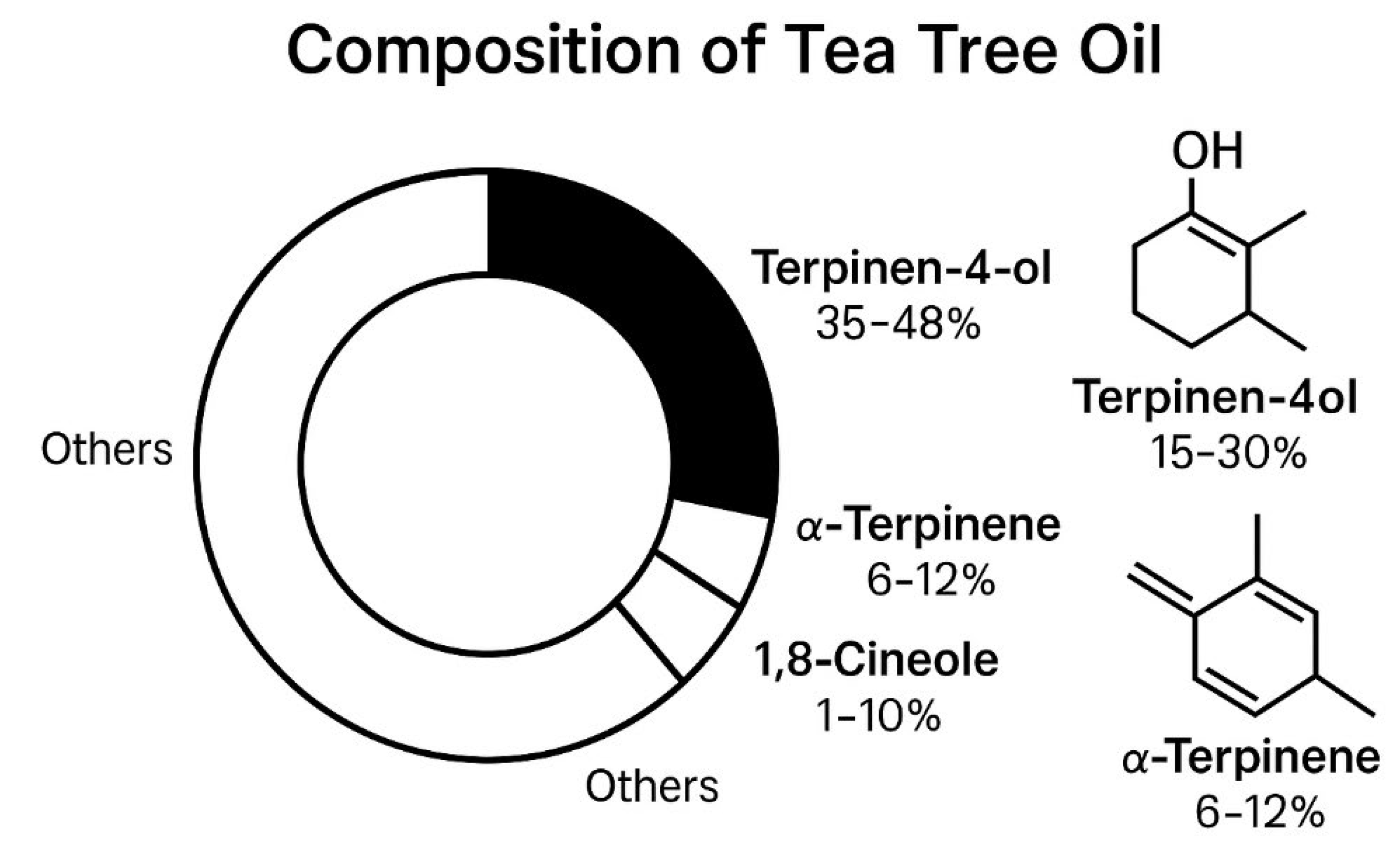
Figure 2.
XRD pattern of tea tree essential oils.
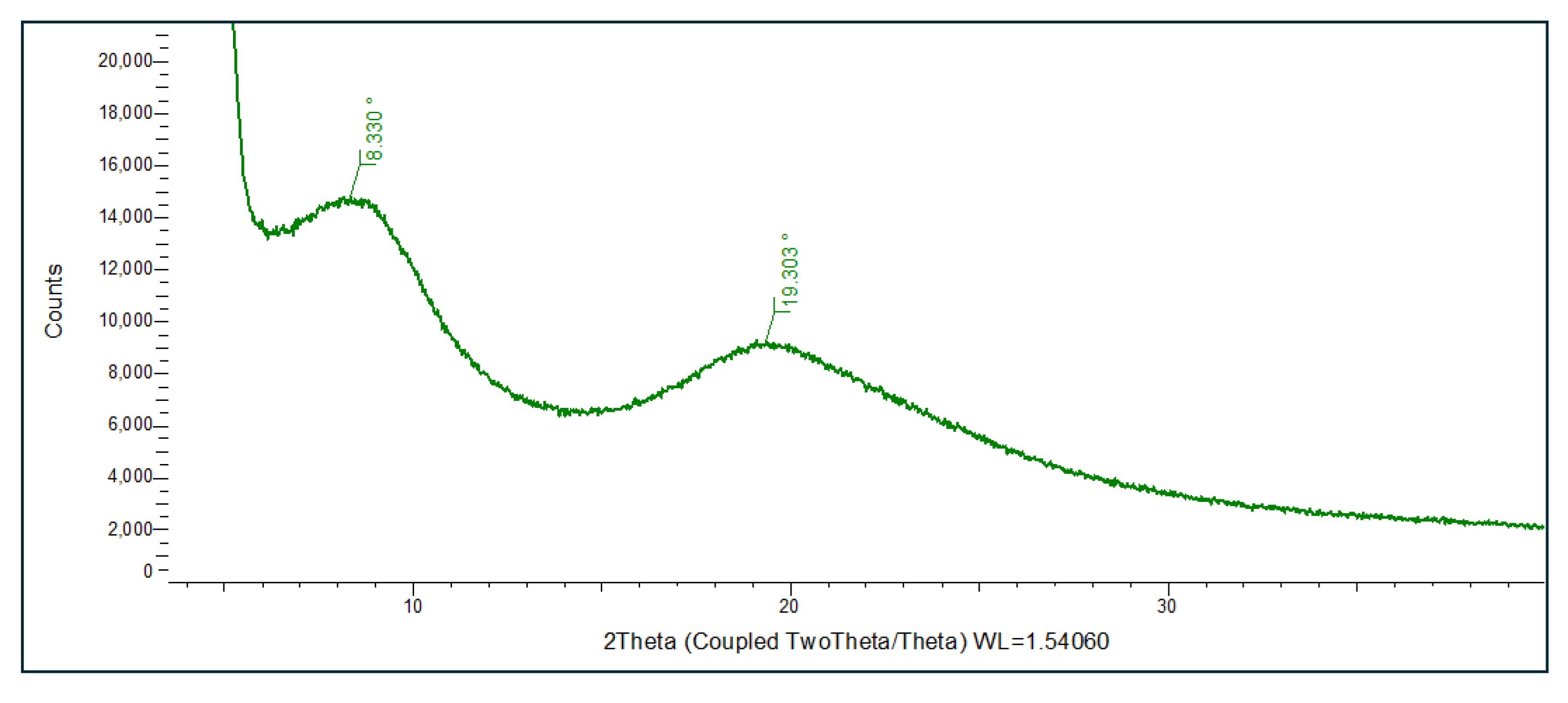
Figure 3.
Physicochemical properties of tea tree oil.
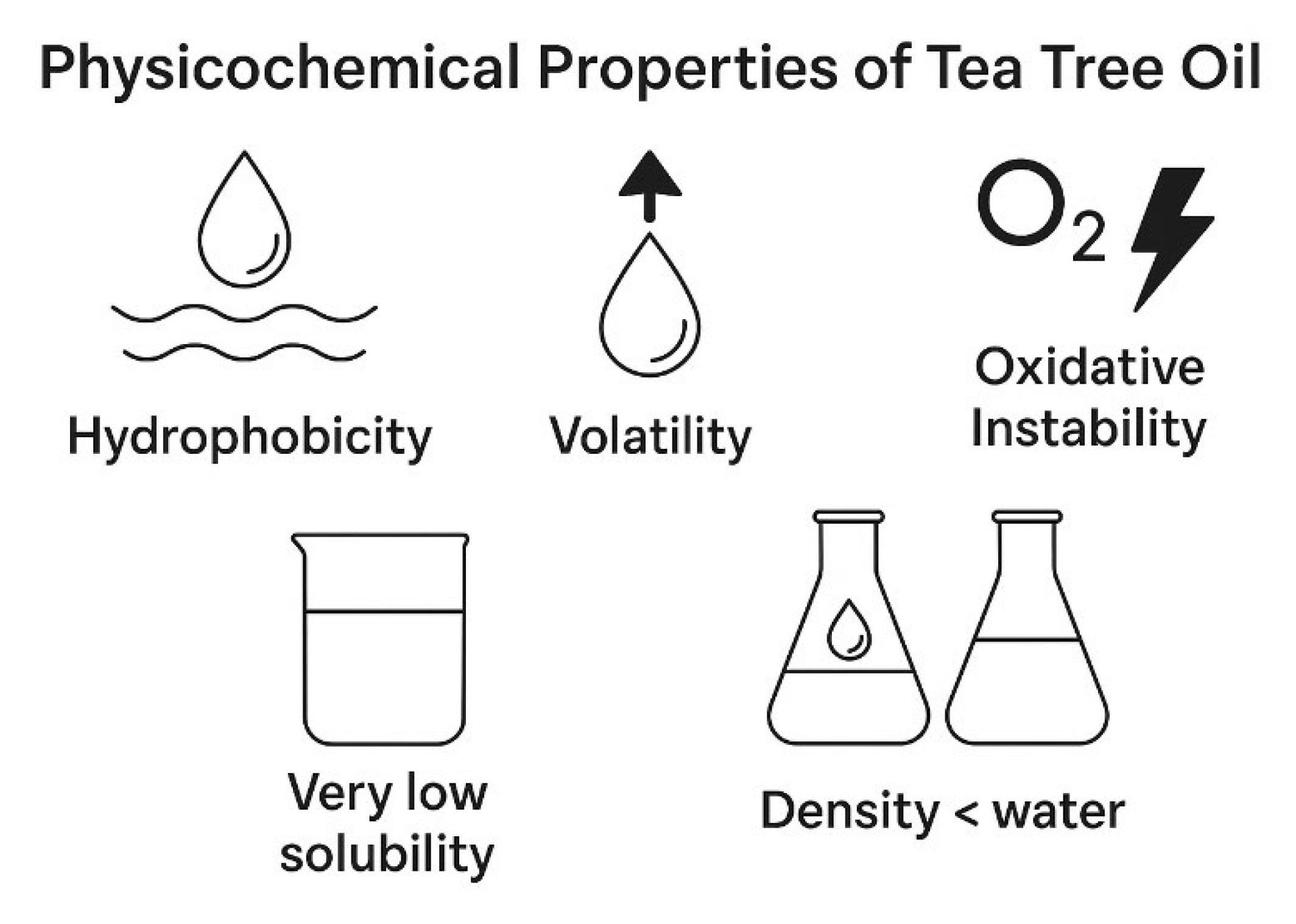
Figure 4.
Tea tree oil applications in the food safety system.
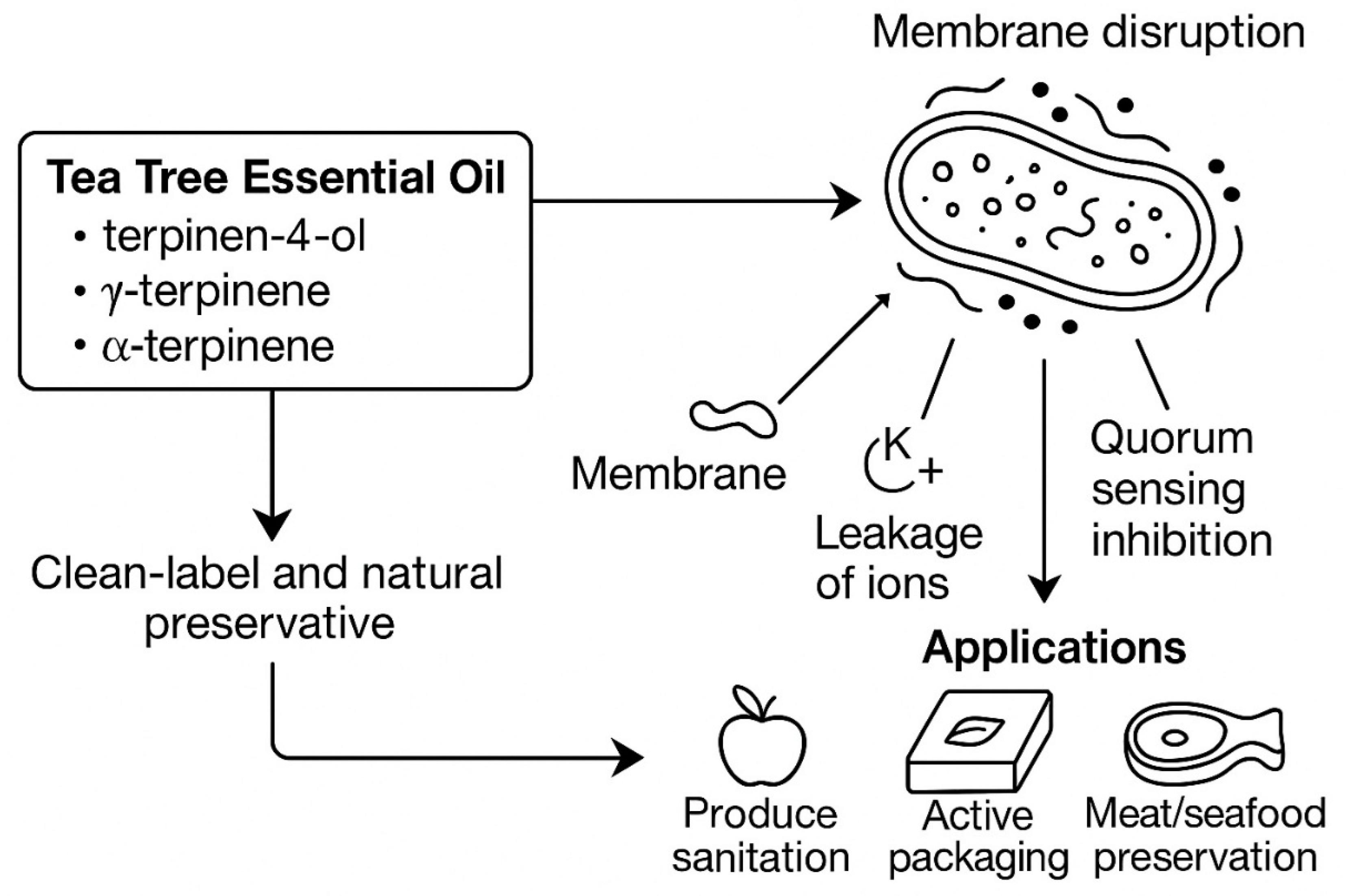
Figure 5.
Mechanisms of antimicrobial action of tea tree oil.
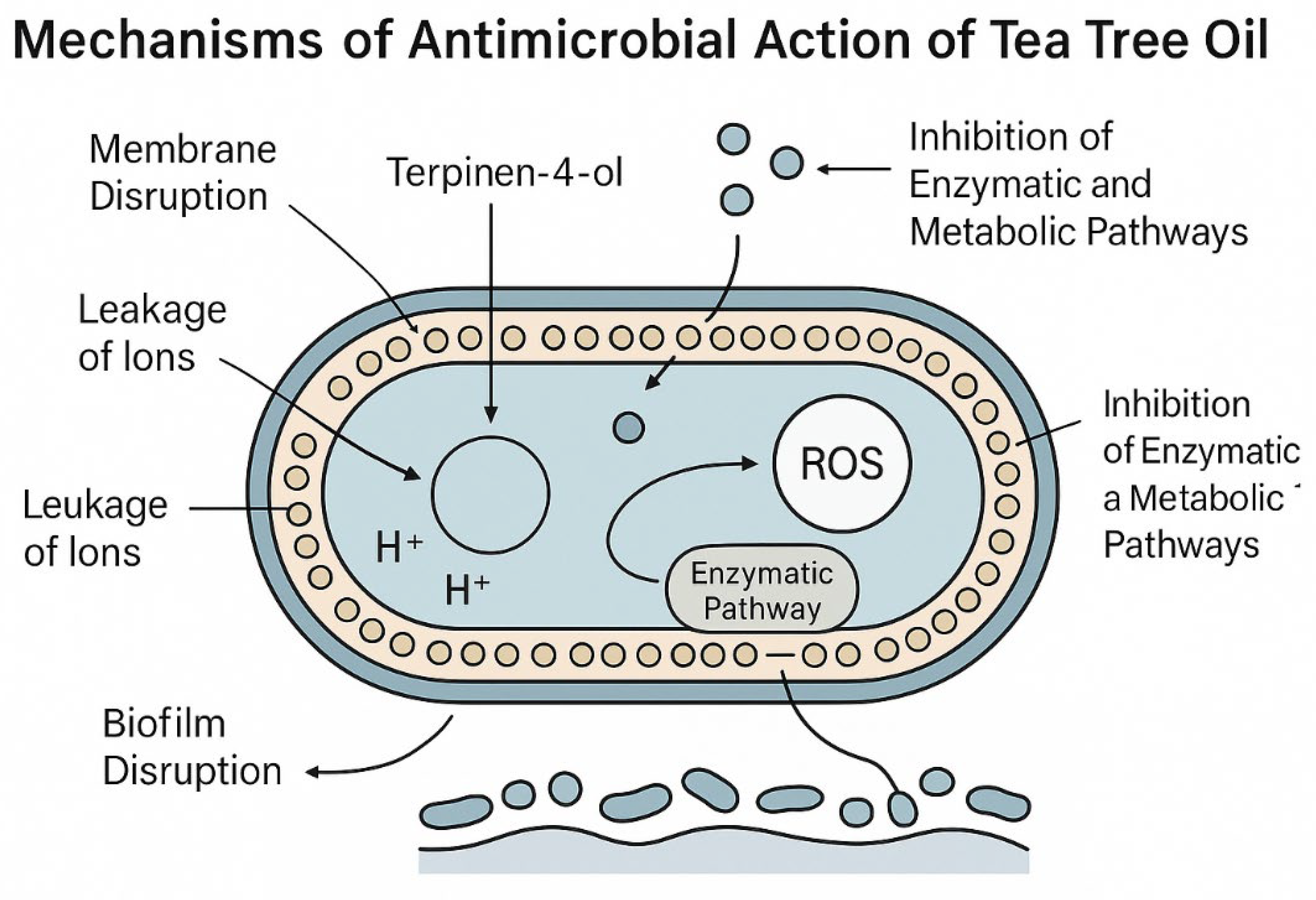
Figure 6.
Tea tree oil application process in meat and seafood preservation.
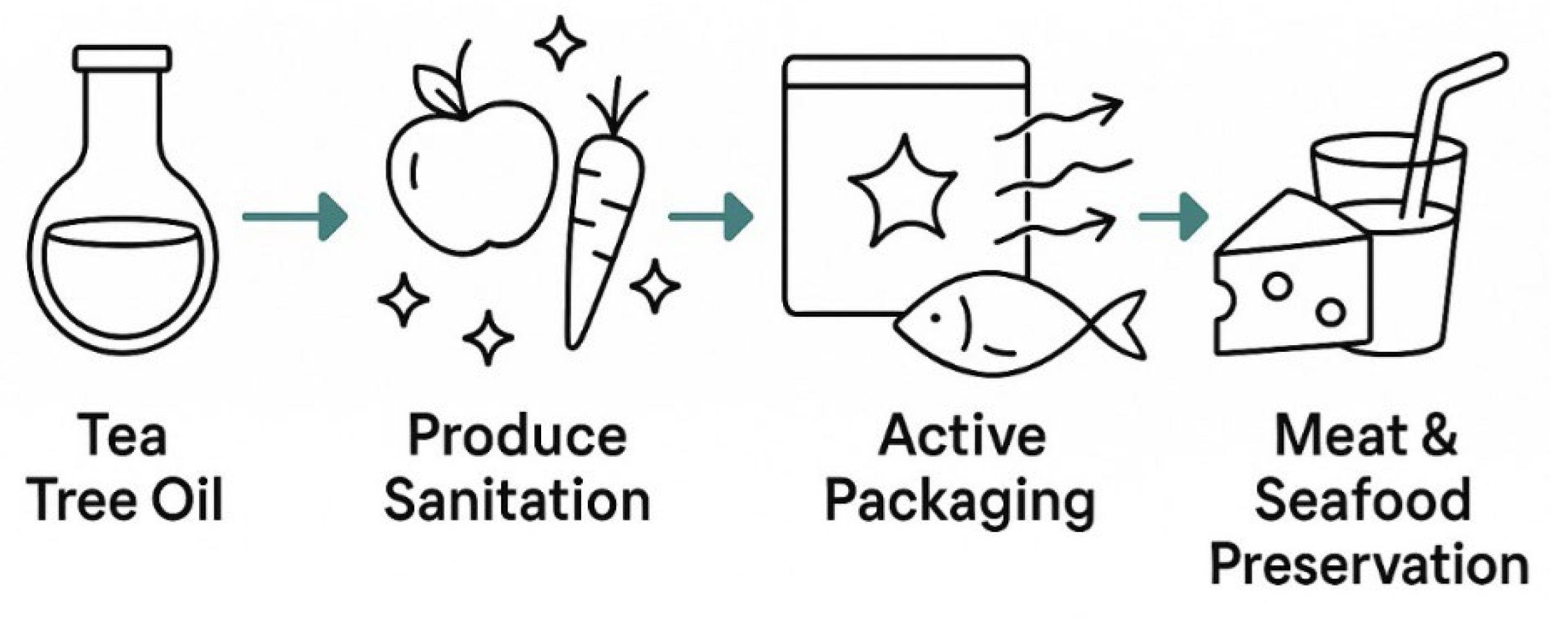

Table 1.
Major scientific motivations for using tea tree essential oil in modern food safety systems.
Table 1.
Major scientific motivations for using tea tree essential oil in modern food safety systems.
| Food safety challenge | Applications of TTO | Role of TTO |
|---|---|---|
| Increasing antimicrobial resistance | Need for non-antibiotic interventions | Broad-spectrum activity with Gram+/Gram− and fungi |
| Consumer push for clean-label preservatives | Replacement of synthetic chemicals | Natural GRAS essential oil |
| Food-contact surface contamination | Biofilm persistence in industry | Strong antibiofilm disruption |
| Limited efficiency of washing/sanitizing | Chlorine/treatments insufficient | Vapor-phase and contact inactivation |
Table 2.
Key physicochemical parameters of tea tree essential oil.
| Property | Typical value | Implication for food systems |
|---|---|---|
| Density | 0.885–0.906 g/mL | Floats on water and requires emulsification |
| Aqueous solubility | ~0.03% (300 mg/L) | Poor dispersion without formulation |
| Vapor pressure | ~2.1 kPa at 25 °C | High volatility → suitable for active packaging |
| Flash point | 56–60 °C | Must be handled carefully in processing |
| Dominant component | Terpinen-4-ol (35–48%) | Major contributor to antimicrobial action |
Table 3.
Functional comparison of major TTO components.
| Component | Relative abundance | Functional group | Contribution |
|---|---|---|---|
| Terpinen-4-ol | Highest | Terpenoid alcohol | Antibacterial, antibiofilm |
| γ-Terpinene | Moderate–high | Monoterpene | Oxidation-prone; aromatic changes |
| α-Terpinene | Moderate | Monoterpene | Supports membrane fluidization |
| 1,8-Cineole | 1–15% | Oxide | Aroma intensity, low antimicrobial |
Table 4.
Representative MIC/MBC values of TTO against foodborne pathogens.
| Microorganism | MIC (% v/v) | MBC (% v/v) | Sensitivity |
|---|---|---|---|
| S. aureus | 0.25–0.50 | 0.50–1.0 | High |
| L. monocytogenes | 0.05–0.25 | 0.25–0.50 | Very high |
| E. coli O157:H7 | 0.20–0.40 | 0.40–1.0 | Moderate |
| Salmonella spp. | 0.20–0.80 | 0.50–1.5 | Moderate |
| Candida albicans | 0.06–0.50 | 0.25–1.0 | High |
Table 5.
Selected Applications of Tea Tree Essential Oil in Food Preservation (2010–2025).
| Food Product & Microbial Issue | TTO Application & Formulation | Outcomes (Microbial Control & Shelf-life) | Sensory & Feasibility |
|---|---|---|---|
| Raw chicken fillets – general spoilage (bacteria, oxidation) | 1% TTO in marinade/dipping solution (lab-scale trial) | Decreased total viable counts; slowed spoilage, +7 days refrigerated shelf-life vs. control. Also decreased lipid oxidation (TBARS) over 9 days. | Maintained color and odor better than control (fewer off odors). Concluded as effective natural preservative for meat. |
| Raw chicken meat – Salmonella contamination | Chitosan nanofiber mat with TTO-loaded liposomes (active packaging) | ~5 log reduction of Salmonella on chicken within 4 days at 12–25 °C; prevented microbial recontamination, extending safety and shelf-life. | Minimal flavor impact: TTO nanofiber caused no noticeable sensory change in chicken. Demonstrated practicability for pathogen control. |
| Fresh lettuce (Butterhead) – field microflora & coliforms | Preharvest spray with TTO emulsion (single or repeated applications late in growth) | Decreased native mesophilic bacteria and coliforms at harvest and after storage. After 5 days @5 °C, treated lettuce had ~2 log10 lower total counts vs. untreated. | No significant differences in sensory quality (appearance, taste) vs. control after treatment. TTO did not adversely affect lettuce flavor. |
| Soft cheese (Feta, fresh Mozzarella) – Listeria, E. coli risk | Direct EO addition to cheese or brine (0.5–1% needed for activity) | High TTO concentrations in vitro inhibit L. monocytogenes and E. coli; however, efficacy drops in high-fat cheese. Thyme or clove EO often outperforms TTO against Listeria. | Sensory hurdle: 1% TTO imparted strong off flavors in Feta; panelists “disliked” TTO aroma in Fior di Latte cheese. Thus, TTO’s use in cheese is limited by flavor at effective doses. |
| Strawberries – postharvest spoilage (fungi, quality loss) | β-cyclodextrin/nano-clay microcapsules releasing TTO in package | TTO vapor slowed decay: treated berries stayed mold-free and firm ~3–6 days longer than control at 4 °C. Optimal dose (5 g microcapsules per 1.2 L) ⇒ least decay, lower weight loss, delayed ripening indices. | Maintained fruit appearance and nutrients better during storage. Controlled-release microcapsules prevented overpowering odor; berries’ aroma remained acceptable (no TTO off-taste noted). |
| Banana – anthracnose (fungal rot by Colletotrichum) | Edible coating/film: bilayer sodium alginate film with TTO nanoemulsion + TiO2 nanoparticles | Markedly suppressed anthracnose lesions. 3 µg/mL TTO in coating reduced rot severity and extended banana shelf-life; treated fruit had significantly less decay over 12–16 days vs. controls. | No significant sensory detriment reported. The alginate–TiO2 matrix slowed TTO release and blocked UV light, preserving fruit quality (firmness, color). Coating is food-grade and meets packaging safety norms. |
| Fresh salmon fillets – spoilage bacteria & oxidation | Electrospun chitosan nanofiber wrapped with encapsulated TTO (coating pad in package) | Lowered microbial loads (including Listeria, E. coli, S. aureus in tests) and slowed spoilage in cold storage. One study showed such EO nanofiber mats added ~6–7 days of shelf-life to fresh fish vs. normal ice storage. | TTO nanofiber inhibited fishy odor development; treated fillets maintained acceptable sensory quality longer. Active fiber is biodegradable (chitosan) and poses no direct residue on fish flesh. |
| Bread (sliced) – mold spoilage (Penicillium spp.) | Vapor-phase TTO in package headspace (experimental set-up) | Limited efficacy: TTO vapor only weakly inhibited P. citrinum and P. crustosum on bread; no meaningful delay of mold growth. (P. expansum even grew faster with TTO present). | Bread absorbed some TTO aroma, but doses high enough to suppress molds would likely cause off-flavors. TTO vapor alone is not effective for bread preservation. Other EOs (e.g., lemongrass, clove) show stronger antifungal effects in bakery products. |
Table 6.
Summary of antibiofilm activity of TTO against major foodborne organisms.
| Organism | % Biofilm reduction | Concentration used | TTO effectivness |
|---|---|---|---|
| Staphylococcus aureus | 50–90% | 0.25–1% | Strong membrane disruption |
| E. coli | 20–60% | 0.5–1% | Strain-dependent |
| Pseudomonas aeruginosa | 10–40% | 1–2% | Highly resistant strain |
| Candida albicans | 40–80% | 0.5–1% | Matrix penetration effective |
Table 7.
Food-category-specific applications of TTO.
| Food category | Application method | Effectiveness | Notes |
|---|---|---|---|
| Meat/poultry | Marinades, active films | +5–7 days shelf life | Flavor masking required |
| Seafood | Nano-fiber wrap, edible coatings | Strong suppression of spoilage bacteria | Minimal sensory change |
| Fresh produce | Washes, vapor-phase, coatings | 1–3 log reduction in microbes | Excellent antifungal |
| Dairy | Edible films, surface treatment | Limited due to flavor | Packaging preferable |
| Beverages | TTO nanoemulsions | Pathogen control | Sensory challenge |
Table 8.
Advantages and limitations of TTO in food applications.
| Advantages | Limitations |
|---|---|
| Broad antimicrobial spectrum | Strong odor, flavor |
| Natural, clean-label | Limited GRAS approval depending on country |
| Works in vapor and liquid phases | Highly volatile, oxidizes quickly |
| Compatible with nanocarriers | Difficult to disperse in water |
Table 9.
High-potential future research directions.
| Innovation | Research need | Expected benefit |
|---|---|---|
| Smart active packaging | pH/humidity-triggered release | Preventing spoilage events |
| Synergy blends | Nisin, carvacrol | Lower dose + better taste |
| Biopolymer–TTO composites | Stability optimization | GRAS-compliant packaging |
| Microfluidic nanoencapsulation | Narrow droplet size | Better antimicrobial delivery |
Table 10.
Performance comparison of TTO delivery systems.
| Delivery system | Release profile | Stability | Sensory impact | Application |
|---|---|---|---|---|
| Nanoemulsion | Fast release | Moderate | Higher aroma | Beverages, washes |
| Microcapsules | Slow release | High | Low aroma | Fruits, fresh-cut produce |
| Edible films | Surface-controlled | High | Minimal | Produce, cheese, seafood |
| Active packaging | Vapor-release | High | Very low | Meat, produce |
Disclaimer/Publisher’s Note: The statements, opinions and data contained in all publications are solely those of the individual author(s) and contributor(s) and not of MDPI and/or the editor(s). MDPI and/or the editor(s) disclaim responsibility for any injury to people or property resulting from any ideas, methods, instructions or products referred to in the content. |
© 2026 by the authors. Licensee MDPI, Basel, Switzerland. This article is an open access article distributed under the terms and conditions of the Creative Commons Attribution (CC BY) license (http://creativecommons.org/licenses/by/4.0/).
Copyright: This open access article is published under a Creative Commons CC BY 4.0 license, which permit the free download, distribution, and reuse, provided that the author and preprint are cited in any reuse.