

Submitted:
13 February 2026
Posted:
27 February 2026
You are already at the latest version
Abstract
Humanity is facing an unprecedented socio-ecological and climate crisis resulting from human impact on the planet, which requires a profound transformation in how we inhabit and develop our territories. Regenerative development is emerging as a key approach to strengthening living systems and improving environmental health. In this context, UNESCO Biosphere Reserves are consolidating their role as strategic instruments that link biodiversity conservation with sustainable development through integrated and par-ticipatory land management models. Mexico stands out for its regional and global leadership in implementing these areas. Participatory governance, promoted by the MAB program, encourages the active involvement of local communities. This article analyses the application of a regenerative and participatory design methodology in a Biosphere Reserve, evaluating both the process and the tools used. Beyond the fulfilment of sus-tainability objectives, it examines the lessons learned, results and scope from a regen-erative perspective, providing critical reflections on its effectiveness as a strategy for the socio-ecological management of vulnerable territories.
Keywords:
regenerative development
; regenerative design
; participatory design
; biosphere reserve
; sustainability
1. Introduction
Humanity is currently immersed in an era in which human impact has led the planet to an unprecedented socio-ecological collapse [1]. This period is characterised by an industrial development model based on unlimited extractivism, which dissociates nature, society and the economy, severely affecting ecosystem services [2] with accelerated species extinction, alterations in phosphorus and nitrogen cycles, ozone degradation and pollution [3,4]. This planetary emergency is accompanied by social crises and new global diseases [5,6].
The contemporary socio-ecological and climate crisis demands a profound transformation in the way we inhabit and develop territories [7]. Several authors advocate a shift towards ecosystemic thinking that promotes ecological and social justice, respecting nature’s regenerative capacity [1,8] The current sustainability paradigm, focused on minimising damage, is insufficient to regenerate degraded ecosystems or to promote their evolution [9]. A shift towards regenerative development is necessary to strengthen living systems and improve the health of the planet as a whole [10].
1.1. Theoretical Framework
1.1.1. Biosphere Reserve
UNESCO Biosphere Reserves (BR) are established as consolidated international instruments for coordinating biodiversity conservation with sustainable development, positioning themselves as strategic frameworks for territorial management and socio-ecological systems [11]. Designated under the Man and the Biosphere (MAB) Program, created in 1971 to improve the relationship between society and nature through conservation, sustainable development, and logistical support for research and education [11,12], these areas operate under inclusive, flexible, and multi-stakeholder governance schemes, adapted to local contexts and aimed at addressing interrelated issues from integrated and holistic approaches [13,14,15].
RBs fulfil three interdependent functions: conservation of genetic resources, species, ecosystems, and landscapes; promotion of sustainable socioeconomic development; and logistical support through education, research, monitoring, and demonstration projects [16,17]. In this sense, they act as living laboratories and spaces for the co-production of knowledge for sustainability science and climate action, strengthening the interface between science, public policy, and education [12,18,19]. Their articulation within the World Network of Biosphere Reserves facilitates the exchange of learning, innovation, and best practices at multiple levels [12,20]. Aligned with the Sustainable Development Goals and multilateral agreements such as the Convention on Biological Diversity and the Paris Agreement, BRs are emerging as key strategies in addressing the triple challenge of the Anthropocene: biodiversity loss, climate change, and human well-being [12,13,14]. By 2025, the network exceeds 740 reserves in more than 130 countries, including transboundary initiatives [11].
Operationally, RBs are structured into core, buffer, and transition zones, integrating strict protection, compatible uses, and sustainable development, reflecting the transition from segregated conservation models to integrated and territorial approaches [21,22,24]. However, gaps remain between the conceptual framework and its effective implementation, as well as an underutilised potential for applied research in sustainability [19,25,26].
Participatory governance emerges as an enabling condition. The MAB Statutory Framework and Technical Guidelines establish flexible principles that promote the active involvement of communities, governments, the private sector, and scientific actors in the design and implementation of reserves [16,27,28]. The MAB Strategy 2015–2025 and the Lima Action Plan reinforce collaborative and equitable planning processes [12]. Similarly, approaches such as adaptive governance, equity, and biocultural integration strengthen institutional and social resilience [29,30,31,32,33]. Together, BRs are establishing themselves as experimental territories for socio-ecological transformation and long-term sustainability.
Mexico occupies a strategic position in global conservation, as it has the largest number of biosphere reserves in Latin America and the Caribbean and ranks third worldwide, thereby consolidating its regional leadership in implementing this socio-ecological management tool [34]. This relevance stems from its status as a “megadiverse” country, defined by the interdependence between biological and cultural diversity as the basis of its socio-environmental dynamics [35]. In this context, biosphere reserves articulate conservation, biocultural heritage, and sustainable development [35].
1.1.3. Regenerative Development and Design
1.1.3.1. Ecologies of Care
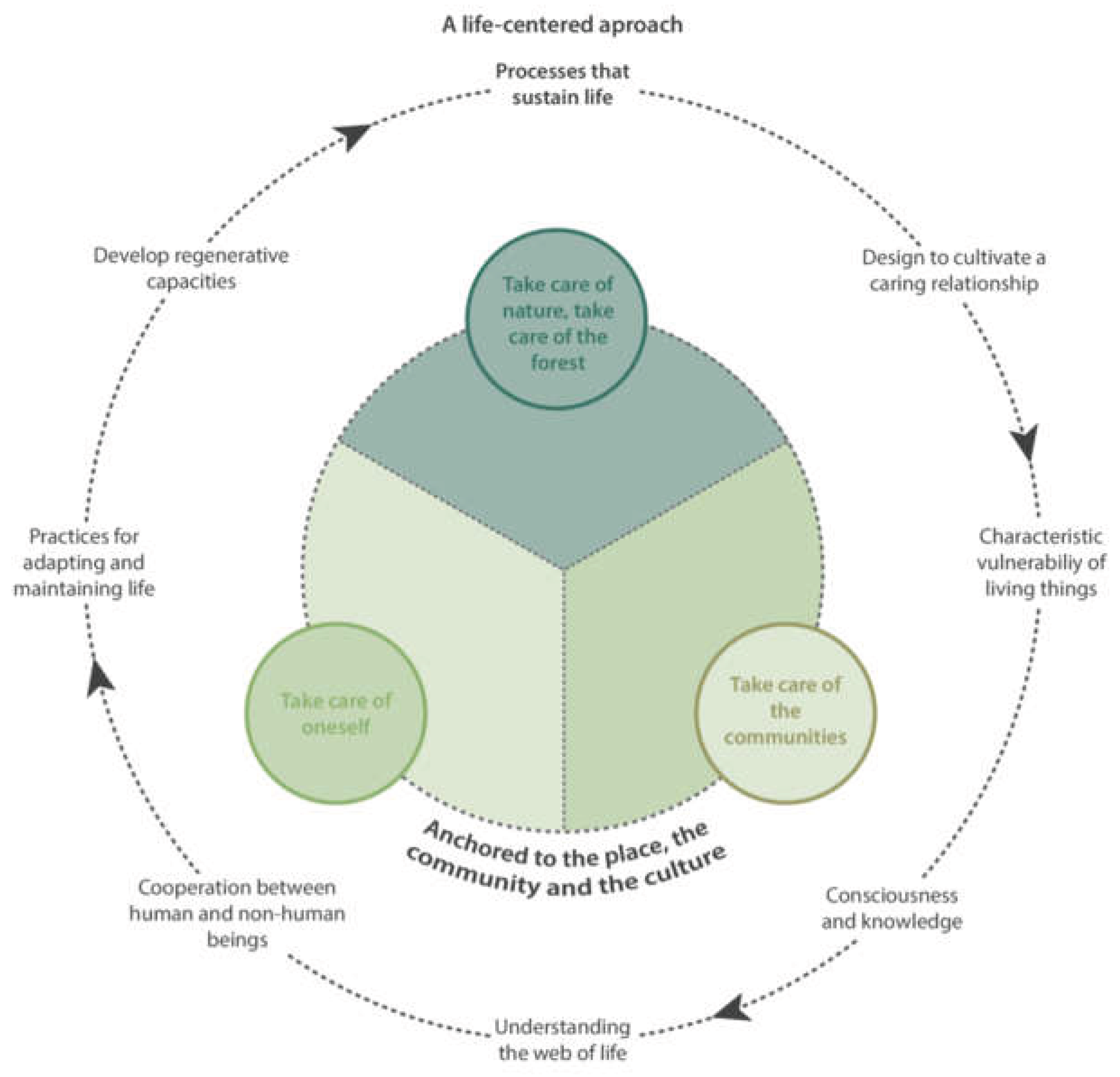
The concept of ecologies of care emerges as a methodological and ethical proposal in response to socio-ecological collapse. Care is understood as a network of interdependent relationships that sustain ecosystems and communities, not as an individual practice [36]. Wendell Berry (1981) [37] asserts that we must care for the earth with respect and reciprocity. Leonardo Boff (2002) [38] suggests that care involves attention, connection, empathy, and compassion for the Earth. From a feminist and territorial perspective, care cannot be understood as an abstract or universal practice, but rather as a relationship of interdependence situated, historically constructed, and territorialised [39,40]. In rural contexts such as San Gaspar, the ecologies of care are embodied in everyday practices linked to sustaining life (water management, the transmission of ecosystem knowledge, intergenerational accompaniment, and community organisation) that have historically been assumed by women [41]. Recognising these practices does not mean romanticising them but rather politicising them as fundamental infrastructures for the socio-ecological regeneration of the territory. In this sense, the forest is no longer understood solely as an ecosystem to be conserved, but rather as a living infrastructure of care, where bodies, memories, affections, and knowledge are intertwined, understood as inseparable dimensions of the territory and the collective body that inhabits it [42]. The ecologies of care make visible the interdependence between human and non-human systems, shifting the centrality of design from form to the links that sustain life and enable the continuity of the territory as a living system.
This connection is fundamental to regenerative design, which promotes co-evolution with natural and social systems, overcoming dehumanisation, and cultivating capacities to integrate co-evolutionary processes [43].
Figure 1.
Processes that sustain life.
1.1.3.2. Regenerative Development and Design
Regenerative development redefines sustainability in terms of resilience and capacity for reorganisation and adaptation [44]. It proposes healing and improving damaged territories, moving from a mechanistic to an ecological view of the world [45,46,47], based on complexity and systems thinking [48,49,50]. From this perspective, regenerative design is conceived as a collaborative process between living systems and human systems, aimed at revealing and enhancing the unique character of the place [47], seeking to co-create conditions that allow ecosystems to thrive and evolve together towards regenerative development [7].
Regenerative design translates the conceptual framework of regenerative development into applied practice [51]. Du Plessis [52] identifies four theoretical principles: (1) Human systems are part of ecosystems; human activities must contribute positively to their evolution; (2) Every action must respond to the context of the place; (3) Participatory and reflective processes are essential.
Lyle (1996) [45] conceives regenerative design as processes that restore and renew their own energy sources, emulating the logic of ecosystems. This holistic and self-organised vision embraces uncertainty as part of creativity and places life at the centre of design. From this perspective, the Anthropocene crisis demands an ethic of care and co-evolution [53].
The fundamental principles of regenerative design [54,55] are: 1) Work from the whole system; 2) Build on the essence and potential of the place; 3) Promote nested development and nodal intervention; 4) Recognise that only the living regenerates and that interrelationships sustain life. These principles can be translated into small-scale interventions, organised into activation nodes and thematic centres, which can extend from the microbiological to the territorial level [9]. These actions foster positive coevolutionary processes [56] by integrating creativity, technology, and community life.
1.1.3.3. Regenerative Responsibility
The design learning process addresses topics such as sustainability, social innovation, and professional ethics. However, these topics often become diluted as the process progresses. Their permanence depends on commitment and maintaining a critical and consistent stance toward thinking that is not only sustainable but also regenerative [57]. Faced with this challenge, Regenerative Responsibility (RR) emerges as a proposed regenerative pedagogical model [58] that promotes the implementation of a pluriversal vision in design project work [59]. Its objective is to consolidate a lasting commitment to the transition from sustainable to regenerative thinking [60]. RR can be exemplified by the presentation of the Relational Regenerative Design methodology, based on principles of regenerative and relational design, developed within the RR framework as a strategy to integrate this vision into academic practice (Figure 1).
1.1.3.4. Entendimiento Regenerativo Del Lugar
The methodological approach to regenerative design proposed here derives from the idea of ‘Understanding of Place’ developed by the Regenesis Group [48], which is a tool for identifying the uniqueness and evolutionary potential of each territory, based on four key premises: (A) the co-evolutionary role of human activity; (B) the transformation of perspectives; (C) the redefinition of the role of the designer as a mediator; (D) and the development of the regenerative capacities of the place, understood as an anthropic community and a physical place or natural system in which it is inserted. It also proposes six key concepts [48]: (1) regeneration as a catalyst for positive human impacts; (2) deep design practices; (3) the notion of place as a complex network of living systems; (4) pattern literacy as a language of relationships; (5) the unique narrative of place; (6) and potential, understood as the capacity inherent in its essence. It structures a three-part work process [44]: part 1, deep understanding of place to identify its potential; part 2, integration of technologies and systemic frameworks; and part 3, application of ecological design.
1.1.3.5. Systemic Design
Regenerative design and systemic thinking form a theoretical and methodological framework relevant to addressing contemporary socio-ecological crises [61]. Unlike conventional sustainability approaches, which aim to mitigate impacts and maintain existing conditions, these approaches propose a profound transformation of the systems that sustain life, questioning extractive, hierarchical and universalising logics [62]. Systemic thinking provides analytical tools for understanding the complexity, interdependencies and power relations in socio-ecological systems. Instruments such as gigamaps, synthesis maps, and socio-ecological mapping make it possible to visualise material flows, actors, and situated knowledge, as well as the dynamics of exclusion that are often overlooked in design processes [63]. Within this framework, regenerative design defines an ethical and political horizon aimed at promoting conditions for self-restoration and flourishing of social and natural systems [64].
This articulation takes shape in Systemic Design or System-Oriented Design (SOD), which integrates systems science with design practices to identify leverage points where strategic interventions activate significant transformations in complex systems [65]. Systemic Design finds in care economies an ethical framework that extends its scope beyond technical efficiency. As Falú (2014) [66] points out, territories are structured based on a sexual division of labour that renders care tasks invisible. Integrating this perspective involves recognising care as socio-environmental infrastructure and shifting the points of leverage towards everyday life, accessibility and social co-responsibility [67].
A central component of this approach is reflexivity, understood as a continuous process through which researchers and designers, together with the communities involved, critically examine their own assumptions, values, and positions of power [68]. This practice is key to inhabiting the uncertainty inherent in so-called wicked problems and to avoiding the reproduction of systemic injustices during transformation processes [64]. Likewise, the methodology emphasises the relevance of situated and place-based knowledge, as well as embodied and everyday practices, recognising that territories are not mere physical supports, but living networks of relationships, memories and care [69].
1.1.3.6. Participatory Design: Co-Designing with Communities
Regenerative design is conceived as a collaborative process developed together with the user community, articulated to the landscape, the natural context and the socio-economic and cultural conditions of the territory, which redefines the role of the designer, who adopts a flexible and situated function, adapting to the particularities of the place and the collective with which they work [70]. Like any design process, it is structured in a recursive, iterative manner, integrating phases of conceptualisation, ideation, prototyping, and continuous community validation [71].
Participatory processes seek to build collaborative networks, strengthen local regenerative capacities and comprehensively understand social, ecological and cultural systems [70]. From this perspective, inhabitants are recognised as central agents of territorial transformation, overcoming colonialist or extractivist approaches. In line with Escobar (2018) [59], participatory design can operate as a tool for autonomy and resistance, promoting interdependent relationships between humans and non-humans.
Collaboration between communities and researchers is supported by tools for two-way information exchange, which facilitate the production of qualitative narratives that reveal identities, memories, and dynamics specific to each territory [71]. In this context, ethnography acquires methodological relevance by focusing on understanding everyday practices and the meanings that people attribute to them, understood as the description of social life from the perspective of its own actors [72]. This approach helps to highlight socio-spatial dynamics that are often ignored and to avoid the exclusion of local experiences in transformation processes [73].
Thus, the participatory-ethnographic process is configured as a methodological alternative that enables communities to build comprehensive knowledge of their territory and to collectively decide how to inhabit it [74]. Trust, based on active listening and sustained presence, is essential for mediating conflicts, strengthening local capacities, facilitating the co-design of interventions, and consolidating community leadership in the regeneration of their environments [70,71].
1.2. Objective of the Article
The article proposes to analyse the process of applying the regenerative and participatory design methodology in a real context, within the framework of a UNESCO Biosphere Reserve, with the community involved, analysing the process itself, going beyond the basic approach of meeting regenerative development objectives that is normally worked on in BRs, addressing it from the framework of regenerative thinking, the tools used, and concluding with a discussion of the results obtained with the application of the methodology, reflections and critical conclusions.
2. Materials and Methods
2.1. Methodological Framework
Based on the Regenesis Group methodological framework [44], understanding place involves recognising each territory as a unique dynamic entity, where community and environment form an interdependent system. This process is structured using nesting scales, which reveal the interrelationships between the different levels of the system. Comprehensive assessment allows for the identification of emerging core patterns within ecological, socio-economic and cultural systems. Given the complexity of these relationships, data systematisation is required using tools such as the Matrix of Influences [75] to distinguish the essential patterns of each place. Achieving this understanding makes it possible to address problems from a systemic perspective and define the regenerative role of the site, establishing nodes and activation principles that drive co-evolutionary and regenerative processes between community and territory [44]. Participatory methods reinforce inclusion and collective agency [76], integrating dialogue, technical and practical knowledge [77,78] and micro-ethnographic tools [79,80].
2.2. Methodology
La metodología, basada en el marco del Grupo Regenesis [44], constaba de 7 fases: (1) Definición del Lugar que en primera instancia desarrolla la selección del Proyecto u Objeto empírico de esta investigación, después define las escalas del sistema de anidación; (2) Entendimiento regenerativo del lugar, mediante una primera subfase de (2.1) análisis documental; subfase 2 (2.2) trabajo etnográfico y participativo, desde una perspectiva de regionalismo crítico; sub-fase 3 de (2.3)Análisis sistémico + mapa de actores, para discernir patrones esenciales y vocación territorial; sub-fase 4 (2.4)Esencia, potencial y vocación del lugar; Sub-fase 5 (2.5), identificación de nodos de activación, puntos de apalancamiento del sistema, coherentes con los hallazgos previos, dentro de líneas estratégicas específicas; (3) co-diseño de propuestas regenerativas de intervención; (4) microacciones para fomentar el desarrollo ecológico y de la comunidad local.
The methodology, based on the Regenesis Group framework [44], consisted of seven phases: (1) Phase 1, definition of Place, which first develops the selection of the empirical Project or Object of this research, then defines the scales of the nesting system; (2) Fae 2, regenerative understanding of the place, through a first sub-phase of (2.1) documentary analysis; sub-phase 2 (2.2) ethnographic and participatory work, from a critical regionalism perspective; sub-phase 3 of (2.3) Systemic analysis + map of actors, to discern essential patterns and territorial vocation; sub-phase 4 (2.4) Essence, potential and vocation of the place; Sub-phase 5 (2.5), identification of activation nodes, leverage points of the system, consistent with previous findings, within specific strategic lines; (3) Phase 3, co-design of regenerative intervention proposals; (4) Phase 4, micro-actions to promote ecological and local community development.
Figure 2.
General Workflow diagram.

2.2.1. Phase 1. Definition of Place
The work carried out during the semesters from February to June 2024 and February to June 2025 at the School of Architecture, Art and Design of the Tecnológico de Monterrey, as part of the natRural lab programme and the national Living Regenerative Laboratories initiative, was carried out in collaboration with the community of San Gaspar, Ejido La Barranca, located within the Sierra Gorda Biosphere Reserve, Mexico. The work was carried out mainly with the ejido assembly, composed of 45 ejido members, with irregular participation, with some of the 400 residents and with a group of mothers and fathers, mainly mothers, about 20 mothers and 1 father, from the ‘República Argentina’ primary school and the children of the school, 50 girls and boys on average. We worked with two groups of students, 14 and 12 students, in the semesters from February to June 2024 and February to June 2025, with a group of 8 and 9 teachers and researchers, respectively. The training partner was the management of CONANP (National Commission for Protected Natural Areas) of the Sierra Gorda Biosphere Reserve, and the collaborating partner was CONAFOR (National Forestry Commission).
The Sierra Gorda Biosphere Reserve (RBSG), located in Querétaro, covers 383,567 ha (≈33% of the state) and is the tenth largest protected area in the country [81,82]. Its mountainous terrain (300–3,100 m above sea level), limestone substrate, and karst morphology generate high geomorphological complexity and climatic gradients that favour great ecosystem heterogeneity [83,84]. It is home to lowland forests, temperate and mesophilic forests, endangered species, endemism and 48% of well-preserved forests, which are important for carbon capture [85]. It forms part of the Pánuco River basin, which includes 25 bodies of water that are strategic for biodiversity and water security, although they face degradation [86]. It is organised into core zones (6.5%) and buffer zones [83].
It is the most populated BR in the country (95,755–105,785 inhabitants), with a rural and indigenous Pame (Xi’iui) and Otomí population, high levels of poverty and migration [87,88,89]. The economy is concentrated in traditional agricultural activities, complemented by handicrafts, services and tourism, along with agroecological and reforestation practices [82].
Its scenic attributes have promoted ecotourism as a source of income and conservation; however, the concentration of services and the growing influx of visitors require planning and regulation. Educational and responsible tourism is proposed as a strategy for socio-environmental balance [81,82,90].
The BR protects traditional knowledge about the use of biodiversity [91,92,93,94]. The erosion of this knowledge, linked to migration and changes in production, compromises biocultural conservation [89,95,96].
Community participation and local ecological knowledge, together with the support of civil organisations, are central to inter-institutional management and coordination [82,97,98]. Taken together, the RBSG constitutes a socio-ecological laboratory for integrating conservation, well-being and territorial sustainability.
The La Barranca ejido is located at the highest point of the RBSG, at an altitude of 2,800 metres above sea level, in a temperate forest setting with a temperate climate, cold, dry winters and mild, humid summers.
2.2.2. Phase 2: Regenerative Unferstanding of Place
2.2.2.1. Documentary Work and Academic Work, Subphase 2.1
An iterative and recursive process was carried out to understand the narrative of the place from a critical bioregionalism perspective, complemented by ethnographic and participatory approaches. According to Martino (2005) [99], bioregionalism represents a new scientific perspective on the relationship between human communities and their natural environments. From a critical and regenerative stance, this study examined nine ecological, social, and cultural subsystems, drawing on academic sources and official data (INEGI, Open Data Portal), bibliographic research, interviews with experts, and with the support of digital tools such as QGIS for the development of a cartographic atlas for analysis.
2.2.2.2. Participatory Process, Social Mapping and Ethnography, Subphase 2.2
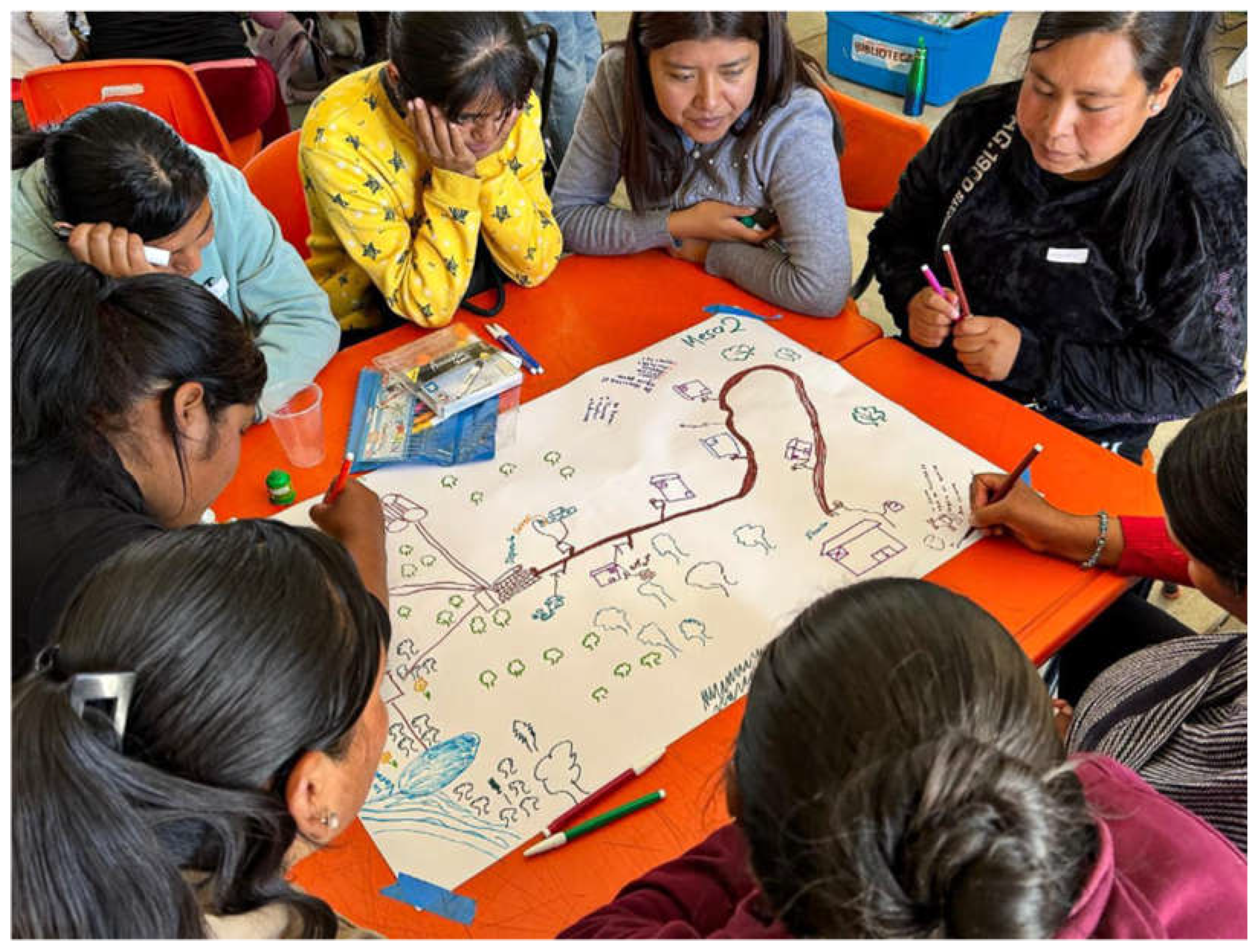
During the FJ2024 and FJ2025 semesters, the participatory process included activities and workshops to understand the area’s social, political, and cultural dynamics. In the case of the community of San Gaspar, in the Ejido de la Barranca, work was carried out mainly with two large groups of community members: 1) on the one hand, work was carried out under the auspices of the ejido’s board of directors, mainly with adults, in the ejido house; 2) on the other hand, we worked with the mothers and fathers of the ‘República Argentina’ primary school, located in the community of San Gaspar within the Ejido La Barranca, as well as with the teachers of this school, together with more than 50 children between the ages of 6 and 12. The children’s participation was essential, contributing creativity and a long-term perspective. Activities such as ‘community mapping’ and the ‘traffic light’ workshop helped to capture residents’ perceptions of their environment, identifying what they value and the challenges they face.
Activities such as community mapping and the traffic light workshop were designed to identify local values, needs, and challenges.
Playful dynamics and open dialogues foster trust, collective expression, and territorial understanding rooted in everyday experience.
The contributions of children, in particular, were designed to reveal hopeful visions for the future and emphasised the importance of incorporating community perceptions into regenerative and participatory design processes.
With spaces for dialogue and initial dynamics, the first visits to the primary school fostered a deep connection with the community through participatory and ethnographic activities. It was essential to build trust to understand the territory from the perspective of its inhabitants. The initial dynamics with the children included games and playful activities that facilitated connection and collective expression. In addition, meetings were held with mothers and teachers to share experiences and reflections, revealing their fundamental role in building the social fabric and community management.
The set of activities, workshops, and tools is summarised in Figure 3, which facilitated communication and fluid information, with workshops such as ‘community mapping’ and ‘the traffic light,’ which captured participants’ perceptions of their community, identifying what they value, their needs, and the challenges they face. The results, especially from the workshops with children, offered a broad view of the community’s values and challenges, highlighting the importance of considering their perspectives in the regeneration and construction of hopeful futures.
The community was open to dialogue and shared its perceptions through various activities adapted to each participating group: mothers, children, teachers and the ejido council. Interaction with the children was facilitated through games and recreational activities. At the same time, bonds with mothers and teachers were built through spaces for listening and mutual recognition, revealing commonalities and strengthening the community’s social fabric. Experiences and reflections were shared, gradually intertwining, revealing commonalities, and strengthening a sense of community.
This created a space for dialogue that not only provided information but also fostered bonds of trust and collectivity. The participation of mothers was central to understanding the territory from a care perspective. Their stories and practices enabled the identification of everyday cartographies linked to school routes, water management, the use of community spaces, and the organisation of domestic and collective life. This knowledge, often excluded from technical assessments, revealed a situated understanding of the territory based on experience, affection, and daily responsibility for community well-being.
Likewise, the active involvement of children allowed the territory to be projected from an expanded temporality, linking the present and the future. Their contributions not only enriched the creative process but also highlighted the need to design from the perspective of the right to play, exploration, and direct connection with nature, recognising children as territorial subjects and active agents in the regeneration of the forest and the community.
In addition, tours were conducted, significant sites were surveyed, and field mapping focused on existing infrastructure and equipment. This work was complemented by data analysis and cartographic work at different scales, which contributed to identifying key points within the community.
Intergenerational dialogues and ecosystem memories are also included, restoring the historical relationship with ecosystems and fostering awareness and motivation for regeneration across generations. Other ethnographic tools used include semi-structured interviews, drawing workshops, field trips, photo shoots, and accompaniment in everyday activities.
Figure 4 compiles all the tools and activities carried out in the participatory and ethnographic process for the regenerative understanding of the place.
Figure 4.
Diagram of activities and participatory tools for the regenerative and participatory design process.
Figure 4.
Diagram of activities and participatory tools for the regenerative and participatory design process.
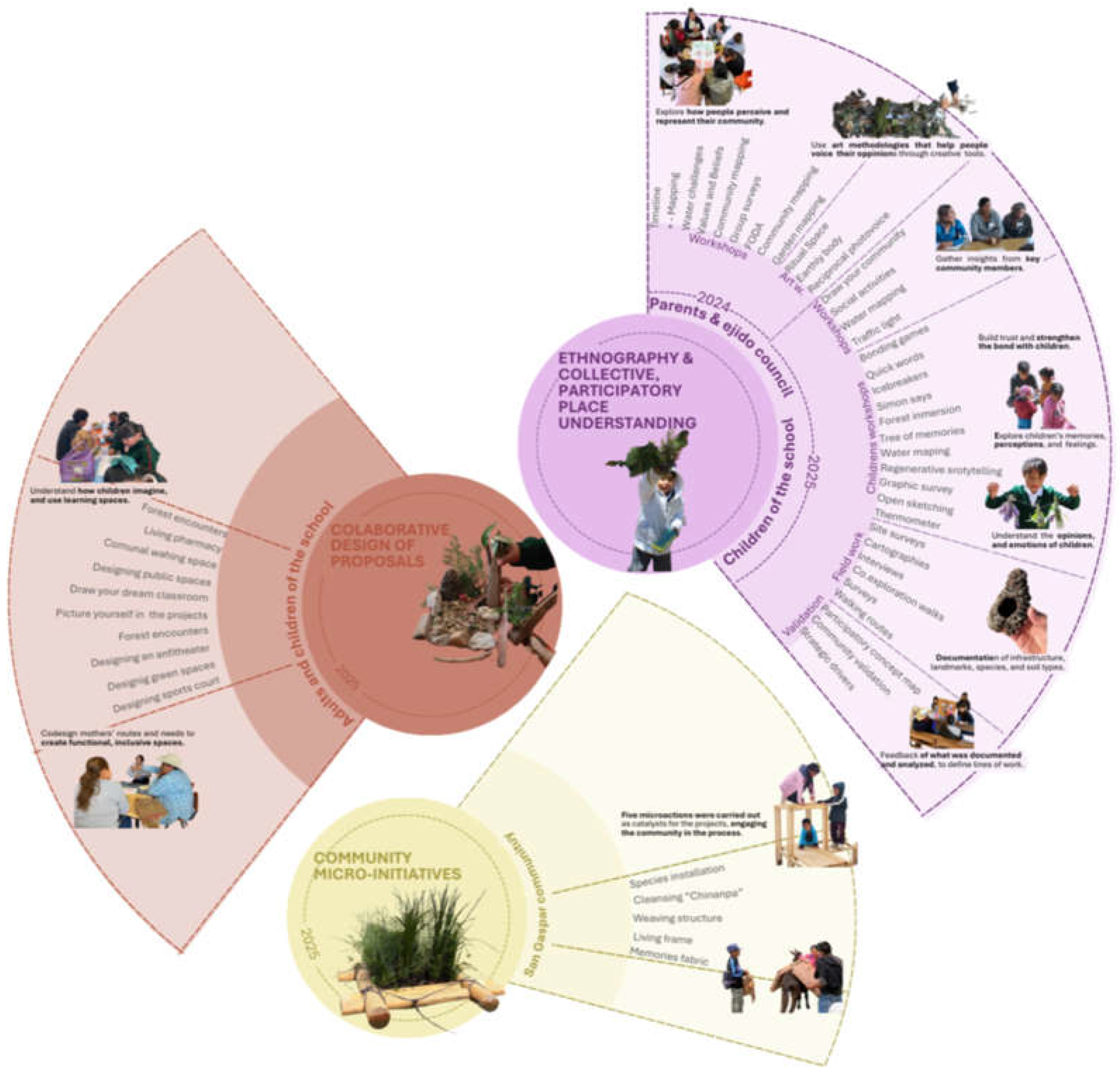
Figure 5.
Participatory workshop at elementary school.
2.2.2.3. Map of Actors, Gigamap and Systemic Analysis Based on Pattern Reading, Subphase 2.3
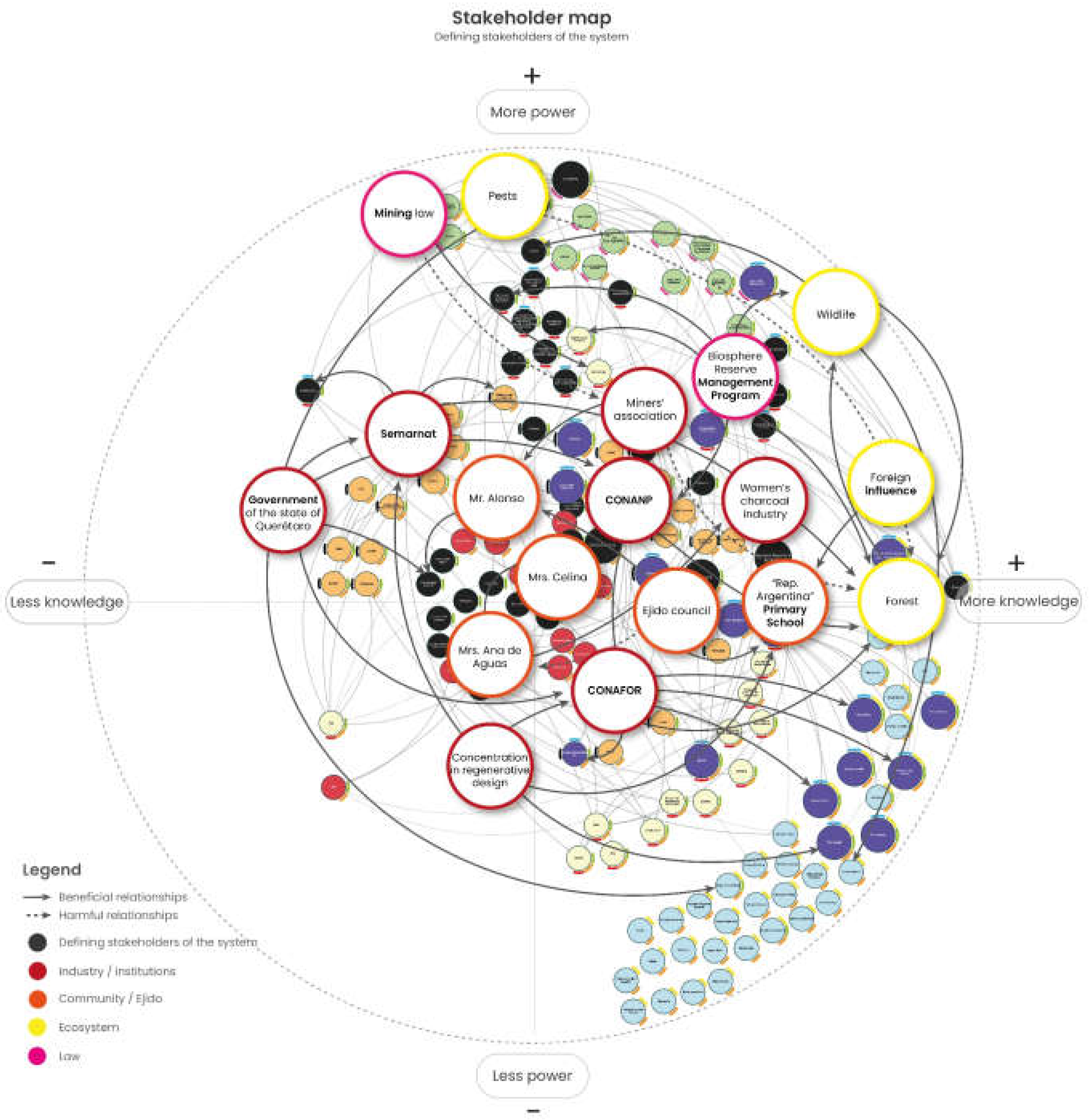
To guide ethnographic and participatory work, a stakeholder map is developed to analyse the systemic relationships between stakeholders. These are classified as: social actors, such as citizens, users and community organisations; non-human actors, including other animal and plant species and ecosystems; economic actors, such as businesses and industries; and institutional actors, which encompass various levels of government (national, state and local), as well as public policies and regulatory frameworks. This comprehensive approach facilitates understanding of the interactions and dynamics that shape the territory, offering a holistic view of how it functions.
Within the framework of Systemic Design and System-Oriented Design (SOD), gigamaps and stakeholder maps are fundamental tools for addressing the complexity of socio-ecological systems and facilitating co-creation processes among multiple stakeholders. Both methodologies allow design to shift from linear approaches to relational, situated and non-reductive readings of territories and their dynamics, as Jones (2023) [65] points out.
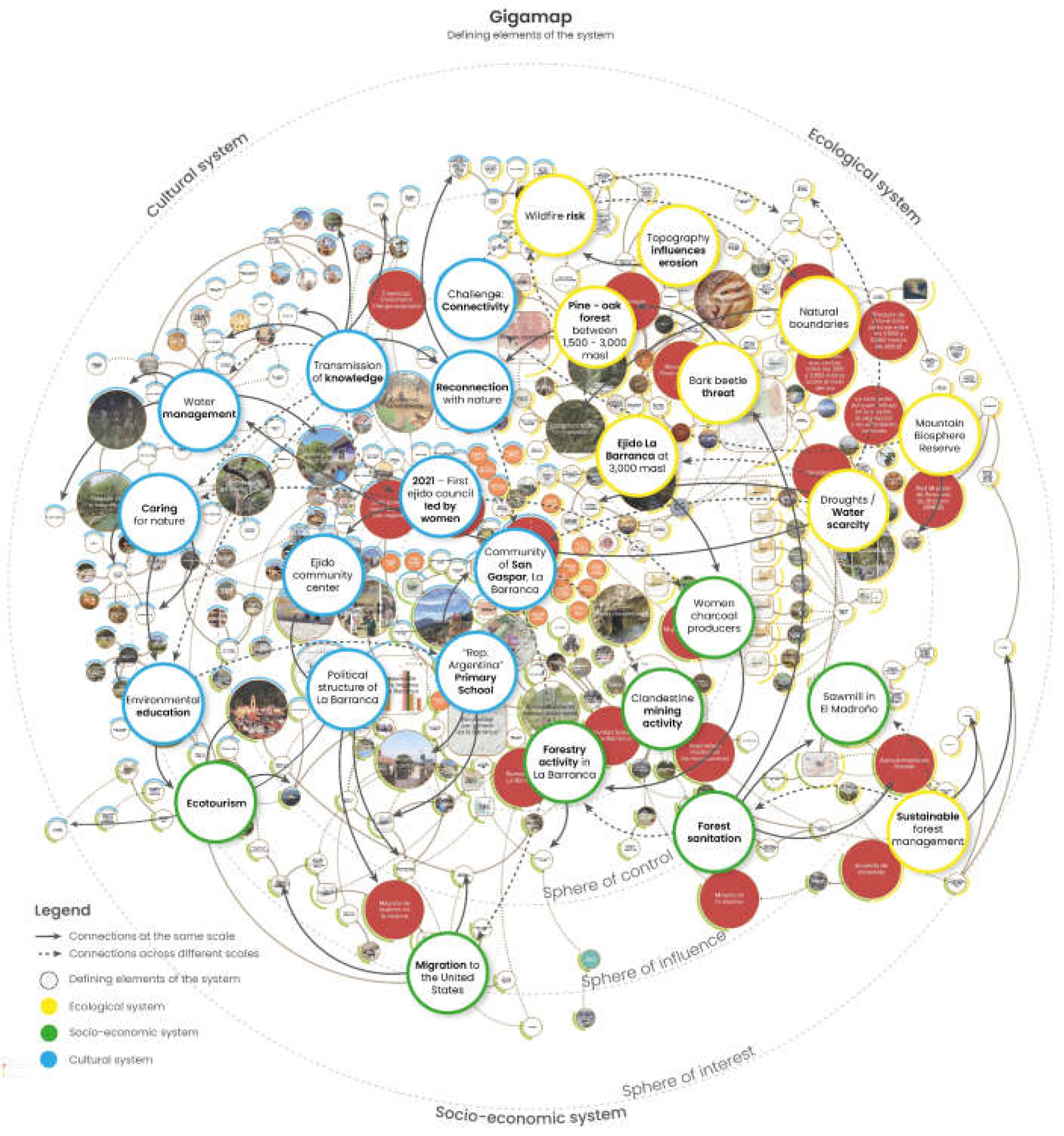
Gigamapping is conceived as a central practice of research through design (Research through Design, RtD) and as a reflective artefact that acts as a ‘bridge’ between different types of knowledge and scales. Through extensive and non-linear visual representations, gigamaps allow us to visualise relationships, dependencies and tensions within complex systems, integrating social, ecological, economic and cultural dimensions. Their main contribution lies in fostering relational understanding by bringing together diverse perspectives on interconnected issues and desired futures, and in promoting critical reflection among participants on their roles within communities and ecosystems. They are generally developed in collaborative ‘visual dialogue’ workshops, in physical or digital formats. They can evolve from an initial mapping of problems to the identification of strategic points of intervention.
For their part, stakeholder maps are used in the system framing stage [65] to identify who comprises the system and how they relate to one another. Beyond a simple list, these maps place people, organisations and institutions within social and ecological structures, highlighting power relations, knowledge flows and qualities of interaction. They are particularly relevant for recognising visible and invisible actors, as well as for incorporating non-human agents—such as ecosystems or future generations—as active participants in the system. Their applications are usually structured at different levels, which makes it easier to define the project’s scope and understand its multiple scales.
In practice, stakeholder mapping is often the starting point for the gigamap: while the former defines who is involved, the latter delves into how and why these relationships are configured, integrating quantitative data with narratives, lived experiences and situated knowledge from the community.
According to Mang and Haggard (2016) [44], environmental issues must be addressed within the specific biosociocultural contexts of each territory, understood as living and evolving systems. This perspective poses the challenge of recognising and reading patterns, a process called pattern literacy, which facilitates understanding of the uniqueness of places. Pattern literacy allows us to recognise territorial uniqueness through three fundamental types [9]: nested system patterns, interaction patterns and essence patterns. Mang (2020) [47] proposes using graphic representations, such as the Gigamap, to visualise the defining elements of the system and their interrelationships.
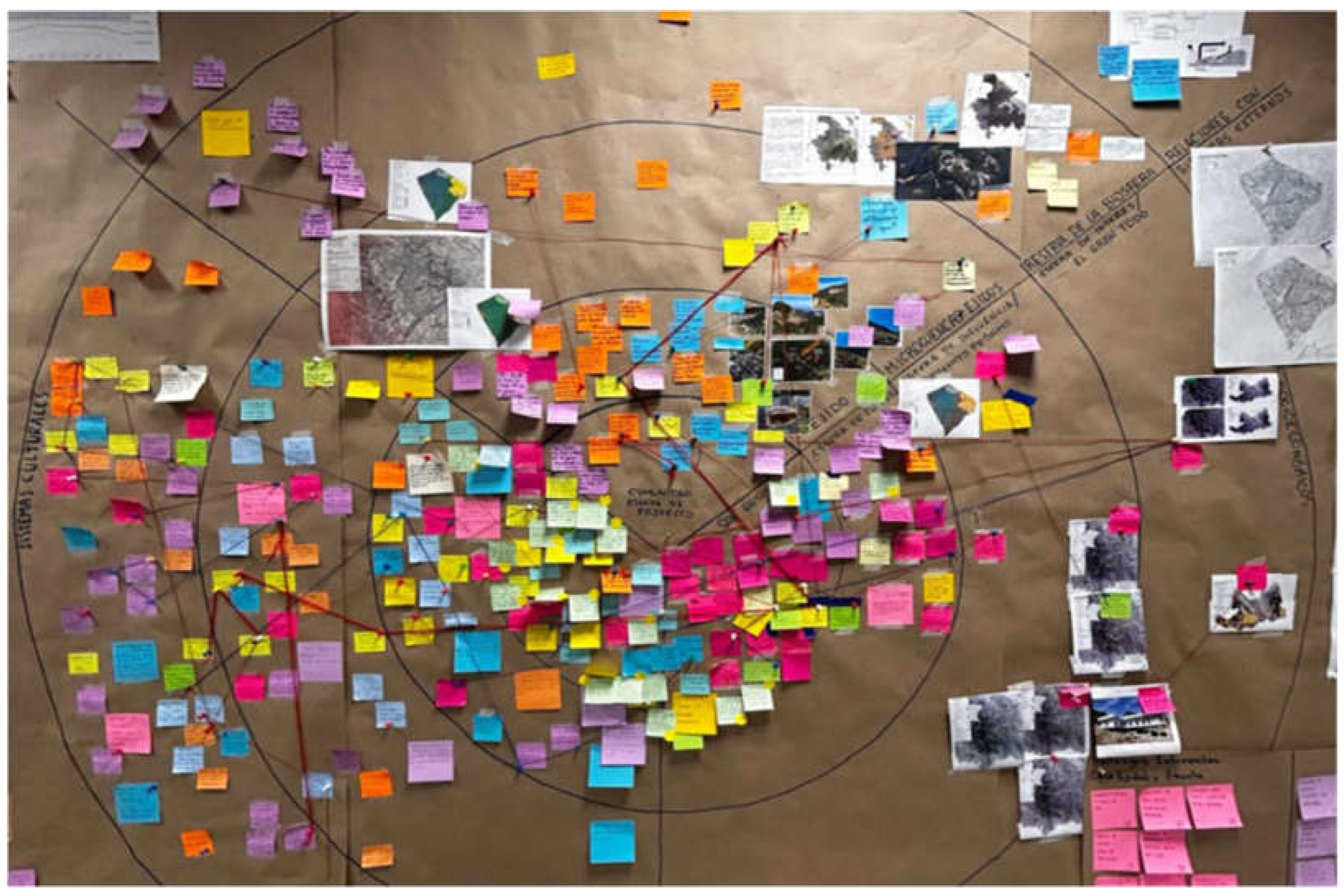
In this work, the Gigamap was used as a systemic analysis tool that integrates ecological, social and cultural dimensions [70,71] . Simultaneously, a stakeholder map was developed to illustrate the relationships among stakeholders, organised by their level of local knowledge and decision-making power, and to highlight the interconnections between stakeholders and specific issues. The resulting Gigamap was subsequently validated collaboratively with the community. Both tools were first created in physical form and then in digital format.
Figure 5.
Work on Gygamapa and Stakeholders map.
There are three fundamental types of patterns for this discernment [9]: 1) Nested system patterns, which show how smaller systems are integrated into larger ones, with systemic health depending on the interrelationships between scales; 2) Patterns of interaction, which reveal the flows of information and mutual influence between living systems; 3) Patterns of essence, which allow the distinctive character of a place to be identified.
2.2.2.4. Essence, Potential and Vocation of the Place, Subphase 2.4
The regenerative understanding of the place culminated in the identification of its essence, vocation, and potential [70]. The essence, described by Alexander et al. (1977) [100] as ‘the nameless quality,’ forms the basis of the identity upon which regenerative design is built [44]. Its discovery is based on narrative research and community participation [47]. Vocation guides action towards collective well-being [44], while potential is defined as the capacity to generate systemic health over time [47]. Participatory activities collectively validated and deepened these findings [70].
This understanding of the place, based on the collective discovery of its essence, vocation, and potential, guides the identification of nodes and activation principles that support co-evolutionary and regenerative processes, enabling the prosperity of the place and its community [70].
In the search for the essence, vocation, and potential of the community of San Gaspar, various participatory validation activities were carried out, allowing the community to actively provide feedback on the findings and deepen the collective perception that had been constructed.
2.2.2.5. Identification of Activation Nodes, Subphase 2.5
From a systemic perspective, regenerative work drives transformation through interventions with multi-scale impact [44]. Activation nodes act as leverage points that channel energy and information, promoting co-evolutionary processes [71]. Their identification, through participatory workshops, emerged from community validation of the place’s essence, vocation, and potential.
From a systemic perspective, regenerative work seeks transformation through interventions with positive multiscale impacts [44]. Activation nodes act as points of support through which energy and information flow, promoting co-evolutionary processes [70].
The identification of nodes arose from the observation and participatory validation of the place’s essence, vocation, and potential, highlighting latent opportunities within the community [70] through a participatory workshop.
2.2.3. Phase 3: Co-Design of Intervention Proposals
Regenerative design was developed in collaboration with the community, integrating landscape, ecological, socio-economic and cultural dimensions. The role of the designer evolves into that of an adaptive facilitator, within a recursive process encompassing conceptualisation, ideation, prototyping, and community validation ([70].
During the co-design phase, collective imagination was promoted through participatory activities—drawings, collective constructions, and territorial tours—that revealed the community’s emotional and functional links to its environment. The participation of children brought fresh and creative perspectives, strengthening understanding of the place and generating contextualised solutions. This process required flexible planning, tailored to different user types and built on prior bonds of trust.
The design culminates in a portfolio of proposals validated and prioritised by the community, whose implementation depends on its resources and interests. Regenerative interventions, although small, generate positive systemic impacts [70]. Finally, the executive project, evaluation indicators and a community monitoring plan are developed, ensuring the autonomy, management and sustainability of the process.
2.2.4. Phase 4: Implementation of Activating Micro-Actions
The micro-actions marked the culmination of the participatory co-design process, acting as catalysts for the respective programmes of the co-created proposals and the implementation of collectively validated community strategies. These interventions, developed with minimal resources and local management, actively involved groups such as primary school mothers, promoting community cooperation and validation.
Their implementation strengthened collective identity, sense of belonging, and self-management capacity, consolidating collaboration as the foundation for the regenerative transformation of the territory. The micro-actions were understood as the culmination, in the form of gratitude, of the group of students and teachers for the time, energy, and interest of the community throughout the regenerative and participatory design process.
3. Results
3.1. Understanding of Place, Phase 2 (Subphase 2.1 and 2.2)
A regenerative understanding of the place was developed through documentary and bibliographic research, which led to the creation of a cartographic atlas integrating ecological subsystems—hydrology, climate, geology, biology, and natural phenomena—along with socio-economic subsystems (demographics, infrastructure, services, activities, and economic potential) and cultural subsystems (history, values, education, traditions, and beliefs). This comprehensive framework enabled the identification of relationships and interdependencies among the subsystems, revealing the integrated network of the territory.
Twenty participatory and ethnographic activities enriched territorial knowledge through multiple voices and scales. The active participation of mothers, teachers, and children was fundamental to building a situated understanding, generating valuable results such as species catalogues, infrastructure maps, local cartographies, and spatial studies, all of which serve as a basis for future interventions.
Icebreaker workshops facilitated initial engagement, and workshops with children highlighted the lack of public and recreational spaces and their strong connection to the natural environment. Through drawings, graphic surveys, and playful activities, participants identified key values—such as nature, forests, and wildlife—as well as a desire to play and socialise, which strengthened bonds between participants and researchers.
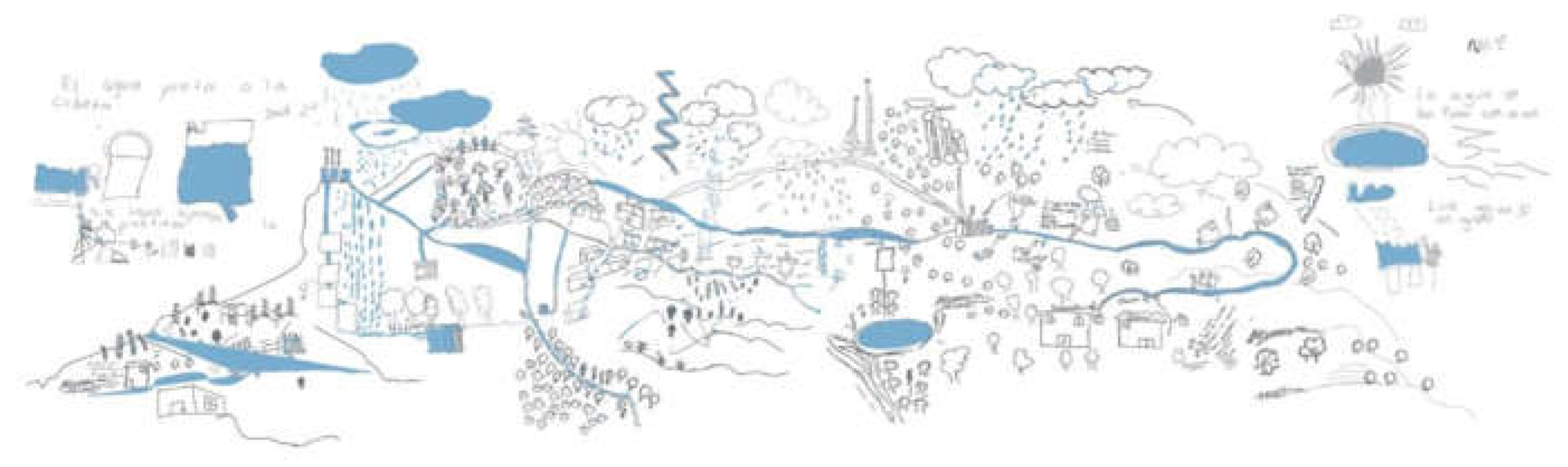
Community mapping activities, including the traffic light exercise and the water mapping workshop, revealed local priorities, challenges and spatial perceptions, emphasising the importance of forest conservation and the need to improve water collection and purification systems. Other activities, such as collective conversations, memory trees, emotional thermometers, and forest immersions, captured collective memory, emotions, and emotional ties to the territory. At the same time, regenerative storytelling encouraged children’s active participation. Interviews and surveys complemented the diagnosis with quantitative and qualitative data on forest use, ejido dynamics, and urban composition, consolidating an integrated analysis of the natural and social context of San Gaspar.
Figure 6.
Activity in the forest with children from the primary school.
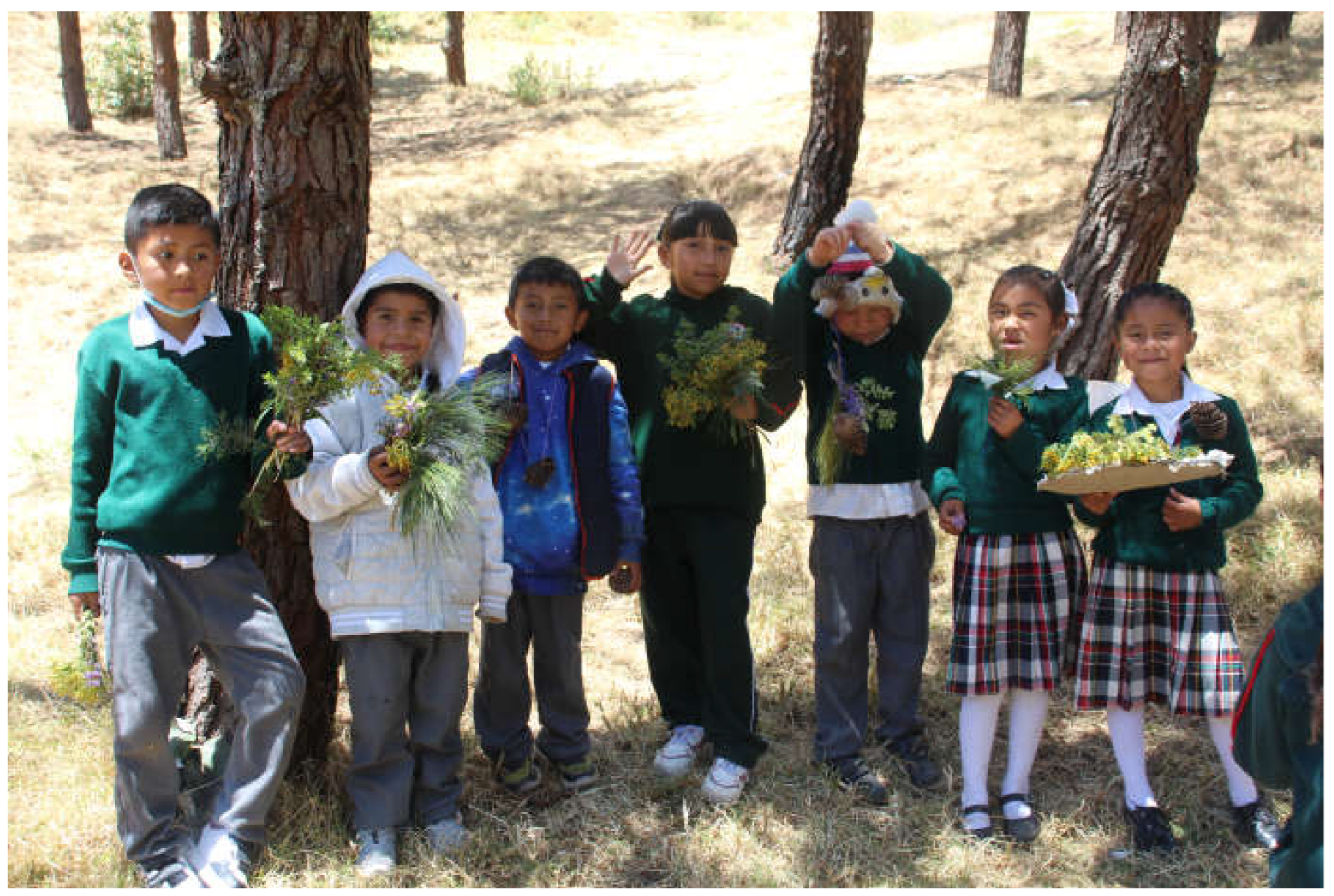
Figure 7.
Outcome of the “Water Mapping” workshop with children and mothers from the primary school.
Figure 7.
Outcome of the “Water Mapping” workshop with children and mothers from the primary school.
3.2. Systemic Analysis Through Pattern Reading and Actor Map, Subphase 2.3
The stakeholder mapping tool proved extremely useful in understanding and organising the various stakeholders and agents that make up the community, both those identified during the research and those recognised by the community itself. These range from organisations, institutions and government entities—such as the Mining Law, SEMARNAT and CONAFOR—to key individuals within the ejido, such as Alonso, either because of their relevance in decision-making or because of their daily relationship with neighbours and their daily impact on the community, as in the case of Ana de Aguas. Actors who function as fundamental agents of change were also identified, including the forest and the primary school, which are defining elements of community life. Finally, the importance of those actors who contribute essential knowledge and insights for understanding the community was recognised, particularly older adults and their wisdom. The format proposed by Jones (2023) [65] was used as a basis, with some variations in levels and scales.
Figure 8.
Actor Map.
Using Gigamap, all the results, findings and conclusions from the documentary and participatory ethnographic phases were visualised in an integrated manner. This tool revealed patterns of relationship, nesting, and essence that allowed for discussion and identification of the site’s essence, potential, and vocation. The stakeholder map complemented this analysis by visualising the key stakeholders whose participation would be essential to initiate a regenerative, co-evolutionary transformation.
The Gigamap includes defining elements of the cultural, ecological, and socio-economic systems, as well as the main actors in the community, to achieve a comprehensive, systemic understanding of the place. In this sense, when talking about nesting scales and trying to capture as much information as possible within the sphere of interest—that which affects or is directly related to the Sierra Gorda Biosphere Reserve—key elements are identified, such as sustainable forest management and both national and international practices linked to the ecology of care for a living forest.
On the other hand, within the sphere of influence, directly related to and located within the reserve, elements such as ecotourism are visualised; migration, which affects the population culturally and socio-economically; care for nature; management and awareness of water as a fragile and unstable resource; the risk of fires; and the rugged topography that characterises the mountains, shaping the settlements and way of life of their inhabitants.
At the micro-basin level, within the sphere of control, mining activity, intergenerational knowledge transfer, bark beetles, women charcoal burners, and the role of ejidos in communities are identified as key characteristics with potential for collaboration, understanding, and contribution.
Finally, within the project sphere, where the focus is specifically on the community of San Gaspar, the map of actors is broken down, and the natural environment, ejido tensions and the daily life of its inhabitants are studied. In this way, thinking globally but acting locally.
Figure 9.
Gigamap.
3.3. Essence, Vocation and Potential, Subphase 2.4
The participatory validation of San Gaspar’s essence, vocation, and potential enabled the collective construction of a representative definition of community identity. Reflections on collective aspirations, ancestral memory and visions of the future consolidated the foundations of identity and strategic orientations. At the same time, children’s perceptions enriched the regenerative projection of the territory through their emotional and imaginative vision.
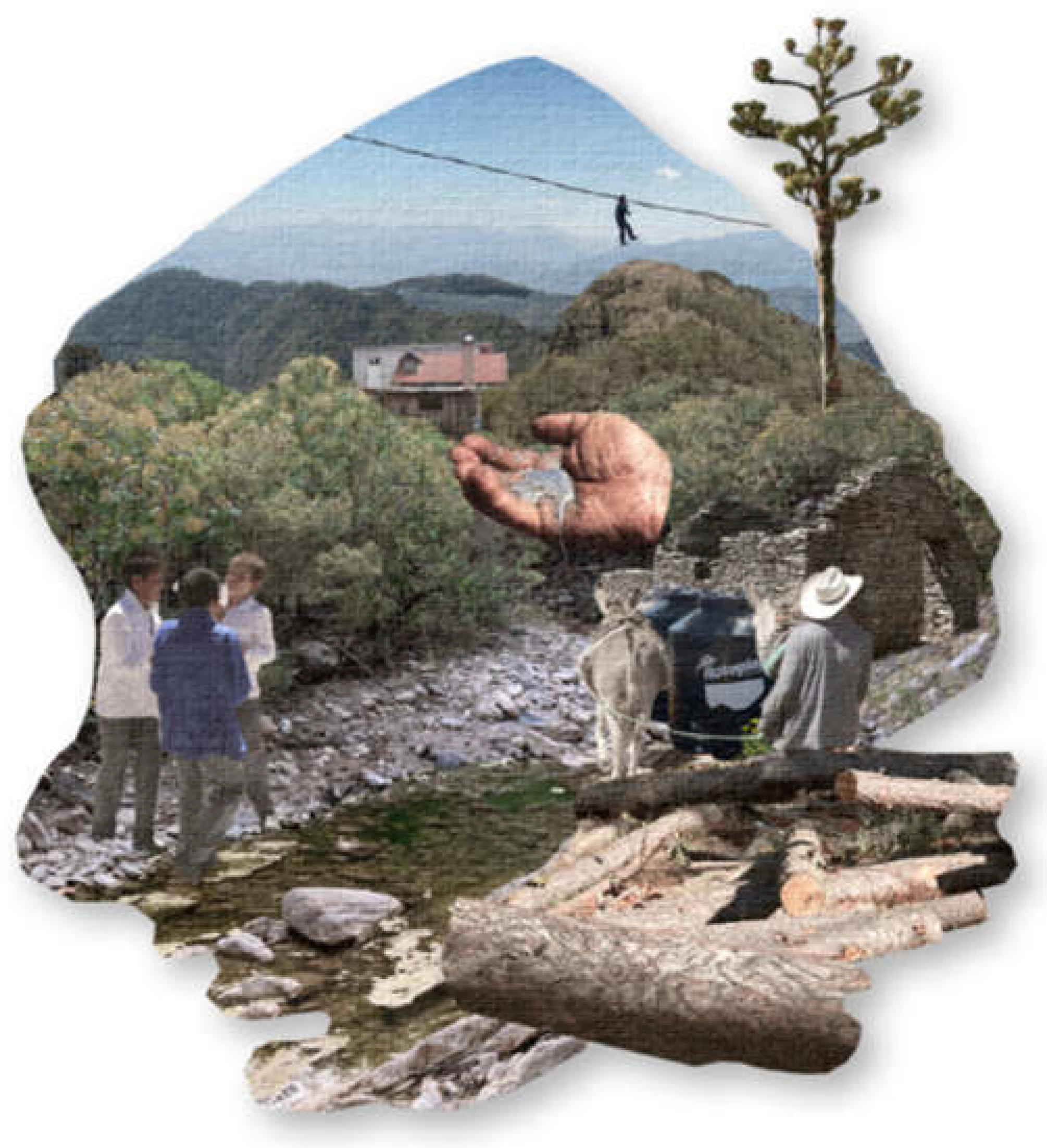
The following definition of essence was collectively agreed upon: ‘San Gaspar has forged its rebellious spirit in the face of external challenges, preserving its inner wealth, defending its customs and its relationship with the environment. With cold winds and a sea of welcoming mountains as a backdrop, its people remain resilient, safeguarding their territory and their way of life.’
Figure 10.
Illustrative collage ‘Essence of Place’.
The collaboratively defined vocation states: ‘San Gaspar cultivates a life of autonomy and harmony with nature. Through sustainable practices and knowledge sharing, the community regenerates its environment, fostering a vocation focused on preserving biodiversity and the traditions that give identity to its territory.’
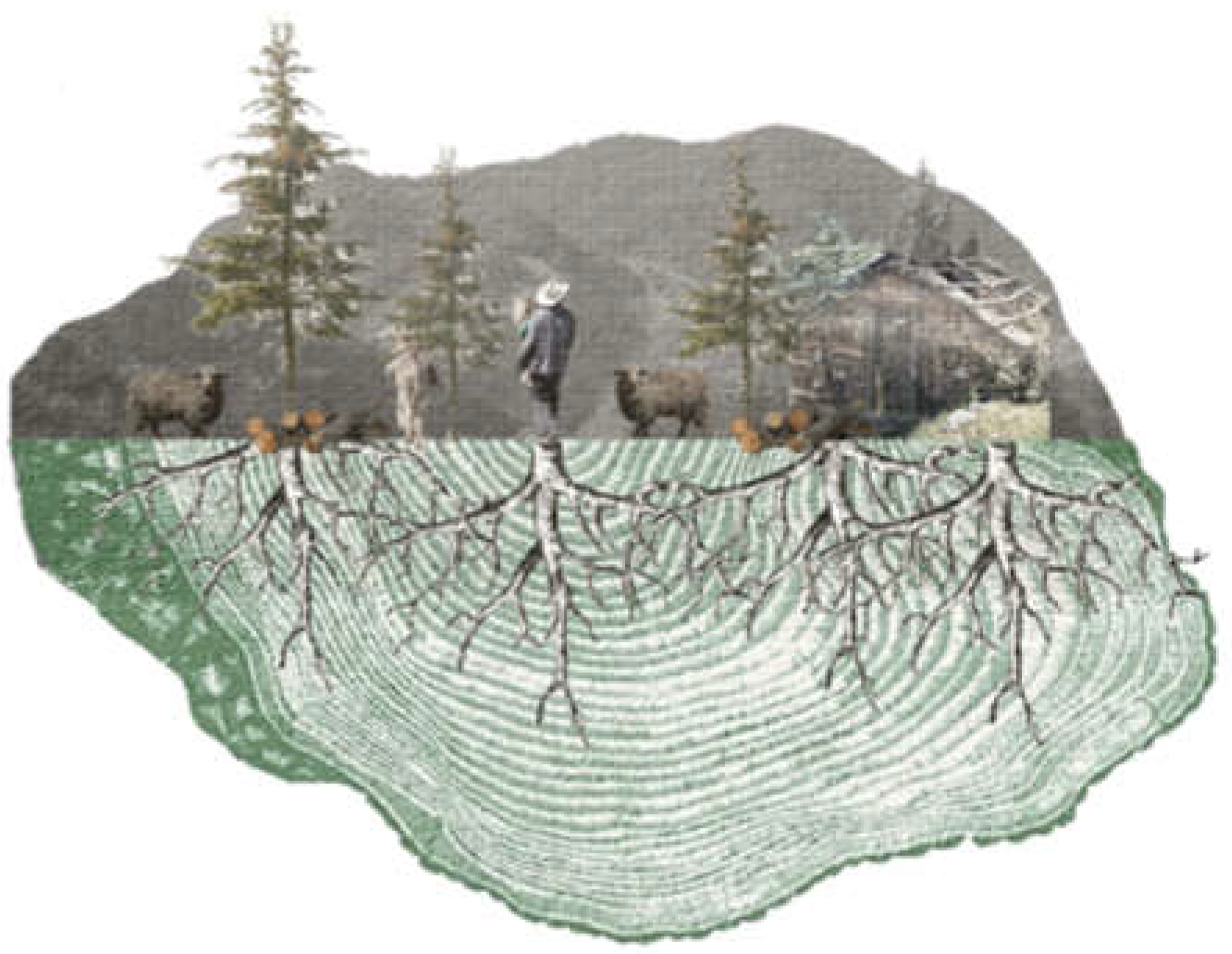
The potential of the place, articulated collectively, states: ‘The potential of San Gaspar lies in its natural wealth and the strength of its community. Its forests, springs and traditional knowledge are seeds for territorial regeneration. This combination strengthens local identity and projects a sustainable and resilient future.’
Figure 11.
Illustrative collage ‘Potential of Place’.
3.4. Identification of Activation Nodes, Subphase 2.5
Strategic lines and activation nodes were defined and validated (Fig. #), ensuring that the working guidelines were recognised and appropriated by the community through collective feedback. The workshops revealed strong emotional ties to nature, a sense of responsibility towards ecosystems, and intergenerational aspirations. Faced with challenges such as water scarcity and a lack of public spaces, the community collectively shaped strategies aligned with its defined essence and regenerative potential.
Figure 12.
Workshop for the validation of strategies and activation nodes with the ejido council.
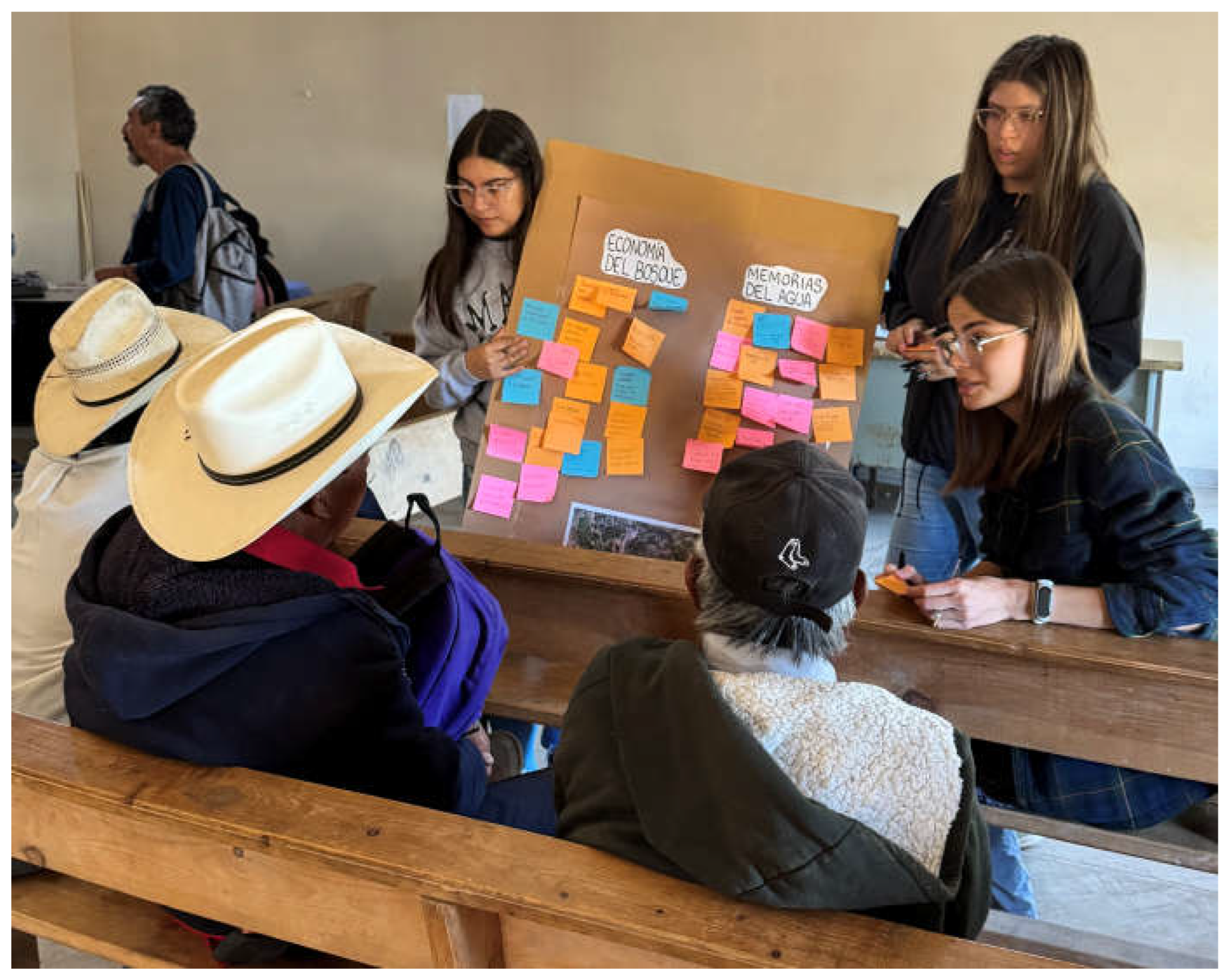
Figure 13.
Strategic Lines and Activation Nodes.
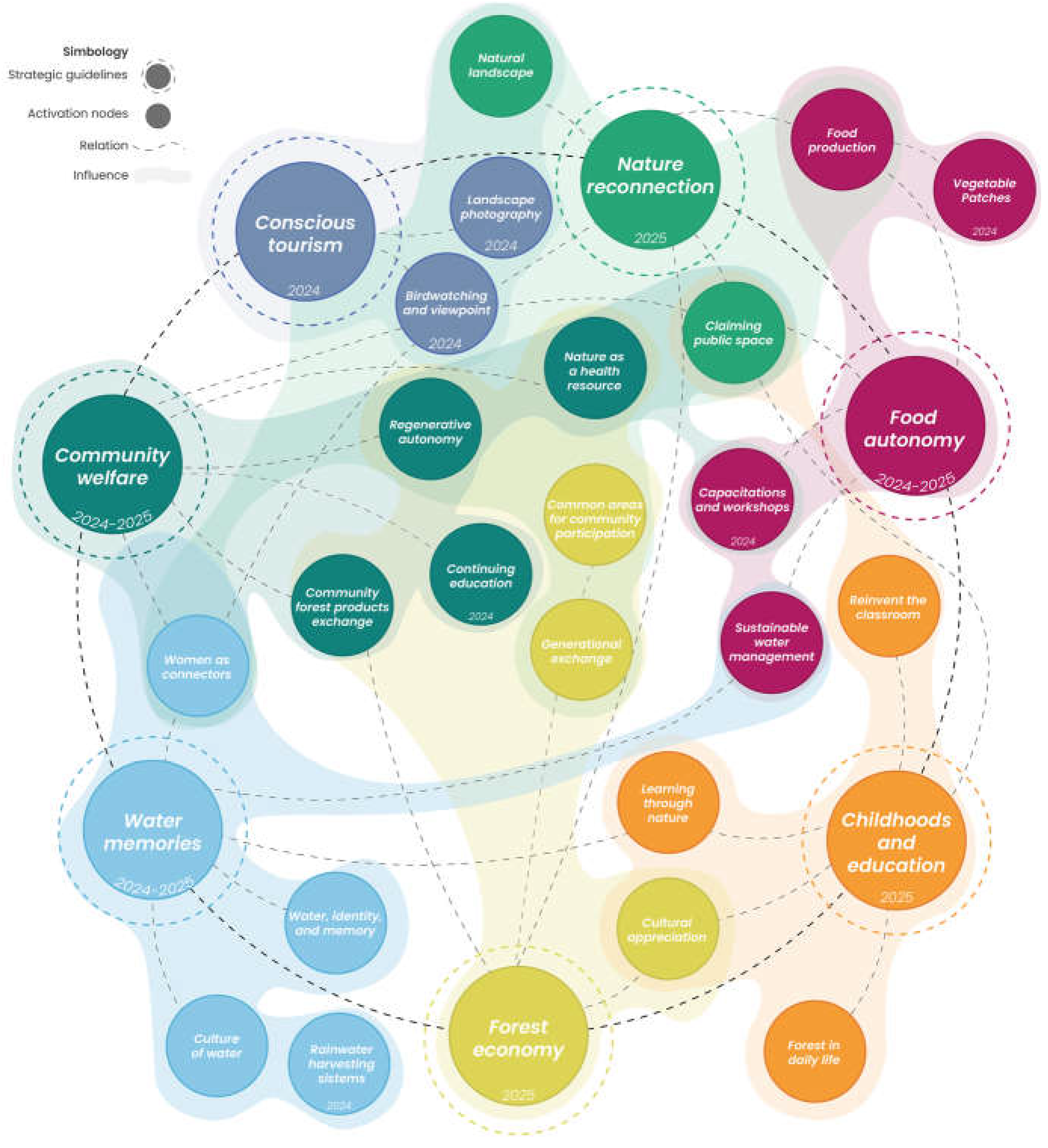
The activation nodes identified in the work carried out during 2024 and 2025 arise from the seven strategic lines developed together with the community. These lines bring together actions aimed at responding to the needs and activating the potential of the territory, either by strengthening the relationship with the environment, as in ‘Memories of Water’ and ‘Reconnecting with Nature,’ or by promoting development and sovereignty processes, such as ‘Forest Economy’ and ‘Food Sovereignty.’
The activation nodes are defined on the basis of these strategic lines. Some of them derive directly from a particular line, such as ‘Water Culture’ and ‘Community Gardens’; others emerge from two or more lines, such as ‘Nature as a Source of Health’ and ‘Generational Exchange’.
In total, the 22 nodes identified function as guiding principles for the projects to be proposed, ensuring that each proposal remains consistent with the essence and potential of the place, contributing to the generation of points of change and regenerative development.
3.5. Co-Design Phase, Phase 3
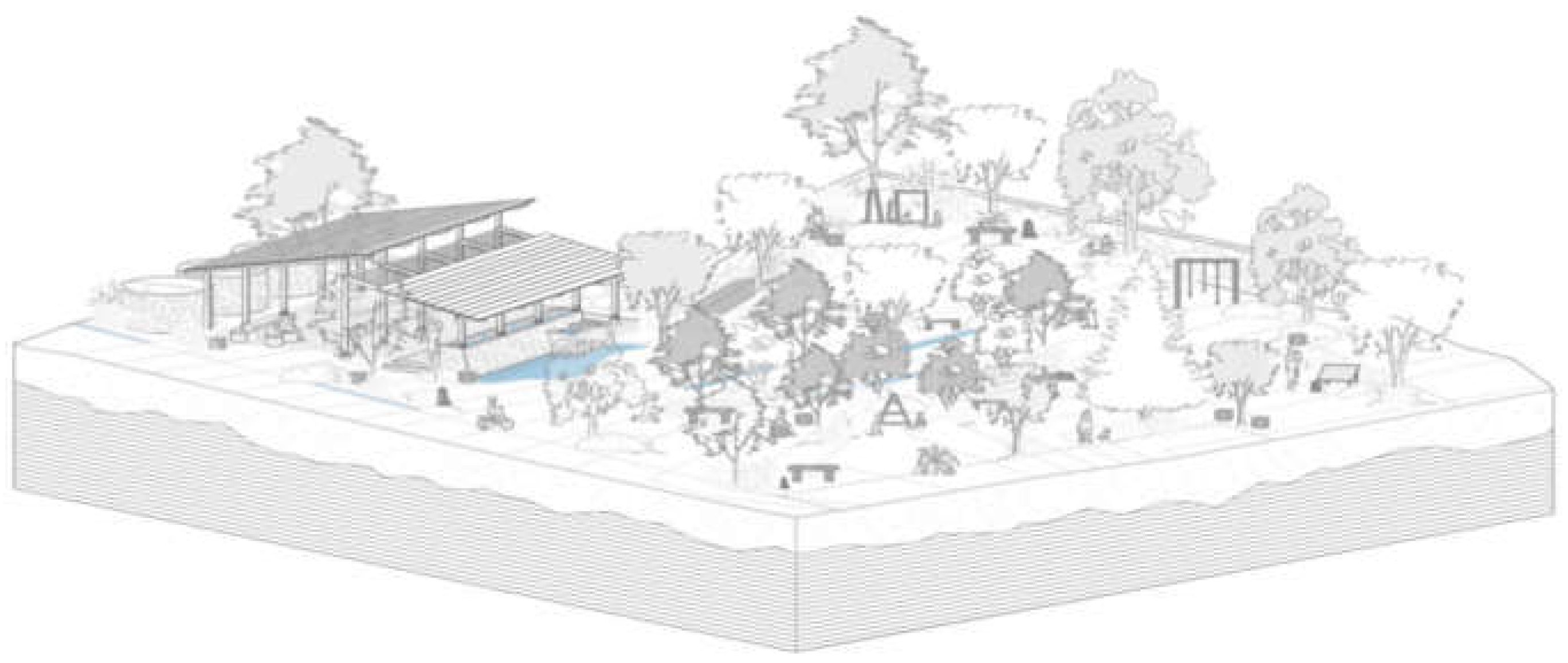
The co-design process strengthened the project proposals through the active participation of mothers, teachers, and children of various ages, integrating their habits, needs, and spatial perceptions [70]. With the mothers, interventions were tailored to their customs, while the children’s perceptions allowed for the design of outdoor play areas, cosy interiors and playful educational environments, promoting direct interaction and family bonding with the spaces.
The co-design workshops served as catalysts for the project’s potential, deepening the bond with the community and valuing local knowledge, such as the uses of medicinal plants and children’s play preferences. The identification of desired elements in green areas, including nature, games, and animals, enabled the design of meaningful spaces that reflect identity, foster creativity, and strengthen the bond with the territory.
Likewise, the positive and negative aspects of the proposals were analysed, incorporating criteria such as colour, materials and diversity of uses. Spaces with potential for intervention were identified, such as green spots and rest areas, and reflections were developed on environmental and educational concerns and access to services, including water management strategies to promote an independent network. This approach integrated community knowledge, children’s creativity and technical criteria, ensuring a contextualised and participatory design.
After defining the strategic lines, each activation node guided specific architectural and landscape interventions aimed at community and environmental regeneration:
- ‘Experiential Education’ (2024) proposed an intervention in the ejido house to create a community gallery for the sale, exhibition and relaxation of the entire community, with spaces for children’s play. In addition to a complex of workshops in the forest for learning and teaching, activities such as weaving, carpentry and handicrafts are proposed.
- ‘Water Regeneration’ (2024) proposes comprehensive water management in the community, placing the primary school at the centre of its intervention, with the implementation of a system for water collection, treatment, interaction and storage using systems such as rain ponds, wetlands, a pavilion and landscape interventions for the creation of medicinal and edible gardens.
- ‘Living Connections’ (2024) works around public space, proposing an intervention in the ejido house to convert it into a centre for administration, commerce, leisure, play and learning in the community, as well as cleaning the pot through a chinanpas system and reactivating the community house. Finally, a landscaping intervention on the ‘maguey path’ that connects these two points in the community.
- ‘Food Sovereignty’ (2024) proposed the creation of a centre where food is produced, stored and managed, based on a water management system called ‘water for life’ where a community dining room, a greenhouse, vegetable gardens, play areas and an edible forest are developed around this water collection and storage system for the development of these crops. Seeking to promote community food sovereignty.
- ‘Memories of a Living Forest’ (2024) proposed the rehabilitation of the sawmill for the development of the ejido forest economy. In addition to forest and water routes, both with different interventions such as cabins and contemplation and rest points, both for community use and as a potential tourist attraction. Recognising the routes already mapped out.
- ‘Memories of Water’ (2025) proposed the renovation of the primary school and teachers’ residence, the construction of a community washing area, and the improvement of a path to the mainstream, including a recreational space, to re-establish connections—especially between mothers and children—with water as a cultural, ecological, and social resource.
- ‘Encounters in the Forest’ (2025) proposed expanding the school and teachers’ housing, incorporating outdoor classrooms, a forest library, and improved play areas, thus promoting the integration of nature-based education.
- ‘Flavours of the Earth’ (2025) consisted of a series of interventions at the La Olla reservoir to implement a water management system that would support regenerative agriculture, complemented by a cooperative shop and a public space called ‘Living Landscape,’ which promoted community resilience and food sovereignty.
- ‘Living Pharmacy’ (2025) designed a forest therapy trail along Peña Blanca, with spaces for reflection, education and reconnection with nature, as well as a living pharmacy that promotes intergenerational co-creation, traditional knowledge and the use of medicinal plants.
- ‘Weaving Knowledge’ (2025) proposed interventions in the primary school and the ejido house, revaluing them as spaces for collective learning, care and territorial management, incorporating an edible forest and regenerative agriculture practices, and positioning community participation as a driver of social and environmental regeneration.
The collaborative design process reinforced these proposals thanks to the active participation of the ejido council, mothers, teachers and children, integrating daily habits, needs and spatial perceptions. Workshops with mothers adapted the interventions to their customs, while children’s contributions served as the basis for the design of outdoor play areas, welcoming interiors, and interactive learning environments that encourage family and community participation. Local knowledge, such as the use of medicinal plants, was incorporated along with children’s play preferences and symbolic references to nature, animals, and games, reflecting identity and attachment to place.
Figure 14.
Collaborative design activity with children at the primary school.
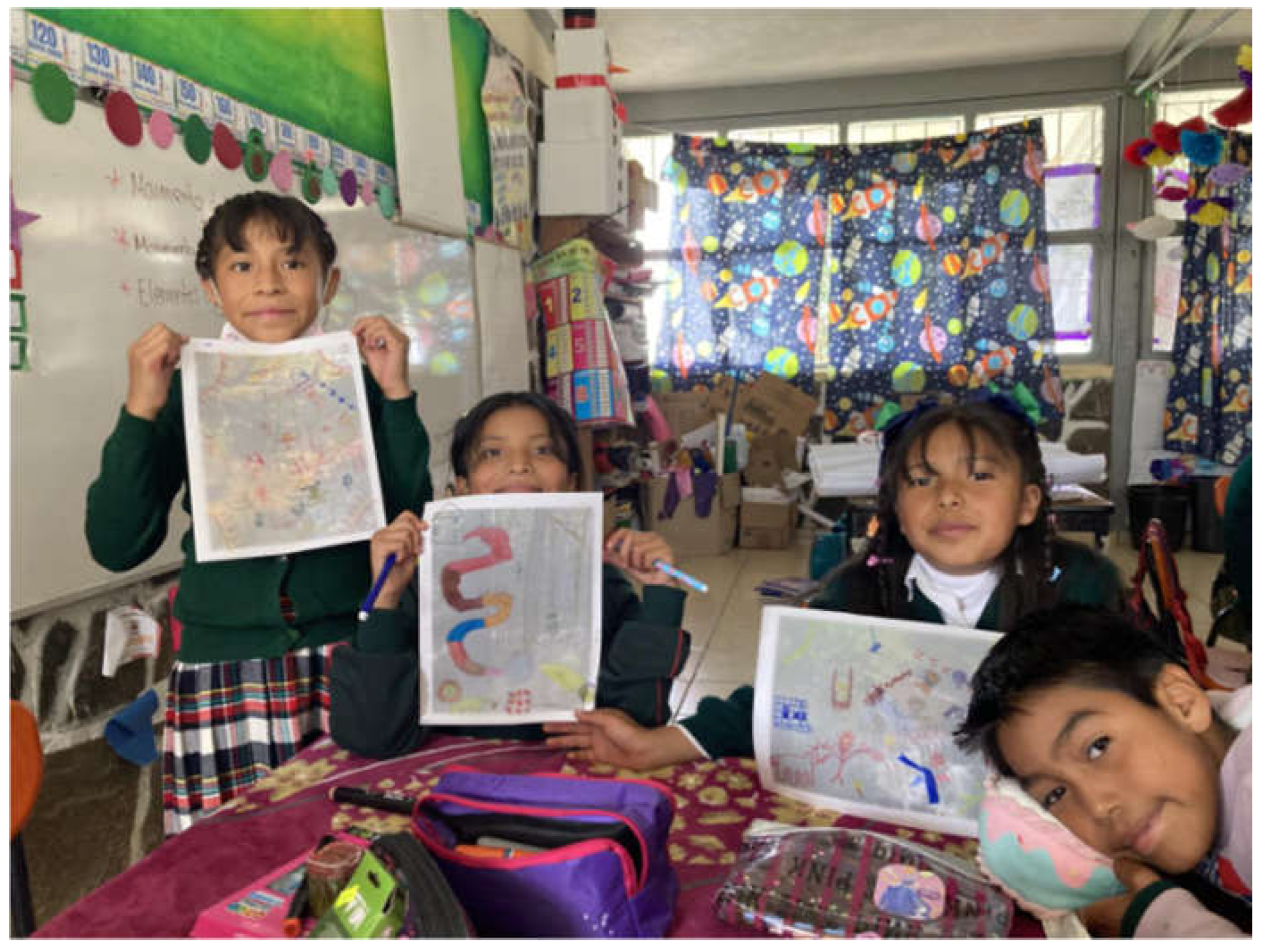
Figure 15.
Visual rendering of project proposal.
3.6. Implementation of Micro-Actions, Phase 4
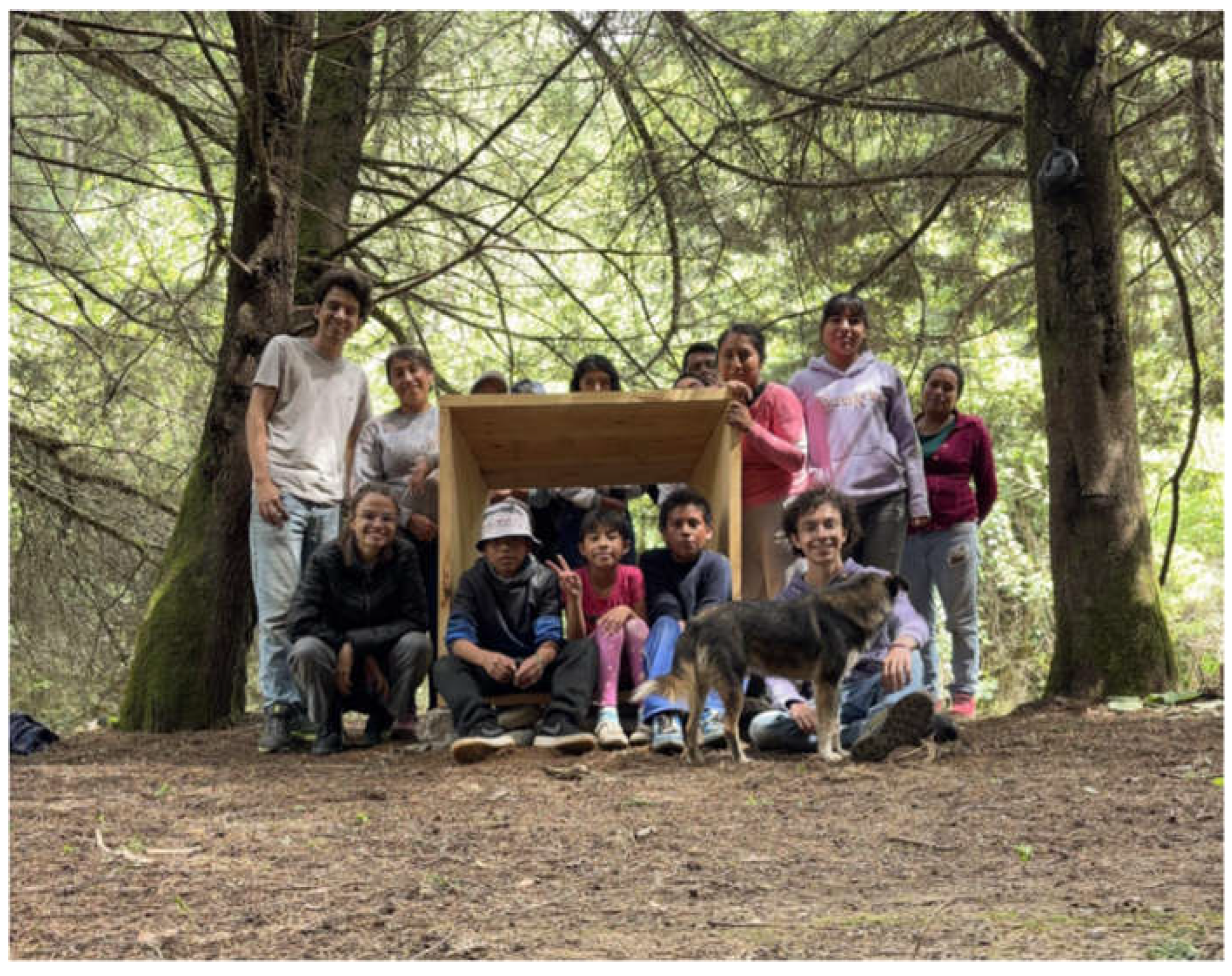
A micro-action was collaboratively developed for each proposed project, which involved implementing their respective programmes by integrating memory, play, knowledge, and care for the environment.
- ‘Memories of Water’ framed the stream with a living installation and a swing.
- ‘Weaving Knowledge’ created a collective mural representing the community’s memories.
- ‘Encounters in the Forest’ built a woven wooden structure for community use.
- ‘Living Pharmacy’ collected and catalogued native plants.
- ‘Flavours of the Earth’ implemented a chinampa in the La Hoya reservoir, promoting sustainable agricultural practices and water conservation.
The implementation of these micro-actions represented a moment of connection, celebration, and tangible realisation of the co-creation process. Through co-design and approval workshops, intergenerational teams of adults and children were formed to manage tools and resources, fostering active, inclusive, and collective participation. These interventions strengthened community identity, sense of belonging, and the viability of developing independent projects from within the community.
Figure 16.
Documentation of micro-action implemented with the community at Arroyo Grande.
4. Discussion of Results and Conclusions
Regenerative and participatory design is conceived as a living process in which memories, relationships and nature are intertwined, and in which each action arises from an ongoing dialogue with the community. For example, exploring water culture through collective mapping revealed that this resource is not only understood in technical terms but also felt, cared for, and remembered, reflecting the place’s history and identity.
The participatory process highlighted the de-hierarchisation of the designer’s role, who acts as a facilitator of a recursive, iterative process, integrating multiple actors in constant interaction. The initial hypothesis served as a flexible starting point, recognising that the project only makes sense when the community is the protagonist, and that co-creation guarantees deeper, more lasting and regenerative solutions.
The co-design workshops allowed the development of comprehensive proposals adapted to community habits, needs, and dynamics, generating environments consistent with San Gaspar’s cultural and social identity.
The active participation of residents strengthened their sense of ownership, and the inclusion of diverse perspectives promoted an inclusive, representative and context-sensitive design. The spaces were co-designed with the habits and preferences of users of all ages, ensuring that each proposal reflected the community’s vision and experience.
Immersion workshops in the forest allowed children to experience nature firsthand, while mothers recalled intergenerational memories, underscoring the importance of intergenerational connections to the natural environment.
Drawing proved to be an effective tool for expressing emotions, ideas, and perceptions beyond verbal communication, fostering imagination, creativity, and openness to new perspectives, not only with children but also with adults.
The methodology prioritises open discussion, avoiding predefined agendas, and ensures that community perceptions guide outcomes and decisions. This recursive and iterative approach redefines the designer’s role as a facilitator, integrating multiple actors.
By conducting a wide variety of workshops and participation, validation, and co-design activities, which included various actors such as children, educators, mothers, ejido power figures, etc.
The methodology was adapted and adjusted to ensure the safe and inclusive participation of individuals, thereby generating composite, enriched results that served as the basis for proposing the essence, vocation, and potential of the place.
The collaborative design workshops enabled the development of comprehensive proposals tailored to local habits, needs, and dynamics, resulting in environments consistent with San Gaspar’s cultural and social identity. The community’s active participation strengthened a sense of belonging and promoted an inclusive, representative, and context-sensitive design. The spaces were planned according to the preferences of all age groups, ensuring that each intervention reflected the collective experience and reinforced the links with the territory.
The implementation of micro-actions consolidated the process, functioning as gestures of gratitude and catalysts for future programmes, demonstrating the community’s capacity for self-determination and its commitment to improving the everyday environment. These actions fostered collective learning through shared practice, reaffirming community participation as the driving force behind regenerative design.
The experience demonstrated that participatory processes and co-design generate more sensitive, inclusive, and sustainable projects, strengthening community identity, ownership, and ecological resilience. Regenerative and participatory design allows us to understand the place not only as a setting, but as a living space that facilitates experiences, memories, and relationships.
Regenerative design, based on memory, collective creativity and interaction with the environment, proves to be an effective strategy for rebuilding links, restoring ecosystems and projecting fairer and more sustainable futures, placing life and community at the centre of action. It invites designers to reconsider their role, recognising and empowering local cultures that foster interdependence between communities and ecosystems, a phenomenon that manifests uniquely in each territory.
Experience has shown that participatory processes and collaborative design generate more sensitive, inclusive and sustainable projects, strengthening community identity, ownership and ecological resilience. Active listening to local narratives allows us to identify genuine problems and develop contextualised solutions, fostering collectively built, resilient and regenerative futures. Women and children emerge as active agents whose knowledge, creativity, and memory enrich projects that integrate community and nature.
Regenerative design invites us to constantly ask ourselves, ‘Who are we as designers?’ Understanding that our work is not only to solve technical problems, but that our practice must be based on regenerative thinking. This implies recognising and promoting regenerative cultures, understood as ways of life that care for the links between communities and ecosystems, which manifest in unique ways in each territory. Regenerative cultures are expressions of their bioregions, in this case, of the Biospherre reserve, and only through dialogue with those who inhabit these places can their memories, traditions, and potential be revealed. Is in the listening that we find the local narratives that allow us to recognise the place truly.
The use of tools such as stakeholder maps and gigamaps was indispensable for synthesising information, fostering a collaborative understanding of the place, and providing a clearer view of all the elements of the system. Its transformative potential depends on the interpretations and proposals for activation nodes that emerge as the system takes shape.
Author Contributions
Conceptualization, C.C.; methodology, C.C., M.V. and G.E.C-S.; software, A. R-M., M.V. and G.E.C-S.; validation, C.C., M.V. and G.E.C-S.; formal analysis, C.C., M.V. and G.E.C-S.; investigation, C.C., M.V. and G.E.C-S.; resources, C.C.; data curation, C.C., M.V. and G.E.C-S.; writing—original draft preparation, C.C., M.V., G.E.C-S., A. R-M. and L. M. G-C.; writing—review and editing, C.C., M.V., G.E.C-S., A. R-M., L. M. G-C., D. B. A-L. and M. C.C.; visualization, M.V. and G.E.C-S.; supervision, C.C.; project administration, C.C.; funding acquisition, C.C. All authors have read and agreed to the published version of the manuscript.
Funding
This research was funded by Tecnologico de Monterrey Crowdfunding.
Data Availability Statement
We encourage all authors of articles published in MDPI journals to share their research data. In this section, please provide details regarding where data supporting reported results can be found, including links to publicly archived datasets analysed or generated during the study. Where no new data were created, or where data is unavailable due to privacy or ethical restrictions, a statement is still required. Suggested Data Availability Statements are available in section “MDPI Research Data Policies” at https://www.mdpi.com/ethics.
Acknowledgments
The authors would like to acknowledge the support of the School of Architecture, Art and Design, its departmental, divisional, and research management, and the regional and national deans. They also wish to acknowledge the communities with whom they have been working in the La Barranca Ejido, without whom this article could not have been written and would lack meaning, as well as the management of CONANP of the RBSG and CONAFOR, Querétaro office. “During the preparation of this manuscript/study, the author(s) used chatGPT for the purposes of Style review and Deepl for the purposes of translation. The authors have reviewed and edited the output and take full responsibility for the content of this publication.”.
Conflicts of Interest
The authors declare no conflicts of interest.
Abbreviations
The following abbreviations are used in this manuscript:
| BR | Biosphere Reserve |
| RBSG | Biosphere Reserve Sierra Gorda |
| RR | Regenerative Responsability |
| MAB | Man and the Biosphere |
References
- Zingoni de Baro, M.E. The Anthropocene and the Urbanising World. In: Regenerating Cities. Cities and Nature. Springer, Cham, 2022. [CrossRef]
- Zingoni de Baro, M.E.; Macedo, J. The Role of Regenerative Design and Biophilic Urbanism in Regional Sustainability. The Case of Curitiba. In: Bioregional Planning and Design: Volume II, ed. Daniela Fanfani y Andrés Matarán Ruiz. Springer, Cham, 2020, pp. 225–241. [CrossRef]
- Cardinale, B.J.; et al. Biodiversity Loss and Its Impact on Humanity. Nature 2012, 486(7401), 59–67. [CrossRef]
- Rands, M.R.; Adams, W.M.; Bennun, L.; Butchart, S.H.; Clements, A.; Coomes, D.; Vira, B.; et al. Biodiversity Conservation: Challenges Beyond 2010. Science 2010, 329(5997), 1298–1303.
- Goodall, J.; Abrams, D. The Book of Hope: A Survival Guide for Trying Times. Celadon Books: Nueva York, 2021.
- Salk, J.D. Planetary Health: A New Reality. Challenges 2019, 10(1), 7.
- Cobreros, C.; Giorgi, E.; Cattaneo, T. There is Hope. Better Possible Futures Through Regenerative Design. In: Regenerative Design. Cities and Nature. Springer, Cham, 2025. [CrossRef]
- González-Márquez, I.; Toledo, V.M. Sustainability Science: A Paradigm in Crisis? Sustainability 2020, 12, 2802.
- Wahl, D.C. Designing Regenerative Cultures. Triarchy Press: Bridport, UK, 2016.
- Gibbons, L.V.; et al. The Development, Application, and Refinement of a Regenerative Development Evaluation Tool and Indicators. Ecological Indicators 2020, 108, 105698.
- Mammadova, A.; May, S.M.; Tomita, Y.; Harada, S. Synergies and Conflicts in Dual-Designated UNESCO Sites: Managing Governance, Conservation, Tourism, and Community Engagement at Mount Hakusan Global Geopark and Biosphere Reserve, Japan. Land 2025, 14, 488. [CrossRef]
- UNESCO. A New Roadmap for the Man and the Biosphere (MAB) Programme and Its World Network of Biosphere Reserves. MAB Strategy (2015–2025), Lima Action Plan (2016–2025), Lima Declaration. UNESCO: Paris, France, 2017.
- Carruthers, J. Conservation Science and UNESCO Biosphere Reserves. S. Afr. J. Sci. 2020, 116, 7709. [CrossRef].
- Baldwin-Cantello, W.; Tickner, D.; Wright, M.; Clark, M.; Cornelius, S.; Ellis, K.; Francis, A.; Ghazoul, J.; Gordon, J.E.; Matthews, N.; et al. The Triple Challenge: Synergies, Trade-offs and Integrated Responses for Climate, Biodiversity, and Human Wellbeing Goals. Clim. Policy 2023, 23, 782–799. [CrossRef].
- Pool-Stanvliet, R. A History of the UNESCO Man and the Biosphere Programme in South Africa. S. Afr. J. Sci. 2013, 109, 6. [CrossRef].
- UNESCO. Biosphere Reserves: The Seville Strategy and the Statutory Framework of the World Network. UNESCO: Paris, France, 1996.
- Kratzer, A. Biosphere Reserves Research: A Bibliometric Analysis. Eco. mont 2018, 10, 36–49.
- Clüsener-Godt, M.; Köck, G.; Müller, L. Editorial: It is About Life: 50 Years of UNESCO’s Man and the Biosphere Program. Int. J. Environ. Sustain. Dev. 2022, 21, 377–387. [CrossRef].
- Barraclough, A.D.; Reed, M.G.; Coetzer, K.; Price, M.F.; Schultz, L.; Moreira-Muñoz, A.; Møren, I. Global Knowledge–Action Networks at the Frontlines of Sustainability: Insights from Five Decades of Science for Action in UNESCO’s World Network of Biosphere Reserves. People Nat. 2023, 5, 1430–1444. [CrossRef].
- Schliep, R.; Stoll-Kleemann, S. Assessing Governance of Biosphere Reserves in Central Europe. Land Use Policy 2010, 27(3), 917–927. [CrossRef]
- Hammer, T. Protected Areas and Regional Development: Conflicts and Opportunities. In: Mose, I. (ed.), Protected Areas and Regional Development in Europe. Towards a New Model for the 21st Century, 21–36. 2007. [CrossRef].
- Shafer, C. Cautionary Thoughts on IUCN Protected Area Management Categories V–VI. Global Ecology and Conservation 2015, 3(Supplement C), 331–348. [CrossRef]
- Coetzer, K.L.; Witkowski, E.T.; Erasmus, B.F. Reviewing Biosphere Reserves Globally: Effective Conservation Action or Bureaucratic Label? Biol. Rev. 2014. [CrossRef]
- Arrogante-Funes, P.; Osuna, D.; Arrogante-Funes, F.; Álvarez-Ripado, A.; Bruzón, A.G. Uncovering NDVI Time Trends in Spanish High Mountain Biosphere Reserves: A Detailed Study. Journal of Environmental Management 2024, 355, 120527.
- Price, M.F. Mountain Area Research and Management: Integrated Approaches. Earthscan: London, UK, 2007.
- Ferreira, A.F.; Zimmermann, H.; Santos, R.; von Wehrden, H. Biosphere Reserves’ Management Effectiveness—A Systematic Literature Review and a Research Agenda. Sustainability 2020, 12, 5497.
- UNESCO. Technical Guidelines for Biosphere Reserves. UNESCO: Paris, France, 2021.
- Klaver, M.; Currie, B.; Sekonya, J.G.; Coetzer, K. Learning Through Place-Based Implementation of the UNESCO MAB Program in South Africa’s Oldest Biosphere Reserve: A Case Study of the Kogelberg Biosphere Reserve. Land 2024, 13, 455. [CrossRef]
- Phillips, A. Turning Ideas on Their Head: The New Paradigm for Protected Areas. Georg. Wright Forum 2003, 20, 8–32.
- Armitage, D.; Mbatha, P.; Muhl, E.-K.; Rice, W.; Sowman, M. Governance Principles for Community-Centered Conservation in the Post-2020 Global Biodiversity Framework. Conserv. Sci. Pract. 2020, 2, e160. [CrossRef].
- Cameron, C.; Rössler, M. Many Voices, One Vision: The Early Years of the World Heritage Convention. Ashgate Publishing: Farnham, UK, 2016.
- Müller, K. Resilience Thinking and the Evolution of Collaborative Environmental Governance in the Western Cape. Administratio Publica 2014, 22(1), 5–23.
- Palomo, I.; Montes, C.; Martin-Lopez, B.; González, J.A.; Garcia-Llorente, M.; Alcorlo, P.; Mora, M.R.C. Incorporating the Social–Ecological Approach in Protected Areas in the Anthropocene. BioSci. 2014. [CrossRef]
- Tagle-Cruz, A.L. México, el País con Más Reservas de la Biósfera de América Latina. Crónica, julio 17, 2021.
- Urquiza-García, J.H. Una Historia Ambiental Global: De las Reservas Forestales de la Nación a las Reservas de la Biósfera en México. Iztapalapa. Revista de Ciencias Sociales y Humanidades 2019, 40(87), 101–134.
- Buser, M. Ecologies of Care. In: Ecologies of Care in Times of Climate Change. Bristol University Press: Bristol, UK, 2024, pp. 106–118. [CrossRef]
- Berry, W. The Unsettling of America: Culture and Agriculture. Sierra Club Books, 1977.
- Boff, L. Cry of the Earth, Cry of the Poor. Orbis Books, 1995.
- Pérez Orozco, A. Subversión Feminista de la Economía: Aportes para un Debate sobre el Conflicto Capital-Vida. Traficantes de Sueños, 2014.
- Svampa, M. Perspectivas Teóricas y Prácticas de los Ecofeminismos Latinoamericanos. In: Fernández Droguett, F.; Puente, F. (Coords.), Feminismos Ecoterritoriales en América Latina: Cuidar, Crear, Re-existir. Fundación Rosa Luxemburgo, 2024, pp. 21–52.
- Federici, S. Reencantar el Mundo: El Feminismo y la Política de los Comunes. 2018.
- Cabnal, L. Acercamiento a la Construcción de la Propuesta de Pensamiento Epistémico de las Mujeres Indígenas Feministas Comunitarias de Abya Yala. En Feminismos Diversos: El Feminismo Comunitario. ACSUR-Las Segovias, 2010.
- Ventura Campusano, M.C.; Schiavo, L. Ecología del Cuidado desde una Perspectiva Feminista. Religião, (Des)humanização e Políticas Públicas 2021, 19(2).
- Mang, P.; Haggard, B. Regenerative Development and Design—A Framework for Evolving Sustainability. Regenesis Institute: Santa Fe, NM, 2016, pp. 1–8. ISBN 978-1-118-97286-1.
- Lyle, J.T. Regenerative Design for Sustainable Development. John Wiley & Sons, 1996.
- Reed, B. Shifting from ‘Sustainability’ to Regeneration. Build Res Inf 2007, 35(6), 674–680.
- Mang, P.; Reed, B. Regenerative Development and Design. In: Sustainable Built Environments. Springer US: New York, NY, 2020, pp. 115–141.
- Mang, P.; Reed, B. Designing from Place: A Regenerative Framework and Methodology. 2012.
- Du Plessis, C.; Brandon, P. An Ecological Worldview as Basis for a Regenerative Sustainability Paradigm for the Built Environment. J Clean Prod 2014. [CrossRef]
- Roggema, R. Designing for Regeneration. In: Roggema, R. (ed.), Design for Regenerative Cities and Landscapes. Contemporary Urban Design Thinking. Springer, Cham, 2022. [CrossRef]
- Zhang, X.; Skitmore, M.; De Jong, M.; Huisingh, D.; Gray, M. Regenerative Sustainability for the Built Environment—From Vision to Reality: An Introductory Chapter. J Clean Prod 2015, 109, 1–10.
- Du Plessis, C. Towards a Regenerative Paradigm for the Built Environment. Build Res & Inf 2012, 40(1), 7–22.
- Herrero, Y.; Pascual, M.; González Reyes, M.; Gascó, E. La Vida en el Centro. Voces y Relatos Ecofeministas. Libros en Acción: Madrid, 2018.
- Sanford, C. The Regenerative Life: Transform Any Organization, Our Society, and Your Destiny. Nicholas Brealey: Boston, 2020.
- McLenna, J.F.; Reed, N. Falling in Love with Nature: Our Next Ecolution. Trimtab Fall 2013, International Living Future Institute.
- Thomson, G.; Newman, P.; Hes, D.; Bennett, J.; Taylor, M.; Johnstone, R. Nature-Positive Design and Development: A Case Study on Regenerating Black Cockatoo Habitat in Urban Developments in Perth, Australia. Urban Science 2022, 6, 47. [CrossRef]
- Guzowski, M. The Next Generation of Architectural Education: Integrating a Regenerative Approach to Sustainable Design. In: 40th ASES National Solar Conference 2011, SOLAR 2011, Vol. 1, pp. 764–771. 2011.
- Moreno Castañeda, M. Por una Pedagogía Regenerativa y Significativa. Revaloración y Regeneración de la Praxis Pedagógica a Través de sus Relatos: Hacia Nuevas Relaciones Educativas. 1a Edición, 2022.
- Escobar, A. Designs for the Pluriverse: Radical Interdependence, Autonomy, and the Making of Worlds. Duke University Press, 2018.
- Gutiérrez Contreras, L.M. Regenerative Responsibility: A Strategy for Design Education. Proceedings of the Design Society 2025, 5, 2731–2740. [CrossRef]
- Toner, J.; Desha, C.; Reis, K.; Hes, D.; Hayes, S. Integrating Ecological Knowledge into Regenerative Design: A Rapid Practice Review. Sustainability 2023, 15(17), 13271.
- Lares López, L. Definiendo el Territorio como Proyecto: Enfoque de Diseño Regenerativo para Proyectar Futuros Alternativos de Cohabitar Socio-Ecológico. Cuadernos del Centro de Estudios de Diseño y Comunicación 2024, (230).
- Sevaldson, B. GIGA-Mapping: Visualisation for Complexity and Systems Thinking in Design. NORDES Conference Proceedings 2011. [CrossRef].
- Fitzpatrick, H.; Luthe, T.; Sevaldson, B. Methodological Pluralism in Practice: A Systemic Design Approach for Place-Based Sustainability Transformations. Contexts—The Systemic Design Journal 2024, 2. [CrossRef]
- Jones, P.H.; Van Ael, K. Design Journeys Through Complex Systems: Practice Tools for Systemic Design. 2nd revised edition. BIS Publishers, 2023.
- Falú, A. El Derecho de las Mujeres a la Ciudad. Ediciones SUR, 2014.
- Muxí, Z. Mujeres, Casas y Ciudades: Más Allá del Umbral. DPR Barcelona, 2018.
- Cuesta-Benjumea, C. La Reflexividad: Un Asunto Crítico en la Investigación Cualitativa. Enfermería Clínica 2011, 21(3), 163–167. [CrossRef].
- De Vos, A.; Biggs, R.; Preiser, R. Methods for Understanding Social-Ecological Systems: A Review of Place-Based Studies. Ecology and Society 2019, 24(4), 16. [CrossRef].
- Cobreros, C.; Giorgi, E.; de la Torre, M.E. Laboratorios Regenerativos Vivos. Diseñando Ecologías de los Cuidados en Territorios Vulnerables. Ediciones Arquitectura, Arte y Diseño, 2025.
- Cobreros, C.; Rodríguez, N. Regenerative Understanding of Place for Urban–Rural Contexts in Mexico. Methodological Proposal. In: Intersections: Interdisciplinary Research on Architecture, Design, City and Territory. Springer Nature: Cham, 2025, pp. 73–97.
- Restrepo, E. Etnografía: Alcances, Técnicas y Éticas. Universidad Nacional Mayor de San Marcos, 2018.
- Salazar, G.; Irarrázaval, F.; Fonck, M. Urban Transformations and Senses of Place in the Intermediate Cities of the Araucanía Region. AUS 2018, 23, 4–11.
- Jiménez Ramos, D. Community Mapping and Social Cartographies: Creative, Pedagogical, Intervention and Community Accompaniment Processes for the Social Management of Territories. Camidabit-The Interns 2019.
- Delgado-Castillo, C.L. The Analysis of Patterns as a Tool for Defining the Essence of a Place Located in the Southern Urban Periphery of Mexico City, Within the Framework of Regenerative Development. Doctoral Thesis, Pontifical Catholic University of Rio de Janeiro, 2017.
- Cobreros, C.; Biondi, S.; Cynthia, D. Social Cartographies of the City, from a Gender, Care and Feminism Perspective. In: Proceedings of the Participatory Design Conference 2024: Exploratory Papers and Workshops-Volume 2, pp. 153–159. 2024.
- Manzini, E.; Rizzo, F. Small Projects/Large Changes: Participatory Design as an Open Participated Process. CoDesign 2011, 7(3–4), 199–215.
- van Hulst, M.; Visser, E.L. Abductive Analysis in Qualitative Research. Public Administration Review 2025, 85(2), 567–580. [CrossRef]
- Cobreros, C.; Maya, M.; Biondi, S.; Sánchez, X.; Ontiveros-Ortiz, E. Re-Signify the Domestic Space in Times of Confinement from the Application of Ethnographic Tools and Personal-Centered Design. In: DS 110: Proceedings of the 23rd International Conference on Engineering and Product Design Education (E&PDE 2021), VIA University, Herning, Denmark, 9–10 Sept. 2021.
- Maya, M.; Cobreros, C.; Ontiveros, E.; Biondi, S. Community Collaboration for Product Design (Co-Co Design): An Academic Alternative for Social Innovation. In: DS 95: Proceedings of the 21st International Conference on Engineering and Product Design Education (E&PDE 2019), University of Strathclyde, Glasgow, 12–13 Sept. 2019.
- CONANP (Comisión Nacional de Áreas Naturales Protegidas). Plan de Manejo de la Reserva de la Biosfera Sierra Gorda. CONANP, 2020.
- Cuapio, O.R.; Frejomil, E.P. Dinámica Territorial del Turismo en la Reserva de la Biosfera Sierra Gorda, Querétaro, México. In: América Latina: Paradigmas, Procesos y Desafíos en un Contexto de Cambios (Hiper) Acelerados, Asociación Española de Geografía, 2025, pp. 437–448.
- INEGI (Instituto Nacional de Estadística y Geografía). Estadísticas Históricas de México. INEGI, 1999.
- INEGI (Instituto Nacional de Estadística y Geografía). Estadísticas Históricas de México. INEGI, 2017.
- Colunga, M.C.L. Almacenamiento de Carbono en Bosques Templados de la Reserva de la Biosfera Sierra Gorda. Universidad Autónoma de Querétaro, 2021.
- Montoya, C.A.M.; Rodríguez, C.E.F. Gestión del Conocimiento Sustentable en la Reserva de la Biosfera Sierra Gorda. El Periplo Sustentable: Revista de Turismo, Desarrollo y Competitividad 2021, (41), 63–82.
- SEDESOL-Microrregiones. Catálogo de Localidades. 2020. Disponible en: http://www.microrregiones.gob.mx/catloc/LocdeMun.aspx?tipo=clave&campo=loc&ent=22&mun=010 (microrregiones.gob.mx in Bing).
- INEGI. Censo de Población y Vivienda 2020. Principales Resultados por Localidad (ITER). INEGI, 2020.
- Bravo-Avilez, D.; Sánchez-Rangel, J.B.; Osorno-Sánchez, T.G.; Cabrera-Luna, J.A.; Landeros-Jaime, F. Etnobiología del Noreste de la Reserva de la Biosfera Sierra Gorda, Querétaro, México. Etnobiología 2022, 20(3), 86–103.
- Martínez, R.; García, J. Ecoturismo y Desarrollo Sostenible en la Sierra Gorda de Querétaro. Revista de Turismo y Desarrollo 2018, 9(2), 45–60. [CrossRef].
- Prieto-Hernández, D.; Utrilla-Sarmiento, B.; Valle-Esquivel, J. Los Pueblos Indígenas de la Huasteca y el Semidesierto Queretano. Atlas Etnográfico. Diario de Campo 12, 2012, 79–83. [CrossRef].
- Bonta, M.; Pulido-Silva, M.T.; Diego-Vargas, T.; Vite-Reyes, A.; Vovides, A.; Cibrián-Jaramillo, A. Ethnobotany of Mexican and Northern Central American Cycads (Zamiaceae). Journal of Ethnobiology and Ethnomedicine 2019, 15(1), 1–34. [CrossRef].
- Carbajal-Esquivel, H.; Fortanelli, M.J.; García-Pérez, J.; Reyes-Agüero, J.A.; Yáñez-Espinosa, L.; Bonta, M. Use Value of Food Plants in the Xi’iuy Indigenous Community of Las Guapas, Rayon, San Luis Potosí, Mexico. Ethnobiology Letters 2012, 3, 39–55. [CrossRef]
- Ramos-Elorduy, J.; Pino-Moreno, J.M. Los Coleoptera Comestibles de México. Anales del Instituto de Biología, UNAM, Serie Zoología 2004, 75(1), 149–183.
- Pérez-Nicolás, M.; Vibrans, H.; Romero-Manzanares, A.; et al. Patterns of Knowledge and Use of Medicinal Plants in Santiago Camotlán, Oaxaca, Mexico. Econ Bot 2017, 71, 209–223. [CrossRef].
- Aparicio Aparicio, J.C.; Voeks, R.A.; Silveira Funch, L. Are Mixtec Forgetting Their Plants? Intracultural Variation of Ethnobotanical Knowledge in Oaxaca, Mexico. Econ Bot 2021, 75, 215–233.
- Valenzuela, A.; González, M.; Martínez, J. Participación Comunitaria en la Conservación de la Biodiversidad en la Sierra Gorda. Ecología y Sociedad 2021, 26(2), 153–169.
- González, M.; Pérez, R.; Martínez, J. La Conservación Comunitaria en la Sierra Gorda: Un Análisis de las ONG y su Impacto. Revista de Ecología y Desarrollo 2019, 15(2), 75–100. [CrossRef].
- Martino, D. Bioregionalism: Introduction to Concepts and Alternatives for Latin America. 2005.
- Alexander, C. A Pattern Language: Towns, Buildings, Construction. Oxford University Press, 1977.
Figure 1.
Relational Regenerative Design Method.
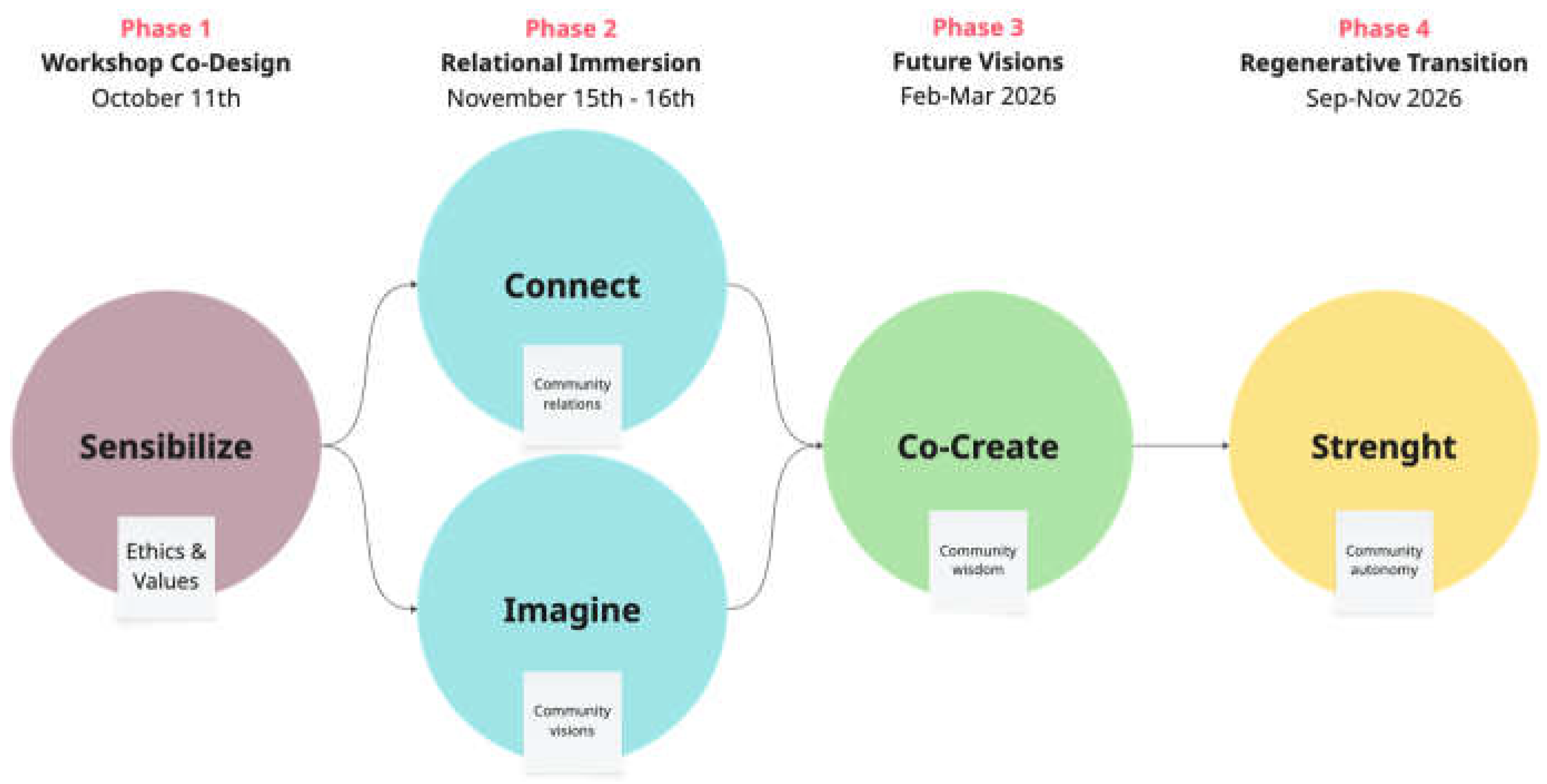
Figure 3.
Regenerative understanding of place Workflow diagram.
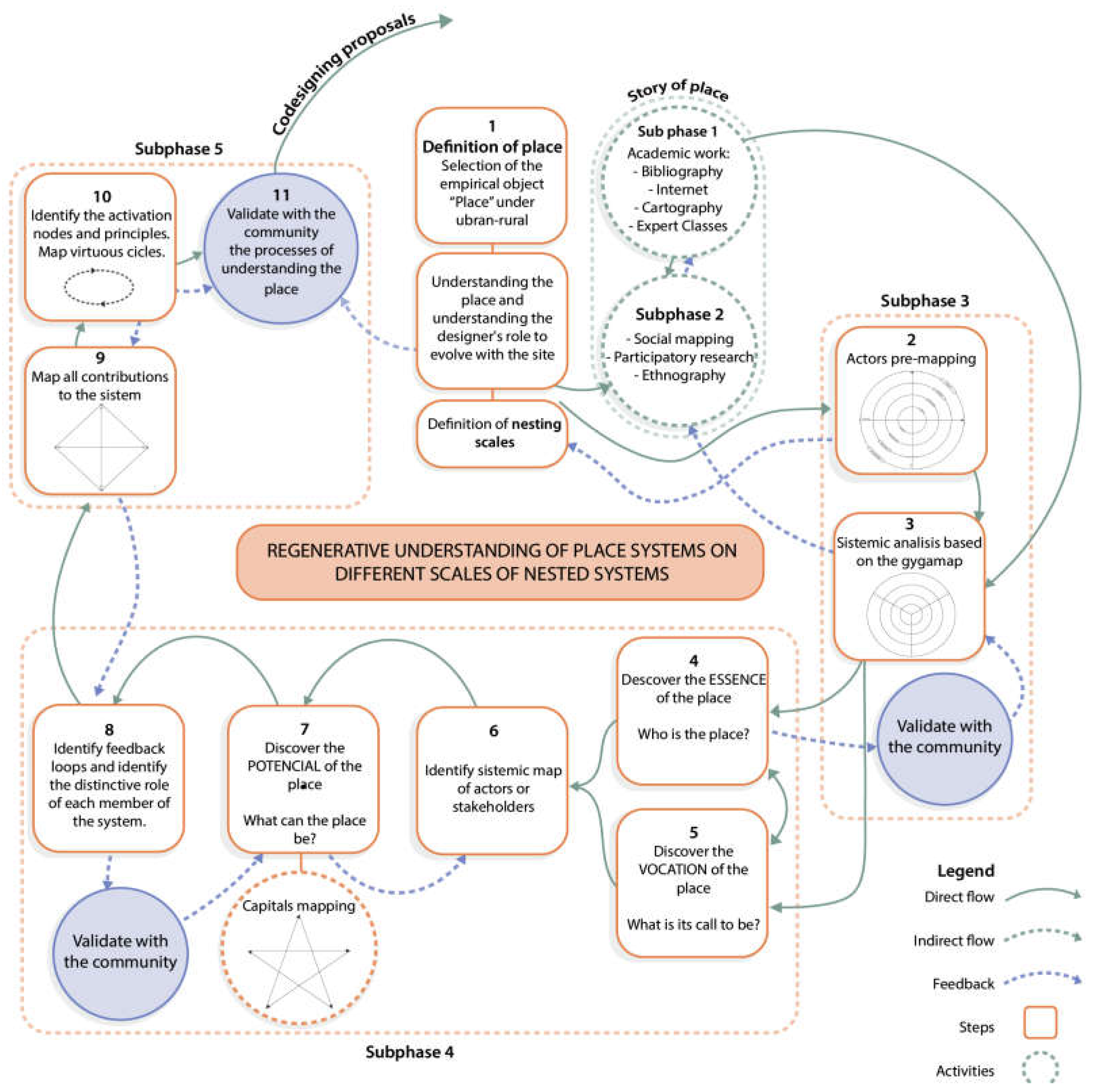
Disclaimer/Publisher’s Note: The statements, opinions and data contained in all publications are solely those of the individual author(s) and contributor(s) and not of MDPI and/or the editor(s). MDPI and/or the editor(s) disclaim responsibility for any injury to people or property resulting from any ideas, methods, instructions or products referred to in the content. |
© 2026 by the authors. Licensee MDPI, Basel, Switzerland. This article is an open access article distributed under the terms and conditions of the Creative Commons Attribution (CC BY) license.
Copyright: This open access article is published under a Creative Commons CC BY 4.0 license, which permit the free download, distribution, and reuse, provided that the author and preprint are cited in any reuse.


