

Submitted:
13 February 2026
Posted:
27 February 2026
You are already at the latest version
Abstract
Marine Spatial Planning (MSP) is recognized as an integrated, ecosystem-based approach towards promoting sustainable ocean. Its implementation is highly dependent on national governance arrangements, particularly in federal nations such as Malaysia, where constitutional authority over land, coastal, and marine resources is divided. To understand the constitutional framework of ocean governance in Malaysia, this paper assesses the feasibility of governance for MSP implementation by highlighting the application of MSP in Peninsular Malaysia, using Kuala Terengganu–Kuala Nerus, Terengganu, as a case study via content analysis for mapping the existing legal and institutional landscape of marine and coastal planning. As Malaysia governance divided into state and federal constitution, the implementation of MSP requires policies and institutional setup adapted from the Federal Constitution. The existing governance framework from a mature statutory spatial planning system under the Town and Country Planning Act 1976 (Act 172) is adequate for MSP implementation via applying the Local Plan adaptivity rather than creating new legal framework. However, this requires strong political will and effective harmonization between federal and state governments; success also hinges on legal reforms that resolve the federal–state divide by proposing PLANMalaysia and Local Planning Authorities as the competent authorities at the national and local levels.
Keywords:
marine spatial planning
; federal-state governance
; coastal management
; Malaysia
; ocean governance
1. Introduction
Marine Spatial Planning (MSP) has emerged internationally as a strategic planning approach designed to address spatial and temporal conflicts and environmental degradation in many coastal and marine regions [1]. Officially defined by IOC-UNESCO as “a public process of analysing and allocating the spatial and temporal distribution of human activities in marine areas to achieve ecological, economic and social objectives that usually specified through a political process” [2]. While MSP has gained significant benchmark in Europe and parts of Australia (the Great Barrier Reef Marine Park) [3], its progress in Southeast Asia remains uneven. Only 6 Southeast Asian country, Cambodia, Indonesia, Myanmar, the Philippines, Thailand and Vietnam were internationally acknowledged by the IOC-UNESCO’s MSPGlobal portal in the 2024. Regional leader, Indonesia has incorporated marine zoning plans into its legal framework through Coastal Areas and Small Islands (RZWP3K), mandating provincial marine spatial plans under national legislation [4]. Relatively MSP in Malaysia is at the early stages of implementation [5] with recent pilot project initiated in Kuala Terengganu-Kuala Nerus, Terengganu (KT-KN MSP) in 2022 which later represents as a reference point for this study.
As background, Malaysia is a maritime nation with a 4,675 km coastline, the 29th longest in the globe. Peninsular Malaysia coastline is 2,068 km with length of beaches is 3,853 km and a sandy beach length of 440.80 km [6]. As the home of most of the population and economic activities [7], the coastal zone faces intense and complex marine conflicts ranging from urban sprawl and land reclamation [8] pushing into critical mangrove and coral reef habitats [9]. The Department of Town and Country Planning or PLANMalaysia presented the proposed National MSP Framework in the 46th meeting of the National Physical Planning Council (NPPC) chaired by the Prime Minister on the 23rd of October 2024. The Council has agreed with the proposals for the needs of MSP to drive the implementation of the blue economy and national ocean governance [10]. Following that, the Thirteenth Malaysia Plan (13th MP) document stated Strategy A3.1: “Strengthening Blue Economy Ecosystem” and MSP development is identified as part of the supporting measures [11].
However, prior studies indicated that the failure of traditional single-sector management in Malaysia to resolve the land-sea interaction (LSI) conflicts necessitates the application of MSP [9,12,13,14]. Yatim et al. (2018) argued that the root cause of conflicts over area allocation is the absence of a comprehensive plan at marine spaces. In the same note, George (2016) [15] stated that the overlapping mandates and functions across government agencies regularly result in a silent’ governance gap within the marine environment. This relative lag does not necessarily indicate institutional weakness. Instead, it reflects the complexity of Malaysia’s federal–state governance structure, where land, coast, and natural resource governance is constitutionally decentralized. Any MSP framework that fails to recognize this reality risks rejection at the implementation stage.
This study aims to answer the core question: Does the existing governance framework enable MSP implementation in Peninsular Malaysia? The outcome of this study will identify whether the current existing legals, policies and institutional mechanisms are sufficient for MSP implementation. Our novelty contribution is the determination of sufficient governance and practical recommendations for the MSP application strategies. As limitation. this paper will focus on governance aspects in Peninsular Malaysia, State of Terengganu and within the KT-KN MSP and will not extensively discuss implementation issues on ground.
2. Materials and Methods
2.1. Content Analysis in Legal Review
Content analysis is a scientific approach utilized to investigate data obtained from various communication channels [16]. This study employs a rigorous qualitative content analysis (QCA) grounded in a legal review to diagnose the governance feasibility. Data collection involved a comprehensive review of the international law, Federal Constitutions, key federal and state legislations governing the land and sea use in Peninsular Malaysia and State of Terengganu as the pilot study area.
2.2. Thematic Analysis in Stakeholders’ Interview
Semi-structured interviews with key informants also conducted for trustworthiness of the study and the findings were organized through thematic analysis. This method offers a comprehensive, and refined representation of information [17] and suitable to explore potentially differing interpretations from participants [18]. Recurrent themes were extracted related to the are “legal”, “policies” and “institutions” for identifying governance feasibility.
The participants consisted of nine participants selected from relevant planning authorities and policies related to ocean governance. Purposive sampling was applied on participants, and this strategy is based on the ‘applicability’ concept based on their expertise in the study field [19]. Participants break down at the federal (n=4), state (n=2), local government (n=1), civil society (n=1) and representative from industry (n=1). The audio then transcribed in verbatim mode, and imported into computer added software, ATLAS.ti for analysis purposes. Data then grouped into conceptual categories and sub-themes. The Thematic Analysis Matrix (TAM) and thematic network [20] was prepared to serve as the qualitative decision tree to clearly show the interplay of governance factors.
3. Results
3.1. The Malaysian Environmental Governance Context
There are 183 Articles and 13 Schedules provided in the Federal Constitution of Malaysia, they are no mention of the word “environment”. It could be since environment covers a wide area, and the responsibilities were laid in all three lists: Federal, State and Concurrent List (the Ninth Schedule) [21]. This may indicate that both the federal and state governments are responsible, and entitled, for passing legislation based on their authority provided under the respective lists.
In his keynote address at the Judicial Colloquium 2022 on the theme “The Role of the Judiciary in Advancing Human Rights through the UN Guiding Principles on Business and Human Rights (UNGP) and the 2030 Agenda for Sustainable Development Goals (SDG)” on 31st March 2022 [22], the Right Honorable Tan Sri Dato’ Sri Azahar Mohamed, the Chief Judge of Malaya has proclaimed that in the absence of any explicit mention of “environment” as a specific subject in its legislative lists (Federal, State, or Concurrent), Article 5(1) on Right of Life is the main constitutional hook interpreted by courts to mean the right to a life of quality, which includes living in a pollution-free environment. Thus, environmental matters fall under shared jurisdiction, with states controlling land, forestry (mostly), and water, while the Federal Government handles broader issues like air pollution and environmental quality standards, necessitating coordination. The distributions of legislative powers in general are as in the following Table 1: -
3.2. Legal Framework
Malaysian coastal governance is characterized by an enduring division between federal and state jurisdiction, which governs all planning activities. Federal Acts e.g Fisheries Act 1985 (Act 317) [24], Environmental Quality Act 1974 (Act 127) [25] and the Territorial Sea Act 2012 (Act 750) [26] individually address specific sectors. Meanwhile, land-use decisions that directly impact the sea (e.g reclamation permits, Development Order (DO)) fall primarily under State authority via the Town and Country Planning Act 1976 (Act 172) [27]. This legislative fragmentation mandates sectoral management, creating a systemic barrier to the ecosystem-based characteristics of effective MSP. The application of MSP is thus not a technical challenge, but fundamentally a governance challenge.
Although there is a plethora of legislation when it comes to matters relating to the conflicting interests between the environment and sectoral human activities, this study found that only 3 main pieces of legislations namely the Town and Country Planning Act 1976 (Act 172) [27], the Local Government Act 1976 (Act 171) [28], and the National Land Code 1965 (Act 56) [29] are deemed relevant for MSP implementation. Thus, the analysis of this study will further examine the ecosystem within the Federal Constitution and these Acts provisions.
In contrast, East Malaysian States (Sabah and Sarawak) operate under distinct constitutional and legislative arrangement, with greater autonomy over land, forests, and natural resources compared to Peninsular Malaysia. State planning ordinances and land codes in Sabah and Sarawak further reinforce state control over coastal and marine- adjacent development as legislated under the Federal Constitution [30]. While this paper focuses primarily on the Peninsular Malaysia’s planning framework under Act 172 [27], the proposed MSP governance principles, particularly state-led planning, federal coordination, and non-statutory integration remain highly applicable to Sabah and Sarawak, subject to adaptation to their respective legal instruments. Content analysis for the legal and policies framework relevant to MSP Implementation in Peninsular Malaysia as Table 2: -
3.3. Policy Framework
Relevant national policies were also gathered including the Forth National Physical Plans (NPP-4) [31], the Second National Coastal Zone Physical Plan (NCZPP-2) [6], and for the case study, the Terengganu State Structure Plans [32], Kuala Terengganu and Kuala Nerus Local Plans [33,34] are listed as per following Table 3: -
3.4. Institutional Framework
There are several Ministries and departments with the role including but not limited to the environmental protection, planning, and ocean related governance. Based on the findings, there are three main institutions which are observed as potentially coordinated MSP implementation at multi-governance levels as follows: -
3.4.1. National Security Council, Prime Minister Department
The National Security Council, Prime Minister Department (NSC, PMD) is the national focal point for the United Nations Convention on the Law of the Sea (UNCLOS) [35] since Malaysia’s ratification in 1994. The Maritime Security and Sovereignty Division is a specific department within the NSC that is responsible for coordinating policies and actions related to safeguarding the nation’s maritime interests. The primary function of the division is summarized in Table 4: -
3.4.2. PLANMalaysia
The main administrative agency in spatial planning is the Department of Town and Country Planning (PLANMalaysia) which is placed under the Ministry of Housing and Local Government. PLANMalaysia is also the custodian of the Town and Country Planning Act 1976 (Act 172) [27], which is the law that provides on spatial planning. This agency also prepared the NPP-4 [31] and the NCZPP-2 [6] which MSP debuted under Thrust 2: Sustainable Ecological Assets and Ecosystem Services (AE). Under Strategy AE 1, MSP is placed as a core action to sustainably manage ocean and coastal usage for future generations by formulating and implementing MSP (Action 1.3). The implementation of MSP in Malaysia is proposed to be carried out across five regional zones in the map in Figure 1 which were strategically identified to facilitate comprehensive and integrated management of marine territories within the jurisdiction of the NCZPP-2 [6] as follows: -
The application is proposed across 5 regional zones as per Map 1 namely: (i) Zone 1: West Coast 1 (Perlis - Kedah Penang - Perak), (ii) Zone 2: West Coast 2 (Selangor - Negeri Sembilan - Malacca - West Johor), (iii) Zone 3: East Coast 1 (East Johor - Pahang), (iv) Zone 4: East Coast 2 (Terengganu - Kelantan), and (v) Federal Territory Labuan. Furthermore, PLANMalaysia functions across three levels of government, namely: federal, state and local governments to ensure the ideal use, development and conservation of land as divided in Table 5: -
Based on the key roles outlined in Table 5, PLANMalaysia’s functions are guided by four levels of plan. Aligning with the characteristics of area-based, MSP must be context-specific, drawing upon local conditions. Therefore, planning in the format of a Local Plan (LP) is deemed the most appropriate approach for the application and implementation of MSP.
3.4.3. State Authorities
The States in Peninsular Malaysia are basically subjected to the federal laws that were enacted under Article 76(1) of the Federal Constitution [30]. They govern water bodies within 3 NM. For the State of Terengganu and KT-KN districts, among the main actors to be considered for MSP implementation are in Table 6: -
Within the KT-KN districts, the KTCC is the respective LPA for that area, which responsible for LP amendment for MSP application. The failure to resolve the legal division between Federal and State authorities potentially creates a fundamental governance barrier. For instants, the State of Terengganu rejected the Federal government’s mandate to limit state jurisdiction to 3 NM is the most explicit example and opposing legal claims to resource authority and revenue.
3.5. Stakeholders Viewpoints
In a past study by Nazirah Abdullah et.al, 2016 [36], it was found that stakeholders in Peninsular Malaysia generally agree on the importance of marine governance but identify significant gaps in the existing frameworks across various sectors, including issues with transparency, coordination, stakeholder engagement, and regulatory enforcement. Taking cue from these past studies, this study embarks on getting the key stakeholders’ viewpoints on the existing governance framework particularly on the potentials of implementing MSP, the foreseeable implementation challenges as well proposed success strategies to address the raised issues, thus facilitating the effective implementation of MSP in Peninsular Malaysia. The data were analysis using ATLAS.Ti which depicted in the thematic network in the following Figure 2: -
Figure 2 presents a synthesis of the research findings, integrating results from both content analysis and semi-structured interviews. The blue-toned boxes on the left delineate the relevant documents for the implementation of MSP in Peninsular Malaysia. These are followed by blue segments identifying the specific provisions within the legislative and policy frameworks, including UNCLOS, the Federal Constitution, the Town and Country Planning Act 1976 (Act 172) [27], and the National Physical Plan (NPP) [31]. Collectively, these elements constitute the “part of” existing governance for MSP implementation in the region.
The green-toned boxes illustrate inputs from nine research participants who collectively affirmed the “adequacy of the existing governance framework,” a concept fundamentally “is associated with” with the current governance structure. Furthermore, the participants highlighted critical challenges facing MSP implementation in Peninsular Malaysia, serving as “a push factor for” its formal adoption: specifically, vertical fragmentation (Federal versus State Authority) and horizontal fragmentation (sectoral divisions). Ultimately, the “proposed success strategies” emphasize “political will” as a driver for institutional reform, aligning with the definition of MSP [2], where success is primarily predicated upon a political approach.
PLANMalaysia as a “competent authority” also supported by the participants insights as they highlighted the Town and Country Planning Act 1976 (Act 172) [27] is the main legal for MSP application, supported by the Act 171 [28] and other relevant acts. Participants also emphasized that any attempt to formulate new legislation is impractical. Consequently, it is more advisable that efforts be directed towards confronting immediate challenges such as climate change.
Since marine affairs have been neglected for an extended period, they also recommended nominating an agency responsible for coordinating the national ocean governance. Given these considerations, the National Security Council, Prime Minister Department (NSC, PMD) may be the most appropriate body to fulfil this function grounded by its institutional capacity as the national focal point for UNCLOS and has a dedicated “Maritime Security and Sovereignty Division”.
As the definition posits that MSP is typically achieved through a political process, political will is deemed required as success strategy for institutional reform in terms of allocation of resources, human capital, and the country’s MSP goal.
3.6. Proposed Governance Framework
Figure 3 presents the summary of proposed governance framework for the MSP implementation in Peninsular Malaysia. The framework illustrates the integration of constitutional foundations, statutory planning mechanisms, policy instruments, MSP specific governance arrangements, and adaptive implementation processes as follows: -
The proposed governance structure for MSP in Peninsular Malaysia as depicted in Figure 3 is anchored in the Federal Constitution, which establishes the division of power between the Federal and State Governments. This constitutional foundation recognized the central role of state government in land, coastal, and natural resources management, while enabling federal coordination on matters of national agenda. MSP is therefore framed not as a new regulatory regime, but as a nested, integrated planning approach that operates within existing constitutional and legal frameworks.
Building upon this foundation, the framework consolidates relevant environmental and planning legislation, including the Town and Country Planning Act 1976 (Act 172) [27], the Local Government Act 1976 (Act 171) [28], the National Land Code 1965 (Act 56) [29], sectoral laws, and state enactments. Act 172 functions as dominant legal, providing established planning institutions and processes, such as the National Physical Planning Council, State Planning Committees, and Local Planning authorities, that can be adapted to support MSP objectives. The flexibility provided within the Act allows spatial planning instruments to respond to evolving land-sea interactions without requiring new legislation.
At the policy and institutional level, NPP-4 [31]and NCZPP-2 [6] provide strategic based for land-sea spatial policy integration, aligning national development priorities with coastal and marine considerations. Ocean governance coordination is strengthened through the National Security Council under the Prime Minister’s Department (NSC, PMD), while PLANMalaysia (Federal) is positioned as the competent authority for MSP, which is responsible for technical guidance, coordination, and policy coherence. This arrangement ensures that MSP is aligned with national spatial planning objectives while remaining sensitive to sectoral mandates. This will harmonize the vertical and horizontal fragmentation through the betterment of ocean governance institutional reform.
Implementation is nested at the state and local levels, where PLANMalaysia (State), State Planning Committees, and relevant state and sectoral agencies translate national policy direction into State Structure Plans and sector-specific actions. Local Planning Authorities, the Kuala Terengganu City Council (KTCC), which governs the Kuala Terengganu and Kuala Nerus districts, play a critical operational role by integrating MSP considerations into local plans, development control, and on the ground, decision making, such as zoning identification. Importantly, the framework incorporates bottom-up feedback mechanisms, enabling local implementation experiences and stakeholder inputs to inform higher-level planning and adaptive policy refinement.
4. Discussion
For MSP application, the “town and country planning” stated in the Ninth Schedule of the Federal Constitution [30] aspect observed as dominant area and although state and municipal councils are mainly custodians of the local environment, federal intervention is required for specific sectors. The responsibility needs to be divided carefully and fairly to avoid future accusation on intruding other parties’ rights. On the contrary, the Federal government has responsibility in integrating and regulating environmental standards among the States for effective monitoring and enforcement purposes. Nonetheless, the acceptance of the standard is solely dependence on the State Government.
4.1. Legal Perspective
From the legal perspective, analysis from desktop study and interviews have confirmed that the current legal framework is sufficient to kick start the MSP initiative in Peninsular Malaysia. Guided by the country’s coastal state’s sovereign rights and duties under the UNCLOS, MSP could be implemented in Peninsular Malaysia by developing a distinct local plan for the selected marine area or alternatively, as a special area plan under Section 16B (1)(2) and (3) of Act 172. Nevertheless, a new law specifically giving effect to MSP and its implementation, including imposing fee for marine space use, must be enacted.
4.2. Policy Perspective
From the policy perspective, analysis from desktop study and interviews have also discovered that they are sufficient to embark on MSP implementation in Peninsular Malaysia. The NPP-4 [31] and NCZPP-2 [6], as current national development planning documents, have provided a strong foundation for incorporating MSP in the physical planning aspects of the country’s coastal and marine areas in the future. Nonetheless, a national MSP Document is necessary to chart and steer the course of MSP implementation for Malaysia.
4.3. Institutional Perspective
From an administrative or institutional perspective, analysis from desktop study and interviews have also found that existing governance framework is inadequate for MSP implementation to the full extent. Nevertheless, for the time being, to kickstart MSP implementation in Peninsular Malaysia, PLANMalaysia is the most suitable government agency based on it functions at all 3 governance levels - federal, state and local. For MSP to be effectively implemented, there must be an agency in place to manage and coordinate maritime affairs holistically. As discussed above, despite being entrusted with the power to enforce UNCLOS as the national focal point, National Security Council under the Prime Minister’s Department (NSC, PMD) do not have jurisdiction beyond maritime sovereignty and security. The other maritime interests like management of marine natural resources, shipping etc., were entrusted to other ministries in sectoral mandate.
4.4. Thematic Analysis Matrix (TAM) Summary
The discussion subsequently proceeded based on the thematic analysis conducted with key stakeholders on the existing governance framework. The thematic analysis was conducted from verbatim-transcribed interview data utilizing Zairul’s Thematic Analysis Method (TAM), leading to the discussions on the key stakeholders’ viewpoints particularly on the potentials of implementing MSP in Peninsular Malaysia the foreseeable implementation challenges as well proposed success strategies to address the raised issues, thus facilitating the effective implementation of MSP. To clarity, the above discussion is as follows: -
4.4.1. Potentials of Implementing MSP
In acknowledging the urgency and potentials to apply MSP in Peninsular Malaysia, there were two emerging themes deduced from the interviews with the key stakeholders namely: -
- i.
- MSP’s Implementation Leverages on Existing Framework: Existing governance structures provide the fundamental framework for MSP, with necessary addition of a new law to give effect to MSP, a national MSP document, and a dedicated agency for managing and coordinating maritime affairs that should incorporate MSP. MSP implementation should leverage on these existing frameworks to narrow legal gaps within national waters and must be consistent with the principles outlined in the UNCLOS.
- ii.
- Effective Planning Leverages on Integration: Effective planning depends on integrating comprehensive data with extensive stakeholder consultation to foster a complementary ecosystem for marine environment management, aligning with national economic visions and identifying potential areas for collaboration.
To support this, participants also highlighted the importance of inter-agency coordination. Considering that this MSP initiative is new, participants also proposed that it be implemented on a broad scale encompassing the entire expanse of the national jurisdiction until EEZ limit. Besides that, stakeholders from multi-sectors like government departments and academic institutions also showed their willingness to support the proposed MSP initiative. The participants also emphasized Malaysia’s aspiration as a maritime nation and the need to ensure orderly ocean governance practice.
4.4.2. Foreseeable Implementation Challenges Hindering Successful MSP Implementation in Peninsular Malaysia.
The participants’ concerns on the expected challenges in implementing MSP in Peninsular Malaysia was streamlined into 2 emerging themes namely: -
- i.
- MSP Implementation Impeded by Governance Deficiencies: Key barriers identified are the absence of national ocean policy and a lead agency for marines. These, coupled with pervasive legislative and institutional fragmentation hinder cohesive approach to ocean management.
- ii.
- Significant Institutional and Political Challenges: The lack of awareness and understanding of the MSP concept, difficulties in inter-agency collaboration and leadership, and deep-seated jurisdiction overlapping between federal and state governments over resource control and territorial rights, all of which are critical to enabling sustainable resource and waste management.
Although the existing governance framework is sufficient to kick start the initiative, the absence of a national ocean policy and coordinating agency complicates planning process. This is due to the lack of clear authoritative grounds for the assignment of tasks to the involved government agencies, resulting in a fragmented situation. Another matter reported by the participants was the lack of understanding and awareness among the respective stakeholders. A clear understanding is necessary to ensure that the planned initiative is well received and gains ownership and accountability from all parties. Furthermore, disputes between Federal and State jurisdictions were also highlighted by the participants, such as the acceptance of the Territorial Sea Act 2012 (Act 750) and the division of benefit-sharing revenue if MSP is implemented.
4.4.3. Proposed Success Strategies for Successful Implementation of MSP in Peninsular Malaysia.
To address the above challenges to implement MSP in Peninsular Malaysia, the key stakeholders had also proposed several strategies that was summarized into the following 2 emerging themes: -
- i.
- Governance reform and political will: The need for political will for the implementation of MSP, which necessitates restructuring the governance framework to integrate the activities of all relevant Federal and State agencies. This will ultimately unify marine policies and its implementation.
- ii.
- Inclusive, collaborative, and strategic implementation: A fundamental shift from a top-down to a more inclusive model is necessary to ensure impactful participation and functions as a collaborative tool to build trust and mutual agreement among all stakeholders.
It was proposed that Malaysia should imitate proven successful models, obtain political influence, and execute pilot projects to gain data evidence. Participants also proposed the establishment of a dedicated agency for MSP and securing active engagement from stakeholders. In a broader perspective, participants also recommended that priority be given to the nation’s marine sovereignty and security and collaboration with Southeast Asian neighbors in technical exchange.
5. Conclusions
Overall, these present findings highlight the constitutional framework of Malaysia governance and its potential in implementation of MSP. As the country have two different authorities, understanding its existing governance is crucial to ensure adaptability on new governance framework on ocean governance as the country need integrated ocean policies which need to be coordinated between federal and state. It is concluded that the existing governance framework in Malaysia: the policy, legal and institutions are adequate in enabling possible implementation of MSP in Peninsular Malaysia through leveraging the Act 172 and other supporting acts. Based on MSP design in Kuala Terengganu-Kuala Nerus, this study recommended that the most effective strategy for MSP application in Peninsular Malaysia is the nested-approach with a top-down and bottom-up approach with “ocean governance coordinator” and “competent authority”. Sectorial alignment should be harmonised where National Security Council under Prime Minister Department can act as “ocean governance coordinator” to unify relevant sectoral planning. Agencies such as PLANMalaysia and Local Planning Authorities can function as “competent authority” and are suggested to be the driver for MSP implementation in Peninsular Malaysia because both agencies are the mature statutory bodies in land spatial planning as indicated in the Act 172. Political will is important to ensure MSP implementation. It is believed that these measures are relevant only with the political will to increase public sector efficiency as outlines in the Public Service Reform Agenda (PSRA) [37]. As the implementation of MSP must follow ‘area-based’ criteria, future studies shall focus on other governance framework from other states in Peninsular Malaysia as well as Sabah and Sarawak to ensure adaptability and feasibility within specific local content.
Author Contributions
For research articles with several authors, a short paragraph specifying their individual contributions must be provided. The following statements should be used Conceptualization, Husni Alhan Md Salimun, Xiong-Zhi Xue and Nazli Aziz; methodology, Husni Alhan Md Salimun, Nazli Aziz and Wan Izatul Asma Wan Talaat; software, Mohd Safuan Che Din; validation, Nazli Aziz and Wan Izatul Asma Wan Talaat; formal analysis, Husni Alhan Md Salimun and M. Fikri Mohamad; investigation, Husni Alhan Md Salimun; resources, Husni Alhan Md Salimun and M. Fikri Mohamad; data curation, Husni Alhan Md Salimun; writing-original draft preparation, Husni Alhan Md Salimun; writing-review and editing, Husni Alhan Md Salimun, Nazli Aziz, and Wan Izatul Asma Wan Talaat; visualization, Husni Alhan Md Salimun; supervision, Nazli Aziz, Wan Izatul Asma Wan Talaat, Mohd Fadzil Mohd Akhir, and Mohd Safuan Che Din; project administration, Wan Izatul Asma Wan Talaat, Xiong-Zhi Xue and Husni Alhan Md Salimun; funding acquisition, Mohd Fadzil Mohd Akhir. All authors have read and agreed to the published version of the manuscript.
Funding
This research was funded by the Higher Institution Centre of Excellence (HICoE) research grant (Vote no. 56061) awarded to the Institute of Oceanography and Environment, Universiti Malaysia Terengganu by Ministry of Higher Education Malaysia. and “The APC was funded by Vote no. 56061 as well.
Data Availability Statement
The data presented in this study are available on request from the corresponding author due to legal and privacy reasons.
Acknowledgments
“The authors have reviewed and edited the output and take full responsibility for the content of this publication.”.
Conflicts of Interest
The authors declare no conflicts of interest. The funders had no role in the design of the study; in the collection, analyses, or interpretation of data; in the writing of the manuscript; or in the decision to publish the results.
Abbreviations
The following abbreviations are used in this manuscript:
| MSP | Marine Spatial Planning |
| IOC-UNESCO | The Intergovernmental Oceanographic Commission IOC of United Nations Educational, Scientific and Cultural Organization |
| LPA | Local Planning Authorities |
| LA | Local Authorities |
| LP | Local Plan |
| NSC, PMD | National Security Council, Prime Minister Department |
| PLANMalaysia | The Department of Town and Country Planning Malaysia |
| SEPU | State Economic Planning Unit |
| KTCC | Kuala Terengganu City Council |
| LAUT | Terengganu Water Resources Board |
| SLMO | State Land and Mineral Office |
References
- Flannery, W.; Healy, N.; Luna, M.; Reimer, J.M.; Devillers, R.; Trouillet, B.; Ban, N.C.; Agardy, T.; Claudet, J.; Moodie, J.R.; et al. Spatial Planning and Sustainable Development. Mar. Policy 2022, 50, 1–14. [Google Scholar] [CrossRef]
- Ehler, C.; Douvere, F. Marine Spatial Planning: A Step-by-Step Approach toward Ecosystem-Based Management. 2009, Vol. No. 53. [Google Scholar]
- Ehler, C.N. Two Decades of Progress in Marine Spatial Planning. Mar. Policy 2021, 132, 104134. [Google Scholar] [CrossRef]
- Hardiana, A.; Nurdin, N.; Adhawati, S.S. Socio and Spatial Economic of Kappaphycus Alvarezii Cultivation in South Sulawesi, Indonesia. Egypt. J. Aquat. Biol. Fish. 2024, 28, 611–625. [Google Scholar] [CrossRef]
- Ma, C.; Zhao, J.; Qiao, Y.; Meng, J.; Zhang, Z.; Wen, T. Accelerating Marine Spatial Planning in the Western Pacific Region: Current Status and Future Directions. Ocean Coast. Manag. 2025, 262, 107552. [Google Scholar] [CrossRef]
- PLANMalaysia Ringkasan Eksekutif Rancangan Fizikal Zon Persisiran Pantai Negara (RFZPPN). 2022.
- Talaat, W.I.A.W.; Ghazali, F.; Kaur, C.R.; Aziz, N. Conceptualising Marine Spatial Planning for Coastal Development in Terengganu; 2019. [Google Scholar]
- Aziz, N.; Muhammad, Z.; Ghazali, F.; Talaat, W.I.A.W.; Saputra, J. Marine Spatial Planning: The Way Forward for Sustainable Development of Central Terengganu, Malaysia. J. Southwest Jiaotong Univ. 2019, 54. [Google Scholar] [CrossRef]
- Safuan, C.D.M.; Talaat, W.I.A.W.; Aziz, N.; Jeofry, H.; Lai, R.K.; Khyril-Syahrizan, H.; Afiq-Firdaus, A.M.; Faiz, A.M.; Arbaeen, M.J.N.; Lua, W.Y.; et al. Assessment of Coral Health Status Using Two-Dimensional Coral Health Index (2D-CHI): A Preliminary Study in Pulau Perhentian Marine Park, Malaysia. Reg. Stud. Mar. Sci. 2022, 55, 102543. [Google Scholar] [CrossRef]
- UKK KPKT Siaran Media Mesyuarat Majlis Perancang Fizikal Negara Ke-46 Bil. 3/2024. 2024.
- Ministry of Economy Thirteenth Malaysia Plan; Kuala Lumpur, Malaysia, 2025.
- Aziz, N.; Yien Lua, W.; Ghazali, F.; Abd. Rasid, N.H.; Idris, I.; Wan Talaat, W.I.A. Marine Spatial Planning and the Local Community’s Awareness of Ecosystem in Setiu Wetland. J. Southeast Asian Stud. 2021, 26, 97–123. [Google Scholar] [CrossRef]
- Razak, F.; Lua, W.Y.; Abd Rasid, N.H.; Aziz, N.; Repin, I.M.; Xue, X.Z.; Muhammad Ashraf, A.R.; Bachok, Z.; Afiq-Firdaus, A.; Asma Wan Talaat, W.I.; et al. Adopting Marine Spatial Planning (MSP) Using Coral Health Assessment as Indicator: A Case Study in Pulau Redang Marine Park, Malaysia. Ocean Coast. Manag. 2024, 248, 106943. [Google Scholar] [CrossRef]
- Yatim, M.H.M.; Omar, A.H.; Abdullah, N.M.; Sarip, A. Extending the Concept of Institutional Analysis to the Marine Spatial Planning Practice. In Proceedings of the IOP Conference Series: Earth and Environmental Science, August 1 2018; Institute of Physics Publishing; Vol. 169. [Google Scholar]
- George, M.; Sabaruddin, J.S.H.; Chong, V.C. Marine Spatial Planning: What Does It Have to Offer Malaysia? 2016; Vol. 31, ISBN 1571808512341. [Google Scholar]
- Crano, W.D.; Lac, A. Content Analysis. Encycl. Adolesence 2023, 20, 38. [Google Scholar] [CrossRef]
- Parissopoulos, S.; Timmins, F.; Mpouzika, M.; Mantzorou, M.; Kapadochos, T.; Papagaroufali, E. Intensive Care Nurses’ Experience of Caring in Greece; A Qualitative Study. Healthc. Switz. 2023, 11. [Google Scholar] [CrossRef] [PubMed]
- Christou, P.A. How to Use Thematic Analysis in Qualitative Research. J. Qual. Res. Tour. 2023. [Google Scholar] [CrossRef]
- Rabiee, F. Focus-Group Interview and Data Analysis. Proc. Nutr. Soc. 2004, 63, 655–660. [Google Scholar] [CrossRef] [PubMed]
- Zairul, M. Ilustrasi Ringkas Analisa Tematik (AT) Menggunakan Perisian ATLAS.Ti 8, 1st Ed. ed; UPM Press., 2021. [Google Scholar]
- Wan Talaat, W.I.A. Ocean GovernanceBridging the Gaps, Connecting the Dots; Penerbit Universiti Malaysia Terengganu: Kuala Nerus, 2024; ISBN 978-629-7625-36-2. [Google Scholar]
- OCRFCM, Keynote Address By The Right Hon. Tan Sri Dato’ Sri Azahar Bin Mohamed Chief Judge of Malaya at the Judicial Colloquium 2022 On the Theme “The Role of the Judiciary in Advancing Human Rights Through The UN Guiding Principles on Business and Human Rights 31 March 2022 (2022. 2.
- Rahman, M.A.A.; Ghazali, F.; Rusli, M.H.M.; Aziz, N.; Talaat, W.I.A.W. Marine Protected Areas in Peninsular Malaysia: Shifting from Political Process to Co-Management. J. Polit. Law 2019, 12, 22. [Google Scholar] [CrossRef]
- AGC, M.; Commissioner, T.H.E.; Law, O.F.; With, I.N.C.; Nasional, P. Act 317 Fisheries Act 1985; 2006.
- Department of Environment Malaysia Environmental Act Quality 1974. Environ. Qual. Act 1974 1974, Act 127, 57–57.
- AGC Act 750 Territorial Sea Act 2012. 2012; 5–6.
- Kerajaan Malaysia Akta Perancangan Bandar Dan Desa 1976 (Akta 172) Pindaan; 2010; pp. 1–68.
- Kerajaan Malaysia Akta Kerajaan Tempatan 1976 (Akta 171); 1976; pp. 89–89.
- AGC National Land Code (Act 56 of 1965). 1965.
- Malaysian Government Federal Constitution (Amendment) 2019. 2020.
- Rancangan Fizikal Negara; Keempat, PLANMalaysia. 2021.
- PLANMalaysia Terengganu, Rancangan Struktur Negeri Terengganu 2050. 2022; 1–14.
- PLANMalaysia Terengganu, Rancangan Tempatan Daerah Kuala Nerus 2035 (Pengubahan 1). 2023.
- PLANMalaysia Terengganu, Rancangan Tempatan Daerah Kuala Terengganu 2035 (Pengubahan 1). 2023.
- United Nations, L. United Nations Convention on the Law of the Sea 1982. 1982. [Google Scholar]
- Nazirah Mohamad Abdullah, Abdullah Hisam Omar, O.Y. Today’s Problem, Tomorrow’s Solutions: Lay Theory Explanations of Marine Space Stakeholder Management in the Malaysian Context. Mar. Policy 2016, 73, 162–171. [Google Scholar] [CrossRef]
- NST ILTIZAM Circular, I-PPA Launched to Strengthen Performance-Based Governance. 2025, 2025.
Figure 1.
Proposed Implementation of MSP at Five Key Regional Zones. Source: The NCZPP-2 [6] Document (PLANMalaysia, 2022).
Figure 1.
Proposed Implementation of MSP at Five Key Regional Zones. Source: The NCZPP-2 [6] Document (PLANMalaysia, 2022).
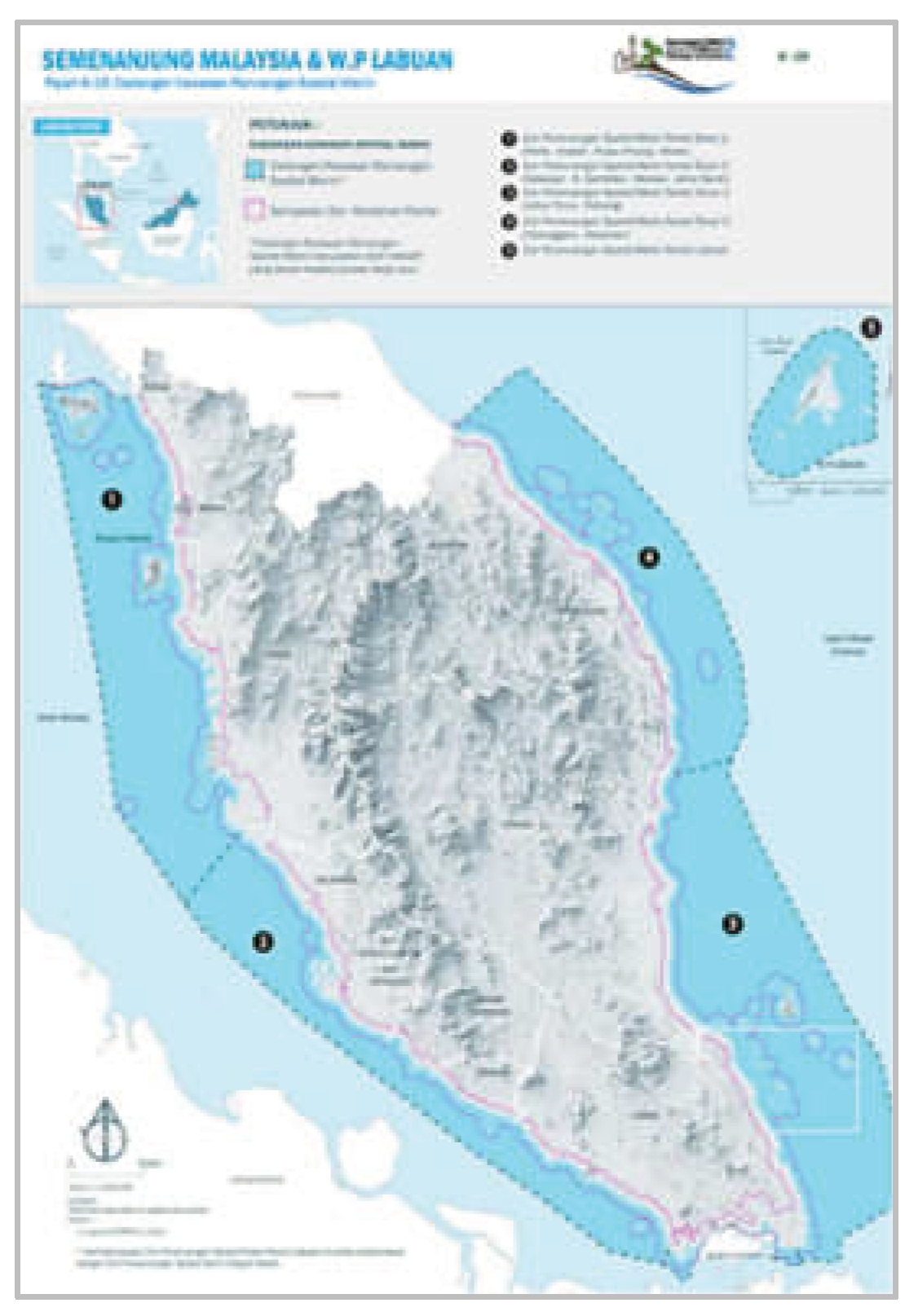
Figure 2.
The Thematic Network of Key Stakeholders Interview Findings.
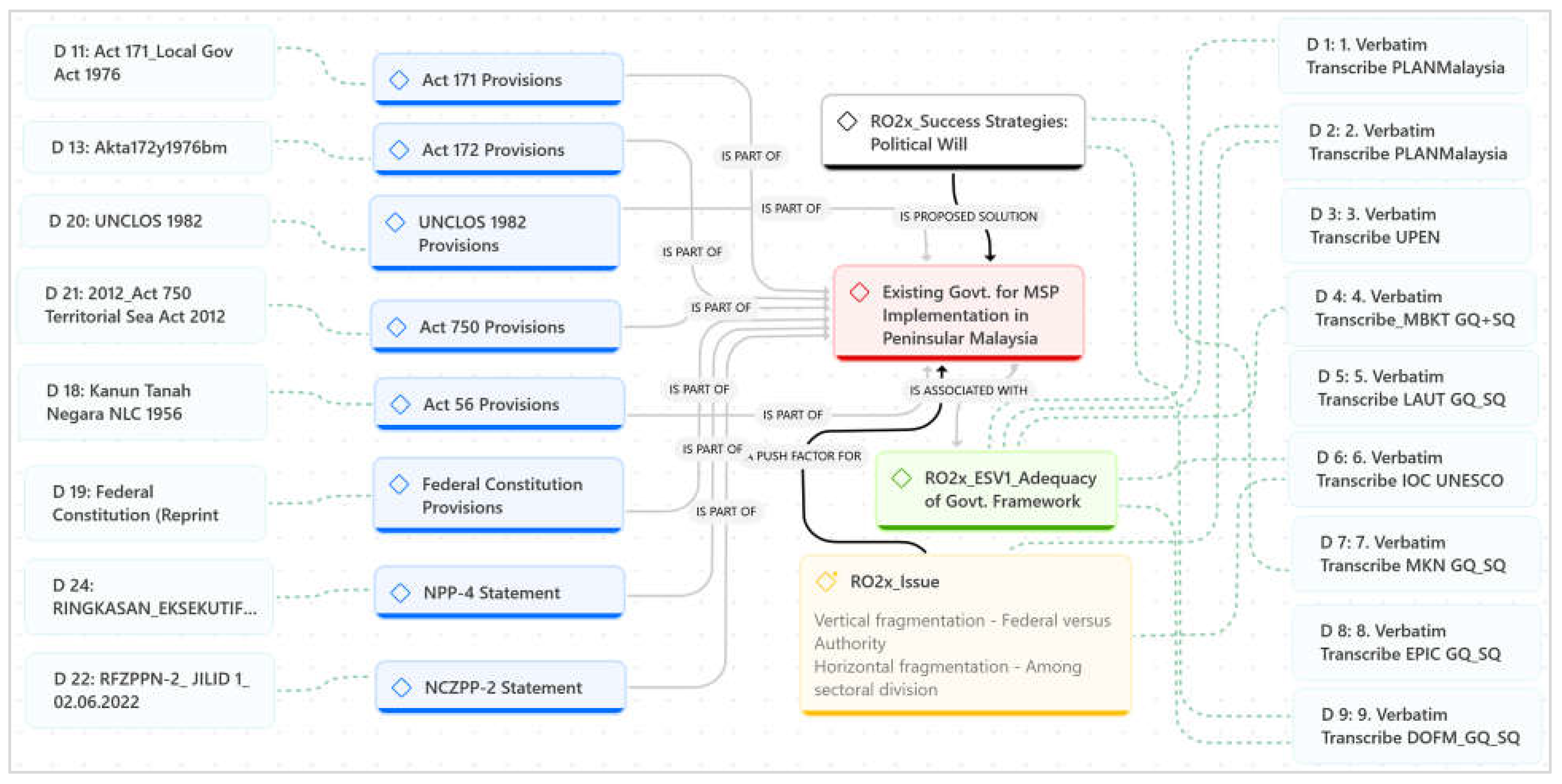
Figure 3.
Proposed Governance Framework for MSP in Peninsular Malaysia for KT-KN MSP.
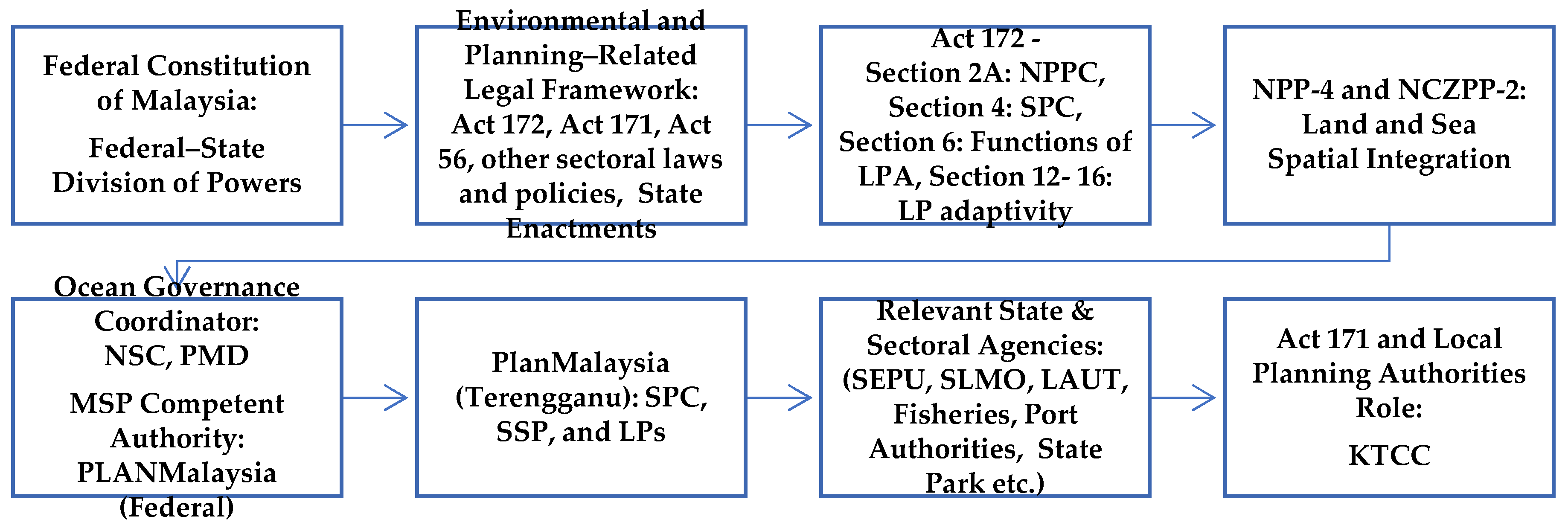

Table 1.
The Distribution of Powers under the Ninth Schedule of the Federal Constitution of Malaysia.
Table 1.
The Distribution of Powers under the Ninth Schedule of the Federal Constitution of Malaysia.
| Federal | State | Local |
|---|---|---|
| Mineral Resources | Land | Wildlife |
| Marine and estuarine fisheries | Agriculture | Town and country planning |
| Pest Control | Forestry | National parks |
| Shipping and navigation | Infrastructure activities for state works | Rehabilitation |
| Water supplies | Water | Eroded and mined land |
| Tourism | Riverine fisheries | Drainage |
| Infrastructure activities for federal works | - | Irrigation |
| - | - | Housing |
Source: Federal Constitutions of Malaysia and adopted from Rahman (2019) [23].
Table 2.
Legal and Framework Relevant to MSP Implementation in Peninsular Malaysia.
| Legals | Key Provision(s) | Relevance to MSP | Governance Gaps/ Challenges |
|---|---|---|---|
| Federal Constitution [30]: The highest national rank legal document defines the right and responsibilities of federal and state governments as well as their interrelationship |
Article 74: Subject matter of federal and State laws & The Ninth Schedule of the Federal Constitution |
Federal-State Concurrent List: The “town and country planning” aspect observed as dominant area for MSP implementation. |
Although state and municipal councils are mainly custodians of the local environment, federal intervention is required for specific sectors. Coastal resource management in Peninsular Malaysia is fragmented across multiple levels of government [30], which found that sector-driven and spatially disconnected. |
| Article 76: Power of Parliament to legislate for States in certain cases |
Parliament is allowed to make laws on matters under the State List in certain limited cases, such as for the purposes of implementing an international treaty by Malaysia or for the creation of uniform State Laws. |
Ratification by the State Legislation is required for such law to be effective in a State. |
|
| Article 77: Residual power of legislation |
State governments have the residual power to make laws on any matter not listed in any of the 3 lists in the Ninth Schedule as long as not the matter under Parliament’s power. |
Potential federal-state conflict if MSP is perceived as Federal owned initiative. |
|
| Article 83: Acquisition of land for federal purposes |
Compulsory acquisition and title registration along with local government matters |
Ironically, State governments seem to have wider authority in managing environment due to their rights on the natural resources. |
|
| The Town and Country Planning Act 1976 (Act 172) [27] |
Section 2A: National Physical Planning Council |
Determination of MSP direction in future national plan. |
Integrated with national development plan and resources. |
| Section 4: The State Planning Committee and its functions. | Implementation of MSP on ground with coordination between state and local stakeholders. |
Stakeholders’ acceptance Towards MSP formulation. |
|
| Section 6: Functions of local planning authorities (LPA). |
LPA has responsibilities encompass the regulation, management, and strategic planning of the development and utilization of all lands and buildings within its designated jurisdiction. |
Limited explicit reference to marine areas, which application to offshore water required policy interpretation. |
|
| Section 12 - Section 16: Preparation, alteration, revocation and replacement of local plans (LP). |
Integration of MSP into LP adaptivity through land and sea interface planning. |
The failure to resolve the legal division between Federal and State authorities potentially create a fundamental governance barrier. |
|
| The Local Government Act 1976 (Act 171) [28] |
Powers of local authorities over development control, planning, and enforcement. |
Enables LPA to operationalize identification of MSP zoning and controls. |
Jurisdictional limits beyond local boundaries and uneven technical capacity among LPAs. |
| National Land Code 1965 (Act 56) [29] |
Section 5: State authority over land administration, tenure, and natural resources. |
Supports MSP linkage to coastal land use, reclamation control, and development approvals. |
Does not address marine spatial conflicts or cumulative impacts explicitly. |
Table 3.
Policies Framework Relevant to MSP Implementation in Peninsular Malaysia.
| Policies | Key Provision(s) | Relevance to MSP | Governance Gaps/Challenges |
|---|---|---|---|
| The Forth National Physical Plan (NPP-4) [31] |
National spatial policy direction guiding the State Structure Plans (SSPs) and LPs provided from Section 6B of Act 172. |
Strategic platform for embedding MSP principles and land–sea integration at national level. Action KD1.5 C: Comprehensive development of coastal land uses. |
Clear policy instrument, however limited enforceability on ground. |
| The Second National Coastal Zone Physical Plan (NCZPP-2) [6] |
Spatial guidance for coastal development, conservation, and hazard management. |
Provides baseline spatial framework for coastal–marine interface planning. AE1: Strengthen conservation of Spatial Planning by formulating and implementing MSP (Action 1.3). |
Focus largely on terrestrial coastal zone however limited coverage of marine waters. |
| State Structure Plan (SSP) - The Terengganu State Structure Plan 2050 [32] |
Written statement explaining the policies and proposals for land use and development in a state which is prepared based on the provisions of Section 8 of Act 172. |
Plays a vital role in realizing goals and policies set in the NPP and other policies to be implemented at the State level in diagrams, illustrations, Plans or materials that can explain the recommendations made. |
To suit MSP zoning Identification in line with the plan. |
| Local Plan (LP) - The Kuala Terengganu LP 2035 [34] The Kuala Nerus LP 2035 [33] |
Interpret the policies and general proposal contained in the SSP to a more detailed at the local or district level, such as determined by the SPC. LP is provided for the areas identified in the Local Planning Authority (LPA). |
In line with the area-based characteristic, LP is deemed suitable through its adaptivity for MSP formulation. |
Determination of marine area zoning, its functions and gazette as supplementary area under existing LP. |
| Multiple Sectoral Marine Acts and Policies (fisheries, ports, shipping, energy, environment, biodiversity etc.) |
Sector-specific mandates, zoning, and regulatory frameworks. |
Potentially provide sectoral input into MSP zoning and allocation processes. |
Highly fragmented which led to lack spatial integration across sectors. |
Table 4.
Functions of The Maritime Security and Sovereignty Division, of NSC, PMD.
| Functions | Details |
|---|---|
| Policy Coordination | Developing and coordinating national policies related to maritime security and the protection of sovereign territory. |
| Agency Collaboration | Ensuring comprehensive security measures by facilitating collaboration between various civil and military agencies, such as the Royal Malaysian Navy (RMN) and the Malaysian Maritime Enforcement Agency (MMEA). |
| Addressing Threats | Formulating strategies to counter a wide range of threats, including boundary disputes, foreign encroachment, illegal fishing, transnational organized crime, piracy, and terrorism. |
| Managing Choke Points | Ensuring the control and security of critical sea lanes and port entry points, such as the Straits of Malacca and Singapore. |
| International Cooperation |
Engaging in diplomatic and legal measures, including adherence to the UNCLOS, and participating in regional cooperation forums to manage shared maritime concerns. |
Source: Official NSC, PMD Websites and Authors Analysis.
Table 5.
Main Functions of PLANMalaysia according to the Levels of Government.
| Federal | State | Local |
|---|---|---|
| Responsible for advising the Federal Government on all matters related to the town and country planning. |
Responsible for advising the State Government on all matters related to the town and country planning in coordinating the implementation of Act 172 [27] at the State level. |
Responsible for planning, coordinating and controlling the use and development of land and buildings in the Local Planning Authorities’ (LPA) areas. |
| Responsible for acting as the Secretariat to the NPPC formed under the Town and Country Planning Act 1976 (Act 172) [27]. | Responsible for acting as the State Planning Committees (SPC) formed under the Town and Country Planning Act 1976 (Act 172) [27]. | Responsible for facilitating and monitoring development within the LPA area through the implementation and regulation of development plans. |
Source: Adopted from PLANMalaysia’s Official Websites.
Table 6.
Among State Institutional Actors Relevant to KT-KN MSP Implementation.
| Authorities | Among Functions/Role |
|---|---|
| State Economic Planning (SEPU) | State-level development planning and control state budgets. |
| State Land and Mines Office (SLMO) | Manage all state land, including approval for land reclamation project. (NLC 1965 Act 56) [29]. |
| Local Planning Authorities (LPA): Kuala Terengganu City Council (KTCC) |
Managing local land use and issues Development Order (DO). |
| Terengganu Water Resources Board (LAUT) | Managing the sustainability of the state’s water resources. |
| Terengganu State Parks Management Council | Managing conservation of the biodiversity and enforcement within the state’s park. |
| Other State Sectoral authorities | Resource management and sectoral regulation. |
Source: Official Agencies Websites and Authors Analysis.
Disclaimer/Publisher’s Note: The statements, opinions and data contained in all publications are solely those of the individual author(s) and contributor(s) and not of MDPI and/or the editor(s). MDPI and/or the editor(s) disclaim responsibility for any injury to people or property resulting from any ideas, methods, instructions or products referred to in the content. |
© 2026 by the authors. Licensee MDPI, Basel, Switzerland. This article is an open access article distributed under the terms and conditions of the Creative Commons Attribution (CC BY) license (http://creativecommons.org/licenses/by/4.0/).
Copyright: This open access article is published under a Creative Commons CC BY 4.0 license, which permit the free download, distribution, and reuse, provided that the author and preprint are cited in any reuse.


