

Submitted:
18 February 2026
Posted:
27 February 2026
You are already at the latest version
Abstract
Purpose: This study aims to explore how sports businesses can be reimagined in the digital era by identifying key transformative indicators shaped by virtualization. Design/methodology/approach: The research is of mixed type (qualitative-quantitative). The statistical population of the qualitative section included all IT specialists in the sports industry and university professors with expertise in sports management and digitalization from executive and academic fields. Purposive sampling method was used to select the research samples. The sample size continued until theoretical saturation (15 people) was reached. In the initial stage, the data of this research were collected through semi-structured interviews with the selected samples. To ensure the validity, various methods such as tracking data over time (audit tracking) and consolidating the findings through repeated assessments of data and patterns were used. After the coding processes and identification of main themes and indicators, a questionnaire was developed to validate the extracted components. For qualitative data, content analysis was used, and in the quantitative phase, second-order confirmatory factor analysis was used using SPSS version 25 and Smart PLS version 3 software. Findings: Based on the findings, the foundations for developing digital business included business virtualization contexts, assumptions of the digital workplace in business; digital business processes included the efficiency of the virtual business system and business virtualization processes; digital business functions encompassed the development of digital business and the sustainability of the digital work environment. Also, the results of the validity and reliability analyses and confirmatory factor analysis of the research components indicated the appropriate validity of all items of the questionnaire obtained from the qualitative section. The examination of the indicators of the final research model also indicated the high validity of the model. According to other results, the desired model had appropriate fit indicators. This research provides a scientific and practical basis for policymakers and managers in the sports industry to better focus on advancing the virtualization and digitalization of sport businesses in their decision-making processes. Originality: This study advances a holistic framework for understanding the virtualization of sports businesses. Unlike prior work, it integrates technological, economic, and social dimensions, introducing new indicators for innovation and sustainable value creation.
Keywords:
sports business
; digital transformation
; virtualization
; transformative indicators
; digital era
; sport industry evolution
1. Introduction
Rapid environmental changes are threats to business in recent years, and rapid technological change and the explosion of information have increased the pressure for survival on businesses in a more competitive environment (Shohani et al., 2016). Today, organizations have come to the conclusion that they are unable to survive without the use of revolutionary technologies and new business approaches (Hosseini Nasab et al., 2021). As the digital age unfolded, hyper-connected technologies have transformed the way work is done, and the temporal and spatial dimensions of work practices and organizational practices (Cavicchioli et al., 2025). During the last 50 years, information technology has been able to transform modern business (Kraus et al., 2022). The shift towards greater reliance on new technologies and digital media (e.g., email, chat systems, or online platforms) for interaction and collaboration increases the complexity of group processes and carries significant implications for work teams and leader–follower interactions (Larson & DeChurch, 2020). Information technology has penetrated and transformed all aspects of business. Advances in information technology continue at a rapid pace (Palovia et al., 2021). In the past decade, administrative affairs have changed from repetitive tasks to tasks based on knowledge, flexibility and adaptation (Attaran et al., 2019).
The sports industry has a significant share in the industrial activities of the countries, and Iran is not an exception, and the impact of the sports on business activities has led the managers and owners of the small and medium enterprises to adapt new technology and to approach to business that can lead to business growth and can reduce the gap between the developed and developing countries in the sports industry (Salehipour et al.,. 2025).
The significance of efficient digitalization is evident for sports industry. In this connection, Karimian et al. (2022) designed a model for developing the digital economy in Iranian sports, showing that computer access, internet, commercialization of sports, e-commerce, and digital technologies are key drivers. Keihan et al. (2021) identified seven propositions in the sports business development model: legal, managerial, environmental, education and awareness, organizational, cultural and social environment, innovation and creativity.
Numerous studies have explored the implications of digitalization for business transformation. For instance, Barnhill and Smith (2022) and Buo and Hiyan (2021) highlighted how digital technologies reshape organizational structures and value creation mechanisms, while Molazehi et al. (2021) and Dashkau et al., (2021), emphasized the managerial and strategic challenges of adopting digital systems in organizations. Similarly, studies by Haddadi Harandi et al., (2021), Rahmati et al., (2021), and Rahmati et al., (2021), Salehipour et al., (2021), identified the need for digital leadership competencies and institutional readiness as key drivers of successful transformation. Furthermore, Nouri et al., (2018) and Nouri et al., (2018), Mehraeen and Islamkhah (2018) noted that although digital transformation has been widely discussed, its industry-specific implications—particularly in sports—remain underexplored. Overall, the reviewed literature indicates that while digitalization significantly influences business efficiency and innovation, there is a lack of integrative studies addressing the unique challenges and transformative indicators of virtualization in the sports industry. This research seeks to bridge that gap by developing a comprehensive model tailored to the digital transformation of sports businesses.
With advancing digital technologies and rapid business changes, the sports industry is moving towards virtualization and digitization of processes and services. Sports organizations seek solutions to improve performance and productivity using digital tools, but face challenges such as lack of infrastructure, skilled workforce, and coordinated management strategies. The growing use of digital technologies makes business virtualization increasingly important. Competition in the global sports market makes digital tool usage a competitive advantage (Qi et al.,. 2024).
Despite extensive research on digital transformation, few comprehensive studies evaluate indicators affecting job virtualization in the sports industry. Most research focuses on general digitalization rather than sports-specific challenges. This underscores the need to identify key indicators to facilitate virtualization, including technology infrastructure, workforce digital skills, management strategies, and organizational culture. The results can guide sports organizations in implementing digital technologies more effectively, increasing productivity, and helping policymakers invest in digital infrastructure and training human resources.
2. Theoretical Background
2.1. Concept of Virtualization
The issue of the virtualization of entrepreneurial activity has been present in the world literature since the 90s of the last century (Janicki et al., 2015). Early computer systems were large, expensive systems that were used for large tasks. Since they were large, expensive, and in high demand, computer systems soon evolved to be time sharing systems so that multiple users could utilize them. As computers became commonplace, however, it became clear that sharing a single computer was not the best solution. Virtualization is a technology that makes it possible to use the computing system efficiently and effectively because the computing system is not a single personnel system but a system of multiprocessor systems. This is a competitive world now and customers are demanding for new products this will give a chance to produce new products with the same resources with the existing infrastructure (Agarwal & Kumar, 2021). Virtualization enables organizations to increase the number of workloads per physical machine, which reduces the physical size of a data center as well as energy costs. From a security perspective, the same technologies also provide superior isolation among workloads and fine-grained access controls. Cato Networks’ analysis found organizations implementing virtualization based consolidation boost average server utilization from a measly 15% to a healthy 60-80%, dramatically cutting both upfront hardware costs and ongoing power consumption (Dhruvesh Talati, 2025). The virtual world opens up new horizons for sports, such as expanding the field of confrontation and the development of the competition, reducing the environmental impact of certain sports, improving the safety and preserving the physical integrity of the athletes, and promoting social justice and equality of opportunities in sports competitions (Molina et al., 2025).
2.2. The Use of Digital Technologies and Virtualization in Sports
The use of digital technologies in sports is growing and this issue is helping to develop employment and sports careers (Davenport, 2014). Digitization in sports integrates administrative functions such as player registration, ranking lists, tournament management, and results recording into a comprehensive ICT system. Not only is there a transformation of material constructions of workplaces and work, but there are also social constructions of workplaces where employees interact and learn at work. This article discusses emerging challenges related to the digitalization of workplaces, and it is argued that these new challenges involve understanding the changing prerequisites for working and competence. Results from a small qualitative exploratory study illustrate that workplace development is complex, with strong but diffuse relationships between people, technology, and work practices (Vallo Hult & Byström, 2022).
Business virtualization is one of the important technologies for efficient use of digital systems in organizations (Agarwal & Kumar, 2021; Huang & Li, 2021). In recent years, sports have become big business, and technology is increasingly integrated into the sports industry. This integration has different purposes (Ratten, 2020), expanding to areas such as organizing and managing teams, accessing and interpreting sports information, and devising new tools and strategies (Caya & Bourdon, 2016). Digitalization has also led to the creation of new sports such as electronic sports, which have profound implications for the nature of sports fields (Hamari & Sjöblom, 2017).
Increasing digitalization in sports has permanently changed sports performance. These changes are multifaceted, and new digital tools act as contact points enabling integration of different stakeholders of sports organizations. For example, digitization integrates administrative functions such as player registration, ranking lists, and tournament management into a comprehensive ICT system (Xiao et al., 2017). Digitalization develops the ecosystem of sports organizations as new IT stakeholders, such as software and data providers, enter the field (Davenport, 2014). Digital technologies provide new means for sports organizations to interact with team members and other stakeholders (such as sponsors and fans), which is particularly useful for organizations with limited resources, allowing them to provide sports content, services, and products through various online channels (Hoye et al., 2018).
Business virtualization includes the integration of systems, processes, supply chains, and the entire market based on internet-related technologies (Akhwan, 2016). The development of business transactions through virtualization increases the value of goods, services, and information (Kim et al., 2010). Virtualization technology has been widely used in many fields, including sports, simulating real-world scenarios to create realistic and reliable user experiences (Wang, 2023). Sports business managers are encouraged to develop virtual business models and increase audience and fan engagement, strengthening their sense of identity and loyalty (Karimi et al., 2023). Access to computers and the internet, commercialization of sports, and growth of e-commerce are among the drivers of the digital economy in sports (Karimian et al., 2021).
2.3. Digital Work Environment and Digitalization in Sports
In the past decade, administrative affairs have changed from repetitive tasks to tasks based on knowledge, flexibility and adaptation (Attaran et al., 2019). One of the important aspects of these changes, is the digital work environment. The term digital workplace has been gaining attention in the business community since 2010. However the academic literature in this field is still limited (Marsh, 2018, Attaran et al., 2020). The digital workplace refers to the set of connected technologies in the workplace that employees use. These technologies include social tools, mobile, analytics, cloud technologies, Internet of Things, intranet, communication tools, email, customer relationship management, enterprise resource planning system and human resource systems (Marsh, 2018, Dery et al., 2017).
Just as the physical workplace is much more than a collection of desks, chairs, telephones, meeting rooms and other such artefacts, so the digital workplace is more than just the multifarious technology environment that enables work. Both imply a complex set of practices that involve elements of organizational culture, ways of working, leadership approaches, human interactions with co-workers and technology and more (e.g., Baptista et al., 2020; Coetzee, 2019; Dery et al., 2017).
These technologies help in daily business operations and can embed advanced technologies such as automation and artificial intelligence in organizations (Baptista et al., 2020). These developments have caused significant changes in organizations (Kraus et al., 2022) which also applies to the sports industry. This industry increasingly requires the use of technology to improve performance (Ratten, 2020). The study by Cavicchioli et al., (2025) on the relationship between digitalization and work-related stress, particularly focusing on how both the number of digital activities (i.e., number of actions and virtual meetings) and employee attitudes (i.e., job satisfaction, person-organization fit, engagement, and work-life interface) affect stress, shows that the time–space intensification and extension of the working experience significantly increases work-related stress when the number of off-hours digital actions and virtual meetings exceeds a certain number, whereas job satisfaction, perceptions of work-life enrichment and person-organization fit are subjective employees’ attitudes that significantly reduce work-related stress in a digitalized working environment.
2.4. Business Process Reengineering (BPR) in Digital and Virtual Contexts
Business Process Reengineering (BPR) represents a systematic and radical redesign of core business processes to achieve dramatic improvements in critical measures of performance such as cost, quality, service, and speed (Hammer & Champy, 1993). In the digital era, BPR is no longer limited to structural changes; it increasingly depends on digital technologies that enable process automation, real-time data analysis, and cross-functional integration. In sports businesses, BPR can facilitate virtualization by reconfiguring traditional processes—such as event management, marketing, and fan engagement—into digital workflows that are more efficient and scalable. The integration of platforms, data analytics, and virtual communication tools allows sports organizations to minimize redundant operations and enhance collaboration among stakeholders. Therefore, reengineering in the virtual environment not only reduces operational costs but also enables innovative value delivery mechanisms that support digital transformation and organizational agility.
2.5. Organizational Learning and Adaptation in the Digital Workplace
Organizational learning is a continuous process of acquiring, sharing, and applying knowledge to enhance organizational performance and adaptability (Argyris & Schön, 1997). In digital and virtual environments, learning processes become more dynamic, supported by data-driven feedback loops, online collaboration platforms, and digital knowledge management systems. In the context of sports businesses, organizational learning plays a pivotal role in facilitating the transition toward virtualization. As new technologies and digital tools emerge, employees and managers must develop competencies for digital literacy, data interpretation, and innovation. Learning-oriented organizations encourage experimentation, reflective practices, and the sharing of lessons from digital initiatives, enabling sustainable improvement. Ultimately, organizational learning acts as the cognitive infrastructure of digital transformation, ensuring that technological adoption is accompanied by cultural and behavioral change—critical for the reinvention of sports organizations in the virtual era.
3. Methodology
The inquiry employed a mixed-methods paradigm, integrating both qualitative and quantitative research methodologies. The qualitative population of this study included all information technology specialists in the sports industry and university professors with expertise in sports management and digitalization from both executive and academic spheres. The purposive sampling method is used to select research samples. This method is to select people who have sufficient experience and knowledge in the field of virtualization and digitalization in the sports industry. The sample size continued until reaching theoretical saturation (15 people). This research was conducted using semi-structured interviews and with samples. These interviews include open and flexible questions and enable the researcher to explore the perspectives and experiences of participants in depth. The interviews are face-to-face or via video conference and are approximately 60 to 90 minutes in length and will be recorded with the consent of the participants and then fully transcribed. Measures to ensure the validity of the data and findings, such as member checking and peer debriefing, were employed. Also to ensure validity, various methods have been used such as tracking data over time (audit trail) and consolidating findings through repeated evaluations of data and patterns. Also to ensure validity, various methods have been used such as tracking data over time (audit trail) and consolidating findings through repeated evaluations of data and patterns. Subsequent to the processes of coding and identifying principal themes and indicators, a questionnaire was formulated to validate the derived components. Thematic analysis was employed for the qualitative data, whereas second-order confirmatory factor analysis was utilized in the quantitative phase, employing SPSS version 22 and Smart PLS version3 software.

Table 1.
Calculations related to retest reliability.
| Row | Interviewee code | Sum of the codes of two coders | Number of agreed codes | Number of failed codes | Retest reliability |
|---|---|---|---|---|---|
| 1 | Interview 1 | 51 | 21 | 4 | 0.82 |
| 2 | Interview 4 | 53 | 20 | 7 | 0.75 |
| 3 | Interview 6 | 42 | 18 | 6 | 0.86 |
| 4 | Interview 10 | 47 | 17 | 3 | 0.72 |
| Total | 193 | 76 | 20 | 0.79 | |
In the above table, the retest reliability results for the intended qualitative study, the characteristics of the interviews and the results related to the agreement between the two coders for each interview are presented. This table includes the interview number, the total number of codes by two coders, the number of agreed codes and the number of unsuccessful codes. For example, interview 1 with a total of 51 codings and 21 agreed codes, shows a retest reliability of about 82%. This information is important for accurate and reliable evaluation of qualitative data analysis and will play an important role in ensuring the validity and reliability of the research results. Also all participants were informed about the goals and stages of the research before starting the interviews and their informed consent was received in written or electronic form. The personal information of the participants is kept confidential and the research results are reported without mentioning the identity of the people. Using thematic analysis, this methodology was able to identify and analyze the effective indicators on the virtualization of jobs in the sports industry based on the digital workplace. It is expected that the results of this research will contribute to a better and more comprehensive understanding of the key factors in the process of virtualization and digitalization of sports businesses and provide a scientific basis and suitable application for policy makers and managers of this industry.
4. Results
4.1. The Qualitative Part of Study
The qualitative part of this study is based on the opinion of 15 experts in the field of study. Their demographic characteristics in the interview by gender, age, education, degree and work experience are presented in Table 2.
According to the results of the above table, 60% of the interviewees are men and 40% are women. The evaluation of the age range of the interviewees shows that 60% of them are 35-45 years old which is the highest rate. Master’s degree with 53.3 percent has the highest frequency among specialists. The field of study of 40% of the interviewees was sports marketing management, 33.33% of the interviewees were information technology engineering and 26.37% of the interviewees were marketing management. Also the highest amount of sports experience was related to more than 20 years of experience (60%).
Table 3.
Coding of basic, Organized and Inclusive Themes.
| Overarching themes | Organized themes | Codes |
|---|---|---|
|
Fields of business virtualization |
Digital competencies | - Entrepreneurial alertness in facing issues and opportunities - Intelligence in identifying and creating business opportunities - Managers’ ability to develop employees’ digital entrepreneurship - Self-efficacy and emphasis on entrepreneurial characteristics - Charismatic competence of digital entrepreneurs in the field of sports |
| Knowledge-based competencies | - Sports business access to all kinds of information sources - Empowering active human forces in the digital business environment - Transforming business into a learning organization - Applied knowledge training for the development of digital businesses - Analysis of digital information in the business environment |
|
| Business executive capacities | - Using comprehensive and updated information systems - Continuous evolution in communication systems in the business environment - Creative and effective use of information technology with the aim of improving service quality - Attention to market needs in the virtual business environment - Improving quality and digital services after receiving feedback from customers |
|
|
Assumptions of the digital workplace in business |
Assumptions based on technology | - Strengthening the technological infrastructure in the digital business environment - Improving the quality of digital services in sports businesses - Creating and improving digital literacy and using it in the field of sports jobs - Electronic and technology-based trainings and emphasis on business improvement - Flexibility of technology in the competitive environment of digital business |
| Assumptions based on culture | - Commitment and sense of belonging to digital business - Attention to organizational values and beliefs for business improvement - Promoting the culture of correct use of modern technologies in the business environment - Belief in the necessity of digital transformation in sports businesses - Helping to preserve the environment with the approach of eliminating many destructive environmental trends |
|
| Digital workplace interactions | - Interaction of sports businesses with science and technology parks - Interaction and connection of sports businesses with other digital startups - Creation and development of sports-based knowledge companies - Using the capacity of social networks for effective advertising - A culture of partnership and cooperation to achieve business goals |
|
|
The efficiency of the virtual business system |
Digital support | - Supporting accelerators for digital businesses in sports - Supporting brokers in providing digital services in the field of sports business - Support of public and private organizations for digital entrepreneurs in sports - Government support through insurance and support services for sports entrepreneurs - Payment of suitable facilities for top entrepreneurs in the field of sports business |
| Digital entrepreneurship | - Privatization of sports organizations in the field of digital business - Emphasis on a working group in digital entrepreneurship - Management of entrepreneurial human resources for digital business development - Trust of sports entrepreneurs in the world of digital business - Creating interest in teamwork among employees of virtual sports businesses |
|
| Strategic planning | - Determining a future direction for digital business goals - Strategic planning for the organization’s information resources to achieve business goals - Defining standards, procedures and policies to control sports businesses - Updating information management strategies in digital businesses - Determining business priorities for investing in the digital workplace of sports |
|
|
Business virtualization processes |
Marketing digital services | - Creation of smart sales and distribution channels - Smart pricing and advertising of sports business - Proper marketing and communication with customers about sports goods and services - Receiving comments and suggestions from sports customers in the field of virtual space - Using effective and attractive advertisements in the virtual business environment |
| Commitment to the law in digital services | - Emphasizing laws to protect the rights of digital entrepreneurs - Approval of protective laws for the creation of digital businesses - Approval of laws to guarantee investment security in sports digital businesses - Creating job and financial security with supportive approaches for entrepreneurs |
|
| Business system based on ethics | - Emphasis on ethical business by entrepreneurs - Maintaining balance between work and life of digital entrepreneurs - Ethical commitment to the business affairs of digital entrepreneurs - Maintaining ethical and human values in the digital business environment |
|
|
Digital business development |
Innovation in ideation | - Intelligent research and development such as digital monitoring - Innovation in the selection of digital technology related to the product - Designing smart products and services with added value capability - Simulation of sports products on accessible sites |
| Smart organization governance | - Supporting investors in the field of virtual sports businesses - Creating a specialized digital entrepreneurship website for businesses - Attracting audiences and buyers by active users and providing motivational incentives - Having top managers and entrepreneurs in the role of educational resources |
|
| Digital ecosystem management | - Improving the functionality of application systems related to the sports business ecosystem - Development of sports jobs related to Iran’s ecosystem - Management of sports business ecosystem information technology services - Convergence of digital business development trends in sports |
|
| Sustainability of the digital workplace | Productivity in business | - Increasing willingness to invest in digital business - Improving the position of active organizations in the field of digital entrepreneurship - Increasing the efficiency and financial effectiveness of sports businesses - Increasing the level of people’s satisfaction with digital jobs - Changing the attitude of customers about receiving services and buying products related to virtual businesses |
| Information management | - Ability to integrate communications and store customer information - Embedding information management system in businesses - Quick access to detailed sports business information - Dissemination of correct and practical information to attract customers - Gaining experience in virtual business fields |
Table 4.
General structures resulting from the classification of main concepts.
| Main themes | Overarching themes | Organized themes |
|---|---|---|
|
Fields of digital business development |
Fields of commercial virtualization |
Digital competencies |
| Knowledge-based competencies | ||
| Commercial executive capacities | ||
| Assumptions of the digital workplace in business |
Assumptions based on technology | |
| Assumptions based on culture | ||
| Digital workplace interactions | ||
|
Digital business processes |
The efficiency of the virtual business system |
Digital support |
| Digital entrepreneurship | ||
| Strategic planning | ||
| Business virtualization processes |
Marketing digital services | |
| Commitment to the law in digital services | ||
| Business system based on ethics | ||
| Digital business functions | Digital business development |
Innovation in ideation |
| Smart organization governance | ||
| Digital ecosystem management | ||
| Sustainability of the digital workplace | Productivity in business | |
| Information management |
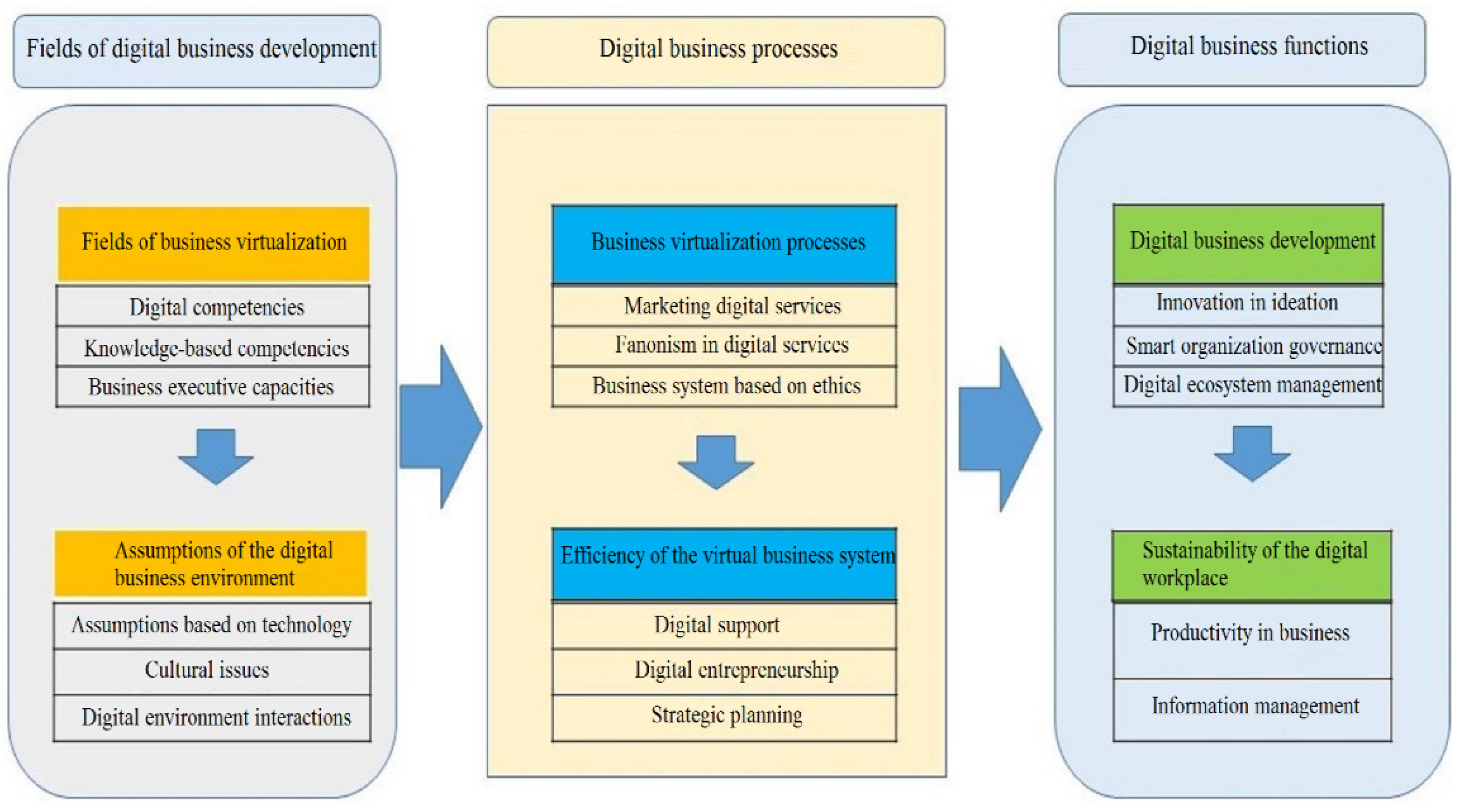
Here, due to the composition, stratification and order of the effect sequence among the identified variables, the conceptual model of this research is drawn as follows. Based on the figure below, the general flow of relationships between variables is drawn from the sequence between general structures, main themes and sub-themes in the framework of the model.
Figure 1.
Research model (derived from research findings).
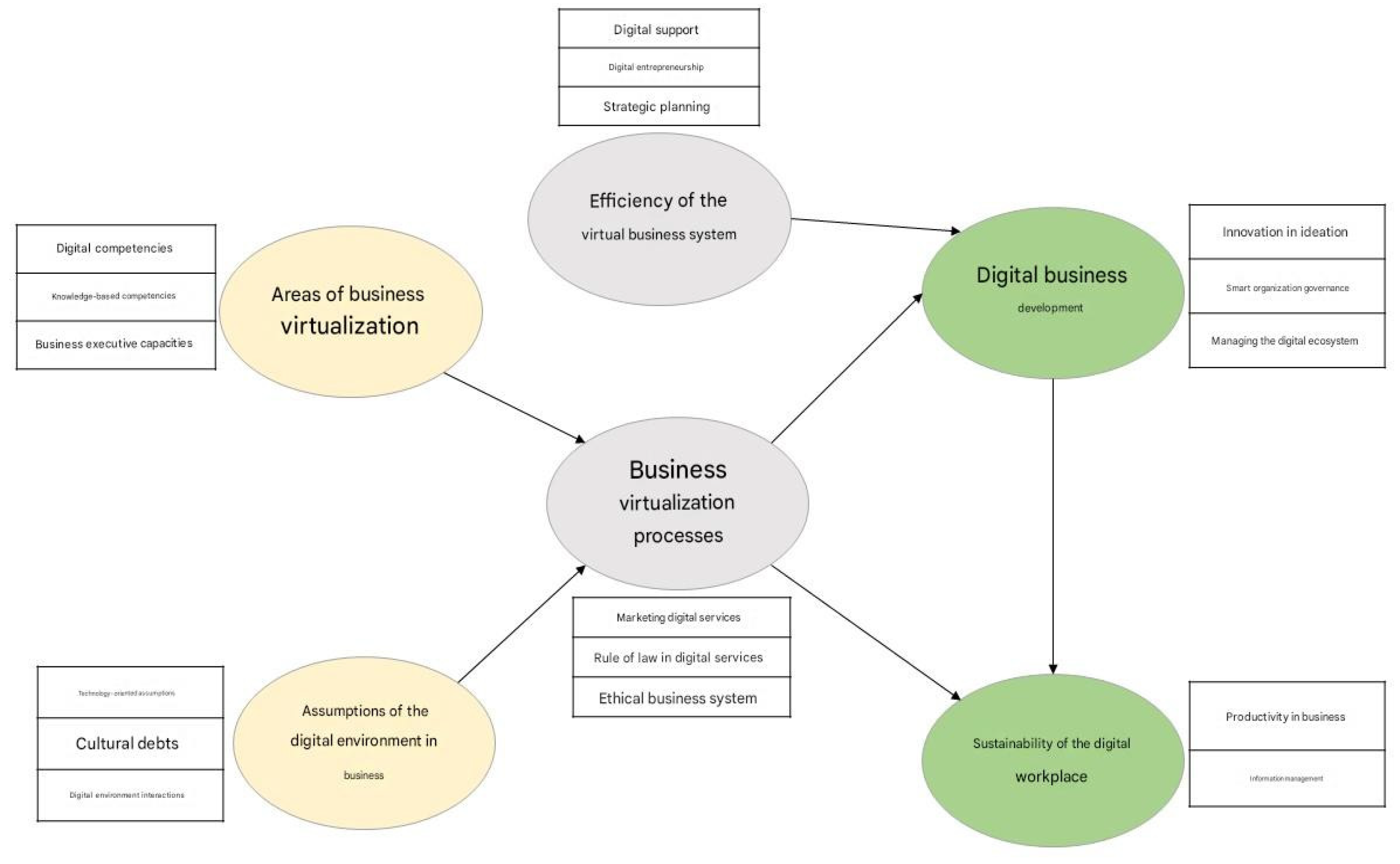
Causal Relationships (Cause-and-Effect) Among Main Variables
The causal relationships (influence–being influenced) among the main variables were determined as shown in the figure below. The relationships were first established based on theoretical foundations and prior research, and then refined through conceptual coding by experts.
The relationships depicted in the model are as follows:
The influence of business virtualization contexts on business virtualization processes.
The influence of assumptions of the digital environment in business on business virtualization processes.
The influence of the efficiency of the virtual business system on digital business development.The influence of business virtualization processes on digital business development.
The influence of business virtualization processes on digital workplace sustainability.
These are the determined relationships which are presented in the figure below that will be tested at the quantitative stage through Structural Equation Modeling (SEM) based on survey data (questionnaire).
Figure 2.
Determining relationships between research variables to test structural equation modeling.
Figure 2.
Determining relationships between research variables to test structural equation modeling.
4.2. The Quantitative Part of Study
The results of the above table showed that the factor loadings of all items are greater than 0.7 and therefore have appropriate validity. On the other hand, the data of the aforementioned table show that the composite reliability for all variables is greater than 0.8 and the mean variance for all variables is greater than 0.5. Also, the Cronbach’s alpha and Dillon and Goldstein’s Rho values of the variables are also greater than 0.7, which indicate a relatively high convergent validity. Given the appropriate validity of all items of the questionnaire, all of them have been included in the analysis of the final research model.
Table 5.
Validity and reliability and Confirmatory Factor Analysis of main variables.
| Subcomponent Item | Item | Factor Loading | Result | Validity Mean | Composite Reliability | Rho | Cronbach’s Alpha |
|---|---|---|---|---|---|---|---|
| Digital competencies | Question 1 | 0.820 | fit | 0.692 | 0.918 | 0.892 | 0.888 |
| Question 2 | 0.840 | fit | |||||
| Question 3 | 0.856 | fit | |||||
| Question 4 | 0.868 | fit | |||||
| Question 5 | 0.773 | fit | |||||
| Knowledge-based competencies | Question 1 | 0.840 | fit | 0.729 | 0.931 | 0.907 | 0.907 |
| Question 2 | 0.851 | fit | |||||
| Question 3 | 0.880 | fit | |||||
| Question 4 | 0.857 | fit | |||||
| Question 5 | 0.841 | fit | |||||
| Business executive capacities | Question 1 | 0.773 | fit | 0.639 | 0.898 | 0.860 | 0.859 |
| Question 2 | 0.817 | fit | |||||
| Question 3 | 0.826 | fit | |||||
| Question 4 | 0.778 | fit | |||||
| Question 5 | 0.790 | fit | |||||
| Assumptions based on technology | Question 1 | 0.768 | fit | 0.721 | 0.928 | 0.905 | 0.902 |
| Question 2 | 0.884 | fit | |||||
| Question 3 | 0.895 | fit | |||||
| Question 4 | 0.846 | fit | |||||
| Question 5 | 0.848 | fit | |||||
| Assumptions based on culture | Question 1 | 0.782 | fit | 0.643 | 0.900 | 0.865 | 0.861 |
| Question 2 | 0.783 | fit | |||||
| Question 3 | 0.862 | fit | |||||
| Question 4 | 0.827 | fit | |||||
| Question 5 | 0.749 | fit | |||||
| Digital workplace interactions | Question 1 | 0.783 | fit | 0.571 | 0.869 | 0.814 |
0.812 |
| Question 2 | 0.750 | fit | |||||
| Question 3 | 0.773 | fit | |||||
| Question 4 | 0.763 | fit | |||||
| Question 5 | 0.705 | fit | |||||
| Digital support | Question 1 | 0.831 | fit | 0.670 | 0.910 | 0.877 |
0.876 |
| Question 2 | 0.862 | fit | |||||
| Question 3 | 0.870 | fit | |||||
| Question 4 | 0.774 | fit | |||||
| Question 5 | 0.747 | fit | |||||
| Digital entrepreneurship | Question 1 | 0.812 | fit | 0.728 | 0.931 | 0.907 | 0.907 |
| Question 2 | 0.878 | fit | |||||
| Question 3 | 0.862 | fit | |||||
| Question 4 | 0.870 | fit | |||||
| Question 5 | 0.844 | fit | |||||
| Strategic planning | Question 1 | 0.845 | fit | 0.747 | 0.936 | 0.916 | 0.915 |
| Question 2 | 0.860 | fit | |||||
| Question 3 | 0.890 | fit | |||||
| Question 4 | 0.854 | fit | |||||
| Question 5 | 0.870 | fit | |||||
| Marketing digital services | Question 1 | 0.784 | fit | 0.673 | 0.911 | 0.880 | 0.878 |
| Question 2 | 0.786 | fit | |||||
| Question 3 | 0.830 | fit | |||||
| Question 4 | 0.878 | fit | |||||
| Question 5 | 0.820 | fit | |||||
| Commitment to the law in digital services | Question 1 | 0.843 | fit | 0.718 | 0.910 | 0.869 | 0.869 |
| Question 2 | 0.840 | fit | |||||
| Question 3 | 0.869 | fit | |||||
| Question 4 | 0.837 | fit | |||||
| Business system based on ethics | Question 1 | 0.860 | fit | 0.651 | 0.882 | 0.834 | 0.821 |
| Question 2 | 0.851 | fit | |||||
| Question 3 | 0.775 | fit | |||||
| Question 4 | 0.735 | fit | |||||
| Innovation in ideation | Question 1 | 0.837 | fit | 0.680 | 0.895 | 0.845 | 0.843 |
| Question 2 | 0.818 | fit | |||||
| Question 3 | 0.830 | fit | |||||
| Question 4 | 0.814 | fit | |||||
| Smart organization governance | Question 1 | 0.719 | fit | 0.642 | 0.877 | 0.812 | 0.812 |
| Question 2 | 0.831 | fit | |||||
| Question 3 | 0.841 | fit | |||||
| Question 4 | 0.808 | fit | |||||
| Digital ecosystem management | Question 1 | 0.730 | fit | 0.656 | 0.884 | 0.836 | 0.825 |
| Question 2 | 0.806 | fit | |||||
| Question 3 | 0.843 | fit | |||||
| Question 4 | 0.856 | fit | |||||
| Productivity in business | Question 1 | 0.854 | fit | 0.765 | 0.942 | 0.923 | 0.923 |
| Question 2 | 0.886 | fit | |||||
| Question 3 | 0.886 | fit | |||||
| Question 4 | 0.894 | fit | |||||
| Question 5 | 0.853 | fit | |||||
| Information management | Question 1 | 0.776 | fit | 0.734 | 0.932 | 0.909 | 0.909 |
| Question 2 | 0.851 | fit | |||||
| Question 3 | 0.889 | fit | |||||
| Question 4 | 0.891 | fit | |||||
| Question 5 | 0.874 | fit |
Next, we report the indicators related to second-order factor analysis in the form of Table 6.
Table 6.
Second-order factor analysis indices.
| Variable | Validity Mean | Composite Reliability | Rho | Cronbach’s Alpha |
|---|---|---|---|---|
| Business Virtualization Contexts | 0.586 | 0.955 | 0.950 | 0.949 |
| Digital Environment Assumptions in Business | 0.567 | 0.951 | 0.948 | 0.944 |
| Virtual Business System Efficiency | 0.584 | 0.954 | 0.950 | 0.949 |
| Business Virtualization Processes | 0.592 | 0.949 | 0.944 | 0.942 |
| Digital Business Development | 0.558 | 0.938 | 0.930 | 0.927 |
| Digital Workplace Sustainability | 0.670 | 0.953 | 0.945 | 0.945 |
The above table shows that the indicators considered in the present study have high validity, as Cronbach’s alpha is higher than 0.7; Rho index is higher than 0.7, composite reliability is higher than 0.8, and the mean variance is higher than 0.5. Therefore, we can continue to report the results of the final research model with complete confidence.
4.3. Structural Model Results
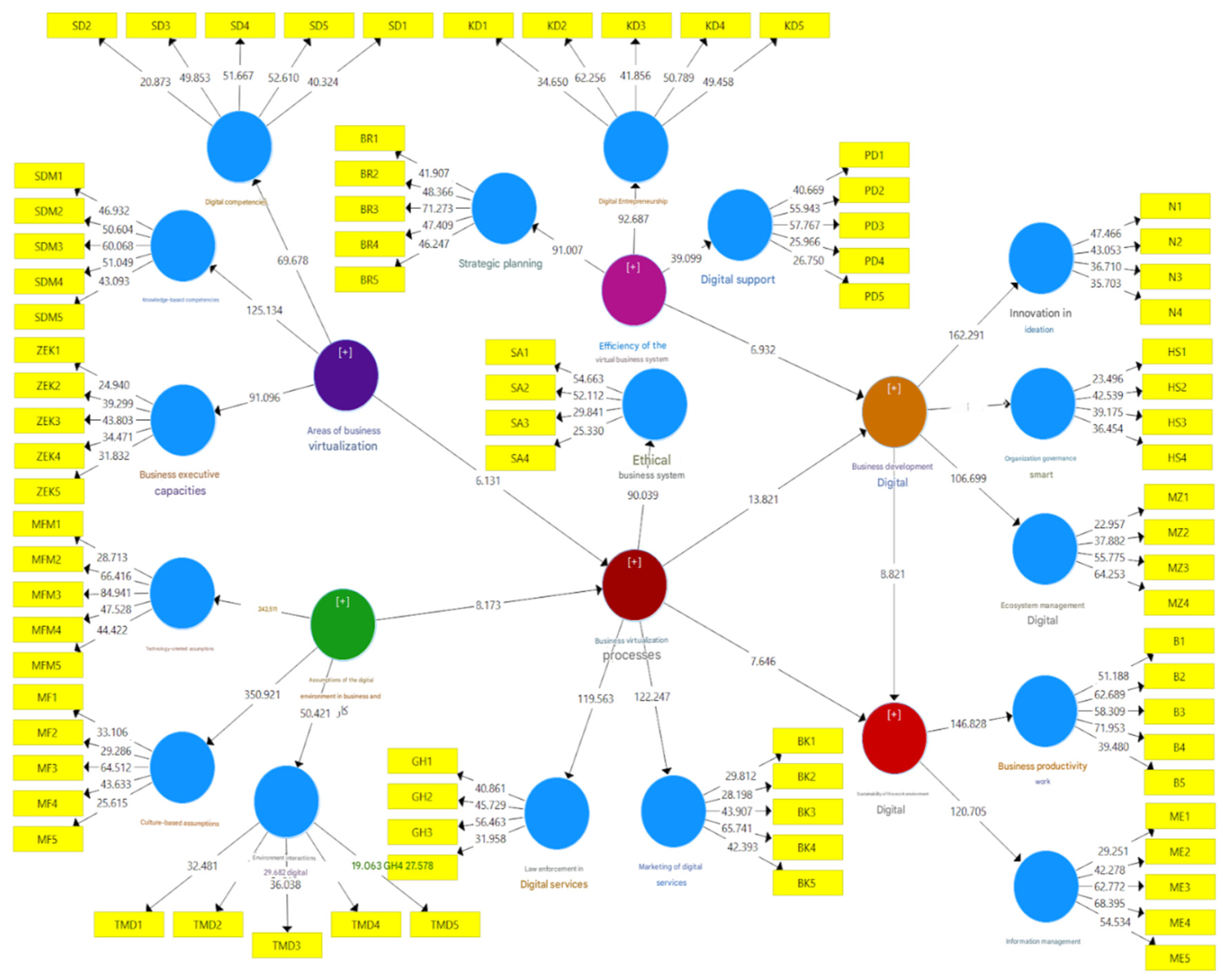
To examine the significance of the observed correlations, cross-sectional Jackknife and Bootstrap methods are used. In this study, the Bootstrapping method was used, which yields the t-statistic. At the 5% error level, if the Bootstrapping statistic is greater than 1.96, the observed correlations are significant. The factor loading value is greater than 0.6 in all cases, so the items play an important role in explaining each factor. The t-statistic is also greater than 1.96 in all cases, so the observed factor loadings are statistically significant.
Table 7.
Path coefficients and t-statistics of hypotheses.
| Relationship | Path Coefficient | t-value | Significance | Result |
|---|---|---|---|---|
| Business Virtualization Contexts→Business Virtualization Processes | 0.389 | 6.131 | 0.001 | Confirmed |
| Digital Environment Assumptions→Business Virtualization Processes | 0.483 | 8.173 | 0.001 | Confirmed |
| Virtual Business System Efficiency→Digital Business Development | 0.324 | 6.932 | 0.001 | Confirmed |
| Business Virtualization Processes→Digital Business Development | 0.616 | 13.821 | 0.001 | Confirmed |
| Business Virtualization Processes→Digital Workplace Sustainability | 0.437 | 7.646 | 0.001 | Confirmed |
| Digital Business Development→Digital Workplace Sustainability | 0.494 | 8.821 | 0.001 | Confirmed |
Result: Since all t-values > 1.96, all hypotheses are confirmed.
Table 8.
Values of fit indices for research model variables.
| Variable | Q² | R² | SRMR |
|---|---|---|---|
| Business Virtualization Processes | 0.386 | 0.703 |
0.098 |
| Digital Business Development | 0.403 | 0.825 | |
| Digital Workplace Sustainability | 0.510 | 0.819 |
Result: Q² and R² values are strong, SRMR < 0.1 → model quality is acceptable.
Figure 3.
Final research model (path coefficients and factor loadings).
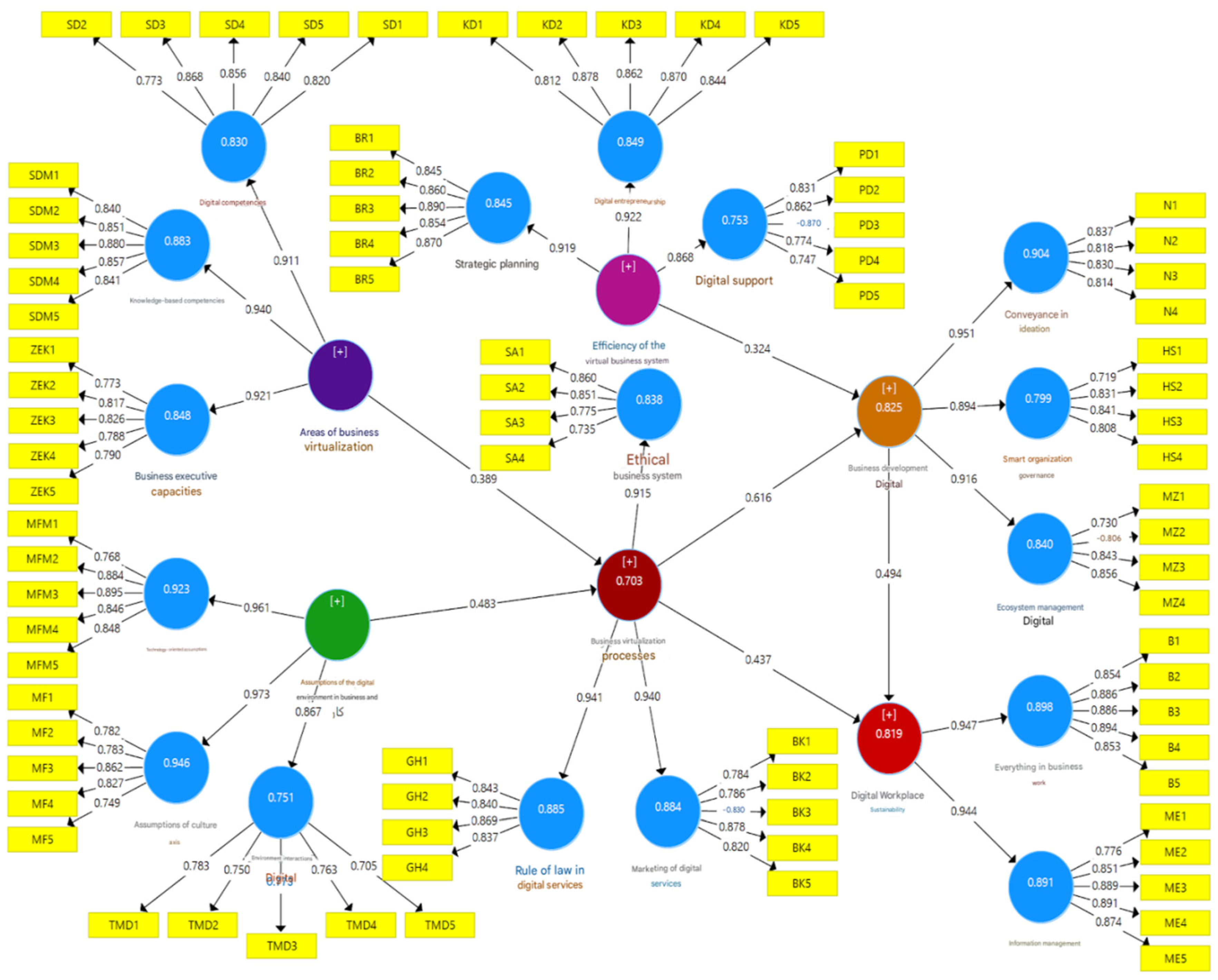
Figure 4.
Final research model (t-values).
6. Discussion
Today, rapid developments in the field of information and communication technology have led to a significant improvement in the process of digital transformation and virtualization of businesses. The sports industry as one of the areas facing these developments, needs the use of digital tools and strategies to improve performance and optimal management. In this study, an attempt was made to evaluate and analyze the various aspects of business virtualization in the sports industry in order to provide the best solutions for organizations and managers in this field. With the rapid development of information and communication technologies, today the concept of business virtualization is considered as one of the most important areas of digital business development in the sports industry. These areas include digital competencies and require entrepreneurial awareness to identify opportunities and issues, the ability to create and use business opportunities, empower managers to develop digital entrepreneurship and improve self-efficacy in the workplace.
In a modern digital workplace, leaders must have the necessary skills to lead employees virtually. Despite its high practical and theoretical relevance, a consensus on crucial digital competencies for virtual leaders is lacking, hindering a systematic exploration of the leader’s role in facilitating technology use (Opt Roodt et al., 2025).
Vallo Hult & Byström (2022) suggest that when developing digital workplaces, the focus on information systems as a new technology, as well as training and education about their use, is not enough. Specifically, they argue that the need for new competencies (first) in the workplace requires an understanding of learning practices in everyday digital work and (second) that leading the transition to a digital workplace requires learning new leadership practices. Therefore, in the future digitalization of work, systems are only a part of development, not the development, and thus the understanding of work should be central in the future digitalization of work.
Knowledge-based competencies related to access to information resources, human resources empowerment, turning business into a learning organization, applied knowledge training in digital business development and digital information analysis are also important. Also business executive capacities in the fields of digital business development including things such as the use of comprehensive and updated information systems, continuous evolution in communication systems, creative use of information technology with the aim of improving service quality, attention to market needs, improving quality and digital services. From receiving feedback from customers and creating flexibility in the competitive environment of digital business. On the other hand, the assumptions of the digital workplace in business (including the assumptions based on technology and culture and the interactions of the digital workplace), are among the factors that play an important role in promoting digital strategies and developments in sports businesses and ultimately help to improve the efficiency and performance of these organizations. In the field of digital sports businesses, it is also important to pay attention to digital skills and intelligence in identifying opportunities. This action will not only help in the optimal use of modern technologies, but will also ensure the improvement of management and leadership abilities in organizations. Also strengthening the competencies of managers in the field of digital entrepreneurship and creating learning organizations is a necessary issue for sports organizations. Access to appropriate information sources and improvement of technological infrastructure are among the basic suggestions in the development of digital sports businesses. Creating a strong information context and easy access to data helps organizations in decision-making processes and creating effective strategies. The creative and effective use of information technologies is also one of the main solutions to improve the quality of services and attract more audiences in the field of digital sports. These measures improve user experience, increase added value and create competition in sports businesses in the digital market.
Based on the findings of this research, digital business processes occur through the efficiency of the virtual business system and business virtualization processes. The effectiveness of the virtual business system includes the components of digital support, digital entrepreneurship, strategic planning and others, each of which helps to improve the performance and efficiency of sports businesses in the digital world. Digital support (including the support of sports digital businesses by accelerators, brokers and public and private institutions) through the provision of digital services, financial and insurance support and financial facilities, can improve the efficiency of the virtual business system. Digital entrepreneurship in the field of sports businesses with emphasis on privatization and work group management, causes the development of human resources and trust in the world of digital business and innovation and improvement in the performance of sports virtual business systems. Also strategic planning through defining standards, strategic planning, updating procedures and policies and determining investment priorities in the digital workplace of sports can help manage digital businesses better and more accurately. Research results in the field of digital sports businesses show that government and private support for this industry is a fundamental support. Suggestions to strengthen these supports include facilitating access to financial resources and insurance support for sports digital entrepreneurs. Creating conditions that provide facilities and direct financial support for these entrepreneurs is one of the important proposals of this department which significantly improves the growth and sustainability of these businesses.
In addition to financial support, improving the skills of entrepreneurs and sports managers in the digital field is also a very important issue. This proposal includes entrepreneurial management, human resource empowerment and strategic planning for optimal use of digital opportunities in the sports industry. By emphasizing the development of necessary competencies and skills in running digital businesses, entrepreneurs can achieve significant improvement in performance and the realization of their goals. Finally, legalism and maintaining the security of investment in sports digital businesses is very important and includes the preparation and implementation of appropriate laws to protect the rights of entrepreneurs, guarantee the security of investment and support the development and sustainable growth of this industry. These actions can lead to a significant improvement in the confidence and trust of digital investors and entrepreneurs in the field of digital sports and contribute to the sustainable growth of this industry.
6. Conclusion
Business virtualization processes include three main elements: digital services marketing, legalism in digital services and ethics-based business systems. Marketing of digital services in sports businesses by using smart distribution and sales channels, strategic pricing and targeted advertising, can strengthen effective communication with customers of sports goods and services which includes receiving feedback and suggestions from customers in the virtual space. It helps to improve business processes and plays an important role in process creation and continuous performance improvement. Legalism in digital services based on the development of protective laws can help secure the rights of digital entrepreneurs, create a safe environment for investment in the field of digital sports businesses and maintain the economic and financial strength of entrepreneurs. These rules include protection and support programs tailored to different needs. The business system based on ethics in digital sports businesses emphasizes ethical behavior and responsibility in all aspects of digital entrepreneurship which includes maintaining the balance between work and life, moral and human values and creating ethical commitment to business affairs and finally promoting. It helps to virtualize sports business processes and improve operational processes. According to research findings, digital business functions include digital business development and digital workplace sustainability. Digitization will lead to the updating of new sports such as eSports which will have profound implications for the nature of sports.
In summary, the increase of digitization in the sports industry causes a permanent change in sports practices. Positive policy guidance and the rapidly expanding industrial scale have made virtual sports to be a noteworthy new concept and problem domain in the sports field in recent years. The connotation of virtual sports is primarily manifested in the virtualization of competitive space and competitive behavior, and its nature lies in the digital presentation of sports based on data. The formation of digital sports is real experience rather than false illusion, and is derivative of sports contents rather than alternatives, and its value focusing on expansion of understanding dimensions and audience scope of sports. Driven by the digital technology, virtual sports will focus more on enhancing the immersion and personalized development of participation experiences in the future, which not only provides a positive entry point for the development of e-sports in the sports field, but also offers a driving force for school sports and mass sports (Yun, 2025). Based on research findings, the concept of digital business development includes innovation in ideation, intelligent organizational governance and digital ecosystem management. Regarding innovation in ideation, it is expected that this issue will lead to results such as digital monitoring for intelligent research and development, choosing the right digital technology for the product, intelligent design of value-added products and services and product simulation through the virtual editing of sports businesses. Sports will be available on websites (Xiao, 2017). Smart corporate governance is also one of the results of the virtualization of sports businesses which supports investors in virtual sports businesses, creates specialized online platforms for digital entrepreneurship in businesses, attracts active users as buyers and creates motivation. In general, the changes caused by digitalization in jobs, especially in sports organizations, are of multiple nature. The most direct impact of these changes relates to the transformation of new digital tools into a series of contact points that enable the integration of the various stakeholders of sports organizations. In other words, digitalization in sports integrates management functions such as player registration, ranking list, tournament management and results recording into a comprehensive information and communication technology (ICT) system with multiple channels such as websites and applications (Xiao , 2017). Finally, it should be noted that digitalization can develop the ecosystem of sports organizations because it creates new opportunities through information technologies so that sports organizations can interact with their team members, sponsors and fans (Davenport, 2014).
Practical Implications
Based on digital business practices, several practical recommendations can enhance performance and innovation in sports businesses. First, promoting innovation through smart research and development, selecting appropriate digital technologies for products, and designing smart services with added value can improve customer experience and strengthen competitiveness. Providing innovative digital services and simulating sports products on different online platforms create more engaging user experiences and improve operational efficiency. Moreover, the development of integrated online databases and information management systems helps organizations analyze data more accurately, make strategic decisions more effectively, and improve customer retention.
Policy Implications
For greater productivity and sustainable growth, active organizations—both governmental and private—should play a more supportive role in facilitating investment and creating favorable conditions for private participation in digital sports businesses. These measures can expand access to financial resources, provide insurance and institutional support, and improve the financial stability of sports organizations. Establishing policies that encourage innovation, entrepreneurship, and technological adoption in the sports industry will accelerate the digital transformation process at a national level.
Theoretical Implications
The findings of this study contribute to the theoretical understanding of how digital transformation and virtualization can reshape the structure and functioning of sports businesses. The results extend existing frameworks of digital business by integrating technological, managerial, and organizational learning perspectives into a holistic model. This integration highlights the interconnection between digital competencies, business process efficiency, and workplace sustainability, offering a foundation for future research on transformative indicators and digital ecosystem development in the sports industry.
Disclosure statement
The authors have no conflicts of interest to declare.
References
- Agarwal, D. K., & Vikas Kumar. (2021). Virtualization Effects on The Security. Journal of Science & Technology , 6(1), 01–08. https://doi.org/10.46243/jst.2020.v6.i1. [CrossRef]
- Argyris, C., & Schön, D. A. (1997). Organizational learning: A theory of action perspective. Reis, (77/78), 345-348. Link.
- Akhwan, Amir Nasser. (2016). The effect of virtual space in the improvement and development of the business field. Approach to Prevention, 10(1), 36-54. [In Persian].
- Attaran, M., Attaran, S., & Kirkland, D. (2019). The need for digital workplace: Increasing workforce productivity in the information age. International Journal of Enterprise Information Systems (IJEIS), 15(1), 1-23. https://doi.org/10.4018/IJEIS.2019010101. [CrossRef]
- Attaran, M., Attaran, S., & Kirkland, D. (2020). Technology and organizational change: Harnessing the power of digital workplace. In Handbook of research on social and organizational dynamics in the digital era (pp. 383-408). IGI Global. https://doi.org/10.4018/978-1-5225-8933-4.ch018. [CrossRef]
- Baptista, J., Stein, M. K., Klein, S., Watson-Manheim, M. B., & Lee, J. (2020). Digital work and organisational transformation: Emergent Digital/Human work configurations in modern organisations. The Journal of Strategic Information Systems, 29(2), 101618. Link.
- Barnhill, C. R., & Smith, N. L. (2022). Organizational behavior and digital transformation in sport. In The Routledge Handbook of Digital Sport Management (pp. 7-21). Routledge. Link.
- Bo, R., & Haiyan, H. (2021). Theoretical logic, practical dilemma and implementation path of high quality development of sports industry driven by digital economy. Journal of Shanghai University of Sport, 45(7), 22-34. https://doi.org/ 10.16099/j.sus.2021.07.003. [CrossRef]
- Cavicchioli, M., Demaria, F., Nannetti, F., Scapolan, A. C., & Fabbri, T. (2025). Employees’ attitudes and work-related stress in the digital workplace: an empirical investigation. Frontiers in Psychology, 16, 1546832. https://doi.org/10.3389/fpsyg.2025.1546832. [CrossRef]
- Caya, O., & Bourdon, A. (2016). A framework of value creation from business intelligence and analytics in competitive sports. In 2016 49th Hawaii International Conference on System Sciences (HICSS) (pp. 1061-1071). IEEE. https://doi.org/10.1109/HICSS.2016.136. [CrossRef]
- Coetzee, M. (2019). Thriving in digital workspaces. Emerging issues for research and practice. Cham: Springer. https://doi.org/10.1007/978-3-030-24463-7. [CrossRef]
- Dashkov, A. A., Belousova, M. N., & Pokazanev, V. Y. (2021). On the Prospects of Digital Transformation of the Field of Sports. In Socio-economic systems: Paradigms for the future (pp. 473-482). Cham: Springer International Publishing. Link.
- Davenport, T. H. (2014). What businesses can learn from sports analytics. MIT Sloan Management Review.Link.
- Dery, K., Sebastian, I. M., & van der Meulen, N. (2017). The digital workplace is key to digital innovation. MIS Quarterly Executive, 16(2), 132-152. Link.
- Dhruvesh Talati. (2025). Environmental Sustainability in Cloud Infrastructure Design: Towards Green Secure Platforms. Journal of Computer Science and Technology Studies, 7(8), 60-69. https://doi.org/10.32996/jcsts.2025.7.8.8. [CrossRef]
- Ghelichkhani, M., Samadi Moghadam, Y., & Fathi Hafashjani, K. (2021). A Digital Transformation Assessment Maturity Model for Industrial Organization Based on Design Science Approach. Business Intelligence Management Studies, 10(37), 135-184. https://doi.org/10.22054/ims.2021.56164.1837 [In Persian]. [CrossRef]
- Haddadi Harandi, A. A., Rezaeifard, M., & Esmaelii, S. (2022). Digital Transformation Maturity Model; Areas and Trends of Research in Iran. Digital Transformation, 2(2), 43-72. https://doi.org/10.22034/dtj.2022.340076.1061. [In Persian]. [CrossRef]
- Hamari, J., & Sjöblom, M. (2017). What is eSports and why do people watch it?. Internet research, 27(2), 211-232. Link.
- HosseiniNasab, S. M., ShamiZanjani, M., & Gholipor, A. (2021). Defining a Framework for Chief Digital Officer Duties as Digital Transformation Governor in Organizations. Journal of Human Resource Management, 11(1), 1-25. https://doi.org/10.22034/jhrs.2021.130495. [In Persian]. [CrossRef]
- Hoye, R., Smith, A. C., Nicholson, M., & Stewart, B. (2018). Sport management: principles and applications. Routledge. Link.
- Huang, K., & Li, Z. (2021). The campus cloud platform setup based on virtualization technology. Procedia Computer Science, 183, 73-78. https://doi.org/10.1016/j.procs.2021.02.032. [CrossRef]
- Janicki, T., Popławski, W., & Słupska, U. (2015). The Concept and the Level of Virtualization in Contemporary Companies (Based on the Example of Polish Firms). Social Sciences, 90(4), 19-31. https://doi.org/10.5755/j01.ss.90.4.14248. [CrossRef]
- Karimi, M. , majedi, N. , Safari, L. and Kalhor, H. (2023). Designing a virtual business development model in the field of sports services. Strategic Studies on Youth and Sports, 21(58), 313-330. https://doi.org/10.22034/ssys.2022.1783.2267. [CrossRef]
- Karimian, S., Askari, A., Fallah, Z., & Bahlekeh, T. (2022). Designing Sport digital economy development model in Iran. Sport Management Journal, 13(4), 1277-1293. https://doi.org/10.22059/jsm.2020.309490.2565 [In Persian]. [CrossRef]
- Keihan, Nikbakhsh, R., Farahani, A., Safania, A. M., & Bagherian Farahabadi, M. (2021). Sports business development model with e-commerce approach. Applied Research in Sport Management, 10(1), 61-75. https://doi.org/10.30473/arsm.2021.53180.3283 [In Persian]. [CrossRef]
- Kim, C., Mirusmonov, M., & Lee, I. (2010). An empirical examination of factors influencing the intention to use mobile payment. Computers in human behavior, 26(3), 310-322. https://doi.org/10.1016/j.chb.2009.10.013. [CrossRef]
- Kraus, S., Durst, S., Ferreira, J. J., Veiga, P., Kailer, N., & Weinmann, A. (2022). Digital transformation in business and management research: An overview of the current status quo. International journal of information management, 63, 102466. https://doi.org/10.1016/j.ijinfomgt.2021.102466. [CrossRef]
- Kroon, Å., & Eriksson, G. (2019). The impact of the digital transformation on sports journalism talk online. Journalism Practice, 13(7), 834-852. https://doi.org/10.1080/17512786.2019.1577695. [CrossRef]
- Larson, L., & DeChurch, L. A. (2020). Leading teams in the digital age: Four perspectives on technology and what they mean for leading teams. The Leadership Quarterly, 31(1), 101377. https://doi.org/10.1016/j.leaqua.2019.101377. [CrossRef]
- Marsh, E. (2018). Understanding the effect of digital literacy on employees’ digital workplace continuance intentions and individual performance. International Journal of Digital Literacy and Digital Competence (IJDLDC), 9(2), 15-33. https://doi.org/10.4018/IJDLDC.2018040102. [CrossRef]
- Marsh, E., Vallejos, E. P., & Spence, A. (2022). The digital workplace and its dark side: An integrative review. Computers in Human Behavior, 128, 107118. https://doi.org/10.1016/j.chb.2021.107118. [CrossRef]
- Mehraeen, M., & Islamkhah, M. (2018). Challenges facing digital transformation and its research trends. In The second national conference on organizational architecture developments (pp. 109-114). [In Persian]. Link.
- Molazahi,M, Salajeghe, S, Hasani Ahmadie, S, Firozabadi, A, Jalali Javaran, R. (2021). Designing and Exercising the Power of LG Digital Leadership in the Education System of the Country (Case Study: Education of Sistan and Baluchestan Province). Strategic Management Researches, 81, 147-175. [In Persian]. Link.
- Molina, P., Gómez-Gonzalvo, F., & Valenciano-Valcárcel, J. (2025). The sportization of esports and its implications in the near future of sport. Sport, Ethics and Philosophy, 19(1), 20-34. https://doi.org/10.1080/17511321.2024.2324390. [CrossRef]
- Nouri, M., Shah hoseini, M., Shami zanjani, M., & Abedin, B. (2019). Designing A Conceptual Framework for Leading Digital Transformation in Iranian Companies. Journal of Management and Planning In Educational System, 12(2), https://doi.org/10.29252/mpes.12.2.211 [In Persian]. [CrossRef]
- Opt Roodt, H., Bracht, E. M., van Dick, R., & Hernandez Bark, A. S. (2025). Navigating through the digital workplace: Measuring leader digital competence. Journal of Business and Psychology, 40(1), 179-205.
- Palvia, P., Ghosh, J., Jacks, T., & Serenko, A. (2021). Information technology issues and challenges of the globe: the world IT project. Information & Management, 58(8), 103545. https://doi.org/10.1016/j.im.2021.103545. [CrossRef]
- Qi, Y., Sajadi, S. M., Baghaei, S., Rezaei, R., & Li, W. (2024). Digital technologies in sports: Opportunities, challenges, and strategies for safeguarding athlete wellbeing and competitive integrity in the digital era. Technology in Society, 77, 102496. https://doi.org/10.1016/j.techsoc.2024.102496. [CrossRef]
- Rahmati Kohroodi, S., Shams Moorkani, G. R., Shami Zanjani, M., & Abolghasemi, M. (2021). Presenting a Framework for Explaining the Competencies of Digital Leaders through Meta-Synthesis Method. Journal of Research in Human Resources Management, 13(1), 9-42. https://doi.org/ 20.1001.1.82548002.1400.13.1.1.5 [In Persian].
- Ratten, V. (2020). Sport technology: A commentary. The Journal of High Technology Management Research, 31(1), 100383. https://doi.org/10.1016/j.hitech.2020.100383. [CrossRef]
- Salehipour Bavarsad, S., & Kazem Pourian, S. (2021). Unveiling a New Roadmap for Digital Transformation. Science and Technology Policy Letters, 11(1), 5-17. https://doi.org/ 20.1001.1.24767220.1400.11.1.5.3 [In Persian].
- Salehipour, M., Najafabadipour, Z., Mohammadi, S., & Shohani, M. (2025). Analysis of the key drivers affecting the development of small and medium sports businesses. SPORT TK-Revista EuroAmericana de Ciencias del Deporte, 14, 3-3. https://doi.org/10.6018/sportk.644351. [CrossRef]
- Shohani, M. H., Mohammadi, S., & Noorbakhsh, P. (2016). Role of Organizational Culture and Knowledge Management in Organizational Intelligence of the Ministry of Sport and Youth Staff. Sport Management Studies, 8(39), 51-72. https://doi.org/10.22089/smrj.2016.855. [CrossRef]
- Skare, M., de Obesso, M. D. L. M., & Ribeiro-Navarrete, S. (2023). Digital transformation and European small and medium enterprises (SMEs): A comparative study using digital economy and society index data. International journal of information management, 68, 102594. https://doi.org/10.1016/j.ijinfomgt.2022.102594. [CrossRef]
- Vallo Hult, H., & Byström, K. (2022). Challenges to learning and leading the digital workplace. Studies in Continuing Education, 44(3), 460-474. https://doi.org/10.1080/0158037X.2021.1879038. [CrossRef]
- Wang, S. (2023). The Analysis of the Application of Computer Virtualization Technology to Modern Sports Training. Journal of Artificial Intelligence Practice. Vol. (6) NO (2), P: 49-53. https://doi.org/10.23977/jaip.2023.060208. [CrossRef]
- Xiao, X., Tan, F. T. C., Lim, E. T., Henningsson, S., Vatrapu, R., Hedman, J., ... & Van Hillegersberg, J. (2018). Sports digitalization: An overview and A research agenda. In 38th International Conference on Information Systems, ICIS 2017. Link.
- Yalina, N., & Rozas, I. S. (2020, February). Digital workplace: digital transformation for environmental sustainability. In IOP Conference Series: Earth and Environmental Science (Vol. 456, No. 1, p. 012022). IOP Publishing. https://doi.org/10.1088/1755-1315/456/1/012022. [CrossRef]
- Yun, Y. A. N. G. (2025). Virtual sports: Natural reinterpretation and valuable reflection on sports during the digital epoch. Journal of Physical Education/Tiyu Xuekan, 32(4). Link.
Table 2.
Demographic characteristics of the qualitative section.
| Demographic characteristics | Abundance | Percentage | |
|---|---|---|---|
| Gender | man | 9 | 60 |
| woman | 6 | 40 | |
|
Age |
less than 35 years | 1 | 6.67 |
| 35 to 45 years | 9 | 60 | |
| 45 years and more | 5 | 33.33 | |
|
Education |
Bachelor | 2 | 13.3 |
| Master’s degree | 8 | 53.3 | |
| PhD | 5 | 33.3 | |
|
Field of study |
Marketing Management | 4 | 26.67 |
| Information Technology Engineering | 5 | 33.33 | |
| sports marketing management | 6 | 40 | |
| Work history | 10 to 20 years | 6 | 40 |
| over 20 years old | 9 | 60 | |
Disclaimer/Publisher’s Note: The statements, opinions and data contained in all publications are solely those of the individual author(s) and contributor(s) and not of MDPI and/or the editor(s). MDPI and/or the editor(s) disclaim responsibility for any injury to people or property resulting from any ideas, methods, instructions or products referred to in the content. |
© 2026 by the authors. Licensee MDPI, Basel, Switzerland. This article is an open access article distributed under the terms and conditions of the Creative Commons Attribution (CC BY) license (http://creativecommons.org/licenses/by/4.0/).
Copyright: This open access article is published under a Creative Commons CC BY 4.0 license, which permit the free download, distribution, and reuse, provided that the author and preprint are cited in any reuse.


