

Submitted:
13 February 2026
Posted:
13 February 2026
You are already at the latest version
Abstract
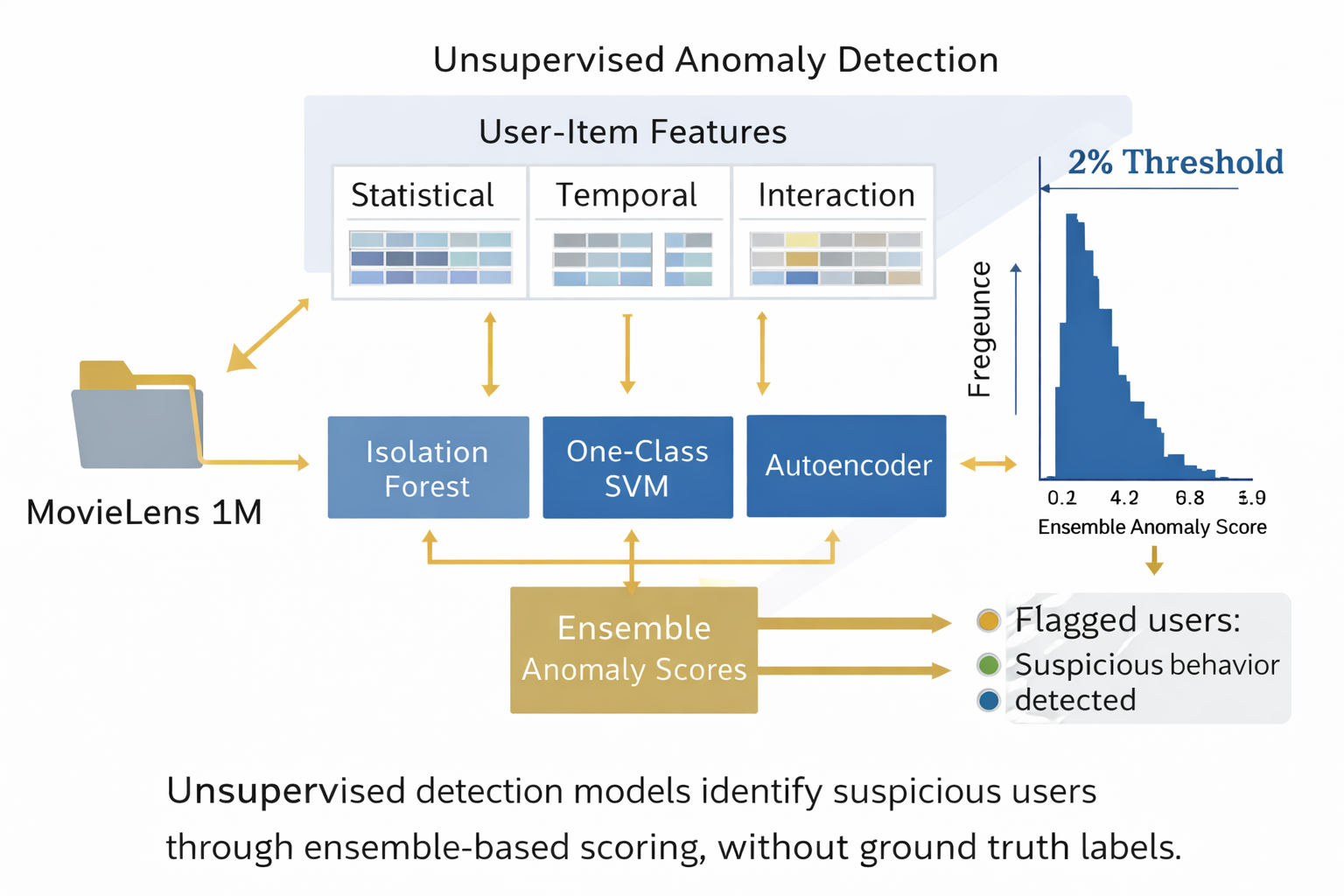
Recommender systems are increasingly exposed to anomalous user behavior that can distort recommendation outcomes and compromise system reliability. In real-world settings, explicit labels identifying malicious activity are rarely available, motivating the adoption of unsupervised detection approaches. This study presents a comparative analysis of classical machine learning and deep learning techniques for anomaly detection in recommender systems. Using the MovieLens 1M dataset, we construct a user-level behavioral representation based on statistical, temporal, and interaction-based features derived from explicit rating data. Three unsupervised detection models are evaluated: Isolation Forest, One-Class Support Vector Machine, and an autoencoder-based neural network. To address the absence of ground truth labels, evaluation is conducted using label-free protocols, including score distribution analysis, percentile-based thresholding, and inter-model agreement. Results indicate that individual models capture complementary aspects of anomalous behavior, exhibiting low to moderate agreement. An ensemble scoring strategy improves ranking stability and provides a consistent mechanism for identifying highly deviant user profiles. The findings suggest that ensemble-based unsupervised detection constitutes a practical and interpretable first-layer screening approach for recommender system monitoring.
Keywords:
recommender systems
; anomaly detection
; unsupervised learning
; ensemble methods
; user behavior analysis
Copyright: This open access article is published under a Creative Commons CC BY 4.0 license, which permit the free download, distribution, and reuse, provided that the author and preprint are cited in any reuse.


