
Submitted:
12 February 2026
Posted:
13 February 2026
You are already at the latest version
Abstract
This study investigates and explores teachers' trust in their colleagues while implementing a PLC in chosen rural primary schools, which has previously been neglected. This study included 310 randomly selected teachers from 57 rural primary schools. The findings demonstrated that primary teachers chose openness, competence, and reliability as three important trust aspects to nurture in their rural primary schools while engaging in PLC activities. Teachers, on the other hand, claimed that compassion and honesty were not well-cultivated in their schools. Additionally, a poor correlation was found between trusting relationships and PLC practice in rural primary schools. Nonetheless, competence, reliability, and openness remained the most important determinants of teachers' PLC practices in the rural primary schools examined. The practical applications and limitations of these findings are discussed.
Keywords:
professional learning community
; colleague trust
; rural primary schools
; Malaysia
1. Introduction
The practice of a Professional Learning Community (PLC) in schools has benefited teachers seeking to improve their knowledge and skills. As a result, PLCs have been widely accepted as a strategic approach to enhance teachers' growth and development (Pedersen, 2019; Tahir & Musah, 2020; Yin & Zheng, 2018; Tanghe & Schelfhout, 2026; Al Masroori et al., 2026). A PLC is believed by many to be a strategic tool/activity capable of enhancing teaching and learning, and competency, which later enhances students' improvement (Hairon et al., 2017; Tahir & Musah, 2020). By using a PLC, teachers are asked to share their knowledge and provide comments on their teaching practice in an ongoing, reflective, and growth-promoting way (Wang, 2016). Regarding benefits, PLCs are globally recognized as a highly effective approach to classroom teaching that ultimately improves students' academic performance (Lomos et al., 2011; Tahir & Musah, 2020; Wahlstrom & Louis, 2008). Moreover, a PLC can enhance the positive school culture by emphasizing organizational learning (Louis & Lee, 2016).
In Malaysian schools, most schools have implemented PLCs following the official announcement by the Ministry of Education Malaysia (MOE). PLCs enable teachers to cooperate and work together (Abdullah, 2016; Mei Kin & Abdul Kareem, 2021; Tahir et al., 2024). From 2013 to 2015, the Malaysian Education Blueprint (MEB) acknowledged PLCs as a way to develop teacher professionalism, ultimately leading to increased school effectiveness as a learning organization (Mei Kin & Abdul Kareem, 2021; Ministry of Education Malaysia [MOE], 2015). Following the implementation of PLCs through MEB, all public schools must implement PLC practices as a strategic method to improve teacher professionalism and progress (Tahir et al., 2024). This includes adding PLCs to their CPD programmes. PLCs aim to improve educators' educational skills and stimulate development through cooperation and sharing (Tahir et al., 2024). Due to this, many local studies have explored Malaysian teachers' acceptance and issues with PLCs. All Malaysian schools adopt the MOE's recommended system. Teacher sharing sessions, learning walks, peer coaching, and lesson study are its major PLC practices. All public school instructors learn and use these ideas. Each school also appoints a senior, experienced teacher to facilitate PLC procedures. These teachers receive basic and advanced PLC training from the MOE. State Department of Education senior teachers also do this (MOE, 2022).
Organizational leadership has a substantial impact on the effectiveness of PLC practice in schools (Huffman et al., 2015). In the framework of PLC practices, it is important for teachers and coworkers to trust one another and make dependable connections (Tahir et al., 2015). Teachers need to trust each other in order to be good teachers and to make the school process better overall (Ninkovic et al., 2022). Trust between employees is essential (Svare et al., 2020). Many studies suggest that coworkers who trust each other need less monitoring and administration (Cho & Poister, 2013). High trust allows employees to share information and collaborate without fear of being watched. Employees develop strong trust and reliability (Hasche et al., 2021). Educational efficacy depends on trust, according to many specialists. Trust helps instructors work collaboratively and complete tasks (Ninkovic et al., 2022; Tschannen-Moran, 2014b), which improves their professional development (Bellibaş & Gümüş, 2023). Collaboration among instructors reduces stress, instability, and conflicts (Brücknerová & Novotný, 2017). In addition, trust between coworkers or trust inside oneself creates a flexible atmosphere where employees may talk to each other honestly and openly within the organization. Such a culture will make everyone feel safe by encouraging collaboration and providing an environment in which people can freely give and accept criticism while also sharing information and valuable personal experiences (Niedlich et al., 2021; Jedelund, 2021; Svare et al., 2020; Tahir et al., 2015).
Lansing et al. (2023) argue that trust is essential for building and maintaining healthy relationships among coworkers. This, in turn, helps to reduce health inequities and promotes collaboration among organization members. In describing this setting, it was assumed that trust relationships within the school context remained important in deciding teacher collaboration and school progress (Cranston, 2011; Goldzung, 2021; Tahir et al., 2015; Tschannen-Moran, 2014b; Zheng et al., 2016;). For nearly 30 years, educational research has focused on the concept of trust (Bukko et al., 2021; Tschannen-Moran, 2004). In this sense, Forsyth et al. (2011) state that trust is essential in schools. When principals and teachers collaborate with trust, they can effectively accomplish the school's goals, supervise and monitor progress, and meet students' needs. When schools have a culture of trust, instructors are happier and confident (Bukko et al., 2021; Demir, 2015), which in turn reduces burnout and stress (Collie et al., 2012). Without trust, a school's effectiveness and efficiency suffer.
In linking PLCs with trust, it is believed that positive trusting relationships among teachers and colleagues have nurtured effective implementation of PLCs in schools (Hallinger et al., 2014; Liu, Hallinger & Feng, 2016). This is because a high level of trust among teachers denotes shared positive social relationships (Bryk & Schneider, 2002). When discussing the importance of trust and collaboration, many believe that teachers' collaboration and trusting relationships enhance school improvement after working together. This presumes they perform better than teachers working in isolation (DeGagne, 2022; Hargreaves & Fullan, 2012). According to Wang and An (2023), trust among teachers, which is illustrated through collective learning, allows them to exchange ideas, knowledge, and strategies with one another, enhancing knowledge flow as an integral part of the school culture. According to Hallam et al. (2015), an effective PLC activity needs to be supported with high trust within the school's collaborative culture to increase students' performance (Bryk & Schneider, 2002; Forsyth et al., 2006).
In this sense, where trust exists, many positive collaborations and sharing of knowledge and information based on personal engagement are likely to emerge (Costa & Anderson, 2011). Without trust, teachers are at a loss to help or assist each other, and they cannot function as a collaborative group (Ninkovic et al., 2022). Additionally, teachers who don't trust their colleagues will feel vulnerable and unwilling to communicate openly about problems they encounter (Ninkovic et al., 2022; Stoll et al., 2006). Many believe all parties on the school's premises must develop trust within their team and school culture (Stoll et al., 2006). As such, Tschannen-Moran (2014b) emphasized that a trusting relationship is significant and works as a 'glue' that holds things together and facilitates smooth operation and collaboration among teachers.
1.1. The Study’s Gap
Despite the increasing number of PLC studies among Malaysian teachers, there is still a lack of understanding regarding the existence of trusting relationships among teachers or colleagues within PLC practices. Although trust can improve collaboration (Hallam et al., 2015), the role of trust in PLC practices is understudied and disregarded from a local perspective. It is unclear whether all instructors in rural schools have a high level of trusting connections while implementing a PLC. Carpenter and Munshower (2020) say that rural schools often have trouble developing PLCs because of where they are and how many staff members they have. Teachers in these schools are few and have diverse subject qualifications. They struggle to collaborate on PLC procedures, share data, and make improvements. Because of this, it is important to look into how trust between teachers or coworkers affects PLC procedures in Malaysian schools, which is not well-studied or well-developed at the moment. There needs to be more research on how much instructors trust one another when they use a PLC in Asian schools, especially in Malaysia, where the topic is thought to be understudied. As a result, the goal of this research was to examine the presence of trusting relationships from the perspective of teachers who have employed PLCs in the classroom. Hopefully, this study will offer suggestions for increasing teachers' trust, which is critical in supporting a PLC and fostering teacher collaboration and collegiality to advance their professional growth.
Second gap, rural primary schools were sampled because there is less research on rural teachers' professional development (Li et al., 2020). Furthermore, rural children make up a sizable proportion of school enrollment worldwide (Preston & Barnes, 2017). In Malaysia, 42 percent of 10,218 schools are categorized as rural, and roughly 22% (4,734,047) of the total student population attends (Educational Planning and Research Division, Malaysia, 2020). Literature in rural education indicates that teachers in these schools face several challenges, including resource shortages, unreliable internet connections, feelings of isolation from colleagues, high rates of student dropout and absenteeism, and low motivation (Durr et al., 2020; Hardman & Sandi, 2024; Şahin et al., 2024; Wang & An, 2023). Although some studies have examined teachers' professional development in local rural schools, particularly those by Aziz et al. (2021), Azman et al. (2021), Fariha et al. (2021), Razi et al. (2021), Salleh and Nordin (2020), Bismuth and Merzel (2025), García et al. (2026), and Wong et al. (2026), there has been insufficient attention to effective Professional Learning Communities (PLC) practices for Malaysian rural school teachers. Though current studies on PLC practices, such as those by Ismail et al. (2014) and Chua et al. (2020), provide some insights, Tahir and Musah (2020) conducted a comprehensive inquiry that revealed a lack of knowledge about PLC implementation in Malaysian rural schools. This emphasizes the critical need for additional study on effective PLC techniques in rural educational contexts.
There has been no study on how much rural primary school instructors trust and value PLC approaches in their Continuous Professional Development (CPD) programs. How much rural elementary school teachers trust their kids is unknown in Malaysia. Trust is essential for educators to share their opinions and collaborate (Hallam et al., 2015). Khan et al. (2021) have only done one big study on the link between teacher trust and PLC practices in secondary schools so far. There is a void in rural primary schools. Kauhsari et al. (2023) underline the importance of trust, claiming that without it, teachers struggle to participate successfully in PLCs, resulting in less sustainable practices. As a result, additional research is urgently required to evaluate the relationship between trust and PLC procedures in underperforming rural primary schools.
The final gap addresses local instructors' lack of trust in relationships when applying PLC. Chong et al. (2018) found that teachers struggle to adopt PLCs due to a lack of sharing and collaboration. Teachers don't trust each other, hence they don't share teaching and instructional methods. Siti Nafsiah et al. (2018) revealed that most teachers prefer to work alone due to a lack of collaboration knowledge among their peers. A study indicated that some teachers refused to accept their colleagues' comments owing to a lack of trust and a wish not to be punished (Mazlan & Zamri, 2016). Few studies have evaluated the relationship between PLC procedures and school trust (Cranston, 2011; Pedersen, 2019). This includes the existence or association of trust relationships within the practice of PLC within Malaysian school contexts, which remains unexplored. We still have an unclear understanding of whether trust is a significant element that 'glues' Malaysian teachers together while participating in PLC activities at school.
1.2. The Research Questions
Despite ample research on the successful implementation of PLCs, there is still limited evidence regarding teachers’ trust in their colleagues regarding effective PLC practices in Malaysia. Additionally, there is a lack of understanding about the level of trust among teachers in rural primary schools, as this topic has been largely overlooked in previous studies. The main goals of this study are to address the following three research questions:
- (a)
- Do rural primary teachers in rural primary schools have a high level of trust in their colleagues when practicing PLCs?
- (b)
- Is there any differentiation in teachers’ trusting relationships with their colleagues based on demographic variables such as gender, teaching experience, and age during PLC practices?
- (c)
- Do trust relationships with colleagues significantly correlate with and predict the practice of Professional Learning Communities (PLCs) as perceived by rural primary school teachers?
2. Literature Review
2.1. Theoretical Framework
A conceptual framework was developed to guide this research, based on Hord's PLC model (Hord, 1997) and Tschannen-Moran and Hoy's five dimensions of trust (Tschannen-Moran & Hoy, 1998). The literature review clarifies both models, which serve as the basis for our research. The talks begin with Tschannen-Moran and Hoy's trust aspect model, which is about having trustworthy connections with coworkers. Then they go on to Hord's PLS model and how it could be interpreted. This portion will also look at the Hord model for PLCs and Tschannen-Moran's model for measuring trust factors. It will also look at concerns of professional development for rural teachers and how PLCs are used in these schools. Şahin et al. (2024) say that this will help us better grasp PLC procedures and trust factors in rural primary schools, which is very important.
2.2. Trusting Relationships with Colleagues
The second key feature investigated in this study is trusting relationships with peers. Tschannen-Moran (2004) proposed five components of trust: benevolence, dependability, honesty, openness, and competency. According to Hoy and Tschannen-Moran (1999), trust is an individual's readiness to be vulnerable to another person because they believe in the latter. Bryk and Schneider (2002) emphasized that a school cannot achieve effectiveness solely based on having the best and brightest teachers; an environment and culture of trust are also crucial. In the context of a PLC activity, collegial trust is defined as teachers depending on and relying on the integrity of their colleagues (Tschannen-Moran & Hoy, 1998). This means that colleagues or faculty members act with integrity in the best interests of their colleagues (Tschannen-Moran & Hoy, 1998). Hargreaves (2007) further defines trust as an individual's confidence in the reasonable fulfillment of obligations by another person or party.
Trusting relationships with colleagues are particularly important in supporting teachers' collaboration and professional growth. Trust in schools, especially trust in colleagues, has been found to contribute to the development of a positive school community and student achievement (Forsyth et al., 2011), as well as school reform (van Maele & Van Houtte, 2011; van Maele et al., 2014). Tschannen-Moran's five facets of trust, which have been widely employed in research on trust in schools, include benevolence, reliability, honesty, openness, and competence. Benevolence is defined as faith in an individual's well-being or something one cares about that is protected by another trusted person or group. Tschannen-Moran and Hoy (1998) argue that fairness and goodwill are essential components of benevolence. The second factor is the capacity to rely on a team member for assistance. Reliability displays thoroughness and dedication to the collective's effort (Pedersen, 2019). Competence, the third aspect, involves having trust in the moral intentions and consistent performance of team members (Tschannen-Moran, 2014a). The fourth facet, honesty, relates to the expectation of integrity and responsibility for actions among team members (Tschannen-Moran & Hoy, 1998). The final aspect of trust is openness, which involves open communication among team members, sharing reliable information, and fostering positive relationships. A summary of the Tschannen-Moran (1998) five facets of trust is presented in Table 1 below.
2.3. A Professional Learning Community
A PLC can be defined in various ways. DuFour and Reeves (2016) describe a PLC as an ongoing process in which teachers work collaboratively within cycles of collective inquiry and action research to improve student performance. Stoll et al. (2006) define PLCs as educators who share and evaluate their teaching practices in a reflective, collaborative, inclusive, and learning-oriented manner to enhance teacher effectiveness and student academic performance. Bolam et al. (2005) view PLCs as platforms for teachers to share and support each other's learning to improve student learning effectiveness.
In this study, Hord's (1997) model of a PLC serves as the theoretical framework. This model consists of five key components: shared vision and mission, shared leadership, collective learning, organizational support, and sharing of personal practice. Firstly, the school establishes a shared vision and mission to foster collective efforts among teachers and school leaders. Teachers need to know and include the school's vision and mission in their everyday lessons (Hord, 1997). To define and carry out the school's vision and mission, teachers need to work together. Second, shared leadership enables instructors to lead their teams, which makes shared and distributed teacher leadership practices better.
Community learning, the third aspect, enables school members to share their knowledge, experiences, and skills in support of other teachers. For collaborative learning, Fullan (1998) and Hargreaves and Fink (2006) advise teachers to collaborate. Fourthly, teachers explain how they teach, think, research, and improve. Teachers learn better with these tools (Andrews & Lewis, 2007; Bolam et al., 2005). The final section discusses organization assistance. School officials and the community must support PLC processes by making the school a suitable place for teachers to learn, providing money and space, and inspiring them. School PLC implementation may benefit from an organizational learning culture (Hord, 1997). Table 2 below depicts Hord’s PLC constructs.
Numerous studies have been conducted on PLC research. In 2021, Antinluoma et al. surveyed PLC practices in Finnish comprehensive schools using a multiple case study approach. The findings revealed that school principals played a significant role in developing PLCs. Regarding trust, it was reported that teachers had positive relationships based on mutual openness, allowing members to express their opinions. Similarly, in 2021, Long et al. (2021) studied PLC practices in schools in China. The results demonstrated that instructors trusted and supported PLCs in their schools. This study demonstrated that trust significantly affected teachers' professional growth through PLC activities.
In Indonesian primary schools that used PLCs to improve teacher professionalism, Sunaengsih et al. (2019) found that teachers understood their purpose but did not use them effectively. Chua et al. (2020) discovered heavy workloads, uninterested teachers, a lack of school community involvement, and a lack of comprehension of PLC methods. Ismail et al. (2021) found that PLC practices greatly influenced high school teacher motivation. PLCs increased instructors' motivation, which helped students succeed in school.
2.4. Trust and a Professional Learning Community
PLCs require trust, according to many experts (Hargreaves, 2013; Stoll et al., 2006). Bryk et al. (1999) argue that trust is necessary for a PLC because it fosters collaboration, reflective conversation, and professional community growth. Hargreaves (2007) calls trust the "foundation" of PLC practice. Gray and Summers (2015) emphasize the importance of trust in PLC teacher relationships. People think that for PLCs to last in schools, it's vitally important that people trust each other. Forsyth et al. (2011) say trust is the "keystone" of effective relationships and organizations. This shows how crucial PLC procedure confidence is. Without team trust, teachers may struggle to communicate and influence. Adams (2013) states that trust is essential for team selection and PLC viability. Researchers believe trust is essential to fostering a culture of collaboration and dependability among educators, reducing uncertainty and concerns, and improving a school's PLC practices (Lleo et al., 2017). Gray and Summers (2015) focused their research on the degree of confidence that teachers have in their leaders and in each other inside PLCs. They discovered that principal trust affected PLC activity more than colleague trust. Leadership patterns, faculty trust, and PLCs in Chinese educational institutions were explored by Yin and Zheng (2018). Leadership approaches increased teacher trust and made PLC formation easier.
Sharing trust with coworkers was wonderful, but it made leadership practices harder to implement in PLCs. Ninkovic et al. (2022) examined how PLC colleague trust influences collaboration in 362 Serbian teachers. Results demonstrated that instructors' job performance was directly related to their coworker trust. Trust affected teacher performance through shared accountability. Pedersen (2019) argues that coworker trust is crucial for maintaining and enhancing PLCs in schools. A qualitative study by Hallam et al. (2015) examined team trust in Professional Learning Communities. The results showed that trust increased when team members worked together and with principal support. When teachers shared student data and teaching methods, trust was evident. This illustrates that PLCs work well with trust. Zheng et al. (2015) explored how colleague trust affects leadership styles and Professional Learning Communities. 215 elementary school teachers in southwestern China said administrators' leadership and coworkers' trust improved PLC processes. Trust between coworkers affects leadership styles and PLC activities in primary schools. The relationship between PLC procedures and school trust has been extensively studied. Khan et al. (2021) examined Malaysian secondary school PLC processes and trust. The study recruited 272 instructors from three central Malaysian states using stratified random sampling. There was a strong association between trust and PLC procedures.
2.5. PLC Practices at Rural Schools
As previously mentioned, many scholars have conducted research on Professional Learning Communities (PLCs). But there isn’t much information on how PLCs are used in rural schools yet. Rural schools have problems that are different from those in cities (Şahin et al., 2024). Some of these problems are that there aren’t enough continuing professional development (CPD) events and training, and there aren’t enough resources for sharing and teaching skills. Moreover, rural educators contend with elevated rates of student dropout and absenteeism, challenges related to insufficient funding, and a heterogeneous student demographic characterized by varied ethnic and linguistic backgrounds, including at-risk students who often participate in child labor to aid their families (Hardman & Sandi, 2024; Ostgaard, 2016; Sandi, 2015). Teachers in remote schools have seen their motivation, job satisfaction, and professional skills go down, which has led to more teachers leaving their jobs (Şahin et al., 2024).
In Malaysia, 42% of all schools are rural, and 22% of students are enrolled in them (Educational Planning and Research Division, 2020). The Malaysian Educational Blueprint (MEB) for 2013–2025 says that rural schools have done very poorly in terms of academic achievement (MOE, 2013). Renganathan (2021) identifies many of the same causes that make rural schools struggle, including those in other nations. Teachers having challenges in remote places, not enough teachers, not enough facilities, not enough school infrastructure, and not enough money and support for school-organized programs make things worse. These issues make rural education difficult for students and teachers.
A closer analysis shows that rural schools must implement PLCs well. Ostgaard (2016) thinks the issue is when teachers view PLCs as extra work rather as an opportunity to learn and improve. Rural schools struggle with funding, operations, and community expectations (Ostgaard, 2016). Rural education concerns include student performance, the disparity between rural and urban schools, and unmotivated teachers exacerbate this issue (Wang et al., 2017). Teachers’ professional skills and motivation improve rural school performance and student results, according to extensive studies.
Rural PLC research is mostly done in China, unlike in other school systems. Wang et al. (2017) found that rural teachers labour alone, making it harder for them to teach and advance. These teachers usually buy static content and don’t collaborate. They also said they didn’t feel like they were being observed very closely because new teachers select their own paths in life. Li and Cui (2015) found that rural instructors also commonly want to be alone, have issues getting along with others, and have substantial problems with their professional skills. Fu and Fan (2018) also commented on how rural teachers do not have many opportunities for professional development that are right for them. People in these areas don’t value teachers as much, and this circumstance exacerbate the already enormous gap between supply and demand for rural teachers even bigger.
According to Şahin et al. (2024), rural Iranian teachers lack easy access to teaching materials since their internet connections are slow. Also, these teachers lack access to many up-to-date professional development materials. Compared to their urban colleagues, they have less access to training due to logistical problems such as the need to drive vast distances to attend courses. Even with these problems, rural teachers are thrilled about how peer learning groups and inter-school networks might help them share ideas and instructional materials. They also believe that attending online courses and learning how to manage their time better will help them get ahead in their careers.
Tahir and Musah (2020) found that rural primary school teachers in Malaysia were happy with the use of PLC activities since they helped them enhance their skills and grow as professionals. PLC creates a culture of working together and helps teachers learn more, which are two of its most well-known benefits. Because of this, PLC is seen as a valuable and useful way for instructors to grow professionally. Also, rural teachers stressed how important the PLC was for helping students grow in a way that is productive and skilled. Other benefits are that it helps teachers work together and that the program can help students learn. People also said that PLC was a good place to share expertise.
3. Materials and Methods
This study used a correlational design as the primary research method based on the post-positivist research paradigm. This study investigates the connection between PLC practices and colleagues' trust level. Hence, we developed a correlational model depicted in Figure 1 below.
3.1. Study’s Population and Sample
The study's population included all teachers working at primary schools in Malaysia. However, due to constraints, the study took a sample of 310 teachers selected using the proportional cluster random sampling approach. Teachers were selected from 57 public rural primary schools, which were also chosen using cluster random sampling. The advantage of the cluster sampling method is that it is suitable for relatively large populations (Elfil & Negida, 2017). The population is then divided into several areas, allowing all members a chance to be selected. Additionally, this method is cost-effective, saving resources and time in data collection. It is instrumental when complete names are unavailable, and only cluster information is required (Ahmed, 2024).
When choosing teachers for the study sample using a cluster random selection method, several steps were used to find participants. Initially, 57 schools were split into four groups to make it easier to send out questionnaires. The principal and senior assistant at each school helped collect the names of the instructors and the names of the remote elementary schools. After that, all of the teachers' names were put into a dossier so that they might be chosen. After the names were put together, a group of researchers drew names from the list of teachers to find the study sample based on the areas that had been chosen. The selection process resulted in 350 teachers being chosen: 86 from Area One, 91 from Area Two, 90 from Area Three, and 83 from Area Four. After that, the researchers asked the district education administration for help getting surveys to the chosen instructors. Each questionnaire came with an envelope already addressed to the researchers and a stamp for sending it back. The researchers asked the teachers to send the questionnaires back to them after they had filled them out. The researchers were able to get data from 310 of the 350 teachers they had chosen. They got 73 from Area One, 80 from Area Two, 76 from Area Three, and 81 from Area Four.
Of the total 310 teachers, 92 were male (29.7%), and 218 were female (70.3%). In terms of age, the majority of teachers (71) belonged to the age category of 45 to 49 years old (22.9%), followed by 60 teachers aged 40 to 44 years old (19.4%). The third highest number in the teachers' age category was the 42 teachers aged 30 to 34 years old (13.5%), followed by 39 teachers (12.6%) aged 50 to 54 years old. Additionally, there were 36 teachers between the ages of 25 and 29 years, followed by 33 (10.6%) teachers aged 33 to 39. The smallest age category was 29 senior teachers (9.4%), over 55 years old.
In terms of teaching experience, 70 teachers (22.6%) had more than 26 years of experience. Another 55 teachers (17.7%) had worked as teachers for 16 to 20 years, followed by another group of 54 teachers (17.4%) with experience between 6 and 10 years. There were also 45 teachers (14.5%) who had served between 21 and 25 years in primary schools, followed by 44 (14.2%) teachers with more than 11 years of teaching in primary schools. Additionally, 42 novice teachers (13.5%) participated in this study and had less than six years of experience. Based on their academic qualifications, a vast majority of 279 teachers (90%) held bachelor's degrees, and 19 teachers (6.1%) had postgraduate academic qualifications. Besides, there were 6 teachers (1.9%) with a diploma qualification, 4 teachers (1.3%) with a Malaysian Higher School Certificate, and only 2 teachers (0.6%) with a Malaysian Education Certificate qualification.
3.2. Instrumentations
Two main instruments were used to obtain teachers' perspectives on their PLC practices: Hord's PLC practices questionnaire and the trust in colleagues’ questionnaire. The school professional staff utilized Hord's PLC questionnaire, which was based on a previously developed learning community questionnaire (Hord, 1997), to examine the PLC practices in schools. The study used the organizational trust questionnaire created by Hoy and Tschannen-Moran (2003) to find out how much instructors trusted their colleagues as PLC partners. There were three main parts to the instrumentation: section A for instructors' demographics (4 things), section B for PLC procedures (25 items), and section C for trust in colleagues (8 items). In total, there were 37 items.
In Section A, there were four questions that contrasted the demographics of teachers, such as their gender, age, years of teaching experience, and academic degrees. All of the questions in this section used a nominal scale to identify teachers' demographic information. The results from this part were shown as descriptive statistics, which included mean scores and percentages. It was determined that all things would be in Malay so that all primary school teachers, who had all obtained their formal education in Malay, could clearly grasp the declarations and purposes. We chose a Malay language specialist and three instructors to check the items for grammatical accuracy, including sentence structure, meaning, and how well they fit into the Malaysian school system.
There were 25 questions in Section B to look at how schools use PLCs. Hord et al. (1997) created the PLC questionnaire, which asked about teachers' PLC activities in their schools. These 25 items were divided into five main groups: shared vision and mission, shared leadership, collective learning, organizational support, and sharing of personal practice. A five-point Likert scale was used for all items, with 1 being "strongly disagree" and 5 being "strongly agree." Roslizam et al. (2019) translated the questionnaire into Malay. In the pilot test, the PLC questionnaire had 0.869 Cronbach's alpha. Pilot test findings showed all PLC constructs had good values. The coefficient alpha of shared leadership was .845, shared values, mission, and vision was 0.848, collective learning was 0.832, sharing personal practice was 0.851, and organizational support was 0.831. The exploratory factor analysis indicated that PLC questionnaire questions explained 67.73% of the variation with loading values from 0.211 to 0.780.
Another tool used in this study was Section C, the 26-item organizational trust questionnaire. In 2003, Hoy and Tschannen-Moran succeeded. Tschannen-Moran's trust model includes kindness, reliability, honesty, skill, and openness. This study examined trust among colleagues, utilizing eight items to evaluate the level of trust among teachers engaged in Professional Learning Communities (PLCs) inside their schools. This research assessed rural teachers' trust utilizing items translated and adapted from Tahir et al. (2015). These items were initially developed from Tschannen-Moran's research conducted between 2002 and 2004, which examined the elements of trust in educational contexts. This part of the pilot research has a good Cronbach's Alpha coefficient of 0.783. This part, like part B, employed a five-point Likert scale with the following options: 1=strongly disagree, 2=somewhat disagree, 3=neutral, 4=somewhat agree, and 5=strongly agree. The pilot test showed that all of the dimensions associated to trust in colleague relationships had acceptable values: kindness (Coefficient alpha =.718), reliability (Coefficient alpha =.761), honesty (Coefficient alpha =.790), competence (Coefficient alpha =.769), and openness (Coefficient alpha =.739). The factor analysis showed that the items in the "trust in colleagues" area accounted for 60.56% of the total variance, with loading values between 0.453 and 0.819.
3.3. Data Collection and Analysis
A pilot study was done before the real data collection to see how consistent the things being studied were with each other. Thirty teachers were invited to give their thoughts on this. People who took part in the pilot study were also invited to give feedback and suggestions on how to improve the sentence patterns and clarity of meaning of the items. We took into account all of the comments made by the pilot research participants to make the items more accurate and make sure they were consistent with each other.
The Ministry of Education Malaysia (MOE) and the State Departments of Education (SDE) obtained authorization before sending out the surveys. Data collection began with questionnaires sent to 57 rural elementary schools. These schools were visited by researchers to distribute teacher questionnaires. Officials from the district school administration helped distribute surveys. Researchers collected all questionnaires at the 57 rural primary schools again.
We analyzed instructors' questionnaire responses with SPSS. We analyzed data using descriptive and inferential statistics. We used percentages, mean scores, and standard deviations to show teachers' age, gender, teaching experience, and academic qualifications. We employed descriptive statistics to address study question 1 on rural primary school teachers' trust in coworkers. We measured coworkers' trust using average scores and standard deviations.
The second question, which examined instructor demographics, was answered using inferential statistics such the t-test and ANOVA. The t-test examined teachers' gender, while the ANOVA tests examined large differences in ages and years of teaching. We created a structural model or route analysis using AMOS software to test the linkages. We assessed the structural model's fit using statistics such as chi-square model fit criterion (χ2/df), Tucker-Lewis index (TLI), comparative fit index (CFI), and root-mean-square error of approximation (RMSEA). The model is considered excellent if the χ2/df ratio is below 3.0, RMSEA is below 0.07, and TLI and CFI are above 0.90 (Hair et al., 2018; Hu & Bentler, 1999).
4. Results
The study's findings are organized by research questions about teachers' trust in peers and PLC involvement. The discussion began with descriptive and inferential statistics, including differential analysis. Data was discussed, including regression analysis, measurement, and structural models.
4.1. Trust in Colleagues
The first question concerns teachers' trust in their colleagues when engaging in PLC practices. Based on the feedback from rural teachers, the findings are presented in Table 3 below, which is based on the achievements of mean scores and standard deviations.
Table 3 also presents the constructs of trust among colleagues based on responses from rural primary teachers. The feedback revealed that reliability had the highest mean score (M = 4.26; SD = 0.69), closely followed by competence (M = 4.21; SD = 0.60). Openness ranked third with a mean score of 3.98 (SD = 0.77), while benevolence came in fourth with a mean score of 3.29 (SD = 0.80). The lowest mean score (M = 3.17; SD = 0.67) for honesty suggests that rural primary teachers may not trust their coworkers in school. The average score for the five coworker trust dimensions is 3.78. This reveals that rural primary teachers trust each other statistically in PLC activities.
4.2. Professional Learning Community.
This study examines rural primary teachers' responses to PLC activities and practices in their schools. The descriptive analysis revealed five constructs of PLC that rural primary teachers perceive. The results are presented in Table 4 below.
Based on feedback from rural teachers, the descriptive analysis reveals that rural primary teachers perceive the construct of shared values, vision, and mission within PLCs as the most frequently practiced element in their schools (M = 3.44; SD = 0.51). Following this, collective learning (M = 3.21; SD = 0.50) is recognized as the second most practiced activity related to PLCs in rural settings. Additionally, rural teachers reported that their principals fostered their leadership competencies through a shared leadership strategy (M = 3.15; SD = 0.64). Organizational support for PLC activities was ranked fourth (M = 3.12; SD = 0.57).
However, the relatively low mean score (M = 2.90; SD = 0.66) indicated that sharing personal practices is not highly emphasized in rural schools. Overall, the mean score for PLC practice, as illustrated in Table 4, indicates an average level compared to trust among colleagues. Consequently, the findings imply that PLC practices are not frequently employed by rural primary teachers within their institutions.
Table 5 presents feedback from teachers in rural schools regarding implementing PLC in their institutions. According to the responses from these educators, the item "sharing information with colleagues to enhance the quality of student learning" was identified as the most frequently implemented aspect, with a mean score of 3.54 (SD = 0.65). This was closely followed by "collaborating with teachers to achieve the vision and mission of the school" (M = 3.51; SD = 0.75) and "participating in academic programs to fulfill the school's vision and mission" (M = 3.50; SD = 0.75). These findings indicate that teachers in rural schools actively collaborate to promote academic improvement for their students while also engaging in developing the school's vision and mission.
Regarding the elements rated low by rural teachers, "observing the teaching and learning process conducted by fellow teachers" (M = 2.35; SD = 0.82) is the least frequently implemented PLC activity in rural schools. Following this, the item "collaborating with peers to create learning modules that support the student learning process" (M = 2.87; SD = 0.88) was rated as the second lowest, alongside "establishing a mentoring team to guide colleagues in enhancing teaching quality" (M = 2.79; SD = 0.91), which was identified as one of the three least frequently implemented activities. This highlights a significant need for mentorship among teachers in rural schools, and educators have emphasized the importance of developing learning modules to improve teacher and student performance. Furthermore, observation sessions remain the least commonly practiced activity in these settings. Table 5 presents the details.
4.3. Significant Differences and Post-Hoc Analyses
In answering the second research question, which examines the significant difference in rural primary teachers' trust in colleagues based on teachers' demographic elements, t-tests and ANOVA analyses are employed. Table 6 provides the results from these analyses. According to teachers' gender, four out of five constructs about trust in colleagues showed no significant differences based on teachers' gender. However, only one construct revealed substantial differences: the reliability element [n = 310 (t = 4.80; Sig = 0.00)].
Based on the rural teachers’ age factor, ANOVA analyses were performed to determine whether there were any significant differences based on teachers' teaching experience (Refer to Table 6 below). The results did not show any significant differences between the five constructs related to trust in colleagues.
Regarding rural teachers’ teaching experiences, four out of five on trust in colleagues showed no significant differences. However, the honesty construct significantly differed based on teachers' teaching experience [n = 310 (F = 2.34; Sig = 0.04)]. An LSD post-hoc test was performed to determine which clusters based on rural primary teachers' teaching experience indicated significant differences. The results from the LSD post-hoc analysis revealed significant differences between teachers with 21 to 25 years of experience in teaching and the three other groups. The post-hoc results found three significant differences based on teachers' teaching experience. These differences were between teachers who had 21 to 25 years of teaching experience and teachers who had 11 to 15 years (MD = 0.221; Sig = 0.02), 16 to 20 years (MD = 0.193; Sig = 0.04), and more than 26 years (MD = 0.302; Sig = 0.00). All results can be found in Table 7 below.
As for PLC practice items, the analysis included teachers' demographics such as gender, teaching experience, and age (Refer to Table 8 below). When looking at rural teachers' gender, significant differences were found for shared leadership (t = 0.18; Sig = 0.67), collective learning (t = 0.29; Sig = 0.58), organizational support (t = 2.41; Sig = 0.12), shared values, vision, and mission (t = 0.83; Sig = 0.36), and sharing personal practices (t = 4.79; Sig = 0.02). Regarding teaching experience, the ANOVA results showed no significant differences for four of the five PLC constructs, except for shared values, vision, and mission [n = 310 (F = 4.31; Sig = 0.00)].
The LSD post-hoc analysis revealed that teachers with 21 to 25 years of experience showed significant differences compared to two other groups: those with less than 6 years (MD = 0.252; Sig = 0.041) and those with 6 to 10 years (MD = 0.228; Sig = 0.049) (Refer to Table 9 below). The analysis of teachers' age found no significant differences for shared leadership (N = 310 (F = 1.86; Sig = 0.08)), collective learning (N = 310 (F = 1.33; Sig = 0.24)), sharing personal practice [N = 310 (F = 1.24; Sig = 0.28)], and organizational support [N = 310 (F = 1.83; Sig = 0.91)]. However, there was a significant difference for shared values, vision, and mission [N = 310 (F = 4.97; Sig = 0.00)], with teachers aged 50 to 55 years having a mean score different from the other groups.
Results obtained from the LSD post hoc analysis revealed significant differences between teachers aged 50 to 55 years and teachers aged 25 to 29 years (MD = 0.582; Sig = 0.00), 30 to 34 years (MD = 0.434; Sig = 0.00), 35 to 39 years (MD = 0.307; Sig = 0.010), 40 to 45 years (MD = 0.313; Sig = 0.002), 45 to 49 years (MD = 0.239; Sig = 0.017), and 55 years old and above (MD = 0.267; Sig = 0.030). (Refer to Table 10).
4.4. Correlational Matrix
Before looking at the structural model, a correlational matrix was used to look at descriptive statistics. Table 11 shows the average scores, standard deviations, and correlation values for all of the variables and sub-dimensions that were looked at. This table is only on what rural primary teachers said about the link between PLC activity and trust in their coworkers.
PLC activity (M = 3.17) and trust in coworkers (M = 3.87) are middle-range in correlational analysis. Other variables, separated into main and sub-constructs, have low to moderate correlation. PLC sub-constructs and variables have substantial relationships. However, when examining the variables of trust in colleagues, the majority show a low to moderate correlation with trust in colleagues. Furthermore, based on the correlational evidence, the relationship between PLC and trusting relationships with colleagues is at a medium level (r = 0.399; Sig = 0.00). These findings conclude that there is a positive, medium-level, and significant relationship between PLC and trust in colleagues.
4.5. Confirmatory Factor Analysis
Before proceeding with the structural or path model, we conducted the confirmatory factor analyses (CFA). In this discussion, we will focus on the measurement model of trust in colleagues, followed by the measurement model for the PLC. The findings of the measurement model for trust in colleagues are presented in Figure 2.
Figure 2 above illustrates the measurement model, or CFA, of colleague trust. According to this model, all four dimensions of trust in colleagues - benevolence (β=0.82; Sig = 0.00), reliability (β= .46; Sig = 0.00), competence (β=0.39; Sig = 0.00), and openness (β = 1.11; Sig = 0.00) - significantly and positively contribute to the overall construct of trust in colleagues. Benevolence is the most significant and positive contributor to trust in colleagues, followed by reliability. The fit statistics values from the measurement model analysis indicate acceptable values that align with the data (χ2= 2.628, df = 2, χ2/df=1.314, p=.00; RMSEA=.032; TLI=.996; CFI=.999; NFI = .997). In Table 12 below, the regression weights for the trust relationship in colleagues reveal the significance of the loadings, which assess the trust in colleagues' items from the measurement model. The regression weights show that all values are above 1.0, and the critical ratios (CRs) are higher than the threshold value of ±1.96 (Ho, 2006; Musah et al., 2023). This demonstrates that all items significantly contribute to the constructs being studied.
The second measurement model examined is the PLC's measurement model. Figure 3 below and Table 12 above depict the findings of the measurement model for trust in colleagues. According to the model, all five dimensions that make up PLC - collective learning (0.78), shared personal practice (0.71), organizational support (0.80), shared values, vision, and mission (0.78), and shared leadership (0.76) - are positive contributors to the PLC construct. The most significant and positive contributors to PLC are organizational support, collective learning, shared values, mission, and vision. The fit statistics values from the CFA model indicate acceptable values (χ2= 3.314, df = 1, χ2/df=3.314, p=.00; RMSEA=.087; TLI=.968; CFI=.997; NFI = .996).
Table 13 shows the regression weights for the PLC items. The regression weights indicate acceptable values above 1.0. Moreover, the critical ratios (CRs) values are higher than the threshold value of ±1.96 (Ho, 2006; Musah et al., 2023). This demonstrates that the data indicate that all items significantly contribute to the studied constructs.
4.6. The Relationship Model
The next phase involves constructing the structural model that depicts the relationship between a PLC and trusting relationships with colleagues. Several researchers have posited a robust correlation between the efficacy of PLC activities and trust in relationships, as indicated by prior studies (Gray & Summers, 2015; Hargreaves, 2013). It is commonly recognized that the lack of trust complicates the implementation of a PLC in schools due to instructors' mutual lack of confidence. As a result, the use of PLCs commonly causes CPD programs to fail. In the next step, a theoretical structural equation model (SEM) is created to find out how trustworthy relationships with coworkers are linked to a PLC. Figure 4 below shows the SEM results after four rounds of alteration indices. Figure 4 shows the goodness-of-fit values for the most recent model after the fourth set of modification indices.
Figure 4 shows that the structural model shows a strong and positive link between rural primary teachers' trust in their coworkers and their perception of PLC activity. Specifically, the element of trust in colleagues demonstrates a weak yet considerable correlation with PLC activities (r = 0.36; Sig = 0.00). The SEM analysis further confirms the fit statistics, which align with the data (χ2=43.049, df=27, χ2/df=1.594, p=.00; RMSEA=.044; TLI=.984; CFI=.990), as suggested by previous researchers (Hooper et al., 2008; Tabachnick & Fidell, 2013). Thus, the indicated fit statistics demonstrate acceptable values. In conclusion, the model suggests a significant correlation between trust in colleagues and PLC activities in rural primary schools, albeit with a weak relationship indicated by the correlational values.
4.7. The Predictive Analysis
The last is the regression model's predictive analysis to determine whether trusting relationships between colleagues predict PLC activity in rural primary school contexts. The regression analyses are presented with two models in Table 13 below.
In Table 14, the findings were obtained from the two regression analyses related to trust in colleagues and the PLC element. In model 1, the overall trust relationship with colleagues predicted 17.7% of PLC practices (R2 = 0.177; Sig = 0.00). Thus, overall trust in colleagues predicted PLC (β = 0.424; t = 8.213; p = 0.00). In model 2, the regression results indicated that three aspects of trusting relationships with colleagues predicted the perceived PLC activities of rural primary teachers. Combining all five elements of trusting relationships with colleagues predicted 25.4% (R2 = 0.254; Sig = 0.000) of PLC implementation in rural primary school contexts. These three significant elements of trusting relationships with colleagues that predicted PLC are: competence (β = 0.236; t = 4.069; p = 0.001), reliability (β = 0.214; t = 3.463; p = 0.001), and openness (β = 0.335; t = 2.362; p = 0.001). However, the other two elements of trust, honesty (β = 0.052; t = .949; p = 0.344) and benevolence (β = 0.242; t = 1.897; p = 0.059), were not seen as significant predictors for PLC activities.
Therefore, it is presumed that teachers in rural primary schools described elements of competence that significantly contributed to the successful implementation of PLC activities. These elements include providing examples and role models to other teachers, participating in problem-solving activities, always looking for results, ensuring standards are achieved, and being flexible. During the PLC implementation, teachers in rural primary schools reported that their leaders have created an open culture that welcomes suggestions and frequently shares relevant information for competency improvement. They also provide teachers the power to lead and let students feel like they belong by sharing. Rural primary teachers also think that reliability is important for the success of PLC implementation in their schools, along with openness and competence. They think that teachers that are committed, dedicated, and always stress consistency and dependability are very important for a PLC to work well.
5. Discussion
This study investigates rural primary teachers' opinions and self-evaluations regarding their experiential learning while engaging in PLC activities. The government has approved PLC activities as a well-organized way to help instructors grow and become more skilled in all schools. Teachers also think that having trusting relationships with their coworkers is another important part of making PLC activities work well and efficiently. This study yields noteworthy findings through empirical research in the hitherto neglected domain of rural primary schools, examining whether in-service Malaysian rural primary teachers trust their colleagues during PLC.
5.1. Teachers’ Trust in Their Colleagues
This study investigated the trusting relationships among teachers and their peers in rural primary schools in Malaysia. We used questionnaires to collect data, and the answers showed that teachers trust their coworkers a lot, especially when they are doing PLC activities. Rural primary school teachers scored well on competence, reliability, and openness, three of Tschannen-Moran's five trust traits. This supports an earlier study on school trust. A school should build student trust to assist teachers in being honest, moral, and successful (Bryk & Schneider, 2002; Hargreaves, 2007). Trust in schools helps instructors collaborate, develop friends, and feel like a group, according to Tschannen-Moran (2014a). It fosters good PLC practices and school efficiency. Little trust can make it hard for the school to function, especially in PLC. Even after years of working together, teachers may be nervous (Stoll et al., 2006). Teachers' evaluations reveal that various school culture traits have helped them build trusting relationships with coworkers. Reliability, openness, and expertise matter. Reliability means acting the same way every time (Hoy & Tschannen-Moran, 2003) and making other people trust that you will meet their expectations and goals (Bukko et al., 2021). Rural primary teachers think they need to be consistent in how they act and talk to their coworkers, especially when they are using PLCs. They are sure that for a PLC to work well, everyone needs to have a good attitude all year long, including taking part in PLC activities. It is important to stress consistency and dependability because they are necessary for successfully carrying out PLCs in a rural educational setting.
Based on the descriptive analysis, teachers also stressed how important it is to be competent in order to create trusted connections with coworkers. When people do their jobs well and with knowledge, and try to meet or surpass expectations, they show competence (Hoy & Tschannen-Moran, 2003). During PLC events, rural primary teachers emphasized the knowledge, skills, devotion, and strong commitment exhibited by all educators and school administrators to attain optimal outcomes for the institution and its objectives. By using PLC methods, school leaders and senior colleagues have been able to help, guide, and motivate teachers, which has made teaching better. This cooperation and greater trust (Bukko et al., 2021) make it easier for rural primary schools to use PLC techniques.
Rural primary teachers also said they were grateful for the chance to take part in problem-solving exercises, which are also related to PLC procedures. These teachers work in rural schools, yet they nevertheless make sure that everything they do, from academics to extracurricular activities to PLC projects, is of the highest quality. Like their urban counterparts, they too follow the rules set by education authorities. Teachers also underlined that being open-minded and flexible with coworkers builds trust, which is essential for a positive school culture and PLC performance. Teachers said they were usually open to coworker criticism while setting up PLCs in rural schools. This is because teachers know peer evaluation can improve their teaching. Remote school teachers are willing to talk to one other, making PLCs easier to form. Teacher comments showed that most were honest and willing to share expertise. School administrators have made sure everyone understands PLCs' goals. This has improved culture and reduced uncertainty, anxiety, and stress (Hoy & Tschannen-Moran, 2003). Teachers and administrators are open to recommendations because of this. They constantly provide useful information to help teachers develop, delegate, and make choices. These things help coworkers trust and be honest. These findings support Bukko et al. (2021) that openness fosters creativity and innovation, holds everyone accountable for educational goals, and makes teachers more loyal and less likely to leave.
The findings also showed that rural PLC teachers were the least honest and friendly, which are key to trust. When discussing honesty, rural primary school instructors weren't sure if their peers were trustworthy. It's disturbing that these longtime teachers don't trust each other's honesty and quarrel over integrity. When teachers suspect coworkers are lying about PLC activities, things get worse. Remote teachers say they're reluctant to speak their opinions since sharing their faults or thoughts could put them in danger.
When coworkers break their promises, people lose trust. Rural primary school teachers are concerned about school administrators' obligations, especially fairness and workload. Some teachers feel insecure and distrust their classmates' honesty. If coworkers lie, it may be tougher for PLC to work in classrooms across the country. Trusting that coworkers are honest helps teachers work effectively together and help each other through the PLC process, which motivates and gets things done. Mistrust hinders collaboration, which could derail PLC installation. Ostgraad (2016) observed that rural school PLC programs are generally perceived as an added burden rather than a useful opportunity for teachers to work together, chat, and support each other for professional development.
The second part of the trust relationship shows that rural teachers dislike friendliness. Benevolence is linked to teacher safety and well-being, according to Hoy and Tschannen-Moran (2003). It also implies feeling safe and not being exploited. The study indicated that instructors think being pleasant is the least essential way to promote school values. Lack of relevance makes teachers distrust their coworkers, making PLCs harder to implement in their schools.
Teachers concerned what their coworkers were doing and if their school was fair. They also stressed how important school information access is for pupils. Because of this, teachers informed us about coworkers who don't share knowledge that could help their friends or longtime employer. This indicates that rural teachers don't trust each other. If employees don't care about each other, they may not desire to share their expertise and talents. According to Svare et al. (2020), being polite promotes honest and open communication and makes disclosure easier. This simplifies collaboration and, more importantly, ideation.
Rural teachers are less likely to collaborate with coworkers or share their knowledge, skills, and experiences. They worry that their vulnerabilities may be exploited, making communication and collaboration harder. Rural instructors must be honest and kind to run a good PLC. Benevolence shows that employees trust and help each other. Teachers who aren't friendly to each other may not trust each other, making it tougher for them to work together and help each other, which could affect teamwork. This finding is in line with what many researchers and intellectuals have said about the problems of implementing PLCs and developing teachers in rural schools. They argue that rural schools often struggle to develop a professional development approach that works for both teachers and students in the long term, especially since teachers need to keep growing professionally (Barrett et al., 2015; Carpenter & Munshower, 2020).
5.2. Teachers’ Demographics and Differences in Trust
The gender of teachers determined the average scores for four trusting coworker relationships. There were no major changes, save for trust. Female teachers scored higher in all five trust areas than male teachers. Statistics show reliability quality varies. The survey found that female teachers trust their coworkers more than male teachers. Female teachers scored higher than male teachers on trusting their PLC colleagues, especially reliability. This implies that female teachers are more optimistic, kind, and confident in the school's policies than male teachers. Female teachers also say other teachers have behaved consistently and communicated properly during PLC. Trusting each other will create a pleasant work atmosphere for instructors.
There are various patterns in the five facets of trusting relationships among colleagues based on teachers' teaching experience. Novice teachers (less than 6 years of teaching experience) have given higher remarks in their perceptions of the trust element of competence than teachers with more experience. As for the reliability aspect, teachers with 21 to 25 years and more than 26 years of experience have shown a more favorable disposition towards this trust element compared to other groups of teachers. Regarding the trust element of benevolence, teachers with more than 26 years of experience favor this aspect while practicing their PLC. A similar pattern is seen for the trust element of openness, where very experienced teachers (more than 26 years) favor the openness element. Most teachers least favor the trust element of honesty, but novice teachers seem to favor it when collaborating with colleagues during PLC activities.
The overall analysis of rural teachers' age groups also shows a similar pattern to their perceptions of teaching experience. The trust element of competence is mainly favored by middle-aged teachers (40 to 44 years old) compared to other age groups. However, teachers aged between 50 and 55 years old seem to favor the aspect of reliability. A similar pattern is observed for the trust elements of benevolence and openness, which are favored mainly by senior teachers aged 55 and above. Lastly, the honesty aspect is of more interest to novice teachers, as they replied with higher mean scores compared to other age groups.
5.3. Relationship Between Trust in Colleagues and PLC Practices
Previous studies examining the correlation between trusting relationships and PLCs have consistently shown a positive relationship with PLC practices in schools. The analysis revealed a weak yet significant association between trust relationships among colleagues and PLC practices among rural primary teachers. The statistical examination of the proposed connection model further indicated a positive and significant link between trustworthy relationships and PLC activity. This means that when putting PLCs in place in rural primary schools, it's important to trust your coworkers, even when the link is thought to be weak. When developing teamwork and collaboration in PLC practices, school administrators should understand how important it is for teachers to trust one another.
When schools use PLC, trust is crucial. PLC works better when teachers trust each other since it makes it easier to collaborate, help, and support each other. This allows teachers to evolve informally in class (Khan et al., 2021). The study found a weak yet robust correlation between trust and PLC. This suggests that teachers are still uninterested in PLC adoption, especially in rural schools, even if trust improves PLC practices. They recognize that trust and PLC are linked, but they don't think PLC's implementation affects their obligation to establish coworker trust. This shows that people struggle to collaborate.
Trust facilitates and inspires school PLC practices, as shown by earlier research (Hargreaves, 2013; Gray & Summers, 2015). Trust between teachers fosters collaboration, reflective conversation, and professional community building in PLCs (Forsyth et al., 2011). Teachers may appear weak or unable to persuade coworkers to cooperate together in PLC activities without trust (Conner, 2015; Pedersen, 2019). When creating good PLC rules, school leaders must consider trust (Gray & Summers, 2015; Hallam et al., 2015; Yin & Zheng, 2018; Zheng, 2016). The local study found a high association between PLC processes and coworker trust (Khan et al., 2021).
5.4. Trust as a Predictor of PLC Practice
Many studies have demonstrated that leadership and coworker trust are equally crucial in developing strong PLC practices in schools (Yin & Zheng, 2018). Building trust is crucial to leadership development (Day et al., 2011). The importance of trust for excellent PLC practice was examined using regression analysis to address two questions: (a) Do trustworthy coworkers collaborate more? (a) What five trust characteristics promote rural primary school PLC procedures? In Model 1 of the regression study, colleague trust predicted 17.7% of rural primary school PLC involvement. Leadership and trust are key to PLC practice. The second regression analysis model showed that only three trust factors—openness, reliability, and competence—predicted rural primary school PLC practices. PLC practice was not predicted by the other two trust factors.
6. Implications
This research study includes perks and cons like any other. Through giving teachers additional chances to collaborate and create trust, this study found that trusting relationships with coworkers can affect PLC implementation. These ties later unite teachers and build trust (Jederlund, 2021). In creating a school culture that values trust, the discussion on implications will focus on the significant and vital role of principals and school leaders in cultivating the school’s culture and setting a tone that enhances trust and supports vibrant instruction for student learning achievements (Tschannen-Moran, 2014a). School leaders should create a school culture that fosters strong collective relationships, decreases teachers’ stress, feelings of insecurity, and micro-conflicts with colleagues (Brücknerová & Novotný, 2017; Jederlund, 2021). Therefore, it is suggested that principals and school leaders establish a school culture that encourages honest and open communication, provides a sense of security, promotes collaboration, facilitates constructive criticism, and encourages sharing knowledge and personal experiences among teachers (Jederlund, 2021). Teachers will feel like they belong and are committed to their schools and profession through empowering and distributed ways to leadership. This can assist keep teachers from leaving (DeGagne, 2022; Tschannen-Moran & Gareis, 2015).
Trust influences instructors, and rural teachers do not value honesty and kindness as highly. Principals and administrators should prioritize these two aspects and encourage teachers to collaborate. Teachers who aren’t honest and empathetic can lose community trust. This can inhibit information sharing, cooperation, and communication (Carpenter & Munshower, 2020; Svare et al., 2020). Rural school administrators should organize frequent events where instructors from different groups can collaborate and help each other to address these issues. School administrators should be honest with all instructors to build trust. Team-building events should be scheduled regularly to help remote school teachers get along.
When it comes to integrity and ethics in schools, school administrators need to make sure that integrity is a top priority in the school setting. Integrity is very important since it builds great trust amongst instructors, which is necessary for any PLC program or activity at school to work. Also, principals and other school officials should make sure that teachers’ instructional or administrative duties are divided out fairly and equally. This will help teachers take part in PLC programs at schools (Tschannen-Moran, 2014b; Tschannen-Moran & Gareis, 2015). School leaders are expected to use ways and procedures that will effectively deal with issues of integrity and provide teachers the confidence to believe in themselves and their coworkers. In addition to fostering a culture of integrity in schools, administrators and school leaders should prioritize compassion, ethical ideals, and empathy. This entails cultivating a sense of mutual assistance among educators (Tschannen-Moran & Gareis, 2015). Moral values and a caring culture help schools improve PLC activities. A caring culture encourages teachers to help each other, share knowledge, and be less skeptical. This good culture makes PLC programs easier to implement, which improves student performance. School administrators must build a culture that instructors can trust, which influences student performance, according to Tschannen-Moran (2014b).
The findings, especially on PLC implementation, demonstrate that school management and leadership have failed to address several key challenges. Lack of sharing begins. Rural teachers don’t know what outstanding teachers do, thus they don’t think PLCs will help them develop. Second, teachers don’t collaborate enough to build learning modules that improve student performance. Third, mentoring initiatives for students to share their work are lacking. Rural school leaders must use professional learning communities (PLCs) to assist teachers collaborate to solve these issues. In remote locations, school managers must foster collaboration and knowledge sharing among teachers to boost student skills (Mydin et al., 2024). School leaders must also ensure that all instructors participate in PLC activities to improve teacher proficiency and student progress (Sancar et al., 2021). Instructors could also establish mentoring programs to encourage cooperation and help PLCs succeed in schools.In an open society, PLCs also improve teacher relations. This encourages teachers to share their skills, improve communication, and seek and offer advise (Tschannen-Moran & Gareis, 2015). Teacher confidence, morale, and motivation increase when they feel better about themselves. According to this study, administrators must take proactive steps to address trust issues that may impede the establishment of Professional Learning Communities (PLCs) in their schools. Schools must overcome trust issues as they become more unstable and have larger demands (Tschannen-Moran & Gareis, 2015).
To improve trust, relevant educational institutions should teach school administrators about case studies and situational methods. This includes participatory and collaborative decision-making and delegation (Mitchell et al., 2011; Tschannen-Moran, 2014b). These strategies help school administrators with trust issues and should be included in leadership development programmes (Tschannen-Moran, 2014b). Ongoing professional development courses for principals should also address trust concerns and school challenges.
7. Limitations and Future Research
This study found that trust is important in evaluating the efficacy of PLC practice, although it has limitations and requires improvement. This study examined the association between trust and PLC using statistical and quantitative data. Future researchers should employ mixed methodologies, which combine quantitative and qualitative approaches, to more effectively explain quantitative findings. This will provide more detailed explanations of quantitative data. Future researchers may employ qualitative methods to gain a deeper understanding of trust in the PLC practice.
The second issue is the approach to data collection. The data were collected at one time using a cross-sectional approach. Many studies argue that longitudinal data is better for assessing associations than cross-sectional data. Thus, future researchers should consider employing a longitudinal approach to measure causal links and obtain more reliable and credible results.
This study also evaluated all characteristics from teachers’ views. Middle and upper school leaders’ perspectives on teachers’ trust and PLC activities in educational institutions will benefit future research. Integrating data from school administrators and teachers helps understand teachers’ trust in each other. SEM and regression analysis were used to examine instructors’ trust and PLC attitudes. Thus, future studies should use multi-level SEM to find relationships (Ninkovic et al., 2022).
Another concern is the study location and sample selection. This study recruited 310 teachers from 57 rural primary schools. Additional schools and locations should be included in future studies to increase teacher participation and generalizability. This study can be replicated at secondary schools, technical or religious institutions, private schools, and colleges and universities in Malaysia. This study used random sampling, which may not represent Malaysian rural primary school teachers. Thus, future studies should use more empirical sampling methods such as stratified, cluster, systematic, or a mix of stratified random and multistage cluster sampling, which are more widely accepted and representative (Yin & Zheng, 2018).
8. Conclusions
This study demonstrated a strong correlation between teachers' peer trust and PLC activities. The findings underscore the significance of trust in promoting collaboration, transparency, adaptability, and security. When teachers trust each other, they can exchange information, experiences, and helpful criticism. The results demonstrate that trust among coworkers is important for schools to succeed.
Author Contributions
Conceptualisation, MSS and LMT; methodology, MSS and RH; validation, MBM and LMT; formal analysis, MSS and LMT; investigation, MFA and RH; data curation, MBM, LMT and MSS; original draft preparation, LMT, MSS, MFA; review and editing, MBM, RH and MFA; project administration, MSS, LMT, RH and MFA; funding acquisition, MSS and LMT. All authors have read and agreed to the published version of the manuscript.
Funding
This study was supported by the Ministry of Higher Education Malaysia (MOHE) under the Fundamental Research Grant Scheme (FRGS) (Grant No. FRGS/1/2023/SS02/UTM/02/11).
Institutional Review Board Statement
The study was conducted in accordance with the Declaration of the Institutional Review Board, Universiti Teknologi, and was approved by the Ministry of Education Malaysia, State of Johor Bahru (JPN.JS.600-1/12 JId. 16 ( /0), October 22, 2022).
Informed Consent Statement
Informed consent was obtained from all subjects involved in the study.
Data Availability Statement
The authors will provide the raw data supporting the conclusions of this paper upon request.
Acknowledgments
The researchers would like to acknowledge the Ministry of Education Malaysia, the State of Johor Bahru, and Universiti Teknologi Malaysia for facilitating the process and supporting this research.
Conflicts of Interest
The authors declare no conflict of interest related to this research work.
References
- Abdullah, Z. Komuniti pembelajaran profesional di Malaysia: Amalan penambahbaikan sekolah. In Kuala Lumpur: Penerbit Universiti Malaya; 2016. [Google Scholar]
- Adams, C. M. Collective trust: A social indicator of instructional capacity. Journal of Educational Administration 2013, 51(3), 363–382. [Google Scholar] [CrossRef]
- Ahmed, S. K. How to choose a sampling technique and determine sample size: A simplified guide for researchers? Oral Oncology Reports 2024, (12), 100662. [Google Scholar] [CrossRef]
- Al Masroori, B.; Shields, R.; Wenham, L. Exploring the role and possibilities for a professional learning community in higher education: Insights from an English language centre in Oman. Education Sciences 2026, 16(2), 274. [Google Scholar] [CrossRef]
- Andrews, D.; Lewis, M. Transforming practice from within the power of the professional learning community. In Professional learning communities: Divergence, depth, and dilemmas; Stoll, L., Louis, K. S., Eds.; Open University Press, 2007; pp. 134–148. [Google Scholar]
- Antinluoma, M.; Ilomäki, L.; Toom, A. Practices of professional learning communities. Frontier Education 2021, (6), 617613. [Google Scholar] [CrossRef]
- Aziz, A.; Ahmad, N.; Harun, M. Exploring the self-efficacy of English teachers in Malaysian rural schools. International Journal of Education, Psychology and Counseling 2021, 6(38), 25–40. [Google Scholar]
- Azman, N.; Adnan, N.; Ismail, A. Perceptions of professional isolation among Malaysian rural teachers. Journal of Educational Research and Practice 2021, 12(4), 345–356. [Google Scholar]
- Barrett, N.; Cowen, J.; Toma, E.; Troske, S. Working with what they have: Professional development as a reform strategy in rural schools. Journal of Research in Rural Education 2015, 30(10), 1–18. [Google Scholar]
- Bellibaş, M. S.; Gümüş, S. The effect of learning-centered leadership and teacher trust on teacher professional learning: Evidence from a centralized education system. Professional Development in Education 2023, 49(5), 925–937. [Google Scholar] [CrossRef]
- Bismuth, S.; Merzel, A. Designed for practice, practical for design: Disciplinary professional learning community as a pedagogical design resource. Education Sciences 2025, 15(11), 1503. [Google Scholar] [CrossRef]
- Bolam, R.; McMahon, A.; Stoll, L.; Thomas, S.; Wallace, M. Creating and sustaining effective professional learning communities; DFES Publications, 2005; p. 12. [Google Scholar]
- Brücknerová, K.; Novotný, P. Trust within teaching staff and mutual learning among teachers. Studia Paedagogica 2017, 22(2), 67–95. [Google Scholar] [CrossRef]
- Bryk, A.; Schneider, B. Trust in schools: A core resource for improvement; Sage Foundation, 2002; p. 14. [Google Scholar]
- Bryk, A.; Camburn, E.; Seashore Louis, K. Professional community in Chicago elementary schools: Facilitating factors and organizational consequences. Educational Administration Quarterly 1999, 35(5), 751–781. [Google Scholar] [CrossRef]
- Bukko, D.; Liu, K.; Johnson, A. H. Principal practices that build and sustain trust: Recommendations from teachers in a high-trust school. Planning and Changing 2021, 50(1/2), 58–74. [Google Scholar]
- Carpenter, D.; Munshower, P. Broadening borders to build better schools: Virtual professional learning communities. International Journal of Educational Management 2020, 34(2), 296–314. [Google Scholar] [CrossRef]
- Cho, Y. J.; Poister, T. H. Human resource management practices and trust in public organizations. Public Management Review 2013, 15(6), 816–838. [Google Scholar] [CrossRef]
- Chong, C. K.; A Ghani, M. F.; Abdullah, Z. Challenges of community practice learning among high-performing primary school teachers in Malaysia. Asia Pacific Journal of Curriculum & Teaching (JuKu) 2018, 6(3), 1–14. [Google Scholar]
- Chua, W. C.; Thien, L. M.; Lim, S. Y.; Tan, C. S.; Guan, T. E. Unveiling the practices and challenges of professional learning community in a Malaysian Chinese secondary school. SAGE Open 2020, 10(2). [Google Scholar] [CrossRef]
- Collie, R.; Shapka, J.; Perry, N. School climate and social-emotional learning: Predicting teacher stress, job satisfaction, and teaching efficacy. Journal of Educational Psychology 2012, 104(4), 1189–1204. [Google Scholar] [CrossRef]
- Conner, T. Relationships and authentic collaboration: Perceptions of a building leadership team. Leadership and Research in Education 2015, 2(1), 12–24. [Google Scholar]
- Costa, A.C.; Anderson, N. Measuring trust in teams: Development and validation of a multifaceted measure of formative and reflective indicators of team trust. Europ. J. Work Organiz. Psych. 2011, 20, 119–154. [Google Scholar] [CrossRef]
- Cranston, J. Relational trust: The glue that binds a professional learning community. Alberta Journal of Educational Research 2011, 57(1), 59–72. [Google Scholar] [CrossRef]
- Day, C.; Sammons, P.; Leithwood, K.; Hopkins, D.; Gu, Q.; Brown, E. School leadership and student outcomes: Building and sustaining success.; Open University Press, 2011; p. 25. [Google Scholar]
- DeGagne, D. Trust and go: Enhancing collaborative school cultures through improvement. International Journal for Leadership in Learning 2022, 22(1), 117–148. [Google Scholar] [CrossRef]
- Demir, K. The effect of organizational trust on the culture of teacher leadership in primary schools. Educational Sciences: Theory & Practice 2015, 15(3), 621–634. [Google Scholar]
- DuFour, R.; Reeves, D. The futility of PLC Lite. Phi Delta Kappan 2016, 97(6), 69–71. [Google Scholar] [CrossRef]
- Durr, T.; Kampmann, J.; Hales, P.; Browning, L. Lessons learned from online PLCs of rural STEM teachers. The Rural Educator 2020, 41(1), 20–26. [Google Scholar] [CrossRef]
- Educational Planning and Research Division Malaysia Educational Statistics 2020. 2020. Available online: https://www.moe.gov.my/menumedia/media-cetak/penerbitan/quick-facts/3719-quick-facts-2020/file.
- Elfil, M.; Negida, A. Sampling methods in clinical research; an educational review. Archives of Academic Emergency Medicine 2017, 5(1), e52. [Google Scholar]
- Fariha, M.; Rashid, N.; Abdullah, R. Impact of limited resources on student engagement in rural schools. Asian Journal of Social Sciences & Humanities 2021, 10(2), 200–214. [Google Scholar]
- Forsyth, P. B.; Adams, C. M.; Hoy, W. K. Collective trust: Why schools can’t improve without it.; Teachers College Press, 2011; p. 33. [Google Scholar]
- Forsyth, P. B.; Barnes, L. L. B.; Adams, C. M. Trust-effectiveness patterns in schools. Journal of Educational Administration 2006, 44, 122–141. [Google Scholar] [CrossRef]
- Fullan, M. Leadership for the 21st Century: Breaking the Bonds of Dependency. Educational Leadership 1998, 55(7), 6–10. [Google Scholar]
- Fu, W.; Fan, X. The effectiveness, problems and countermeasures of implementing the Rural Teacher Support Plan: Based on a survey of 120 rural primary and secondary schools in 12 counties (districts) of 6 provinces in central and Western China. Journal of Central China Normal University (Humanities and Social Sciences Edition) 2018, 57(01), 163–173. [Google Scholar]
- García, Á. G.; Téllez, L. S.; Díaz, M. H. R.; Rangel, F. A. H. Teacher professional development: A workshop proposal for high school–university collaboration using technology and AI. Education Sciences 2026, 16(1), 153. [Google Scholar] [CrossRef]
- Goldzung, L. A. The impact of a professional learning community on 10 early career teachers who seek to understand the meaning and practice of teacher leadership . Doctoral dissertation, University of South Carolina, University of South Carolina Scholar Commons, 2021. [Google Scholar]
- Gray, J. A.; Summers, R. International professional learning communities: The role of enabling school structures, trust, and collective efficacy. The International Education Journal: Comparative Perspectives 2015, 14(3), 61–75. [Google Scholar] [CrossRef]
- Hair, J. F.; Black, W. C.; Babin, B. J.; Anderson, R. E. Multivariate data analysis, 8th ed.; Cengage Learning, 2018; p. 40. [Google Scholar]
- Hairon, S.; Goh, J. W. P.; Chua, C. S. K.; Wang, L. Y. A research agenda for professional learning communities: Moving forward. Professional Development in Education 2017, 43(1), 72–86. [Google Scholar] [CrossRef]
- Hallam, P. R.; Smith, H. R.; Hite, J. M.; Hite, S. J.; Wilcox, B. R. Trust and collaboration in PLC teams: Teacher relationships, principal support, and collaborative benefits. NASSP Bulletin 2015, 99(3), 193–216. [Google Scholar] [CrossRef]
- Hallinger, P.; Moosung, L.; Ko, J. Exploring the impact of school principals on teacher professional communities in Hong Kong. Leadership and Policy in Schools 2014, 13(3), 229–259. [Google Scholar] [CrossRef]
- Hardman, F.; Sandi, A. M. School Improvement in rural settings: A review of international research and practice. In Rural school improvement in developing countries; Zhou, Y., Liu, J., Eds.; Springer Brief in Education, 2024; Volume 44, pp. pp. 1–35. [Google Scholar] [CrossRef]
- Hargreaves, A. Push, pull and nudge: The future of teaching and educational change; Berlin Heidelberg, 2013. [Google Scholar] [CrossRef]
- Hargreaves, A. Sustainable professional learning communities . In Professional learning communities: Divergence, depth and dilemmas; Stoll, L., Louis, K. S., Eds.; Open University Press / McGraw-Hill: Maidenhead, 2007; pp. 181–195. [Google Scholar]
- Hargreaves, A.; Fink, D. Sustainable Leadership; Jossey-Bass: San Francisco, CA, 2006. [Google Scholar]
- Hargreaves, A.; Fullan, M. Professional capital: Transforming teaching in every school; Teachers College Press, 2012; p. 48. [Google Scholar]
- Hasche, N.; Höglund, L.; Mårtensson, M. Intra-organizational trust in public organizations - the study of interpersonal trust in both vertical and horizontal relationships from a bidirectional perspective. Public Management Review 2021, 23(12), 1768–1788. [Google Scholar] [CrossRef]
- Ho, R. Handbook of univariate and multivariate data analysis and interpretation with SPSS.; Chapman & Hall, 2006. [Google Scholar] [CrossRef]
- Hooper, D.; Coughlan, J.; Mullen, M. Structural equation modeling: Guidelines for determining model fit. Electronic Journal of Business Research Methods 2008, 6(1), 53–60. [Google Scholar]
- Hord, S. M. Professional learning communities: Communities of continuous inquiry and improvement; Southwest Educational Development Laboratory, 1997. [Google Scholar]
- Hoy, W. K; Tschannen-Moran, M. The conceptualization and measurement of faculty trust in schools. In Studies in leading and organizing schools; Hoy, W., Miskel, C., Eds.; Information Age Publishing, 2003; pp. 181–208. [Google Scholar]
- Hoy, W. K.; Tschannen-Moran, M. Five Faces of Trust: An Empirical Confirmation in Urban Elementary Schools. Journal of School Leadership (Original work published 1999). 1999, 9(3), 184–208. [Google Scholar] [CrossRef]
- Hu, L.; Bentler, P. M. Cutoff criteria for fit indexes in covariance structure analysis: Conventional criteria versus new alternatives. Structural Equation Modeling 1999, 6(1), 1–55. [Google Scholar] [CrossRef]
- Huffman, J.; Olivier, D.; Wang, T.; Chen, P.; Hairon, S.; Pang, N. Global conceptualization of the professional learning community process: Transitioning from country perspectives to international commonalities. International Journal of Leadership in Education: Theory and Practice 2015, 36(2), 248–265. [Google Scholar] [CrossRef]
- Ismail, S. N.; Wan Yakob, W. R.; Mustapai, N.; Tuan Mat, T. R. Professional learning community and teacher motivation at secondary school in Jeli district. International Journal of Education, Psychology and Counseling 2021, 6(42), 14–29. [Google Scholar] [CrossRef]
- Ismail, A.; Baharom, N.; Abdullah, A. Professional learning community practices in high and low performing schools in Malaysia. International Journal of Current Research and Academic Review 2014, 2(9), 159–164. [Google Scholar]
- Jederlund, U. Trustful relationships and school development . Doctoral dissertation, University of Stockholm, 2021. Available online: https://www.researchgate.net/publication/378527288_Trustful_Relationships_and_School_Development.
- Kauhsari, M.; Chen, J. J.; Amirian, S. Y. The effect of principal emotional intelligence on teacher performance: Mediating roles of organizational trust and Professional Learning Community. Leadership and Policy in Schools 2023, 22(4), 1099–1113. [Google Scholar] [CrossRef]
- Khan, M. H.; Abdul Razak, A. Z.; Kenayatulla, H. B. Professional learning community, trust, and teacher professional development in Malaysian secondary schools. Malaysian Journal of Education 2021, 46(1), 25–37. [Google Scholar]
- Lansing, A. E.; Romero, N. J.; Siantz, E.; Silva, V.; Center, K.; Casteel, D.; Gilmer, T. Building trust: Leadership reflections on community empowerment and engagement in a large urban initiative. BMC Public Health 2023, (23), 1252. [Google Scholar] [CrossRef] [PubMed]
- Li, J.; Shi, Z.; Xue, E. The problems, needs and strategies of rural teacher development at deep poverty areas in China: Rural schooling stakeholder perspectives. International Journal of Educational Research 2020, (99), 101496. [Google Scholar] [CrossRef]
- Li, L.; Hallinger, P.; Walker, A. Exploring the mediating effects of trust on principal leadership and teacher professional learning in Hong Kong primary schools. Educational Management Administration & Leadership 2016, 44(1), 20–42. [Google Scholar] [CrossRef]
- Li, S.; Cui, Y. Investigation and research on the current situation of rural teachers’ professional development in the process of new urbanization: Based on empirical analysis of Sichuan, Yunnan, Guizhou and Chongqing. Education Research 2015, 36(07), 98–107. [Google Scholar]
- Liu, S.; Hallinger, P.; Feng, D. Learning-centered leadership and teacher learning in China: does trust matter? Journal of Educational Administration 2016, 54(6), 661–682. [Google Scholar] [CrossRef]
- Lleo, A.; Viles, E.; Jurburg, D.; Lomas, L. Strengthening employee participation and commitment to continuous improvement through middle manager trustworthy behaviours. Total Quality Management and Business Excellence 2017, 28(9-10), 974–988. [Google Scholar] [CrossRef]
- Lomos, C.; Hofman, R. H.; Bosker, R. J. Professional communities and student achievement: A meta-analysis. School Effectiveness and School Improvement 2011, 22(2), 121–148. [Google Scholar] [CrossRef]
- Long, T.; Zhao, G.; Yang, X.; Zhao, R.; Chen, Q. Bridging the belief-action gap in a teachers’ professional learning community on the teaching of thinking. Professional Development in Education 2021, 47(5), 729–744. [Google Scholar] [CrossRef]
- Louis, K. S.; Lee, M. Teachers' capacity for organizational learning: The effects of school culture and context. School Effectiveness and School Improvement 2016, 27(4), 534–556. [Google Scholar] [CrossRef]
- Louis, K. S.; Kruse, S. D. Professionalism and Community: Perspectives on Reforming Urban Schools; Corwin Press: Thousand Oaks, CA, 1995; p. 71. [Google Scholar]
- Mazlan, R.; Zamri, M. Factors affecting Malay Language teachers’ readiness in conducting their teaching research. Journal of Education Malaysia 2016, 41(2), 173–182. [Google Scholar]
- Mei Kin, T.; Abdull Kareem, O. An analysis of the implementation of professional learning communities in Malaysian secondary schools. Asian Journal of University Education 2021, 17(1), 192–206. [Google Scholar] [CrossRef]
- Ministry of Education Malaysia. Malaysian education blueprint 2013-2025 (preschool to post-secondary education) . 2013. Available online: http://eprints.iab.edu.my/v2/965/.
- Ministry of Education Malaysia. Annual report 2015: Malaysian educational blueprint 2013-2025 . 2015. Available online: https://www.moe.gov.my/storage/files/shares/Dasar/PPPM/PPPM%20Laporan%20Tahunan%202023%20%28BI%29.pdf.
- Ministry of Education Malaysia. Malaysian education blueprint 2013-2025: A closer look at where Malaysia stands . 2022. Available online: https://www.wikiimpact.com/malaysian-education-blueprint-2013-2025-a-closer-look-at-where-malaysia-stands/.
- Mitchell, R.; Ripley, J.; Adams, C.; Raju, D. Trust: An essential ingredient in collaborative decision-making. Journal of School Public Relations 2011, 32(2), 145–170. [Google Scholar] [CrossRef]
- Musah, M. B.; Mohd Tahir, L.; Mohd Ali, H.; Vazhathodi Al-Hudawi, S. H.; Mohammed Farah, A.; Khaleel Abdallah, A.; Mohammed Kamil, N. Testing the validity of academic staff performance predictors and their effects on workforce performance. International Journal of Evaluation and Research in Education 2023, 12(2), 941–955. [Google Scholar] [CrossRef]
- Mydin, A. A.; Xia, Y.; Long, Y. Professional learning communities and their impact on teacher performance: Empirical evidence from public primary schools in Guiyang. Teaching and Teacher Education 2024, (148), 104715. [Google Scholar] [CrossRef]
- Niedlich, S.; Kallfaß, A.; Pohle, S.; Bormann, I. A comprehensive view of trust in education: Conclusions from a systematic literature review. Review of Education 2021, 9(1), 124–158. [Google Scholar] [CrossRef]
- Ninkovic, S.; Floric, O. K.; Dordic, D. The effect of teachers’ trust in colleagues on collective teachers’ efficacy: Examining the mediating roles of the characteristics of professional learning communities. Teachers and Teaching Education 2022, (119), 103877. [Google Scholar] [CrossRef]
- Ostgaard, G. Evaluation practice in rural areas: A vertical case study of evaluation in three Minnesota districts . Doctoral dissertation, The University of Minnesota, University Digital Conservancy, 2016. Available online: https://conservancy.umn.edu/items/ad31a57e-638b-4c3e-b771-bdf259514627.
- Pedersen, T. A. (2019). Professional Learning Communities and Relational Trust: A Correlational Study (Doctoral dissertation). Liberty University. Retrieved from https://digitalcommons.liberty.edu/cgi/viewcontent.cgi?article=3075&context=doctoralPPreston, J., & Barnes, K. E. (2017). Successful leadership in rural schools: Cultivating collaboration. The Rural Educator 2019, 38(1), 6–15. [CrossRef]
- Razi, Z.; Aziz, R.; Ibrahim, S. Effects of digital resource scarcity on teaching practices in rural schools. Educational Research Journal 2021, 56(3), 205–218. [Google Scholar]
- Reagan, E. M.; Hambacher, E.; Schram, T.; McCurdy, K.; Lord, D.; Higginbotham, T.; Fornauf, B. Place matters: Review of the literature on rural teacher education. Teaching and Teacher Education 2019, (80), 83–93. [Google Scholar] [CrossRef]
- Renganathan, S. English language education in rural schools in Malaysia: A systematic review of research. Educational Review 2021, 75(4), 787–804. [Google Scholar] [CrossRef]
- Roslizam, H.; Jamilah, A.; Yusof, B. Professional learning community in Malaysia [Special issue 3]. International Journal of Engineering and Advanced Technology 2019, 8(6), 524–536. [Google Scholar] [CrossRef]
- Saad, K. A.; Walsh, B.; Mallaburn, A.; Brundrett, M. Exploring the implementation of a professional learning communities in Malaysian’s schools. International Journal of Education, Psychology, and Counseling 2017, 2(5), 1–18. [Google Scholar]
- Salleh, H.; Nordin, M. Effectiveness of rural teacher training programs in Malaysia. Journal of Southeast Asian Education 2020, 3(3), 145–156. [Google Scholar]
- Sancar, R.; Atal, D.; Deryakulu, D. A new framework for teachers’ professional development. Teaching and Teacher Education 2021, (101), 103305. [Google Scholar] [CrossRef]
- Sandi, A. M. Mentoring system for teachers’ professional development: A case from Romania. In Developing support systems for rural teachers’ professional development.; Zhao, Y., Jing, L., Awol, E., Eds.; SAGE, 2015. [Google Scholar]
- Schuster, I.; Bormann, I.; Hein, S. Trust between educators and migrant Arab parents in Germany: A qualitative study. International Journal of Educational Research 2025, 92(130), 102522. [Google Scholar] [CrossRef]
- Siti Nafsiah, I.; Zuraidah, A.; Abdul Jalil, O.; Salwati, S. Community practice of professional learning among Malay Language teachers in Selangor. Journal of Educational Leadership 2018, 5(4), 1–19. [Google Scholar]
- Stoll, L.; Bolam, R.; McMahan, A.; Wallace, M.; Thomas, S. Professional learning communities: A review of the literature. Journal of Educational Change 2006, 7(4), 221–258. [Google Scholar] [CrossRef]
- Sunaengsih, C.; Komariah, A.; Isrokatun, I.; Anggarani, M.; Silfiani, S. Survey of the implementation of professional learning community program in primary schools. Mimbar Sekolah Dasar 2019, 6(3), 277–291. [Google Scholar] [CrossRef]
- Svare, H.; Gausdal, A.H.; Möllering, G. The function of ability, benevolence, and integrity-based trust in innovation networks. Industry and Innovation 2020, 27(6), 585–604. [Google Scholar] [CrossRef]
- Şahin, A.; Soylu, D.; Jafari, M. B. Professional development needs of teachers in rural schools. Iranian Journal of Educational Sociology 2024, 7(1), 219–225. [Google Scholar] [CrossRef]
- Tabachnick, B. G.; Fidell, L. S. Using Multivariate Statistics, 6th ed.; Allyn and Bacon, 2013. [Google Scholar]
- Tahir, L. M.; Musah, M. B. Implementing professional learning community in rural Malaysian primary schools: Exploring teacher feedback. International Journal of Management in Education 2020, 14(4), 422–451. [Google Scholar] [CrossRef]
- Tahir, L. M.; Mohammad, A. M.; Musah, M. B.; Mohammad, A. S.; Ali, M. F. Promoting professional learning communities: Discovering principals’ support and leadership strategies in Malaysian religious-based secondary schools. Leadership and Policy in Schools 2024, 23(1), 115–137. [Google Scholar] [CrossRef]
- Tahir, L. M.; Musah, M. B.; Al-Hudawi, S. H.; Yusof, S. M.; Yasin, M. H. M. Investigating teacher trust towards principal in high performing schools: Comparisons on teachers’ demographic profiles. Asian Social Science 2015, 11(5), 169–180. [Google Scholar] [CrossRef]
- Tanghe, E.; Schelfhout, W. The coach matters: Facilitating characteristics of PLC coaches within the context of a professional development trajectory for school leaders. Education Sciences 2026, 16(1), 120. [Google Scholar] [CrossRef]
- Tschannen-Moran, M. Fostering organizational citizenship behavior in schools: transformational leadership and trust. In Studies in leading and organizing schools; Miskel, C, dan Hoy, W., Eds.; Information Age Publishing, 2002; pp. 157–179. [Google Scholar]
- Tschannen-Moran, M. Trust that matters: Building a positive leadership in schools; Jossey Bass, 2004; p. 104. [Google Scholar]
- Tschannen-Moran, M; Hoy, W. Trust in schools: a conceptual and empirical analysis. Journal of Educational Administration 1998, Vol. 36(No. 4), 334–352. [Google Scholar] [CrossRef]
- Tschannen-Moran, M. The interconnectivity of trust in schools. In Trust and school life: The influence of trust on learning, teaching, leading, and bridging; Van Maele, D., Forsyth, P. B., Van Houtte, M., Eds.; Springer, 2014a; pp. 57–81. [Google Scholar] [CrossRef]
- Tschannen-Moran, M. Trust matters: Leadership for successful schools.; John Wiley & Sons, 2014b. [Google Scholar]
- Tschannen-Moran, M.; Gareis, C. Principals, trust, and cultivating vibrant schools. Societies 2015, 5(2), 256–2. [Google Scholar] [CrossRef]
- Tschannen-Moran, M.; Hoy, W. A conceptual and empirical analysis of trust in schools. Journal of Educational Administration 1998, 36(4), 334–352. [Google Scholar] [CrossRef]
- van Maele, D.; van Houtte, M. Collegial trust and the organizational context of the teacher workplace: The role of a homogeneous teachability culture. American Journal of Education 2011, 117(4), 437–464. [Google Scholar] [CrossRef]
- Van Maele, D.; Houtte, V. M.; Forsyth, B. P. Trust and school life: The role of trust for learning, teaching, leading and bridging.; Springer, 2014. [Google Scholar] [CrossRef]
- Wang, D.; Wang, J.; Lia, H.; Li, L. School context and instructional capacity: A comparative study of professional learning communities in rural and urban schools in China. International Journal of Educational Development 2017, (52), 1–9. [Google Scholar] [CrossRef]
- Wang, N.; An, B. G. Improving teachers’ professional development through professional learning community: Voices from secondary school teachers at Malaysian Chinese independent schools. Heliyon 2023, 9(6), e17515. [Google Scholar] [CrossRef]
- Wang, T. School leadership and professional learning community: Case study of two senior high schools in Northeast China. Asia Pacific Journal of Education 2016, 36(2), 202–216. [Google Scholar] [CrossRef]
- Wahlstrom, K. L.; Louis, K. S. How teachers experience principal leadership: The roles of professional community, trust, efficacy, and shared responsibility. Educational Administration Quarterly 2008, 44(4), 458–495. [Google Scholar] [CrossRef]
- Wong, N.; Elsayed, R.; Perez, L. R.; Nilsen, K.; Daehler, K. R.; Darche, S. Data-rich science instruction: Current practices and professional learning needs for middle and high school Earth science. Education Sciences 2026, 16(1), 171. [Google Scholar] [CrossRef]
- Yaakob, M. F. M.; Hasbullah, H.; Yunus, J. N.; Yusuf, H. Modelling professional learning community among Malaysian teachers. Man in India 2017, 97(24-II), 277–290. [Google Scholar]
- Yin, H; Zheng, X. Facilitating professional learning communities in China: Do leadership practices and faculty trust matter? Teaching and Teacher Education 2018, (76), 140–150. [Google Scholar] [CrossRef]
- Yin, H., Lee, J., C. K., Jin, Y. L., & Zhang, Z. H. The effect of trust on teacher empowerment: The mediation of teacher efficacy. Educational Studies 2013, 39(1), 13–28. [CrossRef]
- Zheng, X.; Yin, H.; Liu, Y.; Ke, Z. Effects of leadership practices on professional learning communities: The mediating role of trust in colleagues. Asia Pacific Education Review 2016, 17(3), 521–532. [Google Scholar] [CrossRef]
- Zheng, M.; Lettice, F.; Zhao, X. The impact of social capital on mass customization and product innovation capabilities. International Journal of Production Research 2015, 53(17), 5251–5264. [Google Scholar] [CrossRef]
Figure 1.
The hypothesized relationship model between PLC and trust in colleagues.
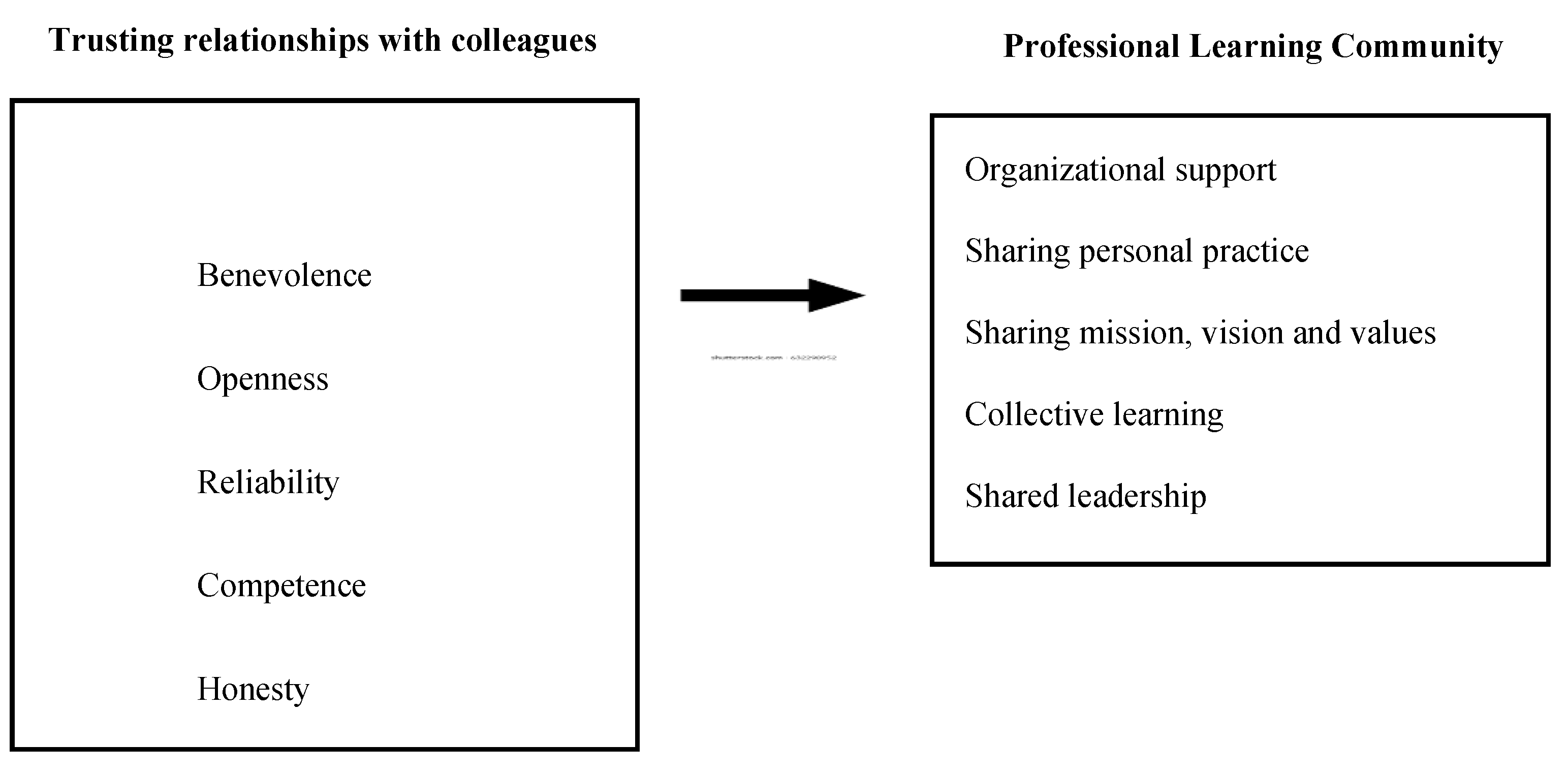
Figure 2.
Measurement model of trust relationship in colleagues.
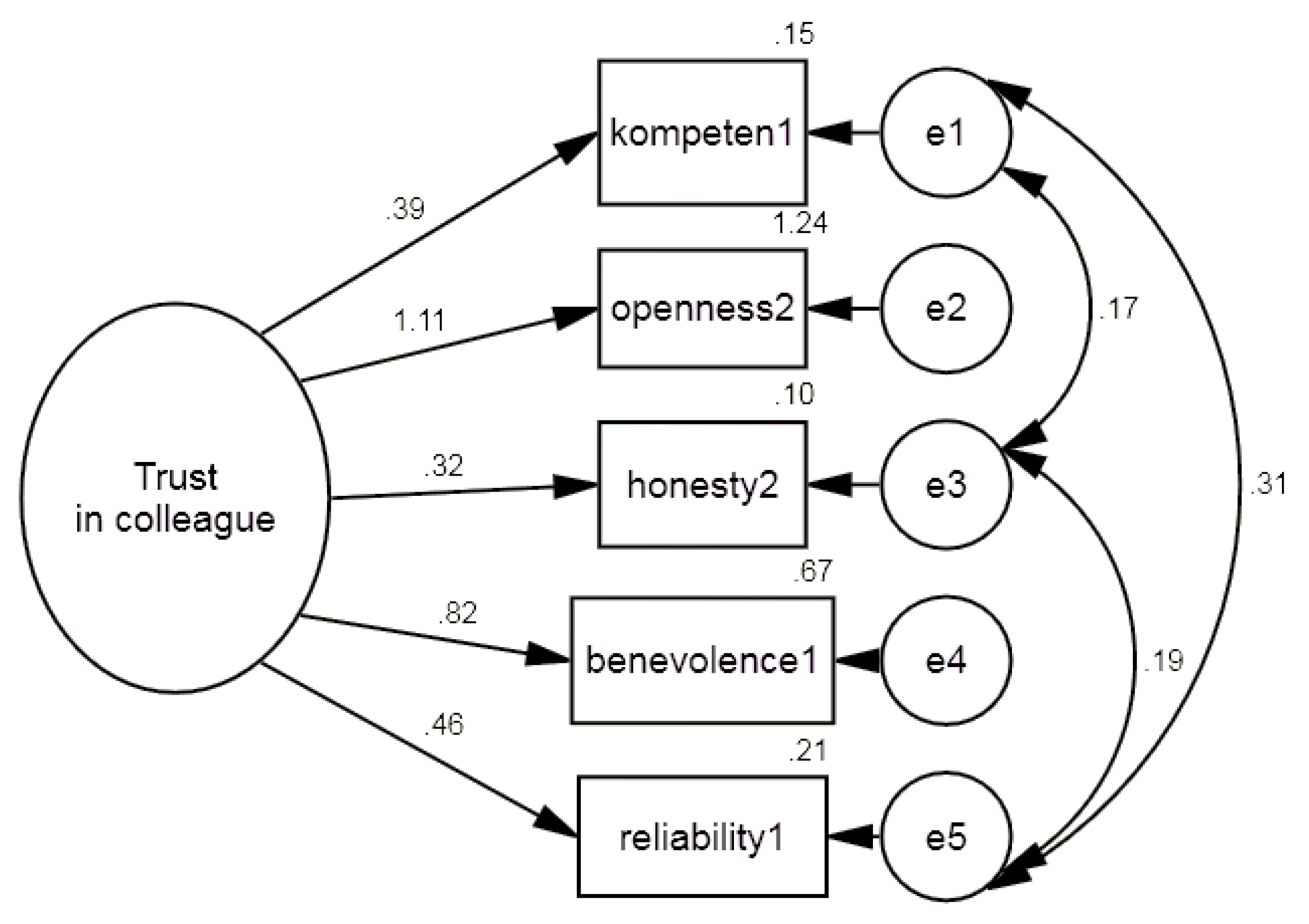
Figure 3.
Measurement model of Professional Learning Community.
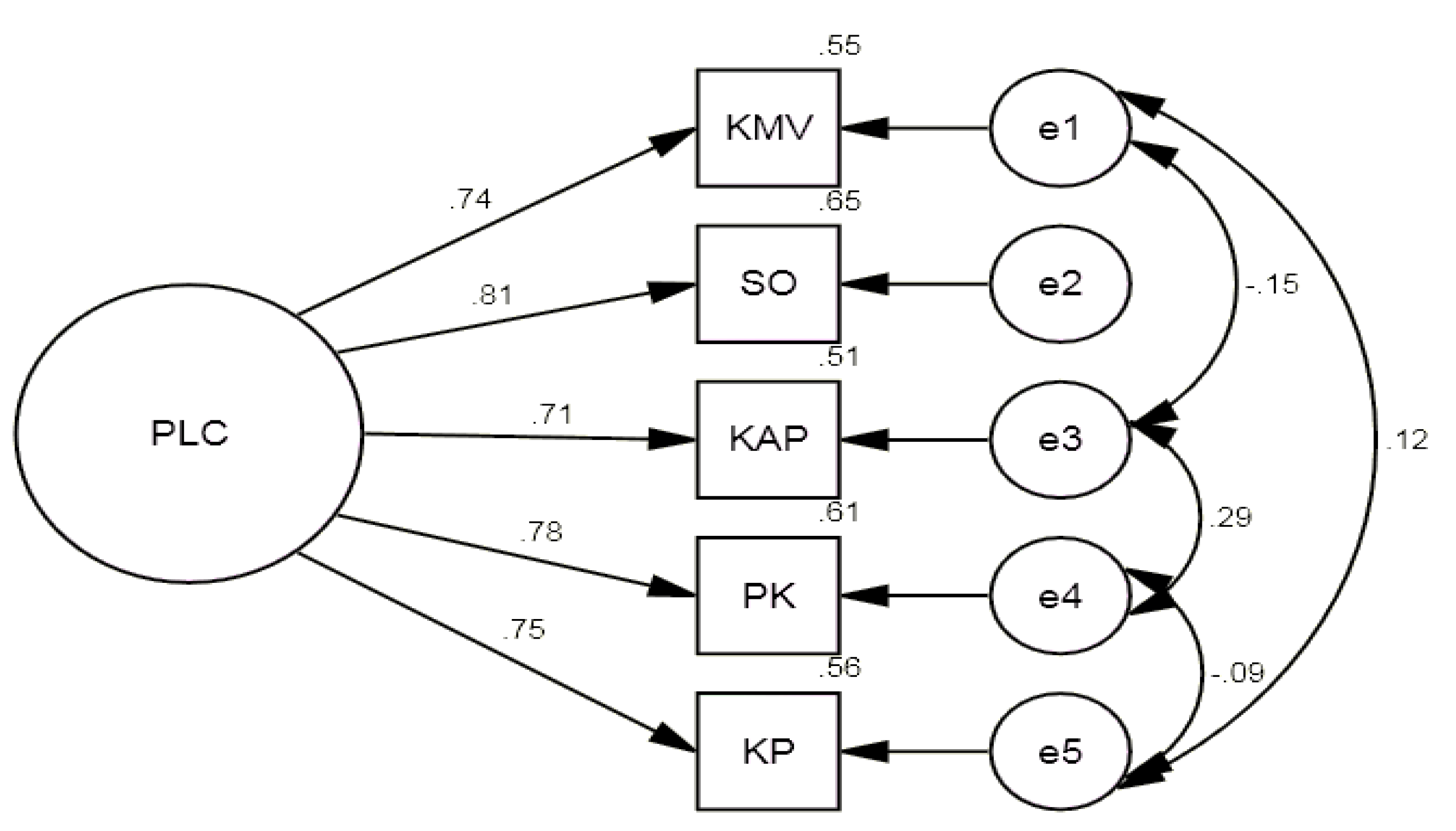
Figure 4.
Relationship model of trusting relationships with colleagues and a PLC.
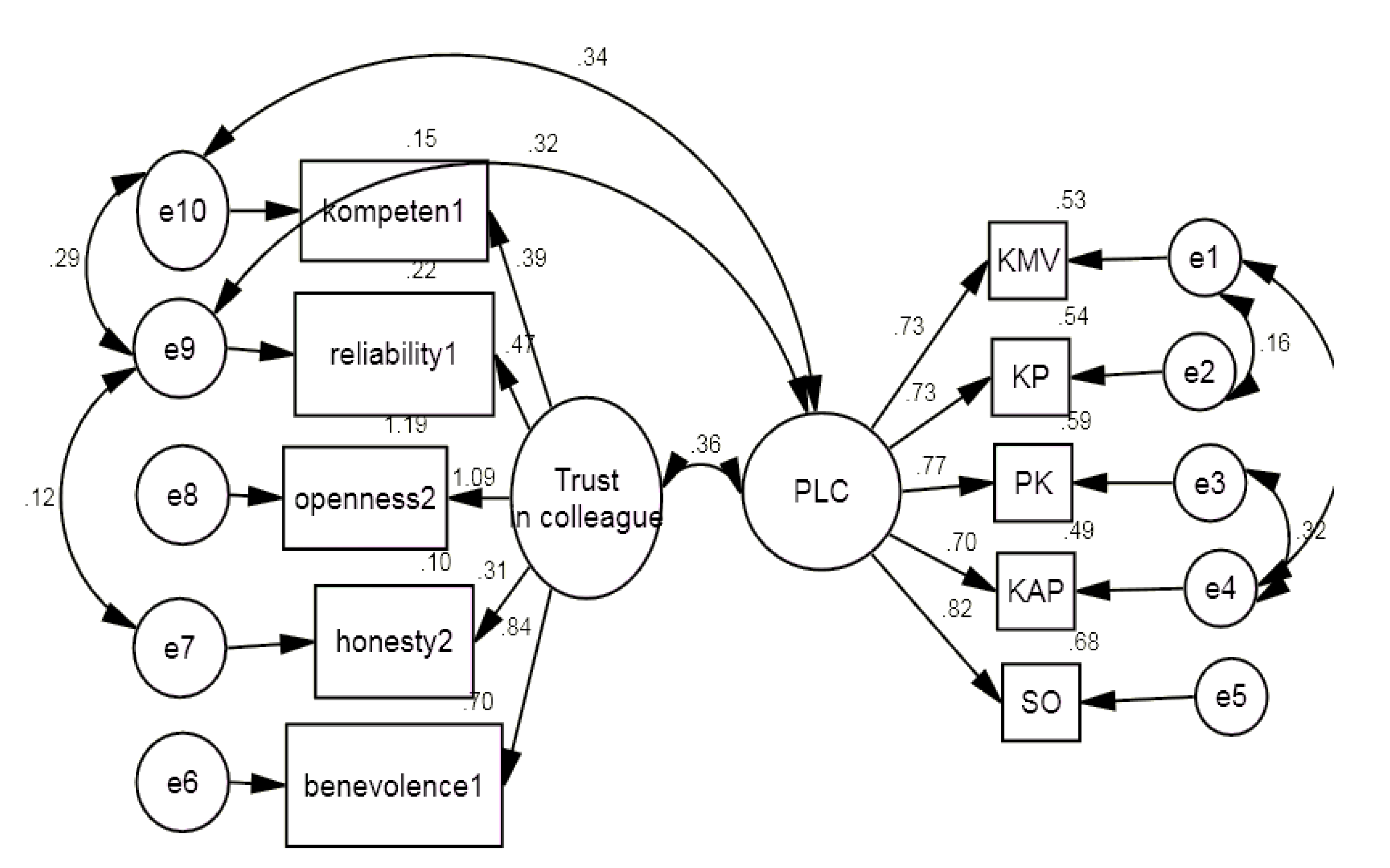

Table 1.
Tschannen-Moran and Hoy’s (1998) five facets of trust.
| Trust Constructs | Explanations |
|---|---|
| Benevolence | Caring, supporting, having positive intentions, being fair, and securing the information. |
| Honesty | Practicing integrity, telling the truth, keeping promises, accepting responsibility, and being true to oneself. |
| Competence | Provide examples to others, participate in problem-solving activities, search for results, ensure standards, and be flexible. |
| Reliability | Consistency, dependability, commitment, and high dedication. |
| Openness | Open communication, sharing the relevant information, delegating and empowering, and sharing decision-making. |
Table 2.
PLC constructs by Hord (1997).
| PLC Constructs | Explanations |
|---|---|
| Shared vision and mission | Teachers and school leaders are working together to reach the school's vision and mission. |
| Shared leadership | Sharing leadership allows teachers the chance and freedom to lead their team members. This is a way to use leadership practice that later improves shared, distributed, and teacher leadership practices. |
| Collective learning | It motivates school members to share what they know, what they've been through, and what they can do with other staff members while they are learning. |
| Sharing personal practice | Discussing how teachers might foster reflective thinking, conduct research, and improve their skills, knowledge, and resources. |
| Organizational support | The school's leadership and community must support the PLC by providing teachers with financial resources and facilities to study and enhance their teaching. |
Table 3.
Rural primary teachers' responses to trust in colleagues.
| Trust statements | Mean scores | Standard deviations |
|---|---|---|
| Teachers look after each other's interests | 4.26 | 0.69 |
| Teachers can rely on each other. | 4.25 | 0.67 |
| Teachers trust each other | 4.36 | 0.91 |
| Teachers are open with their colleagues | 4.08 | 0.71 |
| Teachers believe in the integrity of their colleagues. | 4.05 | 0.75 |
| Teachers believe in each other | 3.90 | 0.77 |
| When the teacher tells me something, I will believe it | 3.17 | 1.08 |
| The teacher is doing his job well. | 4.25 | 1.05 |
| Constructs | ||
| Benevolence | 3.29 | 0.80 |
| Openness | 3.98 | 0.77 |
| Reliability | 4.26 | 0.69 |
| Competence | 4.21 | 0.60 |
| Honesty | 3.17 | 0.67 |
| Overall mean scores | 3.78 |
Table 4.
Rural primary teachers’ responses in PLC.
| Constructs | Mean scores | Standard deviations |
|---|---|---|
| Shared leadership | 3.15 | 0.64 |
| Shared values, vision, and mission | 3.44 | 0.51 |
| Collective learning | 3.21 | 0.50 |
| Sharing personal practice | 2.90 | 0.66 |
| Organizational Support | 3.12 | 0.57 |
| Overall Mean Score | 3.16 |
Table 5.
Rural teachers’ responses to all five elements of PLC practices.
| PLC’s statements | Mean scores | Standard deviations |
|---|---|---|
| Collective learning (χ = 3.21) | ||
| Share information with colleagues to improve the quality of student learning. | 3.54 | 0.65 |
| Re-assess the effectiveness of teaching and learning through performance dialogue/committee meetings. | 3.47 | 0.71 |
| Discuss student learning issues with peers to create a culture of colleague learning. | 3.48 | 0.77 |
| Produce learning modules with peers to support the student learning process | 2.87 | 0.88 |
| Build a mentoring team to guide peers in improving the quality of teaching. |
2.79 | 0.91 |
| Shared personal practice (X = 2.90) | ||
| Observe the teaching and learning process carried out by fellow teachers. | 2.35 | 0.82 |
| Share good teaching practices that have been proven to be effective with teachers | 3.05 | 0.77 |
| Suggest methods to improve student achievement to fellow teachers. | 3.01 | 0.67 |
| Emphasize the importance of reflection in teaching and learning to teachers. | 3.07 | 0.65 |
| Moderate (coordinate) student work/test scores with fellow teachers |
3.05 | 0.58 |
| Organizational support (X = 3.12) | ||
| Allocate time to meet with the principal to discuss academic/non-academic matters. | 3.75 | 0.54 |
| Celebrate every school success together. | 3.41 | 0.53 |
| Receive recognition from the head teacher when achieving success. | 3.13 | 0.52 |
| Receive encouragement from the head teacher to improve academic/non-academic matters. | 3.31 | 0.53 |
| Use all school facilities (ICT, time, resources, and finances) to produce effective teaching. |
3.29 | 0.44 |
| Shared the school’s vision and mission (X = 3.44) | ||
| Planning programs to be in line with the vision and mission of the school. | 3.34 | 0.55 |
| Sharing a vision that focuses on student learning to improve school performance. | 3.40 | 0.53 |
| Using the school's vision and mission as a guide in implementing school tasks. | 3.48 | 0.54 |
| Being involved in academic programs to achieve the school's vision and mission. | 3.50 | 0.75 |
| Collaborating with teachers in achieving the vision and mission of the school |
3.51 | 0.75 |
| Shared leadership (X = 3.15) | ||
| Receive guidance from the principal to be an effective school leader. | 3.23 | 0.43 |
| Obtain the opportunity to make changes to the school's progress. | 3.23 | 0.43 |
| Involved in making decisions related to academic/non-academic progress. | 3.11 | 0.76 |
| Participate in planning school management. | 3.03 | 0.88 |
| Responsible for decisions taken to improve school achievement. | 3.19 | 0.78 |
Table 6.
Significant differences based on rural primary teachers’ demographic factors.
|
Trust constructs |
Gender | Teaching experience | Age | |||
|---|---|---|---|---|---|---|
| t | Sig | F | Sig | F | Sig | |
| Benevolence | 2.36 | .12 | 0.71 | .61 | 1.26 | .27 |
| Openness | 2.99 | .84 | 0.86 | .50 | 1.42 | .20 |
| Reliability | 4.80 | .02* | 0.22 | .91 | 1.13 | .34 |
| Competence | 1.71 | .19 | 0.53 | .74 | 1.05 | .39 |
| Honesty | 1.27 | .26 | 2.34 | .04* | 0.73 | .62 |
p < 0.05*; p < 0.01**; N = 310.
Table 7.
Results of LSD post-hoc analysis of rural primary teachers’ teaching experience.
| Trust Constructs | Teaching experience | Mean Difference |
Sig |
|
|---|---|---|---|---|
| Group 1 | Group 2 | |||
| Honesty | 21 - 25 years | 11 to 15 years | 0.22 | 0.02* |
| 16 to 20 years | 0.19 | 0.04* | ||
| 26 years and above |
0.30 | 0.00* | ||
p < 0.05*; p < 0.01**: N = 310.
Table 8.
Significant differences based on rural primary teachers’ demographic factors.
|
PLC constructs |
Gender | Teaching experience | Age | |||
|---|---|---|---|---|---|---|
| t | Sig | F | Sig | F | Sig | |
| Shared leadership | 0.18 | 0.67 | 1.65 | 0.14 | 1.86 | 0.08 |
| Shared values, vision, and mission | 0.83 | 0.36 | 4.31 | 0.00* | 4.97 | 0.00* |
| Collective learning | 0.29 | 0.58 | 0.93 | 0.45 | 1.33 | 0.24 |
| Sharing personal practice | 4.79 | 0.02* | 0.72 | 0.60 | 1.24 | 0.28 |
| Organizational support | 2.41 | 0.12 | 1.39 | 0.22 | 1.83 | 0.91 |
p < 0.05*; p < 0.01**; N = 310.
Table 9.
Results of LSD post-hoc analysis of rural primary teachers’ teaching experience.
| PLC Construct | Teaching experience | Mean Difference |
Sig |
|
|---|---|---|---|---|
| Group 1 | Group 2 | |||
| Shared values, vision, and mission. |
21 - 25 years | Less than 6 years | 0.25 | 0.04* |
| 6 to 10 years | 0.22 |
0.04* | ||
p < 0.05*; p < 0.01**: N = 310.
Table 10.
Results of the LSD post-hoc analysis of the rural primary teachers’ age factor.
| Construct | Age | Mean Difference |
Sig |
|
|---|---|---|---|---|
| Group 1 | Group 2 | |||
| Shared values, vision, and mission. |
50 to 55 years | 25 to 29 years | 0.58 | 0.00* |
| 30 to 34 years | 0.43 | 0.00* | ||
| 35 to 39 years | 0.30 | 0.01* | ||
| 40 to 44 years | 0.31 | 0.00* | ||
| 45 to 49 years | 0.23 | 0.01* | ||
| 55 years and above | 0.26 | 0.03* | ||
p < 0.05*; p < 0.01**: N = 310.
Table 11.
Means, Standard deviations, and Correlation values.
| M | SD | SO | KM | PK | KP | KAP | PLC | BV | HTY | RELI | CPT | OPNS | TIC | |
|---|---|---|---|---|---|---|---|---|---|---|---|---|---|---|
| SO | 3.17 | .57 | - | |||||||||||
| KM | 3.44 | .51 | .57 | - | ||||||||||
| PK | 3.21 | .50 | .62 | .59 | - | |||||||||
| KP | 3.12 | .64 | .62 | .60 | .54 | - | ||||||||
| KAP | 2.90 | .66 | .59 | .45 | .68 | .51 | - | |||||||
| PLC | 3.17 | .47 | .83 | .78 | .83 | .81 | .80 | - | ||||||
| BV | 4.25 | .62 | .40 | .34 | .41 | .35 | .29 | .44 | - | |||||
| HTY | 3.57 | .47 | .39 | .29 | .29 | .28 | .29 | .23 | .29 | - | ||||
| RELI | 4.17 | .53 | .44 | .37 | .44 | .37 | .33 | .47 | .75 | .20 | - | |||
| CPT | 4.13 | .58 | .40 | .35 | .36 | .31 | .26 | .41 | .63 | .31 | .86 | - | ||
| OPNS | 4.21 | .55 | .30 | .11 | .15 | .14 | .11 | .16 | .30 | .30 | .39 | .44 | - | |
| TIC | 3.87 | .51 | .39 | .32 | .35 | .32 | .26 | .39 | .72 | .58 | .82 | .67 | .77 | - |
*p< .05; **p<. 01; N = 310. SO- Organizational support; KM- Shared Value, Mission, and Vision; PK- Collective learning; KP- Shared leadership; KAP- Shared Personal Practice; PLC- Professional Learning Community; BV- Benevolence; HTY- Honesty; RELIA- Reliability; CPT- Competence; OPNS- Openness; TiC- Trust in Colleagues.
Table 12.
Regression weights estimation for trust relationship in colleagues.
| Path | Estimate | S.E. | C.R. | Sig | ||
|---|---|---|---|---|---|---|
| Competence1 | <--- | Trust_in colleague | 1.000 | |||
| Openness2 | <--- | Trust_in colleague | 3.693 | .500 | 7.391 | ** |
| Honesty2 | <--- | Trust_in colleague | .927 | .150 | 6.168 | ** |
| Benevolence1 | <--- | Trust_in colleague | 3.804 | .463 | 8.213 | ** |
| Reliability1 | <--- | Trust_in colleague | 1.375 | .165 | 8.347 | ** |
* Significant at the 0.05; ** Significant at the 0.01 level; N = 310.
Table 13.
Regression weights estimation of professional learning community.
| Path | Estimate | S.E. | Sig | |||
|---|---|---|---|---|---|---|
| Collective learning | <--- | PLC practices | 1.000 | |||
| Shared personal practices | <--- | PLC practices | 1.232 | .087 | ** | |
| Organizational support | <--- | PLC practices | 1.204 | .090 | ** | |
| Shared values, mission, and vision | <--- | PLC practices | 1.037 | .081 | ** | |
| Shared leadership | <--- | PLC practices | 1.276 | .100 | ** | |
* Significant at the 0.05; ** Significant at the 0.01 level; N = 310.
Table 14.
Regression coefficients of trusting relationships with colleagues with PLC.
|
Model 1 |
Unstandardized Coefficients | Standardized Coefficients |
t |
Sig. |
|
|---|---|---|---|---|---|
|
β |
SE |
Beta | |||
| Trust in a colleague | .349 | .043 | .424 | 8.213 | .00* |
| Model 2 | |||||
| Competence | .185 | .046 | .236 | 4.06 | .00* |
| Reliability | .145 | .042 | .214 | 3.46 | .01* |
| Honesty | .036 | .038 | .052 | 0.94 | .34 |
| Openness | .204 | .086 | .335 | 2.36 | .01* |
| Benevolence | -.106 | .056 | -.242 | -1.89 | .05 |
* Significant at the 0.05; ** Significant at the 0.01 level; N = 310.
Disclaimer/Publisher’s Note: The statements, opinions and data contained in all publications are solely those of the individual author(s) and contributor(s) and not of MDPI and/or the editor(s). MDPI and/or the editor(s) disclaim responsibility for any injury to people or property resulting from any ideas, methods, instructions or products referred to in the content. |
© 2026 by the authors. Licensee MDPI, Basel, Switzerland. This article is an open access article distributed under the terms and conditions of the Creative Commons Attribution (CC BY) license.
Copyright: This open access article is published under a Creative Commons CC BY 4.0 license, which permit the free download, distribution, and reuse, provided that the author and preprint are cited in any reuse.


