

Submitted:
12 February 2026
Posted:
13 February 2026
You are already at the latest version
Abstract
This article presents AgroNova, an intelligent and autonomous Internet of Things (IoT) platform developed for real-time monitoring and control of the microclimate in greenhouses. The system combines distributed wireless sensor nodes, actuator mod-ules, a local gateway equipped with a rule-based control agent, and a cloud infra-structure for data visualization and decision support. The platform’s hybrid architec-ture enables autonomous operation in the event of internet failures and at the same time allows the integration of a large language model (LLM) for context-based deci-sions.
AgroNova was implemented in a tomato greenhouse and validated over a period of seven months, during which over 400,000 environmental data points were recorded. The system effectively kept temperature and humidity within optimal agronomic ranges and reduced deviation time compared to manual control. In experimental tests, the LLM component generated relevant recommendations under complex conditions, such as bad weather.
The results show that AgroNova is a reliable and scalable solution for greenhouse microclimate management. The combination of local autonomy and cloud intelligence of the platform offers promising applications in precision agriculture. Future work in-cludes extending the scope of LLM-assisted reasoning and adapting the platform to additional crops and greenhouse environments.
Keywords:
IoT in agriculture
; greenhouse climate control
; rule-based agent
; cloud-assisted reasoning
; edge computing
; context-aware decision support
; LLM integration
1. Introduction
Modern agriculture faces growing challenges related to climate change, sustainable resource management, and the need for optimized, reliable production processes. In this context, automated and intelligent microclimate control systems for greenhouses have become key technologies for improving crop yield, ensuring consistent product quality, and reducing reliance on manual intervention [1,2,3].
Over the past decade, the integration of the Internet of Things (IoT) and artificial intelligence (AI) into greenhouse management systems has received considerable attention [4,5,6]. Commercial solutions such as AI Garden, IoT Monitor, and Thermosense typically provide basic monitoring and control functions, including temperature, humidity, and lighting regulation. Other platforms, such as those offered by Axbul, incorporate connectivity to external meteorological services (e.g., Meteobot®). While these systems support essential monitoring tasks, they generally rely on predefined control rules and threshold-based automation, offering limited adaptability and minimal contextual decision support [7,8,9].
From a research perspective, various approaches have been proposed to enhance the efficiency and sustainability of greenhouse systems. Some studies focus on energy optimization strategies and the integration of renewable energy sources [10,11], while others investigate wireless sensor networks and mobile sensing platforms for environmental monitoring [12]. Advances in computer vision and AI-based image processing have also been applied to crop monitoring, growth analysis, and disease detection [13,14]. However, these efforts often address isolated subsystems rather than the coordinated operation of sensing, decision making, and actuation within a unified architectural framework.
Despite recent progress, there remains a notable gap in integrated platforms that combine distributed sensor architectures, cloud-based services, autonomous intelligent agents, and large language models (LLMs) for high-level inference and decision support. Prior work in smart agriculture has predominantly emphasized machine learning techniques for yield prediction, plant disease classification, and visual analytics [15,16,17], while higher-level reasoning and adaptive control mechanisms have received comparatively less attention. In particular, the use of LLMs as consultative components for contextual reasoning and system-level decision support in greenhouse environments remains largely unexplored.
Edge computing has been increasingly adopted to support real-time monitoring, low-latency control, and local autonomy in agricultural systems [18,19]. These approaches improve system responsiveness and resilience but are typically limited to reactive control strategies or narrowly defined optimization tasks. Context-aware decision making that integrates local edge intelligence with cloud-based reasoning and global system awareness is still insufficiently addressed. Recent advances in foundation models and large-scale language models demonstrate strong potential for cross-domain reasoning and decision support [20,21,22], yet their practical integration into operational agricultural IoT platforms remains limited.
To address these challenges, AgroNova adopts a hybrid architectural approach in which local intelligent agents operate autonomously at the edge [23,24,25,26], while selectively consulting a remote LLM when complex, ambiguous, or multi-factor situations arise. This design enables continuous operation under limited connectivity conditions while allowing higher-level reasoning to be incorporated when required. AgroNova bridges the gap between low-level sensor-driven automation and high-level decision support through a unified platform that integrates distributed sensing, agent-based control, cloud services, and optional LLM-assisted reasoning.
The proposed platform integrates distributed sensing, agent-based control, cloud services, and LLM-assisted reasoning within a unified, modular framework. The main features of AgroNova include:
- a modular, scalable sensor–actuator architecture suitable for heterogeneous greenhouse environments;
- resilient operation enabled by autonomous local control during limited or absent network connectivity;
- consultative LLM-based decision support for complex or non-standard scenarios;
- and long-term validation through deployment in a real greenhouse environment over an extended operational period.
2. Materials and Methods
2.1. System Architecture
AgroNova is a modular IoT-based platform for greenhouse microclimate management, designed with a distributed architecture that integrates local intelligent agents and centralized cloud services. The system includes sensor and actuator nodes, an intelligent gateway with a rule-based agent, and a remote server infrastructure with a large language model and visualization tools. The main system components, shown in Figure 1, include:
- Sensor nodes (S)
- Actuator nodes (A)
- Coordinator (C)
- Router (R)
- Intelligent gateway (Sg)
- Remote server (Sv)
- Long-range wireless link (L)
- Cloud services.
The rule-based agent on the gateway works autonomously and evaluates the environmental conditions in real time. In complex scenarios (e.g., conflicting data or predicted rain at high temperature), it sends a request to the LLM via the server. The server responds with a contextually based recommendation that is executed locally.
AgroNova is designed to maintain functionality even during temporary internet outages, making it suitable for remote or rural agricultural environments.
2.2. Hardware Implementation
To evaluate the practical feasibility of AgroNova, a prototype was used in a tomato greenhouse at the Maritsa Vegetable Crops Research Institute in Plovdiv, Bulgaria (Figure 2).
The hardware setup includes the following components:
- Five mobile, low-power sensor nodes based on ESP32 microcontrollers (Espressif Systems), each equipped with a DHT22 digital sensor for temperature and humidity measurements (Aosong Electronics);
- A battery power supply with an integrated charging circuit for autonomous operation;
- Actuator modules based on the ESP8266 microcontroller (Espressif Systems), each equipped with two relays for controlling electric ventilation shutters;
- An ESP32-based coordinator node for aggregating and forwarding sensor data;
- A Wi-Fi router used to establish the local wireless network;
- A smart gateway implemented with Orange Pi Zero (Shenzhen Xunlong Software Co.), running the Armbian operating system and hosting a rule-based control agent, Mosquitto MQTT broker, and Node-RED logic flows;
- A remote server configured to host a PostgreSQL database, a large language model (Mistral AI), a server-side agent, and Grafana dashboards for visualization;
- A pair of 5 GHz MikroTik antennas, enabling long-range wireless communication (up to 12 km) between the gateway and the remote server (Figure 3).
2.3. Software Implementation
The software stack of the AgroNova platform includes the following components:
- Python-based agents responsible for decision-making at both local and server levels;
- Mosquitto MQTT brokers (Eclipse Foundation) used for lightweight message exchange between system nodes;
- Node-RED logic flows (OpenJS Foundation) employed for orchestration and low-code programming of data processes;
- PostgreSQL database (PostgreSQL Global Development Group) for structured storage of sensor and system data;
- Grafana dashboards (Grafana Labs) for real-time monitoring, historical data visualization, and analytics;
- Mistral large language model (Mistral AI) integrated via API for context-aware reasoning;
- OpenWeatherMap API (OpenWeather Ltd.) for external weather data retrieval;
- Portainer (Portainer.io) used for managing Docker container environments;
- ESP-NOW and Wi-Fi (IEEE 802.11) wireless communication protocols supporting intra-network connectivity.
3. Results and Discussion
3.1. Validation in a Real Environment
The AgroNova prototype was used and tested in a real agricultural environment over a period of seven months. The tests took place in an unheated greenhouse and covered different climatic seasons, which allowed a reliable assessment of the robustness and applicability of the system under changing environmental conditions.
During the entire validation period, each of the five sensor nodes collected approximately 72 measurements per day. The collected data was transmitted to the remote server at 20-minute intervals, resulting in a cumulative dataset of almost 400,000 measurements stored in the system’s database. The Grafana interface provided real-time monitoring and analysis capabilities that could be accessed remotely via a web-based dashboard (Figure 4).
The system operated continuously and without interruption, with the exception of scheduled scenarios used to assess the gateway agent’s ability to operate autonomously in the event of a temporary loss of internet connectivity.
3.2. Behavior Analysis and Adaptability
Data analysis showed that the platform was able to maintain the microclimate in the greenhouse within the optimal limits specified in the agronomic guidelines: Temperature between 15° C and 30° C and relative humidity between 60% and 85%. The system responded to deviations from these limits with minimal delay.
The average response time after a deviation occurred was less than one minute, which is significantly shorter compared to manual control. Table 1 shows selected examples of agent response delays recorded during the validation period. As expected, server-side decisions (involving the LLM) exhibited slightly higher delays due to internet latency and reasoning time, while rule-based local decisions were almost instantaneous.
Another important aspect of autonomous IoT systems is the sustainability of the energy supply. Battery life was assessed by analyzing the number of the system restarts due to depleted batteries and the number of measurements taken per session (defined as the time between two restarts). The results are summarized in Table 2. The sensors with IDs 2 and 4 performed more than 15,000 measurements per session without requiring a battery change or restarts, indicating stable energy performance. Other nodes experienced one or more restarts, which in one case were caused by external environmental damage (a broken window leading to flooding). These results support the scheduling of preventive maintenance and battery replacement cycles based on observed device behavior.
3.3. Role of the Intelligent Module
In the first version of the AgroNova platform, decision making was handled exclusively by a rule-based local agent embedded in the gateway. Table 3 shows representative cases that illustrate the agent’s actions based on predefined environmental thresholds.
However, field observations showed that these rules alone were not sufficient to make contextual decisions, especially when external weather conditions were not taken into account. To address this limitation, a second version of the platform was implemented that includes a hybrid decision making strategy with a large language model on a remote server.
In this version, the local agent initiates a decision request to the LLM under the following conditions:
- when the indoor temperature is above 30° C or the humidity is above 85% and
- if an internet connection to the server is available.
If no connection is available or the thresholds are not exceeded, the local agent proceeds with a rule-based decision.
When turned on, the LLM agent evaluates sensor data, external weather forecasts (retrieved via the API) and the agronomic knowledge encoded in the prompt to generate an appropriate action. The final recommendation is returned to the local agent, which executes the decision.
During the test phase, there were several temporary internet outages. In all cases, the local agent remained functional and continued to apply the rules autonomously.
Table 4 shows examples of LLM-assisted decisions as opposed to rule-based local responses. In one notable case, the LLM advised to keep the shutters closed despite increased temperature due to simultaneous rainfall — a context-dependent decision that exceeded the capabilities of the rule-based agent. Table 4 shows real LLM responses as returned by the Mistral model in unmodified form.
4. Conclusions
AgroNova is an intelligent IoT platform designed for autonomous climate control in greenhouses. It integrates a capillary sensor infrastructure, actuator logic, a local rule-based agent, cloud services, a server-side agent and a large language model, making it a flexible and adaptable solution for precision agriculture.
A seven-month deployment in a tomato greenhouse demonstrated the robustness, autonomy and effectiveness of the system in maintaining optimal microclimatic conditions under changing environmental factors. The platform operated continuously, even during internet outages, and supported real-time visualization and decision support through Grafana dashboards and LLM-powered reasoning.
AgroNova’s contributions go beyond typical IoT greenhouse systems. It offers a working hybrid architecture with local and cloud agents, contextual decision making through LLM integration and proven precision in microclimate management through quantitative analysis. The modular design allows for seamless scaling with additional sensors or AI modules, while autonomous operation with limited connectivity enables deployment in rural areas.
Future developments could include training the LLM on crop-specific agronomic data, integrating energy optimization metrics and extending functionality to disease detection and stress response mechanisms. Thanks to its adaptable architecture, AgroNova can be applied to different crops and environments, providing added value to both research institutions and agricultural practitioners.
AgroNova is more than just an automation platform. It demonstrates how IoT and AI can converge to enable smart, self-adapting agroecosystems – shaping the future of sustainable agriculture.
Author Contributions
Conceptualization, B.T. and A.T.; methodology, B.T. and A.T.; software, B.T.; formal analysis, A.T.; investigation, B.T.; data curation, B.T.; writing — original draft preparation, A.T.; writing – review and editing, A.T.; visualization, B.T. and A.T.; funding acquisition, A.T. All authors have read and agreed to the published version of the manuscript.
Funding
The authors would like to acknowledge the support of the National Scientific Program “Intelligent Crop Production” (2021–2024), funded by the Ministry of Education and Science of the Republic of Bulgaria, under which the prototype of AgroNova was developed.
Data Availability Statement
The data presented in this study are not publicly available due to confidentiality and operational restrictions but are available from the corresponding author upon reasonable request.
Conflicts of Interest
The authors declare no conflicts of interest.
References
- Shamshiri, R.; Hameed, I.; Thorp, K.; Balasundram, S.; Shafian, S.; Fatemieh, M.; Sultan, M.; Mahns, B.; Samiei, S. “Greenhouse Automation Using Wireless Sensors and IoT Instruments Integrated with Artificial Intelligence” Book: Next-Generation Greenhouses for Food Security; Intech: Publisher, 2021. [Google Scholar] [CrossRef]
- Badji, A.; Benseddik, A.; Bensaha, H.; Boukhelifa, A.; Hasrane, I. Design, technology, and management of greenhouse: A review. Journal of Cleaner Production 2022, vol. 373, 133753. [Google Scholar] [CrossRef]
- Ray, P. A survey on Internet of Things architectures. Journal of King Saud University - Computer and Information Sciences 2018, vol. 30(no. 3), 291–319. [Google Scholar] [CrossRef]
- Ayaz, M.; Ammad-Uddin, M.; Sharif, Z.; Mansour, A.; Aggoune, E.-H.M. Internet-of-Things (IoT)-based smart agriculture: Toward making the fields talk. IEEE Access 2019, vol. 7, 129551–129583. [Google Scholar] [CrossRef]
- Khanna, A.; Kaur, S. Evolution of Internet of Things (IoT) and its significant impact in the field of precision agriculture. Computers and Electronics in Agriculture 2019, vol. 157, 218–231. [Google Scholar] [CrossRef]
- Tokmakov, D.; Asenov, S.; Dimitrov, S. “Research and development of ultra-low power LoraWan sensor node”. 2019 IEEE XXVIII International Scientific Conference Electronics (ET), 2019; pp. 1–4. [Google Scholar] [CrossRef]
- Davor, C.; Dodig, I.; Cesar, I.; Kramberger, T. Developing a modern greenhouse scientific research facility - a case study. Sensors 2021, vol. 21(no. 8), 2575. [Google Scholar] [CrossRef]
- Verdouw, C.; Tekinerdogan, B.; Beulens, A.; Wolfert, S. Digital twins in smart farming. Agricultural Systems 2021, vol. 189, 103046. [Google Scholar] [CrossRef]
- Riahi, J.; Vergura, S.; Mezghani, D.; Mami, A. Intelligent Control of the Microclimate of an Agricultural Greenhouse Powered by a Supporting PV System (1350). Applied Sciences 2020, vol. 10(no. 4), 20. [Google Scholar] [CrossRef]
- Gorjian, S.; Ebadi, H.; Najafi, G.; Chandel, S.; Yildizhan, H. Recent advances in net-zero energy greenhouses and adapted thermal energy storage systems. Sustainable Energy Technologies and Assessments 2021, vol. 43, 100940. [Google Scholar] [CrossRef]
- Jawad, M.; Wahid, F.; Ali, S. Energy optimization and plant comfort management in smart greenhouses using the artificial bee colony algorithm. Scientific Reports 2025, vol. 15, 1752. [Google Scholar] [CrossRef] [PubMed]
- Musa, P.; Sugeru, H.; Wibowo, E. Wireless Sensor Networks for Precision Agriculture: A Review of NPK Sensor Implementations. Sensors vol. 1, 51. [CrossRef] [PubMed]
- Benos, L.; Tagarakis, A.; Dolias, G.; Berruto, R.; Kateris, D.; Bochtis, D. Machine learning in agriculture: A comprehensive updated review. Sensors 2021, vol. 21(no. 11), 3758. [Google Scholar] [CrossRef] [PubMed]
- Anilkumar, P.; Tokmakov, D.; Venugopal, P.; Koppu, S.; Mileva, N.; Bekyarova-Tokmakova, A. A Multi-Objective Derived Adaptive TransDeepLabv3 Using Electric Fish Optimization Algorithm for Aerial Image Semantic Segmentation. IEEE Access vol. 12, 147723–147738. [CrossRef]
- Azlan, Z.; Junaini, S.; Khan, A.; Mustafa, W. Data-Driven Agriculture: Unveiling the Power of Internet of Things and Data Analytics For Transformative Farming Practices. Journal of Sensors. [CrossRef]
- Qian, M.; Qian, C.; Yu, W. “Edge intelligence in smart agriculture CPS” Book: Edge Intelligence in Cyber-Physical Systems. 2025, vol. 11, 265–291. [Google Scholar] [CrossRef]
- Gupta, G.; Pal, S.K. Applications of AI in precision agriculture. Discover Agriculture 2025, vol. 3, 61. [Google Scholar] [CrossRef]
- Gong, R.; Zhang, H.; Li, G.; He, J. Edge Computing-Enabled Smart Agriculture: Technical Architectures, Practical Evolution, and Bottleneck Breakthroughs. Sensors vol. 25, 5302. [CrossRef] [PubMed]
- Qiu, T.; Liu, K.; Li, M. A survey on edge computing in smart agriculture. IEEE Access 2020, vol. 8, 161605–161628. [Google Scholar]
- Bommasani, R.; Hudson, D.A.; Adeli, E.; Altman, R.A.S.; von Arx, S.; Bernstein, M.; Bohg, J.; Bosselut, A.; Brunskill, E. “On the opportunities and risks of foundation models”; Computer Science: Machine Learning., 2022. [Google Scholar] [CrossRef]
- Mohammadabadi, S.; Kara, B.; Eyupoglu, C.; Uzay, C.; Tosun, M.; Karakuş, O.A. A Survey of Large Language Models: Evolution, Architectures, Adaptation, Benchmarking, Applications, Challenges, and Societal Implications. Electronics 2025, vol. 14, 3580. [Google Scholar] [CrossRef]
- Liu, P.; Yuan, W.; Fu, J.; Jiang, Z.; Hayashi, H.; Neubig, G. Pre-train, Prompt, and Predict: A Systematic Survey of Prompting Methods in Natural Language Processing. ACM Computing Surveys vol. 55(no. 9), 1–35. [CrossRef]
- Neelamegam, G.; Rajaram, V.; Ramya, S.; Akshya, J.; Sundarrajan, M. Multi-Agent Systems for Autonomous IoT Network Management Using Distributed Reinforcement Learning. 3rd International Conference on Intelligent Systems; Advanced Computing and Communication, 2025; pp. 906–911. [Google Scholar] [CrossRef]
- Toskov, B.; Toskova, A.; Bogdanov, S.; Spasova, N. Intelligent Management of IoT Devices with Limited Connectivity. In International Conference Automatics and Informatics (ICAI); 2021; pp. 354–357. ISBN 978-1-6654-2662-6. [Google Scholar] [CrossRef]
- Toskov, B.; Toskova, A.; Bogdanov, S.; Spasova, N. “Intelligent IoT Gateway” in International Conference Automatics and Informatics (ICAI); 2021; Volume SBN, ISBN 978-1-6654-2662-6. [Google Scholar] [CrossRef]
- Leitão, P.; Strasser, T.I.; Karnouskos, S.; Ribeiro, L.; Barbosa, J.; Huang, V. Recommendation of Best Practices for Industrial Agent Systems based on the IEEE 2660.1 Standard. 22nd IEEE International Conference on Industrial Technology (ICIT), 2021; pp. 1157–1162. [Google Scholar] [CrossRef]
Figure 1.
Conceptual architecture of the AgroNova platform.
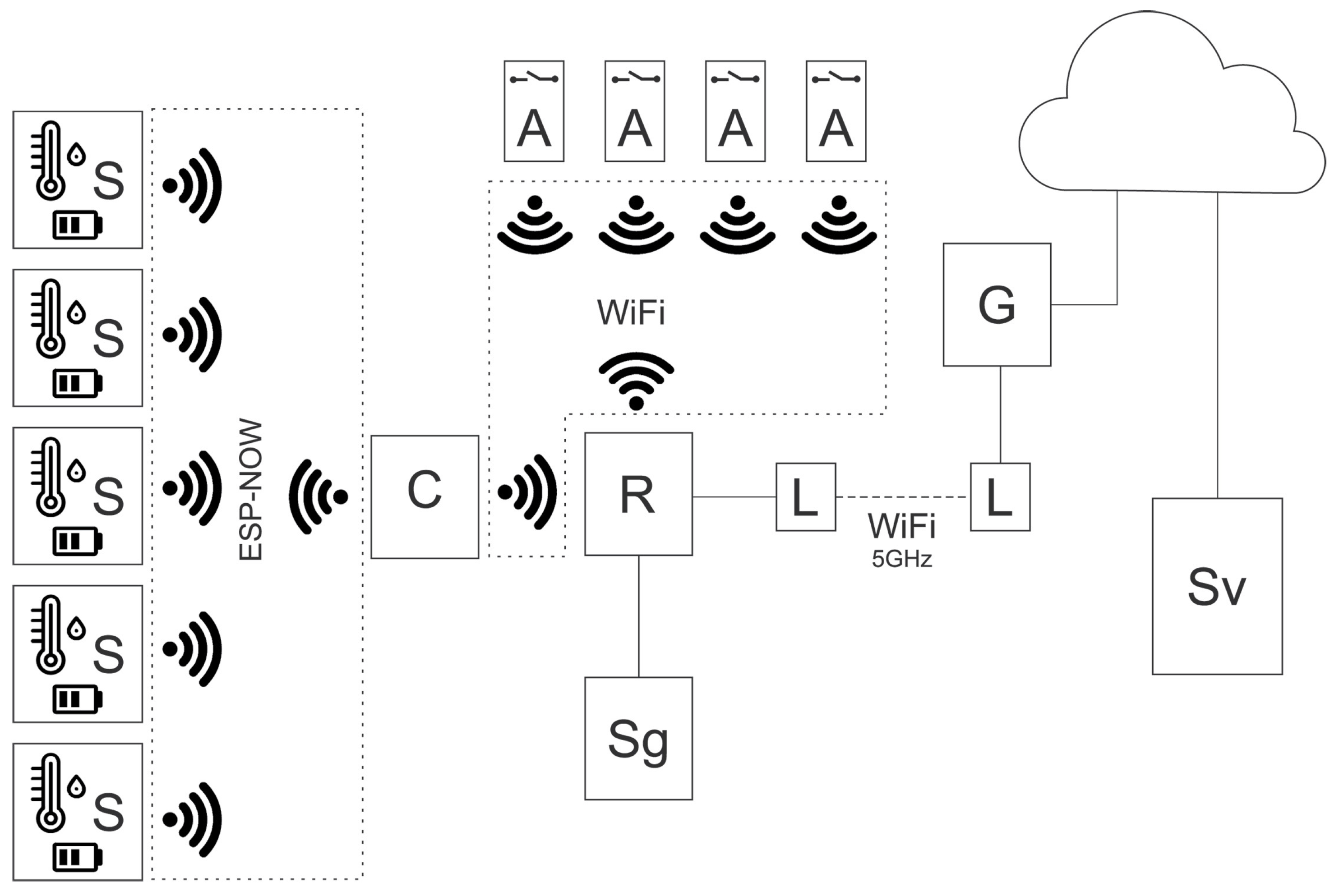
Figure 2.
Sensor nodes installation in greenhouse.
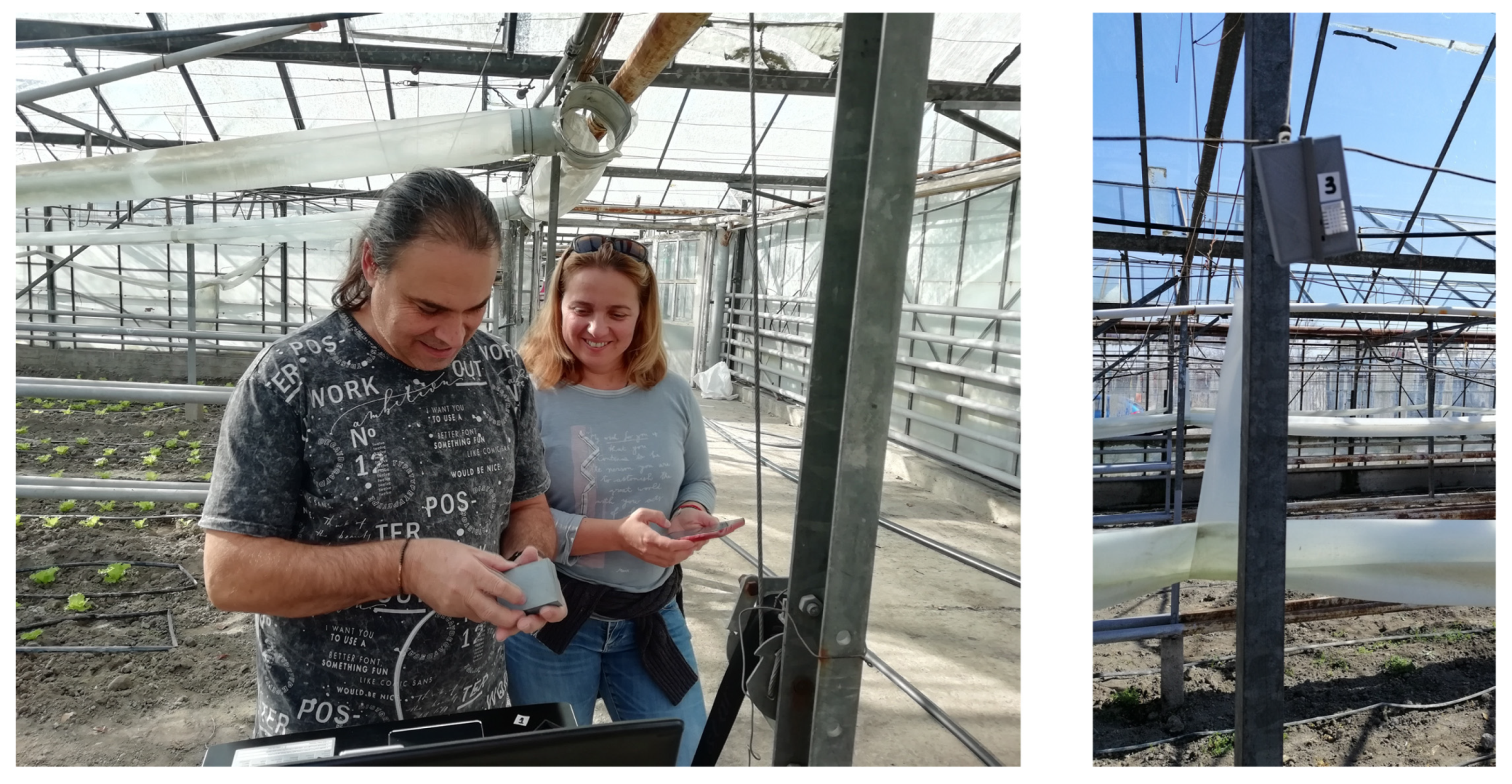
Figure 3.
Long-range Wi-Fi antenna setup.
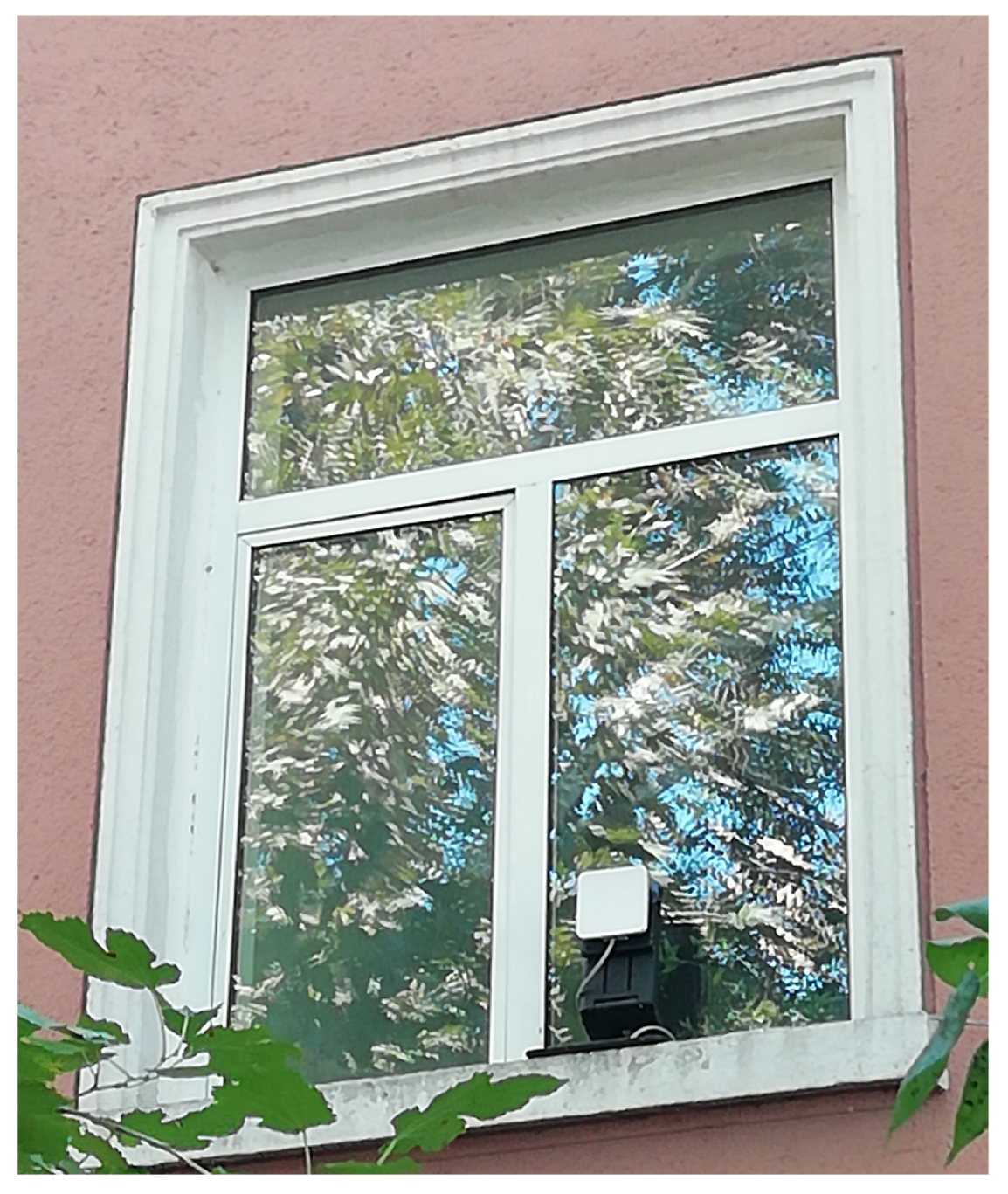
Figure 4.
An example of daily sensor data in the Grafana environment.
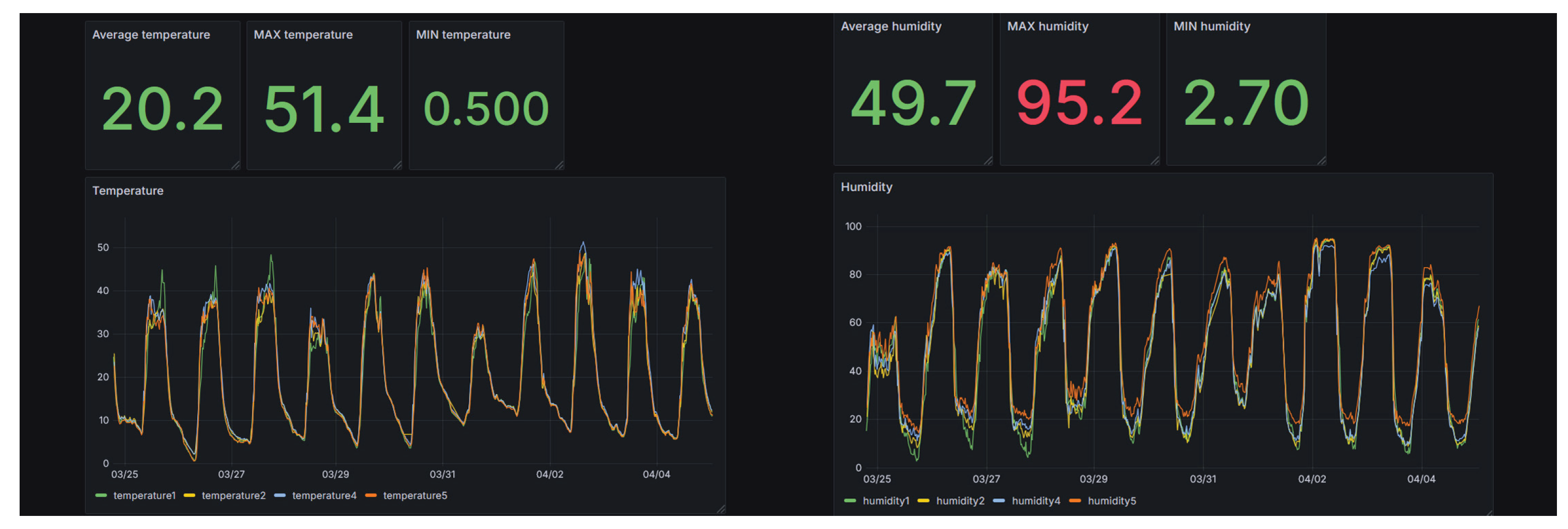

Table 1.
Agent response delay.
| Date | Time | Delay [sec] | Action source |
| 27.03.2024 | 07:02 | 0.0 | Local agent |
| 28.03.2024 | 10:42 | 26.1 | Server agent |
| 05.06.2024 | 14:11 | 26.1 | Server agent |
| 05.06.2024 | 14:31 | 6.0 | Server agent |
| 15.06.2024 | 23:38 | 0.0 | Local agent |
| 16.06.2024 | 09:16 | 6.0 | Server agent |
| 21.06.2024 | 08:31 | 6.0 | Server agent |
| 21.06.2024 | 08:51 | 6.0 | Server agent |
Table 2.
Sensor battery life.
| Sensor id | Number of restarts (battery empty) | Max. measurements per session |
| 1 | 2 | 8149 |
| 2 | 0 | 15209 |
| 3 | 2 | 6605 |
| 4 | 0 | 15220 |
| 5 | 1 | 11656 |
Table 3.
Local agent responses in various scenarios.
| Time | Temperature [° C] |
Humidity [%] |
Shutter position |
Action taken |
| 16.02.2022 07:16 | 14.7 | 34.3 | closed | No action needed |
| 26.02.2022 12:31 | 32.9 | 20.3 | closed | Open shutters |
| 26.02.2022 12:51 | 31.2 | 20.6 | opened | No action needed |
| 26.02.2022 13:11 | 30.4 | 19.5 | opened | No action needed |
| 26.02.2022 16:51 | 13.6 | 39.7 | opened | Close shutters |
| 26.02.2022 17:11 | 12.1 | 43.9 | closed | No action needed |
Table 4.
Intelligent module responses in various scenarios.
| T [° C] |
H [%] |
Shutter position |
Connection | Rain | Wind | Action | Action source & explanation |
| 24.8 | 71.0 | Closed | No needed | No action needed | Local agent decision | ||
| 30.1 | 43.0 | Closed | True | False | False | Open shutters | LLM: The temperature inside the greenhouse is 30.1° C which exceeds the threshold of 30.0° C specified in the rules, indicating that ventilation is needed. The shutters are currently closed, so opening them will allow for better air circulation and cooling. |
| 31.0 | 43.0 | Opened | True | False | False | No action needed | LLM: The greenhouse temperature is above the threshold for ventilation (31.0° C), but the shutters are already open. There is no rain or strong wind outside, so there’s no need to change the current state. |
| 20.1 | 76.3 | Opened | False | No action needed | Local agent decision | ||
| 13.2 | 53.1 | Opened | False | Close shutters | Local agent decision | ||
| 31.1 | 65.5 | Closed | True | True | False | No action needed | LLM: The greenhouse shutters should not be opened as the temperature (31.1° C) is above the threshold for ventilation and it is currently raining outside. |
Disclaimer/Publisher’s Note: The statements, opinions and data contained in all publications are solely those of the individual author(s) and contributor(s) and not of MDPI and/or the editor(s). MDPI and/or the editor(s) disclaim responsibility for any injury to people or property resulting from any ideas, methods, instructions or products referred to in the content. |
© 2026 by the authors. Licensee MDPI, Basel, Switzerland. This article is an open access article distributed under the terms and conditions of the Creative Commons Attribution (CC BY) license (http://creativecommons.org/licenses/by/4.0/).
Copyright: This open access article is published under a Creative Commons CC BY 4.0 license, which permit the free download, distribution, and reuse, provided that the author and preprint are cited in any reuse.