

Submitted:
11 February 2026
Posted:
12 February 2026
You are already at the latest version
Abstract
Resonant transfer and excitation (RTE) is a correlated two-electron process mediated by the two-center electron-electron interaction: A projectile electron is excited while a target electron is captured, forming doubly excited states. These decay via X-ray (RTEX) or Auger (RTEA) emission. For fast enough collisions with light targets, RTE becomes analogous to dielectronic capture (DC)—a key plasma process—and is described by the impulse approximation (IA). Early (1983–1992) RTEX and the more stringent, state-selective RTEA measurements at accelerator facilities provided indirectly, essential DC cross section information before direct electron-ion DC measurements became available. The 1992 review [1], focusing on zero-degree Auger projectile spectroscopy (ZAPS) of state-selective KLL D states, validated the IA for low-Zp ions (Zp ≤ 9). However, a puzzling systematic discrepancy was revealed: IA cross sections were consistently larger than experiment, with the disagreement increasing as projectile atomic number Zp decreased. This review updates RTEA progress since 1992: Refinements to IA calculations include the use of more accurate Auger rates, considerations of Auger anisotropic emission, novel target binding corrections and even an exact IA formulation. Experimental ZAPS improvements feature a hemispherical spectrograph and a proven in situ more accurate standardized absolute cross section calibration using binary encounter electrons. A methodical analysis demonstrates impressive agreement across all measurements spanning both pre- and post-1992 eras including measurements presented here for the first time, eliminating systematic discrepancies. IA validity is confirmed down to boron ions, with He+ ions as the sole clear exception together with some borderline Li-like ion cases. Recently, a rigorous ion-atom collision treatment has also emerged: Nonperturbative close-coupling calculations of transfer excitation of He-like ions in collisions with He confirms RTE dominance via two-center electron-electron interactions at large impact parameters, while providing unexpected insights into many-body collision dynamics at the lowest collision energies.
Keywords:
resonant transfer excitation
; zero-degree auger projectile spectroscopy
; ion-atom collisions
; RTE
; RTEA
; ZAPS
; impulse approximation
1. Introduction
Understanding and modeling the dynamics of many-body quantum systems under intense, ultrafast perturbations remains a major challenge in physics and chemistry—whether for atoms and molecules in the gas phase or condensed matter systems [2,3]. Energetic (MeV) collisions of few-electron ions with atomic targets provide ideal laboratory testbeds for studying these fundamental challenges. Although the interaction time is much shorter than 1 femtosecond, the interplay between electron-nucleus and electron-electron interactions, together with exchange effects, creates profoundly complex dynamics. Fortunately, few-electron collision systems remain sufficiently simple to permit analyses based on individual particle interactions. Special interests and challenges exist when considering the dynamic interactions between two electrons located on different centers (also known as two-center interactions), the most celebrated case of which is the process of resonant transfer and excitation (RTE) occurring in swift ion-atom collisions.
In asymmetric collisions of heavy projectiles with light targets, two distinct peaks typically appear in the cross section as a function of impact energy [4,5]: a high-energy peak attributed to RTE [6], and a low-energy peak attributed to the process of nonresonant transfer excitation (NTE) [4,7,8]. The mechanisms for RTE and NTE differ fundamentally and are shown schematically in Figure 1. The RTE contribution is described to first order by a correlated one-step mechanism mediated by the two-center interaction [see Figure 1(a)]. It was modeled using the IA as a quasifree resonant electron scattering, analogous to the inverse Auger process [9,10,11,12]. In contrast, NTE is thought to arise from a two-step sequence of uncorrelated excitation and transfer events, each driven by independent interactions [13,14] [see Figure 1(b)]. Both transfer excitation (TE) mechanisms can occur in the same ion–atom collision, contributing coherently to the same final doubly excited projectile state. However, cross sections for RTE and NTE have typically been computed separately, allowing only incoherent addition to the total TE cross section and enabling speculations about RTE–NTE interferences [13,15,16,17,18,19,20]. Nevertheless, in collisions with light targets such as H2 and He, NTE is greatly suppressed at the collision energies where RTE is significant and was consequently neglected in early analyses. Alternatively, a rigorous and successful TE treatment has been extremely difficult to accomplish and has only recently emerged.
Following its discovery in 1982 [4,6] RTE received considerable attention due to its unique and direct connection to dielectronic capture (DC), the analogous resonant ion-electron collision process [21]. In both cases, an impinging electron excites an ion while simultaneously being captured into a bound state. The key difference lies in the nature of the impinging electron: it is free in DC, but bound to the target atom in RTE [see Figure 1 (a) and (c)]. Both processes lead to the production of short-lived doubly excited states, but only at specific resonant collision energies. Such resonances, while common in electron-ion collisions are not generally observed in energetic ion-atom collisions since their existence is usually masked by competing interactions as in NTE [4,7,8]. These resonances are especially pronounced in collisions with ions rather than atoms, due to the greater availability of bound states in the ion-electron continuum compared to the negative ion continuum. Consequently, short-lived resonances appear across a wide range of collision energies and prove highly sensitive to both long-range Coulomb interactions and short-range correlation effects that depend strongly on the ion’s electronic structure and collision dynamics [22]. The manifestation of such resonances in collisions of few-electron ions with light targets generated considerable excitement in the ion-atom collision community. These resonances are stabilized through X-ray (RTEX) or Auger (RTEA) emission, which can be readily measured at accelerator facilities, providing much-needed DC cross sections – critical for the modeling of plasma charge-state distributions and temperatures, particularly in astrophysical and fusion environments [23,24].
In 1983, Brandt [9] successfully applied the impulse approximation (IA) to describe RTE. For fast collisions where target electrons behave as quasifree (when viewed from the projectile rest frame), RTE was shown to mimic DC. The key difference is that the impinging electron’s kinetic energy is broadened by its orbital motion around the target nucleus. RTE cross sections could thus be obtained by averaging DC cross sections over the target’s Compton profile (i.e., the electron momentum distribution along the collision axis). Conversely, DC cross sections could be indirectly extracted through the IA from RTE measurements. This elegantly simple approach yielded unexpectedly good agreement with the first RTEX measurements, attracting considerable interest by connecting the seemingly disparate fields of ion-atom and ion-electron collisions. It was quickly extended to other processes, including the electron scattering model (ESM) [25], elastic electron scattering off ions [26], resonant inelastic scattering [27], electron excitation [28], electron loss [29,30], and superelastic scattering [31] (see also Refs. [32,33] and citations therein). However, success was more modest since these processes also involve interactions—which the IA does not address—that often contribute significantly in the same collision energy regime, lacking RTE’s clear, unambiguous two-center interaction signature. The connection between the IA and Born approximation for screening/antiscreening processes was also noted [34].
From 1982 to 1992, TE was extensively studied using He and H2 targets across highly charged ions ranging from He+ [16] to [35]. Both the emitted X-rays [36,37] and Auger electrons [1,38] from the decay of the TE-formed doubly-excited states were measured, with corresponding cross sections determined. In particular, KLL state-selective TE measurements were performed, especially for the lowest atomic number projectile ions, using high-resolution Auger projectile spectroscopy [10,11,16,17,39,40,41,42,43,44], providing the most stringent tests of theory. Both X-ray [36] and Auger [1] spectroscopy measurements tested the validity of the IA and extracted DC cross sections that were unavailable from direct ion-electron collision experiments at the time [23]. The comprehensive 1992 RTEX [36] and RTEA [1] reviews summarize this remarkably productive era.
Early theoretical treatments of DC cross sections relied primarily on atomic structure calculations of Auger energies and rates using Hartree-Fock methods [23]. These evolved into more sophisticated electron-ion scattering approaches such as R-matrix [45] and convergent close-coupling methods [46], which coherently account for both long- and short-range interactions. However, experimental KLL DC cross sections remained scarce in the early 1980s due to insufficient luminosity in crossed-beam or merged-beam setups [22]. The advent of high-luminosity electron beams and highly charged ion sources in the late 1980s and early 1990s made direct DC cross section measurements accessible through merged-beam or crossed-beam experiments.
With this capability established, research interest in RTE shifted toward developing rigorous ion-atom collision theories capable of treating TE processes coherently within a uniform approach. These efforts have proven challenging, primarily due to the difficulty of incorporating multiple electrons and both TC and ) interactions in a unified dynamical treatment [15,47]. Nevertheless, two such dynamical treatments emerged between 1988 and 1997 for two-electron collision systems: (i) the two-electron atomic orbital close-coupling (2eAOCC) method [13], and (ii) the continuum distorted wave four-body (CDW-4B) approach [48,49,50,51]. The 2eAOCC calculations targeted the benchmark He+(1s)+H(1s) system, but the cross sections for the dominant He RTE resonance exceeded measurements for H2 targets (see [52] and Figure 6 in [1]). This approach paved the way for exact nonperturbative TE treatments while refining RTE modeling. The CDW-4B was applied mainly to highly asymmetric systems (e.g., S15++H [48] and references therein), comparing RTE peaks from low-resolution X-ray data, which hindered quantitative interpretation. The NTE peak, occurring at too low an energy, fell outside CDW-4B’s range. Applications to He++He [16,50] and +H [51] disagreed strongly with experimental and 2eAOCC results [13]. Due to computational limitations and measurement challenges, no further comprehensive coherent treatments followed until recently. Alternative approaches extended the IA to double differential cross sections (DDCS), enabling uniform treatment of both resonant and nonresonant electron scattering within the ESM [25]. These were supported by state-selective RTEA measurements and R-matrix calculations [12,53].
Advances in computational speed now enable overcoming many of these barriers. In 2022, the first nonperturbative TE treatment for 0.5–18 MeV collisions of with He was reported, in excellent agreement with measured Auger single differential cross sections (SDCS) [38] of the state. This theoretical treatment considers the dynamics of three active electrons, employs semiclassical close-coupling calculations (3eAOCC) within a full configuration interaction approach [54]. It enables a coupled, coherent description of target and projectile excitation, ionization, single-electron capture, and TE, therefore going well beyond the methods developed in the past. Collaborative efforts to extend these results to other low- isoelectronic systems are under way.
Following this general introduction, more details about the ion-electron process of DC and its stabilization are first presented. This is followed by a revised IA treatment connecting ion-electron to ion-atom collisions, applied to RTE with new refinements and an exact numerical treatment using screened hydrogenic wavefunctions. The ZAPS technique and advanced capabilities of our hemispherical deflector analyzer spectrograph for high-resolution zero-degree Auger spectrometry are then briefly described. Representative RTEA results from both older parallel-plate spectrometer measurements and our new hemispherical spectrograph data are systematically compared to the revised IA calculations. Finally, all existing RTEA measurements are comprehensively tabulated, accompanied by a figure of merit quantifying the significantly improved theory-experiment agreement.
2. Dielectronic Capture (DC)
A free electron cannot be captured by a bare ion (excluding radiative recombination, which predominates for heavy ions [55]), as this violates conservation of both momentum and energy. However, capture becomes possible for non-bare ions via simultaneous excitation of a bound electron, a process termed dielectronic capture [11] (also known as radiationless capture, RC [9]).
In DC, a free electron with momentum and kinetic energy (where is the impinging electron velocity) collides with an N-electron ion, exciting it from level i (binding energy ) while being captured into doubly excited level j (binding energy ) of the resulting -electron ion. The DC cross section is then given by [56,57]:
Here, denotes the DC collision strength (in cm2 eV) for the transition. DC is resonant, peaking at resonance energy , the Auger electron energy in the time-reversed Auger decay. is the normalized Lorentzian lineshape of level j (FWHM ):
For doubly excited j-levels, except near resonance (), yielding a narrow profile often approximated by a Dirac delta function [56,58]:
leading to:
2.1. The DC Collision Strength
Here, and are atomic units of length and energy; and are -coupling degeneracies; is the Auger rate with energy . At resonance ( in eV and in s−1), is given in (cm2 eV) by:
2.2. DC Level Relaxation by Photon or Auger Emission
The doubly excited DC state j stabilizes by photon or Auger emission. Photon decay to final state of the -electron ion () yields DR. Auger decay returns to the N-electron final state f (, where or ), and yields RE [10,59]:
with the fluorescent yield defined as:
and the Auger yield defined as:
DR cross sections for highly charged ions (H-like [57], He-like [60,61,62], Li-like [63,64,65]) have been accurately measured in storage ring electron coolers via merged beams, finely scanning the electron energy while detecting the recombined ions.
For Auger emission at angles relative to the electron beam, the RE collision strength and SDCS are [66]:
Axial symmetry populates only , favoring forward/backward () emission along the beam (z-axis), where . When , RE equates to resonant elastic electron scattering.
2.3. Dielectronic Recombination Rate
The DR rate at plasma temperature T is [56,67]:
with Maxwell–Boltzmann distribution [56]:
where is the Boltzmann constant. Substituting Equation (7) for , Equation (1) for and converting to energy yields:
Using the delta-function approximation Equation (3) simplifies to:
Thus, DC cross sections and DR rates require only atomic structure calculations for , , and fluorescence yield . Although DR’s importance in corona plasmas was recognized in the 1960s, cross sections relied on theory until the first cross-beam measurement in 1983 [68]. EBIS sources [69] and storage ring electron cooling enabled high-resolution merged-beam experiments from the late 1980s [60,70]. Early DC insights came indirectly from RTE in ion–atom collisions, linked via the the IA, treating bound target electrons as quasifree to extract DC/RE/DR cross sections.
3. The Impulse Approximation (IA)
3.1. Quasi-Free Electron Scattering
A bound electron enters the collision with its normalized momentum distribution , arising from its orbital momentum around the target. In the ion’s rest frame, the target electron moves with velocity toward the ion, yielding a net impinging velocity . Primes denote quantities in the projectile rest frame. For fast collisions where , the impinging electron’s distribution centers around .
The impulse approximation (IA) assumes that free electron–ion impact cross sections relate to their bound (or quasifree) analogues via [55]:
where the delta function enforces energy conservation between the total initial energy and final energy of the interacting target-electron–ion system [55] and depend on the process at hand. The impinging momentum and energy of the quasifree electron are:
Aligning the projectile velocity along the z-axis (), Equation ( becomes:
Both and depend on the orbital momentum p (or its components) and projectile velocity . The use of the free-electron cross section in Equation (18) assumes the projectile states remain undistorted by the target nucleus or other target electrons.
The ion rest-frame momentum distribution combines the fixed momentum from relative projectile-target motion with the lab-frame orbital momentum around the target, distributed as . It centers on since the impinging electron averages this momentum toward the stationary ion:
For short interactions, the target electron remains frozen, so
where is the initial target momentum wave function. Substituting in Equation (18) yields:
Equation (25), with from Equation (21), forms the IA’s core equation. It assumes the initial momentum distribution stays undisturbed and projectile resonance states experience negligible distortion by the approaching target. This formulation first appeared in 1970 for Compton scattering of photons off target electrons [71,72]. Kleber and Jakubassa [55] applied it in 1975 to radiative electron capture (REC) using the known radiative recombination (RR) cross section. In 1982, Tanis et al. [6] observed a broad peak in the cross section for electron capture with projectile excitation ( + Ar), attributed to RTE. Brandt [9] explained it via the IA, linking RTE to the DC cross section and predicting the resonance’s dependence and peak position.
The following section presents a careful exposition of the RTE IA treatment, building on the original by Brandt [9] and the further refinements by Lee et al [26]. A small refinement is pointed out that primarily affects low- ions (). In addition, an exact numerical treatment of the IA never considered previously is also shown to be possible further illuminating some of the approximate IA results.
3.2. IA RTE
3.2.1. Total IA RTE Cross Section
Brandt [9] extended the IA from radiative capture [55] to RTE by applying Equation (25) with the corresponding DC cross section:
Here the total initial and final energies are:
Here, is the impinging target electron kinetic energy given by Equation (21), while denote initial and final target and projectile binding energies, respectively (all negative quantities). Defining (target ionization energy) and (Auger energy for decay) yields:
At resonance, , so the impinging resonance electron energy is:
with eV (H2) or 24.59 eV (He). Thus Equation (26) simplifies to:
omitting labels for brevity.
Quadratic IA Treatment
The three-dimensional integral over reduces by assuming only contributes significantly [Equation (21)]:
This retains both linear and quadratic terms, improving on Brandt’s original linear approximation. The Compton profile then is:
normalized such that for two-equivalent-electron targets (He, H2). Equation (31) becomes:
Changing variables in the delta function gives:
where at resonance, , is a function of satisfying the resonance condition :
The derivative evaluates to:
This result introduces the new factor absent in prior treatments [1,11,66]. All older IA treatments evaluated DC at rather than and is therefore called revised quadratic. For heavy ions (), justifies neglecting [9]. For lighter ions, however, this correction can be substantial. For example in He+ + He (, eV) reduces in Equation (40) by 0.589 or 41%. For +He (, eV) reduces by 0.908 or 10%. This correction improves agreement with experimental data (which were mostly smaller than the older IA for ) [1] without altering the dependence, governed by . The values of this correction are listed in Table 1, Table 2 and Table 3 together with .
The older quadratic treatment (without the new correction factor) is then given by:
Linear IA Treatment
Neglecting the term in Equation (32) yields:
and therefore
with the derivative now giving:
similarly leading to the slightly different cross section:
with the older linear IA without the correction given as previously by:
The linear treatment was found to be inferior to the quadratic [11,26,39] and is only shown here for completeness. It was the one first derived by Brandt [9] who even ignored the binding energy completely (i.e., set ) as he was mostly interested in RTEX measurements of that time involving ions with for which .
In both quadratic and linear IA treatments maximizes at (where peaks), at identical or given by:
and with the same maximum RTE cross section, given by:
or in cm2:
with (H2), 1.0641 (He) [73].
Finally, at the RTEA maximum the ratio of projectile velocity to target velocity is given by:
where is the kinetic energy of the target electron with eV and eV for H2 and He, respectively [74]. Both and as well as are listed in Table 1, Table 2 and Table 3. It is reminded that the validity criterion of the IA is .

Table 1.
Results for state production by RTEA in H-like [] ion collisions with He and H2 targets (Refs. in last column). Theoretical RE collision strengths are computed using tabulated parameters (Auger rate), (Auger energy), and (Auger yield). Shown are zero-degree IA RTEA maximum SDCS , projectile energy , and validity criterion . Experimental maximum SDCS yield r ratio and extracted . Where SDCS unavailable, appear in parentheses (from Refs.) and used to compute r in parentheses. Blank entries repeat values above; − indicates SDCS were not available. Boron results in Figure 5 (left); helium in Figure 6.
Table 1.
Results for state production by RTEA in H-like [] ion collisions with He and H2 targets (Refs. in last column). Theoretical RE collision strengths are computed using tabulated parameters (Auger rate), (Auger energy), and (Auger yield). Shown are zero-degree IA RTEA maximum SDCS , projectile energy , and validity criterion . Experimental maximum SDCS yield r ratio and extracted . Where SDCS unavailable, appear in parentheses (from Refs.) and used to compute r in parentheses. Blank entries repeat values above; − indicates SDCS were not available. Boron results in Figure 5 (left); helium in Figure 6.
| Theory | Experiment | ||||||||||||
| Collision | a | a | a | b | rc | d | |||||||
| System | () | (eV) | (MeV/u) | (cm2eV) | (cm2/sr) | (cm2/sr) | (cm2eV) | ||||||
| Equation (51) | Equation (48) | Equations 11 and 6) | Equation (65) | Equation (66) | Equation (67) | Refs | |||||||
| 3He++He | 2 | 1.09 | 35.33e | 1.000 | 0.590 | 1.23 | 0.109 | 191.6 | 8.38 | 0.48 | 0.057 | 11 | [75] |
| 3He++H2 | 0.695 | 1.26 | 0.093 | 15.51 | 3.57 | 0.230 | 44.7 | [52] | |||||
| 7Li2++He | 3 | 1.60f | 74.32g | 0.999 | 0.751 | 1.58 | 0.180 | 133.4 | 5.79 | - | - | - | [76] |
| 11B4++H2 | 5 | 2.86 | 193.26h | 0.996 | 0.926 | 2.56 | 0.381 | 91.17 | 4.86 | 5.30 | 1.10 | 99.4 | [77] |
| (90.41) | - | (0.845) | (77)i | [12] | |||||||||
| (84) | - | (0.879) | (80.1) | [78] | |||||||||
| 12C5+He | 6 | 2.52 | 273.30h | 0.994 | 0.917 | 2.75 | 0.543 | 56.73 | 1.73 | 1.80 | 1.04 | 59.9 | [43] |
| 12C5+H2 | 0.946 | 3.01 | 0.526 | 2.62 | 2.50 | 0.95 | 54.0 | [43] | |||||
| (66.5i) | - | (1.16) | (66)i | [53] | |||||||||
| 14N6++H2 | 7 | 2.68 | 366.9j | 0.991 | 0.960 | 3.46 | 0.697 | 44.75 (51.0)i | 1.82 | - | (1.16) | (52)i | [53] |
| 16O7++H2 | 8 | 3.12 | 474.2j | 0.986 | 0.968 | 3.91 | 0.893 | 40.14 (40.1)i | 1.46 | - | (1.05) | (42)i | [53] |
| 19F8++H2 | 9 | 2.90 | 595.0j | 0.977 | 0.975 | 4.37 | 1.113 | 29.46 | 0.965 | 0.88 | 0.907 | 26.7 | [40] |
| (32.31) | - | (1.12) | (33) | [12] | |||||||||
| (35.00) | - | (1.19) | (36)i | [53] | |||||||||
| (32.3) | - | (1.09) | (32.2) | [78] | |||||||||
| 24Mg11++H2 | 12 | 3.08 | 1038.61 | 0.927 | 0.985 | 5.74 | 1.922 | 17.00 (19.1) | 0.428 | - | (1.31) | (22.2) | [78] |
a , and from various sources as indicated. are mostly from the MZ code based on Z-expansion method with relativistic corrections [79] except for helium [80] and boron [12]. For carbon the truncated-diagonalization method [81] gives the same results, b Absolute experimental error reported ~20-30% in most Refs, c Values of r are also shown in Figure 8 as a function of projectile atomic number Zp with an overall uncertainty of ≤ 30%, d Values in parentheses as reported in the corresponding reference unless otherwise indicated, e From Ref. [82], f Complex rotation method [83], g Measured by Rodbro et al. [76], h Reported in Ref. [12], i Reported in Ref. [78], j Reported in Ref. [78], originally from Ref. [84], k Reported in Ref. [78] as T.W. Gorczyca (private communication).
Table 2.
As in Table 1 (including footnotes unless otherwise indicated), but for the production of the state in collisions of ground state He-like [] ions. Results for carbon and fluorine are shown in Figure 4 and for boron in Figure 5 (right).
| Theory | Experiment | ||||||||||||
| Collision | a | a | a | b | rc | d | |||||||
| System | () | (eV) | (MeV/u) | (cm2eV) | (cm2/sr) | (cm2eV) | |||||||
| Equation (51) | Equation (48) | (Eqs. 11,6) | Equation (65) | Equation (66) | Equation (67) | Refs | |||||||
| 7Li++He | 3 | 0.169e | 55.67f | 1.000 | 0.694 | 1.43 | 0.146 | 74.9 | 3.33 | - | - | - | [85] |
| 11B3++H2 | 5 | 0.633e | 166.50f | 1.000 | 0.915 | 2.39 | 0.332 | 94.1 | 5.30 | 6.32 | 1.19 | 89.1 | [12] |
| 12C4++He | 6 | 0.756 | 242.15g | 0.999 | 0.908 | 2.59 | 0.485 | 77.48 | 2.475 | 2.45 | 1.00 | 77.51 | [38] |
| 16O6++He | 8 | 0.988 | 434.31 | 0.987 | 0.946 | 3.41 | 0.837 | 56.30 | 1.428 | 1.80 h | 1.28 | 72.1 | - |
| 19F7++He | 9 | 1.07 | 551.20 | 0.979 | 0.957 | 3.82 | 1.050 | 47.01 | 1.076 | 0.96 | 0.95 | 44.7 | [86] |
| 19F7++H2 | 0.973 | 4.21 | 1.033 | 1.595 | 1.34 | 0.84 | 39.5 | [86] | |||||
Table 3.
As in Table 1 (including footnotes unless otherwise indicated), but for the production of the and 1 states in collisions of Li-like [] ions.
Table 3.
As in Table 1 (including footnotes unless otherwise indicated), but for the production of the and 1 states in collisions of Li-like [] ions.
| Theory | Experiment | ||||||||||||
| Collision | a | a | a | b | rc | d | |||||||
| System | () | (eV) | (MeV/u) | (cm2eV) | (cm2/sr) | (cm2/sr) | (cm2eV) | ||||||
| Equation (51) | Equation (48) | (Eqs. 11,6) | Equation (65) | Equation (66) | Equation (67) | Refs | |||||||
| 11B2++H2 | 5 | 0.490 | 173.60 | 0.891 | 0.918 | 2.43 | 0.345 | 46.6 | 2.58 | 2.35 | 0.91 | 42.4 | [77] |
| 16O5++He | 8 | 1.05 | 448.68 | 0.879 | 0.948 | 3.46 | 0.861 | 38.2 | 0.955 | 0.260e | 0.272 | 10.4 | [10] |
| 16O5++H2 | 0.967 | 3.81 | 0.845 | 1.422 | 0.875 | 0.615 | 23.5 | [39] | |||||
| 19F6++He | 9 | 1.11 | 567.68 | 0.878 | 0.958 | 3.87 | 1.080 | 31.8 | 0.718 | 0.34e | 0.474 | 15.1 | [11] |
| 19F6++H2 | 0.973 | 4.27 | 1.063 | 0.52f | 0.489 | 15.6 | [11] | ||||||
| 19F6++H2+H2 | 0.78g | 0.733 | 23.3 | [39] | |||||||||
| 11B2++H2 | 5 | 0.387 | 176.83 | 0.398 | 0.919 | 2.45 | 0.351 | 5.39 | 0.297 | 0.60 | 2.0 | 10.9 | [77] |
| 16O5++He | 8 | 0.89 | 455.35 | 0.460 | 0.949 | 3.49 | 0.870 | 5.55 | 0.138 | 0.056e | 0.406 | 2.25 | [10] |
| 16O5++H2 | 0.967 | 3.84 | 0.854 | 0.205 | 0.20 | 0.976 | 5.42 | [39] | |||||
| 19F6++He | 9 | 1.10 | 575.55 | 0.469 | 0.959 | 3.90 | 1.095 | 5.53 | 0.124 | 0.088e | 0.710 | 3.92 | [11] |
| 19F6++H2 | 0.974 | 4.30 | 1.078 | 0.184 | 0.20g | 1.02 | 6.01 | [39] | |||||
a for the 3 state from Ref. [89], while for the 1 state from Ref. [11] for oxygen and fluorine and from [90] for boron and carbon, b Absolute experimental error reported around 20-25% and 30% for Refs. [10,11], e After subtraction of NTEA contributions. Collisions with H2 targets have minimal NTEA not subtracted, f Absolute electron detector efficiency based on normalization to target Ne K-Auger cross sections from 3 MeV collisions with protons, g Revised absolute electron detector efficiency based on normalization to BEe DDCS by bare ions.
Exact IA Treatment
Equation (31) can also be evaluated numerically using explicit (e.g., hydrogenic) and from Equation (1, termed here exact IA. This does not seem to have been noticed previously and is presented here for the first time.
In spherical coordinates Equation (31) can be written as:
with exact given by:
where . Setting , the integral yields:
Using the Lorentzian form of [Equation (1)] we have:
For screened hydrogenic ground states [91] we have with:
and (He), 1.10273 (H2), matching nicely the measured He and H2 Compton profiles [73] normally used with the IA, when multiplied by 2 to account for both electrons. The exact calculation is shown for comparison with the quadratic and revised quadratic in Figure 4, Figure 5 and Figure 6.
3.2.2. Single Differential Cross Sections (SDCS)
Most RTE measurements detect emitted X-rays or Auger electrons at angles relative to the ion beam direction, yielding SDCS. For Auger measurements, the RTEA rest frame SDCS for the transition in LS-coupling is [66] (assuming ):
where is the Auger yield—the probability of decay from state j to final state .
The IA RTEA SDCS then takes the final compact form:
where
where is the Legendre polynomial of order L and the spherical harmonic. At observation in the laboratory the rest frame angle or . Details of the kinematic transformations of angles and cross sections between laboratory and rest frame are given in Ref. [92]. Thus:
with
Here follows from Equation (49) using DC collision strength , remaining constant across IA variants and independent of . The RTEA SDCS are seen to be proportional to the Compton profile and its dependence, with the constant of proportionality most sensitive to the product , i.e., the parameters with the largest uncertainty. This proportionality to the target Compton profile is amply confirmed by experiment, showing that fast collisions preserve the initial target electron momentum distribution, a key IA validation.
The projectile velocity in a.u. is:
Quadratic [Equation (36)] becomes:
Linear IA [Equation (43)]:
The maximum zero-degree SDCS follows from Eqs. 61 and 50:
where uses atomic parameters from Eqs. 11, 6. Note that when also considering the factor in (see Equation (6), , favoring high-L states. This is why D KLL-states () dominate RTE measurements and are the focus of this report as well as most of the measurements.
Matching the maximum theoretical RTEA SDCS to experiment at the RTE peak yields the overall scaling factor r defined by:
which can then be used to extract an “experimental" collision strength
All available RTEA SDCS measurements were reviewed and was extracted according to Equation (67). Theoretical and were computed from Equation (65) using best literature values of , , . Ratios r and appear in Table 1, Table 2 and Table 3 for D states from H-like, He-like, Li-like ions in collisions with He/H2. Figure 8 plots r versus , quantifying theory-experiment agreement.
3.2.3. Double Differential Cross Sections (DDCS) and the Electron Scattering Model (ESM)
The ESM [25,26] has shown that the IA can also be applied directly to DDCS [12] with great success. According to the ESM the quasifree DDCS can be related to the free electron SDCS by:
where in the quadratic IA instead of Eqs. 32 and 36 we have:
and therefore
Substituting the RE SDCS [Equation (12)] for the free electron SDCS and integrating over recovers the RTEA SDCS [Equation (57)]:
with from Equation (36). Energy conservation shifts the free-electron [Equation (4)] to quasifree , introducing again the factor .
Substituting in Equation (68) the non-resonant elastic ion-electron scattering SDCS yields the binary encounter electron (BEe) peak. Its excellent agreement with experiment for bare ions [26] has established it as the preferred standard for the in situ absolute calibration of electron spectrometer efficiencies [92]. Bhalla [25] unified the resonant (RTEA) and non-resonant elastic electron scattering (BEe) for H-like ions + He, thus also including BEe-RTEA interference. R-matrix-enhanced free-electron SDCS further improved results for low- H-like [12,53,93], boron He-like [12], resonant inelastic [27,94], and even superelastic scattering [31]. An example of the IA ESM–R-matrix agreement at the DDCS level is shown in Figure 7 for 21 MeV + H2 collisions shown here for the first time.
A detailed discussion of the ESM is beyond the scope of this review, as it primarily involves electron-ion scattering theory and computational methods (e.g., R-matrix). Interested readers are referred to the previously cited literature for further details.
Figure 2.
Schematic geometries of (a) tandem parallel-plate analyzer (2PPA) spectrometer and (b) hemispherical deflector analyzer (HDA) spectrograph. Red trajectories show electrons; green indicates equipotentials. The 2PPA (a) suffers transmission losses from inter-stage electron retardation for enhanced resolution, while the HDA (b) uses an injection lens for efficient pre-retardation and a 2D PSD for optimal efficiency. Images generated with the SIMION ion optics software [95].
Figure 2.
Schematic geometries of (a) tandem parallel-plate analyzer (2PPA) spectrometer and (b) hemispherical deflector analyzer (HDA) spectrograph. Red trajectories show electrons; green indicates equipotentials. The 2PPA (a) suffers transmission losses from inter-stage electron retardation for enhanced resolution, while the HDA (b) uses an injection lens for efficient pre-retardation and a 2D PSD for optimal efficiency. Images generated with the SIMION ion optics software [95].
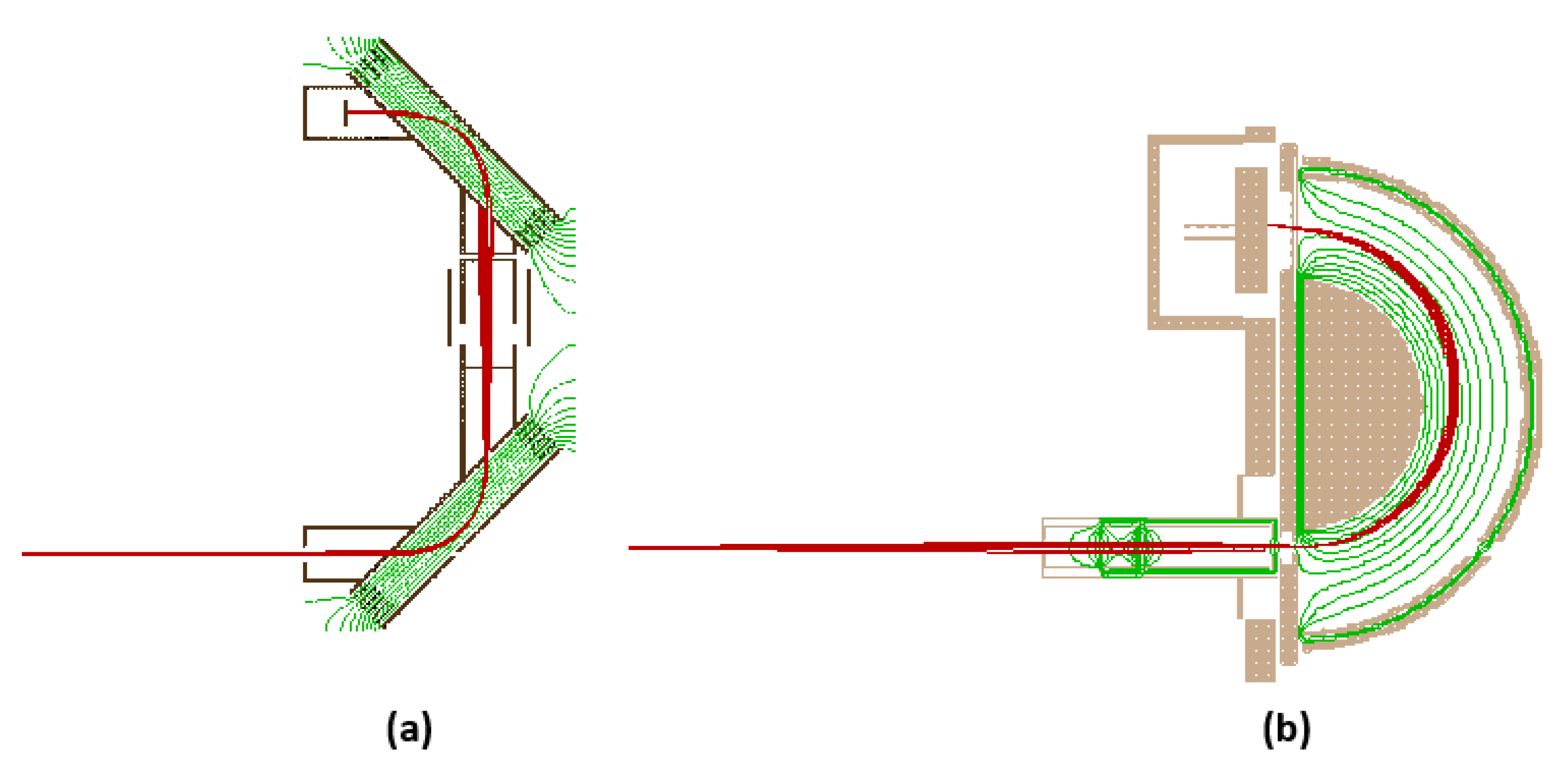
Figure 3.
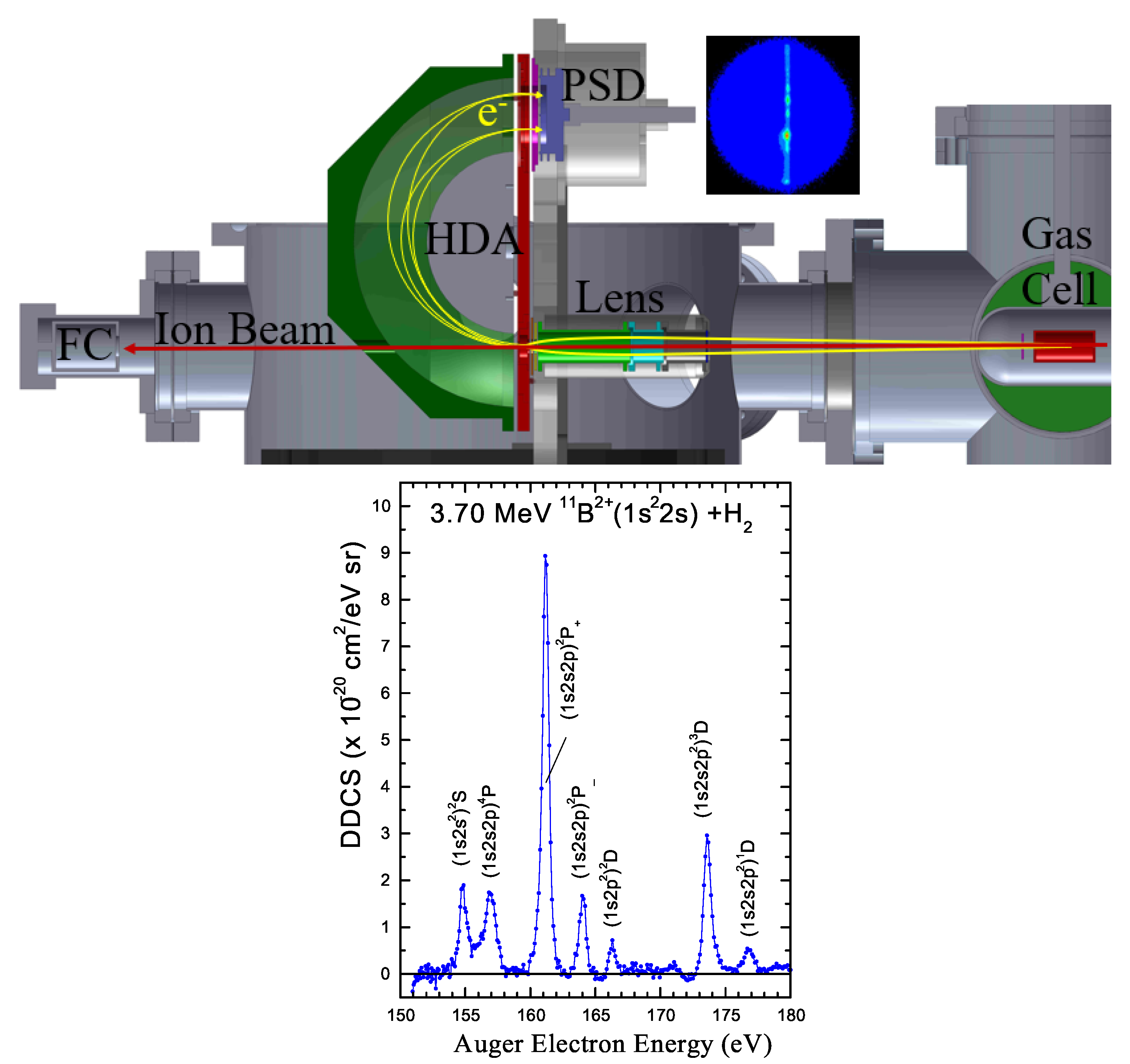
[left] ZAPS setup at NCSR “Demokritos”: Auger electrons from projectile–H2 collisions enter HDA via injection lens for energy analysis and 2D PSD detection. The ion beam traverses the analyzer exiting undisturbed from a small hole at the back plate. It is collected in a Faraday cup (FC) used for normalization. [right] Background-subtracted boron KLL spectrum (3.7 MeV H2, projectile frame) near MeV for D states, resolving excitation (, , 2, ) and TE (, 1) lines. DDCS peak integration yields state-selective SDCS.
Figure 3.
[left] ZAPS setup at NCSR “Demokritos”: Auger electrons from projectile–H2 collisions enter HDA via injection lens for energy analysis and 2D PSD detection. The ion beam traverses the analyzer exiting undisturbed from a small hole at the back plate. It is collected in a Faraday cup (FC) used for normalization. [right] Background-subtracted boron KLL spectrum (3.7 MeV H2, projectile frame) near MeV for D states, resolving excitation (, , 2, ) and TE (, 1) lines. DDCS peak integration yields state-selective SDCS.
4. Zero-Degree Auger Projectile Spectroscopy (ZAPS)
ZAPS detects electrons emitted from fast ionic projectiles at relative to the beam direction, where optimal kinematic conditions maximize energy resolution. This enables LS-resolved (state-selective) Auger spectra, providing a powerful probe of fast ion–atom collision dynamics and stringent tests of theory. ZAPS favors low- projectiles () due to high Auger yields (% for ), surpassing X-ray fluorescence. The technique, introduced in the early 1980s [96], is reviewed in Refs. [92,97].
Early ZAPS used two 45° parallel-plate analyzers (2PPA) in series (tandem) [Figure 2(a)], but since the 2000s, a single-stage hemispherical deflector analyzer (HDA) with injection lens and 2D position sensitive detector (2D PSD) has been used in our group [Figure 2(b)]. Such an HDA spectrograph can record a energy window simultaneously, avoiding 2PPA voltage scanning, thus boosting detection efficiency by over two orders of magnitude [98].
Our ZAPS setup at the NCSR “Demokritos” 5.5 MV Tandem accelerator [99] appears in Figure 3. The ions in the beam interact in the gas cell containing the target atoms, producing doubly-excited states that Auger-decay. The injection lens pre-retards/focuses the forward emitted electrons into the HDA for energy analysis, with 2D PSD imaging along the dispersion axis [100,101]. Spectral projection yields Auger lines, as shown in Figure 3.
We note that ZAPS has predominantly been used to measure KLL Auger lines since these can be well-resolved so as to provide state-selective information. First-row ions have mostly been used in RTEA investigations since the Auger lines in the laboratory frame increase fast with eventually going beyond the range of electrostatic analyzers. Even for Mg (see Table 1) with a Auger energy eV, the corresponding laboratory energy for a forward emitted electron at MeV/u is about or close to 4100 eV, requiring a special high voltage spectrometer [78]. For higher energies a large two-stage magnetic spectrograph was proposed for use at the new experimental storage ring (NESR) at GSI [102], but so far not implemented. Such spectrometers have been used successfully in the past in nuclear physics [103].
In the next section, some typical Auger RTEA cross section measurements using both the older 2PPA spectrometer and the HDA spectrograph are presented and results are compared to the IA RTEA predictions.
Figure 4.
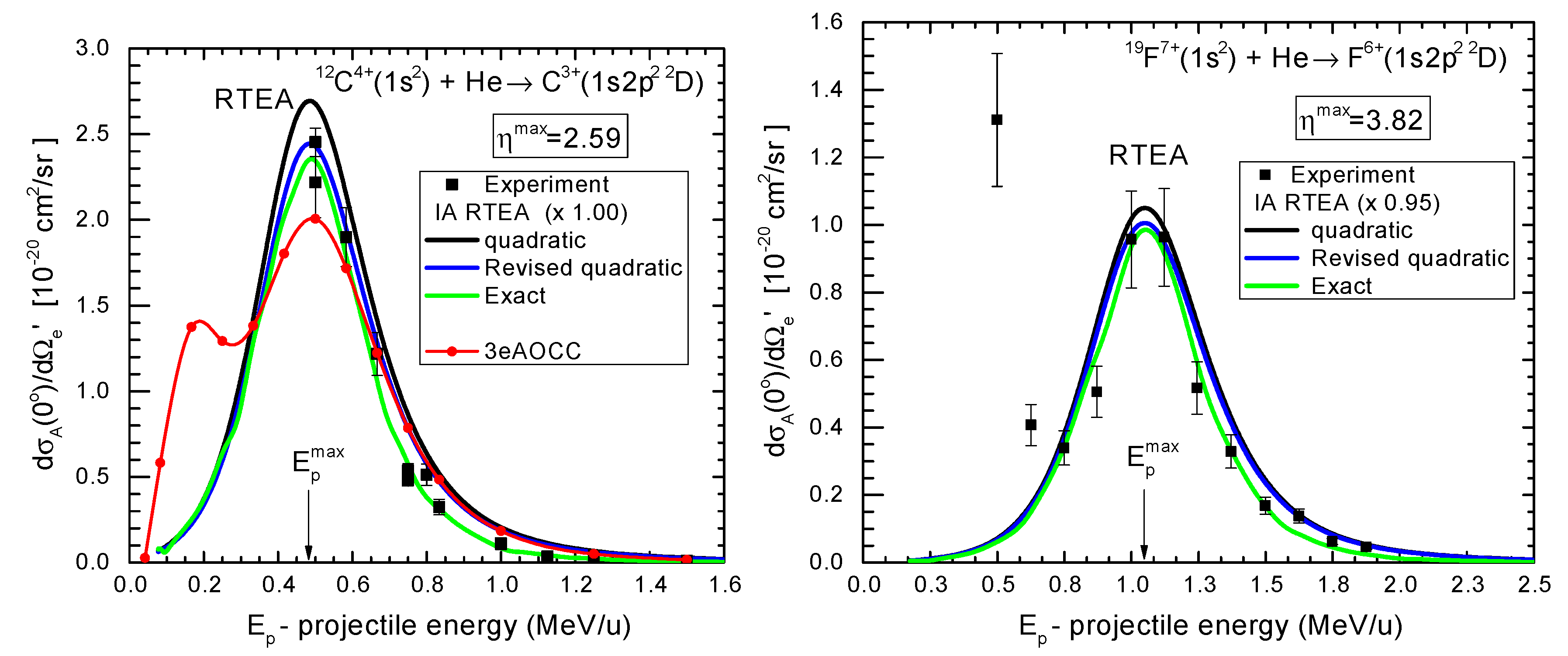
Zero-degree Auger SDCS for the production of the state in (left - adapted from Ref. [38]) and (right - adapted from Ref. [42]) ion collisions with He. Squares: measurements corrected for metastable fraction. Blue lines: revised quadratic IA RTEA (this work - see Equation (60)) with the binding energy correction factor in Equation (49. Black lines: older quadratic IA RTEA (see Equation (18) Ref. [1]) same as Equations (60) and (49), but without this correction factor. Red line: 3eAOCC calculations [38]. is the IA prediction at which the RTEA SDCS peaks. As long as , the energy range of the RTEA peak can be expected to be well described by the IA. Values of and are listed in the tables. We note the improved agreement of the revised IA. The exact IA (green line) is seen to be in even better agreement. Similarly for the fluorine RTEA.
Figure 4.
Zero-degree Auger SDCS for the production of the state in (left - adapted from Ref. [38]) and (right - adapted from Ref. [42]) ion collisions with He. Squares: measurements corrected for metastable fraction. Blue lines: revised quadratic IA RTEA (this work - see Equation (60)) with the binding energy correction factor in Equation (49. Black lines: older quadratic IA RTEA (see Equation (18) Ref. [1]) same as Equations (60) and (49), but without this correction factor. Red line: 3eAOCC calculations [38]. is the IA prediction at which the RTEA SDCS peaks. As long as , the energy range of the RTEA peak can be expected to be well described by the IA. Values of and are listed in the tables. We note the improved agreement of the revised IA. The exact IA (green line) is seen to be in even better agreement. Similarly for the fluorine RTEA.
5. Results and Discussion
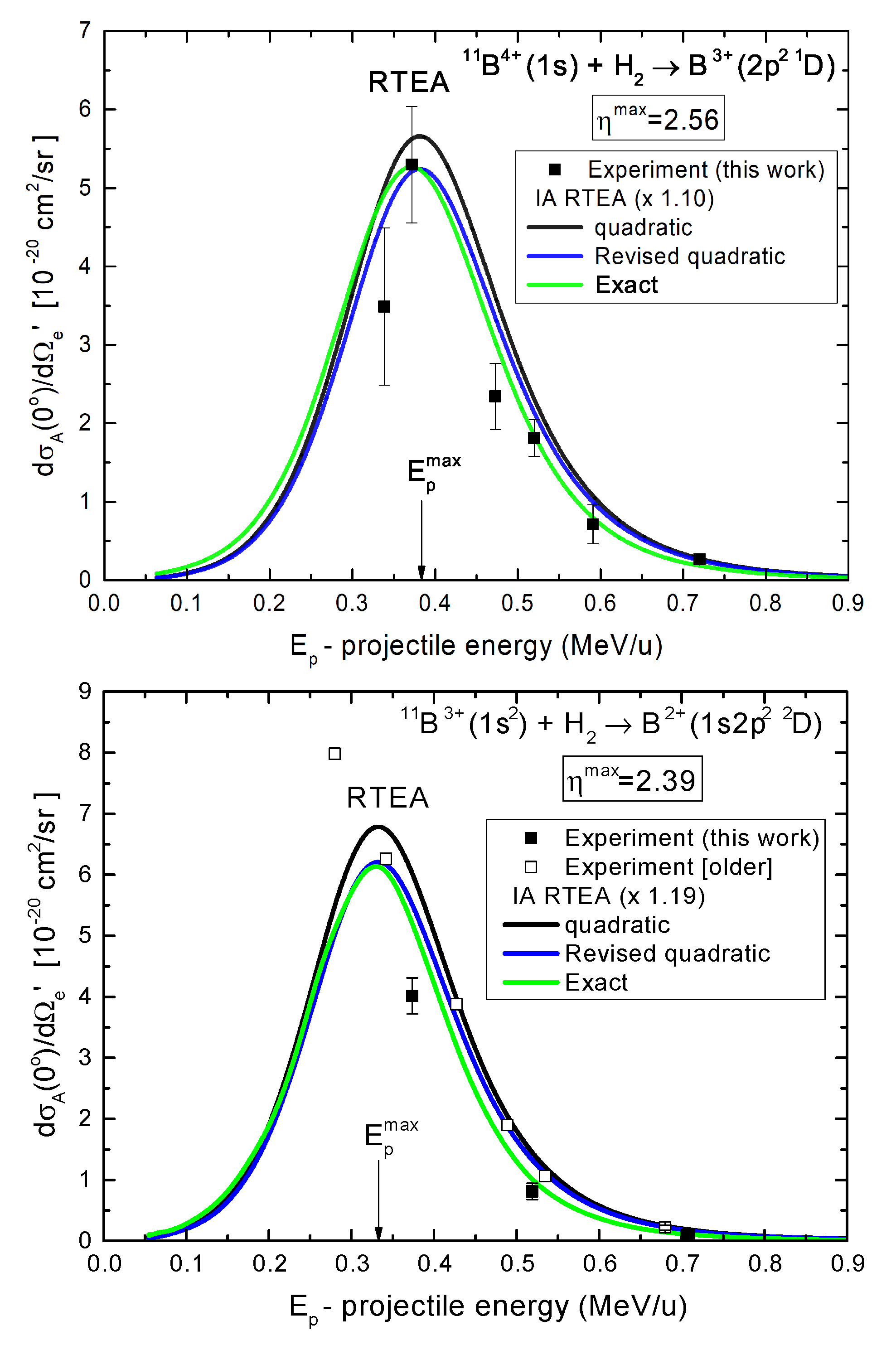
Figure 4 and Figure 5 demonstrate the agreement between the three zero-degree IA RTEA SDCS calculations and experimental data for and state production in He-like and H-like C, F, and B ions colliding with He and H2. Boron results are presented here for the first time. At the lowest collision energies the increase of the experimental SDCS is due to NTE, not handled by the IA.
He-like ion beams contain a mixture of ground () and metastable () states, complicating absolute SDCS determinations. However, we recently developed an in situ technique exploiting gas stripping at the tandem accelerator terminal, which preferentially produces ground-state ions [104,105] and allows for the fractional determination of the mixture [106]. In the reported energy range, production occurs almost exclusively from ground-state ions. Experimental SDCS were thus corrected by dividing by the ground-state fraction .
All three IA calculations shown in the figures are multiplied by the overall scaling factor r which is computed by normalizing the revised quadratic IA (blue line) to the peak of the experimentally measured SDCS. r is given in parentheses in the figure legends and also listed in the tables. The exact IA (green) exhibits a marginally narrower profile in better overall agreement with the data. It is also shifted slightly to lower collision energies relative to the quadratic IA prediction, reflecting the neglected , terms in Equation (21).
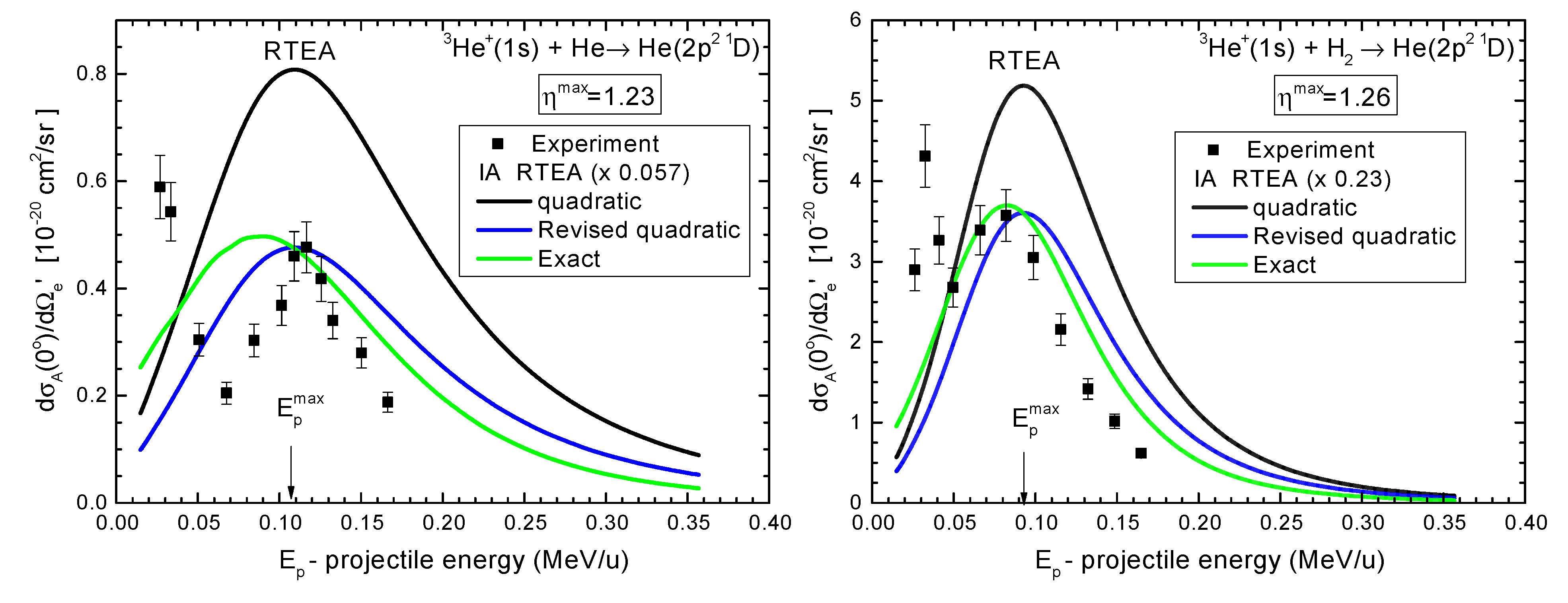
The revised quadratic IA SDCS (blue) are systematically smaller than the original quadratic treatment (black) due to the target binding energy correction factor (also present in the exact IA), yielding improved absolute agreement with experiment—most pronounced for lower- ions where is smaller. This effect is particularly evident in Figure 6 for He++He/H2, though here the validity of the IA is clearly questionable (, ) as evidenced by the much smaller r values and the disagreement in the RTEA profiles. The value (shown per figure) quantifies IA applicability, requiring —clearly violated for He++He collisions in the displayed energy range where the IA nevertheless is seen to predict the RTE peak maximum. Improved agreement with experiment is also due to the use of more accurate Auger rates. For example in Figure 4 for carbon we used the Auger rate s−1 from the 2017 MZ code based on Z-expansion method with relativistic corrections [79] (see Table 2) rather than the one used previously of s−1 [38] taken from an 1986 multi-configuration Dirac-Fock calculation [107].
Figure 6.
Same as Figure 4, but for the production of He state in collisions with H2 (right) and He (left). Large scaling factors of and are needed to bring the IA results closer to the data (see Table 1). The predicted though is seen to be close to the observed experimental maxima. The exact IA is also shown and is seen to be slightly shifted towards lower energies bringing it into better agreement with the H2, but not the He data. In any case, the IA is not expected to hold since and not much larger than 1. Experimental results for He from Ref. [16] and for H2 targets from Ref. [52].
Figure 6.
Same as Figure 4, but for the production of He state in collisions with H2 (right) and He (left). Large scaling factors of and are needed to bring the IA results closer to the data (see Table 1). The predicted though is seen to be close to the observed experimental maxima. The exact IA is also shown and is seen to be slightly shifted towards lower energies bringing it into better agreement with the H2, but not the He data. In any case, the IA is not expected to hold since and not much larger than 1. Experimental results for He from Ref. [16] and for H2 targets from Ref. [52].
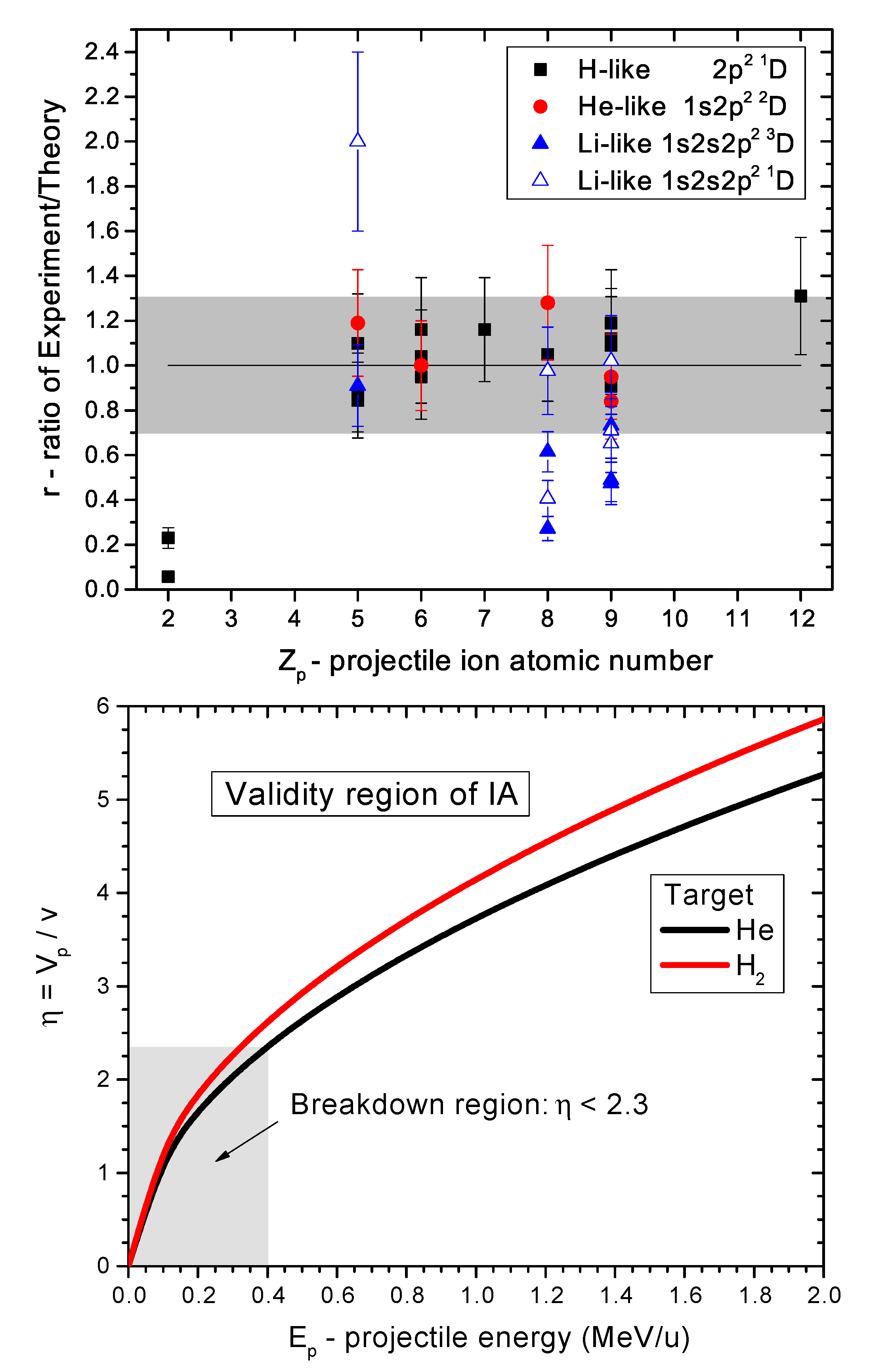
The scaling factor r for each collision system is reported in the tables and plotted in Figure 8, with up to absolute error encompassing the (grey zone) across most —unlike the systematic disagreement with decreasing reported previously (see Figure 8 in [1]). This clear improvement stems primarily from more accurate Auger rates available since the early 1990s and used in the calculation of (see tables). For (He+), the large discrepancy for collisions with H2 reflects the IA breakdown ( and not ), yet astonishingly the scaled IA RTEA SDCS profiles still closely match the data [Figure 6 (right)]. Remarkably, a simple overall r-scaling seems to suffice for most systems (including boron H-/He-like ions), suggesting robust target Compton profile integrity during collisions (, Equation (24) as already pointed out, a key feature of the IA. Any disagreement trends therefore likely reflect increasing projectile disturbance by the target as their electron binding weakens. H-/He-like ions have the tightest bound K-shell electrons and show best agreement; Li-like systems – with the more loosely bound spectator electron – deviate more [10]. This is particularly evident for the state where is also uniquely much less than 1 (see Table 3), potentially signaling less accurate multi-electron and values. However, this conjecture seems to be in conflict with the concept of “ion surgery" for fast light targets in collision with multi-electron ions [108]. Accordingly, low targets (e.g., He/H2) act as a “needle", selectively ionizing the projectile inner shell without substantially disturbing the outer shells which are thus preserved as evidenced by the limited number of charge states produced in the collision [75,97] in contrast to collisions with heavier targets. Clearly, RTEA investigations of Be- and B-like ions with even more spectator electrons might be able to shed more light on this. In addition, the states are more complicated since they can Auger decay either to the or the final states. Clearly, these complication are absent for the and states and might also be responsible for their borderline behavior.
Thus, further investigation on how and why the IA breaks down would be of interest. In particular, RTEA measurements of Li+ and Li2++He ions, never undertaken to date, should lie near the limit of the IA validity () and would therefore also be interesting. In Table 1 and Table 2 we have listed expected values of lithium and for future reference. Overall, the systematic analysis reported here for the D states indicates that the IA seems to be valid even when is only a bit larger than , i.e., for as shown in Figure 8 (right).
Finally, in Figure 4 for carbon (left) the first rigorous ion-atom collision calculations of RTE is shown. This treatment focused on the production of the state via the process
with the Auger SDCS determined via ZAPS [92] by detecting the 2 Auger electron at relative to the ion beam direction. This full configuration interaction, semiclassical close-coupling approach [54] considers the dynamics of three active electrons (known as 3eAOCC) - two on the projectile and one on the target - with the second He target electron considered to be frozen. This approach allows for a coupled and coherent treatment of all processes such as target and projectile excitation, ionization, single electron capture, as well as all TE processes (RTE, NTE etc.) and therefore goes well beyond the methods developed in the past. Two peaks are observed in the computed SDCS (red line). The high-energy peak is seen to be in very good agreement with experiment at/above resonance (0.5 MeV/u), confirming RTE dominance via two-center interactions at large impact parameters b [38]. The low-energy peak (outside the range of the accelerator), remarkably, is found to arise from a one-step interaction (head-on collisions, small b) and not the conventional two-step NTE process. To this effect, it was named non-correlated transfer excitation (NCTE) [38]. This surprising discovery shows that even after almost 45 years since the introduction of the RTE and NTE mechanisms to explain transfer excitation, the presence of a new one-step mechanism was revealed by this fully quantum mechanical treatment, providing further insights into bielectronic processes in many-body quantum systems. We are in the process of further testing the accuracy of the 3eAOCC calculations for other low- isoelectronic systems. A 4eAOCC treatment is also underway to test the validity of the independent electron approximation used for the He target.
Figure 7.
Projectile rest frame electron DDCS for 21.32 MeV F8+ collisions with H2 in the electron energy range of the F resonance (adapted from Ref. [12]). Excellent agreement with ESM-R-matrix calculations is seen. Upon integrating the areas under the peak the SDCS were obtained for both experiment and theory from which the RE collision strengths, , were computed when this method was used. Values of extracted are listed in Table 1 and compared to our present results.
Figure 7.
Projectile rest frame electron DDCS for 21.32 MeV F8+ collisions with H2 in the electron energy range of the F resonance (adapted from Ref. [12]). Excellent agreement with ESM-R-matrix calculations is seen. Upon integrating the areas under the peak the SDCS were obtained for both experiment and theory from which the RE collision strengths, , were computed when this method was used. Values of extracted are listed in Table 1 and compared to our present results.
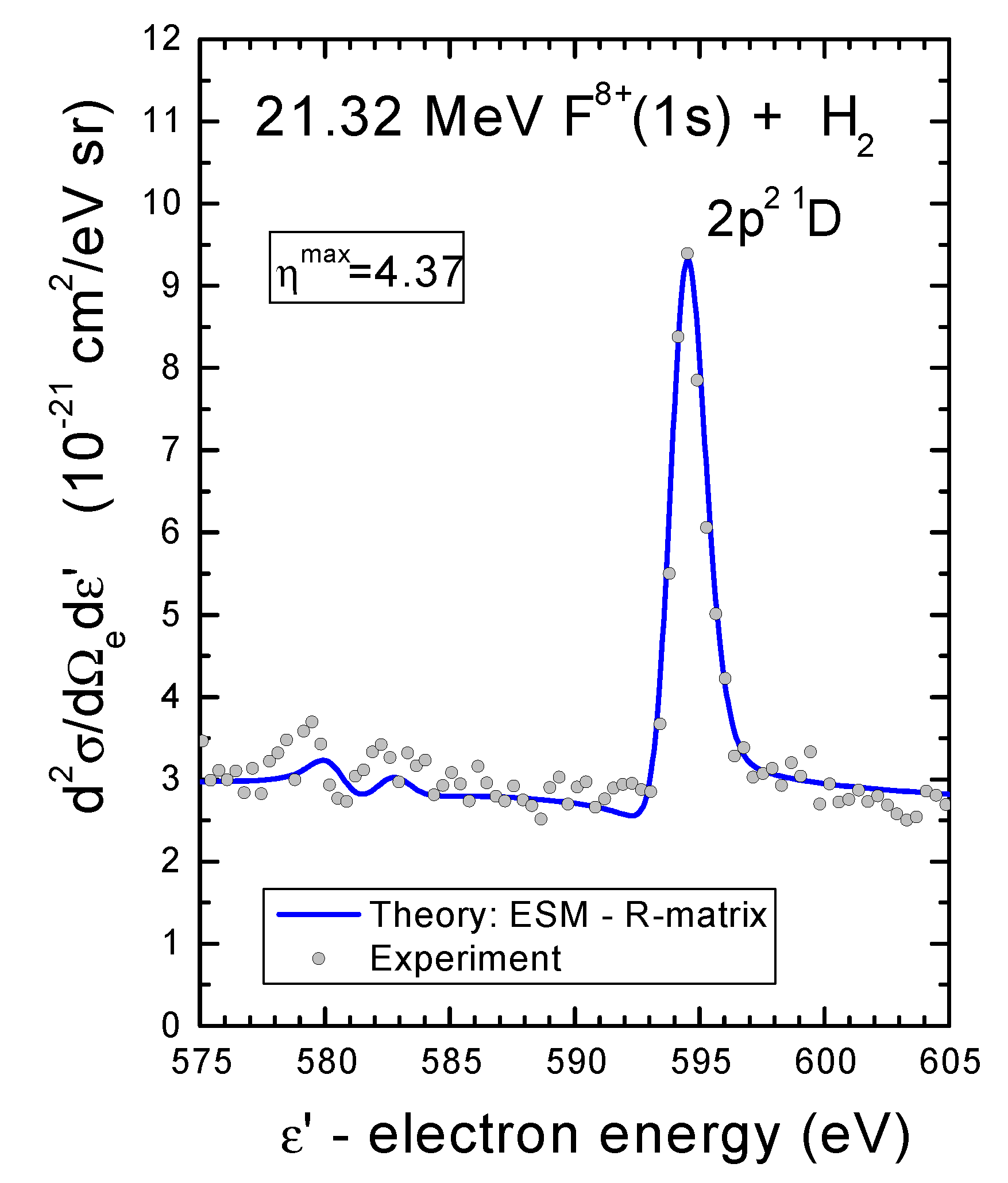
Figure 8.
(Left) Ratio r (from Table 1, Table 2 and Table 3) as a function of projectile atomic number for the projectile ion D states indicated. Except for He+ () where the IA breaks down, and a few borderline Li-like ion cases, agreement is seen to be excellent within the up to 30% expected uncertainty (grey zone). (Right) Plot of , the ratio of the projectile velocity over the target electron velocity v versus collision energy in the range covering all the results listed in the three tables. The IA validity criterion requires , hardly the case here, where clear breakdown is only observed for He+ collisions for (grey area).
Figure 8.
(Left) Ratio r (from Table 1, Table 2 and Table 3) as a function of projectile atomic number for the projectile ion D states indicated. Except for He+ () where the IA breaks down, and a few borderline Li-like ion cases, agreement is seen to be excellent within the up to 30% expected uncertainty (grey zone). (Right) Plot of , the ratio of the projectile velocity over the target electron velocity v versus collision energy in the range covering all the results listed in the three tables. The IA validity criterion requires , hardly the case here, where clear breakdown is only observed for He+ collisions for (grey area).
6. Summary and Conclusions
We have reviewed the progress of resonant transfer excitation followed by Auger stabilization (RTEA) investigations since the comprehensive review of 1992 [1]. We continue to focus on state-resolved single differential cross section (SDCS) measurements of the most strongly populated KLL D states obtained through zero-degree Auger projectile spectroscopy (ZAPS).
These state-selective SDCS measurements enable simple, direct comparisons with the impulse approximation (IA) predictions while providing its most stringent tests. The IA predictions rely primarily upon well-established atomic structure parameters available in the literature. Prior to 1992, 14 such measurements were reported—some employing disparate absolute calibration methods and treatment of the Auger angular distributions. The 1992 review revealed a systematic discrepancy where IA predictions were consistently larger than the experimental SDCS () with r dropping with decreasing , casting some doubts on the impulse approximation’s validity, particularly for low- ions.
Since that time, an additional 16 RTEA measurements have been reported, including several new collision systems presented here for the first time. These later experiments benefit from standardized absolute detection efficiency calibration using the IA binary encounter electron peak (nonresonant elastic scattering). For He-like ion beams, which contain mixtures of ground and metastable states, a more accurate in situ determination of the ground-state fraction has also been implemented. Moreover, the original two-stage parallel-plate spectrometer has been superseded by the single-stage hemispherical deflector spectrograph that offers two orders of magnitude greater efficiency. Taken together, these experimental advances have yielded significantly more reliable and precise experimental SDCS.
We have revisited the fundamental connection between the electron-ion process of dielectronic capture (DC) and its ion-atom counterpart, RTE, provided by the IA. Our systematic comparison of RTEA SDCS—now computed using modern, more accurate Auger rates while uniformly accounting for the highly anisotropic Auger emission at zero-degree observation and novel target binding energy corrections—demonstrates excellent agreement with practically all available measurements spanning both pre- and post-1992 eras. In addition, we have also presented a new exact IA treatment which is shown to be in even better agreement than the revised quadratic IA results. Most important, no systematic discrepancy remains. The IA’s validity is now firmly established down to boron for H-like and He-like ions, with He+ representing the sole clear exception where IA breakdown occurs as expected. Remarkably, the IA is found to be valid down to , clearly much lower than what would be expected by the generally assumed IA validity criterion of . However, some Li-like ion cases seem to be on the borderline for reasons not clearly understood. Overall, these results confirm that state-selective RTEA measurements in combination with the IA can serve as a uniquely reliable source of Auger rates and yields, essential for computing RE collision strengths used in plasma modeling.
Over the last four decades, ZAPS has delivered the most accurate state-selective SDCS measurements for low- ion-atom collision processes leading the way in the investigations of RTE. Very recently, the first nonperturbative 3eAOCC transfer excitation calculations have emerged. Excellent agreement with carbon ZAPS data around the RTE peak was found, while further revealing an novel mechanism at lower energies quite different from the conventional NTE. Ongoing experimental/theoretical isoelectronic studies promise new insights into many-body quantum dynamics under intense, ultra-fast perturbations. In addition, RTEA studies of Li+ and Li2+ collisions with He/H2 would provide valuable tests of IA validity. Moreover, investigating KLL RTEA for Be-like and B-like ions would further examine IA applicability to projectiles with multiple spectator electrons possibly shedding more light on the role of spectator electrons during the collision as already seen for Li-like ions. Finally, Coster-Kronig (CK) transitions in much heavier ions could also be explored using electrostatic analyzers. For example, the CK transition yields electron energies of about 340 eV for lead and 1039 eV for uranium with extremely high Auger rates, have never been explored and could well be of RTE interest.
Author Contributions
Conceptualization, T.J.M.; methodology, T.J.M. and E.P.B.; software, T.J.M.; formal analysis, T.J.M. and E.P.B.; investigation, T.J.M. and E.P.B.; data curation, T.J.M.; writing—original draft preparation, T.J.M.; writing—review and editing, T.J.M. and E.P.B.; visualization, T.J.M. and E.P.B.; All authors have read and agreed to the published version of the manuscript.
Funding
This research received no external funding.
Data Availability Statement
The data presented in this study are available upon request from the corresponding author.
Acknowledgments
We thank Dr. Sotiris Harissopulos, former director of the NCSR “Demokritos” Tandem accelerator, for his more than decade-long support during ZAPS setup installation and commissioning. We also thank the accelerator staff for their maintenance, upgrades, and assistance with the measurements. Finally, we express our deep gratitude to Prof. Alain Dubois (and his group) at Sorbonne University, Paris, for his warm friendship, enthusiasm in advancing the 3eAOCC codes, and invaluable physics discussions throughout our collaboration.
Conflicts of Interest
The authors declare no conflicts of interest.
Abbreviations
| 2D | two-dimensional |
| 3eAOCC | three-electron atomic orbital close-coupling |
| AOCC | atomic orbital close-coupling |
| BEe | binary encounter electrons |
| CK | Coster-Kronig |
| DC | dielectronic capture |
| DDCS | double differential cross section |
| DR | dielectronic recombination |
| ESM | electron scattering model |
| FC | Faraday cup |
| GSI | Gesellschaft für Schwerionenforschung |
| HDA | hemispherical deflector analyser |
| IA | impulse approximation |
| NCTE | non-correlated transfer and excitation |
| NESR | new experimental storage ring at GSI |
| NTE | nonresonant transfer and excitation |
| PSD | position sensitive detector |
| RC | radiationless capture |
| RE | resonance excitation |
| RTE | resonant transfer and excitation |
| RTEA | resonant transfer and excitation followed by Auger electron emission |
| RTEX | resonant transfer and excitation followed by X-ray emission |
| SDCS | single differential cross section |
| TE | transfer excitation |
| ZAPS | zero-degree Auger projectile spectroscopy |
References
- Zouros, T. J. M. Resonant Transfer and Excitation associated with Auger electron emission, in Recombination of Atomic Ions, Vol. 296, edited by W. G. Graham, W. Fritsch, Y. Hahn, and J. Tanis, NATO Advanced Study Institute Series B: Physics (Plenum Publishing Corporation, New York, 1992) pp. 271–300.
- Attosecond Molecular Dynamics, Theoretical and Computational Chemistry Series; Vrakking, M. J. J., Lepine, F., Eds.; The Royal Society of Chemistry, 2019; pp. 1–500. [Google Scholar]
- Tao, Z.; Chen, C.; Szilvási, T.; Keller, M.; Mavrikakis, M.; Kapteyn, H.; Murnane, M. Direct time-domain observation of attosecond final-state lifetimes in photoemission from solids. Science 2016, 353, 62. [Google Scholar] [CrossRef] [PubMed]
- Clark, M.; Brandt, D.; Swenson, J. K.; Shafroth, S. M. Nonresonant Electron Transfer and Projectile K-Electron Excitation in Ion-Atom Collisions. Phys. Rev. Lett. 1985, 54, 544. [Google Scholar] [CrossRef]
- Tanis, J. A.; Bernstein, E. M.; Clark, M. W.; Graham, W. G.; McFarland, R. H.; Morgan, T. J.; Johnson, B. M.; Jones, K. W.; Meron, M. Evidence for uncorrelated electron capture and K-shell excitation in S13+ + He collisions. Phys. Rev. A 1985, 31, 4040. [Google Scholar] [CrossRef] [PubMed]
- Tanis, J. A.; Bernstein, E. M.; Graham, W. G.; Clark, M.; Shafroth, S. M.; Johnson, B. M.; Jones, K. W.; Meron, M. Resonant Behavior in the Projectile X-ray Yield Associated with Electron Capture in S+Ar Collisions. Phys. Rev. Lett. 1982, 49, 1325. [Google Scholar] [CrossRef]
- Pepmiller, P. L.; Prichard, R.; Newcomb, J.; Dillingham, R.; Hall, J. M.; Gray, T. J.; Stöckli, M. A study of transfer excitation in F8++He, Ne and Ar collisions. IEEE Trans. Nucl. Sci. 1983, NS-30, 1002. [Google Scholar] [CrossRef]
- Brandt, D. A simple classical model for the impact parameter dependence of electron capture. Nucl. Instrum. Methods 1983a, 214, 93. [Google Scholar] [CrossRef]
- Brandt, D. Resonant Transfer and Excitation in ion-atom collisions. Phys. Rev. A 1983b, 27, 1314. [Google Scholar] [CrossRef]
- Swenson, J. K.; Yamazaki, Y.; Miller, P. D.; Krause, H. F.; Dittner, P. F.; Pepmiller, P. L.; Datz, S.; Stolterfoht, N. Observation of Resonant Transfer and Excitation to Specific LS-Coupled states in O5+ + He Collisions by High-Resolution, 0∘ Auger-Electron Spectroscopy. Phys. Rev. Lett. 1986, 57, 3042. [Google Scholar] [CrossRef]
- Zouros, T. J. M.; Lee, D. H.; Richard, P.; Sanders, J. M.; Shinpaugh, J. L.; Varghese, S. L.; Karim, K. R.; Bhalla, C. P. State-selective observation of Resonance Transfer Excitation (RTE) in collisions of F6+ with He and H2 targets. Phys. Rev. A 1989a, 40, 6246. [Google Scholar] [CrossRef]
- Benis, E. P.; Zouros, T. J. M.; Gorczyca, T. W.; González, A. D.; Richard, P. Elastic resonant and nonresonant differential scattering of quasifree electrons from B4+(1s) and B3+(1s2) ions. Phys. Rev. A ibid.Erratum, Phys. Rev. A 73, 029901 (2006). 2004, 69, 052718. [Google Scholar] [CrossRef]
- Fritsch, W.; Lin, C. D. Analysis of Electron Correlation in Simultaneous Eletron Transfer and Excitation in Atomic Collisions. Phys. Rev. Lett. 1988, 61, 690. [Google Scholar] [CrossRef]
- Jain, A.; Shingal, R.; Zouros, T. J. M. State-selective non-resonant transfer excitation (NTE) in 50-500 keV 3He++H2 and He collisions. Phys. Rev. A 1991, 43, 1621. [Google Scholar] [CrossRef]
- Feagin, J. M.; Briggs, J. S.; Reeves, T. M. Simultaneous charge transfer and excitation. J. Phys. B 1984, 17, 1057. [Google Scholar] [CrossRef]
- Itoh, A.; Zouros, T. J. M.; Schneider, D.; Stettner, U.; Zeitz, W.; Stolterfoht, N. Transfer Excitation in He++He collisions studied by zero-degree electron spectroscopy. J. Phys. B 1985a, 18, 4581. [Google Scholar] [CrossRef]
- Benhenni, M.; Shafroth, S. M.; Swenson, J. K.; Schulz, M.; Giese, J. P.; Schöne, H.; Vane, C. R.; Dittner, P. F.; Datz, S. Angular distribution of Auger electrons emitted through the resonant transfer and excitation process following O5++He collisions. Phys. Rev. Lett. 1990, 65, 1849. [Google Scholar] [CrossRef] [PubMed]
- Benhenni, M.; Shafroth, S. M.; Swenson, J. K.; Schulz, M.; Giese, J.; Schone, H.; Vane, C.; Dittner, P. F.; Datz, S. Proceedings of the XVII ICPEAC held in Brisbane, Australia, 10-16 July 1991; McGillivray, M. S. W.R., McCarthy, I.E., Eds.; 17th Int. Conf. on the Physics of Electronic and Atomic Collisions (Adam Hilger, Bristol [England], Philadelphia, 1992) pp. 693–698, invited paper.
- Benhenni, M.; Shafroth, S. M.; Swenson, J. K. Alignment in fast ion-atom collisions. Nucl. Instrum. Methods B 1994, 86, 28. [Google Scholar] [CrossRef]
- Ourdane, M.; Bachau, H.; Gayet, R.; Hanssen, J. Transfer and excitation in high-energy He+-He collisions: V. Electronic continuum influence on ejected electron distributions and TE cross sections. J. Phys. B 1999, 32, 2041. [Google Scholar] [CrossRef]
- Recombination of Atomic Ions;NATO Advanced Study Institute Series B: Physics; Graham, W. G., Fritsch, W., Hahn, Y., Tanis, J., Eds.; Plenum Publishing Corporation: New York, 1992; Vol. 296. [Google Scholar]
- Williams, I. D. Electron-ion scattering. Reports on Progress in Physics 1999, 62, 1431. [Google Scholar] [CrossRef]
- Hahn, Y.; Lagattuta, K. J. Dielectronic recombination and related resonance processes. Phys. Rep. 1988, 166, 195. [Google Scholar] [CrossRef]
- Pradhan, A. K.; Nahar, S. N. Atomic Astrophysics and Spectroscopy; Cambridge University Press: Cambridge, 2011. [Google Scholar]
- Bhalla, C. P. Angular distribution of Auger electrons and photons in resonant transfer and excitation in collisions of ions with light targets. Phys. Rev. Lett. 1990, 64, 1103. [Google Scholar] [CrossRef]
- Lee, D. H.; Richard, P.; Zouros, T. J. M.; Sanders, J. M.; Shinpaugh, J. L.; Hidmi, H. Binary encounter electrons observed at zero degrees in collisions of 1-2 MeV/amu H+, C6+, N7+, O8+ and F9+. Phys. Rev. A 1990, 41, 4816. [Google Scholar] [CrossRef]
- Závodszky, P. A.; Tóth, G.; Grabbe, S. R.; Zouros, T. J. M.; Richard, P.; Bhalla, C. P.; Tanis, J. A. Forward-backward asymmetry in the inelastic scattering of electrons from highly charged ions. J. Phys. B 1999, 32, 4425. [Google Scholar] [CrossRef]
- Zouros, T. J. M.; Lee, D. H.; Richard, P. Projectile 1s→2p excitation due to electron-electron interaction in collisions of O5+ and F6+ ions with H2 and He targets. Phys. Rev. Lett. 1989b, 62, 2261. [Google Scholar] [CrossRef] [PubMed]
- Montenegro, E. C.; Melo, W. S.; Meyerhof, W. E.; de Pinho, A. G. Separation of the screening and antiscreening effects in the electron loss of He+ on H2 and He. Phys. Rev. Lett. 1992, 69, 3033. [Google Scholar] [CrossRef]
- Lee, D. H.; Zouros, T. J. M.; Sanders, J. M.; Richard, P.; Anthony, J. M.; Wang, Y. D.; McGuire, J. H. K-shell ionization of O4+ and C2+ ions in fast collisions with H2 and He gas targets. Phys. Rev. A 1992, 46, 1374. [Google Scholar] [CrossRef] [PubMed]
- Závodszky, P. A.; Aliabadi, H.; Bhalla, C. P.; Richard, P.; Tóth, G.; Tanis, J. A. Superelastic scattering of electrons from highly charged ions with inner shell vacancies. Phys. Rev. Lett. 2001, 87, 033202. [Google Scholar] [CrossRef]
- Montenegro, E. C.; Meyerhof, W. E. Passive and active electrons in the electron loss process, in Two-Center Effects in Ion-Atom Collisions. In AIP Conference Proceedings; Gay, T. J., Starace, A.F., Eds.; American Institute of Physics (AIP Press): New York, 1995; Vol. 362, pp. 103–112. [Google Scholar]
- Zouros, T. J. M. Projectile-electron - target-electron interactions: Exposing the dynamic role of electrons in fast ion-atom collisions. Comments At. Mol. Phys. 1996, 32, 291. [Google Scholar]
- Montenegro, E. C.; Zouros, T. J. M. On the relationship between the Born and the impulse approximations for the antiscreening process. Phys. Rev. A 1994, 50, 3186. [Google Scholar] [CrossRef] [PubMed]
- Tanis, J.; Graham, W.; Berkner, K.; Bernstein, E.; Clark, M.; Feinberg, B.; McMahan, M.; Morgan, T.; Rathbun, W.; Schlachter, A. Resonant transfer excitation in U89+ + C and U90+ + H2 collisions. Nucl. Instrum. Methods B 1991, 53, 442. [Google Scholar] [CrossRef]
- Tanis, J. A. Resonant Transfer Excitation associated with single X-ray emission, in Recombination of Atomic Ions. In NATO Advanced Study Institute Series B: Physics; Graham, W. G., Fritsch, W., Hahn, Y., Tanis, J., Eds.; Plenum Publishing Corporation: New York, 1992; Vol. 296, pp. 241–257. [Google Scholar]
- Ding, T.; Xie, L.; He, W.; Rui, J.; Ma, Y.; Liu, Y.; Dong, C. Theoretical study on resonant transfer and excitation process of hydrogen-like and helium-like ions. Eur. Phys. J. D 2025, 79, 101. [Google Scholar] [CrossRef]
- Laoutaris, A.; Nanos, S.; Madesis, I.; Passalidis, S.; Benis, E. P.; Dubois, A.; Zouros, T. J. M. Coherent treatment of transfer-excitation processes in swift ion-atom collisions. Phys. Rev. A 2022, 106, 022810. [Google Scholar] [CrossRef]
- Zouros, T. J. M.; Bhalla, C. P.; Lee, D. H.; Richard, P. Effects of alignment and interference in resonant transfer and excitation for F6+ and O5+ collisions with H2 in 0∘ Auger measurements. Phys. Rev. A 1990, 42, 678. [Google Scholar] [CrossRef]
- DePaola, B. D.; Parameswaran, R.; Axmann, W. J. High-resolution state-selective study of transfer with excitation in the F8++H2 system. Phys. Rev. A 1990, 41, 6533. [Google Scholar] [CrossRef]
- DePaola, B. RTE studied in electron emission. Nucl. Instrum. Methods B 1991, 56-57, 154. [Google Scholar] [CrossRef]
- Lee, D. H.; Richard, P.; Sanders, J. M.; Zouros, T. J. M.; Shinpaugh, J. L.; Varghese, S. L. KLL resonant transfer and excitation to F6+(1s2l2l′) intermediate states. Phys. Rev. A 1991a, 44, 1636. [Google Scholar] [CrossRef]
- Parameswaran, R.; Bhalla, C. P.; Walch, B. P.; DePaola, B. D. Resonant transfer and excitation in collisions of C5+ with H2 and He targets. Phys. Rev. A 1991, 43, 5929. [Google Scholar] [CrossRef]
- Anthony, J. M.; Shafroth, S. M.; Benhenni, M.; Strait, E. N.; Zouros, T. J. M.; Hendrik, L. D.; Peterson, D. M. Production of doubly core-excited configurations in C4+ projectiles through resonant transfer excitation. J. de Phys. (Paris) 1987, 48, 301. [Google Scholar] [CrossRef]
- Burke, P. G.; Berrington, K. A. Atomic and molecular processes: An R-matrix approach; Institute of Physics Publishing: Bristol and Philadelphia, 1993. [Google Scholar]
- Bray, I.; Hayat, H.; Fursa, D. V.; Kadyrov, A. S.; Bray, A. W.; Cytowski, M. Calculations of electron scattering on H-like ions. Phys. Rev. A 2020, 101, 022703. [Google Scholar] [CrossRef]
- Stolterfoht, N. Dielectronic processes and electron correlation in energetic ion-atom collisions. Nucl. Instrum. Methods B 1991, 53, 477. [Google Scholar] [CrossRef]
- Bachau, H.; Gayet, R.; Hanssen, J.; Zerarka, A. Transfer and excitation in ion-atom collisions at high impact velocities: A unified continuum distorted wave treatment of resonant and non-resonant modes in four body approach: II. Application to the collisions S15+(1s) + H(1s). J. Phys. B 1992, 25, 839. [Google Scholar] [CrossRef]
- Gayet, R.; Hanssen, J. Resonant and non-resonant modes of transfer and excitation processes in ion-atom collisions. Nucl. Instrum. Methods B 1994, 86, 52. [Google Scholar] [CrossRef]
- Gayet, R.; Hanssen, J.; Jacqui, L. Transfer and excitation in ion-atom collisions at high impact velocities: III. Application of the CDW-4B theory to an almost symmetrical system: He++He. J. Phys. B 1995, 28, 2193. [Google Scholar] [CrossRef]
- Gayet, R.; Hanssen, J.; Jacqui, L.; Ourdane, M. A. Transfer and excitation in ion-atom collisions at high impact velocities: IV. Application of the CDW-4B theory to an almost symmetrical system: He++H. J. Phys. B 1997, 30, 2209. [Google Scholar] [CrossRef]
- Zouros, T. J. M.; Schneider, D.; Stolterfoht, N. State-selective observation of resonant and non-resonant transfer excitation in 50-500 keV 3He++H2 collisions. J. Phys. B 1988, 21, L671. [Google Scholar] [CrossRef]
- Toth, G.; Závodszky, P. A.; Bhalla, C. P.; Richard, P.; Grabbe, S.; Aliabadi, H. Electron elastic scattering resonances in the collision of fast hydrogenic ions with molecular hydrogen. Phys. Scr. 2001, T92, 272. [Google Scholar] [CrossRef]
- Gao, J. W.; Wu, Y.; Wang, J. G.; Dubois, A.; Sisourat, N. Double Electron Capture in H++H-Collisions. Phys. Rev. Lett. 2019, 122, 093402. [Google Scholar] [CrossRef]
- Kleber, M.; Jakubassa, D. H. Radiative electron capture in heavy-ion collisions. Nuclear Physics A 1975, 252, 152. [Google Scholar] [CrossRef]
- Griffin, D. C. A review of radiative and dielectronic recombination for C and O ions. Phys. Scr. 1989, 17. [Google Scholar] [CrossRef]
- Kilgus, G.; Berger, J.; Blatt, P.; Grieser, M.; Habs, D.; Hochadel, B.; Jaeschke, E.; Krämer, D.; Neumann, R.; Neureither, G.; Ott, W.; Schwalm, D.; Steck, M.; Stokstad, R.; Szmola, E.; Wolf, A.; Schuch, R.; Müller, A.; Wagner, M. Dielectronic recombination of hydrogenlike oxygen in a heavy-ion storage ring. Phys. Rev. Lett. 1990a, 64, 737. [Google Scholar] [CrossRef]
- Bhalla, C. P.; Tunnell, T. W. Theoretical lifetimes, transition energies, fluorescence yields, and nonradiative branching ratios for highly excited states of lithium-like argon. J. Quant. Spectrosc. Rad. Tran. 1984, 32, 141. [Google Scholar] [CrossRef]
- Hahn, Y. Auger spectra from resonant transfer excitation of O VI. Phys. Lett. A 1986, 119, 293. [Google Scholar] [CrossRef]
- Andersen, L. H.; Hvelplund, P.; Knudsen, H.; Kvistgaard, P. State-selective dielectronic-recombination measurements for He-like oxygen ions in an electron cooler. Phys. Rev. Lett. 1989, 62, 2656. [Google Scholar] [CrossRef]
- Andersen, L. H.; Pan, G. Y.; Schmidt, H. T.; Badnell, N. R.; Pindzola, M. S. Absolute measurements and calculations of dielectronic recombination with metastable He-like N, F, and Si ions. Phys. Rev. A 1992a, 45, 7868. [Google Scholar] [CrossRef]
- Kilgus, G.; Habs, D.; Schwalm, D.; Wolf, A.; Schuch, R.; Badnell, N. R. Dielectronic recombination from ground state of heliumlike carbon ions. Phys. Rev. A 1993, 47, 4859. [Google Scholar] [CrossRef]
- Andersen, L. H.; Bolbo, J.; Kvistgaard, P. State-selective dielectronic-recombination measurements for He- and Li-like carbon and oxygen ions. Phys. Rev. A 1990, 41, 1293. [Google Scholar] [CrossRef]
- Andersen, L. H.; Pan, G.-Y.; Schmidt, H. T.; Pindzola, M. S.; Badnell, N. R. State-selective measurements and calculations of dielectronic recombination with Li-like N4+, F6+, and Si11+ ions. Phys. Rev. A 1992b, 45, 6332. [Google Scholar] [CrossRef]
- Kilgus, G.; Habs, D.; Schwalm, D.; Wolf, A.; Badnell, N. R.; Müller, A. High-resolution measurement of dielectronic recombination of lithium-like Cu26+. Phys. Rev. A 1990b, 46, 5730. [Google Scholar] [CrossRef] [PubMed]
- Badnell, N. R. Auger emission following resonant transfer excitation in collisions of F8+ with H2. Phys. Rev. A 1990, 41, 3555. [Google Scholar] [CrossRef] [PubMed]
- Fritzsche, S. Dielectronic recombination strengths and plasma rate coefficients of multiply charged ions. A&A 2021, 656, A163. [Google Scholar]
- Belic, D. S.; Dunn, G. H.; Morgan, T. J.; Mueller, D. W.; Timmer, C. Dielectronic recombination: A crossed-beams observation and measurement of cross section. Phys. Rev. Lett. 1983, 50, 339. [Google Scholar] [CrossRef]
- Ali, R.; Bhalla, C. P.; Cocke, C. L.; Stöckli, M. Dielectronic Recombination on Heliumlike Argon. Phys. Rev. Lett. 1990, 64, 633. [Google Scholar] [CrossRef]
- Wolf, A.; Berger, J.; Bock, M.; Habs, D.; Hochadel, B.; Kilgus, G.; Neureither, G.; Schramm, U.; Schwalm, D.; Szmola, E.; Müller, A.; Wagner, M.; Schuch, R. Experiments with highly-charged ions in the storage ring TSR. Z. Phys. D 1991, 21, S69. [Google Scholar] [CrossRef]
- Eisenberger, P.; Platzman, P. M. Compton scattering of X rays from bound electrons. Phys. Rev. A 1970, 2, 415. [Google Scholar] [CrossRef]
- Eisenberger, P.; Reed, W. A. Gamma-ray Compton scattering: Experimental Compton profiles for He, N2, Ar and Kr. Phys. Rev. A 1972, 5, 2085. [Google Scholar] [CrossRef]
- Lee, J. S. Accurate determination of H2, He, and D2 Compton profiles by high energy electron impact spectroscopy. J. Chem. Phys. 1977, 66, 4906. [Google Scholar] [CrossRef]
- Zouros, T. J. M.; Toth, G.; Richard, P.; Liao, C.; Hagmann, S. Zero-degree Binary Encounter electron production in 30 MeV bare O8+ in collisions with H2, He, Ne, Ar, Kr and Xe. Nucl. Instrum. Methods B 1996, 107, 87. [Google Scholar] [CrossRef]
- Itoh, A.; Schneider, D.; Schneider, T.; Zouros, T. J. M.; Nolte, G.; Schiwietz, G.; Zeitz, W.; Stolterfoht, N. Selective production of Li, Be and, B-like K vacancy states in fast Ne projectiles studied by zero-degree Auger spectroscopy. Phys. Rev. A 1985b, 31, 684. [Google Scholar] [CrossRef] [PubMed]
- Rødbro, M.; Bruch, R.; Bisgaard, P. High-resolution projectile Auger spectroscopy for Li, Be, B and C excited in single gas collisions I. Line energies for prompt decays. J. Phys. B 1979, 12, 2413. [Google Scholar] [CrossRef]
- Benis, E. P. A novel high-efficiency paracentric hemispherical spectrograph for zero-degreeAuger projectile spectroscopy. Ph.D. dissertation, Dept. of Physics, University of Crete, 2001, (unpublished). [Google Scholar]
- Aliabadi, H. High resolution zero degreeAuger electron spectroscopy of doubly excited helium-like resonance states of boron, magnesium and silicon. Ph.D. dissertation, Dept. of Physics, Kansas State University, 2004, (unpublished). [Google Scholar]
- Gorczyca, T. private communications. 2017. [Google Scholar]
- Bhatia, A. D autoionization states of He and H-. Phys. Rev. A 1972, 6, 120–124. [Google Scholar] [CrossRef]
- van der Hart, H. W.; Hansen, J. E. Competition between radiative and non-radiative decay for doubly excited 2lnl′ and 3lnl′ states in C4+. J. Phys. B 1993, 26, 641. [Google Scholar] [CrossRef]
- van den Brink, J. P.; Nienhuis, G.; van Eck, J.; Heideman, H. G. Coherences between autoionising states of different excitation energies. J. Phys. B 1989, 22, 3501. [Google Scholar] [CrossRef]
- Chung, K. T.; Lin, C. D. Doubly excited states of Li+ below the N=2 and N=3 thresholds of Li2+. At. Data Nucl. Data Tables 1998, 69, 101. [Google Scholar] [CrossRef]
- Hidmi, H. I. Systematics of binary encounter electrons from high Z projectiles. Ph.D. dissertation, Dept. of Physics, Kansas State University, 1993, (unpublished). [Google Scholar]
- Cederquist, H.; Mannervik, S. On the core-excited doublets of Li I: Accurate determination of autoionisation rates. J. Phys. B 1982, 15, L807. [Google Scholar] [CrossRef]
- Lee, D. H.; Richard, P.; Sanders, J. M.; Zouros, T. J. M.; Shinpaugh, J. L.; Varghese, S. L. Electron capture and excitation studied by state-resolved KLL Auger measurement in 0.25-2 MeV/u F7+(1s21S,1s2s3S) + H2/He collisions. Nucl. Instrum. Methods B 1991b, 56-57, 99. [Google Scholar] [CrossRef]
- Verbockhaven, G.; Hansen, J. E. Energies and autoionization widths in the lithium iso-electronic sequence. J. Phys. B 2001, 34, 2337. [Google Scholar] [CrossRef]
- Bruch, R.; Chung, K. T.; Luken, W. L.; Culberson, J. C. Recalibration of the KLL Auger spectrum of carbon. Phys. Rev. A 1985, 31, 310. [Google Scholar] [CrossRef]
- Lin, S.-H.; Hsue, C.-S.; Chung, K. T. Auger width and branching ratios for Be-like 1s2s22p3Po and 1s2s2p23S,3P,3D resonances and photoionization of Be from 1s22s2p3Po. Phys. Rev. A 2001, 64, 012709. [Google Scholar] [CrossRef]
- Shiu, W. C.; Hsue, C.-S.; Chung, K. T. Auger branching ratios for berylliumlike 1s2s2p21S,1P,1D resonances and photoionization of beryllium from 1s22s2p1Po. Phys. Rev. A 2001, 64, 022714. [Google Scholar] [CrossRef]
- Bransden, B. C.; Joachain, C. J. Physics of atoms and molecules; Longman Group Ltd.: England, 1983. [Google Scholar]
- Zouros, T. J. M.; Lee, D. H. Zero Degree Auger Electron Spectroscopy of Projectile Ions, in Accelerator-based Atomic Physics: Techniques and Applications, edited by S. M. Shafroth and J. C. Austin (American Institute of Physics, Woodbury, NY, 1997) Chap. 13, pp. 426–479. Shafroth, S. M., Austin, J. C., Eds..
- Bhalla, C. P.; Grabbe, S. R.; Bhatia, A. K. Differential cross sections for the electron-impact excitation of hydrogenlike carbon. Phys. Rev. A 1995, 52, 2109. [Google Scholar] [CrossRef] [PubMed]
- Hvelplund, P.; Gonzalez, A. D.; Dahl, P.; Bhalla, C. P. Resonant inelastic atomic scattering of quasifree electrons on C5+(1s). Phys. Rev. A 1994, 49, 2535. [Google Scholar] [CrossRef] [PubMed]
- SIMION. Available online: http://www.simion.com.
- Itoh, A.; Schneider, T.; Schiwietz, G.; Roller, Z.; Platten, H.; Nolte, G.; Schneider, D.; Stolterfoht, N. Selective production of Auger electrons from fast projectile ions studied by zero-degree Auger spectroscopy. J. Phys. B 1983, 16, 3965. [Google Scholar] [CrossRef]
- Stolterfoht, N. High resolution Auger spectroscopy in energetic ion atom collisions. Phys. Rep. 1987, 146, 315. [Google Scholar] [CrossRef]
- Benis, E. P.; Zouros, T. J. M.; Richard, P. High resolution RTE measurements at zero degrees using a hemispherical analyser with lens and 2-D PSD. Nucl. Instrum. Methods B 1999, 154, 276. [Google Scholar] [CrossRef]
- Harissopulos, S.; Andrianis, M.; Axiotis, M.; Lagoyannis, A.; Karydas, A. G.; Kotsina, Z.; Laoutaris, A.; Apostolopoulos, G.; Theodorou, A.; Zouros, T. J. M.; Madesis, I.; Benis, E. P. The Tandem Accelerator Laboratory of NCSR “Demokritos": Current status and perspectives. Eur. Phys. J. Plus 2021, 136, 617. [Google Scholar] [CrossRef]
- Zouros, T. J. M.; Benis, E. P. The hemispherical deflector analyser revisited. I. Motion in the ideal 1/r potential, generalized entry conditions, Kepler orbits and spectrometer basic equation. J. Electron Spectrosc. and Relat. Phenom. 2002, 125, 221. [Google Scholar] [CrossRef]
- Madesis, I.; Laoutaris, A.; Zouros, T. J. M.; Nanos, S.; Benis, E. P. Projectile electron spectroscopy and new answers to old questions: Latest results at the new atomic physics beamline in Demokritos, Athens, in State-of-the-Art Reviews on Energetic Ion-Atom and Ion-Molecule Collisions, Interdisciplinary Research on Particle Collisions and Quantitative Spectroscopy, Vol. 2, edited by D. Belkić, I. Bray, and A. Kadyrov (World Scientific, Singapore, 2019) Chap. 1, pp. 1–31.
- Mann, R.; Bosch, F.; Koenig, W.; Kozhuharov, C. High resolution electron spectrometry of few-electron projectiles at the ESR; Tech. Rep.; GSI: Darmstadt, 1988. [Google Scholar]
- Mampe, W.; Schreckenbach, K.; Jeuch, P.; Maier, B.; Braumandl, F.; Larysz, J.; von Egidy, T. The double focusing iron-core electron-spectrometer ‘‘BILL" for high resolution (n,e-) measurements at the high flux reactor in Grenoble. Nucl. Instrum. Methods 1978, 154, 127. [Google Scholar] [CrossRef]
- Benis, E. P.; Zamkov, M.; Richard, P.; Zouros, T. J. M. Technique for the determination of the 1s2s3S metastable fraction in two-electron ion beams. Phys. Rev. A 2002, 65, 064701. [Google Scholar] [CrossRef]
- Benis, E. P.; Zouros, T. J. M. Determination of the 1s2ℓ2ℓ′ state production ratios 4Po/2P, 2D/2P and 2P+/2P- from fast (1s2,1s2s3S) mixed-state He-like ion beams in collisions with H2 targets. J. Phys. B 2016, 49, 235202. [Google Scholar] [CrossRef]
- Zouros, T. J. M.; Laoutaris, A.; Nanos, S.; Benis, E. P. Determination of the 1s2s3S and 1s2s1S metastable fractions in swift mixed-state He-like ion beams and supplemental material. J. Phys. B 2025, 58, 055201. [Google Scholar] [CrossRef]
- Chen, M. H. Dielectronic satellite spectra for He-like ions, At. Data Nucl. Data Tables 1986, 34, 301. [Google Scholar] [CrossRef]
- Stolterfoht, N.; Miller, P. D.; Krause, H. F.; Yamazaki, Y.; Swenson, J. K.; Bruch, R.; Dittner, P. F.; Pepmiller, P. L.; Datz, S. Surgery of fast, highly charged ions studied by zero-degree Auger spectroscopy. Nucl. Instrum. Methods B 1987, 24/25, 168. [Google Scholar] [CrossRef]
Figure 1.
Schematic of and interactions leading to the production of doubly-excited projectile states in ion–atom collisions (a) and (b), and in electron–ion collisions (c). (a) RTE proceeds via the two-center interaction (red) in a single, correlated step. (b) NTE proceeds via two independent interactions (green) in a sequential, uncorrelated manner. (c) DC in electron–ion collisions proceeds as in RTE, but the electron is free (there is no target). The projectile excitation is shown by a straight dashed arrow; the transfer of the He target electron in (a) and (b), or free-electron capture in (c), to the projectile orbital by a curved dotted arrow. Also shown are the projectile velocity and impact parameter b. The analogy between RTE and DC is evident, with the target electron’s orbital velocity broadening the impinging collision velocity (a). Processes are viewed from the projectile rest frame.
Figure 1.
Schematic of and interactions leading to the production of doubly-excited projectile states in ion–atom collisions (a) and (b), and in electron–ion collisions (c). (a) RTE proceeds via the two-center interaction (red) in a single, correlated step. (b) NTE proceeds via two independent interactions (green) in a sequential, uncorrelated manner. (c) DC in electron–ion collisions proceeds as in RTE, but the electron is free (there is no target). The projectile excitation is shown by a straight dashed arrow; the transfer of the He target electron in (a) and (b), or free-electron capture in (c), to the projectile orbital by a curved dotted arrow. Also shown are the projectile velocity and impact parameter b. The analogy between RTE and DC is evident, with the target electron’s orbital velocity broadening the impinging collision velocity (a). Processes are viewed from the projectile rest frame.
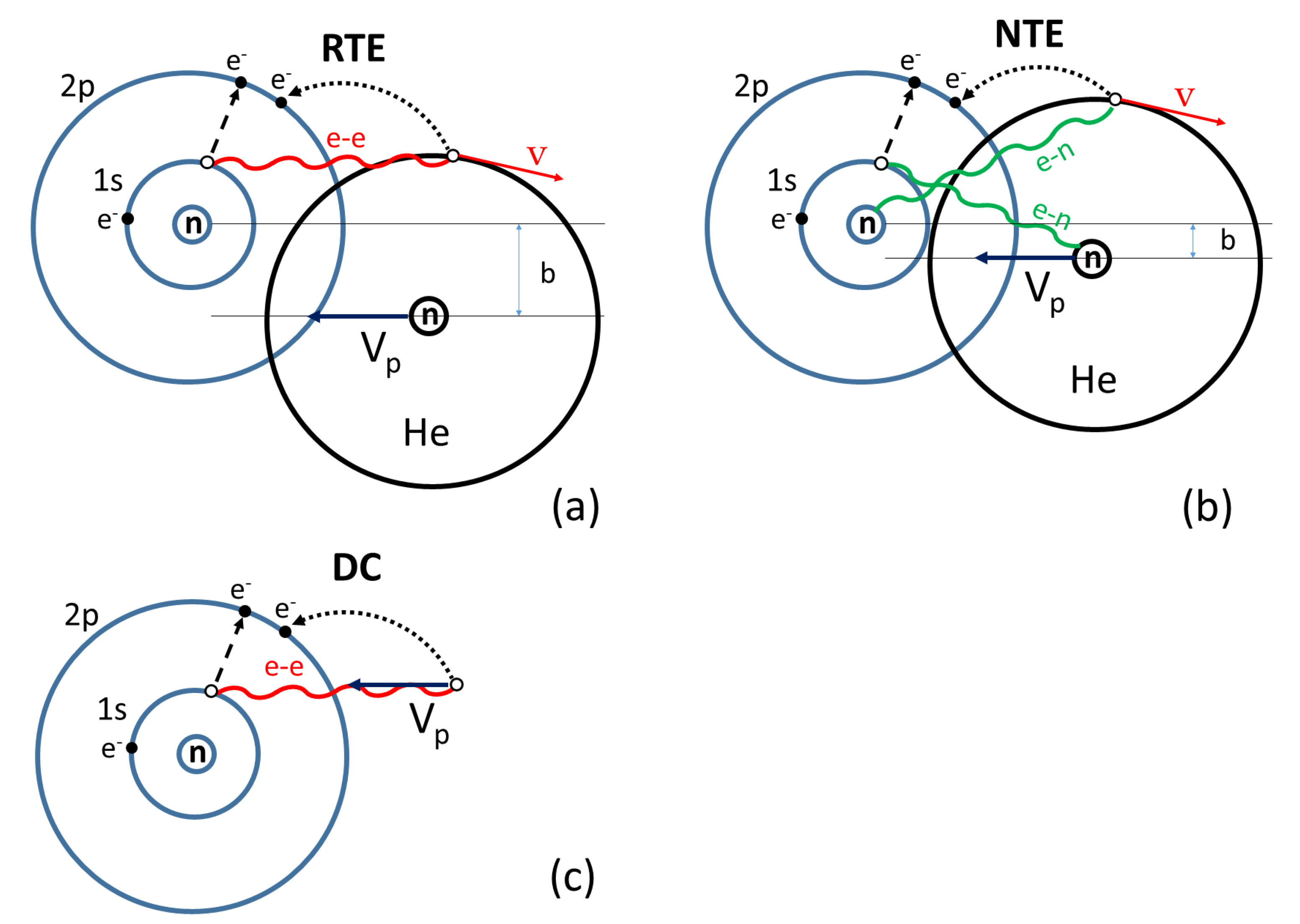
Disclaimer/Publisher’s Note: The statements, opinions and data contained in all publications are solely those of the individual author(s) and contributor(s) and not of MDPI and/or the editor(s). MDPI and/or the editor(s) disclaim responsibility for any injury to people or property resulting from any ideas, methods, instructions or products referred to in the content. |
© 2026 by the authors. Licensee MDPI, Basel, Switzerland. This article is an open access article distributed under the terms and conditions of the Creative Commons Attribution (CC BY) license (http://creativecommons.org/licenses/by/4.0/).
Copyright: This open access article is published under a Creative Commons CC BY 4.0 license, which permit the free download, distribution, and reuse, provided that the author and preprint are cited in any reuse.


