
Submitted:
12 February 2026
Posted:
12 February 2026
You are already at the latest version
Abstract
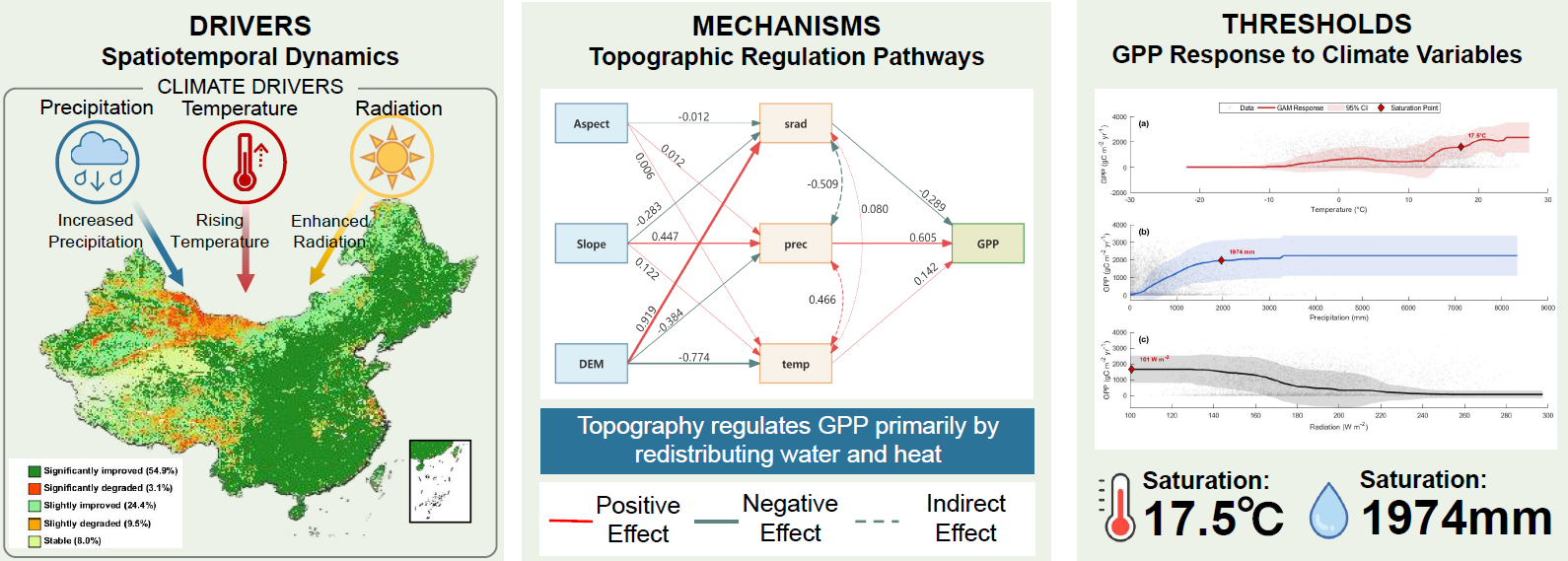
Terrestrial Gross Primary Productivity (GPP) is pivotal to the global carbon cycle, and its response to climate change is strongly regulated by topographic conditions through complex, non-linear mechanisms that remain poorly quantified at macro scales. Integrating multi-source remote sensing data with structural equation modeling (SEM), geographical detectors, and generalized additive models (GAM), this study investigated the spatiotemporal dynamics of GPP and its non-linear responses to coupled climate-topography gradients across China from 2001 to 2020. Results revealed a significant increasing trend in GPP across nearly 80% of China, with precipitation identified as the dominant driver, surpassing temperature and radiation. Topography significantly modulated climate sensitivity by redistributing hydrothermal resources. A distinct transition in dominant limiting factors was observed along the altitudinal gradient, shifting from water-limited (<2000 m) to energy-limited (>3000 m) regimes. Notably, mid-altitude regions (1000–2000 m) exhibited the highest sensitivity to precipitation, representing an ecological "sweet spot". Furthermore, we quantified critical ecological thresholds for climatic drivers, identified saturation points for temperature (~17.4°C) and precipitation (~1974 mm), and an inhibition threshold for solar radiation (>101 W/m²). These findings elucidate the transition mechanisms of climatic constraints and non-linear thresholds in complex terrain, providing robust scientific evidence for region-specific ecosystem and carbon management.
Keywords:
Gross Primary Productivity (GPP)
; climate change
; topographic regulation
; non‐linear thresholds
; Structural Equation Modeling (SEM)
Copyright: This open access article is published under a Creative Commons CC BY 4.0 license, which permit the free download, distribution, and reuse, provided that the author and preprint are cited in any reuse.


