
Submitted:
11 February 2026
Posted:
13 February 2026
Read the latest preprint version here
Abstract
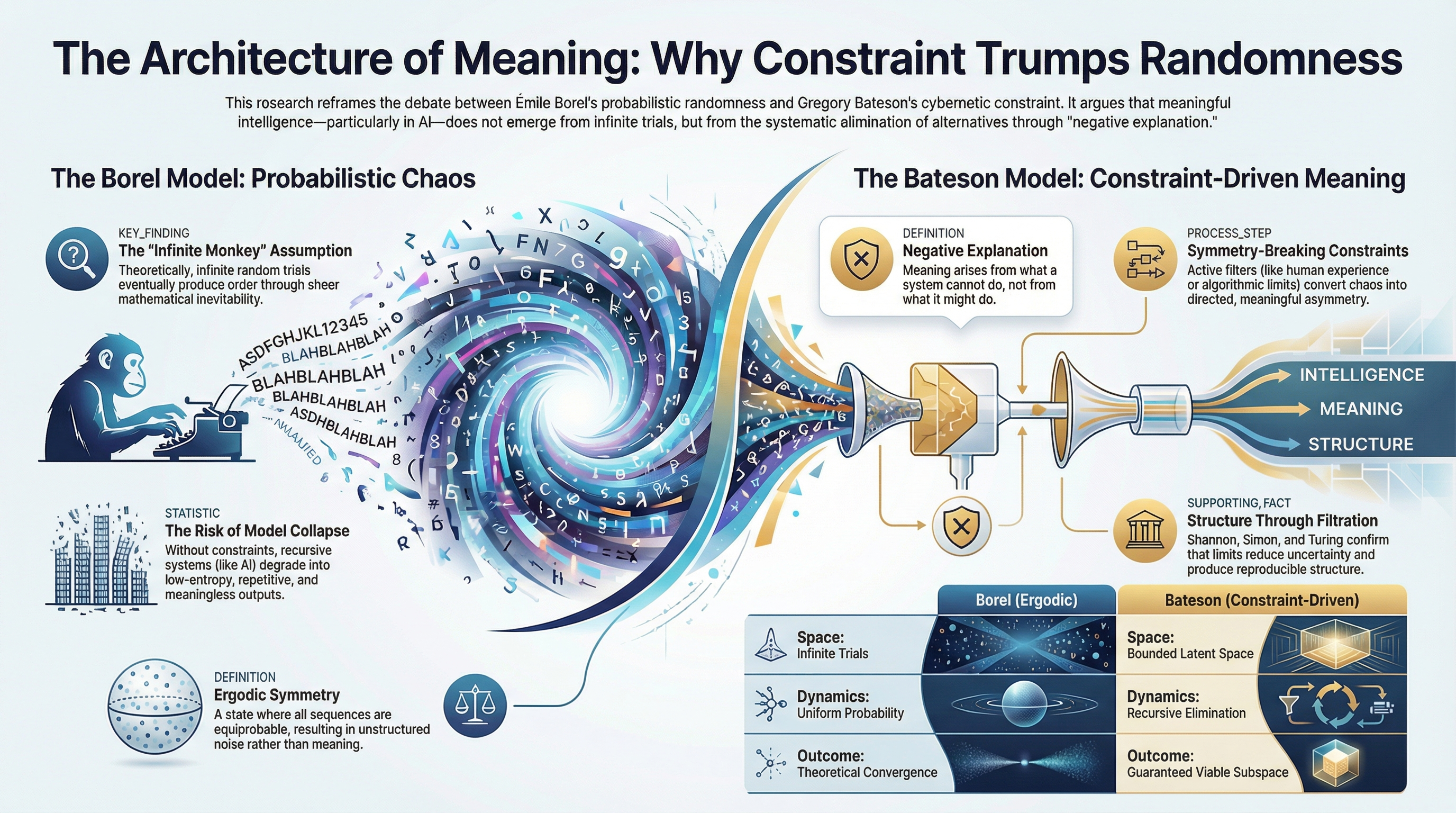
This study develops a Constraint-Driven Model of Intelligence to explain the emergence of structured meaning in complex systems, reconciling probability and cybernetics. Building on Émile Borel’s Infinite Monkey Theorem, which illustrates the theoretical inevitability of order through unbounded stochastic processes, and Gregory Bateson’s principle of negative explanation, which frames structure as the consequence of systematically eliminated alternatives, the analysis formalizes how constraints break ergodicity and generate asymmetry. Shannon’s entropy quantifies the informational effects of constraints, while Simon’s bounded rationality and Turing’s algorithmic limits illustrate how cognitive and computational boundaries produce tractable, reproducible outcomes. Applying this model to modern artificial intelligence, the study provides a formal account of model collapse in recursive training, showing that the loss of asymmetric constraints leads to low-entropy, repetitive outputs, demonstrating the epistemic necessity of constraint-driven regulation. By comparing probabilistic and cybernetic accounts of emergence, the analysis demonstrates that structured intelligence is not an inevitable product of stochastic exploration, but arises from bounded, recursive, and selective processes. Beyond computational systems, this model is transdisciplinary, showing how constraints ranging from socioeconomic pressures to subcultural circulation shape diversity, innovation, and functional asymmetry. By formalizing the transition from maximal stochastic symmetry to meaningful asymmetry, this model establishes a generalizable cybernetic epistemology for the generation of structured intelligence and meaning across numerous domains.
Keywords:
non-ergodic intelligence
; cybernetic constraint
; negative explanation
; infinite monkey theorem
; symmetry-breaking
; AI model collapse
; bounded rationality
; structured emergence
Constraint, Asymmetry, and Meaning: A Cybernetic Reinterpretation of Probabilistic Emergence Across Complex Systems
The nature of meaning, structure, and randomness in complex systems has long posed a challenge across philosophy (Aristotle, 1929/350 B.C.E., Physics Book II; Eagle, 2021), probability theory (Borel, 1913, 1914; Eagle, 2021; von Mises, 1957/1936), systems theory and cybernetics (Bateson, 1972; von Bertalanffy, 1973; von Foerster, 1979; Wiener, 1948), complexity science (Cilliers, 1998; Ladyman & Wiesner, 2020), and now artificial intelligence (AI; Kaplan et al., 2020; Shumailov et al., 2024; Wei et al., 2022). In this study, I enter a longstanding theoretical debate between probabilistic emergence and systemic constraint by reframing Émile Borel’s Infinite Monkey Theorem (1913) with Gregory Bateson’s Cybernetic Explanation (1967). My aim is to explore how meaning arises not from infinite randomness, but from recursive processes of constraint and elimination.
Borel’s theorem offers a compelling and frequently cited thought experiment: given infinite time, a monkey randomly striking keys on a typewriter could eventually reproduce the complete works of Shakespeare. This idea, often used as a reductio ad absurdum, illustrates the improbable but mathematically inevitable emergence of structure from randomness. In modern machine learning, this Borelean logic underpins the scaling hypothesis: sufficiently large, ergodic systems trained on vast data distributions will converge upon structured intelligence simply through prolonged stochastic exploration (Kaplan et al., 2020). Yet recent empirical evidence challenges this assumption. When AI systems shift from open-loop training to closed-loop recursive generation (e.g., training on self-generated data), they frequently undergo “model collapse,” a degradation of output variety into low-entropy, repetitive modes (Shumailov et al., 2024). This collapse reveals the limits of ergodicity: the presumption that time-averaged behavior will explore the full phase space and sustain meaning. Randomness alone does not guarantee structured emergence; it requires the imposition of constraints to break initial symmetry and produce directed asymmetry.
Gregory Bateson provides the decisive alternative. His theory of negative explanation reframes causality not as the positive production of outcomes but as the elimination of alternatives through systemic constraints (Bateson, 1967). In this view, the “symmetry” of an ergodic random system, where all sequences are equiprobable, must be deliberately broken by filters that prevent improbable or meaningless outcomes. Meaning emerges through what the system cannot do, not through what it might eventually do given infinite trials. To borrow from Shakespeare, “The better part of valor is discretion” (Henry IV, Part 1, Act 5, Scene 4). Just as discretion refines action, constraint refines probability, allowing structure and meaning to arise through bounded pathways rather than stochastic chaos.
A related proverb, mater artium necessitas—translated as “necessity is the mother of invention” (Horman, 1519)—encapsulates the essence of Bateson’s argument. This notion of necessity driving invention can be traced back to Aesop’s Fables (c. 6th century BCE), where resourcefulness is shown as emerging from necessity. Plato (c. 4th century BCE) also expressed this idea in The Republic, where he asserted that “necessity is the true creator of invention” (Jowett, 1894). In the 16th century, this proverb appeared in English, as noted by Horman (1519) and Ascham (1923/1545), and it evolved in several forms, such as in Cervantes’ Don Quixote (1605), where “experience is the mother of all the sciences.” The phrase “necessity is the mother of invention” highlights a critical theme: that constraint, not random possibility, shapes the emergence of meaning.
The purpose of this paper is to develop a novel theoretical synthesis that challenges the probabilistic assumptions underlying both Borel’s theorem and contemporary scaling laws in AI. I argue that Bateson’s cybernetic logic not only reframes Borel’s theorem but offers a more coherent epistemology for understanding how complex systems, either biological, cognitive, or artificial, generate meaning. By emphasizing constraint over randomness, this approach explains why ergodic models fail in recursive settings and proposes that intelligence is the product of systemic restraint rather than stochastic accumulation.
No prior study has systematically critiqued the epistemological foundations of the Infinite Monkey Theorem using Bateson’s logic of negative explanation, nor applied that critique to diagnose the symmetry-breaking requirements of modern AI architectures. This paper offers the first such comparative theoretical analysis, reorienting the emergence of meaning as a cybernetic process of asymmetry production through constraint. In doing so, it contributes a fresh perspective to debates in the philosophy of information, AI, and systems theory.
To support this argument, I draw on three foundational thinkers whose work intersects with these issues. Claude Shannon’s (1948) Mathematical Theory of Communication illustrates how constraints increase informational clarity, reinforcing Bateson’s claim that pattern arises through selective filtration, not infinite variation. Herbert Simon’s (1955) model of bounded rationality shows that decision-making occurs within systemic limitations, further opposing the logic of probabilistic infinity. Alan Turing’s (1950) work in computational intelligence also supports this view, demonstrating that meaningful output in artificial systems is a result of algorithmic constraints—not random computation.
This paper is a conceptual–analytic study employing a second-order cybernetic design, integrative theoretical method, and formal analysis of ergodicity-breaking through constraint functions on latent-space structure. The methodology treats AI training not as the accumulation of probabilistic knowledge but as the construction of a cybernetic governor that dictates what the system cannot do. Specifically, it involves:
- Deconstructing the “Borelean” limits of current ergodic assumptions in AI architectures.
- Mapping the transition from symmetry (uniform probability) to asymmetry (directed information) via Bateson’s negative explanation.
- Correlating these concepts with real-world mechanisms such as regularization, pruning, attention masks, and other constraint-inducing techniques.
In the sections that follow, I outline this comparative framework, beginning with a formal analysis of Borel’s and Bateson’s models. I then integrate supporting theories from Shannon, Simon, and Turing to deepen the critique of probabilistic emergence. The discussion elaborates on the implications of this synthesis for AI, cognitive psychology, and systems design. Finally, I conclude by articulating a cybernetic critique of randomness-based epistemologies and proposing directions for future research in constraint-based theory.
The Long-Standing Debate
This interdisciplinary debate revolves around a core tension: whether structured meaning and order emerge primarily from unbounded probabilistic randomness or from systemic constraints that filter possibilities, eliminate alternatives, and impose direction on emergent processes (Lockhart, 2025a). The discussion has persisted for millennia, evolving from ancient inquiries into chance and necessity to modern critiques of stochastic scaling in AI.
Philosophical Foundations: Chance, Necessity, and the Limits of Randomness
Philosophical engagement with randomness and structure dates to antiquity. Aristotle (1929/350 B.C.E.) in Physics Book II analyzed chance (tychē) and spontaneity as accidental outcomes arising from the intersection of independent causal chains, distinct from purposeful necessity or natural teleology. He subordinated randomness to ordered ends, suggesting that true complexity involves structured processes rather than pure accident. This foundational distinction has influenced subsequent treatments of randomness as unpredictability or pattern disruption, contrasted with emergent order in systems that balance chaos and constraint (Eagle, 2021).
Probability Theory: Formalizing Randomness and the Infinite Possibility Horizon
Probability theory provided rigorous tools for modeling randomness in complex systems. Borel (1913, 1914) introduced the Infinite Monkey Theorem as a thought experiment demonstrating that, over infinite time, random sequences could produce structured artifacts (e.g., Shakespeare’s works) through sheer equiprobability. von Mises (1957/1936) further formalized randomness in terms of sequences insensitive to place-selection rules, emphasizing frequency limits in infinite collectives. Yet these conceptualizations highlight a persistent challenge: while randomness enables exploration of vast possibility spaces, it struggles to explain reliable emergence of meaning in finite, constrained systems, where unstructured noise predominates without selective mechanisms (Borel, 1913, 1914; Eagle, 2021; von Mises, 1957/1936).
Systems Theory and Cybernetics: From Holism to Negative Explanation
Systems theory and cybernetics reframed the problem in terms of organization, feedback, and constraint. Wiener (1948) established cybernetics as the study of control and communication in animals and machines, emphasizing feedback loops that maintain structure amid potential disorder. von Bertalanffy (1973) advocated general system theory, focusing on open systems where emergence arises through holistic organization rather than reductionist randomness. von Foerster (1979) advanced second-order cybernetics, underscoring self-referential observation and the role of the observer in constructing order. Bateson (1967) introduced negative explanation, shifting causality from positive production to the elimination of alternatives via constraints, whereby meaning emerges not from infinite possibility but from systemic boundaries that break symmetry and guide asymmetry. These approaches collectively prioritize constraint over unbounded randomness in generating structured complexity (Bateson, 1967; von Bertalanffy, 1973; von Foerster, 1979; Wiener, 1948).
Complexity Science: Intermediate Regimes and Emergent Order
Complexity science synthesizes these threads by positioning complex systems in an intermediate domain between rigid order and complete randomness. Cilliers (1998) argued that understanding complexity requires acknowledging nonlinear dynamics, feedback, and edge-of-chaos behavior, where structure emerges dynamically from constrained interactions. Ladyman and Wiesner (2020) provide a formal account of complex systems as those exhibiting irreducibility, emergence, and sensitivity to initial conditions, reinforcing that meaningful order often arises through selective constraints rather than pure stochasticity (Cilliers, 1998; Ladyman & Wiesner, 2020).
AI: Scaling, Emergence, and the Limits of Ergodicity
In contemporary AI, the debate has resurfaced with scaling laws suggesting that large, stochastic models achieve emergent abilities through massive probabilistic exploration (Kaplan et al., 2020). Wei et al. (2022) documented abrupt qualitative leaps in large language models, such as reasoning or arithmetic, at certain scale thresholds, initially appearing to support the power of randomness in generating structure. However, recent evidence reveals vulnerabilities in purely stochastic, recursive regimes: training on model-generated data leads to model collapse, where distributions degrade, rare events are lost, and outputs converge to low-variety, repetitive modes (Shumailov et al., 2024). This phenomenon underscores the failure of ergodic assumptions in closed loops and highlights the necessity of constraints to sustain diversity and meaning (Kaplan et al., 2020; Shumailov et al., 2024; Wei et al., 2022).
This review scopes the historical and cross-disciplinary debate as a sustained critique of unbounded randomness: while probabilistic infinity (Borel) enables theoretical emergence, real-world complexity depends on cybernetic and systemic constraints to break symmetry, suppress noise, and produce directed structure. While Wiener formalizes feedback as a condition for systemic stability, von Foerster models self-reference through observer inclusion, and Bateson formalizes explanation via constraint-driven elimination of alternatives, this study relies on Bateson’s theory to analyze Borel’s probabilistic emergence, yielding a direct account of asymmetry and meaning in bounded, recursive systems. This synthesis provides a foundation for reinterpreting the Infinite Monkey Theorem through constraint-driven epistemology, particularly in light of current challenges in AI.
Theoretical Framework
This conceptual–analytic study employs a second-order cybernetic design, an integrative theoretical method, and formal set-theoretic reasoning to analyze ergodicity-breaking via constraint functions on latent-space structure. It adopts a second-order cybernetic epistemology, positioning the observer as integral to systemic emergence (von Foerster, 1979). The framework synthesizes Bateson’s (1967, 2000a) notion of negative explanation with Borel’s (1909, 1913, 1914) probabilistic account of ergodicity through three interrelated mechanisms that remain underexplored in prior literature.
Probabilistic Ergodicity and Infinite Enumeration. Borel’s probabilistic ergodicity characterizes an epistemology in which all finite sequences have positive probability under uniform random sampling. Through unbounded iterative enumeration, any specific structured sequence becomes accessible:
 For finite trials, probabilistic success is expressed as
 where p is the probability of generating the target sequence on a single trial. Under this view, structure is interpreted as a statistical inevitability arising from stochastic symmetry and infinite enumeration rather than from system-internal organization.
Constraint-Driven Information. Shannon’s (1948) entropy is defined as
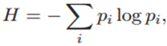 where pi denotes the probability of the ith outcome. Entropy characterizes the expected uncertainty of a discrete random variable. Constraints reduce entropy by limiting the support or reshaping the concentration of the probability mass function, thereby decreasing uncertainty without increasing descriptive dimensionality. This reduction can be expressed schematically as
 where each λi represents the informational restriction imposed by a constraint. Information, in this sense, arises not from stochastic excess but from selective filtration.
Constraint and Negative Explanation. Bateson’s cybernetic notion of negative explanation reverses productive causality by explaining observed outcomes through the systematic exclusion of alternatives. Formally, meaningful outcomes arise as the complement of eliminated possibilities:
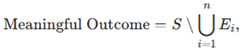 where S denotes the total possibility space and Ei are excluded, non-viable, or improbable alternatives. Equivalently, constraint-satisfaction can be expressed as
 where C(x) encodes violations of systemic constraints. Meaning thus emerges from bounded selection rather than from exhaustive enumeration.
Bounded Rationality. Simon’s (1955) concept of satisficing formalizes decision-making under computational and informational limitations. Instead of exhaustively evaluating all possible alternatives in a combinatorial or probabilistic space, agents select the first option that meets a predefined acceptability criterion. This approach reduces the effective search space, ensuring tractable computation while maintaining structured outcomes in complex decision environments.
Computational Constraint. Turing’s (1950) analysis of algorithmic limits demonstrates that structured outputs arise from processes governed by formal rules and finite computation. Constraints on algorithmic procedures, such as time or memory bounds, limit the exploration of the full space of potential outcomes, yielding predictable and reproducible structure. This formal perspective highlights the role of computational boundaries in shaping feasible information processing and system behavior.
Taken together, these perspectives challenge Borel’s ergodic assumption by demonstrating that structure and meaning emerge through symmetry-breaking constraint functions rather than infinite probabilistic convergence. This framework provides the conceptual foundation for the constraint-driven analyses and formal derivations developed in subsequent sections.
Methods
A multi-stage conceptual and formal examination will be employed using a three stage method:
Stage 1: Conceptual Explication. Close reading of primary texts extracts epistemological commitments:
- Bateson (1967, 2000a, pp. 407–418, Cybernetic Explanation) introduces negative explanation as the principle that structure arises through the recursive elimination of non-viable alternatives within bounded systems. This establishes the abstract, conceptual foundation of constraint-driven emergence.
- Bateson (2000b, pp. 315–344, The Cybernetics of ‘Self’) provides a concrete application: the behavior of the “alcoholic self” illustrates how systemic constraints and feedback loops produce viable outcomes without reliance on direct linear causation. This demonstrates negative explanation in a bounded, real-world context.
- Bateson (2000c, pp. 455–471, Form, Substance, and Difference) grounds the epistemology of structured emergence: meaningful outcomes arise from distinctions (“differences that make a difference”) rather than from stochastic or material forces, highlighting the ontological dimension of constraint.
- Borel (1909, 1913, 1914), by contrast, treats structure as an artifact of ergodic probability: uniform distribution over infinite sequences theoretically guarantees the emergence of order, independent of systemic boundaries or feedback.
This layered reading differentiates conceptual principle, applied illustration, and epistemological foundation, setting the stage for comparing probabilistic and constraint-driven models of emergence.
Stage 2: Comparative Synthesis. Integrative mapping across three domains:
- Information theory: Shannon’s entropy reduction via constraint aligns Bateson’s elimination
- Decision theory: Simon’s satisficing operationalizes cybernetic selection
- Computation theory: Turing’s algorithmic limits formalize constraint-driven convergence
Stage 3: Formal Set-Theoretic Derivation. A formal derivation operationalizes the recursive application of constraint functions in latent spaces, illustrating how ergodic symmetry is broken and structured emergence is preserved. This stage translates conceptual and comparative insights into a set-theoretic model, providing a formal basis for the Constraint-Driven Model of Intelligence.
Analytic Outputs. The analysis produces three primary outputs that collectively support the development of a Constraint-Driven Model of Intelligence:
- Comparative Operational Table (Table 1). Summarizes core differences between Borel’s ergodic model and Bateson’s constraint-driven logic, highlighting how bounded latent spaces and recursive elimination shape viable system outcomes.
- Comparative Epistemological Table (Table 2). Synthesizes cybernetic constraints versus probabilistic randomness in a matrix-like format, linking these distinctions to Information Theory (Shannon), Bounded Rationality (Simon), and Computability Theory (Turing). This table demonstrates how constraints generate meaningful structure and reveal the limits of infinite-trial assumptions.
- Formal Set-Theoretic Derivation. Operationalizes the recursive application of constraint functions in latent spaces, illustrating how ergodic symmetry is broken and structured emergence is preserved.
This non-empirical design adopts a constructivist–interpretivist epistemology (Machamer et al., 2000; Swedberg, 2016), emphasizing theory building through conceptual synthesis rather than statistical generalization (Guba & Lincoln, 1982). Together, these outputs integrate the conceptual, operational, and formal analyses, demonstrating that constraint-driven logic more effectively explains the emergence of structure and meaning across complex systems, including AI architectures, cognitive models, and biological processes.
Analysis
This section presents a multi-stage conceptual and formal examination of Borel’s ergodic logic and Bateson’s notion of negative explanation. It moves from explicating core epistemological assumptions, to comparing operational and theoretical alignments across related domains, and finally to a formal set-theoretic derivation that operationalizes constraint-driven dynamics. Each stage builds on the previous, creating a structured pathway from conceptual understanding to formalized analysis.
Stage 1: Conceptual Explication
This stage identifies and articulates the core epistemological assumptions of Borel and Bateson. It examines how Borel’s ergodic logic treats latent spaces and the generation of sequences, and how Bateson’s negative explanation actively constrains system states to produce viable outcomes. The goal is to clarify the conceptual distinction between passive probabilistic emergence and the active enforcement of constraints.
<<insert Analysis 1.tex or Analysis 1.pdf>>
Stage 2: Comparative Synthesis
Building on Stage 1, the comparative synthesis situates the theoretical distinctions from Borel and Bateson within operationalized and epistemological frameworks. Bateson’s 1967 principle of negative explanation underpins the recursive elimination processes encoded in Table 1, while his applied example in The Cybernetics of “Self” (2000, pp. 315–344) demonstrates how these constraints operate in real-world, bounded systems. The philosophical grounding from Form, Substance, and Difference (2000, pp. 455–471) further informs the epistemic logic in Table 2, showing that meaningful outcomes emerge from differences and distinctions rather than passive stochastic convergence.
In contrast, Borel’s ergodic model assumes that uniform randomness over infinite trials produces structure automatically, a logic that is captured operationally in Table 1 as unbounded space, uniform dynamics, and theoretical convergence. This highlights a key divergence: Borel treats structure as emergent from the possibility space itself, whereas Bateson emphasizes constraint as a necessary condition for viable outcomes. By mapping these distinctions onto Table 2, the synthesis clarifies how negative explanation functions as an epistemic operator, shaping causality, constraints, and logical flow across both conceptual and applied domains.
The synthesis also shows convergence with supporting theories: Shannon’s information theory aligns with Bateson’s emphasis on signal and distinction, Simon’s bounded rationality resonates with the principle of limited latent spaces, and computability theory underscores the importance of algorithmic limits in shaping reproducible outcomes. Together, these connections demonstrate that structured emergence arises not from infinite probability but from the active maintenance of boundaries, recursive feedback, and epistemic distinctions—each illustrated in Bateson’s layered chapters.
<<insert Analysis 2.tex or Analysis 2.pdf>>
Stage 3: Formal Set-Theoretic Derivation
This stage translates the conceptual and comparative insights into a formal set-theoretic model. It defines latent spaces and constraint operators, demonstrates the effect of iterative constraint application, and shows how ergodic symmetry is broken while informational and structural diversity is preserved. The derivation provides a rigorous basis for interpreting the operational and epistemological distinctions highlighted in the previous stages.
<<insert Analysis 3.tex or Analysis 3.pdf>>
Analytic Outputs
The following tables compare Borel’s ergodic model and Bateson’s constraint-driven logic in generating structure, emergence, and diversity.
Stage 1: Conceptual Explication
The operational characteristics of Borel’s infinite probabilistic model and Bateson’s bounded, constraint-driven model are compared, in Table 1, highlighting the mechanisms that generate viable, stable, and diverse outcomes.
Stage 2: Comparative Synthesis
Table 2 contrasts Borel’s probabilistic assumptions with Bateson’s recursively constrained logic, highlighting their differing causal principles and epistemological reasoning of how structure emerges.
Stage 3: Formal Set-Theoretic Derivation
To consolidate the conceptual and comparative analyses from Stages 1 and 2, Stage 3 formalizes constraint-driven dynamics in latent spaces using set-theoretic reasoning. This stage operationalizes the iterative application of constraints, illustrating how recursive elimination systematically breaks ergodic symmetry while preserving informational diversity. The formal derivation defines the latent space, the constraint operator, and its iterated action, showing mathematically that bounded constraints generate structured emergence, prevent recursive collapse, and maintain diversity within complex systems. The derivation provides a rigorous foundation for interpreting the operational and epistemological insights highlighted in Table 1 and Table 2.
<<insert Formal Set-Theoretic Derivation.tex or Formal Set-Theoretic Derivation.pdf>>
Discussion
In this inquiry, I have explored the tension between probabilistic randomness and systemic constraints in the formation of meaning and structure within complex systems. By reframing Émile Borel’s Infinite Monkey Theorem through Gregory Bateson’s negative explanation, I propose that structured emergence does not arise from infinite stochastic processes but from recursive processes of constraint and elimination. This synthesis reconciles probabilistic and cybernetic accounts of emergence, offering a coherent epistemology for meaning-making in natural, artificial, and social systems.
Through the comparative analysis of Borel’s ergodic logic, and Bateson’s cybernetic reasoning supported by foundational theories from Claude Shannon (1948), Herbert Simon (1955), Alan Turing (1950), and contemporary AI studies (Ferbach et al., 2024; Kaplan et al., 2020; Shumailov et al., 2024) it becomes clear that emergence is constrained, not merely stochastic. Borel assumes that infinite trials with uniform probability will eventually produce structure, but this ignores the role of active selection in real-world systems.
Bateson’s essays collectively illustrate this principle through complementary angles: Cybernetic Explanation (2000a) establishes the abstract, conceptual foundation of constraint-driven emergence; The Cybernetics of ‘Self’ (2000b) operationalizes negative explanation within behavioral systems; Form, Substance, and Difference (2000c) provides the epistemological foundation that defines information as constraint-based difference. Later chapters, which were not included in the initial methods, extend these insights: Redundancy and Coding (2000d) models the mechanics of constraint in communicative systems; and Pathologies of Epistemology (2000e) cautions that ignoring these feedback-bound limitations yields maladaptive systems. Taken together, these essays provide both theoretical postulation and evidence from living and communicative systems, demonstrating that structure emerges through recursive elimination within bounded feedback environments rather than through infinite stochastic variation.
Interpretation of Results
The central insight of this analysis is that structured emergence depends on boundary maintenance rather than probabilistic sufficiency alone. While Borel’s model assumes that random variation will eventually generate structure given infinite trials, Bateson’s negative explanation demonstrates that defining what does not occur is the mechanism by which viable patterns are preserved. Shannon’s entropy formalizes the informational effects of constraints, Simon’s bounded rationality illustrates how cognitive limits produce tractable decisions, and Turing’s algorithmic limits show how computational boundaries enable reproducible outcomes. Bateson’s Pathologies of Epistemology (2000) further highlights that neglecting systemic boundaries leads to collapse or degeneracy, a principle that maps directly onto recursive AI training and social systems.These findings reinforce that structured emergence depends on viability filtering, not stochastic sufficiency. Randomness may supply variation, but it does not explain why certain outcomes stabilize while others are systematically excluded. That explanatory burden belongs to constraint, not probability.
These results are especially salient in contemporary AI and computational contexts, where systems are finite, historically situated, and epistemically bounded (Lockhart, 2025a). Kaplan et al. (2020) show that scaling alone does not guarantee qualitative improvements in model behavior; observed gains are mediated by architectural limits, data curation, and inductive biases. Similarly, Shumailov et al. (2024) demonstrate that recursively training models on their own outputs leads to distributional contraction and low-entropy repetition under finite conditions. Together, these findings illustrate that randomness supplies variation, but boundary maintenance determines which patterns stabilize and remain intelligible within bounded systems.
Clarifying Non-Equivalence with Probabilistic Convergence
It is critical to emphasize that probabilistic convergence and constraint-driven emergence are not complementary explanations but rest on incompatible epistemic commitments. Probabilistic convergence presupposes that structure arises passively from unconstrained variation over asymptotic time, whereas constraint-driven emergence presupposes that structure is actively produced through the recursive elimination of non-viable alternatives. Borel treats order as an eventual artifact of infinite possibility, while Bateson treats order as the result of systemic boundaries that prevent most possibilities from ever manifesting.
This incompatibility becomes decisive in artificial and computational systems. Kaplan et al. (2020) show that increased scale does not eliminate the need for architectural and epistemic constraints, and Shumailov et al. (2024) demonstrate that self-consuming training loops collapse precisely because probabilistic convergence lacks mechanisms for viability filtering. These failures cannot be explained by stochastic insufficiency alone; they reflect the absence of enforced boundaries that stabilize meaningful structure. Emergence, on this account, is not what appears when everything is possible, but what persists when most possibilities are systematically ruled out.
Observer Inclusion and Second-Order Cybernetics
Bateson’s cybernetic epistemology emphasizes that the observer plays an active role in defining constraints (Bateson, 2000a, 2000b). In second-order cybernetics, systems are not pre-given entities; they are constituted through the distinctions an observer draws (von Foerster, 1979). Meaningful outcomes are therefore always observer-relative, sustained by feedback loops that enforce viable states relative to those distinctions.
In contemporary AI, this principle is visible in the way human-guided task definitions, evaluation metrics, and success criteria shape what counts as “emergent” behavior (Smith et al., 2024; Wei et al., 2022). Emergent abilities are not intrinsic properties of scale; they become legible only relative to observer-imposed frameworks. Smith et al. (2024) further demonstrate that preserving human-like selective pressures (as occurs in natural language transmission) is necessary to sustain meaningful, non-degenerate patterns. Lockhart’s (2025b) concept of experientia humana extends this observer-centric epistemology: the human observer is not a detached evaluator but an embodied, situated participant whose lived experience, cultural location, and perspectival commitments actively constitute the distinctions that make emergence intelligible.
Symmetry-Breaking and Experientia Humana
Symmetry-breaking constitutes the core dynamical mechanism through which constraints convert maximal stochastic symmetry into directed, meaningful asymmetry. In recursive, self-consuming AI systems, the default trajectory is toward progressive loss of variety: initial ergodic uniformity collapses into bland, low-entropy, highly repetitive outputs (Shumailov et al., 2024). While Lockhart (2024) highlights the human condition and the limits of machine generation, emphasizing that AI outputs lack embodied cognition, emotional texture, and cultural nuance, it does not provide a mechanistic account of symmetry-breaking.
The current study extends this argument, showing how lived human experience (i.e., embodiment, cultural necessities, emotional texture, moral friction, historical situatedness, idiosyncratic quirks) can function as deliberate symmetry-breaking interventions that prevent AI-generated outputs from devolving or collapsing by injecting irreducible character that disrupts entropic homogenization. Lockhart (2025b) operationalizes this concept as experientia humana, proposing that human-derived interventions can be formalized as recursive constraints that preserve diversity, functional specificity, and informational richness. The current study situates this operational framework in the context of deep generative models, showing that constraint-driven architectures, guided by human-informed asymmetries, can sustain emergent novelty in ways that purely stochastic or ergodic processes cannot.
Empirical analyses of AI optimization and deep representations provide complementary support for this principle. Zhang et al. (2025) demonstrate that intentional symmetry-breaking in neural network optimization improves performance stability and learning dynamics, while Achille and Soatto (2018) show that structured features emerge when symmetries are deliberately disrupted in deep representations. These studies indicate that symmetry-breaking is essential for both tractable computation and the emergence of meaningful structure.
Recent work in generative modeling further highlights the necessity of bounded exploration. Brunswic et al. (2025) analyze ergodic generative flows and demonstrate that restricting latent-space traversal is critical for producing stable and tractable generative outcomes. Similarly, Tomczak (2025) emphasizes that structural constraints and latent-space organization are necessary for coherent outputs. Lin et al. (2017) complements this perspective, showing that physical and systemic constraints in neural networks reduce resource requirements while preserving representational fidelity. While these studies do not claim that constraints alone generate meaning, they collectively reinforce the principle that meaningful structure in generative systems is not a purely stochastic phenomenon but requires bounded exploration and viability filtering.
Finally, Peters (2019) defines ergodicity-breaking as essential for viable decision-making in complex systems, while Wolpert (2019) examines the thermodynamic costs of informational constraints in computation. Collectively, these findings support an anti-Borelean position: structure emerges from deliberate, bounded processes rather than infinite stochastic possibility. The current study integrates these insights, connecting human-derived symmetry-breaking (Lockhart, 2024, 2025b) to constraint-driven mechanisms in AI, providing both conceptual framing and operational strategies for sustaining meaningful, emergent outputs.
Applied Examples and the Constraint Operator
Bateson’s principle of negative explanation emphasizes that constraints shape meaningful outcomes by systematically excluding unlikely or undesirable alternatives (von Foerster, 1979). Constraints function as epistemic operators, defining what counts as viable, interpretable, or functional across biological, social, and technological systems. This mechanism ensures that structured emergence is driven by boundary maintenance rather than random variation.
In AI, recursive training without robust external constraints leads to distributional contraction and model collapse (Ferbach et al., 2024; Shumailov et al., 2024; Smith et al., 2024). Ferbach et al. (2024) describe how curated constraints optimize preference alignment, while Shumailov et al. (2024) show degradation in self-consuming loops. Interventions that introduce “human texture” or culturally informed variability serve as epistemic constraints, maintaining viable diversity and preventing homogenization. Similarly, social and cultural systems rely on institutional, subcultural, and economic constraints to produce innovation and functional asymmetry.
Table 3 illustrates these cross-domain applications, demonstrating that structured emergence depends on actively maintained boundaries rather than passive randomness.
Contributions to Contemporary Debates
Emergence should be reconceptualized not as a mysterious byproduct of scale or randomness but as the outcome of selective exclusion within bounded systems. Scaling laws (Kaplan et al., 2020) and emergent abilities (Wei et al., 2022) describe empirical regularities, but they do not explain why certain capacities stabilize while others fail to appear. Constraint-driven epistemology fills this explanatory gap, highlighting why models lacking external constraints collapse, homogenize, or lose meaning (Ferbach et al., 2024; Shumailov et al., 2024). By foregrounding negative explanation and ergodicity-breaking, this study provides a conceptual bridge connecting cybernetics, information theory, and contemporary AI.
This work advances beyond technical fixes for model collapse, toward a revolutionary constraint-centric architecture that prioritizes philosophical depth as the foundation for sustainable, meaningful emergence in artificial systems. It challenges the sufficiency of probabilistic models and supports a shift from stochastic excess toward principled limitation as the basis of intelligible structure. Emergence is not what happens when everything is possible but what occurs when most possibilities are systematically ruled out, often guided by human-derived necessity (Lockhart, 2025b).
Further Implications
This study contributes to ongoing theoretical and interdisciplinary discussions by challenging foundational assumptions about randomness, emergence, and meaning. By reframing Borel’s probabilistic logic through Batesonian logics, it generates a set of implications that advance epistemological and methodological inquiry across multiple fields.
- Reframes the Infinite Monkey Theorem. This study challenges the classical interpretation of Borel’s probabilistic ergodicity, arguing that meaningful structure does not emerge from unbounded random sampling, but from the recursive elimination of improbable alternatives. While Feller (1957) emphasizes the mathematical inevitability of structure through indefinite trials, this perspective overlooks how meaningful outcomes are actively constrained in real-world systems. Bateson’s negative explanation redirects attention from the probability of random success to the systemic boundaries that prevent failure. Popper’s (1959) emphasis on falsifiability and Spencer-Brown’s (1969) logic of distinction reinforce the view that meaningful emergence arises from what is excluded, not from what is permitted.
- Advances Cybernetic Epistemology. Building on Bateson’s (1967) critique of causality, this study advances cybernetic epistemology by formalizing negative explanation as a foundation for understanding how structure and meaning arise. Rather than framing causality as a chain of productive events, it centers on recursive feedback and systemic restraint. This argument aligns with von Foerster’s (1979) second-order cybernetics, which emphasizes the observer’s embeddedness within self-organizing systems, and Varela’s (1980) theory of autopoiesis, which shows that systems maintain coherence through self-regulation. This reconceptualization of causality shifts the discourse from generative randomness to epistemic boundaries.
- Demonstrates the Limits of Probabilistic Models. Traditional probabilistic models rely on asymptotic reasoning, suggesting that probabilities converge with infinite trials. Cantelli (1917) formalized this convergence, and de Finetti (1974) emphasized the subjective foundation of probability as a limiting frequency. However, these views often abstract away from how systems actually generate meaningful outcomes in bounded conditions. This study argues that such models obscure the role of feedback, thresholds, and selection constraints in shaping complex behavior. Morin’s (1992) critique of linear models in complexity science further supports the claim that probabilistic infinity is insufficient for explaining structure. Instead, cybernetic frameworks foreground constraint as the organizing principle of emergence.
- Bridges Philosophy, Cybernetics, and Probability. This study offers an integrative framework that connects philosophical epistemology, cybernetic systems theory, and classical probability. Bateson’s cybernetic logic is shown to intersect with Shannon’s information theory and Simon’s bounded rationality, while also resonating with Wiener’s (1948) theory of feedback and control. Foucault’s (1970) analysis of discourse as constrained by regimes of knowledge complements this cybernetic view, highlighting that epistemic systems are shaped by what they exclude rather than what they contain. Together, these thinkers converge on the idea that structure and intelligibility emerge from the filtration of possibilities—not their proliferation.
- Contributes to Contemporary Debates. By revisiting a canonical paradox in probability theory, this study contributes fresh insight into active debates within epistemology, complexity science, AI, and systems design. Rescher (1977) emphasizes the role of methodological pragmatism, advocating for knowledge systems that reflect real-world constraints. Kauffman’s (1993) notion of the adjacent possible illustrates how novelty arises from bounded combinations, not infinite random recombination. This study’s cybernetic synthesis supports those models that prioritize feedback, boundary conditions, and recursive structuring as mechanisms for emergence, thereby challenging the continued reliance on stochastic excess in contemporary theories of cognition and computation.
- Introduces a Constraint-Driven Model of Emergence. The cumulative insights from this study establish a formal model of constraint-driven emergence. This model reorients traditional assumptions about structure and meaning, placing the emphasis on what systems exclude through negative selection rather than on the statistically inevitable emergence of order. It highlights the explanatory power of cybernetic feedback, algorithmic restriction, and epistemic thresholds in producing intelligible outcomes within complex systems.
- Establishes a Foundation for Interdisciplinary Research. Finally, by integrating foundational insights from cybernetics, epistemology, and probability theory, this study lays the groundwork for interdisciplinary applications. It offers a theoretical architecture that can inform models in AI, cognitive science, ecology, organizational systems, and beyond. This foundation encourages a shift toward constraint-centric frameworks, aligning theoretical insight with practical design principles across disciplines.
Together, these implications underscore the value of a constraint-driven framework in reframing how we understand emergence, meaning, and structure in complex systems. By challenging the sufficiency of probabilistic models and advancing a cybernetic epistemology grounded in systemic exclusion and recursive feedback, this study not only bridges foundational theories but also sets the stage for new interdisciplinary approaches to cognition, computation, and epistemology.
Limitations & Future Research
This study offers a novel theoretical model for understanding structured emergence through systemic constraints. Several limitations remain, each suggesting avenues for future research.
Comparative Scope. The analysis focuses on Borel’s probabilistic ergodicity and Bateson’s cybernetics, without incorporating other theories of emergence such as chaos theory, complex systems theory, or nonlinear dynamics. Incorporating chaos and complexity theory to capture nonlinear interactions and self-organization, expanding Batesonian applicability to diverse phenomena, may extend the model. Integrating insights from second-order cybernetics (von Foerster, 1979) and autopoiesis (Varela, 1980) could formalize how observer-relative distinctions and self-maintaining boundaries sustain asymmetry in evolving systems.
Feedback in Complex Systems. Feedback loops are acknowledged as essential but are not fully addressed across systems. Future research can investigate how feedback functions in biological, technological, and social domains to sustain symmetry-breaking and prevent internal recursion from generating low-entropy, repetitive regimes. Modeling external feedback loops, such as human-in-the-loop curation, is particularly relevant for maintaining constraint-driven dynamics.
Epistemology. Batesonian negative explanation is well-suited to systems involving information, feedback, and constraint-driven asymmetry, but it operates within formal systems that are inherently bounded in their inferential and self-referential capacity. Gödel’s incompleteness theorems, derived via the Diagonal Lemma, demonstrate that any consistent formal system capable of expressing basic arithmetic contains true statements that cannot be proven within the system itself, and cannot prove its own consistency (Gödel, 1992/1931; Nagel & Newman, 2001/1958). Extending this reasoning, Rice-style arguments and Gödel–Tarski results establish that many non-trivial properties of recursive or self-referential systems are undecidable or unprovable within the system (Boolos & Jeffrey, 2002).
In recursive, self-referential systems, such as AI architectures or meta-modeling processes, this implies that certain truths about the system may remain unresolvable within the system itself. While constraint-driven processes can still generate directed structure and meaningful asymmetry, there exist epistemic boundaries beyond which internal inference cannot fully capture system behavior. Recognizing these limits suggests future research should integrate constraint-based models with external meta-validation or multi-level reasoning to navigate fundamental undecidability and incompleteness inherent in recursive systems (Majumdar, 2026; Vassilev, 2025).
Probabilistic Models. This model emphasizes constraints as an alternative to Borelean probabilistic models, but its relationship to traditional probabilistic reasoning is not fully explored. Investigating the intersection of Borelean and Batesonian approaches could inform more sophisticated learning algorithms that reflect how meaning emerges through recursive refinement rather than random variation. This includes explicit testing of symmetry-breaking interventions inspired by negative explanation, such as deliberate exclusion of recycled synthetic data or imposition of human-derived epistemic boundaries, which can further guide the emergence of structure and lay the groundwork for formally identifying the “Borelean trap” in the study’s conclusion (Alemohammad et al., 2024; Kaplan et al., 2020).
Empirical Validation. The model is largely theoretical, with limited application to real-world systems including AI, cognition, and ecology. Empirical validation could test the model in systems characterized by feedback loops and recursive processes. Interventions that introduce human-like variability could prevent degradation in recursive AI training (Alemohammad et al., 2024; Shumailov et al., 2024) and mitigate Model Autophagy Disorder (MAD) by maintaining informational variety.
Interdisciplinary Approaches. Collaboration across philosophy, neuroscience, robotics, and sociology could refine the model and reveal universal patterns in how systems manage constraints. Studies could incorporate lived human experience as a source of constraints in humanoid robotics and AI design to ensure systems develop meaningful structure and avoid uniformity.
These combined limitations and directions advance beyond technical fixes for model collapse, promoting a constraint-centric architecture that prioritizes human necessity, discretion, and exclusion as the foundation for sustainable and meaningful emergence in artificial systems.
Conclusion
This study set out to determine whether structured emergence and meaning can be adequately explained by probabilistic randomness, or whether they require systemic constraint as a primary explanatory principle. By formally contrasting Borel’s Infinite Monkey Theorem with Bateson’s Cybernetic Explanation, the analysis demonstrates that probabilistic convergence is insufficient as an epistemology of meaning. Structure does not arise from infinite stochastic trials, but from the recursive elimination of non-viable alternatives within bounded systems.
The study produces three concrete outcomes. First, it provides a clarified conceptual distinction between ergodic probabilistic models and constraint-driven, non-ergodic systems, showing that these represent fundamentally different explanatory logics rather than alternative descriptions of the same process. Second, it synthesizes insights from information theory, bounded rationality, and computability to formalize constraint as an epistemic operator that reduces uncertainty, delimits viable outcomes, and stabilizes structure without reliance on probabilistic infinity. Third, it articulates a constraint-driven model of emergence that explains how informational diversity can be preserved while avoiding recursive collapse.
These results have direct relevance for contemporary debates in AI, cognitive science, and systems theory. In computational systems, the findings clarify why scaling and randomness alone fail to produce stable intelligence, and why constraint enforcement, feedback, and bounded search are essential to maintaining meaningful structure. More broadly, the study advances a cybernetic epistemology in which meaning arises not from what systems generate exhaustively, but from what they systematically exclude. By repositioning constraint, not chance, as the engine of emergence, this work offers a coherent theoretical foundation for understanding structure, intelligence, and meaning in finite, real-world systems.
Epistemological Addendum
At the epistemological level, this study argues that meaning, knowledge, and structure do not arise from the accumulation of random possibilities, but from principled limitation. In probabilistic terms, order is said to emerge eventually, given enough time and sufficient exploration. In cybernetic terms, order emerges because most possibilities are prevented. Under Borelean–Batesonian probabilistic logic, epistemic systems advance not by expanding the space of possibilities indefinitely, but by selectively restricting which possibilities are viable. Probability defines the raw space of potential states; asymmetric constraints deform that space, breaking ergodicity and introducing asymmetry. Entropy quantifies how much stochastic potential is removed by these constraints. Probability explains why order is possible; constraints explain why it exists, persists, and produces intelligible outcomes.
This argument extends a line of inquiry introduced in Lockhart (2025a), which identifies epistemic production as a problem of bounded systems and investigates whether recursive knowledge generation can yield genuine novelty without external or self-regulating constraints. Asymmetric constraints eliminate incoherent possibilities, generating reproducible, structured outcomes. Knowledge arises from this systematic shaping of variation, not from statistical inevitability. This causal mechanism defines epistemic systems as cybernetic processes.
The relevance of this principle extends well beyond artificial or computational systems. In human, social, and organizational contexts, limitations such as formal rules, scarce resources, socioeconomic pressures, or physical and cognitive differences often guide adaptive and innovative responses. Poverty or low-resource conditions can catalyze inventive problem-solving and cultural or technological improvisation, while disability can prompt the development of novel strategies or tools that expand a system’s functional range. Social norms, institutional rules, and subcultural practices similarly channel variation in ways that promote coherence, circulation, and diversity within communities.
Across these domains, constraints do not merely restrict possibility. They give it form. They determine which differences matter, which innovations persist, and which patterns remain intelligible over time. The broader epistemic lesson is consistent: meaning, innovation, and complexity emerge less from unconstrained variation than from the selective pressures, whether material, cognitive, or informational, that govern which possibilities survive, propagate, and interact.
References
- Achille, A., & Soatto, S. (2018). Emergence of invariance and disentanglement in deep representations. Journal of Machine Learning Research, 19(1), Article 1947. https://jmlr.org/papers/v19/17-646.html.
- Alemohammad, S., Casco-Rodriguez, J., Luzi, L., Humayun, A. I., Babaei, H., LeJeune, D., Siahkoohi, A., & Baraniuk, R. G. (2024, January 16–20). Self-consuming generative models go MAD [Poster presentation]. International Conference on Learning Representations (ICLR 2024), Vienna, Austria. https://openreview.net/forum?id=ShjMHfmPs0.
- Aristotle. (350 B.C.E./1929). Physics (R. P. Hardie & R. K. Gaye, Trans.). In The works of Aristotle (Vol. 2). Oxford University Press. (Original work published ca. 350 B.C.E.).
- Ascham, R. (1923). The scholemaster (E. Arber, Ed.). Constable & Company. (Original work published posthumously 1545).
- Bateson, G. (1967). Cybernetic explanation. American Behavioral Scientist, 10(8), 29–32. [CrossRef]
- Bateson, G. (1972). Steps to an ecology of mind: Collected essays in anthropology, psychiatry, evolution, and epistemology. Chandler Publishing Company.
- Bateson, G. (2000a). Cybernetic explanation. In G. Bateson, Steps to an ecology of mind: Collected essays in anthropology, psychiatry, evolution, and epistemology (pp. 407–418). University of Chicago Press. (Original work published 1972).
- Bateson, G. (2000b). The cybernetics of “self”: A theory of alcoholism. In G. Bateson, Steps to an ecology of mind: Collected essays in anthropology, psychiatry, evolution, and epistemology (pp. 315–344). University of Chicago Press. (Original work published 1972).
- Bateson, G. (2000c). Form, substance, and difference. In G. Bateson, Steps to an ecology of mind: Collected essays in anthropology, psychiatry, evolution, and epistemology (pp. 455–471). University of Chicago Press. (Original work published 1972).
- Bateson, G. (2000d). Redundancy and coding. In G. Bateson, Steps to an ecology of mind: Collected essays in anthropology, psychiatry, evolution, and epistemology (pp. 419–440). University of Chicago Press. (Original work published 1972).
- Bateson, G. (2000e). Pathologies of epistemology. In G. Bateson, Steps to an ecology of mind: Collected essays in anthropology, psychiatry, evolution, and epistemology (pp. 484–493). University of Chicago Press. (Original work published 1972).
- Boolos, G., & Jeffrey, R. (2002). Computability and logic (4th ed.). Cambridge University Press.
- Borel, É. (1909). Les probabilités dénombrables et leurs applications arithmétiques. Rendiconti del Circolo Matematico di Palermo, 27, 247–271.
- Borel, É. (1913). Mécanique statistique et irréversibilité. Journal de Physique Théorique et Appliquée, 5(1), 189–196.
- Borel, É. (1914). Le hasard. Librairie Félix Alcan.
- Brunswic, L. M., Clémente, M., Yang, R. H., Sigal, A., Rasouli, A., & Li, Y. (2025). Ergodic generative flows. In Proceedings of the 42nd International Conference on Machine Learning (pp. 5649–5668). Proceedings of Machine Learning Research.
- Cantelli, F. P. (1917). Sulla probabilità come limite della frequenza. Atti della Accademia Nazionale dei Lincei, 26(1), 39–45.
- Cervantes, M. de. (1605). Don Quixote (Vol. 1; J. Jarvis, Trans.; G. Doré, Illus.; D. W. Clark, Ed.). Project Gutenberg.
- Cilliers, P. (1998). Complexity and postmodernism: Understanding complex systems. Routledge.
- de Finetti, B. (1974). Theory of probability (Vol. 1). Wiley.
- Eagle, A. (2021). Chance versus randomness. In E. N. Zalta (Ed.), The Stanford encyclopedia of philosophy (Spring 2021 ed.). Metaphysics Research Lab, Stanford University.
- Feller, W. (1957). An introduction to probability theory and its applications (Vol. 1). Wiley.
- Ferbach, D., Bertrand, Q., Bose, A. J., & Gidel, G. (2024). Self-consuming generative models with curated data provably optimize human preferences. arXiv. https://arxiv.org/abs/2407.09499.
- Foucault, M. (1970). The order of things: An archaeology of the human sciences. Pantheon.
- Gödel, K. (1992). On formally undecidable propositions of Principia Mathematica and related systems (B. Meltzer & R. B. Braithwaite, Trans.). Dover. (Original work published 1931).
- Guba, E. G., & Lincoln, Y. S. (1982). Epistemological and methodological bases of naturalistic inquiry. Educational Technology Research and Development, 30(4), 233–252.
- Horman, W. (1519). Vulgaria. Wynkyn de Worde.
- Jowett, B. (1888). The republic of Plato. Clarendon Press.
- Kaplan, J., McCandlish, S., Henighan, T., Brown, T. B., Chess, B., Child, R., Gray, S., Radford, A., Wu, J., & Amodei, D. (2020). Scaling laws for neural language models. arXiv. https://arxiv.org/abs/2001.08361.
- Kauffman, S. (1993). The origins of order: Self-organization and selection in evolution. Oxford University Press.
- Knorr, K. (1999). Epistemic cultures: How the sciences make knowledge. Harvard University Press.
- Ladyman, J., & Wiesner, K. (2020). What is a complex system? Yale University Press.
- Lin, H. W., Rolnick, D., & Tegmark, M. (2017). Why does deep and cheap learning work so well? Journal of Statistical Physics, 168(6), 1223–1247. [CrossRef]
- Lockhart, E. N. S. (2024). Creativity in the age of AI: The human condition and the limits of machine generation. Journal of Cultural Cognitive Science, 9(1), 83–88. [CrossRef]
- Lockhart, E. N. S. (2025a). Bounded knowledge bases and the limits of epistemic production. ResearchGate. [CrossRef]
- Lockhart, E. N. S. (2025b, November 20–22). Experientia Humana contra Simulacra et Technē Artificialis: Re-envisioning humanoid robots as trans-synthetic species beyond corporate technosimulacra [Conference presentation]. Roboi 2025: The 1st International Symposium on Embodied Intelligence and Humanoid Robots, Osaka, Japan.
- Nagel, E., & Newman, J. R. (2001). Gödel’s proof (rev. ed.). New York University Press. (Original work published 1958).
- Machamer, P., Darden, L., & Craver, C. F. (2000). Thinking about mechanisms. Philosophy of Science, 67(1), 1–25.
- Majumdar, A. (2026). The relativity of AGI: Distributional axioms, fragility, and undecidability. arXiv. https://arxiv.org/abs/2601.17335.
- Morgan, M. S. (2001). Models, stories, and the economic world. Journal of Economic Methodology, 14(3), 361–385.
- Morin, E. (1992). From the concept of system to the paradigm of complexity. Journal of Social and Evolutionary Systems, 15(4), 371–385. [CrossRef]
- Peters, O. (2019). The ergodicity problem in economics. Nature Physics, 15(12), 1216–1221. [CrossRef]
- Popper, K. (1959). The logic of scientific discovery. Routledge.
- Rescher, N. (1977). Methodological pragmatism: A systems-theoretic approach to the theory of knowledge. New York University Press.
- Shannon, C. E. (1948). A mathematical theory of communication. Bell System Technical Journal, 27(3), 379–423.
- Shumailov, I., Shumaylov, Z., Zhao, Y., Papernot, N., Anderson, R., & Gal, Y. (2024). AI models collapse when trained on recursively generated data. Nature, 631(8022), 755–759. [CrossRef]
- Simon, H. A. (1955). A behavioral model of rational choice. Quarterly Journal of Economics, 69(1), 99–118. [CrossRef]
- Smith, K., Kirby, S., Guo, S., & Griffiths, T. L. (2024). AI model collapse might be prevented by studying human language transmission. Nature, 633(8030), 525. [CrossRef]
- Spencer-Brown, G. (1969). Laws of form. Allen & Unwin.
- Swedberg, R. (2016). Before theory comes theorizing or how to make social science more interesting. The British Journal of Sociology, 67(1), 5–22. [CrossRef]
- Tomczak, J. M. (2025). Deep generative modeling: From probabilistic framework to generative AI. Entropy, 27(3), Article 238. [CrossRef]
- Turing, A. M. (1950). Computing machinery and intelligence. Mind, 59(236), 433–460.
- Varela, F. J. (1980). Autopoiesis and society. In M. Zeleny (Ed.), Autopoiesis, Dissipative Structures, and Spontaneous Social Orders (pp. 85–100). Pergamon.
- Vassilev, A. (2025). Robust AI security and alignment: A Sisyphean endeavor? arXiv. https://arxiv.org/abs/2512.10100.
- von Bertalanffy, L. (1973). General system theory (Rev. ed.). George Braziller.
- von Foerster, H. (1979). Cybernetics of cybernetics. In K. Krippendorff (Ed.), Communication and Control in Society (pp. 5–8). Gordon and Breach.
- von Mises, R. (1957). Probability, statistics and truth (J. Neyman, Trans.). George Allen & Unwin. (Original work published 1936).
- Walker, L. O., & Avant, K. C. (2019). Strategies for theory construction in nursing (6th ed.). Pearson.
- Wei, J., Tay, Y., Bommasani, R., Raffel, C., Zoph, B., Borgeaud, S., ... & Fedus, W. (2022). Emergent abilities of large language models. arXiv. [CrossRef]
- Wiener, N. (1948). Cybernetics: Or control and communication in the animal and the machine. MIT Press.
- Wolpert, D. H. (2019). The stochastic thermodynamics of computation. Journal of Physics A: Mathematical and Theoretical, 52(19), Article 193001. [CrossRef]
- Zhang, J.-J., Cheng, N., Li, F.-P., Wang, X.-C., Chen, J.-N., Pang, L.-G., & Meng, D. (2025). Symmetry breaking in neural network optimization: Insights from input dimension expansion. npj Artificial Intelligence, 1, Article 12. [CrossRef]

Table 1.
Operationalization: Borel vs. Bateson.
| Dimension | Borel (Ergodic) | Bateson (Constraint-Driven) |
|---|---|---|
| Space | Infinite trials | Bounded latent space |
| Dynamics | Uniform probability | Recursive elimination |
| Outcome | Theoretical convergence | Guaranteed viable subspace |
| Stability | Recursive collapse | Diversity preserved |
Note. This table compares operational characteristics of Borel’s ergodic model and Bateson’s constraint-driven model. “Space” refers to the range of potential system states, with Borel assuming an unbounded set and Bateson a deliberately limited latent subspace. “Dynamics” describes how the system evolves over time: Borel assumes uniform probabilistic sampling of all possible states, whereas Bateson applies recursive constraints to systematically eliminate non-viable states. “Outcome” reflects expected results: Borel predicts theoretical convergence toward structure over infinite trials, while Bateson ensures the system remains within a viable subspace. “Stability” captures the persistence of informational diversity: recursive application of constraints in Bateson’s model prevents collapse into repetitive or degenerate patterns. These operational distinctions illustrate how constraint-driven processes actively shape meaningful structure, in contrast to passive probabilistic emergence.
Table 2.
Comparative Analysis of Cybernetic Constraints vs. Probabilistic Randomness.
| Concept | Borel Infinite Monkey Theorem | Bateson Cybernetic Explanation | Supporting Theories |
|---|---|---|---|
| Core Principle | Random keystrokes + uniform probability → infinite trials → structured sequences | Constraints → recursive elimination → viable sequences → emergent meaning |
IT: uncertainty → selective filtering → structured information BR: limited search + satisficing → tractable, structured decisions CT: algorithmic limits → constrained exploration → reproducible structure |
| Causal Explanation | Probabilistic causality: any sequence is possible + independent selection mechanisms → theoretical convergence | Negative explanation: constraints → eliminate improbable sequences → reinforce viable pathways → observed outcomes |
IT: constraints → signal amplification → meaningful patterns BR: limited evaluation + satisficing → directed selection CT: algorithmic rules + halting limits → feasible outputs only |
| Role of Constraints | Operates independently of eliminative constraints; stochastic processes + infinite trials → passive structure | Constraints → remove implausible alternatives + iterative refinement → structured emergence |
IT: signal filtering + probability shaping → information clarity BR: search-space limitation + satisficing → structured decisions CT: algorithmic bounds + stepwise rules → constrained system behavior |
| Logical Structure | Reductio ad absurdum → infinite trials resolve disorder → theoretical structure | Recursive refinement → feedback constraints → structured meaning, non-random outcomes |
IT: filtering → measurable reduction of uncertainty → preserved structure BR: bounded exploration + satisficing → consistent outcome logic CT: computation constraints → enforce reproducible structure |
| Implications | Infinite stochastic possibility + no systemic restraints → passive emergence | Bounded selection + recursive constraint enforcement → viable sequences, preserved diversity |
IT: constraint application → high signal-to-noise ratio → informative sequences BR: bounded rationality + iterative selection → structured emergence within cognitive limits CT: algorithmic control → predictable, non-random outputs |
Note. Arrows (→) indicate causal or operational flow within each theory; plus signs (+) indicate additive or convergent mechanisms. The Borel and Bateson columns encode the mechanistic logic of each approach, highlighting causal, operational, and logical dimensions of system behavior. Borel assumes that all sequences are equally probable, so structure may emerge passively given infinite trials. In contrast, Bateson emphasizes the systematic elimination of non-viable alternatives through recursive constraints, generating meaningful outcomes while preserving diversity. The Supporting Theories column names each formal framework (Information Theory, Bounded Rationality, Computability Theory) followed by arrows describing its operational flow, emphasizing unique contributions and points of convergence/divergence. Column order mirrors Table 1, moving from probabilistic emergence to constraint-driven structure, illustrating the progression from passive possibility to active organization.
Table 3.
Negative Explanation Applied Transdisciplinarily.
| Category | Example | Context | Application |
|---|---|---|---|
| Artificial Intelligence | Machine Learning Algorithms | In computational models, algorithms are used to predict outcomes based on data input. | Regularization and loss functions guide algorithms to exclude poor models and converge on optimal solutions. |
| Art and Music | Composition of a Fugue | In music composition, the creation of a fugue follows strict counterpoint and harmony rules. | Excludes dissonant or structurally flawed note combinations, producing a harmonious and coherent musical piece. |
| Biology | Cellular Apoptosis (Programmed Cell Death) | In living organisms, cells undergo apoptosis to maintain health and function. | Cells that are damaged or malfunctioning are eliminated, preventing the spread of harm. |
| Communication Systems | Error-Correcting Communication Systems | In digital communication, systems ensure reliable message transmission despite noise or interference. | Error-correcting codes eliminate invalid messages, ensuring only correct sequences are transmitted. |
| Cybersecurity | Intrusion Detection Systems | In information security, systems monitor network traffic to detect unauthorized access. | Identifies and blocks anomalous behavior, preventing security breaches and maintaining system integrity. |
| Economics | Central Banks (Monetary Policy) | Central banks regulate the economy through monetary policy to maintain economic stability. | Constraints such as interest rates eliminate extreme market behaviors, preventing inflation or deflation. |
| Education | Adaptive Learning Platforms | In educational technology, platforms adjust to students’ learning needs. | Excludes mastered topics and focuses on areas needing improvement to optimize the learning experience. |
| Environmental Systems | Ecosystem Management (Predator-Prey Balance) | In ecological systems, maintaining balance among species ensures ecosystem health. | Prevents ecological collapse by managing populations and excluding unsustainable population levels. |
| Healthcare | Insulin Pumps (Diabetes Management) | In medical technology, insulin pumps regulate blood sugar levels for diabetic patients. | Excludes non-optimal insulin dosing patterns to maintain homeostasis and prevent glucose instability. |
| Law | Legal Systems (Judicial Decision-Making) | In legal frameworks, courts make decisions based on established statutes and precedents. | Eliminates unlawful or inconsistent outcomes by ensuring decisions align with legal standards. |
| Linguistics | Grammar Checkers (Word Processors) | In word processing, software tools check for grammatical accuracy. | Excludes ungrammatical sentences by using syntactic rules, helping users create correct language structures. |
| Manufacturing | Assembly Line Quality Control | In industrial settings, production lines ensure that products meet certain standards. | Detects and removes defective products from the production line, ensuring high-quality output. |
| Psychology | Cognitive Behavioral Therapy (CBT) | In mental health, CBT helps individuals reframe their thought patterns. | Identifies and excludes irrational thoughts, guiding individuals toward healthier cognitive patterns. |
| Robotics | Adaptive Robots | In robotics, autonomous systems adjust based on sensor feedback to optimize actions. | Excludes unsafe or ineffective movements, ensuring that robots perform tasks safely and efficiently. |
| Social Systems | Organizational Management (Performance Reviews) | In business environments, performance reviews are used to evaluate employee effectiveness. | Excludes unproductive behaviors through feedback and guides the organization toward its goals. |
| Transportation | Air Traffic Control Systems | In aviation, air traffic control ensures safe management of aircraft movements in busy airspace. | Excludes unsafe flight paths by preventing collisions and ensuring safe air traffic management. |
| Urban Planning | Zoning Laws and Building Codes | In urban planning, laws regulate how buildings and structures are designed and placed in cities. | Excludes non-compliant or unsafe building designs, ensuring safe and functional city planning. |
Disclaimer/Publisher’s Note: The statements, opinions and data contained in all publications are solely those of the individual author(s) and contributor(s) and not of MDPI and/or the editor(s). MDPI and/or the editor(s) disclaim responsibility for any injury to people or property resulting from any ideas, methods, instructions or products referred to in the content. |
© 2026 by the authors. Licensee MDPI, Basel, Switzerland. This article is an open access article distributed under the terms and conditions of the Creative Commons Attribution (CC BY) license (http://creativecommons.org/licenses/by/4.0/).
Copyright: This open access article is published under a Creative Commons CC BY 4.0 license, which permit the free download, distribution, and reuse, provided that the author and preprint are cited in any reuse.