

Submitted:
11 February 2026
Posted:
12 February 2026
You are already at the latest version
Abstract
Pareidolia is usually framed as a viewer-side illusion, a tendency to perceive meaningful forms, especially faces, in ambiguous inputs. This Concept Paper argues that pareidolia can also be deliberately engineered and therefore provides a tractable entry point into the neurophysiology of visual creativity. We propose a unifying construct in which pareidolia functions as externally scaffolded mental imagery. Minimal visual constraints trigger a completion process that shares functional features with imagery, including reliance on internally generated templates and top-down inference, while remaining anchored to sensory input. This perspective connects mental imagery, visual perception, artistic cognition, and creativity within a single mechanistic narrative. Using Arcimboldo’s composite portraits and Dürer’s embedded face in View of the Arco Valley as complementary case studies, we outline how artists may transform an internally simulated pareidolic template into a stable perceptual outcome in the viewer, anticipating attention, viewing conditions, and individual differences. We then propose an operational bridge to creativity research by linking pareidolia design to constructs classically measured by the Torrance Tests of Creative Thinking, and we formulate testable predictions for behavioral and neuroimaging paradigms. Finally, we discuss cultural motivations for pareidolic techniques, including virtuoso “challenges” between artists and the possibility of layered or contestatory messages embedded through cryptic symbolism, and we highlight clinical resonance in neurodegenerative disorders where pareidolia can be quantified and is clinically meaningful.
Keywords:
pareidolia
; mental imagery
; artistic cognition
; visual perception
; visual creativity
; predictive processing
; face perception
; Torrance tests of creative thinking
1. Introduction
Mental imagery and visual perception share neural resources while remaining dissociable in important ways, a duality that has shaped cognitive neuropsychology and systems neuroscience for decades [1]. Contemporary reviews emphasize that imagery can be studied as a functional mechanism with clinical implications, rather than as a mere introspective faculty [2]. Neuroimaging work has further clarified that imagery and perception overlap in representational content while differing in how strongly they are constrained by sensory input and how they are gated by attention and control networks [3,4]. Individual differences reinforce this point, ranging from congenital absence of visual imagery to unusually vivid imagery, suggesting that the imagery–perception interface is a dimension of brain function rather than a binary state [5,6].
Pareidolia occupies a privileged position on this interface. It is the experience of perceiving meaningful forms, often faces, in ambiguous or noisy stimuli. Rapid brain dynamics show that face pareidolia can recruit face-selective processing with striking speed, indicating that meaning can emerge from minimal cues through template-driven inference [7]. Clinically, pareidolia is not anecdotal. It can be evoked and quantified in dementia with Lewy bodies, where complex visual illusions occur reliably and relate to visual cognitive vulnerability [8,9,10]. Neurocomputational accounts have proposed that Lewy body–associated hallucinations and related phenomena reflect increased weighting of prior knowledge under uncertainty, linking pareidolia to broader models of predictive inference [11]. This convergence resonates with general theoretical work on hallucinations as expressions of strong priors and altered inference [12] and with predictive coding accounts of psychosis that formalize how perception can become overly prior-driven when sensory precision or hierarchical weighting is disrupted [13].
In parallel, art history offers examples suggesting that pareidolia is not merely a viewer’s bias but can be intentionally constructed. Because faces are privileged stimuli for the human visual system, artistic manipulation of face-like cues provides a direct route to attentional capture and perceptual completion. This aligns with evidence that face perception is supported by specialized and distributed neural systems that can be engaged by sparse or degraded inputs when configuration is sufficient [14,15]. It also aligns with the fact that pareidolia depends on global organization and hierarchical interpretation, a point that becomes especially clear in artworks that force a negotiation between global and local processing [16]. Finally, pareidolia is intimately related to closure and completion. Classic work on closure demonstrated that meaningful recognition can arise when inputs are incomplete, foreshadowing modern paradigms that probe the brain’s capacity to complete ambiguous forms [17].
This Concept Paper proposes that engineered pareidolia can be treated as a cognitive device for studying visual creativity. It also provides a bridge to empirical aesthetics and neuroaesthetics, which aim to connect artistic production and experience to cognitive and neural mechanisms without reducing art to pathology or mere “illusion” [18]. To make this bridge experimentally actionable, we further connect engineered pareidolia to established constructs in creativity science, including those operationalized by the Torrance Tests of Creative Thinking and by cognitive neuroscience models of creative cognition [19,20,21,22].
2. Pareidolia as Externally Scaffolded Mental Imagery
We can propose that pareidolia can be conceptualized as externally scaffolded mental imagery. The claim is mechanistic rather than metaphorical. In standard imagery, the brain constructs a quasi-perceptual representation largely from internal signals, guided by intention, memory, and expectation [1,2,3,4]. In pareidolia, external cues are too sparse to specify a stable percept on their own, yet sufficient to recruit a template that completes the scene. The resulting experience is not purely imagined, because it is anchored to an external stimulus, but it is not purely perceived either, because internal inference supplies essential structure.
This framework naturally aligns with predictive processing. Under ambiguity, the system is biased toward meaningful interpretations that reduce uncertainty, often by weighting prior expectations more strongly. In such conditions, the percept can become a hybrid of sensory evidence and internally generated structure. Pareidolia therefore becomes a measurable “boundary phenomenon” that reveals how meaning is constructed when the sensory world underspecifies what should be seen.
Faces provide a particularly sensitive testbed because they recruit highly tuned detection systems, are socially salient, and can be elicited by minimal configurational cues [14,15]. When an artist manipulates those cues, the artwork becomes an intervention on the viewer’s inference process. This is why engineered pareidolia is not simply an artistic trick. It is a controlled manipulation of the same inferential architecture that can become dysregulated in clinical hallucinations and illusions [8,9,10,11,12,13].
3. Artistic Cognition and Predictive Engineering
Artistic cognition can be defined as the set of cognitive operations by which artists deliberately manipulate attention, expectation, and categorization to shape what a viewer will see, and when they will see it. From this perspective, a pareidolic artwork is not merely an aesthetic object but a cognitive device that externalizes a sequence of mental operations. The artist begins with an internally simulated template and then engineers the minimal constraints that can reliably elicit completion in another observer, while anticipating variability across viewers and viewing conditions.
This implies meta-cognitive control over perception. The artist must hold ambiguity without collapsing it prematurely, oscillate between competing readings, and simulate the viewer’s likely interpretive trajectory. In modern experimental terms, engineered pareidolia can be framed as predictive engineering. It involves designing cue validity, constructing or suppressing perceptual attractors, and arranging an attentional release that allows a latent form to emerge. The point is not that artists explicitly formalize predictive coding, but that their practice can instantiate its functional consequences in a way that is inspectable and testable.
4. Two Art-Historical Regimes of Engineered Pareidolia
4.1. Arcimboldo and the Composite Face
Arcimboldo’s composite portraits exemplify pareidolia as a construction problem with a clean hierarchical structure (Figure 1). At one scale, the global configuration resolves into a face. At another scale, the face decomposes into local objects that remain identifiable. The artwork therefore forces a negotiation between global and local processing, a core dimension of visual cognition [16]. In electrophysiological work, Arcimboldo-like portraits can evoke face-sensitive components such as the N170, supporting the notion that global face-like configuration can recruit face processing even when the “face” is assembled from non-face objects [23].
Figure 1.
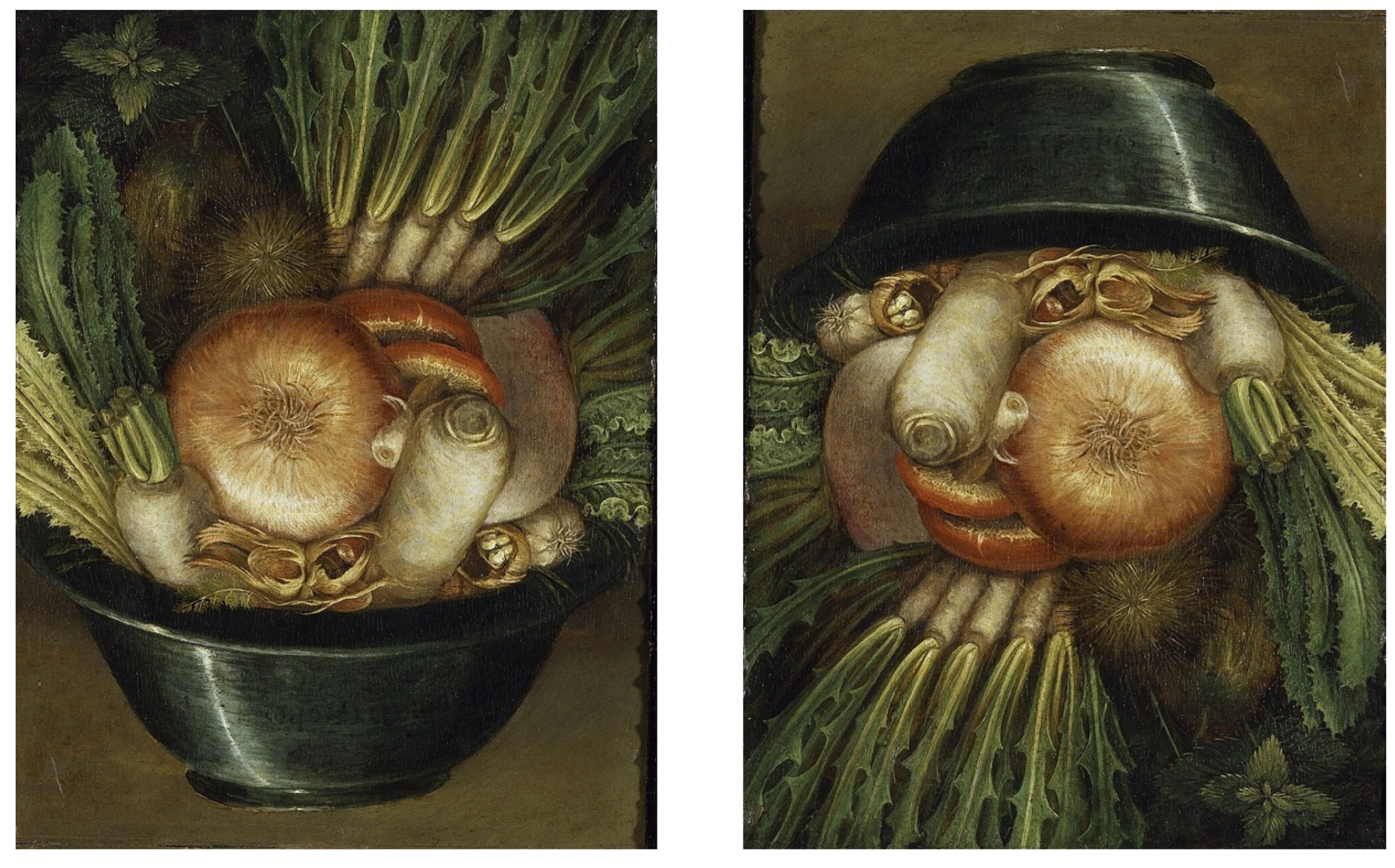
A particularly instructive example is Vegetables in a Bowl (The Gardener), a reversible composition in which a still life becomes a face when the image is rotated [24]. Reversibility highlights that the same sensory input can support distinct stable interpretations, and that perceptual selection is not a passive readout but an active inferential act. In the present framework, Arcimboldo’s device scaffolds imagery-like completion by providing minimal constraints that invite the viewer to “see” a face that is not literally present as a face at the level of parts.
4.2. Dürer and the Embedded Face
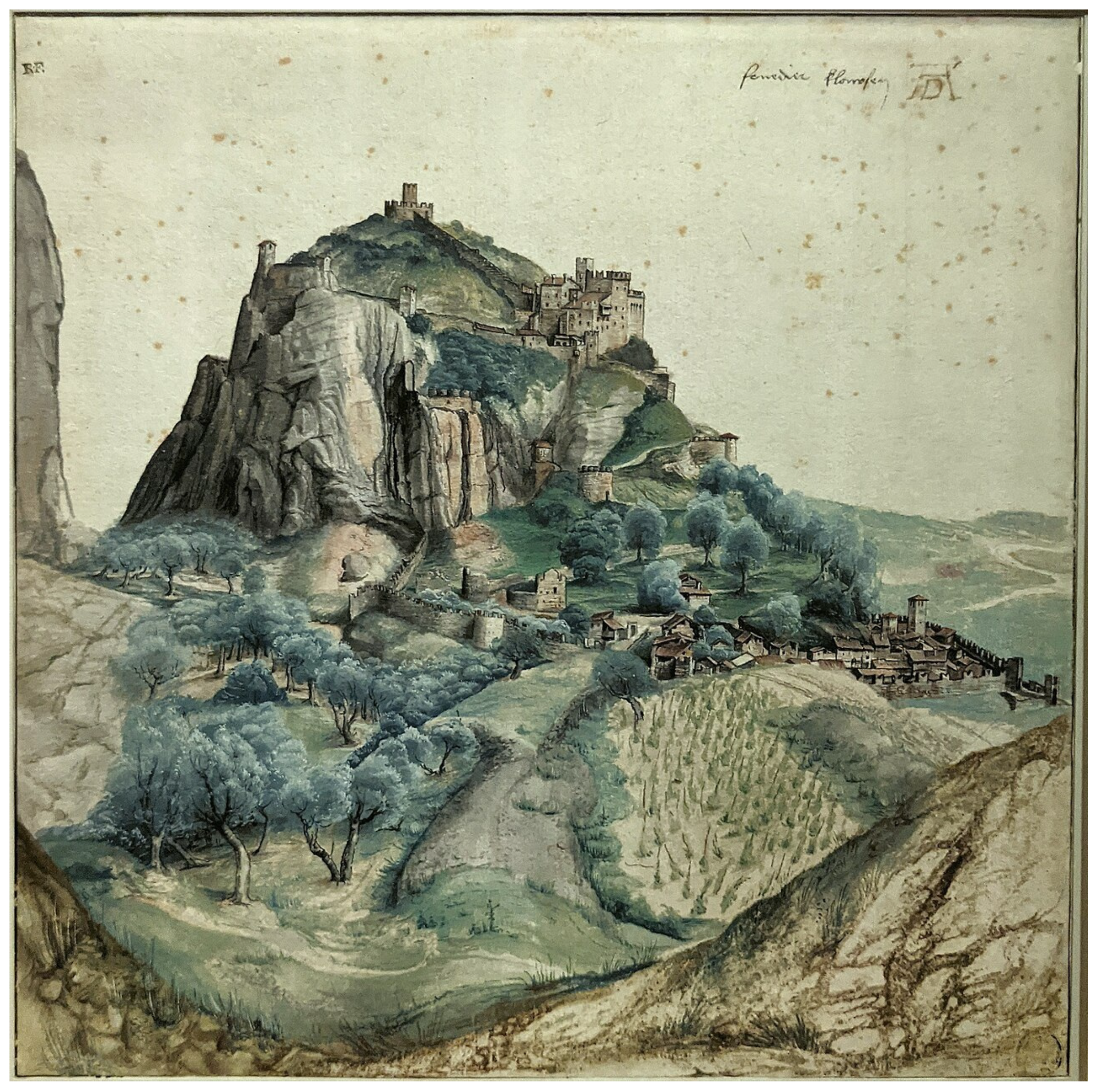
Dürer’s View of the Arco Valley offers a complementary regime, in which pareidolia emerges through attentional release rather than explicit compositional assembly (Figure 2). A human profile can be discerned within the landscape, embedded in the cliff structure and potentially remaining latent until attention shifts away from the dominant landscape reading [25]. Unlike Arcimboldo’s composites, where the face is the primary global attractor, Dürer’s device can be understood as a two-stage interpretation. First, a conventional scene reading organizes attention. Second, a latent face emerges once the viewer adopts a different scanning strategy, viewing distance, or attentional set.
This is experimentally interesting because it resembles a controlled manipulation of attractor dominance. The perceptual system may lock onto one stable interpretation, then reorganize the same stimulus under a different interpretive frame. In clinical contexts, comparable shifts are observed when attention and priors become dysregulated, making latent meaning more likely to intrude [8,9,10,11,12,13]. Dürer’s example therefore offers a naturalistic stimulus for studying how attention, expectation, and cue weighting enable pareidolic completion.
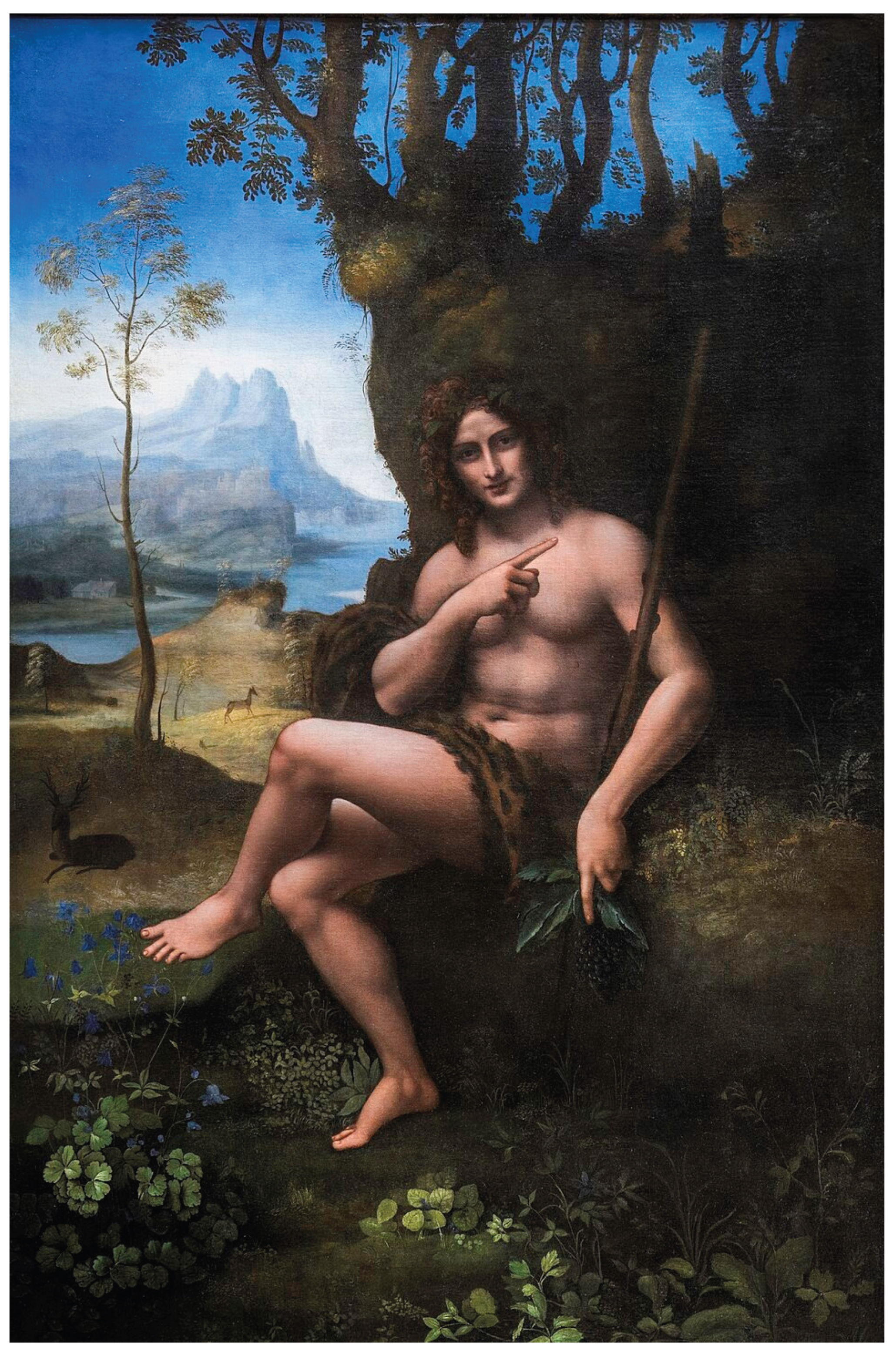
In addition to historical exemplars such as Arcimboldo and Dürer, engineered pareidolia can be identified in canonical Renaissance painting when the composition is read as a controlled manipulation of attention and completion. In a forthcoming correspondence in The Lancet Neurology, I reported previously undescribed pareidolic forms embedded in a Leonardo da Vinci painting and argued that their detection depends on disengaging from a dominant perceptual attractor that constrains gaze and interpretation (Figure 3). This case supports the present framework by illustrating a key principle. The artist can design not only the latent form but also the conditions under which it becomes visible, effectively shaping the viewer’s predictive completion through attentional gating and interpretive release. [26]
5. Creativity and the Torrance Bridge
Creativity research has sought operational measures of generative cognition. The Torrance Tests of Creative Thinking have historically played a central role in this effort, particularly the figural forms that quantify fluency, originality, elaboration, and resistance to premature closure [19,22]. While the TTCT was not designed to model artistic pareidolia, it provides a useful bridge because engineered pareidolia can be framed as divergent thinking under perceptual constraints.
In divergent thinking, one generates multiple possibilities from a prompt. In engineered pareidolia, the artist performs a related operation but with a distinctive target. The output is not simply a set of ideas. It is a set of visual constraints designed to elicit a specific completion in another observer. This reframes creativity as an intersubjective problem. The creator must anticipate the distribution of observers’ perceptual priors and select cues that exploit shared mechanisms of recognition.
Cognitive neuroscience models of creativity emphasize the interplay of associative and executive processes, balancing generative exploration with selection and control [20,21]. Engineered pareidolia fits naturally in that framework. The artist explores candidate mappings between ambiguous structures and meaningful templates, then selects a mapping that remains robust across viewing conditions and observers. In this sense, “resistance to premature closure” becomes not only a psychometric construct but a perceptual discipline. The creator must preserve ambiguity long enough to test multiple completions before converging on a stable design.
6. Testable Paradigms and Predictions
A Concept Paper is most valuable when it defines a research program. The externally scaffolded imagery framework suggests paradigms that quantify engineered pareidolia as a measurable interface phenomenon between imagery and perception.
One paradigm would ask participants to create pareidolia rather than merely to experience it. Individuals could be given ambiguous textures, visual noise, or naturalistic photographs and instructed to modify them to elicit a face percept in naïve viewers. Success could be quantified using viewer detection rate, reaction time, confidence, and robustness across transformations such as blur, inversion, scaling, or viewpoint shifts. Coupling this task to imagery measures and TTCT-derived constructs would test whether pareidolia design ability is predicted primarily by imagery vividness, cognitive flexibility, or resistance to premature closure.
A second paradigm would treat artworks as naturalistic stimuli and apply controlled manipulations. Arcimboldo-like composites can be parametrically varied by perturbing the global facial configuration while preserving local object identity, testing the threshold at which face processing collapses. Dürer-like embedded profiles can be manipulated by altering local contrast gradients that define the outline, testing how subtle cue changes shift detectability and how attentional instructions modulate the transition from non-detection to detection. Neuroimaging could then examine whether pareidolic emergence recruits face-selective networks under ambiguity and how those networks couple to attention and control systems during interpretive shifts [7,14,15].
These predictions remain deliberately broad, because the goal is to define an experimentally tractable bridge between creativity and perception. The core claim is that engineered pareidolia offers quantitative handles. It enables measurement of thresholds, robustness, and transition dynamics in a way that many creativity constructs do not.
7. Artistic Challenge and Cryptic Symbolism
Engineered pareidolia also has a social and cultural ecology. It can function as a virtuoso challenge aimed at peers and connoisseurs who recognize the concealed form and thereby participate in the artist’s cognitive game. Such “perceptual puzzles” can signal mastery over the viewer’s inference process and thus confer symbolic capital in settings where rivalry, workshop culture, and patronage shaped artistic reputation.
Beyond virtuosity, the same perceptual engineering can carry layered communication. Because pareidolic content may remain latent until attention is released from a dominant attractor, it offers an opportunity to embed secondary meanings that are selectively accessible. These may include playful signatures, private commentary, or potentially dissenting messages in contexts where direct speech is constrained. This does not require assuming uniform intent across artists or periods. It is enough to note that engineered pareidolia provides a principled mechanism for coexisting overt and covert readings, using the viewer’s predictive machinery as both decoder and gatekeeper. Such possibilities are compatible with broader models in neuroaesthetics that treat artworks as structured interfaces between cognition and culture rather than as static objects [18].
8. Clinical Resonance and the Boundary Between Generative and Intrusive Completion
A strength of pareidolia is that it connects the studio and the clinic without collapsing one into the other. Artistic pareidolia is crafted and voluntarily explored. Clinical pareidolia can be imposed by altered inference, attention, or salience and may become intrusive rather than playful. Work in dementia with Lewy bodies demonstrates that pareidolic illusions can be reliably evoked and quantified, supporting their value as a behavioral proxy for vulnerability to complex visual phenomena [8,9,10]. This is consistent with models proposing that altered weighting of priors under uncertainty contributes to hallucinations and related perceptual distortions [11,12,13].
This reciprocity is conceptually important. It suggests that the predictive brain is not only a mechanism for avoiding error but also a mechanism for creating meaning. Creativity may exploit the same inferential architecture that pathology can destabilize. A mature neuroscience of creativity should therefore map parameters that shift completion from generative to disruptive, and from chosen ambiguity to imposed ambiguity, rather than romanticizing pathology or pathologizing art.
9. Conclusions
This Concept Paper proposes that engineered pareidolia can be reframed as externally scaffolded mental imagery and that this reframing offers a concrete way to connect mental imagery, visual perception, artistic cognition, and visual creativity. Arcimboldo and Dürer illustrate two distinct creative regimes. One constructs a face through compositional constraints that recruit global templates against local object identity, eliciting face-like processing even when the face is assembled from objects. The other embeds a face within a naturalistic scene and relies on attentional release to reveal it. In both cases, the artist’s creative act can be understood as the transformation of an internally simulated template into an externally reliable elicitation in the viewer, a form of predictive engineering addressed to another brain.
By linking such devices to established creativity constructs, including the Torrance tradition and cognitive neuroscience models of creative cognition, and by proposing experimentally tractable paradigms that quantify pareidolia creation, detectability, and robustness, this paper outlines a research program in which creativity is studied as a measurable interaction between internal simulation and external constraint. Clinical work showing that pareidolia is quantifiable and meaningful in Lewy body disease further strengthens the translational relevance of this interface. Pareidolia thereby becomes not a curiosity but a principled bridge between cognition, culture, and the neurophysiology of meaning-making.
Data Availability Statement:
Author Contributions
Alexis Demas: literature search, study design, data collection, data analysis, data interpretation, writing.
Funding
This research received no external funding.
Institutional Review Board Statement
Not applicable.
Informed Consent Statement
Not applicable.
Conflicts of Interest
The authors declare no conflict of interest.
References
- Kosslyn, S.M.; Ganis, G.; Thompson, W.L. Neural foundations of imagery. Nat. Rev. Neurosci. 2001, 2, 635–642. [Google Scholar] [CrossRef] [PubMed]
- Pearson, J.; Naselaris, T.; Holmes, E.A.; Kosslyn, S.M. Mental imagery: Functional mechanisms and clinical applications. Trends Cogn. Sci. 2015, 19, 590–602. [Google Scholar] [CrossRef] [PubMed]
- Dijkstra, N.; Bosch, S.E.; van Gerven, M.A.J. Shared neural mechanisms of visual perception and imagery. Trends Cogn. Sci. 2019, 23, 423–434. [Google Scholar] [CrossRef] [PubMed]
- Koenig-Robert, R.; Pearson, J. Why do imagery and perception look and feel so different? Philos. Trans. R. Soc. B 2021, 376, 20190703. [Google Scholar] [CrossRef]
- Zeman, A.; Dewar, M.; Della Sala, S. Lives without imagery—Congenital aphantasia. Cortex 2015, 73, 378–380. [Google Scholar] [CrossRef]
- Marks, D.F. Visual imagery differences in the recall of pictures. Br. J. Psychol. 1973, 64, 17–24. [Google Scholar] [CrossRef]
- Wardle, S.G.; Taubert, J.; Teichmann, L.; Baker, C.I. Rapid and dynamic processing of face pareidolia in the human brain. Nat. Commun. 2020, 11, 4518. [Google Scholar] [CrossRef]
- Uchiyama, M.; Nishio, Y.; Yokoi, K.; et al. Pareidolias: Complex visual illusions in dementia with Lewy bodies. Brain 2012, 135, 2458–2469. [Google Scholar] [CrossRef]
- Yokoi, K.; Nishio, Y.; Uchiyama, M.; et al. Hallucinators find meaning in noises: Pareidolic illusions in dementia with Lewy bodies. Neuropsychologia 2014, 56, 245–254. [Google Scholar] [CrossRef]
- Mamiya, Y.; Nishio, Y.; Watanabe, H.; Yokoi, K.; Uchiyama, M.; et al. The Pareidolia Test: A simple neuropsychological test measuring visual hallucination-like illusions. PLOS ONE 2016, 11, e0154713. [Google Scholar] [CrossRef]
- Zarkali, A.; Adams, R.A.; Psarras, S.; et al. Increased weighting on prior knowledge in Lewy body–associated visual hallucinations. Brain Commun. 2019, 1, fcz007. [Google Scholar] [CrossRef] [PubMed]
- Corlett, P.R.; Horga, G.; Fletcher, P.C.; Alderson-Day, B.; Schmack, K.; Powers, A.R. Hallucinations and strong priors. Trends Cogn. Sci. 2019, 23, 114–127. [Google Scholar] [CrossRef] [PubMed]
- Sterzer, P.; Adams, R.A.; Fletcher, P.; et al. The predictive coding account of psychosis. Biol. Psychiatry 2018, 84, 634–643. [Google Scholar] [CrossRef] [PubMed]
- Kanwisher, N.; McDermott, J.; Chun, M.M. The fusiform face area: A module in human extrastriate cortex specialized for face perception. J. Neurosci. 1997, 17, 4302–4311. [Google Scholar] [CrossRef]
- Haxby, J.V.; Hoffman, E.A.; Gobbini, M.I. The distributed human neural system for face perception. Trends Cogn. Sci. 2000, 4, 223–233. [Google Scholar] [CrossRef]
- Navon, D. Forest before trees: The precedence of global features in visual perception. Cogn. Psychol. 1977, 9, 353–383. [Google Scholar] [CrossRef]
- Mooney, C.M. Age in the development of closure ability in children. Can. J. Psychol. 1957, 11, 219–226. [Google Scholar] [CrossRef]
- Chatterjee, A.; Vartanian, O. Neuroaesthetics. Trends Cogn. Sci. 2014, 18, 370–375. [Google Scholar] [CrossRef]
- Torrance, E.P. Torrance Tests of Creative Thinking; Personnel Press: Princeton, NJ, USA, 1966. [Google Scholar]
- Dietrich, A. The cognitive neuroscience of creativity. Psychon. Bull. Rev. 2004, 11, 1011–1026. [Google Scholar] [CrossRef]
- Beaty, R.E.; Silvia, P.J.; Nusbaum, E.C.; Jauk, E.; Benedek, M. The roles of associative and executive processes in creative cognition. Mem. Cogn. 2014, 42, 1186–1197. [Google Scholar] [CrossRef]
- Clapham, M.M. The convergent validity of the Torrance Tests of Creative Thinking and creativity interest inventories. Educ. Psychol. Meas. 2004, 64, 828–841. [Google Scholar] [CrossRef]
- Caharel, S.; d’Arripe, O.; Ramon, M.; Rossion, B. Early holistic face-like processing of Arcimboldo paintings in the right occipito-temporal cortex: Evidence from the N170 ERP component. Int. J. Psychophysiol. 2013, 90, 157–164. [Google Scholar] [CrossRef]
- Arcimboldo, G. Vegetables in a Bowl (The Gardener) . Image source (public domain); Wikimedia Commons. Available online: https://commons.wikimedia.org/wiki/File:Arcimboldo,_Giuseppe_-_Vegetables_in_a_Bowl_or_The_Gardener_-_1590s.jpg (accessed on 6 February 2026).
- Dürer, A. View of the Arco Valley. (c.1495). Image source (public domain). Wikimedia Commons. Available online: https://commons.wikimedia.org/wiki/File:Burg_arco_d%C3%BCrer_1495.JPG (accessed on 6 February 2026).
- Demas, A. Pareidolia in a Leonardo da Vinci painting. Lancet Neurol. 2026, in press (February issue).
Disclaimer/Publisher’s Note: The statements, opinions and data contained in all publications are solely those of the individual author(s) and contributor(s) and not of MDPI and/or the editor(s). MDPI and/or the editor(s) disclaim responsibility for any injury to people or property resulting from any ideas, methods, instructions or products referred to in the content. |
© 2026 by the authors. Licensee MDPI, Basel, Switzerland. This article is an open access article distributed under the terms and conditions of the Creative Commons Attribution (CC BY) license (http://creativecommons.org/licenses/by/4.0/).
Copyright: This open access article is published under a Creative Commons CC BY 4.0 license, which permit the free download, distribution, and reuse, provided that the author and preprint are cited in any reuse.