

Submitted:
11 February 2026
Posted:
13 February 2026
You are already at the latest version
Abstract
This paper examines the factors influencing women farmers' adaptation strategies to climate change in Benin's central cotton-growing area. Through cross-sectional data and a multivariate probit model, it finds that gender is not a significant factor in adaptation choices. Education and access to climate information promote short-cycle crop adoption, while experience and farm size relate to crop diversification and intercropping. The study highlights the need for targeted initiatives to improve access to education, climate information, financial services, and agricultural extension.
Keywords:
climate variability
; adaptation strategies
; farmers
; Benin
Introduction
Climate change is now recognised as one of the greatest challenges facing the world, the environment, and economies (IPCC, 2007). The literature offers several definitions of the concept of climate change, but we have chosen the one proposed by the Intergovernmental Panel on Climate Change, which considers climate change to be a statistically significant variation in the average state of the climate or its variability, persisting for an extended period, generally decades or more. Thus, sub-Saharan Africa’s high vulnerability to climate change is due to its heavy dependence on agriculture and its limited capacity to adapt, attributable to a lack of resources and technologies (Abid et al., 2016).
The effects of climate change are strongly felt by rural populations, regardless of their geographical location and the climate zone in question. Rural women are more severely affected by climate impacts than men. The main reasons for this include inequalities in the distribution of economic resources, including labor and capital, persistent cultural norms and beliefs, and social and political discrimination (Eastin, 2018; Bjornberg et al., 2013). It is in this context that women in rural households are particularly affected by climate effects due to their dependence on natural resources and their role in agricultural production for family well-being (Deborah et al., 2010). As a result, there is no doubt about the relevance of the impact of climate change on agricultural yields in many countries (IPCC, 2007; Deressa et al., 2008; and Hounkponou, 2015).
The level of poverty, which is generally high among rural women, also tends to predispose them to climate impacts by reducing their adaptive capacities. Politically, the underrepresentation of women in decision-making processes is a characteristic of modern democratic societies (Bjornberg et al., 2013) that does not favor the emergence of this vulnerable class. As evidence, Adzawla and Kane (2019) consider that the observed impacts of climate change have led to an increase in the welfare gap between men and women in farming households in northern Ghana. This finding justifies calls for the integration of gender into discussions on climate change (Alston, 2014).
In West Africa, the agricultural sector employs 60% of the working population, although it accounts for only 35% of GDP (Abdulai et al., 2013). The economies of countries in this region are particularly vulnerable to climate change, as populations are heavily dependent on rain-fed agriculture. Adaptation to climate change is often considered a preemptive, reactive, or proactive measure to reduce climate impacts (Adzawla and Kane 2019). Like other aspects of climate change, adaptation is not gender neutral. Mersha et al. (2016) identified differences in gender approaches to the adoption of climate change response strategies, given the obstacles linked to gender inequalities and not based on a preferred decision by men and women.
Wrigley-Asante et al. (2017) found that men are more involved in agricultural adaptation strategies, while women are more interested in non-agricultural adaptation strategies such as small-scale trade. When faced with drought, for example, many farmers use resistant varieties and opt more for improved seed varieties and soil fertility conservation practices (Assan et al., 2018). In contrast, women farmers engage in traditional crops and adopt the most appropriate strategies in response to climate change. In this particularly uncertain socio-economic context, the research question is to determine the factors that characterise smallholder farmers’ adaptation decisions in response to climate change in the central cotton-growing region of Benin.
Numerous studies (Deressa et al., 2008; Solomon et al., 2018; Mihiretu, 2019) have examined the factors determining adaptation strategies to climate change in rural areas of sub-Saharan Africa, but none of them focus on ultra-vulnerable smallholders characterised by the cumulative effects of gender (female heads of household) and constraints on access to land, credit, and climate information. For this study, we selected the central cotton-growing region of Benin because it was chosen as a test site for the National Action Program on Adaptation to Climate Change (NAPA). Using a probabilistic sample in three municipalities (21 villages) chosen for their diversity of agricultural crops, ten (10) farmers were randomly selected from each village. The multivariate probit model was used on a probabilistic sample of 210 farmers, including 102 women and 108 men. The advantage of this model, through marginal effects, is that it facilitates policy recommendations using categorical decisions.
1. Materials and Methods
1.1. Study Area
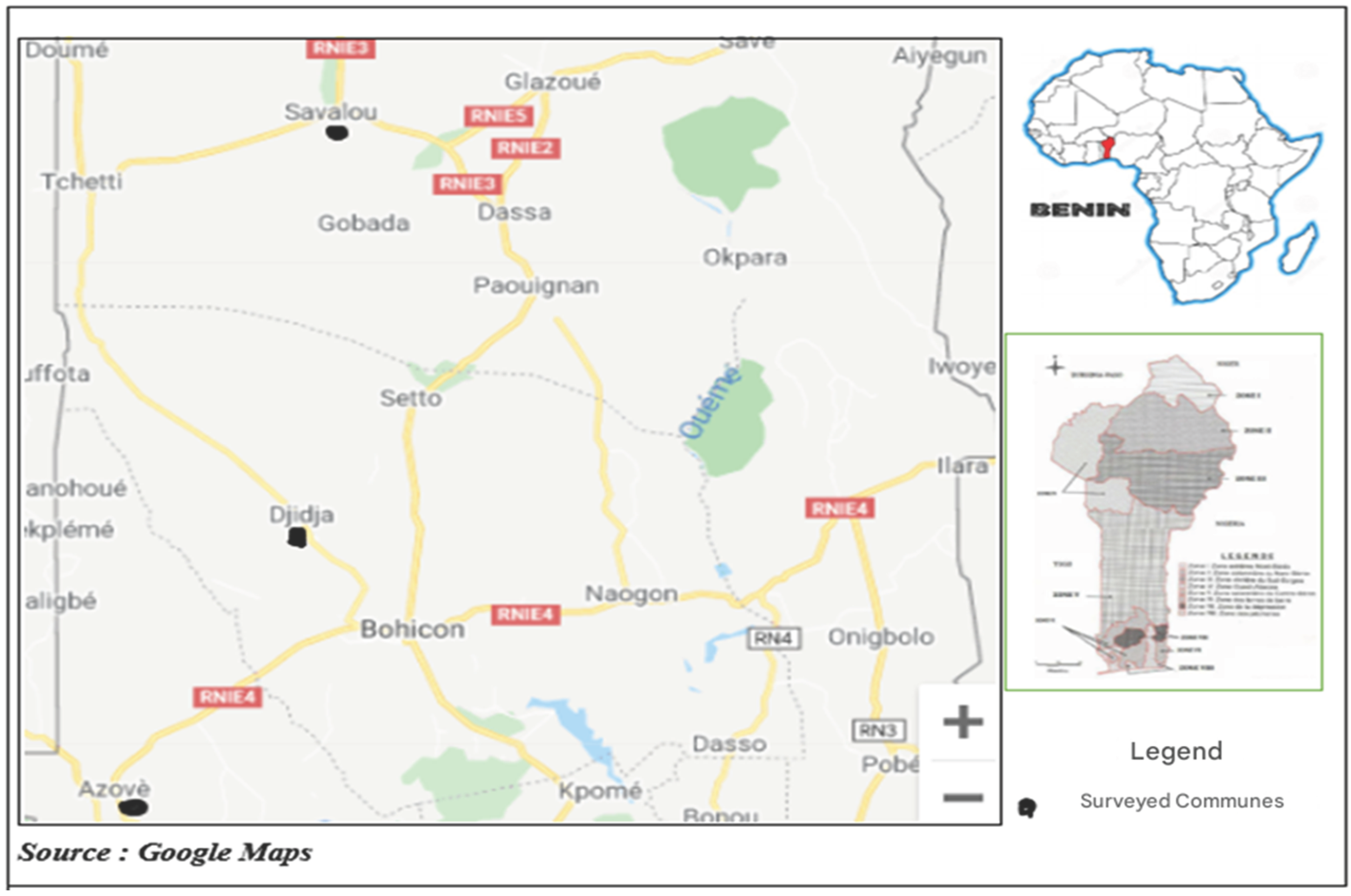
The study was conducted in the central cotton-producing area of Benin, given its rain-fed economic activities that are dependent on climate change (NAPA, 2008) and covering a total area of 32,163 km2. The municipalities of Savalou (Collines department), Djidja (Zou department) and Aplahoué (Couffo department) were selected for two main reasons: their significant contribution to agricultural production and the choice of these areas as experimental fields in the work of the National Climate Change Adaptation Programme (PANA) because they are characterised by groundwater recharge deficits and rainfall deficits of more than 20% as a result of climate variability and change (PANA, 2008).
Figure 1.
Study area.
1.2. Sampling and Data Collection
With the assistance of stratification officers from the municipal centres, twenty-one (21) villages with high food crop production were selected based on the diversity of agricultural crops in the three municipalities. In each village, with the assistance of the village chief and the heads of the farmers’ associations, ten (10) farmers were selected at random. To determine the sample size for our study, we used the estimated population proportion P= 0.7, taking into account the survey area. The sample gives: N = [(1.881)2 *0.7(1-0.7)] / (0.06)2 = 206.39. Ultimately, to reduce the margin of error, we took a sample of two hundred and ten (210) farmers, including 102 women and 108 men, all of whom were smallholder farmers.
The data was collected using a structured questionnaire for the 2022 agricultural season. The information covers a wide range of topics, including the various adaptation strategies adopted by each farmer in response to climate change, socio-economic factors (level of education, farming experience, farm size, agricultural and non-agricultural income), institutional factors (access to credit, climate information, and extension services), and environmental factors (temperature, precipitation, and soil fertility). The data was collected by agents trained and experienced in conducting surveys. Farmers were required to give their consent to participate in the study by providing their names and contact details.
1.3. Specification of the Multivariate Probit Model
In order to analyse the determinants of agricultural farmers’ choice of climate change adaptation strategies, we use a multivariate probit (MVP) model, which allows us to take into account the simultaneous adoption of several strategies as well as the potential interdependencies between them. Unlike the multinomial logit model, which assumes mutually exclusive choices, the multivariate probit model is appropriate when farmers can adopt several strategies jointly (Greene, 2012).
In this study, four binary dependent variables are considered:
if the farmer adopts crop diversification, 0 otherwise;
if the farmer changes production site, 0 otherwise;
if the farmer adopts short-cycle crops, 0 otherwise;
if the farmer practices crop combination, 0 otherwise.
Each adaptation decision is assumed to result from an unobserved latent variable (m = 1, 2, 3, 4), which depends on a set of socioeconomic, institutional, and environmental factors (Xi):
where is the vector of parameters to be estimated and represents the random error terms.
The observed variables are defined as follows:
The error vector is assumed to follow a multivariate normal distribution with zero mean and variance-covariance matrix , where the off-diagonal terms capture the correlation between the decisions to adopt different strategies.
The presence of significant correlations between the error terms indicates that the adaptation strategies are not independent, which justifies the use of the multivariate probit model rather than separately estimated univariate probit models. The model parameters are estimated using the simulated maximum likelihood method (Cappellari & Jenkins, 2003).
1.4. Interpretation of Coefficients
The estimated coefficients measure the effect of the explanatory variables on the latent propensity to adopt each adaptation strategy. Given the nonlinear nature of the probit model, these coefficients cannot be interpreted directly as changes in probabilities. Consequently, the economic analysis relies mainly on the sign and statistical significance of the coefficients, as well as on the marginal effects calculated to assess the impact of the explanatory variables on the probabilities of adoption.
Marginal effects measure the expected change in the probability of adopting a given strategy following a unit change in an explanatory variable, all other things being equal (Greene, 2012).
1.5. Study Variables
The dependent variable in the empirical estimation is the choice of an adaptation strategy, as described in the Table 2. The choice of explanatory variables is based on the economic literature in relation to the availability of survey data. The explanatory variables in this study include farmer characteristics, such as level of education, farming experience, farm size, and non-agricultural income; institutional factors, such as extension services, access to credit and access to climate information; and climatic characteristics, such as temperature and precipitation as well as soil fertility. Table 1 describes the variables used for model estimation. The summary statistics of all the study variables is outlined in Table A1 in appendix.

Table 1.
study variables.
| Variables | Description | Expected sign |
|
Climate adaptation strategies |
Crop diversification (Yes 0 = No) Change of location (Yes 0 = No) Adoption of short-cycle crops (Yes 0 = No) Crop association (Yes 0 = No) |
|
| Gender | 1 = Male 2= Female |
± |
| Educated | 1 = Yes 0 = No | + |
| Agricultural experience | 1=Experienced (>5 years) 0=Inexperienced (< 5 years) |
+ |
| Farm size | 1= Medium-scale farmer (2-19 hectares) 0= Smallholder farmer (< 2 hectares) |
± |
| Non-agricultural income | 1 = Yes 0 = No | + |
| Temperature | 1 = Yes 0 = No | + |
| Precipitation | 1 = Yes 0 = No | + |
| Access to climate information | 1 = Yes 0 = No | + |
| Access to extension services | 1 = Yes 0 = No | ± |
| Access to financial credit | 1 = Yes 0 = No | ± |
| Soil fertility | 1 = Yes 0 = No | ± |
Source: Authors, based on the literature.
Gender: Various studies have shown that gender is an important variable affecting farmers’ adaptation decisions. Dolisca et al. (2006) pointed out that male farmers are more likely to adopt good management and natural resource conservation practices than their female counterparts. Asfaw and Admassie (2004) argue that male-headed households are better able to obtain information on new technologies and adopt appropriate strategies. However, Bekele and Drake (2003) showed that gender does not influence farmers’ decisions to adopt conservation measures. In this study, we expect the gender of the farmer to have a mixed influence.
Education and farming experience: Several studies have highlighted that education levels and knowledge dissemination are important policy measures for stimulating local participation in various natural resource development and management initiatives (Adebiyi et al., 2019; Solomon et al., 2018; Antwi-Agyei et al. 2018; Jellason et al., 2022). Literate and experienced farmers should have more knowledge about the effects of climate change and the agronomic practices they can develop as a result (Solomon et al., 2018). In this research, we assume that education and farming experience positively influence farmers’ decisions regarding adaptation strategies.
Farm size: The effect of farm size on adaptation decisions is mixed. On the one hand, research has shown that farmers with large fields have more opportunities to build long furrows (Marie et al., 2020; Kide, 2014). On the other hand, Solomon et al. (2018) found that farmers with small land holdings were more likely to invest in soil conservation than those with large holdings. We expect farm size to have a mixed influence.
Non-agricultural income: Yong Ngondjeb et al. (2014) mentioned that the use of agricultural technologies requires sufficient financial well-being. Thus, higher-income farmers may have fewer difficulties in dealing with risks and have better access to more attractive bank interest rates (Oluwakemi et al., 2015). Based on this study, it is expected that income will improve farmers’ ability to adapt.
Access to extension services: Extension services are important sources of information on agricultural practices and climate (Mihiretu et al., 2019; Ojo et al., 2018). Empirical studies have highlighted that farmers with better access to extension services are more likely to use improved technologies (Solomon et al., 2018). However, other studies on adaptation have found that access to extension services is not a significant factor affecting the choice of adaptation strategies (Nkonya et al., 2008). In this study, we expect access to extension services to have a positive influence on farmers’ decisions.
Access to credit: Several studies have shown that access to credit is an important determinant in promoting the use of various technologies (Solomon et al., 2018; Mihiretu et al., 2019; Ojo et al., 2018). With more financial resources, farmers will be able to develop adaptation practices that are appropriate for changing climatic conditions. In this study, we assume that access to credit has a positive influence on the choice of adaptation strategies.
Access to climate information: The availability of better climate information enables farmers to make comparative decisions about alternative crop management practices. Since access to climate information is an important prerequisite for farmers to take adaptation measures, the choices they make enable them to better cope with climate change (Solomon et al., 2018; Diouf et al., 2019). Obtaining reliable climate forecast information therefore increases the likelihood of using the most appropriate adaptation strategies.
Climate variables: Variations in temperature and precipitation influence farmers’ adaptation choices in response to these changes. Empirical studies have suggested that climate variables significantly affect net agricultural income (Marie et al., 2020; Ojo et al., 2018; Solomon et al., 2018). To test the effects of climate change on adaptation strategies, we included variables such as temperature and precipitation in the empirical model.
2. Results and Discussion
The correlation matrix of error terms in the multivariate probit model, presented in Table 3, indicates that decisions to adopt different climate change adaptation strategies are not independent. This confirms the relevance of using the multivariate probit model, which explicitly takes into account the existence of such interdependencies between the choices made by agricultural farmers.
The main findings from the multivariate probit model are outlined in Table 2. The marginal effects for each of the four equations are presented in Table A2, Table A3, Table A4 and Table A5 in appendix. The results presented in Table 2 reveal that several socio-economic and institutional factors determine the adoption of climate change adaptation strategies by farmers. However, the direction and magnitude of the effects vary depending on the type of strategy considered.
Table 2.
Determinants of adaptation strategies (multivariate probit model).
| Independent variables | Coefficient | Robust std. err. | P-value |
| Change of location | |||
| Gender | 0.085 | 0.342 | 0.803 |
| Educated | 0.294 | 0.364 | 0.419 |
| Agricultural experience | 0.286 | 0.409 | 0.485 |
| Farm size | -0.675 | 0.424 | 0.111 |
| Non-agricultural income | 1.470 | 0.901 | 0.103 |
| Temperature | -0.058 | 0.439 | 0.895 |
| Precipitation | -1.325 | 0.730 | 0.069 |
| Access to climate information | -0.788 | 0.407 | 0.053 |
| Access to extension services | -0.926 | 0.426 | 0.030 |
| Access to financial credit | 0.610 | 0.483 | 0.206 |
| Soil fertility | 0.084 | 0.355 | 0.813 |
| Constant | -1.444 | 1.032 | 0.162 |
| Crop association | |||
| Gender | 0.192 | 0.395 | 0.627 |
| Educated | 0.207 | 0.521 | 0.691 |
| Agricultural experience | 0.677 | 0.437 | 0.121 |
| Farm size | 1.957 | 0.498 | 0.000 |
| Non-agricultural income | 0.388 | 0.679 | 0.568 |
| Temperature | 0.380 | 0.521 | 0.465 |
| Precipitation | -0.819 | 0.798 | 0.305 |
| Access to climate information | -0.138 | 0.381 | 0.718 |
| Access to extension services | 0.061 | 0.516 | 0.907 |
| Access to financial credit | -0.476 | 0.508 | 0.348 |
| Soil fertility | -1.330 | 0.496 | 0.007 |
| Constant | -2.831 | 0.880 | 0.001 |
| Crop diversification | |||
| Gender | 0.626 | 0.530 | 0.238 |
| Educated | 0.119 | 0.472 | 0.802 |
| Agricultural experience | 0.629 | 0.595 | 0.290 |
| Farm size | 2.231 | 0.710 | 0.002 |
| Non-agricultural income | 1.607 | 0.741 | 0.030 |
| Temperature | -0.094 | 0.597 | 0.875 |
| Precipitation | 12.481 | 0.684 | 0.000 |
| Access to climate information | -0.390 | 0.516 | 0.449 |
| Access to extension services | -1.966 | 0.711 | 0.006 |
| Access to financial credit | 1.128 | 0.549 | 0.040 |
| Soil fertility | 0.239 | 0.453 | 0.597 |
| Constant | -17.792 | 1.171 | 0.000 |
| Adoption of short-cycle crops | |||
| Gender | -0.059 | 0.290 | 0.840 |
| Educated | 0.504 | 0.260 | 0.052 |
| Agricultural experience | 0.165 | 0.258 | 0.523 |
| Farm size | -0.725 | 0.281 | 0.010 |
| Non-agricultural income | -0.682 | 0.391 | 0.081 |
| Temperature | 0.205 | 0.313 | 0.512 |
| Precipitation | 0.387 | 0.483 | 0.423 |
| Access to climate information | 1.034 | 0.254 | 0.000 |
| Access to extension services | 0.631 | 0.283 | 0.026 |
| Access to financial credit | 0.357 | 0.285 | 0.210 |
| Soil fertility | -0.065 | 0.247 | 0.793 |
| Constant | -1.752 | 0.596 | 0.003 |
Source: Authors.
Table 3.
Matrix of error terms correlation.
| Climate adaptation strategy | Coefficient |
Robust std. err. |
P>z | p-value | |
| Change of location | Crop diversification | 0.224 | 0.063 | 3.550 | 0.000 |
| Change of location | Crop association | -0.234 | 0.063 | -3.740 | 0.000 |
| Change of location | Adoption of short-cycle crops | -0.307 | 0.047 | -6.520 | 0.000 |
| Crop diversification | Crop association | 0.556 | 0.042 | 13.370 | 0.000 |
| Crop diversification | Adoption of short-cycle crops | -0.653 | 0.037 | -17.530 | 0.000 |
| Crop association | Adoption of short-cycle crops | -0.450 | 0.051 | -8.760 | 0.000 |
Source: Authors.
First, educational attainment, farming experience and perceptions of rainfall variability and irregularity have a positive influence on the adoption of adaptation strategies. These results suggest that more educated farmers with greater experience and a greater awareness of climate risks are more inclined to adjust their farming practices in response to climate change. Second, farm size, non-agricultural income, access to climate information and access to agricultural extension services significantly affect the adoption of adaptation strategies. However, these effects appear to be asymmetrical depending on the types of strategies implemented, reflecting the heterogeneity of adaptation mechanisms. Finally, the perception of soil fertility has a significant negative effect on the adoption of crop association practices, suggesting that farmers who perceive their soil as fertile are less inclined to use this strategy to cope with climate hazards.
Gender
Gender does not appear to be a statistically significant determinant of the adaptation strategies chosen by farmers in response to climate change. This lack of effect does not necessarily mean that differences between men and women do not exist in the field, but rather that other factors (resources, institutional constraints, access to services) may neutralise or modulate the net impact of gender on these adaptive decisions. Recent literature in rural economics and agricultural economics highlights mechanisms whereby gender differences in the adoption of agricultural practices are often mediated by access to resources, information and capital, rather than by gender itself as an isolated variable. For example, empirical studies in Burkina Faso show that, although women are heavily involved in agriculture and face specific constraints (higher workload, less access to land and inputs), their adaptation decisions may not differ statistically from those of men once these constraints are controlled for in the econometric model (Diendéré & Ouédraogo, 2023).
Similarly, recent comparative analyses in Africa suggest that gender differences in the adoption of climate strategies often reflect structural disparities, such as access to credit, information and extension services, rather than a direct effect of gender on decision-making (Ngong et al. 2025). In other words, when women and men have comparable levels of access to productive and informational resources, adoption gaps may narrow or disappear in statistical models. Finally, the absence of a significant statistical effect may also reflect contextual effects specific to the study area, where women’s participation in various agricultural activities is already high or where adaptation strategies are more strongly determined by economic or environmental factors than by simple demographic attributes such as gender. In any case, these results indicate that a more nuanced understanding of the mechanisms linking gender to adaptation decisions would require the use of more detailed data on inequalities in access to resources, decision-making power and social networks, variables that can capture important dimensions of gender not captured by a simple binary indicator.
Level of education
The level of education of farmers has a positive and significant effect on the adoption of climate change adaptation strategies. More specifically, agricultural farmers with a higher level of education are more likely to adopt short-cycle crops as an adaptation strategy. Being educated increases the likelihood of adopting short-cycle crops by 11.7 percentage points, compared to no educated farmers. This result is consistent with existing literature that highlights the central role of education in improving the adaptive capacity of farming households (Adebiyi et al., 2019; Solomon et al., 2018). Education facilitates access to climate information, improves understanding of environmental risks and strengthens the capacity to adopt appropriate agricultural innovations. In addition, educated farmers are more likely to experiment with new practices and incorporate recommendations from extension services, which increases their resilience to climate shocks.
Agricultural experience
Agricultural experience also appears to be an important determinant of the adaptation strategies implemented by farmers. The positive coefficient observed suggests that accumulating years of experience promotes the adoption of practices such as crop association. In particular, having more than five years of experience increases the likelihood of adopting crop association by 7.9 percentage points, compared to farmers with less experience. This result can be explained by the fact that experienced farmers have developed, over time, a better understanding of local agroclimatic conditions and appropriate agronomic responses. It corroborates the findings of Mulatu (2014), who emphasises that agricultural experience is a more decisive factor than age in the ability to adapt to climate change in Ethiopia. Learning by doing thus enables farmers to anticipate climate risks and adjust their production systems more effectively.
Perception of rainfall
Our results also show that the perception of irregularity and extreme rainfall events positively influences the adoption of certain adaptation strategies, particularly crop diversification. Having the perception of an increase in rainfall variability increases the likelihood of diversifying crops by 97.8%. This behaviour reflects a risk management strategy that is widely documented in agricultural literature, where diversification limits potential losses related to climate shocks affecting a specific crop. The perception of climate change thus acts as a trigger for adaptation, encouraging farmers to adjust their production choices to ensure income stability and food security (Yiridomoh et al., 2025).
Access to financial credit
Access to credit has a positive and significant effect on the likelihood of adopting climate change adaptation strategies. In particular, having access to credit increases the likelihood of adopting crop diversification by 8.4 percentage points, compared to no access. This relationship can be explained by the fact that credit can alleviate the liquidity constraints faced by women farmers, enabling them to meet the initial costs of adopting new practices or technologies (Dercon & Christiaensen, 2011). Access to finance also facilitates the purchase of improved inputs and climate risk management. These results confirm that financial inclusion is an important lever for the resilience of farming households to climate change.
Farm size
The size of cultivated land has a positive and significant influence on the adoption of crop combination and crop diversification. On the other hand, it reduces the likelihood of resorting to site change as an adaptation strategy. This result suggests that farmers with larger areas of land benefit from greater productive flexibility, allowing them to allocate different plots to different crops in order to reduce climate risks. Conversely, in a context of land scarcity, large-scale farmers are less inclined to change location, as this option involves high costs in finding new land and institutional constraints related to land access (Barrett et al., 2001). The literature emphasises that farm size is a key determinant of investment capacity and agricultural diversification, favouring the adoption of more resource-intensive adaptation strategies (Bryan et al., 2009).
Non-agricultural income
Non-agricultural income also appears to be an important lever for climate adaptation. Our results show that it significantly promotes site change and crop diversification. Having non-agricultural income increases the likelihood of adopting site change and crop diversification strategies by 13.3 and 18.8 percentage points, respectively, compared to farmers without alternative sources of income. On the other hand, non-agricultural income decreases the likelihood of adopting short-cycle crops by 19.6 percentage points. These results suggest that diversifying livelihoods allows farming households to reduce their dependence on climate-sensitive income, while providing them with additional financial resources to invest in more costly adaptation strategies (Reardon et al., 2007). Non-agricultural activities thus act as informal insurance against climate shocks and facilitate productive risk-taking (Barrett et al., 2001; Coulibaly, 2015). However, the availability of alternative income can also reduce the incentive to resort to certain short-term strategies, such as short-cycle crops, when households have more stable sources of livelihood.
Access to climate information and extension services
Access to climate information and agricultural extension services has a positive and significant influence on the adoption of short-cycle crops. In particular, access to climate information and extension services increases the likelihood of adopting short-cycle crops by 25.0 and 14.8 percentage points, respectively, compared to those without access. This result can be explained by the central role of information in reducing climate uncertainty and improving farmers’ decision-making capabilities. Access to weather forecasts and climate risk information makes it possible to anticipate periods of drought or excessive rainfall and to adjust agricultural schedules and crop choices (Di Falco et al., 2011). Short-cycle crops are a rational response to irregular rainfall, as they reduce exposure to climate shocks by shortening the production period.
These results are consistent with the empirical work of Saguye et al. (2016), which highlights a positive relationship between access to climate information and the adoption of adaptation strategies in Ethiopia. Similarly, agricultural extension facilitates the dissemination of climate-adapted practices and strengthens farmers ‘ technical skills (Mounirou & Bassongui, 2023; & Mutunga et al., 2018). However, access to climate information and extension services significantly decreases the likelihood of resorting to changing production sites by 11.1 and 12.4 percentage points, respectively, compared to those with no access. This result suggests that when farmers have adequate information and technical support, they favour in situ adaptation strategies, such as adjusting crops and agricultural practices, rather than more costly and uncertain strategies such as relocating agricultural activities.
Soil fertility
Perceptions of soil fertility also influence the adoption of adaptation strategies. Our results show that considering land to be fertile decreases the likelihood of adopting crop association practices by 13.6 percentage points, compared to those who perceive their soil to be infertile. This result can be explained by the rational behaviour of farmers and potentially by cognitive biases, such as time discounting, which means that farmers do not consider adopting sustainable agricultural practices as long as their yields are not compromised by soil fertility. Thus, when soils are fertile, farmers may perceive this practice as less profitable, which limits its adoption. The literature emphasises that soil quality strongly influences agricultural investment decisions and the adoption of sustainable land management practices (Tittonell & Giller, 2013).
3. Conclusion
This study examined the determinants of climate change adaptation strategies among agricultural farmers in the central cotton-growing region of Benin using a multivariate probit model applied to survey data from smallholder farmers. The results highlight a significant interdependence between the different adaptation strategies, indicating that farmers combine several responses to climate hazards.
Analyses reveal that socio-economic, institutional and environmental factors influence the adoption of adaptation strategies in different ways depending on the type of strategy considered. In particular, education and access to climate information mainly promote the adoption of short-cycle crops, while agricultural experience and farm size further reinforce diversification and crop combination strategies. Furthermore, access to credit and non-agricultural income facilitate the adoption of more resource-intensive strategies, such as crop diversification and site change, while they may reduce the use of certain short-term strategies. Finally, environmental constraints, particularly soil degradation, limit the adoption of practices such as crop association.
These asymmetric effects underscore that adaptation to climate change does not rely on a uniform response, but on a set of differentiated choices conditioned by available resources and farmers’ perceptions. In terms of rural policy, these results suggest the need to design targeted and differentiated interventions according to the types of adaptation strategies. Improving access to education, credit, climate information and extension services appears essential, but these instruments must be coordinated in a complementary manner in order to support forms of adaptation tailored to the specific constraints of farmers. In addition, improving access to land is crucial to increasing the effectiveness of climate adaptation policies in rural areas.
Despite its contributions, this study has certain limitations, notably the absence of an analysis of the effects of adaptation strategies on household productivity and well-being, as well as the use of cross-sectional data. Future research could use longitudinal data to assess the long-term impact of different strategies and better understand their interactions over time.
Appendix
Table A1.
Summary statistics.
| Variable | Obs | Mean | Std. Dev. | Min | Max |
| Change of location | 210 | 0.162 | 0.369 | 0 | 1 |
| Crop association | 210 | 0.138 | 0.346 | 0 | 1 |
| Crop diversification | 210 | 0.1 | 0.301 | 0 | 1 |
| Adoption of short-cycle crops | 210 | 0.367 | 0.483 | 0 | 1 |
| Gender | 210 | 0.486 | 0.501 | 0 | 1 |
| Educated | 210 | 0.452 | 0.499 | 0 | 1 |
| Agricultural experience | 210 | 0.529 | 0.5 | 0 | 1 |
| Farm size | 210 | 0.429 | 0.496 | 0 | 1 |
| Non-agricultural income | 210 | 0.819 | 0.386 | 0 | 1 |
| Temperature | 210 | 0.771 | 0.421 | 0 | 1 |
| Precipitation | 210 | 0.919 | 0.273 | 0 | 1 |
| Access to climate information | 210 | 0.443 | 0.498 | 0 | 1 |
| Access to extension services | 210 | 0.462 | 0.5 | 0 | 1 |
| Access to financial credit | 210 | 0.338 | 0.474 | 0 | 1 |
| Soil fertility | 210 | 0.51 | 0.501 | 0 | 1 |
Table A2.
Marginal effects-crop diversification model.
| Variables | dy/dx | std. err. | p-value |
| Gender | 0.051 | 0.042 | 0.223 |
| Educated | 0.014 | 0.040 | 0.730 |
| Agricultural experience | 0.050 | 0.046 | 0.283 |
| Farm size | 0.179 | 0.051 | 0.000 |
| Non-agricultural income | 0.133 | 0.063 | 0.034 |
| Temperature | -0.006 | 0.049 | 0.908 |
| Precipitation | 0.978 | 0.184 | 0.000 |
| Access to climate information | -0.028 | 0.040 | 0.490 |
| Access to extension services | -0.161 | 0.056 | 0.004 |
| Access to financial credit | 0.084 | 0.041 | 0.039 |
| Soil fertility | 0.016 | 0.038 | 0.662 |
Table A3.
Marginal effects-Crop association model.
| Variables | dy/dx | std. err. | p-value |
| Gender | 0.030 | 0.046 | 0.521 |
| Educated | 0.012 | 0.053 | 0.813 |
| Agricultural experience | 0.079 | 0.052 | 0.128 |
| Farm size | 0.207 | 0.044 | 0.000 |
| Non-agricultural income | 0.037 | 0.071 | 0.599 |
| Temperature | 0.036 | 0.058 | 0.535 |
| Precipitation | -0.064 | 0.082 | 0.429 |
| Access to climate information | -0.020 | 0.042 | 0.635 |
| Access to extension services | 0.016 | 0.059 | 0.781 |
| Access to financial credit | -0.064 | 0.056 | 0.252 |
| Soil fertility | -0.136 | 0.045 | 0.002 |
Table A4.
Marginal effects- Change of location model.
| Variables | dy/dx | std. err. | p-value |
| Gender | 0.009 | 0.048 | 0.849 |
| Educated | 0.046 | 0.049 | 0.348 |
| Agricultural experience | 0.038 | 0.055 | 0.490 |
| Farm size | -0.090 | 0.055 | 0.105 |
| Non-agricultural income | 0.188 | 0.122 | 0.125 |
| Temperature | -0.013 | 0.061 | 0.825 |
| Precipitation | -0.161 | 0.109 | 0.141 |
| Access to climate information | -0.111 | 0.053 | 0.038 |
| Access to extension services | -0.124 | 0.058 | 0.032 |
| Access to financial credit | 0.082 | 0.065 | 0.212 |
| Soil fertility | 0.010 | 0.049 | 0.843 |
Table A5.
Marginal effects- Adoption of short-cycle crops model.
| Variables | dy/dx | std. err. | p-value |
| Gender | -0.024 | 0.064 | 0.710 |
| Educated | 0.117 | 0.059 | 0.046 |
| Agricultural experience | 0.024 | 0.063 | 0.697 |
| Farm size | -0.184 | 0.060 | 0.002 |
| Non-agricultural income | -0.196 | 0.095 | 0.039 |
| Temperature | 0.062 | 0.072 | 0.393 |
| Precipitation | 0.145 | 0.117 | 0.215 |
| Access to climate information | 0.250 | 0.050 | 0.000 |
| Access to extension services | 0.148 | 0.065 | 0.023 |
| Access to financial credit | 0.070 | 0.066 | 0.293 |
| Soil fertility | -0.007 | 0.059 | 0.905 |
References
- Abdulai, J.; Nelson, G.C.; Thomas, T.S.; Zougmore, R.; Roy-Macauley, H. West African agriculture and climate change: A comprehensive analysis; IFPRI Research Monographs: Washington DC, USA, 2013; p. 408 p. [Google Scholar]
- Ngong, T.H.; Yenlajai, B. J.; Azibo, N. K.; Alusoh, C. N.; Kimengsi, J. N. Gendered Analysis of Agro-Based Climate Adaptation in the Santchou Landscape of Cameroon. Sustainability 2025, 17(9), 3772. [Google Scholar] [CrossRef]
- Diendéré, AA; & Ouédraogo, D. Women farmers and climate change: Empirical evidence from Burkina Faso. Agricultural and Resource Economics Review 2023, 52(3), 451–475. [Google Scholar] [CrossRef]
- Abid, M.; Schneider, U. A.; Scheffran, J. Adaptation to climate change and its impacts on food productivity and crop income: Perspectives of farmers in rural Pakistan. Journal of Rural Studies 2016, 47(Part A), 254–266. [Google Scholar] [CrossRef]
- Adebiyi, K. D.; Maiga-Yaleu, S.; Issaka, K.; Ayena, M.; Yabi, J.A. Déterminants de l’adoption des bonnes pratiques de gestion durable des terres dans un contexte de changement climatique au Nord Bénin: cas de la fumure organique. The International Journal of Biological and Chemical Sciences 2019, 13(2), 998–1010. [Google Scholar] [CrossRef]
- Adzawla, W.; Kane, A. Effects of climate shocks and climate adaptation through livelihood diversification on gendered welfare gaps in northern Ghana. International Journal of Environment and Climate Change 2019, 9(2), 104–119. [Google Scholar] [CrossRef]
- Alston, M. Gender mainstreaming and climate change. Women’s Studies: International Forum 2014, 47, 287–294. [Google Scholar] [CrossRef]
- Antwi-Agyei, P.; Dougill, A.J.; Stringer, L.C.; Codjoe, S.N.A. Adaptation opportunities and maladaptive outcomes in climate vulnerability hotspots of northern Ghana. Climate Risk Management 2018, 19, 83–93. [Google Scholar] [CrossRef]
- Asfaw, A.; Admassie, A. The role of education on the adoption of chemical fertilizer under different socioeconomic environments in Ethiopia. Agricultural Economics 2004, 30(3), 215–228. [Google Scholar] [CrossRef]
- Assan, E.; Suvedi, M.; Olabisi, L.S.; Allen, A. Coping with and adapting to climate change: A gender perspective from smallholder farming in Ghana. Environments 2018, 5(86), pp1–19. [Google Scholar] [CrossRef]
- Barrett; Reardon, C.B.; Webb, T.P. Nonfarm income diversification and household livelihood strategies in rural Africa: concepts, dynamics, and policy implications. Food Policy 2001, 26(4), pp 315–331. [Google Scholar] [CrossRef]
- Bekele, W.; Drake, L. Soil and Water Conservation Decision Behavior of Subsistence Farmers in the Eastern Highlands of Ethiopia: A Case Study of the Hunde-Lafto Area. Ecological Economics 2003, 46, 437–451. [Google Scholar] [CrossRef]
- Björnberg, K.E.; Hansson, S.O. Gendering local climate adaptation. Local Environment: The International Journal of Justice and Sustainability 2013, 18(2), 217–232. [Google Scholar] [CrossRef]
- Bryan, E.; Deressa, T. T.; Gbetibouo, G. A.; Ringler, C. Adaptation to climate change in Ethiopia and South Africa: Options and constraints. Environmental Science & Policy 2009, 12(4), 413–426. [Google Scholar] [CrossRef]
- Cappellari, L.; Jenkins, S. P. Multivariate probit regression using simulated maximum likelihood. The Stata Journal 2003, 3(3), 278–294. [Google Scholar] [CrossRef]
- Coulibaly, JY. Responding to Crop Failure: Understanding Farmers’ Coping Strategies in Southern Malawi. Sustainability (Suisse) 2015, 7(2), 1620–1636. [Google Scholar] [CrossRef]
- Rubin, Deborah; Wangui, Edna; Olson, Jennifer. Gender, Agriculture, and Climate Change: A Regional Analysis for USAID/East Africa; 2010. [Google Scholar]
- Deressa, T.; Hassen, R.; Alemu, T.; Yesuf, M.; Ringler, C. Analyzing the determinants of farmers’ choice of adaptation measures and perceptions of climate change in the Nile Basin of Ethiopia. In International Food Policy Research Institute (IFPRI) Discussion Paper No.00798; IFPRI: Washington, DC, 2008. [Google Scholar]
- Dercon, S.; Christiaensen, L. Consumption risk, technology adoption and poverty traps: Evidence from Ethiopia. Journal of Development Economics 2011, 96(2), pp159–173. [Google Scholar] [CrossRef]
- Di Falco, S.; Veronesi, M.; Yesuf, M. Does Adaptation to Climate Change Provide Food Security? A Micro-Perspective from Ethiopia. American Journal of Agriculture Economic 2011, 93, 829–846. [Google Scholar] [CrossRef]
- Diouf, J.; Mbaye, M.S.; Camara, A.A.; Dieng, B.; Diouf, N.; Sarr, M.; Noba, K. Structure et dynamique de la flore et la végétation de la réserve spéciale botanique de Noflaye Sénégal. International Journal of Biological and Chemical Sciences 2019, 13, 1458. [Google Scholar] [CrossRef]
- Dolisca, F.; Carter, D. R.; McDaniel, J. M.; Shannon, D. A.; Jolly, C. M. Factor influencing farmers’ participation in forestry management programs: A case study from Haiti. For. Ecol. Manage 2006, 236, 324–331. [Google Scholar] [CrossRef]
- Yong, Dorothé Ngondjeb. Factors Affecting the Choice of Adaptation Measures To Climate Change: The Case of Famers In the Sudano-Sahelian Area of Cameroon Tanzanian. Economic Review 2014, Vol. 4 Nos. 1 & 2, 56–72. [Google Scholar] [CrossRef]
- Eastin, J. Climate change and gender equality in developing states. In World Development; 2018; Volume 107, pp. 289–305. [Google Scholar]
- Greene, W. H. Econometric Analysis, 7th ed.; Pearson Education, 2012. [Google Scholar]
- Hounkponou, S-K. Rapport d’étude sur les impacts des changements climatiques et avancées en matière s’adaptation: Cas du bassin de Tèwi dans la commune de Dassa-Zoumè au Bénin IDID Bénin. 2015. [Google Scholar]
- IPCC. Summary for Policymakers. Climate Change 2007: Impacts, Adaptation and Vulnerability. Contribution of Working Group II to the Fourth Assessment Report of the IPCC 2007, 7–22. [Google Scholar]
- Jellason, N. P.; Salite, D.; Conway, J. S.; Ogbaga, C. C. A systematic review of smallholder farmers’ climate change adaptation and enabling conditions for knowledge integration in Sub-Saharan African (SSA) drylands. Environmental Development 2022, 43, 100733. [Google Scholar] [CrossRef]
- Kide, G.T. Smallholder Farmers’ Adaptation Strategies to Climate Change in Ethiopia: Evidence from Adwa Woreda of Tigray Region; Mekelle University, 2014. [Google Scholar]
- Marie, M.; Yirga, F.; Tquabo, Mebrahtu Haile F. Farmers’ choices and factors affecting adoption of climate change adaptation strategies: evidence from northwestern Ethiopia. College of Natural Resource and Environmental Science, Oda Bultum University: Chiro, Ethiopia, 2020. [Google Scholar]
- Mersha, A.; Van Laerhoven, F. A gender approach to understanding the differentiated impact of barriers to adaptation: Responses to climate change in rural Ethiopia. Regional Environmental Change 2016, 16(6), 1701–1713. [Google Scholar] [CrossRef]
- Mihiretu, A.; Okoyo, Eric Ndemo; Lemma, Tesfaye. Determinants of adaptation choices to climate change in agro-pastoral dry lands of Northeastern Amhara, Ethiopia. Cogent Environmental Science 2019, 5, 1. [Google Scholar] [CrossRef]
- Mounirou, I.; Bassongui, N. Welfare impact of organic cotton adoption in Benin. Economics Bulletin, AccessEcon 2023, vol. 43(2), 907–921. [Google Scholar]
- Mulatu, N. Déterminants de la préférence des agriculteurs pour les stratégies d’adaptation au changement climatique: données probantes de la zone North Shoa de la région d’Amhara, en Éthiopie. Journal américain des sciences sociales 2014, 2(4), 56–66. [Google Scholar]
- Mutunga, E. J.; Ndungu, C. K.; Muendo, P. Factors influencing smallholder farmers’ adaptation to climate variability in Kitui County, Kenya. International Journal of Environmental Sciences & Natural Resources 2018, 8(5), 155–161. [Google Scholar] [CrossRef]
- Nkonya, E. M.; Pender, J. L.; Kaizzi, K. C.; Kato, E.; Mugarura, S.; Ssali, H.; Muwonge, J. Linkages between land management, land degradation, and poverty in Sub- Saharan Africa: The case of Uganda (No. 159). In International Food Policy Research Institute; (IFPRI), 2008. [Google Scholar]
- Ojo, T.; Baiyegunhi, L. Determinants of Adaptation Strategies to Climate Change among Rice Farmers in South western Nigeria: A Multivariate Probit Approach University of KwaZulu-Natal, Agricultural Economics. South Africa, 2018. [Google Scholar]
- Adebayo, Oluwakemi O.; Omodele, Ibraheem. The current status of cereal (maize, rice and sorghum) crops cultivation in Africa: Need for integration of advances in transgenic for sustainable crop production. International Journal of Agricultural Policy and Research 2015, Vol.3(3), 233–245. [Google Scholar]
- Reardon, T.; Berdegue, J.; Barret, C.; Stamoulis, K. “Household Income Diversification into Rural Nonfarm Activities”, chapter 8 in S. Haggblade, P. Hazell and T. Reardon (Eds.), Transforming the Rural Nonfarm Economy, Baltimore: Johns Hopkins University Press.
- Saguye, TS. Déterminants de l’adoption par les petits exploitants agricoles des stratégies d’adaptation au changement climatique et à la variabilité: données probantes du district de Geze Gofa, zone de Gamo Gofa, sud de l’Éthiopie. 2016. [Google Scholar]
- Solomon, E.; Edet, O. George. Determinants of Climate Change Adaptation Strategies Among Farm Households in Delta State, Nigeria. In Department of Agricultural Economics, Nigeria, William H. Greene, Stern School of Business, New York University, Econometric Analysis, 5th Edition; 2018. [Google Scholar]
- Tittonell, P.; Giller, K. E. When yield gaps are poverty traps: The paradigm of ecological intensification in African smallholder agriculture. Field Crops Research 2013, 143, 76–90. [Google Scholar] [CrossRef]
- Greene, William H. Stern School of Business, New York University, Econometric Analysis, 5th Edition. 2002. [Google Scholar]
- Wrigley-Asante, C.; Owusu, K.; Egyir, I.S.; Owiyo, T.M. Gender dimensions of climate change adaptation practices: the experiences of smallholder crop farmers in the transition zone of Ghana. In African Geographical Review; 2017; pp. 1–14. [Google Scholar]
- Yiridomoh, G. Y.; Bonye, S. Z.; Ahmed, A.; Aasoglenang, T. A.; Derbile, E. K. Climate-smart agriculture adoption and food security in Sub-Saharan Africa: A systematic review. Climate Resilience and Sustainability 2025, 4(2), e70017. [Google Scholar] [CrossRef]
- Dorothé, Yong Ngondjeb; Bernadette, Dia Kamgnia; Patrick, Nje; Michel, Havard. L’Evaluation économique de l’investissement dans la conservation des sols: Le cas des aménagements antiérosifs dans le bassin versant du lac Lagdo au Cameroun. Canadian Journal of Agricultural Economics 2014, 62(3), 393–410. [Google Scholar]
Disclaimer/Publisher’s Note: The statements, opinions and data contained in all publications are solely those of the individual author(s) and contributor(s) and not of MDPI and/or the editor(s). MDPI and/or the editor(s) disclaim responsibility for any injury to people or property resulting from any ideas, methods, instructions or products referred to in the content. |
© 2026 by the authors. Licensee MDPI, Basel, Switzerland. This article is an open access article distributed under the terms and conditions of the Creative Commons Attribution (CC BY) license (http://creativecommons.org/licenses/by/4.0/).
Copyright: This open access article is published under a Creative Commons CC BY 4.0 license, which permit the free download, distribution, and reuse, provided that the author and preprint are cited in any reuse.


