

Submitted:
10 February 2026
Posted:
12 February 2026
You are already at the latest version
Abstract
Local public workers are central to implementing sustainable development policies at the local level, yet the determinants of their wage growth remain underexplored from a sustainability governance perspective. Building on the “decent work” agenda embedded in SDG 8, this study examines how political context, fiscal capacity, and local wage institutions combine to shape wage increases for local public workers (LPWs) in South Korea. Using fuzzy-set Qualitative Comparative Analysis (fsQCA) on 17 regional governments for 2018–2021, we test whether configurations of progressive local councils, fiscal capacity and autonomy, living-wage adoption, socio-economic context, and workforce composition are sufficient for high LPW wage growth. No single condition is necessary across years; instead, distinct pathways emerge. In 2018, high wage growth is associated with configurations combining progressive councils with larger LPW workforces and supportive socio-economic context. In 2020–2021, fiscal capacity and autonomy become more salient, with high wage growth occurring where stronger fiscal conditions align with either progressive politics or institutional wage standards. The findings highlight that sustainable wage governance is configurational and time-varying, implying that policy mixes should balance decent work, local fiscal sustainability, and equitable service capacity.
Keywords:
decent work
; local public workers
; wage governance
; fiscal capacity
; living wage
; local councils
; fsQCA
; South Korea
; SDG 8
1. Introduction
Can public officials’ wages be meaningfully estimated—and should wage levels even be debated when public service is normatively grounded in professionalism and job security? In South Korea, civil servants have long been viewed as relatively insulated from external shocks because a legally embedded “basic income standard” tends to change only slowly. Yet, recent controversy surrounding the wages of local public workers (LPWs) has pulled public-sector remuneration—previously treated as outside ordinary scrutiny—into the center of public debate.
At the core lies an institutional and conceptual ambiguity: Are LPWs actually public officials? In 2018, the Moon Jae-in administration implemented large-scale conversions of contract-based public employees into an indefinite-term employment arrangement, replacing the label “contract employees” with “LPWs.” This reform aimed to address difficult working conditions and excessive workloads, but it also implicitly confirmed that LPWs are governed by wage-setting mechanisms distinct from those applied to conventional civil servants. Accordingly, pursuing a single “correct answer” by mechanically extending standard public-sector wage determination logics to LPWs risks mis-specifying the phenomenon and its causal structure [1]. Because the LPW system is also largely specific to Korea—without a straightforward institutional analogue elsewhere—its “essence” must be examined in its own terms.
Following Lasswell’s guidance that policy inquiry should begin with the identification of a phenomenon’s “essence” and its contextual embedding, LPWs can be understood as the product of a particular political–institutional trajectory rather than merely a technical adjustment in personnel management [2,3]. After the nationwide conversion to indefinite-term employment, public interpretations polarized—ranging from “warm-hearted politics” to critiques of “political populism.” Regardless of normative stance, the institutionalization of LPWs is widely recognized as a political outcome. Moreover, political reforms often prioritize visible institutional stabilization—the external shape of a “system”—over less visible improvements in substantive conditions such as wage growth. This possibility raises a critical sustainability-relevant question: if employment status is stabilized while wage outcomes remain contingent, what governs the uneven evolution of wage conditions across places?
A defining feature of the LPW arrangement is that wage levels are negotiated annually through a process delegated to local governments. As a result, the national-level agenda of improving contract-based employees’ treatment was reframed into local political negotiation over wages, embedded within heterogeneous regional contexts. However, reducing this to a simplistic strategic game among actors overlooks that localities vary markedly in fiscal capacity, cost-of-living pressures, and institutional environments—factors that can reshape bargaining scopes and feasible settlements. In other words, if wage negotiation is not merely politics by other means, and if local contexts differ structurally, then identifying the determinants of cross-local variation in LPW wage growth becomes essential.
Classical economics often presumes that wages reflect labor productivity, but real-world labor markets are not perfectly balanced or self-equilibrating [4]. Wages are therefore shaped not only by market forces but also by non-market institutions that compensate for market incompleteness and embed distributive choices in social arrangements [5,6]. From this perspective, LPW wage negotiations can be interpreted as an institutional mechanism through which local stakeholders translate regionally specific valuations of “fair pay” and productivity into wage outcomes under varying constraints [4,5,6]. Yet, despite the institutional novelty and policy salience of LPWs, empirical research examining LPW wage outcomes through a social policy and institutional lens remains limited [7]. A closer, context-sensitive analysis is thus necessary to clarify how the nationwide adoption of the LPW label and negotiation-based wage-setting has unfolded across diverse localities.
Methodologically, this phenomenon also challenges conventional regression-centered approaches. Standard regression models prioritize isolating net effects of individual variables, whereas local governance outcomes frequently arise from conjunctural causation—multiple conditions combining to produce outcomes—rather than from a single dominant factor [8]. Additionally, regional studies often face limited numbers of comparable cases, which can constrain the inferential leverage of regression-based designs [9]. To address these features, this study employs fuzzy-set qualitative comparative analysis (fsQCA), which foregrounds how configurations of political, fiscal, and institutional conditions jointly generate LPW wage growth, and how different pathways can lead to similar outcomes (equifinality). By adopting a configurational lens, the analysis is designed to illuminate the locally embedded, institutionally mediated mechanisms through which wage outcomes in the LPW system are produced.
Against this backdrop, the study pursues three objectives. First, it identifies contextual determinants of LPW wage growth and clarifies how political byproducts and local conditions jointly shape wage outcomes. Second, it specifies and tests a research model grounded in fuzzy-set theory to capture configurational causality in local wage governance. Third, it derives policy-relevant implications by identifying the “optimal” configurations associated with higher wage growth and examining how these relate to each condition.
2. Theoretical Background
2.1. LPWs’ Significance
As the state’s role expands, the scope of tasks and administrative demands in the public sector also increases, thereby making it difficult for traditional civil service systems to handle all public duties. Consequently, various forms of employment other than conventional systems have been introduced to complement public-service functions. Particularly, the increasing number of public-sector employees hired under private-law employment contracts has led to the emergence of a “second group of public servants” [1,2], distinct from civil servants yet performing public services. In the Korean context, LPWs are regarded as this “second group of public servants.” LPWs are not governed by the National Civil Service Act or the Local Civil Service Act; rather, they are governed by labor-related statutes. Further, they are subject to different legal conditions than general civil servants vis-à-vis working conditions, pensions, and other social security systems. Notably, even when performing identical or similar tasks, LPWs’ employment terms may vary significantly by institution [1].
LPWs are indefinite-term employees in the public sector who perform public tasks under open-ended employment contracts that provide them with de-facto job security through a guaranteed retirement age [2]. However, legally, they are employed under private-law labor contracts rather than appointed under the civil service statutes, and therefore do not hold civil servant positions [1,5]. This distinction must be understood in light of how the LPW role was established. Since the 2000s, disparities in working conditions and wages between regular and non-regular employees have emerged as pressing social issues [4], prompting calls for the improved treatment of non-regular workers in the public sector as an important policy agenda.
This dual structure of employment status not only leads to discrepancies in wage levels but also fuels social conflict and polarization by raising concerns about job security. Consequently, successive Korean administrations have proposed various policy initiatives to address the issue of non-regular employees in the public sector. For instance, the Roh Moo-hyun administration introduced the Comprehensive Measures for Non-Regular Employees in the Public Sector, the Lee Myung-bak administration presented the Employment Improvement Measures for Non-Regular Employees in the Public Sector, and the Park Geun-hye administration announced the Comprehensive Measures for Non-Regular Employees, each highlighting the conversion of non-regular employees to indefinite-term positions as a key policy objective [2]. The Guidelines for Converting Non-Regular Employees to Regular Status in the Public Sector, announced during the Moon Jae-in administration, served as a crucial catalyst for promoting non-regular employees’ regularization [2]. Additionally, considerable efforts have been made by the Moon Jae-in administration to dispel the negative perceptions of indefinite-term employment and facilitate organizational integration for employees who have been granted regular status. A representative example is the policy of changing the designation of indefinite-term employees at public institutions to LPWs [2].
Indeed, the 2017 Policy for Converting Non-Regular Employees to Regular Status in the Public Sector is considered a pivotal turning point in public-sector employment policies [5]. This policy substantially increased the number of local workers in the public sector. In response, the government established a Committee on Local Public Workers to discuss ways to enhance their working conditions.
As shown in Table 1, the LPW system can be examined in detail by comparing LPWs with both conventional civil servants and non-regular employees. While public officials are managed in accordance with statutory regulations, LPWs remain constrained within the framework of existing rules for non-regular employees. This implies that, depending on the circumstances of each region and governmental body, LPWs’ management may be implemented at the administration’s discretion, thereby leading to variations in practice. Naturally, these variations are reflected in the hiring process [2]. Public officials are typically hired through open competitive examinations, whereas LPWs are generally hired via an interview process that emphasizes the verification of prior experience. Moreover, because LPWs hold civilian status, they are not granted access to, or authority over, government administrative systems, operations, or approval [6]. In this regard, LPWs are arguably closer to modifying the existing non-regular employment system than to extending the civil service system [2].
Nevertheless, although LPWs in central administrative agencies, local governments, and educational institutions have different occupational roles and responsibilities, they perform public functions, either directly or indirectly, thereby maintaining working relationships with civil servants [5]. Lee [5] pointed out that as the proportion of LPWs has increased, demands have arisen to prohibit discriminatory treatment and implement the principle of equal pay for work of equal value. However, the public sector, comprising both the central and local governments, appears inadequately prepared to address such demands. Particularly, the central government’s rapid push to convert non-regular employees to regular status left individual administrative bodies and local governments with insufficient time to respond, revealing its limitations in devising appropriate measures aligned with the scale of LPWs and financial conditions.
In conclusion, while LPWs enjoy job security, to an extent, within the structure of non-regular employment, substantial disparities remain between their working conditions and those of civil servants. Particularly, as employees governed by labor law, LPWs must negotiate their wages through collective bargaining. This indicates that their working conditions are influenced not only by institutional factors but also by the political strategies employed during the bargaining process. Furthermore, the distinct local and situational contexts of the relevant public institutions and local governments can shape the scope and outcomes of wage negotiations. Ultimately, LPWs’ wages may be viewed as a product of a confluence of factors, including the number of workers, institutional circumstances, and regional characteristics, rather than the outcome of a straightforward negotiation process. In other words, LPW-wage determination manifests features of “embedded negotiation” [2], which suggests that wage disparities across different regions may be substantial. Accordingly, this study seeks to comparatively analyze LPW-wage patterns at the metropolitan government level in Korea, thereby offering an in-depth understanding of how the regional context influences wages.
2.2. Theories of Wage Determination and Discussions on LPWs’ Wages
One of the earliest theoretical debates regarding standards for wage determination is rooted in neoclassical economics. According to this perspective, labor productivity is the primary determinant of wages; that is, wages are seen as a reflection of the economic value generated by workers’ productivity. Within this framework, workers’ productivity differs depending on factors such as educational attainment, innate abilities, diligence, and accumulated work experience [7]. These productivity differentials lead the labor market to assign distinct economic values to individual workers, ultimately resulting in wage disparities. Workers with higher productivity are assumed to generate greater economic value and, consequently, are more likely to earn higher wages. However, in practice, it is difficult to attribute wage gaps between regular and non-regular employees solely to differences in labor productivity.
Neoclassical economics assumes a perfectly balanced market and posits that labor productivity is the principal factor in wage determination. However, real-world markets are subject to numerous external factors that affect supply and demand. For example, imperfect information among market participants, transaction costs, and barriers to market entry often create a significant gap between theoretical assumptions and actual market conditions. Consequently, rather than reaching an ideal equilibrium, real wages are frequently shaped by institutional and societal contexts, thereby exposing the limitations of a purely neoclassical approach.
Against this backdrop, wage determination can be examined from two key perspectives: a competitive approach rooted in market logic or a non-competitive approach that emphasizes social institutions’ influence [8]. From a non-competitive perspective, collective bargaining and social institutions have emerged as critical factors in shaping wages. From a bargaining theory standpoint, collective bargaining power is a core variable in the wage-setting process involving workers and employers, with the outcome of negotiations directly affecting wage levels [9,10]. According to Reilly et al. [11], the status of collective bargaining substantially influences local governments’ wage determination. In this context, collective bargaining can be viewed as an exchange in which employers offer compensation in return for labor, with wage levels determined by the dynamics of this negotiation. Labor unions may employ strategies such as strikes to constrain labor supply, thereby influencing wage rates by effectively raising demand relative to supply. While employees prioritize their livelihoods and job security, employers are inclined to set wages based on labor productivity [7]. Ultimately, the wage-determination process is heavily influenced by both parties’ relative bargaining power.
Nevertheless, questions arise regarding whether wage determination can be adequately explained solely by differences in bargaining power. From a neo-institutionalist perspective, institutional arrangements and socially embedded practices shape how public organizations interpret problems and select policy responses, including wage-setting and employment governance [2,12,13]. Recent institutional scholarship in public administration highlights that institutions operate through multiple mechanisms—formal rules, shared meanings, and historically layered practices—and that these mechanisms can coexist and interact rather than follow a single dominant logic [12]. This lens implies that local contexts can influence decision-making within organizations, including bargaining processes in the public sector, which is consistent with this study’s core claim that regional factors condition wage negotiations.
Lasswell’s (1970, 1971) notion of contextuality underscores the importance of local contexts [2]. While scientific policy studies tend to isolate policy problems from their real-world contexts to meet scientific criteria and adhere to rational analytical frameworks, Hur [15] argues that policies can only be effective if they are socially appropriate and reflect the actual conditions in which issues arise. Similarly, Lasswell (1970, 1971) contends that policy problems cannot be separated from their temporal, spatial, and social contexts and that recognizing these contextual elements is key to successful policymaking. Consequently, local contexts align closely with Lasswell’s conception of policy problems, highlighting the importance of tailoring governmental institutions and policies to distinct regional and cultural features. From this perspective, incorporating local characteristics and contexts is essential for designing and implementing public personnel systems, including those for LPWs. Similarly, social constructionism emphasizes contextual factors’ significance by regarding sociocultural variables as foundational meanings within a given society. It posits that humans construct social reality through shared interpretations of the world, which in turn give rise to rules, norms, identities, concepts, and institutions [14]. This outlook implies that key determinants may evolve in complex ways across contexts and that different outcomes can emerge depending on how various factors converge in specific situations.
This leads to the following question: Which elements of the “regional context” should be considered when examining LPWs’ wages? First, because localities exist within a political framework, a region’s political orientation is relevant [16]. Specific factors may include local chief executives’ political leanings and local councils’ partisan composition. Second, from an economic standpoint, demographic factors, regional income levels, and local price indices serve as basic determinants of public officials’ wage levels . Third, factors such as local labor costs and local governments’ fiscal health directly affect wage levels in the public sector [16]. Fourth, LPWs often occupy roles more akin to public sector officials than to private sector employees; these roles’ scope can significantly influence wage determination [2]. Given LPWs’ salaries are drawn from central or local government budgets, the size of the civil-service workforce (e.g., the number of civil servants per capita) is a key determinant in wage-setting processes. Finally, because financial capacities and operating conditions vary across local governments, each locality’s fiscal resources must be factored into wage decisions affecting LPWs.
In sum, while LPWs’ wages are often understood through the lens of collective bargaining and viewed as the outcome of political gamesmanship, theoretical perspectives, such as neo-institutionalism, policy studies, and social constructionism, suggest that wage determination is shaped by both bargaining processes and regional or cultural contexts. LPWs, like other employees, are influenced by local financial conditions and social environments, meaning that they cannot be entirely insulated from prevailing public sector compensation structures. Thus, their wage levels are determined as a result of a combination of the bargaining dynamics present in broader labor markets and the compensation standards that affect civil servants. Although questions remain about the generalizability of these causal factors, as an emphasis on locality and contextual elements implies a focus on particularities over universal principles, this study maintains that exploring these regional contextual determinants is theoretically justified.
2.3. Literature Review
Although studies focusing specifically on Korean local public workers (LPWs) remain relatively limited, adjacent research on non-standard public employment, public-sector wage-setting, and institutional change offers several robust insights that help situate this study. First, Korean case- and law-oriented work documents how the expansion of indefinite-term public employment can generate persistent tensions around equal treatment, career prospects, and perceived fairness vis-à-vis career civil servants, particularly when employment status is stabilized without full alignment of pay and career systems [1,4,5]. Second, comparative scholarship on public-sector wage-setting emphasizes that pay outcomes are frequently structured by bargaining architectures and state-employer strategies, including deliberate wage restraint and political contestation over distributive choices even in coordinated settings [3,27]. Third, evidence from decentralization reforms shows that shifting responsibilities and incentives to subnational governments can reshape local capacities and responses to centrally designed employment policies, thereby affecting how wage governance is implemented across territories [28]. Fourth, recent research on work quality indicates that public–private differences are nuanced and contingent on institutional and task contexts, reinforcing the need to examine local governance conditions rather than assuming uniform public-sector advantages [29]. Finally, contemporary institutional theory in public administration highlights that organizational outcomes—such as wage governance—are shaped by interacting institutional mechanisms (formal rules, shared meanings, and historically layered practices), which can coexist and operate simultaneously rather than through a single dominant logic [12].
Building on these insights, this study frames LPW wage growth as an embedded and configuration-dependent outcome shaped by the intersection of local political orientation, fiscal capacity, institutional wage standards, socio-economic context, and workforce composition. This configurational framing motivates the use of fsQCA to identify multiple sufficient pathways to high LPW wage growth under heterogeneous local constraints.
Yun et al. [4] pointed out that the introduction of LPWs in 2017 did not fully eliminate discrimination against non-regular workers—one of the reform’s core rationales. Their empirical assessment of LPW management in a central government agency suggests that perceptions of workload and job value differ systematically between managers and LPWs, indicating that institutional conversion alone does not resolve perceived inequities. From a legal standpoint, Kwon [1] examined disparities across agencies and between LPWs and career civil servants, arguing that the current legal framework does not readily accommodate the principle of equal pay for work of equal value and proposing statutory amendments to strengthen anti-discrimination enforcement. Lee [5] likewise emphasized constitutional equality principles and comparative legal implications, underscoring the need for clearer standards and procedures to recognize and remedy discriminatory treatment.
Complementing this Korea-focused literature, international evidence clarifies why LPW wage outcomes should be analyzed as institutionally mediated rather than as simple “bargaining results.” Di Carlo’s work shows that public-sector wages can be shaped by state-employer strategies and political dynamics, including wage restraint that reflects broader distributive and governance considerations [3,27]. Nieminen et al. [28] further demonstrate that decentralization can alter local governments’ responses to policy incentives, suggesting that subnational wage governance may vary as local capacities and fiscal signals diverge. In addition, Andersen et al. [29] provide recent evidence that public-sector work quality is not uniformly superior or inferior to private-sector work, highlighting the importance of context when interpreting employment conditions and workforce sustainability. Together with the institutional-theory perspective advanced by Aksom and Vakulenko [12], these studies support the central argument of this paper: LPW wage growth is plausibly generated by combinations of political, fiscal, and institutional conditions operating within locally embedded governance environments.
Seo [2] provides the closest empirical benchmark in Korea, applying panel regression to identify correlates of LPW wage outcomes and showing that civil-service workforce size, regional income, and fiscal conditions are associated with wage increases. However, the regression framework primarily isolates net effects and does not directly test conjunctural causation—i.e., whether different combinations of conditions produce similar wage outcomes across heterogeneous local contexts. Accordingly, the present study extends prior work by explicitly examining configurational causality using fsQCA, with a focus on how regional contexts and institutional wage arrangements combine to shape LPW wage growth.
Table 2 summarizes prior research on LPWs and public-sector wage determination, highlighting the gaps addressed in this study.
Taken together, most previous studies on LPWs have concentrated on identifying institutional shortcomings and proposing reforms. Such a focus has, to some extent, precluded comprehensive inquiries into how LPWs function as part of a “system” within the broader apparatus of state governance—especially with regard to causal relationships in wage determination. Indeed, most prior studies have emphasized practical remedies to mitigate legal or institutional inconsistencies, given LPWs’ unique nature, compared with similar public sector roles in other countries. Consequently, generalizing these findings is difficult. Although Seo et al.’s (2024) panel regression study aimed to identify generalizable outcomes by assessing the effects of individual independent variables on wage determination, it did not fully explore the “combined effects” of these variables. Moreover, despite acknowledging that LPWs’ wages are influenced by both economic and political factors, union bargaining power, and region-specific policies, this study did not fully address these political, social, and regional contextual factors.
Against this backdrop, the present study differs from prior work in explicitly examining regional contextual characteristics—along with variables tied to civil service compensation—to build and analyze a fuzzy-set model for causal inquiry. This approach seeks to account for the multifaceted interactions and embedded contextual influences that shape wage determination for LPWs.
3. Materials and Methods
3.1. Data Collection
This study integrates two data streams—publicly available statistics and non-public administrative records—to construct a metropolitan-level dataset for empirical analysis. Public data were obtained from the Korean Statistical Information Service (KOSIS), the official national statistics portal managed by Statistics Korea [1,2]. From KOSIS, we extracted annual indicators for each metropolitan government, including (i) the size of the general civil-service workforce, (ii) regional wage-related measures, (iii) fiscal indicators capturing local revenue and expenditure capacity, and (iv) population statistics.
To capture institutional variation in local wage policy, we compiled information on living-wage standards by systematically reviewing annual ordinances and related official documents issued by each local government. Where ordinances specified a living-wage rate and/or decision rules (e.g., committee deliberation, adjustment factors such as inflation or household expenditure), these elements were coded and harmonized into comparable yearly measures across jurisdictions.
LPW-specific data were collected through an administrative request process. Designated officials responsible for LPW personnel or labor–management affairs provided standardized records covering the most recent five-year period available at the time of collection. Because these records are not publicly released and may be subject to institutional access restrictions, we used them under controlled conditions and report only aggregated indicators sufficient to replicate the analytic procedures without disclosing identifiable or restricted information.
3.2. Measures
Table 3 presents the selected indicators based on the theoretical rationale of each variable. The dependent variable is “LPWs’ wage level,” operationalized as the rate of wage increase for LPWs. Specifically, this measure is defined as the percentage increase in LPWs’ wages in the following year.
In the present study, the explanatory (causal) conditions include a political variable, the size of the civil-service workforce, income factors, local government finances, and an additional control variable. First, the political factor was captured by the progressive orientation of local councils, under the assumption that a more progressive council is likely to prioritize improving the conditions for LPWs. Notably, this study did not consider the progressive orientation of local chief executives as a separate indicator. Although progressive local government heads may wield considerable influence, the prospect of expanding public-sector employment may also pose an administrative burden. In actual wage negotiations, local councils often assume a more direct role than local chief executives; hence, they choose to focus on the former. Second, as it was necessary to differentiate between LPWs and regular civil servants, data on authorized staffing levels were collected separately for both groups. Third, with respect to income factors, the present study’s model incorporated both regional wage levels and local living wage benchmarks. These were operationalized via the regional wage growth rate and the local living wage, respectively. Fourth, the local government’s fiscal capacity was included to capture the influence of financial resources on wage outcomes. Finally, the population was included as a control variable, measured by the registered resident population in each jurisdiction. This approach ensured that any differences in demographic context across local governments were accounted for in the analysis of wage increases among LPWs.
In summary, this study treated LPWs’ wage rate as the outcome variable and the combined effects of regional contextual factors as causal conditions. Specifically, the following causal conditions were incorporated: number of LPWs, size of the civil-service workforce, regional wage growth rate, officially announced living wage amount, fiscal independence ratio, registered population, and progressive orientation (operationalized as the proportion of seats held by the Democratic Party in each local council). In the analytical model, uppercase letters denote focal sets and lowercase letters indicate their respective complements.
|
Y = A + B + C + D + E + F + H Note: Y (rate of LPW wage increase), A (number of public-service workers), B (number of general civil servants), C (regional wage growth rate), D (officially announced living wage), E (fiscal independence ratio), F (registered population), H (share of seats held by the Democratic Party) |
3.3. Method : fsQCA
Fuzzy-set qualitative research applies fuzzy-set theory to case-based investigations [17]. Fuzzy-set theory addresses the uncertainties arising from linguistic ambiguity [18,19]. Rather than using discrete (crisp) values, fuzzy-set theory assigns continuous numerical values to variables otherwise difficult to quantify [20]. Essentially, fuzzy-set theory extends Boolean algebra—where “1” denotes “true” and “0” denotes “false”—to allow for intermediate membership values [21], thereby accommodating more nuanced assessments of ambiguity [22].
Fuzzy-set analysis comprises four main steps: measurement, operation, verification, and reduction. First, measurements can be conducted using standardized functions available in Stata software [23]. Second, fuzzy-set operations utilize Boolean algebraic methods [24]. Third, the set relationships were verified by examining consistency and explanatory power. Consistency refers to how well a potential causal condition aligns with the outcome set [23] and includes both Y-consistency (the degree to which a model meaningfully differs from the baseline) and N-consistency (the extent to which set X is a subset of set Y or a subset of the complement of Y) ; Min, 2014). Checking for both Y- and N-consistencies enhances findings’ logical validity [23]. Even when Y-consistency is confirmed, it is prudent to consider both the necessary and sufficient conditions to establish causal explanations [25].
The fourth step involves reduction, which typically follows Ragin’s (2008b) standard analytical approach. In Stata, fsQCA provides a minimization procedure, frequently referred to as a “minimally sufficient term reduction set,” to remove redundant or logically superfluous configurations. This process ultimately facilitates the generation of the simplest possible pathways of causation [20,26]. The adoption of this methodological approach enables researchers to identify the minimal combination of causal factors that maximizes explanatory power. Finally, the reduced configurations are applied to relevant cases for closer examination, facilitating both a detailed case-level analysis and the derivation of substantive implications from the findings.
4. Results
4.1. Descriptive Statistical Analysis
Table 4 presents the descriptive statistics for the original (untransformed) values of the variables used in this study. The maximum number of observations per year was 17. For the period 2018–2021, the highest average increase rate in LPW wages occurred in 2018 (6.13%), whereas the lowest was in 2021 (1.95%). The progressive orientation of local councils remained constant at 78% across all the years. Regarding the size of the LPW workforce, the highest average (0.86 thousand people) was recorded in 2021, up from the lowest average (0.69 thousand people) in 2018, indicating a steady increase. Regarding the general civil service, the largest average workforce size was 19.83 thousand people in 2019, dropping to 17.29 thousand in 2021. In terms of regional wage growth, 2021 exhibited the highest rate of increase (4.02%), whereas 2020 registered the lowest (1.34%). Living wages continued to rise annually, peaking at 10,322 KRW per hour in 2021. Local government fiscal autonomy was highest in 2018 (43.32) and lowest in 2021 (40.26).
Following fuzzy-set transformations, all variables yielded mean values higher than their respective standard deviations, with the minimum and maximum values scaled to 0 and 1, respectively (see Table 5).
4.2. Contextual Analysis of LPWs’ Wage Levels
4.2.1. Sufficient-Condition Analysis For LPWs’ Wage Levels in 2018
Table 6 shows the fuzzy-set analysis of LPWs’ wage levels in 2018. Examining Y-consistency- and N-consistency, only one configuration demonstrated Y-consistency above 0.8, with Y-consistency exceeding N-consistency at a statistically significant level (p < 0.1).
Table 7 presents the fsQCA solution terms identifying sufficient configurations associated with higher wage levels in 2018.
Consequently, only one contextual configuration explained the LPW wage levels in local governments in 2018. The overall explanatory power was the same as that of a single configuration.
| Sufficient Causal Configuration: A*b*C*D*e*f*h |
In cases where the general civil service size (B) is small and local fiscal capacity (E) is relatively low (b, e), the population (F) is low (f), and the LPW workforce size (A), regional wage growth (C), and living wage (D) are high, the probability of an LPW wage increase is high. The consistency of this sufficient causal condition is 99.6%, with an overall explanatory power of 31.6%. Because only one configuration is identified, the unique explanatory power is 31.6%.
To provide an intuitive understanding of this contextual configuration, a scatterplot is presented. The Y-axis represents the LPW wage increase rate for 2018 and the X-axis indicates the identified causal configuration (see Figure 1). All cases lie on or near the diagonal, indicating high consistency.
Table 8 reports the optimal-case matching results for the 2018 solutions across metropolitan governments.
Additionally, this study investigated “optimal cases,” defined as those that fully satisfy the sufficient-condition result, to provide a more comprehensive contextual analysis. Jeju Special Self-Governing Province (i.e., Jeju) emerged as an optimal case (see Table 8), demonstrating that policy configurations associated with increases in living wages (LPW) are closely linked to local characteristics. As a “special” provincial-level entity, Jeju benefits from a comparatively greater degree of administrative autonomy, which may facilitate more effective policy measures aimed at increasing LPW wages. Furthermore, a relatively stable fiscal environment and proactive strategies for economic development, including initiatives that address income-related factors, may positively affect LPW wage increases.
4.2.2. Sufficient-Condition Analysis for LPWs’ Wage Levels in 2019
Table 9 presents the results of the fuzzy-set analysis of LPW wages in 2019. Upon examining Y-consistency- and N-consistency, it is noteworthy that no configuration exhibited Y-consistency exceeding 0.8 in conjunction with a higher Y-consistency than N-consistency at a statistically significant level (p < 0.1).
Using both sets identified and applying the minimization process, one final causal configuration emerged (Table 10).
One determinant context was identified for the 2019 local public officials’ wage levels. Consequently, the overall explanatory power and value of the individual combinations are equivalent.
| Sufficient Causal Configuration: a*B*c*D*e*H |
This configuration indicates that, even if the LPW workforce size (A), regional wage growth (C), and local fiscal capacity (E) are relatively low (a, c, e), having a larger general civil service (B), a high living wage (D), and a progressive council orientation (H) can increase the likelihood of an LPW wage increase. The consistency of this sufficient condition is 95.1%, while the model’s explanatory power is 28.7%. As only one configuration is identified, the unique explanatory power is 28.7%. With the exception of Gangwon Province, all other cases appeared on or near the top-left diagonal line (see Figure 2), demonstrating high consistency. However, an optimal case has not yet been identified.
4.2.3. Sufficient-Condition Analysis for LPWs’ Wage Levels in 2020
Table 11 presents fuzzy-set analysis results for LPW wages in 2020. Examining Y- and N-consistencies, two configurations showed Y-consistency exceeding 0.8; both also had higher Y-consistency than N-consistency at statistically significant levels (p < 0.1). Among these, only one configuration (aBCdeFh) included an “optimal case.”
Including the single set above, the final causal combination was estimated using a minimal configuration reduction process for the two sets. Even after the minimization process, the two sets remained highly mutually exclusive, resulting in identical reduced configurations. Table 12 presents the results.
The determinants of local public officials’ wage levels in 2020 were identified in two distinct forms. The overall explanatory power was 46.2%, whereas the consistency across all sufficient causal combinations was 96.8%. Both explanatory power and consistency can be analyzed in relation to each specific causal combination.
| Sufficient Causal Configuration: a*b*c*d*e*f*H |
Even when the LPW workforce size (A), general civil service (B), regional wage growth (C), living wages (D), local fiscal capacity (E), and population (F) are all relatively low (a, b, c, d, e, f), having a highly progressive council orientation (H) can drive LPW wage increases. The consistency of this configuration is 98.5% and the overall explanatory power of the model is 33.5%, with a unique explanatory power of 15.6%.
| Sufficient Causal Configuration: a*B*C*d*e*F*h |
Even when LPW workforce size (A), living wages (D), and local fiscal capacity (E) are relatively low (a, d, e), having a larger general civil service (B), higher regional wage growth (C), and a larger population (F) can increase the likelihood of an LPW wage increase. The consistency of this configuration is 96.7%, with a model-wide explanatory power of 30.7% and a unique explanatory power of 12.7%.
Figure 3 presents scatterplots to facilitate an intuitive understanding of these contextual combinations. The cases in set Y & abcdefH, excluding Gangwon Province, lie above the diagonal, as do those in set Y & aBCdeFh, excluding South Gyeongsang Province and Busan Metropolitan City, indicating high consistency.
Subsequent analysis of the optimal case for 2020 identified South Gyeongsang Province as a representative example (see Table 13).
In that year, the province exhibited a relatively large general civil-service workforce, substantial regional wage growth, and a significant population size, collectively fostering favorable economic conditions for increases in LWP wages. Although living wages and local fiscal capacity were comparatively low, these constraints may have intensified the demand for improved working conditions among LPWs, potentially accelerating wage growth. Moreover, a province’s larger public sector workforce could provide strategic advantages in collective bargaining processes. The identification of South Gyeongsang Province as an optimal case in 2020 further suggests that the determination of LWP wages is shaped not only by economic factors, but also by the synergistic interactions between regional and policy dynamics.
4.2.4. Sufficient-Condition Analysis for LPWs’ Wage Levels in 2021
Table 14 presents the results of the fuzzy-set analysis of LPW wages for 2021. An examination of Y- and N-consistencies revealed that only one configuration demonstrated a Y-consistency exceeding 0.8, surpassing N-consistency at statistically significant levels (p < 0.1).
A minimization procedure applied to this single set resulted in the identification of one final causal configuration (Table 15).
A single contextual path accounted for LPW wage levels in 2021, with the overall explanatory power being attributed entirely to this configuration. The model exhibited an explanatory power of 37.4% and an overall sufficient condition consistency of 90.6%. The identified configuration can be interpreted as follows:
| Sufficient Causal Configuration: a*b*c*d*E*f*H |
Even in localities where LPW workforce size (A), general civil-service workforce size (B), regional wage growth (C), living wages (D), and population (F) are relatively low (a, b, c, d, f), LPW wages are likely to rise if the local fiscal capacity (E) is high and the council’s political orientation (H) is highly progressive. The consistency is 90.6% and the explanatory power is 37.4%. As a single configuration, the unique explanatory power is 37.4%.
Figure 4 presents a scatterplot that visualizes these contextual combinations. Except for Sejong Special Self-Governing City and Busan Metropolitan City, all the cases aligned closely with the diagonal, indicating a high level of consistency.
In 2021, South Gyeongsang Province once again emerged as the optimal case to meet this sufficient condition (see Table 16).
Despite having a relatively smaller population, the region’s higher fiscal capacity may have facilitated LPW wage increases, offsetting potential deficiencies in other factors. Unlike in 2020, when wage growth was accompanied by a larger general civil-service workforce, in 2021, wage increases occurred despite a smaller general civil-service workforce. This shift highlights the heightened importance of local fiscal capacity in wage determination during 2021. Furthermore, the model’s explanatory power declined from 46.2% in 2020 to 37.4% in 2021, suggesting a narrower contextual focus in the latter year.
4.3. Comparative Analysis of Findings and Optimal Cases Across Pathways
Table 17 summarizes the configurations influencing wage increases from 2018 to 2021, revealing that no single configuration remained consistent across all four years. However, the configurations exhibited annual variations. Analyzing the results by factor type indicates that no individual factor—whether political orientation (H), civil-service workforce size (A, B), income factors (C, D), or local government finances (E)—exerted consistent influence throughout the entire period.
However, between 2018 and 2020, the interaction between the civil-service workforce size (A and B) and income factors (C and D) emerged as the key contextual determinants. In 2021, the local fiscal capacity (E) became the primary driver, while political factors (H) played a significant role in 2019 and 2021. Although workforce size and income factors were not dominant in 2021, their combined effects remained a central mechanism for LPW wage increases in earlier years.
5. Discussion
This study clarifies that wage determination for local public workers (LPWs) in South Korea is best understood as an institutionally embedded and context-dependent governance outcome, rather than as the product of a single bargaining “driver”. Using fuzzy-set qualitative comparative analysis (fsQCA), we show that high LPW wage growth emerges through multiple, time-varying configurations of political, fiscal, institutional, and socio-economic conditions. The absence of a necessary condition across 2018–2021 supports a central implication for Sustainability: social sustainability in public employment is configurational—shaped by interacting constraints and opportunities within decentralized governance systems—rather than driven by one dominant lever alone [24,25].
A first substantive implication concerns the temporal shift in effective pathways. In 2018–2019, living-wage institutions appear more salient in configurations associated with higher LPW wage growth, plausibly reflecting a catch-up dynamic in jurisdictions where LPW wages had historically lagged behind local wage norms or policy expectations. This is consistent with the view that wage standards can operate as institutional “floors” that correct low-wage conditions early in a reform cycle but may have diminishing marginal explanatory power once basic thresholds are met. Over time, wage trajectories may become more dependent on the bargaining architecture and the state-employer strategies that structure negotiations, including the possibility of deliberate restraint even within coordinated settings [27]. In other words, a living-wage signal may help explain early-stage adjustment, while later-stage dynamics reflect evolving negotiation structures and institutionalized employer strategies [3,27].
Second, the relatively stable appearance of civil-service workforce size and regional income in sufficient configurations indicates that bargaining outcomes are systematically conditioned by local administrative scale and socio-economic context. Administrative scale plausibly matters because it shapes the internal reference points used in wage setting and the organizational salience of LPWs within local personnel systems—mechanisms highlighted in institutional perspectives emphasizing how organizational fields converge on “legitimate” practices under contextual constraints [13]. Regional income conditions may similarly influence expectations of “reasonable” wage trajectories and the perceived legitimacy of negotiated settlements, while also shaping local capacity to recruit and retain labor for public service delivery [2,9]. This interpretation aligns with empirical evidence that determinants of public-sector wage decisions involve labor-market and fiscal factors, but operate through locally situated administrative contexts [2].
Third, the rising salience of fiscal capacity by 2021 signals an emerging sustainability constraint: wage increases that rely primarily on bargaining gains may become less feasible as fiscal stress intensifies and as decentralization expands the scope of local responsibility. In decentralized systems, policy reforms and administrative responsibilities can reshape local incentives and the capacity to respond to centrally driven employment agendas, especially where fiscal signals and institutional discretion interact [28]. Our findings resonate with the broader comparative literature showing that public-sector wage outcomes are closely tied to the political economy of state employer strategies and institutional bargaining arrangements [3], and that fiscal conditions can become a binding constraint when local governments must reconcile wage growth with competing service and investment obligations [16]. From a sustainable local governance perspective, the key issue is not simply whether LPW wages rise, but whether wage trajectories remain financially credible and distributionally defensible across jurisdictions given uneven fiscal capacity.
These results yield policy implications aligned with Sustainability’s emphasis on integrated socio-economic approaches to sustainable development. Rather than adopting one-size-fits-all prescriptions, policymakers should pursue a policy mix that jointly addresses (i) institutional wage safeguards (e.g., living-wage frameworks, transparent bargaining procedures, and anti-discrimination standards) [1,5], (ii) intergovernmental arrangements that mitigate structural inequities in wage-setting capacity across regions and reduce the risk of “fiscalized” inequality in decent-work outcomes [16,28], and (iii) administrative standardization that improves predictability—such as structured pay scales (step/grade systems) and clearer personnel rules for LPWs—to reduce discretionary variability and perceived unfairness [1,2,6]. These elements are also consistent with contemporary public administration work emphasizing the importance of institutional design and theory-informed governance mechanisms for explaining and improving policy outcomes [12]. Moreover, because differences in work quality and employment experience between public and private sectors can be nuanced and context-dependent, improving LPW wage governance should be pursued alongside broader efforts to strengthen workforce conditions, organizational integration, and service quality rather than assuming uniform public-sector advantages [29].
Finally, this study’s configurational approach is well suited to the small-N, context-embedded nature of metropolitan comparisons, but it also implies limitations. The four-year window may not capture longer-run institutional maturation or macroeconomic shocks, and fsQCA results are best interpreted as context-sensitive causal explanations rather than universal laws. Future research should extend the temporal scope, explicitly compare metropolitan and non-metropolitan settings, and examine whether similar configurational logics appear in other East Asian contexts where public-sector labor reforms and decentralized governance are actively debated. Such extensions would strengthen external validity while preserving the institutional realism necessary to evaluate sustainable wage governance.
6. Conclusions
This study examined LPW wage growth in South Korea (2018–2021) and found that no single factor explains high wage increases across years. Instead, multiple, time-varying configurations of political, fiscal, institutional, and socio-economic conditions are sufficient for high wage growth. Living-wage institutions appear more relevant in earlier years, whereas fiscal capacity becomes more salient later, indicating that sustainable wage governance requires both institutional safeguards for decent work and fiscal foundations that can maintain wage trajectories without undermining other public functions. The findings support a sustainability-oriented policy direction that combines transparent bargaining, equity-sensitive intergovernmental support, and structured pay frameworks to enhance fairness, workforce stability, and the long-run capacity of local governments to deliver essential public services.
Funding
This research received no external funding.
Institutional Review Board Statement
Not applicable.
Informed Consent Statement
Not applicable.
Data Availability Statement
The data presented in this study are openly available in Zenodo at https://doi.org/10.5281/zenodo.18539436 (accessed on 9 February 2026).
Conflicts of Interest
The author declares no conflicts of interest.
References
- Kwon, O.-S. Employees with Indefinite-Term Contracts in the Public Sector and the Principle of Equal Pay for Work of Equal Value. Korean Social Security Law Association 2023, 12, 43–80. [Google Scholar]
- Seo, I.; Lee, J.; Chung, W.H. Determinants of Wage Decisions for Public Employees in Korea: An Empirical Study. The Korean Journal of Public Administration 2024, 33, 73–99. [Google Scholar]
- Di Carlo, D. Beyond Neo-Corporatism: State Employers and the Special-Interest Politics of Public Sector Wage-Setting. Journal of European Public Policy 2023, 30, 967–994. [Google Scholar] [CrossRef]
- Yun, C.; Hwang, C. An Exploratory Study on the Operation of Lifetime-Contract Public Workers: Focusing on a Case of a Korean Government Agency. Journal of Korean Policy Studies 2022, 22, 53–74. [Google Scholar] [CrossRef]
- Lee, J.-H. Issues on the Determination of Discriminatory Treatment between Public Service Workers and Public Officials. DONG-A Law Review 2023, 99, 137–171. [Google Scholar] [CrossRef]
- Oh, M.; Cho, H. An Exploratory Study on Necessity of Reforming the Wage System for Workers on National Subsidy Programs at Local Governments: Focused on Four National Subsidy Programs. Korean Public Personnel Administration Review 2019, 18, 119–146. [Google Scholar]
- Kim, D.W.; Sa, Y. A Study on the Actual Condition and Improvement of Personnel Management in Local Governments. Korean Society for Public Personnel Administration 2018, 17, 59–87. [Google Scholar]
- Lee, B.H.; Hong, G.B. A Study on the Determinants of Wage Determination. Journal of Employment & Occupation 2008, 2, 1–21. [Google Scholar]
- Carter, S. Real Wage Productivity Elasticity across Advanced Economies, 1963. Journal of Post Keynesian Economics 2007, 29, 573–600. [Google Scholar] [CrossRef]
- Rowthorn, B. Capitalism, Conflict, and Inflation: Essays in Political Economy; Lawrence and Wishart: London, UK, 1980. [Google Scholar]
- Reilly, T.; Schoener, S.; Bolin, A. Public Sector Compensation in Local Governments: An Analysis. Review of Public Personnel Administration 2007, 27, 39–58. [Google Scholar] [CrossRef]
- Aksom, H.; Vakulenko, Y. Revisiting the Scope and Suggesting Novel Domains of Institutional Theory in Public Administration Research. Teaching Public Administration 2024, 42, 230–250. [Google Scholar] [CrossRef]
- DiMaggio, P.J.; Powell, W.W. The Iron Cage Revisited: Institutional Isomorphism and Collective Rationality in Organizational Fields. American Sociological Review 1983, 48, 147–160. [Google Scholar] [CrossRef]
- Seo, I.; Park, H.J.; Kwon, G.H. Policy Target Group and Policy Decision-Making Time. Korean Public Administration Review 2013, 47, 55–83. [Google Scholar]
- Hur, B. Ideals and Challenges of the Policy Sciences. The Korea Association for Policy Studies 2002, 11, 293–311. [Google Scholar]
- Gimpelson, V.; Treisman, D. Fiscal Games and Public Employment: A Theory with Evidence from Russia. World Politics 2002, 54, 145–183. [Google Scholar] [CrossRef]
- Bennett, A.; Elman, C. Qualitative Research: Recent Developments in Case Study Methods. Annual Review of Political Science 2006, 9, 455–476. [Google Scholar] [CrossRef]
- Ahn, K.-A.; Rhee, H.-C. The Effects of Korea–US and Korea–China FTA for Industrial Growth and Employment in Korea: Using the Fuzzy Set Theory. Korea Trade Review 2010, 35, 49–81. [Google Scholar]
- Cho, K.; Park, H.J. The Application of Two-Step Fuzzy-Set Qualitative Comparative Analysis (fsQCA) to Conflict Research: Focusing on NIMBY Facilities Conflict. Korean Journal of Policy Analysis and Evaluation 2015, 25, 311–333. [Google Scholar] [CrossRef]
- Min, K. A Comparative Social Policy Study on the Welfare State in Post-Socialist Countries. Doctoral Dissertation, Seoul National University, Seoul, Republic of Korea, 2014. [Google Scholar] [CrossRef]
- Al-Najjar, B.; Alsyouf, I. Selecting the Most Efficient Maintenance Approach Using Fuzzy Multiple Criteria Decision Making. International Journal of Production Economics 2003, 84, 85–100. [Google Scholar] [CrossRef]
- Rhee, H.-C.; Lee, K.-Y.; Lee, I. Fuzzy Set Theory as a Method of Policy Evaluation: A Case of Job Creation Policy. The Korea Association for Policy Studies 2007, 16, 67–91. [Google Scholar]
- Seo, I.; Lee, Y.; Ju, H. Fuzzy-set QCA on the Performance of the Local Government Participatory Budgeting System: Organizational and Local Characteristics in Gyeonggi-do. Korean Policy Studies Review 2021, 30, 147–185. [Google Scholar] [CrossRef]
- Ragin, C.C. Fuzzy-Set Social Science; University of Chicago Press: Chicago, IL, USA, 2000. [Google Scholar]
- Ragin, C.C. Set Relations in Social Research: Evaluating Their Consistency and Coverage. Political Analysis 2006, 14, 291–310. [Google Scholar] [CrossRef]
- Longest, K.G.; Vaisey, S. fuzzy: A Program for Performing Qualitative Comparative Analysis (QCA) in Stata. The Stata Journal. 2008, 8, 79–104. [Google Scholar] [CrossRef]
- Di Carlo, D. Understanding Wage Restraint in the German Public Sector: Does the Pattern Bargaining Hypothesis Really Apply? Industrial Relations Journal 2020, 51, 185–208. [Google Scholar] [CrossRef]
- Nieminen, M.; Ropponen, A.; Karo, E.; Kattel, R. The Decentralization of Public Employment Services and Local Governments’ Responses to Incentives. Journal of Economic Geography 2023, 23, 1371–1395. [Google Scholar] [CrossRef]
- Andersen, S.C.; Jørgensen, T.B.; Kjeldsen, A.M. Does Work Quality Differ between the Public and Private Sectors? Evidence from Two Online Field Experiments. Journal of Public Administration Research and Theory 2024, 34, 573–590. [Google Scholar] [CrossRef]
Figure 1.
Scatterplot of 2018 LPWs’ Wage Increase Rate and Contextual Combination.
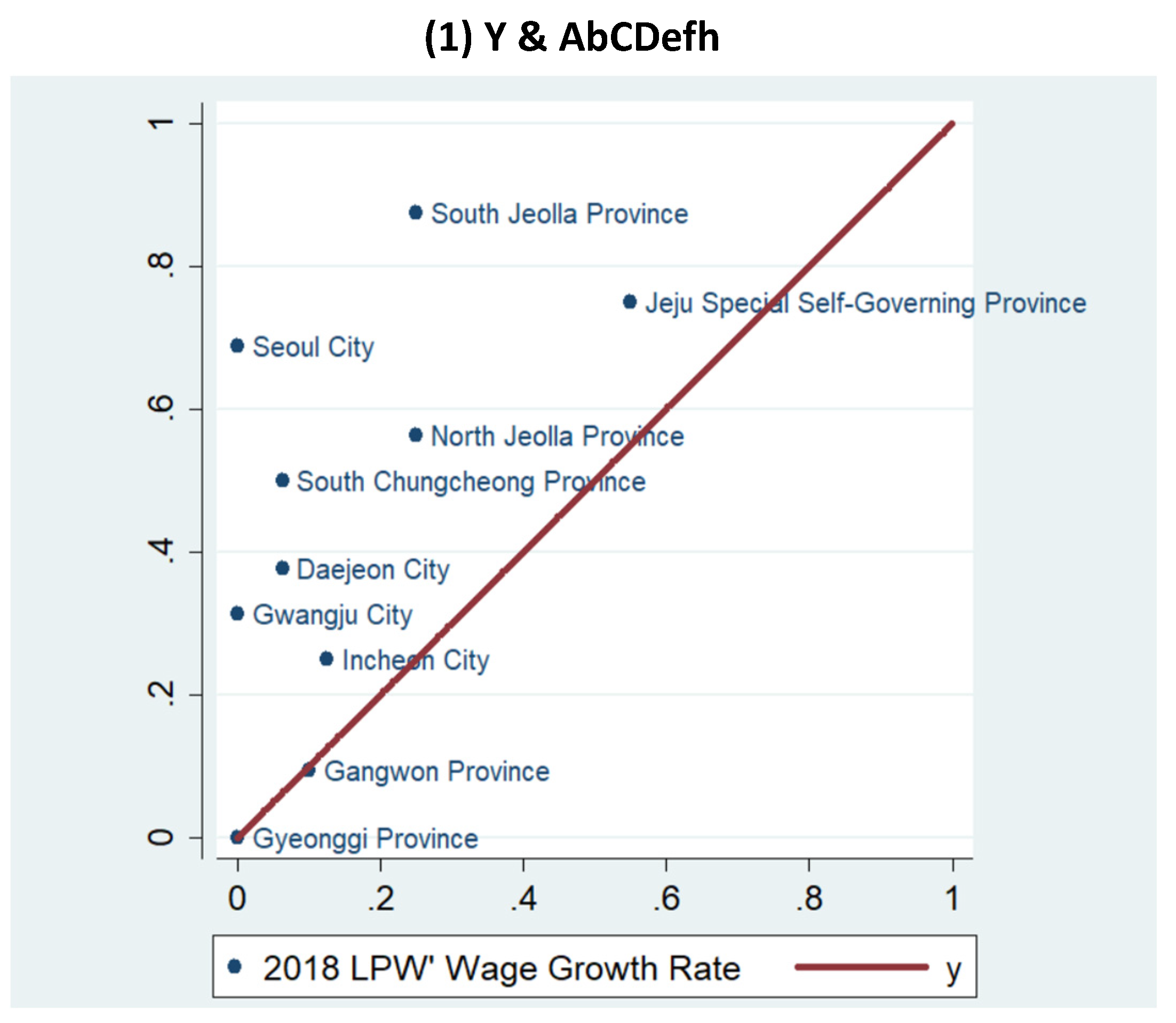
Figure 2.
Scatterplot of 2019 LPWs’ Wage Increase Rate and Contextual Combination.
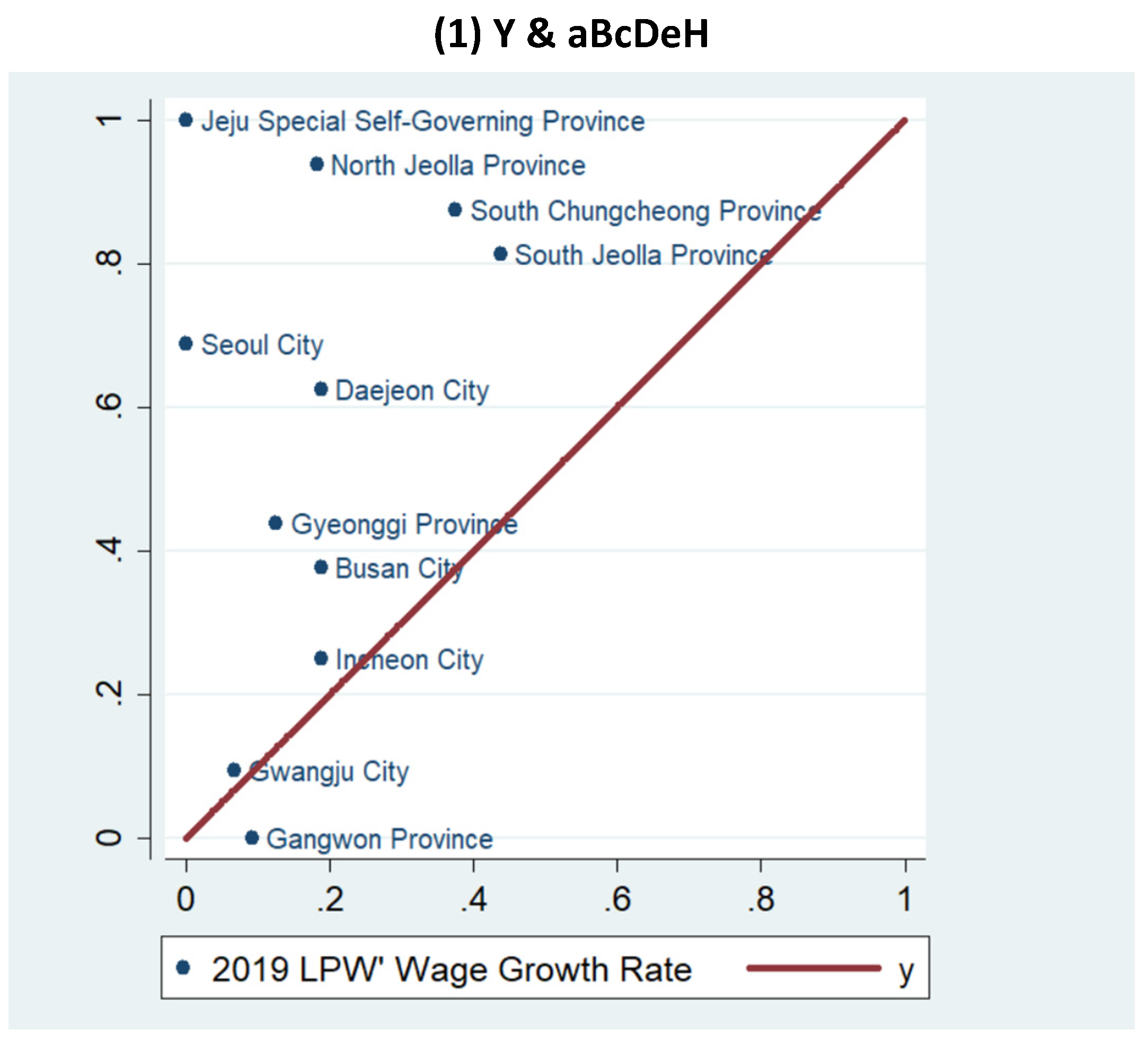
Figure 3.
Scatterplot of 2020 LPWs’ Wage Increase Rate and Contextual Combination.
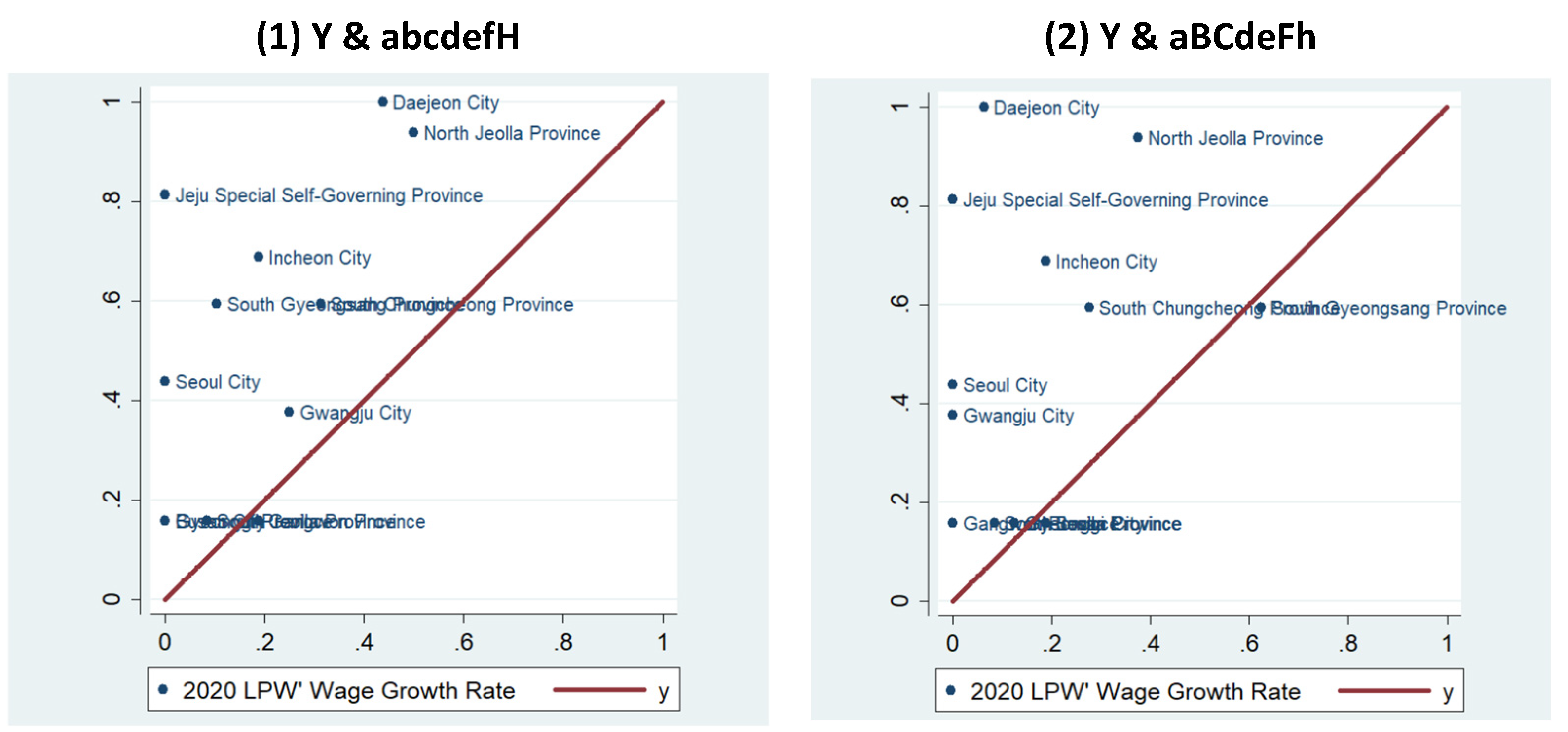
Figure 4.
Scatterplot of 2021 LPWs’ Wage Increase Rate and Contextual Combination.
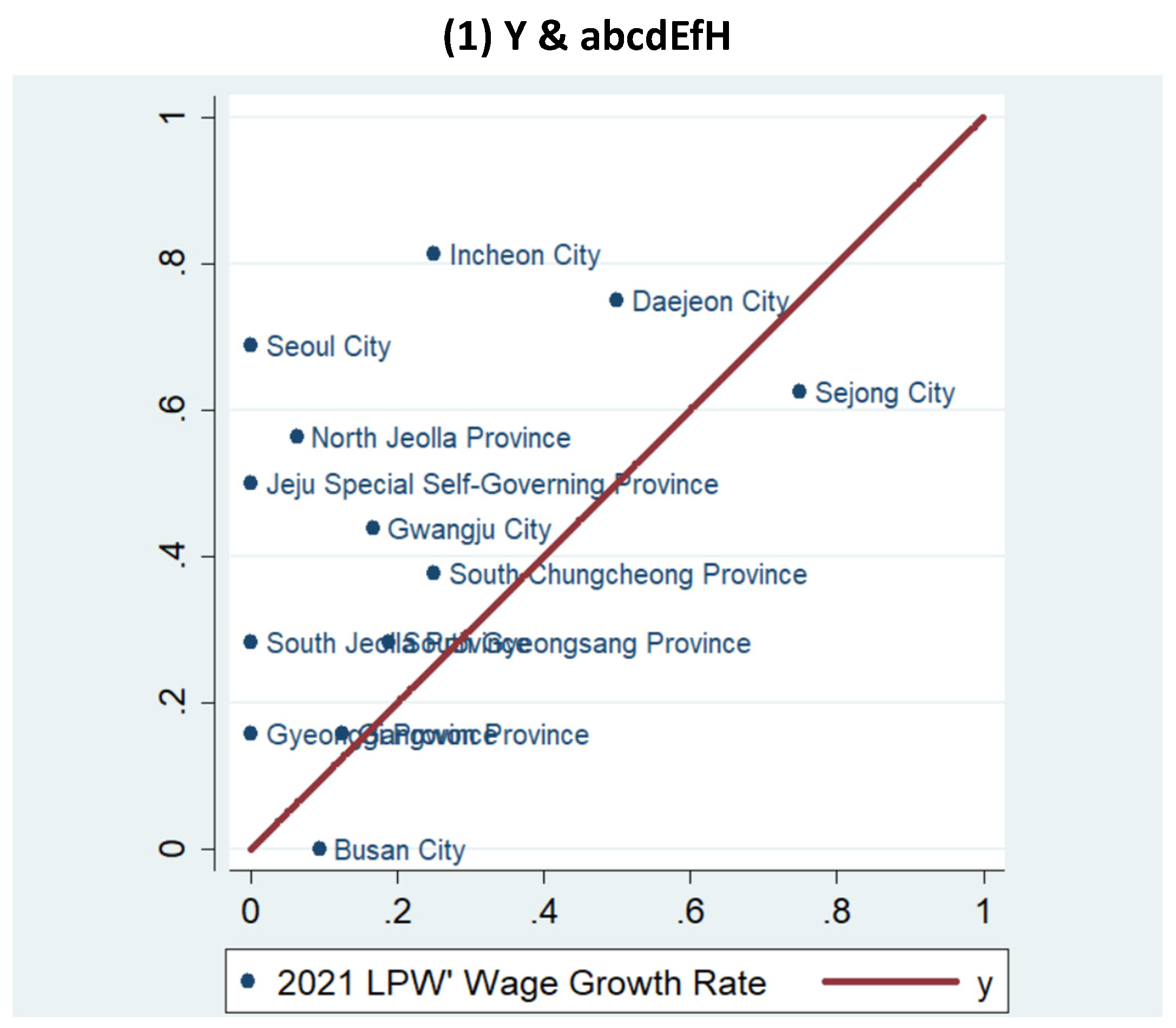

Table 1.
Comparison of Public Officials, LPWs, and Non-Regular (Fixed-Term) Employees.
| Classification | Public Officials | LPWs | Non-Regular (Fixed-Term) Employees | |
|---|---|---|---|---|
| Definition | Individuals governed by the Public Officials Act | Employees with an indefinite term of employment | Employees with a set term of employment | |
| Applicable Regulations | Public Officials Act | Labor Standards Act and other labor-related laws | Labor Standards Act and other labor-related laws | |
| Job Stability | Guaranteed by virtue of civil servant status | De-facto status guarantee; however, dismissal with notice is permitted (Article 26 of the Labor Standards Act) | No status guarantee; contract terminates automatically upon expiration; dismissal without notice is possible during the contract period (Article 24 of the Labor Standards Act) | |
| Working Conditions | Specifically stipulated by law (Regulations on Civil Service, Pay Regulations, Allowance Regulations, etc.) | Determined by each institution’s internal rules (prohibition of discrimination under the Act on the Protection, etc. of Fixed-Term and Part-Time Employees) | Determined by each institution’s internal rules (prohibition of discrimination under the Act on the Protection, etc. of Fixed-Term and Part-Time Employees) | |
| Retirement Age | Guaranteed by law (civil servant status) | Guaranteed retirement age (according to each institution’s rules) | No retirement age guarantee | |
| Severance Pay | Public Officials Pension Act | Act on the Guarantee of Employees’ Retirement Benefits | Act on the Guarantee of Employees’ Retirement Benefits (excludes employment of less than one year) | |
| Four Major Social Insurances | Pension | Public Officials Pension Act | National Pension Act | National Pension Act (excludes day laborers or employees working less than one month) |
| Health | National Health Insurance Act | National Health Insurance Act | National Health Insurance Act (excludes non-full-time employees) | |
| Employment | Not applicable | Employment Insurance Act | Employment Insurance Act (excludes those working fewer than 60 hours per month) | |
| Occupational Injury | Public Officials Pension Act | Industrial Accident Compensation Insurance Act | Industrial Accident Compensation Insurance Act | |
Table 2.
Review of Prior Research.
| Researcher | Research Purpose | Major Theories/Variables | Key Findings | Methodology |
|---|---|---|---|---|
| Kwon [1] | Improving working conditions for local public workers | Legal frameworks including the Labor Standards Act, Equal Employment Act, Civil Act, etc. | Argues that amending the Labor Standards Act to prohibit discrimination based on employment type is necessary | Literature review |
| Yun et al. [4] | Assessing the management of newly transitioned local public workers | Comparative approach across administrations (Roh Moo-hyun, Lee Myung-bak, Park Geun-hye, Moon Jae-in) | Diagnoses operational issues following LPW status conversion | Comparative case study focusing on three divisions within a single government agency |
| Lee [5] | Addressing discriminatory treatment between civil servants and LPWs | Constitutional right to equality, labor law principles, and other legal-institutional approaches | Proposes clear standards and procedures for recognizing discriminatory treatment, improving the management of LPWs, and preventing such discrimination | Comparative legal analysis across different countries |
| Seo [2] | Analyzing determinants of LPWs’ wages | Labor market theory, public-sector wage determination theory | Finds that greater local government fiscal capacity and larger civil-service workforce size significantly impact LPW wages | Panel regression analysis (DV: wage level of LPWs; IVs: size of the civil-service workforce, regional income, fiscal autonomy) |
| Di Carlo [3,27] | Explaining public-sector wage-setting and restraint | State-employer strategy; bargaining architecture; political dynamics | Shows wage outcomes can reflect state strategy and deliberate restraint; distributive politics matters | Comparative/analytical public-sector IR research |
| Nieminen et al. [28] | Decentralization and local responses to incentives | Subnational incentives; capacity; fiscal signals | Demonstrates that decentralization reshapes local responses to policy incentives, implying territorial variation in implementation | Empirical political economy / economic geography |
| Andersen et al. [29] | Comparing public vs. private work quality | Work quality; task/institution context | Finds sector differences are nuanced and context-dependent, cautioning against uniform assumptions | Two online field experiments |
| Aksom & Vakulenko [12] | Institutional theory scope in public administration | Institutional mechanisms; multi-dimensional institutional processes | Argues institutional effects operate through multiple coexisting mechanisms; supports context-sensitive governance analysis | Theoretical synthesis/review |
Table 3.
Analytical Indicators and Data Sources.
| Condition | Factor | Element | Variable Name | Measurement Indicator | Data Source |
|---|---|---|---|---|---|
| Result | LPW Wages | Wage Increase Level of LPWs | Y | Rate of LPW Wage Increase | Internal Data from Local Governments |
| Causal Condition |
Political Factor | Progressive Orientation of the Local Council | H | Share of Seats Held by the Democratic Party | National Election Commission Website |
| Civil-Service Workforce Size | LPW Scale | A | Number of LPWs (in thousands) | Statistics Korea Website | |
| General Civil Servant Scale | B | Number of General Civil Servants (in thousands) | Statistics Korea Website | ||
| Income Factors | Regional Wages | C | Regional Wage Growth Rate | Statistics Korea Website (if applicable) | |
| Living Wage | D | Officially Announced Living Wage | Local Government Ordinances and Notices | ||
| Local Government Finances | Fiscal Capacity | E | Fiscal Independence Ratio | Statistics Korea Website | |
| Population | Registered Residents | F | Registered Population (in millions) | Statistics Korea Website |
Table 4.
Descriptive Statistics of Original Scores, by Variable.
|
Year |
Variable | N | Mean | Standard Deviation | Minimum | Maximum |
|---|---|---|---|---|---|---|
| 2018 | Wage Increase Rate (Local Public Officials) | 17 | 6.13 | 3.48 | 2.53 | 12.35 |
| Progressive Orientation of Local Council | 17 | 0.78 | 0.25 | 0.15 | 0.957 | |
| Scale of Local Public Officials | 17 | 0.69 | 0.67 | 0.129 | 2.792 | |
| Scale of General Civil Servants | 17 | 19.02 | 14.47 | 1.91 | 54.86 | |
| Regional Wages | 16 | 4.39 | 1.03 | 2.6 | 6.3 | |
| Living Wage | 11 | 8807.27 | 386.91 | 7920 | 9370 | |
| Fiscal Capacity | 17 | 43.32 | 16.94 | 19.8 | 79.2 | |
| Population (Control) | 17 | 3.12 | 3.42 | 0.32 | 13.49 | |
| 2019 | Wage Increase Rate (Local Public Officials) | 17 | 3.8 | 2.19 | 0 | 8.6 |
| Progressive Orientation of Local Council | 17 | 0.78 | 0.25 | 0.15 | 0.957 | |
| Scale of Local Public Officials | 17 | 0.81 | 0.73 | 0.211 | 2.938 | |
| Scale of General Civil Servants | 17 | 19.83 | 15.13 | 2.13 | 58.29 | |
| Regional Wages | 16 | 3.83 | 0.78 | 2.8 | 5.1 | |
| Living Wage | 12 | 9607.75 | 525.32 | 8350 | 10148 | |
| Fiscal Capacity | 17 | 41.59 | 16.66 | 19.1 | 76.5 | |
| Population (Control) | 17 | 3.12 | 3.45 | 0.35 | 13.65 | |
| 2020 | Wage Increase Rate (Local Public Officials) | 17 | 3.54 | 1.81 | 0 | 7.96 |
| Progressive Orientation of Local Council | 17 | 0.78 | 0.25 | 0.15 | 0.957 | |
| Scale of Local Public Officials | 17 | 0.85 | 0.71 | 0.223 | 2.938 | |
| Scale of General Civil Servants | 17 | 17.99 | 15.7 | 1.77 | 64.71 | |
| Regional Wages | 16 | 1.34 | 0.72 | 0.1 | 2.4 | |
| Living Wage | 13 | 10110.31 | 282.23 | 9378 | 10523 | |
| Fiscal Capacity | 17 | 41.73 | 14.8 | 23.3 | 76.1 | |
| Population (Control) | 17 | 3.12 | 3.47 | 0.36 | 13.81 | |
| 2021 | Wage Increase Rate (Local Public Officials) | 17 | 1.95 | 1 | 0.8 | 3.7 |
| Progressive Orientation of Local Council | 17 | 0.78 | 0.25 | 0.15 | 0.957 | |
| Scale of Local Public Officials | 17 | 0.86 | 0.71 | 0.224 | 2.944 | |
| Scale of General Civil Servants | 17 | 17.29 | 13.55 | 1.72 | 51.76 | |
| Regional Wages | 17 | 4.02 | 1.22 | 1.8 | 6.6 | |
| Living Wage | 13 | 10322.92 | 196.78 | 10017 | 10722 | |
| Fiscal Capacity | 17 | 40.26 | 14.87 | 22.2 | 75.6 | |
| Population (Control) | 17 | 3.1 | 3.47 | 0.38 | 13.93 |
Table 5.
Descriptive Statistics of Fuzzy Transformation Scores.
| Year | Code | Variable | N | Mean | Standard Deviation | Minimum | Maximum |
|---|---|---|---|---|---|---|---|
| Y | Wage Increase Rate (Local Public Officials) | 17 | 0.5 | 0.32 | 0 | 1 | |
| H | Progressive Orientation of Local Council | 17 | 0.5 | 0.32 | 0 | 1 | |
| A | Scale of Local Public Officials | 17 | 0.5 | 0.32 | 0 | 1 | |
| B | Scale of General Civil Servants | 17 | 0.5 | 0.32 | 0 | 1 | |
| C | Regional Wages | 16 | 0.5 | 0.31 | 0 | 1 | |
| D | Living Wage | 11 | 0.5 | 0.33 | 0 | 1 | |
| E | Fiscal Capacity | 17 | 0.5 | 0.32 | 0 | 1 | |
| F | Population (Control) | 17 | 0.5 | 0.32 | 0 | 1 | |
| Y | Wage Increase Rate (Local Public Officials) | 17 | 0.5 | 0.32 | 0 | 1 | |
| H | Progressive Orientation of Local Council | 17 | 0.5 | 0.32 | 0 | 1 | |
| A | Scale of Local Public Officials | 17 | 0.5 | 0.32 | 0 | 1 | |
| B | Scale of General Civil Servants | 17 | 0.5 | 0.32 | 0 | 1 | |
| C | Regional Wages | 16 | 0.5 | 0.32 | 0 | 1 | |
| D | Living Wage | 12 | 0.5 | 0.33 | 0 | 1 | |
| E | Fiscal Capacity | 17 | 0.5 | 0.32 | 0 | 1 | |
| F | Population (Control) | 17 | 0.5 | 0.32 | 0 | 1 | |
| Y | Wage Increase Rate (Local Public Officials) | 17 | 0.5 | 0.31 | 0 | 1 | |
| H | Progressive Orientation of Local Council | 17 | 0.5 | 0.32 | 0 | 1 | |
| A | Scale of Local Public Officials | 17 | 0.5 | 0.32 | 0 | 1 | |
| B | Scale of General Civil Servants | 17 | 0.5 | 0.32 | 0 | 1 | |
| C | Regional Wages | 16 | 0.5 | 0.33 | 0 | 1 | |
| D | Living Wage | 13 | 0.5 | 0.32 | 0 | 1 | |
| E | Fiscal Capacity | 17 | 0.5 | 0.32 | 0 | 1 | |
| F | Population (Control) | 17 | 0.5 | 0.32 | 0 | 1 | |
| Y | Wage Increase Rate (Local Public Officials) | 17 | 0.5 | 0.32 | 0 | 1 | |
| H | Progressive Orientation of Local Council | 17 | 0.5 | 0.32 | 0 | 1 | |
| A | Scale of Local Public Officials | 17 | 0.5 | 0.32 | 0 | 1 | |
| B | Scale of General Civil Servants | 17 | 0.5 | 0.32 | 0 | 1 | |
| C | Regional Wages | 17 | 0.5 | 0.31 | 0 | 1 | |
| D | Living Wage | 13 | 0.5 | 0.32 | 0 | 1 | |
| E | Fiscal Capacity | 17 | 0.5 | 0.32 | 0 | 1 | |
| F | Population (Control) | 17 | 0.5 | 0.32 | 0 | 1 |
Table 6.
Results of Y-Consistency and N-Consistency Tests for 2018 Local Public. Officials’ Wage Levels.
Table 6.
Results of Y-Consistency and N-Consistency Tests for 2018 Local Public. Officials’ Wage Levels.
| No. | set | Validation Criterion | Num Best Fit | ||||||
|---|---|---|---|---|---|---|---|---|---|
| Benchmark ≥ 0.8, p < 0.1 | Y-Con ≥ N-Con, p < 0.1 | ||||||||
| Y-Con | Validation Criterion Value | F | p | N-Con | F | p | |||
| 1 | AbCDefh | 0.996 | ≥ 0.8 | 1580.68 | 0.000 | 0.696 | 5.28 | 0.047 | 1 |
Note. Y-Con = Y-consistency; N-Con = N-consistency.
Table 7.
Sufficient Conditions for 2018 Local Public Officials’ Wage Levels.
| Case | Causal Combination | Raw Coverage | Unique Coverage | Solution Consistency |
|---|---|---|---|---|
| 1 | A*b*C*D*e*f*h | 0.316 | 0.316 | 0.996 |
| Total Coverage | 0.316 | Solution Consistency | 0.996 | |
Table 8.
Optimal Case Matching for the 2018 Increase in Local Governments’ LPWs’ Wage Levels.
| Sufficient Condition | Causal Condition Combination | Optimal Case | Number of Cases |
|---|---|---|---|
| 1 | AbCDefh | Jeju Special Self-Governing Province (Jeju) | 1 |
Table 9.
Results of Y-Consistency and N-Consistency Tests for 2019 Local Public Officials’ Wage Levels.
Table 9.
Results of Y-Consistency and N-Consistency Tests for 2019 Local Public Officials’ Wage Levels.
| No. | set | Validation Criterion | Num Best Fit | ||||||
|---|---|---|---|---|---|---|---|---|---|
| Benchmark ≥ 0.8, p < 0.1 | Y-Con ≥ N-Con, p < 0.1 | ||||||||
| Y-Con | Validation Criterion Value | F | p | N-Con | F | p | |||
| 1 | aBcDefH | 0.945 | ≥ 0.8 | 5.95 | 0.035 | 0.625 | 4.5 | 0.06 | 0 |
| 2 | aBcDeFH | 0.951 | ≥ 0.8 | 8.05 | 0.018 | 0.663 | 3.95 | 0.075 | 0 |
Note. Y-Con = Y-consistency; N-Con = N-consistency.
Table 10.
Sufficient Conditions for 2019 Local Public Officials’ Wage Levels.
| Case | Causal Combination | Raw Coverage | Unique Coverage | Solution Consistency |
|---|---|---|---|---|
| 1 | a*B*c*D*e*H | 0.287 | 0.287 | 0.951 |
| Total Coverage | 0.287 | Solution Consistency | 0.951 | |
Table 11.
Results of Y-Consistency and N-Consistency Tests for 2020 Local Public Officials’ Wage Levels.
Table 11.
Results of Y-Consistency and N-Consistency Tests for 2020 Local Public Officials’ Wage Levels.
| No. | set | Validation Criterion | Num Best Fit | ||||||
|---|---|---|---|---|---|---|---|---|---|
| Benchmark ≥ 0.8, p < 0.1 | Y-Con ≥ N-Con, p < 0.1 | ||||||||
| Y-Con | Validation Criterion Value | F | p | N-Con | F | p | |||
| 1 | abcdefH | 0.985 | ≥ 0.8 | 139.07 | 0 | 0.576 | 3.88 | 0.075 | 0 |
| 2 | aBCdeFh | 0.967 | ≥ 0.8 | 90.74 | 0 | 0.691 | 4.11 | 0.068 | 1 |
Note. Y-Con = Y-consistency; N-Con = N-consistency.
Table 12.
Sufficient Conditions for 2020 Local Public Officials’ Wage Levels.
| Case | Causal Combination | Raw Coverage | Unique Coverage | Solution Consistency |
|---|---|---|---|---|
| 1 | a*b*c*d*e*f*H | 0.335 | 0.156 | 0.985 |
| 2 | a*B*C*d*e*F*h | 0.307 | 0.127 | 0.967 |
| Total Coverage | 0.287 | Solution Consistency | 0.951 | |
Table 13.
2020 LPW Wage Increases: Optimal Case Matching.
| Sufficient Condition | Causal Configuration | Optimal Case | Number of Cases |
|---|---|---|---|
| 1 | aBCdeFh | South Gyeongsang Province | 1 |
Table 14.
Results of Y-Consistency and N-Consistency Tests for 2021 Local Public Officials’ Wage Levels.
Table 14.
Results of Y-Consistency and N-Consistency Tests for 2021 Local Public Officials’ Wage Levels.
| No. | set | Validation Criterion | Num Best Fit | ||||||
|---|---|---|---|---|---|---|---|---|---|
| Benchmark ≥ 0.8, p < 0.1 | Y-Con ≥ N-Con, p < 0.1 | ||||||||
| Y-Con | Validation Criterion Value | F | p | N-Con | F | p | |||
| 1 | abcdEfH | 0.906 | ≥ 0.8 | 3.97 | 0.07 | 0.704 | 4.06 | 0.067 | 1 |
Note. Y-Con = Y-consistency; N-Con = N-consistency.
Table 15.
Sufficient Conditions for 2021 Local Public Officials’ Wage Levels.
| Case | Causal Combination | Raw Coverage | Unique Coverage | Solution Consistency |
|---|---|---|---|---|
| 1 | a*b*c*d*E*f*H | 0.374 | 0.374 | 0.906 |
| Total Coverage | 0.374 | Solution Consistency | 0.906 | |
Table 16.
2021 LPW Wage Increases: Optimal Case Matching.
| Sufficient Condition | Causal Configuration | Optimal Case | Number of Cases |
|---|---|---|---|
| 1 | abcdEfH | South Gyeongsang Province | 1 |
Table 17.
Configurational Relationships and Optimal Cases by Year of Analysis.
| Year | Variable | Configuration Type | Optimal Case | Related Factors |
|---|---|---|---|---|
| 2018 | 2018 LPW Wage Increase Rate | ACD | Jeju Special Self-Governing Province | Civil-service workforce size, income factors |
| 2019 | 2019 LPW Wage Increase Rate | BDH | - | Civil-service workforce size, income factors, political factors |
| 2020 | 2020 LPW Wage Increase Rate | BCF | South Gyeongsang Province | Civil-service workforce size, income factors |
| 2021 | 2021 LPW Wage Increase Rate | EH | South Gyeongsang Province | Local fiscal factors, political factors |
Disclaimer/Publisher’s Note: The statements, opinions and data contained in all publications are solely those of the individual author(s) and contributor(s) and not of MDPI and/or the editor(s). MDPI and/or the editor(s) disclaim responsibility for any injury to people or property resulting from any ideas, methods, instructions or products referred to in the content. |
© 2026 by the authors. Licensee MDPI, Basel, Switzerland. This article is an open access article distributed under the terms and conditions of the Creative Commons Attribution (CC BY) license (http://creativecommons.org/licenses/by/4.0/).
Copyright: This open access article is published under a Creative Commons CC BY 4.0 license, which permit the free download, distribution, and reuse, provided that the author and preprint are cited in any reuse.