

Submitted:
07 March 2026
Posted:
09 March 2026
You are already at the latest version
Abstract
The article explains the narcissism leadership paradox in the existing organizations in relation to the rhetoric of ethics used strategically to legitimize the use of control. The loss of trust in leaders and in employees are both practiced in the sense that leaders manifest the disjunction between organizational discourses and reality by instantiating values in superficial ways in what they say and in real ways in what they do. The study relies on three guiding questions: (1) How do narcissistic leaders legitimize themselves by thinking that they are right in the moral sense? (2) What are a few of the stressors related to employees where ethics and practice collide? (3) Does dissonance cause organizational cynicism? Semi-structured interviews with 24 employees working in Higher Education Institutes were used to collect qualitative data to answer the following questions: The similar patterns and their comparison across cases were determined by coding and performing thematic analysis in computer through excel. The outcomes show 3 broad themes. First, the Virtue Costume demonstrates that both virtues signaling and moral language are being offered to fulfill personal interest and acquire power. Second, Branding the Self as the Company causes us to concentrate on how egoistic leaders project their own image as the identity and values of the company. Third, the Contagion of Cynicism explains how employees who become disillusioned, cynical and detached respond when they feel hypocrisy in the words and actions of their leaders. The paper associate’s impression management and moral justification of narcissist leaders with falling trust and calls on authentic leadership and open cultural supervision to restrain cynicism and provide theoretical and practical organizational knowledge. This study’s implications build on the dark triad perspective advanced by Alowais and Suliman, which demonstrated that Leader Dark Triad (LDT) traits can cascade into Employee Dark Triad (EDT) behaviors within organizational settings. Extending this logic, the present study shows that narcissistic leaders’ ethical rhetoric can similarly shape organizational climates in ways that reinforce manipulative dynamics, highlighting how seemingly ethical leadership signals may mask deeper patterns of influence and behavioral contagion.
Keywords:
narcissistic leadership
; ethical rhetoric
; employee cynicism
; impression management
; trust in the organization
1. Introduction
The current paper is a continuation of previous works that have been conducted to assess the role of Leader Dark Triad (LDT) traits in employee Dark Triad (EDT) behaviors in higher education institutions (HEIs) and how toxic leadership may affect institutional ethics and trickle down to employee conduct and cultural norms [1]. Through the investigation of the ways in which narcissistic leaders use moral framing to legitimize control, the given research will help to reveal the nuances of manipulation, elaborate on the theoretical concept of LDT in academic environments and provide the input into the practices of promoting genuine authority among higher education leaders [1].
1.1. Background
Within the past 10-20 years, the degree of trust that leaders have shown to the population is at all-time lows, and the degree of distrust that the employees and other stakeholders have of the leadership authenticity is on the ris [2]. In the meantime, institutions have embraced the ethics, sustainability and values-based purpose language as an identity and branding tool (Ibn-Mohammed et al., 2024). The leaders have now learned the language of integrity, corporate social responsibility and stakeholder capitalism in a way that no longer makes them appear like decision-makers but rather moral guardians of their organizations. A paradox, however, lurks beneath this moralized rhetoric; the truth behind this moralized rhetoric that most of the employees subscribe to is that there appears to be no connection between the moral values that leaders preach, and the behaviors that they observe in organizational practice [3].
The paradox has taken a very keen twist particularly when it comes to cases of leaders with narcissistic traits. Narcissistic leaders are charismatic and authoritative, even though their leadership model is associated with personal interests, manipulations, and lack of concern about the general good [4]. When such leaders apply ethical rhetoric, they do not amount to a values-based leadership, but to a superior form of impression management. The self-serving choices are legitimized, and power is consolidated using ethical language instead of behavior. This paper seeks to better understand how this paradox functions by studying through the prism of employees who, most often, get exposed to the consequences of such leadership by living experiences that are likely to make the consequences more real to them than any other external message or leader self-reports.
1.2. Problem Statement and Significance
The main problem, and hence the subject of this research, is the growing gap between rhetoric and the working reality of leaders, and, specifically, the application of rhetoric of ethics as a convenient to practice narcissistic rules. Although trust, involvement, and reduced wrongdoing are universal attributes of ethical leadership [5], this paper holds that the positive outcomes would not be achieved unless ethics is exercised with personal gain in view. When the employees are unable to reconcile the realities of ordinary life with those values they are purported to hold, they feel confused, disappointed and eventually cynical [6].
This issue functions on more than just one level. The result of such an organizational disconnection between rhetoric and reality is the loss of trust, culture, and performance [7]. Moral stress and disengagement at the individual level exist when the workers perceive moral hypocrisy among the leaders [8]. Lastly, institutional trust is ruined by organizational hypocrisy on the socialization level, thus strengthening cynicism not only of companies, but also of leadership as a practice in general.
1.3. Research Gap and Justification
Although a large body of literature has been published about narcissistic leadership, it has been more satisfied with the features of leaders, the effects of their behavior, and performance indicators [9]. Similarly, ethical leadership has been studied to find out the level where followers of the values-driven leaders can be influenced by them and mold their behavior.[10] Minor attention has been paid, however, to how ethical speech itself can be manipulated. Ethical rhetoric is typically assumed to be either authentic or ineffective, and seldom do we find research examining the application of narcissistic leaders of ethical rhetoric in an instrumented manner.
Further, the existing literature is skewed towards leader-center, self-reported, survey or case-based approaches that predetermine the leader picture but not the employee one.[11] That leaves a cavernous hole: we know relatively little about how employees experience and respond to the disillusionment between the said values and the behaviors put in place. This paper addresses this gap by preempting the voices of employees and looking at how they understand the ethical paradox.
Finally, there is the subject of impression management and virtue signaling in the political and public realm [12], yet virtually nothing is understood about how it works within the organization. This study has made a new contribution into the body of literature in leadership, organizational psychology and business ethics by exploring how narcissist leaders can strategically apply ethical language in business.
1.4. Research Questions and Objectives
This research will be based on three research questions: (1) What is the way that narcissistic leaders present their decisions as ethical decisions in the framework of ethical language? (2) What are some of the tensions that employees encounter where they feel there is a disconnect between ethical messages and unethical behavior? (3) Does this paradox help to propagate cynicism in the organizational culture? To respond to these questions, the study aims to acquire the following objectives: (1) To examine the rhetoric devices that narcissistic leaders employ to make legitimate decisions. (2) To investigate the experiences of dissonance, moral stress, and resistance that employees experience when there is a difference in values and behaviors. (3) To analyze the cultural implications of ethical rhetoric as a manipulation tool, especially the emergence of cynicism.
2. Literature Review
The section provides the theoretical and empirical bases of the study. It performs a literature review of the research available as to narcissistic leadership, ethical rhetoric, and organizational trust as part of the wider discourse of dark personality traits in higher education institutions (HEIs) [1]. By placing these views in context with the previous studies on the effects of the leader dark traits, this chapter uncovers some gaps in the literature that the current study attempts to fill. It also connects these gaps to the larger objectives of the thesis by explaining the interaction between narcissistic leadership and ethical framing in scholarly settings. [1]
2.1. Theoretical Foundations
This study builds on the work of demonstrated how Leader Dark Triad (LDT) traits influence and reinforce employee behaviors in higher education institutions [1]. By integrating narcissistic leadership theory and the ethics of change in leadership, this paper extends their insights by focusing specifically on narcissism’s rhetorical use of ethics to legitimize control, thereby deepening the understanding of how dark leadership traits shape organizational culture and trust.
The type of leadership behaviors in organizational research has appropriated the clinically defined narcissistic personality disorder to describe the nature of the behaviors.[13] All these attributes find their reflection at workplaces in pride, bullying of subordinates, and excessive sensitivity to criticism.[14] Theorists prefer to describe clinical and organizational narcissism and add that hierarchies and power systems in business corporations support organizational narcissism.
The psychoanalytic model invented has the following characteristics: grandiosity and insensitivity, with the help of which, it is possible to establish the image of charisma and vision and offer a manipulative and theatrically cold environment.[15] The rest intend to strengthen the control: withhold the information, scapegoat the subordinate, etc.[16] It is important to note that differences between constructive and destructive narcissists that utilize their ambition and charisma to serve the organization or leverage their influence, suppress criticism and skewed morals to satisfy their ego needs. [17]
Narcissistic leadership is, therefore, hard to categorize. Leaders appear to be visionary and end up destroying culture because they are destructive. Leadership narcissism is a cognitive problem and a challenge that is culturally, and employee oriented that considers the fact that narcissist leaders can create an impact with charismatic and impression, silence defiance as gaining power. [18]
Ethical leadership is defined by creating a balance between the moral person and the moral manager. In this model though it assumes that authenticity accompanies that behavior which in practice is always found false.[19] Ethical rhetoric is a good performance strategy that leaders can employ to enhance legitimacy and compliance, but not moral conviction. Here we have a contradiction, those who do it out of ethical motives, and those who apply ethics to an instrumental goal, i.e., reputation or power.
Another reason ethical conduct gives credit to future wrongdoing is the moral licensing theory.[20] Narcissistic leaders jump at this chance and use the functions and activities of philanthropy or CSRs as a way of escaping criticism and, in the process, further entrench their selfish interests. This is maximized by ethical fading,[21] which repackages a decision in terms of profitability and efficiency and considers morality to be nonexistent. In these situations, rhetorical ethicality justifies dubious activities and an environment within which manipulation through narcissism thrives.
Finally, the example of ethical leadership shows the conflict between motive and rhetoric. Because it can create trust it is also able to cover up exploitation. The mobilization of moral discourse by narcissist leaders which institutionalizes power, perpetuates organizational legitimacy and conceals the degrading quality of the ethical culture needs further research. The conceptual distinctions between Narcissistic Leadership Theory and the Ethics of Change in Leadership framework are summarized in Table 1, highlighting how narcissistic leaders may appropriate ethical discourse while failing to embody authentic ethical leadership practices.
2.2. The Rhetoric of Virtue
The rhetoric of virtue highlights how ethical language can be strategically employed to project credibility and legitimacy, even when leaders’ actions contradict their words. Higher education institutions that Leader Dark Triad (LDT) traits, particularly narcissism, often exploit such rhetorical tools to influence Employee Dark Triad (EDT) behaviors [1]. This demonstrates that the moral discourse used by leaders is less about genuine virtue and more about impression management, reinforcing the contagion of unethical conduct across organizational hierarchies.
The virtue costume is a phrase describing the way self-interest is clothed in the language of virtue by leaders. Impression management theory and particularly the dramaturgical approach postulates that leaders manipulate their roles in such a way to make other people think of them in a particular manner.[22] The narcissistic leaders use this to masquerade as the morally upright leader with the outward look of integrity but with ulterior motives.
Moral grandstanding is one of them; as the moral talk employed to prove oneself as superior and even gain social status.[23] This has also been shown in organizations whereby decisions, which are mostly personal and political in nature, are packaged by leaders in terms of ethics to show virtue.
Corporate social responsibility campaigns are also a masquerade. According to the theory of legitimacy,[24] when organizations attempt to act in a manner that is congruent to the actions of the society, they are attempting to achieve legitimacy. Through the veil of CSR, narcissistic leaders mask all types of exploitative operations by highlighting the presence of charitable activities or sustainability initiatives.
Language manipulation also helps to reinforce the virtue costume. Right sizing (instead of mass layoffs), or the rebranding of practices that are hurtful as necessary sacrifices help leaders make toxic choices ethical.[25] Narcissistic leaders can cover the immoral facade by wording it in such a manner that it looks like they are ethical leaders when they are not.
Individual character and company brand are confounded in narcissistic leadership about morality. Even though the theory of personal branding is built upon sincerity and principles,[26] the narcissist leaders use branding with self-interest in mind. They ensure that their own narrative is not tied to an organizational value by sitting themselves as the moral compass of the company. This generates conformity at the cost of nonconformity since disobeying the leader is disobeying the organization. Stakeholder or values-oriented leadership as the basis of decision-making is another means of legitimizing authority through concealing self-serving interests. Ethical rhetoric is thus a method of showing power, that centralizes the power and makes the image of the leader identical to the image of the company, which is harmful to the legitimate organizational identity.
2.3. Experience and Impact on the Organization by the Employees
Employee experiences of leadership are not passive but shape organizational culture and performance. When leaders exhibit Dark Triad traits, employees mirror or adapt to these behaviors, reinforcing toxic dynamics in higher education institutions [1]. This highlights how leader influence extends beyond individual relationships to systemic organizational impact, where ethical erosion translates into diminished trust, engagement, and long-term effectiveness.
One practical theory of cognitive dissonance is to consider how employees react to the gap between ethical rhetoric and actual behavior of leaders,[27] which leaves them psychologically uneasy, thus moral distress, which is defined as an awareness of a course of action that is ethically correct but cannot be pursued due to some organizational constraint.[28] The psychological discomfort that employees experience under the influence of narcissistic leadership is that they have a perception of unethical deeds being done by a leader, leading to a situation where they cannot act in a specific way they know is ethically correct, and they cannot express discontent with.
The second factor that generates workforce dissonance is broken psychological contract. The psychological contracts are informal agreements between workers and employers like being fair, treating them with respect and morality. Employees of bosses who do quite the reverse of what they so much prattle about will feel cheated in the deal and be less pious and enthusiastic.
It is also a threatened identity dissonance. As soon as the organizational values are identified as being fronted, the employees whose identity aligns with the values which are being falsely fronted are put at risk. Such conflicts not only destroy the individual integrity and sense of belonging to the organization, but also cause withdrawal, cynicism or even turnover. [29]
When the employee loses the belief of organizational leadership values that encompass the attitudes of betraying, getting angry, or ridiculing a person or being uninterested, cynicism is realized in organizations.[30] That is accelerated in narcissistic leadership through continuous breaches of moral demands. The reason is that social contagion is proliferating dissent (Homan, 2024) and subcultures of skepticism and resistance.[31] This lack of trust is evident when integrity, which is core in the model of trust developed, seems to be disrespected and results in dissatisfaction, absenteeism and turnover. The workers adjust through moral disengagement,[32] without worrying about their feelings or having some reason behind certain immoral acts. Lastly, when ethics are abused, culture, performance and sustainability are killed by the cynicism loop.
2.4. Research Gaps & Synthesis
Despite all that has been written about narcissistic and ethical leadership there are several significant gaps. First, most of the studies are dedicated to narcissism at the personal but not at the systems level. Despite the situation that research has already determined the psychological traits of grandiosity, abuse, and indifference by the narcissistic leaders,[33] little literature explains how it becomes the long-term organizational culture of cynicism. The connection between the features of narcissistic leadership and group performance therefore requires to be examined further.
Second, the views of the employees are not included, regardless of the broad scope of the literature on leadership rhetoric and impression management. Little is known about how employees perceive, resist or internalize manipulative ethical language, yet the evidence suggests that ethical dissonance is a potent driver of trust, motivation and engagement [19].
Third, there exists a methodological limitation. Most of the literature is founded on cross-sectional designs that provide snapshots of but not the cumulative effects of repeated moral manipulation in the formation of long-term cynicism. Longitudinal research is needed to understand how the disillusionment is slowly altering the culture of the organization. [34]
Finally, there remains an integration gap in theory. This is mostly clinical psychology of narcissism, and the study of organizational cynicism is based on behaviors and cultural theories.[35] The narrowing of the gaps could offer further insights into how the moral rhetoric of leaders in correlation to employee responses to them-resistance or silence-contributes to cultural outcomes in the long-term. According to the theoretical paradigm, narcissistic leadership corrupts the integrity of the organization through manipulation of ethical rhetoric to create employee dissonance and cultural cynicism. The first is the way leaders have used grandiosity and moralized language to justify power a phenomenon which has been called Narcissistic Leadership to Rhetoric of Virtue. It is during virtue signaling and impression management that they build a moral image that hides self-interest. This can build credibility in the short term, but it will not take long before workers begin to notice discrepancies between words and actions and experience cognitive dissonance, moral stress, and a sense of violation of psychological contract.
Otherwise, such tensions become contagious, transmitting cynicism, normalized disillusionment, and a deficit of trust, interest, and reputation. Organizational culture is weak, performance is poor and the credibility of the institution is weak as well. Culture mediates such forces: culture may not be easily manipulated in high-integrity environments, but it may be in hierarchical cultures. Further mediation of outcomes in the face of increasing cynicism is carried through employee resilience, and ethical voice.
3. Methodology
The choice of a qualitative methodology was especially suitable to this study due to the fact that it allows investigating the dynamics and underlying causality of lived experiences in greater detail and more flexibility to analyze the very dynamics of narcissistic rhetoric and its implications on organizations and employees. [1]
3.1. Research Philosophy and Approach
This paper applied an interpretive paradigm to understand processes by which employees interpreted the ethically declared and manipulative acting leaders.[36] It was based on social constructionism and supposed that organizations’ realities were co-constructed not only through discourse and contacts, but also through a relatively shared set of meanings.[37] Methodologically, it was an inductive study, i.e., the patterns were built upon the data in contrast to data being analyzed to prove hypotheses created in earlier stages of the research. Accordingly, it generated a theory of the cultural influence of narcissistic leadership rhetoric. To illustrate the subtle psychological and cultural aspects of employees’ experiences that were not quantifiable, the qualitative method was selected.
3.2. Research Design
The phenomenological design formed the basis of the study and was applied to describe and meaningfully interpret lived experiences. [38]The design was appropriate as the subjective experiences of employees regarding leadership paradox were central to the research questions. Although phenomenology was inherently qualitative, it used a cross-sectional design to capture an organizational image of dynamic flows in various workplaces at a specific point in time. The research also employed some components of a case study to gain depth and compare trends across organizations and industries.
Coding and interpretation were guided by the six-phase thematic analysis method [3]. This involved familiarization, initial coding, search of themes, reviewing, theme definition and labeling as well as the production of final narratives. The frame gave an orderly structure to the information and had room to adjust to any emergent information.
3.3. Sampling Strategy
In order to have insights that were relevant and rich they were filtered based on certain inclusion and exclusion criteria. The inclusion criteria required that workers must have had at least two years of experience within their current organization to have sufficient exposure to leadership dynamics. They also must have been directly or indirectly connected with senior leadership and have felt the disengagement between values discussed and leadership practices portrayed. The exclusion criteria eliminated employees who were subjected to disciplinary action or those below the age of 18.
The sample consisted of purposive sampling of relevant (in terms of experience) individuals.[39] This was supplemented with snowball sampling that utilized participants’ networks to locate other individuals who had similar experiences. To guarantee maximum variation in the sample population—industries, size, and organizational positions—maximum variation sampling was applied.
The sample consisted of approximately 24 people across eight organizations, as it met the qualitative research threshold of thematic saturation.[40] This scale was adequate to add depth and breadth and allowed comparison of insights without sacrificing the richness of phenomenological descriptions.
3.4. Data Collection
Semi-structured interviews were used as the method of data collection because they were both flexible and consistent. An interview guide as a four-category framework was developed based on the following areas: (1) patterns of leadership communication, (2) personal experience of value-behaviour gaps, (3) organizational culture perceptions, and (4) individual coping strategies. Open-ended questions encouraged expansion without losing focus on the research objectives. The design also allowed participants to narrate fine-grained experiences and enabled the researcher to probe emergent themes. [41]
Interviews lasted 20–30 minutes and were conducted online via secure platforms such as Microsoft Teams or Zoom. They were audio-recorded, with participants’ consent, to ensure accuracy. Anonymous coding was used to ensure confidentiality, and all data were stored in coded files. The online format minimized logistical challenges and enabled greater geographic participation.
3.5. Data Analysis
To preserve detail, verbatim transcription of interviews took place within 48 hours of collection. Coding was done in three phases, including (1) open coding, where text was broken down into concepts; (2) axial coding, where the same concepts were grouped into categories; and (3) selective coding, where the most relevant categories were chosen to answer the research questions. [42]
To fill the knowledge gaps in the literature on the leader dark traits in higher education institutions (HEIs), this study included the direct quotes of the participants in the thematic analysis and also included some of them in the standalone form to maintain the authentic voices before a theme. This strategy supported the contextual interpretation and ensured that the results were based on lived experience to be in line with the previous methodological suggestions. ¹ The analysis was performed manually in line with the previous recommendation of methodological suggestions in order to interact closely with the data and identify the hidden rhetorical strategies and intentions. Manual coding enabled the patterns to form naturally as opposed to being limited by automatic mechanisms. These two analytic methodologies were a complement to the interpretative rigor that was used by synthesizing methodical development of themes together with excellent narratives. Other qualitative criteria that guaranteed credibility of methodological decisions of an analysis of narcissistic rhetorics and organizational behavior in the academic setting were reliable credibility, reliability and transparency in the processes of analysis.
3.6. Semi-Structured Interview Guide
The semi-structured interview guide involved investigation on how leaders employed ethical rhetoric and how employees felt that there were gaps between the professed values and actual behavior. The guide was broken into five sections so as to be thorough, flexible, and consistent during all the interviews. It gave the participants the freedom to tell their stories and also gave the researcher the opportunity to enquire on the themes that were emerging.
- Section A (Background & context) entailed the roles, tenure, and exposure of the participants to the communication of leadership.
- Section B (Leadership Communication Patterns): The section examined leadership communication of values and ethics and how the participants perceived these communications as authentic or strategic.
- Section C (Value-Behaviour Gaps) looked into the discrepancies between rhetoric and behaviour of the leaders, and the impact of those gaps on the employees emotionally and socially.
- Section D (Organizational Culture and Employee Experience) was exploring more about the cultural responses more generally, such as trust, morale, and silent or vocal patterns of responses.
- Section E (Coping Mechanisms and Outcomes): The importance of this section was on the way employees reacted to perceived hypocrisy and the impact of contradictions on long-term motivation, trust and engagement at the workplace.
At the close of every interview, the participants were asked to provide any extra thoughts about the leadership authenticity, narcissistic behaviour, or organizational results. This final prompt served to record unstructured or spur of the moment information that was not directly obtained by the other questions.
Opening Remark: Welcome to the discussion. In this study, the focus will be on the use of ethical rhetoric by leaders as well as the experiences of employees who see discrepancies between the values and the behavior of leaders. Your thoughts will be confidential and voluntary. Do you feel at ease to start talking about your experiences?
Section A: Background & Context
- Can you briefly describe your role and responsibilities in the organization?
- How long have you been with this organization, and how has leadership communication evolved during this time?
- Which organizational values are the most common values that are laid stress by leadership?
Section B: Leadership Communication Patterns
- How do leaders typically communicate organizational values and ethics (e.g., policies, speeches, campaigns)?
- Do you feel their communication is clear, consistent, and genuine? Why or why not?
- In your view, do leaders use ethical language more for inspiration or for control?
- How often do you feel leaders’ ethical messages align with organizational decision-making (e.g., promotions, resource allocation)?
- Can you recall a moment when leadership’s communication positively influenced your motivation or trust?
Section C: Value–Behaviour Gaps
- Have you witnessed leaders behaving in ways that contradict the values they promote?
- If yes, what specific examples stand out to you?
- How did such contradictions make you feel as an employee?
- Do employees openly discuss these contradictions, or are they ignored/hidden?
- How frequent do you think such inconsistencies are within your organization?
Section D: Organizational Culture & Employee Experience
- How would you describe the current organizational culture (e.g., supportive, distrustful, competitive, collaborative)?
- How do employees generally react when leadership actions don’t match their words?
- Have you observed changes in trust levels or morale because of leadership inconsistencies?
- To what extent do you feel the organization encourages honesty and voice when employees notice gaps between values and actions?
Section E: Coping Mechanisms and Outcomes
- How do you personally cope when you experience contradictions between leaders’ rhetoric and behaviour?
- What long-term effects do you believe these contradictions have on employee motivation, trust, or performance?
- In your opinion, how does leadership authenticity (or lack thereof) shape the organization’s overall success and reputation?
Closing Remark: I appreciate the fact that you have clearly expressed your opinion on leadership rhetoric and its influence on the trust and workplace culture. You are priceless with your contributions. Are there any other points you would like to make before you wrap up on the topic of leadership authenticity or organizational outcomes?
These questions were purposefully designed to bring out rich, reflective and psychologically descriptive responses of how employees constructed meaning of ethical rhetoric and leadership practice. Since the narcissistic leadership works based on subtle impressions-management, moral wording and symbolic control, straightforward inquiries would have been incapable of identifying the dynamics within the leadership. The format of the guide which shifted to interpretive to reflective prompt was required to enable the participants to place their experiences with tangible events first, followed by explaining the perceived contradiction and lastly assessing the emotional and organizational influence. This sequencing made sure that the participants were not guided to preconceived beliefs, but rather created their own stories, which is in line with phenomenological rigor. Additionally, the non-structured form also enabled the researcher to discover the concealed meanings, unforeseen ramifications, and delicate insights, which are usually repressed in top-down HEI settings. By so doing the interview guide was specifically constructed to bring out the moral dissonance, rhetorical manipulation and cynicism contagion that is at the heart of the narcissistic leadership paradox.
3.7. Ethical Considerations
The study met all institutional ethical requirements and was approved by the low risk self-review procedure of the British University in Dubai (BUiD) Ethics Committee. The research was a part of the current PhD project of the researcher. This was done by providing informed consent to all participants and briefing them about the purpose of the study, their rights, and the fact that they participated on a voluntary basis. The use of pseudonyms (rather than participant names) guaranteed anonymity, and organizations were disguised. The data were kept in encrypted files accessible only to the researcher. Once recordings were transcribed, the tapes were destroyed, and the transcripts were stored securely. Ethical protection was a necessary tool because the critique of leadership is a delicate matter that could expose participants to professional repercussions. [43]
4. Finding and Results
The chapter contains the results of the research based on 24 semi-structured interviews coded and thematically analyzed in Excel. The data disclosed three dominant themes which were (1) The Virtue Costume Strategic Moral Positioning, (2) Branding the Self as the Company Identity Fusion, and (3) Cultural Deterioration Cynicism Contagion. All themes are explicated, with direct quotations of participants, which are italicized to avoid any violation of authenticity.[44] Participant demographics and organizational contexts are profiled in the beginning of the chapter.
4.1. Demographics of Participants
The research is based on interviews conducted with 24 participants who hold various positions in different industries such as finance, retail, healthcare and technology. The participants were between 25 and 58 years of age with the median being 38. Tenure was quite heterogeneous: six had less than three years of experience in their respective organizations, and eight had over ten years, which offers fresh and experienced insights. The distribution at the organizational level was equal: nine participants were working in managerial or supervisory roles, eleven were professionals of the middle level, and four were frontline workers. [45]
The organizations represented were of various sizes and structures. Seven respondents were employed at large private universities that employed more than 2500 employees, ten were employed in medium-sized companies (500-2,000 employees) and seven were employed in small HEIs of less than 300 employees. The leadership models were hierarchical corporate landscapes and flatter, and more nimble organizations, but all of them reported a strong leader figure who influenced ethical discussion.
The response rates were high and all 24 attended the sessions to the end. The quality of data was high: transcripts were characterized by high involvement, and participants were often able to provide in-depth examples and rarely answered a question with a single word. The consistency of recurrent themes including conflicts between declared values and practices supported the credibility of the dataset to be analyzed thematically. As shown in Table 2, the sample consisted of 24 participants representing different gender groups, age categories, organizational sizes, and professional roles, providing a diverse cross-section of employees within higher education institutions.
4.2. Theme 1: “The Virtue Costume” Strategic Moral Positioning
Results surrounding The Virtue Costume are very conducive to the Narcissistic Leadership Theory since they establish how leaders mask their selfish interests as ethical stories in order to gain power, and respect. The study brings to light the manipulative nature of narcissistic leadership by showing how ethical rhetoric is an impression management strategy, as opposed to a value-based management strategy.[46] Meanwhile, the findings are related to the Ethics of Change in Leadership that has shown that the most superficial appeals to integrity and fairness do not support the nature of a true change, and instead of reforming, they pervert the conditions of a performance of a virtue. This is consistent with the downward projection of Leader Dark Triad characteristics to the culture of employees; here, leaders with narcissistic qualities deliver veneers that employees are obliged to solve, at the cost of building trust and spirit.
4.2.1. Ethical Language as Performance
“Every town hall begins with such words like honesty and fairness, but at the end of the week, these words have no meaning in reality. (P03)
“Everywhere are emails and posters and speeches the language of values. However, it is a performance to outsiders, like in the case of us, indoors, we feel it is a show for outsiders.
“Ethics appears when they are required to make sacrifices, but not when leadership is making decisions regarding their own benefits.
“They make all such choices as those related to integrity, but it is all about preserving their image before the stakeholders. (P10)
“The code of ethics can be seen as a marketing tool at times. It is read out in press releases than actual meetings. (P11)
“When leaders address values it sounds corny, practiced. However, in reality, I observe decisions taken out of fear and thus contrary to the same principles. (P13)
“Sustainability is a buzzword everybody is talking about but once budgets are slender sustainability is quick to fade away (P14)
“They do not lie but, pretending that the language of ethics is a costume that they have on when cameras are present” (P16)
The members of the group always explained how leaders used moral language as a performance tool, but not as an actual value system. Leaders were often heard to talk about integrity, sustainability, or fairness and these assertions were hardly reflected in their personal decision-making. One of the participants described it as follows,
“Our CEO keeps on preaching about the need to do the right thing, however, the instant the profits are at stake that whole phrase fades away. Like he is wearing a mask that slips the second money is involved on the table” (P07).
Employees pointed at the selectivity in implementation of ethical principles. In particular, actions that enhanced reputation were glorified as value-based, and those that compromised the well-being of the employees were explained as a necessary evil. “One of the participants commented, they tell us that we are a family but make bonuses cuts during the night. Families don’t do that” (P12).
What it turned out to be was that moral talk was a performance. Virtue was promoted in public proclamation and branding to the outside world, whereas self-interest and expediency were shown in internal practices.[47] This trend generated increasing disenchantment among workers, who had to make up their mind to align the publicly expressed signaling of virtue with privately conflicting judgments.
4.2.2. Moral Justification Mechanisms
They never used a worse term than optimizations, layoffs were now called realignments. It felt dishonest.” (P02)
Loss of benefits was a move that was described as an empowerment measure. Frankly speaking, it simply offended our intelligence (P06)
When the company withdrew in a local project, they claimed that it was to protect our long term vision. For us, it just meant no jobs.” (P09)
Their favourite was to make comparisons, they would say, it is a good thing we are not closing as other people. That does not make my reduction of pay any better. (P12)
Any unpopular decision was packaged as an ineptitude of somebody else regulators, clients, shareholders. Leaders were never owners of their decisions (P14).
The framing makes one feel guilty, which is difficult to dispute when you are left with the scraps to be thankful, as (P18) says.
It was universally known that the board was the final authority but they gave us the impression that their hands were bound. It was a convenient excuse.” (P20)
The idiom was never uncultured, yet the fact was savage. It compelled us to repeat stories which we had not even believed in. (P22)
In addition to performance, the participants also noted that leaders were quite active in justifying ethically doubtful decisions based on rhetorical strategies. A typical process was euphemistic labeling. “When one of the respondents remembered, it was not so much that we were firing people, but we were rightsizing. It was sounding clean and tidy, yet it was ravaging in actual sense” (P03).
Leaders also made comparisons that were favorable to facilitate malfeasance. One person who is in the manufacturing sector explains how management justifies outsourcing: “They explained to us that it was superior to closing the entire plant. It was a guilt trip, that we could be thankful to lose half the jobs (P15).
Another common defence was displacement of responsibility. Very often, leaders blamed the decisions that were not popular on the negative influence of the external stakeholders. “Shareholders or regulators were blamed on every harsh decision. It created the impression that they were helpless yet everyone was aware that they were not (P21).
Not only did such mechanisms enable leaders to maintain their image but they also put employees in awkward situations where they were supposed to parrot justifications which they did not share. This increased feelings of complicitness and more cynicism in the workplace. [48]
4.3. Theme 2: “Branding the Self as the Company”, Identity Fusion
The Branding the Self as the Company theme enhances the Narcissistic Leadership Theory due to how the narcissistic leaders integrate their identity in the company thereby making the mission of that company a replica of their ego and image. Such a combination of identities increases the power of the leader who suppresses other points of view, indicating that narcissism in leadership goes beyond dominance to take Organizational identity. According to the Ethics of Change in Leadership, this sort of fusion compromises the ethics of the collective and shoots down the plural voices by subjugating the common values with the ambitions of a particular leader. It is these findings that are reinforced by who stress the way the Dark Triad dynamics trickle down through the institutions of higher learning;[1] here, the fusion of identities turns the language of ethics into a tool of domination, inhibiting any actual change, and making the organization cynical.
4.3.1. Personal-Organizational Values Conflation
“All the statements in the wall were nothing but his words. It was not our problem; it was his problem.” (P02)
“When the company refers to the issue of innovation, it is merely the pet idea of the CEO being reused.” (P05)
“The reason why awards were selected was not based on the meaning behind the award to the company, but on the appearances based on his own resume.” (P07)
“It was like being a servant of his image, not of an organization with its culture.” (P10)
“It was not consultative in making decisions. These were the extensions of the personality of the CEO.” (P13)
“Sometimes I used to joke that the company should be re-named as after him because it was functioning as such.” (P16)
“Any form of resistance was met with disloyalty. It was not business performance it was simply a reflection of his worldview.” (P19)
“The company turned into the reflection of his ego - and we were all forced to live within that reflection.” (P22)
The most noticeable trend was how the narcissistic leaders integrated themselves with the organizational mission. Employees thought that the stated values of the company were more of the group values rather than the reflection of the persona of the leader. Our mission statement is the autobiography of our CEO, his values, his ambitions basically. “It is as though we are serving his own brand and not the company itself”. (P09).
Respondents explained that the strategic objectives could resemble the ego of the leader, more than the requirements of the organization. Categories such as sponsorships, awards and partnerships seemed to be aimed at boosting visibility of the leader. A respondent noted, “There were so many of our initiatives that were not related to business priorities. “They were the kinds of projects that made the CEO become the focus of the press”. (P18)
This identity amalgamation did not allow much space to other opinions. Those employees who doubted the compliance between the values imposed by leaders and organizational requirements were marginalized. As one of the participants put it, “without being able to reflect the philosophy of the CEO, you are branded as not fitting in. It kills imagination and diversity of ideas.” (P18)
4.3.2. Marketing Ethics as Competitive Advantage
“We had a slick brochure which was our sustainability report, but at the office, the printer never stopped working.” (P02)
“Each and every investor meeting had a new moral motto. It was comparable to donning costumes according to the listeners.” (P05)
“They used to talk about how we were inclusive but the leadership team has always been the five people during a decade.” (P08)
“Promotions within the company spoke otherwise, as at conferences we were crusaders of fairness.” (P10)
“It seemed like a script, not a belief and when they were told to say the values of the company in all presentations, they had to reiterate the same”. (P13)
“The sales pitch was a morality story. Customers purchased it but each day the staff could see through it.” (P14)
“In the situation where I questioned the difference between words and deeds, the answer turned out to be: Not to spoil the brand.” (P17)
“It was not in an attempt to live the values but selling them. That was the real business.” (P22)
Ethically, ethical positioning was an advantage that leaders used as competition. Firms positioned themselves as innovators in terms of sustainability, justice, or diversity. Nevertheless, internal contradictions were observed drastically among participants. “We were the most sustainable company in the industry; however, we were not even recycling in our own offices. It was all optics” (P06).
Values also served as a source of motivation and control inside the company. They told employees that they were guardians of ethics, a statement that was at first, inspirational but at later stages turned coercive. Initially, the title of being termed as the guardians of ethics was significant. “However, in a short time it turned into emotion blackmail, when you questioned leadership, you were not living the values”. (P20)
Ethical rhetoric was also prepared to suit stakeholders, customized to investors, regulators or customers. Although this boosted its reputation, this instrumental character of such narratives was soon perceived by the employees. According to one of the participants, it was ethics on demand. “The message varied according to the listener and this made it hollow to us”. (P11)
These results indicate that ethical branding was outwardly successful but, in the process, created distrust internally. Such practices were seen more by employees as being manipulative and not motivating thus weakening organizational unity.
4.4. Theme 3: “Cynicism Contagion” Cultural Deterioration
The theme of Cynicism Contagion builds on Narcissistic Leadership Theory because it reveals how hypocrisy and self-branding of narcissistic leaders cause not only personal disillusionment, but also spread cynicism across the organizational culture. This cultural degradation explains how self-interest-based leadership destroys the psychological safety, demoralizes innovation, and substitutes trust with passive resistance. Through the prism of Ethics of Change in Leadership, the results correlate that in cases where the rhetoric applied to ethics is camouflage, the desired transformational power of ethics is thus reversed with disengagement instead of commitment. The contagion effect points to the fact that the manipulation of ethics is not isolated at the dyadic level but propagated via networks, to which sarcasm, withdrawal, and symbolic defiance become normalized. These observations indicate how leadership attributes of the Dark Triad go down to organisational behaviour, and reveal that by the time cynicism has taken firm root in the culture, no individual but a system-wide intervention is sufficient to change the situation. [1]
4.4.1. Trust Erosion Patterns
“I initially gave them a benefit of the doubt. At this point I simply imagine them saying anything that looks good.” (P03)
“And each contradiction eats you through. It is not a kind of betrayal, but death by a thousand cuts.” (P05)
“I have ceased to raise ideas at meetings and sat down silent why bother when nobody is honest.” (P07)
“As soon as the trust is lost, all the messages become fake, however much they may sound honest.” (P09)
“When we had time free we volunteered on additional projects. Now, individuals perform mere minimum in order to save themselves.” (P12)
“It was not only disappointment but weariness continuously awaiting the distance between words and deeds.” (P16)
“I ceased to commit anything into this place emotionally. I work, but I lost my allegiance to my job.” (P18)
“Trust does not corrupt in one day. It is like the undress one bit at a time until there is nothing left of it.” (P21)
Virtue signaling and identity fusion together brought a slow but deep loss of trust. The employees explained a three-step process where first, there was initial dissonance of cognition, then there followed skepticism and then there was disengagement. Initially I believed that I was reading things wrong. “The same contradictions, then I saw again and again. I simply stopped caring eventually.” (P11)
Erosion was a behavioral condition characterized by a decreasing engagement in voluntary programs, decreasing readiness to speak up, and closed communication. One interviewee had summarized this change in a nutshell: when you do not trust the leadership, you will cease to give extra. “Why bother to lay your heart in when they obviously do not?” (P14).
This collapse was not some isolated cases but general trends. The culture of leaders not acknowledging their ability to match the words with the deeds was built by their recurrent failure to put it into practice.
4.4.2. Development of Collective Cynicism
“Cynicism was the safest language to use - we were making jests because we could not object.” (P04)
“Initially it was rumours, then it was the rule: do not believe what they say, only watch what they do.” (P06)
“In the lunchroom, we used laughter as a coping mechanism but they were bitter underneath.” (P08)
“It becomes more of a play when the leadership is a show and the employees determine their own script, which is mainly sarcasm.” (P10)
“I ceased to provide solutions. Why submit ideas, knowing that they will be overlooked or even stolen by another individual?” (P12)
“Foot stomping was a sort of passive resistance. We were aware that they had detected it, but they could not refer to it as insubordination.” (P13)
“Anybody who comes in soon understands how to laugh at us or lose the appearance of fooling around. Cynicism is something the culture teaches quickly.” (P15)
“The more time you stay the more your hope wanes. To survive is to be absorbed with the crowd of cynics.” (P17)
Cynicism quickly gets to individuals and subsequently to organizational cultures. Opponent networks within the employees became a place of expressing doubts and reinforcing it. “At lunch it always used humor on management ethics theatrics. It united us together, however, in an ugly way.” (P02)
Subcultures had emerged where sarcasm, passive resistance or symbolic defiance was normalized. Other ones withheld new ideas, other people took so long to follow the orders and some even defied it by other underground means. “We never said no outright. We only dragged our feet till they gave in. What we were all responding to was to push back.” (P19)
This cynicism was viral as it took time and it affected the manner in which new employees dealt with their work. “Fresh recruits catch on fast. “You either turn into one of the cynics or you are seen as a naive person. Nobody would like to be the one who is stupid.” (P19)
The processes kill team spirit, disembowel innovation and gut the corporate culture (Kinn and Estrada, 2025). What began to be dissonant with the rhetoric of leadership, became a condition of mistrust and disengagement in culture.
4.5. Cross-Cutting Patterns and Connections.
“The speech of ideals was another mask. We were all aware that it was acting and not belief.” (P03)
“In larger companies, it was more like a full theatre production; in other smaller ones, it was the same script, only played but more quietly.” (P05)
“Each department had its spin finance accused regulators, education slogans on display. The game was the same.” (P07)
“Young hires gave up faster. On the first day, they could see the mask and did not engage anymore.” (P09)
“In the case of the senior employees, we would go through the motions but the fire would be gone. “(P11)
Cynicism like smoke in a room came around. You had no chance of not breathing it in. (P13)
“A culture that was vacuolized due to the never-ending discrepancy between the word and the deed.” (P15)
“Ethics no longer inspired at some point. It was frozen background noises we were all deafening.” (P16)
It was slow eating away of its culture: the first application of the dress of virtue made a gap between the rhetoric and the reality in the space of which the executives could lose the organizational self in the personal purpose. This has assisted in the proliferation of the virus of cynicism which waters down faith and strengthens culture. The larger hierarchical organizations were quite engaged in massive distortion of values, and the smaller companies did the same, just to a low key. The rhetoric inside the industry was readjusted to the circumstances: the head of finance and healthcare has been driven out of the sphere of interest as soon as the industry became regulated, the heads of retail and education have been forced to virtue signaling.[49] The young workers became bored almost immediately, the old workers had no choice but to perform the ritual of paying attention to the case but cynicism spread like a virus. The rhetoric based on ethics was finally transformed into skepticism, and subsequently to general cynicism, and rendered performance unhealthy. The thematic analysis revealed three overarching themes: The Virtue Costume, Branding the Self as the Company, and Cynicism Contagion, each capturing distinct mechanisms through which ethical rhetoric and narcissistic leadership dynamics influence organizational climates. A summary of these themes and their supporting evidence is provided in Table 3.
5. Discussion
Combined with the background of the cascading effect of the Dark Triad characteristics of Leaders in the institutions of higher education, these views understand the findings in the context of Narcissistic Leadership Theory and the Ethics of Change in Leadership. The themes that were identified, The Virtue Costume, Branding the Self as the Company and Cynicism Contagion showed the interplay between rhetoric, identity fusion and cultural erosion in perpetuating cycles of distrust. The connection of theory and evidence facilitates the discussion to gain more knowledge about the capacity of manipulative leadership to transform not only leader-follower relationships but also organizational climate in general.
5.1. Interpretation of Findings
The results indicate that narcissist leaders construct their verdicts using morally appropriate rhetorical schemata in which they tend to disguise their egos with advanced rhetorical devices. The most obvious was the euphemistic labelling of contentious behavior that was repackaged as being righteous. To demonstrate that, one of our respondents remembered the moment when layoffs happened and the CEO informed him that it was time to reinvent oneself but he was referring to executive bonuses. The combination of these lines of thought results in the theory of moral disengagement in which words allow an individual to be irresponsible.[32] Moral licensing was also a window dressing of ethical behavior by leaders, and sustainability campaign activities to excuse opportunism, and a kind of stakeholder ventriloquism when decisions were claimed to be necessitated by external demand. These dispositions represent the evolutionary expansions of the previous research on impression management beliefs in leadership. [18]
According to the respondents, tension existed when the ethical rhetoric of leaders and leaders-in-practice was in conflict and experienced cognitive dissonance and moral stress. According to one of the respondents, there is integrity written on the poster walls but whoever praises the boss the most is promoted. These inconsistencies are aligned with the evidence that value incongruence is a threat to employee identity.[50] The ways of coping varied: some justified inconsistencies, some distanced themselves and a small group opposed them in an insidious manner. Marking the importance of resilience in such responses, tenure and career stage defined adaptation.[51]
This rhetoric-practice gap led to cynicism, first via the comic path but later via oral tradition in the form of social learning. The informal networks also increased the distrust rate and changed the culture of trust into disconnection and, eventually, opposition. [18] Therefore, narcissistic leadership kills the values it purports and leaves a void of legitimacy, cohesion and long-term performance.
5.2. Theoretical Contributions
This paper also adds to the theory of narcissistic leadership by showing how the theory not only affects the relationship between a leader and followers, but the whole culture of an organization. Unlike the above studies which concentrate on individual attributes of grandiosity, dominance and entitlement,[52] our findings reflect processes, which turn these attributes into common meaning categories, euphemistic labelling, stakeholder ventriloquism and identity fusion. Employee accounts reflected the realization that the process of making such practices normal is to rewrite the organizational stories and values. The gap that the study addresses in the literature regarding leadership is a characteristic that does not examine leaders as actors but the way they engage in cultural discourse.[53] The rhetorical exploitation of shared identity is thus what sustains the narcissistic leadership beyond charisma or power.
Organizational cynicism theory is also constructed around the results. Organizational-integrity-related negative attitudes,[54] on the other hand, turned out to be developed in phases: individual dissonance, then interpersonal contagion and ultimately within subcultures.[55] This process and cynicism become self-perpetuating when institutionalized in narcissistic impressions management. It has contributed to lack of trust and moral corruption,[51] and non-sustainability and non-validity once it is created.
These mental health implications should be placed in the wider clinical and occupational health literature. The studies of adversity in the workplace have shown consistently that the exposure to the environment that is characterised by moral incongruence and suppressed voice is not episodic but chronic and relational: instead of a particular traumatic incident, the employees are reacting to a long-term tradition of ethical manipulation by the very individuals upon whom their professional lives are dependent. This power imbalance increases the threat to the psyche significantly. When workers feel that organisational leadership is not only the cause but is also oblivious to their suffering, there are less likely to present symptoms, get help in occupational health, or even take restorative leave; these behaviours otherwise help mitigate the build-up of mental health burden.
The situation with the Higher Education Institute (HEI) which is considered here deserves specific clinical interest. The academic and professional personnel in HEIs has been known to report disproportionately elevated burnout, anxiety, and depressive percentages compared to other fields of the knowledge-economy, 7 and this susceptibility is amplified by the fact that institutional cultures may be both normalizing of moral dedication and allowing or disguising narcissistic leadership. The value betrayal is particularly detrimental to psychological integrity when employees have joined the field with well-developed prosocial and ethical drives, such is typical of the educators and researchers. This was the dynamic that was observed in the current research: the shift between the original belief in the institutional values and disillusionment, and eventually to the protective cynicism that was closely aligned with the process of occupational disenchantment found in the clinical burnout research. The three phases of losing trust observed in this case, including cognitive dissonance, scepticism, and an established form of disengagement, are in line with the model of progressive erosion of occupational burnout, in which emotional exhaustion is followed by depersonalisation, which is followed by reduced accomplishment with personal achievement.
Clinically, health psychology wise, these results suggest that it is highly important to rethink some presentations of workplace anxiety, depression, and cynicism not only as individual pathologies that must be addressed by individuals, but rather as expressions of unhealthy organisational climates that must be addressed by systemic remedies. Clinicians who deal with employees in HEIs (or other, more hierarchical organizations) are advised to assess organisational moral distress, as well as usual symptom inventories, and to wonder how much the psychological distress of their clients is environmentally sustained. Psychotherapeutic strategies that facilitate the clarification of values, the establishment of boundaries within authority and the re-building of identity as a professional after an institutional betrayal can be identified in particular. Equally, as organisational health psychologists are in a better position to influence preventive interventions on the structural level, such as leadership integrity audits, anonymous ethics reporting processes, and peer-support networks as intercepts that break the self-perpetuating loop of narcissistic rhetoric and the mental health effect it produces, self-sustaining cycle. In conclusion, one cannot dissociate the welfare of the workforce to the morality of its leadership.
5.3. Practical Implications
Organizations need to improve mechanisms of detecting and mitigating the risks of narcissistic leadership. In addition, throughout the selection processes, integrity tests should be conducted to determine the integrity behind the facade performance. [19] In order to find out the gap between rhetoric and reality, employee survey, employee ethics audit and employee behavioral checks can be conducted during the initial stages of organization before cynicism propagates in the organization. They should have secure voice environments where people are at liberty to speak without any sort of fear of retaliation. Holding choices and rewards of the consequences of ethical choices institutionalized will simplify it to be accountable and will additionally lessen manipulation.
Employees also are critical. Peer support and stress: the former can help them understand how to critically recognize, and the latter can help them learn how to disengage moral strain. Collective action enhances resistance to cultural fall using ethical alignment groups (alternatively referred to as collective action). The career alternatives should be morally right, and this extends the requirement of being honest as far as well-being and satisfaction are concerned.[51] It is possible to avoid cynicism and even to maintain the state of trust due to joint responsibility.
5.4. Employee Mental Health: Psychological Consequences of Narcissistic Ethical Rhetoric
Since the focus of Health Psychology Research (HPR) is on the interface between psychology and clinical health outcomes, this section takes a look at the mental health consequences of the results discussed earlier, which, so far, have not been studied in the context of narcissistic leadership and the application of ethical rhetoric in higher education institutions (HEIs). The evidence gathered during this research project does not just indicate an organizational malfunction, however, a health psychology clinical phenomenon: the gradual erosion of the psychological well-being of the employees under the influence of constant exposure to a manipulative moral rhetoric. The experiences that were reported by participants of all organizational sizes and hierarchical positions were associated with the well-known mental health conditions and risk factors, which were recorded in the occupational health literature, such as anxiety disorders, burnout syndrome, moral injury, and depression. These mental health implications are not incidental to the issues of this study; they are key to its theoretical contribution, as well as to its practical recommendations, especially in the case of a journal devoted to clinical health psychology.
5.4.1. Moral Trauma and Psychological Suffering
Among the most clinically relevant results brought out by the participants in their narratives is what has come to be known in the literature as moral injury - a concept first created in military and medical settings but is currently being broadly used in professional environments.[28] Moral injury happens when a person has the recurring experience of witnessing, not stopping, or being forced into the action that contradicts his or her beliefs based on the moral values deeply held. In this paper, the interviewees were able to give a consistent narrative of the instances where they had to publicly affirm moral constructs they internally held as insincere, or to say nothing when subjected to manipulative behavior themselves that they considered unethical. One of the participants explained it in the following way: “Whenever I sat in a meeting, and nodded my head to what I knew were values that were not being lived, I felt something break inside me a little. This phenomenological description is aligned with the clinical manifestation of moral injury that is connected with shame, guilt, anger, feeling of betrayal, and spiritual/existential distress.
Moral injury is the opposite of, yet commonly occurring alongside, moral distress - the term has already been mentioned in the literature review. Moral distress is more of a frustration of having known what to do but being unable to do it, [28] whereas moral injury is a more profound and long-lasting harm to oneself and integrity. When the narcissistic leaders use ethical rhetoric in order to cover self-interested actions, the employees are not only frustrated, they are put to an untenable situation in which their professional identity and personal morality system is systematically compromised. This maintained ethical incongruence over time creates what is arguably the long-term psychological stress effects, which have been widely reported health implications including increased cortisol levels, sleep problems, cardiovascular vulnerability, and immune suppression. These physiological processes highlight the fact that narcissistic leadership is not just an organizational management issue, but is a very real public health one that needs clinical health psychology views.
5.4.2. Burnout Syndrome in Employees Who Were Subjected to Ethical Dissonance
Occasionally, the World Health Organization (WHO) identified burnout as an occupational phenomenon in ICD-11, and it is defined as three dimensions, including feelings of energy depletion or exhaustion, mental distance to or feelings of negativism or cynicism towards one of the two jobs, and professional ineffectiveness. Remarkably, all three of them were most evident in the descriptions of participants of this research, and each of them seems to be directly connected to prolonged exposure to narcissistic moralizations, as opposed to workload or task complexity per se. The exhaustion that was reported by the participants was of a psychological and existential nature, a kind of fatigue of purpose and meaning that came as they began to recognize that the values they had been enlisted to promote were performance and not real.
The dimension of burnout that is pertinent here is that of cynicism, which is directly related to the theme of Contagion of Cynicism that came up in the findings. Employees have reported on erosion of emotional investment in their institution not by a burst, but by a gradual process of erosion by repeated incidents of noting the discrepancy between the moral rhetoric and moral reality. A number of the respondents claimed that they had come into their institutions inspired, dedicated, and optimistic only to realize that after a period of two to three years they were already demoralized in their emotions, their profession and were personally disengaged. This continuum of development commitment to cynicism is exactly the same burnout progression model,[52] who reported the way the modifications of belongingness and meaningful work directly turned into the emotional exhaustion over time.
The third dimension of burnout was the reduced professional efficacy that was also evident. Respondents also talked about a sense of competence and contribution that was becoming worse as their efforts were used to make the persona of a narcissistic leader. As one of them said: My job became unrecognized. The vision of the leader was redefined as whatever accomplished. After a time, you are no longer willing to do your best since you know that it is not going to be your best. This methodical deprofessionalization is a direct consequence of the identity fusion process mentioned above and the psychological consequences are far beyond the sphere of professional discontent into a clinical sphere of self-efficacy, self-esteem and, in certain instances, depressive symptomatology.
5.4.3. Anxiety, Hypervigilance, and the Neuroscience of Psychological Safety
Another clinically crucial but often ignored effect of narcissistic leadership conditions, is the long-term anxiety and hypervigilance experienced by employees as an adaptive but also ultimately detrimental coping mechanism. The unpredictable nature of the psychological environment makes one to work under a narcissistic leader who employs the use of ethical rhetoric as a control mechanism. Rules of engagement change depending on the needs of the leader: what was described as ethical behavior yesterday can be reshaped into a subversive behavior today as rules are manipulated to suit the new self-serving goals. Employees soon get to know that the moral terrain is not fixed and is unreliable. This uncertainty causes the neurological threat detection system to become activated and leaves the amygdala in a state of chronic alertness and overload the body with stress hormones even with no threat in sight.
The behavioral patterns that were described by the participants of the given study can be characterized as the traits of hypervigilance caused by anxiety: paying extra attention to the mood of the leader in question, checking and rechecking the emails before sending them to her, avoiding talking to the leader in a hall, and risking to be interpreted as being unfaithful, the participants tend to interpret organizational messages as the threats. Such trends among middle-level managers who have the experience of being subjected to psychologically unsafe bosses,[45] which he reports as revealing that cognitive load of constant threat monitoring has an extreme detrimental effect on decision-making ability, creativity, and productivity. Clinical health psychology perspective These anxiety reactions, when chronic, fit the descriptors that are related to Generalized Anxiety Disorder (GAD) and, in more extreme situations, Post-Traumatic Stress Disorder (PTSD), especially where the work place environment is characterized by aspects of psychological coercion, public humiliation or random punishment.
The notion of psychological safety, the common understanding of being able to speak up, risk and be oneself without the fear of being punished is completely irreconcilable with the environment, in which ethical language is used as a weapon by narcissistic leaders. Psychological safety is not just a management dream but a neurologically driven state which can result in higher-level thinking (prefrontal cortex), creativity, and ethical reasoning to control employees or to have a threat response and survival-fueled behavior (limbic system) take over. Lack of psychological safety prevents people to deliver their cognitive and moral best, as the results of the research have direct implications on the quality of higher education, research legitimacy, and student well-being in institutions of higher learning where narcissistic leaders are common.
5.4.4. Depression, Identity Loss and Existential Disengagement
In addition to burnout and anxiety, a group of participants in this study reported experiences that bear the symptoms of the depressive symptomatology, namely, the loss of sense, hopelessness in the future possibility of change, and the sense of personal agency and worth. These are closely related to what the literature defines as identity threat and identity loss.[29]When the people enter an HEI as they are attracted by the proclaimed values of the given institution academic integrity, intellectual honesty, collegial respect and later find out that these values are actually instrumentalized by narcissistic leadership, the break is not only professional. It is existential. Their identity, the purpose of what they do and their decisions on whether they make good ones or not are in doubt. Such existential disengagement has been linked in the literature on occupational health with a high risk of clinical depression especially in those who have invested a great deal in value-person fit such as is typical of highly educated professionals in an academic setting.
One of the clinical issues of the first importance is the interconnection between identity fusion due to narcissistic leaders and depressive outcomes. When the leaders methodically internalize organizational identity into themselves, individual workers turn out to be deprived of the shared moral compass that usually gives the sense of meaning and belonging. The connection between narcissistic personality disorder and a lack of empathy has been proposed to make narcissistic leaders virtually incapable of identifying, or reacting in an appropriate manner to the psychological damage that their actions produce. [33] This brings about a self-correcting mechanism whereby the failure of the leader to discern harm will lead to failure to correct the organization, and the employees will remain undetected even as the mechanisms of fear and complicity that are the production of the narcissistic rhetoric of ethics will be maintained. Silencing dynamic is referred as especially harmful to mental health, and reports that the act of silencing the voice in unhealthy leadership contexts is a highly predictive of psychological withdrawal, learned helplessness, and finally, clinical depression.[48]
The interdependence between identity fusion under narcissistic leadership and the depressive outcomes among the employees is considered to be one of the most clinically important issues.[33] By the leaders systematically imbuing organization identity into their system, the employees might lose a common moral code that usually gives them their meaning and belonging. This correlation of narcissistic traits of personality with lack of empathy will render these leaders less able to realize or address the psychological damage that their actions will lead to. This dynamic may form a vicious circle where the perceived absence of harm on the part of the leader leads to inaction in the organization where the distress of the employees remains unaddressed and the atmosphere of fear and complicity, which are maintained through the narcissistic moral discourse, remains. silencing dynamic as especially harmful to mental health, and reports that the act of silencing the voice in unhealthy leadership contexts is a highly predictive of psychological withdrawal, learned helplessness, and finally, clinical depression.
5.4.5. The Social Contagion of Mental Health Decadency
The findings of this research on contagion of cynicism are directly relevant and underestimated in terms of mental health. Organizational cynicism when propagated by peer networks as it was described by participants, in their informal conversations, in knowing glances during meetings, in group resignations, does not merely constitute a cultural issue. It is the psychological suffering that is transmitted through society. Dissent is transmitted by social contagion processes that are similar to those detected in the studies of emotional contagion: negative affect,[31] hopelessness, and disengagement are communicated by behavioral mirroring and shared interpretation. This contagion in the HEI settings considered in this post implies that even those employees, who had not even gotten the worst types of narcissistic manipulation, were sucked into a state of psychological distress because of the connection with some other employees who did. This carries severe consequences on the breadth and pressing of the organizational mental health initiatives: not only the individuals who can be identified as exhibiting overt symptoms should be supported, but the whole organizational system needs to be addressed.
Figure 1 below has shown a conceptual model of how the psycho-organizational processes occur when narcissistic moral rhetoric is converted to mental health decline among employees. This model combines the three key themes found in this study Virtue Costuming, Identity Fusion, and Cynicism Contagion with their respective mental healthcare outcomes, demonstrating how all mechanisms mobilize certain psychological vulnerabilities and without either organizational or personal defenses cause mental health outcomes at the clinical level.
Conceptual Model.
The process model presented in Figure 1 outlines a six-stage progression beginning with narcissistic leadership rhetoric and culminating in employee mental health outcomes such as burnout, anxiety, withdrawal, and chronic ill-health.
To consolidate the psychological and organizational consequences identified in the analysis, Table 4 presents an integrated framework linking leadership mechanisms to employee mental health outcomes and institutional implications. The framework demonstrates how narcissistic ethical rhetoric functions through mechanisms such as virtue costuming, identity fusion, cynicism contagion, and hypervigilant threat monitoring. These mechanisms activate psychological processes including moral injury, cognitive dissonance, identity threat, and emotional contagion, which cumulatively produce a spectrum of mental health consequences ranging from burnout and anxiety to depressive symptomatology and chronic stress responses. As shown in Table 4, these individual experiences ultimately scale into broader organizational risks, including erosion of ethical culture, talent attrition, suppressed innovation, and declining institutional resilience.
5.4.6. Clinical Health Psychology Recommendations for Practice
The effects of mental health in this part have a direct and immediate influence on the practice of clinical health psychology. First of all, the results require the official acknowledgment of narcissistic leadership conditions as professional occupational health risks deserving the methodical clinical surveillance maintenance and treatment. Organizations, but most especially HEIs that have a direct responsibility towards the welfare of the staff and the student body are advised to have periodic, anonymous psychological well-being tests that explicitly screen in moral injury, burnout and anxiety symptoms regarding leadership experience. Qualified clinical health psychologists that know the organizational environments that give rise to psychological distress are supposed to design and interpret such assessments and can differentiate leadership induced pathology with other precipitating factors.
Second, the challenge of therapeutic intervention with employees under narcissistic leadership presupposes a unique approach that does not depend on general stress management or resilience training. As much as the role of resilience-building is justified, it can also subconsciously act as a pathology to classify individual employees as having failed to absorb structural damage, making the victim the focal point of the blame to a system that perpetrates. Better would be Acceptance and Commitment Therapy (ACT), which assists one in self-documenting values and devoting themselves to value-appropriate action despite the constricting environments, without approving of that environment being acceptable. ACT has been confirmed to be effective in occupational health studies, in its ability to treat moral distress and values incongruence, thus being especially suitable to the occurrences experienced by the employees in this research paper. Narrative therapy could also prove useful, and the employees should be assisted in building other self-narratives that will maintain their sense of integrity and agency against institutional identity fusion.
Third, on the systemic and organizational scale, the mental health findings of this research are compelling in arguing to have clinical health psychologists integrated into HEIs in the capacity of consultants, not in the capacity of employee assistance providers, but in the capacity of systems analysts with the capacity and authority to give advice on leadership culture, effective governance structure, and ethical climate. Placing such psychologists in this position would allow them to diagnose early indicators of collective mental health degradation such as increased cynicism, decreasing engagement, growing presenteeism and to issue evidence-based recommendations to those in power before they develop into clinical crises. This reflects a major shift in the conceptualization of health psychology as an individual treatment mode to a systemic prevention paradigm, and comes in line with an increasing amount of literature in the literature on the topic of health psychology that demands a model of occupational psychological care of the masses.
Lastly, this paper shows the necessity of future research that will directly assess the outcome of mental health, that is, by implementing the validated clinical measures, including and not limited to Maslach Burnout Inventory (MBI) to assess burnout, depression, generalized anxiety, and the Moral Injury Symptom Scale (MISS) to assess narcissism, in a population that have to work under leaders with high narcissism scores. This type of research would provide the empirical association between the qualitative, experiential findings of the research and the quantifiable clinical outcome, and present the chance to formulate evidence-based prevention and intervention guidelines. The fact that a validated Narcissistic Leadership Mental Health Impact Scale (NLMHIS) is developed would be an especially valuable addition to the literature of organizational psychology and clinical health psychology, as it would provide practitioners with a standardized instrument to determine the psychological risks posed by a particular style of leadership in a particular institutional setting.
The practical implications derived from the study are synthesized in Table 5, which outlines a multi-level framework of recommendations targeting organizational governance, leadership development, clinical and human resource practices, employee empowerment, and future research directions. The recommendations emphasize the need for institutions to move beyond symbolic ethics toward structural mechanisms that ensure accountability and psychological safety. At the governance level, mechanisms such as independent ethics oversight and anonymous reporting systems are proposed to detect and address rhetoric–practice gaps before they evolve into systemic cynicism. Leadership development interventions focus on screening for narcissistic tendencies and cultivating ethical self-awareness and humility, while clinical and HR strategies highlight the role of psychological screening and evidence-based therapeutic interventions to mitigate burnout, moral injury, and anxiety. Collectively, these measures aim to strengthen institutional resilience, restore ethical voice, and support healthier organizational climates while also guiding future empirical research on narcissistic leadership and employee mental health.
5.5. Limitations
There are some limited ways to this work. Cross-sectional study design cannot track the dynamics of cynicism through time, but the use of self-reported interview data makes the likelihood of perceptual bias and selective recollection of this data more likely, despite the attempt at making it seem credible. The sample region: the area of interest that is reduced to certain industries and culture cannot be extended to other areas. Besides, although thematic analysis has given us mechanisms by which narcissistic leadership was related to cynicism, it is not possible to draw a causal conclusion.
In the future, the longitudinal research design will have to be applied to trace the development of cynicism in cases involving a narcissist leader. Ethical degeneration can be prevented or reversed through intervention-based research (e.g., development of leadership courses or culture-resilience interventions). It would also be helpful to make intercultural comparisons, as the choice of rhetoric and the way the employees receive leadership may differ across cultures and institutions. More than that, the image of leaders can be employed as a potent instrument to understand whether the manipulative rhetoric is conscious or the manifestation of a low level of awareness. The omissions would confer value to the theory and improve the practical processes of the maintenance of ethical organizational cultures.
6. Conclusions
This paper has explored the concept of using ethical language as a strategic instrument of narcissistic leaders that develop gaps between ethical values and actions leading to cynicism and loss of trust. With the use of Narcissistic Leadership Theory, Ethics of Change in Leadership,1, the research shows that impression management and identity fusion lead to the deterioration of the organization. The results highlight that, when used in a predatory manner, ethical rhetoric does not only pervert the relationship between leaders and followers but also transforms the institutional culture in a harmful manner.
6.1. Summary of Key Findings
This, as it has been previously discussed in this paper, entails the application of moral rhetoric by narcissistic leaders to the benefit of justifying their egocentric deeds, and the way employees manage the resulting contradictions. Several key themes have been identified: virtue costuming, branding the self as the company and cynicism contagion. When personal interests took center stage, leaders were more likely to resort to ethical language, which is associated with euphemistic naming, moral licensing, and stakeholder ventriloquism tactics.[32] These practices were perceived as virtue signaling by the employees and created the notion of manipulation among employees. In addition, narcissistic leaders blended their personal brand with the name of an organization, and thus the individual aspiration was re-packaged as a mission. Where values were mentioned, as noted by one respondent the CEO was referring to himself and the trust and good sense was breached. [19] This practice-rhetoric disjunction generated, in the long run, cultural erosion, infidelity and alienation. All these are the implications that constitute the fact that the notion of narcissistic leadership is no longer a leadership problem and has become a cultural problem of infusibility of broad aspects, which abandons the identity and the credibility of the organization in the long-term. It also empirically confirms past presumptions of ethical leadership and provides alternative directions of impression management and identity fusion. [19]
6.2. Implications for Theory and Practice
The present article contributes to further development of the concept of narcissistic leadership by connecting the psychological characteristics to the consequences of the organizational culture. As it shows, the task of the mechanisms of disengagement of the leaders is performed not only at the level of individual but also at the level of unity when the attitude ascribed to the employees and the organizational values are created. [32] Theoretically, the focus that the study gives to perceptions of employees gives a rich contrast to other studies that are more interested in leaders and the degree to which manipulation is internalized and perceived. It also empirically confirms past assumptions of ethical leadership and provides new directions of impression management and identity fusion [19].
In addition to the organization context, the findings can be extrapolated to questions of wider social concern about intuitional trust. Once incorporated into the group of employees, cynicism can be further transferred to a larger civic and democracy disengagement. [18] As the evidence demonstrates, the other aspect that causes the loss of trust in business and leadership, in general, is the organizational culture of ethical branding that does not assume ethical behavior in its true sense. In this is to be found the necessity of establishing real ethical leadership not only in the performance of the health of an organization but also in the preservation in society of democratic and other forms of trust.
6.3. Recommendations
Leadership within an organization should be integrated within a culture of upright moral commitments in contrast to performance. Leadership development programs should be internal, meaning, they should be self-aware, humble and morally courageous. Measures to see to it that there is a disconnect age between values and acts can be taken: committees of ethics, whistleblowing, value audits, and other safety nets, can be taken. Trust and cynicism should be put on a scale between two poles since the act should be introduced by the time disillusionment is an epidemic.
Future scholarship should include longitudinal studies that would quantify an intervention-driven change in cynicism over time and intervention-based studies that would quantify what to do to change, i.e., to correct the value-behavior disconnects. Multicultural literature would contribute towards shedding light on how narcissistic styles of leadership are displayed in various situations in an institution. Ideally, a psychological and sociological approach to organizations will enable one to find out more about how individual traits of leaders are created in contexts of cultures. Applied research should favor solution-based models that extend past diagnosis to actual change.
6.4. Final Reflections
The leadership crisis described in this paper is a crisis with a short-term nature: the loss of credibility in the context of narcissist leaders who cover their personal self-centeredness with the rhetoric of morality. But it points, too, to ways of hope. The workers are sensitive to the moral predicament, and, given the push, they could become the drivers of the cultural renaissance. It is in the sharing of a commitment between the leaders, the employees and the scholars to acquire real values congruency in the future. Given that they are built, organizations can transfer to the culture of trust and transparency that is the foundation of sustainable performance and long-term trust in society.
References
- ALOWAIS, A. A.; SULIMAN, A. THE INFLUENCE OF LEADER DARK TRIAD ON EMPLOYEE DARK TRIAD IN HIGHER EDUCATION INSTITUTIONS. TPM – Testing, Psychometrics, Methodology in Applied Psychology 2025, 32(S4(2025), 523–541. Available online: https://tpmap.org/submission/index.php/tpm/article/view/607.
- Nyquist, A. Building Stakeholder Trust Through Industry Leadership in Sustainable Development. Journal of Sustainable Marketing 2024, 5(2), 130–148. Available online: https://www.diva-portal.org/smash/record.jsf?pid=diva2%3A1997437&dswid=9142. [CrossRef]
- Zettna, N.; Yam, C.; Kunzelmann, A.; Forner, V. W.; Dey, S.; Askovic, M.; Parker, S. K. Crystal clear: How leaders and coworkers together shape role clarity and well-being for employees in social care. Human Resource Management 2025, 64(1), 5–20. [Google Scholar] [CrossRef]
- Braun, S.; Sleebos, E.; Zou, L. L.; Wisse, B. M. Sparking or smothering darkness: Motivational climates influence the leader grandiose narcissism–follower trust relation via leader self-serving behaviour. Journal of Occupational and Organizational Psychology 2025, 98(1), e12555. Available online: https://bpspsychub.onlinelibrary.wiley.com/doi/full/10.1111/joop.12555. [CrossRef]
- Ukeni, I. G. A Systematic Review of Ethical Leadership as a Panacea for Combating Sexual Harassment in Africa. Administrative Sciences 2024, 14(12), 332. [Google Scholar] [CrossRef]
- AlOwais, A. A.; Suliman, A. Charisma and Conscience: Narcissistic Leaders’ Use of Ethical Language to Justify Control. 2026. Available online: https://www.preprints.org/manuscript/202602.0900.
- Verhey, J. R. Leadership’s Role in Transforming Negative Organizational Culture into a Positive Workplace; Capella University, 2024; Available online: https://www.proquest.com/openview/f8dcc19c328b32e928d3af8ed12dd0e3/1?pq-origsite=gscholar&cbl=18750&diss=y.
- Ogunfowora, B. T.; Nguyen, V. Q.; Steel, P.; Hwang, C. C. A meta-analytic investigation of the antecedents, theoretical correlates, and consequences of moral disengagement at work. Journal of Applied Psychology 2022, 107(5), 746. Available online: https://psycnet.apa.org/fulltext/2021-86667-001.html. [CrossRef]
- Khorram-Manesh, A.; Goniewicz, K.; Burkle, F. M., Jr. The impacts of narcissistic leadership on achieving the United Nations’ sustainable development goals—a scoping review. Challenges 2024, 15(3), 37. [Google Scholar] [CrossRef]
- Nkan, E.E.; Essien, O.O.; Umoren, O.A.; Inyang, U.E. MODERATING ROLE OF TRANSFORMATIONAL LEADERSHIP IN THE RELATIONSHIP BETWEEN WORKPLACE INCIVILITY, EMOTIONAL INTELLIGENCE, AND WORK ENGAGEMENT. 2025. Available online: https://abjournals.org/ijebi/wp-content/uploads/sites/5/journal/published_paper/volume-8/issue-1/IJEBI_IIF7IYIO.pdf.
- Wang, L.; Jin, X.; Yoo, J. J. The process of visionary leadership increases innovative performance among IT industry 4.0 for SMEs for organizational sustainability: Testing the moderated mediation model. Sustainability 2024, 16(19), 8690. [Google Scholar] [CrossRef]
- Burnett, A. Confucian Moral Impression Management: A Framework for Navigating Polarization and Incivility in Contemporary Society. Doctoral dissertation, University of Oklahoma–Graduate College, 2025. Available online: https://www.proquest.com/openview/a31065a40d1702ad03a3e08377bf31fb/1?pq-origsite=gscholar&cbl=18750&diss=y.
- Day, N. J.; Green, A.; Denmeade, G.; Bach, B.; Grenyer, B. F. Narcissistic personality disorder in the ICD-11: Severity and trait profiles of grandiosity and vulnerability. Journal of Clinical Psychology 2024, 80(8), 1917–1936. [Google Scholar] [CrossRef]
- Liu, Q.; Wang, L.; Luo, M. When seeing is not believing: self-efficacy and cynicism in the era of intelligent media. Humanities and Social Sciences Communications 2025, 12(1), 1–13. Available online: https://www.nature.com/articles/s41599-025-04594-5. [CrossRef]
- Sarfarazi, M. P. Narcissistic-Psychopathic Manipulation Part II of: Leadership or Chaos Effectuated by Avaricious Desire for Tyrannous Manipulation and Control? 2022. [Google Scholar]
- Choi, Y.; Phan, W. M. J. Narcissistic leaders: The good, the bad, and recommendations. Organizational Dynamics 2022, 51(3), 100868. Available online: https://www.sciencedirect.com/science/article/pii/S0090261621000437. [CrossRef]
- Brownell, K. M. Social Influence, Power, and Control: The Dark and Destructive Side of Entrepreneurship; Indiana University, 2022; Available online: https://www.proquest.com/openview/a125fccf212c104f5318a6dc516d23f5/1?pq-origsite=gscholar&cbl=18750&diss=y.
- Williams, B. Unveiling Narcissism: Exploring Its Role in Tech Industry Culture. Doctoral dissertation, California Baptist University, 2025. Available online: https://www.proquest.com/openview/803016f80744ef6a4c5c13d3eddb089b/1?pq-origsite=gscholar&cbl=18750&diss=y.
- Faherty, C. M.; Clinton, E. Speaking Up to the Boss: The Effects of Top Management Team Members’ Felt Trust and Perceived CEO Trustworthiness on Voice Behaviour in Family Firms. Journal of Management Studies 2025, 62(4), 1747–1778. Available online: https://onlinelibrary.wiley.com/doi/full/10.1111/joms.13126. [CrossRef]
- Griep, Y.; Germeys, L.; Kraak, J. M. Unpacking the relationship between organizational citizenship behavior and counterproductive work behavior: Moral licensing and temporal focus. Group & Organization Management 2021, 46(5), 819–856. [Google Scholar] [CrossRef]
- Luchkowec, D. Exploring the “edge”: re-imagining the potential of permaculture’s third ethic. Master’s thesis, Northern Arizona University, 2023. Available online: https://www.proquest.com/openview/8322a15e900ad2773bd8de2da7a3e38e/1?pq-origsite=gscholar&cbl=18750&diss=y.
- Li, X. The analysis of internet celebrities’ impression management tactics on social media from the perspective of dramaturgical theory. International Conference on Educational Reform, Management Science and Sociology (ERMSS 2021), 2021; Available online: https://webofproceedings.org/proceedings_series/ESSP/ERMSS%202021/ZJ_2111020.pdf. [CrossRef]
- Vijay, D.; Nair, V. G. In the Name of Merit: Ethical Violence and Inequality at a Business School. Journal of Business Ethics 2022, 179(2). [Google Scholar] [CrossRef]
- Crossley, R. M.; Elmagrhi, M. H.; Ntim, C. G. Sustainability and legitimacy theory: The case of sustainable social and environmental practices of small and medium-sized enterprises. Business Strategy and the Environment 2021, 30(8), 3740–3762. [Google Scholar] [CrossRef]
- Pan, J. C. Selling Social Justice: Why the Ruling Class Loves Antiracism; Verso Books, 2025. [Google Scholar]
- Venciute, D.; April Yue, C.; Thelen, P. D. Leaders’ personal branding and communication on professional social media platforms: motivations, processes, and outcomes. Journal of Brand Management 2024, 31(1), 38–57. Available online: https://link.springer.com/article/10.1057/s41262-023-00332-x. [CrossRef]
- Chatterjee, S.; Chaudhuri, R.; Kumar, A.; Wang, C. L.; Gupta, S. Impacts of consumer cognitive process to ascertain online fake review: A cognitive dissonance theory approach. Journal of Business Research 2023, 154, 113370. [Google Scholar] [CrossRef]
- Morley, G.; Bradbury-Jones, C.; Ives, J. The moral distress model: An empirically informed guide for moral distress interventions. Journal of Clinical Nursing 2022, 31(9-10), 1309–1326. [Google Scholar] [CrossRef]
- Atalay, M. O.; Aydemir, P.; Acuner, T. The influence of emotional exhaustion on organizational cynicism: The sequential mediating effect of organizational identification and trust in organization. Sage Open 2022, 12(2), 21582440221093343. [Google Scholar] [CrossRef]
- İnal, İ. H. The Relationship Between Leadership Culture and Cynicism in the Businesses of the Future. 2023. Available online: https://www.researchgate.net/profile/Ibrahim-Inal/publication/374795110_The_Relationship_between_Leadership_Culture_and_Cynicism_in_the_Businesses_of_the_Future/links/655f74b6ce88b8703107e2d4/The-Relationship-between-Leadership-Culture-and-Cynicism-in-the-Businesses-of-the-Future.pdf.
- Homan, H. B. Meeting Societal Expectations Through Understanding Police Decision-Making; Bowling Green State University, 2024; Available online: https://www.proquest.com/openview/fc9d55a52a5b75cf5fd43f766173dca1/1?pq-origsite=gscholar&cbl=18750&diss=y.
- Hindriks, F. How does reasoning (fail to) contribute to moral judgment? Dumbfounding and disengagement. Ethical Theory and Moral Practice 2015, 18(2), 237–250. Available online: https://link.springer.com/article/10.1007/s10677-015-9575-7. [CrossRef]
- di Giacomo, E.; Andreini, E.; Lorusso, O.; Clerici, M. The dark side of empathy in narcissistic personality disorder. Frontiers in psychiatry 2023, 14, 1074558. Available online: https://www.frontiersin.org/journals/psychiatry/articles/10.3389/fpsyt.2023.1074558/full. [CrossRef]
- Liu, Q.; Wang, L.; Luo, M. When seeing is not believing: self-efficacy and cynicism in the era of intelligent media. Humanities and Social Sciences Communications 2025, 12(1), 1–13. Available online: https://www.nature.com/articles/s41599-025-04594-5. [CrossRef]
- Rawal, N. Therapists’ Understanding of Clients’ Perceptions of Pathological Narcissism in the Family-of-Origin. Doctoral dissertation, California Southern University, 2024. Available online: https://www.proquest.com/openview/6e2e37c8af5ba1686078ce47f6c515ac/1?pq-origsite=gscholar&cbl=18750&diss=y.
- Lenart-Gansiniec, R.; Lenart-Gansiniec, R.; Sułkowski, Ł. Paradigm Shifts in Management Theory. 2025. Available online: https://ruj.uj.edu.pl/server/api/core/bitstreams/739bc0c5-6d91-4606-bd9f-cea354f1761f/content.
- Burr, V. Social constructionism; Routledge, 2024; Available online: https://www.utupub.fi/bitstream/handle/10024/161812/Making%20Sense%20of%20the%20Entrepreneurial%20University%20%20%20A%20Social%20Constructionist%20View.pdf?sequence=1.
- Lindseth, A.; Norberg, A. Elucidating the meaning of life world phenomena. A phenomenological hermeneutical method for researching lived experience. Scandinavian journal of caring sciences 2022, 36(3), 883–890. [Google Scholar] [CrossRef]
- Magnone, K. Q.; Yezierski, E. J. Beyond convenience: A case and method for purposive sampling in chemistry teacher professional development research. Journal of Chemical Education 2024, 101(3), 718–726. Available online: https://pubs.acs.org/doi/full/10.1021/acs.jchemed.3c00217. [CrossRef]
- Naeem, M.; Ozuem, W.; Howell, K.; Ranfagni, S. Demystification and actualisation of data saturation in qualitative research through thematic analysis. International Journal of Qualitative Methods 2024, 23, 16094069241229777. [Google Scholar] [CrossRef]
- Xiao, Z. S.; Zhou, H.; Jiang, Y. L.; Samah, N. A. Embracing the complexity of lived experiences in psychiatry research: reflexivity, cultural sensitivity, and emergent design. World Journal of Psychiatry 2024, 14(12), 1793. Available online: https://pmc.ncbi.nlm.nih.gov/articles/PMC11622033/. [CrossRef] [PubMed]
- Aguas, P. P. Fusing approaches in educational research: Data collection and data analysis in phenomenological research. The Qualitative Report 2022, 27(1), 1–20. Available online: https://core.ac.uk/download/pdf/516459144.pdf. [CrossRef]
- Nasir, S.; Khan, R. A.; Bai, S. Ethical framework for harnessing the power of AI in healthcare and beyond. IEEE Access 2024, 12, 31014–31035. Available online: https://ieeexplore.ieee.org/abstract/document/10445375. [CrossRef]
- DeLaughter, K. L.; Fix, G. M.; McDannold, S. E.; Pope, C.; Bokhour, B. G.; Shimada, S. L.; Cutrona, S. L. Incorporating African American Veterans’ Success Stories for Hypertension Management: Developing a Behavioral Support Texting Protocol. JMIR Research Protocols 2021, 10(12), e29423. Available online: https://www.researchprotocols.org/2021/12/e29423/. [CrossRef]
- Scott, M. J. H. Competing in the Stress Olympics: Mid-Level Managers and Their Experiences of Work Stress as Impacted by Their Supervisor and Organizational Climate. Doctoral dissertation, Old Dominion University, 2024. Available online: https://www.proquest.com/openview/8103e9e5120da40c7b024d51543b9d69/1?pq-origsite=gscholar&cbl=18750&diss=y.
- Rosenthal, S. A.; Pittinsky, T. L. Narcissistic leadership. The leadership quarterly 2006, 17(6), 617–633. [Google Scholar] [CrossRef]
- Ahmad, N.; Ahmad, A.; Siddique, I. Beyond self-interest: how altruistic values and human emotions drive brand advocacy in hospitality consumers through corporate social responsibility. Corporate Social Responsibility and Environmental Management 2024, 31(3), 2439–2453. Available online: https://www.tandfonline.com/doi/abs/10.1080/0147037X.2021.1991719. [CrossRef]
- Martinez, J. D. The Prohibiting Voice of Toxic Leadership: A Pentecostal Silencing Study. Doctoral dissertation, Regent University, 2025. Available online: https://www.proquest.com/openview/2e19dac964eddbdd026c80b602836d00/1?pq-origsite=gscholar&cbl=18750&diss=y.
- Walton, K. Corporate Virtue Signaling: The Devolution of Virtue into Signaling. Doctoral dissertation, 2022. Available online: https://baylor-ir.tdl.org/server/api/core/bitstreams/5b5a41a7-9268-48cb-98f2-5914869f7d49/content.
- Wenjun, Z.; Panikarova, S. V.; Zhiyuan, L. The effects of personal-organizational fit on employee’s positive work attitudes: An entrepreneurial orientation perspective. Управленец 2024, 15(1), 15–34. Available online: https://cyberleninka.ru/article/n/the-effects-of-personal-organizational-fit-on-employee-s-positive-work-attitudes-an-entrepreneurial-orientation-perspective. [CrossRef]
- Afota, M. C.; Provost Savard, Y.; Léon, E.; Ollier-Malaterre, A. Changes in belongingness, meaningful work, and emotional exhaustion among new high-intensity telecommuters: Insights from pandemic remote workers. Journal of Occupational and Organizational Psychology 2024, 97(3), 817–840. [Google Scholar] [CrossRef]
- Freis, S. D.; Hansen-Brown, A. A. Justifications of entitlement in grandiose and vulnerable narcissism: The roles of injustice and superiority. Personality and Individual Differences 2021, 168, 110345. Available online: https://www.sciencedirect.com/science/article/abs/pii/S0191886920305365. [CrossRef]
- Mabey, C. Leadership development in organizations: Multiple discourses and diverse practice. International Journal of Management Reviews 2013, 15(4), 359–380. [Google Scholar] [CrossRef]
- Polowczyk, P. Ł. Organizational ethical integrity: good and bad illusions. Palgrave Communications 2017, 3(1), 1–11. Available online: https://www.nature.com/articles/s41599-017-0044-x. [CrossRef]
- Ulusoy, E. Subcultural escapades via music consumption: Identity transformations and extraordinary experiences in Dionysian music subcultures. Journal of Business Research 2016, 69(1), 244–254. Available online: https://www.sciencedirect.com/science/article/abs/pii/S0148296315003288. [CrossRef]
Figure 1.
Psycho-organizational pathways with narcissistic ethical conceptual model. rhetoric to employee psychological degradation.
Figure 1.
Psycho-organizational pathways with narcissistic ethical conceptual model. rhetoric to employee psychological degradation.
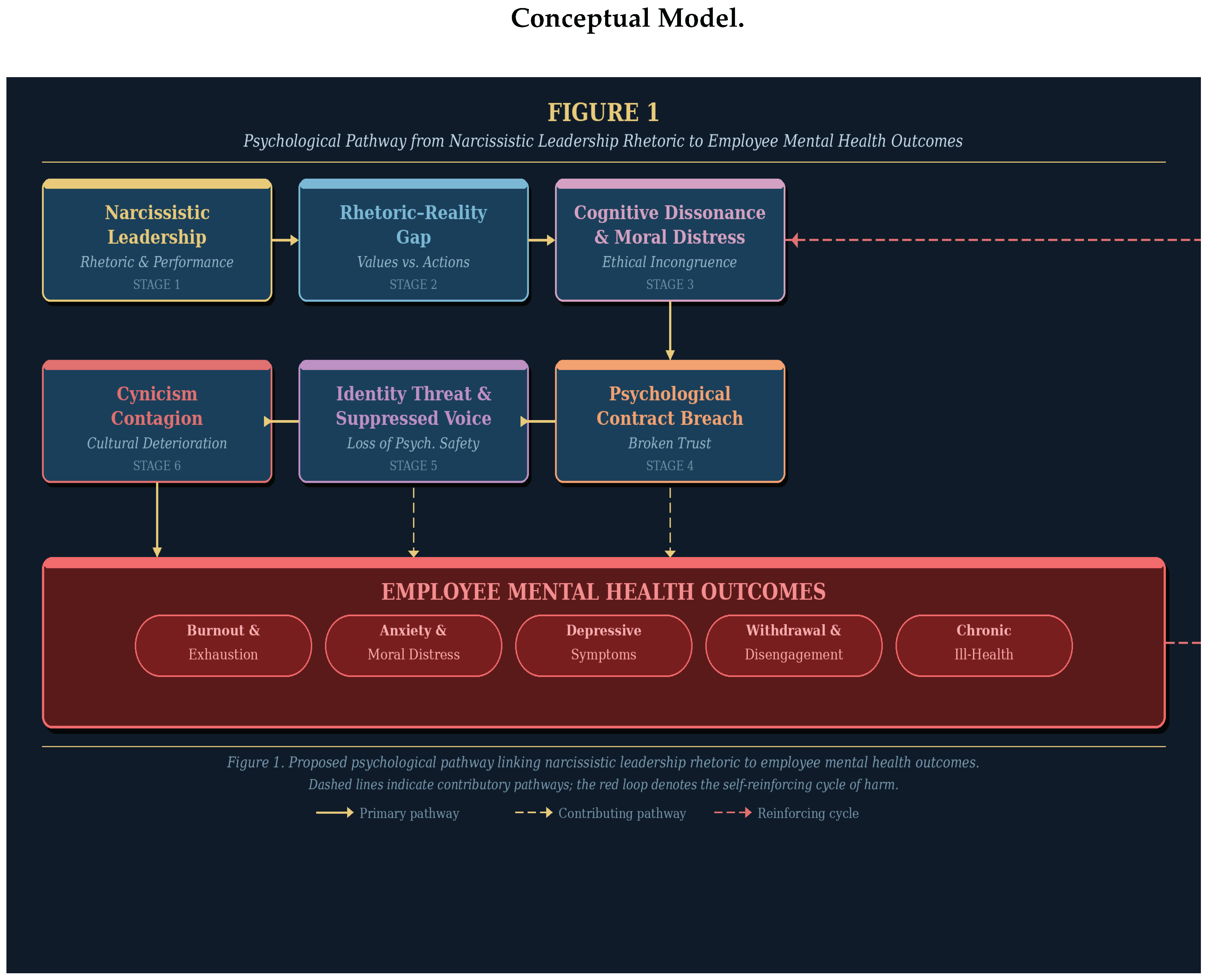

Table 1.
Comparison of Theoretical Frameworks: Narcissistic Leadership Theory vs. Ethics of Change in Leadership.
Table 1.
Comparison of Theoretical Frameworks: Narcissistic Leadership Theory vs. Ethics of Change in Leadership.
| Dimension | Narcissistic Leadership Theory | Ethics of Change in Leadership | Relevance to This Study |
|---|---|---|---|
| Core Premise | Leaders driven by grandiosity & self-interest use charisma to acquire and sustain power | Authentic leaders align moral character with visible ethical management practices | Narcissistic leaders mimic the language of ethics without enacting its substance |
| Key Construct | Impression management; identity fusion; moral disengagement | Moral manager vs moral person dichotomy; authentic value alignment | Ethical rhetoric weaponized as impression management strategy |
| Organizational Outcome | Trust erosion, cynicism, cultural deterioration, subordinate harm | Sustainable trust, ethical climate, genuine follower commitment | Cynicism contagion: rhetoric–reality gap drives collective disengagement |
| Employee Impact | Psychological contract violation; moral injury; burnout | Value alignment fosters engagement, identity security, and well-being | Three themes map empirically to framework predictions: Virtue Costume, Identity Fusion, Cynicism |
| Key Theorists | Rosenthal & Pittinsky (2006)¹ ⁴⁸; Braun et al. (2025)⁵; Williams (2025)¹⁹ | Faherty & Clinton (2025)²⁰; Griep et al. (2021)²¹ | AlOwais & Suliman (2025)¹ — LDT cascades; this study extends to rhetoric |
Abbreviations: LDT = Leader Dark Triad; HEI = Higher Education Institution; CSR = Corporate Social Responsibility.
Table 2.
Participant Demographics and Organizational Profile (N = 24).
| Variable | Category | n (%) | Organizational Size | n (%) |
|---|---|---|---|---|
| Gender | Male | 14 (58.3%) | Large (>2,500 employees) | 7 (29.2%) |
| Female | 10 (41.7%) | Medium (500–2,000) | 10 (41.7%) | |
| Age Group | 25–35 years | 8 (33.3%) | Small (<300) | 7 (29.2%) |
| 36–45 years | 10 (41.7%) | Role Level | n (%) | |
| 46–58 years | 6 (25.0%) | Senior/Managerial | 9 (37.5%) | |
| Tenure | <3 years | 6 (25.0%) | Mid-level Professional | 11 (45.8%) |
| 3–10 years | 10 (41.7%) | Frontline Staff | 4 (16.7%) | |
| >10 years | 8 (33.3%) | Total Participants | 24 (100%) |
Note: Percentages may not total 100% due to rounding. HEI = Higher Education Institution.
Table 3.
Summary of Thematic Findings: Core Mechanisms, Representative Quotes, and Participant Frequencies.
Table 3.
Summary of Thematic Findings: Core Mechanisms, Representative Quotes, and Participant Frequencies.
| Theme | Sub-theme | Core Mechanism | Representative Quote | Participant % |
|---|---|---|---|---|
| Theme 1: The Virtue Costume | Ethical Language as Performance | Leaders deploy moral vocabulary in public communications while private decisions contradict stated values | “It feels like a show staged for outsiders” (P05) | 21/24 (87.5%) |
| Moral Justification Mechanisms | Euphemistic labeling, displacement of responsibility, advantageous comparison used to legitimize harm | “We weren’t firing people, we were ‘rightsizing’” (P03) | 19/24 (79.2%) | |
| Theme 2: Branding the Self as the Company | Personal-Organizational Conflation | Leader identity fused with organizational mission; dissent equated with disloyalty | “It felt like we were employees of his image” (P10) | 22/24 (91.7%) |
| Marketing Ethics as Advantage | Ethical branding weaponized for external reputation; internal contradictions normalized | “It was ethics on demand. The message changed depending on who was listening” (P11) | 20/24 (83.3%) | |
| Theme 3: Cynicism Contagion | Trust Erosion Patterns | Three-stage progression: cognitive dissonance → skepticism → disengagement | “Trust doesn’t break overnight. It unravels piece by piece” (P21) | 24/24 (100%) |
| Collective Cynicism Development | Social contagion spreads distrust through informal peer networks; subcultures of sarcasm emerge | “Newcomers quickly learn — either laugh with us or risk being seen as naïve” (P15) | 22/24 (91.7%) |
Note: Participant frequencies represent the proportion who reported experiences consistent with each sub-theme. P = Participant identifier.
Table 4.
Mental Health Consequences of Narcissistic Ethical Rhetoric: Mechanisms, Symptoms, and Organizational Implications.
Table 4.
Mental Health Consequences of Narcissistic Ethical Rhetoric: Mechanisms, Symptoms, and Organizational Implications.
| Leadership Mechanism | Psychological Process | Mental Health Consequences | Organizational Implications |
|---|---|---|---|
| Virtue Costuming (Ethical Rhetoric) | Moral injury; cognitive dissonance; violation of psychological contract | Moral injury symptoms (guilt, shame, existential distress); chronic occupational stress; sleep disturbances | Increased absenteeism; reduced ethical voice; erosion of institutional integrity culture |
| Identity Fusion (Leader–Organization Merging) | Identity threat; loss of professional autonomy; suppression of authentic self | Depressive symptomatology; learned helplessness; diminished self-efficacy and self-esteem; existential disengagement | Loss of intellectual diversity; conformism; talent exodus; institutional reputation damage |
| Cynicism Contagion (Peer Network Spread) | Emotional contagion; collective demoralization; normalization of disillusionment | WHO-recognized burnout (exhaustion, cynicism, reduced efficacy); subclinical and clinical anxiety; system-wide psychological distress | Organizational culture collapse; elevated turnover; systemic productivity decline; diminished student/stakeholder experience |
| Hypervigilance (Threat-Monitoring Adaptation) | Chronic amygdala activation; cognitive overload; suppression of prefrontal reasoning | Generalized Anxiety Disorder (GAD) symptoms; PTSD-adjacent responses; cardiovascular and immune consequences of chronic cortisol elevation | Impaired decision-making; suppressed innovation; increased medical leave and healthcare costs for organization |
Table 5.
Recommendations for Organizations, Practitioners, and Future Research.
| Level | Recommendation | Strategy / Mechanism | Expected Outcome |
|---|---|---|---|
| Organizational Governance | Embed real-time ethical audits and 360° values assessments | Independent ethics committees; anonymous whistleblowing systems; regular culture surveys | Early detection of rhetoric–practice gaps; accountability structures that deter cynicism |
| Leadership Development | Reorient leadership programs toward authentic self-awareness and moral courage | Narcissism screening in selection; psychometric integrity testing; coaching on humility and ethical congruence | Reduced frequency of manipulative leadership; increased follower trust and engagement |
| Clinical / HR Practice | Deploy clinical health psychologists in consultative roles within HEIs | MBI / PHQ-9 / GAD-7 / MISS screening; ACT-based individual therapy; narrative therapy for identity repair | Earlier intervention for burnout, moral injury, and anxiety; reduced clinical escalation |
| Employee Empowerment | Create psychological safety structures and peer-support ethical alignment groups | Guaranteed non-retaliation policies; moral resilience training; peer mentoring networks | Reduced cynicism contagion; increased ethical voice; higher organizational resilience |
| Future Research | Longitudinal and cross-cultural studies on narcissistic leadership and mental health | Development and validation of NLMHIS; multicultural comparative designs; mixed-methods approaches | Robust evidence base for clinical and organizational interventions; generalizability of findings |
Note: HEI = Higher Education Institution; ACT = Acceptance and Commitment Therapy; MBI = Maslach Burnout Inventory; PHQ-9 = Patient Health Questionnaire-9; GAD-7 = Generalized Anxiety Disorder-7; MISS = Moral Injury Symptom Scale; NLMHIS = Narcissistic Leadership Mental Health Impact Scale.
Disclaimer/Publisher’s Note: The statements, opinions and data contained in all publications are solely those of the individual author(s) and contributor(s) and not of MDPI and/or the editor(s). MDPI and/or the editor(s) disclaim responsibility for any injury to people or property resulting from any ideas, methods, instructions or products referred to in the content. |
© 2026 by the authors. Licensee MDPI, Basel, Switzerland. This article is an open access article distributed under the terms and conditions of the Creative Commons Attribution (CC BY) license (http://creativecommons.org/licenses/by/4.0/).
Copyright: This open access article is published under a Creative Commons CC BY 4.0 license, which permit the free download, distribution, and reuse, provided that the author and preprint are cited in any reuse.


