
Submitted:
10 February 2026
Posted:
11 February 2026
You are already at the latest version
Abstract
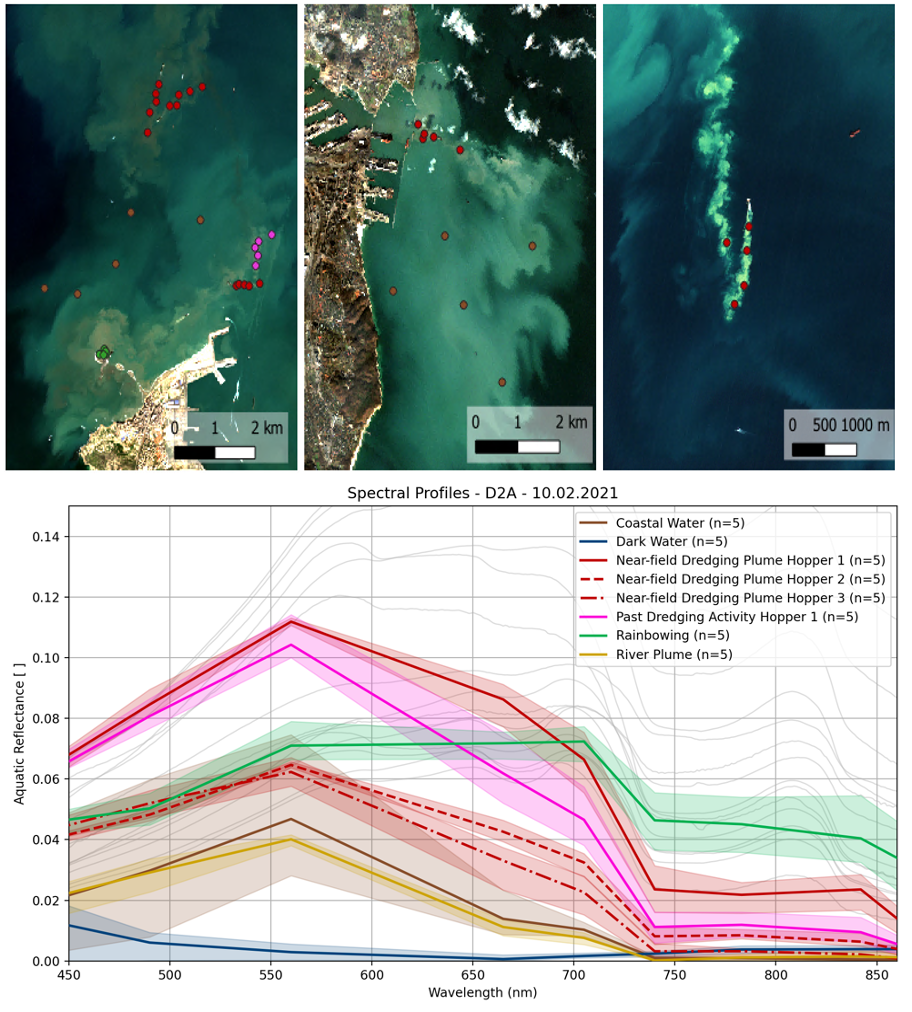
Dredging activities regularly occurring in near-shore and coastal waters generate turbid waters within the surface layer with high concentrations of suspended particulate matter collected in bottom sediments. The potential impact of these dredge plumes on natural ecosystems must be monitored using cost-effective methods and observations. Here, we investigate the biogeochemical and optical properties of dredge plumes selected mainly in European and African coastal waters. Laboratory analyses realized on numerous water samples collected in dredge plumes reveal (extremely) high water turbidity and high concentrations of mineral-rich particles in suspension, sometimes mixed to high concentrations of phytoplankton particles. The most peculiar optical property of these particles is a spectral light absorption coefficient significantly flatter than that of suspended particles in natural turbid waters (e.g., river plumes or estuarine maximum turbidity zones). This peculiar optical property is also detected on ocean color satellite data corrected for atmospheric effects, with a water reflectance signal higher than natural turbid waters at short visible wavebands (400-550 nm). Such an atypical spectral signature, that can be detected and mapped from space, makes the operational monitoring of dredge plumes in coastal waters using high spatial resolution (e.g., Sentinel2-MSI) satellite data possible.
Keywords:
dredging
; turbid plumes
; spectral signatures
; suspended particulate matter
; Sentinel2-MSI
Copyright: This open access article is published under a Creative Commons CC BY 4.0 license, which permit the free download, distribution, and reuse, provided that the author and preprint are cited in any reuse.


