

Submitted:
06 February 2026
Posted:
11 February 2026
Read the latest preprint version here
Abstract
We show that Quantum Mechanical Hilbert space can be paradoxical under some group action and explore its physical consequences. (1) Is there a more natural way of resolving the paradox of Wigner’s friend without invoking the Heisenberg’s cut?; (2) We notice the qualitative similarities between the paradox and paradoxical sets and use it as a motivation to rigorously prove that the Hilbert space H of the harmonic oscillator is paradoxical under the group action U ≤ U(H) × U(1); (3) This paradoxical nature of the Hilbert space H provides the natural resolution for the paradox by using the Axiom of Choice instead of the Heisenberg’s cut; (4) Finally, we show that due to the very same paradoxical nature of H, certain class of quantum gravities naturally emerge from Quantum Mechanics that mediates a self-decoherence of the system.
Keywords:
paradoxical sets
; equidecomposability
; decoherence
; quantum gravity
; Hilbert space
1. Introduction
Quantum Mechanics (QM) is the only field in physics whose foundational and fundamental aspects continue to remain open and sensitive to interpretation. This openness to interpretation makes QM susceptible to many paradoxes including a paradox in particular called Wigner’s friend [1]. According to the paradox, Wigner’s friend is investigating an electron which with respect to F is in the following state of superposition
However, Wigner himself now views his own friend and the electron as a closed quantum system and assigns a state to F if F observes the electron in state and if F observes the electron in state which makes the combined state from Wigner’s perspective to be
But is an entangled state while is a pure state. The state of the electron is either pure or entangled depending on the observer, or more precisely, where the Heisenberg cut1 is made, hence, the paradox. Of course, the above paradox makes some assumptions that can be seen as problematic - QM is universal and applies to a macroscopic object like F, and QM is invariant under the change of the Heisenberg cut. can simply be removed by introducing the Heisenberg cut between all macroscopic observers and quantum experiments while can simply be removed by arguing that QM is actually not invariant under change of the Heisenberg cut. Clearly, the transformation under the change of the cut is highly nontrivial and cannot be an isometry, hence, resolving the paradox. However, it is also worth noting that the Heisenberg cut is actually an external addition and is not necessarily natural. A more natural resolution to the paradox, therefore, should not involve the Heisenberg cut.
To do that, let’s revisit the paradox and note a few peculiarities. Notice that while . It seems that the presence of an extra observer apart from F, namely Wigner, has duplicated the Hilbert space . But the term ‘observer’ implicitly involves a Heisenberg cut, hence, in a cut-independent manner one may naively state that the Hilbert space itself has ‘spontaneously’ duplicated. This way we enter a much more familiar and well-established territory of paradoxical set theory where paradoxical sets can undergo duplication via specific group actions. The most celebrated and well-known example of this is the Banach-Tarski paradox which states that a sphere can be duplicated via group action [2]. Qualitatively, this is very similar to what is happening with above except the underlying group action that causes this duplication is unidentified. In the next section, we will rigorously show that the Hilbert space in QM can indeed be paradoxical with respect to some group action.
2. Hilbert Space as a Paradoxical Set
A paradoxical set is defined with respect to a group G that has the following (left) group action
Definition 1.
Let G be a group acting on a set X and suppose . A is G-equidecomposable to B (denoted ) if such that and .
Definition 2.
Let G be a group acting on a set X and suppose . E is G-paradoxical if for some positive integers there exists pairwise disjoint subsets , of E and such that
Alternatively, a subset E is G-paradoxical if there exists two disjoint subsets A and B such that and .
Consider the ladder operators in the standard Quantum Harmonic Oscillator (QHO) given by
using which one can define
where are elements of the group where is the Hilbert space of the QHO and is the space of all unitary operators on . More precisely, they form a subgroup of which we define as
We wish to show that is -paradoxical. The first step towards that is to show that it contains a free subgroup which is defined as [4]
Definition 3.
Afree group is the set of all words generated by a generating set . It follows [4] that free group is also -paradoxical which can be demonstrated by the disjoint subsets that partition where
where represents a word starting from such that .
Theorem 1.
For , , form the generating set for the free subgroup of .
Proof.
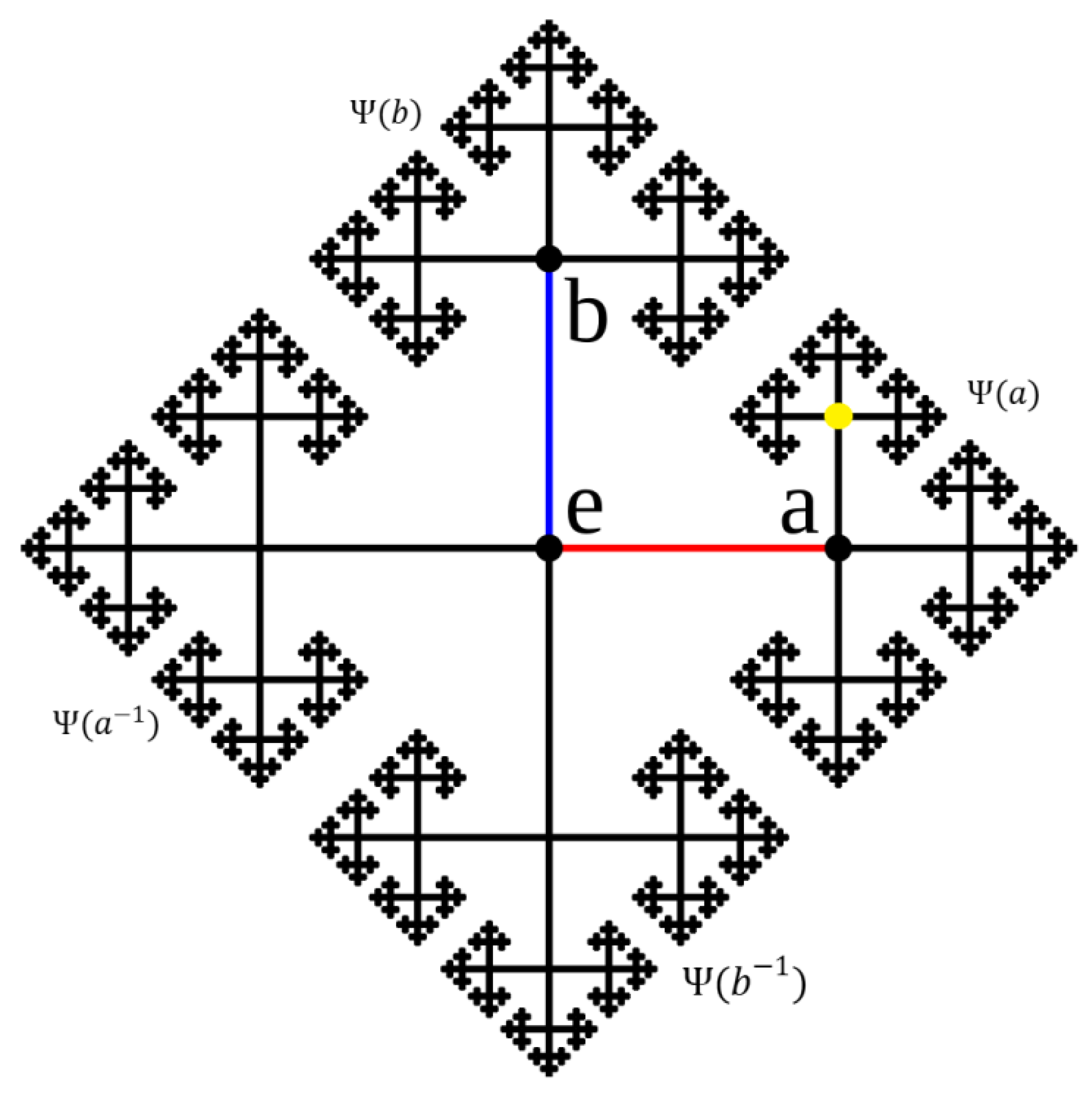
Follows from Definition 3. One can check that no reduced word becomes the identity element e by following the vertices of the Cayley graph in Figure 1. □
The above implies that has a free subgroup and therefore, guarantees that is indeed -paradoxical but for the sake of completion, we will follow through all the crucial steps of the proof closely following Kaseorg[3] and Buchhorn[4].
Theorem 2.
Let .
- 1.
- Δ is countably infinite.
- 2.
- For any , implies .
Proof.
- 1.
-
Considerwhere andsuch thatFrom the Cayley’s graph in Figure 1, we can see thatSince, we havethis leads toSince, each is countable, therefore, is countably infinite.
- 2.
-
Consider then ∃ such that . Now, considerSince, as both .
Example: We will look at the elements of . Consider the hermitian operator
The eigenvectors for the above operator
is given by
Then we have
Hence, represents the states that are invariant under action i.e . Since, we are strictly working with and not , the phases cannot be ignored in the above. Also, we do not worry about normalizability because we are working with a rigged . □
Theorem 3.
is -equidecomposable to i.e. .
Proof.
Let such that which due to Theorem 2 implies that for any and for any . Hence, we have . Then for some without loss of generality, implies that where . Now, we define
where the above satisfy
The above demonstrates that . □
Definition 4.
is called an -orbit around . The following property of the -orbit follows from its definition [4]
- 1.
- The -orbitspartition the set .
- 2.
- The union of all the -orbitsis i.e.
Theorem 4.
is -paradoxical i.e. there exists two disjoint subsets and of satisfying , .
Proof.
Using Axiom of Choice (AOC), one can construct such that . Then one can construct subsets such that[4]
where in the above we have used which follows from Definition 4. Now, since, we have
where in the above we used Theorem 3. Hence, proved. □
In other words, the Hilbert space can be partitioned into subsets, each of which can be transformed into the full via -transformations! Since, the elements of are time-independent transformations these duplications are indeed spontaneous.
3. Results
The paradoxical nature of the Hilbert space allows it to be duplicated arbitrarily by applying Theorem 4 repeatedly as follows
where the numerical subscripts on are simply to label the duplicates. Also, it is worth noting how the final step of the duplication above resembles a quantum mechanical system in entanglement with an environment. In terms of their respective density matrices, Eq. (31) becomes
where O refers to the ‘original’ and D refers to the ‘duplicates’. Now, we partially trace out the duplicates to obtain
where we have used
which can be defined without loss of generality. Notice that if then we will get back . However, for a given n, in general is a random Hermitian matrix of infinite size and therefore, is governed by some Random Matrix Theory (RMT) in the limit where N is the size of the matrix in RMT. Depending on the mean, the RMTs are of two types
The RMTs where are precisely the theories that correspond to the matrix models that result in string theories in the limit [5]. In fact, for finite N, matrix models represent the discretized version of the string theories themselves [5]. The RMTs where represents interacting condensed matter systems[6,7]. Since, the quantum system under consideration is free and isolated, we must have for the above which is also the condition for decoherence [8]! This represents the most striking consequence of the Banach-Tarski paradox where quantum states can entangle with its duplicates and self-decohere even before a measurement is made. Since, the matrix models with zero mean are quantum theories of gravity, the decoherence is gravitationally mediated. The source of this gravity must be the particle itself as the system is isolated. This computation, therefore, also demonstrates how gravity can emerge from QM owing to the paradoxical nature of .
Coming back to our original motivation i.e. in the paradox of Wigner’s friend, notice how the choice in the placement of the Heisenberg’s cut lead to the duplication of exactly like how the AOC in the above allows group theoretic duplications of . In other words, the Heisenberg’s cut is a Quantum Mechanical analogue of the AOC. However, as mentioned earlier, compared to the AOC the underlying group action is unknown and the duplication doesn’t follow naturally. But by demonstrating that such a duplication is indeed natural and built into the mathematical foundations of QM itself, the paradox is then resolved. The resolution being that all description of the QM system whether pure or entangled are equally valid owing to the paradoxical nature of .
4. Discussion and Conclusions
In this exercise, we explored a rare demonstration of how foundational abstract mathematics can have physical consequences. Usually, only the applied aspects of mathematics are relevant to physics as physical phenomena are not expected to be so counter-intuitive that it warrants a more abstract treatment. This is the reason paradoxical phenomena in QM is handled philosophically. But as demonstrated, working with the abstract foundations of mathematics is more natural. We also demonstrated how quantum gravity emerges from QM as a result of the paradoxical nature of . The entanglement of the quantum system with its own duplicates encoded via can be seen as an emergence of self-interaction. Since, this self-interaction is best modelled by RMTs that have a zero mean which are known to be quantum theories of gravity, the emergent self-interaction is, therefore, of gravitational nature. This result is qualitatively consistent with various models of gravitationally mediated collapse in the literature [9]. However, in this letter, this is made more natural by demonstrating gravity as emergent from QM due to the paradoxical nature of which then mediates the collapse.
However, one may interpret the number of duplicates n to be some sort of a “hidden variable" that affects the outcome of measurements. If so, such a paradox may impose a Bell-like inequality on the quantum mechanical system which can lead to serious conflict with experiments. To check that, let A and B represent dichotomic measurement outcomes [10]
where representing the probability of the state being entangled with n of its duplicates. The correlation between the measurements A and B is then given by
But probability theory deals with measurable sets while Banach-Tarski duplications are consequences of non-measurable sets [2,4], therefore, there are no means to define . Hence, no well-defined Bell-like inequality is enforced on the quantum mechanical state as it should be to be consistent with experiments.
It is also worth noting that the applications of Banach-Tarski paradox itself has been explored in Hadronic physics previously [11]. The Hadrons were likened to spheres that are then subjected to standard Banach-Tarski duplications which were noted to correspond to well-known Hadronic decay and tree-level processes. This means that paradoxical sets do play some roles in physics all the way upto the Standard Model. Therefore, working with paradoxical sets may help us develop new physics and formalism beyond the current one as well. This is something we intend to explore in the future.
Funding
This research received no external funding
Data Availability Statement
No data was generated in this research.
Acknowledgments
AM would like to acknowledge the moral support of Hare Krishna Movement, Pune, India. AM would like to thank his friend Rithwik Nivam for his continuous and steady support.
Conflicts of Interest
The authors declare no conflicts of interest.
Abbreviations
The following abbreviations are used in this manuscript:
| AOC | Axiom of Choice |
| QM | Quantum Mechanics |
| 1 |
Heisenberg cut is the hypothetical separation between a quantum experiment and the observer. At the level of the experiment only QM applies but at the level of the observer only classical mechanics applies. |
References
- Bong, K.W.; Utreras-Alarcón, A.; Ghafari, F.; Liang, Y.C.; Tischler, N.; Cavalcanti, E.G.; Pryde, G.J.; Wiseman, H.M. A strong no-go theorem on the Wigner’s friend paradox. Nature Physics 2020, 16, 1199–1205. [Google Scholar] [CrossRef]
- Wagon, S. The Banach-Tarski Paradox; Cambridge University Press, 1993; Vol. 24. [Google Scholar]
- Kaseorg, A. The Banach-Tarski Paradox, 2007.
- Buchhorn, K. The Banach-Tarski Paradox. arXiv 2022, arXiv:math.HO/2108.05714. [Google Scholar] [PubMed]
- Kazakov, V.A.; Migdal, A.A. Recent Progress in the Theory of Noncritical Strings. Nucl. Phys. B 1988, 311, 171. [Google Scholar] [CrossRef]
- Kosterlitz, J.M.; Thouless, D.J.; Jones, R.C. Spherical model of a spin-glass. Physical Review Letters 1976, 36, 1217. [Google Scholar] [CrossRef]
- Edwards, S.F.; Jones, R.C. The eigenvalue spectrum of a large symmetric random matrix. Journal of Physics A: Mathematical and General 1976, 9, 1595. [Google Scholar] [CrossRef]
- Zurek, W.H. Environment-induced superselection rules. Physical review D 1982, 26, 1862. [Google Scholar] [CrossRef]
- Aguiar, G.H.; Matsas, G.E. Simple gravitational self-decoherence model. Physical Review D 2025, 112. [Google Scholar] [CrossRef]
- Kaiser, D. Bell’s Inequality and Quantum Entanglement, 2020.
- Augenstein, B.W. Hadron physics and transfinite set theory. International journal of theoretical physics 1984, 23, 1197–1205. [Google Scholar] [CrossRef]
Figure 1.
Cayley graph where . Each vertex is a reduced word in and the edges are elements of S. Each edge is a multiplication on the vertex it starts from. Edges that are going up multiply with b, the ones going down multiply with . Edges that go right multiply with a, the ones that go left multiply with . For instance, the word corresponding to the yellow vertex reads . To reach that vertex, we first go right which multiply a with e (identity) and then go up which acts with b to give .
Figure 1.
Cayley graph where . Each vertex is a reduced word in and the edges are elements of S. Each edge is a multiplication on the vertex it starts from. Edges that are going up multiply with b, the ones going down multiply with . Edges that go right multiply with a, the ones that go left multiply with . For instance, the word corresponding to the yellow vertex reads . To reach that vertex, we first go right which multiply a with e (identity) and then go up which acts with b to give .
Disclaimer/Publisher’s Note: The statements, opinions and data contained in all publications are solely those of the individual author(s) and contributor(s) and not of MDPI and/or the editor(s). MDPI and/or the editor(s) disclaim responsibility for any injury to people or property resulting from any ideas, methods, instructions or products referred to in the content. |
© 2026 by the authors. Licensee MDPI, Basel, Switzerland. This article is an open access article distributed under the terms and conditions of the Creative Commons Attribution (CC BY) license (http://creativecommons.org/licenses/by/4.0/).
Copyright: This open access article is published under a Creative Commons CC BY 4.0 license, which permit the free download, distribution, and reuse, provided that the author and preprint are cited in any reuse.