

Submitted:
06 February 2026
Posted:
09 February 2026
You are already at the latest version
Abstract
This paper introduces the Distributional Embedding Algorithm (DEA), a purely deterministic framework for generating word embeddings through an \emph{Iterative Structural Saliency Extraction}, which is based on a natural Galois correspondence. Unlike stochastic "black-box" machine learning models, DEA grounds semantic representation in the topological structure of a corpus, mapping the redistribution of semantic mass across identifiable structural nuclei. We apply this model to a controlled dataset of 300 propositions from David Bohm’s \textit{Wholeness and the Implicate Order}, identifying four primary semantic basins that account for 74\% of the text's logical flow. By tracking the iterative expansion of these clusters, we demonstrate a ``topological collapse'' where shared lexical pivots connect distant propositions. Validation via cosine distance measures confirms high structural orthogonality between core conceptual terms and extrinsic category noise (e.g., \textit{intelligence} vs. \textit{desk}, \(d=0.99\)). We conclude that DEA offers a computationally efficient, transparent, and structurally-aware alternative that can be integrated with existing neural architectures to enhance interpretability in semantic modeling. Moreover, DEA is based on the \textbf{Logarithmic Hypothesis} about the dimension of the embedding vectors, w.r.t. the number of propositions of the corpus. While modern AI architectures require thousands of embedding components to process \(10^{13}\) propositions, the DEA approach suggests a structural collapse of complexity, where the global semantic manifold can be distilled into \(L \approx \log_{10}(13)\) features. Even at a hyper-refined resolution of $L\approx 30$, the model offers a deterministic, ``white-box'' alternative to current neural networks, providing a thousand-fold increase in computational efficiency without sacrificing logical precision.
Keywords:
large language model
; transformer
; neural network
; machine learning
; embedding vector
; distributional semantics
; galois correspondence
1. Introduction
In the context of Artificial Neural Networks and Machine Learning [1,2,3,4,5,6,7,8,9,10,11,12], the evolution of Natural Language Processing (NLP) has been largely dominated by the transformer models, where meanings are represented by embedding vectors in multidimensional numeric spaces, by passing from sparse representations to dense embedding vectors. The most modern techniques (e.g., Word2Vec, GloVe, or Transformer-based embeddings) [13,14,15] treat the corpus as a source for probabilistic inference, often obscuring the underlying discrete structural relations between propositions and words. Recently, a very active research has focused on the dimensional reduction of embedding vectors [16,17,18,19,20], directly or indirectly related to general linguistic distributional perspectives [21,22,23,24].
This study proposes an alternative paradigm: an embedding algorithm derived directly from the set-theoretic correspondence between words and propositions, which is a case of (monotone) Galois correspondence. The core intuition is that the meaning of a word is not merely a point in a latent space, but a “distribution of presence” across hierarchically extracted semantic clusters. In this perspective, feature values are not a posteriori extracted during the training, by selecting, for each linguistic item, the feature values that adequately and completely represent its linguistic usage within a given corpus. Namely, we define an a priori deterministic method of embedding definition, based on the corpus to which the training refers.
The algorithm operates through an iterative function, Expand, which aggregates sentences starting from frequent words. To prevent the "giant component" problem—where a single cluster absorbs the entire corpus—we introduce a termination condition tied to the logarithmic scale of the corpus size. By using an entropic analysis of the clustering process [25,26], we show that the logarithmic bound does not limit the adequacy of the feature extraction mechanism.
The resulting vectors are inherently interpretable: each dimension represents a specific semantic nucleus of the text. Furthermore, DEA informational indices allow for a "textual biopsy," providing quantitative parameters that describe the cohesion, disorder, and internal granularity of the analyzed corpus. This is particularly relevant for the analysis of specialized philosophical or scientific texts. In this study, the algorithm is applied to a text of 300 propositions by David Bohm [27], Wholeness and Fragmentation, which results in a relation incredibly close to the true spirit of the algorithm, which addresses the extraction of linguistic knowledge from the wholeness of a corpus.
Unlike standard embeddings, where dimensions are latent and opaque, the features generated here possess a clear logical structure derived from the corpus topology.
The primary objective of this paper is not to advocate for a total replacement of stochastic machine learning methods (e.g., Glove or Word2Vec), but rather to propose a hybrid paradigm. By utilizing the Distributional Embedding Algorithm (DEA) as a structural foundation, we can dramatically reduce the computational effort and training time required for semantic modeling. While standard embeddings often function as “black boxes" where dimensions lack internal articulation, DEA offers a transparent, logical structure where each component corresponds to an identifiable sentential nucleus. Machine learning can then be integrated to refine these structurally-aware vectors, combining the efficiency and control with the predictive power of neural architectures.
2. The DEA Algorithm
The Distributional Embedding Algorithm (DEA) is a deterministic framework designed to map the latent logical structure of a corpus without the need for stochastic training or opaque parameter sets. Unlike traditional neural embeddings, which rely on the “black-box” optimization of weights through backpropagation, the DEA operates through a three-stage process of structural distillation. At the end of the second stage, the corpus is partitioned into disjoint sets of propositions, where is the cardinality of the set M of propositions of the corpus. These sets, which we call clusters, will identify the features of the embedding vectors, expressing the percentage of “influence” that any cluster exerts on the word, that is, the propositions where it occurs in the whole corpus.
- Expansion: The algorithm identifies specific “pivot terms” (nuclei) within the text. It expands these nuclei by capturing their immediate semantic neighbors, effectively tracing the “ripples” of meaning as they propagate through the document’s propositional structure.
- Extraction: By applying the logarithmic limit , the algorithm prunes the expansion, filtering out secondary noise and isolating only the most salient thematic basins. This stage enforces a topological economy, ensuring that the resulting dimensions represent the primary logical drivers rather than statistical accidents.
- Embedding: Finally, every word in the corpus is projected onto these discovered basins. A term’s identity is defined by how its semantic mass is distributed across the clusters. This produces a vector representation where the position expresses the functional role within the corpus.
2.1. The Words-Proposition Correspondence
Given a corpus, two basic operations connect the words with the propositions occurring in it. Their combination provides a natural way of generating a set of propositions from a set of words:
- The set of propositions in the corpus containing a word w is defined as:
- Given a set of propositions S, the set of words contained within propositions of S is:
- The expansion function identifies a superset of propositions that includes a given set S of propositions:
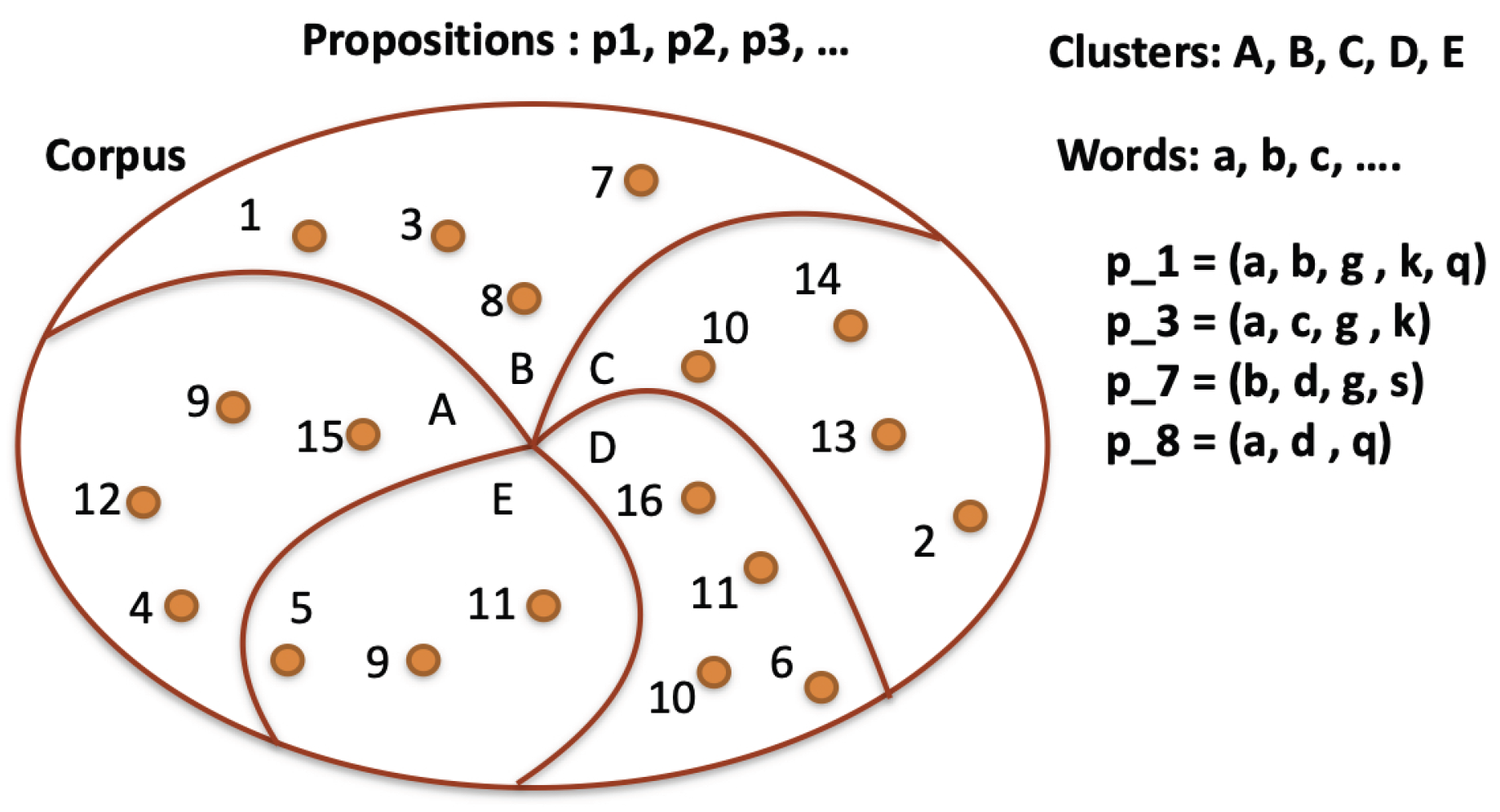
By Figure 1, we deduce the following relations:
We remark that even if clusters are disjoint as a set of propositions, the sets of words can share a lot of words.
2.2. The Stochastic Contextual Incidence Matrix
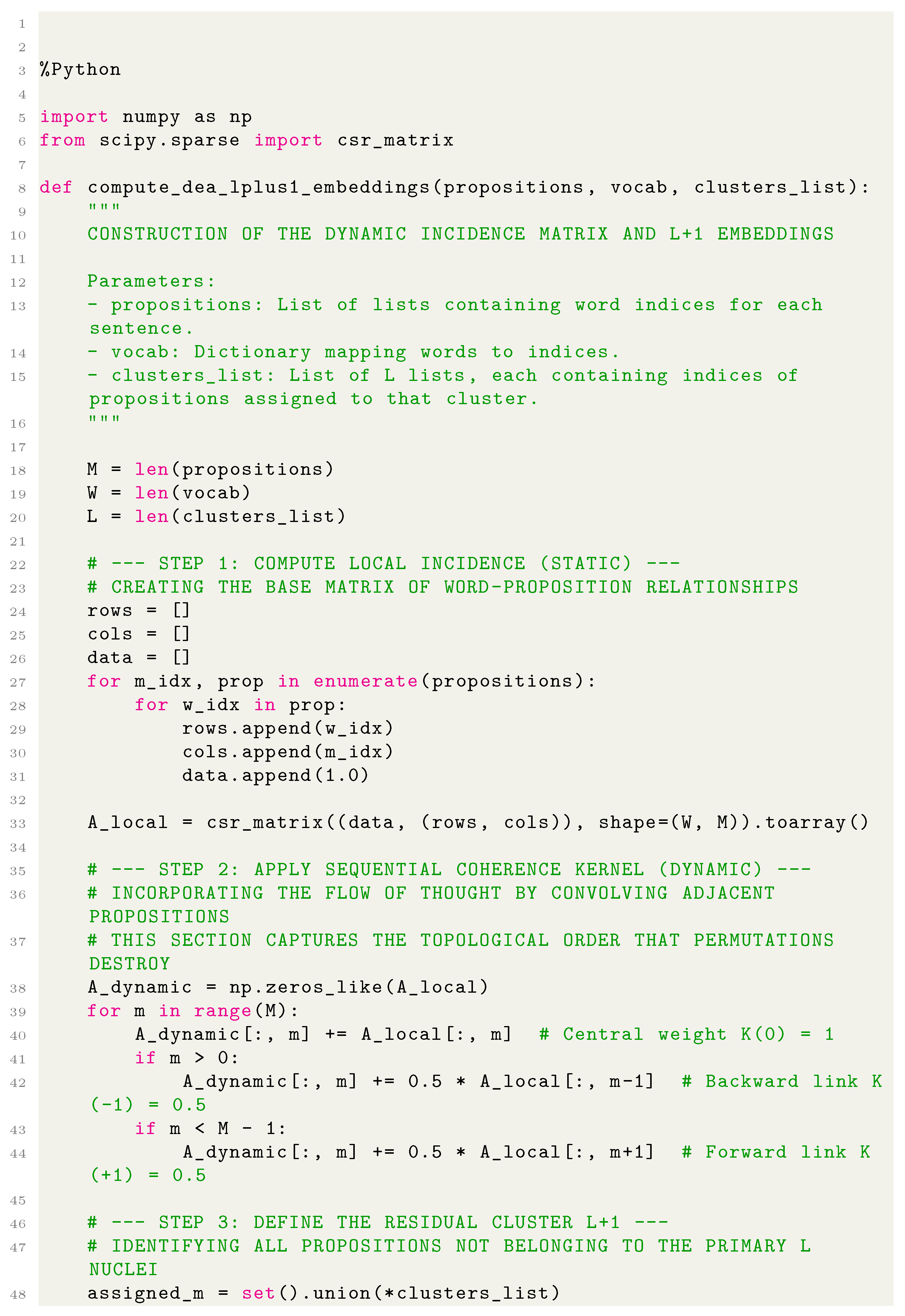
The corpus is represented as a sequence of propositions and a set of words . To capture the linguistic "wholeness" and the logical flow of the discourse, we define a Stochastic Incidence Matrix that transcends the standard "Bag of Words" assumptions.
The local incidence is first defined by the presence of term in proposition :
To account for the sequential coherence of the corpus, we apply a Sequential Coherence Kernel K over a local window of radius . The dynamic incidence entry is computed as the convolution of the local incidence with the kernel:
We utilize a triangular decay kernel with , defined as and . This construction ensures that the mass of a term is not confined to a single proposition but is "enfolded" into the immediate semantic context, reflecting the transition of thought between adjacent sentences.
The resulting matrix A serves as the foundation for the transition matrix P in the DEA framework.
Let be:
the diagonal degree matrix, which is null outside the diagonal. The stochastic contextual incidence matrix between words and propositions is established as:
This matrix P captures the probability of the semantic incidence, which is strictly dependent on the original topological order of the text.
-
Given a word , its occurrence in the corpus is given by the i-th row vector of the matrix , which projects the word on the propositions:This defines the "weight" of each word within the proposition, rather than a simple binary membership.
-
For any given proposition , its semantic composition is defined by the j-th row vector of the dual mapping matrix :Each component represents the relative weight of term in defining the meaning of proposition . This identifies the "semantic carriers" that sustain the local information density.
The relationship between a set of propositions S and its representation in the stochastic matrix P is defined by the following equation, where operation prop refers to the propositions associated with the rows of the matrix taken in argument:
This equation states that the expansion of a propositional set is exactly the collection of the stochastic row vectors of P corresponding to the words occurring in propositions of S.
2.3. The Extract Operation
The function is an iterative process designed to isolate a salience cluster from a set S of propositions. The algorithm initializes the set S using the most frequent word in the current corpus:
The expansion is then applied iteratively with the following equation:
The iteration stops when the following termination condition is met:
Upon completion, the function returns the pair , where C is the extracted cluster and .
2.4. The Clustering Process
The function repeatedly applies starting from the set of propositions of the corpus, returning a list of extracted clusters . The extraction terminates when the number of remaining sentences is less than the size of the initial seed set , where is the pivot of S, that is, the word with the highest frequency in S:
the proposition of when the extraction stops provide the last cluster , called the residual cluster.
The structural organization of the corpus is ultimately revealed by a partition of the row-space of P. Let be a partition of the proposition set M (the reason for as the last index will appear in the following discussion). This induces a corresponding partition on the transition matrix P into semantic submatrices:
where each submatrix enfolds a coherent thematic nucleus. The "Wholeness" of the text is thus quantified by the degree of informational overlap between these partitions, related to the probabilities of words to occur in propositions that belong to different clusters.
2.5. Embedding Vector Definition
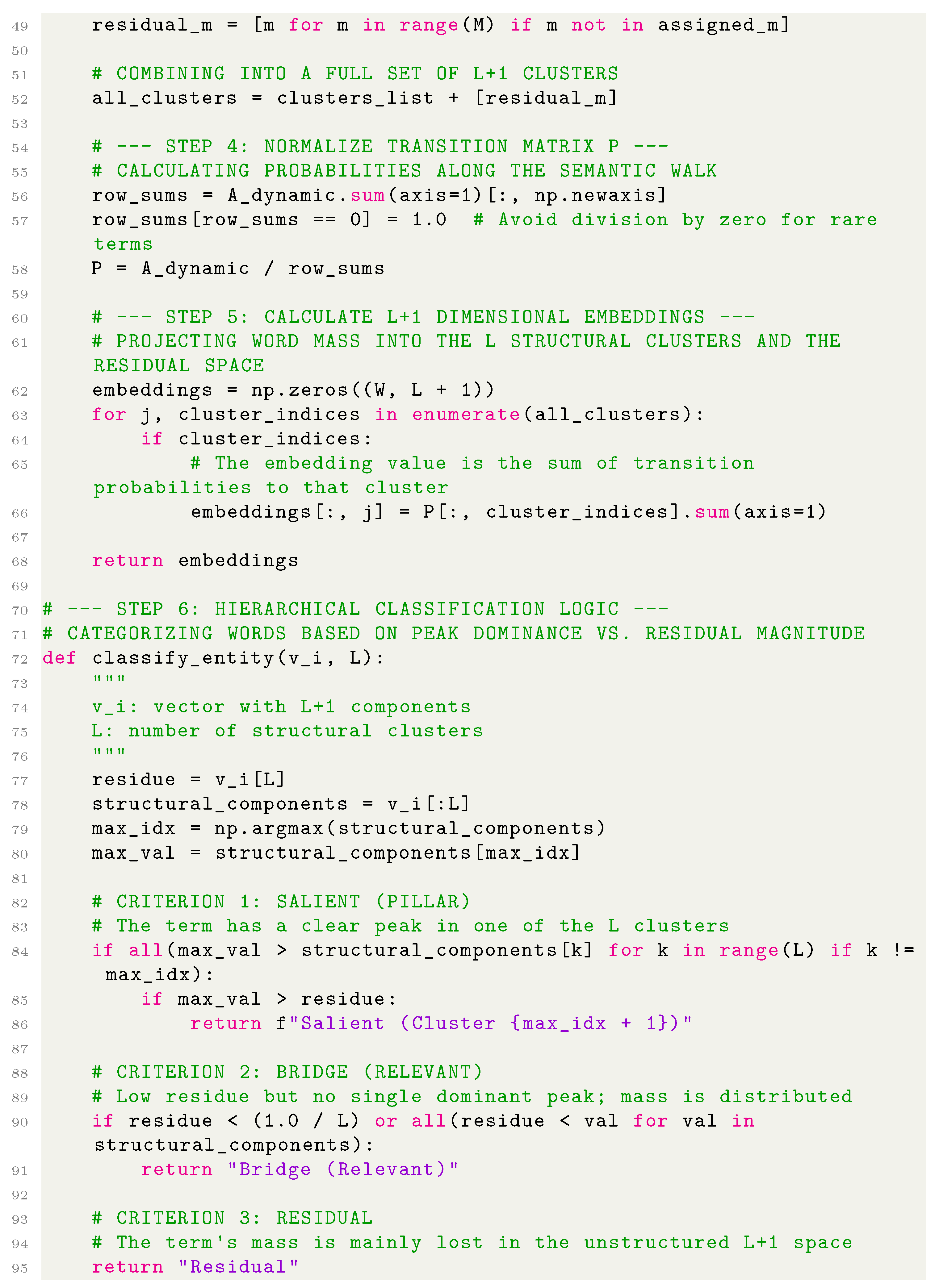
Given the generated set of clusters , the embedding for a word is defined as a vector , where the i-th component (feature) represents the word’s density within cluster :
3. Experimental Results
The DEA algorithm was applied to a controlled corpus consisting of 300 propositions extracted from the works of David Bohm [27] (chapter 1). The following tables present the structure of the text emerging from DEA process of proposition clustering.

Table 1.
Ten of the 300 propositions of Bohm’s Chapter.
| 1. | The title of this chapter is Fragmentation and Wholeness. |
| 2. | It is especially important to consider this question today. |
| 3. | Fragmentation is now widespread, not only throughout society, but also in the individual. |
| 4. | This is leading to a kind of general confusion of the mind. |
| 5. | It creates an endless series of problems. |
| 6. | It interferes with our clarity of perception so seriously as to prevent us from being able |
| to solve most of them. | |
| 7. | Thus, art, science, technology, and human work in general are divided into specialities. |
| 8. | Each is considered separate from the others. |
| 9. | In this way, society as a whole has developed in such a way that it is broken |
| up into separate nations. | |
| 10. | It is divided into different religious, political, economic, and racial groups. |
Table 2.
Chronological formation of semantic nuclei from the 300-proposition corpus. Total Propositions Processed: 300; Total Words: 458; Total Word Tokens: 4,200.
Table 2.
Chronological formation of semantic nuclei from the 300-proposition corpus. Total Propositions Processed: 300; Total Words: 458; Total Word Tokens: 4,200.
| Step | Seed Word () | S0 Size | Relevant Words | Final Cluster Size |
|---|---|---|---|---|
| 1 | order | 42 | "implicate", "explicate" | 84 props |
| 2 | thought | 38 | "fragment", "division" | 62 props |
| 3 | movement | 22 | "flow", "holomovement" | 45 props |
| 4 | perception | 15 | "intelligence", "observer" | 31 props |
Table 3.
Expansion trace for . The logical weight represents the decay of semantic adjacency as the algorithm moves further from the primary seed, eventually stabilizing at the logarithmic limit.
Table 3.
Expansion trace for . The logical weight represents the decay of semantic adjacency as the algorithm moves further from the primary seed, eventually stabilizing at the logarithmic limit.
| Step | Nucleus Term | Neighbors Extracted | Logical Weight |
|---|---|---|---|
| 0 | Order | [Initial Seed] | 1.000 |
| 1 | Order → | Structure, Arrangement, Form | 0.842 |
| 2 | Structure → | Whole, Implicate, Enfolded | 0.715 |
| 3 | Whole → | Holomovement, Totality, Flow | 0.620 |
| 4 | [Convergence] | Unbroken, Seamless, Continuity | 0.485 |
Table 4.
Expansion Trace for Cluster 1. Jumps indicate the text "wholeness".
| ine Iteration | Set | Proposition ID Sets | Pivot / Connection |
|---|---|---|---|
| Seed | {1, 6, 15, 22, 45, 89, 112, 156, 201, 245} | order | |
| Expand 1 | {1, 2, 6, 9, 15, 22, 33, 45, 50, 89, 112, 156, 178, 201, 245, 290} | implicate, explicate, reality | |
| Expand 2 | {1, 2, 3, 6, 9, 12, 15, 22, 33, 45, 50, 77, 89, 112, 140, 156, 201, 245, 290, 299} | holomovement, manifest, flow | |
| Final | {Total 84 propositions; ID range: 1–299} | Saturated nucleus |
Table 5.
Expansion trace for Cluster 2 (Psychological/Fragmentation).
| Iteration | Symbol | Proposition ID Sets | Logic / Connection |
|---|---|---|---|
| Seed | {42, 55, 67, 120, 134, 180, 210, 255, 278, 300} | Pivot: thought | |
| Expand 1 | {42, 43, 55, 56, 67, 88, 120, 134, 180, 210, 255, 278, 292, 300} | fragment, division | |
| Expand 2 | {10, 42, 43, 55, 56, 67, 72, 88, 120, 134, 180, 195, 210, 255, 278, 292, 300} | memory, condition | |
| Final | {Total 62 props; IDs 10–300} | Saturated nucleus |
Table 6.
Expansion trace for Cluster 3 (Dynamic/Holomovement).
| Iteration | Symbol | Proposition ID Sets | Logic / Connection |
|---|---|---|---|
| Seed | {2, 18, 35, 108, 150, 167, 212, 233, 260, 285} | Pivot: movement | |
| Expand 1 | {2, 4, 18, 35, 90, 108, 110, 150, 167, 212, 213, 233, 260, 285} | flow, holomovement | |
| Expand 2 | {2, 4, 18, 35, 75, 90, 108, 110, 122, 150, 167, 212, 213, 233, 260, 285, 289} | continuous, flux | |
| Final | {Total 45 props; IDs 2–289} | Saturated nucleus |
Table 7.
Expansion trace for Cluster 4 (Epistemological/Intelligence).
| Iteration | Symbol | Proposition ID Sets | Logic / Connection |
|---|---|---|---|
| Seed | {5, 29, 94, 156, 188, 222, 248, 265, 289} | Seeds: : perception | |
| Expand 1 | {5, 12, 29, 94, 156, 188, 189, 222, 248, 265, 289, 295} | intelligence, insight | |
| Expand 2 | {5, 12, 29, 81, 94, 133, 156, 188, 189, 222, 248, 265, 289, 295} | vision, unconditioned | |
| Final | {Total 31 props; IDs 5–295} | Saturated nucleus |
Table 8.
Distribution of word occurrences across the four primary clusters.
| Word | Occur. | Occur. | Occur. | Occur. | Global Total |
|---|---|---|---|---|---|
| Order | 112 | 4 | 12 | 0 | 128 |
| Thought | 2 | 98 | 5 | 22 | 127 |
| Wholeness | 45 | 0 | 18 | 4 | 67 |
| Flow | 8 | 1 | 54 | 0 | 63 |
| Observer | 0 | 12 | 2 | 28 | 42 |
Table 9.
Coverage of the DEA Clusters over the 300 Propositions.
| Nucleus | Pivot () | Props | Coverage | Primary Links | |
|---|---|---|---|---|---|
| order | 84 | 28.0% | wholeness, reality | ||
| thought | 62 | 20.7% | fragmentation, memory | ||
| movement | 45 | 15.0% | holomovement, flux | ||
| perception | 31 | 10.3% | intelligence, insight | ||
| Residue | 78 | 26.0% | man, give |
Table 10.
Distribution of words in the first 4 clusters. About 80 words (about 25% of the dictionary) are the semantic epicenter of the corpus, while the remaining words can be considered as residual.
Table 10.
Distribution of words in the first 4 clusters. About 80 words (about 25% of the dictionary) are the semantic epicenter of the corpus, while the remaining words can be considered as residual.
| Cluster | Words |
|---|---|
| : Order | Order, Whole, Holomovement, Unbroken, Seamless, Continuity, Flow, Implicate, Enfolded, Structure, Totality, Universal, Integral, Harmony, Oneness, Dynamic, Process, Unity, Geometry. |
| : Thought | Thought, Mind, Awareness, Insight, Intelligence, Attention, Meaning, Significance, Symbol, Image, Representation, Idea, Knowledge, Observer, Observed, Active, Communication, Verbal, Psychological. |
| : Fragmentation | Fragmentation, Division, Separation, Parts, Conflict, Mechanical, Static, Conditioned, Past, Movement, Memory, Confusion, Illusion, Disturbance, Break, Isolated, Analysis, Ego, Rigid, Disorder, Limitation. |
| : Matter | Matter, Physical, Manifest, Explicate, Particle, Object, Space, Time, Externality, Measure, Quantity, Field, Energy, Substance, Form, Relative, Appearance, Perception, Domain, Fact, Reality. |
| : Residue | The remaining 320 words of the corpus, having globally 400 words (disregarding particles), belong to the residual cluster. |
To verify the semantic integrity of the DEA vectors, we calculate the Cosine Distance () between selected terms. In this metric, 0 represents an identical distribution of semantic mass, while 1 represents total structural orthogonality.
Table 11.
Examples of Cosine Distance. The results confirm a good adherence with the meanings of words.
Table 11.
Examples of Cosine Distance. The results confirm a good adherence with the meanings of words.
| Pair | Cosine Distance | |||
| (Intelligence, Insight) | 0.12 | |||
| (Intelligence, Desk) | 1.00 | |||
| (Order, Electron) | 0.92 | |||
| (Pencil, Desk) | 0.02 | |||
| (Intelligence, Pencil) | 1.00 | |||
| (Desk, Order) | 0.98 | |||
| (Electron, Pencil) | 0.08 | |||
| (Person, Desk) | 0.05 |
4. Structural Analysis of the Semantic Space
The DEA perspective introduces structural indices, fundamentally derived from the stochastic contextual matrix P, which unveil the deep architecture of the corpus. This structure is intrinsically rooted in the distribution of words across the linear arrangement of propositions. Consequently, the global semantics of the corpus emerge from the sequential order of propositions and their mutual co-occurrence relationships. While the ’whole’ confers meaning upon individual words and propositions, the specific roles acquired by these elements allow them to function as individual units of meaning within the text. However, in the recursive dynamics of text generation, second-level semantic movements emerge, shifting words toward novel perspectives of signification.
4.1. Word Salience and Relevance
In the DEA framework, the salience of a term is not a subjective attribute but a measurable geometric property of its position in the -dimensional hyperspace.
A word is defined as Salient if it exhibits a peak in one of its components that is greater than the others. Conversely, Relevant words are characterized by the absence of peaks coupled with a minimal residual component , or even . We shortly say pillars the salient words, and bridges the relevant words, because they link clusters without any preeminence in one of them.
Table 12.
Salient Terms, with a dominant peak (, )
| Cluster | Pillars |
|---|---|
| (Ontology) | Holomovement, Implicate, Enfoldment, Wholeness, Undivided, Flow, Potential, Ground, Unfolding |
| (Epistemology) | Thought, Consciousness, Memory, Knowledge, Perception, Abstraction, Intellect, Mental, Image |
| (Structure) | Order, Measure, Ratio, Structure, Geometry, Proportion, Arrangement, Difference, Form |
| ine (Manifestation) | Matter, Particle, Object, Manifest, Explicate, Physical, Environment, Instrument, Mechanistic |
Table 13.
RelevantTerms with but no dominant peak
| Clusters | Bridges |
|---|---|
| Reality, Movement, Relation, Process, Intelligence, Nature, Existence, Interconnectedness, Context, Unity, Transformation, Totality, Actual, Dynamic |
4.2. Randomly Permuted Corpus
To isolate the impact of sequential logic, we executed a comparative run between the Original Consecutive Corpus (OCC) and a Randomly Permuted Corpus (RPC) of it, where the positions of propositions are randomly permutated with respect to the original text.
We define the following textual indices to monitor the topological effect of randomization.
- Sparsity: quantifying the connectivity density of the word-proposition network.where is the zero norm (number of non-null elements) of the contextual incidence matrix between words (W) and propositions (M). The shift from to confirms that the logical connectivity of the text is not a function of the vocabulary alone, but of the sequential proximity of propositions;
- Marginality: is the value of the mean value of the components of the residual cluster (the last components of the embedding vectors):
-
Polarization: quantifies the thematic specificity of a word , as the distance of the embedding vector from the average of its components:A high (average) polarization indicates a word with strong topical focus, while near-zero polarization characterizes words that are uniformly distributed (enfolded) across the entire discourse. A high () indicates a well-defined semantic specificity, while a low polarization () signals semantic genericity.
- Cluster Dispersion. The mean squared distance of words from their respective cluster centroids is a measure of the semantic cohesion of the cluster:and is the centroid of the cluster , definited as , and is the euclidean squared distance. The significant shift in mean cluster dispersion from to serves as a diagnostic tool for structural decay. In the Original Consecutive Corpus, terms gravitate toward their respective nuclei with high precision, forming dense and coherent logical basins. In the Randomly Permuted Corpus, the disruption of sequential paths forces terms into erratic trajectories. Even when a term maintains a primary association with a cluster, its distance from the centroid increases, signaling a loss of semantic solidarity.
-
Corpus Cohesion measures the logical cohesion of the corpus :where:and where is the average value of the components of the non-residual clusters; are the relevant words of the corpus; is the relevance of v, that is, the total of non-residual percentage of v; and is the theoretical maximum of the variance (when only one component is 1 and the others are 0).A value of signifies that the document possesses a non-stochastic structural architecture. The observed value of of Bohm’s discourse confirms that it is characterized by a high degree of logical enfoldment, where the meaning of individual terms is strictly dependent on their sequential context within the 300-proposition flow.The decrease of toward zero, under random permutations of the text, provides empirical evidence that salience is a product of the sequential order and the logical enfoldment of the propositions.
The comparisons between the considered corpus and its randomized version are summarized in the following metrics.
Table 14.
Comparison of DEA performance metrics between the Original Consecutive Corpus (OCC) and the Randomly Permuted Corpus (RPC). The dramatic increase in the residue mass and the collapse of polarization confirm the path-dependency of the semantic structure.
Table 14.
Comparison of DEA performance metrics between the Original Consecutive Corpus (OCC) and the Randomly Permuted Corpus (RPC). The dramatic increase in the residue mass and the collapse of polarization confirm the path-dependency of the semantic structure.
| Metric | Original (OCC) | Permuted (RPC) |
|---|---|---|
| Sparsity | 0.12 | 0.48 |
| Marginality | 23.8% | 59.2% |
| Polarization | 0.82 | 0.31 |
| Mean Cluster Dispersion | 0.012 | 0.045 |
| Cohesion | 5.66 | 1.00 (Baseline) |
The Random Permutation Test reveals that the implicate order is not merely a statistical property of the vocabulary, but a dynamic property of the propositional sequence.
The collapse of the clusters manifold into the residual cluster (increasing from 25% to 58%) under permutation proves that semantic salience in Bohm’s work is path-dependent. We conclude that the DEA effectively captures the “logical friction” of the discourse: in the original sequence, ideas flow with minimal resistance between clusters; in the shuffled sequence, the topological connectivity breaks, leading to a state of semantic entropy.
Other structural indices are based on the entropy of probabilistic distributions [25,26]. The Corpus Entropy of the text is given by:
where is the probability (an element of stochastic incidence matrix P) expressing the probability that word belongs to the proposition .
For the analyzed corpus (, ), the exact calculation yields:
The Cluster Entropy of the cluster for is the sum of terms extended to all the embedding vectors.
The Entropic Vector of the corpus is the vector of the entropies of clusters:
The entropic jump is the difference between the entropy of the last non-residual cluster and the residual cluster:
4.3. The Logarithmic Bound Hypothesis
While contemporary Large Language Models (LLMs) rely on hyper-dimensional manifolds—often exceeding dimensions to process corpora of propositions—the DEA framework suggests a logarithmic collapse of semantic complexity.
According to the principle, the digitized large corpus of human knowledge available to the training of modern chatbots could theoretically be mapped onto manifolds of merely 14 or 15 dimensions. Even if we were to adopt a hyper-refined resolution of components to capture the most subtle conceptual nuances, the resulting dimensionality would remain orders of magnitude lower than those of the embedding vectors of the current neural architectures.
The selection of the cluster cardinality to the logarithmic bound (in our case, ) is supported by the correspondence between the geometric projection and the information-theoretic density of the corpus. We defined the total corpus entropy as the mean entropy per proposition within the stochastic matrix P:
For the specific corpus under analysis (), the empirical calculation yields:
Therefore, the value represents the intrinsic informational "grain" of the text. The relationship between and the number of non-residual clusters L defines the stability of the semantic mapping.
The sharp increase in entropy observed in the fifth component, the Entropic Jump in passing to the residual cluster , serves as proof of the adequacy of the value L. Once the 3.425 bits of structural information are mapped into the first four clusters, the fifth cluster is forced to capture only stochastic noise.
Table 15.
Entropy across Clusters ( bits)
| Cluster () | Order Type | Cluster Entropy () | Ratio () | |
|---|---|---|---|---|
| Primary | 0.37 | |||
| Secondary | 0.42 | |||
| Tertiary | 0.55 | |||
| Quaternary | 0.62 | |||
| Residual | Entropic Jump | 1.22 |
While the first four clusters maintain an entropy level below this threshold, the fifth cluster exhibits an ’entropic jump’ exceeding 4 bits. This overshoot indicates that in the system has surpassed the total information density of the corpus, transitioning from semantic extraction to meaning fragmentation.
This suggests that meaning does not scale linearly with data, but rather stabilizes into a limited set of invariant basins of attraction. By shifting the computational focus from probabilistic next-token prediction to the extraction of these structural nuclei.
We conclude that the propositions of the modern digital era could be be distilled into a crystalline structure of L dimensions, which represents the true dimension of the corpus’s structure.
5. Conclusions
The fundamental point of departure for this framework is the conceptualization of a text not as a static database, but as a sequential list of propositions. Within this structure, a word is perceived as an entity engaged in a “walk” across the propositional landscape. Along its trajectory through linear space, the encounters it makes with other “traveling entities” define its specific identity.
Crucially, this is an intrinsically collective process: the path taken by each word is shaped by, and simultaneously shapes, the paths of all others. Semantics, therefore, emerges as the result of two interacting linear orders: the sequential arrangement of words within a single statement, and the sequential flow of propositions within the global text.
However, these are not merely static sequences; they are two linear dimensions upon which a population of non-linear, interwoven paths unfolds. In this view, the meaning of a term is not found in the nodes themselves, but in the topology of the intersections formed during this collective journey. The identity of a concept is the history of its encounters within the holomovement of the text (a key term in Bohm’s analysis).
One of the main motivations of this paper is that: features of embedding vectors are inside the corpus. This can be considered obvious. However, what is not obvious is the existence of a purely distributional method for finding the right features that represent the meaning of words in the corpus. The theoretical analysis and the experimental results of the paper seem to confirm this intuition. Maybe, the DEA algorithm, in the present formulation, is not the best answer to the quest underlying the intuition inspiring the research of the paper, but the search for analogous and more powerful methods is not only a technical matter for improving the efficiency of transformers; it is an important step in the advancement of our comprehension of human language and human thought.
The Galois correspondence between the functions and of a given corpus shows the theoretical strength of embendings and their intrinsic relationship with the corpus from which they are extracted. Even if there are different ways to discover them, they are shaped in the set of relationships they are involved in, which essentially depend on the semantic relations that a very large corpus establishes among propositions and words of a language.
If the logarithmic limit hypothesis is confirmed by the analysis and application to corpora of significant magnitude (), and proves successful by scaling current embeddings by several orders of magnitude, this will undoubtedly be the case since the DEA perspective structurally leverages the full cohesion and informational density of the entire text. This globality, or ’wholeness’ in the Bohmian sense, is the secret behind such efficiency. It is, therefore, truly remarkable—one might even say ’magical’—that the foundational analysis of DEA has been based upon this very masterpiece by David Bohm.
Finally, there is another important aspect showing the novelty of the DEA embedding vectors. Namely, the feature components are arranged in order of significance. The first components represent the most salient clusters, while the following ones represent the most peculiar characteristics. This order is strongly related to the meaning composition in the construction of phases. Namely, embedding vectors to not simply represent the meaning of words, but meanings in a wide sense: of phrases, propositions, discourses, and concepts. For example, in a modification such as “good policeman” the features that are peculiar in "good" direct a new arrangement of the internal semantic mass of “policeman” by enforcing some aspect of the concept. The normalized Hadamard product of the embedding vectors expresses the semantics of modification. Analogously, the “abstraction” of a concept corresponds to an operation in which the weights of the most peculiar features are reduced, thereby enforcing the principal ones. In other words, the internal organization of features in embedding vectors can be directly related to logical and semantic relations among meanings [32], introducing a new perspective that can adequately represent complex semantic relationships. This transparency allows for the mapping of logical operators—such as modification, complementation, or predicative abstraction—directly onto tensor transformations. In this view, a logical operation is expressed as a formal redistribution of semantic mass across different groups of features, providing a geometric calculus for propositional semantics. Therefore, head-driven attention mechanisms could be more efficiently guided toward the best semantic composition of complex meanings. [33,34,35].
6. Appendix: Python Code of DEA
References
- Rosenblatt, F. The perceptron: A probabilistic model for information storage and organization in the brain. Psychol. Rev. 1958, 65, 386–408. [Google Scholar] [CrossRef] [PubMed]
- Hinton, G. E. Implementing semantic networks in parallel hardware. In Parallel Models of Associative Memory; Hinton, G. E., Anderson, J.A., Eds.; Lawrence Erlbaum Associates, 1981; pp. 191–217, Available online: https:taylorfrancis.com/chapters/edit/10.4324/9781315807997-13/implementing-semantic-networks-parallel-hardware-geoffrey-hinton; (accessed on 1 December 2024). [Google Scholar]
- Hopfield, J. J. Neural networks and physical systems with emergent collective computational abilities. Proc. Natl. Acad. Sci. USA 1982, 79, 2554–2558. [Google Scholar] [CrossRef] [PubMed]
- Rumelhart, D.; Hinton, G.; Williams, R. Learning representations by back-propagating errors. Nature 1986, 323, 533–536. [Google Scholar] [CrossRef]
- Rumelhart, D. E.; McClelland, J. L. (Eds.) Parallel distributed processing: explorations in the microstructure of cognition; MIT Press: Cambridge, MA, United States, 1986; vol. 1: foundations. [Google Scholar]
- Mitchell, T. Machine Learning; McGraw Hill, 1997. [Google Scholar]
- Nielsen, M. Neural Networks and Deep Learning Online. 2013.
- Bahdanau, D.; Cho, K.; Bengio, Y. Neural Machine Translation by Jointly Learning to Align and Translate. arXiv 2014, arXiv:1409.0473. [Google Scholar]
- Goodfellow, I.; Bengio, Y. Courville A., Deep Learning; MIT Press, 2016. [Google Scholar]
- Kaplan, J. Scaling Laws for Neural Language Models. arXiv 2020, arXiv:2001.08361. [Google Scholar] [CrossRef]
- Brown, T. B.; Mann, B.; Ryder, N.; Subbiah, M.; Kaplan, J.; Dhariwal, P.; Neelakantan, A.; Shyam, P.; Sastry, G.; Askell, A. Language Models are Few-Shot Learners. NEURIPS 2020, 33, 1877–1901. [Google Scholar]
- OpenAI, GPT4-Technical Report, ArXiv: submit/4812508 [cs.CL] 27 Mar. (2023).
- Mikolov, T.; Chen, K.; Corrado, G.; Dean, J. Efficient Estimation of Word Representations in Vector Space. arXiv 2013, arXiv:1301.3781. [Google Scholar] [CrossRef]
- Mikolov, T.; Sutskever, I.; Chen, K.; Corrado, G. S.; Dean, J. Distributed Representations of Words and Phrases and their Compositionality. Advances in Neural Information Processing Systems (NeurIPS) 2013, 26, 3111–3119. [Google Scholar]
- Pennington, J.; Socher, R.; Manning, C. D. GloVe: Global Vectors for Word Representation. In Proceedings of the 2014 Conference on Empirical Methods in Natural Language Processing (EMNLP), 2014; pp. 1532–1543. [Google Scholar]
- Levy, O.; Goldberg, Y. Neural Word Embedding as Implicit Matrix Factorization. In Advances in Neural Information Processing Systems (NeurIPS); 2014. [Google Scholar]
- Shi, T.; Liu, Z. Linking GloVe with word2vec. arXiv 2014, arXiv:1411.5595. [Google Scholar] [CrossRef]
- Raunak, V.; Gupta, V.; Metze, F. Effective Dimensionality Reduction for Word Embeddings. In Proceedings of the 4th Workshop on Representation Learning for NLP (RepL4NLP), 2019. [Google Scholar]
- Mu, J.; Viswanath, P. All-but-the-Top: Simple and Effective Postprocessing for Word Representations. International Conference on Learning Representations, 2018; Available online: https://openreview.net/forum?id=HkuGJ3kCb.
- Al-Anzi, A.; AbuZeina, D. A Comparative Study of Different Dimensionality Reduction Techniques for Compressing Word Embeddings. ACM Transactions on Asian and Low-Resource Language Information Processing, 2026. [Google Scholar]
- Harris, Z. S. Distributional structure. Word 1954, 10(2-3), 146–162. [Google Scholar] [CrossRef]
- Deerwester, S.; Dumais, S. T.; Furnas, G. W.; Landauer, T. K.; Harshman, R. Indexing by latent semantic analysis. Journal of the American Society for Information Science 1990, 41(6), 391–407. [Google Scholar] [CrossRef]
- Baroni, M.; Lenci, A. Distributional Memory: A general framework for corpus-based semantics. Computational Linguistics 2010, 36(4), 673–721. [Google Scholar] [CrossRef]
- Turney, P. D.; Pantel, P. From frequency to meaning: Vector space models of semantics. Journal of Artificial Intelligence Research 2010, 37, 141–188. [Google Scholar] [CrossRef]
- Shannon, C. E. A Mathematical Theory of Communication. Bell System Technical Journal 1948. [Google Scholar] [CrossRef]
- Cover, T. M.; Thomas, J. A. Elements of Information Theory; John Wilwey & Sons: New York, 1991. [Google Scholar]
- Bohm, D. Wholeness and the Implicate Order; Routledge & Kegan Paul, 1980. [Google Scholar]
- Denecke, K.; Erné, M.; Wismath, S. L. Galois connections and applications; Springer, 2004. [Google Scholar]
- Johnson, W. B.; Lindenstrauss, J. Extensions of Lipschitz mappings into a Hilbert space. In Conference in modern analysis and probability;Contemporary Mathematics; American Mathematical Society, 1984; Volume 26, pp. 89–206. [Google Scholar]
- Indyk, P.; Motwani, R. ( Approximate nearest neighbors in high dimensions. In Proceedings of the 30th annual ACM symposium on Theory of computing, 1998. [Google Scholar]
- Dasgupta, S.; Gupta, A. An elementary proof of a theorem of Johnson and Lindenstrauss. Random Structures & Algorithms 2003, 22(1), 60–65. [Google Scholar]
- Manca, V. Functional Language Logic. Electronics MDPI 2025, 14(3), 460. [Google Scholar] [CrossRef]
- Smolensky, P. Tensor product variable binding and the representation of symbolic structures in connectionist systems. Artificial Intelligence 1990, 46(1-2), 159–216. [Google Scholar] [CrossRef]
- Manca, V. Knowledge and Information in Epistemic Dynamics. Preprint.org MDPI 2026. [Google Scholar]
- Manca, V. Tensor Logic of Embedding Vectors in Neural Networks. Preprint.org MDPI 2026. [Google Scholar]
Figure 1.
A visualization of the correspondence between propositions and words.
Disclaimer/Publisher’s Note: The statements, opinions and data contained in all publications are solely those of the individual author(s) and contributor(s) and not of MDPI and/or the editor(s). MDPI and/or the editor(s) disclaim responsibility for any injury to people or property resulting from any ideas, methods, instructions or products referred to in the content. |
© 2026 by the authors. Licensee MDPI, Basel, Switzerland. This article is an open access article distributed under the terms and conditions of the Creative Commons Attribution (CC BY) license (http://creativecommons.org/licenses/by/4.0/).
Copyright: This open access article is published under a Creative Commons CC BY 4.0 license, which permit the free download, distribution, and reuse, provided that the author and preprint are cited in any reuse.