

Submitted:
04 February 2026
Posted:
06 February 2026
Read the latest preprint version here
Abstract
An N(2,2,0)-algebra (abbreviated as NA-algebra) is an algebraic structure equipped with two binary operations,
$\ast$ and $\bigtriangleup$, satisfying specific axioms. This paper investigates a special class of NA-algebras where the operation "$\ast $" exhibits nilpotent properties. We study several fundamental concepts within NA-algebras, including ideals, congruence decomposition, congruence kernels, and multiplicative stabilizers. A notion of NA-morphism is introduced, and a corresponding NA-morphism theorem is established. Furthermore, we explore the relationships between NA-algebras and other related logical algebraic structures, such as quantum B-algebras, Q-algebras, CI-algebras, pseudo-BCH-algebras, and RM-algebras. Notably, we prove that any nilpotent NA-algebra forms a quantum B-algebra. These results lay a foundation for further research into the structure and potential applications of NA-algebras.
Keywords:
NA-algebra
; quantum B-algebra
; Q-algebra
; CI-algebra
; RM-algebra
MSC: 03G25; 03B52; 06F35; 20M10
1. Introduction
Fuzzy algebras and their axiomatizations have become important topics in theoretical research and in the applications of fuzzy logic[1]. Wu introduced a class of fuzzy implication algebras, FI-algebras for short, in 1990 [2]. Recently, researchers such as [3,4] have studied fuzzy implications from different perspectives. Naturally, it is meaningful to investigate the common properties of some important fuzzy implications used in fuzzy logic. Consequently, various interesting properties of FI-algebras, regular FI-algebras, commutative FI-algebras, and some concepts of filter, ideal and fuzzy filter of FI-algebras were proposed, some relations between these FI-algebras and several famous fuzzy algebras were systematically discussed [5].
In the last decades, the development algebraic models for non-commutative multiple-valued logics has become a central topic in the study of fuzzy systems. Various logical algebras have been introduced as the semantical systems of nonclassical logic systems. The notion of NA-algebras was introduced by Deng and Xu in 1996 [7]. We investigate the basic properties of NA-algebra , and showed that if the class of operation ∗ is idempotent, then is a rewriting systems. Analogously. If the operation △ is nilpotent, then is an associated BCI-algebra. Furthermove, some relationships between nilpotent NA-algebra and other algebras with the type of(2,0)are obtained [8].
Quantum B-algebras were introduced by Rump and Yang(2014)[19]. A quantum B-algebra is a partially ordered set with two binary operations → and ⇝ satisfying four conditions (see Sect.4). Logically, → and ⇝ represent the left and right implications, while ≤ corresponds to the entailment relation. In commutative logic, the two implications → and ⇝ coincide.
The present paper is organized as follows: In Section 2, we review some basic concepts, present the main properties of NA-algebras, and show relationship between the NA-algebras and the related fuzzy logic algebras. In Section 3, we consider subalgebras, ideal, stabilizer and congruence kernels and NA-morphism theorem in NA-algebras. In Section 4, we investigate the relationships among NA-algebra and other related logical algebraic structures, such as Q-algebras[14], CI-algebras[15] , Quantum B-algebras[19,20,21], pseudo-BCH-algebras[22], and RM-algebras[23].
2. Basis Concepts and Properties of NA-Algebras
The numerical verification in this paper can be referred to the algorithm program in [30]. We recall some basic definitions and results that are necessary for this paper.
Let S be a semigroup. An element a of S is idempotent if . The set of idempotents of a subset A of S is denoted by .
An element z of S is a left (respectively, right)zero of S if (respectively, ) for all ; z is a zero of S if it is both a left and right zero of S. A semigroup all of whose elements are left (respectively, right) zeros is a left (respectively, right) zero semigroup. Elements a and b of S commute if ; S is commutative if any two of its elements commute[6].
Definition 2.1. ([2]) A fuzzy implication algebra X with a constant 0 and a binary operation satisfying the following axioms: for any ,
;
;
;
;
, where .
In a fuzzy implication algebra :
(I) The order relation ≤ satisfying iff is a partial order[2];
(II) A multiplication ⚬ induced by the adjoint relation
, where is an adjoint pair on X[1].
In [7], we proved that in a fuzzy implication algebra , for all if, the following equalities hold:
then is a semigroup [7,8].
By generalizing the expressions (2) and (3), we replace the symbol → by the symbol ∗, and the symbol ⚬ by the symbol △, we obtain the basic equations of NA-algebra.
Definition 2.2.([7]) An algebra of type (2,2,0) is called an NA-algebra if for all the following axioms hold:
;
;
.
In order to distinguish NA-algebras and Fuzzy implication algebras, we have introduced constant 1 in NA-algebra, and axioms are conditions of the multiplication ∗ forming a semigroup, which induced by the adjointness relation expressions (1) in fuzzy implication algebra .
Example 1. Let . Define the operations ∗ and △ on S by cayley Tables 1 and 2 below:

Table 1.
∗ table.
| ∗ | 1 | a | b | c |
| 1 | 1 | a | b | c |
| a | 1 | a | b | c |
| b | c | b | b | c |
| c | c | b | b | c |
Table 2.
△ table.
| △ | 1 | a | b | c |
| 1 | 1 | 1 | c | c |
| a | a | a | b | b |
| b | b | b | b | b |
| c | c | c | c | c |
Based on the Cayley Tables 1 and 2, , we have
, so holds.
, hence holds.
Similarly, other cases can be verified and established.
The following propositions gives some basic properties of NA-algebra.
Theorem 2.1. Let be an NA-algebra. Then for all , the following hold:
;
(∗ associative law), (∗ left commutative law);
(△ associative law); (△ right commutative law).
Proof. : ;
: ; ;
: ;
.
It is easy to verity that is an NA-algebra. This completes the proof.
Corollary 2.2.([7,8]) If is an NA-algebra, then and are semigroups.
Let be an arbitrary semigroup. A semigroup is called a dual semigroup to if for all .
A semigroup is called left commutative (respectively, right commutative) if it satisfies the identity (respectively, )[6].
Obviously, the NA-algebra is an algebra system with a pair of dual semigroups, and is a left commutative semigroup, is a right commutative semigroup.
Several interesting properties of NA-algebra have been discussed earlier [7,8].
Theorem 2.3. Let be an NA-algebra and for every , then the following hold:
(1)If , then . In this case, two binary operations ∗ and △ coincide, and is an abelian group, where “1” is an unit element, , for all x.
(2)If , then and semigroup is a right zero semigroups.
Proof. (1)By theorem 2.1 , we have operation∗ is associative, and . In this case, ∗ and △ coincide, is a commutative semigroups. Since , then . So, . Hence, 1 is unique unit element. Since , we get 1 is unique unit in S.
From that , we have x is an inverse x, if there exists an inverse element y of x such that , then . Hence, for any , we have x is itself inverse and unique. So, for an NA-algebras, if , then is an Abelian group.
(2) For every , if it satisfies , then
We get , i.e., .
Moreover, for any , we have . Hence, is a right zero semigroup.
Theorem 2.4. Let be an NA-algebra. For any , then if and only if .
Proof. .
Let us suppose that , but , by , a contradiction.
It is easy to check that the following results are true.
Remark 1. Let be an NA-algebra. Then, for any , satisfy simultaneously and if and only if . In this case, NA-algebra is trivial, and also it shows the condition are very strong.
Remark 2. Let be an NA-algebra. For all , such that is a sufficient but unnecessary condition semigroup for as commutative semigroup.
We illustrate this conclusion with the following example:
Example 2.([7],[8]) Let . Define the operations ∗ and △ on S by Tables 3 and 4 below:
Table 3.
∗ table.
| ∗ | 1 | a | b | c |
| 1 | 1 | a | b | c |
| a | a | 1 | c | b |
| b | b | c | 1 | a |
| c | c | b | a | 1 |
Table 4.
△ table.
| △ | 1 | a | b | c |
| 1 | 1 | a | b | c |
| a | a | 1 | c | b |
| b | b | c | 1 | a |
| c | c | b | a | 1 |
Where , such that , we can verify that is an NA-algebra, and is a commutative semigroup.
Example 3. Let . Define the operations ∗ and △ on X by Tables 5 and 6 below:
Table 5.
∗ table.
| ∗ | 1 | a | b |
| 1 | 1 | a | b |
| a | a | 1 | b |
| b | b | b | b |
Table 6.
△ table.
| △ | 1 | a | b |
| 1 | 1 | a | b |
| a | a | 1 | b |
| b | b | b | b |
It is easy to verity that is an NA-algebra, where , but , by theorem 2.4, then is a commutative semigroup.
So, for all satisfies is a sufficient but unnecessary condition semigroup for as commutative semigroup.
Remark 3. If a fuzzy implication algebra with a partial order , such that any , , and for all , the following conditions hold:
then is an NA-algebra.
Remark 4. Let be an NA-algebra, then semigroups and are a pair of dual semigroup. A pair of dual operations form an adjoint pair , ie., , for every .
Theorem 2.5. Let be an NA-algebra and for every in S, then the following hold:
Proof. By Theorem 2.1, we have . Hence, . Similarly, .
Note that the associativity of ∗ and △ of NA-algebra is equivalent to the equation:
Theorem 2.6. ([8]) Let be an NA-algebra. For every , if the binary operation ∗ satisfies , then the following hold:
(1) ;
(2) ;
(3) .
Theorem 2.7. Let S be a set with a consistent 1 and two binary operations , for all , satisfying
(I)
(II)
(III) (left commutative)
(IV)
Then is an NA-algebra.
Proof. By (I) and (II), for all , we have
Thus, for any , we have .
Similarly, we can prove
So, “∗” and “△” with associative.
Using the hypothesis, we have
, hence, axiom holds.
, so axiom holds.
by hypothesis (IV), we get axiom holds. Thus, is an NA-algebra.
Let be a NA-algebra. If operations ∗ and △ of coincide, then the NA-algebra becomes a semigroup. Thus, every NA-algebras are a generalization of semigroups.
Let is a monoid, the operations ⊙,→ and ⇝ satisfy the so-called right adjointness property:
and the left adjointness property:
Remark 5. Let be an NA-algebra, for any , by using , and
we obtain ∗ satisfy the left adjoint property, and △ satisfy the right adjoint property.
3. Subalgebras, Ideal and Stabilizer of NA-Algebras
3.1. Subalgebras, Ideal of NA-Algebras
In this section, we will introduce ideals and congruences of NA-algebra . We define two quasi-ordering relations and denote them by and on as follows, respectively.
Definition 3.1. Let A be an nonempty subset of NA-algebra is called a subalgebra of S if hold for any .
Definition 3.2. Let A be an nonempty subset of NA-algebra is called an NA-ideal of S, if
(1) ;
(2) for any , and
It is easy to verify that and S are two ordinary ideals of NA-algebra .
Example 4. Let . Define the operations ∗ and △ on X by Tables 7 and 8 below:
Table 7.
∗ table.
| ∗ | 1 | a | b |
| 1 | 1 | a | b |
| a | a | a | a |
| b | b | a | a |
Table 8.
△ table.
| △ | 1 | a | b |
| 1 | 1 | a | b |
| a | a | a | a |
| b | b | a | a |
Then, it is easy to verity that is an NA-algebra. One can easily check that are ideals of NA-algebra .
Proposition 3.1. Let be an NA-algebra. Then we have
and
are ideals of S.
Proof. (1) By equation (4) and , we have . Hence, . Now, if , then , i.e., , and , so , i.e, .
By , so , thus . Therefore is an ideal of S.
(2) Using , so . If , and , then we have
. Hence, is an ideal of S.
Example 5. Let . Define the operations ∗ and △ on S by Tables 9 and 10 below:
Table 9.
∗ table.
| ∗ | 1 | a | b | c | d | e |
| 1 | 1 | a | b | c | d | e |
| a | 1 | a | b | c | d | e |
| b | b | b | b | c | b | b |
| c | c | c | c | c | c | c |
| d | d | d | b | c | d | d |
| e | 1 | a | b | c | d | e |
Table 10.
△ table.
| △ | 1 | a | b | c | d | e |
| 1 | 1 | 1 | b | c | d | 1 |
| a | a | a | b | c | d | a |
| b | b | b | b | c | b | b |
| c | c | c | c | c | c | c |
| d | d | d | b | c | d | d |
| e | e | e | b | c | d | e |
Then, it is easy to check that is an NA-algebra, and
are NA-ideals.
Proposition 3.2. Let be an NA-algebra. If Q is an ideal of S, and for all , , such that , then .
Proof. Since Q is an ideal of S, we have . If , such that , then by Definition 3.1, we have . Similarly, , then we have .
Proposition 3.3. Let be an NA-algebra. If for any , such that , then we have
is an ideal of S.
Proof. (1) By equation(6) and , we have holds.
(2) If , then, . Let , then we get , it follows that . Therefore, is an ideal of S.
Example 6. Let . Define the operations ∗ and △ on S by Tables 11 and 12 below:
Table 11.
∗ table.
| ∗ | 1 | a | b | c |
| 1 | 1 | a | b | c |
| a | 1 | a | b | c |
| b | c | b | b | c |
| c | c | b | b | c |
Table 12.
△ table.
| △ | 1 | a | b | c |
| 1 | 1 | 1 | c | c |
| a | a | a | b | b |
| b | b | b | b | b |
| c | c | c | c | c |
Then, it is easy to verity that is an NA-algebra. One can easily check that
are ideals of NA-algebra .
An element is called nilpotent provided that .
Proposition 3.4. Let be an NA-algebra, N be set of all nilpotent element S. Then N is an ideal of S.
Proof. is obvious. For any , we have , hence . Therefore, N is an ideal of S.
From Proposition 3.4 it follows that if N be a set of all nilpotent element on NA-algebra , then N is an ideal of S. For any , we define
then, the relation ∼ in N is an equivalence relation.
In fact, if , we get , that is ∼ satisfying reflexive.
Secondly, from the define of relation ∼, for any , it follows that we get ∼ satisfying symmetric.
Finally, suppose that , that is , , we have
That is, . This case of can be proved similarly. Hence, ∼ is transitive. Therefore, the relation ∼ in N is an equivalence relation.
In what follows, let us check the equivalence classes partition of the set S. Call the equivalence class of an element e belong to the S. So consists of the elements t such that :
We denote by the set of equivalence class. Two operations in be defined as follows:
Then, it is easy to verify that is an NA-algebras.
3.2. Multiplicative Stabilizers in NA-Algebras
From a logic point of view, stabilizer can be used in studying the consequence connectives in the correspondence logic system, which has a very close relationship with fuzzy set. Since stabilizer was successful in some distinct tasks in various branches of mathematics (Roudabri and Torkzadeh)[11], it has been extended to various logical algebras; for example, Haveshki and Mohamadhasani first introduced the notion of stabilizers in BL-algebras and then, they studied several properties of them[12]. Michiro Kondo considered two types of stabilizers, implicative and multiplicative stabilizers in residuated lattices and proved their fundamental properties[13].
In this section, we will introduce some stabilizers and study related properties of them in NA-algebras.
Let S be an NA-algebras. For an non-empty subset , , the multiplicative stabilizers are defined as follows:
for all
Proposition 3.5. Let S be an NA-algebras. Then, we have the following basic results about multiplicative stabilizers:
(1) ;
(2) is a subalgebra and an ideal of S;
(3) If , s.t., , then x and y is a multiplicative stabilizer of the same element.
Proof. (1) By Definition 2.2 , we have , hence , so we get . It follows that
From , we have . Therefore, .
(2) Let . Then, . We have . In a similar way, we have . Since , we get is a subalgebra of .
It is obvious that , because of .
Next, if , then , we get
that is . Hence, is an ideal of S.
(3) Suppose that . Since , it follows that , we get , we show . can be proved similarly.
Proposition 3.6. Let S be an NA-algebras. We defined two types products of S and as follows:
Then, the following statements hold.
(1) is a subalgebra of NA-algebras S. In particular, for any positive integer n, we get a NA-algebras sequence as follows:
(2) is a subalgebra of NA-algebras S. In addition,
(3) For any , we have
(A)
(B)
(C) If , then
Proof. We only show the cases (1) and (C) of (3). Other cases can be proved easily.
(1) It follows from Proposition 3.5 (2) that is a subalgebra of S, we have .
For any , where , we have
By using the operational duality between ∗ and △, we get . Therefore, is a subalgebra of NA-algebras S.
Obviously, for any positive integer n, the subalgebras sequence of NA-algebras
holds.
(3) We prove that case (C) of (3). Let , if , satisfies , then, for any , we have , i.e., . Therefore, . In a similar way, we can show that implies , i.e., . Hence, . Moreover, for any , implies . It follows from (A) of (3), we get . Therefore, we have
3.3. Congruence Decomposition of NA-Algebras
We define congruence decomposition of NA-algebras, which plays a central role in the results that follow.
Definition 3.3. A congruence on an NA-algebras is an equivalence relation on S such that and , then and .
The condition for an equivalence relation on S to be a congruence ensures that the set of equivalence classes under has a well-defined monoid structure inherited from S.
Definition 3.4. Let be an NA-algebra. For all , if there exists some with , then u is called middle unit of S.
The all middle unit set of S will be denoted by . Obviously, .
Proposition 3.7. Let be an NA-algebras. Then, the following statements hold.
(1) is a subalgebra of .
(2) If satisfies , then if and only if .
Proof. (1) By , we have . , using Definition 3.4, this implies that
, hence, . In a similar way, we can show that . By using the operational duality between ∗ and △, we get Therefore, is a subalgebra of .
(2)Suppose that . Then , we have . On the other hand, from , we get , and hence that . Conversely, we assume that , for all , i.e., hold. If , then, for any , . This implies that .
Proposition 3.8. Let be an NA-algebras and is all middle unit set of S. Define the relation as follows: , there exists such that . then is a congruence on S.
Proof. It is easy to verify that reflexive and symmetric are satisfied. We only show the proof of transitivity.
From the relation on S, it is defined by the following rule:
if and only if there exists such that , for any .
In fact, if , then there exists , such that
It follows that .
From proposition 3.7(1), is a subalgebra of , we get , Thus . Therefore, is an equivalence relation on S.
Next, we show that is a congruence on S. Suppose that , i.e., , such that
we have . Hence, is a congruence on S.
We denote equivalence classes belonging to x by . . For any , we define then, form an NA-algebras, which is a quotient algebra of .
Suppose that a is a fixed element in S. Now, we define another congruence relation on S by using as follow.
Proposition 3.9. Let be an NA-algebras. , such that . Then, is a congruence relation on S as follow.
Proof. It is easy to verify that reflexive and symmetric are satisfied. We only show the proof of transitivity.
In fact, let , then there exists , such that
It follows that:
.
From Proposition 3.5(2), we get . Thus . Therefore, is a equivalence relation on S.
Let now , then there exists , such that . Thus, we have . Hence, is a congruence relation on S.
Similar to Proposition 3.8, we denote equivalence classes belong to x by . . For any , we define
Then, forms an NA-algebra, which is a quotient algebra of .
3.4. Congruence Kernels of NA-Algebras
In this section, we give a characterization of congruence kernels in an NA-algebra. Let be a binary relation on an NA-algebra . We denote , by . If is a congruence relation on S, then is called a congruence kernel.
Proposition 3.10. Let be an NA-algebras. We denote natural homomorphism . Then, we have
is a subalgebra and an ideal of .
Proof. In fact, .
Obviously, . For all , there exists , such that
This means that . Hence .
By using the operational duality between ∗ and △, we can show that . Therefore, is a subalgebra of .
Next, suppose , then there exists , such that
Hence This means that .
Therefore is an ideal of
3.5. NA-Morphisms
Let and be two NA-algebras unless otherwise specified.
Definition 3.5. A mapping is called an NA-morphism if it satisfies: for all ,
Example 7. Let , define the operations ∗ and △ with Cayley Tables 13 and 14:
Table 13.
∗ table.
| ∗ | 1 | a | b | c |
| 1 | 1 | a | b | c |
| a | 1 | a | b | c |
| b | c | b | b | c |
| c | c | b | b | c |
Table 14.
△ table.
| △ | 1 | a | b | c |
| 1 | 1 | 1 | c | c |
| a | a | a | b | b |
| b | b | b | b | b |
| c | c | c | c | c |
Let , define the operations and with Cayley Tables 15 and 16:
Table 15.
∗ table.
| w | s | t | ||
| w | s | t | ||
| w | w | s | t | |
| s | t | s | s | t |
| t | t | s | s | t |
Table 16.
△ table.
| w | s | t | ||
| t | t | |||
| w | w | w | s | s |
| s | s | s | s | s |
| t | t | t | t | t |
It is routine to verify that and both are NA-algebras.
Now, let be a mapping defined by
It is routine to verify that is an NA-morphism[30].
Proposition 3.11. If is an NA-morphism, then and for all with .
Proof. We have . Let be such that . Then , and so . This shows that .
Let be an NA-morphism. For any subset B of Y , the set
is called the preimage of B under f . The preimage of under f is called the kernel of f and is denoted by or , and so
Proposition 3.12. The preimage of an NA-ideal under an NA-morphism is an NA-ideal.
Proof. Let be an NA-morphism and let G be an NA-ideal of Y. It is clear that . Let be such that and . Then and . It follows from Definition 3.2 that . Hence , and therefore is an NA-ideal of X. Now, let G be an NA-ideal of Y.
Given a constant element c and an non-empty subset H of an NA-algebra S, we consider a special set:
Theorem 3.13. If H is an NA-ldeal of S and is the quotient NA-algebra induced by H, then the map is an NA-morphism.
Proof. Assume that H is an NA-ldeal of S. We define a map . This implies that
, we have
Obvious that
We say that is the natural NA-morphism.
In a NA-algebra , a binary relation “≤” is defined by or .
Definition 3.6. (1) An NA-algebra is antisymmetric if the binary relation “≤” is antisymmetric.
(2)An NA-algebra S is said to be transitive if it satisfies:
In fact, by the definition of binary relation “≤”, we have , and .
Therefore, the binary relation “≤” is antisymmetric.
Theorem 3.14. Let S be an NA-algebra. For every if it satisfies , then S is a transitive NA-algebra.
Proof. Let S be an NA-algebra and . Then
.
Hence , and therefore S is a transitive NA-algebra.
Theorem 3.15. Let and be NA-morphisms where U is an antisymmetric NA-algebra. If is onto and , then there exists a unique NA-morphism such that the following diagram commutes.
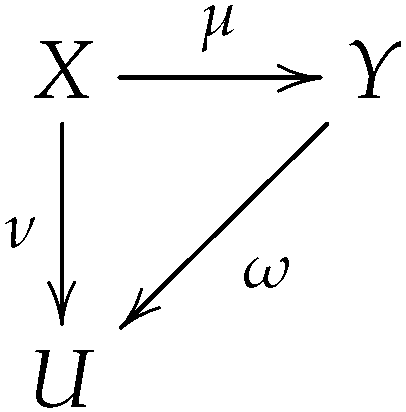
Proof. For every , we can take such that since is onto. Define by . We first show that is well-defined. Let be such that . Then , and thus
It follows that . Similarly, we get . Hence . Since U is an antisymmetric NA-algebra, this shows that is well-defined, and . Let . For every with and , we have . Hence is an NA-morphism. The uniqueness of is directly verified since is an onto NA-morphism. This completes the proof.
In the next theorem, we consider the NA-morphism theorem.
Theorem 3.16.(NA-morphism theorem) Let and be arbitrary NA-algebras. is an onto NA-morphism where S is transitive and T is antisymmetric, then there exists an one-one and onto NA-morphism , and so is isomorphic to T such that the following diagram commutes.
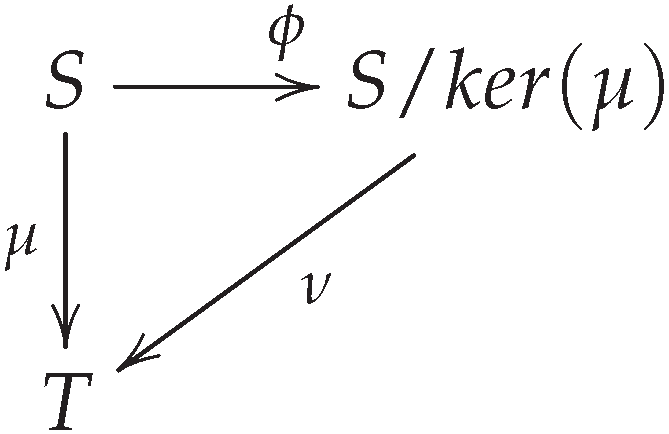
Proof. Recall that is an NA-ideal of S. Thus is an NA-algebra where . Define a mapping by for all . For every , there exists such that since is onto. Thus which shows that is onto. Assume that . Then , and so and . It follows that and . Since T is antisymmetric, we get . Thus is a well-defined mapping. Suppose that . Then x and y cannot belong to the same equivalence class. Hence or . If , then and so . If , then and so . Hence is an one-one mapping. Since and for all .
This completes the proof.
4. Relation Between NA-Algebras and Other Related Logical Algebras
This section aims to systematically position NA-algebras in the spectrum of non-classical logical algebras.
An algebra is called a bicommutative algebra [9], if it satisfies the following identities
One-sided commutative algebras first appeared in the paperby Cayley in 1857[10] . The variety of right commutative algebras is defined by the following identity:
Similarly, the variety of left commutative algebras is defined by the following identity:
Thus, for a given NA-algebra , is a left commutative algebras, and is a right commutative algebra. If two binary operations ∗ and △ coincide, then NA-algebra is a bicommutative algebra.
Meanwhile, NA-algebra has close connections with several important non-classical logical algebraic structures:
Relations with CI-algebras and Q-algebras: When operations in a NA-algebra satisfy the condition of power-zero (i.e. , its algebraic structure forms a CI-algebra, and its dual structure forms a Q-algebra. This shows that a NA-algebra which satisfies certain conditions be embedded into the category of CI/Q-algebras.
Relation with quantum B-algebras: This is a central conclusion of the paper. Any power-zero NA-algebra which satisfies forms a quantum B-algebra. This makes NA-algebras a subclass of the wide quantum B-algebraic framework (which contains-effect algebras, residuated lattices, etc.).
Relation with pseudo-BCH-algebras: In a NA-algebra, let and use its properties, one can derive a pseudo-BCH-algebra. The converse is not true, and there are examples which are pseudo-BCH-algebras but not-algebras, showing that pseudo-BCH-algebras are a broader class than NA-algebras.
Relation with RM-algebras: Also, a NA-algebra which satisfies forms an RM-algebra. However, a general RM-algebra is not necessarily a NA-algebra. Therefore a NA-algebra which satisfies the power-zero condition forms a proper subclass of RM-algebras.
Below we discuss the relationship between NA-algebras and CI/Q-algebras, quantum B-algebras, pseudo BCH-algebras, RM-algebras, etc.
4.1. Relations with CI-Algebras and Q-Algebras
J.Neggers, S.S.Ahn and H.S. Kim introduced a new notion, called an Q-algebra, which is a generalization of the idea of BCH/BCI/BCK-algebras and they generalized some theorems discussed in BCI-algebras[14]. CI-algebras as a generalization of BE-algebras and BCK/BCI/BCH-algebras was initiated by B.L.Meng in 2009, and studied its important properties and relations with BE-algebras[15]. Arsham Borumand Saeid proved that CI-algebra is equivalent to dual Q-algebra[16].
In this section, we investigate the relation between NA-algebras and CI-algebras and Q-algebras.
Definition 4.1.([15]) An algebra of type (2, 0) is called a CI-algebra if it satisfies the following axioms: for all
for all ;
for all ;
, for all .
A CI–algebra X satisfying the condition is called a BE-algebra. In any CI-algebra X one can define a binary relation by if and only if .
A CI-algebra X has the following properties:
;
;
if , then , for all .
Definition 4.2.([14]) An algebra of type (2, 0) is called a Q-algebra if it satisfies the following axioms: for all
for all ;
for all ;
for all .
Definition 4.3.([14,18]) Let be a Q-algebra and binary operation on X is defined as follows:
Then is called dual Q-algebra. In fact, the axioms of that are as follows:
;
;
, for all .
Example 8. Let . We define binary operations △ on X with the following Tables 17 and 18:
Table 17.
△ table.
| △ | 1 | a | b | c |
| 1 | 1 | a | b | c |
| a | a | 1 | c | b |
| b | b | c | 1 | a |
| c | c | b | a | 1 |
It is not complicated to check that is an Q-algebra, this is also a Klein four-group. By Definition 4.3, we can immediately write down the dual algebra of the Q-algebra with the following Table 18:
Table 18.
∗ table.
| ∗ | 1 | a | b | c |
| 1 | 1 | a | b | c |
| a | a | 1 | c | b |
| b | b | c | 1 | a |
| c | c | b | a | 1 |
Obviously, here . Therefore is a self-dual Q-algebras.
Theorem 4.1.([16,17]) Any CI-algebra is equivalent to the dual Q-algebra.
Applying Theorem 2.1, based on Definition 4.1-4.3, for all , the following hold,
Theorem 4.2. Let be an NA-algebra and for all , it holds that , then
(1) is a CI-algebra;
(2) is a Q-algebra.
Proof. The proof is straightforward.
Definition 4.4.([29]) An algebra of type (2,2,0) is called a pseudo-CI algebra if, for all , it satisfies the following axioms:
,
,
,
.
It follows from Definition 2.2 and Theorem 2.1 that the following conclusion is obtained easily:
Theorem 4.3. An NA-algebra if, for all , it satisfies , then is a pseudo-CI algebra, i.e, every pseudo-CI algebra is contained in the class of NA-algebras.
4.2. Relation with Quantum B-Algebras
Rump and Yang introduced the concept of quantum B-algebras[19], and proved that the quantum B-algebras can provide a unified semantic for non-commutative algebraic logic. Almost all implicational algebras studied before - pseudo-effect algebras, residuated lattices, pseudo MV/BL/MTL-algebras, bounded non-commutative R-monoids, pseudo-hoops, pseudo BCK/BCI-algebras are quantum B-algebras. Now, let us proceed by stating the definitions, some of them being well known.
Definition 4.5.([19]) A quantum B-algebra is a partially ordered set X with two binary operations → and ⇝ such that the following are satisfied for
Both → and ⇝ stand for logical implication, a left one and a right one, which have to be distinguished in an non-commutative framework. The partial order relation ≤ stands for entailment.
Proposition 4.4. ([19,20]) Let be a quantum B-algebra. The following hold, for all ,
;
implies ;
implies ;
;
.
Now, we study the relationship between NA-algebra and quantum B-algebras as follows.
Theorem 4.5. Let be an NA-algebra which satisfies for any , we have
the order is given by (or is a partial order.
is a trivial quantum B-algebra, the element x is group-like element.
Proof. 1)By , we have ;
2) Assume that holds for given . Then it implies that . Hence .
3) Assume that satisfies .
Hence So the order relation is a partial order in X.
In the semigroup of NA-algebra , for all , we have holds, hence for all ,
Using equality (12), by ∗ instead of →, and use △ instead of ⇝, we obtain equality(11)is verified.
From that It follows that (9)
By , i.e., . In this case, . and if , then , the converse is also true. Thus, we obtain So, the inequality (10) is verified.
This proves is a quantum B-algebra.
Furthermore, we can be obtain:
Therefore, is a commutative quantum B-algebra, and the element x is group-like element.
Remark 6. In an NA-algebra , a order relation is defined by is defined by . We can prove that only if condition holds, this order relation is a partial order. Therefore, to construct a quantum B-algebra using NA-algebra, an additional condition must be imposed to ensure reflexivity.
The following example shows that a nilpotent NA-algenra is a quantum B-algebra.
Let . Define the operations ∗ and △ on S by cayley Tables 19 and 20 below:
Table 19.
∗ table.
| ∗ | a | 1 |
| a | 1 | a |
| 1 | a | 1 |
Table 20.
∗ table.
| △ | a | 1 |
| a | 1 | a |
| 1 | a | 1 |
Here is a NA-algebra. We putting ,, and , then is also a quantum B-algebra.
In [20], Shengwei Han and Xiaoting Xu use the identity (11) to propose the concept of C-algebras and show that a C-algebra is a group if and only if each of its elements is dualizing and by dualizing elements of a C-algebra X define different binary operations on X such that X is a moniod. In this section, we will to define C-algebras and investigate the relation between C-algebras and NA-algebras.
Definition 4.6.([20]) A set X with two binary operations → and ⇝ is called a C-algebra if → and ⇝ satisfy the condition (11).
Theorem 4.6. Every NA-algebra is a C-algebra.
Proof. By Theorem 2.1, we putting , , for all , we have
Hence, . So, axiom (11) hold. The proof is complete.
4.3. Relation with Pseudo-BCH-Algebras
In order to characterize fuzziness, non-commutability or uncertainty in quantum logic, it is necessary to break through the rigid structures of traditional Boolean algebra, such as excluded neutrality and commutative law. Pseudo-prefix algebra, such as pseudo-Boolean algebra and pseudo-BCI algebra, has become an effective mathematical tool for describing complex logical relationships by weakening axiomatic conditions such as non-commutativity and non-associativity. 2015, Andrzej Walendziak introduced the concept of pseudo-BCH-algebras, which is a theoretical exploration in the evolution of non-commutative logic algebra. Its core value lies in extending the BC/BCI framework to adapt to non-commutative logic scenarios and filling the theoretical gap between strict Boolean algebra and completely free algebra[22]. Definition 4.7.([22]) A pseudo-BCH-algebra is an algebra of type (2,2,0) satisfying the axioms:
(pBCH-1) ;
(pBCH-2) ;
(pBCH-3) ;
(pBCH-4) .
Replacing ⋄ by △ in Definition 4.7 we obtain
Remark 7. Observe that if is a NA-algebra, letting . By Theorem 2.5 and Theorem 2.6, then we have , and produces a pseudo-BCH-algebra . Its inverse is not generally true as shown in the following example.
Example 9. Let . Define the operations ∗ and ⋄ on X by Tables 21 and 22 below:
Table 21.
∗ table.
| ∗ | 1 | a | b | c |
| 1 | 1 | 1 | 1 | 1 |
| a | a | 1 | a | 1 |
| b | b | b | 1 | 1 |
| c | c | b | c | 1 |
Table 22.
⋄ table.
| ⋄ | 1 | a | b | c |
| 1 | 1 | 1 | 1 | 1 |
| a | a | 1 | a | 1 |
| b | b | b | 1 | 1 |
| c | c | c | a | 1 |
Then, it is easy to verity that is a pseudo-BCH-algebra, which is not a NA-algebras, since .
4.4. Relation with RM-Algebras
In 2019, Walendziak, A. introduced the notion of RM algebras and investigated its elementary properties[23]. The class of all RM algebras contains BCK, BCI, BCH, BZ, RME, pre-BZ algebras and many others.
In this section, for all , we apply the identity
(I)
to NA-algebras and investigate some relations between this condition with other axioms in some algebras of logic and some examples are given to illustrate them. The relations between NA-algebras and RM-algebras are given.
Definition 4.8.([23])An RM-algebra is an algebra of type (2,0) satisfying the following axioms: for all
(R) ,
(M) .
Example 10. Let . Define the operations → on X with Cayley Table 23:
Table 23.
→ table.
| → | 1 | a | b |
| 1 | 1 | a | b |
| a | a | 1 | b |
| b | b | b | 1 |
then is an RM-algebra and satisfies condition(I)[24], but , hence it does not satisfy
(E) .
So, RM-algebra is not NA-algebra.
Theorem 4.7. If is a NA-algebra with , then is an RM-algebra.
Proof. By , we have (M) holds. Based on the assumption , we obtain is an RM-algebra.
Theorem 4.8. Let be an NA-algebra. If it satisfies condition(I), for all , we have:
Proof. Let . By using , if S satisfies condition(I), we have
Therefore,
Proposition 4.8. If NA-algebra satisfies and , then .
Proof. Let . suppose , then . If S satisfies , we have , and
Proposition 4.9. Let be an NA-algebra, we have
(1) if it satisfies condition(I), then , for any .
(2) if for all , then iff .
Proof. (1) For any , we apply identity (I) to NA-algebra , we obtain
(2) Put with identity , we get . Conversely, if all , have , then . The proof is complete.
Proposition 4.10. ([24]) If is an RM-algebra satisfying (I), then (E) holds.
From theorem 4.7, Proposition 4.9 and Proposition 4.10, we have: The RM-algebras are a special subclass of the NA-algebras with for all .
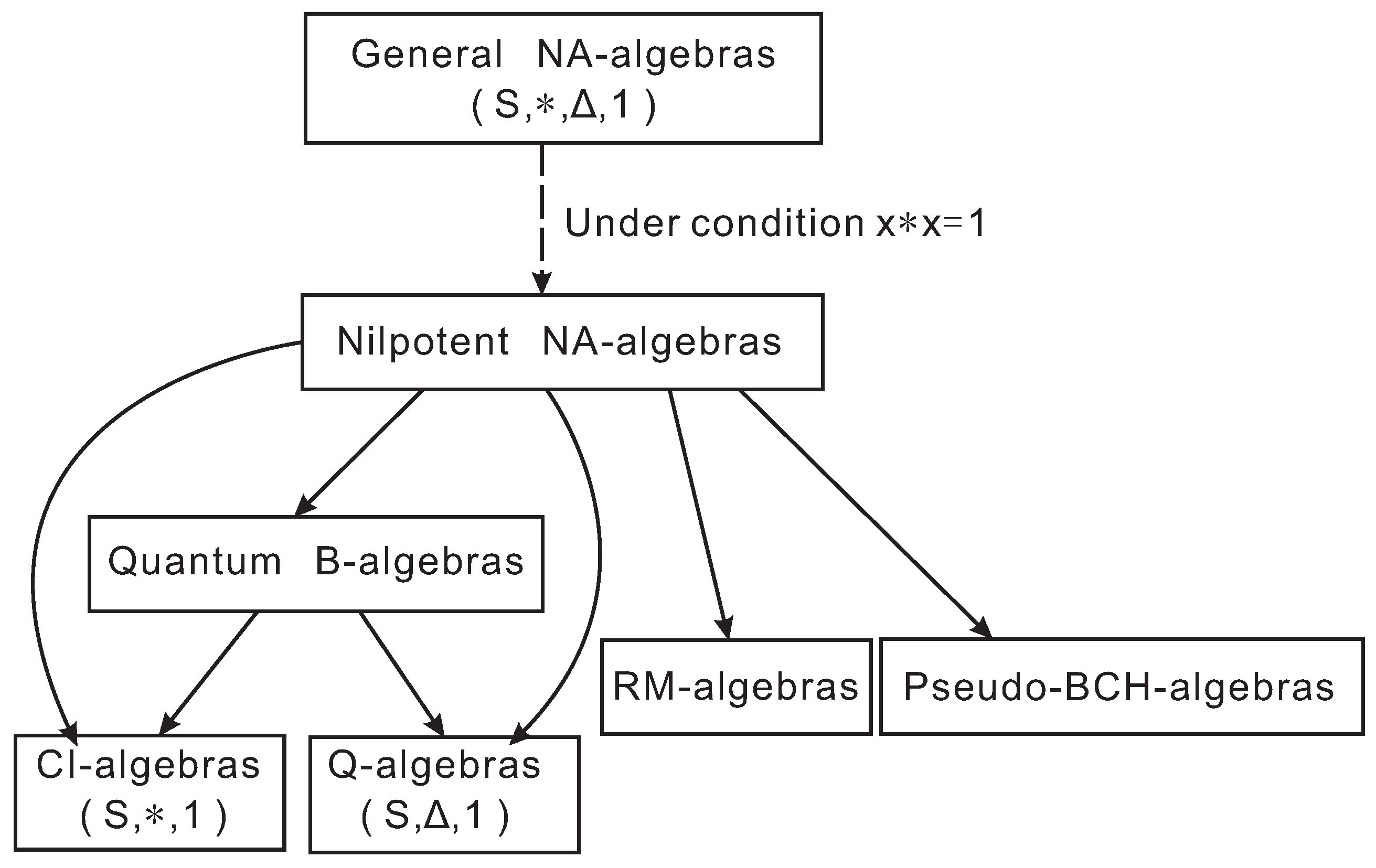
According to the above analysis, the following diagram of inclusion relation can be outlined (where “Nilpotent NA” denotes a nilpotent NA-algebra satisfying ):
Figure 1.
The relationships between NA-algebras and other algebras
5. Conclusions and Future Work
In this paper, we have introduced the concept of NA-algebras and investigated some of their useful properties. It is well known that the ideals with special properties play an important role in the logic system. The aim of this article is to investigate ideals and stabilizers in NA-algebra, we establish the NA-morphism theorem. We characterize congruence kernels in a NA-algebra. Finally, the relationships between NA-algebras and other algebras, like Q-algebras, CI-algebras, GE-algebras and quantum B-algebra are also investigated. As a direction of research, one can investigate and extend these results to the other algebraic structures.
We believe that these results are very useful in developing algebraic structures also these definitions and main results can be similarly extended to some other algebraic systems such as lattices and Lie algebras etc. We hope this work would serve as a foundation for further studies on the structure of NA-algebras like fuzzy NA-algebras, soft NA-algebras and hyper NA-algebras.
NA-algebras have applications in the dialgebra theory. It is also closely connected with dimonoids and Digroups introduced by Loday[25,26,28]. Digroups which form a subclass of dimonoids, play an important role in the theory of Leibniz algebras[28]. Next, we will embed the NA-algebra into a vector space, deeply further study its relationship with other algebraic systems, and expand the field of NA-algebra.
Funding
This work is supported by the National Natural Science Foundation of China (Grants No. 11801239, 11771004).
Conflicts of Interest
The authors declare that there is no conflict of interests regarding the publication of this article.
References
- Baczynski, M.; Jayaram, B. Fuzzy implications; New York, 2008. [Google Scholar]
- Wu wangming, Fuzzy implication algebra. Fuzzy systems and Mathematics 1990, 1, 56–64.
- Mas, M.; Monserrat, M.; Torrens, J.; Trillas, E. A Survey of fuzzy implication functions. IEEE TRANSACTIONS ON FUZZY SYSTEMS 2007, 15(6), 1107–1120. [Google Scholar] [CrossRef]
- Massanet, S.; Mayor, G.; Mesiar, R.; Torrens, J. On fuzzy implications: an axiomatic approach. International Journal of Approximate Reasoning 2013, 54, 1471–1482. [Google Scholar] [CrossRef]
- Pei, D. A Survey of fuzzy implication algebras and their axiomatization. International Journal of Approximate Reasoning 2014, 55, 1643–1658. [Google Scholar] [CrossRef]
- Gavrylkiv, V.M.; Rendziak, D.V. Interassociativity and three-element doppelsemigroups. Algebra Discrete Math. 2019, 28(2), 224–247. [Google Scholar]
- Deng, F.; Xu, Y. On N(2,2,0)-algebra. The Journal of Southwest Jiaotong University 1996, 31, 457–463. [Google Scholar]
- Deng, F.; Ren, S.; Zheng, P. N(2,2,0) Algebras and Related Topic. Journal of Mathematics Research 2021, 13(6), 27–38. [Google Scholar] [CrossRef]
- Kaygorodov, I.; Paez-Guillan, P.; Voronin, V. The Algebraic and Geometric Classification of Nilpotent Bicommutative Algebras. Algebras and Representation Theory 2020, 23, 2331–2347. [Google Scholar] [CrossRef]
- Cayley, A. On the theory of analytical forms called trees. Phil. Mag., (1857)13: 19–30. Collected Math. Papers, University Press, Cambridge, (1890)3:242-246. [CrossRef]
- Roudabri, T.; Torkzadeh, L. A topology on BCK-algebras via left and right stabilizers. Iran J Math Sci Inf 2009, 4, 1–8. [Google Scholar]
- Haveshki, M.; Mohamadhasani, M. Stabilizer in BL-algebras and its properties. Int Math 2010, 5(57–60), 2809–2816. [Google Scholar]
- Kondo, M. Properties of stabilizers in residuated lattices. Soft Computing 2022, 26, 6981–6988. [Google Scholar] [CrossRef]
- Neggers, J.; Ahn, S.S. On Q-algebras. International Journal of Mathematics and Mathematics Sciences 2001, 27, 749–757. [Google Scholar] [CrossRef]
- Biao Long Meng, CI-algebra. Scientiae Mathematicae Jpn 2010, 71(2), 695–701.
- Saeid, A.B. CI-algebra is equivalent to dual Q-algebra. Journal of the Egyptian Mathematical Society 2013, 21, 1–2. [Google Scholar] [CrossRef]
- Saengsura, K.; Sarasit, N.; Anantayasethi, A. On the Strong Atoms of Q-Algebras. Axioms 2025, 14(4), 271:1–11. [Google Scholar] [CrossRef]
- Anantayasethi, A.; Kunawat, T.; Moonnipa, P. Relations between G-part and atoms in Q-algebras. European Journal of Pure and Applied Mathematics 2024, 17(4), 3268–3276. [Google Scholar] [CrossRef]
- Rump, W.; Yang, Y. Non-commutative logical algebras and algebraic quantales. Ann Pure Appl Log 2014, 165(2), 759–785. [Google Scholar] [CrossRef]
- Han, S.; Xu, X. A few notes on quantum B-algebras. Studia Logica 2021, 109, 1423–1440. [Google Scholar] [CrossRef]
- Ciungu, L.C. Monadic classes of quantum B-algebras. Soft Computing 2021, 25, 1–14. [Google Scholar] [CrossRef]
- Walendziak, A. Pseudo-BCH-algebras. Discussiones Mathematicae General Algebra and Applications 2015, 35, 5–19. [Google Scholar] [CrossRef]
- Walendziak, A. The property of commutativity for some generalizations of BCK-algebras. Soft Computing 2019, 23(17), 7505–7511. [Google Scholar] [CrossRef]
- Rezaei, A. RM-algebras with an additional condition. Journal of Mahani Mathematics Research 2024, 13(3), 1–12. [Google Scholar]
- Loday, J.L. Dialgebras. In Dialgebras and Related Operads; Lect. Notes Math.; Springer: Berlin, 2001; pp. 7–66. [Google Scholar]
- Zhuchok, A.V. Commutative dimonoids. Algebra Discrete Math 2009, 2, 116–127. [Google Scholar]
- Zhuchok, A.V.; Gorbatkov, A.B. On the structure of dimonoids. Semigroup Forum 2017, 94, 194–203. [Google Scholar] [CrossRef]
- Phillips, J.D. A short basis for the variety of digroups. Semigroup Forum 2005, 70, 466–470. [Google Scholar] [CrossRef]
- Rezaei, A.; Borumand Saeid, A.; Yousefi, K.; Saber, S. On pseudo-CI algebras. Soft Computing 2019, 23(2). [Google Scholar] [CrossRef]
- Deng, F.; Tuo, S.; Yong, L.; Zhou, T. Construction Example for Algebra System Using Harmony Search Algorithm. Mathematical Problems in EngineeringVolume 2015, 2015, 836925. [Google Scholar] [CrossRef]
Disclaimer/Publisher’s Note: The statements, opinions and data contained in all publications are solely those of the individual author(s) and contributor(s) and not of MDPI and/or the editor(s). MDPI and/or the editor(s) disclaim responsibility for any injury to people or property resulting from any ideas, methods, instructions or products referred to in the content. |
© 2026 by the authors. Licensee MDPI, Basel, Switzerland. This article is an open access article distributed under the terms and conditions of the Creative Commons Attribution (CC BY) license (http://creativecommons.org/licenses/by/4.0/).
Copyright: This open access article is published under a Creative Commons CC BY 4.0 license, which permit the free download, distribution, and reuse, provided that the author and preprint are cited in any reuse.


