
Submitted:
04 February 2026
Posted:
05 February 2026
You are already at the latest version
Abstract
Engineered Geothermal System (EGS) cross-well flow V ~ 30L/s @ Q ~ 20MWth for 30 days was observed by the Utah-Forge project in 2024. The cross-well flow doublet measured 400m in length at 100m offset. A first-order question is how sustainable is the doublet’s heat extraction Q. Deconstruction of the UtahForge flow data answers the sustainabil-ity question in terms fundamentally different from what has been long supposed. EGS stimulation fluids do not absorb heat via pipe-like cubic-law flow along induced fault-scale planar heat exchange surfaces. Rather, heat exchange oc-curs at the grain-scale along disseminated volumetric flow paths controlled by the ambient-crust poro-permeability dis-tribution κ(x,y,z) ~ exp(α(x,y,z)). More specifically, EGS deconstructs into four sequential steps : (i) stimulation of am-bient crust poro-permeable medium κ(x,y,z) ~ exp(α(x,y,z)) as α α’ > α in the cross-well volume; (ii)wellbore-centric flow V in/out of ambient crust poro-permeability distributions at wellbore radius along the 400m length of open well; (iii) heat advection in the cross-well volume with stimulated poro-connectivity parameter α’; (iv) sustainability-specific heat conduction into the stimulated cross-well volume from the surrounding unstimulated crust. EGS stimulation process step (i) is attested by microseismic emissions registered on downhole sensors. Step (iv) crustal heat conduction sustainability is approximated by a central line-sink analytic computation that yields heat reservoir sustainability of ~ 3-10 years for the UtahForge 100m cross-well offset. Greater sustainability implies larger cross-well offsets. The inti-mate relation between fluid flow and seismic emissions enables downhole seismic sensor data to image EGS flow stim-ulation activity. As the heat reservoir sustainability scales inversely with heat removal rate Q, UtahForge data show how upscaling EGS Q requires upscaling cross-well offsets. The association of EGS microseismicity with κ(x,y,z) ~ exp(αφ(x,y,z)) poro-permeability gives observational means to systematically monitor the future of EGS.
Keywords:
EGS
; sustainability
; permeability stimulation
; induced microseismicity
1. Introduction
In 2024 the UtahForge Engineered Geothermal System (EGS) project completed a km-long horizontal wellbore doublet with 100m vertical offset in T ~ 185oC tight crystalline rock [1]. The intent was to hydrofracture a series of well-to-well discrete stress-aligned planar pipe-like flow channels through which to pass a working fluid to conductively extract crustal heat as per decades-long conceptual planning [2,3,4,5]. The overall EGS hydrofracture schema had its field origins in the rift tectonics of Iceland [2] supplemented by the computational ease of presumed pipe-like fracture-borne fluid flow [3]. The joint field/computational construct is that of a laminar-flow heat exchanger [4,5]. Fundamental to this construct is stress-alignment of laminar-flow structures in an essentially uniformly permeable medium serviced by wellbores passing through the laminar-flow surfaces. EGS stimulation of low permeability crustal media was thus envisioned as hydrofracture generation of new laminar-flow heat exchange surfaces. We see the standard EGS scenario as pipe-like heat transfer that cannot produce more heat than contained in the laminar-flow slabs at rates constrained by thermal conduction from slab to laminar-flow fluid.
In discussing the UtahForge 2024 EGS stimulation flow data, we must directly recognise that a vast amount of ambient crust field data contradicts the long-envisioned EGS process [2,3,4,5]. Since the advent of digital well-logs in the 1980s, it has been observed that well-log sequences of crustal rock properties related to crustal fluids have the singular and special spectral property that spatial fluctuation power S(k) scales inversely with spatial wave number k over five decades of scale length cm to km, S(k) ~ 1/k [6]. Similarly, well-core poro-permeability data from reservoirs worldwide attest to the spatial-correlation δφ ~ δlog(κ) for foot-scale sequences extending over 10s to 100s of meters [7]. These two crustal flow-heterogeneity indicators combine to give an ambient crust poro-permeability distribution κ(x,y,z) ~ exp(αφ(x,y,z)), where φ(x,y,z) is a 3D pink-noise porosity array and α is a measurable poro-connectivity formation constant [8,9]. The ambient crust poro-permeability fluctuations occur at all scales from cm to km in geological settings worldwide, thus directly contradicting the long-standing flow-uniformity assumption made for EGS projects [2,3,4,5]. Accordingly, we are prompted to view the 2024 UtahForge EGS flow stimulation data from a flow-heterogeneity rather than flow-uniformity stand-point.
In the 2024 UtahForge EGS stimulation event, after some dozen hydrofracture attempts conducted in both wellbores, no envisioned well-to-well planar flow channels were achieved [1]. The UtahForge EGS isolated hydrofracture stimulation format was then abandoned in favour of an open-well-to-open-well pressurisation format. In a final cross-well pressurisation set-up, all hydrofracture interval packer gear was drilled out of both wells to leave an ℓ ~ 400m reach of an essentially open wellbore-pair. When the entire ℓ ~ 400m length of open injection wellbore was pressurised with surface temperature fluid, it was immediately observed that ambient crust temperature T ~ 185oC fluids flowed from the producer well. The rate of cross-well flow was V ~ 30L/s ~ 3 10-2 m3/s [1]. The rate of heat energy produced was Q = ρCTV ~ 4MJ/m3/ oC x 185 oC x 3 10-2 m3/s ~ 20MWth, ρC = water heat capacity. This steady-state flow was observed for 30 days. With these EGS-stimulation open-well-to-open-well flow data, the UtahForge cross-well project achieved the first commercial grade ambient crust EGS result.
While the UtahForge result effectively eliminates the standard view of EGS stimulation, open questions remain. First, in the absence of any isolated hydrofracture cross-well flow breakthroughs, what was the actual flow stimulation mechanics that produced the observed cross-well flow? I.e., why did 30L/s cross-well flow happen when the entire wellbore was pressurised? Second, how long can the 100m offset cross-well flow system sustain the observed Q~ 20MWth heat extraction before cooling of the ambient crust heat store diminishes its utility? Will the observed 20MWth heat production quickly cool the cross-well interval? Third, how feasible is it to upscale heat production Q by stimulating flow across cross-well offsets > 100m? How does the present UtahForge result extend into the future of EGS?
We address these questions via a four-step deconstruction of EGS flow stimulation involving fluid-rock interactions in a realistic ambient crust. Fluid flow in the ambient crust is controlled by the poro-permeability empiric κ(x,y,z) ~ exp(αφ(x,y,z)), where φ(x,y,z) is a volumetric distribution of pink-noise spatial fluctuations at all scales from cm to km, and α is poro-connectivity parameter that controls the degree by which pore-fluids communicate [6,7,8,9,10]. The poro-permeability empiric κ(x,y,z) ~ exp(αφ(x,y,z)) is attested by well-logs, well-core, and well-flow worldwide [8]. The poro-connectivity parameter α is attested across the value range given by 2-3 < αφ < 5-6 for geological formations of mean porosity 0.003 < φ < 0.2 [9]. Finally, also widely attested is the intimate relation between ambient crust microseismicity (Meqs) and the poro-permeability empiric κ(x,y,z) ~ exp(αφ(x,y,z)) [10].
On the basis of these physical attributes of fluid-rock interaction, the step (i) deconstruction of the UtahForge EGS flow stimulation system recognises that wellbore fluids injected into the ambient crust flow into an unknown and essentially unknowable distribution of permeability that connects flow at all scale lengths. Accordingly, it is apparent that cross-well flow is a complex disseminated process of activating pre-existing poro-permeability flow structures that can in principle enable flow from anywhere in the injection well to anywhere in the production well. The key feature is that wellbore fluid pipe-like flow ceases at the wellbore radius; nowhere in the crustal medium is fluid flow pipe-like. Further, in step (i) injection flow, Meq stimulation implies pressure-induced irreversible changes in poro-connectivity parameter α that stimulates flow without creating new porosity. Deconstruction step (ii) recognises that fluid flow out of or into a wellbore V ~ 2πr0φv0ℓ involves collective bulk Darcy flow velocity φv0 at each point along the open wellbore interval. By conservation of mass, the collective Darcy velocity scales inversely with distance from the wellbore v(r) = r0v0//r. Collectively, the Darcy flow fluid is in grain-scale contact with the granular heat store whatever the local complexity of poro-permeability structure. In deconstruction step (iii), the collective fluid flow increases if local poro-connectivity α parameters increase via local elevated fluid pressurisation that extends to larger scale lengths. To first order, increasing poro-connectivity does not involve increasing porosity and thus to first order does no work against the large confining stresses. We thus have a new energetically favoured means of flow stimulation consistent with both the pre-existing poro-permeability distribution and with heat transport by advection rather than conduction. With the recognition of heat advective transport within the stimulation value, EGS deconstruction step (iv) addresses the EGS sustainability question of conductively supplying heat from the surrounding crust. In this step the UtahForge EGS flow stimulation system is approximated as a single central line-sink of radius R and Q/ℓ radial heat flux boundary condition embedded within a crustal mass of thermal diffusivity D ~ 10-6 m2/s at temperature T. The analytic solution for the thermal mass T(r,t), r > R, serves to estimate the sustainability of UtahForge EGSS systems.
2. Materials and Methods
The UtahForge EGS flow stimulation system geometry is sketched in Figure 1. The sketched crustal volume is defined throughout by poro-permeability κ(x,y,z) ~ exp(αφ(x,y,z)), with the cross-well sub-volume understood to be defined by stimulated poro-connectivity parameter α’ > α. The greater poro-connectivity parameter r α’ > α increases the heat advection flow in the cross-well volume without doing work against the confining stresses. The four following subsections detail the four deconstruction components of the UtahForge EGS flow stimulation system, and so define the EGS system sustainability. EGS sustainability thus resolved into assessing how much heat Q is advected from the cross-well stimulation volume (§§2.1-2.3) versus how much heat is conducted from the surrounding crustal thermal mass (§2.4).
2.1. Fluid In/Out Flow for the Wellbore Pair -- Q = ρCTV
EGS flow system heat energy production is the product of fluid volumetric heat capacity ρC, crustal temperature T, and wellbore fluid volumetric flow V, Q = ρCTV. For water heat capacity ρC ~ 4.2MJ/m3/oC, crustal temperature at T ~ 185oC and production wellbore volumetric flow V ~ 30L/s ~ 3 10-2m3/s, the UtahForge EGS flow system produces Q ~ 23MW of heat energy flow. For a commercial perspective , direct-use energy applications at 1.5 cents per kWh, the UtahForge EGS system returns ~ $3M heat energy equivalent per annum. The utility of Q ~ 23MW heat energy rate depends on how long the rate can be sustained. We can also note further that Q ~ 20NWth ~ 2MWe is at the lowest end of commercial power electrical generation spectrum ranging from 2MWe to 20MWe with the majority between 3MWe and 10MWe [12]. We are thus prompted to address in detail the sustainability question of how feasible it will be to upscale the UtahForge EGS stimulation process to greater cross-well offsets.
2.2. Wellbore Coupling to Ambient Crust Poro-Permeability Empiric κ(x,y,z) ~ exp(αφ(x,y,z))
With reference to Figure 1, the UtahForge EGS flow stimulation plan was to site a series of isolated hydrofractures along the ℓ ~ 400m horizontal well-pair reach [1]. As per the long-standing stimulation expectation [2,3,4,5], well-to-well flow stimulation would occur via discrete stress-aligned planar-like cubic-law flow channels through which to pass a working fluid to conductively extract crust heat as per decades-long conceptual planning. In the event, after some dozen hydrofracture attempts conducted in both wellbores, no envisioned well-to-well planar flow channels were achieved [1]. In a final cross-well pressurisation set-up, all hydrofracture interval packer gear was drilled out of both wells to leave an ℓ ~ 400m reach of an essentially open wellbore-pair. As seen in Figure 2, as soon as the injection well pressurisation began at 50 minutes (blue trace pressure in 2a, red trace flow rate in 2b), the open wellbore pair immediately passes well-to-well fluid (blue flow rate trace in 2b). With passing time the injector pressure grows and the injector and producer flow rates grow in lock step. When at 300 minutes the injector pressure is interrupted, the injector and producer flow rates drop. The is a clear well-to-well flow connectivity between the open injector well and the open producer well that did not exist when hydrofrack fluids were injected at either the injector or producer wells [1]. Well-to-well flow connectivity is logically inferred to be distributed over the entire the ℓ ~ 400m horizontal well-pair reach as per the ambient crust empiric κ(x,y,z) ~ exp(αφ(x,y,z)) distribution
During the pressurisation of the 400m length of open injector well shown in Figure 2, a pressure/flow logging tool was deployed in the injector well to measure the wellbore fluid flow along the length of the pressurisation interval. Figure 3 shows that the wellbore flow along the 400m pressurisation interval was semi-uniform. This semi-uniformity of injector well flow implies that fluid exiting the injector wellbore does not move into the surrounding crustal volume at isolated discrete fracture-structure laminar-flow intervals as assumed by the long-standing EGS assumption. Rather, it is consistent with injector fluids exiting the open wellbore at rates averaged over extended wellbore lengths of poro-permeability κ(x,y,z) ~ exp(αφ(x,y,z)).
It is evident from the Figure 2 and Figure 3 primary UtahForge EGS stimulation well-to-well flow data that cross-well flow occurs volumetrically rather than being confined to the envisioned discrete pipe-like planar cross-well flow paths. The inferred Figure 1 volumetric flow distribution nature is further attested by ancillary microseismic emissions throughout the greater UtahForge stimulation volume. As discussed below, EGS microseismicity event size and spatial-correlation spatial distributions indicate that EGS injected fluids pass into the surrounding crust via the poro-permeability distribution κ(x,y,z) ~ exp(αφ(x,y,z)) attested by well-log, well-core, and well-flow data worldwide [8,9,10].
The UtahForge EGS production well volumetric flow is related to the crustal cross-well flow as V ~ 2πr0φv0ℓ, where φv0 is bulk fluid flow into an open wellbore interval of radius r0 and length ℓ. Bulk flow denotes Darcy fluid velocity v0 in a medium of porosity φ, and well-to-well flow is taken to have effective angular aperture of 2π. By conservation of mass, v(r) = v0r0/r at radial offsets r > r0 at least near the wellbore, giving V ~ 2πr0φv0ℓ in terms of mean values of porosity and fluid velocity averaged along the open wellbore length ℓ ~ 400m and the 100m wellbore-pair offset. The deconstruction thus features Darcy flow v(r) denoting heat advection rather than heat conduction as the primary heat transfer process of EGS systems in the ambient crust.
At this point it becomes logical to gauge the role of advection in the UtahForge EGS system via the Peclet number Pe = r0φv0/D, for thermal diffusive D ~10-6 m2/s. For r0φv0 ~ V/2πℓ ~ 10-5 the Peclet number for the UtahForge EGS system is Pe ~ 10. For purposes of comparison with the long-standing concept of EGS via conduction processes [2,3,4,5], the present advection system is 10 times more heat energy productive than any heat extraction system bound by thermal conduction which is functionally equivalent to Pe ~ 1. In addition to marking the contrast to decades of EGS process concepts firmly tied to conduction processes, Pe ~ 10 ties the EGS flow system to other wellbore-temperature data clearly related to crustal flow in fractures. Peclet values 5 < Pe < 10 are observed for isolated wellbore interval in two wellbore-temperature data sets from naturally occurring deep crustal wellbores [13,14]. We are logically entitled to infer that UtahForge EGS flow stimulation has boosted incidental natural fracture advective flow in range 5 < Pe < 10 to Pe ~ 10 for the extended decameters-long stimulation interval at the UtahForge site. .
2.3. Cross-Well Flow Stimulation of Realistic Poro-Permeability Crust -- κ(x,y,z) ~ exp(αφ(x,y,z)) → κs(x,y,z) ~ exp(αs φ(x,y,z))
Having found that UtahForge EGS stimulation processes are inconsistent with the long-standing assumption of an effectively mechanically uniform crust, and noting the evidence that crustal rock-fluid interactions are likely to be conditioned by poro-permeability distribution of form κ(x,y,z) ~ exp(αφ(x,y,z)), we now explore the evidence for this mechanical heterogeneity. The stimulation mechanics by which UtahForge wellbore treatments enhance the cross-well flow documented in Figure 2 and Figure 3 are logically due to alterations in the local cross-well poro-permeability field κ(x,y,z) ~ exp(αφ(x,y,z)). Again, logically, the changes are those involving the least expenditure of deformation energy. It is thus logical that porosity changes are minimal because increasing porosity necessarily works against the large confining stresses. Far less energy is required to change the poro-connectivity parameter α → αs > α.
Figure 4a shows a sample of well-core porosity and log(permeability) fluctuation sequences for 200 meters of core wellbore measured depths. The 222 porosities in blue and log(permeabilities) in red are reduced to zero-mean/unit-variance format to give a zero-lag cross-correlation of 87%. Equivalent purely random sequences have zero-lag cross-correlation values of the order of 6%. It is clearly evident that in Figure 4a well-core poro-permeability data are responding to a physical property of the ambient crust. That poro-permeability property is parameterised by the factor α. Figures 4b-c illustrate the degree to which the poro-connectivity parameter α naturally occurs in a suite of reservoir formations [9]. While Figure 4a poro-perm data are given at progressive depths in a reservoir formation, Figure 4b-c data are plotted in ascending order of core porosity. Each subplot shows how well-core log(permeability) scales with well-core porosity across a crustal formation. In effect, each subplot shows a best-fit curve of form δlog(κ) ~ αδφ, where the parameter α has values specific to the units of porosity and permeability. For the Figure 4b-c data, porosity is given in pore volume fraction between 0% and 100%, and permeability is given in darcies. The mean value of α is 4 and the standard deviation is 1, so that α formation values naturally tend to vary between 25% below the mean and 25% above the mean. The coefficient of variation CoV ~ 25% is statistically meaningful and is at the high end of variability. Totally random fluctuations have CoV ~ 100%, hence the α values are not random; i.e., there is an underlying physical process controlling the α values. On the other hand, the underlying physical process is complex over many scale lengths and is thus not tightly constrained to a narrow range. We will see below that this statistical characterisation of α variation is present in the nature of microseismicity associated with EGS stimulation.
By way of understanding the poro-permeability relation we note that the observed physical relation δlog(κ) ~ αδφ is duplicated by the well-known Stirling formula combinatorial relation δlog(N!) ~ αδN, where N is the number of pores in a unit volume and N! is the number of connections possible for the N pores within the unit volume.
With many physical factors in play deterring each formation α value, it is clear that α can have a range of values, and logical that UtahForge stimulation treatment can alter α values without significantly altering porosity. Figure 5 illustrates in two dimensions how changing the poro-connectivity value can change the bulk fluid flow velocity without expending energy changing porosity. The implied stimulation mechanics stands in marked contrast to the decades-long supposition of creating planar-gap flow channels that necessarily requires expending energy doing work against crustal confining pressures
The relation of the poro-connectivity parameter α and flow stimulation mechanics is illustrated in Figure 5 [8]. A cross-well pressure field drives wellbore fluids across a crustal section of poro-permeability κ(x,y,z) ~ exp(αφ(x,y,z)). Darcy fluid flow velocity for low α (a) shows little spatial variation on the scale of the cross-well gap. The flow velocity distribution is dramatically different for large α (b), where pronounced poro-connectivity structure appear at all scales. From Figure 4 we see that poro-connectivity parameter α naturally varies in the ambient crust. EGS stimulation concentrates the otherwise natural poro-permeability variations into a local zone of high pore-cluster-to-pore-cluster flow. We note here that the increased poro-connectivity formally involves no change in porosity. While it is unlikely that no porosity changes occur in physical EGS stimulation processes, the amount of deformation energy expended in increasing α is small compared with systematically creating planar flow-structure gaps as per the traditional stimulation concept [2,3,4,5].
Equally importantly, we see in Figure 5 a strong a priori case for EGS stimulation processes to create a vast range of microseismic emissions activity in the cross-well volume. A signal feature of ambient crust microseismicity is a close connection between the spatial statistics of the poro-permeability and the spatial statistics of the microseismicity [8]. This relation is developed in Section 3 below.
2.4. EGS Cross-Well Heat Advection Systainability -- Conductive Heat Transport into the Cross-Well Heat Exchanger
The above deconstruction of the UtahForge EGS stimulation flow system data places heat advection transport comfortably in a natural physical framework characterised by increased poro-connectivity parameter α leading to increased fluid flow velocity and hence increased Peclet number Pe ~ v(r)r/D ~ 12, r0 < r < ~ 50m. We now connect the internal wellbore-to-wellbore heat advection flow system sketched in Figure 1 with its larger external heat volume that conductively feeds heat energy to the internal advection system. This is simply approximated by notionally reconfiguring the internal heat transport from well-to-well flow within an R ~ 50m cylinder that encloses the UtahForge well pair. For a production well at the notional r ~ 50m radius, the well retains ambient temperature fluid. We can thus estimate the lifetime τ of the UtahForge heat store by solving the heat conduction equation radial heat inflow as a notional central well removes heat at rate Q/ℓ ~ ρCTV/ ℓ ~ ρCT/K 2πK r0φv0 ~ 2πKT r0φv0/D ~ 2πKT Pe W/m. By this notional radial flow and heat flux boundary, we reserve both the wellbore-based cylindrical heat flow geometry and the internal advection heat transfer of the UtahForge EGS stimulation advection flow system.
The wellbore-centric time-evolving crustal temperature field is provided by Carslaw & Jaeger [[15]; §13.5 Eq(17)]:
where k is spatial frequency, a is the central wellbore radius, r > a, ad J0, J1, Y0 , and Y1 are Bessel functions of first and second kind and first and second order. Figure 6 (a) shows the generic/normalised form of (1) for small values of central wellbore radius a in a crustal volume of r = 100m radius for a period of 30 years. Yellow represents the far-field ambient crustal temperature away from the small central line-sink radius, and blue represents the temperature of the exiting central wellbore fluid as defined by the heat flux boundary condition. Figure 6 (b-d) shows top-down views of temperature distributions for central wellbore radii a = 20m, 30m, and 40m. We are interested in the region r ~ 50m showing the crustal temperature at the radius corresponding to the position of the UtahForge production well. For large radii equivalences for the actual well-to-well heat extraction, heat at r ~ 50m is seen to decline from ambient temperature due to heat withdrawal outstripping conductive heat renewal. The Figure 6 (b-d) plots show that the larger the heat withdrawal line-sink radius, the greater the temperature decline at the production position. To more quantitatively measure the temperature decline illustrated in Figure 6, we numerically simulate the heat withdrawal process for a T = 185oC ambient crust as seen in Figure 7.
T(r,t) ~ Q∑k(1 -exp(-Dk2t))/k2 (J0(kr)Y1(ka) -Y0(kr)J1(ka))/(J1(ka)2+Y1(ka) 2),
Figure 7 (a-c) numerical simulations fix the near-field heat flux boundary condition Q/ℓ at the internal line-sink radii and the external far-field ambient crust temperature at radius r = 150m. The top-down temperature fields are shown for three internal line-sink radii, r = 5m, 15m, and 25m. Our interest is shown by (d), where blue, red, and gold traces profile the time-evolving temperature at the r = 50m radial location of the production well. We see that the r = 5m radius link-sink has little effect on the production well temperature for up to 30 years of production. By contrast, the r = 25m radius line-sink has a significant effect on the production well temperature. For simplicity, the heat flux boundary value is the same for the three internal line-sink radii. Accordingly, the spread of simulated production well temperatures is wider than if the heat flux boundary were adjusted to the same net heat sink extraction rate. In light of the very approximate nature of our computation, allowing the wider production well temperature spread provides a safer illustration of the UtahForge crustal heat store cooling for a Q ~ 20MW, Pe ~10, production well heat energy delivery rate.
Over the spread of Figure 7 heat extraction scenarios, the simulations indicate, first, the viability of a decades-long heat delivery for the present UtahForge EGS stimulation system, while, second, raising questions about the feasibility of achieving significantly higher heat production rates Q >> 20MW, Pe >> 10. Clearly, refining our direct observational knowledge-base for the UtahForge system is called for.
2.5. UtahForge Microseismic Emission Support for the EGS Deconstruction
As given by Eq (1), the UtahForge production well temperature fields scale with heat extraction rate Q/ℓ ~ 2πKT Pe W/m. Recalling that from V ~ 2πr0φv0ℓ and ℓ ~ 400m, we have r0φv0 ~ 3 10-2 m3/s /2π/400m ~ 2.4 10-5 m2/s to get Pe = r0φv0/D ~ 12. For the present UtahForge EGS stimulation flow system, increasing Q/ℓ means increasing Pe through increasing Darcy flow v0. Further, from Figure 6 we see that increasing Q/ℓ also means increasing the well-to-well offset as sketched in Figure 2. Two questions arise here: Can we increase v0, and can we increase the well-to-well stimulation offset?
Prompted by Figure 5 answers to both questions almost certainly lie in what we can learn about EGS from the present UtahForge EGS stimulation structure, and with equal certainty the key to these learnings lies in the EGS stimulation microseismic Meq activity recorded by local downhole seismic sensor strings indicated by the vertical black lines in Figure 1,
EGS crustal flow stimulation is automatically accompanied by microseismic emissions as the injected high-pressure wellbore fluids are forced into the ambient crust. The long-held belief isthat the ambient crust is effectively a quasi-uniform poro-elastic continuum at all relevant scales. In accordance with this belief, it has long been supposed that injected high-pressure fluids will hydrofrack the ambient crust along stress-aligned planes of weakness, and that associated microseismic emissions arise from stress-aligned planar slip surfaces resembling fault-zone-like slip mechanics [16].
With Figure 8, Figure 9, Figure 10, Figure 11 and Figure 12 we see that a large body of UtahForge EGSS flow stimulation Meq events emphatically negate these fault-like Meq slip mechanics. Instead, Meq slip processes show evidence of being embedded in the ambient crust poro-permeability distribution κ(x,y,z) ~ exp(αφ(x,y,z)). More specifically, we see three diagnostic UtahForge Meq features that point directly to rock-fluid interaction controlled by the poro-permeability relation . First, UtahForge Meq events are lognormally distributed in size. Second, the Meqs are pairwise spatially correlated as G(r) ~ 1/r for pair-offset r. Third, Meq first motions are bidirectional rather than unidirectional. We can here note how accurate location of EGS stimulation Meq motions recorded by local downhole sensors allow us to explore the EGS stimulation process in space and time.
We begin the UtahForge Meq survey with Figure 8, showing three views of the UtahForge stimulation Meq activity volume sketched in Figure 1. Each view shows the Figure 1 well-pair trajectory and the vertical downhole sensor arrays in relation to Meq activity. It is abundantly clear that the cross-well fluid injection excites Meq slip events over a volume that greatly exceeds the target stimulation volumes indicated by rectangular patches superposed on the Meq activity. Large black dots denote large-magnitude slip events. The vast majority of EGS fluid-induced slip activity occurs away from the cross-well target areas. At the very least, the UtahForge EGS stimulation is highly inefficient. More precisely, Figure 8 gives no evidence that localised hydrofracture interval fluid pressurisation is injecting fluid into laminar-flow planes as per the long-standing EGS stimulation scenario. It is notable that most of the high-magnitude Meqs bear no relation to the EGS target zones
It is apparent from Figure 8 that stimulation fluids extend into the ambient crust far beyond the cross-well volume sketched in Figure 1. While stress effects may indeed influence the Meq distribution, they do not explain the lognormal Meq size distribution, the Meq-pairwise distribution, or the bidirectional rather than unidirectional slip mechanics of Figure 9, Figure 10 and Figure 11, which we now discuss. Rather, these properties emerge naturally from the interaction of stimulation fluids with the ambient crust poro-permeability empiric κ(x,y,z) ~ exp(αφ(x,y,z))
The widely distributed Figure 9a UtahForge Meq events recorded in 2022 anticipate the widely distributed 2024 Meq data of Figure 8 [1]. We can see in the Figure 9 data two of the three diagnostic features that characterise ambient crust microseismicity. Figure 9b exhibits the lognormal distribution of Meq events, and Figure 9c exhibits the two-point event-pair spatial correlation distribution function G(r) ~ 1/r, r = Meq event-part separation. These observed properties refute the standard view of EGS Meqs: (i) Gutenberg-Richter power-law frequency distribution N ~ 101-bm, m = event magnitude, predicts small event number increase indefinitely (but are not seen in the data), and (ii) Meq locations have no structure (but instead are seen to have spatial correlation G(r) ~ 1/r).
Equally important to the Figure 9 negation of standard Meq assumptions are the Figure 10 positive assertions that EGS Meq size and spatial correlation property distributions are congruent with the ambient crust poro-permeability size and spatial correlation distributions given κ(x,y,z) ~ exp(αφ(x,y,z)). Figures 10a-b display two poro-permeability distributions κ(x,y,z) ~ exp(αφ(x,y,z)), with (a) having a finite value 2 < α < 4 as per Figure 4 and (b) having 0.2 < α < 0.4. Figures 10c-d show the corresponding lognormal versus normal size distributions, and corresponding two-point spatial correlation functions G(r) ~ 1/r1 and G(r) ~ 1/r0. .
Figure 11 illustrates the seismic first motion property of EGS Meq events that negates standard Meq assumptions [17]. The standard fault-zone dislocation source slip sketched above has a far-field displacement wave motion denoting slip in one direction only, with slip releasing stress from high to low values along the fault. The observed first displacement motion of EGS Meqs is instead bidirectional, with slip in one direction being followed at a later time by slip in the opposite direction. The observed bidirectional slip is logically due to radial expulsion of high-pressure fluids forced into poro-permeability strutures by EGS pressurisation followed by radial pressure release. In radial pressure release, fluid-ejection motion pointing to a far-field sensor arrives earlier than the corresponding radial motion away from the sensor.
The EGS stimulation Meq mechanics illustrated in Figure 9, Figure 10 and Figure 11 establish that injected wellbore fluids migrate through the ambient crust poro-permeability field κ(x,y,z) ~ exp(αφ(x,y,z)) and over-pressure high permeability structures which then suffer bidirectional dislocation slip in releasing the over-pressuring fluids. In tracing the observed UtahForge EGS stimulation Meq emission process to the κ(x,y,z) ~ exp(αφ(x,y,z)) poro-permeability field, we establish the systematic means for surveying the stimulation process. As an application of seismic emission tomography, precise Meq waveform timing of seismic motion recorded by the downhole sensor strings seen in Figure 8 allows each event to be precisely located in time and space within the stimulation volume. This Meq survey capability can be used in future stimulation exercises to thoroughly explore the flow structure of the present UtahForge stimulation volume and any future stimulation volumes in the ambient crust.
3. Results
Figure 2 cross-well crustal fluid flow in the 2024 UtahForge EGS stimulation volume sketched in Figure 1 opens the door to understanding EGS sustainability at decameter scales at 2.5km depth in the actual ambient crust. As all previous attempts at realizing an EGS procedure for accessing crustal heat at drillable depths have been based on a hypothetical crust assumed to be effectively structureless at all relevant scales, it is timely that the UtahForge project achieved a result that exhibits the actual crustal properties controlling fluid-rock interactions. Heretofore, any EGS process that was presumed to work at an exploration scale was automatically presumed to work at larger commercial scales. Figure 2 and Figure 3 EGS flow data are consistent with an ambient crust that is randomly structured at all scales as per the empirical poro-permeability distribution field κ(x,y,z) ~ exp(αφ(x,y,z)) attested worldwide by well-log, well-core, and well-flow data across the cm-km scale range [6,7,8,9,10]. The pink-noise structured ambient crust poro-permeability undercuts the assumed easy scalability of EGS in the hypothetical structureless crust. Instead, wellbore injected EGS fluids are seen in Figure 8, Figure 9, Figure 10 and Figure 11 to interact with the poro-permeability κ(x,y,z) ~ exp(αφ(x,y,z)) that varies unpredictably at all scales. As such, there is a high probability that any EGS fluid injection path meanders according to the pre-existing structured random poro-permeability noise rather than cleaving through a structureless poro-permeability controlled by local stress alignments as assumed in [4,5,16].
In compensation for the scaling pink noise complexities of the actual ambient crust flow structures, the UtahForge EGS cross-well stimulation flow data connecting Meq seismic emissions to spatially erratic crustal flow allow observers to remotely explore the physical details of EGS mechanics. Referring to Figure 8, we see that near the EGS stimulation wells there are three vertical wells housing seismic sensor strings. These local seismic sensors record countless Meq seismic emission first motion wavelets traveling in an essentiality uniform seismic wave speed of known logged value. In these circumstances, accurately locating the flow-specific seismic emission source locations is a straightforward exercise in acoustic emission tomography [18,19].
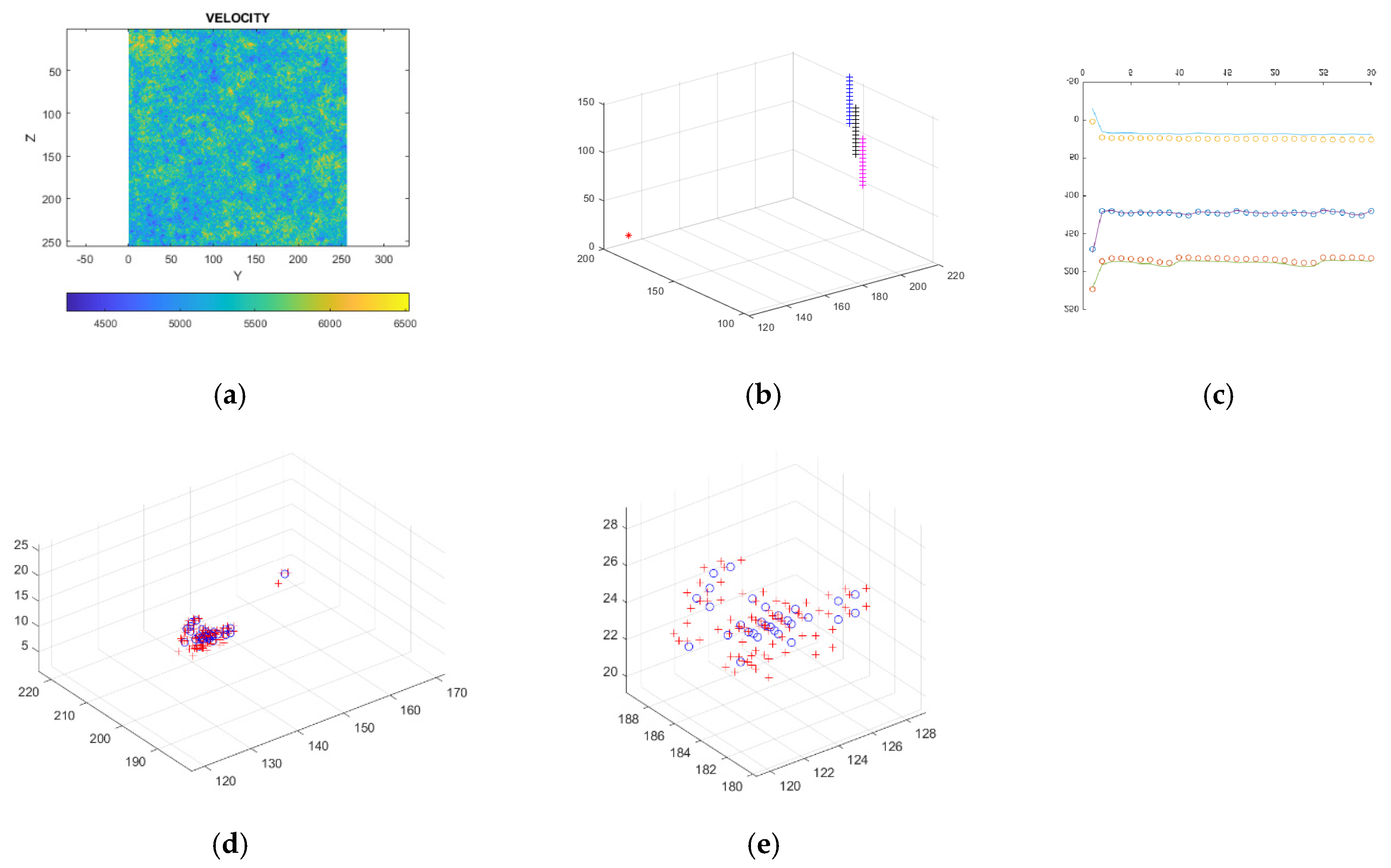
Figure 12 overviews the Meq location inversion process via a numerical simulation of a Figure 8-scale crustal volume of κ(x,y,z) ~ exp(αφ(x,y,z)) poro-permeability distribution. Figure 12a illustrates porosity-driven wave speed fluctuations in a 2D crustal section followed by the Figure 12b schema of wellbore sensors in the stimulation volume able to record waves emanating from a notional source point asterisk. Figure 12c shows successive source-sensor travel-time data as circles tracked by travel-time curves fit to data by a least-squares Nelder-Mead fitting algorithm. The Nelder-Mead algorithm returns the spatial location of the source point from the collective sensor travel-time arrival data. Figure 12d-e are two views of the fidelity of the inverted source locations (red) in relation to the actual locations (blue) for 30 Meq event locations. These source locations are selected as the 30 largest-value poro-permeability sites in the simulation data cube, and as such conform to the Figure 10a poro-permeability distribution. The spatial resolution of the inversions is shown respectively at decameter - and meter-scales. Such an Meq data acquisition and processing conducted at the UtahForge EGS stimulation site can routinely confirm in detail the nature and progress of the EGS stimulation process.
On the basis of existing and future UtahForge observation, the Figure 1 cross-well flow structure sketch can be cast into a generic advection-conduction format in which the radial scale R of the EGS advection-conduction structure can be assessed for a given heat energy flow Q for a given crustal heat reservoir temperature lifetime τ. This result answers the EGS syste4m sustainability problem we posed. We can mow determine if the (existing) EGS flow stimulation process can provide a sufficiently large stimulation volume radius R for a given heat production rate Q for a given duration τ. With Figure 7 prospectively calibrating the present UtahForge EGS cross-well flow system at R ~ 50m able to produce viable heat for 3-10 years at heat production rate Q ~ 20MW, we are in a position to make systematic Meq observations to validate or adjust the Figure 7 process. With a firm Meq-based calibration of the present UtahForge EGS cross-well stimulation volume, we can, for instance, confidently assess what increase of well-to-well offset is needed to increase Q to, say, 40MW while avoiding badly depleting the heat reservoir over, say, a 20 year period. This capability fully and practically defines EGS system sustainability.
4. Discussion
Our deconstruction of the UtahForge EGS flow stimulation data introduces active crustal rock-fluid interactions radically at odds with the passive crustal rock-fluid interaction accepted as normative by the hydrocarbon industry over many decades. We can here formally recognise that to achieve EGS geothermal heat energy extraction we should identify and abandon the passive engineering flow framework inherited from the hydrocarbon industry.
Historically, hydrocarbon recovery institutionally ignored the spatial complexity of crustal permeability. From the 1930s on official records of US onshore oil field production showed that well production was effectively Pareto 80-20 distributed [20]. That is, 20% of wells in an oil field produced 80% of the oil while 80% of the wells produced 20% of the oil. In 1944, J Law published a comprehensive study of oil field well-core porosity and permeability distributions showing porosity was normally distributed and permeability was lognormally distributed [21]. In 1945, J Arps noted that oil field well production declines varied over a range of values over time, indicating large spatial variation in reservoir permeability distributions [22]. In 1956, King Hubbert celebrated the Darcy Law centennial by declaring that groundwater flow fluctuations were uncorrelated randomness at all significant scales and hence could be routinely spatially averaged over [23].
In spite of the pervasive evidence of large scale spatial complexities of reservoir flow heterogeneity e.g., [24], Warren and Root in 1963 introduced the computation-friendly “sugar cube” model of dual-permeability as substitute for the well-known permeability heterogeneity [25]. The sugar cube dual permeability model ignores large scale flow heterogeneity yet remains a mainstay of reservoir flow modelling [26]. In 1972 Bear popularised the computational tactic of the Representative Elementary Volume (REV) based on the concept that reservoir complexity was confined to scales smaller than the REV and this could ignored by modelling flow in units of REV [27]. Reservoir flow variations modelling incorporating REVs remains common practice [28].
In ignoring the pervasive evidence for large-scale crustal permeability, we can express the hydrocarbon industry flow framework as equivalent to the ambient crust poro-permeability distribution with small values of poro-connectivity parameter α, κ(x,y,z) ~ exp(αφ(x,y,z)) 1 + αφ(x,y,z) + (αφ(x,y,z)) )2 + (αφ(x,y,z) )…3… With this formulation of crustal poro-permeability we recover elements of the well-known Carman-Kozeny relation popular in the hydrocarbon industry [29]. We have, however, in Figure 4 conclusive evidence that α is not small, hence that, despite its popularity in the hydrocarbon industry, the Carman-Kozeny relation has little or no field-scale validity.
The general determination of the hydrocarbon industry to ignore poro-permeability heterogeneity in favour of effective passive uniformity is manifested in the industry approach to microseismicity associated with reservoir fluids. While acknowledging that no evidence exists for Meqs to be generated by dislocations along fractures (“ One of the curious features of microseismic technology is that no one has ever seen the slippage plane of a microseism that was induced by a hydraulic fracture.”), it is widely assumed that Meqs are dislocation slips on fracture surfaces [30]. A long-standing feature of the hydrocarbon industry approach to crustal fractures is to assume that Discrete Fracture Networks (DFNs) are purely uncorrelated random distributions at all scales [31]. By definition, uncorrelated randomness can be considered as effectively uniform in the sense that any random feature property at a given position will be balanced by its opposite somewhere in the fracture medium. We thus see the hydrocarbon industry reverting to an overall assumption express by Hubbert [23] that crustal fluid flow systems are adequately treated by spatial averaging as effectively uniform. This working uniformity assumption is exemplified by the treatment of UtahForge EGS stimulation Meq processing of [16] where all Meqs are assumed to occur on stress-aligned fractures rather than being associated with spatially-correlated poro-permeability structures [17]..
Given the evident failure of hydrocarbon industry to engage accurately with the large sale crustal poro-permeability complexity and heterogeneity deconstructed from the UtahForge EGS stimulation flow data, we can conclude that, while the hydrocarbon industry crustal fluid flow framework may suffice for hydrocarbon recovery, it is manifestly a poor starting point for thinking about EGS and crustal heat extraction. Let us consider reservoir sustainability in particular. In hydrocarbon recovery the hydrocarbon reservoir is considered finite, with the hydrocarbons extracted by any profitable method until the reservoir is exhausted and abandoned. There is no thought of hydrocarbon reservoir sustainability; one simply pumps fluids that start out a hydrocarbons and gradually become predominantly water For geothermal energy recovery, on the other hand, the crustal heat reservoir is effectively infinite, but the first order question asked of a geothermal project scheme is whether the project is sustainable for long enough to be commercially viable before the heat extracted advectively exceeds the conductive recharge and cools the heat reservoir.
While it is clear that the physical laws of hydrocarbon and geothermal water flow are identical, the practical concept of crustal reservoir fluid flow are quite different. For energy-rich hydrocarbons, even the most meagre of hydrocarbon flows can often pay for a well. For energy-poor steam only the most vigorous flow can pay for a well.
It follows that a key determinate for both hydrocarbon and stream recovery is reservoir permeability, but in very different ways. For hydrocarbon, provided there is sufficient flow, wells can be drilled uniformly so that each well pays for itself with the bonus that some wells pay far more than low pay wells. For energy-poor geothermal steam flow, however, most wells are simply “sunk costs”, and failure to find the few high flow wells dooms the geothermal project. The only way to find the high flow well sites is to abandon the hydrocarbon recovery drilling mode and fully embrace the physical actuality of ambient crust poro-permeability distribution κ(x,y,z) ~ exp(αφ(x,y,z)) and use this physical actuality to locate the subsurface flow structures that can provide the requisite steam flow rates over sustainable durations.
The three-fold importance of the UtahForge EGS stimulation flow data is, first, the explicit failure of well-to-well hydrofracks to create well-to-well planar cubic-law flow paths as per the EGS canon, second, the success of the 400m-interval open wellbore pressurisation to flow at 30L/s for 30 days, with well-to-well flow beginning at small initial injector well pressures as seen in Figure 2; and third, the return of deep-sensor Meq waveform data which clearly demonstrate that the Meq slip events do not occur on “fault-like” plane surfaces, but instead are consistent with bidirectional fluid expulsion from over-pressured permeability structures [17]. Together the UtahForge EGS flow stimulation data collectively provide direct evidence for comprehensive updated perspectives on EGS sustainability. Ambient crust flow heterogeneity at all scales from cm to km as expressed by the poro-permeability empiric. κ(x,y,z) ~ exp(αφ(x,y,z)) poses serious problems for upscaling to commercial grade crustal heat extraction facilities. The intimate relation between Meqs generated by EGS fluid preservation with the ambient crust poro-permeability κ(x,y,z) ~ exp(αφ(x,y,z)) distribution provides powerful observational means by which to reliably validate, survey, monitor the sustainability of present and future EGS stimulation projects.
Funding
This research received no external funding.
Data Availability Statement
The data presented in this study are openly available in [Utah FORGE: Wells 16A(78)-32 and 16B(78)-32 Stimulation Program Report - May 2024] at [DOI: 10.15121/2483880].
Conflicts of Interest
Author Peter Leary was employed by the company GeoFlow Imaging. The author declares that the research was conducted in the absence of any commercial or financial relationships that could be construed as a potential conflict of interest.
References
- Utah FORGE: Wells 16A(78)-32 and 16B(78)-32 Stimulation Program Report - May 2024. [CrossRef]
- Gringarten, A. C., P. A. Witherspoon, et al. (1975) Theory of Heat Extraction from Fractured Hot Dry Rock. Journal of Geophysical Research 80(8): 1120-1124. [CrossRef]
- Tester JW et al. (2006) The Future of Geothermal Energy -- Impact of Enhanced Geothermal Systems (EGS) on the United States in the 21st Century, Massachusetts Institute of Technology.
- Sutter D, Fox DB, Anderson BJ, Koch DL, von Rohr PR &Tester JW (2011) Sustainable heat farming of geothermal systems: a case study of heat extraction and thermal recovery in a model egs fractured reservoir. 35th Workshop on Geothermal Reservoir Engineering, Stanford University, January 31-February 2.
- Zhang Q and Taleghani AD (2024) Downhole flow management to enhance efficiency of fractured geothermal systems in horizontal wells, 49th Workshop on Geothermal Reservoir Engineering, Stanford University, February 12-14, SGP-TR-227 1.
- Leary PC (2002) Fractures and physical heterogeneity in crustal rock, in Heterogeneity of the Crust and Upper Mantle – Nature, Scaling and Seismic Properties, J. A. Goff, & K. Holliger (eds.), Kluwer Academic/Plenum Publishers, New York, 155-186.
- Leary PC & Al-Kindy F (2002) Power-law scaling of spatially correlated porosity and log(permeability) sequences from north-central North Sea Brae oilfield well core, Geophysics Journal International 148, 426–442. [CrossRef]
- Leary PC, Malin PE & Pogacnik JA (2012) Computational EGS -- heat transport in 1/f-noise fractured media, 37th Workshop on Geothermal Reservoir Engineering .Stanford, California, January 30 - February 1, 2012 SGP-TR-194.
- Leary P, Malin P, Saarno T and Kukkonen (2018) αφ ~ αφcrit – Basement rock EGS as extension of reservoir rock flow processes, 43rd Workshop on Geothermal Reservoir Engineering, Stanford University, February 12-14, SGP-TR-213 1.
- Leary P. Malim P, Saarno T, Heikkinen P and Diningrat W (2019) Coupling crustal seismicity to crustal permeability – Power-law spatial correlation for EGS-induced and hydrothermal seismicity , 44th Workshop on Geothermal Reservoir Engineering, Stanford University, February 11-13, 2019 SGP-TR-214 1.
- Simmons SF & Barker B (2025) Utah FORGE geothermal resource assessment based on stored heat. Unpublished Utah FORGE report, https://gdr.openei.org/submissions/1745.
- Success of Geothermal Wells: A global study (2013) International Finance Corporation – 7230 https://ope nknowledge.worldbank.org/bitstreams/cdf75592-bb66-5feb-b138-38f7221d2366.
- Leary P, Malin P & Niemi R (2017) Fluid flow & heat transport computation for power-law scaling poroperm media, Geofluids, Volume 2017. [CrossRef]
- Leary P, Malin P, Saarno T & Kukkonen I (2017) Prospects for Assessing Enhanced Geothermal System (EGS) Basement Rock Flow Stimulation by Wellbore Temperature Data, Energies, vol 10 , no. 12. [CrossRef]
- Carslaw HS & Jaeger J (1959) Conduction of Heat in Solids, Oxford University Press. [CrossRef]
- Rutledge J, Pankow K, Niemz P, Dyer B and Karvounis d (2025) Microseismic source mechanisms during a Utah FORGE injection stimulation, 50th Workshop on Geothermal Reservoir Engineering Stanford University, February 10-12, SGP-TR-229 1.
- Malin PW and Leary PC (2023) Haskell Waveform Modeling of EGS Stimulation Meqs as Slow Ruptures Within Ambient Crust Permeability Structures, 48th Workshop on Geothermal Reservoir Engineering , February 6-8, 2023 SGP-TR-2243.
- Schubert F (2012) Basic Principles of acoustic emission tomography, Journal of Acoustic Emission. https://www.ndt.net.
- Shapiro SA, Rentsch S, and Rothert R ( 2003) Characterization of hydraulic properties of rocks using probability of fluid-induced micro-earthquakes, https://www.wit.uni-hamburg.de › wit2003-rentsch. [CrossRef]
- The Distribution of U.S. Oil and Natural Gas Wells by Production Rate with Data Through 2024, www.eia.gov.
- Law J (1944) A statistical approach to the interstitial heterogeneity of sand reservoirs. Trans AIME. 1944; 155: 202-222. [CrossRef]
- Arps JJ (1945) Analysis of decline curves, AIME Petroleum Technology 1758, 1944. [CrossRef]
- Hubbert MK. Darcy’s law and the field equations of the flow of underground fluids. Hydrol Sci J. 1957; 2: 23-59. [CrossRef]
- Warren JE, Price HS. Flow in heterogeneous porous media. Soc Pet Eng J. 1961; 1: 153-169. ; Warren JE, Skiba FF. Macroscopic dispersion. Soc Pet Eng J. 1964; 4: 215-230.
- Warren JE & Root PJ (1963) The behavior of naturally fractured reservoirs, Society of Petroleum Engineers Journal, pp. 245–255.
- Pruess K, Oldenburg C & Moridis (2012) TOUGH2 User’s Guide, Version 2.1, Tech. Rep. LBNL-43134, Lawrence Berkeley National Laboratory; Pruess K (2003) The TOUGH Codes - A Family of Simulation Tools for Multiphase Flow and Transport Processes in Permeable Media MS 90-1 1 16, LBNL; Arbogast T, Douglas, Jr. J & Hornung U (1990) Derivation of the double porosity model of single phase flow via homogenization theory, Siam J. Math. Anal. Vol. 21, No. 4, Pp. 823–836.
- Bear J (1972) Dynamics of fluids in porous media. New York: American Elsevier Publishing Company, Inc; Bachmat Y, Bear J. On the concept and size of a representative elementary volume (Rev). Advances in Transport Phenomena in Porous Media. Dordrecht: Springer; 1987. [CrossRef]
- Nordahl K & Ringrose P (2008) Identifying the representative elementary volume for permeability in heterolithic deposits using numerical rock models. Math Geosci. 2008; 40: 753-771. [CrossRef]
- Dvorkin J 2009) kozeny-Carman equation revisited, Stanford Geothermal Workshop 2009.
- Warpinski NR (2013) Understanding Hydraulic Fracture Growth, Effectiveness, and Safety Through Microseismic Monitoring. [CrossRef]
- Welch MJ, Lüthje1 M & Oldfield SJ (2022) DFN Generator v2.0: A new tool to model the growth of large-scale natural fracture networks using fundamental geomechanics. [CrossRef]
Figure 1.
Sketch of UtahForge EGS stimulation flow system geometry. The sketch is extracted from a traditional assessment of the UtahForge EGS system suitability. [11]. In the present discussion the crustal volume is defined throughout the sketch volume by a poro-permeability distribution κ(x,y,z) ~ exp(αφ(x,y,z)), with the cross-well crustal volume of 100m diameter having a stimulated poro-permeability κs(x,y,z) ~ exp(‘φ(x,y,z)),. The poro-connectivity value α’ > α increases cross-well flow without needing deformation energy to increase cross-well porosity.
Figure 1.
Sketch of UtahForge EGS stimulation flow system geometry. The sketch is extracted from a traditional assessment of the UtahForge EGS system suitability. [11]. In the present discussion the crustal volume is defined throughout the sketch volume by a poro-permeability distribution κ(x,y,z) ~ exp(αφ(x,y,z)), with the cross-well crustal volume of 100m diameter having a stimulated poro-permeability κs(x,y,z) ~ exp(‘φ(x,y,z)),. The poro-connectivity value α’ > α increases cross-well flow without needing deformation energy to increase cross-well porosity.
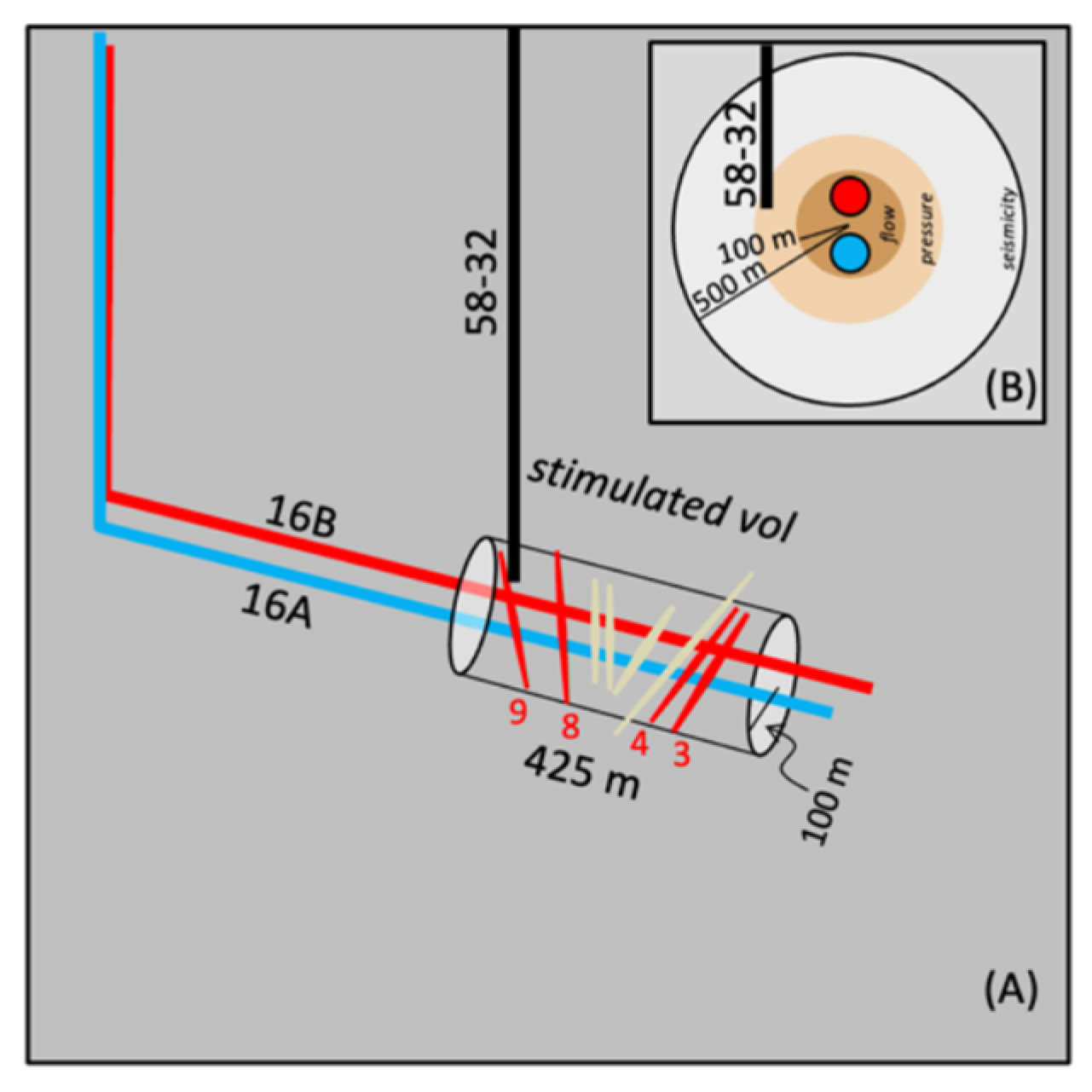
Figure 2.
UtahForge EGS stimulation flow data Figures 25 and 26 from 2024 stimulation treatment report [1]. (a) Injector wellbore pressurisation of 400m length of open hole (blue trace) > 0 at ~ 50 minutes. (b) Fluid flow rates in injector (red) and producer (blue) wellbores beginning at the time of injector pressurisation. The producer well flow rate lags the injector flow rate due to finite fluid flow travel time over the 100m well-pair separation. Well-to-well flow occurs immediately with pressurisation, indicating that the EGS stimulation procedures created well-to-well flow connectivity within the cross-well volume that was accessible to the whole-well pressurisation fluid column that were not available to the discrete isolated hydrofrack intervals. We can conclude that well-to-well flow occurs via the disseminated volumetric poro-permeability distribution κ(x,y,z) ~ exp(αφ(x,y,z)) accessed by the 400 meters of open hole pressurisation fluids. .
Figure 2.
UtahForge EGS stimulation flow data Figures 25 and 26 from 2024 stimulation treatment report [1]. (a) Injector wellbore pressurisation of 400m length of open hole (blue trace) > 0 at ~ 50 minutes. (b) Fluid flow rates in injector (red) and producer (blue) wellbores beginning at the time of injector pressurisation. The producer well flow rate lags the injector flow rate due to finite fluid flow travel time over the 100m well-pair separation. Well-to-well flow occurs immediately with pressurisation, indicating that the EGS stimulation procedures created well-to-well flow connectivity within the cross-well volume that was accessible to the whole-well pressurisation fluid column that were not available to the discrete isolated hydrofrack intervals. We can conclude that well-to-well flow occurs via the disseminated volumetric poro-permeability distribution κ(x,y,z) ~ exp(αφ(x,y,z)) accessed by the 400 meters of open hole pressurisation fluids. .
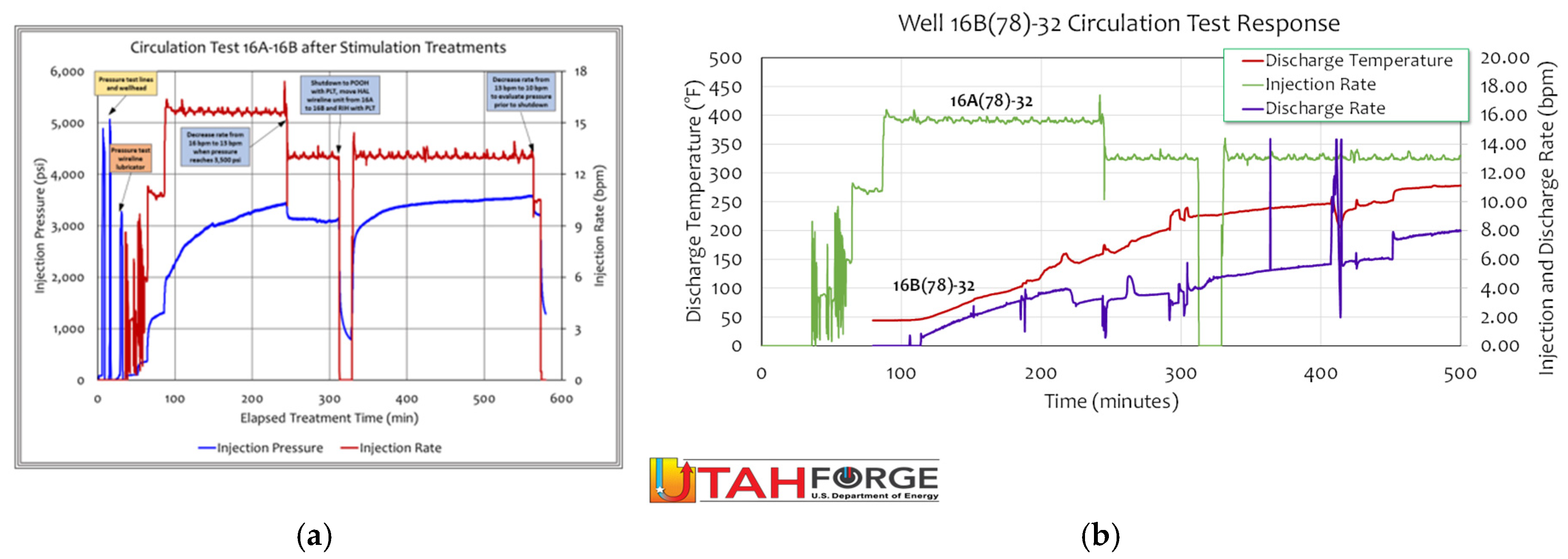
Figure 3.
UtahForge EGS stimulation flow data Figure 27 from 2024 stimulation treatment report [1]. At left is listed the wellbore measured depths of pre-programmed hydrofracture packer-isolation intervals. At right is shown the measured fluid flow rates measured by the flow-rate logging tool at the stated depths. The shown fluid rates are percentages of the total cross-well flow as measured at each pre-programed hydrofracture depth interval. The injector wellbore flow data show that during the Figure 2 pressurisation of the entire length of the injector well, injector wellbore fluid exited the well in semi-uniform rates along the 400m open well reach. The exiting fluid was not constrained to limited wellbore intervals by packers used in the earlier sequence of cross-well hydrofrack attempts. The semi-uniform flow is consistent with flow variations expected for open wellbore intervals access the full range of ambient crust poro-permeability flow paths given by κ(x,y,z) ~ exp(αφ(x,y,z)). The observed mean and standard deviation are respectively 11% and 9%; numerical simulations of κ(x,y,z) ~ exp(αφ(x,y,z)) distribution return mean values of order 12% with 8% standard deviations. .
Figure 3.
UtahForge EGS stimulation flow data Figure 27 from 2024 stimulation treatment report [1]. At left is listed the wellbore measured depths of pre-programmed hydrofracture packer-isolation intervals. At right is shown the measured fluid flow rates measured by the flow-rate logging tool at the stated depths. The shown fluid rates are percentages of the total cross-well flow as measured at each pre-programed hydrofracture depth interval. The injector wellbore flow data show that during the Figure 2 pressurisation of the entire length of the injector well, injector wellbore fluid exited the well in semi-uniform rates along the 400m open well reach. The exiting fluid was not constrained to limited wellbore intervals by packers used in the earlier sequence of cross-well hydrofrack attempts. The semi-uniform flow is consistent with flow variations expected for open wellbore intervals access the full range of ambient crust poro-permeability flow paths given by κ(x,y,z) ~ exp(αφ(x,y,z)). The observed mean and standard deviation are respectively 11% and 9%; numerical simulations of κ(x,y,z) ~ exp(αφ(x,y,z)) distribution return mean values of order 12% with 8% standard deviations. .
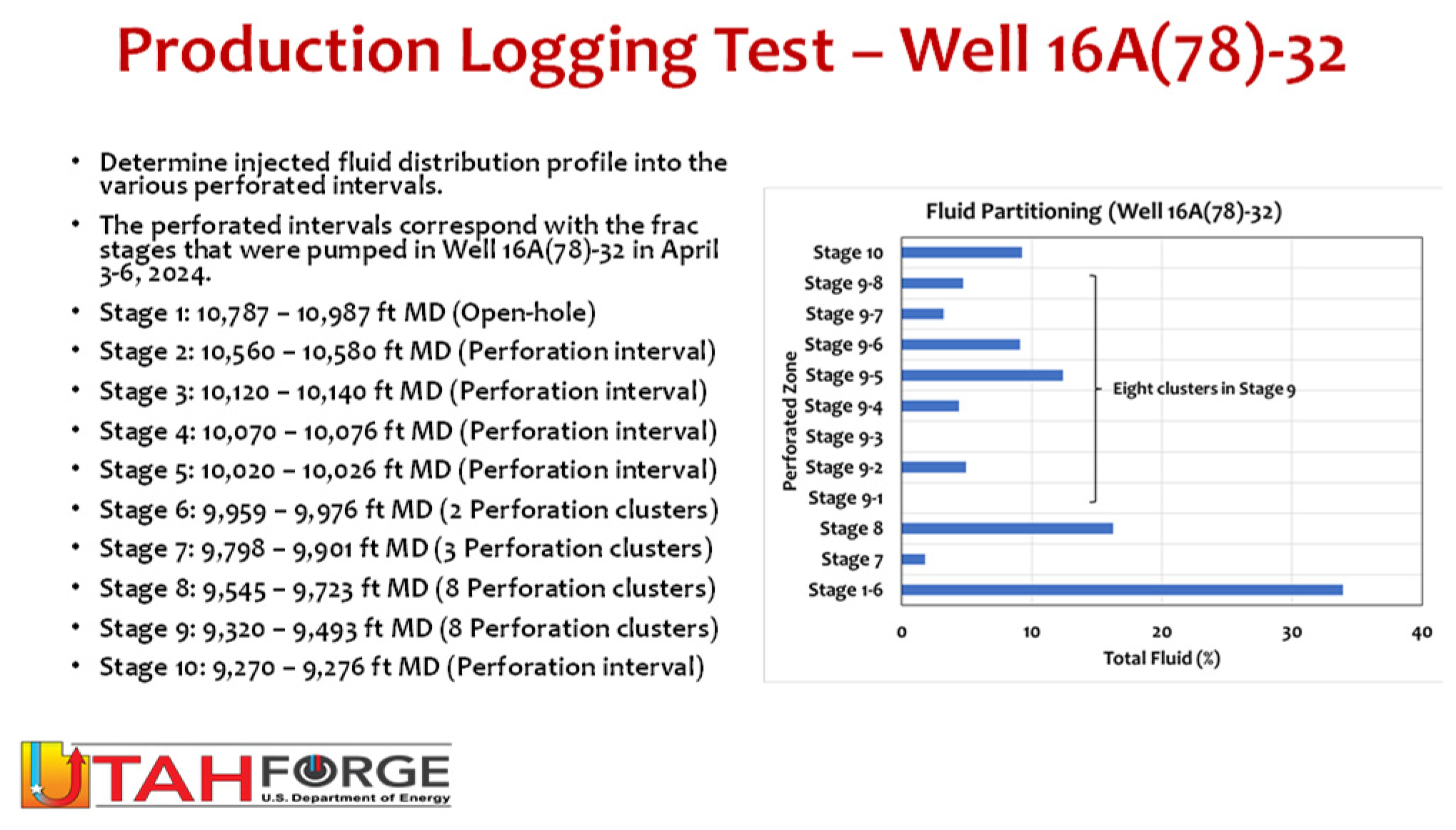
Figure 4.
(a) Well-core porosity (blue) and log(permeability) (red) data for a 200m-thick reservoir formation. The data reduced to zero-mean/unit-variance format return a Zero-lag cross-correlation of 87; an equivalent cross-correlation of purely random numbers has 6% value. (b)-(c) Plots of porosity (horizontal axis) against log(permeability) (vertical axis) for sequences of reservoir formations in South Australia [9]. The slope of each plot gives the value of poro-connectivity α for each formation. The mean α value is 4; the standard deviation from the mean is 1. The range of naturally occurring α values indicates the plausibility that UtahForge cross-well pressurisation treatments can alter α within the cross-well volume by 50% or more without expending stimulation energy by increasing porosity. .
Figure 4.
(a) Well-core porosity (blue) and log(permeability) (red) data for a 200m-thick reservoir formation. The data reduced to zero-mean/unit-variance format return a Zero-lag cross-correlation of 87; an equivalent cross-correlation of purely random numbers has 6% value. (b)-(c) Plots of porosity (horizontal axis) against log(permeability) (vertical axis) for sequences of reservoir formations in South Australia [9]. The slope of each plot gives the value of poro-connectivity α for each formation. The mean α value is 4; the standard deviation from the mean is 1. The range of naturally occurring α values indicates the plausibility that UtahForge cross-well pressurisation treatments can alter α within the cross-well volume by 50% or more without expending stimulation energy by increasing porosity. .
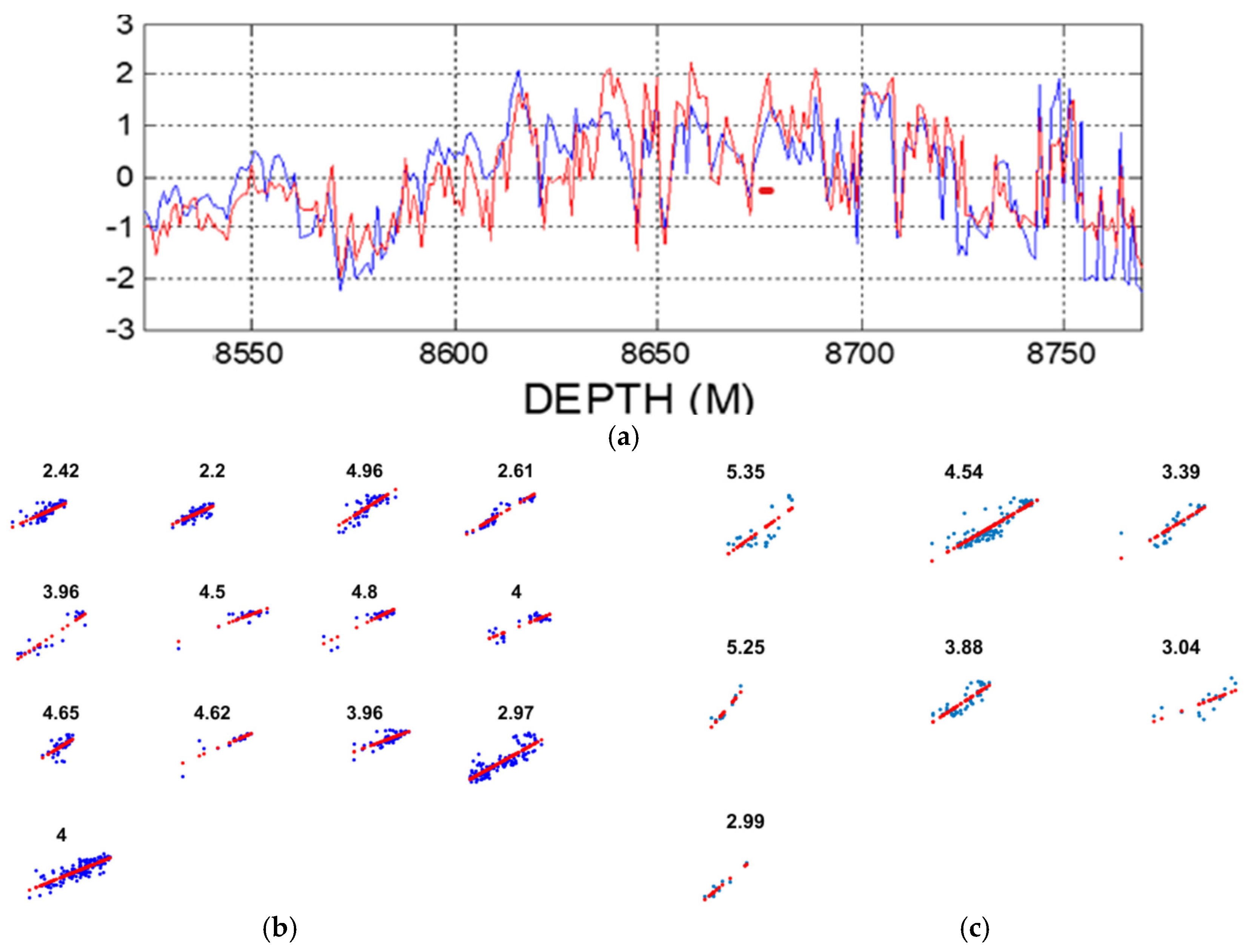
Figure 5.
Cross-well Darcy fluid flow for poro-permeability media distributions κ(x,y,z) ~ exp(αφ(x,y,z)) with low α (a) and high α (b). An important feature of the illustrated EGS crustal stimulation process is that the concurrent microseismic emissions recorded by local seismic sensors can locate the emission sources in time and space to provide an ongoing image of the stimulation volume.
Figure 5.
Cross-well Darcy fluid flow for poro-permeability media distributions κ(x,y,z) ~ exp(αφ(x,y,z)) with low α (a) and high α (b). An important feature of the illustrated EGS crustal stimulation process is that the concurrent microseismic emissions recorded by local seismic sensors can locate the emission sources in time and space to provide an ongoing image of the stimulation volume.

Figure 6.
(a) Eq (1) time-evolving radial temperature field 0 < T(r,t) < 1 for a Figure 1 crustal cylindrical section of radius 150m with a central line-sink of radius a = 10m. Yellow denotes the crustal ambient temperature; blue denotes the line-sink wellbore temperature fixed by the heat flux boundary condition (b-d) Top-down temperature view for heat-sink radii r = 20m, 30m, 40m. .
Figure 6.
(a) Eq (1) time-evolving radial temperature field 0 < T(r,t) < 1 for a Figure 1 crustal cylindrical section of radius 150m with a central line-sink of radius a = 10m. Yellow denotes the crustal ambient temperature; blue denotes the line-sink wellbore temperature fixed by the heat flux boundary condition (b-d) Top-down temperature view for heat-sink radii r = 20m, 30m, 40m. .
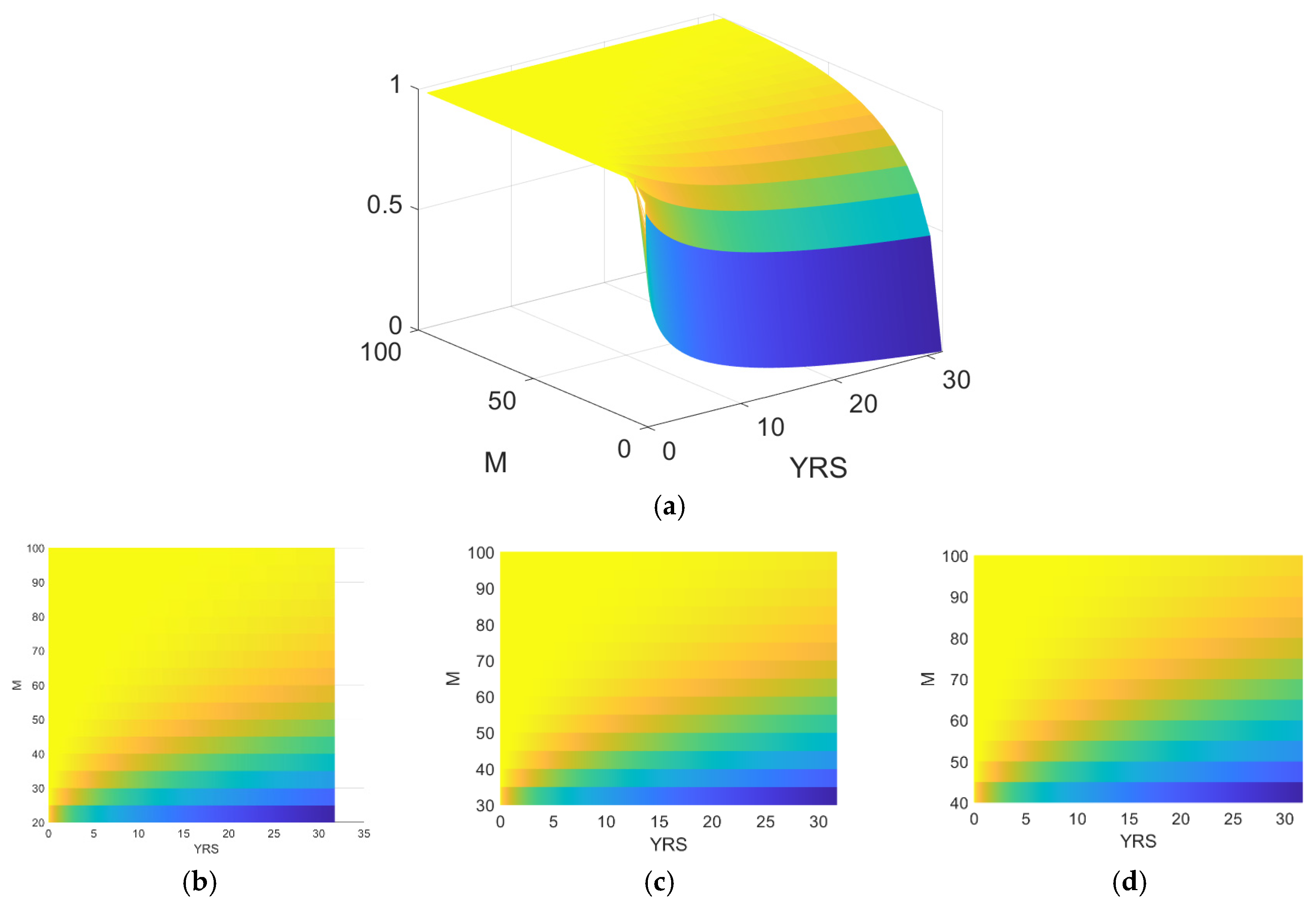
Figure 7.
(a-c) Three top-down views of numerical simulations of Eq (1) heat extraction geometry approximation to UtahForge EGS stimulation flow system for heat extraction rate Q/ℓ ~ 20/400MW/m for line-sink radii r ~ 5m, 15m, 25m respectively. Black line represents the UtahForge production well at 50m offset from the central line-sink. (d) Time-evolving temperature profiles for trio of temperature fields at r = 50m radial offset from the line-sink representing the crust temperature at the UtahForge production well. Blue/red/gold traces equate to (a-c) temperature fields. An effective r = 5m line-sink does not affect the production well temperature, while an r = 25m line-sink radius cools the production well temperature by 20oC over 30yrs. A working assumption is that the actual effective line-sink radius lies between these two extremes whereby the production well cools by 10oC after 30 yrs.
Figure 7.
(a-c) Three top-down views of numerical simulations of Eq (1) heat extraction geometry approximation to UtahForge EGS stimulation flow system for heat extraction rate Q/ℓ ~ 20/400MW/m for line-sink radii r ~ 5m, 15m, 25m respectively. Black line represents the UtahForge production well at 50m offset from the central line-sink. (d) Time-evolving temperature profiles for trio of temperature fields at r = 50m radial offset from the line-sink representing the crust temperature at the UtahForge production well. Blue/red/gold traces equate to (a-c) temperature fields. An effective r = 5m line-sink does not affect the production well temperature, while an r = 25m line-sink radius cools the production well temperature by 20oC over 30yrs. A working assumption is that the actual effective line-sink radius lies between these two extremes whereby the production well cools by 10oC after 30 yrs.
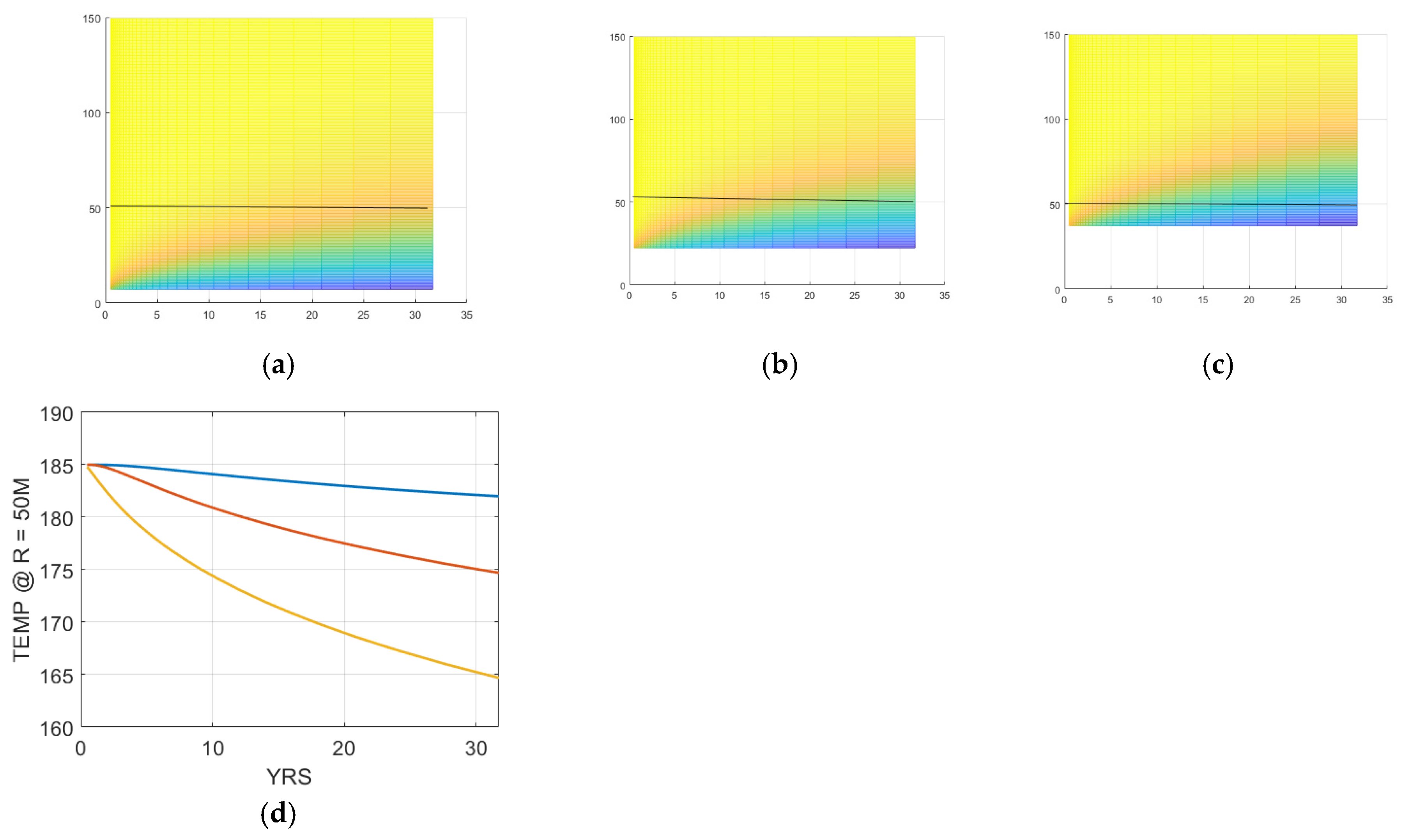
Figure 8.
UtahForge EGS stimulation flow structure microseismicity event (Meq) distribution surounding the injection/production well-pair [1]. Rectangles mark the notional position of cross-well stimulation events sketched in Figure 1 Blue dots along vertical sensor wellbores in black denote seismic sensors recording Meq emissions. Figure 9, Figure 10 and Figure 11 illustrate the internal statistical and dislocation-slip properties of such Meq events that testify to the κ(x,y,z) ~ exp(αφ(x,y,z)) origin of these EGS-induced seismic emissions.
Figure 8.
UtahForge EGS stimulation flow structure microseismicity event (Meq) distribution surounding the injection/production well-pair [1]. Rectangles mark the notional position of cross-well stimulation events sketched in Figure 1 Blue dots along vertical sensor wellbores in black denote seismic sensors recording Meq emissions. Figure 9, Figure 10 and Figure 11 illustrate the internal statistical and dislocation-slip properties of such Meq events that testify to the κ(x,y,z) ~ exp(αφ(x,y,z)) origin of these EGS-induced seismic emissions.
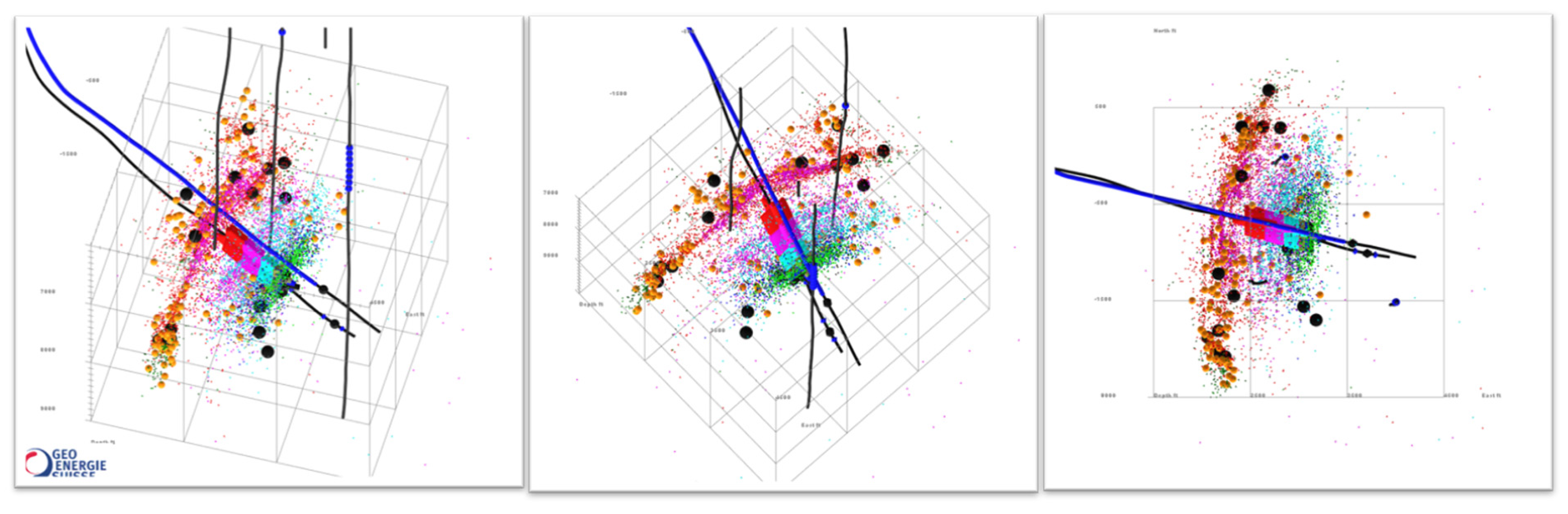
Figure 9.
UtahForge EGS stimulation microseismicity (Meq) size and pairwise spatial correlation statistics. (a) UtahForge Meq event location for three stimulations in 2022. (b) Meq moments are lognormally distributed, with small numbers of small moments occurring naturally instead of increasing indefinitely as per the Gutenberg-Richter relation for fault-zone seismicity. (c) Two-point spatial correlation distributions G(r) ~ 1/r, r = pairwise Meq event offsets; in the staandard view Meqs are not correlated.
Figure 9.
UtahForge EGS stimulation microseismicity (Meq) size and pairwise spatial correlation statistics. (a) UtahForge Meq event location for three stimulations in 2022. (b) Meq moments are lognormally distributed, with small numbers of small moments occurring naturally instead of increasing indefinitely as per the Gutenberg-Richter relation for fault-zone seismicity. (c) Two-point spatial correlation distributions G(r) ~ 1/r, r = pairwise Meq event offsets; in the staandard view Meqs are not correlated.
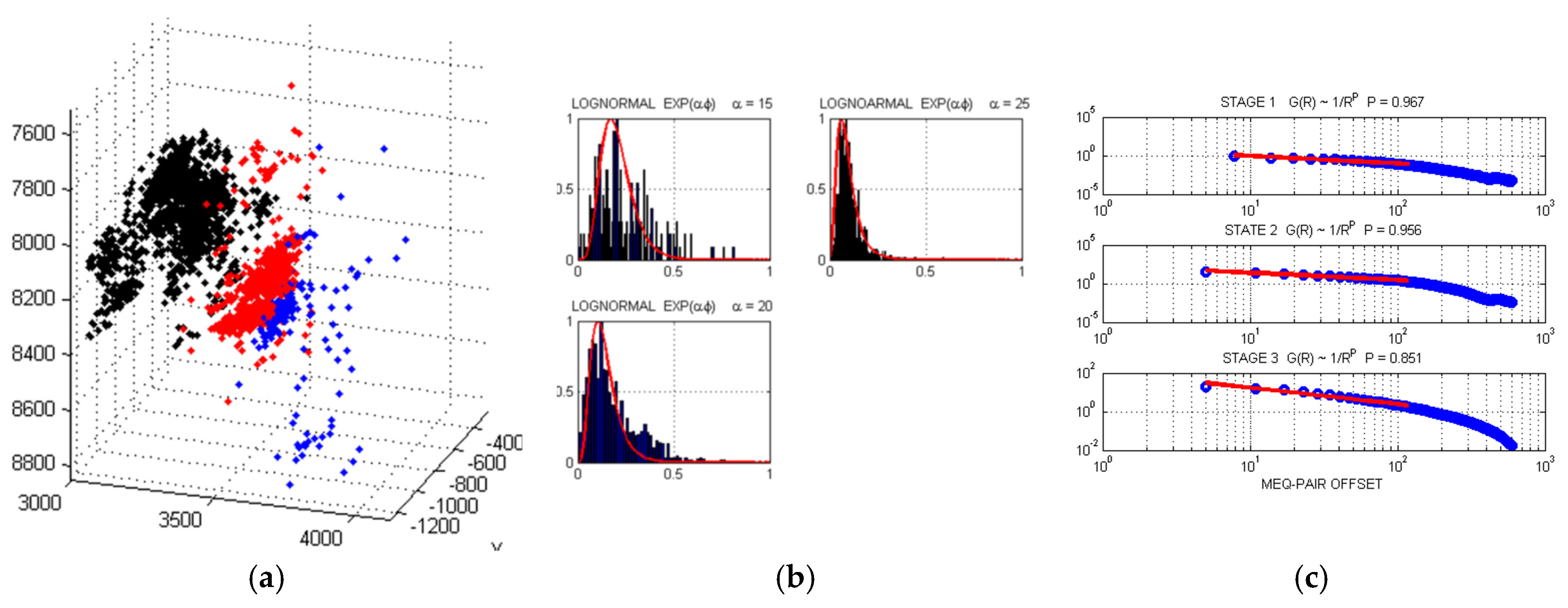
Figure 10.
Comparison of two synthetic representations of UtahForge EGS stimulation Meq size and spatial correlation distributions. (a) Meq ev ents occur as dislocation slip within high poro-permeability structures in an ambient crust poro-permeability empiric κ(x,y,z) ~ exp(αφ(x,y,z)). (b) Meqs are white noise randomly spaced as regularly assumed in discrete fracture network (DFN) constructions. (c) Above is lognormal size distribution of upper left Meqs, below is normal distribution of upper-right random Meqs. (d) Above is the G(r) ~1/r two-point spatial correlation function G(r) ~ 1/r and below is the white noise random spatial correlation function G(r) ~ const. The empiric κ(x,y,z) ~ exp(αφ(x,y,z)) synthetic Meq size and spatial correlation statistics are identical to those of the Figure 10 UtahForge EGS stimulation Meqs, thus v\validating the working hypotheses that UtahForge EGS stimulations proceed via interacting with the pre-existing ambient crust poro-permeability field.
Figure 10.
Comparison of two synthetic representations of UtahForge EGS stimulation Meq size and spatial correlation distributions. (a) Meq ev ents occur as dislocation slip within high poro-permeability structures in an ambient crust poro-permeability empiric κ(x,y,z) ~ exp(αφ(x,y,z)). (b) Meqs are white noise randomly spaced as regularly assumed in discrete fracture network (DFN) constructions. (c) Above is lognormal size distribution of upper left Meqs, below is normal distribution of upper-right random Meqs. (d) Above is the G(r) ~1/r two-point spatial correlation function G(r) ~ 1/r and below is the white noise random spatial correlation function G(r) ~ const. The empiric κ(x,y,z) ~ exp(αφ(x,y,z)) synthetic Meq size and spatial correlation statistics are identical to those of the Figure 10 UtahForge EGS stimulation Meqs, thus v\validating the working hypotheses that UtahForge EGS stimulations proceed via interacting with the pre-existing ambient crust poro-permeability field.
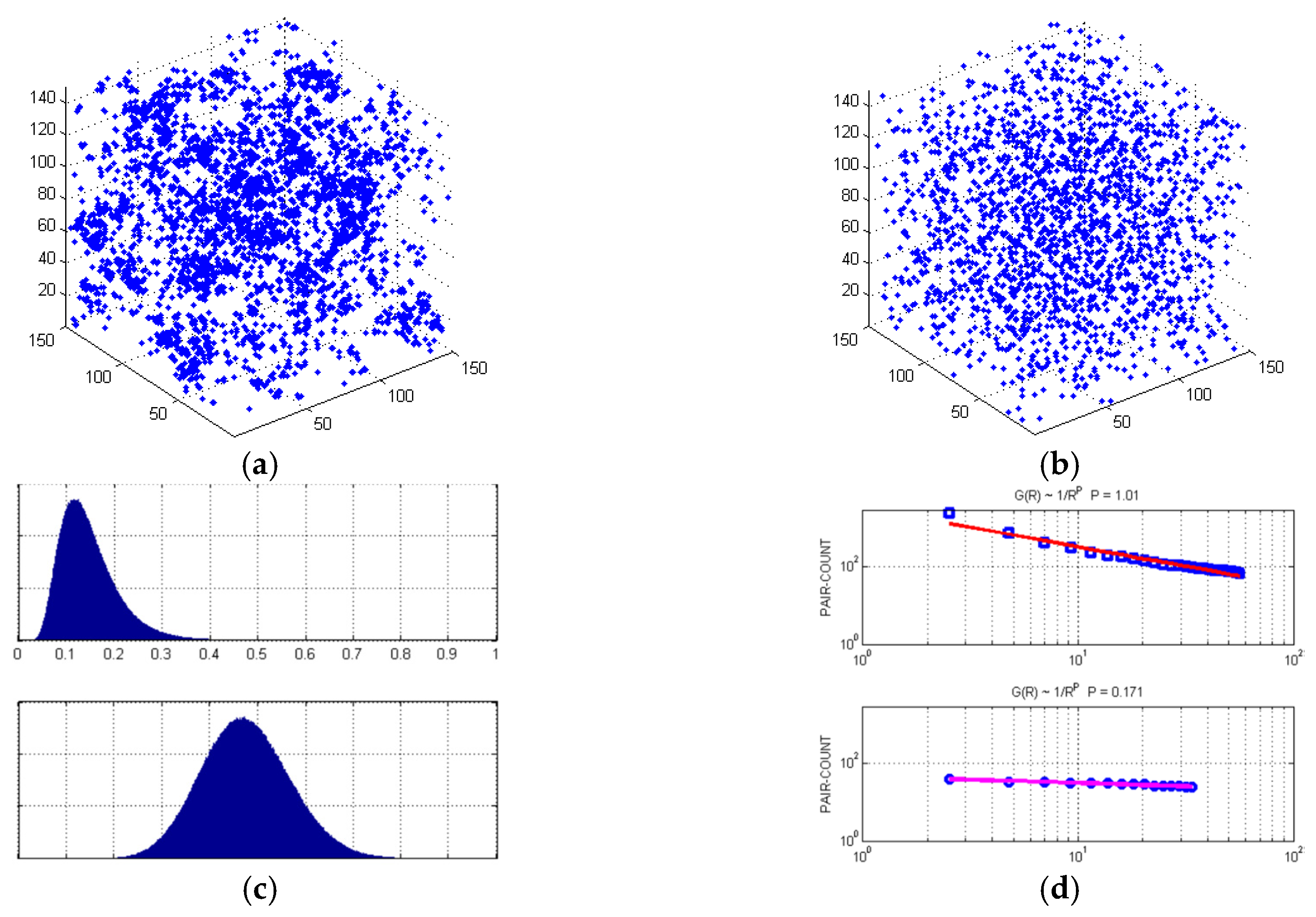
Figure 11.
(a) Unidirectional fault-zone slip-mechanics constant velocity rupture dislocation profile (above) and resultant unidirectional far-field displacement waveform of duration t (below). (b) Bidirectional first motion P-wave displacement waveforms in red recorded at 2kHz sample rate on vertical array sensors in crystalline basement at 2.5km depth directly above a km-scale EGS controlled-stimulation volume at 6km depth.
Figure 11.
(a) Unidirectional fault-zone slip-mechanics constant velocity rupture dislocation profile (above) and resultant unidirectional far-field displacement waveform of duration t (below). (b) Bidirectional first motion P-wave displacement waveforms in red recorded at 2kHz sample rate on vertical array sensors in crystalline basement at 2.5km depth directly above a km-scale EGS controlled-stimulation volume at 6km depth.
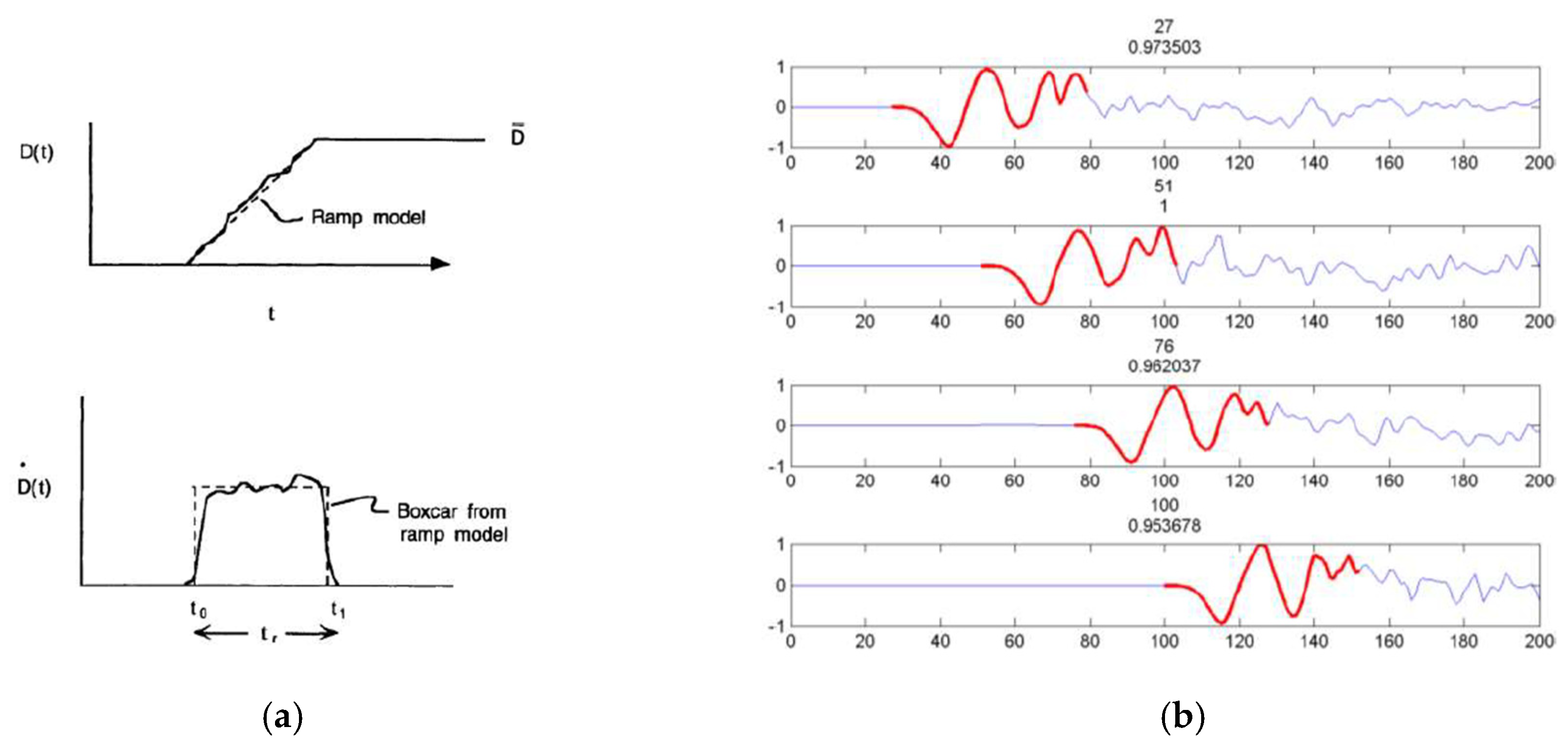
Figure 12.
Numerical simulation summary of Meq surveillance of UtahForge EGS stimulation process for source-sensor geometry shown in Figure 8: (a) 2D seismic wave speed fluctuations due to pink-noise porosity distributiomn φ(x,y,z)); (b) Meq source (*) andwellbore sensors (+); (c) Nelder-Mead traveltime inversion fit (lines) to sensor travel times (o); (d) decameter-scale spatial resolution of Meq fit locations (red) to actual source locations (blue); (e) meter-scale resolutions of Meq locat.
Figure 12.
Numerical simulation summary of Meq surveillance of UtahForge EGS stimulation process for source-sensor geometry shown in Figure 8: (a) 2D seismic wave speed fluctuations due to pink-noise porosity distributiomn φ(x,y,z)); (b) Meq source (*) andwellbore sensors (+); (c) Nelder-Mead traveltime inversion fit (lines) to sensor travel times (o); (d) decameter-scale spatial resolution of Meq fit locations (red) to actual source locations (blue); (e) meter-scale resolutions of Meq locat.
Disclaimer/Publisher’s Note: The statements, opinions and data contained in all publications are solely those of the individual author(s) and contributor(s) and not of MDPI and/or the editor(s). MDPI and/or the editor(s) disclaim responsibility for any injury to people or property resulting from any ideas, methods, instructions or products referred to in the content. |
© 2026 by the authors. Licensee MDPI, Basel, Switzerland. This article is an open access article distributed under the terms and conditions of the Creative Commons Attribution (CC BY) license (http://creativecommons.org/licenses/by/4.0/).
Copyright: This open access article is published under a Creative Commons CC BY 4.0 license, which permit the free download, distribution, and reuse, provided that the author and preprint are cited in any reuse.


