
Submitted:
04 February 2026
Posted:
05 February 2026
You are already at the latest version
Abstract
Exploring effective training methods to reliably trigger scoring in electronic protective gear is a significant challenge faced by coaches and athletes, and it constitutes a critical research direction that urgently demands scientific exploration. To improve the scientific precision of daily Taekwondo training and enhance competitive performance more efficiently, there is a need to develop a hydrogel-based flexible pressure sensing film. This film would enable traditional Taekwondo protective gear with electronic sensing capabilities via a simple adhesion method. By attaching a low-cost, high-precision, and appropriately flexible gel-based pressure-sensing film to conventional protective gear through a straightforward adhesion approach, it can attain sensing performance comparable to that of specialized competition-grade electronic protective gear. This innovation will provide technological support for advancing the scientific rigor of Taekwondo training in China. This study focuses on the design and development of high-strength, high-toughness ionic hydrogels, offering technical backing for the creation of flexible pressure-sensing films tailored for Taekwondo applications.
Keywords:
taekwondo
; electronic protective gear
; sensing films
; ionogel
; stress-strain
1. Introduction
Taekwondo is a combat sport characterized by direct physical contact and high-intensity competition, and it is an official event in the Olympic Games [1]. To ensure fairness, impartiality, and real-time scoring in Taekwondo competitions, the World Taekwondo Federation first decided to introduce electronic protective gear into competitions at the 18th Asian Taekwondo Championships in 2008. Since then, all official Taekwondo competitions have adopted electronic gear to assist in scoring. The validity of strikes is primarily assessed in two approaches. Firstly, points scored by punches to valid target areas are judged and awarded by referees. Secondly, points from kicks to valid target areas are determined by sensors embedded in the protective gear. These sensors quantify the force of impact when the foot protector strikes the opponent's body or head protector, thereby determining the validity of the strike. This approach acts as the primary scoring mechanism in competitions, rendering electronic scoring the "key player" in determining victory or defeat [2,3,4]. Currently, DaeDo and KP&P are the two officially recognized electronic protective gear brands by the World Taekwondo Federation (WT), and they are alternately utilized across all levels of Taekwondo competitions.
The full set of sensor-integrated electronic protective gear employed in Taekwondo competitions is relatively costly and has a limited service life. Additionally, the supporting software is frequently updated and often fails to meet the requirements of daily Taekwondo training. Studies have indicated that sports teams nationwide procure only a limited number of electronic protective gear sets, with athletes predominantly training with traditional, non-sensor-equipped gear. However, when training with traditional gear, numerous techniques that athletes perceive as score-worthy are often not validated by electronic scoring systems. The primary reason for this is athletes’ inadequate understanding of the operational principles of electronic sensors. This results in a high incidence of ineffective or excessively forceful techniques in competitions and practical training. Ineffective techniques waste athletes' energy without securing points, whereas excessively forceful actions can disrupt balance, delay posture recovery, and hinder the execution of follow-up techniques—all of which diminish scoring efficiency [5]. It is common in competitions to observe cases where an attacking athlete strikes a valid scoring area on the opponent's gear with a clear, audible impact (a technique that would typically be scored by human judges), yet the electronic system fails to award points. Even athletes who excel in training often a low attain low scores within the allotted competition time. This suggests that numerous techniques practiced in training do not satisfy the criteria for electronic scoring validation, thus failing to effectively improve competitive performance. Consequently, the efforts invested in daily training yield limited outcomes, leading to considerable frustration for both coaches and athletes.
Presently, electronic protective gear is mandatory equipment for Taekwondo World Championships and the Olympic Games. However, national sports teams and Taekwondo associations worldwide maintain a large inventory of traditional gear but possess only a limited number of electronic sets. Consequently, athletes predominantly train with traditional gear, presenting a major challenge for coaches and athletes to develop training methods that can effectively simulate the scoring mechanisms of electronic gear. This issue also represents a critical research direction that urgently requires attention in the field of sports science. Therefore, to enhance the scientific rigor of daily Taekwondo training and improve its effectiveness in boosting competitive performance, there is a need to develop a hydrogel-based flexible pressure sensing film that can enable traditional Taekwondo gear to acquire electronic sensing capabilities. Using the simplest adhesion methods, this low-cost, high-precision, and suitably flexible hydrogel pressure sensing film can be attached to traditional gear, endowing it with sensing functions identical to those of specialized electronic competition gear. This advancement would provide technological support for elevating the scientific standards of Taekwondo training.
As a flexible sensing technology based on advanced materials, hydrogel-based flexible pressure-sensing films are highly suitable for flexible electronic device design owing to their superior elasticity, extensibility, and transparency. Hydrogel sensors possess superior extensibility and elasticity, which minimize their interference with Taekwondo protective gear and avoid disrupting athletes during training. Researchers have achieved significant progress in investigating the related properties of hydrogel flexible sensors. For instance, Ruya et al. developed a flexible all-fabric supercapacitive wearable pressure sensor based on an elastic ion-electron interface, which greatly enhanced the sensitivity of ionic pressure sensors and provided technical insights for designing flexible pressure sensing films [6]. Yan et al. proposed the utilization of quadruple hydrogen-bond-crosslinked supramolecular polymer materials as substrates for stretchable, tear-resistant, and self-healing film electrodes, enabling self-healing functionality in flexible materials and offering technical guidance for hydrogel self-healing design [7]. Wang et al. employed interfacial bonding techniques to combine high-modulus fibers with low-modulus matrices, creating a composite material with high toughness and low hysteresis. This approach achieved the physical properties of high toughness and low hysteresis in elastic materials like hydrogels, providing technical references for enhancing the toughness and accuracy of flexible sensors [8]. Deng et al. studied novel self-deformable soft-hard composite hydrogel films, offering new ideas for designing sensors with special properties [9]. Lee et al. designed a high-performance transparent polymer film [10], while Yan et al. developed a transistor film capable of high-fidelity monitoring and local amplification of potential and electrophysiological signals, providing technical references for designing thin-film transistors in hydrogel films [11]. Wang et al. designed an ionogel with high toughness, shape memory, and self-healing properties, offering technical insights for the design of anti-dynamic fatigue hydrogel devices in this study [12]. Xie et al. developed a mussel-inspired hydrogel with conductivity, long water retention, and self-healing functions [13]. Zhang et al. conducted research on hydrogel toughness, providing theoretical guidance for improving the toughness of hydrogel devices [14]. He et al. designed a high-precision sensor using a polymer-carbon composite system, which was fabricated into a wearable device capable of monitoring subtle humidity fluctuations in the human body caused by activities such as respiration in a non-contact manner [15]. Gao et al. designed a flexible transparent hydrogel sensor for monitoring finger movements [16]. Lili et al. developed a flexible ionic sensor based on high-performance gradient ionogels, achieving hydrogel sensors with high sensitivity and a wide measurement range [17]. Li et al. designed a highly conductive and stretchable double-network hydrogel [18], while Han et al. realized hydrogel self-healing functionality through covalent hydrogen bond interactions [19]. International researchers have made made significant advancements in hydrogel research. Regarding hydrogel flexible devices, they have successfully designed and conducted preliminary experiments for artificial skin, artificial nerves, electroluminescent devices, electro-optical devices, touchscreens, and GEO devices, among others [20,21,22,23,24,25,26,27,28]. Although sensor devices involved in these studies, such as high-performance transparent polymer films [29], ionogels with self-healing properties [30,31,32], and highly sensitive hydrogel sensors [33,34], have not yet fully met the high-precision force monitoring requirements for Taekwondo training, they provide technical support for designing hydrogel-based flexible pressure-sensing films. The development of flexible pressure sensing films based on copolymer ionogel with high compressibility, stability, and sensitivity is of great significant for enhancing the scientific rigor of Taekwondo training.
Ionogels possess excellent ionic conductivity [35], thermal stability, electrochemical stability, and non-volatility, making them highly suitable for designing flexible pressure sensing films for Taekwondo. However, existing ionic hydrogels generally exhibit inadequate strength and toughness, which fail to meet the performance requirements for Taekwondo flexible pressure-sensing films. Therefore, this study focuses on the design and development of high-strength, high-toughness ionic hydrogels, aiming to provide technical support for the development of Taekwondo-specific flexible pressure-sensing films.
2. Results and Discussion
2.1. Taekwondo Electronic Protective Gear Threshold Patterns
In Olympic Games and National Games, Taekwondo events comprise of eight weight categories: women's 49kg, women's 57kg, women's 67kg, women's +67kg, men's 58kg, men's 68kg, men's 80kg, and men's +80kg. The pressure threshold required for a valid scoring hit on the electronic protectors varies for each weight category.
Experimental tests yielded pressure thresholds for different levels, as shown in Table 1. Since the electronic protective gear relies on piezoelectric film sensors to detect force values, its working principle involves measuring the pressure exerted by athletes' kicks or strikes on the gear during matches to determine the validity of the action and enable automated scoring. Therefore, the pressure values for each level in the table are expressed in terms of pressure intensity. Table 1 presents only the minimum pressure intensity required for valid scoring. Thus, the performance of the high-performance ionic hydrogel used as the base material for the Taekwondo flexible pressure sensing film must exceed the tested minimum pressure intensity. This ensures that the flexible pressure sensing film meets testing requirements while avoiding issues such as fracture or damage during testing, which could affect performance. Consequently, the gel material must possess high fracture strength (above 1.07 MPa).During training, the hydrogel flexible pressure sensing film will inevitably undergo repeated cycles of stress loading and unloading. Using a hydrogel with high toughness and self-healing properties ensures the stability of the test signals. This requires the hydrogel to exhibit both high compressibility and self-repairing capabilities.
2.2. Taekwondo Electronic Protective Gear Threshold Patterns
During Taekwondo competitions, electronic protective gear primarily endures striking pressure, requiring hydrogel materials to exhibit both high compressive toughness and effective mechanical responsiveness. Based on existing research, this study evaluated the performance of four types of gels: copolymer ionogel, pure PAA ionogel, pure PAAm ionogel, and copolymer hydrogel. Testing revealed that the pure PAAm ionogel was excessively fragile, making it unsuitable for testing compressive strength and thus inappropriate as a material for Taekwondo flexible pressure sensing films. Therefore, Figure 1 presents only the compressive performance of the remaining three gels: copolymer ionogel, pure PAA ionogel, and copolymer hydrogel.
As shown in Figure 1, the copolymer ionogel can withstand up to 60% compressive strain without failure, reaching the maximum limit of the testing instrument. This demonstrates its strong compressive toughness and deformation resistance. The excellent performance is primarily attributed to the abundant high-polymer phase domains in its structure, which provide robust rigid support. Additionally, the solvent-rich phase in the ionogel effectively disperses loads. The synergistic combination of rigid support and load dispersion endows the material with superior compressive and deformation-resistant properties. In contrast, the pure PAA ionogel exhibits a compressive strength of 1.5 MPa at 80% strain, indicating relatively weaker compressive toughness. This limitation arises from the lack of high-strength polymer phase domains in its network structure, which hampers its ability to effectively resist compressive loads, resulting in relatively lower compressive performance. The copolymer hydrogel shows a compressive strength of 1.7 MPa at 80% strain, outperforming the pure PAA ionogel but falling short of the copolymer ionogel. This is because the solvent (water) in the hydrogel is prone to extrusion under compression, leading to rapid collapse of the network structure and thereby limiting its compressive strength.
Based on the threshold patterns observed in Taekwondo electronic protective gear, it is evident that gel materials must possess both high compressive toughness and effective mechanical responsiveness to be suitable for designing Taekwondo-specific gel sensors. Through comprehensive comparative analysis, the copolymer ionogel demonstrates superior compressive toughness, making it more advantageous for the design of Taekwondo flexible pressure-sensing films. It meets the striking force requirements across all Taekwondo competition levels, thereby establishing the copolymer ionogel as the preferred primary material for developing such sensing films.
2.3. Mechanical Response Patterns of Ionogels with Different Monomer Ratios
In addition to meeting the requirement of high compressive toughness, gels must also possess fatigue resistance. Based on the theory of dissipation-induced toughening, this study adopts a strategy of high copolymerization and low solubility monomers. By forming a dual-continuous synergistic structure within a single network—comprising low-solvation (hydrogen bond-enriched) domains and high-solvation (elastic gel-like) domains—the synthesized copolymer ionogel is designed to exhibit excellent fatigue resistance (under repeated loading) and toughness, thereby effectively meeting the testing demands of Taekwondo training.
Existing research indicates that variations in concentration and chemical composition in copolymer ionogels can lead to different mechanical effects. This study investigates the mechanical response patterns of ionogels by adjusting the ratios of PAAm and HEMA at different concentrations. The proportions of different components in the copolymer ionogels with varying ratios are detailed in Table 2.
As shown in Table 2, five different ratios of polyacrylamide (PAAm) to hydroxyethyl methacrylate (HEMA) were set: 5:1, 2:1, 1:1, 1:2, and 1:5. This study investigates the mechanical response sensitivity patterns of gel materials under these five different proportion conditions. As shown in Figure 2, the stress-strain patterns of gels with different monomer ratios under repeated cyclic loading are illustrated.
As shown in Figure 2, cyclic loading experiments reveal that different monomer ratios in copolymer ionogels lead to varying mechanical response sensitivities. After 100 cycles of repeated loading tests, the stress-strain behavior of copolymer ionogels with each monomer ratio remained largely consistent during the cyclic loading process. The only slight variation observed was the hysteresis during the unloading phase, primarily attributed to the viscoelastic nature of gels, which inherently exhibit such hysteresis effects during unloading. This minor difference does not affect the testing requirements. Overall, the copolymer ionogels demonstrated stable performance and strong resistance to repeated loading, indicating excellent anti-fatigue properties and sufficient stability to meet testing needs.
As shown in Figure 2, among the five monomer ratio schemes adopted in the experiment, the AAm-to-HEMA ratio of 1:2 demonstrates a more pronounced rate of change in stress-strain, which is beneficial for enhancing the performance of the Taekwondo flexible pressure sensing film. When the AAm-to-HEMA ratio exceeds 1:1, the rate of change in stress-strain gradually decreases as the ratio coefficient further increases. Therefore, in the design process of the Taekwondo flexible pressure sensing film, emphasis should be placed on adopting a preparation scheme with a lower AAm-to-HEMA ratio to improve the testing accuracy of the sensing film.
Analysis of the threshold patterns for Taekwondo electronic protective gear reveals that the pressure thresholds required for valid scoring across all competition categories in the Olympic Games and the National Games are primarily concentrated between 0.6 MPa and 1.07 MPa. Striking forces exceeding 1.07 MPa can be judged as valid scores in any competition category, while forces below 0.6 MPa cannot achieve valid scores in any category. Therefore, in the design and research of high-performance gels suitable for Taekwondo flexible pressure sensing films, emphasis should be placed on the mechanical response and sensitivity of gels within the pressure range of 0.6 MPa to 1.1 MPa. The stress-strain characteristics observed at an AAm-to-HEMA ratio of 1:2 align more closely with the demands of Taekwondo competitions.
As shown in Figure 3, the copolymer ionogel with an AAm-to-HEMA ratio of 1:2 exhibits excellent linear correlation between stress and strain under compressive loading. This correlation is particularly pronounced within the stress range of 0.6 MPa to 1.1 MPa, making it highly suitable for the design of Taekwondo pressure sensing films. Additionally, the copolymer ionogel demonstrates extremely high compressive strength and deformation resistance. Even when subjected to intense kicking forces, the sensing film remains undamaged, making it ideal for force testing and monitoring during striking actions.
3. Conclusions
The high-performance ionic hydrogel designed as the base material for Taekwondo flexible pressure-sensing films must exhibit compressive toughness. Copolymer ionogels offer greater advantages in the design of such films owing to their superior compressive toughness, which can satisfy the striking force requirements across all Taekwondo competition levels. Compared with other monomer-based gels, copolymer ionogels are more suitable as the base material for developing Taekwondo flexible pressure-sensing films. Copolymer ionogels exhibit high stability and strong resistance to repeated loading, while their mechanical response sensitivity varies with different monomer contents. Employing a preparation protocol with a lower AAm to HEMA ration is beneficial for enhancing the testing accuracy of the sensing films. Specifically, the copolymer ionogel with an AAm-to-HEMA molar ratio of 1:2 shows an excellent linear correlation between stress and strain under compressive loading, making it particularly suitable for the design of Taekwondo pressure-sensing films.
4. Materials and Methods
4.1. Selection of High-Toughness Gels
Based on existing research [36], this study primarily selected four types of gels for comparative performance analysis: copolymer hydrogel, pure polyacrylic acid (PAA), pure polyacrylamide (PAAm), and copolymer ionogels (PAAm-co-PAA) . Copolymer hydrogel, pure PAA, pure PAAm, and copolymer ionogels (PAAm-co-PAA) were all prepared through covalent cross-linking using N,N'-methylenebisacrylamide (MBAA). Among these, the copolymer ionogels were synthesized by randomly copolymerizing AAm and AA monomers in EMIES. The polymer-rich phase forms a bicontinuous network structure by penetrating the solvent-rich phase, thereby effectively synergizing to enhance the mechanical properties of the material. The chemical model diagram of the copolymer ionogel is shown in Figure 4.
4.2. Performance Testing of Taekwondo Electronic Protective Gear
To design high-performance gels suitable for Taekwondo flexible pressure-sensing films, it is essential first to test the sensor distribution, force-response patterns, and threshold ranges across different levels of specialized Taekwondo electronic protective gear (such as DaeDo and KP&P). This analysis aims to determine the fundamental performance parameters of ionic hydrogels, ensuring that the designed hydrogel flexible pressure-sensing film better meets practical requirements. This study employs an integrated testing system consisting of a three-dimensional force platform (Kistler) and a high-speed camera system, synchronized with the electronic scoring system. In the experiments, shot puts of varying weights and volumes were used as force sources by dropping them from different heights in free fall. During testing, Taekwondo protective gear was placed on the three-dimensional force platform (Kistler), with a foot guard positioned on top. A spatial coordinate system was established, and the electronic protective gear was divided into over a thousand small sections for individual testing. Small balls were dropped onto the electronic gear in free fall, with repeated tests conducted at varying heights. The entire process was recorded using a high-speed camera.
4.3. Testing of Gel Properties
To investigate high-performance gels suitable for pressure-sensing films that meet the training demands of Taekwondo, this study employed an electronic universal testing machine (Wance TSE104C) to conduct various mechanical property tests on the gels. The film samples were cut into 20mm × 20mm specimens and compressed at a rate of 1mm/min. Given that protective gear primarily experiences compressive loads from kicks and strikes during Taekwondo competitions, this research was designed to test the compressive strain, pressure resistance, and mechanical response patterns of different gels.
Author Contributions
Conceptualization, Z.Z.; methodology, Z.Z. and Q.Z.; formal analysis, Z.Z.,W.P. and N.Z.; investigation, Y.M. and Z.Z.; data curation, Z.Z.; writing—original draft preparation, Z.Z.; writing—review and editing, Z.Z. and W.P.; visualization, Q.Z, Z.Z. and Y.M.; supervision, Z.Z. and L.T.; project administration, L.T.; funding acquisition,Z.Z. All authors have read and agreed to the published version of the manuscript.
Funding
This research was funded by the Key Research and Development Program of Shaanxi Province (grant number 2025SF-YBXM-293); the National Sports Administration Technology Innovation Project (grant number 2025KJCX073) and the Youth Innovation Team Project of Shaanxi Provincial Education Department (grant number 22JP070).
Institutional Review Board Statement
Not applicable.
Informed Consent Statement
Not applicable.
Data Availability Statement
The original contributions presented in the study are included in the article; further inquiries can be directed to the corresponding author.
Conflicts of Interest
The authors declare no conflicts of interest.
References
- Jiang, J. Analysis of the Development Trends in Techniques and Tactics of Women’s Competitive Taekwondo in the Era of Electronic Protective Gear. Journal of Guangzhou Sport University 2014, 34, 77–80. [Google Scholar]
- Shen, X; Zhihong, G. Analysis of the Gold–Winning Techniques and Tactical Characteristics of Zhao Shuai, the Taekwondo Champion at the 2016 Rio Olympic Games. Journal of Xi’an Physical Education University 2018, 35, 606–611. [Google Scholar]
- Dacan, L; Zhihong, G; Jianzhong, W. Analysis of the Characteristics of Head–Striking Techniques and Tactics in Taekwondo Competitions under New Rules and Electronic Headgear. China Sport Science and Technology 2015, 51, 103–107. [Google Scholar]
- Mu, T. Research on the Electronization of Taekwondo Competitions. Journal of Inner Mongolia Normal University (Natural Science Edition) 2016, 45, 293–296. [Google Scholar]
- Feng, L. An Empirical Study on the Sensing Performance of DeaDo Electronic Protective Gear in Taekwondo; Hunan Normal University, 2015. [Google Scholar]
- Ruya, L; Yang, S; Zhu, Z; et al. Supercapacitive Iontronic Nanofabric Sensing. Adv. Mater. 2017, 29, 1700253. [Google Scholar]
- Yan, X; Liu, Z; Zhang, Q.; et al. Quadruple H-Bonding Cross-Linked Supramolecular Polymeric Materials as Substrates for Stretchable, Antitearing, and Self-Healable Thin Film Electrodes. A Chem Soc 2018, 140, 5280–5289. [Google Scholar] [CrossRef] [PubMed]
- Wang, Z; Xiang, C; Yao, X; et al. Stretchable materials of high toughness and low hysteresis. PNAS 2019, 1821420116. [Google Scholar] [CrossRef]
- Deng, H; Xu, X C; Zhang, C; et al. Deterministic Self-Morphing of Soft-Stiff Hybridized Polymeric Films for Acoustic Metamaterials. ACS Applied Materials & Interfaces 2020, 12, 13378–13385. [Google Scholar]
- Lee, S; Kim, E H; Yu, S; et al. Polymer-Laminated Ti3C2TX MXene Electrodes for Transparent and Flexible Field-Driven Electronics. ACS Nano 2021, 15, 8940–8952. [Google Scholar] [CrossRef]
- Yan, Z C; Xu, D; Lin, Z Y; et al. Highly stretchable van der Waals thin films for adaptable and breathable electronic membranes. Science 2022, 375, 852–859. [Google Scholar] [CrossRef] [PubMed]
- Wang, M X; Zhang, P Y; Shamsi, M; et al. Tough and stretchable ionogels by in situ phase separation. Nature Materials 2022, 21, 359–365. [Google Scholar] [CrossRef]
- Xie, CM; Wang, X; He, H; et al. Mussel-Inspired Hydrogels for Self-Adhesive Bioelectronics. Advanced Materials 2020, 30. [Google Scholar] [CrossRef]
- Zhang, W; Liu, X; Wang, J; et al. Fatigue of double-network hydrogels. Nature Rev Mater 2018, 187, 74–93. [Google Scholar] [CrossRef]
- He, J; Peng, X; Wei, L; et al. A Universal high accuracy wearable pulse monitoring system via high sensitivity and large linearity graphene pressure sensor. Nano Energy 2019, 422–433. [Google Scholar] [CrossRef]
- Gao, Y; Chen, J; Han, X; et al. A Universal Strategy for Tough Adhesion of Wet Soft Material. Advanced Functional Materials 2020, 30, 2003207. [Google Scholar] [CrossRef]
- Zhang, Y.; et al. Self-Healing Hydrogel Sensors for Continuous Monitoring of Human Motion and Physiological Signals. Advanced Functional Materials 2023, 33, 2212105. [Google Scholar]
- Chen, X.; et al. Ionic Conductive Hydrogels with Anti-Freezing Properties for Low- Temperature Flexible Sensors. Nano Energy 2023, 108, 108234. [Google Scholar]
- Liu, Lili.; Liu, Z.; Ren, Y.; et al. A Superstrong and Reversible Ionic Crystal-based Adhesive Inspired by Ice Adhesion. Angewandte International Edition Chemie 2021, 02, 1–12. [Google Scholar]
- Li, G; Huang, K X; Deng, J; et al. Highly conducting and stretchable double network hydrogel for soft bioelectronics. Advanced Materials 2022, 202200261. [Google Scholar] [CrossRef]
- Han, Z L; Wang, P; Chen, Y C; et al. A versatile hydrogel network–repairing strategy achieved by the covalent-like hydrogen bond interaction. Science Advances 2022, 8, 1–11. [Google Scholar] [CrossRef]
- Tang, J; Li, J; Vlassak, JJ; Suo, Z. Fatigue fracture of hydrogels. Extreme Mech Lett 2017, 10, 24–31. [Google Scholar] [CrossRef]
- Bai, R; Chen, B; Yang, J; Suo, Z. Tearing a hydrogel of complex rheology. J Mech Phys Solids 2019, 125, 749–761. [Google Scholar] [CrossRef]
- Lin, S; et al. Anti-fatigue-fracture hydrogels. Sci. Adv 2019, 5, eaau8528. [Google Scholar] [CrossRef]
- Zhang, W; et al. Fracture toughness and fatigue threshold of tough hydrogels. ACS Macro Lett 2019, 8, 17–23. [Google Scholar] [CrossRef] [PubMed]
- Yang, H; Li, CH; Yang, M; et al. Printing Hydrogels and Elastomers in Arbitrary Sequence with Strong Adhesion. Advanced Functional Materials 2019, 29, 1901721. [Google Scholar] [CrossRef]
- Gu, GY; Hu, HP; Peng, S; et al. Integrated soft ionotronic skin with stretchable and transparent hydrogel-elastomer ionic sensors for motion monitoring. Soft Robotics 2019, 6, 368–376. [Google Scholar] [CrossRef]
- Xu, H.; et al. 4D-Printed Shape-Morphing Hydrogel Sensors for Adaptive Biomedical Interfaces. Materials Horizons 2023, 10, 2540–2551. [Google Scholar]
- Lee, S.; Park, H. Biomechanical Analysis of Head and Body Impacts in Taekwondo: Implications for Protective Equipment Design. Journal of Sports Sciences 2022, 40, 891–902. [Google Scholar]
- Victor, G F S.; Flavio d, O P. Romulo Bertuzzi, Relationship between attack and pause in world taekwondo championship contests: effects of gender and weight category. Muscles, Ligaments and Tendons Journal 2014, 4, 127–131. [Google Scholar]
- Keplinger, C; et al. Stretchable, transparent, ionic conductors. Science 2013, 341, 984–987. [Google Scholar] [CrossRef]
- Sun, J Y; Keplinger, C; Whitesides, G M; et al. Ionic skin. Adv. Mater. 2014, 26, 7608–7614. [Google Scholar] [CrossRef]
- Acome, E; et al. Hydraulically amplified self-healing electrostatic actuators with muscle-like performance. Science 2018, 359, 61–65. [Google Scholar] [CrossRef] [PubMed]
- Yang, C; Suo, Z. Hydrogel ionotronics. Nature Rev Mate 2018, 3, 125–142. [Google Scholar] [CrossRef]
- Limei, Z; HONG, L; Zhiquan, L; et al. Highly Stretchable, Low Hysteresis, and Transparent Ionogels as Conductors for Dielectric Elastomer Actuators. Gels 2025, 11, 369. [Google Scholar] [CrossRef] [PubMed]
- Meixiang, W; Pengyao, Z; Mohammad, S; et al. Tought and stretchable ionogels by in situ phase separation. Nature materials 2022, 21, 559–365. [Google Scholar]
Figure 1.
Compression stress-strain diagrams of different gels .
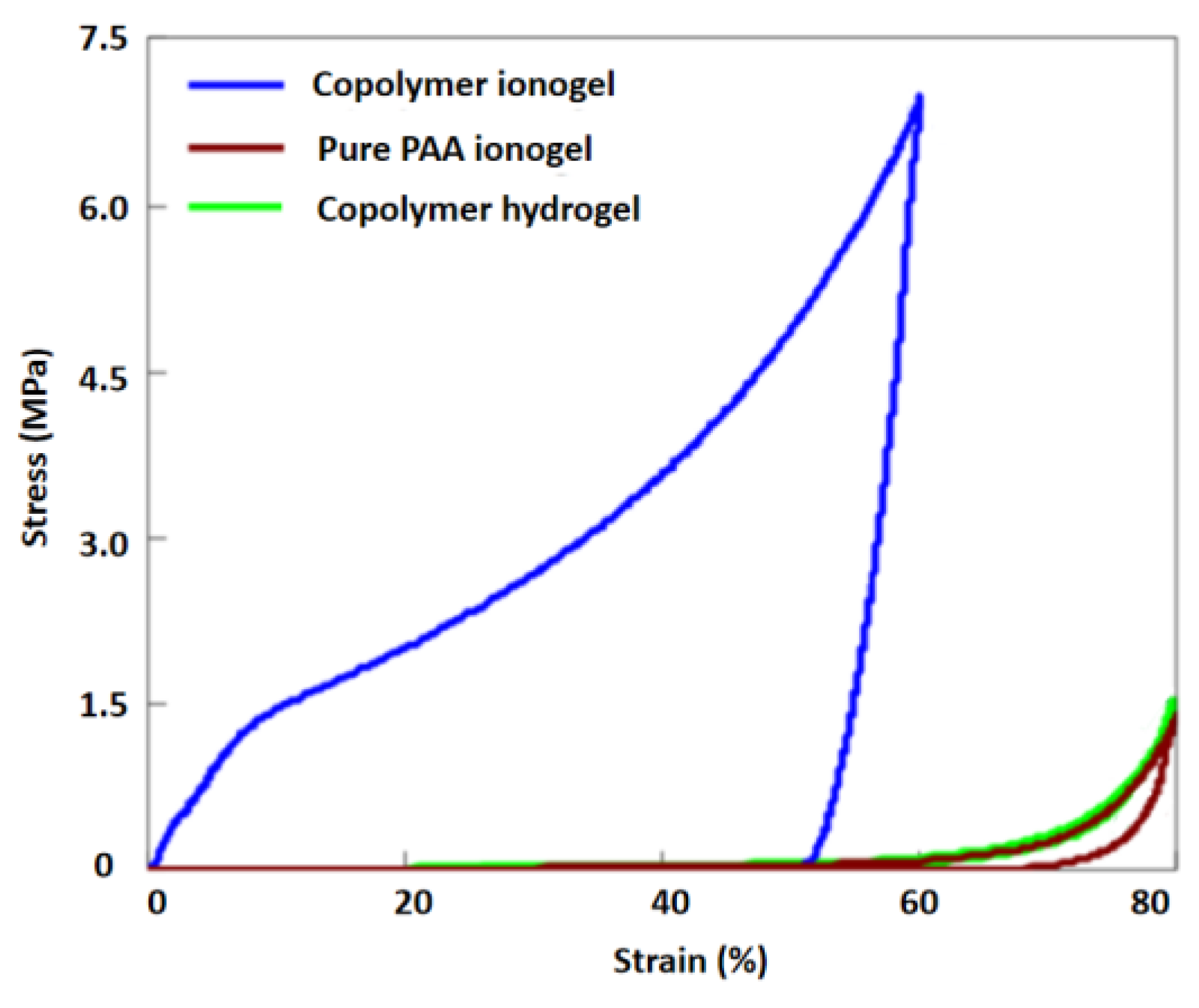
Figure 2.
Stress-strain behavior of copolymer ionogels with different monomer ratios under repeated cyclic loading.
Figure 2.
Stress-strain behavior of copolymer ionogels with different monomer ratios under repeated cyclic loading.
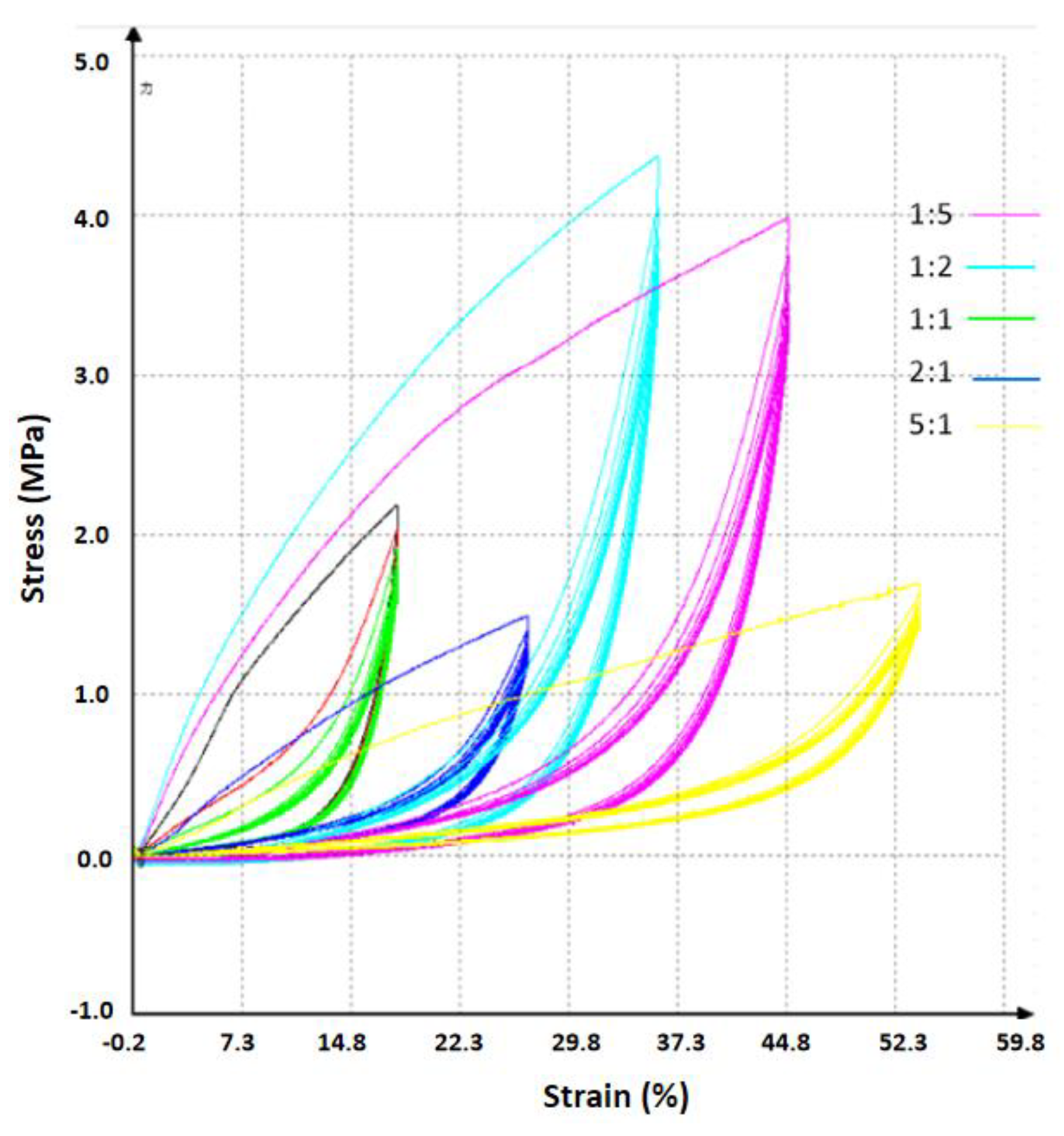
Figure 3.
Stress-strain plot of 1:2 AAm/HEMA .
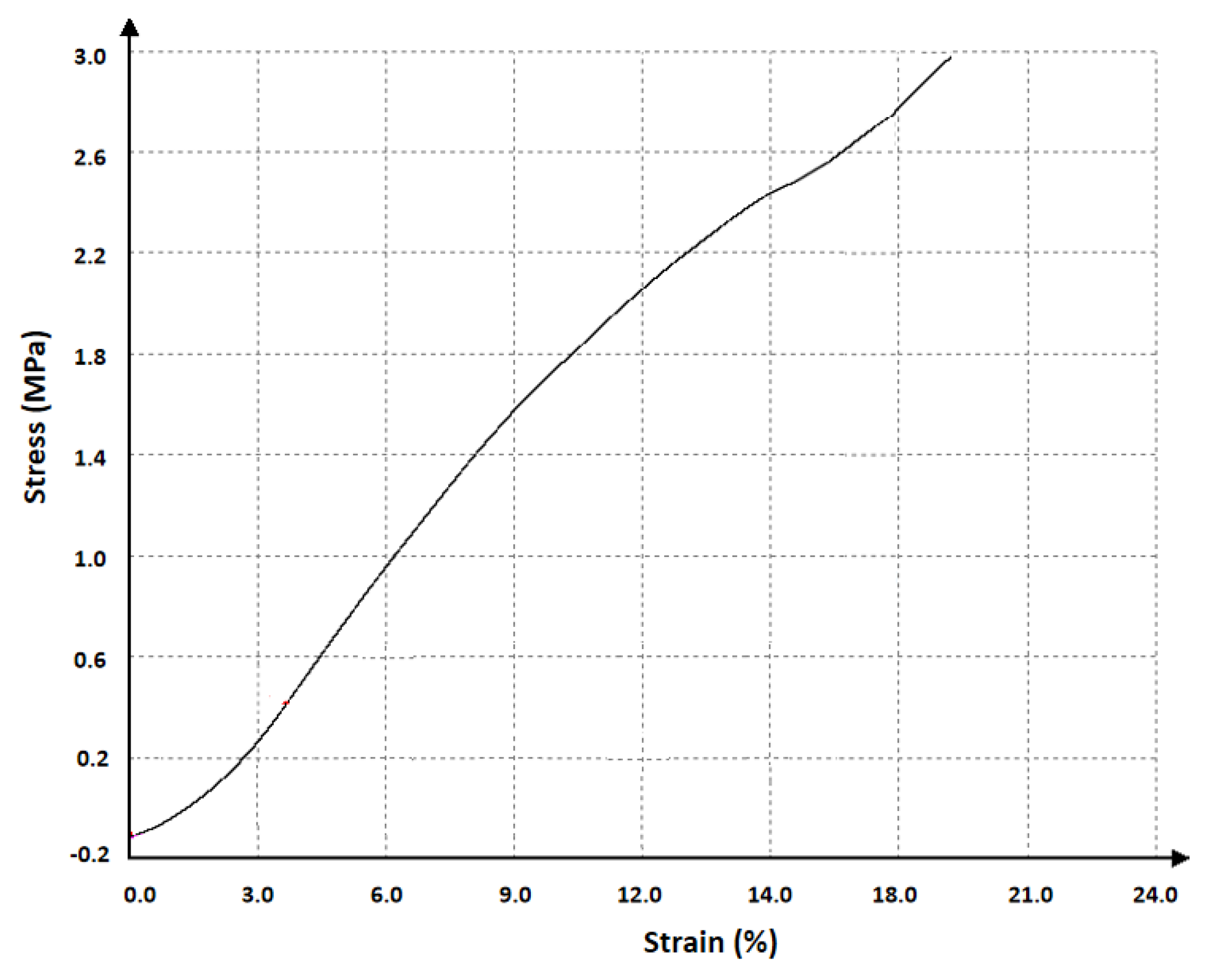
Figure 4.
Chemical model diagram of copolymer ionogel.
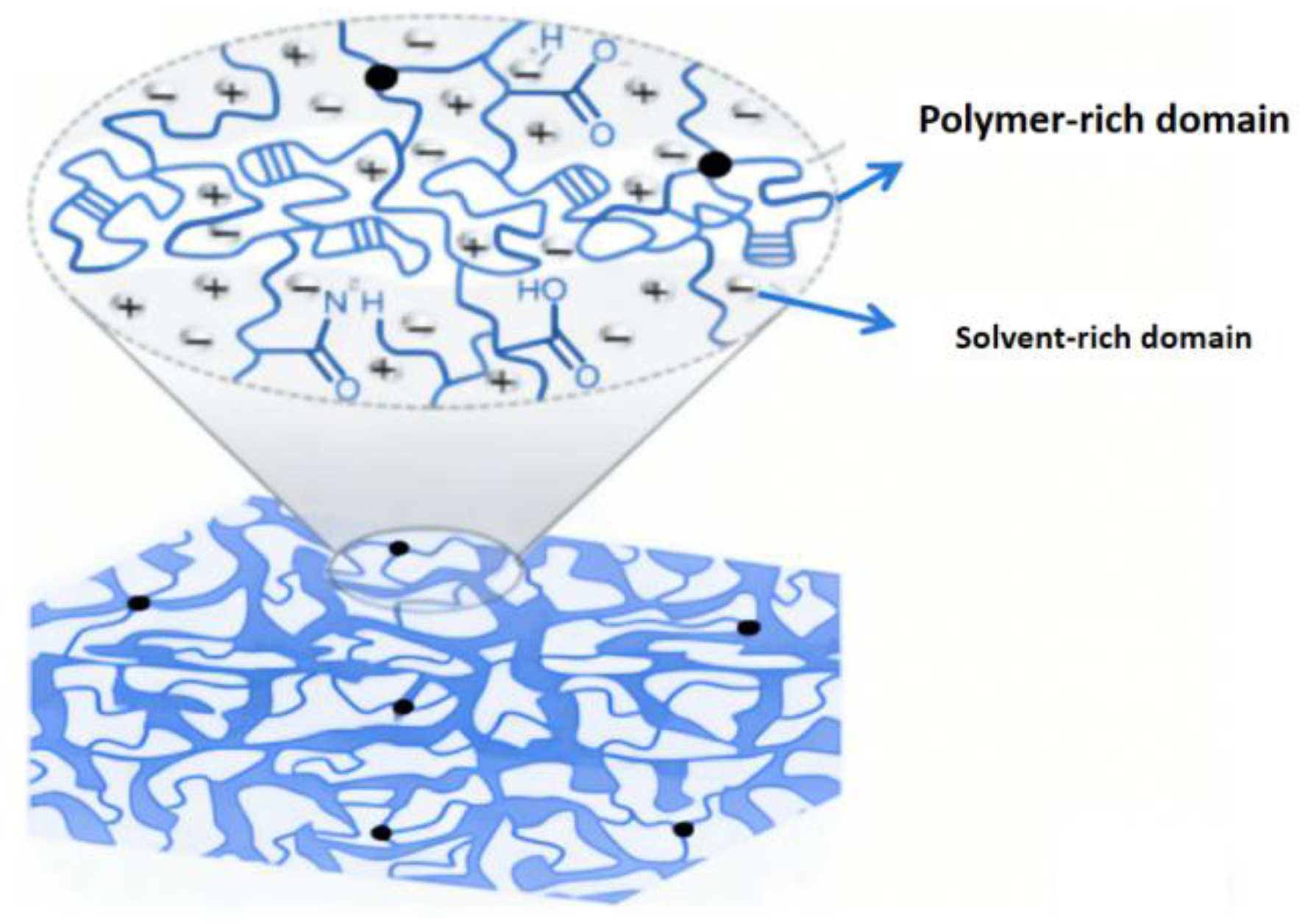

Table 1.
Effective striking thresholds for each level in Taekwondo.
| Competition weight categories * | Electronic protector display threshold | Pressure(MPa) | Striking speed(m/s) |
| women's 49kg | 16 | 0.60 | 2.47 |
| women's 57kg | 18 | 0.71 | 2.84 |
| women's 67kg | 20 | 0.87 | 3.34 |
| women's +67kg | 21 | 0.88 | 3.54 |
| men's 58kg | 20 | 0.87 | 3.37 |
| men's 68kg | 21 | 0.88 | 3.37 |
| men's 80kg | 23 | 1.00 | 3.94 |
| men's +80kg | 25 | 1.07 | 4.20 |
* Data is sourced from the official Olympic Games website.
Table 2.
Preparation scheme for copolymer ionogels with different component ratios.
| monomer | Molecular weight | AAm:HEMA(5:1) | AAm:HEMA(2:1) | AAm:HEMA(1:1) | AAm:HEMA(1:2) | AAm:HEMA(1:5) |
| AAm | 71.079 | 1.7769 | 1.4215 | 1.0662 | 0.7108 | 0.3554 |
| HEMA | 130.14 | 0.6507 | 1.3014 | 1.9521 | 2.6028 | 3.2535 |
| MBAA(0.1 mol% ) | 154.17 | 0.0046 | 0.0046 | 0.0046 | 0.0046 | 0.0046 |
| OA(0.05 mol% ) | 146.1 | 0.0021 | 0.0021 | 0.0021 | 0.0021 | 0.0021 |
| H2O | 18.01528 | 9.3493 | 8.6986 | 8.0479 | 7.3972 | 6.7465 |
Disclaimer/Publisher’s Note: The statements, opinions and data contained in all publications are solely those of the individual author(s) and contributor(s) and not of MDPI and/or the editor(s). MDPI and/or the editor(s) disclaim responsibility for any injury to people or property resulting from any ideas, methods, instructions or products referred to in the content. |
© 2026 by the authors. Licensee MDPI, Basel, Switzerland. This article is an open access article distributed under the terms and conditions of the Creative Commons Attribution (CC BY) license (http://creativecommons.org/licenses/by/4.0/).
Copyright: This open access article is published under a Creative Commons CC BY 4.0 license, which permit the free download, distribution, and reuse, provided that the author and preprint are cited in any reuse.


