

Submitted:
30 June 2026
Posted:
01 July 2026
You are already at the latest version
Abstract
The Western honey bee (Apis mellifera) forms large colonies which represent organisms in their own right, known as superorganisms. Although this species is among the most extensively studied insects, competing explanations persist regarding fundamental characteristics like colonial lifespan. This review refutes the notion of colonial immortality due to an inverted identification of parent and offspring, advocating instead for viewing a traditional honey bee colony as a matrilineage of mortal superorganisms. By refining the colonial life cycle to trace zygotic, embryonic, fetal, juvenile, and adult stages during superorganismal ontogeny, we extend the animal-superorganism analogy to reveal a viviparous organism engaged in strictly sexual reproduction and complex maternal care. Furthermore, analyzing the multiple pathways to female reproduction reveals that swarming in itself does not represent reproduction, as it precedes fertilization. Under this framework, the prime swarm allows the maternal superorganism to survive reproduction, whereas afterswarms serve to multiply offspring within a single reproductive cycle. These insights have implications for honey bee parasitology, demographic monitoring, and beekeeping management and provide a more rigorous foundation for the superorganism concept applicable to sexually reproducing social insects with queen supersedure or turnover.
Keywords:
honey bee
; Apis mellifera
; superorganism
; life history
; life cycle
; swarming
Introduction
Over a century ago, Wheeler (1910) identified the striking analogy between morphologically distinct castes of insect colonies and differentiated tissues of animals, and proposed treating such colonies as organisms in their own right, so-called superorganisms (Helanterä 2016). Backed by advances in our understanding of major evolutionary transitions, many authors place the superorganism at the top of a nested hierarchy of organismality, following unicellular and multicellular lifeforms, see e.g., Szathmáry (2015) and Boomsma and Gawne (2018). While it has recently been suggested that superorganismality is not a major evolutionary transition (Robin et al. 2021; Nonacs and Denton 2024), we herein seek to further develop the superorganism concept defined by morphologically differentiated queen and worker castes (Boomsma and Gawne 2018), thereby possibly negating some of the arguments against it. A prime example among the diversity of species, which are considered to form superorganisms, and likely the most extensively studied among them, is the Western honey bee, Apis mellifera (Boomsma and Gawne 2018). Here, Apis mellifera is used as model organism for superorganismality and a review of the life histories within the honey bee genus Apis.
A honey bee superorganism can be viewed as the somatic extension of the queen and consists of several thousand workers throughout its adult life (Wilson 1971, p. 443). Individual bees represent analogs of cells in multicellular organisms (Moritz and Southwick 1992). With just one physical worker caste, the various superorganismal tissues arise from the worker’s temporal polyethism (Seeley 1982; Johnson and Linksvayer 2010). Honey bee superorganisms are perennial and rear new queens and drones in preparation for reproduction in spring or early summer in temperate climate zones (Seeley 1982). One or more swarms may be issued, the first of which is referred to as the prime swarm and includes the old queen. Subsequent swarms are called afterswarms and carry newly emerged, unmated queens. One of the new queens remains at the original nest, from which it takes mating flights and begins laying eggs to produce new worker bees. Swarms select and move into new nesting sites, where nest-building and provisioning commences, and new worker bees are reared in preparation for the winter. New queens may also be reared to replace a fading, injured or lost queen (Fell and Morse 1984).
Despite the substantial knowledge about honey bees, which has been collected over centuries of scientific research, there are still different explanations in use for characteristics as fundamental as colonial lifespan (cf. Wilson 1971; Moritz and Southwick 1992). Wilson (1971, pp. 444-445) views new queens, which replace the old queens, as an integral part of one and the same colony. Since all bees in a nest are replaced on a regular basis, the colonial lifespan is determined by the duration of the succession of consecutive queens. According to Wilson (1971), this makes honey bee colonies “potentially immortal”. While “immortality” may seem intuitively clear as a concept, and has been suggested to occur in e.g., yeasts, sponges and flatworms (Petralia, Mattson and Yao 2014), there are various difficulties associated with proposed definitions (Hayflick 2000; Gavrilov and Gavrilova 2005; Florea 2017), and indeed, immortality is not defined by Wilson (1971). Instead of offering a definition, Wilson compares honey bee colonies with hydras, which are considered to be potentially immortal due to a complete renewal of their cells (Martínez 1998). An analysis of whether the renewal of all constituent bees truly makes honey bee colonies potentially immortal in accordance with one or another definition is not relevant for our main argument and would go beyond the scope of this review. What is relevant is the concept of queen supersedure or turnover within colonies and its relation to the individuality of a colony.
In contrast to Wilson (1971), Moritz and Southwick (1992, pp. 62-67) argue that a honey bee colony possesses a genotype much like any other organism does, and that this genotype is defined by the queen and the drones she mated with. A new queen carries a different genotype, such that the replacement of the old queen results in a different colony. Here, the lifespan of a honey bee colony is tied to that of its single queen. Based on the explicit mortality, Moritz and Southwick’s view is herein referred to as the mortal colony as opposed to Wilson’s potentially immortal colony.
The mortal and potentially immortal honey bee colonies as described by Moritz and Southwick (1992) and Wilson (1971), respectively, represent contradicting views of one and the same reality. This is not just a semantic debate, but has implications for how the biology of honey bees is quantified and understood. Apart from the potentially very different lifespans, consider, for instance, the respective survivorship curves. New potentially immortal colonies are created by casting swarms, which are faced with comparably low survivorship in their first year because they have to locate and move into suitable hollows, construct and provision the nests and produce winter bees before their first winter (Seeley 2017). Once a potentially immortal swarm has survived its first year, it stays in its nest. The mortality rate for the remaining years is therefore markedly lower (Seeley 2017). A high mortality rate early in life, followed by a lower mortality rate, is characteristic for a type III survivorship curve (Seeley 1978). A mortal colony, on the other hand, inherits its parent’s nest and benefits from the lower mortality rate in its first year. Once the colony leaves its nest to make room for its offspring, however, it faces the lower survival rates associated with swarming. A low mortality rate early in life, followed by a higher mortality rate, is described by a type I survivorship curve. The opposing nature of the two views may have far-reaching consequences for honey bee life history, heritability and dispersal, describing two theoretically substantially differing organisms.
The potentially immortal view of honey bee colonies appears to be prevalent in the scientific literature, especially in the 21st Century, see e.g., Fell and Morse (1984), Allsopp and Hepburn (1997), Fries et al. (2006), Smith et al. (2016), Seeley (2017) and Kohl et al. (2022). In contrast, usage of the mortal view is rather rare and often intermixed with the potentially immortal view, see e.g., Wilson (1971) and Seeley (1978, 1985). Although Wilson (1971) described honey bee colonies as potentially immortal, the life cycle presented on page 98 implies the mortal view. With respect to the life history strategy of honey bee colonies, Seeley (1978) also used the mortal view by focusing on queens. For the colonial lifespan, however, Seeley (1978) reverted to viewing colonies as potentially immortal.
The purpose of this review is to compare the two views in how they trace individuals during reproduction and to discuss the implications of the insights gained with respect to honey bee life history and superorganismality. The colonial life cycle is analyzed and further specified, followed by a review of colonial reproduction, the role of swarming and the extent of parental care. The paper concludes with a discussion of the consequences of the findings for honey bee parasitology, monitoring and beekeeping as well as a generalization to other species of superorganisms.
Parent or Offspring?
The opposing nature of mortal and potentially immortal honey bee colonies can be boiled down to one simple question: Which colony is the parent, and which is the offspring? To answer this question, the outcome of one reproductive cycle of an individual colony is analyzed, which results in the creation of the first filial generation. Consider the occupancy of three cavities at two points in time: year 1 before reproduction and one year later before the next reproductive cycle, see Table 1. It is assumed that no swarms occur from other colonies. To gain clarity, the year in between is treated as a black box at this stage. We return to this in the following section.
In year 1, one colony is present in cavity 1, whereas the other two cavities are vacant. Since this colony is about to reproduce, its queen can be referred to as the mother queen. The parental colony survives reproduction and produces two filial colonies. In year 2, before the next reproductive cycle, cavity 1 is occupied by a daughter of the mother queen and workers, which developed from the daughter’s eggs. Cavity 2 hosts the mother queen and her new workers, and cavity 3 hosts another daughter of the mother queen with her workers.
When honey bee colonies are viewed as potentially immortal, the colony in cavity 1 in year 2 represents the parent. Owing to the replacement of the mother queen with one of her daughter queens, the parental colony has undergone genetic transformation. The new genotype of the parental colony stems in part from the previous genotype, which was passed on from the mother queen to the daughter queen. The remaining part is contributed by other colonies via the mating of the daughter queen with drones. Here, we find many similarities with sexual reproduction at the level of the colony, which contradicts the view of the occupant of cavity 1 before and after a reproductive cycle as one and the same colony.
The potentially immortal colony in cavity 2 is viewed as offspring. Since it has the same genotype as the parental colony back in year 1 and even includes the actual physical mother queen, it should represent a clone. This suggests that reproduction is asexual. The colony in cavity 3 is also viewed as offspring. With the new genotype resulting from the daughter queen and the drones she mated with, reproduction appears to be sexual. While asexual and sexual modes of reproduction coexist in many species, in the present case, the view that the colony in cavity 2 is a clonal offspring of the original colony seems misleading.
For the theoretical case of mortal colonies, on the other hand, in year 2, the occupants of cavities 1 and 3 are viewed as offspring. Both filial colonies feature new genotypes, which are partly inherited from the parental colony, whereas the remaining parts originate from mating with drones of other colonies. Here, the similarities with sexual reproduction are in line with viewing the colonies with new genotypes as offspring. The colony in cavity 2 is viewed as the parent. The presence of the mother queen may simply imply that the parental colony has moved from cavity 1 to cavity 2.
Comparing the two opposing views provides a compelling case for parsimony in favor of the mortal view. The potentially immortal view implies a changing genotype, combined sexual and asexual reproduction, but without yielding two genetically identical offspring, and of course potential immortality. The mortal view, on the other hand, cuts out redundancies and explains the facts of Table 1 efficiently with mere sexual reproduction of mortal superorganisms. The difference between mortal and potentially immortal colonies in Table 1 is the referral of parent or offspring to the colonies in cavities 1 and 2. This suggests that the unique attributes of potentially immortal colonies merely stem from an inverted identification of parent and offspring. Honey bee colonies should therefore be viewed as mortal, which is simpler and in better agreement with how evolutionary individuals are identified for single-celled and multicellular organisms, and, as we will show below, helps us clarify several important aspects of honey bee biology.
Life Cycle
In this section we outline the life cycle of a honeybee superorganism (the time between years 1 and 2 in Table 1), using terminology which highlights the similarities between animals and superorganisms and may contextualize superorganismal traits in a new light.
Conventional terms for honey bees, such as colony, queen and drone, preceded Darwin and Mendel as well as the superorganism concept by centuries, see e.g., Butler (1609). It is rather unlikely that this terminology would be in line with modern biological thinking. A mated queen, for example, represents the analog of a fertilized egg cell of an animal (Moritz and Southwick 1992, pp. 217-218). By means of symmetry, one may ask whether mated queen would be a suitable term for a zygote. Such a terminology for cells may lead to confusion, rather than an intuitive understanding of an animal’s nature. Conventional terminology therefore likely obscures comparisons between superorganisms and multicellular organisms. An alternative terminology that works well to highlight the biology of honey bee superorganisms readily emerges by adopting the familiar terms for the various cell types, see Table 2.
Drones are the equivalent of sperm cells in multicellular organisms (Moritz and Southwick 1992, pp. 216-218) and can therefore be referred to as sperm bees. The terminology for queens depends on the current stage of their life cycle. A virgin queen is analogous to an egg cell and can be called egg bee, which makes a mated queen a fertilized egg bee or zygote. Since a laying queen is the source for all other types of constituent bees throughout the life of a colony, she represents not only the germline, but the analog of a totipotent stem cell, and can therefore be referred to as stem bee. Finally, the workers that are functionally sterile under queenright conditions (Thompson et al. 2006) are somatic bees and the colony or society a superorganism.
Figure 1 shows the life cycle presented by Seeley (1985, p. 37), which was modified to fit the case of one parental superorganism with two offspring from Table 1, as well as the new terminology. The life cycle begins with the rearing of egg bees (Seeley 1985), after which it splits into three lines. The first, innermost circle follows superorganism 1 with the stem bee, which swarms into a new cavity as the prime swarm, where it resumes somatic growth. In the second circle, the first egg bee departs with the afterswarm as superorganism 2. After moving into another cavity, the egg bee is fertilized and superorganism 2 commences somatic growth. The third, outermost circle follows a second egg bee, which inherits the original nest to become a third superorganism. After fertilization, superorganism 3 commences somatic growth as well.
The first, innermost, circle in Figure 1 follows one and the same superorganism 1 with its stem bee, which moves to a new nesting site for each year or reproductive cycle. As such, it corresponds with the mortal view of honey bee superorganisms. However, this first circle does not feature the generational shift and renewal associated with biological life cycles. Instead, it can be interpreted to describe what the parental superorganism 1 is doing, while its offspring develop elsewhere. The second and third circles, on the other hand, do represent conventional life cycles in the sense that they progress one generation for each round. The presence of two distinct life cycles suggests that there are multiple pathways that lead to honey bee superorganismal reproduction.
An issue with the life cycle from Figure 1 is brought to light by the new terminology, namely that filial superorganisms appear to be created before fertilization takes place. Additionally, the sperm bees are left out, which are required for fertilization. Moreover, as discussed in the following section, there are further pathways to reproduction, which are not featured in Figure 1. By continuing the line of thought from Moritz and Southwick (1992), a single life cycle is drawn in Figure 2, which resolves the aforementioned issues and unites the various circles from Figure 1.
The proposed life cycle shown in Figure 2 begins with the external fertilization of an egg bee by sperm bees to create a filial superorganism. The fertilized egg bee represents the zygote of the filial superorganism, which returns to its maternal superorganism, where it is implanted in the brood area of the nest. Since all somatic bees at this stage are from the maternal superorganism, the offspring develops inside its mother, which can be referred to as gestation. Embryogenesis commences with the first egg laid, from whereon the fertilized egg bee represents the stem bee. The laying of eggs and their development into somatic bees is analogous with cellular division for multicellular organisms to produce the various tissues of the filial superorganism. As time progresses, the maternal somatic bees are gradually replaced by those of the filial superorganism, such that the offspring becomes separated from its mother. The cycle is then closed with gametogenesis at the level of the superorganism. Spermatogenesis results in sperm bees and oogenesis results in egg bees. In a form of somatic gametogenesis, sperm bees can also develop parthenogenetically from haploid eggs of somatic bees, and egg bees may arise via thelytoky (Allsopp and Hepburn 1997). Both sperm and egg bees leave their respective parental superorganisms for external fertilization to begin a new cycle.
The development of the filial superorganism can be divided into several stages, as shown in Table 3. After the initial zygotic stage, an embryonal stage begins with eggs laid by the filial stem bee. These eggs and the larvae and pupae developing from them can be interpreted as rudiments for the various superorganismal tissues. With the emergence of somatic bees, a fetal stage can be identified. Here, young somatic bees represent the tissues of the superorganism. However, since young somatic bees perform only the first few required functions, such as cleaning and brood tasks (Seeley 1982), these tissues do not yet constitute a fully functional organism. Consequently, the juvenile stage occurs, when the somatic bees can perform all the required functions inside and outside the nest and thereby constitute all fully functional superorganismal tissues and organs. Adulthood can then be defined with the onset of sexual maturity, i.e., when sperm bees and later egg bees are present. Finally, fertilization transforms the superorganism into a parent. It should be noted that brood breaks, e.g., from swarming, dearth and also overwintering, can lead to an absence of eggs, larvae and pupae during juvenile, adult and parental stages.
As proposed in the life cycle in Figure 2, the reproduction of honey bee superorganisms encompasses external fertilization, implantation, embryogenesis and fetal development to produce a filial superorganism. This set of stages and steps can be said to underlie the second and third circles of the life cycle shown in Figure 1. The distinct circumstances under which honey bee superorganisms are able to reproduce are discussed in the following section.
Reproduction
During the reproductive phase, honey bee superorganisms produce both male and female gametes and are therefore simultaneous hermaphrodites (Moritz and Southwick 1992, p. 219). As with anisogamous multicellular organisms, there is asymmetry between the contributions of males and females to reproduction. Male superorganismal reproduction is restricted to the fertilization of egg bees, which requires the production, maintenance and release of sperm bees. Female superorganismal reproduction, on the other hand, is more involved, covering fertilization and gestation, which can be realized via various pathways.
The arguably simplest form of female superorganismal reproduction is supersedure, i.e., the replacement of the maternal stem bee with one of her egg bees within one and the same nest. This implies the replacement of a maternal superorganism by a filial superorganism, which develops inside its mother. In this light, a temporary presence of both the maternal stem bee and the filial egg or stem bee inside a nest is therefore not a case of one colony with two queens (Kleckner and Ellis 2025), but rather, a maternal superorganism pregnant with one of its offspring. Once the maternal stem bee stops laying eggs, the maternal superorganism decays with the passing of its somatic bees until it ceases to exist. Supersedure therefore entails obligate maternal death and represents a form of terminal reproduction. Since one parent is replaced by one offspring, supersedure is reproduction without multiplication. Supersedure is one of the pathways to female reproduction, which are missing in the life cycle shown in Figure 1.
A second pathway to female reproduction occurs at the original nest in conjunction with the issuing of one or more swarms, as depicted by the outermost circle in Figure 1. The reproduction and development of the filial superorganism are then essentially identical as with supersedure, except the mother may survive reproduction by swarming (see next section). As in the case of supersedure, reproduction after the issuing of only the prime swarm produces only a single offspring per reproductive cycle. If the maternal superorganism manages to complete more than one reproductive cycle, however, multiplication is possible.
After the departure of the prime swarm, one or more afterswarms may be issued (Seeley 1985). In such cases, the fraction of the parental superorganism at the original nest further divides and departs with egg bees to proceed along a third pathway to female reproduction. Afterswarms construct nests for their respective filial superorganisms at different nesting sites. As in the original nest, these fractions of the maternal superorganism decay with the passing of the maternal somatic bees during gestation.
A fourth pathway to female reproduction involves the sudden loss of the stem bee, which may lead to spontaneous reproduction. When a stem bee is severely injured or perishes, the superorganism can no longer renew its soma and is faced with certain death. The superorganism reacts by rearing egg bees from the remaining eggs and larvae to reproduce. While such reproduction closely resembles supersedure, there are minor differences. First, as spontaneous reproduction happens unprepared, the types of cells in which egg bees are reared differ from those during supersedure (Fell and Morse 1984). Furthermore, the rearing of egg bees first after the loss of the stem bee results in a longer brood break than for the more seamless transitions during supersedure and after the issuing of swarms.
Another form of spontaneous reproduction may occur, if there are no eggs or suitable larvae available for rearing egg bees after the loss of the stem bee. While somatic bees normally are functionally sterile in the presence of a stem bee (Thompson et al. 2006), they may then develop their ovaries and start laying haploid eggs, which develop into sperm bees (Miller III and Ratnieks 2001). At the level of the superorganism, this can be viewed as somatic gametogenesis in order to maximize fitness in the face of certain death. Sperm bees developing from eggs of somatic bees may succeed to fertilize egg bees of other superorganisms. Genetically, this would be the same as if the laying somatic bees would instead have developed into stem bees, whose superorganisms succeed in fathering offspring. Like that, a dying superorganism can become a paternal grandmother, without having produced the paternal superorganism in between generations.
In A. mellifera capensis, egg bees may also be produced by somatic gametogenesis when somatic bees lay diploid eggs by means of thelytoky (Hepburn 1994). One such egg may develop into the stem bee of the filial superorganism, which replaces the dying maternal superorganism (Allsopp and Hepburn 1997). An egg bee produced via thelytoky can be considered a clone of the laying somatic bee (Goudie and Oldroyd 2014). Again, this is genetically the same as if the laying somatic bee would instead have become a stem bee. The resulting filial superorganism, therefore, genetically represents the offspring of the dying maternal superorganism.
It is striking that a single species of superorganisms exhibits a total of four pathways to female reproduction. On top of that, honey bee superorganisms may utilize at least three such pathways during a single reproductive cycle. By making full use of the phenotypic plasticity, which comes with a body made of bees, the superorganism splits into several fractions, which can independently raise offspring at different nesting sites. Filial superorganisms may be produced at the original nest and via afterswarms at new nesting sites, while the prime swarm may supersede or spontaneously reproduce after losing the stem bee in yet another nest.
Swarming
Swarming has traditionally been described as reproduction, analogous to strictly asexual modes of reproduction such as fission, fragmentation or budding (Wilson 1971; Moritz and Southwick 1992). However, Moritz and Southwick (1992) argue against this analogy with respect to honey bee superorganisms, since it poorly captures the complex genetic mechanisms at play. According to Moritz and Southwick (1992), only the prime swarm represents asexual reproduction, and swarming in general involves a mix of asexual and sexual reproduction. In this section, we provide arguments for viewing honey bee superorganismal reproduction as strictly sexual. Furthermore, the concept of swarming as reproduction is challenged, and an alternative explanation for the function of swarming is offered.
Reproduction by fission, fragmentation or budding involves the division of an organism into two or more fractions, followed by a phase of regeneration or growth to produce one or more clones. Initially, swarming may be analogous to such modes of asexual reproduction, since the superorganism divides into two or more parts. However, only the prime swarm, which carries the stem bee, is able to regrow its soma. The other fractions shrink with the passing of their constituent bees until they cease to exist. As discussed above, the prime swarm is not a clone, but rather the parental superorganism on the move. Swarming, therefore, does not result in clones, which means that asexual reproduction can be ruled out.
Phenotypically, the issuing of a swarm shows many similarities with the birth of a new organism. At the time of swarming, however, there exists no new organism to give birth to. This is because swarming precedes fertilization. Swarming alone does not result in reproduction, which still requires fertilization, implantation, embryogenesis and so on. For both male and female reproduction, swarming is not needed.
The issuing of the prime swarm does not lead to an increase in the number of offspring produced per reproductive cycle. The same number of offspring can be achieved without swarming, which is one. This is because there are two pathways to female reproduction that do not involve swarming, i.e., supersedure as well as spontaneous reproduction, initiated by the loss of the stem bee. Although afterswarms do not represent offspring, they do set the stage for the production of more than one offspring per reproductive cycle.
All bees involved in swarming are constituents of an adult superorganism, which divides into two or more fractions. Instead of a new organism, a swarm is therefore a fraction of an adult superorganism. Since the prime swarm includes the stem bee, it represents the fraction that can continue to live as the adult superorganism at a different nesting site. If a superorganism does not issue a prime swarm before reproduction, it will have no chance to survive reproduction. The issuing of a prime swarm, therefore, represents a survival mechanism rather than a reproduction mechanism.
The swarming behavior of honey bees in conjunction with female superorganismal reproduction shows many similarities with schizogamous epitoky of certain polychaete marine worms (Nygren 1999). In preparation for reproduction, the sexually immature worm called atoke produces gametes and splits off gamete-carrying sections called epitokes (Fischer 1999). The latter are temporarily autonomous and go on to reproduce sexually, sometimes involving parental care (Langeneck et al. 2020), but die shortly thereafter. Epitokes are therefore analogous with afterswarms as well as the fraction of the adult superorganism remaining at the original nest. With the release of its gametes to the epitokes, the atoke re-enters a phase of sexual immaturity, where it regenerates its body in order to survive to repeat the process. Similarly, after leaving its egg bees behind, the prime swarm becomes sexually immature with regard to female reproduction and may survive for another reproductive cycle.
Afterswarms and the fraction remaining at the original nest represent parts of an adult superorganism, which possess temporary autonomy to carry out female superorganismal reproduction. Under this framework, the prime swarm allows the maternal superorganism to survive reproduction, whereas afterswarms serve to produce more than one offspring per reproductive cycle. It can be concluded that swarming in itself is not reproduction, but rather, means to facilitate maternal survival, multiplication and parental care.
Parental Care
The life cycle in Figure 2 demonstrates maternal care by superorganisms, reminiscent of viviparous animals. After fertilization, the nurse bees of the maternal superorganism collectively provide a nourishing environment similar to a uterus, in which the embryonic larvae develop. Here, milky food secretions by maternal nurse bees can be viewed as analogous to uterine milk. The first nurse bees of the filial superorganism may be interpreted to function as a placenta, which transmits nectar and pollen from the maternal somatic bees to the developing embryo and fetus. When the maternal foragers have been replaced by those of the filial superorganism, the placental function ceases, and the offspring becomes metabolically independent. During gestation, the protection of the developing filial superorganism by the maternal guard bees constitutes an additional form of parental care.
Before fertilization, maternal superorganisms invest heavily in their offspring by building and provisioning nests (Moritz and Southwick 1992). Here, a distinction is meaningful between nests that were established in the previous year and newly founded nests, see Seeley (2017). Since swarms deprive a nest of portions of both provisions and bees (Seeley 1985), maternal investment in offspring developing in an established nest after swarming is lower. The lowest maternal investment is found for filial superorganisms that develop in afterswarms. However, even here, the respective fraction of the maternal superorganism selects a nesting site for its future offspring and begins to construct and provision the nest before fertilization. During gestation, it will continue to do so until no maternal somatic bees remain.
Filial superorganisms are always provided with a nest: an established nest after the departure of the prime swarm and newly founded nests by afterswarms. Since superorganisms have many fathers and a single mother, all of which may construct a multitude of nests during each reproductive cycle, terms such as parental, maternal or natal nest may be rather unspecific. Herein, the term original nest is used to refer to the nest of an adult superorganism from which it may swarm to a new nesting site (Moritz and Southwick 1992, p. 63).
The construction and provisioning of a nest by a swarm is associated with risks and considerable labor, resulting in lower chances of surviving the coming winter than in an already established nest (Seeley 2017). Interestingly, honey bee parental care goes as far as providing the offspring with the security associated with an established nest, while the maternal superorganism puts its life at risk by swarming away with a fraction of its soma. The bequeathal of the parent’s territory to its offspring represents a rare strategy (van Alphen 2025), which has been found to occur also in e.g., Columbian ground squirrels (Harris and Murie 1984) and American red squirrels (Price and Boutin 1993). Such a “space perennial” strategy could be an adaptation to a situation where the high quality nesting sites or territories remain far longer than the potential life-span of the parent (Nonacs 1993).
Filial superorganisms that develop inside afterswarms also face the lower survival rates associated with swarming. The various pathways to reproduction have the effect that honey bee superorganisms do not possess just one characteristic survivorship curve. On the basis of the survival rates from Seeley (2017) with annual swarming, superorganisms born in established nests exhibit a higher survival rate in their first year and a lower rate associated with swarming in following years, which yields in a type I survivorship curve. Being raised by an afterswarm, on the other hand, results in a constant survival rate and, therefore, a type II survivorship curve, since a new nest is founded every year.
In addition to nest-building and -provisioning and subsequent matrotrophy, honey bee superorganisms may also engage in postnatal maternal care. However, this is dependent on when a honey bee superorganism is considered to be born. As discussed in the previous section, it is not meaningful to consider swarming as the birth of a new superorganism. Birth normally refers to the exit of the internal environment of a mother. However, this does not occur for honey bee superorganisms, since filial superorganisms remain in the nest in which they have developed, whereas the mother slowly fades away until maternal separation is completed. Instead, birth can be defined as the rather inconspicuous onset of the juvenile stage, see Table 3, i.e., when the various tissues of a filial superorganism are fully developed, but may not yet have grown to full size. It is thus the transition to foraging of the first filial somatic bees that marks the onset of the juvenile stage and, thereby, the birth of the filial superorganism.
Postnatal parental care occurs when maternal bees are still present in the nest after birth. In conjunction with reproduction after the issuing of one or more swarms, considerable time may pass until a filial superorganism reaches the juvenile stage. Owing to the short lifespan of somatic bees during the foraging season, the maternal bees still present after the birth of the filial superorganism are therefore expected to be foragers, and possibly guard bees. Postnatal parental care may therefore be rather limited and include feeding and possibly protection.
During a certain period, both maternal and filial foragers are present inside the nest. The waggle dance of maternal foragers may then constitute additional instances of postnatal parental care. When a filial forager follows the waggle dance of a maternal forager, the maternal superorganism essentially guides its offspring to a food source. Teaching may also be involved, since the intricacies of the waggle dance are at least partly learned by young foragers observing more experienced foragers (Dong et al. 2023).
Supersedure likely represents a special case with respect to the extent of postnatal maternal care. The maternal stem bee may remain in the nest for a period of time, while the filial superorganism already commences its development, see e.g., Kleckner and Ellis (2025). Moreover, during supersedure later in the season, long-lived maternal winter bees may already be present, which could care for a filial superorganism for several months throughout the winter. Postnatal parental care may therefore be more comprehensive in conjunction with supersedure than for reproduction following swarming.
The various characteristics of the four pathways to female reproduction are summarized in Table 4. The parental care administered for all four includes nest building and provisioning as well as nurturing, protecting, feeding, guiding and teaching, all of which are exclusively carried out by the maternal superorganism. Parental care for individual filial superorganisms is therefore characterized by a distinct asymmetry between the sexes.
Discussion
A colony of honey bees may appear to be phenotypically perennial because of the renewal of all its constituent bees, thereby fostering the idea of potential immortality. However, a change of the queen entails a transition into a new colonial genotype (Moritz and Southwick 1992). Since a new genotype implies a new organism, potential immortality can be refuted due to an inverted identification of parent and offspring. What has traditionally been referred to as honey bee colony represents, in reality, a lineage of superorganisms, which uninterruptedly occupies a certain nesting site. Since the nest is passed on from mother to offspring, this is a matrilineage. Viewing honey bee superorganisms as mortal instead of potentially immortal paves the way for new insights into honey bee biology, ranging from life history, parental care and the role of swarming to research on pathogens and parasites, as well as monitoring and beekeeping. In general, correctly applying ecological and evolutionary theories and concepts to superorganisms requires the correct identification of evolutionary individuals.
In conjunction with research on the effects of the ectoparasitic mite Varroa destructor on honey bees, the lifespan of potentially immortal colonies has been documented, see e.g., Fries et al. (2006). However, this is not the lifespan at all, but rather, represents the duration of uninterrupted nest occupancy by consecutive generations of superorganisms. The fact that a nest may become vacant 3 to 5 years after an initial infestation with Varroa destructor (Korpela et al. 1992) may mean that the great-great-great-granddaughter of the original superorganism succumbs to the infestation. During that period of time, the initially infested superorganism may have moved elsewhere and multiplied successfully to contribute to a population that may thrive, despite exposure to varroa. A continuous nest occupancy of merely a few years does not imply that a population of honey bee superorganisms cannot cope with a varroa infestation. The duration of continuous nest occupancy, therefore, represents a rather abstract characteristic of questionable significance. Studies based on nest site occupancy may need to be revisited in light of the insights gained from the current review.
Another subject of research, which employs the traditional view of potentially immortal colonies, is honey bee demography in the wild, see e.g., Kohl et al. (2022). Birth, age and death rates are highly dependent on whether superorganisms are treated as mortal or potentially immortal. The lifespan presented by e.g., Seeley (2017) represents the duration of nest site occupancy by a matrilineage of superorganisms. The monitoring of nest site occupancy several times a year, such as that described by Moro et al. (2024), is likely inconclusive with respect to the occurrence of supersedure, usurpation (Danka et al. 1992), absconding (Seeley 1985) as well as swarming and the number of swarms issued. Even if honey bee superorganisms are treated as mortal, such monitoring protocols would deliver merely a subset of the data required to describe their demography. Genetic sampling of individual nests, on the other hand, may suffice to register supersedure, but cannot differentiate between swarming and supersedure and does not yield information about the number of swarms issued or their fate. It appears that the elusive nature of the honey bee poses a number of challenges for researchers seeking to document their demography.
A common practice in beekeeping is requeening (Gray et al. 2020), i.e., the manual replacement of the queen with one that is usually not her daughter. Manual requeening involves the killing of the old queen and, thereby, implies the killing of the associated superorganism. The subsequent implantation of a new queen forces the dying superorganism to gestate the offspring of other superorganisms. Surprisingly, regular requeening is considered good hive management (Gray et al. 2020). The replacement of at least 50% of queens is recommended for beekeepers to minimize losses during winter (Gray et al. 2020). This recommendation means killing and replacing at least every other superorganism in summer, with the goal of decreasing the number of deaths during the winter. The acceptance of such a practice likely stems from viewing honey bee colonies as potentially immortal. Apparently, not only are new queens from supersedure and swarming considered to be part of one and the same colony, but also unrelated queens that are manually implanted by a beekeeper. As should be clear from the present review, however, such a view is not compatible with how evolutionary individuals are identified. While colonies with younger queens may be more productive and healthier than with older queens, see e.g., (Akyol et al. 2008), requeening does not rejuvenate a colony but kills it. Consequently, conventional practices designed to maximize pollination services and honey production may come at the expense of superorganismal lives.
The analogy between honey bee superorganisms and animals has been weakened by unconventional characteristics attributed to superorganisms, such as unique combined sexual and asexual reproduction (Moritz and Southwick 1992, p. 227) and potential immortality (Wilson 1971, pp. 444-445). The present review provides arguments for viewing superorganisms as mortal, with strictly sexual reproduction. Consequently, terms such as fragmentation, budding and fission may be misleading with respect to honey bee superorganisms, since they imply asexual reproduction. Swarming in itself is not reproduction, but analogous with schizogamous epitoky in polychaete marine worms, which occurs prior to reproduction to facilitate maternal survival, increased reproductive output and parental care. The developmental stages and viviparity discussed herein substantiate the validity of the analogy between honey bee superorganisms and animals.
The fact that the old honey bee queen follows the swarm in preparation for reproduction makes for a particularly clear case for rejecting notions of queen replacement within one and the same superorganism. While this is the case for all species of the genus Apis (van Alphen 2025), it is more typical for dependently-founding social insects that the young queen leaves the original nest site with a fraction of the workers (Cronin et al. 2013), such as in stingless bees and swarm-founding Polistinae (although the latter are not strictly speaking superorganismal by the definition of Boomsma & Gawne 2018). The evolutionary reasons for this difference remain unclear, but may include pathogen resistance (van Alphen 2025) and benefits of continuously occupying a high quality nest site (Nonacs 1993). However, the logic of identifying a superorganismal genotype defined by the mated queen (Moritz and Southwick 1992) does not rely on details of colony founding modes and is therefore thought to be applicable to any sexually reproducing superorganisms with queen supersedure or turnover. As replacement queens do not recreate the superorganismal genotype from the previous queen, a new queen results in a new superorganism which develops inside the previous superorganism and eventually replaces it. Queen replacement is therefore superorganismal reproduction, effectively linking the lifespan of a superorganism to that of its mated queen, apart from rare cases of clonal reproduction in ants, e.g., Mycocepurus smithii (Himler et al. 2009). In such a case, as well as in colony fissioning in species where the reproductive castes have been secondarily lost (Kronauer 2025), the lifespan of superorganisms can far exceed that of individual reproductives.
The genetic turnover inside a nest associated with the replacement of the queen is one reason why it has been suggested that superorganismality does not represent a major evolutionary transition (Robin et al. 2021; Nonacs and Denton 2024). However, our treatment of queen replacement as reproduction on the level of the superorganism rather than turnover within a superorganism, likely negates that argument. Another argument put forth by Nonacs and Denton (2025) is that “during reproduction in all social and nonsocial species, offspring receive genetic material from at most two parents” such that “there is no fundamental change in reproduction due to a higher level of individuality”. The identification of the multicellular drones and virgin queens as superorganismal gametes, the newly mated queen as the zygote and workers as the soma (Moritz and Southwick 1992), however, challenges this argument. Virgin queens are not simple products of meiosis as eggs of a solitary female would be. In haplodiploid social insects, they carry a complete set of chromosomes from one of the fathers of the maternal superorganism in addition to the recombined set from their queen mother. So do the workers which stand out from the soma of multicellular organisms by not being clones of the zygote. Furthermore, for cases of polyandry, the superorganismal zygote carries genetic material from several drones, such that superorganisms can have multiple fathers. The genes from the single maternal grandfather, mother and multiple fathers will all be present in the superorganismal soma and can be transmitted to the next generation of superorganisms. In combination with viewing queen replacement as superorganismal reproduction, we argue that these differences in sexual reproduction and development at multicellular and superorganismal levels are large enough to support the mainstream view that superorganismality is an evolutionary transition in individuality.
The issue with the immortal view of honey bee superorganisms can be boiled down to an inverted identification of parent and offspring, yielding misleading data for a multitude of essential characteristics, ranging from life span, dispersal and heritability to parental care and beyond. The importance of using the mortal view can, therefore, not be emphasized enough. By taking the analogy between animals and honey bee superorganisms further, this review contextualizes superorganismal traits in a new light, hopefully opening new lines of thought and inquiry even for other taxa. In the spirit of Boomsma and Gawne (2018), the insight presented herein calls for rigor in both the definition and use of superorganismal terminology. Superorganismality affirms itself as a fruitful paradigm to gain insight and understanding of life at the top of the organismal hierarchy.
Author Contributions
Hannes Bonhoff contributed the idea for this review, conducted the literature search and drafted the manuscript. Both authors critically revised and approved the manuscript.
Funding
Hannes has received partial financial support by The Swedish Board of Student Finance (CSN) during his Master’s degree studies at Lund University.
Data Availability Statement
There are no data available for this review article.
Acknowledgments
We thank Niklas Wahlberg for introducing us to one another and for welcoming this review as part of Hannes’ Master’s thesis at Lund University and Steve Rogenstein for proofreading the manuscript. We thank the Editor-in-Chief and the two reviewers for their constructive comments and valuable suggestions.
Conflicts of Interest
The authors have no competing interests to declare that are relevant to the content of this review.
References
- Akyol E, Yeninar H, Korkmaz A, Çakmak I (2008) An observation study on the effects of queen age on some characteristics of honey bee colonies. Ital J Anim Sci 7:19–25. [CrossRef]
- Allsopp MH, Hepburn HR (1997) Swarming, supersedure and the mating system of a natural population of honey bees (Apis mellifera capensis). J Apic Res 36:41–48. [CrossRef]
- Boomsma JJ, Gawne R (2018) Superorganismality and caste differentiation as points of no return: how the major evolutionary transitions were lost in translation. Biol Rev Camb Philos Soc 93:28–54. [CrossRef]
- Butler C (1609) The Feminine Monarchie. Joseph Barnes, Oxford.
- Cronin AL, Molet M, Doums C, Monnin T, Peeters C (2013) Recurrent evolution of dependent colony foundation across eusocial insects. Annu Rev Entomol 58:37–55. [CrossRef]
- Danka RG, Hellmich RL, Rinderer TE (1992) Nest usurpation, supersedure and colony failure contribute to Africanization of commercially managed European honey bees in Venezuela. J Apic Res 31:119–123. [CrossRef]
- Dong S, Lin T, Nieh JC, Tan K (2023) Social signal learning of the waggle dance in honey bees. Science 379:1015–1018. [CrossRef]
- Fell RD, Morse RA (1984) Emergency queen cell production in the honey bee colony. Insectes Soc 31:221–237. [CrossRef]
- Fischer A (1999) Reproductive and developmental phenomena in annelids: a source of exemplary research problems. Hydrobiologia 402:1–20. [CrossRef]
- Florea M (2017) Aging and immortality in unicellular species. Mech Ageing Dev 167:5–15. [CrossRef]
- Fries I, Imdorf A, Rosenkranz P (2006) Survival of mite infested (Varroa destructor) honey bee (Apis mellifera) colonies in a Nordic climate. Apidologie 37:564–570. [CrossRef]
- Gavrilov LA, Gavrilova NS (2005) Reliability theory of aging and longevity. In EJ Masoro and SN Austad (Eds.), Handbook of the biology of aging (6th ed., pp. 3–42). Academic Press.
- Goudie F, Oldroyd BP (2014) Thelytoky in the honey bee. Apidologie 45:306–326. [CrossRef]
- Gray A, Adjlane N, Arab A et al. (2020) Honey bee colony winter loss rates for 35 countries participating in the COLOSS survey for winter 2018–2019, and the effects of a new queen on the risk of colony winter loss. J Apic Res 59:744–751. [CrossRef]
- Harris MA, Murie JO (1984) Inheritance of nest sites in female Columbian ground squirrels. Behav Ecol Sociobiol 15:97–102. [CrossRef]
- Hayflick L (2000) The illusion of cell immortality. Br J Cancer 83:841–846. [CrossRef]
- Helanterä H (2016) An organismal perspective on the evolution of insect societies. Front Ecol Evol 4. [CrossRef]
- Hepburn HR (1994) Reproductive cycling and hierarchical competition in Cape honeybees, Apis mellifera capensis Esch. Apidologie 25:38–48. [CrossRef]
- Himler AG, Caldera EJ, Baer BC, Fernández-Marín H, Mueller UG (2009) No sex in fungus-farming ants or their crops. Proc Biol Sci 276:2611–2616. [CrossRef]
- Johnson BR, Linksvayer TA (2010) Deconstructing the superorganism: social physiology, groundplans, and sociogenomics. Q Rev Biol 85:57–79. [CrossRef]
- Kleckner K, Ellis JD (2025) Reviewing evidence for varied colony structures in honey bees. Insect Soc 1–14. [CrossRef]
- Kohl PL, Rutschmann B, Steffan-Dewenter I (2022) Population demography of feral honeybee colonies in central European forests. R Soc Open Sci 9:220565. [CrossRef]
- Korpela S, Aarhus A, Fries I, Hansen H (1992) Varroa jacobsoni Oud. in cold climates: population growth, winter mortality and influence on the survival of honey bee colonies. J Apic Res 31:157–164. [CrossRef]
- Kronauer DJ (2025) Clonal raider ants. Curr Biol 35:R7-R8. [CrossRef]
- Langeneck J, Del Pasqua M, Licciano M, Giangrande A, Musco L (2020) Atypical reproduction in a syllid worm: the stolon of Syllis rosea (Annelida, Syllidae) takes care of its offspring. J Mar Biol Assoc UK 100:221–227. [CrossRef]
- Martínez DE (1998) Mortality patterns suggest lack of senescence in hydra. Exp Gerontol 33:217–225. [CrossRef]
- Miller III D, Ratnieks F (2001) The timing of worker reproduction and breakdown of policing behaviour in queenless honey bee (Apis mellifera L.) societies. Insectes Soc 48:178–184. [CrossRef]
- Moritz RFA, Southwick EE (1992) Bees as superorganisms. Springer-Verlag, Berlin.
- Moro A, Albouy V, Dickey M et al. (2024) A Protocol for Monitoring Populations of Free-Living Western Honey Bees in Temperate Regions. Bee World 101:70–74. [CrossRef]
- Nonacs P (1993) The effects of polygyny and colony life history on optimal sex investment. In Queen Number and Sociality in Insects, L. Keller (Ed.), Oxford University Press, London, pp 110–131.
- Nonacs P, Denton KK (2024) Eusociality is not a major evolutionary transition, and why that matters. Insect Soc 71:17–27. [CrossRef]
- Nygren A (1999) Phylogeny and reproduction in Syllidae (Polychaeta). Zool J Linn Soc 126:365–386. [CrossRef]
- Petralia RS, Mattson MP, Yao PJ (2014) Aging and longevity in the simplest animals and the quest for immortality. Ageing Res Rev 16:66–82. [CrossRef]
- Price K, Boutin S (1993) Territorial bequeathal by red squirrel mothers, Behav Ecol 4:144–150. [CrossRef]
- Robin AN, Denton KK, Horna Lowell ES et al. (2021) Major evolutionary transitions and the roles of facilitation and information in ecosystem transformations. Front Ecol Evol 9:711556. [CrossRef]
- Seeley TD (1978) Life history strategy of the honey bee, Apis mellifera. Oecologia 32:109–118. [CrossRef]
- Seeley TD (1982) Adaptive significance of the age polyethism schedule in honeybee colonies. Behav Ecol Sociobiol 11:287–293. [CrossRef]
- Seeley TD (1985) Honeybee ecology. Princeton University Press.
- Seeley TD (2017) Life-history traits of wild honey bee colonies living in forests around Ithaca, NY, USA. Apidologie 48:743–754. [CrossRef]
- Smith ML, Ostwald MM, Seeley TD (2016) Honey bee sociometry: tracking honey bee colonies and their nest contents from colony founding until death. Insect Soc 63:553–563. [CrossRef]
- Szathmáry E (2015) Toward major evolutionary transitions theory 2.0. PNAS 112:10104–10111. [CrossRef]
- Thompson G, Kucharski R, Maleszka R, Oldroyd B (2006) Towards a molecular definition of worker sterility: differential gene expression and reproductive plasticity in honey bees. Insect Mol Biol 15:637–644. [CrossRef]
- van Alphen JJM (2025) The paradox of the old queen leaving. In Advances in termite, bee and wasp biology - ecology, physiology, and integrated management. IntechOpen. [CrossRef]
- Wheeler WM (1910) Ants: Their Structure, Development and Behavior. Columbia University Press, New York.
- Wilson EO (1971) The insect societies. Belknap Press, Cambridge, MA.
Figure 1.
Honey bee life cycle modified from Seeley (1985, p. 37), which begins with the rearing of egg bees and traces the life cycles of three different superorganisms (Figure created with Adobe Illustrator CS3).
Figure 1.
Honey bee life cycle modified from Seeley (1985, p. 37), which begins with the rearing of egg bees and traces the life cycles of three different superorganisms (Figure created with Adobe Illustrator CS3).
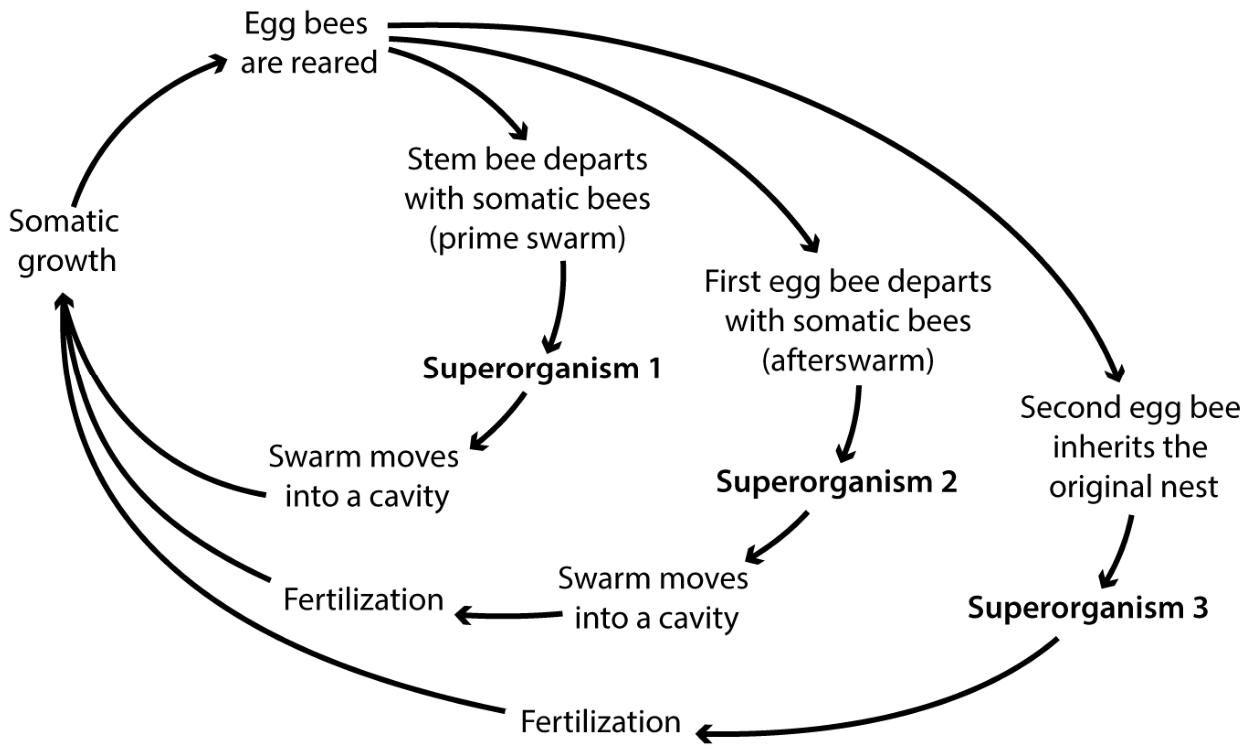
Figure 2.
Proposed honey bee life cycle, which begins with fertilization to produce a zygote, followed by embryonic, fetal, juvenile and adult stages. During gestation, the maternal superorganism decays with the passing of its somatic bees. The proportions between the parental and filial sections of the circle are intended to illustrate the growth of the offspring and decay of the gestating parent. They do not correspond with the actual proportions between the respective numbers of bees found in nature. Neither does the thickness of the circle account for fluctuations in the numbers of bees for varying brood activities or swarming events (Figure created with Adobe Illustrator CS3).
Figure 2.
Proposed honey bee life cycle, which begins with fertilization to produce a zygote, followed by embryonic, fetal, juvenile and adult stages. During gestation, the maternal superorganism decays with the passing of its somatic bees. The proportions between the parental and filial sections of the circle are intended to illustrate the growth of the offspring and decay of the gestating parent. They do not correspond with the actual proportions between the respective numbers of bees found in nature. Neither does the thickness of the circle account for fluctuations in the numbers of bees for varying brood activities or swarming events (Figure created with Adobe Illustrator CS3).
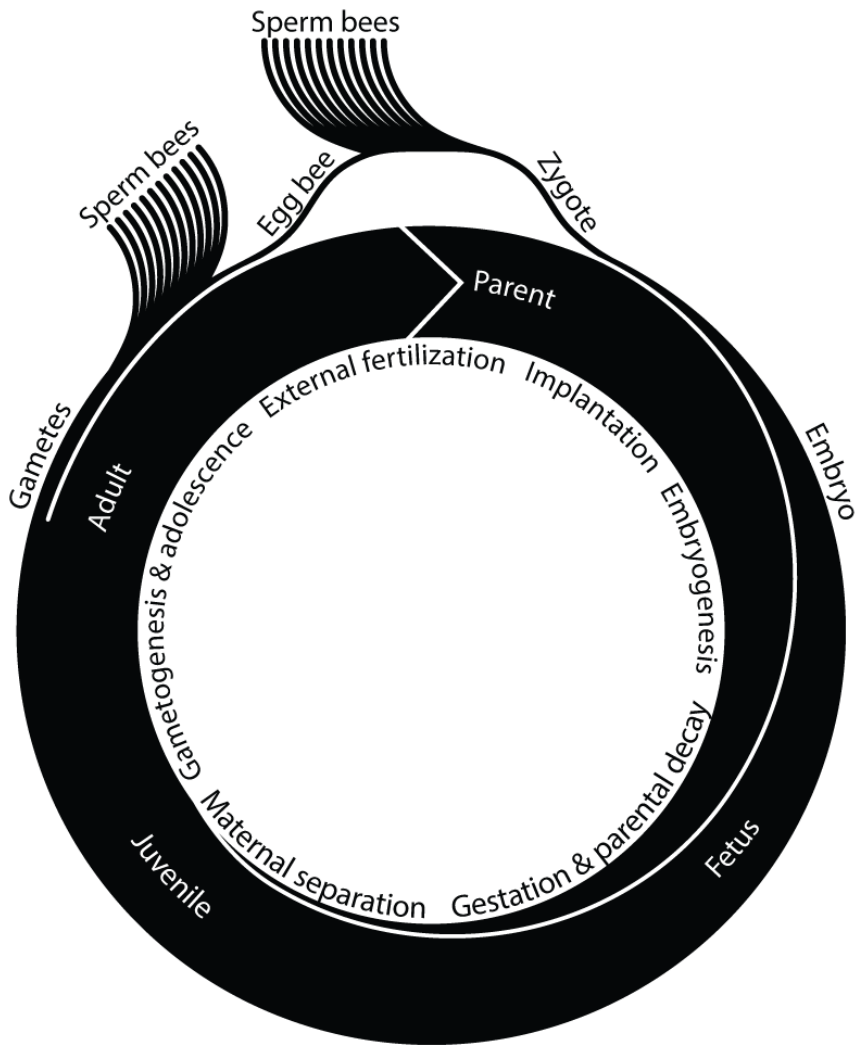

Table 1.
Hypothetical case of cavity occupancy by a parental colony and its offspring before reproduction and one year later, with designation of parent and offspring for theoretically mortal and potentially immortal colonies.
Table 1.
Hypothetical case of cavity occupancy by a parental colony and its offspring before reproduction and one year later, with designation of parent and offspring for theoretically mortal and potentially immortal colonies.
| Cavity 1 | Cavity 2 | Cavity 3 | |
|---|---|---|---|
| Year 1 before reproduction | Mother queen and her workers | Not occupied | Not occupied |
| Year 2 before reproduction | Daughter queen and her workers | Mother queen and her new workers | Daughter queen and her workers |
| Year 2 before reproduction for potentially immortal colonies | Parent | Offspring | Offspring |
| Year 2 before reproduction for mortal colonies | Offspring | Parent | Offspring |
Table 2.
Conventional and alternative terminology for honey bees.
| Conventional terminology | Alternative terminology |
|---|---|
| Drone | Sperm bee (gamete) |
| Virgin queen | Egg bee (gamete) |
| Mated queen | Fertilized egg bee (zygote) |
| Laying queen | Stem bee |
| Worker | Somatic bee |
| Colony/society | Superorganism |
Table 3.
Characteristic stages in the ontogeny of honey bee superorganisms.
| Zygote | Fertilized egg bee |
| Embryo | Stem bee with laid eggs and later larvae and pupae |
| Fetus | Stem bee with laid eggs, larvae, pupae and somatic bees performing a subset of the required functions |
| Juvenile | Stem bee with somatic bees performing all functions (optional: laid eggs, larvae, pupae) |
| Adult | Stem bee with somatic bees performing all functions, sperm bees and/or egg bees (optional: laid eggs, larvae, pupae) |
| Parent | Stem bee with somatic bees performing all functions and at least one fertilized egg bee (optional: laid eggs, larvae, pupae, sperm bees, egg bees) |
Table 4.
Characteristics of the four pathways to female honey bee superorganismal reproduction.
| Pathway to reproduction: | supersedure | after departure of prime swarm in original nest | via afterswarm | spontaneous after loss of stem bee |
|---|---|---|---|---|
| Provided nest: | established or newly founded | established | newly founded | established or newly founded |
| Provided stores: | all | fraction | all | all |
| Maternal care by: | entire or fraction of superorganism | fraction of superorganism | fraction of superorganism | entire or fraction of superorganism |
| Postnatal maternal care: | potentially high | low | low | very low or potentially high when reproduction occurs late in the season |
| Survivorship curve: | type I in established nest or II in newly founded nest | type I | type II | type I in established nest or II in newly founded nest |
| Fate of maternal superorganism: | reproduction entails obligate death | may survive reproduction | may survive reproduction | reproduction initiated by impending death |
| Possible number of offspring per reproductive cycle: | 1 (replacement of maternal superorganism) | 1 (may lead to multiplication) | 2 or more (may lead to multiplication) | 1 (replacement of maternal superorganism) |
Disclaimer/Publisher’s Note: The statements, opinions and data contained in all publications are solely those of the individual author(s) and contributor(s) and not of MDPI and/or the editor(s). MDPI and/or the editor(s) disclaim responsibility for any injury to people or property resulting from any ideas, methods, instructions or products referred to in the content. |
© 2026 by the authors. Licensee MDPI, Basel, Switzerland. This article is an open access article distributed under the terms and conditions of the Creative Commons Attribution (CC BY) license (http://creativecommons.org/licenses/by/4.0/).
Copyright: This open access article is published under a Creative Commons CC BY 4.0 license, which permit the free download, distribution, and reuse, provided that the author and preprint are cited in any reuse.