
Submitted:
01 February 2026
Posted:
03 February 2026
You are already at the latest version
Abstract
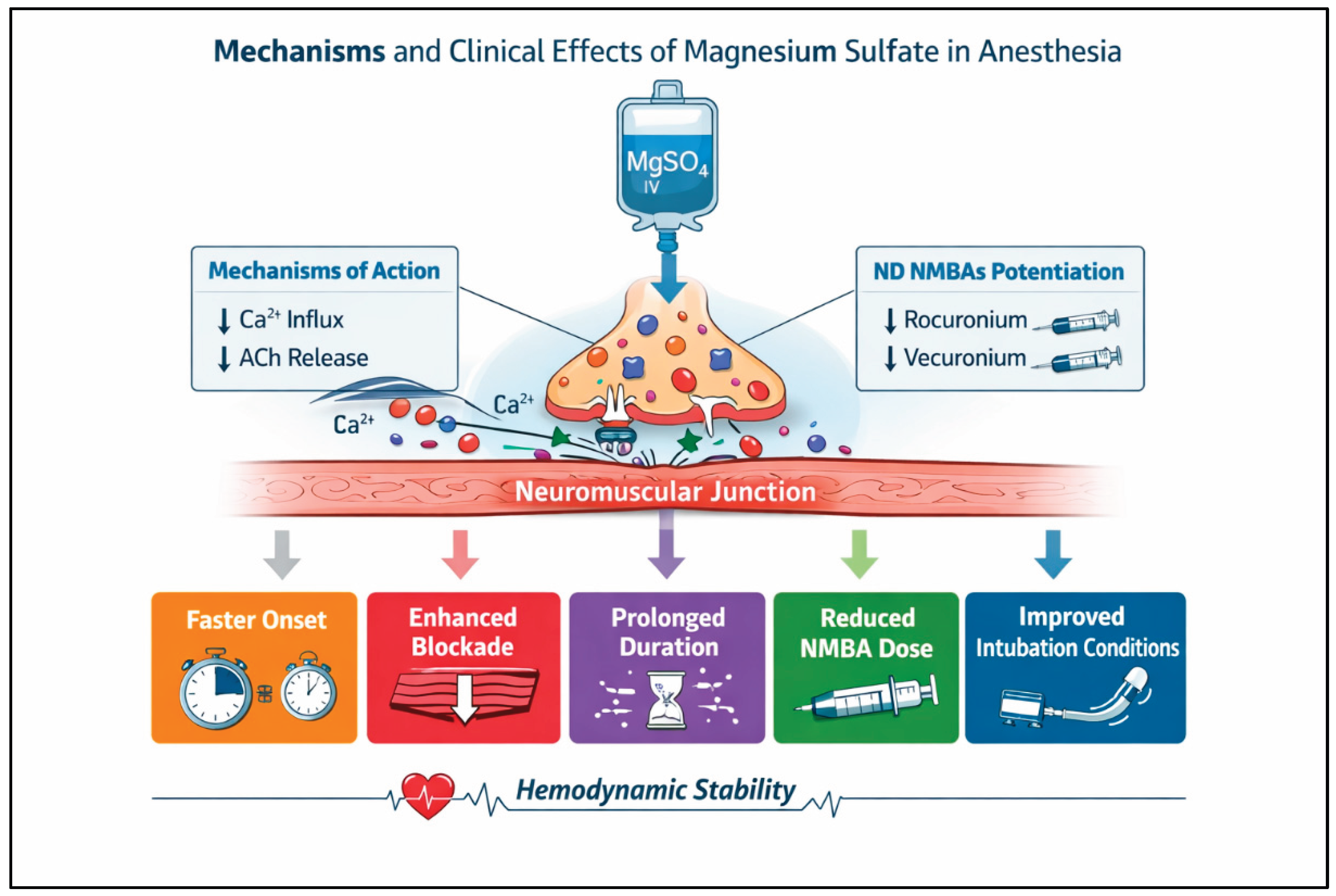
Background and Objectives: Magnesium sulfate (MgSO₄) has gained increasing attention in anaesthesiology due to its analgesic, muscle-relaxant, and hemodynamic-stabilizing properties. Acting as a calcium channel antagonist, magnesium reduces presynaptic acetylcholine release and potentiates the effects of neuromuscular blocking agents. The aim of this review is to evaluate the clinical role of intravenous magnesium sulfate as an adjuvant for enhancing neuromuscular blockade (NMB) during general anesthesia based on a summary of the available data. Materials and Methods: A narrative review of the literature was conducted, including clinical studies published between 1978 and 2025. The analysis comprised 18 randomized controlled trials (RCTs), 1 systematic review with meta-analysis, and 1 retrospective population-based cohort study. The included studies evaluated the interaction between MgSO₄ and depolarizing or non-depolarizing neuromuscular blocking agents in adult patients undergoing general anesthesia. Outcomes of interest included onset, duration, recovery of neuromuscular block, intubation conditions, required relaxant dose, effects during rapid sequence induction, and safety. Results: The majority of randomized trials demonstrate that magnesium sulfate accelerates the onset and prolongs the duration of neuromuscular blockade induced by non-depolarizing agents. Some clinical studies reported improved intubation conditions and reduced relaxant dose requirements. Data regarding recovery and reversal of neuromuscular block are heterogeneous. Magnesium pretreatment was associated with reduced fasciculations, myalgia, and potassium release after succinylcholine (SCh). The reviewed studies reported no serious adverse events or clinically significant hemodynamic instability at doses of 30–60 mg/kg. Conclusions: Intravenous magnesium sulfate is a valuable pharmacological adjuvant in anesthesia, enhancing neuromuscular blockade and improving intubation conditions while allowing dose reduction of neuromuscular blockers. Its use requires strict quantitative monitoring of neuromuscular transmission (NMT). Future large-scale, standardized trials should define optimal dosing strategies and long-term safety.
Keywords:
1. Introduction
2. Materials and Methods
3. Results
3.1. Effect on Depolarizing Neuromuscular Blockers
3.2. Effect of Magnesium Sulfate Pretreatment on the Onset of NMB
3.3. Effect of Magnesium Sulfate on the Duration of Neuromuscular Blockade
3.4. Recovery and Reversal of Neuromuscular Block
3.5. Intubation Conditions
3.6. Dose-Sparing Effect
3.7. Rapid Sequence Induction
3.8. Without Muscle Relaxant
3.9. Safety and Hemodynamic Effects
3.10. Meta-Analysis
4. Discussion
5. Practical Clinical Implications
6. Conclusions
Funding
Conflicts of Interest
References
- Evron, S; Ron, M; Donchin, Y. [Magnesium sulfate in the treatment of toxemia of pregnancy and its influence on muscle relaxants used in general anesthesia]. Harefuah;Hebrew. 1978, 94(2), 90–2. [Google Scholar] [PubMed]
- James, MF; Cork, RC; Dennett, JE. Succinylcholine pretreatment with magnesium sulfate. Anesth Analg. 1986, 65(4), 373–6. [Google Scholar] [CrossRef] [PubMed]
- Stacey, MR; Barclay, K; Asai, T; Vaughan, RS. Effects of magnesium sulphate on succinylcholine -induced complications during rapid-sequence induction of anaesthesia. Anaesthesia 1995, 50(11), 933–6. [Google Scholar] [CrossRef] [PubMed]
- Kumar, M; Talwar, N; Goyal, R; Shukla, U; Sethi, A. Effect of magnesium sulfate with propofol induction of anesthesia on succinylcholine-induced fasciculations and myalgia. J Anaesthesiol Clin Pharmacol. 2012, 28(1), 81–5. [Google Scholar] [CrossRef] [PubMed] [PubMed Central]
- James, MF; Schenk, PA; van der Veen, BW. Priming of pancuronium with magnesium. Br J Anaesth 1991, 66(2), 247–9. [Google Scholar] [CrossRef] [PubMed]
- Kussman, B; Shorten, G; Uppington, J; Comunale, ME. Administration of magnesium sulphate before rocuronium: effects on speed of onset and duration of neuromuscular block. Br J Anaesth 1997, 79(1), 122–4. [Google Scholar] [CrossRef] [PubMed]
- Fuchs-Buder, T; Wilder-Smith, OH; Borgeat, A; Tassonyi, E. Interaction of magnesium sulphate with vecuronium-induced neuromuscular block. Br J Anaesth 1995, 74(4), 405–9. [Google Scholar] [CrossRef] [PubMed]
- Wu, HL; Ye, TH; Sun, L. Effects of atracurium pretreatment with magnesium on speed of onset, duration, and recovery of neuromuscular blockade. Zhongguo Yi Xue Ke Xue Yuan Xue Bao;Chinese. 2009, 31(1), 73–6. [Google Scholar] [PubMed]
- Czarnetzki, C; Lysakowski, C; Elia, N; Tramèr, MR. Time course of rocuronium-induced neuromuscular block after pre-treatment with magnesium sulphate: a randomised study. Acta Anaesthesiol Scand. 2010, 54(3), 299–306. [Google Scholar] [CrossRef] [PubMed]
- Rotava, P; Cavalcanti, IL; Barrucand, L; Vane, LA; Verçosa, N. Effects of magnesium sulphate on the pharmacodynamics of rocuronium in patients aged 60 years and older: A randomised trial. Eur J Anaesthesiol 2013, 30(10), 599–604. [Google Scholar] [CrossRef] [PubMed]
- Sun, H; Jin, T; Wu, X; Yang, L; Zuo, Y; Liao, R. Efficacy of magnesium sulfate as an adjuvant to rocuronium in general anaesthesia: a meta-analysis. J Int Med Res. 2021, 49(7), 3000605211027736. [Google Scholar] [CrossRef] [PubMed] [PubMed Central]
- Kim, MH; Oh, AY; Jeon, YT; Hwang, JW; Do, SH. A randomised controlled trial comparing rocuronium priming, magnesium pre-treatment and a combination of the two methods. Anaesthesia 2012, 67(7), 748–54. [Google Scholar] [CrossRef] [PubMed]
- Queiroz Rangel Micuci, AJ; Verçosa, N; Filho, PAG; de Boer, HD; Barbosa, DD; Cavalcanti, IL. Effect of pretreatment with magnesium sulphate on the duration of intense and deep neuromuscular blockade with rocuronium: A randomised controlled trial. Eur J Anaesthesiol 2019, 36(7), 502–508. [Google Scholar] [CrossRef] [PubMed]
- Fuchs-Buder, T; Ziegenfuss, T; Lysakowski, K; Tassonyi, E. Antagonism of vecuronium-induced neuromuscular block in patients pretreated with magnesium sulphate: dose-effect relationship of neostigmine. Br J Anaesth 1999, 82(1), 61–5. [Google Scholar] [CrossRef] [PubMed]
- Han, J; Jeon, YT; Ryu, JH; Koo, CH; Nam, SW; Cho, SI; Oh, AY. Effects of magnesium on the dose of rocuronium for deep neuromuscular blockade: A randomised controlled trial. Eur J Anaesthesiol 2021, 38(4), 432–437. [Google Scholar] [CrossRef] [PubMed]
- Paul, G; Naaz, S; Bhadani, UK; Sahay, N; Kumar, R; Kumar, S. Comparison of Succinylcholine, Rocuronium, and Rocuronium with Magnesium on Time of Onset of Paralysis in Adult Patients Undergoing Rapid Sequence Induction: A Double Blinded Randomised Control Trial. Turk J Anaesthesiol Reanim 2025. [Google Scholar] [CrossRef] [PubMed]
- Ghodraty, MR; Saif, AA; Kholdebarin, AR; Rokhtabnak, F; Pournajafian, AR; Nikzad-Jamnani, AR; Shah, A; Nader, ND. The effects of magnesium sulfate on neuromuscular blockade by cisatracurium during induction of anesthesia. J Anesth. 2012, 26(6), 858–63. [Google Scholar] [CrossRef] [PubMed]
- Czarnetzki, C; Albrecht, E; Masouyé, P; Baeriswyl, M; Poncet, A; Robin, M; Kern, C; Tramèr, MR. Rapid Sequence Induction With a Standard Intubation Dose of Rocuronium After Magnesium Pretreatment Compared With Succinylcholine: A Randomized Clinical Trial. Anesth Analg. 2021, 133(6), 1540–1549. [Google Scholar] [CrossRef] [PubMed] [PubMed Central]
- Aissaoui, Y; Qamous, Y; Serghini, I; Zoubir, M; Salim, JL; Boughalem, M. Magnesium sulphate: an adjuvant to tracheal intubation without muscle relaxation – a randomised study. Eur J Anaesthesiol 2012, 29(8), 391–7. [Google Scholar] [CrossRef] [PubMed]
- Song, IA; Oh, TK; Do, SH. Trends in Perioperative Magnesium Sulfate Use in Patients Who Underwent Major Cancer Surgery: A Retrospective Population-Based Cohort Study in South Korea. Cancer Control 2023, 30, 10732748231180977. [Google Scholar] [CrossRef] [PubMed] [PubMed Central]
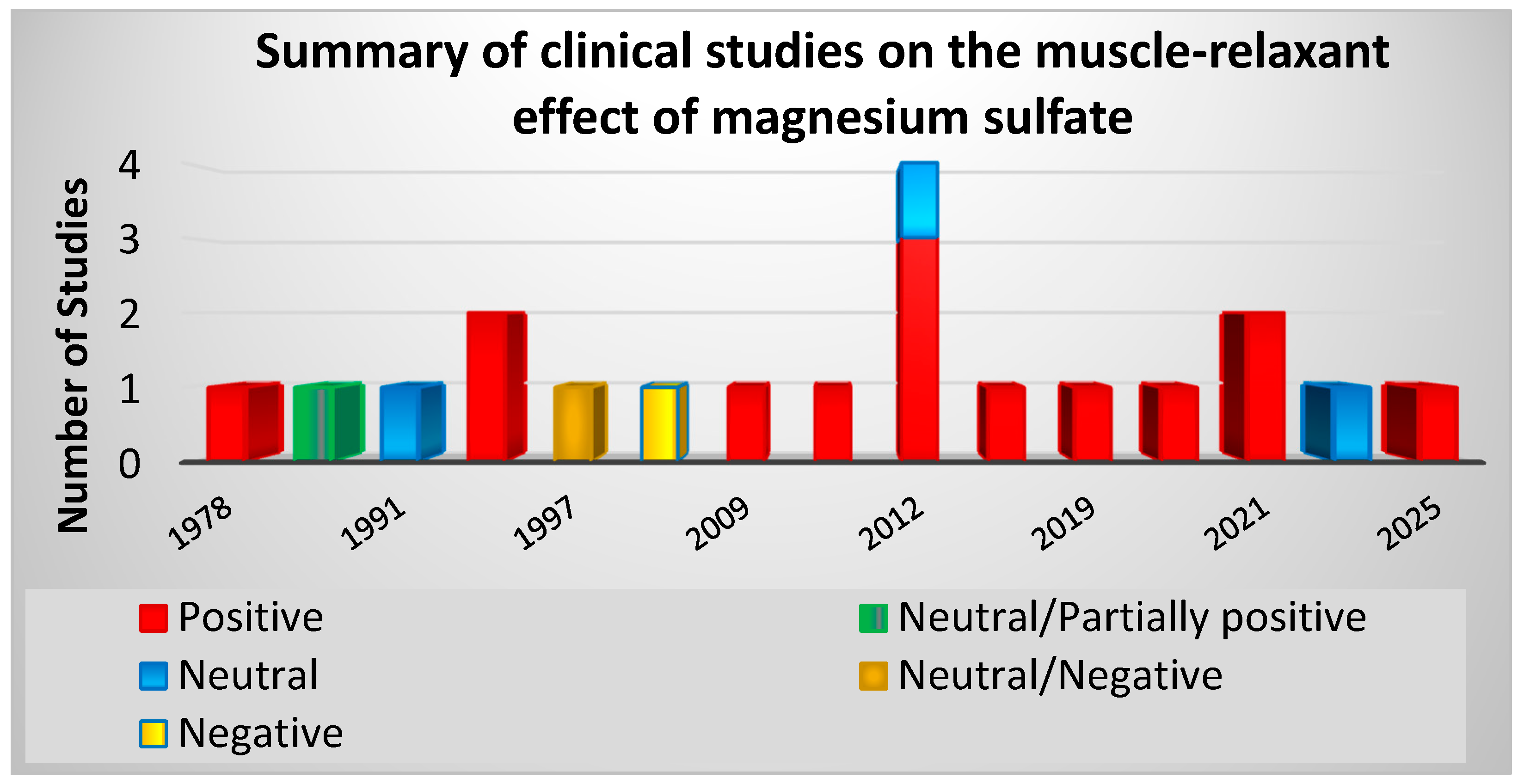

| Author/Year | Study Type | Relaxant/Patients | Main Finding | Mg Effect |
|---|---|---|---|---|
| 1978 Evron S | Observational study | NDMR | Prolonged action of NDMR | Positive |
| 1986 James MF | RCT | SCh n=20 | Suppresses serum K+ | Neutral/Partially positive |
| 1991 James MF | RCT | Pancuronium n=20 | No significant effect | Neutral |
| 1995 Stacey MR | RCT | SCh n=20 | Reduced fasciculations, no effect on K+ or myalgia | Positive |
| 1995 Fuchs-Buder T | RCT | Vecuronium n=125 | Faster onset and duration; improved intubation | Positive |
| 1997 Kussman B | RCT | Rocuronium n=30 | No faster onset, prolonged duration | Neutral/Negative |
| 1999 Fuchs-Buder T | RCT | Vecuronium n=48 | Slower reversal with neostigmine | Negative |
| 2009 Wu HL | RCT | Atracurium n=30 | Faster onset, prolonged NMB | Positive |
| 2010 Czarnetzki C | RCT | Rocuronium n=80 | Faster onset (~35%), prolonged NMB | Positive |
| 2012 Kim MH | RCT | Priming with Rocuronium vs Mg n=92 | Fastest onset and best intubation with Mg + priming | Positive |
| 2012 Aissaoui Y | RCT | Intubation without relaxant n=60 | Improved intubation conditions (83% vs 60%) | Positive |
| 2012 Ghodraty MR | RCT | Cisatracurium n=88 | No significant acceleration of onset | Neutral |
| 2012 Kumar M | RCT | SCh + Propofol n=60 | Reduced fasciculations and myalgia | Positive |
| 2013 Rotava P | RCT | Rocuronium n=64 (>60 yrs) | Faster onset of NMB | Positive |
| 2019 Queiroz Rangel Micuci AJ | RCT | Rocuronium n=60 | Increased duration of intense NMB; no change in deep NMB | Positive |
| 2021 Sun H | Meta-analysis | Rocuronium 11 RCTs, n=460 | Faster onset, prolonged NMB, improved intubation | Positive |
| 2021 Han J | RCT | Rocuronium n=70 | Reduced Rocuronium dose by 20% | Positive |
| 2021 Czarnetzki C | RCT | RSI; Rocuronium + Mg vs SCh n=280 | Similar intubation; fewer side effects in Mg group | Positive |
| 2023 Song IA | Retrospective cohort | Various n=253538 oncologic | No faster onset, prolonged NMB | Neutral |
| 2025 Paul G | RCT | RSI; SCh vs Rocuronium vs Roc + Mg n=135 | Excellent intubation conditions; stable hemodynamics | Positive |
| Clinical Aspect | Effect of Magnesium Sulfate | Clinical Implications |
|---|---|---|
| Onset of neuromuscular block | Accelerated onset of non-depolarizing neuromuscular blockade (up to ~30–35% in several RCTs) | Faster achievement of optimal intubation conditions; useful during rapid sequence induction |
| Depth of neuromuscular block | Enhanced intensity and quality of blockade | Improved surgical conditions, particularly in laparoscopic and robotic procedures |
| Duration of neuromuscular block | Prolonged duration of neuromuscular blockade | Requires dose adjustment of neuromuscular blocking agents and strict monitoring |
| Recovery from blockade | Variable effects; delayed spontaneous recovery reported in some studies | Emphasizes the importance of quantitative neuromuscular monitoring and appropriate reversal |
| Dose of non-depolarizing NMBAs | Reduction of effective dose by approximately 20–25% | Lower total neuromuscular blocker exposure and potential reduction of dose-related adverse effects |
| Succinylcholine -related effects | Reduced fasciculations, postoperative myalgia, and potassium release | Improved safety profile, particularly in patients at risk of hyperkalemia |
| Intubation conditions | Improved intubation conditions when combined with rocuronium or vecuronium | Potential alternative to succinylcholine in selected patients |
| Hemodynamic effects | Generally stable hemodynamics at doses of 30–60 mg/kg | Suitable for routine clinical use in anaesthetic practice |
| Safety profile | Mild and transient adverse effects reported (e.g., flushing, injection site discomfort) | Magnesium sulfate is well tolerated when used with appropriate dosing and monitoring |
Disclaimer/Publisher’s Note: The statements, opinions and data contained in all publications are solely those of the individual author(s) and contributor(s) and not of MDPI and/or the editor(s). MDPI and/or the editor(s) disclaim responsibility for any injury to people or property resulting from any ideas, methods, instructions or products referred to in the content. |
© 2026 by the authors. Licensee MDPI, Basel, Switzerland. This article is an open access article distributed under the terms and conditions of the Creative Commons Attribution (CC BY) license (http://creativecommons.org/licenses/by/4.0/).