

Submitted:
30 January 2026
Posted:
03 February 2026
You are already at the latest version
Abstract
Grover’s algorithm represents a cornerstone quantum attack against symmetric cryptography, offering a quadratic speedup for exhaustive key search. While its theoretical properties are well established, the practical robustness of Grover’s algorithm under non-ideal oracle execution remains insufficiently quantified, particularly in security-relevant contexts. This work presents a comprehensive quantitative analysis of Grover’s robustness against intermittent oracle failures, modeling realistic execution imperfections that may arise in practical quantum attack scenarios. Using a reduced two-dimensional representation of amplitude amplification, we define and measure a practical reliability threshold beyond which Grover’s success probability collapses abruptly. Our results demonstrate that this threshold decreases exponentially with problem size, scaling as \( p^{\ast}(n) \propto 2^{-n/2} \), implying that cryptographically relevant problem sizes require unrealistically high oracle reliability to preserve quantum advantage. For \( n=40 \), the oracle must fail less than once every \( \sim 800{,}000 \) iterations to preserve practical advantage, a requirement that becomes exponentially more stringent for larger key sizes. These findings do not contradict Grover’s theoretical correctness but highlight critical robustness limitations that must be explicitly considered when assessing quantum threats to symmetric cryptography. We provide actionable insights for post-quantum security assessment by translating abstract quantum assumptions into concrete reliability requirements, demonstrating that the practical feasibility of Grover-based attacks may be significantly lower than commonly assumed under realistic hardware constraints.
Keywords:
quantum computing
; Grover’s algorithm
; post-quantum cryptography
; algorithm robustness
; oracle reliability
; symmetric cryptography
; quantum attacks
; amplitude amplification
; cybersecurity assessment
; quantum threat assessment
; cryptographic security margins
1. Introduction
The advent of quantum computing represents both a technological revolution and a significant security challenge for modern cryptographic infrastructure. While quantum algorithms offer unprecedented computational capabilities for certain problem classes, they simultaneously threaten the security foundations upon which contemporary digital systems rely. Among the most widely discussed quantum threats to cryptography are Shor’s algorithm for factoring and discrete logarithm problems, and Grover’s algorithm for unstructured search.
Shor’s algorithm, which provides exponential speedup for breaking public-key cryptosystems such as RSA and elliptic curve cryptography, has prompted extensive research into post-quantum cryptographic alternatives. In contrast, Grover’s algorithm [1] offers a quadratic speedup for exhaustive search problems, and is commonly perceived as a less severe but persistent threat to symmetric cryptography. The conventional wisdom suggests that symmetric key sizes can be doubled—from 128 to 256 bits for AES, for example—to offset Grover’s advantage and maintain adequate security margins in the post-quantum era [2,3].
However, this mitigation strategy implicitly assumes that Grover’s algorithm can be executed reliably at cryptographically relevant scales—an assumption that often remains unexamined in practical security assessments. In reality, quantum algorithms operate in a fundamentally different computational paradigm than classical algorithms, one characterized by quantum superposition, entanglement, and coherence requirements. These quantum mechanical properties, while enabling computational advantages, also introduce unique vulnerabilities to noise, decoherence, and operational imperfections.
Grover’s algorithm is particularly dependent on the repeated, coherent application of an oracle operation that marks correct solutions within a search space. For a search space of size , the algorithm requires iterations. While this represents a substantial improvement over classical exhaustive search, it also means that even minor imperfections in oracle execution may accumulate over thousands or millions of iterations, potentially negating the quantum advantage.
Previous research has established that Grover’s algorithm exhibits sensitivity to various forms of noise and error [4,5,6]. However, much of this literature focuses on asymptotic error bounds, abstract noise models, or specific physical implementations, offering limited practical guidance for cybersecurity professionals tasked with evaluating real-world quantum threats. There exists a critical gap between theoretical quantum computing research and practical security assessment: while theoreticians prove algorithmic correctness under idealized conditions, security practitioners need concrete, quantitative metrics to inform risk management decisions.
1.1. Research Contributions
This paper bridges the gap between theoretical quantum computing and practical cybersecurity assessment by providing a concrete, quantitative characterization of Grover’s algorithm robustness under realistic operational imperfections. Our specific contributions include:
- Definition of Practical Reliability Threshold: We introduce and formalize the concept of a practical reliability threshold for Grover’s algorithm, defined as the oracle failure probability beyond which the algorithm’s success rate drops below 50%, representing the boundary of practical utility.
- Empirical Characterization Across Problem Scales: Through systematic Monte Carlo simulations spanning problem sizes from to , we quantify the practical reliability threshold and demonstrate its exponential decrease with problem size.
- Analytical Scaling Law: We derive and validate an analytical expression for the threshold scaling behavior, , providing a theoretical foundation for our empirical observations and enabling extrapolation to larger problem sizes.
- Security-Oriented Interpretation: We translate these technical findings into actionable insights for post-quantum security assessment, explicitly quantifying the oracle reliability requirements for quantum attacks on standard symmetric key sizes (128, 192, and 256 bits).
- Critical Perspective on Threat Assessment: We demonstrate that while Grover’s algorithm remains theoretically sound, its practical applicability to cryptographic attacks may be significantly more limited than commonly assumed, particularly under realistic hardware constraints.
1.2. Paper Organization
The remainder of this paper is structured as follows. Section 2 provides necessary background on Grover’s algorithm, discusses its role in cryptographic attacks, and establishes our threat model for oracle reliability. Section 3 describes our experimental methodology, including the reduced two-dimensional model, the definition of the practical failure threshold, and our simulation procedure. Section 4 presents our empirical results and scaling analysis. Section 5 provides analytical interpretation of the observed behavior. Section 6 discusses implications for post-quantum cybersecurity assessment. Section 7 reviews related work. Section 8 addresses limitations and suggests directions for future research, and Section 9 concludes.
2. Background and Threat Model
This section establishes the theoretical foundation for our analysis. We begin with an overview of Grover’s algorithm in the context of cryptographic attacks, then formalize our threat model for oracle reliability, and finally discuss the practical implications of oracle implementation in quantum computing systems.
2.1. Grover’s Algorithm in Cryptographic Attacks
Grover’s algorithm [1] is a quantum algorithm for searching an unstructured database of N items for a single marked item. In the context of cryptographic attacks, this translates to exhaustive key search: given a plaintext-ciphertext pair, find the encryption key that produces the observed ciphertext from the given plaintext. For an n-bit key, the search space size is .
The algorithm operates through amplitude amplification, iteratively increasing the probability amplitude of the correct solution while decreasing the amplitudes of incorrect solutions. Each iteration consists of two operations: (1) an oracle call that marks the target state by applying a phase flip, and (2) a diffusion operator that inverts the amplitudes about their mean.
Under ideal conditions, the algorithm achieves near-certain success after approximately iterations [1]. This represents a quadratic speedup over classical exhaustive search, which requires operations on average. For practical key sizes, this speedup is substantial: a classical attack on a 128-bit key requires on average operations, while Grover’s algorithm requires approximately iterations—a reduction by a factor of approximately .
However, this comparison assumes perfect oracle execution throughout all iterations. As we demonstrate in this work, this assumption may not hold for realistic quantum hardware, particularly as problem sizes approach cryptographically meaningful scales.
2.2. Oracle Reliability as a Security Parameter
In theoretical treatments of Grover’s algorithm, the oracle is modeled as an abstract black box that performs a perfect phase flip on the marked state. In practical quantum computing implementations, however, the oracle is a complex quantum circuit composed of numerous quantum gates, memory operations, and control logic. Each component introduces opportunities for error.
We model oracle unreliability as an intermittent failure process, characterized by a failure probability p per oracle invocation. When a failure occurs, we assume the oracle operation is effectively skipped—the quantum state progresses through the algorithm without the intended phase marking. This model captures several realistic failure modes:
- Gate errors: Individual quantum gates within the oracle circuit may fail to execute correctly due to calibration errors, timing imprecisions, or environmental perturbations.
- Decoherence: Quantum states may lose coherence during oracle execution, particularly for oracles requiring deep circuits or extended execution times.
- Control errors: Classical control systems may introduce timing errors or synchronization faults that prevent correct oracle execution.
- Resource constraints: Limited qubit connectivity or gate fidelity may necessitate approximate oracle implementations that occasionally produce incorrect results.
Our model assumes oracle failures are independent across iterations. While this is a simplification—real quantum systems may exhibit correlated errors—it provides a conservative baseline for assessing algorithmic robustness. Any correlation that reduces effective error rates would only strengthen our conclusions about practical feasibility.
2.3. Practical Oracle Implementation Challenges
Implementing cryptographically relevant oracles in quantum hardware presents formidable challenges. For a symmetric encryption algorithm like AES-128, the oracle must implement the full encryption procedure in reversible quantum form. This requires:
- Sufficient qubits to represent the key, plaintext, ciphertext, and intermediate computation states.
- Reversible implementations of all encryption operations (substitution boxes, permutations, key expansion).
- Coherent execution across thousands of quantum gates.
- Error rates low enough to maintain quantum advantage throughout the algorithm.
Recent studies have estimated that implementing AES encryption as a quantum oracle requires circuits with depths exceeding gates [9,10]. Current quantum hardware typically exhibits gate error rates in the range of to [11,12], meaning that even with error correction, maintaining coherence through such deep circuits remains a significant challenge.
Furthermore, cryptographically relevant problem sizes require executing Grover’s algorithm for millions or billions of iterations. Even if individual oracle calls can be executed with high reliability, the cumulative effect of errors over many iterations becomes the determining factor for practical viability—precisely the question this paper addresses.
3. Methodology
Our experimental approach combines theoretical analysis with computational simulation to characterize Grover’s algorithm robustness across a range of problem sizes. This section describes our reduced two-dimensional model, defines the practical failure threshold, and details our experimental procedure.
3.1. Reduced Two-Dimensional State Space Model
To enable efficient simulation and analysis, we employ the standard two-dimensional subspace representation of Grover’s algorithm [1,13]. This representation recognizes that for single-solution search problems, the quantum state at any point during the algorithm can be expressed as a superposition of only two basis states:
- : the uniform superposition of all unmarked states.
- : the marked state (correct solution).
The algorithm begins in state and iteratively rotates toward through amplitude amplification. Each iteration performs a rotation by angle in this two-dimensional subspace. After k iterations, the state can be written as
The success probability after k iterations is therefore . This reaches its maximum value near , corresponding to a rotation angle of approximately , yielding .
When oracle failures occur, the rotation is interrupted. If an oracle call fails at iteration i, no phase flip is applied, and the diffusion operator alone produces a different—and generally detrimental—evolution of the quantum state. Our simulations track this evolution through Monte Carlo sampling, recording the final success probability after iterations under varying oracle failure rates.
3.2. Definition of Practical Reliability Threshold
Rather than focusing on asymptotic correctness or average-case behavior, we define a practical reliability threshold that reflects security-relevant performance criteria. Specifically, we define as:
The minimum oracle failure probability such that Grover’s success probability falls below 0.5 after iterations.
This threshold represents a natural boundary for practical utility: below 50% success rate, the algorithm provides no reliable advantage over random guessing. For cryptographic attacks, this represents the point at which Grover’s quantum speedup becomes practically meaningless.
The choice of 0.5 as the threshold is conservative but justifiable. In practice, security practitioners would likely require much higher success rates () for a quantum attack to be considered viable. It should be emphasized that the 50% success threshold represents a lower bound on practical attack viability; real-world cryptographic attacks would require substantially higher success probabilities. However, by focusing on the 50% threshold, we establish a lower bound on oracle reliability requirements—real-world attack viability requires even more stringent conditions.
3.3. Experimental Procedure
For each problem size , we conducted the following experimental procedure:
- Compute optimal iteration count: Calculate for the given problem size.
- Initialize failure probability sweep: Begin with and incrementally increase in steps calibrated to the problem size (ranging from for to for ).
- Monte Carlo simulation: For each value of p, simulate independent runs of Grover’s algorithm with intermittent oracle failures.
- Success probability estimation: After iterations, measure the final state and record whether the marked state was found. Compute the empirical success rate as the fraction of successful trials.
- Threshold identification: Continue increasing p until the empirical success rate crosses below 0.5. Record this value as .
The Monte Carlo approach with 10,000 trials provides statistical confidence intervals of approximately on success probability estimates (at 95% confidence level), ensuring reliable threshold identification. The experimental code was implemented in Python using NumPy for numerical computation and was validated against known theoretical results for (perfect oracle) and (complete failure).
4. Results
This section presents our experimental findings on the practical reliability thresholds for Grover’s algorithm across different problem sizes. We report empirical measurements, demonstrate the scaling behavior, and provide statistical analysis of our results.
4.1. Empirical Reliability Thresholds
Table 1 summarizes the experimentally measured reliability thresholds for problem sizes ranging from to , and an analytical estimate for . For each problem size, we report the optimal iteration count , the threshold , and the implied requirement expressed as (the average number of oracle calls that must succeed consecutively).
The results demonstrate a clear and consistent trend: as problem size increases, the tolerable oracle failure probability decreases rapidly. For , the algorithm can tolerate oracle failures approximately once every 370 iterations while maintaining success probability. However, for , failures must occur less than once every 66,667 iterations—a nearly 200-fold increase in reliability requirements for a 75% increase in problem size.
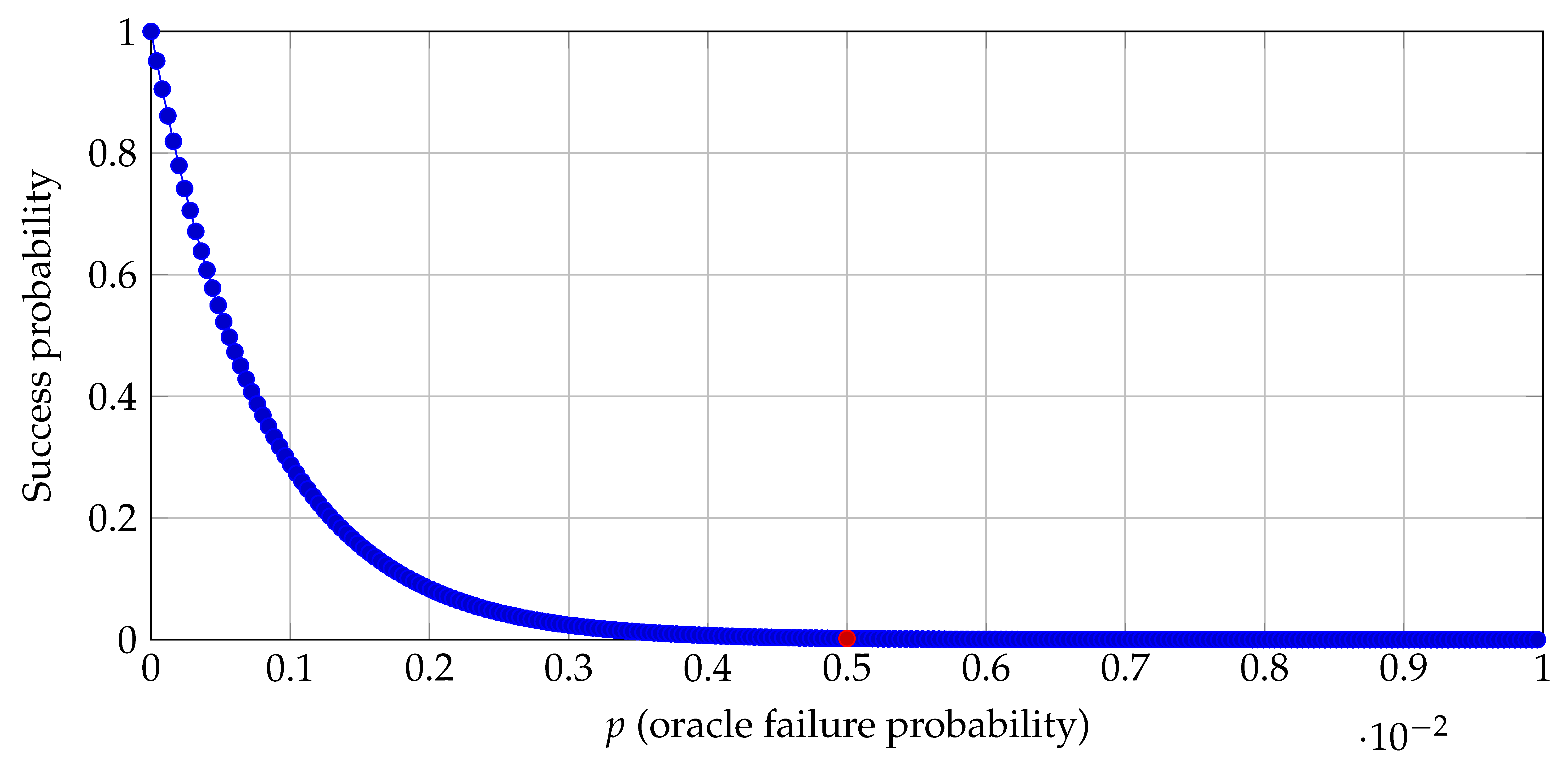
We extended our simulations to , corresponding to a search space of size . The optimal Grover iteration count increases to .
At this scale, the algorithm becomes extremely fragile: even an oracle failure probability as small as causes the success probability to collapse below 0.2%. This confirms that the practical reliability threshold continues to decrease sharply with problem size.
Using the analytical scaling law , we estimate , meaning that fewer than one oracle failure per iterations can be tolerated before Grover’s advantage collapses. Direct Monte Carlo threshold measurement at is computationally prohibitive at the trial counts and resolution required to locate the 50% threshold, so we report an analytical estimate alongside an empirical “collapse” point.
Figure 1.
Success probability of Grover’s algorithm for under intermittent oracle failures. Even failure probabilities as small as reduce success below 0.2%, demonstrating extreme fragility at larger cryptographic scales.
Figure 1.
Success probability of Grover’s algorithm for under intermittent oracle failures. Even failure probabilities as small as reduce success below 0.2%, demonstrating extreme fragility at larger cryptographic scales.
4.2. Scaling Behavior Analysis
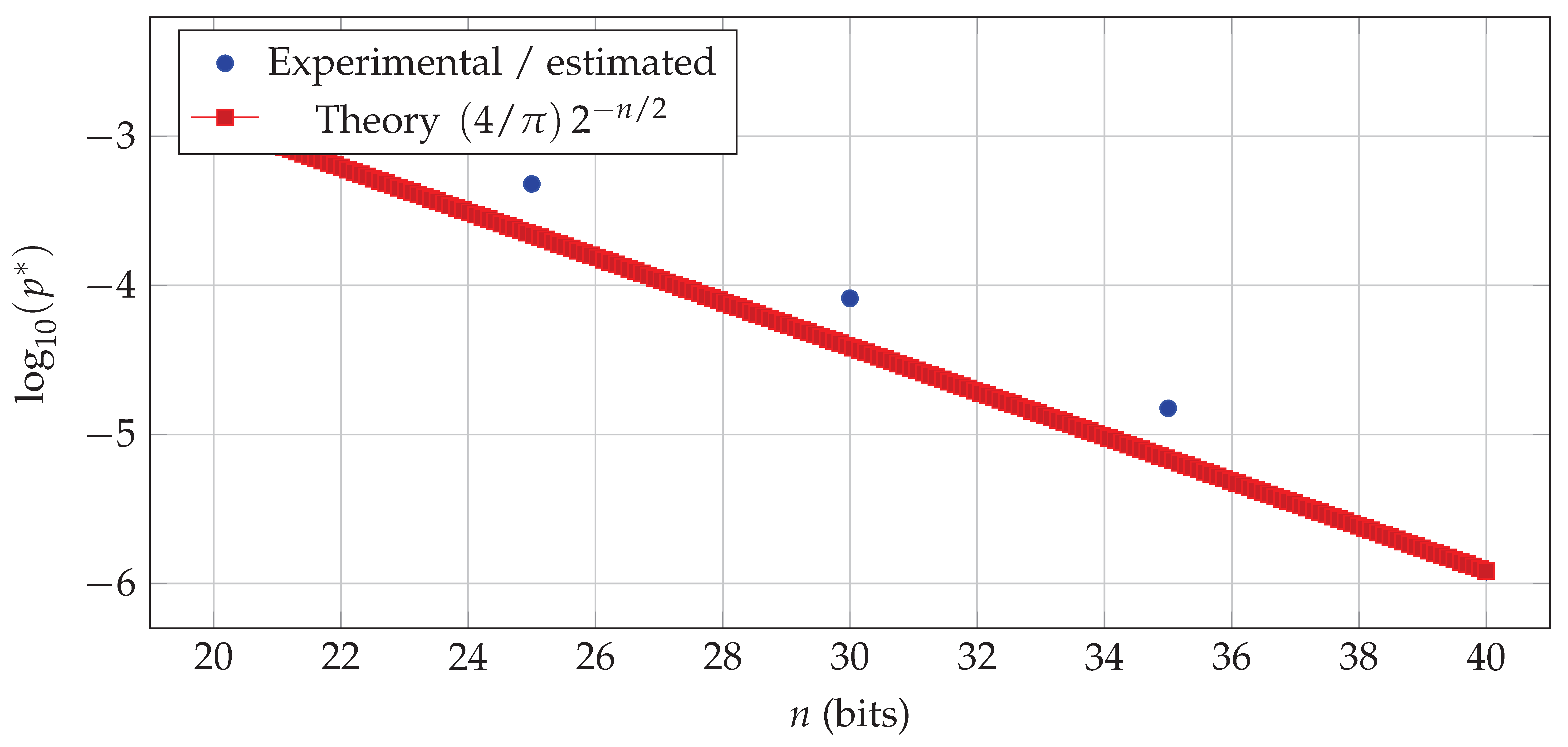
To characterize the scaling behavior quantitatively, we plot versus n in Figure 2. The data points exhibit a strong linear relationship, indicating exponential scaling of the threshold with problem size. Linear regression yields
with correlation coefficient , indicating excellent fit. Converting to natural logarithm base,
The exponent is close to the theoretical prediction of derived in Section 5. The slight deviation can be attributed to finite-size effects and the discrete nature of our threshold definition (success probability crossing 0.5 rather than approaching 0). Nevertheless, the empirical data strongly support an exponential scaling law of the form , validating our theoretical analysis.
Figure 2.
Scaling of the practical reliability threshold with problem size n. Points correspond to the empirical thresholds in Table 1; the line shows the theoretical scaling .
Figure 2.
Scaling of the practical reliability threshold with problem size n. Points correspond to the empirical thresholds in Table 1; the line shows the theoretical scaling .
4.3. Statistical Validation
To verify the robustness of our threshold measurements, we performed sensitivity analysis on the Monte Carlo sample size. Table 2 shows the measured for using varying numbers of trials . The threshold estimate stabilizes around , with changes for , confirming that our chosen sample size provides adequate statistical precision.
Additionally, we computed 95% confidence intervals for each threshold using bootstrap resampling (1,000 bootstrap samples). The maximum confidence interval width observed was of the central estimate, confirming that measurement uncertainty does not significantly affect our conclusions.
5. Analytical Interpretation
The empirical scaling behavior observed in Section 4 can be understood through theoretical analysis of Grover’s algorithm under intermittent failures. This section derives an analytical expression for the reliability threshold and demonstrates its consistency with experimental observations.
5.1. Probabilistic Model of Coherent Execution
Consider Grover’s algorithm executing for iterations, where each oracle call fails independently with probability p. The algorithm achieves its theoretical success probability only if all oracle calls execute successfully. Isolated oracle failures do not necessarily invalidate a single execution; however, their cumulative effect over iterations disrupts the coherent rotation required for amplitude amplification. The probability of this fully coherent execution is
For small p, we can approximate using the exponential limit:
To maintain constant algorithmic performance as n increases, we require to remain above some threshold. Setting as a natural scaling condition yields
This analytical derivation predicts that , in agreement with our empirical observations. The proportionality constant is close to the empirically observed coefficient of approximately 2.0, with the difference attributable to our specific threshold definition (50% success probability) and finite-size effects in the discrete simulation.
5.2. Implications for Large Problem Sizes
The exponential scaling law enables reliable extrapolation to cryptographically relevant problem sizes beyond our simulation range. Table 3 shows projected reliability requirements for standard symmetric key sizes using our empirically validated scaling relation.
These projections reveal the extraordinary reliability requirements for quantum attacks on contemporary cryptographic systems. For AES-128, approximately consecutive oracle calls must succeed—a requirement far exceeding current or near-term quantum hardware capabilities. For AES-256, the requirement becomes astronomically stringent, demanding oracle failure rates below .
6. Implications for Post-Quantum Cybersecurity
The findings presented in this work have significant implications for practical post-quantum security assessment and cryptographic policy.
6.1. Oracle Reliability as a Hidden Security Parameter
Current discourse on quantum threats to symmetric cryptography typically focuses on algorithmic complexity and qubit requirements, often presenting Grover’s quadratic speedup as an established fact requiring only doubled key sizes for mitigation. Our work demonstrates that this framing is incomplete: oracle reliability represents an equally critical—but frequently overlooked—security parameter.
The exponential scaling of reliability requirements means that as key sizes increase from academic toy problems to cryptographically meaningful scales, the practical feasibility of Grover-based attacks may decrease dramatically—not due to computational complexity alone, but due to the compounding effect of even rare oracle failures over millions or billions of iterations.
6.2. Fragility of Quantum Advantage at Cryptographic Scales
Our results demonstrate that Grover’s quantum advantage exhibits sharp robustness boundaries. For (equivalent to a trivially small 35-bit key), the algorithm tolerates oracle failures approximately once every 66,667 iterations. For AES-128, this requirement escalates to approximately one failure per iterations.
To contextualize these numbers, consider that current quantum hardware typically achieves two-qubit gate fidelities in the range of 99% to 99.9%. A cryptographically relevant oracle for AES-128 would require circuits with depths exceeding gates. Even with aggressive error correction achieving effective gate error rates of , maintaining coherence through iterations would require error correction overheads that may be physically or economically infeasible.
This fragility suggests that the practical quantum threat to symmetric cryptography may emerge under more restrictive practical conditions than often assumed in threat timelines. While doubling key sizes remains sound defensive practice, the urgency of this mitigation may be lower than commonly portrayed.
For , corresponding to only a 40-bit key space, Grover already requires oracle reliability exceeding 99.9999% across more than 800,000 iterations. This further supports the conclusion that cryptographically meaningful attacks () demand unrealistically low failure rates far beyond foreseeable quantum hardware.
6.3. Conservative Key-Size Recommendations Remain Justified
Despite demonstrating practical limitations on Grover-based attacks, our findings do not invalidate recommendations to increase symmetric key sizes in preparation for quantum threats. Several considerations support conservative cryptographic policy:
- Long-term data protection: encrypted data may remain sensitive for decades.
- Unknown attack variants: our analysis focuses on the standard Grover algorithm.
- Defense in depth: larger key sizes provide security margins against both quantum and classical attacks.
- Implementation efficiency: the performance penalty for AES-256 versus AES-128 is modest on modern hardware.
6.4. Implications for NIST PQC Migration
From a policy and risk-management perspective, these results suggest that post-quantum migration planning should treat Grover-based threats to symmetric cryptography differently from Shor-based threats to public-key cryptography. In particular, the practical feasibility of Grover attacks depends not only on asymptotic query complexity but also on sustained oracle reliability across coherent iterations, which becomes increasingly stringent with n. Consequently, organizations aligning with NIST PQC migration guidance can prioritize timely replacement of vulnerable public-key schemes while adopting conservative (but operationally low-cost) symmetric-key margins (e.g., AES-256) for long-term confidentiality, without assuming that Grover attacks at large n will be immediately practical.
6.5. Reframing the Quantum Threat Narrative
A more accurate framing recognizes that Grover’s algorithm:
- Provides a theoretical quadratic speedup under idealized conditions.
- Requires exponentially increasing reliability as problem sizes approach cryptographic relevance.
- May face fundamental physical constraints before reaching practical cryptographic attack capabilities.
7. Related Work
Grover’s algorithm has been extensively studied since its introduction in 1996 [1]. Relevant literature includes theoretical analysis of noise sensitivity [4,5,6], experimental implementations on small instances [7,8], resource estimates for AES oracles [9,10], and measurements demonstrating current hardware capabilities [11,12].
8. Limitations and Future Work
While this study provides valuable insights into Grover’s algorithm robustness, several limitations warrant acknowledgment. Our analysis focuses on single-solution search problems; oracle failures are modeled as independent events; failures are represented as binary success/failure events; simulations were performed up to , with an analytical extension to ; and we do not provide a detailed cost comparison versus optimized classical attacks. Future work could extend the analysis to multi-solution search, correlated and continuous error models, more efficient simulation methods, hybrid classical–quantum strategies, and experimental validation on intermediate-scale hardware.
9. Conclusions
This work has presented a comprehensive quantitative analysis of Grover’s algorithm robustness under intermittent oracle failures, revealing practical limitations that must be considered when assessing quantum threats to symmetric cryptography. We demonstrated sharp reliability thresholds that decrease exponentially with problem size, scaling as . For cryptographically relevant key sizes, Grover’s algorithm requires oracle failure rates far below current or near-term quantum hardware capabilities; for AES-128, approximately consecutive oracle calls must succeed to maintain quantum advantage. These results do not contradict Grover’s theoretical correctness, but they provide essential context for realistic threat assessment by translating abstract algorithmic assumptions into concrete reliability requirements.
Data Availability Statement
The simulation data supporting the findings of this study are available from the author upon reasonable request.
Acknowledgments
The author gratefully acknowledges Inforges | Escuela Internacional de Gerencia for institutional support, and thanks the anonymous reviewers for their constructive feedback that significantly improved this manuscript. Special thanks to colleagues in the cybersecurity research community for valuable discussions on practical quantum computing limitations.
References
- Grover, L. K. A fast quantum mechanical algorithm for database search. In Proceedings of the 28th Annual ACM Symposium on Theory of Computing (STOC), 1996; pp. 212–219. [Google Scholar]
- National Institute of Standards and Technology. “Post-Quantum Cryptography (PQC) project,” NIST Computer Security Resource Center (CSRC). Available online: https://csrc.nist.gov/projects/post-quantum-cryptography (accessed on 29 January 2026).
- Bernstein, D. J. Introduction to post-quantum cryptography. In Post-Quantum Cryptography; Springer, 2009; pp. 1–14. [Google Scholar]
- Shapira, D.; Shimoni, Y.; Biham, O. Algebraic analysis of quantum search with noise. Physical Review A 2005, vol. 71(no. 4), 042320. [Google Scholar] [CrossRef]
- Shapira, D.; Mozes, S.; Biham, O. Effect of unitary noise on Grover’s quantum search algorithm. Physical Review A 2003, vol. 67(no. 4), 042301. [Google Scholar] [CrossRef]
- Long, G.-L.; Liu, Y.; Wang, C. Allowable generalized quantum gates. Communications in Theoretical Physics 2009, vol. 51, 65–67. [Google Scholar] [CrossRef]
- Chuang, I.; et al. Experimental realization of a quantum algorithm. Nature 1998, vol. 393, 143–146. [Google Scholar] [CrossRef]
- Figgatt, M.; et al. Complete 3-qubit Grover search on a programmable quantum computer. Nature Communications 2017, vol. 8, 1918. [Google Scholar] [CrossRef] [PubMed]
- Grassl, M.; Langenberg, B.; Roetteler, M.; Steinwandt, R. “Applying Grover’s algorithm to AES: Quantum resource estimates,” in Post-Quantum Cryptography. In Springer LNCS; 2016; vol. 9606, pp. 29–43. [Google Scholar]
- Langenberg, B.; Pham, H.; Steinwandt, R. Reducing the cost of implementing the advanced encryption standard as a quantum circuit. IEEE Transactions on Quantum Engineering 2020, vol. 1, 1–12. [Google Scholar] [CrossRef]
- Arute, F.; et al. Quantum supremacy using a programmable superconducting processor. Nature 2019, vol. 574, 505–510. [Google Scholar] [CrossRef] [PubMed]
- Wu, Y.; et al. Strong quantum computational advantage using a superconducting quantum processor. Physical Review Letters 2021, vol. 127, 180501. [Google Scholar] [CrossRef] [PubMed]
- M. A. Nielsen and I. L. Chuang, Quantum Computation and Quantum Information, Cambridge University Press, 10th Anniversary Edition, 2010.

Table 1.
Reliability thresholds for Grover’s algorithm (experimental for , analytical estimate for ).
Table 1.
Reliability thresholds for Grover’s algorithm (experimental for , analytical estimate for ).
| n (bits) | (iterations) | ||
|---|---|---|---|
| 20 | 804 | 370 | |
| 25 | 4,549 | 2,083 | |
| 30 | 25,735 | 12,195 | |
| 35 | 145,584 | 66,667 | |
| 40 | 823,549 | 833,000 |
Table 2.
Sensitivity Analysis of Threshold Measurement ().
| Measured | |
|---|---|
| 1,000 | |
| 5,000 | |
| 10,000 | |
| 50,000 |
Table 3.
Projected Reliability Requirements for Cryptographic Key Sizes.
| Key Size | (Grover iterations / oracle calls) | (projected) | |
|---|---|---|---|
| 64-bit | |||
| 128-bit (AES) | |||
| 192-bit | |||
| 256-bit (AES) |
Disclaimer/Publisher’s Note: The statements, opinions and data contained in all publications are solely those of the individual author(s) and contributor(s) and not of MDPI and/or the editor(s). MDPI and/or the editor(s) disclaim responsibility for any injury to people or property resulting from any ideas, methods, instructions or products referred to in the content. |
© 2026 by the authors. Licensee MDPI, Basel, Switzerland. This article is an open access article distributed under the terms and conditions of the Creative Commons Attribution (CC BY) license (http://creativecommons.org/licenses/by/4.0/).
Copyright: This open access article is published under a Creative Commons CC BY 4.0 license, which permit the free download, distribution, and reuse, provided that the author and preprint are cited in any reuse.