

Submitted:
02 February 2026
Posted:
03 February 2026
You are already at the latest version
Abstract
We study involutions on complex K3 surfaces and their quotients, focusing on the emergence of Enriques and Kummer surfaces. Emphasis is placed on lattice-theoretic structures, geometric invariants, and projective realizations via the Kodaira embedding theorem. Examples are provided to illustrate the relationships among these surface classes and their induced geometric properties.
Keywords:
K3 surfaces
; enriques surfaces
; kummer surfaces
MSC: 14J28; 14J10; 53C26; 14J50; 32G13; 14E20; 14D07; 32Q15
1. Introduction
Complex surfaces with trivial canonical class, such as K3 and Enriques surfaces, occupy a central place in algebraic geometry and mathematical physics. A K3 surface is a simply-connected compact complex surface with trivial canonical bundle [1,4]. An Enriques surface is (in characteristic 0) a quotient of a K3 surface by a fixed-point-free involution [2]. A Kummer surface is a special K3 obtained from an abelian surface by resolving the quotient by inversion. These surfaces are related by rich correspondences in geometry, topology, and Hodge theory.
This paper synthesizes and extends two earlier works [17,18] into a coherent treatment of these relationships. In [17], the author studied automorphisms and topological invariants of K3 and Enriques surfaces; in [14,18], hypercomplex (Kähler, Calabi-Yau, hyperkähler) structures and Kodaira embedding for Calabi-Yau manifolds were examined. Here we merge those results to explore geometric correspondences among Enriques, K3, and Kummer surfaces via involutions and embeddings.
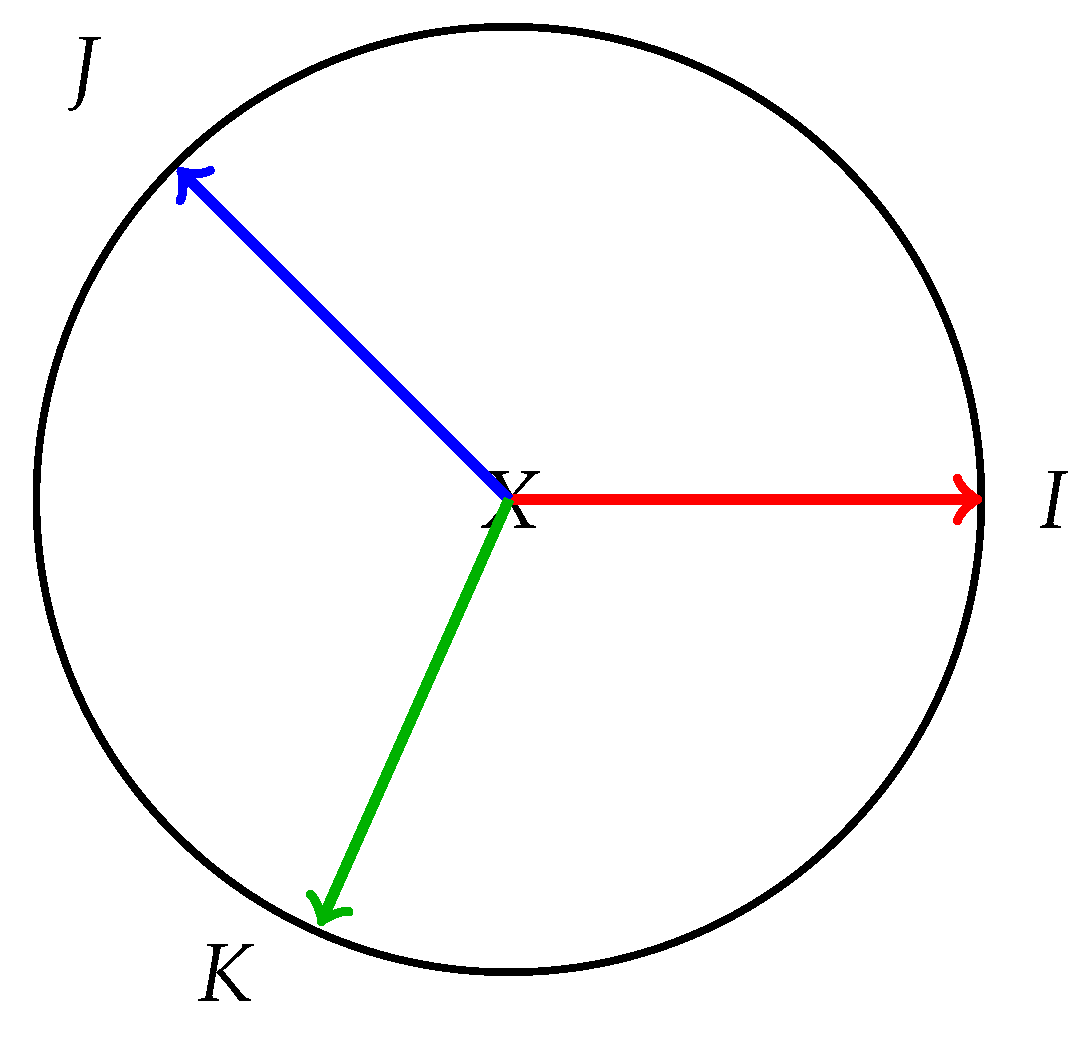
In Section 2 we review the fundamentals of K3 surfaces: definitions, Hodge structure, and the even unimodular cohomology lattice . We include the Hodge diamond of a K3 surface in Figure 1 and illustrate the lattice decomposition in Figure 2. We discuss the Néron-Severi lattice, transcendental lattice, and the moduli of K3 surfaces (the period domain) [4,7]. The hyperkähler nature of K3 surfaces and the twistor sphere of complex structures are also described (Figure 4).
Section 3 covers Enriques surfaces: their definition (, ), basic invariants (, ), and the fact that any Enriques has a K3 universal cover. The covering relationship is illustrated in Figure 3. We summarize the classification of complex Enriques surfaces (e.g. into nodal and unnodal types, following [12,15]) and indicate how Enriques can be obtained as -quotients of K3.
Figure 3.
A K3 surface X with free involution covering an Enriques surface E.

Figure 4.
Sphere of complex structures on a hyperkähler K3 surface (twistor sphere). Three orthogonal structures are shown.
Figure 4.
Sphere of complex structures on a hyperkähler K3 surface (twistor sphere). Three orthogonal structures are shown.
Section 4 introduces Kummer surfaces. Given an abelian surface A, the involution on A has 16 fixed points; the quotient has 16 ordinary double points, and resolving them yields a Kummer K3 surface. Figure 5 sketches this construction. We note that Kummer surfaces have Picard rank at least 17 (at least 16 from the exceptional curves), and give examples such as the Kummer quartic in . We also recall Nikulin’s result that any K3 with a symplectic involution (8 fixed points) yields a Kummer quotient [2,9].
In Section 5 we discuss involutions on K3 surfaces. Symplectic involutions (preserving the holomorphic 2-form) fix 8 points and yield Kummer surfaces after resolution; anti-symplectic involutions may fix curves or points, with the special case of a fixed-point-free involution yielding an Enriques quotient. We summarize Nikulin’s lattice-theoretic classification [9] and the fixed-point data (Table 1).
Section 6 states the Kodaira embedding theorem and applies it to these surfaces. In particular, any ample line bundle on a K3 or Enriques surface gives a projective embedding [6,8]. We note examples: the quartic K3 in as a degree-4 polarization, and classical Kummer surfaces realizable as quartics. The Kodaira criterion implies that algebraic K3 surfaces have nonzero , while generic (transcendental) K3 are not projective. Analogous remarks apply to Enriques and Kummer surfaces, which are always projective by construction.
In Section 7 we tie these threads together. We describe explicitly how Enriques and Kummer surfaces correspond to involutions on K3. For instance, any free involution on a K3 yields an Enriques , and conversely each Enriques arises this way [2]. Similarly, a Nikulin involution on a K3 yields a Kummer surface, and conversely each Kummer arises from an abelian cover. Figure 6 summarizes these relations. We comment on how these correspondences interact with Hodge structures and topological invariants: e.g. the Euler characteristics and Betti numbers match under the double covers, and line bundles pull back under the quotient maps.
In Section 8 we give concrete examples. One example constructs the Kummer surface of (two elliptic curves), showing the 16 nodes and their resolution into -curves. Another example starts with the Fermat quartic K3 and the involution , which is fixed-point-free and yields an Enriques quotient [1]. These illustrate the abstract theory of Section 5, Section 6 and Section 7.
Finally we include appendices. Appendix A recalls lattice theory needed: the definition of even unimodular lattices, the hyperbolic plane U, the lattice (Figure A1), and Nikulin’s theory of 2-elementary sublattices [9]. Appendix B presents classification tables: e.g. the seven types (I-VII) of complex Enriques surfaces and the fixed-point patterns of K3 involutions. Appendix C gives extended details of the examples.
2. K3 Surfaces
A K3 surface is a smooth compact complex surface X with trivial canonical bundle and . Equivalently, X is simply-connected and admits a nowhere-vanishing holomorphic 2-form. K3 surfaces are two-dimensional Calabi–Yau manifolds and carry rich geometry. Their Hodge diamond is:
with and . In particular and for a holomorphic symplectic form . Figure 1 shows the K3 Hodge diamond.
The cohomology of a K3 surface is an even unimodular lattice of signature , isomorphic to
where U is the hyperbolic plane lattice and is the unique positive-definite even unimodular rank-8 lattice. We illustrate this decomposition in Figure 2. The intersection form on has determinant 1.
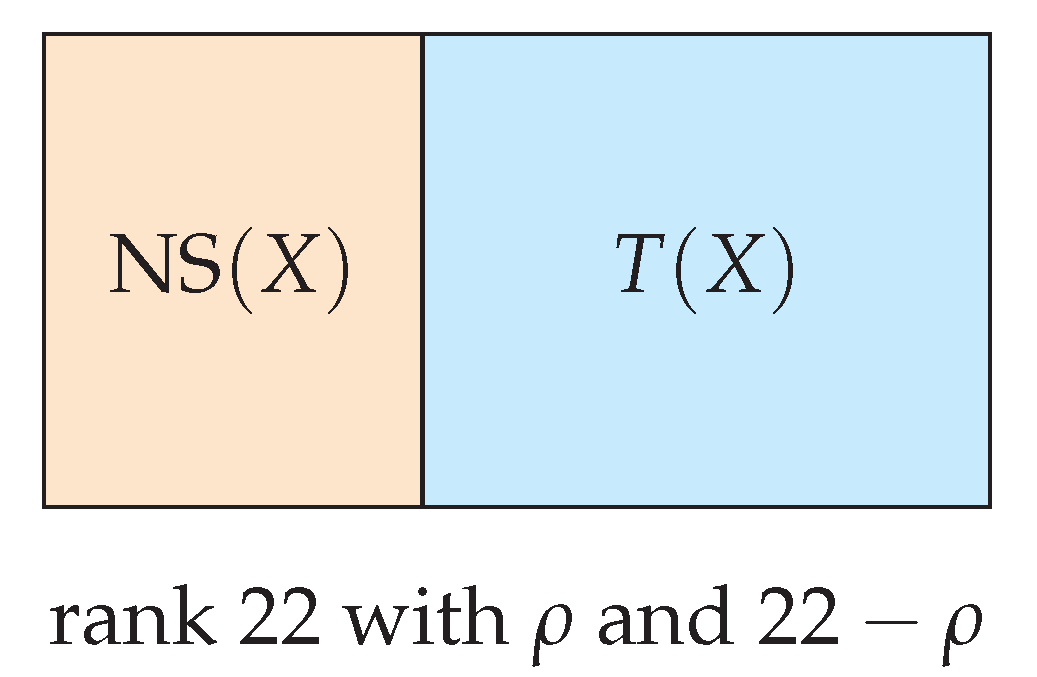
The Néron–Severi group of algebraic cycles on a projective K3 is a sublattice of of rank . Its orthogonal complement is the transcendental lattice, and we have
A K3 surface is algebraic (projective) if and only if . In that case any ample class gives a projective embedding by Kodaira’s theorem. Figure 7 illustrates this decomposition.
K3 surfaces are hyperkähler: they admit a Ricci-flat Kähler metric and a 2-sphere of complex structures. Equivalently, if one chooses a complex structure I with holomorphic form , there are compatible structures such that behave like the unit quaternions [4,5]. Figure 4 illustrates the “twistor sphere” of complex structures on a K3.
Key facts:
- has rank . When , X is algebraic and polarizable.
- has signature ; is even unimodular.
- Any two K3 surfaces are diffeomorphic but can have different algebraic geometry. For example, a generic quartic in is a polarized K3 of degree 4, while the quartic Fermat surface has extra symmetries and Picard rank 20.
3. Enriques Surfaces
An Enriques surface E is a smooth compact complex surface of Kodaira dimension 0 with fundamental group . Equivalently, is a nonzero 2-torsion line bundle () and [2]. Key invariants:
- , so its universal cover is a K3 surface with a free involution.
- , in the algebraic case, signature .
- (no holomorphic 2-form), .
Every complex Enriques arises as the quotient of a K3 by a fixed-point-free involution [1]. Conversely, if X is a K3 and a fixed-point-free involution, then is an Enriques. This is illustrated in Figure 3.
Complex Enriques surfaces fall into several classes. Roughly, a generic Enriques contains no smooth rational -curves, while a nodal Enriques contains at least one -curve (called a nodal curve). Further distinctions (I–VII) depend on configurations of nodal curves and elliptic fibrations [12,15]. For example, Type I (generic) has infinite automorphism group and no -curves; Type II has a single -curve; Types III–VII have more special configurations (see Table A1).
Topologically, an Enriques has Euler characteristic (half that of a K3). By Lefschetz, a covering involution on the K3 has no fixed points, consistent with this halving of Betti numbers. The Néron–Severi group of E has rank 10; its intersection form is the unimodular lattice , often called the Enriques lattice. Since , one cannot embed E into projective space via a holomorphic form, but E is still projective (it has ample divisors induced from the K3 cover).
4. Kummer Surfaces
A Kummer surface is a K3 surface obtained from an abelian surface A by resolving the quotient by the involution . Concretely, let A be a 2-dimensional complex torus (an abelian surface). The involution has exactly 16 fixed points (the 2-torsion points). The quotient is a singular surface with 16 ordinary double points. A minimal resolution of these 16 nodes yields a smooth K3 surface [2]. Figure 5 sketches this process.
Key properties of Kummer surfaces:
- (since each resolved node gives a -curve, and typically one additional polarization).
- The Néron–Severi lattice contains a primitive sublattice isomorphic to (the 16 exceptional curves).
- If A is principally polarized (for instance a product of elliptic curves), then is projective. Classical examples include the Kummer quartic in .
Alternatively, a Kummer surface can arise from a K3 involution. A Nikulin involution on a K3 is a symplectic involution with exactly 8 fixed points [9]. The quotient has 8 nodes, and resolving them yields another K3 surface. Nikulin showed that this resolved quotient is a Kummer surface of some abelian A. Conversely, every Kummer surface admits a Nikulin involution exchanging pairs of the 16 exceptional curves [2].
5. Involutions on K3 Surfaces
An involution on a K3 surface is an automorphism of order 2. There are two broad cases: symplectic involutions, which fix (the holomorphic 2-form) and have isolated fixed points, and anti-symplectic involutions, which send and fix curves or points.
- A symplectic involution on a K3 has exactly 8 fixed points (Nikulins theorem) [9]. The quotient by such an involution, after resolving the 8 nodes, yields a K3 surface. In fact, this resulting K3 is a Kummer surface. Thus symplectic involutions correspond to Kummer constructions.
- An anti-symplectic involution may fix a curve or be free. The only free anti-symplectic involution is precisely the Enriques involution: and no fixed points. Then is a smooth Enriques surface. If an anti-symplectic involution fixes a curve, the quotient is typically a rational or other type of surface (not the main case here).
In summary:
On a K3 surface X: a free involution τ (no fixed points) yields an Enriques surface. A Nikulin (symplectic) involution with 8 fixed points yields a Kummer surface after resolution. [3]
Table 1 lists these involution types and fixed loci.
Lattice-theoretically, an involution splits into -eigenspaces. For an Enriques involution, the -lattice has rank 10 (isometric to the Enriques lattice ) and the -lattice has rank 12. For a Nikulin involution, the -lattice is even of rank 14 and discriminant (containing two copies of ). These lattice signatures match the presence of 16 or 10 exceptional curves in the quotient.
6. Kodaira Embedding Theorem
A fundamental result in algebraic geometry is the Kodaira embedding theorem [6,8]. We state a version:
Theorem 1
(Kodaira Embedding). Let X be a compact Kähler manifold and L a holomorphic line bundle on X. If L admits a hermitian metric with positive curvature (i.e. is a Kähler form), then some tensor power is very ample and gives an embedding . In particular, any compact Kähler surface with an ample line bundle is a projective algebraic surface.
For K3, Enriques, and Kummer surfaces, this implies: if there is an ample divisor class, the surface can be embedded in projective space. For example, any polarized K3 surface of degree embeds in by its linear system (e.g. a quartic K3 in when ) [4]. A classical case is a Kummer surface: if A has a polarization of type , then inherits a polarization. In particular, the Kummer surface of (two elliptic curves) often embeds as a quartic or a complete intersection in projective space.
Enriques surfaces, having , always have ample divisors and are projective. Kodaira’s theorem allows one to realize an Enriques surface as a branched double cover of or as a surface of degree 6 in a weighted projective space (see [2]). Kummer surfaces, being constructed from abelian varieties, are also projective: the abelian surface is projective and the resolution of its quotient preserves projectivity.
In Hodge-theoretic terms, Kodaira’s theorem says a compact complex surface is projective iff . For K3 this is . By Lefschetz theorem, integral classes correspond to divisors. Thus an algebraic K3 has one such class and embeds, while a generic analytic K3 does not.
7. Correspondences Between Surfaces
We now describe the geometric correspondences between Enriques, K3, and Kummer surfaces in terms of involutions and covers.
7.1. Enriques–K3 Correspondence
A pair where X is a K3 and a free involution corresponds bijectively to an Enriques surface . Concretely, given a K3 X with fixed-point-free , the quotient is an Enriques with half the Betti numbers of X. Conversely, given an Enriques E, its universal K3 cover with the deck involution recovers E. Invariants match: while , and the holomorphic form satisfies so it descends to zero on E. Figure 3 illustrates this cover.
7.2. Kummer–K3 Correspondence
Similarly, a pair where is a Nikulin involution on a K3 yields a Kummer surface. If has 8 fixed points, then has 8 nodes and blowing them up gives a new K3. By Nikulin’s theorem, this resolved K3 is isomorphic to for some abelian surface A [9]. Conversely, every Kummer surface arises this way: it has an involution (coming from ) whose 8 fixed points lead back to an abelian cover.
7.3. Enriques–Kummer via K3
By combining involutions, one can link Enriques and Kummer surfaces indirectly. For instance, if a K3 admits commuting involutions (free) and (Nikulin), one can form iterated quotients. The composition is another involution whose quotient yields either an Enriques or a Kummer depending on fixed points. In any case, the invariant lattices under these involutions intersect in interesting ways, reflecting how the Picard groups of the Enriques and Kummer relate inside that of the K3.
Figure 6 summarizes the basic relations:

Each arrow is a double cover or quotient. Note also that every Kummer arises from an Abelian A: (dashed arrow).
These correspondences also manifest in numerical invariants. For example, if is the 2:1 cover to an Enriques, then the Chern numbers and Euler characteristic satisfy . Similarly, an involution with 8 fixed points on X satisfies , and after resolution gives for the Kummer, consistent with it being a K3.
8. Examples
8.1. Kummer of a Product of Elliptic Curves
Let be elliptic curves defined by (). The abelian surface has involution . It fixes 16 points (each and a 2-torsion value). The quotient has 16 nodes. Resolving each node gives the Kummer surface , a K3 containing 16 disjoint -curves (the exceptional curves).
One can show K admits an ample divisor of degree 4 and hence embeds in . For example, if is the curve , the surface K can be realized by a quartic equation (after suitable coordinate change) with exactly 16 double points. Symplectic involutions on K come from translations by 2-torsion of A. This illustrates how a product of two elliptic curves yields a Kummer K3 in practice [10].
8.2. Enriques from a Fermat Quartic
Consider the Fermat quartic surface in :
This is a K3 surface with many symmetries. In particular, the involution
fixes no points on X (there is no nonzero solution to in homogeneous coordinates up to scaling). Thus is free and anti-symplectic, and the quotient is an Enriques surface [1]. One checks that has rank 10, and indeed . The Enriques E can be viewed as a double cover of branched along a sextic (the image of X). This example demonstrates the K3→Enriques construction concretely.
8.3. Other Examples
A general K3 with (transcendental K3) admits no algebraic involutions, so it produces neither Enriques nor Kummer surfaces. On the other hand, special K3s can admit multiple involutions. For instance, a K3 realized as a double cover of branched over a union of lines can have both symplectic and non-symplectic involutions, giving both an Enriques and a Kummer in different ways.
Acknowledgments
The authors are grateful to the colleagues of the Electro-Gravitational Space Propulsion Laboratory for helpful discussions.
Conflicts of Interest
The authors declare no competing interests.
Appendix A. Lattice Background
A key tool is the theory of integer lattices. Recall:
- The lattice U is the hyperbolic plane with form .
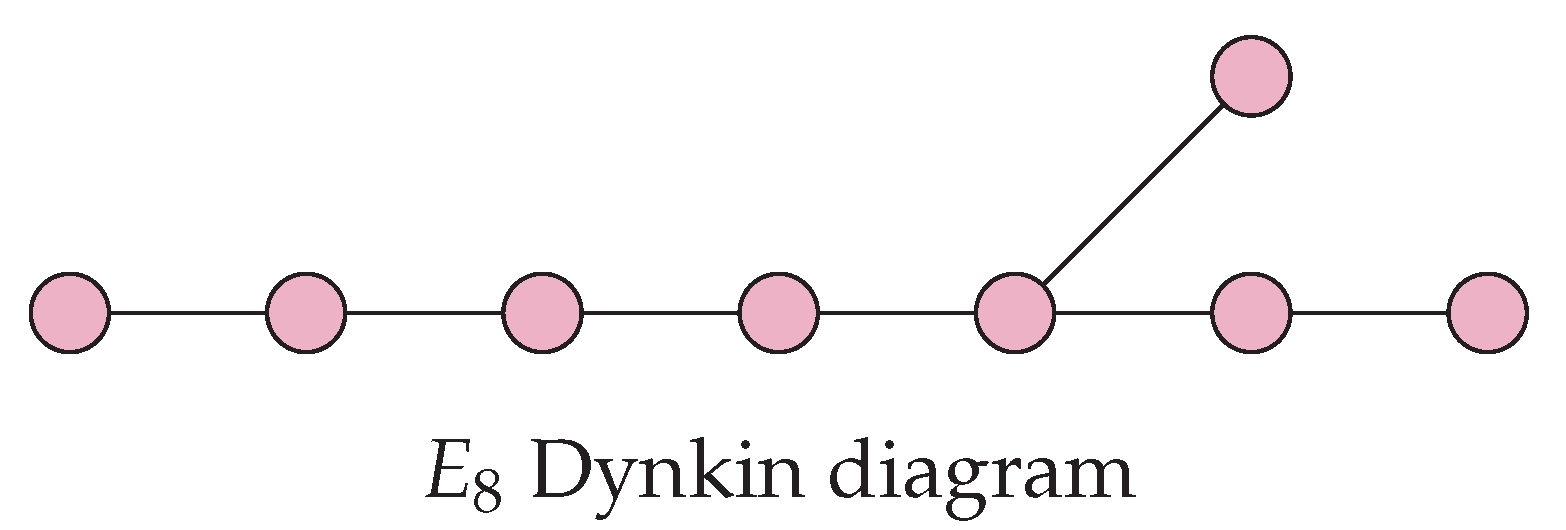
- The lattice is the unique even unimodular positive-definite rank-8 lattice (the root lattice of ). Its Dynkin diagram is shown in Figure A1.
- An even unimodular lattice exists only in signatures congruent to . For signature , the only such lattice is (the K3 lattice).
- A 2-elementary lattice is one with a discriminant. Nikulin classified 2-elementary lattices [9]. In particular, the invariant lattice of an involution on a K3 is often 2-elementary.
Figure A1.
Dynkin diagram of the lattice.
Appendix B. Classification Tables

| Type | Description |
|---|---|
| I | Generic Enriques: no -curves, , infinite automorphism group. |
| II | Nodal Enriques: contains exactly one -curve, has an elliptic fibration. |
| III | Enriques with finite automorphism group (special nodal configuration). |
| IV | Enriques of Reye congruence type (multiple elliptic pencils). |
| V | Special Enriques with extra -curves (Fano polarization). |
| VI | Enriques with finite (or arithmetic) automorphism group, special lattices. |
| VII | Enriques with high symmetry (e.g. Hessian Enriques). |
Appendix C. Extended Examples
Appendix C.1. Details: Kummer from E 1 ×E 2
Let have Weierstrass form (). Then covers by . The involution acts fiberwise. The 16 fixed points correspond to with , giving 16 solutions. The quotient locally looks like at each fixed point. One resolves by replacing each node with a -curve. The resulting K3, , has . The 16 exceptional curves are orthogonal to the pullback of .
Appendix C.2. Details: Enriques from K3
Consider a K3 given by a double cover of branched along a union of 6 lines in general position. For instance,
This K3 has an involution induced by swapping , (with z fixed). One checks this involution has no fixed points on the surface (no solution has ). Thus is free and anti-symplectic, and the quotient is an Enriques surface. The invariant lattice is generated by the pullbacks of the lines and has rank 10. The quotient can be described as a double cover of branched along certain curves.
References
- Beauville, A. Complex Algebraic Surfaces, 2nd ed.; Cambridge Univ. Press, 1996. [Google Scholar]
- Barth, W.; Peters, C.; Van de Ven, A. Compact Complex Surfaces, 2nd ed.; Springer, 2004. [Google Scholar]
- Bhattacharjee, D. Calabi–Yau Solutions for Cohomology Classes. TechRxiv Preprint 2023. [Google Scholar] [CrossRef]
- Huybrechts, D. Lectures on K3 Surfaces; Cambridge Univ. Press, 2016. [Google Scholar]
- Beauville, A. Variétés Kähleriennes dont la première classe de Chern est nulle. J. Diff. Geom. 1983, 18, 755–782. [Google Scholar] [CrossRef]
- Griffiths, P.; Harris, J. Principles of Algebraic Geometry; Wiley, 1994. [Google Scholar]
- Voisin, C. Hodge Theory and Complex Algebraic Geometry I; Cambridge Univ. Press, 2002. [Google Scholar]
- Kodaira, K. On Kähler varieties of certain type. Ann. Math. 1954, 60, 28–48. [Google Scholar] [CrossRef]
- Nikulin, V. Finite automorphism groups of Kähler K3 surfaces. Trans. Moscow Math. Soc. 1979, 38, 71–135. [Google Scholar]
- Bhattacharjee, D. Generalization of Quartic and Quintic Calabi–Yau Manifolds Fibered by Polarized K3 Surfaces. Research Square Preprint 2022. [Google Scholar] [CrossRef]
- Dolgachev, I. A brief introduction to Enriques surfaces . arXiv 2014, arXiv:1412.7744. [Google Scholar]
- Kondo, S. Enriques surfaces with finite automorphism groups. J. Math. Soc. Japan 1986, 38(no. 4), 563–607. [Google Scholar] [CrossRef]
- Ohashi, H. On the number of Enriques quotients of a K3 surface. Publ. Res. Inst. Math. Sci. 2007, 43(no. 1), 181–200. [Google Scholar] [CrossRef]
- Bhattacharjee, D. M-Theory and F-Theory over Cosmic Strings and Calabi–Yau Manifolds with Conifold Singularities. Asian Journal of Research and Reviews in Physics 2022, 6(2), 25–40. [Google Scholar] [CrossRef]
- Cossec, F.; Dolgachev, I. Enriques Surfaces I; Birkhäuser, 1989. [Google Scholar]
- Nikulin, V. Integer quadratic forms and some of their geometric applications. Izv. Math. 1979, 43, 111–177. [Google Scholar]
- Bhattacharjee, D. Relating Enriques surface with K3 and Kummer through involutions and double covers. Research Square Preprint 2022. [Google Scholar] [CrossRef]
- Bhattacharjee, D. Establishing Equivalence among Hypercomplex Structures via the Kodaira Embedding Theorem for Non-Singular Quintic Threefolds. Research Square Preprint 2022. [Google Scholar] [CrossRef]
Figure 1.
Hodge diamond of a K3 surface.
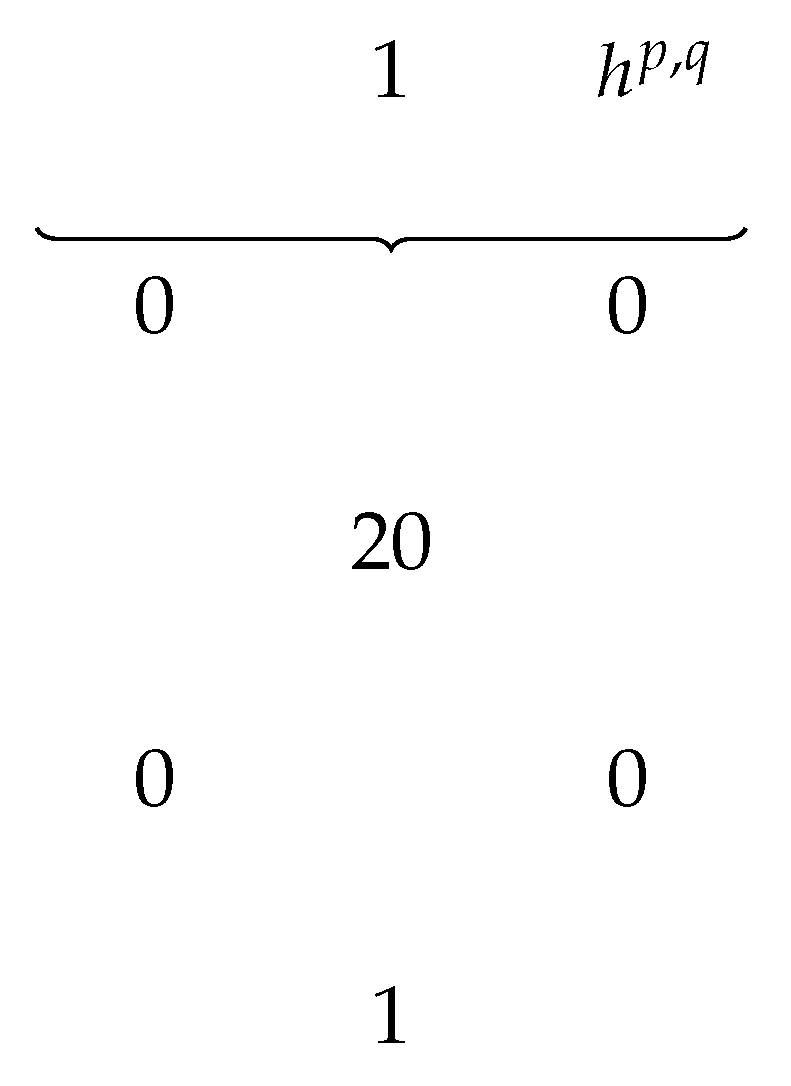
Figure 2.
Decomposition of the K3 cohomology lattice .
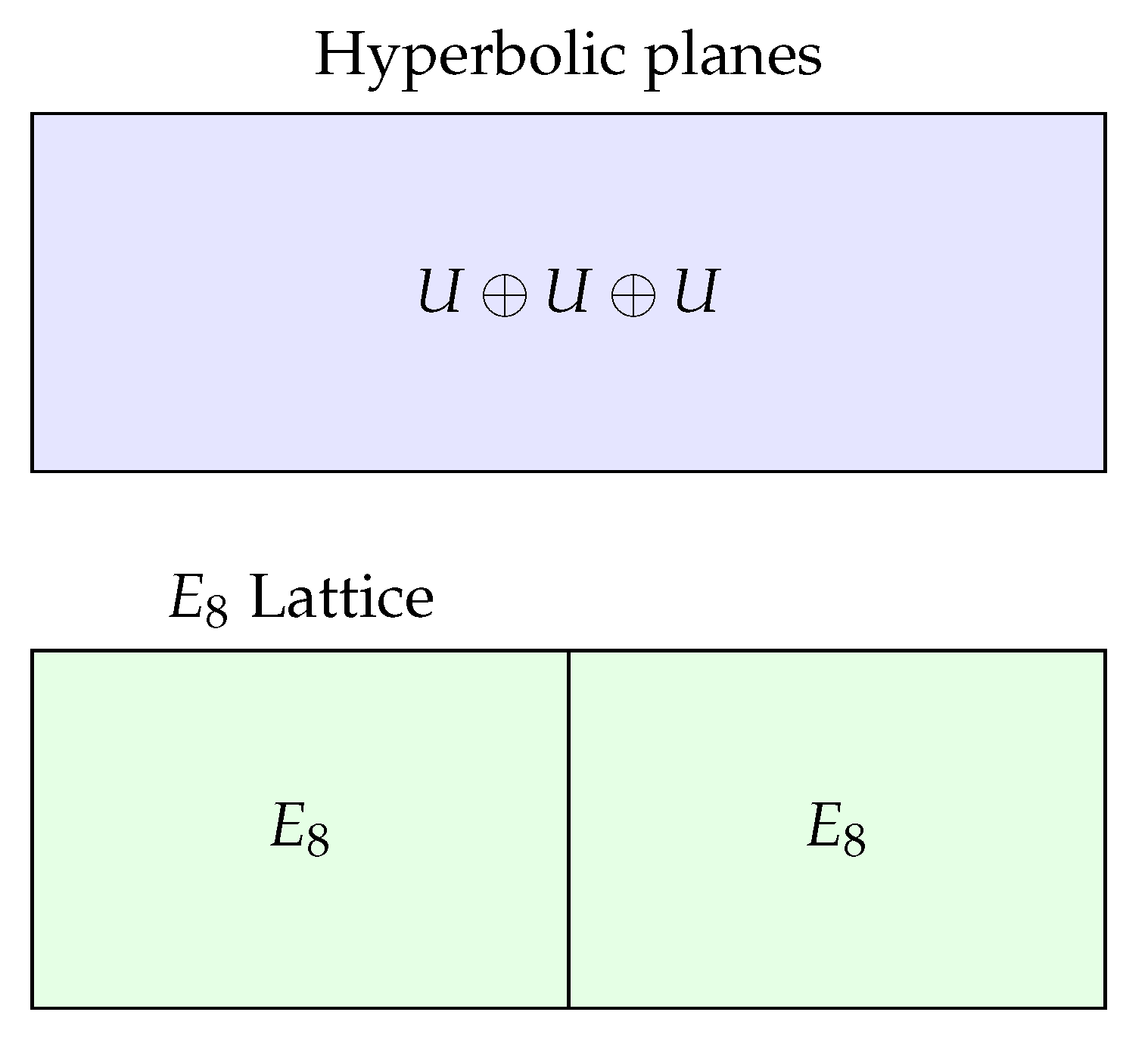
Figure 5.
Kummer construction: quotient of an abelian surface A by , followed by resolution of 16 nodes.
Figure 5.
Kummer construction: quotient of an abelian surface A by , followed by resolution of 16 nodes.
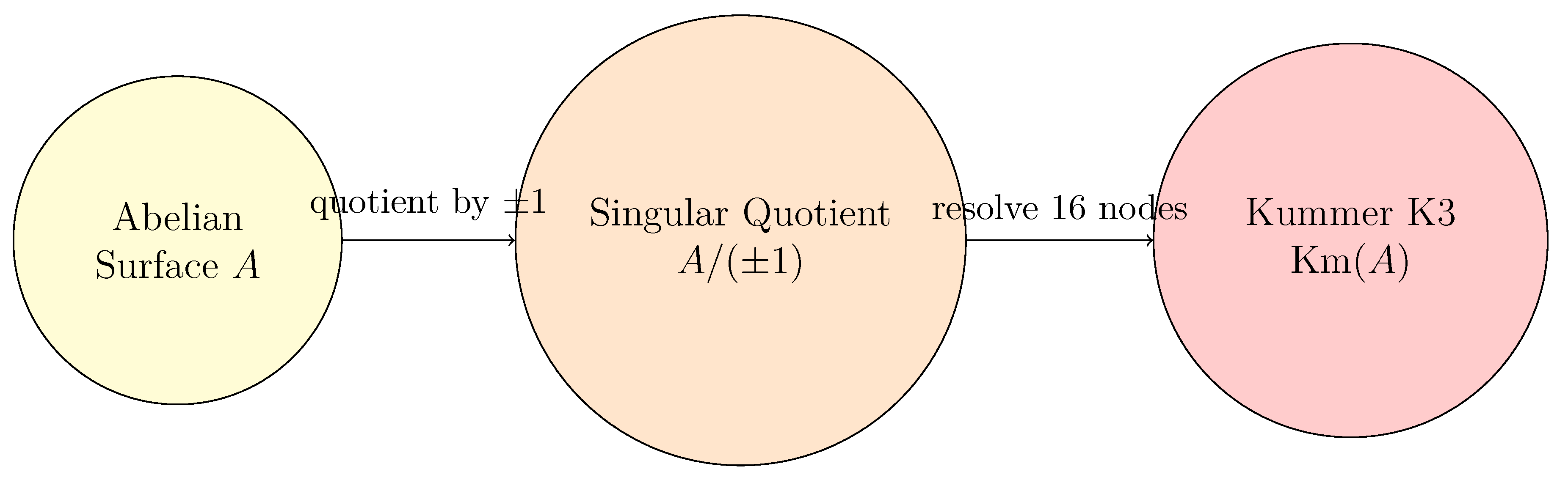
Figure 6.
Relations among surfaces: a K3 X can have a free involution (left arrow) giving an Enriques , and a Nikulin involution (right arrow) giving a Kummer . Any Kummer arises from an Abelian A (dashed).
Figure 6.
Relations among surfaces: a K3 X can have a free involution (left arrow) giving an Enriques , and a Nikulin involution (right arrow) giving a Kummer . Any Kummer arises from an Abelian A (dashed).
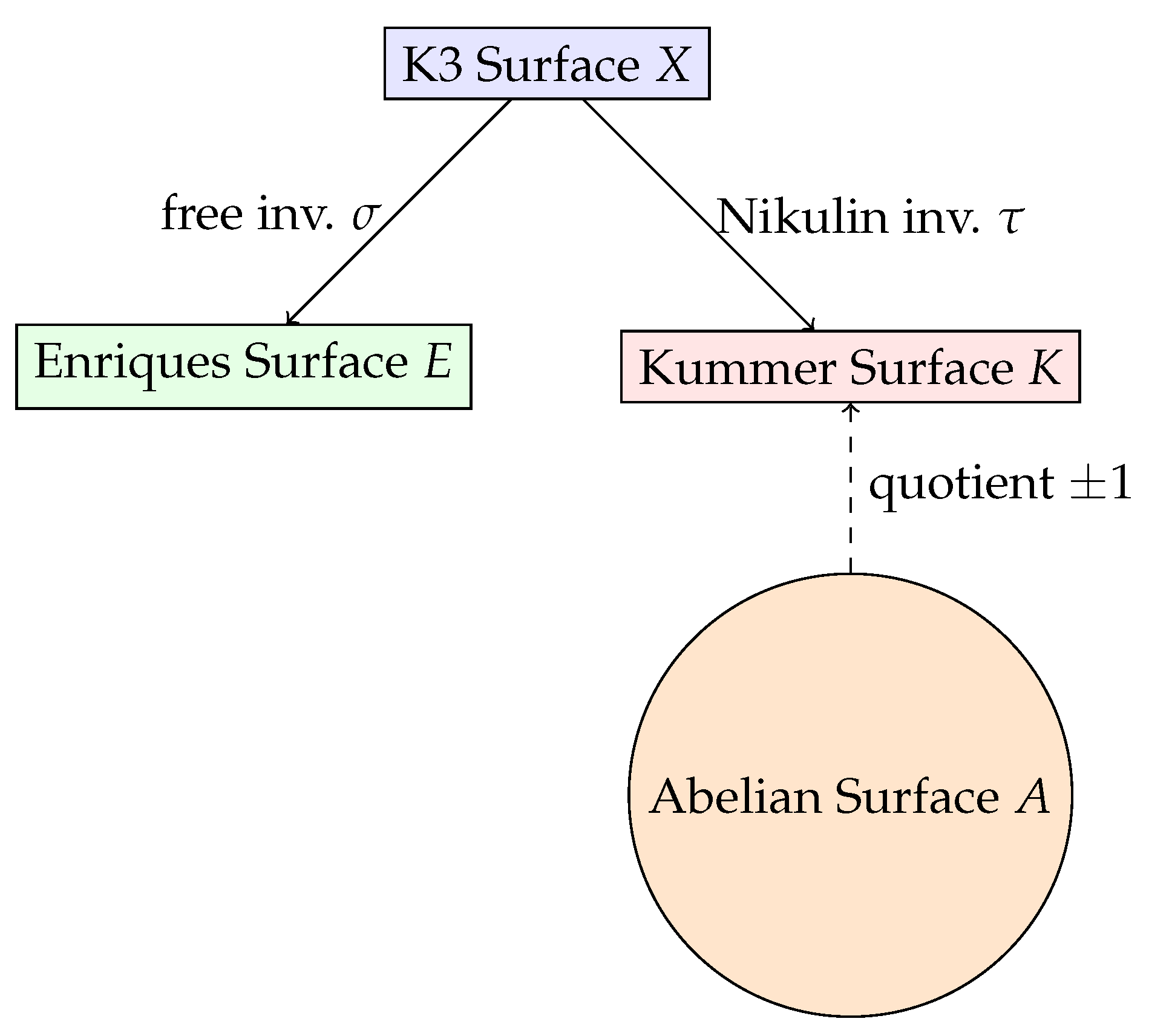
Figure 7.
Decomposition of into Néron–Severi (algebraic) and transcendental parts.
| Involution type | Fixed locus on X |
|---|---|
| Symplectic (Nikulin) | 8 isolated points; quotient has 8 nodes, resolved to Kummer K3 |
| Anti-symplectic, free | none; quotient is a smooth Enriques surface |
| Anti-symplectic, 1 curve | one smooth genus-1 curve; quotient is a rational or other K3 |
| Anti-symplectic, 2 curves | two disjoint genus-1 curves; quotient is rational surface |
Disclaimer/Publisher’s Note: The statements, opinions and data contained in all publications are solely those of the individual author(s) and contributor(s) and not of MDPI and/or the editor(s). MDPI and/or the editor(s) disclaim responsibility for any injury to people or property resulting from any ideas, methods, instructions or products referred to in the content. |
© 2026 by the authors. Licensee MDPI, Basel, Switzerland. This article is an open access article distributed under the terms and conditions of the Creative Commons Attribution (CC BY) license.
Copyright: This open access article is published under a Creative Commons CC BY 4.0 license, which permit the free download, distribution, and reuse, provided that the author and preprint are cited in any reuse.


