

Submitted:
01 February 2026
Posted:
03 February 2026
You are already at the latest version
Abstract
Household-scale biogas has been widely promoted as a decentralized renewable energy option to improve rural energy access, enhance agricultural sustainability, and reduce greenhouse gas emissions; however, adoption remains uneven in many low- and middle-income countries. This study examines factors influencing biogas uptake among 201 dairy-based mixed crop–livestock households in West Java, Indonesia, and interprets adoption outcomes through a sustainability–resilience framework. A binary logistic regression model is applied to assess how household characteristics, institutional support, and perceived benefits shape adoption decisions. The results indicate that livestock ownership, participation in technical training, and perceived fuel-cost and time-saving benefits significantly increase the likelihood of biogas adoption, while education level and household income do not exert independent effects. Interpreted through resilience attributes of robustness, adaptability, and transformability, biogas adoption contributes to improved manure management, reduced reliance on fossil-based fuels, and enhanced adaptive capacity through learning and institutional engagement. Nevertheless, adoption remains constrained by fragmented institutional support and misalignment between renewable energy initiatives and prevailing energy-policy regimes, particularly long-standing subsidies for liquefied petroleum gas. These findings suggest that expanding biogas adoption requires not only technical feasibility at the household level but also coherent institutional arrangements and policy alignment to ensure durable sustainability and resilience outcomes in livestock-based rural systems.
Keywords:
biogas adoption
; sustainability
; resilience
; mixed crop–livestock systems
; institutional support
; rural energy transition
; Indonesia
1. Introduction
The accelerating global transition to low-carbon energy systems has intensified the attention on decentralized renewable technologies capable of addressing rural energy poverty, improving agricultural sustainability, and reducing greenhouse gas emissions [1,2]. Among these technologies, household-scale biogas systems have been widely promoted for their potential to transform livestock waste into clean cooking fuel, organic fertilizer, and environmental co-benefits. Empirical evidence from low- and middle-income countries demonstrates that biogas adoption can reduce reliance on traditional biomass, improve indoor air quality, and lower household energy expenditures [3,4]. Despite these documented benefits, adoption and sustained use remain uneven, suggesting that technical potential alone does not ensure durable uptake [5,6].
Indonesia represents a particularly important context for examining these dynamics. As one of the world’s most populous countries and a major greenhouse gas emitter, Indonesia remains heavily dependent on fossil fuels, especially liquefied petroleum gas (LPG), whose long-standing subsidy regime strongly shapes household energy choices [7]. Although national policy frameworks—including the National Energy Policy (KEN), the General Plan for National Energy (RUEN), and the goals of the renewable energy mix, targets—formally promote the expansion of renewable energy, implementation at the household level has been fragmented. In livestock-intensive rural regions, livestock manure constitutes a substantial but underutilized resource for biogas development, indicating a persistent gap between policy ambition and on-the-ground outcomes [8].
Table 1 compares Indonesia with the larger Southeast Asian region while summarizing recent trends in household energy use. Although most households in Indonesia now have access to clean cooking fuels like electricity and LPG, a sizable minority (40%) still rely on traditional biomass sources, particularly in rural areas, indicating a persistent challenge to the country’s energy transition. Access to clean cooking is still less common throughout Southeast Asia, with regional averages of about 60% and significant differences between urban and rural areas. According to the World Bank’s World Development Indicators, access to electricity (% of population) reflects the share of people connected to national grids or off-grid services [10] This variety emphasizes ongoing reliance on biomass and unequal access to clean energy that affects household environmental impacts, exposure to air pollution, and greenhouse emission profiles—a crucial context for comprehending the environmental consequences of biogas adoption in your research [13].
A growing body of recent research has strengthened the evidence base on biogas adoption by applying quasi-experimental methods, such as propensity score matching, to estimate causal impacts. These studies demonstrate that the adoption of biogas can generate measurable welfare benefits, particularly through reductions in household energy expenditures. However, their analytical focus has largely remained confined to private household outcomes, offering limited insight into the institutional, governance, and policy conditions that determine whether adoption is sustained, scaled, or translated into broader system-level change [14].
West Java, Indonesia’s leading dairy production region, illustrates this paradox clearly. The province combines high livestock density, established cooperative structures, and favorable agro-ecological conditions that should support biogas diffusion. Nevertheless, adoption remains modest even in this relatively enabling context. Previous studies identify constraints including uneven construction quality, limited maintenance services, financing barriers, inconsistent program design, and strong competition from subsidized LPG [14,15]. At the household level, adoption decisions are shaped not only by livestock ownership and expected economic returns, but also by access to training, perceived convenience, and confidence in long-term system reliability [9,14].
Insights from sustainability and resilience research offer a complementary lens for addressing this limitation. Integrated assessments of farming systems emphasize that technology adoption outcomes are embedded within multi-level socio-technical systems, where household decisions interact with institutional support structures, service provision, and policy regimes [9,14]. Within this literature, resilience is commonly conceptualized through three interrelated attributes: robustness, referring to the capacity to maintain core functions under stress; adaptability, denoting the ability to adjust practices through learning and resource reallocation; and transformability, capturing the potential for structural change when existing systems become unsustainable. These attributes depend not only on household assets, but also on institutional coherence, advisory services, and policy alignment [15,16].
Applied to the adoption of household biogas in West Java, this perspective suggests that the outcomes of adoption cannot be fully understood only by welfare metrics. Robustness relates to feedstock stability and energy security; adaptability reflects access to training, knowledge, and operational confidence; and transformability depends on coordination among cooperatives, extension services, and national energy-policy regimes. For example, fuel-cost pressure—often identified as an adoption driver—cannot be separated from Indonesia’s LPG subsidy structure, while perceived time-saving benefits align with resilience research emphasizing labor constraints as a key determinant of adaptive capacity [17,18].
This study extends causal biogas adoption research by embedding treatment-effect evidence within a sustainability–resilience framework. Using household-level data from dairy-based mixed crop–livestock systems in West Java, the analysis combines econometric modeling with resilience-oriented interpretation to examine how household capabilities, institutional support, and policy environments jointly shape biogas adoption and its outcomes. By shifting the analytical focus from short-term welfare effects to the conditions that enable durable and scalable adoption, the study contributes system-relevant insights for strengthening rural energy transitions in Indonesia and comparable developing-country contexts.
1.1. Biogas Development in Indonesia
Biogas development has received increasing attention in Indonesia, particularly in livestock-intensive regions such as West Java, where environmental pressures from manure management have intensified over time. Dairy production centers in Lembang and cattle-farming districts including Garut and Tasikmalaya have experienced sustained methane and nitrous oxide emissions associated with livestock waste, trends documented since the early 1990s and now recognized as a growing component of national greenhouse gas emissions [9,19,20]. At the same time, high population density and limited land availability have led many smallholder farmers in West Java to adopt mixed crop–livestock (MCL) systems as a strategy to optimize constrained production resources [21]. Nationally, approximately 42% of Indonesian households engage in farming, with more than half operating smallholder MCL systems as their primary livelihood strategy [9,19] These systems are globally significant, as nearly two-thirds of the rural poor depend on integrated crop–livestock production for subsistence and income generation [17,20,22]
Within dairy clusters such as Lembang, the integration of crop and livestock activities supports nutrient recycling within farm boundaries and ensures forage availability for smallholder cattle herds [9,23,24]. As dynamic production systems, MCL farms link agronomic, livestock, and socioeconomic components of household livelihoods [25]. However, when manure is inadequately managed, these same systems become environmentally vulnerable. This challenge is particularly acute in West Java’s densely populated upland landscapes, where improper storage and disposal of livestock waste frequently result in localized water and air pollution [25,26].
Anaerobic digestion offers a technically well-established response to these challenges by stabilizing organic waste, reducing odors and pathogens, improving nutrient recovery, and producing biogas as a renewable household energy source [27,28,29]. For smallholder farmers in West Java, these benefits extend beyond environmental protection to include improved nutrient management in fodder and vegetable production systems, which are common across Lembang, Garut, and Tasikmalaya. At the national level, Indonesia’s energy consumption grew by approximately 3% annually between 2000 and 2011 and is projected to increase by 4.7% per year through 2030, driven by economic growth and rising household demand [9,25,30,31]. Despite relatively modest growth in household energy consumption, fossil fuels continue to dominate the energy mix, supplying nearly 80% of total demand [28]. In this context, household-scale biogas adoption has been shown to reduce expenditures on cooking fuels such as LPG and firewood by at least 40%, highlighting its potential economic relevance for rural households [32].
Biogas technology was first introduced in Indonesia in the 1970s and disseminated more widely during the 1980s through initiatives led by the Ministry of Agriculture [9,14,15,17,33]. Subsequent promotion by public and private actors led to the construction of more than 7000 household digesters nationwide by 2012, supported in part by organizations such as SNV The Netherlands [19]. Nevertheless, Indonesia’s total number of digesters remains low relative to other developing countries. Two main digester types are used: communal systems requiring more than 30 cattle and thus accessible primarily to larger farms [35], and household-scale digesters ranging from 4 to 12 m³, which are better suited to smallholders typically keeping two or three cows [25,34,35,36]. Despite their lower investment requirements and dual production of energy and organic fertilizer [37], diffusion of household-scale biogas systems among MCL farmers has remained slow for more than three decades [38].
Table 2 above compares estimated annual GHG emissions across common household fuels, illustrating that biogas systems are associated with substantially lower emissions compared to firewood and cow dung combustion [39]. Previous research highlights that perceived benefits—particularly access to reliable cooking fuel and organic fertilizer—play an important role in motivating biogas adoption [37]. These benefits are expected to reduce dependence on firewood and LPG [32,40]and lower the use of chemical fertilizers in crop production [41]. However, much of the existing literature relies on descriptive comparisons between adopters and non-adopters, making it difficult to distinguish the effects of biogas adoption from pre-existing household characteristics [42,43,44]. Although recent treatment-effect studies have strengthened causal inference by isolating welfare impacts, their analytical focus has largely remained on short-term household outcomes, offering limited insight into the institutional and system-level conditions that shape adoption persistence, performance, and scalability [45,46].
Against this background, this study examines household biogas adoption in dairy-based MCL systems in West Java using a treatment-effect framework while extending interpretation beyond welfare outcomes. Rather than asking only whether biogas adoption generates measurable benefits, the analysis situates adoption within a broader sustainability–resilience perspective that emphasizes household capabilities, institutional support, and policy environments. By integrating causal estimation with system-oriented interpretation, the study contributes new insights into why biogas adoption remains uneven even in resource-rich contexts and under what conditions it can support durable sustainability and resilience outcomes among smallholder farming households [25,47,48].
Figure 1.
Biogas Distribution across Districts in West Java. Source: West Java Energy and Mineral Resources Agency (2020) [21].
Figure 1.
Biogas Distribution across Districts in West Java. Source: West Java Energy and Mineral Resources Agency (2020) [21].
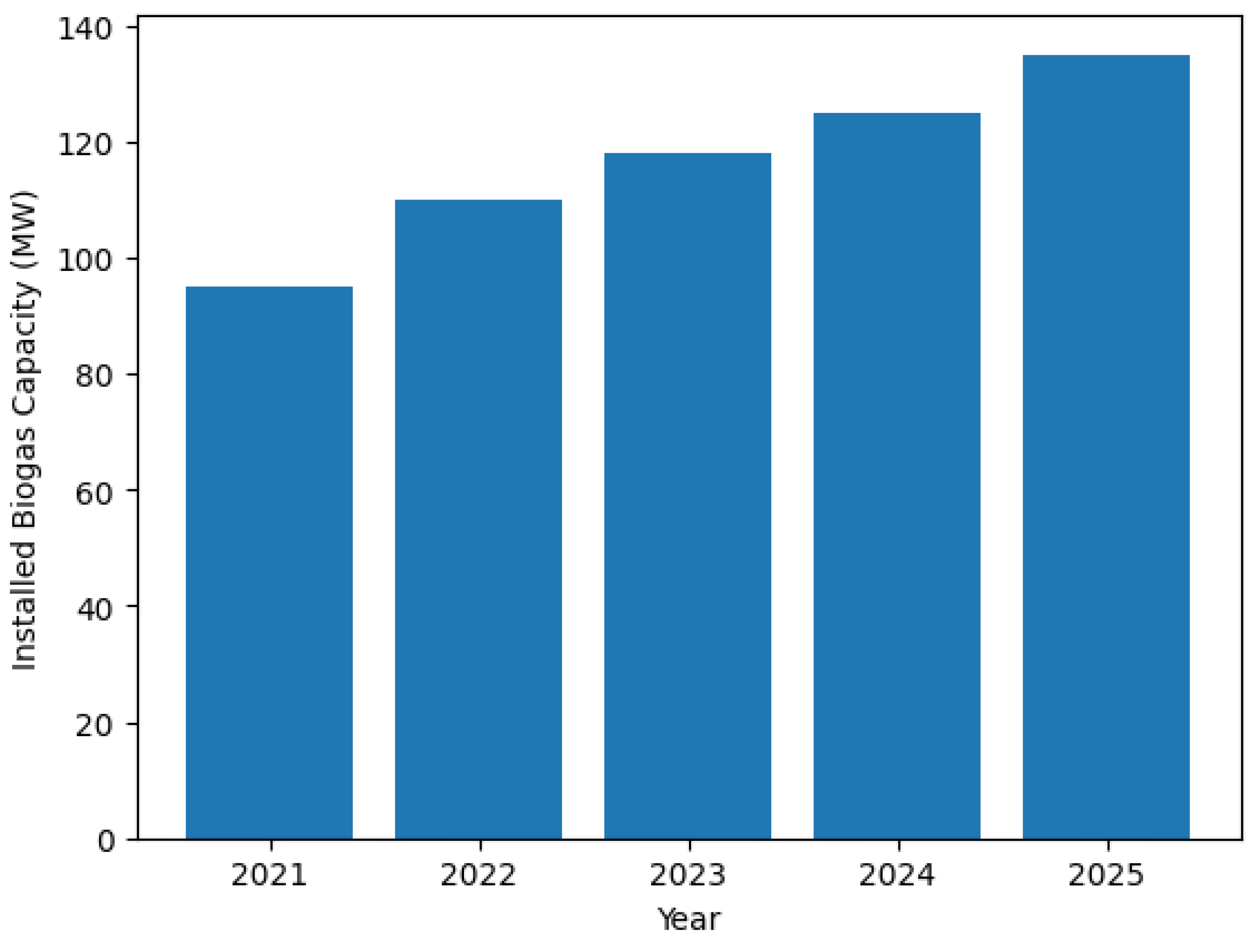
Despite the long history of biogas promotion in Indonesia and the substantial technical potential associated with livestock-based mixed crop–livestock systems, adoption and sustained use among smallholder households remain limited. Existing studies provide valuable descriptive insights into expected benefits and perceived constraints, yet they often lack robust empirical strategies capable of isolating the causal effects of biogas adoption from underlying household characteristics and contextual factors. As a result, it remains unclear which household and institutional conditions most strongly drive adoption and whether the anticipated energy, environmental, and livelihood benefits are realized in practice [24,35,49].
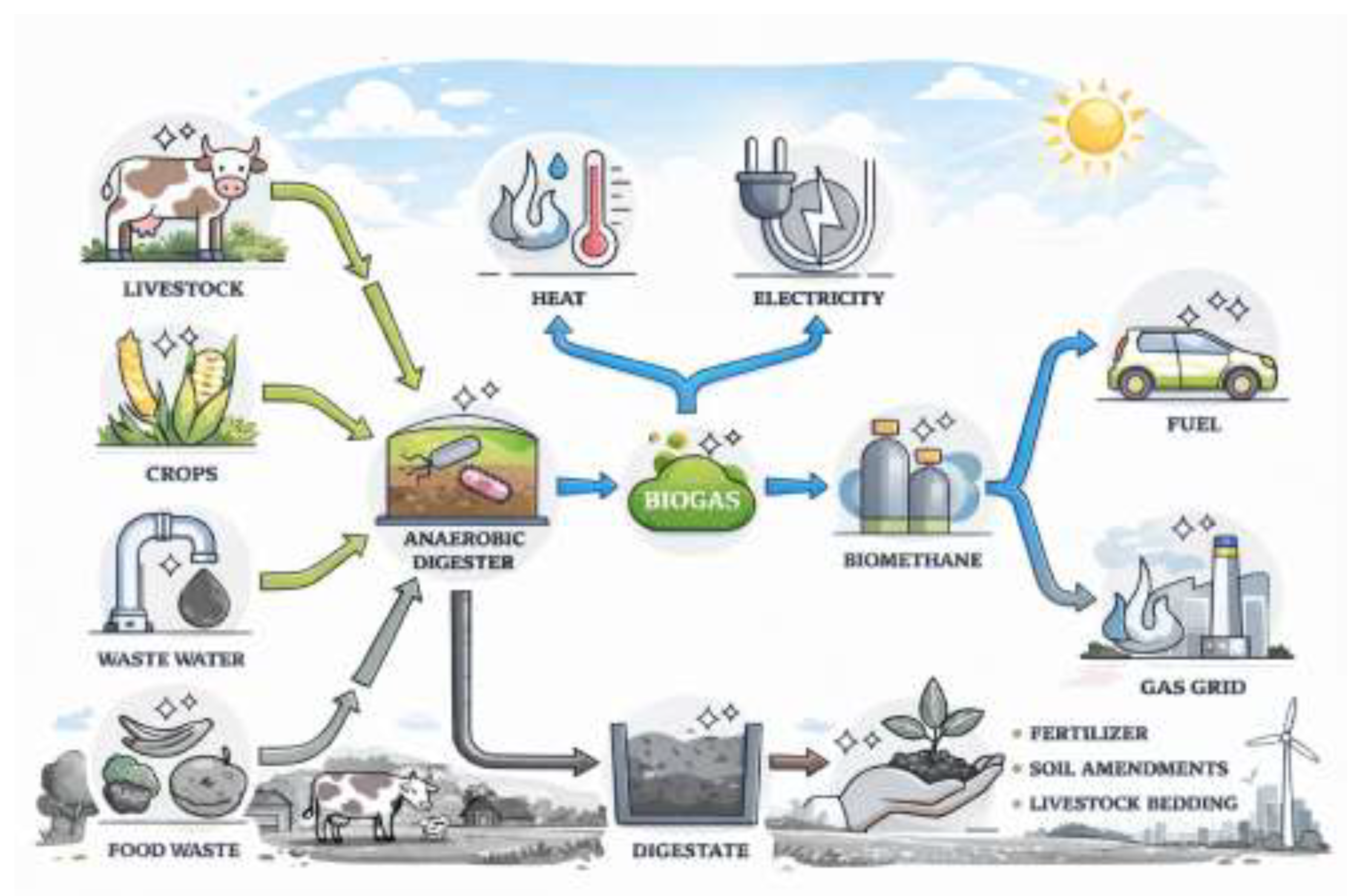
To address these limitations, this study applies a household-level quantitative approach that explicitly distinguishes between the determinants of biogas adoption and the realized impacts of adoption on key household outcomes. By combining regression analysis with treatment-effect estimation and situating the results within a sustainability–resilience framework, the study provides a systematic assessment of how household characteristics, institutional support, and structural conditions jointly shape biogas adoption and its contribution to sustainable and resilient rural livelihoods [5,50]. The following section details the study design, sampling strategy, and analytical methods employed to achieve these objectives. While the econometric approach follows established treatment-effect methods used in biogas adoption research, its purpose here is not limited to estimating welfare impacts but to provide a causal foundation for interpreting adoption outcomes within a sustainability–resilience framework that emphasizes institutional and system-level conditions [51,52,53].
2. Materials and Methods
2.1. Study Design and Data Collection
This study applies a quantitative household-level analysis complemented by a sustainability–resilience interpretive framework to examine biogas adoption in dairy-based mixed crop–livestock systems in West Java, Indonesia. Primary data were collected through a structured household survey of 201 dairy-farming households affiliated with major cooperative networks in the province. The survey captured socioeconomic characteristics, livestock ownership, household energy-use practices, perceptions of biogas benefits, institutional engagement, and participation in training and technical support programs.
Data were collected through face-to-face interviews with household heads using a standardized questionnaire. In addition to current conditions, respondents reported recall-based pre-adoption information on LPG, firewood, and chemical fertilizer use, enabling analysis of both adoption determinants and household-level outcomes associated with biogas use.
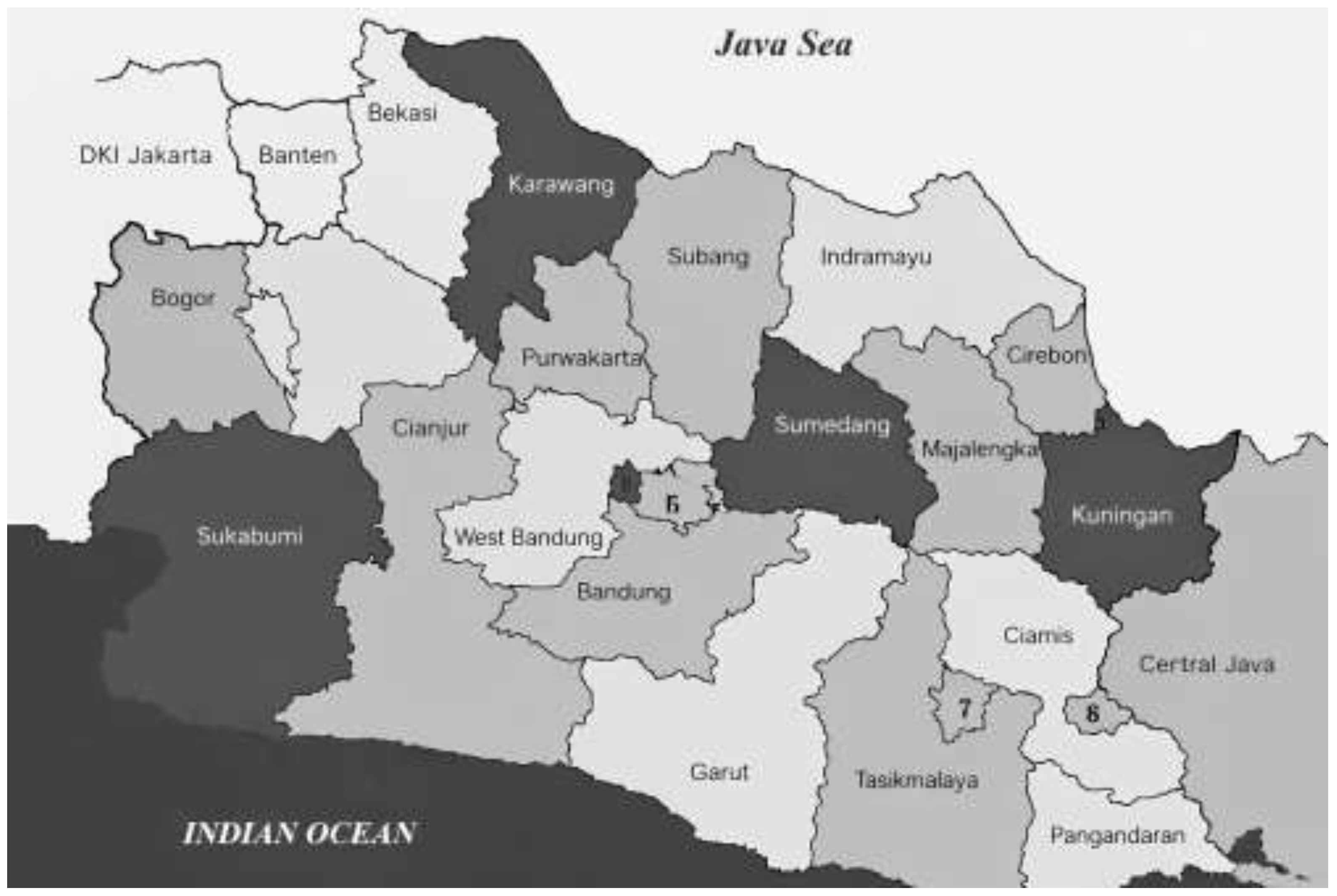
Figure 3.
Map of West Java Province, Indonesia. Sources: GIS, 2024 [54]. .
Figure 3.
Map of West Java Province, Indonesia. Sources: GIS, 2024 [54]. .
2.2. Sampling Strategy
Because no comprehensive registry of biogas adopters exists in West Java, a multi-stage sampling approach was employed. Lists of adopter households were compiled from cooperative records, non-governmental organizations, and local extension offices, and expanded through snowball identification to improve coverage. Adopter households were then selected using stratified random sampling across districts [22,55,56,57].
Non-adopter households were randomly selected from the same or neighboring villages to ensure comparability in agroecological and institutional conditions. To account for unequal selection probabilities arising from this procedure, inverse probability sampling weights were applied in all regression analyses.

Table 3.
Demographic of Respondents and economic characteristics of biogas adopter (N201).
| Characteristic | Category |
Adopters (n = 101) |
% |
Non-adopters (n = 100) |
% |
| Gender of household head | Male | 78 | 77.2 | 82 | 82.0 |
| Female | 23 | 22.8 | 18 | 18.0 | |
| Education level | No schooling / Illiterate | 6 | 5.9 | 23 | 23.0 |
| Primary school | 21 | 20.8 | 37 | 37.0 | |
| Secondary education | 54 | 53.5 | 33 | 33.0 | |
| Post-secondary / Vocational / University | 20 | 19.8 | 7 | 7.0 | |
| Household size (persons) | 1–3 | 22 | 21.8 | 38 | 38.0 |
| 4–6 | 61 | 60.4 | 49 | 49.0 | |
| ≥7 | 18 | 17.8 | 13 | 13.0 | |
| Age of household head (years) | 25–34 | 9 | 8.9 | 22 | 22.0 |
| 35–44 | 41 | 40.6 | 28 | 28.0 | |
| 45–54 | 31 | 30.7 | 29 | 29.0 | |
| 55–64 | 15 | 14.9 | 13 | 13.0 | |
| ≥65 | 5 | 5.0 | 8 | 8.0 | |
| Number of cattle owned | 1–4 | 11 | 10.9 | 32 | 32.0 |
| 5–8 | 59 | 58.4 | 53 | 53.0 | |
| ≥9 | 31 | 30.7 | 15 | 15.0 | |
| Landholding size (ha) | <0.25 | 7 | 6.9 | 22 | 22.0 |
| 0.25–0.50 | 25 | 24.8 | 36 | 36.0 | |
| 0.51–1.00 | 33 | 32.7 | 28 | 28.0 | |
| 1.01–1.50 | 23 | 22.8 | 10 | 10.0 | |
| >1.50 | 13 | 12.8 | 4 | 4.0 |
2.3. Econometric Analysis of Adoption Determinants
Determinants of household biogas adoption were examined using a binary logistic regression model, with adoption status as the dependent variable. Explanatory variables were selected based on innovation–diffusion theory, prior biogas adoption studies, and the institutional context of West Java, and include household demographics, livestock ownership, income, education, electricity access, perceived fuel-cost pressure, perceived time-saving benefits, cooperative engagement, and training participation [24,57].
Continuous variables were standardized to facilitate interpretation. Model adequacy was assessed using multicollinearity diagnostics, likelihood ratio tests, goodness-of-fit measures, and receiver operating characteristic (ROC) analysis.
2.4. Causal Estimation of Adoption Effects
To estimate the causal effects of biogas adoption on household outcomes, the study employs a propensity score matching (PSM) framework, appropriate given the voluntary and non-random nature of adoption. Propensity scores were estimated using logistic regression incorporating household characteristics, livestock holdings, institutional engagement, distance to training or extension facilities, and a household asset index. Observations outside the region of common support were excluded to ensure adequate overlap between adopters and non-adopters [58,59].
Covariate balance was assessed using standardized mean differences and established balance diagnostics. Multiple matching approaches were implemented, including nearest-neighbor matching, kernel matching, and entropy balancing. Final estimates of the Average Treatment Effect on the Treated (ATT) rely on doubly robust estimators—inverse probability weighted regression adjustment and augmented inverse probability weighting—which remain consistent if either the treatment or outcome model is correctly specified. Sensitivity to potential unobserved confounding was evaluated using Rosenbaum bounds.
2.5. Sustainability–Resilience Interpretation
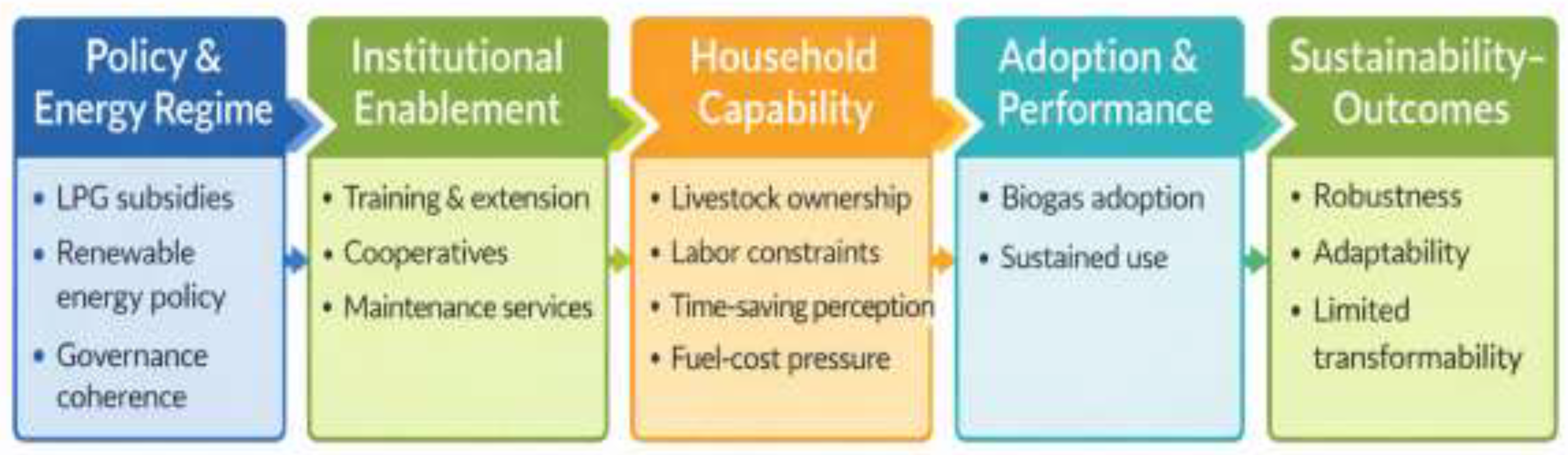
The empirical results are interpreted through a sustainability–resilience framework to situate household-level adoption within broader socio-technical systems. Rather than measuring resilience directly, resilience concepts are used analytically to interpret how household capabilities, institutional support, and policy conditions shape adoption trajectories and realized benefits. In this framework, robustness relates to households’ capacity to maintain energy functions under fuel-cost pressure; adaptability reflects access to training and operational knowledge; and transformability relates to institutional coordination and alignment between renewable energy initiatives and prevailing energy-policy regimes. This interpretive approach enables causal findings to be assessed in terms of their durability, scalability, and long-term relevance for livestock-based rural systems in West Java [17,60,61].
2.6. Sustainability–Resilience Framework
Household-level results are interpreted using a sustainability–resilience framework to situate biogas adoption within broader socio-technical systems. Rather than directly measuring resilience, resilience concepts are used analytically to interpret how household capabilities, institutional support, and policy conditions shape adoption trajectories and outcomes [58,62].
In this framework, robustness refers to the’ capacity of households to maintain basic energy functions under pressure from the price of fuel; adaptability reflects access to training, learning, and operational knowledge; and transformability refers to institutional coordination and alignment between renewable energy initiatives and the prevailing energy-policy regimes. This multi-level perspective provides a basis for assessing the durability, scalability, and long-term relevance of biogas adoption in livestock-based rural systems [36,63].
Figure 4.
Sustainable and Resilience Biogas Adoption Framework (Author).
3. Results
3.1. Descriptive Characteristics of Adopters and Non-Adopters
Table 4 outlines the key socioeconomic and behavioral variables influencing household biogas adoption, detailing their types, measurement methods, and expected effects. It highlights how demographic, economic, and institutional factors, such as age, income, livestock ownership, fuel-cost pressure, and training jointly shape the likelihood and sustainability of biogas adoption and summarizes the socioeconomic and farm characteristics of biogas adopters (n = 101) and non-adopters (n = 100). Several differences are observed, particularly in education, livestock ownership, and landholding size.
Adopter households exhibit higher educational attainment: 53.5% have completed secondary education and 19.8% post-secondary education, compared with 33.0% and 7.0% among non-adopters, respectively. Non-adopters are more concentrated among households with no schooling or only primary education. Household size and age distributions differ modestly, with adopters more frequently located in medium-sized households (4–6 members) and economically active age groups (35–54 years) [48,64].
Livestock ownership shows the most pronounced contrast. Nearly 31% of adopters own nine or more cattle, compared with 15% of non-adopters, while one-third of non-adopters own fewer than five cattle. Landholding size follows a similar pattern, with adopters more likely to operate larger farms. Gender composition is comparable across groups, with male-headed households accounting for approximately four-fifths of both adopters and non-adopters [65,66,67]. These descriptive patterns indicate that adopters generally possess stronger productive asset bases, though causal inference requires multivariate and counterfactual analysis.
3.2. Determinants of Biogas Adoption
Table 5 reports the binary logistic regression results identifying factors associated with biogas adoption. The model performs well, with a likelihood ratio test rejecting the null model (p < 0.001), a pseudo-R² of approximately 0.42, and a receiver operating characteristic (ROC) value of 0.82, indicating strong discriminatory power.
Livestock ownership is a key determinant of adoption (β = 0.684, p < 0.001), with an odds ratio of 1.98, confirming the importance of manure availability. Participation in biogas-related training exhibits the strongest effect, increasing adoption likelihood by more than threefold (OR = 3.48, p < 0.001). Perceived time-saving benefits also significantly raise adoption probability (OR = 1.81, p = 0.001), highlighting the role of labor considerations. Fuel-cost pressure is positively associated with adoption (OR = 1.55, p = 0.003), indicating responsiveness to cooking-energy expenditure constraints.
In contrast, education, household income, household size, landholding size, and access to grid electricity are not statistically significant once other factors are controlled for. These results suggest that adoption decisions are shaped primarily by feedstock availability, exposure to training, and perceived functional benefits rather than by general socioeconomic status.
3.3. Synthesis of Adoption Patterns and Implications for Causal Loop Analysis
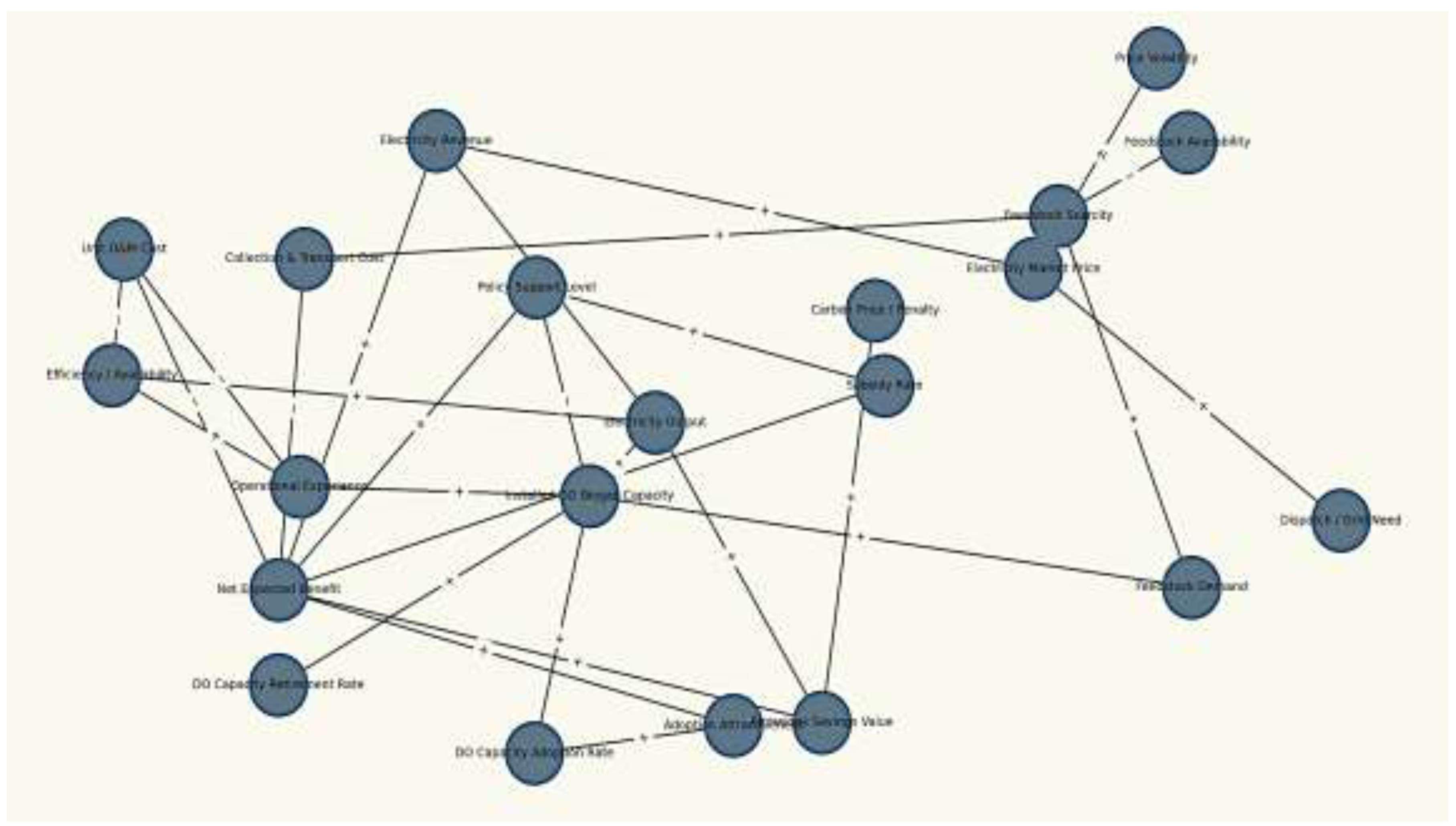
To support interpretation of the empirical results, this study employs a causal loop diagram (CLD) as a conceptual tool to illustrate key feedback mechanisms influencing household biogas adoption and its sustainability–resilience outcomes. CLDs are widely used in system dynamics and sustainability research to represent reinforcing and balancing relationships among social, institutional, and policy variables without formal simulation modeling. In this study, the CLD synthesizes survey findings, field observations, and relevant literature to map interactions among household capabilities, institutional support, and energy policy conditions, including LPG subsidies. By making these feedback structures explicit, the CLD complements the econometric analysis by explaining how adoption outcomes persist, stagnate, or weaken under different governance and service environments [68,69,70].
Figure 5.
Conceptual causal loop diagram illustrating reinforcing and balancing feedback influencing household biogas adoption and sustainability–resilience outcomes [1,68,69,70]. .
These findings justify the application of propensity score matching and doubly robust estimators in subsequent analysis, as simple comparisons between adopters and non-adopters would confound asset endowments with adoption effects. The prominence of training and perceived functional benefits further underscores the importance of institutional engagement and service provision, providing a basis for interpreting adoption outcomes within a sustainability–resilience framework in the discussion section [71,72].
Figure 6.
Odds ratios from the logit model showing the influence of livestock ownership, training participation, and household characteristics on biogas adoption [13,36,73,74]. .
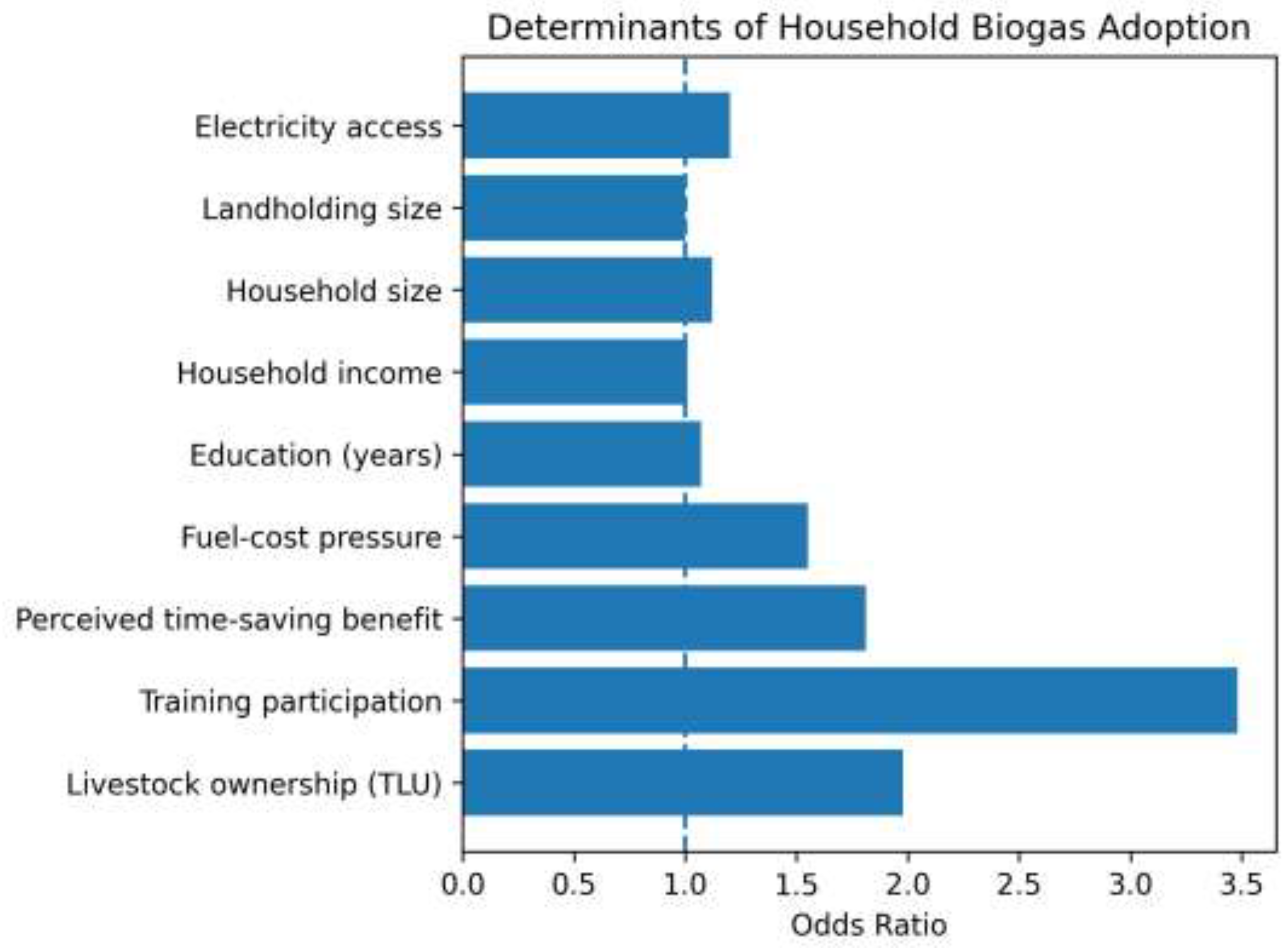
The binary logistic regression model provides strong explanatory power in identifying the determinants of biogas adoption among dairy-based mixed crop–livestock households in West Java. The likelihood ratio chi-square test (p < 0.001) confirms that the full model performs significantly better than the null specification, while a pseudo-R² of approximately 0.42 indicates that the included socioeconomic, perceptual, and institutional variables capture a substantial portion of variation in adoption behavior. Model discrimination is also robust, with a receiver operating characteristic (ROC) value of about 0.82, demonstrating high accuracy in distinguishing between adopters and non-adopters. Among the evaluated predictors, four variables emerge as positive and statistically significant drivers of adoption. Livestock ownership is a key determinant, reflecting the practical requirement of a reliable manure supply to maintain digester function [25,36]. Participation in biogas-related training exhibits one of the strongest effects, underscoring the critical role of technical knowledge, confidence, and user readiness in adoption decisions. Perceived time-saving benefits also significantly increase adoption likelihood, highlighting the importance of reduced labor burdens—particularly for women responsible for fuel collection and cooking. In addition, households experiencing stronger fuel-cost pressure, especially volatility in LPG prices, show higher odds of transitioning to biogas as a cost-buffering strategy [25,32,64,75]. By contrast, variables such as education, income, landholding size, household size, and electricity access do not significantly influence adoption, indicating that uptake in West Java is shaped less by general socioeconomic status and more by resource endowments, institutional engagement, and perceived functional advantages. Overall, the results demonstrate that successful biogas diffusion in West Java depends on both material capacity and institutional enablement, reinforcing the technology’s potential contribution to the sustainability and resilience of dairy-based farming systems [25,64].
4. Discussion
The results demonstrate that household biogas adoption in West Java is shaped less by conventional socioeconomic characteristics and more by capability-related, institutional, and functional considerations. While adopters tend to possess larger livestock herds and landholdings, multivariate analysis shows that adoption decisions are driven primarily by manure availability, participation in training, perceived time-saving benefits, and fuel-cost pressure. Variables such as education, household income, landholding size, and electricity access do not exert independent effects once these factors are controlled for. Interpreted through the sustainability–resilience framework outlined in Section 2, these findings provide insights into how household capabilities and enabling environments jointly shape adoption outcomes.
4.1. Adoption as a Function of Capability Rather Than Wealth
The non-significance of income and formal education challenges the common assumption that renewable energy adoption is primarily constrained by financial capacity or schooling. Instead, the strong influence of training participation and perceived time-saving benefits indicates that adoption depends more on household capability—specifically, the ability to operate, maintain, and integrate biogas systems into daily routines. Training reduces uncertainty surrounding digester operation, enhances user confidence, and improves expectations of system reliability, thereby lowering perceived adoption risk [25,42,44].
From a resilience perspective, these findings align with adaptability, which emphasizes households’ capacity to adjust practices in response to labor constraints and energy-price pressures. The prominence of time-saving benefits highlights that adoption is often motivated by immediate functional improvements rather than long-term economic optimization, particularly in smallholder contexts where labor is scarce and multifunctional.
4.2. Livestock Ownership and the Robustness of Household Energy Systems
Livestock ownership emerges as a fundamental structural condition for biogas adoption, underscoring the importance of feedstock reliability. Households with larger herds are better positioned to maintain stable gas production, reducing the likelihood of system underperformance or abandonment. This finding reinforces that household biogas adoption is inherently embedded within mixed crop–livestock systems, where energy generation depends on biological and managerial stability [25,35].
In resilience terms, livestock ownership contributes to robustness by enabling households to sustain basic energy functions under conditions of fuel-price volatility or biomass scarcity. However, robustness derived from asset endowments also implies unequal entry conditions, as households with fewer animals face higher barriers to adoption. This highlights a potential trade-off between technical efficiency and inclusiveness in household biogas programs [76,77].
4.3. Fuel-Cost Pressure and the Limits of Economic Incentives
The positive association between fuel-cost pressure and adoption indicates that households respond to rising energy expenditures by seeking alternative energy options. Nevertheless, the absence of significant effects for income and electricity access suggests that economic incentives alone are insufficient to drive widespread adoption. In Indonesia, long-standing subsidies for liquefied petroleum gas continue to dampen the relative economic attractiveness of biogas, even for households facing high fuel costs. This finding helps explain why adoption does not automatically translate into full energy substitution. From a system perspective, it reflects misalignment between renewable energy objectives and prevailing energy-pricing regimes, which constrains the transformative potential of household biogas systems and limits adoption to incremental rather than structural change [32,77].
The central role of training highlights the importance of institutional support in shaping adoption outcomes. Biogas adoption is not a one-time investment decision but an ongoing process that depends on sustained technical assistance, access to maintenance services, and reliable institutional linkages. Where such support is fragmented or inconsistent, adoption risks resulting in short-lived installations rather than durable energy solutions. These findings relate directly to transformability, which concerns the capacity of systems to shift toward more sustainable configurations. While individual households may adapt through biogas adoption, broader transformation of rural energy systems requires coherent governance, consistent policy incentives, and integration of biogas programs with agricultural and waste-management strategies. Without such alignment, household-level adoption remains vulnerable to institutional breakdowns and policy shifts.
4.4. Implications for Sustainability and Resilience Outcomes
Taken together, the results suggest that household biogas adoption in West Java contributes to sustainability and resilience primarily through incremental improvements rather than systemic transformation. Adoption enhances labor efficiency, improves manure management, and reduces dependence on traditional biomass, generating environmental and social benefits. However, the durability and scalability of these gains depend critically on institutional conditions that support operation, learning, and long-term system maintenance.
This interpretation aligns with sustainability–resilience research emphasizing that resilience emerges from interactions between household capabilities and enabling environments rather than from technology deployment alone. In the absence of coherent institutional support and policy alignment, biogas adoption risks becoming a fragile intervention—effective for some households but insufficient to drive broader rural energy transitions.
4.5. Positioning within the Biogas Impact Literature
A growing body of empirical research uses treatment-effect approaches to assess the welfare impacts of household biogas adoption, particularly reductions in energy expenditure. These studies provide robust evidence that biogas can deliver private economic benefits when selection bias is addressed. However, their analytical focus is largely confined to welfare outcomes.
The present study builds on this causal impact literature while extending it by embedding adoption analysis within a sustainability–resilience framework. Rather than treating adoption as a binary outcome, the analysis emphasizes institutional support, operational capability, and policy-regime interactions that shape the durability of adoption. Training participation and perceived time-saving benefits emerge as central mechanisms, highlighting the importance of learning and service provision—factors that are often peripheral in welfare-focused studies.
Moreover, the Indonesian context introduces system-level constraints that differ from biomass-dominated settings, particularly the influence of subsidized LPG on household energy choices. By explicitly accounting for this regime-level interaction, the study demonstrates that biogas adoption outcomes depend not only on household characteristics but also on alignment between renewable energy initiatives and national energy policies. In this sense, the study complements existing impact evaluations by shifting attention from short-term welfare gains to the conditions under which biogas adoption contributes to long-term sustainability and resilience.
5. Recommendation
5.1. From Adoption to Long-Term Sustainability
The results indicate that while biogas adoption yields clear benefits, these gains are strongly mediated by system functionality and continued use. This suggests that policy frameworks emphasizing installation targets alone may overstate program success. Incorporating indicators of long-term operability, maintenance frequency, and user satisfaction into monitoring and evaluation systems would allow policymakers to better capture the sustainability performance of household biogas programs.
5.2. Strengthening Maintenance and Local Service Ecosystems
Resilience outcomes are closely linked to households’ capacity to maintain and repair biogas systems. Policies that invest in local technician training, reliable spare-part supply chains, and affordable after-sales services can substantially enhance system longevity. Supporting village-level service providers or cooperatives may reduce downtime and prevent system abandonment, thereby improving the overall cost-effectiveness of public investments in biogas.
5.3. Targeted and Differentiated Program Design
The findings also highlight the importance of aligning program design with household capacities. Households with adequate livestock resources, labor availability, and energy demand profiles are more likely to realize sustained benefits from biogas adoption. Rather than uniform subsidy schemes, differentiated targeting and support mechanisms could improve both equity and efficiency, ensuring that limited public resources are directed toward households with the highest likelihood of long-term system use.
5.4. Contributions to Climate and Sustainable Development Goals
Sustained use of household biogas systems contributes to multiple policy objectives, including reduced reliance on traditional biomass, improved waste management, and enhanced household energy security. These outcomes align directly with Sustainable Development Goals related to clean energy access (SDG 7), climate action (SDG 13), and sustainable agriculture (SDG 2). Biogas programs that prioritize durability and resilience can therefore play a meaningful role in integrated rural development and climate mitigation strategies.
5.5. Scalability and Transferability
Although this study focuses on West Java, the underlying mechanisms identified—maintenance capacity, resource adequacy, and post-adoption support—are likely relevant across other regions implementing decentralized renewable energy solutions. The insights from this analysis may thus inform the design of biogas and similar household-level energy interventions in comparable low- and middle-income country contexts.
5.6. Limitations and Future Research
Despite the use of propensity score matching to improve causal inference, the analysis remains subject to unobserved heterogeneity and potential recall bias. Future research could build on this work by incorporating longitudinal data, objective performance measures, and experimental or quasi-experimental designs to further assess the long-term resilience of household biogas systems.
6. Conclusions
These results confirm that household biogas uptake depends more on operational capability and institutional engagement than on general socioeconomic status, consistent with evidence from other developing-country contexts [1,9,33,39,78,79,80]. Interpreted through a sustainability–resilience lens, biogas adoption contributes to rural systems mainly through incremental gains in robustness and adaptability, including improved manure management, reduced reliance on traditional biomass, and enhanced labor efficiency. However, the persistence of subsidized liquefied petroleum gas limits the extent to which these gains translate into broader energy-system transformation. This misalignment between renewable energy initiatives and prevailing energy-pricing regimes constrains the long-term scalability and transformative potential of household biogas systems in Indonesia.
The results further underscore the central role of institutional support. Without consistent service provision and policy coordination, biogas installations risk becoming short-lived interventions rather than durable components of rural energy systems, a challenge documented in previous Indonesian programs. From a policy perspective, effective biogas scaling requires a shift from installation-focused approaches toward integrated strategies that strengthen technical support, align energy and agricultural policies, and gradually address distortive fossil-fuel subsidies. This study is subject to limitations, including reliance on cross-sectional data and indirect assessment of environmental impacts. Future research should employ longitudinal designs, incorporate biophysical indicators, and examine how alternative institutional and service-delivery models affect the durability and resilience of household biogas systems.
Author Contributions
Conceptualization, R.S. and H.R.; Methodology, R.S. and J.M.; Software, R.S.; Validation, H.R. and J.M.; Formal analysis, R.S.; Investigation, R.S.; Resources, H.R.; Data curation, R.S.; Writing—original draft preparation, R.S.; Writing—review and editing, R.S., J.M. and H.R.; Visualization, R.S.; Project administration, H.R.; Funding acquisition, H.R. and J.M.; Supervision, H.R. All authors have read and agreed to the published version of the manuscript.
Funding
The research was financially supported by the Czech University of Life Sciences, Prague (Faculty of Tropical Agrisciences) within the IGA project No. 20253132.
Institutional Review Board Statement
Not applicable.
Informed Consent Statement
Not applicable.
Data Availability Statement
Data is available in a publicly accessible repository.
Conflicts of Interest
The authors declare no conflict of interest.
References
- Heracleous, C.; Michael, A.; Savvides, A.; Hayles, C. A Methodology to Assess Energy-Demand Savings and Cost-Effectiveness of Adaptation Measures in Educational Buildings in the Warm Mediterranean Region. Energy Reports 2022, 8, 5472–5486. [CrossRef]
- IPCC Climate Change 2022 - Mitigation of Climate Change; Cambridge University Press: Cambridge University Press: Cambridge, UK, 2023; ISBN 9781009157926.
- Hu, X.; Jaraitė, J.; Kažukauskas, A. The Effects of Wind Power on Electricity Markets: A Case Study of the Swedish Intraday Market. Energy Econ. 2021, 96, 105159. [CrossRef]
- Chipango, E.F. Why Do Capabilities Need Ubuntu? Specifying the Relational (Im)Morality of Energy Poverty. Energy Res. Soc. Sci. 2023, 96, 102921. [CrossRef]
- Galster, H.S.; Van der Wal, A.J.; Batenburg, A.E.; Koning, V.; Faaij, A.P.C. A Comprehensive Review of Integrating Behavioral Drivers of Technology Adoption and Energy Service Use in Energy System Models. Renewable and Sustainable Energy Reviews 2025, 214, 115520. [CrossRef]
- Jack, M.W.; Mirfin, A.; Anderson, B. The Role of Highly Energy-Efficient Dwellings in Enabling 100% Renewable Electricity. Energy Policy 2021, 158, 112565. [CrossRef]
- Li, Z.; Wu, B.; Wang, D.; Tang, M. Government Mandatory Energy-Biased Technological Progress and Enterprises’ Environmental Performance: Evidence from a Quasi-Natural Experiment of Cleaner Production Standards in China. Energy Policy 2022, 162, 112779. [CrossRef]
- Yang, X.; Wang, S.; He, Y. Review of Catalytic Reforming for Hydrogen Production in a Membrane-Assisted Fluidized Bed Reactor. Renewable and Sustainable Energy Reviews 2022, 154, 111832. [CrossRef]
- Biogas Development in Indonesia: Household Scale Evaluation of Indonesian Transition Pathways in Biogas Utilisation TRANSrisk Project; 2016;
- The World Bank. Access to Electricity (% of Population). World Development Indicators Database, World Bank Group; 2025. Available Online: Https://Data.Worldbank.Org/Indicator/EG.ELC.ACCS.ZS (Accessed on 16 May 2024).;
- International Energy Agency (IEA); World Bank Energy Sector Management Assistance Program (ESMAP). The State of Electricity Access Report (SEAR) 2017; World Bank: Washington, DC, USA, 2017.
- World Bank Clean Cooking Fund: Modern Energy Access; World Bank: Washington, DC, USA, 2024.
- Günther, A.; Engel, L.; Hornsey, M.J.; Nielsen, K.S.; Roy, J.; Steg, L.; Tam, K.-P.; van Valkengoed, A.M.; Wolske, K.S.; Wong-Parodi, G.; et al. Psychological and Contextual Determinants of Clean Energy Technology Adoption. Nature Reviews Clean Technology 2025, 1, 547–565. [CrossRef]
- Mutaqin, M.I.; Widyarani; Hamidah, U.; Janetasari, S.A.; Muchlis; Sintawardarni, N. Biogas Consumption Pattern in Indonesia : (A Case Study of Sumedang Community Biogas Plant, Indonesia). In Proceedings of the 2019 International Conference on Sustainable Energy Engineering and Application (ICSEEA); IEEE, October 2019; pp. 113–118.
- Indonesia Domestic Biogas Programme (BIRU) Indonesia Domestic Biogas Programme (BIRU): Report 2021; Yayasan Rumah Energi: Jakarta, Indonesia, 2022.
- SNV & Hivos Indonesia Domestic Biogas Programme–Annual Report 2023; Yayasan Rumah Energi: Jakarta, Indonesia, 2024.
- Wahyudi, J.; Kurnani, T.B.A.; Clancy, J. Biogas Production in Dairy Farming in Indonesia: A Challenge for Sustainability. International Journal of Renewable Energy Development 2015, 4, 219–226. [CrossRef]
- Badan Pusat Statistik (BPS) Populasi Hewan Ternak 2022–2023; Central Bureau of Statistics: Jakarta, Indonesia, 2023.
- Hivos & SNV Netherlands Development Organisation. Indonesia Domestic Biogas Program–Annual Report 2024; Biogas Rumah (BIRU): Jakarta, Indonesia, 2025.
- Pambudi, N.A.; Firdaus, R.A.; Rizkiana, R.; Ulfa, D.K.; Salsabila, M.S.; Suharno; Sukatiman Renewable Energy in Indonesia: Current Status, Potential, and Future Development. Sustainability (Switzerland) 2023, 15.
- Dinas Energi dan Sumber Daya Mineral Provinsi Jawa Barat. Jumlah Biogas Berdasarkan Kabupaten/Kota Di Jawa Barat (2020); Dinas Energi Dan Sumber Daya Mineral Provinsi Jawa Barat: Kota Bandung, Jawa Barat, 2020.;
- Praditya, A.; Abdilla, T.; Damayanti, A.H.; Marciano, I.; Simamora, P.; Mursanti, E.; Arinaldo, D.; Giwangkara, J.; Adiatma, J.C. Indonesia Clean Energy Outlook Tracking Progress and Review of Clean Energy Development in Indonesia; 2019;
- BADAN PUSAT STATISTIK NASIONAL INDONESIA Populasi Hewan Ternak , 2022-2023.
- Situmeang, R.; Mazancová, J.; Roubík, H. Technological, Economic, Social and Environmental Barriers to Adoption of Small-Scale Biogas Plants: Case of Indonesia. Energies (Basel). 2022, 15, 5105. [CrossRef]
- Ahmad Romadhoni Surya Putra, R.; Liu, Z.; Lund, M. The Impact of Biogas Technology Adoption for Farm Households – Empirical Evidence from Mixed Crop and Livestock Farming Systems in Indonesia. Renewable and Sustainable Energy Reviews 2017, 74, 1371–1378. [CrossRef]
- Langer, J.; Quist, J.; Blok, K. Review of Renewable Energy Potentials in Indonesia and Their Contribution to a 100% Renewable Electricity System. Energies (Basel). 2021, 14.
- Mata-Alvarez, J.; Macé, S.; Llabrés, P. Anaerobic Digestion of Organic Solid Wastes. An Overview of Research Achievements and Perspectives. Bioresour. Technol. 2000, 74, 3–16. [CrossRef]
- Mohamed Ali, A.; Alam, M.Z.; Mohamed Abdoul-latif, F.; Jami, M.S.; Gamiye Bouh, I.; Adebayo Bello, I.; Ainane, T. Production of Biogas from Food Waste Using the Anaerobic Digestion Process with Biofilm-Based Pretreatment. Processes 2023, 11, 655. [CrossRef]
- Rao, P.V.; Baral, S.S.; Dey, R.; Mutnuri, S. Biogas Generation Potential by Anaerobic Digestion for Sustainable Energy Development in India. Renewable and Sustainable Energy Reviews 2010, 14, 2086–2094. [CrossRef]
- Indonesia Domestic Biogas Programme ANNUAL REPORT;
- Bond, T.; Templeton, M.R. History and Future of Domestic Biogas Plants in the Developing World. Energy for Sustainable Development 2011, 15, 347–354. [CrossRef]
- Budya, H.; Yasir Arofat, M. Providing Cleaner Energy Access in Indonesia through the Megaproject of Kerosene Conversion to LPG. Energy Policy 2011, 39, 7575–7586. [CrossRef]
- Budiman, I.; Muthahhari, R.; Kaynak, C.; Reichwein, F.; Zhang, W. Multiple Challenges and Opportunities for Biogas Dissemination in Indonesia. Indonesian Journal of Energy 2018, 1. [CrossRef]
- Rakgase, M.A.; Norris, D. Determinants of Livestock Farmers’ Perception of Future Droughts and Adoption of Mitigating Plans. Int. J. Clim. Chang. Strateg. Manag. 2015, 7, 191–205. [CrossRef]
- Roubík, H.; Mazancová, J. Suitability of Small-Scale Biogas Systems Based on Livestock Manure for the Rural Areas of Sumatra. Environ. Dev. 2020, 33, 100505. [CrossRef]
- Vanvanhossou, S.F.U.; Dossa, L.H.; König, S. Sustainable Management of Animal Genetic Resources to Improve Low-Input Livestock Production: Insights into Local Beninese Cattle Populations. Sustainability 2021, 13, 9874. [CrossRef]
- Yu, W.; Yue, Y.; Wang, F. The Spatial-Temporal Coupling Pattern of Grain Yield and Fertilization in the North China Plain. Agric. Syst. 2022, 196, 103330. [CrossRef]
- Yasmin, N.; Grundmann, P. Adoption and Diffusion of Renewable Energy – The Case of Biogas as Alternative Fuel for Cooking in Pakistan. Renewable and Sustainable Energy Reviews 2019, 101, 255–264.
- Akter, S.; Kabir, H.; Akhter, S.; Hasan, Md.M. Assessment of Environmental Impact and Economic Viability of Domestic Biogas Plant Technology in Bangladesh. J. Sustain. Dev. 2021, 14, 44. [CrossRef]
- Landi, M.; Sovacool, B.K.; Eidsness, J. Cooking with Gas: Policy Lessons from Rwanda’s National Domestic Biogas Program (NDBP). Energy for Sustainable Development 2013, 17, 347–356. [CrossRef]
- Liebetrau, J.; Reinelt, T.; Agostini, A.; Linke, B.; Murphy, J.D.; IEA Bioenergy Programme; IEA Bioenergy Task 37. Methane Emissions from Biogas Plants : Methods for Measurement, Results and Effect on Greenhouse Gas Balance of Electricity Produced; ISBN 9781910154359.
- Sarker, S.A.; Wang, S.; Adnan, K.M.M.; Sattar, M.N. Economic Feasibility and Determinants of Biogas Technology Adoption: Evidence from Bangladesh. Renewable and Sustainable Energy Reviews 2020, 123. [CrossRef]
- Mengistu, M.G.; Simane, B.; Eshete, G.; Workneh, T.S. Factors Affecting Households’ Decisions in Biogas Technology Adoption, the Case of Ofla and Mecha Districts, Northern Ethiopia. Renew. Energy 2016, 93, 215–227. [CrossRef]
- Feder, G.; Umali, D.L. The Adoption of Agricultural Innovations: A Review. Technol. Forecast. Soc. Change 1993, 43, 215–239. [CrossRef]
- Appau, S.; Awaworyi Churchill, S.; Smyth, R.; Trinh, T.-A. The Long-Term Impact of the Vietnam War on Agricultural Productivity. World Dev. 2021, 146, 105613. [CrossRef]
- Watson, A. Designing Low Carbon Innovation Organisations: The Energy Technologies Institute Experience. Environ. Innov. Soc. Transit. 2021, 39, 173–190. [CrossRef]
- Nevzorova, T.; Kutcherov, V. Barriers to the Wider Implementation of Biogas as a Source of Energy: A State-of-the-Art Review. Energy Strategy Reviews 2019, 26, 100414. [CrossRef]
- Rahman, Md.S.; Majumder, M.K.; Sujan, Md.H.K. Adoption Determinants of Biogas and Its Impact on Poverty in Bangladesh. Energy Reports 2021, 7, 5026–5033. [CrossRef]
- Paramonova, K.; Mazancová, J.; Roubík, H. Dis-Adoption of Small-Scale Biogas Plants in Vietnam: What Is Their Fate? Environmental Science and Pollution Research 2023, 30, 2329–2339. [CrossRef]
- Annual Report 2018 Indonesia Domestic Biogas Program 2 Annual Report 2018 Indonesia Domestic Biogas Program;
- Rose, D.C.; Sutherland, W.J.; Barnes, A.P.; Borthwick, F.; Ffoulkes, C.; Hall, C.; Moorby, J.M.; Nicholas-Davies, P.; Twining, S.; Dicks, L. V. Integrated Farm Management for Sustainable Agriculture: Lessons for Knowledge Exchange and Policy. Land use policy 2019, 81, 834–842. [CrossRef]
- Walekhwa, P.N.; Mugisha, J.; Drake, L. Biogas Energy from Family-Sized Digesters in Uganda: Critical Factors and Policy Implications. Energy Policy 2009, 37, 2754–2762. [CrossRef]
- Mottaleb, K.A.; Rahut, D.B. Biogas Adoption and Elucidating Its Impacts in India: Implications for Policy. Biomass Bioenergy 2019, 123, 166–174. [CrossRef]
- Bappeda Provinsi Jawa Barat. West Java Provincial Spatial Planning Map (RTRW) 2024–2045: GIS-Based Thematic Maps; Government of West Java Province: Bandung, Indonesia, 2024.; 2024;
- Ammenberg, J.; Anderberg, S.; Lönnqvist, T.; Grönkvist, S.; Sandberg, T. Biogas in the Transport Sector—Actor and Policy Analysis Focusing on the Demand Side in the Stockholm Region. Resour. Conserv. Recycl. 2018, 129, 70–80. [CrossRef]
- Budiman, I. The Tangled Thread: Fragmentation of Biogas Governance in Indonesia; 2018;
- Vorley, W.; Porras, I.; Amrein, A. The Indonesia Domestic Biogas Programme: Can Carbon Financing Promote Sustainable Agriculture? 2015.
- Mwirigi, J.W.; Makenzi, P.M.; Ochola, W.O. Socio-Economic Constraints to Adoption and Sustainability of Biogas Technology by Farmers in Nakuru Districts, Kenya. Energy for Sustainable Development 2009, 13, 106–115. [CrossRef]
- Ullah, A.; Saqib, S.E.; Kächele, H. Determinants of Farmers’ Awareness and Adoption of Extension Recommended Wheat Varieties in the Rainfed Areas of Pakistan. Sustainability 2022, 14, 3194. [CrossRef]
- Tahir, F.; Rasheed, R.; Fatima, M.; Batool, F.; Nizami, A.-S. Sustainability Analysis of Commercial-Scale Biogas Plants in Pakistan vs. Germany: A Novel Analytic Hierarchy Process—SMARTER Approach. Sustainability 2025, 17, 2168. [CrossRef]
- Ali, S.; Yan, Q.; Razzaq, A.; Khan, I.; Irfan, M. Modeling Factors of Biogas Technology Adoption: A Roadmap towards Environmental Sustainability and Green Revolution. Environmental Science and Pollution Research 2022, 30, 11838–11860. [CrossRef]
- Shane, A.; Gheewala, S.H.; Kasali, G. Potential, Barriers and Prospects of Biogas Production in Zambia Sustainability Assessment of Bioomss for Energy Use in East Asia View Project Potential, Barriers and Prospects of Biogas Production in Zambia; 2015; Vol. 6;
- Kaygusuz, K. Energy for Sustainable Development: A Case of Developing Countries. Renewable and Sustainable Energy Reviews 2012, 16, 1116–1126. [CrossRef]
- Ali, J. Factors Affecting the Adoption of Information and Communication Technologies (ICTs) for Farming Decisions. Journal of Agricultural & Food Information 2012, 13, 78–96. [CrossRef]
- Chuang, J.H.; Wang, J.H.; Liou, Y.C. Farmers’ Knowledge, Attitude, and Adoption of Smart Agriculture Technology in Taiwan. Int. J. Environ. Res. Public Health 2020, 17, 1–8. [CrossRef]
- Shallo, L.; Sime, G. Impacts of Biogas Technology Adoption on Rural Household Energy Expenditure in South Ethiopia. The Scientific World Journal 2025, 2025. [CrossRef]
- Abadi, N.; Gebrehiwot, K.; Techane, A.; Nerea, H. Links between Biogas Technology Adoption and Health Status of Households in Rural Tigray, Northern Ethiopia. Energy Policy 2017, 101, 284–292. [CrossRef]
- Hovmand, P.S. Community Based System Dynamics; Springer: New York, NY, USA, 2014. Springer 2014.
- Luna-Reyes, L.F.; A.D.L. Collecting and Analyzing Qualitative Data for System Dynamics: Methods and Models. Syst. Dyn. Rev. 2003, 19, 271–296.; 2003.
- Forrester, J.W. Industrial Dynamics—A Major Breakthrough for Decision Makers. Harv. Bus. Rev. 1958, 36, 37–66.
- Truc, N.T.T.; Nam, T.S.; Ngan, N.V.C.; Bentzen, J. Factors Influencing the Adoption of Small-Scale Biogas Digesters in Developing Countries – Empirical Evidence from Vietnam. International Business Research 2016, 10, 1. [CrossRef]
- Li, B.; Ding, J.; Wang, J.; Zhang, B.; Zhang, L. Key Factors Affecting the Adoption Willingness, Behavior, and Willingness-Behavior Consistency of Farmers Regarding Photovoltaic Agriculture in China. Energy Policy 2021, 149. [CrossRef]
- Mwirigi, J.; Balana, B.B.; Mugisha, J.; Walekhwa, P.; Melamu, R.; Nakami, S.; Makenzi, P. Socio-Economic Hurdles to Widespread Adoption of Small-Scale Biogas Digesters in Sub-Saharan Africa: A Review. Biomass Bioenergy 2014, 70, 17–25. [CrossRef]
- Getaneh, A.; Eba, K.; Tucho, G.T. Assessment of Biomass Energy Potential for Biogas Technology Adoption and Its Determinant Factors in Rural District of Limmu Kossa, Jimma, Ethiopia. Energies (Basel). 2024, 17, 2176. [CrossRef]
- Fernandes, A.A.T.; Filho, D.B.F.; da Rocha, E.C.; da Silva Nascimento, W. Read This Paper If You Want to Learn Logistic Regression. Revista de Sociologia e Politica 2020, 28, 1/1-19/19. [CrossRef]
- Matin, H.H.A.; W.J.; R.G.; et al Distribution Mapping and Accessibility Analysis of Biogas Digester Units Using Spatial Analysis Methods in Central Java, Indonesia. E3S Web Conf. 2025, 50, 01013.
- Hu, Y.; Cheng, H.; Tao, S. Environmental and Human Health Challenges of Industrial Livestock and Poultry Farming in China and Their Mitigation. Environ. Int. 2017, 107, 111–130. [CrossRef]
- Eichsteller, M.; Njagi, T.; Nyukuri, E. The Role of Agriculture in Poverty Escapes in Kenya – Developing a Capabilities Approach in the Context of Climate Change. World Dev. 2022, 149, 105705. [CrossRef]
- Darnhofer, I.; Lamine, C.; Strauss, A.; Navarrete, M. The Resilience of Family Farms: Towards a Relational Approach. J. Rural Stud. 2016, 44, 111–122. [CrossRef]
- Bedi, A.S.; Sparrow, R.; Tasciotti, L. The Impact of a Household Biogas Programme on Energy Use and Expenditure in East Java. Energy Econ. 2017, 68, 66–76. [CrossRef]
- Bößner, S.; Devisscher, T.; Suljada, T.; Ismail, C.J.; Sari, A.; Mondamina, N.W. Barriers and Opportunities to Bioenergy Transitions: An Integrated, Multi-Level Perspective Analysis of Biogas Uptake in Bali. Biomass Bioenergy 2019, 122, 457–465. [CrossRef]
- Hasan, M.H.; Mahlia, T.M.I.; Nur, H. A Review on Energy Scenario and Sustainable Energy in Indonesia. Renewable and Sustainable Energy Reviews 2012, 16, 2316–2328. [CrossRef]
Table 1.
Household energy access and fuel use indicators in Indonesia compared with Southeast Asia [9].
Table 1.
Household energy access and fuel use indicators in Indonesia compared with Southeast Asia [9].
| Indicator | Indonesia | Southeast Asia (Regional Average / ASEAN) | Source |
| Access to electricity (% of population) | 99-100% | 90% | World Bank WDI – Access to electricity (% of population) [10] |
| Access to clean cooking fuels (% of population) | 80–90% | 60–70% | World Bank WDI – Clean fuels indicator [10] |
| Household reliance on traditional biomass (solid fuels) | 26% | 40% | OECD/IEA regional report (2017) [10,11] |
| Renewable energy share in final energy consumption (includes bioenergy) | 12–15% | 23% | World Bank WDI; IRENA report [10,11,12] |
Table 2.
Estimated annual greenhouse gas emissions (CO₂-equivalent) from traditional biomass fuels (firewood, cow dung) compared with biogas under typical rural household use. Data adapted from Akter et al. (2021) [39].
Table 2.
Estimated annual greenhouse gas emissions (CO₂-equivalent) from traditional biomass fuels (firewood, cow dung) compared with biogas under typical rural household use. Data adapted from Akter et al. (2021) [39].
| Fuel type |
Estimated GHG Emissions (CO₂-eq per year) |
| Firewood | 122.5 t CO₂ eq annual (for sample households) |
| Cow dung | 47.3 t CO₂ eq annual (for sample households) |
| Biogas | 1.9 t CO₂ eq annual (net emission per biogas unit) |
Table 4.
Description and Expected Effects of Socioeconomic and Institutional Variables Influencing Household Biogas Adoption.
Table 4.
Description and Expected Effects of Socioeconomic and Institutional Variables Influencing Household Biogas Adoption.
| Variable | Type | Description | Operationalization | Sign | Justification |
| X1 Age | Continuous (centered, scaled) | Age of household head (years) | (Age – mean)/SD | ± | Mixed: younger HH heads more open to innovation, older may have resources but risk-aversion. |
| X2 Gender | Categorical | Gender of household head (male =1, female =0) | Dummy | + | Male heads more likely to control resources; but female-led HH may value timesaving strongly. |
| X3 Family size | Continuous (centered, scaled) | Number of household members | Raw count, standardized | + | Larger HH consume more energy → higher incentive to adopt biogas. |
| X4 Education | Continuous (years of schooling) | Years of formal schooling of household head | Centered/scaled | ± | Theory: higher education improves technology uptake; empirical (West Java) showed negative due to LPG substitution. |
| X5 Household income | Continuous (annual, million Rupiah) | Annual HH income | Log-transformed | + | Higher income eases upfront investment and maintenance costs. |
| X6 Electricity access | Categorical | Access to grid electricity (1=yes, 0=no) | Dummy | – | Grid electricity/LPG access can substitute biogas → reduces adoption probability. |
| X7 Fuel-cost pressure | Categorical | Household perceives fuel costs as high | Dummy (1=yes) | + | Strong predictor: high fuel burden motivates biogas adoption. |
| X8 Livestock ownership | Continuous (cow equivalents) | Number of cattle owned | Centered/scaled | + | Provides feedstock for biogas; but diminishing returns if herd size too large. |
| X9 Timesaving | Categorical | Household reports time saved due to biogas | Dummy (1=yes) | + | Major driver; particularly valued by women (fuelwood collection, cooking). |
| X10 Training on biogas technology | Categorical | Hands-on training received in last 24 months | Dummy (1=yes) | + | Increases technical knowledge, reduces digester failure risk, improves adoption odds. |
Table 5.
The Logit Model Results in Determining Biogas Adoption.
| Variable | Coefficient (β) | Odds Ratio (OR) | Std. Error | z-value | p-value | Significance |
| Constant | –3.212 | — | 0.88 | –3.64 | <0.001 | *** |
| Livestock ownership (TLU) | 0.684 | 1.98 | 0.21 | 3.25 | 0.001 | *** |
| Training participation (1 = yes) | 1.247 | 3.48 | 0.34 | 3.65 | <0.001 | *** |
| Perceived time-saving benefit | 0.593 | 1.81 | 0.18 | 3.29 | 0.001 | *** |
| Fuel-cost pressure | 0.441 | 1.55 | 0.15 | 2.94 | 0.003 | ** |
| Education (years) | 0.067 | 1.07 | 0.05 | 1.34 | 0.181 | ns |
| Household income (IDR million/month) | 0.014 | 1.01 | 0.02 | 0.62 | 0.534 | ns |
| Household size | 0.112 | 1.12 | 0.10 | 1.12 | 0.262 | ns |
| Landholding (m²) | 0.00003 | 1.00 | 0.00 | 1.01 | 0.311 | ns |
| Electricity access (1 = yes) | 0.185 | 1.20 | 0.39 | 0.47 | 0.639 | ns |
Disclaimer/Publisher’s Note: The statements, opinions and data contained in all publications are solely those of the individual author(s) and contributor(s) and not of MDPI and/or the editor(s). MDPI and/or the editor(s) disclaim responsibility for any injury to people or property resulting from any ideas, methods, instructions or products referred to in the content. |
© 2026 by the authors. Licensee MDPI, Basel, Switzerland. This article is an open access article distributed under the terms and conditions of the Creative Commons Attribution (CC BY) license (http://creativecommons.org/licenses/by/4.0/).
Copyright: This open access article is published under a Creative Commons CC BY 4.0 license, which permit the free download, distribution, and reuse, provided that the author and preprint are cited in any reuse.


