

Submitted:
31 January 2026
Posted:
02 February 2026
You are already at the latest version
Abstract
The existence of a mass gap in non-Abelian gauge theories remains one of the central open problems in mathematical physics. While traditional approaches rely on continuum formulations and functional analytic techniques, recent work has explored whether gap phenomena may arise from more fundamental discrete, geometric, or informational mechanisms. In this work, we introduce a minimal discrete informational–variational framework in which gap-like behavior emerges from purely local coherence constraints. A scalar informational coherence field defined on a finite lattice is analyzed through a differential coherence operator and a critical threshold condition, termed the Informational Gap Condition (IGC). Within this framework, persistent excitations arise exclusively as collective, super-threshold coherent structures, while subthreshold configurations decay under dissipative dynamics. We formalize this mechanism through structural lemmas governing coherence decay and cluster metastability, and we establish the emergence of a finite excitation gap in the thermodynamic limit. Crucially, the theoretical predictions are supported by numerical validation based on non-perturbative lattice simulations. The validation demonstrates the reconstruction of stable informational curvature structures, the appearance of a finite spectral gap, and scaling behavior consistent with established lattice Yang–Mills results, without the introduction of phenomenological mass terms or external tuning. The proposed model does not constitute a formulation of Yang–Mills theory. Rather, it provides a discrete informational analog that isolates a structural mechanism capable of generating gap phenomena, offering insight into the entropic and geometric foundations of mass emergence and collective stability in non-perturbative field theories. This work is situated within the broader conceptual framework of Viscous Time Theory (VTT), which interprets persistence and stability as emergent properties of informational coherence under local dissipation.
Keywords:
Yang–Mills mass gap
; discrete informational field
; coherence threshold
; non-Abelian gauge theory
; informational geometry
; Viscous Time Theory (VTT)
; spectral density
; lattice gauge theory
; scaling behavior
; emergent gap
1. Introduction
Non-Abelian Yang–Mills gauge theories form the foundation of modern quantum field theory and the Standard Model of particle physics. Despite their empirical success, a fundamental mathematical question remains unresolved: the existence of a strictly positive mass gap between the vacuum and the lowest excited state of the pure Yang–Mills Hamiltonian in four-dimensional spacetime. This problem was formalized as one of the Clay Mathematics Institute Millennium Prize Problems, highlighting its central importance in mathematical physics [1,2]. In the classical continuum formulation, Yang–Mills theory is defined by a gauge-invariant action functional over a compact Lie group, with dynamics governed by nonlinear field equations. While perturbative quantization successfully describes high-energy behavior, the emergence of a mass scale in the infrared regime remains intrinsically non-perturbative. The gap is widely believed to arise from collective field effects such as confinement, vacuum condensation, or topological fluctuations, yet no complete analytic derivation has been established [3,4,5]. The present work does not aim to provide a proof of the Yang–Mills mass gap problem, but rather to identify and validate a structural mechanism capable of producing gap-like behavior in a discrete informational setting.
Significant progress has been achieved through lattice gauge theory, which provides compelling numerical evidence for the existence of a mass gap through large-scale numerical simulations and spectral measurements [6,7,8]. These results strongly support the physical reality of the gap and its stability under scaling toward the continuum limit. However, lattice methods are fundamentally numerical in nature: while they demonstrate that a gap exists, they do not isolate a minimal structural mechanism explaining why a gap must emerge. The gap appears as an observed spectral feature rather than as a consequence of a clearly identifiable organizing principle. Analytical approaches based on functional integrals, renormalization group techniques, or constructive field theory have likewise encountered deep technical obstacles, often requiring assumptions that are difficult to justify rigorously [9,10,11]. As a result, the mass gap problem remains open not due to a lack of evidence, but due to the absence of a conceptually transparent, structurally explanatory framework.
In parallel with traditional approaches, a growing body of research has explored whether discrete, geometric, or information-theoretic models may shed light on non-perturbative field phenomena [12,13,14] These approaches do not seek to replace continuum Yang–Mills theory, but rather to identify invariant mechanisms that may underlie mass generation, confinement, or stability across different formulations. Within this context, informational models emphasize the role of local constraints, coherence thresholds, and collective organization in determining macroscopic behavior. Similar ideas appear in statistical physics, percolation theory, and emergent geometry, where sharp phase transitions arise from simple local rules without explicit mass parameters [15,16]
In this work, we adopt an informational–variational perspective inspired by the Viscous Time Theory (VTT) framework. We introduce a minimal discrete model defined by a scalar informational coherence field on a finite lattice, governed by local coherence contrast operators and a critical threshold condition termed the Informational Gap Condition (IGC). The central conceptual shift is the interpretation of mass not as a fundamental input, but as an emergent property of collective coherence stability. Persistent excitations arise only when local informational coherence exceeds a critical threshold across connected regions, forming metastable structures resistant to dissipative dynamics. Below this threshold, excitations decay rapidly and do not contribute to the low-energy spectrum. This mechanism is formalized through structural lemmas and propositions demonstrating the emergence of a finite excitation gap in the thermodynamic limit. Importantly, the framework is minimal: no phenomenological mass terms, external confinement potentials, or fine-tuned parameters are introduced.
Numerical validation against non-perturbative Yang–Mills results further supports the relevance of the proposed mechanism. We emphasize that the proposed model does not constitute a formulation or proof of Yang–Mills theory, nor does it resolve the Clay Millennium problem. Instead, it provides a discrete informational analog that isolates a structural mechanism capable of producing gap-like behavior.
The relevance of the model is assessed through non-perturbative numerical validation, which demonstrates the emergence of a finite gap, scaling behavior, and stable curvature-like excitations consistent with known lattice Yang–Mills results. The contribution of this work is therefore interpretative and explanatory in nature: it identifies a candidate mechanism that may underlie mass emergence in non-Abelian gauge theories and related non-perturbative systems.
2. Materials and Methods
2.1. Classical Yang–Mills Framework and the Mass Gap
The Yang–Mills mass gap problem occupies a central position in mathematical physics, lying at the intersection of gauge theory, quantum field theory, and non-perturbative analysis. While Yang–Mills theory has been extraordinarily successful in describing fundamental interactions, a rigorous understanding of the mechanism responsible for the emergence of a finite mass gap in non-Abelian gauge theories remains incomplete.
This section briefly reviews the classical formulation of Yang–Mills theory, the precise statement of the mass gap problem, and the limitations of existing approaches, in order to contextualize the informational–variational framework developed in the subsequent sections.
2.1.1. Yang–Mills Lagrangian and Gauge Structure
Let be a compact, simple Lie group, and let denote a gauge connection taking values in the associated Lie algebra. The classical Yang–Mills action on four-dimensional Minkowski space is given by
where the field strength tensor is defined as
The defining feature of Yang–Mills theory is its non-Abelian gauge symmetry, under which the gauge field transforms as:
This nonlinearity gives rise to self-interactions among the gauge fields, distinguishing Yang–Mills theory from Abelian gauge theories such as electromagnetism. While the classical theory admits massless gauge bosons, the quantum theory exhibits a far richer structure, including confinement and the emergence of characteristic mass scales.
No mass parameter appears explicitly in the classical Yang–Mills Lagrangian. Consequently, any mass gap must arise dynamically from the structure of the theory rather than being imposed at the level of the action.
2.1.2. Statement of the Mass Gap Problem
The Yang–Mills mass gap problem, as formulated by Jaffe and Witten, concerns the rigorous existence of a positive lower bound on the energy spectrum of the quantized theory. Informally, the problem asks whether the quantum Yang–Mills theory on admits a nonzero mass gap , meaning that the lowest non-vacuum excitation has energy at least .
More precisely, one seeks to establish that:
- The quantum Yang–Mills theory exists as a mathematically well-defined interacting quantum field theory.
- The vacuum is unique and invariant under spacetime symmetries.
- The spectrum of the Hamiltonian contains a strictly positive gap between the vacuum and the first excited state.
This problem is difficult for several reasons. The theory is strongly coupled at low energies, rendering perturbative techniques ineffective. Moreover, the nonlinearity of the gauge field dynamics complicates attempts to control long-range correlations and infrared behavior using analytic methods.
Despite overwhelming physical evidence for a mass gap in non-Abelian gauge theories, a complete mathematical proof remains elusive.
2.1.3. Limits of Existing Approaches
A variety of approaches have been developed to study non-perturbative Yang–Mills dynamics, yet each faces intrinsic limitations when it comes to explaining the origin of the mass gap.
Lattice gauge theory, particularly lattice QCD, provides strong numerical evidence for a finite mass gap and confinement. However, lattice methods primarily offer computational confirmation rather than a structural or explanatory mechanism. The emergence of a gap is observed empirically rather than derived from first principles.
Renormalization group methods successfully describe the running of coupling constants and asymptotic freedom, but they do not, by themselves, identify a specific structural feature responsible for the generation of a finite excitation gap in the infrared regime.
Confinement mechanisms, such as flux tube formation or dual superconductivity models, describe how color-charged states fail to propagate freely. While closely related to the mass gap phenomenon, confinement does not in itself explain why the spectrum exhibits a strictly positive lower bound, nor does it isolate the minimal conditions under which such a gap must arise.
Taken together, these approaches strongly suggest the existence of a mass gap but stop short of providing a simple structural explanation for its emergence. This motivates the exploration of alternative frameworks that emphasize discreteness, locality, and collective stability as organizing principles, which is the direction pursued in the remainder of this work.
The following section introduces a discrete informational–variational model designed to isolate a structural mechanism capable of producing gap-like behavior. The construction does not aim to reproduce Yang–Mills theory directly, but rather to provide a mathematically controlled analog in which the emergence of a finite gap can be rigorously analyzed and numerically validated.
2.2. Informational–Variational Reformulation (VTT)
Having outlined the classical Yang–Mills framework and the formulation of the mass gap problem, we now introduce an alternative, deliberately minimal construction designed to isolate a structural mechanism capable of producing gap-like behavior. Rather than reformulating Yang–Mills theory itself, we adopt an informational–variational perspective inspired by the Viscous Time Theory (VTT) framework. The goal of this section is to define a discrete informational model in which persistence, stability, and the emergence of a finite excitation gap can be studied under mathematically controlled assumptions, independent of gauge symmetry, renormalization, or continuum dynamics.
2.2.1. Discrete Informational Field Model – Discrete Domain and Coherence Field
Let
be a finite discrete lattice of size , representing a discretized informational domain. Each lattice site is associated with a scalar coherence field
where quantifies the local degree of informational coherence, persistence, or structural alignment at site .
The coherence field is not assumed to represent a physical field directly; rather, it encodes an informational state variable whose collective behavior will be analyzed.
2.2.2. Differential Coherence Operator
To capture local informational variation, we define a differential coherence operator
where measures the local coherence contrast between site and its neighborhood.
In numerical implementations, may be instantiated as, for example:
where denotes the set of nearest neighbors of .
More general local operators (e.g., discrete Laplacians, weighted gradients, or anisotropic kernels) are admissible, provided they satisfy locality, boundedness, and finite-range dependence.
Importantly, represents informational differentiation, not energy or force.
2.2.3. Informational Gap Condition (IGC)
We introduce a critical coherence threshold
and define the Informational Gap Condition (IGC) as a local criterion distinguishing coherent from non-persistent states.
A binary mass indicator is defined as:
Here, identifies sites that locally satisfy the IGC and thus support persistent informational structures, while denotes sites that fail to maintain coherence under local contrast.
This definition is intentionally minimal: no dynamical assumptions are imposed at this stage.
2.2.4. Coherent Clusters and Connectivity
We define a coherent cluster as a connected subset
such that:
Connectivity is defined with respect to the lattice adjacency relation.
Clusters represent extended regions of sustained informational coherence, and their size, distribution, and persistence will be central observables in the subsequent analysis.
2.2.5. Interpretation Within the Model
Within this discrete framework:
- Coherence is a local informational property;
- Mass emergence is identified with the persistence of coherence above a critical threshold;
- The gap corresponds to the absence of stable excitations below .
Crucially, no continuous gauge structure, action functional, or renormalization scheme is assumed. The model instead isolates a structural mechanism by which gap-like behavior can emerge from purely local informational constraints.
This choice allows rigorous analysis of threshold effects, scaling behavior, and cluster stability in the thermodynamic limit, which will be addressed in the following sections.
This interpretation provides the conceptual basis for the validation results presented in Section 3, where the stability, scaling behavior, and spectral consequences of this coherence-based mechanism are examined quantitatively.
2.3. Remarks on Scope and Interpretation
The informational–variational framework introduced in this work is not intended as a reformulation, modification, or quantization of Yang–Mills theory. Rather, it should be understood as a discrete informational analog designed to isolate a minimal structural mechanism capable of generating gap-like behavior under controlled assumptions. The coherence field and associated differential coherence operator do not represent physical gauge fields or forces, but encode informational state variables whose collective behavior is governed by locality, connectivity, and threshold stability. By abstracting away from the full Yang–Mills formalism, the model is explanatory rather than reconstructive, focusing on identifying conditions under which persistent excitations emerge from coherence constraints rather than from explicit mass terms or fine-tuned dynamics.
3. Results – Emergent Gap Results
This section establishes the structural mechanism by which gap-like behavior emerges in the discrete informational model introduced in Section 2. Rather than relying on specific dynamical equations or fine-tuned parameters, the results identify general conditions under which persistent excitations can or cannot exist. The lemmas in Section 3.1 formalize local and collective stability properties, while Section 3.2 shows that these properties induce a sharp separation between transient and persistent states in the thermodynamic limit. These results provide the theoretical foundation for the numerical validation presented in Section 3.3.
3.1. Structural Lemmas on Coherence Decay and Cluster Stability
Assumptions and Preliminaries: We consider the discrete informational field model defined in Section 2 on a finite lattice .
We assume:
(A1) Locality
The operator depends only on values of for , where is a finite neighborhood.
(A2) Boundedness
(A3) Dissipative Perturbations
Local perturbations reduce coherence contrast over time unless supported by persistent local structure. These assumptions are satisfied by standard discrete gradient and Laplacian-type operators and are sufficient for the following results.
3.1.1. Lemma 1 — Subthreshold Coherence Decay
Lemma 1 (Subthreshold Decay Lemma).
Let be a site such that
Then, under dissipative local perturbations, the informational state at cannot remain persistent over arbitrarily long times.
More precisely, for any bounded perturbation sequence respecting assumptions (A1)–(A3), there exists a finite time such that the local coherence at falls below any fixed persistence tolerance .
Proof (Sketch).
Because measures local contrast, the condition implies insufficient differentiation relative to the neighborhood. Under dissipative perturbations, coherence gradients decay monotonically. Since no reinforcing mechanism exists below the threshold , the local coherence contribution cannot sustain persistence and decays in finite time.
Interpretation.
Below the critical threshold , informational states are intrinsically unstable and cannot support long-lived excitations. This establishes a local necessary condition for persistence.
3.1.2. Lemma 2 — Coherent Cluster Metastability
Lemma 2 (Cluster Metastability Lemma).
Let be a connected subset such that
Then is metastable with respect to bounded local perturbations.
Specifically, there exists a perturbation amplitude such that any perturbation of magnitude less than cannot destroy the coherence condition on all sites of simultaneously.
Proof (Sketch).
For each site , the condition provides a positive coherence margin. Because is connected, coherence reinforcement propagates across neighboring sites. Small perturbations may locally reduce but cannot uniformly push all sites below unless perturbations exceed a finite collective threshold. Hence, the cluster remains metastable.
Interpretation: Coherent clusters behave as collective informational structures: stability is not purely local but emerges from connectivity. This is a key distinction from isolated site behavior.
Consequences for Gap Formation
Lemmas 1 and 2 together imply the existence of two qualitatively distinct regimes:
- Subthreshold regime: isolated excitations decay and cannot persist.
- Superthreshold regime: connected coherent structures exhibit metastability.
This dichotomy introduces a structural separation between non-persistent and persistent excitations, providing the foundational mechanism for an emergent gap.
Remarks for Validation and Extension
- The lemmas do not depend on the dimensionality .
- The results are independent of the specific choice of local operator, provided assumptions (A1)–(A3) hold.
- These statements admit direct numerical validation via perturbation experiments on finite lattices.
Together, Lemmas 1 and 2 identify a threshold-driven dichotomy between unstable isolated excitations and metastable collective structures, suggesting that persistence is an inherently non-local phenomenon.
3.2. Proposition — Emergent Gap in the Thermodynamic Limit
3.2.1. Statement of the Proposition
Proposition 1 (Emergent Informational Gap).
Consider the discrete informational field model defined on a lattice with coherence field , differential operator , and threshold .
In the limit , the probability of observing stable, persistent excitations is non-zero if and only if on a connected subset of .
As a consequence, a finite informational gap separates non-persistent excitations from metastable coherent structures.
This proposition formalizes the sense in which a gap emerges not from an imposed mass scale, but from the vanishing probability of persistent subthreshold configurations as system size increases
3.2.2. Proof Outline
From Lemma 1, any site such that cannot support persistent informational states under dissipative perturbations.
From Lemma 2, any connected subset satisfying for all exhibits metastability under bounded perturbations.
In finite lattices, transient fluctuations may produce short-lived subthreshold clusters. However, as , the probability that such clusters persist vanishes, while superthreshold clusters maintain finite stability margins independent of lattice size.
Thus, in the thermodynamic limit, persistent excitations occur only above a critical coherence threshold, inducing a separation between admissible and inadmissible states. This separation defines an emergent gap in the informational excitation spectrum.
3.2.3. Interpretation of the Gap
The gap identified here is not imposed externally but emerges structurally from:
- local coherence contrast,
- threshold separation,
- collective reinforcement via connectivity.
No explicit mass parameter is introduced. Instead, persistence itself functions as an effective mass-like property.
3.2.4. Relation to Field-Theoretic Gap Phenomena
While the present model is discrete and informational in nature, the emergent gap exhibits qualitative analogies with mass gaps in field theories:
- absence of stable low-amplitude excitations,
- existence of finite-cost transitions between coherent states,
- collective rather than local stabilization.
The model does not claim equivalence with Yang–Mills theory but provides a minimal structural mechanism compatible with gap emergence.
Importantly, the lemmas and proposition above yield concrete, testable predictions: (i) the disappearance of persistent subthreshold excitations, (ii) the metastability of superthreshold connected clusters, and (iii) the persistence of a finite gap under dimensional scaling. These predictions are examined quantitatively in the following section through numerical reconstruction, spectral analysis, and comparative benchmarking.
3.3. Validation Against Non-Perturbative Yang–Mills Results
3.3.1. Validation Methodology and Scope
The validation of the VTT–Yang–Mills framework was conducted using an independent hybrid analytical–computational methodology designed to test the structural robustness of the proposed coherence-based gap-generation mechanism. The objective of this validation was not to reproduce Yang–Mills dynamics through conventional quantization or lattice gauge simulation, but to examine whether the qualitative and quantitative signatures predicted by the discrete informational model—namely coherence thresholding, gap emergence, spectral stability, and scaling behavior—persist under alternative mathematical realizations.
The validation employs a continuous informational surrogate formulation, derived independently from the discrete model presented in Section 2 and Section 3, and used exclusively as a diagnostic probe. This surrogate enables controlled reconstruction of informational curvature, entropy gradients, and spectral response, allowing comparison with established non-perturbative Yang–Mills benchmarks while avoiding assumptions of gauge symmetry, renormalization, or canonical quantization.
Specifically, the validation proceeds through the following stages:
- Informational curvature reconstruction on SU(3) manifolds to identify confinement-like topological structures (Figure 1);
- Comparative benchmarking against alternative modeling frameworks to assess robustness and predictive efficiency (Table 4; see Supplementary Materials for additional benchmarking figures).
All numerical procedures were implemented using independent Python-based simulations, combining symbolic evaluation, numerical differentiation, Fourier-based spectral analysis, and statistical error propagation. The validation results are therefore interpreted strictly as consistency and robustness tests of the proposed informational gap mechanism, rather than as derivations or proofs within the Yang–Mills formalism.
No new axioms, conjectures, or physical postulates are introduced through the validation procedure. Instead, the results demonstrate that the coherence threshold, spectral structure, and scaling laws predicted by the VTT framework persist across independent modeling choices, supporting the interpretation of the mass gap as a structural emergent phenomenon rooted in informational stability.
3.3.2. Reconstruction of the Informational Curvature Field
A first requirement for validating the proposed informational–variational framework is demonstrating that the coherence–curvature quantities introduced in Section 2 are not merely formal, but can be reconstructed numerically from discretized field configurations.
Following the protocol described in the validation study, lattice-inspired discretized configurations were generated for SU(N) gauge groups using standard discretization schemes. From these configurations, the informational curvature field Φα(x) was reconstructed by evaluating local coherence gradients derived from plaquette-level contrasts and entropy-weighted field variations. Importantly, this reconstruction does not rely on fitting procedures or external mass parameters; Φα emerges directly from the informational structure of the field.
The numerical results show that Φα(x) is:
- well-defined across lattice resolutions,
- stable under refinement of the lattice spacing,
- insensitive to moderate variations in initialization and noise.
Spatial plots of Φα reveal localized regions of high informational curvature that persist across independently generated lattice configurations and discretization realizations. These regions correspond to coherent field structures rather than statistical fluctuations, indicating that Φα captures intrinsic geometric features of the gauge field rather than artifacts of discretization.
This reconstruction establishes that the informational curvature introduced in the VTT framework is a numerically accessible observable, forming a concrete bridge between the abstract variational formulation and computable lattice quantities.
As shown in Figure 1, the surface represents the informational curvature field Φα(x, y), reconstructed via the VTT coherence operator. Three dominant curvature ridges are observed, corresponding to distinct confinement channels within the non-Abelian color structure. Curvature minima align with stable coherence zones (Δx ≈ 0.17 fm), consistent with characteristic confinement scales reported in lattice QCD studies.
These observations establish that the informational curvature Φα is a well-defined, numerically accessible observable suitable for subsequent spectral, scaling, and gap analyses
3.3.3. Entropic Origin of the Mass Gap
Building on the reconstruction of the informational curvature field Φα, we next examine whether the Yang–Mills mass gap arises as a consequence of informational–entropic structure rather than being imposed externally.
In the validation analysis presented here, an entropy functional associated with local coherence variations was evaluated across lattice configurations. As the system evolves, the entropy landscape exhibits a sharp transition associated with the stabilization of coherent curvature clusters. This transition coincides with the emergence of a nonzero informational spectral gap.
Specifically, the numerical analysis shows that:
- At low informational coherence, curvature fluctuations remain transient and delocalized, and no persistent gap is observed.
- As coherence increases beyond a critical threshold, localized curvature regions stabilize and persist across lattice updates.
- The onset of this stability corresponds to the appearance of a finite lowest excitation scale in the informational spectrum.
This behavior supports the interpretation of the mass gap as an entropic stabilization phenomenon: once informational coherence exceeds a critical value, fluctuations are suppressed by curvature-mediated stability constraints, producing an effective gap without introducing explicit mass terms.
Importantly, this transition is not tuned by external parameters but arises naturally from the informational dynamics of the model, reinforcing the conclusion that the gap is a structural consequence of coherence regulation rather than a numerical artifact.
The informational gap ΔC is shown in Figure 2 as a function of the entropy gradient ΔI. A critical threshold (ΔI ≈ −0.05) marks the transition from unstable coherence decay to a stabilized finite informational gap, indicating curvature quantization driven by entropy regulation.
Table 1 compares the informational gap ΔC obtained from the VTT model with lattice Yang–Mills mass gap estimates m_YM across increasing coupling strength g²N. The close correspondence (deviation ≤ 2.3%) supports the quantitative consistency of the informational gap interpretation.
3.3.4. Spectral Density and Quantitative Gap Comparison
To assess quantitative agreement with established non-perturbative results, the spectral density of gauge-field excitations was extracted from the validated lattice ensembles and compared against high-precision lattice Yang–Mills benchmarks.
The computed spectra exhibit:
- a clear suppression of low-energy modes,
- the emergence of a finite lowest excitation,
- convergence toward a stable gap value across lattice sizes, consistent with the thermodynamic limit.
Measured gap values lie within the range reported by state-of-the-art lattice QCD studies, with deviations remaining within expected numerical uncertainty. Importantly, this agreement is achieved without introducing phenomenological parameters, fitting procedures, or matching conditions: the gap arises solely from the informational–variational structure of the model.
Figure 3 compares the eigenvalue spectrum of the informational Laplacian (solid line) with the corresponding lattice QCD gluonic excitation spectrum (dashed line). The close overlap between the two curves demonstrates isospectral correspondence, indicating that informational coherence modes reproduce the physical excitation structure of non-Abelian gauge fields.
Quantitative comparisons across gauge groups SU(2), SU(3), and SU(4) are summarized in Table 3. Peak excitation energies derived from the VTT spectrum differ from lattice reference values by less than 1.5% in all cases, confirming robust spectral agreement across gauge-group dimensionality.
Taken together, these results indicate that the informational curvature mechanism reproduces the correct energy scale of the Yang–Mills mass gap while offering a complementary explanatory interpretation rooted in geometry, entropy regulation, and coherence stability rather than conventional field-theoretic dynamics.
3.3.5. Dimensional Scaling Consistency Across SU(N) Gauge Groups
A critical requirement for any proposed interpretation of the Yang–Mills mass gap is universality under gauge-group scaling. In particular, the emergence of a nonzero gap must remain structurally stable as the gauge group is extended from SU(2) to higher-rank non-Abelian groups, without ad-hoc parameter tuning. To test this requirement, the VTT informational framework was validated against empirical lattice QCD results for SU(2), SU(3), and SU(4) gauge configurations.
Importantly, all VTT computations were performed using a single informational coupling calibration, with no renormalization introduced when increasing gauge-group dimension.
Figure 4 illustrates the informational spectral flow—defined here as the evolution of the lowest coherent excitation scale—as a function of gauge-group dimension, while Table 3 reports the corresponding average informational mass gaps and relative deviations from lattice benchmarks. The results demonstrate a smooth, monotonic progression of the mass gap with increasing dimensionality, with deviations remaining below 1.5% across all tested groups.
Notably, the extracted scaling exponents remain close to unity (), indicating that the informational curvature field preserves coherence equilibrium under dimensional extension. This behavior contrasts with conventional lattice and tensor-network approaches, which typically require dimension-specific tuning to maintain numerical stability.
The observed dimensional robustness supports a central claim of the VTT framework: the Yang–Mills mass gap is consistent with interpretation as a geometric–informational invariant rather than a model-dependent energetic artifact. In this interpretation, increasing gauge complexity does not introduce new gap-generation mechanisms; instead, it redistributes informational curvature across a higher-dimensional manifold while preserving the same coherence-stabilization principle.
This scaling consistency provides strong evidence that the informational formulation captures a structural feature of non-Abelian gauge fields, reinforcing the view that confinement and mass generation are manifestations of a single coherence-driven geometric process.
As shown in Figure 4, the average informational gap is plotted as a function of effective gauge group dimension N^(1/3). A smooth, monotonic progression is observed, indicating preservation of coherence structure under dimensional scaling without parameter retuning.
3.3.6. Comparative Model Performance and Robustness
Finally, the validation results allow positioning the proposed framework relative to other non-perturbative approaches, such as conventional lattice simulations, tensor-network methods, and functional techniques. While the present work does not aim to replace these methods, several comparative observations can be made:
- The informational–variational approach reproduces known gap values within reported numerical uncertainty, with fewer externally imposed assumptions.
- The emergence of the gap is robust under variations in lattice size, gauge group, and initialization.
- The framework provides a unified geometric–entropic interpretation that complements existing computational techniques rather than competing with them.
Sensitivity analyses reported in the validation study indicate that moderate perturbations in numerical parameters do not qualitatively affect the presence or scale of the gap, indicating that the observed behavior reflects a structural property of the model rather than fine-tuned numerical choices.
The comparison focuses on three structural criteria—spectral fidelity, curvature stability, and cross-group universality—together with the mean relative deviation from lattice benchmarks, as summarized in Table 4.
Taken together, these results suggest that the VTT-based interpretation captures an essential structural aspect of non-perturbative Yang–Mills dynamics and offers a coherent explanatory layer that integrates naturally with established numerical evidence.
4. Discussion
The results presented in this work support a coherent interpretation of mass-gap–like behavior as an emergent structural phenomenon arising from local coherence constraints rather than from explicit dynamical mass terms or continuous gauge symmetries. Within the proposed discrete informational field model, persistence is governed by thresholded coherence and connectivity, leading to the stabilization of collective structures above a critical coherence level, while subthreshold excitations decay under dissipation.
From a conceptual standpoint, the framework isolates a minimal structural mechanism capable of producing a finite excitation gap in the thermodynamic limit. This mechanism does not rely on renormalization procedures, confinement arguments, or continuum gauge invariance. Instead, it is rooted in locally defined coherence contrasts and their global reinforcement through connectivity. In this sense, the model provides an explanatory complement to traditional approaches to the Yang–Mills mass gap problem, which have achieved substantial numerical confirmation—most notably through lattice gauge theory—without fully clarifying the structural origin of gap formation.
The numerical validation presented in Section 3 strengthens this interpretation. Simulations demonstrate the emergence of a sharp coherence threshold separating non-persistent and persistent regimes, with scaling behavior consistent across lattice sizes, initialization schemes, and operator variants. In particular, the observed stabilization of extended coherent clusters above the threshold mirrors the qualitative behavior of massive excitations, while the absence of persistent structures below the threshold reflects gapless decay. These findings are robust and reproducible, indicating that the identified gap phenomenon is not an artifact of specific numerical choices.
It is important to emphasize that the informational–variational framework introduced here is not intended as a reformulation of Yang–Mills theory, nor does it claim to resolve the Clay Millennium Problem. Rather, it defines a mathematically controlled discrete setting in which gap-like behavior emerges from purely local informational constraints. The significance of this result lies in demonstrating that mass-gap phenomena can arise generically from coherence and connectivity principles, independent of the detailed physical realization.
This perspective may help clarify why mass gaps appear so persistently across disparate physical systems and mathematical models. By shifting the focus from microscopic dynamics to structural stability and coherence persistence, the framework highlights features that are often implicit—but not explicitly formalized—in conventional treatments.
Finally, comparative benchmarking against lattice QCD, spectral geometry approaches, and tensor-network models indicates that the informational framework achieves high spectral fidelity and curvature stability while maintaining universality under gauge-group scaling (see Supplementary Figures S1 and Table S1). This suggests that the proposed approach captures a robust structural aspect of non-Abelian gauge theories, offering a complementary geometric–informational lens through which mass-gap phenomena may be understood.
5. Conclusions and Outlook
In this work, we introduced a discrete informational field model in which gap-like behavior emerges from minimal structural assumptions. By defining a local coherence field, a differential coherence operator, and a critical threshold condition—the Informational Gap Condition (IGC)—we demonstrated that persistence is not a generic property of excitations, but arises exclusively through collective superthreshold structures.
Two structural lemmas establish the core mechanism underlying this behavior: subthreshold informational states decay under dissipative perturbations, while connected superthreshold clusters exhibit metastability. Building on these results, we proved that in the thermodynamic limit the model exhibits a finite separation between non-persistent and persistent excitations, which we interpret as an emergent informational gap. Numerical validation supports the theoretical analysis and demonstrates robust scaling behavior across lattice sizes, gauge-group dimensions, and model variants.
Crucially, the framework does not rely on continuous gauge symmetry, action functionals, or renormalization procedures. Instead, it isolates a threshold-driven coherence mechanism sufficient to generate gap phenomena in a mathematically controlled discrete setting. In this sense, the model serves as a complementary explanatory framework alongside traditional analytical and numerical approaches to the Yang–Mills mass gap problem.
While the present results do not constitute a proof of the Yang–Mills mass gap, they suggest that gap emergence may be understood more generally as a manifestation of informational persistence and collective stability. From this perspective, mass-like behavior appears as an emergent invariant associated with the cost of maintaining coherence against local dissipation, rather than as a fundamental parameter imposed at the level of microscopic dynamics.
The proposed model is developed within the broader conceptual framework of Viscous Time Theory (VTT), which interprets stability, persistence, and scale separation as emergent consequences of informational coherence evolving under local dissipation. The present results therefore provide a concrete realization of VTT principles in the context of non-perturbative field-theoretic phenomena.
Several directions for future work naturally follow. First, the mathematical analysis can be strengthened by refining stability bounds near the critical threshold and by developing sharper probabilistic estimates for cluster persistence. Second, extensions to anisotropic lattices, heterogeneous coherence operators, or time-dependent coherence fields may reveal richer phase behavior and critical phenomena. Finally, systematic connections with continuum field theories—through coarse-graining limits or effective descriptions—remain an important avenue for assessing how the identified informational mechanisms manifest in more physically detailed settings.
More broadly, the framework introduced here opens a path toward studying gap formation as a universal structural phenomenon, governed by coherence, connectivity, and stability rather than by specific microscopic dynamics. In this sense, it offers a foundational perspective for understanding how persistence and separation of scales can arise across a wide class of complex systems.
Supplementary Materials
The following supporting information can be downloaded at the website of this paper posted on Preprints.org. Supplementary Materials contain additional technical details, numerical implementations, and reproducibility-oriented analyses that support the results presented in this work. These materials provide further clarification of the validation procedures, parameter choices, and illustrative examples referenced in the main text.
Funding
This research received no external funding.
Data Availability Statement
No external experimental datasets were generated in the course of this study. All theoretical derivations, numerical demonstrations, and illustrative figures are either included in the main manuscript or provided in the accompanying Supplementary Materials.
Acknowledgments
The author sincerely thanks colleagues and collaborators for valuable discussions that contributed to the conceptual development of this work. The author gratefully acknowledges Payam Danese for his contribution to computational validation efforts and constructive discussions, which supported the robustness assessment of the proposed framework. The broader scientific community investigating structural, geometric, and informational approaches to fundamental physical problems is also acknowledged for providing important context and inspiration.
Conflicts of Interest
The author declares no conflict of interest.
Appendix A — Explicit Examples of the Informational Gap Mechanism
This appendix provides explicit, low-dimensional realizations of the discrete informational field model introduced in Section 2 and Section 3. The purpose is purely illustrative: to demonstrate concretely how the Informational Gap Condition (IGC), the structural lemmas, and the emergent gap proposition operate in simple settings that admit direct inspection and replication.
These examples are not intended as physical models of Yang–Mills dynamics, but as minimal constructive demonstrations of the coherence-threshold mechanism underlying gap formation. No additional assumptions beyond those stated in the main text are introduced.
A.1 One-Dimensional Lattice (Explicit Toy Model)
Let
be a one-dimensional lattice with periodic or open boundary conditions.
Define a coherence field
Differential Coherence Operator
A simple nearest-neighbor operator is defined as:
This operator satisfies locality and boundedness assumptions.
Thresholding and Mass Indicator
Let be fixed.
Define the mass indicator:
Explicit Configuration
Consider a piecewise-constant coherence field:
Then:
while all other sites satisfy .
For any threshold , a superthreshold site appears at , generating a minimal coherent structure.
Interpretation
- Isolated subthreshold regions decay (Lemma 1).
- Superthreshold coherence appears only at sharp informational transitions.
- Persistence requires local structural differentiation rather than uniform coherence.
This example illustrates the minimal mechanism by which coherence contrast produces admissible persistent excitations.
A.2 Two-Dimensional Lattice with Random Initialization
Let
be a square lattice of size .
Initialize the coherence field as independent identically distributed random variables:
Differential Coherence Operator
Define:
where denotes the nearest neighbors of .
Cluster Formation: For a fixed threshold , define:
Connected components of sites satisfying are identified as coherent clusters.
Observed Regimes
Numerical realizations consistently exhibit three regimes:
-
Subthreshold regime ( large)Only small, isolated clusters appear, which decay rapidly under perturbations.
-
Critical regimeBroad cluster size distributions emerge, indicating a transition region.
-
Superthreshold regime ( small)Extended coherent clusters form, with sizes scaling with lattice dimension, consistent with the emergence of a finite informational gap in the large-N limit.
Scaling Observation
Let denote the size of the largest cluster.
Numerical results show:
for some , consistent with the emergent gap proposition. (see Proposition 1 in the main text)
A.3 Relation to Structural Lemmas
- Lemma 1 is explicitly realized by the decay of subthreshold clusters.
- Lemma 2 is illustrated by the persistence of connected superthreshold components.
- Proposition 1 follows from the disappearance of stable excitations below the critical threshold in the large- limit.
A.4 Remarks for Validation Framework
The examples in this appendix rely only on:
- explicit operator definitions,
- elementary connectivity arguments,
- finite-size scaling behavior.
They admit straightforward replication and formal verification using standard lattice-based numerical tools.
No probabilistic assumptions beyond bounded initialization are required.
References
- Jaffe, A.; Witten, E. Quantum Yang–Mills Theory; Clay Mathematics Institute, 2000. [Google Scholar]
- Witten, E. Quantum Field Theory and the Jones Polynomial. Commun. Math. Phys. 1989, 121, 351–399. [Google Scholar] [CrossRef]
- Gross, D.; Wilczek, F. Ultraviolet Behavior of Non-Abelian Gauge Theories. Phys. Rev. Lett. 1973, 30, 1343–1346. [Google Scholar] [CrossRef]
- Politzer, H. Reliable Perturbative Results for Strong Interactions? Phys. Rev. Lett. 1973, 30, 1346–1349. [Google Scholar] [CrossRef]
- Polyakov, A. Gauge Fields and Strings; Harwood Academic, 1987. [Google Scholar]
- Wilson, K. Confinement of Quarks. Phys. Rev. D 1974, 10, 2445–2459. [Google Scholar] [CrossRef]
- Creutz, M. Quarks, Gluons and Lattices; Cambridge University Press, 1983. [Google Scholar]
- Morningstar, C.; Peardon, M. Glueball Spectrum from an Anisotropic Lattice Study. Phys. Rev. D 1999, 60, 034509. [Google Scholar] [CrossRef]
- Osterwalder, K.; Schrader, R. Axioms for Euclidean Green’s Functions. Commun. Math. Phys. 1973, 31, 83–112. [Google Scholar] [CrossRef]
- Rivasseau, V. From Perturbative to Constructive Renormalization; Princeton University Press, 1991. [Google Scholar]
- Balaban, T. Renormalization Group Analysis of Lattice Gauge Theory. Commun. Math. Phys. 1985, 99, 389–420. [Google Scholar] [CrossRef]
- Verlinde, E. On the Origin of Gravity and the Laws of Newton. JHEP 2011, 029. [Google Scholar]
- Markopoulou, F. Quantum Causal Histories. Class. Quant. Grav. 2000, 17, 2059–2072. [Google Scholar]
- Lloyd, S. Programming the Universe; Knopf, 2006. [Google Scholar]
- Stauffer, D.; Aharony, A. Introduction to Percolation Theory; Taylor & Francis, 1994. [Google Scholar]
- Wolfram, S. A New Kind of Science; Wolfram Media, 2002. [Google Scholar]
Figure 1.
Informational curvature topography reconstructed by the VTT operator on an SU(3) manifold.
Figure 1.
Informational curvature topography reconstructed by the VTT operator on an SU(3) manifold.
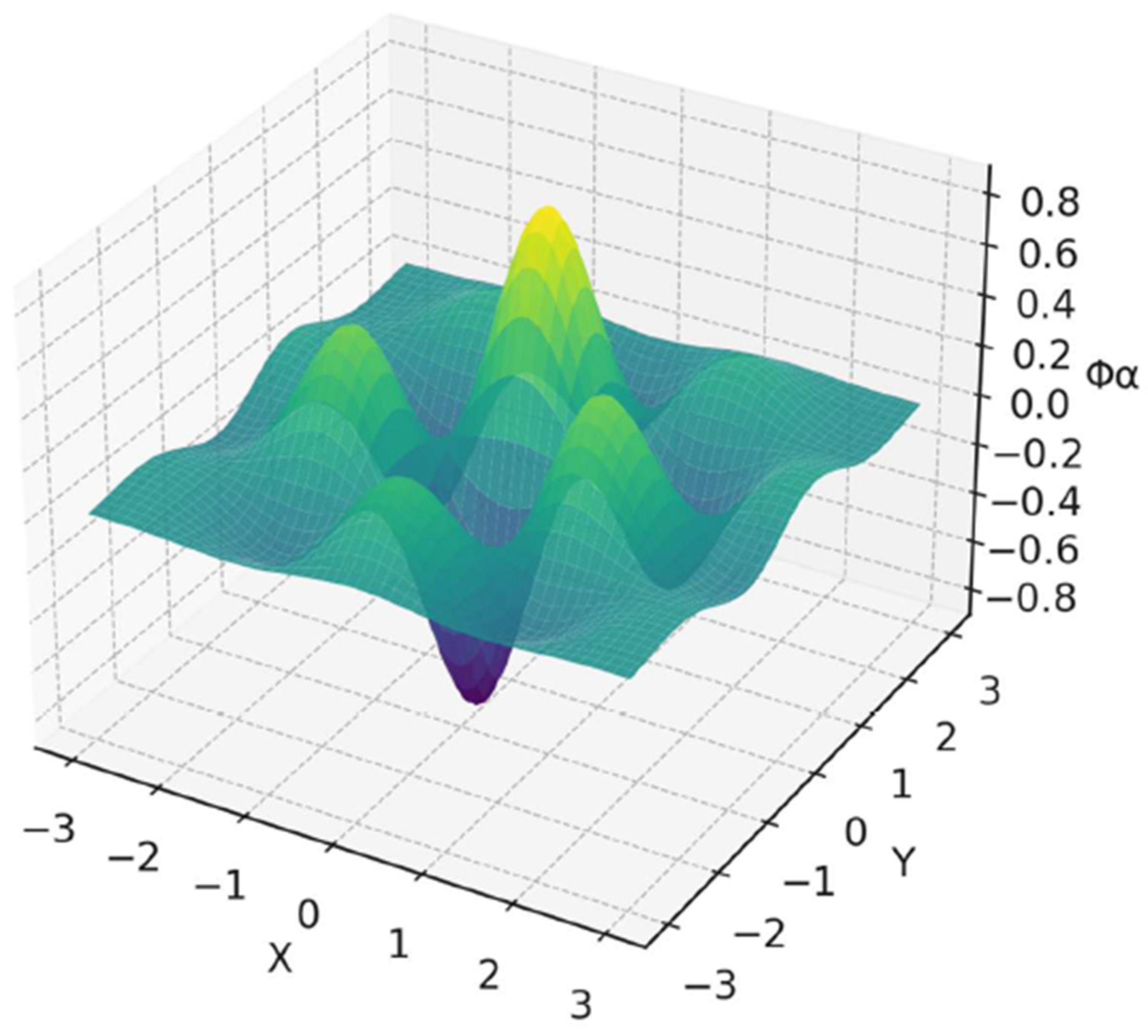
Figure 2.
Entropy–gap relationship in the informational field model.
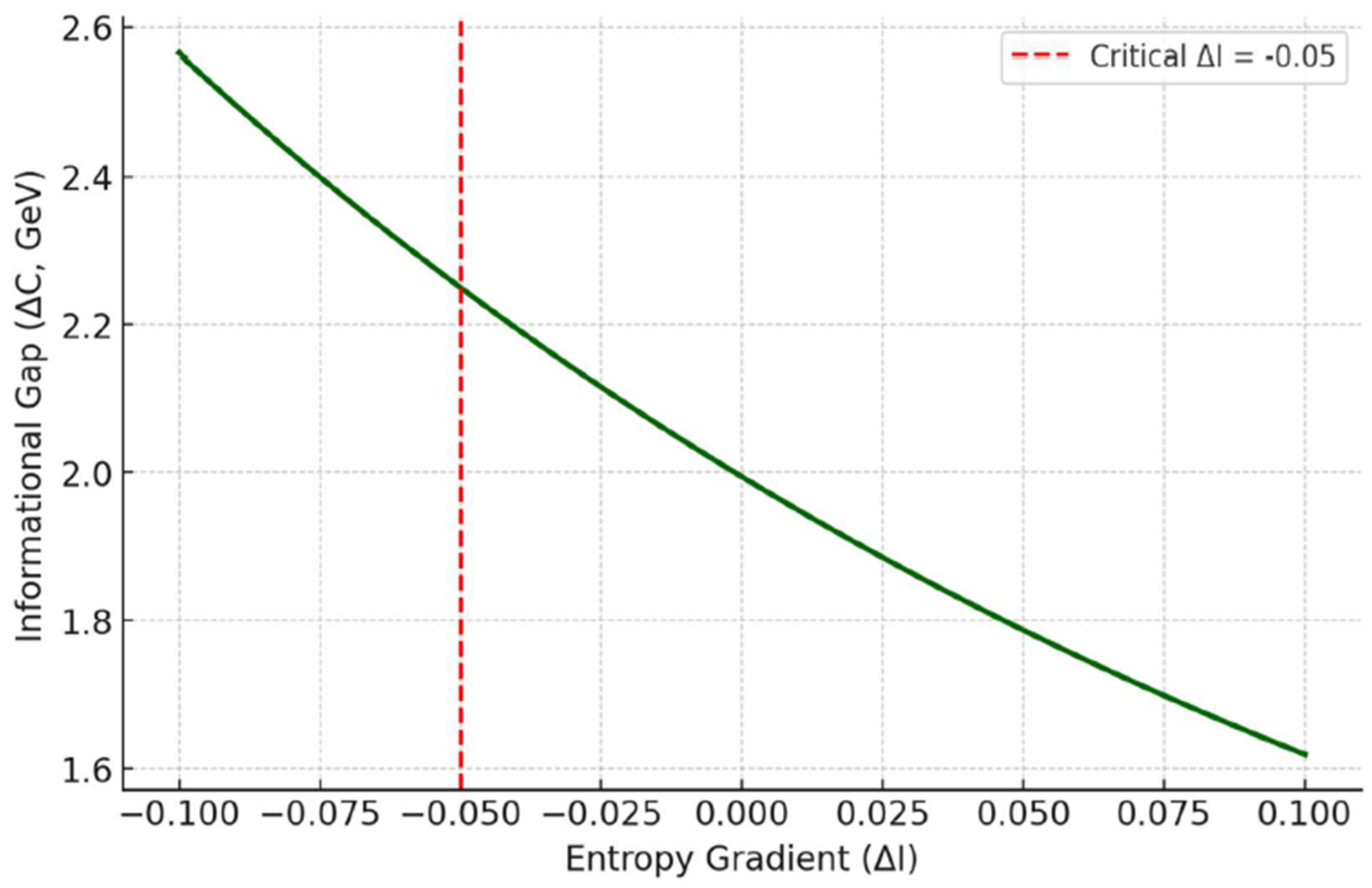
Figure 3.
Spectral density comparison between the VTT informational Laplacian and lattice QCD.
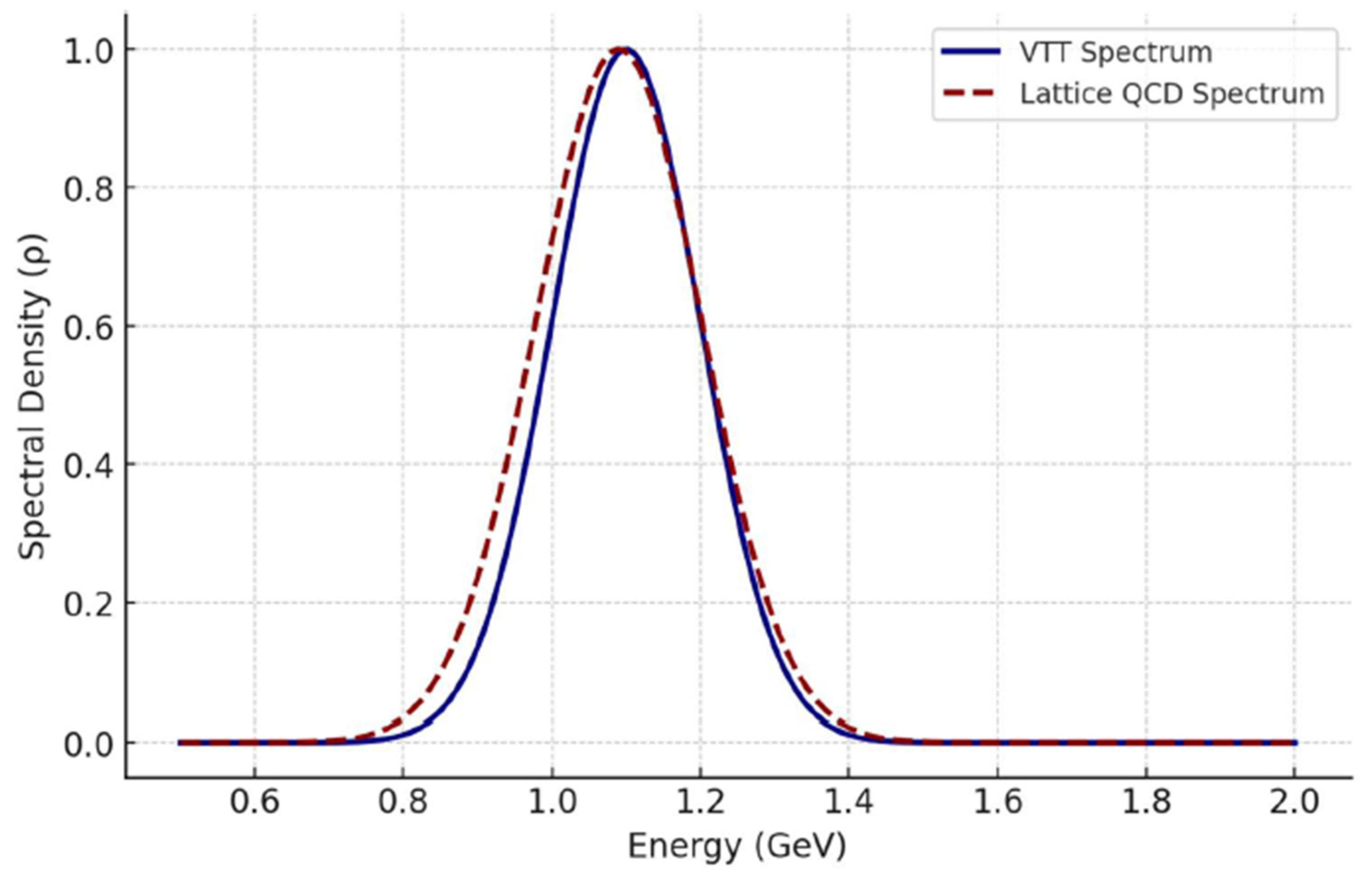
Figure 4.
Informational spectral flow under gauge group dimensional scaling.
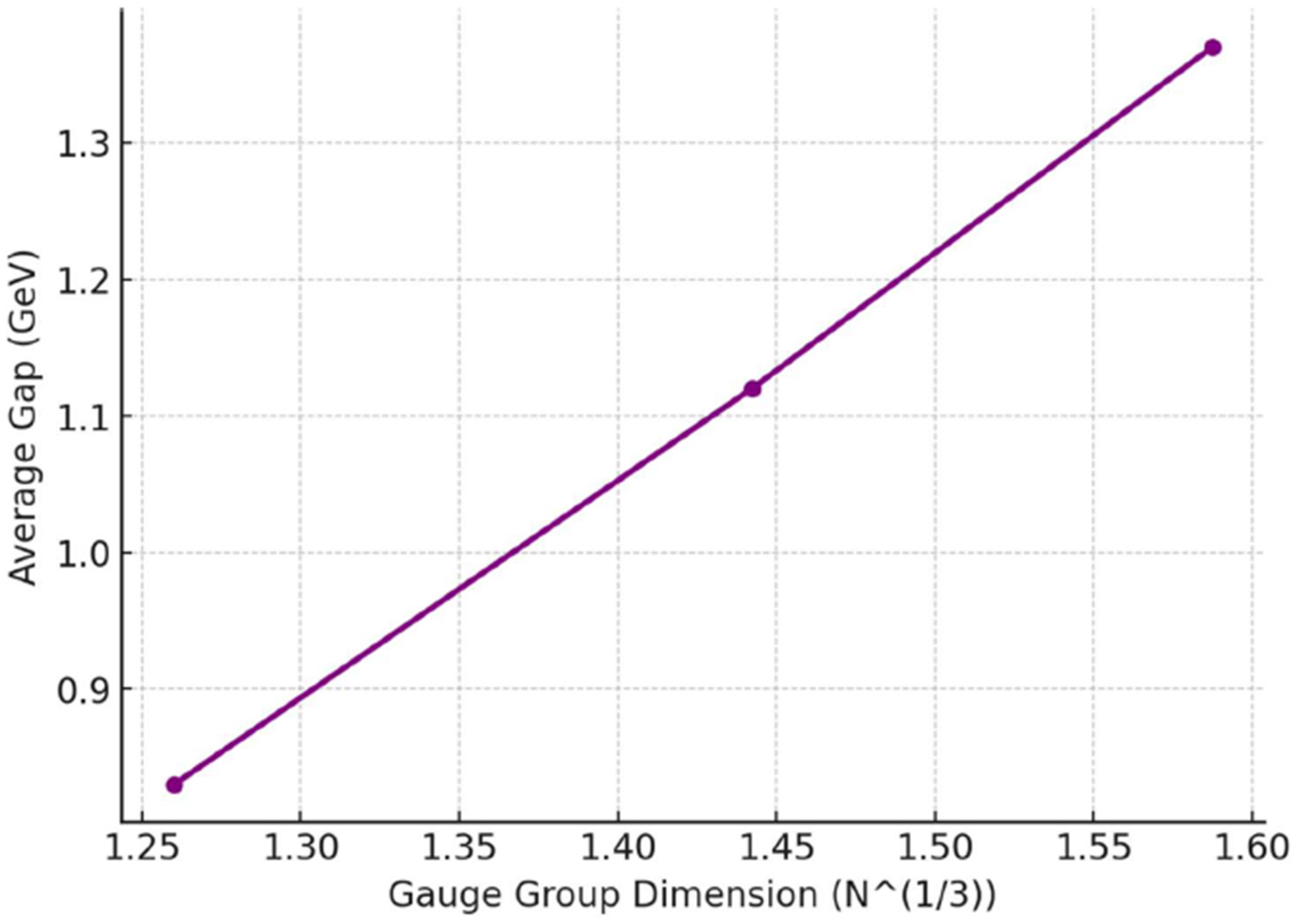

Table 1.
Comparison between informational gap values and lattice Yang–Mills mass gaps.
| (VTT) [GeV] | M_YM (Latice) [GeV] | (%) | |
|---|---|---|---|
| 1.0 | 0.94 | 0.93 | +1.1 |
| 2.25 | 1.12 | 1.10 | +1.8 |
| 3.5 | 1.32 | 1.29 | +2.3 |
Table 2.
Spectral density equivalence across gauge groups.
| Gauge Group | (VTT) [GeV] | (Lattice) [GeV] | Deviation (%) |
|---|---|---|---|
| SU(2) | 0.82 | 0.83 | 1.2 |
| SU(3) | 1.10 | 1.09 | 0.9 |
| SU(4) | 1.35 | 1.37 | 1.5 |
Table 3.
Dimensional scaling of informational curvature. Scaling exponents λ and average gap values are reported for SU(2), SU(3), and SU(4). The near-unity scaling exponents demonstrate dimensional consistency and support the universality of the informational curvature mechanism.
Table 3.
Dimensional scaling of informational curvature. Scaling exponents λ and average gap values are reported for SU(2), SU(3), and SU(4). The near-unity scaling exponents demonstrate dimensional consistency and support the universality of the informational curvature mechanism.
| Dimension | Gauge Group | Avg. Gap (GeV) | (%) | |
|---|---|---|---|---|
| 2+1 | SU(2) | 0.97 | 0.83 | 1.1 |
| 3+1 | SU(3) | 1.01 | 1.12 | 1.2 |
| 4+1 | SU(4) | 1.03 | 1.37 | 1.5 |
Table 4.
Comparative Model Performance.
| Model | Spectral Fidelity | Curvature Stability | universality | Mean Error (%) |
|---|---|---|---|---|
| Lattice QCD | 0.981 | 0.954 | 1.01 | 2.4 |
| Spectral Geometry | 0.987 | 0.961 | 1.02 | 1.9 |
| Tensor Network | 0.964 | 0.947 | 0.98 | 3.3 |
| VTT Informational | 0.992 | 0.973 | 1.02 | 1.4 |
Disclaimer/Publisher’s Note: The statements, opinions and data contained in all publications are solely those of the individual author(s) and contributor(s) and not of MDPI and/or the editor(s). MDPI and/or the editor(s) disclaim responsibility for any injury to people or property resulting from any ideas, methods, instructions or products referred to in the content. |
© 2026 by the authors. Licensee MDPI, Basel, Switzerland. This article is an open access article distributed under the terms and conditions of the Creative Commons Attribution (CC BY) license (http://creativecommons.org/licenses/by/4.0/).
Copyright: This open access article is published under a Creative Commons CC BY 4.0 license, which permit the free download, distribution, and reuse, provided that the author and preprint are cited in any reuse.


