

Submitted:
29 January 2026
Posted:
30 January 2026
You are already at the latest version
Abstract
Park in a Truck (PiaT) is a participatory urban green space development initiative that helps communities transform vacant lots into neighborhood parks. Critical to PiaT is the Park Ambassador (PA) program that trains neighborhood youth involved with this process as paid interns to plan events and perform maintenance in their new neighborhood park. While research has identified the benefits of participatory urban greening programs among adults, including fostering interpersonal relationships and community engagement, there is little research on the benefits among youth. This article describes the results of 17 interviews with youth PAs about their perspectives on the activities they complete, and their perceptions of the impact of the program. In the interviews, PAs described many common personal and community benefits, including the importance of meaningful work, self-efficacy, socializing, and creating places of natural respite for community and environmental benefit. Overall, the results provide evidence of the beneficial effects of a participatory urban greening program on youth participants.
Keywords:
urban parks
; youth
; neighborhood
; self-efficacy
; respite
; stress
Introduction
Today there is increasing attention to the importance of green spaces in post-industrial cities for the range of health, social, environmental, and economic benefits they bring to urban residents (Cohen et al., 2022). Parks and green spaces have been shown to improve human health in a myriad of ways (Frumkin et al., 2017; Hartig et al., 2014). In addition to regulating and supporting healthy ecosystems, parks and green spaces make people feel good, both directly and indirectly. Parks foster physical activity (Remme et al., 2021), preventing future chronic disease. Green space access is associated with reduced stress (Yao et al., 2021), lower rates of anxiety and depression (Liu et al., 2023), improved mood (Li et al., 2018), prosocial behavior (Arbuthnott, 2023), and collective efficacy (Cohen et al., 2008). At the group level, the creation of parks has been shown to improve sense of community (Francis et al., 2012), social cohesion (Jennings & Bamkole, 2019), and even improve neighborhood home values (U.S. Environmental Protection Agency, 2025).
Yet, in many U.S. cities, including Philadelphia (McIntire et al., 2022), lower income and minoritized groups have less access to these beneficial spaces. In Philadelphia, there are more than 42,000 neighborhood lots and properties which sit vacant (Rodriguez, 2019). Urban greening programs in U.S. cities have begun turning vacant lots into green spaces using models such as the Pennsylvania Horticultural Society (PHS)’s LandCare program, a successful program administered by the PHS with support from the city of Philadelphia. The LandCare program removes trash and debris on vacant lots, mows overgrown vegetation, plants grass, installs a low white fence around the lot, and in some cases, employs local landscaping companies to mow and maintain the “greened” lot (Pennsylvania Horticultural Society, 2023). This process does not just improve the aesthetics of the built environment, but has also been shown to reduce gun violence (Branas et al., 2011; Branas et al., 2018) and feelings of depression (South et al., 2018) while increasing property values (Heckert & Mennis, 2012).
While there are many benefits to standardized urban greening programs such as LandCare, the voices of community members are not often present in the design process. In order to engage stakeholders in community design projects, designers and planners use a process of community-engaged or participatory design, which addresses “complex urban problems through collaboration, guided by local knowledge” (Wilson, 2018). Engaging community members in urban greening through participatory design allows projects to reflect the lived experiences, values, and needs of local residents (Hou & Rios, 2003; Wilson, 2018). This inclusive approach centers community knowledge, builds trust and sense of ownership, fosters social connection, and ultimately leads to more resilient, culturally relevant, and sustainably maintained neighborhood spaces (Derr et al., 2018; Lawson, 2005; Sanoff, 1999).
Researchers have identified benefits of participatory vacant lot remediation among adults, including strengthening interpersonal relationships and community engagement (Stewart et al., 2019), yet there is less research on similar programs among young people. A study of the Seeds of Change program which engages youth with designing, building, planting, and maintaining urban gardening spaces identified many positive outcomes including development of new skills, self-efficacy, relationships between participants and staff, and a sense of purpose from participating in the program (Roberts et al., 2020). Further, youth described a strong motivation to create spaces to improve the community. Similarly, in other studies adolescents report that vacant lots affect them personally and they are motivated to improve neighborhood conditions (Teixeira, 2015).
Park in a Truck (PiaT) is a participatory design initiative that helps residents transform available lots into vibrant neighborhood parks (McIntire et al., 2025). Unlike conventional approaches that often design parks in isolation from the communities they serve, PiaT engages local residents at every stage—from site selection and assessment to design, construction, and ongoing maintenance (Philadelphia City Planning Commission, 2021). PiaT has worked with Philadelphia communities to build 6 new parks in the past 8 years.
A hallmark of the PiaT initiative is the Park Ambassador (PA) program, which employs neighborhood youth as paid interns. With a foundation of Positive Youth Development (Larson, 2000; Shek et al., 2019), the PA program guides youth to plan events, organize community clean-up efforts, and perform park maintenance in the new parks. PAs are trained over a period of 6 weeks, typically in cohorts of 5-10 youth aged 10-17, by the PiaT Program Director, who is a landscape architect. The training covers topics including leadership, civic engagement, design, ecology, and event planning. Training includes both classroom activities and hands-on skill building at the park site, and often includes instruction by expert builders, horticulturalists, and educators, some of whom are neighborhood residents. Once trained, PAs work one day per week on construction and maintenance projects within the park, either individually or with other PAs. For training and work, PAs receive an hourly pay of $15.
Typically, PAs live in close proximity to the parks where they work, but this is not always the case; some PAs live in adjacent neighborhoods. PAs are recruited by word of mouth from organizations or individuals involved in the PiaT process. For example, in the two latest PiaT neighborhoods in the Kingsessing neighborhood in Southwest Philadelphia and the Mantua neighborhood in West Philadelphia, PAs were recruited via contacts with neighborhood youth serving programs. Day-to-day PA activities are managed by leaders from local community organizations. For example, the Mantua cohort is managed by a board member of the Mantua Civic Association, and the Kingsessing cohort is managed by an employee of Empowered Community Development Corporation.
While program administrators have received anecdotal feedback that Ambassadors find the experience rewarding—citing job skills, income, and the satisfaction of giving back—there has been no empirical research to date on the program’s impact. This article describes the results of interviews with PAs about their perspectives on the activities they complete, including the benefits and challenges of participating in the program and the impact of the program on themselves and their communities.
Methods
Participants: Participants were PAs who work at PiaT parks in either the Kingsessing or Mantua neighborhoods of Philadelphia. Both neighborhoods are low income, based on median household income, and have experienced gentrification and economically driven residential displacement. The Mantua neighborhood, in particular, was targeted for an urban renewal project led by Drexel University and the University of Pennsylvania between the late 1950s and 1960s, and it continues to undergo gentrification today (Allen-Handy et al., 2024). The Mantua PAs live in the Mantua neighborhood, while some of the Kingsessing PAs live in other areas of the city. All participants are Black/African American between the ages of 10 to 17.
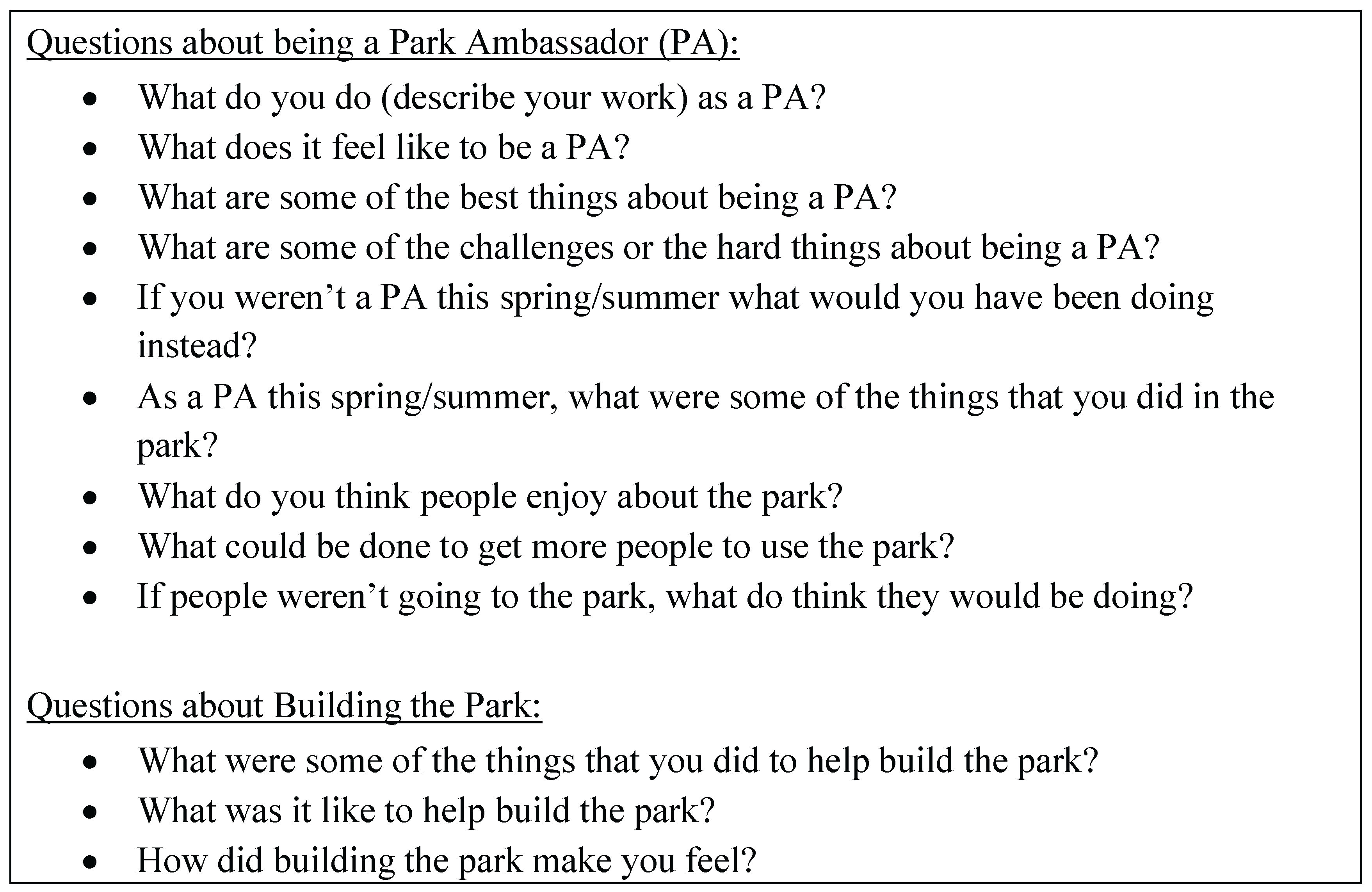
Interviews: We conducted 10–20-minute semi-structured interviews among PAs during a park work session (Kingsessing) and a neighborhood celebration (Mantua). During the interview, we asked participants to describe their experiences working as PAs, including the tasks they perform, personal perspectives on the program, and the program benefits and challenges they experience (Figure 1). We conducted 17 interviews among PAs in summer 2024, 9 of whom work in Kingsessing (5 boys and 4 girls) and 8 who work in Mantua (5 boys and 3 girls).
Analysis: We used MaxQDA to transcribe the recorded interviews and share transcripts between the 3 coders (Researcher 1, Researcher 2, Researcher 3). Coders independently coded each interview and conferred to create master coded interviews for thematic analysis. Codes were analyzed using an inductive process where the data was categorized directly based on participants’ answers to semi-structured interview questions. These themes were then cross-referenced between interviews and triangulated between three researchers to enhance the validity and reliability of the qualitative findings.
Results
Benefits
Across interviews, PAs described two levels of benefits they experienced in the PiaT initiative; personal benefits to themselves as individuals and benefits they saw for the broader community. Often personal and community benefits were positioned as mutually developing and supportive, that is, participants viewed benefits to the community as also benefiting themselves individually, and vice versa.
Sense of Self-Efficacy Through Productive Work Activities
The personal benefit most frequently mentioned by all 17 interviewed participants was a sense of accomplishment and satisfaction engaging in what they saw as important and productive work activities. PAs described participating in regular tasks related to park construction, hardscaping, and maintenance, including picking up trash, cleaning the park, painting, or generally, making the park and surrounding streets “look good.” They also described gardening, including planting and tending flowers and vegetables as well as identifying and pulling weeds. In describing these work activities, it was clear that participants had a sense they were making a tangible positive difference in a community space and felt pride in the work. Providing the community with a nice space to spend time gave the PAs meaning, fulfillment, and motivation to continue their engagement in the program. One PA noted that park work “gives me a reason to get out of the house and do something” while another PA explained that building the park “makes me feel good. Welcome. Because I got the feeling that we built this place.” Another participant explained her involvement in building the park in this way:
I did a lot. It was from the ground up, like just seeing, you know, it's amazing because some trees wasn't that tall when we first put them in, some trees was like baby trees… Building the park made me feel accomplished. I felt very accomplished in my goals and my dreams. It was always one of my things…for me to build, build on, like building stuff for the youth in the community.
Similarly, many other participants talked about the positive feelings they gained from their park work, for example participants who noted that building the park “makes me feel important, just as a person,” and “it made me feel good that I can know that I helped build this park, and that I know that people have a safe, peaceful environment.” Another PA reflected that building the park “makes me feel great. When I'm a grandma, I can tell my kids that I built a park. And, like, I could brag to my friends now.” One PA explained that building the park made him “feel happy,” explaining:
Before the park was there, I just walked past an empty lot and be like, “oh my goodness, I wonder what they're going to do to this?” And then…helping build the park was like…we did that. So that just, like, felt kind of good.
Similarly, another PA noted that building the park taught him that “the things I used to think I couldn't do, I can really do it if I put my mind to it. That's what I learned.”
For other participants, their positive feelings and personal sense of self-efficacy transcended the physical changes they saw resulting from their work, i.e. building, beautifying, and maintaining the park space, to include a perception that as a PA their role in the neighborhood became more proactive and important. For example, one participant explained that his work as a PA made him feel like he was “good help. Like it makes you feel like a better person” while another participant noted that being a PA makes her feel “important. Like I'm actually doing something.” Several PAs talked specifically about becoming a “role model,” for other kids in the neighborhood especially. For example, one PA explained: “I'm helping the kids, I'm just mentoring the kids and stuff like that, being a good role model.” Another PA discussed her pride in the “positive impact” she had in her work in the park and then shared her advice for other kids who might join the PA program in future years:
Look for a problem and try to fix it, whether it's in the park or not in the park, anywhere in Philly, look for a problem and find a solution. Whether you can do it by yourself or not. Ask someone for help. Ask for resources, ask for anything that can help you and try to fix that problem.
PAs often positioned the needs of the neighborhood community as top priority in the program, such as the participant who noted, “some of the best things about being a Park Ambassador is me just making sure the community is okay. The community before anything.” Another participant elaborated that her work as a PA gave her an increased sense of the power of kids in the neighborhood:
Everybody got ideas. But we're not putting these ideas together for the youth…You gotta go in the neighborhoods and ask the kids, how do they feel about their neighborhood?...talking to kids more. Sometimes adults, adults live their lives already. Right now it's time. It's time for the youth. The youth never get heard at all…. It's so amazing just being around the kids and knowing the kids, knowing the kids (can) safely go somewhere every day. That's my main goal. And my main passion is for the kids.
Another PA opined that the involvement of kids in park maintenance resulted in the completion of tasks that otherwise might not get done: “Most parks don't get cleaned up or just don't get cleaned up often. But if we're here during the day… there's definitely going to be, like, a cleanup.” Another PA similarly summed up what he and his fellow PAs do at the park each week: “We clean it. Keep it clean. We look at it and if it's dirty we clean it.” A focus on the efficacy of kids in creating a physically positive space in the neighborhood was a dominant theme across interviews; most participants talked about their pride in creating a park that was “clean,” “pretty,” “cute,” or otherwise aesthetically pleasing: “The park is so pretty. It's filled with flowers and plants and it's just like, it's just so cute.” Similarly, another participant noted: “We clean up the park, we take care of it, maintain it, we plant, we just make the park look pretty. So, there's a safe environment for people to come and have fun.”
Other PAs described the self-efficacy for effecting improvements in their community they felt in making positive changes in the natural environment, for example, by planting trees, which is “helping the environment.” In another example, one participant noted that building the park made him feel like he was “helping the environment. Like I was doing something to better where we live.” One PA elaborated:
It feels nice to help the environment, because a lot of animals, bugs too, are going extinct because of the unsanitary places. Like people litter in the ocean, and that's killing fish. So it feels really good to help the environment.
Another participant explained the project of building and maintaining a park as a way to protect green spaces in a neighborhood experiencing rapid development on vacant lots:
We don't really have too many community public, like little open garden spaces. Because with all this, uh, what's the word I'm looking for? Uh, gentrification. There you go. Uh, around the neighborhood. This is being a lot more apartments being built up and replacing old lots that could probably be used for better things. So there would be almost nowhere to go to hang out and relax and stuff like that.
In sum, all participating PAs at least mentioned, if not extensively discussed, their sense of self-efficacy in creating positive change through their participation in the PA program. As one PA summed up: “It gives me something to do. And, like, you're making a change. So it makes you happier. And to see the kids have something to do instead of staying in the house all day. It's just, like it makes you feel good.”
Opportunities for Social Interaction
PAs also talked extensively about opportunities to socialize afforded by their participation in PiaT. Often, interviewed PAs brought up the benefits of social interactions when asked what they would be doing if not participating in the PA Program; many interviewees indicated that there was “nothing” or “not much” to do outside of being a Park Ambassador. For example, one PA said, “if I wasn't doing this, I'd probably just be at home on my phone all day in bed writing because there's like, there's not really anything to do outside of being a Park Ambassador…besides homework, there's nothing else to do.” Other PAs noted that if it was not for their participation in PiaT they would be doing “nothing” or staying at home “on a device.” Some PAs expressed a desire for the program to continue through the gardening off-season as a way to provide extended opportunities for engagement, for example the PA who explained, “the program slows down once the weather gets colder as well. So, like, we're not really doing anything. So I'm just, like, damn, I'm back to being home. Yeah. I have nothing to do again.”
PAs clearly enjoyed the opportunities for routine social interactions through their involvement in PiaT. For example, one PA noted, “it's just like a place that you can hang out with your friends” and another PA who used PiaT to reconnect with friends attending a different school: “I like it because me and my friends don't go to the same school anymore. So, it's like a chance for us to meet up on the weekends and do something productive together.” Other PAs emphasized the possibilities of meeting new people, for example one PA who declared that “the best thing” about PiaT “is that you get to meet new people and learn what things you like.”
The particular type of socializing emphasized by PAs focused on reciprocal interactions and team-based activities. For example, one PA described feeling “very good inside” because he gets to “work with my cousins and other friends…that I go to school with. I get to really build…my confidence up with them. Communication skills and teamwork skills and collaboration skills.” Another PA noted that “I learned teamwork. Like, there’s a lot of teamwork out here when we work. That’s the stuff I learned for real.” Other PAs were more self-reflective about the personal changes they saw in how they interacted with others. One PA self-reflected that she saw herself as having “little patience… and a big attitude problem. So, I feel like over the years this program helped me out with getting a better attitude and not talking back.”
Some participants also described planning community events at the parks, including parties and family events. For example, participants hosted a pumpkin carving/decorating event for Halloween, with games and prizes. Participants also happily described activities that they themselves did not plan, but were organized in the park by community members, such as private parties and cookouts. Positive interactions with community members not directly involved in PiaT added meaning and value to the participation of PAs in the program and several PAs shared stories of neighbors recognizing their work. For example, one PA described how people would “walk by…They say we've done a good job… people were always admiring us like that.”
Building A Space for Respite
The well-being of the community came up many times in the interviews with relaxation, respite, and rest often discussed by PAs as a benefit to being in the park. For instance, PAs were asked if and why other people like the park and most answers focused on the “safe,” “relaxing,” and “peaceful” space. PAs described the opportunity for community members, more so than for themselves, to experience relaxation and stress reduction due to the calm, scenic environment of the park and ability to spend time with friends and family. For example, one PA described the park as “a place where you could chill at instead of doing stuff that would get you in trouble, like how some kids go out and fight and all of that. You can come here, relax and chill by yourself or with a couple of friends.”
Numerous PAs described the park in ways oriented towards intergenerational family activities specifically. For example, one PA reflected that people come to the park to “sit there with their family. Or like, say, their kids want to go to the park, their kids want to run around, while they sit in here and enjoy themselves. Or if they need a break or something.” Similarly, another PA thought of the park as “a safe environment to chill. Your kids can do their homework and stuff. Y’all can just enjoy your time over here and get some quiet.” Several PAs noted the destressing effects of nature afforded by the park’s flora and fauna, for example the PA who noted “people probably enjoy to go somewhere where they can sit down and look at birds and throw food for birds or just have somewhere to go when they are stressed or something to calm down” and another who explained, “you could come out here to calm yourself down, look around, watch cars go past, look at the trees and feel the breeze.”
Lastly, several PAs noted perceptions that they were creating a relaxing neighborhood space that would outlast their personal involvement in PiaT. As one PA described: “We're creating something long lasting, you know what I mean? Because, like, the park is going to be there forever. So we want the people in the neighborhood to use it and know about it and to overall make it like a space for them because it was created for them.”
Challenges
Interviewed PAs overwhelmingly emphasized the positive benefits of their involvement in PiaT, both for themselves and for the broader community. Nonetheless, they did not shy away from mentioning challenges to participation in the program. Interestingly, several challenges were closely linked to perceived benefits, that is, benefits were described as a direct result of overcoming or surmounting challenges. For example, a sense of self-efficacy through work activities was the most frequently described benefit to participation as a PA and, closely linked to this, the difficulty of the work was the most frequently mentioned challenge, particularly the amount of hard physical labor required to build and maintain the park. One participant noted, “packing up the shed is pretty hard. All the stuff is falling out. You have to pick up (dog) poop sometimes…. And the rocks. We had to pick up the rocks and with the wheelbarrow- it was really heavy.” Along with the physicality of the work, weather was another prominent challenge for PAs, especially the humid heat during summers in Philadelphia. One participant described the sentiments of many: “Uh, the heat is definitely…a real killer… when we have to pick up trash and plant plants and all that other extra stuff like cleaning our neighborhood. The heat…It's just hard to deal with because when we're doing our program, like mainly during the summer.”
Next in frequency mentioned were challenges associated with personal conflicts with others in the PA program. Some participants explained how when working in a team it can be difficult to agree on ideas which can lead to conflict as could personality clashes. Notably, a few participants highlighted such personal conflicts as opportunities for increased collaboration and personal satisfaction. For example, when reflecting on group decision-making, one participant noted, “sometimes it's, like, a little rocky because some people might want this thing, some people might want another thing, but we all come together, and we always just end up choosing one.”
A limited number of participants also mentioned challenges with waking up for a job on weekend mornings; transportation to the park; dirtying clothes during park build and maintenance activities; and gender imbalance (one female PA noted: “I just feel like if there were more girls in it, it would be, like, better”). In sum, although participants shared challenges that came up throughout the program, they spoke most often about positive experiences and benefits that the program provided both them and their local community.
Discussion
This paper describes the results of interviews among Park Ambassadors engaged in building, maintaining, and programming parks during the Park in a Truck initiative in two Philadelphia neighborhoods. We asked PAs to describe their work activities, their perspectives on the benefits and challenges of being a PA, and their perceived impacts of the program. PAs described many common personal and community benefits, including the importance of meaningful work, self-efficacy, socializing, and creating places of natural respite for community and environmental benefit.
A sense of personal and collective efficacy surfaced as a primary theme in interviews with PAs. In Bandura’s social cognitive theory, self-efficacy refers to “beliefs in one’s capacities to produce given attainments” (Bandura et al., 1999), profoundly impacting personal actions. Bandura proposed that a primary influence on a person’s self-efficacy comes from perceptions of control- or lack of control- in one’s contextual environment. Importantly, self-efficacy is a strong predictor of health behaviors and the academic performance of students (Bandura, 1997; Sharkey, 2006) and low self-efficacy beliefs predict depression in adolescents (Bandura et al., 1999).
While the PA program does not explicitly focus on increasing participants’ self-efficacy, it does prioritize direct involvement in the local community through structured and positive activities in which PAs are expected to be doers. PAs are directly involved in designing, planning, and building park spaces and take leadership roles in park maintenance after construction. While the study investigators did not interview PAs before their participation in PiaT and so cannot provide insight into changes in perceptions of self-efficacy resulting from the PA program, it is clear from the interviews that participants attribute their increased sense of self-efficacy about their PA work activities, especially a belief that they have personal influence over a contextual environment in their neighborhood, to their experience as a PA. Participants frequently described their participation in the PA program through illustrative examples of “can do” engagement, both at the individual (“I can do”) and collective (“we can do”) levels, most especially focused on building features of the park itself, for example by noting “I built…” or “we built…” PAs repeatedly described experiencing positive emotions and a sense of accomplishment through their engagement in park construction and community work. Their participation fostered a strong sense of self-worth and supported personal development, as reflected in their confidence and self-perceptions closely linked to self-care behaviors (Tan et al., 2021). As Dupéré et al. (2012) explain in their study of the influence of neighborhood processes on adolescent self-efficacy, “the development of agency is fostered by participation in high-quality structured activities,” pointing to the need to consider not just the presence but also the quality of services and programs in disadvantaged neighborhoods. The results of our study suggest that the PA program provides important opportunities for improving adolescents’ sense of efficacy through an activity in which participants build a desired space from the ground up.
Building on this understanding of self-efficacy as shaped by participation in structured, community-based activities, our findings highlight how PAs’ experiences in the program fostered not only personal growth but also a collective culture of care and stewardship rooted in environmental and social responsibility. In particular, PAs’ self-efficacy was shaped by the outcomes of their work and their concern for community well-being and expressed as a commitment to improving their neighborhoods, supporting peers and families, and serving as role models for other youth. Participation in the program facilitated social interactions that fostered a sense of community both among the PAs and within their broader neighborhoods through shared responsibility for the physical maintenance of a neighborhood space. Within this context, the parks serve not only as community assets, designed and constructed by the PAs, but also as material manifestations of communal environmental care (Kondo et al., 2018).
PAs’ sense of efficacy and personal pride in building a park for their community also reflects key tenets in environmental education to change learners' behaviors not just by providing information about the environment but also through opportunities for learners to develop affective values (caring for the environment) and effect change through environmentally oriented behaviors (Hungerford & Volk, 1990; Tidball & Krasny, 2011). While the PA program does include informational components (for example learning about native plants and ecological gardening), the primary focus of the program- and the aspect clearly most enjoyable to interviewed participants- is the focus on action, that is, park construction, beautification, and maintenance. Participants developed a love for the park space because they worked on it, literally building and caring for the park with their hands. This gave them a sincere appreciation and love for a particular green space and, despite the relatively small size (what might be considered “pocket parks”), this affective and physical connection led many PAs to wider reflection about environmental concerns more generally. While PAs understood that they might not be able to directly and wholly solve large environmental problems- such as the ocean pollution and animal extinction mentioned by one PA- they all had a sense that they could make a positive difference by greening a specific-albeit small- space in their own neighborhood. In their study on the relationships between adolescent self-efficacy, knowledge, attitudes, and environmental behaviors, Meinhold and Malkus (2005) found that adolescents who had higher levels of perceived self-efficacy reported more proenvironmental behaviors than adolescents who had lower levels of perceived self-efficacy. The possible relationship between perceived self-efficacy and engagement in proenvironmental behaviors that PAs may participate in outside of organized PiaT activities constitutes an area for further investigation.
The care articulated in the PAs’ narratives and actions (i.e., “we built this place”) underscores the significance of ownership in advancing community development through relational and localized placemaking (Foo et al., 2013; Plunkett et al., 2018). Reclaiming vacant lots and transforming them into shared green spaces constitutes a form of spatial and symbolic resistance to gentrification (Stewart et al., 2019), a connection noted explicitly by one participant and more broadly reflected in participants’ awareness of the limited availability of green space within their neighborhoods. Through the PA program, they were afforded an opportunity to revitalize their communities while actively resisting displacement pressures (Stewart et al., 2019). For all PAs, the benefits of green placemaking were a positive lived experience; participants frequently described their satisfaction in creating spaces for relaxation and respite, where people can escape the stressors of everyday life and described specific moments of having such experiences themselves. Particularly notable was PAs’ focus on human-nature interactions. Some participants described nature features as particularly important for gaining psychological benefits at their newly-built parks, citing the beauty of trees and flowers and recalling interactions with animals. This affinity for nature is a common characteristic among humans. The biophilia hypothesis posits that human affinity for nature is intrinsic because humans evolved in natural settings (Kellert & Wilson, 1995). In the same vein, researchers have argued that perceptions of beauty of places are, to varying degrees, common among humans, especially those containing natural features (Porteous, 2013). Further, spending time in green spaces reduces stress, and this proceeds primarily through neuroendocrine and affective restoration mechanisms both among adults (Jones et al., 2021; Roe et al., 2013; Thompson et al., 2012; Ulrich et al., 1991), and young people (Franklin et al., 2020; Mennis et al., 2018). PAs’ descriptions of relaxing or “chilling” in their park reflects the fact that nature exposure allows humans to pay attention to their surroundings while recovering from fatigue, allowing the brain to recharge via the process of attention restoration (Kaplan, 1995). As urban environments exert a multitude of stressors on the brain of adolescents, resources need to be dedicated to create spaces for respite and relaxation to reduce stress and improve the mental wellbeing of teenagers. This is particularly important given the fact that in recent years children/adolescents’ access to the outdoors has decreased (Larson et al., 2019; Louv, 2008; Sefcik et al., 2019).
Besides human-nature interactions, PAs also described socializing with friends as an important benefit of the program and the parks they created. Community-based youth programs, especially those taking place in nature, foster prosocial behavior (Bates et al., 2018; Garst et al., 2025) and civic engagement (Madera et al., 2025) more broadly. PAs described working together on shared goals and decision-making, socializing with friends, meeting new people, and collaboratively working out differences of opinions, all of which are important skills to learn for social and emotional learning. Further, urban parks foster socialization among adults and young people (Van Aalst & Brands, 2021). Small urban parks are important for relaxing and socializing (Peschardt et al., 2012; Peschardt et al., 2016), even more so than other traditional park recreation functions such as physical activity (Baur & Tynon, 2010). Urban parks have strong potential to increase neighborhood social cohesion among diverse communities, and also emphasize the interrelatedness of maintenance of physical spaces, safety/crime, and green gentrification (Jennings & Bamkole, 2019).
Initiatives such as PiaT use participatory design principles to involve community stakeholders in park design and building, yet these types of programs are not standard practice and are not widely implemented. Barriers to community-engaged park-building are often difficult to overcome, and require patience and resources, as well as authentic connections and clear messaging (McIntire et al., 2025). However, community participation results in spaces with potential for sustainability because community members provide not just feedback, but time, energy, and sometimes, sweat equity into the creation of the neighborhood park. Thus, community-members are more likely to use and support a space for which they had a hand in designing, building, and maintaining.
Conclusions
Our study describes the perceptions of adolescent participants in a Park Ambassador program about how the program has impacted themselves and their communities. It is clear from interviews that they enjoyed the program, and that they were proud to contribute to the building and maintenance of a park, which they consider an important and perpetual community asset. PAs used language describing self-efficacy, and personal pride in their work and their contribution to the community. PAs described creating parks that would contribute to the health of the environment, and their personal and community health via the mental health-promoting properties of contact with nature. These findings suggest the value in municipalities considering adoption of participatory design programs, such as PiaT, as they plan future initiatives to address vacant lot remediation and youth development programs in urban areas.
Funding
This work was supported by Robert Wood Johnson Foundation, Institutional Research Leaders Grant.
Institutional Review Board Statement
The study was approved by the Institutional Review Board of Lehigh University (approval no. 2219145-4, 28 August 2025).
Acknowledgments
We would like to thank our community and administrative partners including Greg Thompson, Val Gay, Luzenia Lovett, Samantha Samuels, Gwendolyn Morris, DeWayne Drummond, Alexandra Zahn, Teddy Pickering, Xeyah Martin, Karen Small, and Victoria Chambliss-Miles. We would also like to thank all the Park Ambassador who were (and were not) interviewed for this project.
Conflicts of Interest
The authors declared no potential conflicts of interest with respect to the research, authorship, and/or publication of this article.
References
- Allen-Handy, A.; Meloche, A.; Likely, R.; Sterin, K.; Thomas-EL, S.; McCullough, C. R.; Datts, K.; Wenrick, R.; Nicholas, D.; Kaschock, K. A sandwich effect: Gentrification and Black residential displacement in the university-adjacent West Philadelphia Promise Zone. Journal of race, ethnicity and the city 2024, 5(2), 133–163. [Google Scholar] [CrossRef]
- Arbuthnott, K. D. Nature exposure and social health: Prosocial behavior, social cohesion, and effect pathways. Journal of environmental psychology 2023, 90, 102109. [Google Scholar] [CrossRef]
- Bandura, A. Self-efficacy: The exercise of control; Macmillan, 1997. [Google Scholar]
- Bandura, A.; Pastorelli, C.; Barbaranelli, C.; Caprara, G. V. Self-efficacy pathways to childhood depression. Journal of Personality and social Psychology 1999, 76(2), 258. [Google Scholar] [CrossRef] [PubMed]
- Bates, C. R.; Bohnert, A. M.; Gerstein, D. E. Green schoolyards in low-income urban neighborhoods: natural spaces for positive youth development outcomes. Frontiers in Psychology 2018, 9, 805. [Google Scholar] [CrossRef]
- Baur, J. W.; Tynon, J. F. Small-scale urban nature parks: Why should we care? Leisure Sciences 2010, 32(2), 195–200. [Google Scholar] [CrossRef]
- Branas, C. C.; Cheney, R. A.; MacDonald, J. M.; Tam, V. W.; Jackson, T. D.; Ten Have, T. R. A difference-in-differences analysis of health, safety, and greening vacant urban space. American journal of epidemiology 2011, 174(11), 1296–1306. [Google Scholar] [CrossRef]
- Branas, C. C.; South, E.; Kondo, M. C.; Hohl, B. C.; Bourgois, P.; Wiebe, D. J.; MacDonald, J. M. Citywide cluster randomized trial to restore blighted vacant land and its effects on violence, crime, and fear. Proceedings of the National Academy of Sciences 2018, 115(12), 2946–2951. [Google Scholar] [CrossRef]
- Cohen, D. A.; Inagami, S.; Finch, B. The built environment and collective efficacy. Health & place 2008, 14(2), 198–208. [Google Scholar]
- Cohen, M.; Burrowes, K.; Gwam, P. The health benefits of parks and their economic impacts; Urban Institute, Issue, 2022. [Google Scholar]
- Derr, V.; Chawla, L.; Mintzer, M. Placemaking with children and youth: Participatory practices for planning sustainable communities; New Village Press, 2018. [Google Scholar]
- Dupéré, V.; Leventhal, T.; Vitaro, F. Neighborhood processes, self-efficacy, and adolescent mental health. Journal of health and social behavior 2012, 53(2), 183–198. [Google Scholar] [CrossRef]
- Foo, K.; Martin, D.; Wool, C.; Polsky, C. The production of urban vacant land: Relational placemaking in Boston, MA neighborhoods. Cities 2013, 35, 156–163. [Google Scholar] [CrossRef]
- Francis, J.; Giles-Corti, B.; Wood, L.; Knuiman, M. Creating sense of community: The role of public space. Journal of environmental psychology 2012, 32(4), 401–409. [Google Scholar] [CrossRef]
- Franklin, M.; Yin, X.; McConnell, R.; Fruin, S. Association of the Built Environment With Childhood Psychosocial Stress. JAMA Netw Open 2020, 3(10), e2017634. [Google Scholar] [CrossRef] [PubMed]
- Frumkin, H.; Bratman, G. N.; Breslow, S. J.; Cochran, B.; Kahn, P. H., Jr.; Lawler, J. J.; Levin, P. S.; Tandon, P. S.; Varanasi, U.; Wolf, K. L. Nature contact and human health: A research agenda. Environmental health perspectives 2017, 125(7), 075001. [Google Scholar] [CrossRef] [PubMed]
- Garst, B. A.; Vanic, M.; Melton, T.; Foster, C.; Bowers, E. P. Principles and Practices of Impactful Nature-Based Positive Youth Development Programs. Current Opinion in Psychology 2025, 102048. [Google Scholar] [CrossRef] [PubMed]
- Hartig, T.; Mitchell, R.; De Vries, S.; Frumkin, H. Nature and health. Annual review of public health 2014, 35, 207–228. [Google Scholar] [CrossRef]
- Heckert, M.; Mennis, J. The economic impact of greening urban vacant land: a spatial difference-in-differences analysis. Environment and planning A 2012, 44(12), 3010–3027. [Google Scholar] [CrossRef]
- Hou, J.; Rios, M. Community-driven place making: The social practice of participatory design in the making of Union Point Park. Journal of Architectural Education 2003, 57(1), 19–27. [Google Scholar] [CrossRef]
- Hungerford, H. R.; Volk, T. L. Changing learner behavior through environmental education. The journal of environmental education 1990, 21(3), 8–21. [Google Scholar] [CrossRef]
- Jennings, V.; Bamkole, O. The relationship between social cohesion and urban green space: An avenue for health promotion. International journal of environmental research and public health 2019, 16(3), 452. [Google Scholar] [CrossRef]
- Jones, R.; Tarter, R.; Ross, A. M. Greenspace Interventions, Stress and Cortisol: A Scoping Review. International journal of environmental research and public health 2021, 18(6), 2802. [Google Scholar] [CrossRef]
- Kaplan, S. The restorative benefits of nature: Toward an integrative framework. Journal of environmental psychology 1995, 15(3), 169–182. [Google Scholar] [CrossRef]
- Kellert, S. R.; Wilson, E. O. The biophilia hypothesis; Island Press, 1995. [Google Scholar]
- Kondo, M. C.; Fluehr, J. M.; McKeon, T.; Branas, C. C. Urban Green Space and Its Impact on Human Health. Int J Environ Res Public Health 2018, 15(3). [Google Scholar] [CrossRef] [PubMed]
- Larson, L. R.; Szczytko, R.; Bowers, E. P.; Stephens, L. E.; Stevenson, K. T.; Floyd, M. F. Outdoor time, screen time, and connection to nature: Troubling trends among rural youth? Environment and Behavior 2019, 51(8), 966–991. [Google Scholar] [CrossRef]
- Larson, R. W. Toward a psychology of positive youth development. American psychologist 2000, 55(1), 170. [Google Scholar] [CrossRef] [PubMed]
- Lawson, L. J. City bountiful: A century of community gardening in America; Univ of California Press, 2005. [Google Scholar]
- Li, D.; Deal, B.; Zhou, X.; Slavenas, M.; Sullivan, W. C. Moving beyond the neighborhood: Daily exposure to nature and adolescents’ mood. Landscape and Urban Planning 2018, 173, 33–43. [Google Scholar] [CrossRef]
- Liu, Z.; Chen, X.; Cui, H.; Ma, Y.; Gao, N.; Li, X.; Meng, X.; Lin, H.; Abudou, H.; Guo, L. Green space exposure on depression and anxiety outcomes: A meta-analysis. Environmental Research 2023, 231, 116303. [Google Scholar] [CrossRef]
- Louv, R. Last child in the woods: Saving our children from nature-deficit disorder; Algonquin books, 2008. [Google Scholar]
- Madera, F.; Olcese, M.; Migliorini, L. A systematic review of nature connectedness in adolescents and young adults: Fostering environmental responsibility and sustainable practices. Journal of Prevention & Intervention in the Community 2025, 1–35. [Google Scholar]
- McIntire, R. K.; Douglas, K.; Shockley, A.; Harris, D.; Gay, V. Community-Designed Park-Building and Maintenance With the Park in a Truck Initiative. Health Promotion Practice 2025, 15248399251315721. [Google Scholar] [CrossRef]
- McIntire, R. K.; Halstead, T.; Dajee, D.; Buckley, M.; McGregor, K.; Larson, S. Disparities in neighborhood park access among adults in Philadelphia. Urban forestry & urban greening 2022, 78, 127790. [Google Scholar]
- Meinhold, J. L.; Malkus, A. J. Adolescent environmental behaviors: Can knowledge, attitudes, and self-efficacy make a difference? Environment and Behavior 2005, 37(4), 511–532. [Google Scholar] [CrossRef]
- Mennis, J.; Mason, M.; Ambrus, A. Urban greenspace is associated with reduced psychological stress among adolescents: A Geographic Ecological Momentary Assessment (GEMA) analysis of activity space. Landscape and Urban Planning 2018, 174, 1–9. [Google Scholar] [CrossRef]
- Pennsylvania Horticultural Society. Transforming Vacant Land. 2023. Available online: https://phsonline.org/programs/transforming-vacant-land.
- Peschardt, K. K.; Schipperijn, J.; Stigsdotter, U. K. Use of small public urban green spaces (SPUGS). Urban forestry & urban greening 2012, 11(3), 235–244. [Google Scholar]
- Peschardt, K. K.; Stigsdotter, U. K.; Schipperrijn, J. Identifying features of pocket parks that may be related to health promoting use. Landscape Research 2016, 41(1), 79–94. [Google Scholar] [CrossRef]
- Philadelphia City Planning Commission. Park in a Truck. 2021. Retrieved July 23. Available online: https://citizensplanninginstitute.org/park-in-a-truck-home/.
- Plunkett, D.; Phillips, R.; Ucar Kocaoglu, B. Place attachment and community development. Journal of Community Practice 2018, 26(4), 471–482. [Google Scholar] [CrossRef]
- Porteous, J. D. Environmental aesthetics: Ideas, politics and planning; Routledge, 2013. [Google Scholar]
- Remme, R. P.; Frumkin, H.; Guerry, A. D.; King, A. C.; Mandle, L.; Sarabu, C.; Bratman, G. N.; Giles-Corti, B.; Hamel, P.; Han, B. An ecosystem service perspective on urban nature, physical activity, and health. Proceedings of the National Academy of Sciences 2021, 118(22), e2018472118. [Google Scholar] [CrossRef] [PubMed]
- Roberts, L. T.; Stein, C.; Tompsett, C. J. Seeds of change: A qualitative case study of a neighborhood youth program. Journal of community psychology 2020, 48(7), 2290–2308. [Google Scholar] [CrossRef]
- Rodriguez, A. B. Philadelphia Land Bank Strategic Plan and Performance Report. 2019. Available online: https://phdcphila.org/who-we-are/publications/land-bank-strategic-plan/.
- Roe, J. J.; Thompson, C. W.; Aspinall, P. A.; Brewer, M. J.; Duff, E. I.; Miller, D.; Mitchell, R.; Clow, A. Green space and stress: evidence from cortisol measures in deprived urban communities. International journal of environmental research and public health 2013, 10(9), 4086–4103. [Google Scholar] [CrossRef]
- Sanoff, H. Community participation methods in design and planning; John Wiley & Sons, 1999. [Google Scholar]
- Sefcik, J. S.; Kondo, M. C.; Klusaritz, H.; Sarantschin, E.; Solomon, S.; Roepke, A.; South, E. C.; Jacoby, S. F. Perceptions of Nature and Access to Green Space in Four Urban Neighborhoods. Int J Environ Res Public Health 2019, 16(13). [Google Scholar] [CrossRef]
- Sharkey, P. T. Navigating dangerous streets: The sources and consequences of street efficacy. American Sociological Review 2006, 71(5), 826–846. [Google Scholar] [CrossRef]
- Shek, D. T.; Dou, D.; Zhu, X.; Chai, W. Positive youth development: Current perspectives. Adolescent health, medicine and therapeutics 2019, 131–141. [Google Scholar] [CrossRef]
- South, E. C.; Hohl, B. C.; Kondo, M. C.; MacDonald, J. M.; Branas, C. C. Effect of greening vacant land on mental health of community-dwelling adults: a cluster randomized trial. JAMA network open 2018, 1(3), e180298–e180298. [Google Scholar] [CrossRef] [PubMed]
- Stewart, W. P.; Gobster, P. H.; Rigolon, A.; Strauser, J.; Williams, D. A.; Van Riper, C. J. Resident-led beautification of vacant lots that connects place to community. Landscape and Urban Planning 2019, 185, 200–209. [Google Scholar] [CrossRef]
- Tan, F. C. J. H.; Oka, P.; Dambha-Miller, H.; Tan, N. C. The association between self-efficacy and self-care in essential hypertension: a systematic review. BMC family practice 2021, 22, 1–12. [Google Scholar] [CrossRef] [PubMed]
- Teixeira, S. “It Seems Like No One Cares” Participatory Photo Mapping to Understand Youth Perspectives on Property Vacancy. Journal of Adolescent Research 2015, 30(3), 390–414. [Google Scholar] [CrossRef]
- Thompson, C. W.; Roe, J.; Aspinall, P.; Mitchell, R.; Clow, A.; Miller, D. More green space is linked to less stress in deprived communities: Evidence from salivary cortisol patterns. Landscape and Urban Planning 2012, 105(3), 221–229. [Google Scholar] [CrossRef]
- Tidball, K.; Krasny, M. Toward an ecology of environmental education and learning In. Ecosphere 2011, 2(2), 1–17. [Google Scholar] [CrossRef]
- U.S. Environmental Protection Agency. Economic Benefits of Green Infrastructure. 2025. Retrieved May 29. Available online: https://www.epa.gov/green-infrastructure/economic-benefits-green-infrastructure.
- Ulrich, R. S.; Simons, R. F.; Losito, B. D.; Fiorito, E.; Miles, M. A.; Zelson, M. Stress recovery during exposure to natural and urban environments. Journal of environmental psychology 1991, 11(3), 201–230. [Google Scholar] [CrossRef]
- Van Aalst, I.; Brands, J. Young people: being apart, together in an urban park. Journal of Urbanism: International Research on Placemaking and Urban Sustainability 2021, 14(1), 1–17. [Google Scholar] [CrossRef]
- Wilson, B. B. Resilience for all: Striving for equity through community-driven design; Island Press, 2018. [Google Scholar]
- Yao, W.; Zhang, X.; Gong, Q. The effect of exposure to the natural environment on stress reduction: A meta-analysis. Urban forestry & urban greening 2021, 57, 126932. [Google Scholar]
Figure 1.
Interview Questions for Park Ambassador Interviews.
Disclaimer/Publisher’s Note: The statements, opinions and data contained in all publications are solely those of the individual author(s) and contributor(s) and not of MDPI and/or the editor(s). MDPI and/or the editor(s) disclaim responsibility for any injury to people or property resulting from any ideas, methods, instructions or products referred to in the content. |
© 2026 by the authors. Licensee MDPI, Basel, Switzerland. This article is an open access article distributed under the terms and conditions of the Creative Commons Attribution (CC BY) license (http://creativecommons.org/licenses/by/4.0/).
Copyright: This open access article is published under a Creative Commons CC BY 4.0 license, which permit the free download, distribution, and reuse, provided that the author and preprint are cited in any reuse.


