

Submitted:
28 January 2026
Posted:
30 January 2026
You are already at the latest version
Abstract
Background: The use of physical restraints in hospital settings remains a controversial practice due to its ethical, legal, and safety implications. Although restraints are intended to prevent falls or manage agitation, their inappropriate use may compromise patient dignity, autonomy, and quality of care. Current healthcare policies emphasize restraint reduction, proper documentation, and professional training as key elements of humanized and safe care. Methods: A descriptive, observational cross-sectional study was conducted in a tertiary university hospital to assess healthcare professionals’ knowledge, perceptions, and documentation practices related to physical restraint use. A structured anonymous questionnaire was distributed to nurses and nursing assistants (TCAE) working in adult inpatient units. The survey explored training, clinical decision-making, communication with patients and families, awareness of institutional protocols, and use of the electronic health record (EHR). Descriptive statistical analyses were performed using IBM SPSS Statistics. Results: A total of 241 professionals participated. More than half of respondents (54.8%) reported no formal training in physical restraints, and only 27.4% considered their training sufficient. Although 86.3% stated they were familiar with restraint indications, only 53.5% were aware of the existence of a structured EHR restraint registry, and just 31.0% consistently completed it. Documentation of restraint removal was particularly low (32.9%). Furthermore, significant discrepancies were observed between regulatory definitions of restraints and professionals’ perceptions of which practices require registration. Conclusions: This diagnostic phase reveals substantial gaps between regulatory requirements, professional knowledge, and real-world documentation of physical restraint use. The findings highlight the urgent need for structured training programs, standardized documentation processes, and institutional leadership to improve patient safety, regulatory compliance, and the humanization of hospital care.
Keywords:
physical restraints
; humanization care
; nursign practice
; hospital managements
; helathcare quality
1. Introduction
The use of physical restraints in hospital settings has become an increasingly debated issue in recent years, particularly within the framework of patient safety, humanized care, and respect for fundamental rights. Physical restraints are commonly defined as any method, device, or action that limits an individual’s freedom of movement and that the person cannot easily remove or control. Although traditionally applied to prevent falls, manage agitation, or avoid accidental removal of medical devices, their use must be considered an exceptional measure rather than a routine intervention [1].
Scientific evidence has consistently shown that the use of physical restraints is associated with significant adverse outcomes, including physical injuries, psychological distress, functional decline, and deterioration of the therapeutic relationship between patients and healthcare professionals. These consequences are especially relevant in vulnerable populations, such as older adults, patients with cognitive impairment, and those experiencing acute confusion or delirium. Moreover, the use of restraints has not been shown to effectively reduce adverse events such as falls; in some cases, it may even increase their incidence [2].
In response to these concerns, international and national organizations have promoted strategies aimed at reducing restraint use and encouraging safer, less invasive alternatives. The World Health Organization has emphasized that restraint practices raise important ethical and human rights issues and should be minimized through preventive approaches, staff training, and organizational commitment. Similarly, healthcare policies in Spain and other European countries have increasingly incorporated restraint reduction as a key indicator of quality, safety, and humanization of care [3,4].
Within the Spanish healthcare system, the regulatory framework governing physical restraint use establishes strict requirements regarding medical prescription, proportionality, time limitation, periodic reassessment, patient and family information, and systematic documentation in the electronic health record. In the Community of Madrid, Resolution 106/2017 of the Regional Health Authority explicitly defines physical restraints, outlines professional responsibilities, and mandates structured documentation to ensure traceability and accountability [5]. Despite these regulations, previous studies suggest that compliance with documentation and reassessment requirements remains inconsistent in routine clinical practice.
One of the main challenges in reducing inappropriate restraint use is the gap between regulatory standards, professional knowledge, and real-world clinical practice. Healthcare professionals may perceive restraints as necessary safety measures, particularly in contexts of high workload, staffing constraints, or limited access to preventive alternatives. In this context, insufficient training, lack of awareness of institutional protocols, and poorly designed documentation systems can contribute to the normalization of restraint use and to under-registration in electronic health records.
Training and education have been identified as central components in strategies to reduce restraint use and improve compliance with ethical and legal standards. Multicomponent interventions that combine staff education, protocol implementation, audit and feedback, and leadership involvement have demonstrated reductions in restraint prevalence and improvements in documentation quality [2,6]. However, the effectiveness of such interventions largely depends on an accurate understanding of baseline knowledge, perceptions, and practices among healthcare professionals.
From a humanization perspective, the appropriate management of physical restraints is closely linked to patient-centered care, shared decision-making, and respect for dignity and autonomy. Transparent communication with patients and families, along with systematic documentation of indication, duration, reassessment, and withdrawal, is essential to ensure that restraint use, when unavoidable, is ethically justified and clinically appropriate [7,8].
In this context, the present study represents the diagnostic phase of a multi-phase quality improvement project conducted in a tertiary university hospital. The aim of this initial phase was to assess healthcare professionals’ knowledge, perceptions, and documentation practices related to physical restraint use in adult inpatient units. By identifying gaps in training, conceptual understanding, and electronic health record use, this study seeks to provide the foundation for the subsequent implementation of a structured training program and a standardized documentation circuit, aligned with patient safety principles, regulatory compliance, and the humanization of hospital care.
2. Materials and Methods
2.1. Study Design
A descriptive, observational, cross-sectional study was conducted as the diagnostic phase of a multi-phase interventional project aimed at improving the prescription, documentation, and management of physical restraints in hospital settings. This initial phase focused on assessing healthcare professionals’ knowledge, perceptions, and documentation practices prior to the implementation of a structured training and quality improvement strategy.
2.2. Setting
The study was carried out at a tertiary-level university hospital in Madrid, Spain. Data collection took place in adult inpatient units, including medical and surgical wards.
2.3. Participants
The target population consisted of nursing professionals, including registered nurses (RN) and nursing assistants (TCAE), working in adult inpatient units.
Inclusion criteria
- Registered nurses and nursing assistants employed in adult inpatient wards.
- Permanent, temporary, or interim staff members.
Exclusion criteria
- Healthcare professionals in training
- Staff on temporary rotations
2.4. Data Collection Instrument
Data were collected using an anonymous, self-administered structured questionnaire (version V5) developed ad hoc by the research team and implemented using Microsoft Forms. Access to the survey was provided through a QR code distributed across the participating units.
The questionnaire consisted of 34 items grouped into eight sections:
- 1.
- Sociodemographic and professional characteristics
- 2.
- Knowledge and perceptions regarding physical restraints
- 3.
- Prescription practices and clinical decision-making
- 4.
- Communication with patients and families
- 5.
- Scope and indications for restraint use
- 6.
- Documentation practices in the electronic health record (HCIS)
- 7.
- Training and educational resources
- 8.
- Legal framework and professional responsibility
2.5. Variables
The following variables were collected:
- Sociodemographic and professional variables: sex, age, professional category, clinical unit, years of professional experience, and employment status.
- Training-related variables: previous training in physical restraints and perceived adequacy of training.
- Knowledge and perception variables: understanding of restraint indications, perceived appropriateness of restraint use, and awareness of institutional protocols.
- Clinical practice variables: physician involvement in prescription and withdrawal of restraints, communication with patients and families, and reassessment frequency.
- Documentation variables: awareness and use of the structured restraint registry in the electronic health record (HCIS), completion of initiation and termination records.
- Legal and organizational variables: knowledge of the legal framework and perceived need for improved documentation tools.
2.6. Ethical Considerations
The study complied with current data protection regulations, including Regulation (EU) 2016/679 (General Data Protection Regulation) and Spanish data protection legislation (Organic Law 3/2018). Participation was voluntary and anonymous, and no personal identifying information was collected. The study was approved by the Nursing Directorate and subsequently submitted to the hospital’s Nursing Research Department (2025/005, 04/07/2025).
2.7. Statistical Analysis
Data were analyzed using IBM SPSS Statistics (version 29). A descriptive analysis was performed using means and standard deviations for quantitative variables, as well as absolute and relative frequencies for qualitative variables. Categorical variables were compared using the chi-square test where appropriate. Statistical significance was set at p < 0.05.
3. Results
3.1. Participant Characteristics
A total of 241 healthcare professionals participated in the study, all of whom worked in adult inpatient units. The sample was predominantly female (88.4%), with registered nurses representing 61.0% of participants and nursing assistants (TCAE) accounting for 39.0%. Participant characteristics are summarized in Table 1.
Most professionals (83.0%) had less than 10 years of service. Participation was obtained from a wide range of clinical units, with the highest representation from Internal Medicine (12.0%), Cardiology (8.7%), Psychiatry (8.3%), General and Digestive Surgery (7.9%), Infectious Diseases (7.9%), Pulmonology (7.5%), and Orthopedics/Orthogeriatrics (7.5%).
3.2. Training and Perception of Physical Restraint Use
More than half of participants (54.8%) reported having received no specific training in physical restraints, and only 27.4% considered their training sufficient. Despite this, 66.4% perceived the use of physical restraints as appropriate in the hospital setting. Training and perceptions regarding physical restraint use are shown in Table 2.
An overwhelming majority of respondents (96.3%) expressed a need for additional training focused on restraint prevention, and 72.6% believed that the use of restraints was directly influenced by the level of training received.
3.3. Knowledge, Prescription Practices, and Communication
Although 86.3% of participants reported knowing the clinical indications for the use of physical restraints, inconsistencies were observed in prescription and withdrawal practices. Only 19.9% stated that physicians always assessed patients prior to restraint prescription, and just 17.4% reported that restraint removal was always prescribed by a physician. Details regarding prescription practices and communication are presented in Table 3.
Communication with patients and families was irregular; only 19.9%. indicated that patients and relatives were always informed before restraint application, while the most frequent response was “sometimes” (30.3%).
3.4. Conceptualization of Physical Restraints and Documentation Criteria
Participants demonstrated heterogeneous interpretations of what constitutes a physical restraint. While combined immobilization systems (e.g., bed rails plus belts and wrist restraints) were commonly identified as restraints, lower-intensity measures such as raised bed rails alone were frequently excluded from this classification.
Similarly, documentation practices reflected a tendency to register only what professionals perceived as “maximum immobilization,” leading to the under-registration of lower-intensity restraint practices despite their inclusion in regulatory definitions.
3.5. Reassessment Practices
Regarding the frequency of reassessment, 40.9% of participants considered that restraints should be reassessed every 2 hours, while 24.5% believed it should be done every 30 minutes. These frequencies align with patient safety standards; however, this awareness was not consistently translated into documented clinical practice. Perceived reassessment frequencies are summarized in Table 4.
3.6. Knowledge and Use of the Electronic Health Record Registry
Only 53.5% of respondents were aware of the existence of a structured physical restraint registry in the electronic health record (HCIS). Among those who were aware of the registry, only 31.0% consistently completed the documentation when restraints were applied.
Documentation of restraint termination was even lower, with only 32.9% reporting consistent completion. Nearly half of participants (49.4%) considered that an additional or clearer documentation tool was necessary to improve registration practices.
Knowledge and use of the electronic health record registry are detailed in Table 5.
3.7. Training Resources
Engagement with existing institutional training resources was limited. Only 10.8% of professionals reported having viewed training modules on restraint use, 9.1% on restraint prevention, and 7.5% on the legal framework, indicating low penetration of current educational initiatives. Engagement with institutional training resources is shown in Table 6.
4. Discussion
The results of this study confirm the continued use of physical restraints in hospital settings and reveal significant deficiencies in knowledge, documentation, and compliance with regulatory requirements among healthcare professionals. These findings are consistent with concerns raised in previous studies and institutional reports highlighting the gap between policy recommendations, clinical practice, and documentation in the management of physical restraints [2,5,6,9].
4.1. Deficit in Documentation and Traceability
One of the most relevant findings of this diagnostic phase is the low level of completion of the structured physical restraint registry in the electronic health record (HCIS). Although more than half of the professionals were aware of the existence of the registry, only a minority reported completing it consistently, and documentation of restraint removal was particularly limited. This finding is especially relevant from a patient safety and legal perspective, as proper documentation is essential to ensure traceability, accountability, and compliance with current regulations [5].
The discrepancy observed between the number of registered restraints and the consumption of restraint devices detected through material management records and institutional audits reinforces the presence of under-registration in routine clinical practice. Similar situations have been described in the literature, where the absence of standardized and user-friendly documentation systems has been identified as a major barrier to the appropriate monitoring and reduction of physical restraint use in hospitals [3,4].(Figure 1).
4.2. Knowledge and Training of Healthcare Professionals
Although most participants reported knowing the indications for the use of physical restraints, more than half had not received specific training on this topic, and only a small proportion considered their training sufficient. This lack of formal education may partly explain the inconsistencies observed in prescription practices, reassessment, and documentation. Previous studies have highlighted that insufficient training contributes to the normalization of physical restraints as routine safety measures rather than exceptional interventions [10,11,12].
The high percentage of professionals expressing the need for additional training, particularly focused on prevention, supports the relevance of the educational component proposed in the subsequent phases of this project. Furthermore, the fact that most respondents considered that restraint use depends on the training received suggests that educational interventions may have a direct impact on clinical practice, as previously reported in national and international studies [11,12].
4.3. Prescription, Reassessment, and Professional Responsibility
The results reveal notable variability in prescription and reassessment practices. Only a minority of professionals indicated that physical restraints were always prescribed and withdrawn following medical assessment, and reevaluation frequencies were inconsistently applied. These findings indicate partial non-compliance with the regulatory framework, which establishes that restraint use must be medically prescribed, time-limited, and subject to periodic reassessment [5].
From a clinical governance perspective, the lack of systematic medical involvement in prescription and withdrawal represents a potential risk, as it places a disproportionate burden of responsibility on nursing staff. This issue has also been identified by professional societies, which emphasize the shared responsibility of physicians and nurses in the decision-making and monitoring process [13].
4.4. Communication with Patients and Families
Communication with patients and families regarding the use of physical restraints was found to be irregular. Only a small proportion of professionals reported always informing patients and relatives before applying restraints, while the most frequent response indicated that information was provided only occasionally. This finding is particularly relevant in the context of humanized care, as transparent communication is essential to respect patient autonomy and maintain trust in the therapeutic relationship [7,8].
The lack of systematic information provision suggests that communication is not yet fully integrated into routine restraint management. Incorporating explicit documentation fields related to patient and family information in the electronic health record may contribute to improving transparency and compliance with ethical standards.
4.5. Conceptualization of Physical Restraints
The study also identified heterogeneity in professionals’ perceptions of what constitutes a physical restraint. While high-intensity immobilization measures were widely recognized, lower-intensity practices such as bed rails or partial containment techniques were often excluded from this definition. This finding is consistent with previous reports describing conceptual ambiguity among healthcare professionals and highlights the need for clearer definitions and practical examples during training [14].
This conceptual discrepancy has direct implications for documentation, as professionals tend to register only measures perceived as more restrictive, leading to the under-registration of other practices that are nonetheless included in the regulatory definition of physical restraints [5].
In this regard, the multiphase quality improvement strategy proposed in this project (Figure 2) aligns with international recommendations and national policies on patient safety and humanization of care.
4.6. Implications for Practice and Quality Improvement
Taken together, the results of this diagnostic phase highlight the need to implement a structured and coordinated strategy aimed at improving the management of physical restraints in hospital settings. This strategy should include targeted training programs, the redesign of documentation circuits in the electronic health record, and regular audits to monitor compliance and progress. Evidence from previous studies suggests that combining these elements is more effective than isolated interventions [2,9].
The findings of this study provide a solid baseline for the implementation of the subsequent phases of the project, which will evaluate the impact of educational and organizational interventions on documentation quality, professional practice, and institutional monitoring of physical restraint use.
5. Limitations
This study has several limitations. Data were based on self-reported perceptions, which may not fully reflect actual clinical practice. In addition, the single-center design may limit generalizability. However, the primary aim was to identify local gaps to guide a targeted quality improvement intervention rather than to extrapolate results to other settings.
6. Conclusions
This diagnostic study highlights the existence of relevant gaps in the management of physical restraints in adult inpatient units of a tertiary hospital, particularly in relation to professional training, documentation practices, and compliance with the regulatory framework. Although most healthcare professionals report knowing the general indications for physical restraint use, this knowledge is not consistently reflected in clinical practice or in systematic documentation within the electronic health record.
The results show a low level of completion of the structured restraint registry, especially regarding restraint withdrawal and reassessment, as well as inconsistencies in medical prescription and communication with patients and families. In addition, notable discrepancies were identified between regulatory definitions of physical restraints and professionals’ perceptions of which practices require registration, contributing to under-documentation and limited traceability.
The high proportion of professionals reporting insufficient training and expressing a clear demand for additional education, particularly focused on prevention, reinforces the need to strengthen structured and standardized training strategies. These findings support the implementation of an integrated approach combining professional education, redesign of electronic documentation circuits, and regular auditing processes to improve compliance, patient safety, and accountability.
Overall, this diagnostic phase provides a solid baseline for the subsequent phases of the project, aimed at evaluating the impact of targeted educational and organizational interventions. Improving the management of physical restraints is essential to advance toward safer, more transparent, and more humanized hospital care, in line with current regulatory requirements and quality standards.
7. Future Directions
Future phases of the project will evaluate the impact of the implemented training program and the redesigned documentation circuit on actual restraint use, documentation quality, and audit outcomes. Longitudinal analyzes will allow the assessment of whether improvements in knowledge and perception translate into sustained changes in clinical practice.
Author Contributions
For research articles with several authors, a short paragraph specifying their individual contributions must be provided. The following statements should be used “Conceptualization, A.A., N.M and A.F-G.; methodology, N.M.; software, V.H-A.; validation, N.P., P.N, S.G-T, J.C-C; formal analysis, N.M.; investigation, N.P., P.N, S.G-T, J.C-C; resources, A.A.; data curation, N.M.; writing—original draft preparation, A.A.; writing—review and editing, F.G.; visualization, F.G.; supervision, A.A.; project administration, M.M.; funding acquisition, F.G.
Funding
The APC was funded through the funds of the IDIPHISA Foundation (Research Institute of the Puerta de Hierro University Hospital), with which the Infanta Cristina University Hospital in Madrid was affiliated.
Institutional Review Board Statement
The study was conducted in accordance with the Declaration of Helsinki, and approved the Nursing Directorate and subsequently submitted to the hospital’s Nursing Research Department (2025/005, 04/07/2025).
Informed Consent Statement
Informed consent was waived, as the study involved anonymous surveys of healthcare professionals and had prior approval from the Nursing Directorate.
Data Availability Statement
.
Acknowledgments
During the preparation of this manuscript, Perplexity Pro (Perplexity AI, version current as of December 2025) was used to improve the English language and readability of the text. The authors reviewed and edited the output and take full responsibility for the final content of the publication.
Conflicts of Interest
The authors declare no conflicts of interest.
Abbreviations
The following abbreviations are used in this manuscript:
| TCAE | Nursing assistant |
| DOAJ | Directory of open access journals |
| LD | Linear dichroism |
References
- Chou, M.Y.; Hsu, Y.H.; Wang, Y.C.; Chu, C.S.; Liao, M.C.; Liang, C.K.; Chen, L.K.; Lin, Y.T. The Adverse Effects of Physical Restraint Use among Older Adult Patients Admitted to the Internal Medicine Wards: A Hospital-Based Retrospective Cohort Study. 24, 160–165. [CrossRef] [PubMed]
- Abraham, J.; Hirt, J.; Kamm, F.; Möhler, R. Interventions to reduce physical restraints in general hospital settings: A scoping review of components and characteristics. 29, 3183–3200. [CrossRef]
- Gill, N.; Drew, N.; Rodrigues, M.; Muhsen, H.; Morales Cano, G.; Savage, M.; Pathare, S.; Allan, J.; Galderisi, S.; Javed, A.; et al. Bringing together the World Health Organization’s QualityRights initiative and the World Psychiatric Association’s programme on implementing alternatives to coercion in mental healthcare: a common goal for action. BJPsych Open 2024, 10, e23. [Google Scholar] [CrossRef] [PubMed]
- Enfermero, D. El BOE publica la nueva legislación sobre atención libre de sujeciones. Diario Enfermero 2022. Accessed: Jan. 27, 2026.
- Comunidad de Madrid: Viceconsejería de Sanidad. Resolución 106/2017, de 27 de enero, del Viceconsejero de Sanidad y Director General del Servicio Madrileño de Salud por la que se aprueban las instrucciones relativas al uso de sujeciones físicas y químicas en centros hospitalarios del Servicio Madrileño de Salud.
- Alostaz, Z.; Rose, L.; Mehta, S.; Johnston, L.; Dale, C. Implementation of nonpharmacologic physical restraint minimization interventions in the adult intensive care unit: A scoping review. 69, 103153. [CrossRef]
- Acevedo-Nuevo, M.; Velasco-Sanz, T.; Del Olmo-Somolinos, B.; Vía-Clavero, G. Ethical and legal considerations and recommendations for action in the physical restraint use in critically ill patients. 36, 100497. [CrossRef] [PubMed]
- Michelle Princeton, D.; Yönt, H.; Sezer Kisa, G. Ethical Considerations and Informed Consent in the Use of Physical Restraints in Healthcare. In Medical Ethics - Navigating Complex Decisions in Contemporary Healthcare [Working Title]; IntechOpen. [CrossRef]
- Abraham, J.; Hirt, J.; Richter, C.; Köpke, S.; Meyer, G.; Möhler, R. Interventions for preventing and reducing the use of physical restraints of older people in general hospital settings. 2022. [Google Scholar] [CrossRef]
- Via-Clavero, G.; Claramunt-Domènech, L.; García-Lamigueiro, A.; Sánchez-Sánchez, M.; Secanella-Martínez, M.; Aguirre-Recio, E.; Sandalinas-Mulero, I.; Ortega-Guerrero, Á.; Yuste-Bustos, F.; Delgado-Hito, P. Análisis de una encuesta sobre conocimientos en contenciones mecánicas de las enfermeras de unidades de críticos. 30, 47–58. [CrossRef] [PubMed]
- Rubio Domínguez, J. Contención mecánica de pacientes. Situación actual y ayuda para profesionales sanitarios 32, 172–177. [CrossRef]
- Acevedo-Nuevo, M.; Martín-Arribas, M.; González-Gil, M.; Solís-Muñoz, M.; Arias-Rivera, S.; Royuela-Vicente, A. Uso de contenciones mecánicas en unidades de cuidados críticos: caracterización, estándares de aplicación y factores relacionados. Resultados de un estudio multicéntrico 33, 212–224. [CrossRef]
- Comité Interdisciplinar de Sujeciones, SEGG (o Sociedad Española de Geriatría y Gerontología (SEGG). Documento de Consenso sobre Sujeciones Mecánicas y Farmacológicas.
- Krüger, C.; Mayer, H.; Haastert, B.; Meyer, G. Use of physical restraints in acute hospitals in Germany: A multi-centre cross-sectional study. 50, 1599–1606. [CrossRef] [PubMed]
Figure 1.
Conceptual model illustrating the gap between regulatory requirements, healthcare professionals’ knowledge, and real-world clinical practice in physical restraint use.
Figure 1.
Conceptual model illustrating the gap between regulatory requirements, healthcare professionals’ knowledge, and real-world clinical practice in physical restraint use.
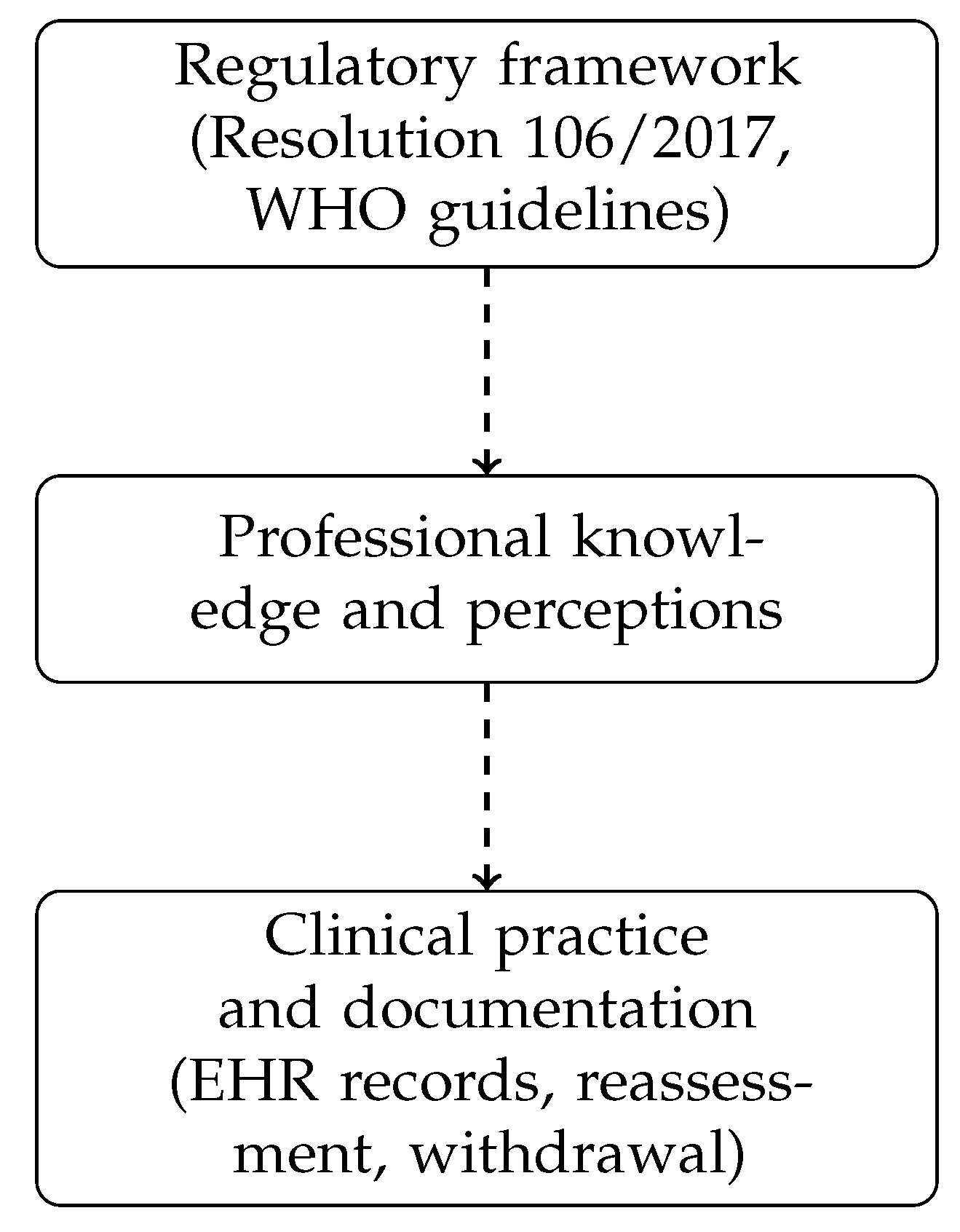
Figure 2.
Multiphase quality improvement strategy for optimizing physical restraint use, documentation, and humanized care in hospital settings.
Figure 2.
Multiphase quality improvement strategy for optimizing physical restraint use, documentation, and humanized care in hospital settings.


Table 1.
Sociodemographic and professional characteristics of participants (n = 241).
| Variable | Category | n | % |
|---|---|---|---|
| Sex | Female | 213 | 88.4 |
| Male | 27 | 11.2 | |
| Non-binary | 1 | 0.4 | |
| Age group (years) | <20 | 3 | 1.2 |
| 20–30 | 44 | 18.3 | |
| 31–40 | 66 | 27.4 | |
| 41–50 | 53 | 22.0 | |
| 51–60 | 55 | 22.8 | |
| >60 | 20 | 8.3 | |
| Professional category | Registered nurse | 147 | 61.0 |
| Nursing assistant (TCAE) | 94 | 39.0 | |
| Years of service | 0–10 | 200 | 83.0 |
| 11–20 | 22 | 9.1 | |
| 21–30 | 11 | 4.6 | |
| >31 | 8 | 3.3 |
Table 2.
Training and perception regarding physical restraint use (n = 241).
| Variable | Response | n | % |
|---|---|---|---|
| Received prior training | Yes | 109 | 45.2 |
| No | 132 | 54.8 | |
| Perceives restraint use as appropriate | Yes | 160 | 66.4 |
| No | 81 | 33.6 | |
| Considers training sufficient | Yes | 66 | 27.4 |
| No | 175 | 72.6 | |
| Needs additional training | Yes | 232 | 96.3 |
| No | 9 | 3.7 | |
| Believes restraint use depends on training | Yes | 175 | 72.6 |
| No | 66 | 27.4 |
Table 3.
Prescription practices and communication with patients and families (n = 241).
| Variable | Response | n | % |
|---|---|---|---|
| Knows restraint indications | Yes | 208 | 86.3 |
| No | 33 | 13.7 | |
| Physician assesses before prescription | Always | 48 | 19.9 |
| Almost always | 65 | 27.0 | |
| Sometimes | 64 | 26.6 | |
| Almost never | 57 | 23.7 | |
| Physician prescribes removal | Always | 42 | 17.4 |
| Almost always | 33 | 13.7 | |
| Sometimes | 51 | 21.2 | |
| Almost never | 73 | 30.3 | |
| Patients/families informed | Always | 48 | 19.9 |
| Almost always | 63 | 26.1 | |
| Sometimes | 73 | 30.3 | |
| Rarely/Never | 53 | 22.0 |
Table 4.
Perceived reassessment frequency of physical restraints (n = 241).
| Reassessment frequency | n | % |
|---|---|---|
| Every 30 minutes | 58 | 24.5 |
| Every 2 hours | 97 | 40.9 |
| Every 4 hours | 31 | 13.1 |
| Every 8 hours | 24 | 10.1 |
| More than 8 hours | 13 | 5.5 |
Table 5.
Knowledge and use of the electronic health record registry for physical restraints (n = 241).
Table 5.
Knowledge and use of the electronic health record registry for physical restraints (n = 241).
| Variable | Response | n | % |
|---|---|---|---|
| Aware of registry existence | Yes | 129 | 53.5 |
| No | 112 | 46.5 | |
| Completes registry when applied | Always | 40 | 31.0 |
| Sometimes | 36 | 27.9 | |
| No | 43 | 33.3 | |
| Documents restraint removal | Always | 25 | 32.9 |
| Sometimes | 37 | 48.7 | |
| No | 13 | 17.1 | |
| Needs improved registry | Yes | 119 | 49.4 |
| No | 122 | 50.6 |
Table 6.
Use of institutional training resources related to physical restraints (n = 241).
| Training resource | n | % |
|---|---|---|
| Training module on restraint use | 26 | 10.8 |
| Training module on restraint prevention | 22 | 9.1 |
| Training module on legal framework | 18 | 7.5 |
Disclaimer/Publisher’s Note: The statements, opinions and data contained in all publications are solely those of the individual author(s) and contributor(s) and not of MDPI and/or the editor(s). MDPI and/or the editor(s) disclaim responsibility for any injury to people or property resulting from any ideas, methods, instructions or products referred to in the content. |
© 2026 by the authors. Licensee MDPI, Basel, Switzerland. This article is an open access article distributed under the terms and conditions of the Creative Commons Attribution (CC BY) license (http://creativecommons.org/licenses/by/4.0/).
Copyright: This open access article is published under a Creative Commons CC BY 4.0 license, which permit the free download, distribution, and reuse, provided that the author and preprint are cited in any reuse.