
Submitted:
28 January 2026
Posted:
29 January 2026
You are already at the latest version
Abstract
Perfumery is often described as an art, yet it rests on well-defined technological foundations involving extraction chemistry, carrier systems, and sensory performance. In such domains, nomenclature is not merely descriptive; it structures scientific classification, market organisation, and cultural memory. In contemporary India, the term “attar/ittar” has undergone pronounced semantic degradation. Once associated with a specific natural, oil-based fragrance technology, it is now applied indiscriminately to chemically and technologically incompatible products. This loss of predictive meaning has weakened consumer trust, obscured artisanal legitimacy, and compromised scholarly and regulatory clarity. This paper reconstructs the historical trajectory of fragrance-oil technology to explain how this degradation occurred. Drawing on archaeology, history of science, and perfumery chemistry, it traces early Indian aromatic practices, subsequent scholarly refinement in Persia and the Arab world, westward transmission to Europe through medieval translation networks, and the later divergence that produced alcohol-based perfumery as a parallel technological architecture rather than a linear evolution. It further shows that the term “attar” re-entered India during the Persianate and Mughal period as a prestigious lexical label rather than as a marker of technological origin, and that colonial disruption subsequently severed the term from institutional standards, accelerating semantic collapse within India. Against this background, the paper argues that terminological renewal is necessary in the Indian context. It proposes JWALE as a contemporary category name to denote natural Indian fragrance oils produced through traditional vapour-mediated technologies, ideally exemplified by the deg–bhapka hydro-distillation system. Derived from the Indic root jval (“to glow”), the term encodes the defining behavioural characteristics of such fragrances: gradual release, skin-proximal presence, and persistence. By restoring semantic precision, the proposal seeks to support scientific clarity, truthful market signalling, artisanal protection, and future standard-setting, without contesting the legitimacy of oil-based perfumery traditions in other cultural contexts.
Keywords:
Attar
; JWALE
; fragrance-oil technology
; semantic degradation
; deg–bhapka
; Indian perfumery
; nomenclature renewal
; oil-based perfumery
; hydro-distillation
; cultural terminology
Section 1. Rationale and Scope: Why Naming Matters in Perfumery Science, Markets, and Cultural Technology
Perfumery is often described as an art, yet it is sustained by a rigorous substrate of applied chemistry, extraction engineering, materials science, and sensory psychophysics [1,2]. The observable behaviour of a fragrance—its diffusion, persistence, temporal evolution, and interaction with skin—is determined by extraction method, carrier medium, volatility distribution, and formulation architecture [3]. In such a domain, nomenclature is not ornamental. It performs an operational role, shaping scientific classification, manufacturing standards, quality control regimes, market segmentation, and consumer expectation [4,5].
A category name acquires scientific value only insofar as it predicts the nature of the object it denotes. In perfumery, a technically meaningful term should reliably signal at least one of the following attributes: (i) extraction method (for example, distillation, solvent extraction, or enfleurage); (ii) carrier system (lipid, alcohol, aqueous, or polymeric); (iii) dominant compositional class (such as low-molecular-weight volatiles versus heavier oxygenated or resinous fractions); or (iv) performance architecture (projection-oriented versus skin-proximal diffusion) [3]. When a label fails to indicate any of these properties, it ceases to function as a descriptor and becomes a marketing placeholder. Such semantic failure is not merely academic; it produces measurable downstream effects on product quality, consumer trust, and market structure [6,7].
Key technical and cultural terms used throughout this paper are defined in Table 1 for the reader’s convenience.
The contemporary Indian usage of the term “attar/ittar” exemplifies this problem. Within current Indian markets, “attar” may denote a traditional hydro-distilled floral oil produced via deg–bhapka technology; a compounded oil containing a limited proportion of natural extracts; a predominantly synthetic fragrance diluted in a neutral carrier; or, more loosely, any non-spray fragrance format. These products differ fundamentally in chemical composition, extraction logic, and sensory behaviour, yet are subsumed under a single name [7]. As a result, the term has become a low-precision umbrella within India—unsuitable for scientific classification, unreliable for consumer education, and vulnerable to commercial degradation.
These variants of “attar” in contemporary Indian markets are summarized in Table 2, illustrating the semantic overextension and loss of predictive value of the term.
This paper argues that the Indian fragrance-oil category requires terminological repair. The objective is not to deny or diminish the legitimacy of the Arabic term ʿiṭr (commonly rendered as attar). On the contrary, in Arabic and Middle-Eastern contexts, oil-based perfumery remains a coherent, culturally respected, and commercially robust category, supported by continuity of practice and consumer literacy.
The semantic problem addressed here is context-specific: in India—despite being among the earliest centres of fragrance-oil technology—the term “attar” has undergone fragmentation and dilution, accumulating social and commercial baggage that now impedes engagement, particularly among younger consumers.
A second and equally important rationale is historical. Scientific credit and cultural memory are mediated through language. When a later or borrowed term becomes the default label for a significantly older indigenous technology, misattribution occurs—not necessarily through intent, but through cognitive anchoring. The technology becomes mentally associated with the linguistic corridor through which it is most visibly named rather than with its earlier technical origins.
This paper therefore distinguishes three intertwined but analytically separate trajectories: the indigenous development of fragrance-oil technologies in the Indian subcontinent; the westward transmission and scholarly refinement of aromatic science through Persia and the Arab world; and the later European emergence of alcohol-based perfumery as a parallel technological system. Accurate recognition of each trajectory is essential to avoid both erasure and over-correction.
The scope of this Perspective is fourfold. First, it reconstructs a long-term timeline—from Harappan-period material practices through classical Sanskritic systems, Indo-Persian transmission, Arabic documentation, and European divergence—to establish Indian fragrance oils as a continuous chemical tradition rather than a peripheral craft. Second, it presents a technical comparison between oil-based and alcohol-based carrier systems to demonstrate that fragrance oils represent a distinct performance architecture, not an inferior precursor. Third, it analyses why the term “attar” has retained coherence and prestige in many Middle-Eastern markets while becoming semantically unstable in India, with particular attention to colonial disruption and subsequent market informalisation. Fourth, it proposes a pathway for terminological renewal in the Indian context, including criteria for scientific and commercial clarity and the introduction of a contemporary Indian term—JWALE, derived from the Indic root jval (to glow)—to denote traditional fragrance oils without sectarian or degraded associations.
The argument advanced here is therefore not merely linguistic. It is scientific, historical, and policy-relevant. Stable nomenclature enables standard-setting, protects artisanal legitimacy, supports truthful marketing, and allows future research—chemical, sensory, historical, and economic—to proceed without ambiguity. In the absence of terminological clarity, India’s fragrance-oil heritage remains exposed to continued dilution: technologically undervalued, commercially distorted, and socially misunderstood.
Section 2. Indian Origins of Fragrance-Oil Technology: From Harappan Foundations to Classical Systems
The origins of fragrance-oil technology in the Indian subcontinent substantially predate the emergence of formalised perfumery vocabularies in West Asia or Europe. Archaeological, material-cultural, and comparative technological evidence indicates that by the mid-third millennium BCE, communities of the Indus (Harappan) civilisation possessed the core technical competencies required for controlled aromatic processing [8,9]. These competencies—thermal regulation, vessel standardisation, sealing technologies, and liquid–vapour manipulation—constitute the essential substrate of early fragrance extraction, even in the absence of surviving textual manuals [8,9].
The historical trajectory of fragrance-oil technology, from its early foundations to later disruptions, is summarized in Table 3.
Excavations across major Harappan sites reveal a high degree of precision in ceramic manufacture, metallurgy, bead production, dyeing, and thermal processing. Such activities are not peripheral to fragrance technology; they are prerequisite skills. The controlled liberation and capture of aromatic vapours demands vessels capable of withstanding sustained heating, narrow apertures for vapour channelling, and sealants to manage pressure and prevent loss. The Harappan material record demonstrates these capabilities clearly, indicating an advanced empirical understanding of heat, phase behaviour, and containment [8,9].
Direct chemical identification of fragrance residues from Harappan contexts remains limited, primarily due to preservation constraints and the organic volatility of aromatic compounds. This limitation must be stated explicitly. However, absence of residue is not evidence of absence of practice. Botanical remains, trade artefacts, and comparative Bronze Age exchange networks strongly suggest familiarity with aromatic woods, resins, and floral materials. Archaeobotanical studies indicate the circulation of scent-bearing plant products within and beyond the subcontinent, linking the Indus region to contemporaneous networks extending into Mesopotamia and the Iranian plateau [10].
Crucially, Harappan technological culture was not episodic or ritual-only. It was integrated and reproducible. Standardised weights, urban planning, water management systems, and craft specialisation all point to a civilisation grounded in process optimisation rather than ad hoc experimentation. Fragrance preparation, within such a context, is best understood as an applied material practice embedded in daily, medical, and ritual life rather than as a symbolic luxury alone [11].
Continuity between Harappan material culture and later Indian knowledge systems further strengthens this interpretation. While the Indus script remains undeciphered, early Vedic and post-Vedic literature displays an unambiguous familiarity with aromatic substances, perfumed materials, and scent-based offerings. References to fragrant plants, scented smoke, anointing oils, and aromatic preparations occur repeatedly in ritual, medicinal, and social contexts. These references presuppose material familiarity, not novelty [12,13,14].
By the early first millennium BCE, Indian medical and pharmacological traditions—later systematised in Ayurvedic literature—demonstrate explicit conceptualisation of extraction processes. Terms such as arka (distillate), taila (oil-based carrier), and rasa (extractive essence) indicate that aromatic processing had progressed from empirical practice to articulated methodology. The emergence of such terminology implies a prolonged period of experimentation, refinement, and intergenerational transmission extending well before textual codification [12,13,14,15,16].
Importantly, these developments occurred independently of Arabic or Persian perfumery nomenclature. The civilisation that practised aromatic extraction in the Indian subcontinent did so without recourse to the later term ʿiṭr. This chronological fact has analytical consequences. It establishes that oil-based fragrance technology in India is not derivative of West Asian perfumery traditions, even though it later influenced and was refined by them. Linguistic borrowing occurred after technological maturation, not before it [13].
From a history-of-science perspective, the correct inference is one of continuity rather than conjecture. The Indian subcontinent represents one of the earliest sustained centres of fragrance-oil technology, grounded in empirical chemical practice long before formalised distillation treatises appeared elsewhere. While later cultures contributed significantly to documentation, standardisation, and lexical consolidation, the foundational material intelligence originated earlier and independently [8,9,15,16,17,18].
This temporal depth is central to the argument of the present paper. When a technology precedes the terminology most commonly used to describe it by several millennia, linguistic dominance cannot be equated with technological origin. Recognising this distinction is essential not for civilisational comparison, but for terminological accuracy. The name may travel across cultures; the technology remains anchored in its original material context [13].
Section 3. Indigenous Indian Fragrance Science Before Arabic Terminology: Concepts, Methods, and Lexical Precision
A defining feature of mature scientific traditions is the development of internal vocabularies that distinguish between processes, materials, and outcomes [13,14]. In the Indian subcontinent, fragrance and aromatic preparation were never treated as a single undifferentiated activity. Long before the emergence of Arabic perfumery terminology, Indian medical, ritual, and artisanal traditions articulated fragrance science through a set of conceptually precise terms that encoded method, medium, and sensory effect [13,14,15,16].
Classical Indian sources do not present fragrance merely as an aesthetic accessory. Instead, aromatic substances are situated at the intersection of medicine, ritual practice, environmental conditioning, and personal adornment. This integration necessitated technical differentiation. As a result, Indian traditions developed a layered aromatic lexicon rather than a single umbrella term. This lexical granularity reflects scientific awareness, not linguistic excess [13,14].
One of the most technically significant terms is arka, commonly translated as “distillate.” In Ayurvedic and allied literature, arka denotes a preparation obtained through controlled heating and condensation, yielding a volatile fraction enriched in active principles. The conceptual clarity of arka is notable: it identifies a specific extraction pathway rather than a general product category [13,14].
Complementing arka is taila, the term for lipid-based carriers, most often derived from sesame or other stable plant oils. In Indian pharmacological texts, taila is treated as a functional medium rather than an inert base. Its capacity to dissolve, stabilise, and deliver aromatic and therapeutic compounds is explicitly recognised [13,14].
The term rasa occupies a more abstract but equally important position. While often translated as “essence” or “sap,” rasa refers to the extractive principle—the component responsible for potency, activity, or sensory impact. In aromatic contexts, rasa denotes what is transferred from plant material into a preparation, regardless of method [12,13,14].
Finally, gandha refers to fragrance as a sensory property. In Vedic, Puranic, and Ayurvedic sources, gandha is not treated as an incidental attribute but as a manipulable outcome. Fragrance can be enhanced, softened, stabilised, combined, or attenuated through technique. This understanding culminates in references to Gandhayukti—a codified body of knowledge concerned with fragrance formulation, blending, maturation, and application [13,14,15,16].
Taken together, arka, taila, rasa, and gandha constitute a coherent aromatic ontology. They differentiate process (arka), medium (taila), active principle (rasa), and sensory outcome (gandha) [13,14]. This structure is scientifically significant. It demonstrates that Indian fragrance science prioritised methodological clarity over categorical compression. The absence of a single overarching term equivalent to “attar” was not a limitation; it was a reflection of technical specificity [13,14].
The later emergence of the Arabic term ʿiṭr represents a different lexical strategy: consolidation rather than differentiation. Within the Arabic and Persian scholarly traditions, ʿiṭr successfully unified diverse aromatic preparations under a respected category, facilitating documentation, trade, and standardisation [10]. This consolidation proved effective within its cultural and institutional context. However, when the term later entered India, it overlaid an existing, more granular system without fully replacing its conceptual distinctions [11].
Over time, particularly under colonial and post-colonial market pressures, this overlay contributed to semantic flattening. Indigenous terms receded from common usage, while the imported umbrella term gradually absorbed heterogeneous products. The result was not linguistic enrichment but loss of resolution. Where earlier vocabulary encoded process and medium, the newer usage increasingly encoded only form or appearance [19].
This historical trajectory has direct relevance to the present argument. The erosion of indigenous aromatic terminology did not occur because it was scientifically inadequate, but because it was displaced by a lexicon optimised for different institutional conditions. Reintroducing clarity therefore does not require wholesale revival of classical Sanskrit terminology, which would be impractical and exclusionary. It does, however, require recognition that India once possessed a fragrance vocabulary aligned with scientific reasoning [13,14].
The proposal of a contemporary Indian term later in this paper must be understood in this light. It is not an attempt to resurrect archaic language, nor to contest the legitimacy of Arabic perfumery terminology in its own context. Rather, it is an effort to restore functional correspondence between language and technology within India’s contemporary fragrance ecosystem—drawing inspiration from indigenous conceptual principles while speaking in a modern, inclusive register.
Section 4. Gandhayukti as an Indigenous Applied Discipline: Formulation Logic, Contextual Use, and Encyclopaedic Recognition
The recognition of Gandhayukti as an applied discipline rests not on the survival of a single canonical manual, but on convergent evidence that fragrance formulation in pre-modern India operated through systematic, context-aware reasoning [15]. Unlike earlier sections, which establish the conceptual vocabulary of Indian fragrance science, this section focuses on how that knowledge functioned in practice—as a reproducible, socially embedded, and non-ritual-specific body of applied expertise [15].
A defining feature of Gandhayukti is its emphasis on formulation over isolation. Classical Indian fragrance practices did not prioritise the extraction of singular aromatic entities but rather the construction of balanced, purpose-specific compositions. Fragrance was understood to be modulated through proportion, sequence, carrier choice, maturation, and situational appropriateness [15]. Such considerations reflect an implicit grasp of volatility management, solubility, and temporal evolution of scent—principles that align closely with modern perfumery science, albeit articulated through experiential rather than molecular frameworks [1].
Crucially, Gandhayukti was not confined to medical pharmaceutics. While Ayurvedic texts preserve the most explicit discussions of extraction and carrier logic, fragrance formulation also appears in non-medical, encyclopaedic literature. This broader textual presence is essential for establishing Gandhayukti as a mainstream applied discipline rather than a subspecialty of therapeutics [16].
A key source in this regard is the Bṛhat Saṃhitā of Varāhamihira (6th century CE). As an encyclopaedic work addressing architecture, meteorology, horticulture, gemmology, cosmetics, and daily life, the Bṛhat Saṃhitā reflects applied scientific reasoning intended for practical governance and cultured society, not ritual prescription [15]. Its inclusion of perfumes, scented unguents, and cosmetic formulations demonstrates that fragrance knowledge had achieved sufficient cultural and technical legitimacy to be incorporated into general scientific discourse [15].
Varāhamihira’s treatment of perfumes is notable not for procedural detail but for formulation logic. Aromatic substances are discussed in terms of combinations, contextual suitability, and sensory effect, rather than as isolated curiosities. This mode of presentation presupposes an audience already familiar with the underlying techniques [15].
This matters analytically. Encyclopaedic inclusion signals disciplinary normalisation. Knowledge that appears in such compendia has typically passed through stages of empirical consolidation and social validation. The presence of fragrance formulation in the Bṛhat Saṃhitā therefore corroborates the argument that Gandhayukti functioned as a recognised applied discipline—one that extended beyond temple or clinic into courtly, domestic, and civic life [15,16].
The methodological character of Gandhayukti is further reinforced by its implicit concern with situational variables: seasonality, climate, bodily condition, and purpose of use. These variables demand adaptive formulation rather than static recipes. Such adaptive reasoning is a hallmark of applied science traditions, distinguishing them from purely artisanal or symbolic practices [15].
It is important to state the limits of the evidence clearly. The Bṛhat Saṃhitā does not provide laboratory-style protocols, nor does it articulate distillation theory in abstract terms. However, neither omission undermines its relevance. Many pre-modern applied sciences relied on apprenticeship, embodied skill, and contextual judgment rather than exhaustive textual codification. The absence of explicit protocols reflects modes of knowledge transmission, not absence of systematic practice [15].
Colonial historiography, with its preference for explicit manuals and theoretical exposition, contributed to the downgrading of such traditions into the category of “craft” [19]. Reassessing Gandhayukti through sources like the Bṛhat Saṃhitā allows for a more accurate classification: fragrance formulation in India operated as a rational, adaptive, and socially embedded applied discipline long before the consolidation of later perfumery lexicons [15,16].
This recognition has direct implications for contemporary terminology. If Indian fragrance science historically functioned through method- and context-aware reasoning across multiple domains of life, then modern nomenclature should seek to restore that functional clarity rather than rely on degraded umbrella terms. The proposal advanced later in this paper builds on this insight, aiming to align language once again with technological behaviour and disciplinary identity.
Section 5. Deg–Bhapka Distillation as Indigenous Chemical Technology
Among the most durable material expressions of Indian fragrance science is the deg–bhapka distillation system, a vapour-mediated extraction apparatus that has remained in continuous use for centuries [20,21]. Its persistence is not accidental. The system represents a stable technological solution optimised for oil-based fragrance extraction under climatic, material, and resource conditions specific to the Indian subcontinent [20,21].
At its core, the deg–bhapka system consists of a closed metal vessel (deg) in which aromatic plant material and water are heated, connected via a conduit to a receiving vessel (bhapka) containing a lipid carrier, traditionally sandalwood oil. Vapour generated in the deg passes through the conduit, condenses, and transfers aromatic constituents into the oil phase. The process is repeated across multiple cycles, gradually enriching the carrier while maintaining low thermal stress [20,21].
A schematic representation of the traditional deg–bhapka hydro-distillation apparatus is shown in Figure 1.
From a chemical perspective, this configuration reflects several non-trivial design choices. First, the system operates at atmospheric pressure and moderate temperatures, reducing thermal degradation of delicate aromatic compounds [21]. Second, the use of a lipid receiver exploits the preferential solubility of many fragrance molecules in non-polar media, effectively coupling distillation with in situ solvent capture. Third, repeated cycling allows cumulative enrichment without requiring complete re-extraction or high-energy inputs [21].
The deg–bhapka system is therefore not a crude antecedent of later laboratory distillation, but a purpose-built apparatus aligned with specific formulation goals. Unlike alcohol-based perfumery, which relies on volatility and evaporation for projection, oil-based fragrance extraction prioritises retention, stability, and skin affinity [20]. The apparatus is tuned accordingly. Vapour transfer is controlled, condensation is gradual, and the final product is designed for proximity rather than diffusion [21].
It is also significant that the deg–bhapka system integrates extraction and formulation within a single workflow. In modern industrial settings, these steps are often separated: essential oils are first isolated, then later diluted or blended. In contrast, the Indian system treats the carrier oil as an active participant from the outset [20].
Material choice further underscores empirical optimisation. Copper and copper alloys, commonly used for deg construction, offer high thermal conductivity and antimicrobial properties, while earthen or metal bhapkas provide stable cooling environments [20]. Sealants made from natural materials ensure pressure containment without introducing extraneous odours. These features indicate iterative refinement informed by practice rather than by abstract theory [20,21].
The longevity of the deg–bhapka system also reflects its adaptability. While the basic architecture remains stable, practitioners adjust variables such as plant-to-water ratio, heating intensity, cycle duration, and carrier replenishment according to material type and desired outcome [20]. Floral materials, resins, and woods require different handling, and the system accommodates such variation without structural modification. This flexibility is a hallmark of robust applied technology [20,21].
Importantly, the absence of formal theoretical exposition does not imply absence of chemical reasoning. The deg–bhapka system embodies tacit knowledge of phase change, selective transfer, solubility, and thermal control. These principles are encoded in practice rather than articulated in equations [20,21]. As with many pre-modern technologies, understanding resided in method rather than manuscript.
Later Arabic and Persian scholars would document and extend distillation theory, contributing decisively to the global history of chemistry [18,21]. However, the Indian deg–bhapka system demonstrates that vapour-mediated extraction was already operationally mature prior to such textual consolidation. The difference lies in documentation and dissemination, not in the existence of chemical technique itself [20].
Recognising deg–bhapka distillation as indigenous chemical technology has direct implications for contemporary classification. It reinforces the argument that oil-based fragrance preparation in India evolved as a coherent technological pathway, distinct from later alcohol-based perfumery. Any nomenclature intended to represent this tradition must therefore align with its integrated extraction–formulation logic rather than reduce it to a generic category label.
Section 6A. Transmission to Europe and the Emergence of Alcohol-Based Perfumery
The westward movement of fragrance science did not terminate within the Persian and Arab intellectual world. From the early medieval period onward, distillation techniques, aromatic substances, and pharmacological knowledge entered Europe through multiple conduits, most prominently via Islamic Spain (Al-Andalus, 8th–12th centuries CE), Sicily, and Mediterranean trade networks [18]. These regions functioned as translational zones in which Arabic scientific texts were rendered into Latin and adapted to European material conditions [18].
European engagement with distillation initially mirrored West Asian practice, focusing on medicinal and alchemical applications [17]. However, a decisive divergence occurred with the widespread availability of high-proof ethanol derived from wine and grain spirits. Unlike earlier aqueous distillates or oil-based systems, ethanol offered a volatile, transparent, and easily standardisable carrier medium. This material shift altered not only extraction efficiency but the entire sensory logic of fragrance.
Alcohol’s rapid evaporation enabled airborne diffusion and spatial projection, aligning well with European social environments—enclosed interiors, layered clothing, and courtly display [7]. Over time, perfumery in Europe became increasingly oriented toward immediate olfactory impact rather than skin-proximal persistence. Distillation technology was therefore repurposed: not to enrich oils cumulatively, but to isolate aromatic compounds for dilution in alcohol.
By the late medieval and early modern periods, this alcohol-centric paradigm had stabilised into a distinct technological architecture. Crucially, it did not replace oil-based perfumery globally; it developed alongside it, shaped by local resources, climate, and social norms. The European trajectory thus represents divergence, not culmination. Understanding this divergence is essential to avoid retroactively positioning alcohol-based perfumery as the inevitable endpoint of fragrance history [22].
This European evolution also had downstream effects on global valuation. As European colonial power expanded, alcohol-based perfumes came to be framed as modern, scientific, and aspirational, while oil-based systems were increasingly marginalised within colonial knowledge hierarchies [19]. These value judgements would later influence both market structures and consumer perceptions in colonised regions, including India [19].
Section 6B. Persianate and Mughal Re-entry of “Attar” into India
A critical but often overlooked episode in the Indian fragrance narrative is the re-entry of the term “attar” into the subcontinent during the Persianate and Mughal period [11]. While oil-based fragrance technology in India long predates Arabic terminology, the word attar did not remain continuously dominant in Indian usage. Its later prestige in India is historically linked to Persianate court culture rather than to ancient indigenous practice [11].
From the early medieval period onward, Persian functioned as a language of administration, literature, and elite culture across much of North India. With the establishment of the Mughal Empire, Persianate aesthetics—encompassing architecture, poetry, dress, cuisine, and scent—became deeply embedded in courtly life [11]. Within this cultural milieu, attar entered India not as a novel technology, but as a prestigious lexical label associated with refinement, luxury, and imperial taste [11].
This distinction is analytically important. The Mughal court did not introduce oil-based perfumery to India; it re-lexicalised an existing technological tradition. Indigenous distillation practices, aromatic materials, and formulation knowledge were already well established [13]. What changed was the name under which elite fragrance oils circulated, particularly in courtly, diplomatic, and urban contexts [11].
The Persianate association of attar conferred social capital. Over time, this prestige facilitated the gradual displacement of older, more granular indigenous vocabularies in everyday usage, especially among urban elites and artisanal centres supplying court demand [11]. The term thus gained dominance in India not because it offered superior technical clarity, but because it was embedded in structures of power and patronage [11].
This historical re-entry helps explain the later paradox addressed in this paper. A word that arrived with imperial prestige but without institutional standardisation eventually became vulnerable to semantic dilution once the supporting courtly ecosystem collapsed. Under colonial rule, Mughal patronage systems disintegrated, while the term attar remained in circulation—now detached from both indigenous classificatory logic and Persianate regulatory coherence [19].
Understanding attar as a Mughal-period re-import rather than an uninterrupted indigenous label resolves several historiographic tensions. It clarifies why India possesses one of the world’s oldest fragrance-oil technologies yet relies on a later, externally consolidated term to describe it. It also reinforces the central argument of this paper: that terminological dominance does not necessarily reflect technological origin or continuity [19].
Section 7. Oil-Based and Alcohol-Based Perfumery: Two Parallel Technological Architectures
Modern perfumery discourse often frames alcohol-based fragrances as the technological culmination of earlier oil-based traditions. This linear narrative is misleading. Oil-based and alcohol-based perfumery represent parallel technological architectures, each optimised for distinct chemical behaviours, sensory objectives, and cultural contexts. Treating one as a primitive precursor of the other obscures their fundamental differences in formulation logic and performance design [2].
From a materials perspective, the most consequential distinction lies in the carrier medium. Alcohol-based perfumery relies on ethanol as a volatile solvent that facilitates rapid evaporation and airborne diffusion of aromatic molecules. Projection, sillage, and spatial presence are therefore intrinsic design goals [1,2]. By contrast, oil-based perfumery employs lipid carriers that strongly retain aromatic compounds, releasing them gradually through skin contact and thermal exchange. The objective is not environmental saturation but skin-proximal persistence [1,2].
These divergent carrier properties produce markedly different sensory architectures. Alcohol-based fragrances are typically structured around a pronounced top-note impact, followed by sequential evaporation of mid- and base-note components. This volatility-driven choreography is well suited to temperate climates, indoor social settings, and visual–olfactory performance. Oil-based fragrances, by contrast, suppress sharp top-note volatility and favour continuity. Scent unfolds slowly, often with minimal initial impact, revealing depth through duration rather than projection [2].
The key differences between oil-based and alcohol-based perfumery are summarized in Table 4, highlighting their parallel technological architectures.
Chemical stability further differentiates the systems. Ethanol accelerates oxidation and hydrolysis of certain fragrance compounds, necessitating stabilisers and antioxidants in formulation. Lipid carriers, while not inert, often provide a more protective environment for delicate aromatics, particularly when exposure to light and air is limited. This contributes to the long shelf life and ageing tolerance historically associated with fragrance oils [3].
Application method is another structural distinction. Alcohol-based fragrances are engineered for spray dispersion, maximising surface area and evaporation. Oil-based fragrances are applied by contact, concentrating scent at specific anatomical sites. This difference is not merely cultural; it reflects assumptions about how fragrance is meant to be perceived—either as an ambient signal or as an intimate attribute. Misapplication of oil-based fragrances using alcohol-based heuristics is a major source of consumer dissatisfaction and misjudgement [1,2].
Climatic compatibility also plays a role. In hot or arid environments, rapid evaporation of alcohol can lead to fleeting performance and olfactory fatigue. Oil-based systems, with their slower release kinetics, often perform more consistently under such conditions [7]. This environmental suitability helps explain the enduring prominence of fragrance oils in West Asia, South Asia, and parts of Africa, independent of European perfumery trends [4,7].
Importantly, neither system is chemically or aesthetically superior in absolute terms. Each represents a coherent solution to different constraints and preferences. Alcohol-based perfumery excels in projection-oriented contexts, mass production, and rapid stylistic turnover. Oil-based perfumery excels in longevity, intimacy, and cumulative presence. Problems arise only when one system is evaluated using the criteria of the other [2].
In the Indian context, oil-based perfumery has frequently been mischaracterised as inferior or outdated precisely because it is judged through alcohol-centric performance metrics. Longevity is conflated with weakness, intimacy with lack of sophistication. Such misinterpretations are not intrinsic to the technology but arise from categorical confusion and colonial value hierarchies [19,22].
Recognising oil-based perfumery as a distinct technological pathway also clarifies historical trajectories. The European adoption of alcohol as a dominant carrier did not replace earlier oil-based systems globally; it created an alternative paradigm shaped by different materials, climates, and social practices. Both systems continue to coexist, serving different functions within the global fragrance ecosystem [2,7].
For the purposes of this paper, the significance of this comparison is terminological. A category name that fails to encode carrier architecture invites misuse, misunderstanding, and devaluation. Any contemporary nomenclature intended to represent Indian fragrance oils must therefore signal their oil-based, skin-proximal, persistence-oriented design, rather than allowing them to be judged against inappropriate alcohol-based expectations [22].
Section 8. Colonial Disruption and the Semantic Collapse of “Attar” in India
The semantic instability of the term “attar” in contemporary India cannot be explained by technological inadequacy or cultural decline alone. It is more accurately understood as the outcome of structural disruption during the colonial period, followed by post-colonial market fragmentation [19]. Colonial political economy altered production, regulation, and consumption patterns in ways that selectively favoured alcohol-based perfumery while marginalising indigenous oil-based systems [19].
European colonial administration introduced new regulatory frameworks for trade, taxation, and industrial manufacture that privileged standardised, export-oriented goods. Alcohol-based perfumes—compatible with industrial bottling, rapid turnover, and long-distance shipping—fit neatly into these frameworks. Oil-based fragrances, by contrast, were locally embedded, labour-intensive, and resistant to mass standardisation. As a result, they were progressively excluded from formal commercial recognition, relegated to informal markets and artisanal niches [19].
This institutional asymmetry had linguistic consequences. In colonial discourse, the term “perfume” increasingly became synonymous with alcohol-based products, while oil-based fragrances were described through loosely translated or residual categories. The word “attar,” which had entered Indian usage through earlier Indo-Persian exchange, survived primarily in informal contexts. Deprived of regulatory definition and quality benchmarks, it became a catch-all label rather than a technical descriptor [19].
Market fragmentation accelerated this process. As industrial fragrance chemistry expanded in the twentieth century, synthetic aromatic compounds became widely available and inexpensive. In the absence of enforceable standards, these materials were incorporated into oil-based products marketed as “attar,” often without disclosure of composition or method. Over time, the term ceased to predict extraction technique, carrier medium, or sensory behaviour. What remained was a name detached from technological specificity [22].
Social stratification further compounded the problem. Colonial cultural hierarchies associated modernity with European forms of consumption, including alcohol-based perfumes. Indigenous practices were increasingly framed as traditional, local, or backward. These value judgements did not require explicit prohibition; they operated through aspiration and imitation. Oil-based fragrances, once integrated into elite and courtly life, were gradually repositioned as markers of regionalism or religiosity rather than of sophistication [19].
Post-colonial India inherited these distortions. While political sovereignty was restored, market structures and consumer imaginaries remained uneven. Alcohol-based perfumery continued to dominate formal retail, advertising, and aspirational branding. Oil-based fragrances persisted largely through informal networks, family businesses, and niche communities. In this environment, “attar” functioned less as a category of technology than as a residual term—simultaneously overinclusive and undervalued [19].
Importantly, this semantic collapse is context-specific. In West Asian markets, oil-based perfumery retained institutional support, consumer literacy, and cultural prestige. The same term, ʿiṭr, continued to operate with relative coherence because the surrounding ecosystem preserved its meaning [10]. In India, by contrast, the erosion of standards and the absence of formal recognition allowed the term to fragment [19].
The consequences are measurable. Consumers encounter wide variability in quality and performance under a single label, eroding trust. Artisanal producers struggle to distinguish genuine oil-based work from compounded or diluted products. Educational discourse lacks a stable vocabulary to describe fragrance oils as a technological class. Together, these effects reinforce a cycle of devaluation [22].
The problem, therefore, is not that the term “attar” is historically illegitimate or culturally foreign. It is that, within India’s post-colonial market structure, it no longer functions as a reliable signifier. Once a term loses predictive value, attempts at rehabilitation through marketing or nostalgia are unlikely to succeed. Structural problems require structural solutions.
This diagnosis sets the stage for the argument advanced in the following sections: that terminological renewal is not an act of rejection but a necessary step toward restoring clarity, dignity, and technological recognition to India’s fragrance-oil tradition.
Section 9. Why “Attar” Retains Coherence and Prestige in Middle-Eastern Contexts
The semantic stability of the term ʿiṭr in many Middle-Eastern contexts provides a useful counterpoint to its fragmentation in India. This contrast demonstrates that the problem diagnosed in the preceding section is not inherent to oil-based perfumery or to the term itself, but to the institutional and cultural ecosystems within which terminology operates [4,18].
In West Asian markets, oil-based perfumery has enjoyed relative continuity of social legitimacy. Fragrance oils have remained embedded in everyday grooming, religious etiquette, courtly traditions, and contemporary luxury consumption. This continuity ensured that ʿiṭr never became a residual or marginal category. Instead, it functioned as a respected and intelligible class of fragrance products, understood by consumers to possess distinct behavioural properties and usage norms [4].
One key factor in this coherence is consumer literacy. In Middle-Eastern contexts, users generally distinguish between oil-based and alcohol-based fragrances intuitively, without requiring formal technical explanation. Application methods, expectations of projection, and evaluation criteria are culturally transmitted. As a result, ʿiṭr is rarely judged by inappropriate alcohol-centric standards. Its value is assessed in terms of longevity, intimacy, and material richness rather than spatial diffusion .
Market structure has reinforced this literacy. Oil-based perfumery in West Asia has not been confined to informal or artisanal margins. It has coexisted with, and often complemented, alcohol-based perfumery across price tiers—from everyday personal use to high-end luxury. This integration has preserved commercial incentives for quality control, standardisation, and brand differentiation within the oil-based category itself [22,23].
Equally important is the absence of a sharp colonial rupture in fragrance consumption patterns. While West Asian societies certainly experienced political and economic disruption, their aromatic cultures were not systematically displaced by European perfumery norms. Alcohol-based perfumes entered these markets as additions rather than replacements. As a result, oil-based traditions retained symbolic and practical prestige, allowing ʿiṭr to evolve without semantic collapse [11,18].
Linguistic discipline has also played a role. Although ʿiṭr functions as an umbrella term, its usage is constrained by shared understanding of what the category implies. Products marketed under the term are expected to conform broadly to oil-based formulation logic, even as stylistic diversity expands. This informal but effective boundary maintenance prevents the term from absorbing chemically or technologically incompatible products [22].
The Middle-Eastern case therefore illustrates a general principle: terminology remains meaningful when it is supported by institutional recognition, consumer education, and market incentives aligned with technological reality. Where these supports are present, a category name can accommodate innovation without losing coherence. Where they are absent, even historically legitimate terms may degrade [22,23].
This comparison has direct implications for the Indian context. The persistence of ʿiṭr as a prestigious and functional category elsewhere demonstrates that oil-based perfumery does not suffer from intrinsic limitations of modern relevance or appeal. It also clarifies why attempts to rehabilitate “attar” in India through branding alone are unlikely to succeed. Without rebuilding the surrounding ecosystem, the term cannot recover predictive value [11,23].
The purpose of highlighting this contrast is not to advocate adoption of Middle-Eastern nomenclature wholesale, nor to suggest cultural borrowing as a remedy. Rather, it underscores the need for context-appropriate solutions. Just as West Asian societies maintained linguistic coherence by sustaining institutional continuity, India must address its own historical disruptions through terminology that aligns with contemporary realities while respecting indigenous technological lineage [22].
Section 10. Why Terminological Renewal Is Necessary in the Indian Context
The preceding sections demonstrate that the semantic instability of “attar” in India is not accidental, nor is it resolvable through incremental clarification or branding. It is the cumulative outcome of historical re-entry, colonial disruption, market fragmentation, and the absence of institutional standard-setting. Under these conditions, terminology ceases to function as a technical descriptor and becomes an unreliable cultural residue [11,22,23].
In scientific and technological domains, nomenclature performs a predictive role. A category name is valuable only insofar as it allows practitioners, regulators, and consumers to infer meaningful properties of the object it denotes. In perfumery, this includes carrier medium, extraction logic, volatility behaviour, and intended sensory architecture. When a term fails to support such inference, it obstructs rather than facilitates understanding [22].
In contemporary India, “attar” no longer reliably predicts any of these properties. Products marketed under the term range from traditional hydro-distilled floral oils to compounded blends containing minimal natural material, and from artisanal preparations to industrial fragrance oils diluted in generic carriers [6,23]. This semantic overextension undermines consumer trust, erodes artisanal differentiation, and renders technical discourse imprecise.
Attempts to rehabilitate the term through regulation or education face structural limitations. Regulation presupposes definitional clarity, which is precisely what is lacking. Educational efforts, meanwhile, are constrained by the absence of a stable reference category against which quality or authenticity can be explained. In the absence of institutional continuity comparable to that seen in West Asian markets, semantic repair becomes increasingly difficult [11,22].
The problem is compounded by sociocultural signalling. In India, “attar” carries layered associations—religious, regional, and historical—that influence consumer perception independently of product quality. While such associations are not inherently problematic, they complicate the task of re-establishing the term as a neutral, technology-centred category suitable for scientific, commercial, and cross-cultural discourse [4,23].
From a policy perspective, terminological ambiguity also inhibits standard-setting. Quality benchmarks, geographical indications, and artisanal protection mechanisms all depend on clear categorical boundaries. Without a term that reliably denotes oil-based, skin-proximal fragrance architecture, such initiatives risk either exclusion or dilution. This has implications not only for heritage preservation but for innovation and export positioning [19,22].
It is therefore analytically appropriate to distinguish between historical legitimacy and functional adequacy. A term may be historically valid yet functionally compromised within a given context. The argument advanced here is not that “attar” should be rejected globally, nor that it lacks cultural dignity. Rather, within India’s contemporary fragrance ecosystem, it no longer performs the work required of a technical category [22].
Terminological renewal, in this sense, is not an act of cultural rupture but of pragmatic clarification. It allows historical traditions to be described accurately without forcing them into categories shaped by different trajectories of transmission and disruption. Such renewal also creates space for future research—chemical, sensory, historical, and economic—to proceed without semantic ambiguity [22,23].
The following section therefore proposes criteria for a contemporary Indian nomenclature capable of representing fragrance oils as a distinct technological class, grounded in indigenous lineage yet oriented toward modern scientific and commercial realities.
Section 11. Criteria for a Contemporary Indian Natural Fragrance-Oil Category
If terminological renewal is to restore clarity rather than introduce further ambiguity, it must be governed by explicit and restrictive criteria. In the Indian context, any contemporary category intended to represent fragrance oils must be grounded in natural materials, traditional extraction logics, and predictable sensory behaviour, rather than in market convenience or historical association alone [1,2,22].
First, the category must be restricted to natural fragrance oils. This requirement is foundational. Products derived primarily from synthetic aroma chemicals, regardless of carrier medium, represent a different chemical and technological paradigm and cannot be accommodated within a category intended to preserve and describe India’s traditional fragrance-oil heritage. The indiscriminate mixing of natural and synthetic materials under a single label is a well-recognised cause of semantic dilution and loss of consumer trust in artisanal and heritage categories [6,21,22].
Second, the category must clearly signal an oil-based carrier architecture. Carrier medium is not an incidental attribute but a determinant of volatility behaviour, diffusion dynamics, chemical stability, and application method. Oil-based systems are characterised by skin-proximal persistence and gradual release, in contrast to alcohol-dominant perfumery, which is structured around rapid evaporation and spatial projection [2,7]. Any term that fails to encode this distinction invites systematic misinterpretation and inappropriate performance evaluation.
Third, while the category should be methodologically anchored, it should not be methodologically exclusive. The deg–bhapka hydro-distillation system represents the most historically continuous and conceptually complete embodiment of Indian fragrance-oil technology and therefore serves as the ideal reference method [20,21]. At the same time, other traditional or natural vapour-mediated extraction techniques may be included, provided they adhere to the same technological principles: natural botanical input, vapour-based transfer of aromatic compounds, oil-based fixation, and maturation consistent with traditional practice [20].
Fourth, the category must be behaviour-predictive rather than narrowly process-descriptive. Given the diversity of legitimate natural extraction approaches, defining the category solely by procedural detail would be both exclusionary and fragile. Predictive value at the level of sensory and performance behaviour—gradual unfolding, intimacy of presence, and temporal persistence—is more robust and transferable than narrow technical definitions, particularly in consumer-facing and regulatory contexts [2,10].
Fifth, the category must be culturally non-sectarian and context-appropriate. A contemporary Indian term must be intelligible and acceptable across communities and generations, without being encumbered by religious, regional, or colonial associations that distort perception. This requirement follows directly from the historical analysis of terminological fragmentation and sociocultural signalling in earlier sections [11,19].
Finally, the category must be compatible with future standard-setting and heritage protection. Clear categorical boundaries are a prerequisite for any discussion of quality benchmarks, authenticity, geographical indications, or artisanal recognition. A term that tolerates chemical or technological ambiguity cannot support such frameworks and risks reproducing the very dilution it seeks to correct [22].
Taken together, these criteria define a high-integrity, natural-only fragrance-oil category, anchored in India’s traditional technologies yet articulated in a form suitable for contemporary scientific, commercial, and policy discourse.
Section 12. Proposal of a New Indian Term (JWALE): Rationale, Semantics, and Scope
In accordance with the criteria outlined in the preceding section, this paper proposes JWALE as a contemporary Indian term to denote natural fragrance oils produced through traditional Indian vapour-mediated technologies, with the deg–bhapka hydro-distillation system serving as the preferred and reference embodiment. The proposal is not intended to overwrite historical usage in other cultural settings, nor to rename past practices retrospectively. Its purpose is specific: to restore semantic precision to a natural technology whose existing nomenclature has become unreliable in the Indian context.
The necessity of a new term arises from demonstrable semantic degradation. In present-day India, the word “attar” is applied indiscriminately to natural distillates, compounded blends, and synthetic fragrance oils diluted into carriers. These products differ fundamentally in chemistry, provenance, and performance, yet circulate under a single label. This collapse of categorical meaning has eroded consumer trust, obscured artisanal distinction, and rendered technical discourse imprecise. A new term is therefore proposed as an act of category repair, not cultural contestation.
The word JWALE is derived from the Indic root jval, meaning “to glow,” “to emit steadily,” or “to burn with controlled radiance.” This derivation is conceptually precise rather than decorative. Traditional Indian fragrance oils do not announce themselves through rapid volatilisation or spatial projection. Instead, they unfold gradually, remain close to the body, and persist over extended periods. The metaphor of a glow captures this behavioural identity with unusual accuracy, emphasising continuity, intimacy, and endurance rather than immediacy.
The semantic logic of the term mirrors the technological logic of its production. Natural fragrance oils produced through deg–bhapka distillation and related traditional methods emerge from controlled heat, vapour transfer, repeated enrichment, and patient maturation. Their sensory behaviour reflects this process history. In this sense, JWALE encodes both how the fragrance is made and how it behaves, without naming specific botanicals or techniques that may vary across regions.
The scope of JWALE is intentionally bounded. It denotes natural fragrance oils only, derived from botanical materials through vapour-mediated or traditional extraction systems and captured in an oil base. While deg–bhapka represents the most complete and historically continuous model, other natural technologies may be included where they adhere to the same conceptual framework of natural input, vapour transfer, oil fixation, and maturation. Products that are predominantly synthetic, alcohol-dominant, or formulated through volatility-driven design are explicitly excluded.
Anchoring the term to natural technologies and a reference method provides a defensible basis for future discourse on authenticity, quality, and standard-setting. It allows artisans, scholars, regulators, and consumers to speak about India’s fragrance-oil tradition with reduced ambiguity and restored confidence, without denying the legitimacy of oil-based perfumery traditions in other cultural contexts.
In this framing, JWALE is proposed not as a replacement for historical terminology elsewhere, but as a context-specific instrument of clarity for India’s natural fragrance-oil heritage.
Section 13. Conclusions: Naming as Scientific Clarity, Cultural Responsibility, and Technological Stewardship
This paper has argued that the current instability surrounding the term “attar” in India is not a failure of tradition, technology, or cultural relevance, but a failure of terminological continuity shaped by historical re-entry, colonial disruption, and post-colonial market fragmentation. India possesses one of the world’s oldest and most sophisticated fragrance-oil technologies, yet lacks a stable contemporary term that reliably denotes this tradition in scientific, commercial, and regulatory discourse. This mismatch has allowed semantic ambiguity to erode artisanal legitimacy, consumer trust, and scholarly precision.
By reconstructing the historical trajectory of fragrance science—from early Indian aromatic practices, through Persian and Arab scholarly consolidation, onward to European divergence and the rise of alcohol-based perfumery—this paper has shown that oil-based and alcohol-based perfumes represent parallel technological architectures, not stages of a single evolutionary sequence. The subsequent colonial privileging of alcohol-based systems, coupled with the collapse of institutional support for oil-based perfumery in India, rendered the term “attar” increasingly overinclusive and functionally unreliable within the Indian context.
The analysis further demonstrated that the prestige and coherence of ʿiṭr in many Middle-Eastern markets is sustained by institutional continuity, consumer literacy, and clear performance expectations. The contrast with India underscores a central insight: terminology remains meaningful only when it is supported by surrounding ecosystems. Where those ecosystems fragment, historical legitimacy alone is insufficient to preserve semantic clarity.
Against this background, the proposal of JWALE is advanced as a pragmatic and context-specific response. The term is not intended to overwrite history or contest cultural lineages elsewhere. Rather, it is offered as a contemporary Indian category name that restores predictive value by denoting natural fragrance oils produced through traditional vapour-mediated technologies, ideally exemplified by the deg–bhapka system. By encoding behavioural identity—gradual release, skin-proximal presence, and persistence—rather than inherited prestige or market convention, the term seeks to realign nomenclature with technological reality.
Crucially, the proposal of JWALE is intentionally bounded. It excludes synthetic fragrance oils, alcohol-dominant formulations, and hybrid systems whose performance logic is incompatible with the natural oil-based architecture described. This restriction is not exclusionary; it is protective. Without clear boundaries, any new term would risk repeating the semantic dilution it seeks to remedy. By anchoring the category to a traceable technological lineage, JWALE provides a defensible basis for future discussion of authenticity, quality, and standard-setting.
The implications of terminological renewal extend beyond language. A stable category name enables more precise scientific research, clearer sensory evaluation, and more effective education. It allows artisans to distinguish genuine work from imitative products without resorting to nostalgia or obscurity. It also opens pathways for policy interventions, including standards, labelling norms, and heritage protection mechanisms, that are currently impeded by definitional ambiguity.
Ultimately, naming is not a cosmetic exercise. In applied sciences and heritage technologies alike, names structure perception, valuation, and survival. When a category name ceases to predict what it denotes, the technology it represents becomes vulnerable to misinterpretation and marginalisation. By proposing JWALE, this paper argues for a form of technological stewardship: a conscious effort to align language with practice so that an ancient yet living tradition can be understood, respected, and sustained in the modern world.
Author Contributions
Conceptualization, Writing – Original Draft, Writing – Review & Editing: [Dr Abdul Ghafur].
Funding
No funding received.
Author Statement
The term JWALE and the associated conceptual framework are original to the author and are proposed solely as part of an academic analysis of terminology, history, and technology in Indian fragrance science.
Ethical Statement
No human or animal studies were conducted; no ethical permission required.
AI Disclosure
AI-assisted tools were used for language polishing, with full author oversight.
Conflicts of Interest
The author is the founder of Fragragenomics Biotech Pvt LTD. The views and analyses presented in this manuscript are academic in nature. The author declares no other conflicts of interest.
References
- Sell CS. The Chemistry of Fragrances: From Perfumer to Consumer. 2nd ed. Cambridge: Royal Society of Chemistry; 2006.
- Ohloff G, Pickenhagen W, Kraft P. Scent and Chemistry: The Molecular World of Odors. Weinheim: Wiley-VCH; 2012.
- Chaintreau A. Simultaneous distillation-extraction: from birth to maturity—review. Flavour Fragr J. 2001;16(2):136-148. [CrossRef]
- McHugh J. Sandalwood and Carrion: Smell in Indian Religion and Culture. New York: Oxford University Press; 2012. [CrossRef]
- Ganguly-Scrase R, Scrase TJ. Globalisation and the Middle Classes in India: The Social and Cultural Impact of Neoliberal Reforms. Abingdon: Routledge; 2008. [CrossRef]
- Naik M. From palaces to pan shops, India’s attar heritage has seen a structural shift. Down To Earth. 2025 Jan 15.
- Gaikwad MT, Chinchane PP, Deshmane SS, Rathi GM. A comprehensive review on perfume. Int J Adv Res Sci Commun Technol. 2024;4(7). [CrossRef]
- Kenoyer JM. Ancient Cities of the Indus Valley Civilization. Oxford: Oxford University Press; 1998.
- Possehl GL. The Indus Civilization: A Contemporary Perspective. Walnut Creek, CA: AltaMira Press; 2002.
- Fuller DQ. Agricultural origins and frontiers in South Asia: a working synthesis. J World Prehist. 2006;20(1):1-86. [CrossRef]
- Arnold D. Science, Technology and Medicine in Colonial India. Cambridge: Cambridge University Press; 2008. [CrossRef]
- Wujastyk D. The Roots of Ayurveda: Selections from Sanskrit Medical Writings. New York: Penguin Classics; 2003.
- Mishra L, Singh BB, Dagenais S. Ayurveda: a historical perspective and principles of the traditional healthcare system in India. Altern Ther Health Med. 2001;7(2):36-42.
- Belge RS, Belge AR. Critical study of Gandhashastra with special reference to Rasashastra and Bhaishajya Kalpana. IOSR J Pharm Biol Sci. 2012;2(3):5-9.
- Sarma KV. Varāhamihira. In: Selin H, editor. Encyclopaedia of the History of Science, Technology, and Medicine in Non-Western Cultures. Dordrecht: Springer; 2008. p. 2184-2185. [CrossRef]
- Boddupalli RS. A Historical Review on the Botanical Facets of Brhat Samhita—Varahamihira’s Magnum Opus. J Hist Art Archaeol. 2024;4(1):61-74. [CrossRef]
- Levey M. Early Arabic pharmacology and the history of distillation. Isis. 1959;50(2):145-160.
- Burnett C. The coherence of the Arabic–Latin translation program in Toledo in the twelfth century. Sci Context. 2001;14(1-2):249-288. [CrossRef]
- Roy T. The economic history of India 1857–1947. Econ Hist Rev. 2011;64(3):745-769.
- Das P, Bajpai N. Indian history of perfume: its evidences and evolution from different era. Int J Creat Res Thoughts. 2021;9(11).
- Shukla SK, Mukherjee A. The Fragrant Legacy: Reviving the Craft of Ittar-making in Kannauj Amidst Modern Challenges. J Herit Manag. 2024;10(1):38-51. [CrossRef]
- Bowker GC, Star SL. Sorting Things Out: Classification and Its Consequences. Cambridge, MA: MIT Press; 1999.
- Scrase TJ. Precarious production: globalisation and artisan labour in the Third World. Third World Q. 2003;24(3):449-461.
Figure 1.
Traditional Deg–Bhapka Hydro-Distillation Apparatus of Kannauj, India (Representative Illustration).
Figure 1.
Traditional Deg–Bhapka Hydro-Distillation Apparatus of Kannauj, India (Representative Illustration).
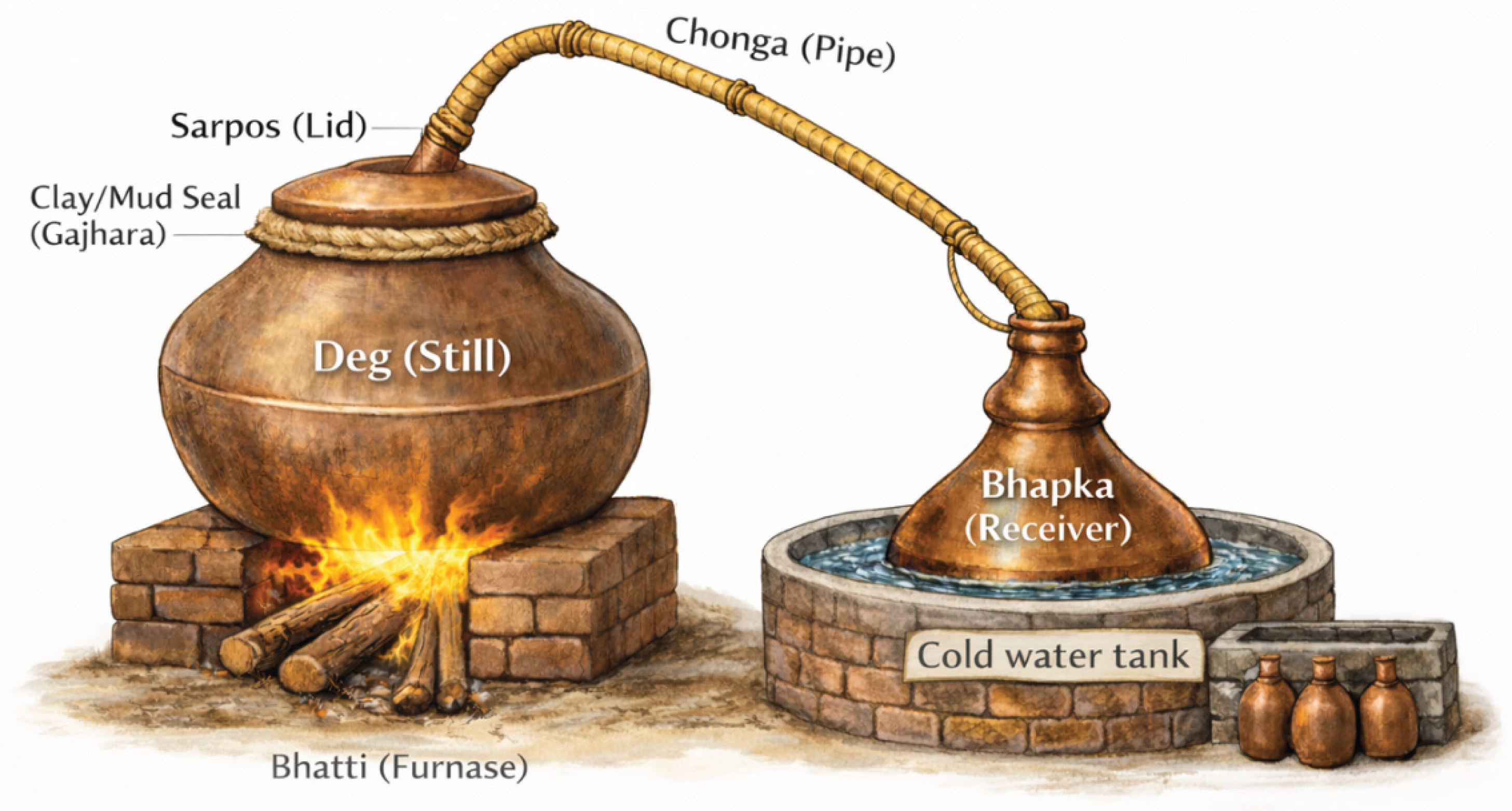

Table 1.
Glossary of Key Terms.
| Term | Definition |
| Attar / ʿiṭr / Ittar | Arabic term for oil-based fragrance extracts, historically prestigious in Middle Eastern and Persianate perfumery; in contemporary India, applied indiscriminately to natural, compounded, synthetic, or undefined fragrance products, leading to semantic degradation. |
| Deg–bhapka | Traditional Indian hydro-distillation apparatus consisting of a deg (copper vessel for heating plant material and water) and bhapka (receiving vessel containing a lipid carrier like sandalwood oil) for extracting fragrance oils via vapour transfer. |
| Gandhayukti | Classical Indian applied discipline of fragrance formulation, blending, maturation, and contextual use, documented in encyclopaedic literature such as the Bṛhat Saṃhitā. |
| Arka | Ayurvedic term for distillate or volatile fraction obtained through controlled heating and condensation, enriched in active aromatic principles. |
| Taila | Lipid-based carrier oil (e.g., sesame or sandalwood) used in Indian fragrance and medicinal preparations to dissolve, stabilise, and deliver aromatic compounds. |
| Rasa | Extractive principle or essence responsible for potency, activity, or sensory impact in aromatic and pharmacological contexts. |
| Gandha | Fragrance as a sensory property; in classical Indian sources, a manipulable outcome that can be enhanced, softened, or stabilised through technique. |
| Jval | Indic root meaning “to glow” or “to emit steadily,” the basis for the proposed term JWALE, encoding gradual release and skin-proximal persistence. |
| JWALE | Proposed contemporary Indian category name for natural fragrance oils produced through traditional vapour-mediated technologies (e.g., deg–bhapka), emphasizing gradual release, skin-proximal presence, and persistence without sectarian or degraded associations. |
| Vapour-mediated technologies | Extraction methods where aromatic compounds are transferred via vapour (e.g., hydro-distillation), typically into an oil base, as opposed to solvent or alcohol-based systems. |
| Semantic degradation | Loss of precise meaning of a term (e.g., “attar”) through indiscriminate use, resulting in ambiguity, reduced consumer trust, and weakened artisanal legitimacy. |
| Skin-proximal persistence | Characteristic of oil-based fragrances where scent unfolds gradually and remains close to the body for extended periods, unlike alcohol-based projection. |
| Projection-oriented | Characteristic of alcohol-based fragrances designed for rapid volatilisation and spatial diffusion (sillage), suited to temperate climates and indoor settings. |
| Sillage | The trail or scent cloud left by a fragrance in the air, a key performance metric in alcohol-based perfumery. |
| Top-note | The initial, most volatile fragrance impression that evaporates quickly, prominent in alcohol-based systems. |
| Partial distillation | Use of traditional hydro-distillation (e.g., deg–bhapka) for only a limited proportion of the natural extracts, with the remainder added through compounding with synthetic or semi-synthetic materials (common in compounded “attar” products). |
Table 2.
Variants of “Attar” in Contemporary Indian Markets.
| Variant in Current Indian Markets | Composition / Ingredients | Extraction Method | Carrier Medium | Sensory Behaviour | Typical Price Range | Authenticity Level |
| Traditional natural oil-based | Pure hydro-distilled floral/resinous extracts | Deg–bhapka hydro-distillation | Lipid (e.g., sandalwood oil) | Gradual release, skin-proximal, long-lasting (8–12+ hours) | High (₹5,000–₹50,000 per 10 ml) | High (artisanal, natural) |
| Compounded oil-based | Limited natural extracts + synthetics/compounds | Compounding + partial distillation | Lipid | Moderate release, variable longevity (4–8 hours) | Medium (₹1,000–₹10,000 per 10 ml) | Medium (partial natural) |
| Synthetic fragrance oil | Predominantly synthetic aroma chemicals | Chemical synthesis | Lipid carriers (e.g., mineral oil, DPG, or vegetable oil) | Rapid volatilisation, short-lived (2–4 hours) | Low (₹200–₹2,000 per 10 ml) | Low (mostly synthetic) |
| Any non-spray fragrance | Mixed or undefined (often synthetic) | Varies | Varies | Unpredictable | Varies | Low (undefined) |
Table 3.
Historical Timeline of Fragrance-Oil Technology.
| Period | Key Development / Term | Region / Culture | Evidence / Source | Significance |
| Mid-3rd millennium BCE | Early vessel standardization, thermal control | Indus Valley (Harappan) | Archaeological evidence [8,9] | Foundational competencies for controlled aromatic processing |
| Early 1st millennium BCE | Conceptualisation of arka, taila, rasa | India (Ayurvedic) | Sanskrit texts [12,13] | Transition from empirical to articulated methodology |
| 6th century CE | Gandhayukti in encyclopaedic literature | India (Varāhamihira) | Bṛhat Saṃhitā [16] | Recognition of fragrance formulation as applied discipline |
| 7th-10th CE | Coining of the word “attar” (from Arabic “itr” meaning perfume) | Arabia/Persia | Historical records (e.g., Ibn Sina) [17] | Emergence of “attar” as term for flower-distilled oils; spread through Islamic scholars |
| 8th-12th CE | Entry of technology to Europe via Al-Andalus (Islamic Spain) | Europe (via Arabia) | Arabic-Latin translations [18] | Transmission of distillation and aromatic science to Europe; basis for later divergence |
| 14th CE | Development of parallel alcohol-based perfumery | Europe (Hungary/France) | Historical records (e.g., Hungary Water in 1370) [3] | Invention of alcohol-based perfumes; divergence from oil-based systems |
| 13th-16th CE | Re-entry of “attar” name as prestigious label | Persianate/Mughal India | Historical records [20,21] | Prestige overlay on existing Indian technology; lexical shift under court influence |
| Colonial period (18th–20th CE) | Disruption of standards, rise of alcohol-based | India & Europe | Colonial records [11] | Acceleration of semantic collapse in India |
Table 4.
Comparison of Oil-Based vs Alcohol-Based Perfumery.
| Aspect | Oil-Based Perfumery (e.g., traditional attar) | Alcohol-Based Perfumery (modern Western) | Key Difference |
| Carrier Medium | Lipid (e.g., sandalwood oil) | Ethanol / alcohol | Retention vs volatility |
| Release Profile | Gradual, skin-proximal, long-lasting | Rapid, projection-oriented, short-lived | Persistence vs sillage |
| Top-Note Impact | Suppressed | Pronounced | Continuity vs immediate impact |
| Application Method | Contact (dab on skin) | Spray dispersion | Intimate vs ambient |
| Climatic Suitability | Hot/arid (stable release) | Temperate (rapid evaporation) | Environmental adaptation |
| Shelf Life | Long (stable in lipid) | Shorter (oxidation in alcohol) | Stability vs turnover |
| Cultural Context | Indian/Middle Eastern (intimate, ritual) | Western (courtly, display) | Tradition vs modernity |
Disclaimer/Publisher’s Note: The statements, opinions and data contained in all publications are solely those of the individual author(s) and contributor(s) and not of MDPI and/or the editor(s). MDPI and/or the editor(s) disclaim responsibility for any injury to people or property resulting from any ideas, methods, instructions or products referred to in the content. |
© 2026 by the author. Licensee MDPI, Basel, Switzerland. This article is an open access article distributed under the terms and conditions of the Creative Commons Attribution (CC BY) license.
Copyright: This open access article is published under a Creative Commons CC BY 4.0 license, which permit the free download, distribution, and reuse, provided that the author and preprint are cited in any reuse.


