

Submitted:
27 January 2026
Posted:
28 January 2026
You are already at the latest version
Abstract
Ease-of-retrieval theories predict that information seems more credible when supporting reasons come to mind easily, however it is unclear whether this holds for realistically ambiguous news headlines. We conducted two preregistered experiments (N = 128; N = 135) in which participants evaluated six pilot-tested real and fake headlines selected to minimize baseline credibility differences between veracity categories. In Experiment 1, participants generated either two or six reasons supporting or opposing each headline’s truth; in Experiment 2, the two-versus-six manipulation was crossed with a 20 s time limit. Headline veracity (real vs. fake) varied within participants, who then rated perceived task difficulty, credibility, and familiarity. Across experiments, generating six (vs. two) reasons increased perceived difficulty and reduced perceived deliberation time, indicating that the manipulation affected subjective fluency. However, linear mixed-effects analyses showed no reliable effect of the number of reasons on credibility. Credibility instead shifted with the direction of reasons required (supporting vs. opposing; ΔM ≈ 1.3) and increased with headline familiarity (r ≈ .40). These findings suggest that for ambiguous real-world headlines, classic ease-of-retrieval manipulations may alter perceived effort without translating into credibility judgments; future work should test stronger fluency interventions and account for familiarity and motivational factors.
Keywords:
misinformation
; news credibility
; retrieval fluency
; familiarity
1. Introduction
The growing overlap between real and fake news makes it challenging to assess the truthfulness of ambiguous information. Important societal concerns such as political polarization and manipulation of public opinion are largely attributed to misinformation (Lefebvre et al., 2024; Lewandowsky et al., 2017; Roozenbeek et al., 2020). Although the exact extent of misinformation impact of society is not clear (Adams et al., 2023; Miró-Llinares & Aguerri, 2023), understanding the cognitive mechanisms underlying judgments of credibility remains crucial. In many real-world situations, individuals must assess quickly news credibility without explicit indicators of its truthfulness, often relying instead on intuitive judgments and subjective feelings. Among these metacognitive cues, ease-of-retrieval (EoR), this is, the subjective experience of ease or difficulty to recall relevant information (Schwarz et al., 1991) seems particularly relevant although understudied in realistic contexts of news consumption.
Although the urgency to respond to social conflicts attributed to misinformation has attracted attention from multiple disciplines (Lazer et al., 2018) interested for instance in the cognitive (Greifeneder et al., 2011; Schwarz & Jalbert, 2020; Thorson, 2016) and motivational (Pennycook & Rand, 2020) factors involved in trusting misinformation. The specific influence of individuals’ interpretation of their own subjective feelings of ease or difficulty in processing news as diagnostic information has not been fully investigated. This might be relevant for misinformation research because easy retrieval typically signals validity and increases reliance on retrieved content, whereas processing difficulty signals uncertainty and reduces reliance (Schwarz et al., 1991), and because previous studies have demonstrated EoR effects in various judgment contexts (Ask et al., 2012; Wänke, 2013). However, it is unclear whether these effects hold when individuals assess ambiguous, real-world headlines under conditions reflecting natural complexity and uncertainty. Prior experiments tend to use less ambiguous materials or a single scenario or target, whereas we intend to asses multiple news headlines with real and fake uncertainty analogous to real scenarios, for instance in social media where ambiguity characterizes encounters with news, where credibility judgments often involve rapid heuristic-driven decisions made under cognitive or temporal constraints.
Therefore, in the present study we test whether subjective ease or difficulty in generating supporting reasons influences credibility judgments of difficult to discriminate (real and fake) news headlines, using an experimental task analogous to real decision about news credibility. The task withholds explicit information about headlines’ veracity, creating ambiguity similar to everyday news exposure in social media, with the potential to reveal the influence of EoR effects, thus contributing to refine both theoretical models of misinformation acceptance and practical strategies to mitigate susceptibility to fake news (Ross et al., 2019).
We conducted two preregistered experiments. Experiment 1 examined whether manipulating retrieval difficulty, by requiring participants to generate fewer (easier retrieval) or more (difficult retrieval) reasons, affects credibility judgments of ambiguous headlines. Experiment 2 extended this investigation by adding a time constraint, thereby simulating the rapid decision-making typical of real-world news evaluation. Since misinformation typically employs simpler and emotionally evocative content (Carrasco-Farré, 2022), we hypothesized that easier retrieval experiences would generally increase perceived credibility, because subjective ease signals informational validity in ambiguous contexts (Ask et al., 2012; Clore & Huntsinger, 2007; Schwarz & Jalbert, 2020).
Dual-process theories that distinguish intuitive (automatic and effortless) from deliberative (controlled and effortful) processing (Carruthers, 2012; De Neys, 2023; Evans, 2003; Kahneman et al., 2021) are commonly used to account for credibility judgements under uncertainty. Although people vary in their propensity to engage either mode when assessing credibility, intuitive processing tends to increase vulnerability to misinformation, whereas deliberative processing facilitates the identification of false content (Ross et al., 2019; Schwarz & Jalbert, 2020). Given the rapid and intuitive nature of information exposure online, many interventions explicitly target intuitive biases by encouraging deliberation (Lutzke et al., 2019; Pennycook et al., 2020, 2021). For instance, drawing individuals’ attention to accuracy can reduce misinformation sharing. Thus, understanding how cognitive feelings like EoR interact with intuitive and deliberative processes is relevant for such proposed interventions.
2. Feeling-as-Information Theory and Credibility Judgments
The Feeling-as-Information (FI) theory suggests that subjective feelings such as cognitive ease or difficulty, provide heuristic cues influencing judgments and decisions (Song & Schwarz, 2008; Greifeneder et al., 2011). This theory differentiates between incidental feelings (unrelated to judgment targets) and integral feelings (directly related to processing relevant information) (Clore, 2017). EoR, refers explicitly to integral feelings arising during the intentional recall or generation of relevant opinions (Schwarz et al., 1991; Wänke, 2013). For instance, individuals typically judge information as more credible when they experience ease in generating few supporting reasons, interpreting retrieval fluency as a signal of higher truthfulness (Ask et al., 2012).
While familiarity (often increased through repetition) also impacts credibility judgments, known as the illusory truth effect (Dechêne et al., 2010; L. K. Fazio, 2020; Hasher et al., 1977; Udry & Barber, 2024; Unkelbach & Greifeneder, 2013), our research focuses specifically on the retrieval fluency dimension, examining how deliberate reasoning efforts shape credibility judgments, although we also measure the perceived familiarity of the materials. Understanding retrieval fluency might contribute directly to understand how subjective cognitive feelings effectively guide judgment versus when other cognitive processes might dominate.
To ensure theoretical clarity, it is also essential to differentiate EoR clearly from priming effects (Higgins et al., 1977, 1985; Loersch & Payne, 2016), another source of cognitive accessibility influencing judgments. Priming involves semantic activation of content concepts independently of subjective cognitive feelings (Carroll & Slowiaczek, 1986; Fiedler, 2003; Fiedler et al., 2011; Payne et al., 2016). Importantly, previous evidence from EoR tasks aligns better with the Feeling-as-Information theory than with priming accounts. For example, if EoR effects stemmed primarily from semantic activation, asking participants to generate many reasons supporting a concept should enhance belief in that concept. However, studies show the opposite pattern: retrieval difficulty decreases judgments aligned with the primed concept, indicating subjective difficulty overrides semantic activation effects (Tomita et al., 2021; Weingarten & Hutchinson, 2018). Thus, our study explicitly focuses on retrieval fluency (EoR), disentangling subjective cognitive feelings from mere content accessibility (priming effects).
3. The Current Studies and Hypotheses
The current experiments investigate how manipulating EoR impacts credibility judgments of difficult to discriminate real vs. fake news headlines. Derived from FI theory, we hypothesize that when participants can easily list a small number of reasons supporting why the headline might be true, the accompanying heightened processing fluency will lead them to rate the headline as more credible. In this situation they rely on the heuristic “If it is easy to think of reasons why the headline is true, it is probably true.” Conversely, when generating supporting reasons is difficult because more reasons are required, fluency declines and credibility judgments should drop. Following the heuristic “If it is hard to think of reasons why the headline is true, it is probably false.”
We also included a reversed experimental condition in which participants list reasons why the headline might be false. In this context, easily producing a few reasons for falsehood should increase fluency and decrease credibility, guided by the heuristic “If it is easy to think of reasons why the headline is false, it is probably false.” Conversely, when participants struggle to provide many reasons for falsehood, reduced fluency should raise credibility judgments, consistent with the heuristic “If it is hard to think of reasons why the headline is false, it is probably true.” Additionally, by introducing realistic conditions, ambiguity in Experiment 1 and time constraints in Experiment 2, we explicitly test whether EoR remains influential when judgments more closely resemble actual news evaluation contexts.
4. Experiment 1
4.1. Method
We preregistered all hypotheses, variables, exclusion criteria, and data analysis methods (https://aspredicted.org/54Y_8DK). Please refer to Supplementary Materials for raw data.
4.2. Design and Participants
We used a 2 (high and low accessibility) x 2 (true and false reasons) between-subjects factorial design. An a priori power analysis was conducted to determine the required sample size, targeting 80% power to detect an effect size of f = 0.25. This effect size is common in psychology (Brysbaert & Stevens, 2018) and aligns with previous similar research (Ask et al., 2012). The analysis indicated a need for 128 participants, with 32 participants per condition. Calculations were performed using G*Power software (Faul et al., 2009) and verified with the WebPower R package (Zhang & Yuan, 2018). Participants were randomly assigned to one of the four study conditions.
According to the preregistered exclusions, we removed four participants who failed the attentional check from further analyses. Additionally, we assessed data from two participants with unusual long completion times (greater than 1.5 interquartile ranges) to identify potentially poor-quality data (Leiner, 2019). However, after reviewing their data and finding their explanations coherent and valid, we retained these participants. The final sample consisted of 128 participants, 52% female, aged 18-34 years (M = 21, SD = 2.96). The Supplementary Materials provide full descriptive statistics of participants’ demographics.
4.3. Materials
We used the Shiny package (Chang et al., 2021) in R to develop and run the experiment. First, we designed a pool of 38 news headlines, following a procedure closely similar to ours (Pennycook et al., 2018), we gathered fake news from fact-checking websites and real news from traditional media outlets. The headlines mimicked the format commonly found on social networks such as Facebook, consisting of an image followed by a title and a brief description (see SM).
We conducted a pilot test to ensure that the headlines used in the experiment were sufficiently ambiguous to challenge participants’ ability to distinguish between real and fake news under uncertainty. A pool of 38 fake and real headlines was rated for credibility on a nine-point scale (1 = not at all credible, 9 = very credible) by 36 university students (63.8% male) who were not part of the main experiment. We classified headlines as ambiguous if their mean credibility scores were close to the midpoint of the scale, indicating they were neither clearly real nor fake. Based on these ratings, we selected six headlines (three real and three fake) for the test trials.
4.4. Procedure
The experiment was conducted in a laboratory with individual cubicles to ensure privacy and focus attention. Upon arrival, participants completed the informed consent form and a demographic survey. Then we provided detailed instructions about the task and administered a practice trial to familiarize them with the task. The instructions included an attentional control item, asking participants to “answer the question below with the first letter of the alphabet,” with options for the first four letters (A, B, C, D) provided at the bottom of the page.
Each trial began with the presentation of a news headline, displayed without a time limit. Participants rated whether they had previously encountered the headline on a 9-point Likert scale (1 = I am sure I have not seen it, 9 = I am sure I have seen it). Next, in line with Ask et al. (Ask et al., 2012), participants were randomly assigned to one of four conditions to generate either two reasons (high accessibility) or six reasons (low accessibility) supporting or challenging the headline’s credibility. Although this two-versus-six approach is consistent with prior work, we did not additionally pilot-test these numbers in our specific context, so it is possible that both conditions felt relatively difficult given the ambiguous nature of the headlines. Importantly, participants did not know the headlines’ true veracity; “true reasons” and “false reasons” simply referred to whether they were supporting or opposing credibility, rather than reflecting actual knowledge of authenticity.
The instructions, prompts and the rating scales were also closely modelled after Ask et al. (Ask et al., 2012). After each trial, participants rated the credibility of the news headline on a 9-point Likert scale (1 = not at all credible, 9 = very credible) for each of the six headlines. Then they assessed the overall difficulty of the task through three questions: How difficult was it to generate the list of reasons? How difficult would it have been to generate more reasons? and how difficult was it to find the last reason? Responses to each question were recorded on a 9-point Likert scale (1 = very easy, 9 = very difficult). Finally, participants rated their overall engagement with the task using a 9-point Likert scale ranging from 1 (not at all engaged) to 9 (very engaged).
4.5. Results
4.5.1. Experimental Manipulation Check
We computed an aggregated difficulty score from the three difficulty-related questions, achieving strong internal reliability (Cronbach’s α = .80). The many-reasons group rated the task more difficult (Mdn = 8.00) than the few-reasons group (Mdn = 6.83), as confirmed by a Mann-Whitney U test (U = 3026, p < .001) conducted after detecting violations of normality assumptions (Shapiro-Wilk tests: many reasons W = .88, p < .001; few reasons W = .94, p = .003). Despite this statistical confirmation, we also observed that the median difficulty rating for the easy condition was relatively high 6.83 on a 9-point scale, meaning that participants probably experienced moderate versus very high difficulty rather than the classic easy versus difficult gap typically observed in previous EoR studies (e.g., Schwarz et al. [6], Experiments 1 and 2).
Additionally, participants who generated many reasons took significantly more time (Mdn = 33.0 minutes) compared to those generating few reasons (Mdn = 18.0 minutes), also confirmed by a Mann-Whitney U test (U = 555.5, p < .001) following normality violations (Shapiro-Wilk: many reasons W = .93, p = .002; few reasons W = .92, p < .001). Participant engagement ratings were uniformly high (means ≥ 7 on a 9-point scale) across conditions, indicating strong task involvement and good data quality.
4.5.2. Primary Results
We tested whether high perceived fluency or accessibility (two reasons) increased credibility ratings, and whether low perceived fluency or accessibility (many reasons) reduced credibility ratings. To this end, a linear mixed model (LMM) was used with participants as a random factor to account for the data’s hierarchical structure, reducing false positives and offering a robust alternative to traditional ANOVA (Meteyard & Davies, 2020).
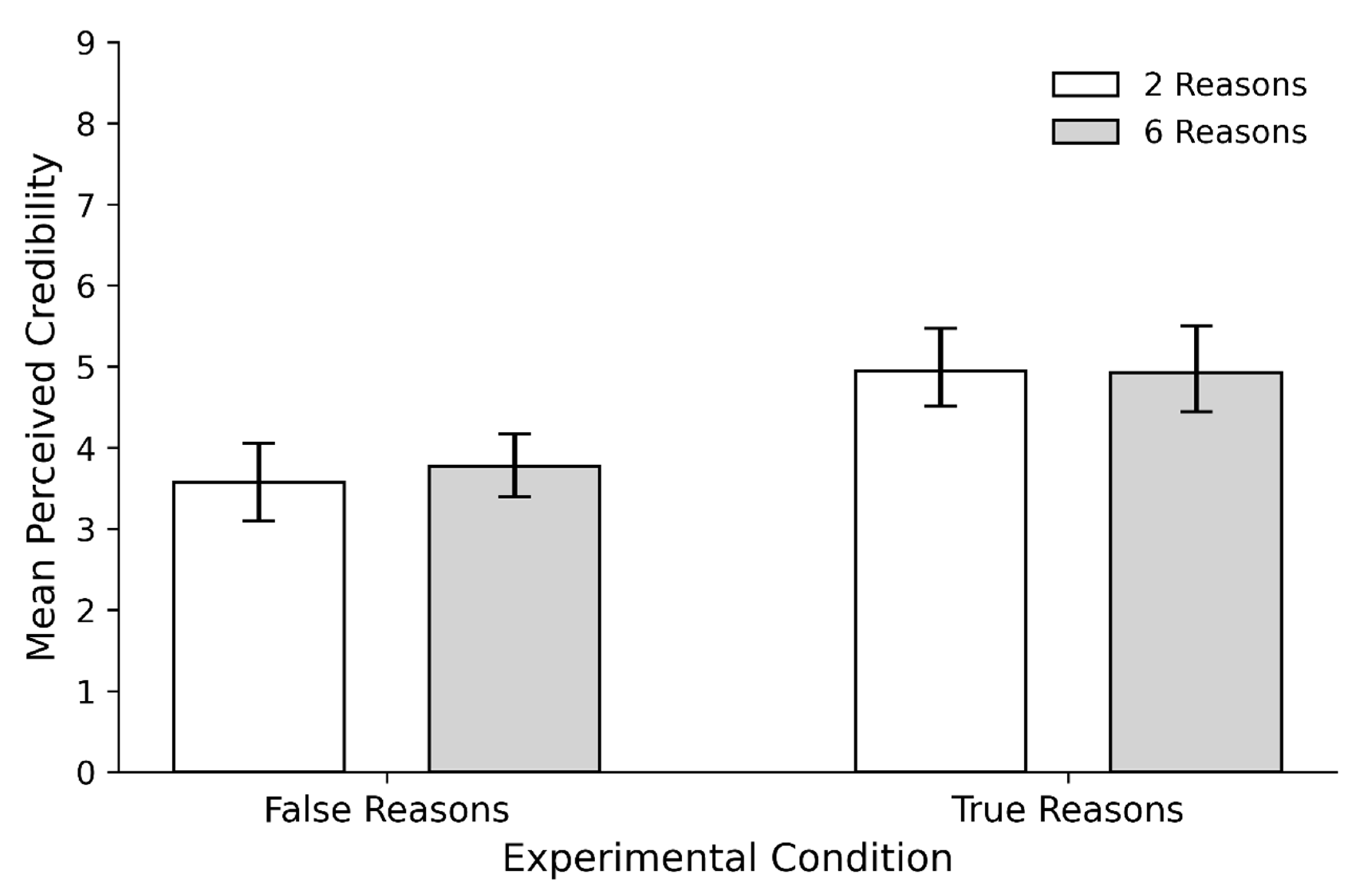
The number of reasons did not have a significant effect on credibility ratings (b = 0.17, SE = 0.34, t(124) = 0.50, p = .62, d = 0.03). However, the type of reasons had a significant effect on credibility ratings (b = 1.37, SE = 0.34, t(124) = 4.08, p < .001, d = 1.4). More specifically, participants who provided reasons supporting the headlines’ veracity rated them as more credible (M = 4.92, SD = 1.41) than those who provided reasons refuting them (M = 3.65, SD = 1.25, d = 0.97). The interaction between the number and the type of reasons was also not significant (b = -0.19, SE = 0.48, t(124) = -0.39, p = .69, d = -0.03).
We checked the normality assumptions before running the main analysis. Both the Shapiro-Wilk test (W = 0.99, p < .001) and the Levene’s test (F(3, 764) = 5.12, p < .01) were significant. However, the residual plots indicated that the assumptions of linearity and independence were soundly met, considering that LMMs are robust to minor deviations from normality (Knief & Forstmeier, 2021), especially with sample sizes above 100 (N = 128 in our case).
In sum, the ease or accessibility experienced when generating reason (few vs. many) did not influence credibility judgments while the type of reason provided by participants (supporting or refuting) aligned better with credibility (see Figure 1).
4.5.3. Secondary Results
Based on the EoR manipulation, in our preregistration, we also hypothesized that the relationship between perceived difficulty and credibility ratings would differ between participants providing reasons supporting the headlines’ veracity and those providing reasons indicating the headlines’ falsehood. Consistent with the previous main results, Kendall’s tau correlations between perceived difficulty and credibility were not significant for participants providing true reasons (τ = -0.036, z = -0.388, p = .698) or false reasons (τ = 0.049, z = 0.520, p = .603), performed after detecting violations of normality assumptions (Shapiro-Wilk tests: true reasons, W = 0.940, p = .0038; false reasons, W = 0.883, p < .001), which also reject this secondary hypothesis.
In our pre-registration, we also aimed to analyze the role of the actual type of news (fake vs. real) on credibility. We conducted a three-way mixed-design ANOVA to examine the effects on credibility ratings, using the objective veracity of news headlines as a within-subjects factor, and the number and type of reasons participants provided (few vs. many and true vs. false) as between-subjects factors. The main effect of the number of reasons was not significant, F(1, 251) = 0.14, p = .71, η² < .001, indicating that the number of reasons provided (few vs. many) did not significantly affect credibility ratings. The main effect of the type of reasons was significant, F(1, 251) = 42.44, p < .001, η² = .14, suggesting again that participants who provided true reasons rated the headlines as significantly more credible than those who provided false reasons. The main effect of the type of news was not significant, F(1, 251) = 2.90, p = .09, η² = .01. The interaction between the number of reasons and the type of reasons was not significant, F(1, 251) = 0.23, p = .63, η² < .001. These results highlight the importance of the type of reasons in influencing credibility judgments and confirms that the actual veracity of the headlines did not significantly influence the main results.
To explore how familiarity modulates credibility, we also conducted a pre-registered ANCOVA with familiarity as the covariate and the number of reasons (few vs. many) and the type of reasons (true vs. false) as independent variables. Importantly, familiarity was significant, F(1, 123) = 14.29, p < .001, η² = .10, meaning that higher credibility ratings were predicted by subjectively more familiar headlines. Consistent with previous analyses, the ANCOVA confirmed a significant main effect of the type of reasons, F(1, 123) = 16.13, p < .001, η² = .12. The main effect of the number of reasons remained non-significant, F(1, 123) = 0.13, p = .72, η² < .001, and the interaction between the number of reasons and the type of reasons was also not significant, F(1, 123) = 0.57, p = .45, η² < .001. Assumptions of homogeneity of slopes (F(1, 120) = 0.66, p = .4188; F(1, 120) = 0.41, p = .5256; F(1, 120) = 1.44, p = .23) and homogeneity of variance (F(3, 124) = 0.8, p = .5) were met. Additionally, Pearson’s correlations confirmed that familiarity was positively associated with credibility ratings, r(126) = .40, p < .001, and this correlation held for both true reasons, r(62) = .40, p = .003, and false reasons, r(62) = .30, p = .04. These findings confirm the role of familiarity on credibility, highlighting the importance of prior exposure and cognitive fluency in shaping credibility judgments.
Finally, previous research has pointed out that some misinformation studies might conflate participants’ true ability to distinguish real form fake news with response bias (Batailler et al., 2022; Higham et al., 2024), so we carried out a supplemental non-preregistered analysis to address this potential issue. We employed a signal detection measure analogous to d-prime (D’), using participants’ ratings on a 9-point Likert scale, normalized by their standard deviations as in the following formula:
Where is the mean credibility rating for real news, the mean credibility for fake news, and the denominator contains the square root of the pooled standard deviations. However, this measure did not show statistical significance in a Kruskal-Wallis test for credibility ratings across experimental groups χ²(3) = 4.42, p = .22, conducted after observing violations of normality (W = 0.965, p = .002). Despite removing response bias by focusing on the detection of real vs. fake news, this analysis revealed that the experimental manipulation did not influence discriminability among the headlines.
4.6. Discussion
In this preregistered experiment, we examined whether EoR influenced credibility judgments of ambiguous news headlines. Consistent with Feeling-as-Information (FI) theory and prior research [6,15], we predicted that participants generating fewer reasons (high accessibility) would rate headlines as more credible than participants generating more reasons (low accessibility). Our design explicitly tested this by randomly assigning participants to one of four conditions formed by crossing the number of reasons (two vs. six) with the direction of reasoning (supporting vs. opposing headline credibility).
Contrary to our expectations, we found no significant effect of the EoR manipulation on credibility ratings. Instead, participants’ judgments were strongly influenced by whether they were asked to support or oppose the headline’s credibility: participants generating supportive reasons gave higher credibility ratings than those generating opposing reasons. This pattern emerged even though our manipulation check confirmed that providing six reasons was perceived as more difficult—and took longer—than providing two reasons. These null effects cannot be attributed to carry-over effects because each experimental group experienced only one condition and there were not mixed factors involved in our experimental design.
A critical methodological consideration here involves the sensitivity of EoR manipulations to context-specific factors. A more critical consideration involves how sensitive the EoR manipulation is to context-specific factors. Although we pilot-tested headlines to ensure they were sufficiently ambiguous, we did not pilot-test the classic manipulation of (two versus six reasons). Was the two reasons condition genuinely “easy” in this domain? Our manipulation check indicated that even two reasons felt moderately difficult, which narrowed the intended contrast between “easy” and “difficult” conditions. We only became aware of this narrower gap upon analyzing our data. However, the classic laboratory task (2 vs. 6 reasons) reliably yields a pronounced contrast, whereas the realistically ambiguous headlines here appear to have made even two reasons feel challenging.
Our results also differ notably from Ask et al. [15], who observed EoR effects on credibility judgments. While we closely replicated key aspects such as the number of reasons, instructions, sample size, and manipulation checks, our task was arguably more complex because Ask et al. focused on a single judgment scenario (evaluating a videotaped candidate’s believability), whereas we required participants to assess multiple ambiguous headlines. On one hand, evaluating multiple headlines may improve measurement reliability, but on the other, it can increase participants’ engagement and promote more deliberate, analytical processing, thereby overriding heuristic reliance on cognitive fluency cues [6,10]. In fact, in line prior research on familiarity [52,53], our secondary analyses showed that subjective familiarity with the headlines enhanced perceived credibility independently of retrieval fluency.
Demand characteristics may also have contributed to the null effect. Participants who were explicitly told to generate reasons supporting or opposing each headline might have inferred that researchers expected their subsequent credibility ratings to align with that stance, diminishing any influence from subjective ease. Additionally, because our headlines were deliberately chosen to minimize obvious truthfulness cues, participants may have felt compelled to adopt more careful, effortful reasoning rather than relying on fluency-based heuristics.
In summary, we found no evidence of EoR effects on credibility judgments under realistic, cognitively demanding conditions reminiscent of evaluating real vs. fake news on social media. Our findings imply that EoR might be constrained by heightened task complexity, ambiguity, participant engagement, and possible demand characteristics. Notably, having discovered that the difference between “2 vs. 6” reasons was narrower than anticipated, we introduced time pressure in a second experiment in hopes of increasing reliance on intuitive processing. According to dual-process models like the MODE model [54], subjective cognitive cues (e.g., retrieval fluency) should dominate when people have less opportunity for systematic thought. Therefore, Experiment 2 was designed to impose strict time constraints, aiming to create an environment where EoR might more clearly influence credibility judgments.
5. Experiment 2
We designed a second experiment to enhance the likelihood that the EoR manipulation would influence credibility judgments. Consequently, we introduced time pressure, which can significantly influence how individuals evaluate the credibility of information by making them more reliant on intuitive heuristics, such as ease of processing, and less likely to engage in systematic analytical thinking (Kahneman, 2011). This manipulation also provides practical ecological validity by simulating the fast-paced evaluation of news headlines on social media, where individuals often make quick, superficial credibility judgments amidst information overload.
We hypothesized that the absence of time pressure in our first experiment might have contributed to the deviation from results observed in other studies on ease-of-processing manipulations. Specifically, when the informational value of feelings is low, these feelings are less likely to influence judgments and decisions (Greifeneder et al., 2011). High processing investment, requiring cognitive resources such as attention, memory and abstraction, tends to decrease the influence of intuitive feelings (Kahneman, 2011; Schwarz & Jalbert, 2020). For instance, according to the MODE model (R. H. Fazio, 1990), the extent to which intuitive processing influences judgments is determined by the motivation and opportunity to process information deliberately. When motivation and opportunity for deliberation are high, judgments are more likely to be analytical (Kahneman, 2011).
In Experiment 2, we asked whether limiting the opportunity for deliberative processing by introducing time pressure would allow feelings of processing to affect credibility judgments more directly. We expected that the time constraint would lead participants to rely more on heuristic cues, potentially revealing effects that were masked by high processing engagement and high difficulty in the previous experiment. Since Experiment 1 did not show a significant interaction between the type of reason (supporting or refuting) and the ease of processing on credibility judgments, and because the focus of the present paper is on predictions from the FI theory, we removed the type of reason factor to concentrate on the effects of time constraint and ease of processing.
5.1. Method
Experiment 2, is a direct theoretical follow-up to Experiment 1. As s in the first study, we pre-registered the research on the aspredicted.org platform before starting data collection (https://aspredicted.org/DHG_C5W). Please refer to Supplementary Materials for raw data.
5.2. Participants and Design
We focused on the primary variables of interest: ease of processing and time restriction, by excluding the type of reason factor. This simplification resulted in a 2 (high vs. low accessibility) x 2 (with vs. without time restriction) between-subjects factorial design. We calculated the sample size a priori to be 128 participants, following the same approach as in the first experiment. However, we collected data from 135 participants recruited by the same procedures as in experiment 1. To account for potential issues such as computer crashes or data corruption. The final sample was 63% female, with ages ranging from 17 to 52 years (M = 21, SD = 4.03). The Supplementary Materials provide full descriptive statistics of participants’ demographics.
5.3. Materials and Procedure
The materials (news headlines), apparatus (Shiny App), methods, and procedure closely followed those of the first study. The news headlines were displayed for at least 30 seconds. Participants were prompted to read and observe the headlines carefully before continuing. Subsequently, all participants were required to write reasons (2 or 6, depending on the condition) explaining why the headline might be true. In the time-constrained conditions, participants had only 20 seconds per reason (resulting in a total of 40 seconds for the 2-reason condition and 120 seconds for the 6-reason condition).
When the time had expired or when all the requested reasons had been written, participants rated the credibility of the headline using a Likert scale similar to the one used in the first experiment. Finally, participants answered the same questions about difficulty and engagement as before. Additionally, we added a new manipulation check adapted to the new time-constrained condition: Did you have enough time to think and write the reasons? This question was rated on a scale from 1 (not at all) to 9 (plenty of time).
5.4. Results
5.4.1. Manipulation Check
Similar to the first study, we averaged the scores of the perceived difficulty questions (Cronbach’s α = 0.73). Since the time constraint can influence perceived difficulty, we compared these scores across experimental conditions. Participants in the time-constrained conditions found the task more difficult when they had to report six reasons (Mdn = 7.67) compared to those who reported two reasons (Mdn = 6.67), U = 317, p < .01. A similar pattern emerged in the conditions without time constraints, where participants who reported six reasons also found the task more difficult (Mdn = 8.00) compared to those who reported two reasons (Mdn = 6.67), U = 224, p < .01.
Additionally, we evaluated the effectiveness of the time pressure manipulation with the question, “Did you have enough time to think and write the reasons?” Participants in the conditions without time constraints reported having sufficient time (Mdn = 8.00), whereas those in the time-constrained conditions reported having less time (Mdn = 5.00), U = 829, p < .01.
5.4.2. Primary Results
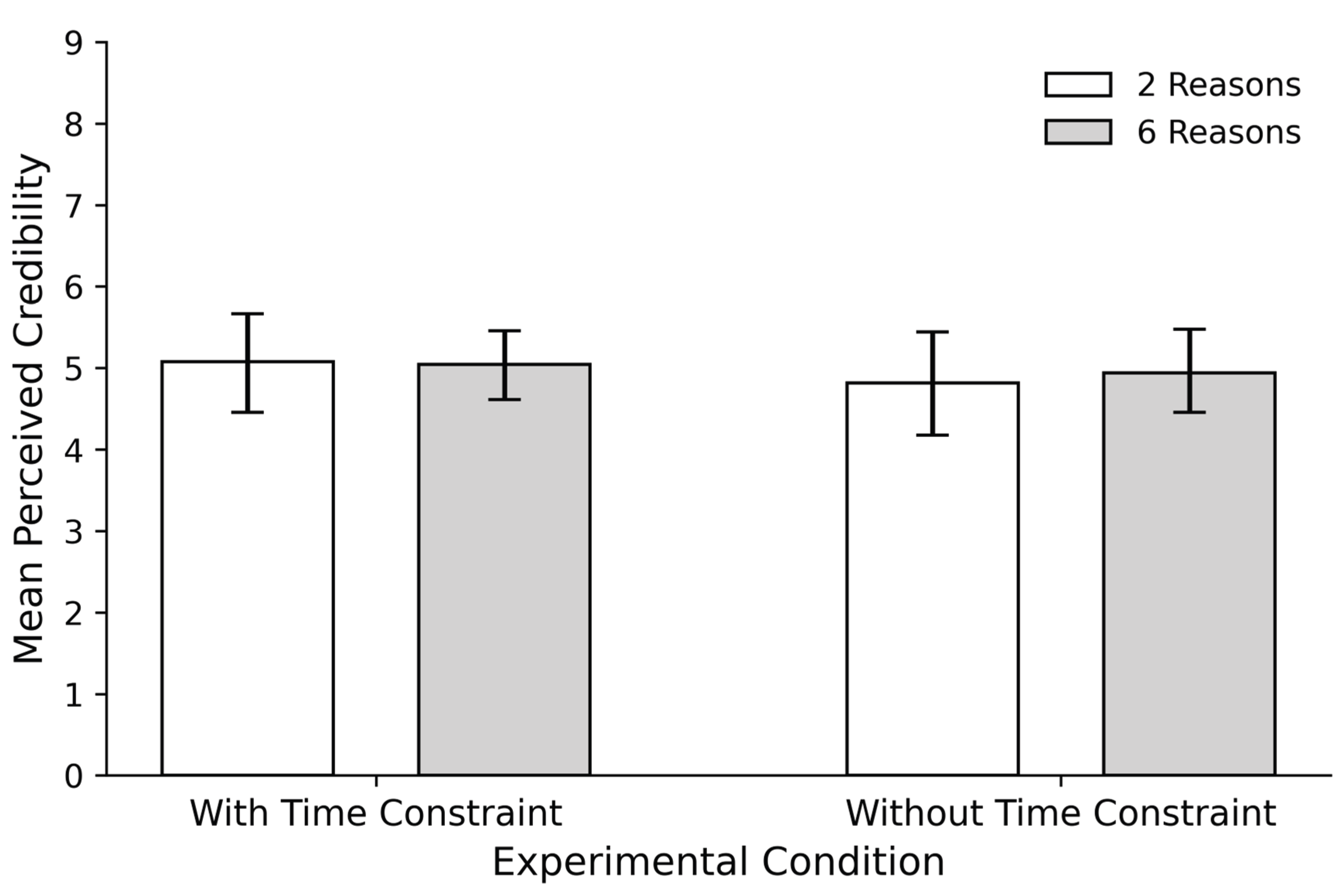
As in the first study, we used a LMM with participants as a random factor. The main effects of number of reasons (β = -0.03, SE = 0.29, t = 0.09, p = .92) and temporal restriction (β = -0.43, SE = 0.29, t = 1.47, p = .14) were not significant. Similarly, the interaction between the main factors (β = 0.24, SE = 0.42, t = 0.58, p = .56) was not statistically significant. That is, no differences in credibility scores were observed between any of the experimental conditions.
Figure 2.
Mean Perceived Credibility by Type and Number of Reasons in Experiment 2. Error bars represent 95% confidence intervals (CIs) around the mean. Time restriction indicates the condition where participants experienced limited time to provide reasons, while No time restriction indicates the condition where participants had no time limit. The conditions 2 Reasons and 6 Reasons refer to the EoR manipulation, indicating the number of reasons participants were required to provide.
Figure 2.
Mean Perceived Credibility by Type and Number of Reasons in Experiment 2. Error bars represent 95% confidence intervals (CIs) around the mean. Time restriction indicates the condition where participants experienced limited time to provide reasons, while No time restriction indicates the condition where participants had no time limit. The conditions 2 Reasons and 6 Reasons refer to the EoR manipulation, indicating the number of reasons participants were required to provide.
5.5. Discussion
In this second experiment, we introduced time pressure to determine whether limiting deliberation might reveal EoR effects that were masked in Experiment 1. Specifically, we anticipated that forcing participants to respond quickly—by restricting the time available to generate reasons—would encourage greater reliance on heuristic cues, consistent with the MODE model (R. H. Fazio, 1990). We also wanted to see whether the relatively small subjective gap between “2 reasons” and “6 reasons” observed in Experiment 1 would persist when participants were under time constraints.
Contrary to our expectations, neither the number of reasons provided nor the presence of time pressure reliably influenced credibility ratings. Even though participants in the time-constrained condition reported having less time to think and found generating six reasons more difficult, this did not translate into higher credibility ratings for headlines in the ostensibly “easy” (two-reason) condition. As in Experiment 1, the manipulation of accessibility was statistically valid—participants perceived a difference between “2 vs. 6 reasons”—yet it did not affect headline credibility. These findings indicate that time pressure alone was insufficient to elicit EoR effects, potentially due to persistent contextual or motivational factors.
6. General Discussion
In this study, we tested whether varying the ease of retrieving reasons to trust or distrust ambiguous headlines would shape credibility judgments of real and fake news. Across two preregistered experiments, participants who generated fewer (“easy”) vs. more (“difficult”) reasons did not differ in their credibility ratings. There were no discernible EoR effects, not even from a time pressure modification meant to promote heuristic processing. These results provide boundary conditions under which the EoR phenomenon may be diminished, rather than refuting it. The subjective distinction between “easy” and “difficult” retrieval may become far less noticeable in genuine, ambiguous situations where participants are encouraged to think critically and news items provide few clear truth indications. Consequently, cognitive fluency cues can be easily overshadowed by deeper analytical engagement, strong motivations, or demand characteristics.
6.1. Methodological Considerations
We were concerned about whether insufficient power masked an otherwise reliable effect. To address this, we combined data from participants in both experiments who completed identical tasks (generating two vs. six reasons, without time pressure). This nearly doubled the sample size, providing adequate power (86%) to detect a medium effect (d ≈ 0.53). However, we still observed no meaningful differences in credibility judgments (d = 0.08). Hence, statistical power alone is unlikely to explain our null effects.
Another issue involves how “easy” and “difficult” manipulations function in the complex domain of news credibility. Although our manipulation checks showed that participants in “many reasons” conditions reported significant higher difficulty, the “few reasons” condition still felt subjectively challenging. When facing inherently ambiguous headlines, even an ostensibly small retrieval task may demand substantial cognitive effort, compressing the distinction between easy and difficult retrieval. Careful pilot testing must therefore verify not only the headlines are ambiguous, but also that the target contrast in difficulty (e.g., two vs. six reasons) truly maps onto participants’ subjective experiences.
A second explanation involves participants’ motivation and analytical engagement. Generating reasons for credibility assessments, especially in a laboratory setting that emphasizes thoroughness, can encourage deliberative processing. Prior research (Bronstein et al., 2021) suggests that highly engaged participants, especially university students, rely less on heuristic fluency cues if they have sufficient cognitive resources to think critically. Similarly, motivational factors (such social identification or personal convictions) may take precedence over ease of retrieval. Simply changing the number of reasons might not significantly change participants’ final assessments if they are already prepared to examine ambiguous headlines.
Notably, we did not see the expected impact on credibility even in Experiment 2, where time constraints were supposed to promote intuitive over deliberate reasoning. Participants may have adapted by producing fewer, stronger arguments under time pressure, which would have allowed them to maintain an analytical approach even with shorter deadlines, consistent with dual-process theories such as the MODE model (R. H. Fazio, 1990; Olson & Fazio, 2008).
Typical demand characteristics likely also had a role in our experiments. When participants are explicitly instructed to generate reasons supporting or challenging a headline’s credibility, they may infer that their subsequent ratings “should” match the reasons they just produced, thereby overshadowing any subtle fluency-based cues. We nonetheless adopted this procedure because earlier work suggested that such demand effects do not always dominate when retrieval difficulty is manipulated effectively (Ask et al., 2012). In our data, however, participants’ credibility ratings still aligned strongly with the direction of the reasons they generated, independent of the experienced ease or difficulty of retrieval.
These issues could be addressed in future studies by employing cover stories, including filler tasks, or measuring credibility indirectly, which would lessen the likelihood that participants will intentionally align their credibility judgments with the type of reasons they provided. In order to ascertain whether demand characteristics were involved, researchers could also evaluate participants’ awareness of the study hypotheses after the experiment.
6.2. Implications
Although our null results resonate with recent large-scale replication efforts (Groncki et al., 2021) that also failed to detect classic EoR effects, even in more controlled settings reminiscent of Schwarz et al. (Schwarz et al., 1991), our replication failures highlight methodological constrains such as question order, number of retrieval items, timing, and instruction style, that can affect whether fluency cues surface in judgment. The present research suggests that EoR may have reduced applicability in complex, real-world tasks. Ambiguous content, high participant engagement and motivational factors can all undermine or mask fluency cues. Rather than invalidating the principle that subjective feelings can shape judgments, our findings help delineate situations where they are less likely to exert a measurable effect.
Theoretically, these results imply that in challenging or ambiguous contexts even “few reasons” feel effortful for participants and that credibility judgments may rest more on motivational states than on heuristic feelings of difficulty. While EoR remains robust in many controlled laboratory paradigms, in practice, interventions designed to counter misinformation may be better served by approaches that actively encourage critical reasoning and deliberate argument evaluation. Media literacy training that emphasizes systematic source scrutiny and more reflective forms of judgment could increase resilience to misinformation more effectively than interventions relying on manipulation of subjective fluency cues because, as our results demonstrate such manipulations require high subjective contrasts between easy and difficult conditions.
In sum, our findings expand current knowledge on EoR by identifying specific conditions under which it may fail to influence credibility judgments: realistic news contexts characterized by ambiguity, motivated processing, and potentially powerful demand characteristics.
Future studies should investigate whether stronger difficulty contrasts (e.g., 1 vs. 6 reasons) or alternative designs (e.g., hidden hypotheses, indirect credibility measures) might boost the impact of EoR. Researchers could also evaluate the quality of generated arguments, measure participants’ motivations directly, and further explore how personal or emotional investment interacts with fluency cues. By systematically addressing these conditions, we can refine theoretical models of how people judge the credibility of uncertain information and develop more effective interventions for countering misinformation in the real world.
Supplementary Materials
The following supporting information can be downloaded at the website of this paper posted on Preprints.org, Figure S1: title; Table S1: title; Video S1: title. Headlines used in both experiments.
Author Contributions
Conceptualization, X.X. and Y.Y.; methodology, X.X.; software, X.X.; validation, X.X., Y.Y. and Z.Z.; formal analysis, X.X.; investigation, X.X.; resources, X.X.; data curation, X.X.; writing—original draft preparation, X.X.; writing—review and editing, X.X.; visualization, X.X.; supervision, X.X.; project administration, X.X.; funding acquisition, Y.Y. All authors have read and agreed to the published version of the manuscript.
Funding
Please add: “This research received no external funding” or “This research was funded by NAME OF FUNDER, grant number XXX” and “The APC was funded by XXX”. Check carefully that the details given are accurate and use the standard spelling of funding agency names at https://search.crossref.org/funding. Any errors may affect your future funding.
Institutional Review Board Statement
Please add “The study was conducted in accordance with the Declaration of Helsinki, and approved by the Institutional Review Board (or Ethics Committee) of NAME OF INSTITUTE (protocol code XXX and date of approval).” for studies involving humans. OR “Ethical review and approval were waived for this study due to REASON (please provide a detailed justification).” OR “Not applicable” for studies not involving humans or animals. Please note that the Editorial Office might ask you for further information.
Informed Consent Statement
Please add “Informed consent was obtained from all subjects involved in the study.” OR “Patient consent was waived due to REASON (please provide a detailed justification).” You might also choose to exclude this statement if the study did not involve humans.
Data Availability Statement
please provide details regarding where data supporting reported results can be found, including links to publicly archived datasets analyzed or generated during the study. Where no new data were created, or where data is unavailable due to privacy or ethical restrictions, a statement is still required. Suggested Data Availability Statements are available in section “MDPI Research Data Policies” at https://www.mdpi.com/ethics.
Acknowledgments
In this section, you can acknowledge any support given which is not covered by the author contribution or funding sections. This may include administrative and technical support, or donations in kind (e.g., materials used for experiments).
Conflicts of Interest
Declare conflicts of interest or state “The authors declare no conflicts of interest.” Authors must identify and declare any personal circumstances or interest that may be perceived as inappropriately influencing the representation or interpretation of reported research results. Any role of the funders in the design of the study; in the collection, analyses or interpretation of data; in the writing of the manuscript; or in the decision to publish the results must be declared in this section. If there is no role, please state “The funders had no role in the design of the study; in the collection, analyses, or interpretation of data; in the writing of the manuscript; or in the decision to publish the results”.
References
- Adams, Z.; Osman, M.; Bechlivanidis, C.; Meder, B. (Why) Is Misinformation a Problem? Perspectives on Psychological Science 2023, 18(6), 1436–1463. [Google Scholar] [CrossRef] [PubMed]
- Ask, K.; Greifeneder, R.; Reinhard, M. On the Ease of (Dis)believing: The Role of Accessibility Experiences in Credibility Judgments. Applied Cognitive Psychology 2012, 26(5), 779–784. [Google Scholar] [CrossRef]
- Batailler, C.; Brannon, S. M.; Teas, P. E.; Gawronski, B. A Signal Detection Approach to Understanding the Identification of Fake News. Perspectives on Psychological Science 2022, 17(1), 78–98. [Google Scholar] [CrossRef]
- Bronstein, M. V.; Pennycook, G.; Buonomano, L.; Cannon, T. D. Belief in fake news, responsiveness to cognitive conflict, and analytic reasoning engagement. Thinking & Reasoning 2021, 27(4), 510–535. [Google Scholar] [CrossRef]
- Brysbaert, M.; Stevens, M. Power Analysis and Effect Size in Mixed Effects Models: A Tutorial. Journal of Cognition 2018, 1(1), 9. [Google Scholar] [CrossRef]
- Carrasco-Farré, C. The fingerprints of misinformation: How deceptive content differs from reliable sources in terms of cognitive effort and appeal to emotions. Humanities and Social Sciences Communications 2022, 9(1), 162. [Google Scholar] [CrossRef]
- Carroll, P.; Slowiaczek, M. L. Constraints on semantic priming in reading: A fixation time analysis. Memory & Cognition 1986, 14(6), 509–522. [Google Scholar] [CrossRef]
- Carruthers, P. An architecture for dual reasoning. In Two minds: Dual processes and beyond; Evans, E. J., Frankish, K., Eds.; Oxford University Press, 2012; pp. 109–127. [Google Scholar] [CrossRef]
- Chang, W.; Joe Cheng, J. J. A.; Sievert, C.; Schloerke, B.; Xie, Y.; Allen, J.; McPherson, J.; Dipert, A.; Borges, B. Shiny: Web Application Framework for R . 2021. Available online: https://CRAN.R-project.org/package=shiny.
- Clore, G. L. The impact of affect depends on its object. In The nature of emotion: A volume of short essays addressing fundamental questions in emotion; Davidson, E. R., Shackman, A., Fox, A., Lapate, R., Eds.; Oxford University Press, 2017; pp. 186–189. [Google Scholar] [CrossRef]
- Clore, G. L.; Huntsinger, J. R. How emotions inform judgment and regulate thought. Trends in Cognitive Sciences 2007, 11(9), 393–399. [Google Scholar] [CrossRef]
- De Neys, W. Advancing theorizing about fast-and-slow thinking. Behavioral and Brain Sciences 2023, 46, e111. [Google Scholar] [CrossRef] [PubMed]
- Dechêne, A.; Stahl, C.; Hansen, J.; Wänke, M. The Truth About the Truth: A Meta-Analytic Review of the Truth Effect. Personality and Social Psychology Review 2010, 14(2), 238–257. [Google Scholar] [CrossRef]
- Evans, J. In two minds: Dual-process accounts of reasoning. Trends in Cognitive Sciences 2003, 7(10), 454–459. [Google Scholar] [CrossRef] [PubMed]
- Faul, F.; Erdfelder, E.; Buchner, A.; Lang, A.-G. Statistical power analyses using G*Power 3.1: Tests for correlation and regression analyses. Behavior Research Methods 2009, 41(4), 1149–1160. [Google Scholar] [CrossRef]
- Fazio, L. K. Repetition Increases Perceived Truth Even for Known Falsehoods. Collabra: Psychology 2020, 6(1), 38. [Google Scholar] [CrossRef]
- Fazio, R. H. Multiple processes by which attitudes guide behavior: The MODE model as an integrative framework. In Advances in experimental social psychology; Zanna, M. P., Ed.; Academic Press, 1990; Vol. 23, pp. 75–109. [Google Scholar]
- Fiedler, K. The hidden vicissitudes of the priming paradigm in evaluative judgment research. In The psychology of evaluation: Affective processes in cognition and emotion; Lawrence Erlbaum Associates Publishers, 2003; pp. 109–137. [Google Scholar]
- Fiedler, K.; Bluemke, M.; Unkelbach, C. On the adaptive flexibility of evaluative priming. Memory & Cognition 2011, 39(4), 557–572. [Google Scholar] [CrossRef]
- Greifeneder, R.; Bless, H.; Pham, M. T. When Do People Rely on Affective and Cognitive Feelings in Judgment? A Review. Personality and Social Psychology Review 2011, 15(2), 107–141. [Google Scholar] [CrossRef]
- Groncki, R.; Beaudry, J. L.; Sauer, J. D. Investigating the ease-of-retrieval effect in an eyewitness context. Memory 2021, 29(2), 234–254. [Google Scholar] [CrossRef]
- Hasher, L.; Goldstein, D.; Toppino, T. Frequency and the conference of referential validity. Journal of Verbal Learning and Verbal Behavior 1977, 16(1), 107–112. [Google Scholar] [CrossRef]
- Higgins, E. T.; Bargh, J. A.; Lombardi, W. J. Nature of priming effects on categorization. Journal of Experimental Psychology: Learning, Memory, and Cognition 1985, 11(1), 59–69. [Google Scholar] [CrossRef]
- Higgins, E. T.; Rholes, W. S.; Jones, C. R. Category accessibility and impression formation. Journal of Experimental Social Psychology 1977, 13(2), 141–154. [Google Scholar] [CrossRef]
- Higham, P. A.; Modirrousta-Galian, A.; Seabrooke, T. Mean rating difference scores are poor measures of discernment: The role of response criteria. Current Opinion in Psychology 2024, 56, 101785. [Google Scholar] [CrossRef] [PubMed]
- Kahneman, D. Thinking, fast and slow, 1st ed; Farrar, Straus and Giroux, 2011. [Google Scholar]
- Kahneman, D.; Sibony, O.; Sunstein, C. R. Noise: A flaw in human judgment, First edition; Little, Brown Spark, 2021. [Google Scholar]
- Knief, U.; Forstmeier, W. Violating the normality assumption may be the lesser of two evils. Behavior Research Methods 2021, 53(6), 2576–2590. [Google Scholar] [CrossRef]
- Lazer, D. M. J.; Baum, M. A.; Benkler, Y.; Berinsky, A. J.; Greenhill, K. M.; Menczer, F.; Metzger, M. J.; Nyhan, B.; Pennycook, G.; Rothschild, D.; Schudson, M.; Sloman, S. A.; Sunstein, C. R.; Thorson, E. A.; Watts, D. J.; Zittrain, J. L. The science of fake news. Science 2018, 359(6380), 1094–1096. [Google Scholar] [CrossRef]
- Lefebvre, G.; Deroy, O.; Bahrami, B. The roots of polarization in the individual reward system. Proceedings of the Royal Society B: Biological Sciences 2024, 291, 20232011. [Google Scholar] [CrossRef] [PubMed]
- Leiner, D. J. Too Fast, too Straight, too Weird: Non-Reactive Indicators for Meaningless Data in Internet Surveys. Survey Research Methods 2019, 229–248 Pages. [Google Scholar] [CrossRef]
- Lewandowsky, S.; Ecker, U. K. H.; Cook, J. Beyond misinformation: Understanding and coping with the “post-truth” era. Journal of Applied Research in Memory and Cognition 2017, 6(4), 353–369. [Google Scholar] [CrossRef]
- Loersch, C.; Payne, B. K. Demystifying priming. Current Opinion in Psychology 2016, 12, 32–36. [Google Scholar] [CrossRef]
- Lutzke, L.; Drummond, C.; Slovic, P.; Árvai, J. Priming critical thinking: Simple interventions limit the influence of fake news about climate change on Facebook. Global Environmental Change 2019, 58, 101964. [Google Scholar] [CrossRef]
- Meteyard, L.; Davies, R. A. I. Best practice guidance for linear mixed-effects models in psychological science. Journal of Memory and Language 2020, 112, 104092. [Google Scholar] [CrossRef]
- Miró-Llinares, F.; Aguerri, J. C. Misinformation about fake news: A systematic critical review of empirical studies on the phenomenon and its status as a ‘threat. European Journal of Criminology 2023, 20(1), 356–374. [Google Scholar] [CrossRef]
- Olson, M. A.; Fazio, R. H. Implicit and explicit measures of attitudes: The perspective of the MODE model. In Attitudes; Psychology Press, 2008; pp. 39–84. [Google Scholar] [CrossRef]
- Payne, B. K.; Brown-Iannuzzi, J. L.; Loersch, C. Replicable effects of primes on human behavior. Journal of Experimental Psychology: General 2016, 145(10), 1269–1279. [Google Scholar] [CrossRef]
- Pennycook, G.; Cannon, T. D.; Rand, D. G. Prior exposure increases perceived accuracy of fake news. Journal of Experimental Psychology: General 2018, 147(12), 1865–1880. [Google Scholar] [CrossRef]
- Pennycook, G.; Epstein, Z.; Mosleh, M.; Arechar, A. A.; Eckles, D.; Rand, D. G. Shifting attention to accuracy can reduce misinformation online. Nature 2021, 592, 590–595. [Google Scholar] [CrossRef]
- Pennycook, G.; McPhetres, J.; Zhang, Y.; Lu, J. G.; Rand, D. G. Fighting COVID-19 Misinformation on Social Media: Experimental Evidence for a Scalable Accuracy-Nudge Intervention. Psychological Science 2020, 31(7), 770–780. [Google Scholar] [CrossRef]
- Pennycook, G.; Rand, D. G. Who falls for fake news? The roles of bullshit receptivity, overclaiming, familiarity, and analytic thinking. Journal of Personality 2020, 88(2), 185–200. [Google Scholar] [CrossRef] [PubMed]
- Roozenbeek, J.; Schneider, C. R.; Dryhurst, S.; Kerr, J.; Freeman, A. L. J.; Recchia, G.; Van Der Bles, A. M.; Van Der Linden, S. Susceptibility to misinformation about COVID-19 around the world. Royal Society Open Science 2020, 7(10), 201199. [Google Scholar] [CrossRef] [PubMed]
- Ross, R.; Rand, D. G.; Pennycook, G. Beyond “fake news”: Analytic thinking and the detection of false and hyperpartisan news headlines. Judgment and Decision Making 2019, 16(2), 484–504. [Google Scholar] [CrossRef]
- Schwarz, N.; Bless, H.; Strack, F.; Klumpp, G.; Rittenauer-Schatka, H.; Simons, A. Ease of retrieval as information: Another look at the availability heuristic. Journal of Personality and Social Psychology 1991, 61(2), 195–202. [Google Scholar] [CrossRef]
- Schwarz, N.; Jalbert, M.; Greifeneder, R.; Jaffe, M.; Newman, E.; Schwarz, N. When (Fake) News Feels True. In The Psychology of Fake News, 1st ed.; Routledge, 2020; pp. 73–89. [Google Scholar] [CrossRef]
- Song, H.; Schwarz, N. Fluency and the Detection of Misleading Questions: Low Processing Fluency Attenuates the Moses Illusion. Social Cognition 2008, 26(6), 791–799. [Google Scholar] [CrossRef]
- Thorson, E. Belief Echoes: The Persistent Effects of Corrected Misinformation. Political Communication 2016, 33(3), 460–480. [Google Scholar] [CrossRef]
- Tomita, R.; Chokmeesuk, J.; Loriot, C.; Bu, Z.; Adan, G. Ease of retrieval experiences and judgment: Review of extant literature and meta-analysis (Version 1). [object Object]. 2021. [Google Scholar] [CrossRef]
- Udry, J.; Barber, S. J. The illusory truth effect: A review of how repetition increases belief in misinformation. Current Opinion in Psychology 2024, 56, 101736. [Google Scholar] [CrossRef] [PubMed]
- Unkelbach, C.; Greifeneder, R. A general model of fluency effects in judgment and decision making. In The experience of thinking: How the fluency of mental processes influences cognition and behaviour; Unkelbach, C., Greifeneder, R., Eds.; Psychology Press, 2013; pp. 11–32. [Google Scholar]
- Wänke, M. Almost everything you always wanted to know about ease-of-retrieval effects. In The experience of thinking: How the fluency of mental processes influences cognition and behaviour; Psychology Press, 2013; pp. 151–169. [Google Scholar]
- Weingarten, E.; Hutchinson, J. W. Does ease mediate the ease-of-retrieval effect? A meta-analysis. Psychological Bulletin 2018, 144(3), 227–283. [Google Scholar] [CrossRef] [PubMed]
- Zhang, Z.; Yuan, K.-H. Practical statistical power analysis using Webpower and R; ISDSA Press, 2018. [Google Scholar] [CrossRef]
Figure 1.
Mean Perceived Credibility by Type and Number of Reasons in Experiment 1. Error bars represent 95% confidence intervals (CIs) around the mean. False Reasons: participants to refute the headlines’ veracity. True Reasons: participants had to support headlines’ veracity. The conditions 2 Reasons and 6 Reasons refer to the EoR manipulation, indicating the number of reasons participants were required to provide.
Figure 1.
Mean Perceived Credibility by Type and Number of Reasons in Experiment 1. Error bars represent 95% confidence intervals (CIs) around the mean. False Reasons: participants to refute the headlines’ veracity. True Reasons: participants had to support headlines’ veracity. The conditions 2 Reasons and 6 Reasons refer to the EoR manipulation, indicating the number of reasons participants were required to provide.
Disclaimer/Publisher’s Note: The statements, opinions and data contained in all publications are solely those of the individual author(s) and contributor(s) and not of MDPI and/or the editor(s). MDPI and/or the editor(s) disclaim responsibility for any injury to people or property resulting from any ideas, methods, instructions or products referred to in the content. |
© 2026 by the authors. Licensee MDPI, Basel, Switzerland. This article is an open access article distributed under the terms and conditions of the Creative Commons Attribution (CC BY) license.
Copyright: This open access article is published under a Creative Commons CC BY 4.0 license, which permit the free download, distribution, and reuse, provided that the author and preprint are cited in any reuse.


