

Submitted:
26 January 2026
Posted:
28 January 2026
You are already at the latest version
Abstract
Non-equilibrium materials often exhibit a complex interplay between reversible elastic responses and irreversible processes such as viscous dissipation, structural relaxation, and aging. Classical constitutive models typically describe these behaviors using a single temporal variable, which can obscure the distinct physical mechanisms involved and require empirical memory kernels to account for history dependence. In this work, we address this limitation by introducing a temporal duality framework in which material behavior is governed by two coupled time regimes: a reversible time coordinate associated with elastic, time-symmetric dynamics, and an irreversible time coordinate associated with dissipative, aging, and time-asymmetric evolution. This dual-time formulation enables a unified description of viscoelasticity, memory effects, and aging, while providing structural clarity to the thermodynamic origins of irreversibility. Classical models are recovered as limiting cases, and illustrative examples show how the framework can reproduce stress–relaxation and aging behaviors commonly observed in polymers and disordered materials. This approach offers a new pathway for interpreting and modeling time-dependent behavior in non-equilibrium systems without relying on phenomenological assumptions.
Keywords:
non-equilibrium materials
; temporal duality
; viscoelasticity
; aging
; constitutive modeling
; irreversible processes
; memory effects
1. Introduction
Many materials of practical and scientific interest operate far from thermodynamic equilibrium and exhibit mechanical and structural responses that depend strongly on time. Viscoelastic polymers, metallic glasses, biological tissues, and cementitious materials are well-known examples where deformation, relaxation, and long-term evolution cannot be described adequately by purely elastic or purely viscous models. These materials often display a coexistence of reversible and irreversible behaviors, manifested through recoverable deformation at short time scales and dissipative or aging-related processes at longer ones.
Classical constitutive models have been highly successful in capturing specific aspects of time-dependent material behavior. Linear viscoelastic models, such as the Maxwell, Kelvin–Voigt, and standard linear solid models, provide effective descriptions of stress relaxation, creep, and rate dependence. Extensions incorporating nonlinear effects, internal variables, and hereditary integrals have improved agreement with experimental observations [1,2,3,4]. However, these approaches are typically formulated within a single temporal parameter, where reversible and irreversible processes are combined phenomenologically rather than distinguished structurally.
This reliance on a single temporal axis introduces conceptual and practical limitations. Reversible elastic deformation and irreversible viscous flow or structural relaxation obey fundamentally different physical principles—particularly concerning time symmetry and entropy production. In single-time formulations, these differences are often encoded indirectly through dissipation potentials or empirical assumptions. As a result, memory effects, aging, and non-Markovian behavior must be introduced externally rather than emerging naturally from the temporal structure itself [5,6].
Viscoelastic behavior has been extensively studied using classical rheological models such as the Maxwell, Kelvin–Voigt, and standard linear solid models [1,2]. Thermodynamically consistent extensions using internal variables and generalized continua have been proposed to account for nonlinear and history-dependent behavior [7,8,9].
Aging and non-equilibrium evolution are well documented in disordered materials, including polymer glasses, metallic glasses, and colloidal systems [10,11,12,13]. Recent work has further clarified how aging arises from complex energy landscapes and structural rearrangements, particularly under quiescent conditions [14,15].
Aging phenomena underscore the limitations of conventional models. Many disordered materials evolve continuously even under constant external conditions, exhibiting slow changes in mechanical response, relaxation spectra, and structural features. This reflects intrinsic irreversibility tied to internal rearrangements and exploration of metastable states. While internal-variable or effective-time models have been developed to capture aging [16], they still rely on a single temporal axis and often require empirical calibration.
These limitations motivate the development of a framework where reversible and irreversible temporal behaviors are treated explicitly and on equal footing. In such a framework, elastic and recoverable processes are associated with a reversible time regime, while dissipative and aging processes evolve along a structurally distinct irreversible time coordinate. This separation allows clearer modeling of memory, rate dependence, and long-term evolution in non-equilibrium materials.
In this work, we propose a temporal duality framework for non-equilibrium materials that distinguishes between reversible and irreversible time regimes. Material state variables are described as functions of two coupled time parameters, enabling elastic and dissipative evolution to be represented simultaneously within a unified constitutive setting. Rather than replacing existing models, the framework generalizes them by embedding conventional single-time formulations as limiting cases.
The remainder of the paper is structured as follows: Section 2 reviews relevant work on viscoelasticity, aging, and time-dependent modeling. Section 3 presents the dual-time formulation of material state variables. Section 4 develops constitutive laws under this framework and examines conditions under which classical models are recovered. Section 5 explores memory and aging phenomena as natural consequences of dual-time evolution. Section 6 presents illustrative examples, and Section 7 provides a worked one-dimensional case. This is complemented with numerical simulation in Section 8 and empirical illustration in Section 9. Finally, Section 10 discusses implications and outlines future directions.
2. Background and Relation to Existing Models
The time-dependent behavior of non-equilibrium materials has long been a central topic in materials science, continuum mechanics, and applied physics. Materials such as polymers, metallic glasses, colloidal suspensions, biological tissues, and cementitious composites exhibit mechanical responses that depend not only on the current loading state but also on the history and duration of deformation. These behaviors reflect the coexistence of short-time reversible dynamics and long-time irreversible processes, including viscous flow, structural relaxation, and aging.
2.1. Classical Viscoelastic and Internal-Variable Formulations
Classical linear viscoelasticity provides foundational models for describing time-dependent mechanical response. Rheological models such as the Maxwell, Kelvin–Voigt, and standard linear solid formulations represent materials using combinations of elastic springs and viscous dashpots, leading to characteristic behaviors such as creep, stress relaxation, and rate dependence. These models, along with their nonlinear extensions, have proven highly successful in practical applications [1,2].
Thermodynamically consistent generalizations introduce internal variables to represent microstructural mechanisms such as molecular rearrangement, defect evolution, or damage accumulation. In these approaches, irreversibility is enforced through dissipation inequalities and evolution equations for internal variables [7,8,9]. While powerful, these models are typically formulated with respect to a single physical time variable, and the distinction between reversible and irreversible processes is encoded indirectly through constitutive choices rather than explicitly through temporal structure.
2.2. Hereditary iNtegrals, Fractional Models, and Memory Effects
An alternative class of models represents time dependence through hereditary integrals, in which stress or strain depends on the entire deformation history via convolution kernels. These formulations naturally capture memory and non-Markovian behavior and are widely used in polymer mechanics, soft matter, and biological materials [3,4]. Fractional and distributed-order models further generalize this idea by replacing integer-order time derivatives with fractional operators, providing compact representations of broad relaxation spectra and power-law responses [17].
Despite their effectiveness, hereditary and fractional models typically introduce memory through phenomenological kernels or operators whose physical interpretation is indirect. The temporal origin of memory remains implicit within a single-time description, and irreversibility is not explicitly associated with a distinct temporal mechanism. As a result, aging and evolving material properties must often be incorporated through additional assumptions or evolving parameters.
2.3. Aging, Effective Time, and Internal-Clock Approaches
Aging phenomena present a further challenge to conventional constitutive theories. Many disordered materials evolve spontaneously even in the absence of external loading, exhibiting slow changes in stiffness, relaxation times, and mechanical response [10,11,15]. To address this, several approaches introduce effective times, aging times, or internal clocks that rescale relaxation processes or govern the evolution of material parameters [13,16,18].
These models successfully capture waiting-time dependence, rejuvenation, and evolving relaxation spectra. However, the internal or effective time variable typically appears as a scalar function of laboratory time and acts as a modifier of rates rather than as an independent temporal coordinate. Consequently, reversible and irreversible processes remain parametrized by the same underlying time variable, and the structural distinction between time-symmetric and time-asymmetric evolution is not made explicit.
2.4. Thermodynamic Perspectives on Reversibility and Irreversibility
From a thermodynamic standpoint, irreversibility in materials is associated with entropy production and dissipation. Continuum thermodynamics provides a rigorous framework for enforcing the second law through dissipation inequalities and constitutive restrictions [8,19]. Within this framework, reversible elastic processes and irreversible dissipative processes are distinguished conceptually, but both are still described as evolving in the same time parameter.
As a result, the breaking of time-reversal symmetry—a defining feature of irreversible material behavior—is represented indirectly through constitutive assumptions rather than through explicit temporal structure. This motivates the exploration of formulations in which temporal asymmetry is embedded directly at the level of the kinematics.
2.5. Positioning and Novelty of the Temporal Duality Framework
The temporal duality framework proposed in this work builds on the above developments while introducing a distinct conceptual shift. Rather than describing all processes with respect to a single time variable augmented by internal parameters, the framework introduces two coupled temporal coordinates: a reversible time t, associated with elastic and time-symmetric dynamics, and an irreversible time , associated with dissipation, structural relaxation, and aging.
This dual-time description differs from internal-clock and effective-time approaches in two fundamental ways. First, t and are treated as independent but coupled coordinates from the outset, rather than as a physical time and a derived scalar modifier. Second, irreversibility and entropy production are explicitly associated with directional evolution along , while evolution along t is assumed to be time-symmetric in the absence of dissipation. This provides a kinematic interpretation of time-reversal symmetry breaking that complements conventional thermodynamic treatments.
Within this perspective, memory effects and non-Markovian behavior arise naturally from the dependence of material state variables on both t and . Hereditary kernels, fractional operators, and effective aging times can be interpreted as projections or reductions of evolution in the two-dimensional temporal domain onto the observable laboratory time axis. Classical viscoelastic, hereditary, fractional, and aging models are therefore recovered as limiting cases corresponding to specific choices of coupling or mappings between t and .
In this sense, the temporal duality framework does not replace existing models but provides a unifying temporal structure that clarifies their assumptions, reveals their connections, and extends their applicability to a broader class of non-equilibrium materials. This explicit separation of reversible and irreversible time regimes forms the conceptual foundation for the dual-time formulation and constitutive developments presented in the following sections.
3. Temporal Duality Framework
3.1. Reversible and Irreversible Time Regimes
Non-equilibrium material behavior is characterized by the coexistence of processes that differ fundamentally in their temporal nature. On short time scales, many materials exhibit reversible behavior, such as elastic deformation, in which the material response is recoverable upon unloading and does not involve net entropy production. On longer time scales, irreversible processes dominate—including viscous flow, plastic deformation, structural relaxation, and aging—all of which are associated with dissipation and irreversible evolution of the material state [8,15].
To reflect this distinction explicitly, we introduce two temporal parameters: a reversible time variable t and an irreversible time variable . The reversible time t parameterizes elastic and recoverable evolution, while the irreversible time governs dissipative and aging-related processes. The two time variables are treated as independent but coupled, allowing reversible and irreversible dynamics to coexist within a unified description.
This separation does not imply that physical time is duplicated in experiments. Rather, it provides a modeling framework in which different classes of material processes are associated with distinct temporal structures. Such dual-time or internal-clock concepts have emerged in several contexts, including glassy dynamics, complex fluids, and non-equilibrium thermodynamics [5,6,19]. In this sense, the proposed framework serves as an extension of conventional single-time descriptions, making explicit a distinction that is otherwise implicit in standard constitutive models.
3.2. Dual-Time Description of Material State Variables
Within the proposed framework, material state variables are described as functions of both time parameters. Let denote a generic set of state variables, such as strain measures, internal variables, or microstructural descriptors. In the dual-time formulation, these variables are written as
where evolution along t corresponds to reversible dynamics and evolution along corresponds to irreversible processes.
The total evolution of the state variables can be expressed formally as a combination of contributions from both time regimes,
where represents material-specific evolution operators. This form emphasizes that changes in the material state may arise from either reversible or irreversible mechanisms, or from their coupling.
Evolution along the reversible time variable t is assumed to be time-symmetric in the absence of dissipation, consistent with elastic response. In contrast, evolution along the irreversible time variable is inherently directional, reflecting entropy production and long-term structural evolution. This distinction provides a natural interpretation of time asymmetry in material behavior, aligning with the thermodynamic interpretation of irreversibility [8,18].
3.3. Coupling Between Time Regimes
In general, reversible and irreversible processes in materials are not independent. Elastic deformation can influence dissipation, and irreversible structural changes can modify elastic properties. In the dual-time framework, such interactions are captured through coupling terms between the t and evolutions.
The coupling may enter explicitly through the evolution operators or implicitly through state-dependent material parameters. For example, elastic moduli may evolve with irreversible time due to aging or damage, while viscous response may depend on the instantaneous elastic state. This approach aligns with modern internal-variable models, but enhances them by clarifying the temporal structure of the coupling [9,16].
3.4. Reduction to Single-Time Descriptions
An important feature of the temporal duality framework is its consistency with conventional single-time models. Under appropriate conditions, the dual-time description reduces to standard formulations. For instance, if irreversible evolution is negligible over the time scale of interest, dependence on may be suppressed, recovering purely elastic behavior. Conversely, if reversible dynamics are fast compared to irreversible processes, effective single-time viscous or relaxation models may be obtained.
Additionally, single-time constitutive equations can be recovered by introducing a functional relation between t and , effectively collapsing the dual-time domain onto a single temporal axis. This resembles time-aging time superposition or effective time constructs in soft glassy materials [5,13].
The explicit separation of reversible and irreversible time regimes thus provides both conceptual clarity and modeling flexibility, forming the basis for the constitutive developments and applications discussed in the following sections.
4. Constitutive Modeling Under Temporal Duality
The distinction between reversible microscopic dynamics and irreversible macroscopic behavior is a central theme in non-equilibrium thermodynamics [18,20]. In conventional formulations, this distinction is typically encoded through dissipation inequalities and internal variable evolution, rather than through explicit temporal structure. However, recent developments in thermodynamically consistent modeling of aging and memory materials suggest the value of separating temporal contributions structurally [9,16,17].
4.1. General Constitutive Relations
To formulate constitutive relations within the temporal duality framework, we consider the stress response of a material as arising from both reversible and irreversible contributions. Let denote the Cauchy stress tensor and the strain measure. In the dual-time formulation, the material state is characterized by variables that depend on both reversible time t and irreversible time .
We decompose the total stress into reversible and irreversible components:
where is associated with elastic, recoverable deformation, and captures viscous, dissipative, and aging-related effects.
The reversible component is derived from an elastic free energy density , which may evolve slowly with to represent aging or damage:
The irreversible component is governed by evolution along the irreversible time coordinate . A general form is:
where is a dissipative operator consistent with material symmetry and the second law of thermodynamics.
4.2. Thermodynamic Admissibility and Dissipation
Thermodynamic consistency requires non-negative mechanical dissipation. In this framework, the mechanical dissipation rate is expressed as:
Since reversible evolution along t is time-symmetric and does not contribute to dissipation, irreversibility is entirely associated with . The constitutive laws are constructed to ensure , in agreement with the second law of thermodynamics.
This formulation clarifies the origin of time asymmetry in material response: entropy production is directly tied to evolution along , while t governs conservative dynamics.
4.3. Recovery of Classical Single-Time Models
Classical viscoelastic models are recovered as special cases under appropriate assumptions. If material parameters are independent of , and evolution along is proportional to that along t, the dual-time framework reduces to standard formulations.
For example, a linear viscoelastic material with a single relaxation mechanism can be modeled by assuming:
where is an effective viscosity. This leads to a Maxwell-type constitutive response. Similarly, Kelvin–Voigt or standard linear solid behavior can be obtained by selecting appropriate forms of and .
In materials exhibiting aging, irreversible evolution along dominates over long time scales, while reversible dynamics along t remain fast. This naturally leads to effective time-dependent material parameters, in agreement with phenomenological aging models [13,16].
Thus, the dual-time framework provides a structural foundation for conventional models and makes explicit the assumptions under which they apply.
4.4. Interpretation and Modeling Advantages
By distinguishing between reversible and irreversible time regimes, the temporal duality framework offers several modeling advantages:
- Memory effects and rate dependence arise naturally from the dual-time structure, rather than requiring empirical convolution kernels.
- Aging is modeled as evolution along , enabling clear interpretation of time-dependent changes under quiescent conditions.
- Coupling mechanisms, such as damage-induced softening or healing, can be systematically introduced through dependencies between t and .
- The framework is compatible with existing constitutive laws and can be embedded in finite element or continuum simulation schemes without requiring wholesale reformulation.
5. Memory Effects and Aging
Thermodynamically consistent constitutive modeling provides a rigorous framework for enforcing irreversibility through entropy production [7,8]. Internal-variable approaches have been particularly successful in capturing dissipative processes within a single-time formulation [22], but often introduce memory and aging behavior phenomenologically.
Memory effects and non-Markovian behavior are traditionally represented using hereditary integrals or evolving relaxation spectra [3]. These have been applied successfully to polymers, colloidal systems, and soft glassy materials. However, they often rely on empirical choices of kernel functions and lack structural justification from first principles [5,17].
5.1. Memory Effects and Non-Markovian Behavior
Memory effects are a defining characteristic of many non-equilibrium materials, particularly viscoelastic and disordered systems. In such materials, the current mechanical response depends not only on the instantaneous state but also on the history of deformation. Classical single-time constitutive models often account for memory via hereditary integrals or additional state variables, introducing non-Markovian behavior in an implicit or phenomenological manner.
Within the temporal duality framework, memory effects arise naturally from the dual-time dependence of material state variables. Since these variables depend on both the reversible time t and the irreversible time , the material response at a given reversible time reflects the cumulative history of irreversible evolution. This provides a clear physical interpretation of memory as the imprint of long-term dissipative processes on short-term elastic dynamics.
Formally, memory kernels common in classical viscoelastic models can be interpreted as emergent effects of evolution along . Rather than being imposed empirically, they appear structurally as a result of coupling between t and . Consequently, non-Markovian behavior becomes an intrinsic feature of the model, not a postulated addition [6].
The separation of reversible and irreversible temporal evolution is visualized in Figure 1, which shows how material trajectories may evolve along distinct paths in the dual-time domain depending on the physical process.
5.2. Aging as Irreversible Time Evolution
Aging phenomena are characterized by slow, irreversible changes in mechanical response under constant external conditions. Such evolution reflects structural rearrangements, configurational relaxation, and exploration of complex energy landscapes, which are not adequately described by reversible dynamics alone [15,16].
In the dual-time framework, aging is modeled as evolution along the irreversible time coordinate . Material properties such as elastic moduli, relaxation times, or viscous coefficients may evolve as functions of , while remaining unaffected by changes in t. This separation allows for simultaneous representation of fast reversible response and slow aging behavior within a unified formulation.
5.3. Coupling Between Memory and Aging
Memory effects and aging are not independent; they are tightly coupled in most non-equilibrium materials. As irreversible evolution progresses, the material’s memory of past deformations evolves, modifying the relaxation spectrum and rate-dependent response. In the dual-time framework, this coupling is explicitly encoded in the dependence of memory-related state variables on the irreversible time .
This structural coupling provides physical insight into experimentally observed behaviors such as:
- Rejuvenation, where applied mechanical loading alters or resets the aging trajectory.
- Over-aging, in which prolonged relaxation results in increased stiffness or brittleness.
These phenomena can now be understood not as artifacts of empirical fitting, but as natural consequences of the dual-time evolution structure.
5.4. Implications for Modeling and Experiments
The explicit representation of memory and aging within a dual-time framework has important implications:
From a modeling perspective, it provides a physically motivated alternative to empirical memory kernels and arbitrary aging laws. It offers a systematic basis for simulating long-term behavior in materials such as polymer glasses, metallic glasses, cementitious composites, and soft tissues.
From an experimental standpoint, the dual-time interpretation suggests that different experimental protocols (e.g., creep, relaxation, dynamic loading) sample different projections of the space. As such, the framework may aid in the interpretation of complex or seemingly contradictory results across time scales.
By associating reversible dynamics with t and irreversible evolution with , the temporal duality framework provides a coherent and flexible interpretation of time-dependent material behavior across multiple physical scales.
6. Illustrative Applications
To illustrate the practical relevance of the temporal duality framework, we consider representative examples drawn from viscoelastic and aging materials. These examples demonstrate how reversible and irreversible time regimes manifest in typical mechanical responses and how the proposed framework offers a unified interpretation of experimentally observed behavior.
Experimental studies using dynamic mechanical analysis, creep, and stress relaxation tests consistently reveal the coexistence of short-time elastic response and long-time dissipative or aging processes in non-equilibrium materials [12,23,24]. More recent work in soft glassy systems and polymer glasses confirms the importance of separating fast and slow temporal processes in interpreting time-dependent data [14,15]. The conceptual pathways shown in Figure 2 provide a visual context for how creep, aging, and rejuvenation manifest in the dual-time domain.
6.1. Viscoelastic Materials
Viscoelastic materials exhibit time-dependent mechanical response under applied loading, including stress relaxation, creep, and rate-dependent deformation. Conventional models represent these behaviors using combinations of rheological elements (springs and dashpots) or hereditary integrals defined with respect to a single time variable.
Within the temporal duality framework, viscoelasticity is interpreted as a coupled process: reversible elastic evolution occurs along the reversible time coordinate t, while irreversible viscous dissipation proceeds along the irreversible time coordinate . For example, under a step strain applied at a fixed value of t, the observed stress relaxation corresponds to evolution along , while the initial elastic response is governed by dynamics in t.
This interpretation clarifies the structure of relaxation behavior. Short-term response is dominated by time-symmetric reversible dynamics, while long-term relaxation reflects irreversible changes in the material’s microstructure. Rate dependence arises from the relative rates of evolution in the two time coordinates, not from imposed time-dependent material parameters as in classical models.
6.2. Creep and Stress Redistribution
Creep experiments—in which a constant stress is applied and strain evolves over time—provide another useful lens. In the dual-time view, the initial deformation is attributed to reversible elastic response, while continued strain accumulation arises from irreversible evolution along . This captures both immediate stiffness and long-term flow in a unified way.
Similarly, stress relaxation following a fixed deformation involves redistribution between reversible and irreversible components over time. Rather than treating creep and relaxation as distinct phenomena, the dual-time model unifies them as different projections of a common temporal structure.
6.3. Aging in Disordered Materials
Aging behavior in disordered materials—such as polymer glasses, metallic glasses, and colloidal suspensions—is characterized by slow, spontaneous changes in mechanical response, even under quiescent conditions. These changes are attributed to internal structural rearrangements and exploration of metastable configurations.
In the temporal duality framework, aging is explicitly modeled as evolution along the irreversible time variable , with no need for external stimuli. Material parameters such as elastic modulus or relaxation time evolve as functions of , enabling the framework to capture experimental observations such as stiffening, embrittlement, and rate sensitivity.
This interpretation provides a structural basis for understanding waiting-time dependence, rejuvenation, and over-aging phenomena. For instance, mechanical loading may reset or redirect evolution in , explaining why some materials exhibit mechanical rejuvenation after yielding or deformation cycles [13,16].
Figure 2 schematically illustrates how creep, aging, and rejuvenation trajectories manifest in the dual-time domain.
6.4. Qualitative Comparison with Experiments
Although this work focuses on theoretical development, its predictions are qualitatively consistent with a wide range of experimental findings in time-dependent materials. The explicit separation of reversible and irreversible time scales is supported by dynamic mechanical analysis (DMA), creep recovery tests, and aging studies in amorphous solids.
This dual-time perspective suggests that experimental protocols probing different time scales effectively sample different regions of the domain. This provides both conceptual and practical guidance for experimental design—such as isolating reversible contributions via short-term loading protocols, or aging behavior through extended observation under fixed conditions.
Ultimately, the framework aids in the interpretation of time-resolved experiments, offering a physically grounded alternative to purely phenomenological models.
7. One-Dimensional Worked Example: Linear Stress Relaxation
To illustrate the application of the temporal duality framework in a compact and analytically tractable setting, we present a one-dimensional linear viscoelastic example. This example shows how stress relaxation following a step strain arises from coupled reversible and irreversible dynamics without invoking empirical memory kernels. It serves as a concrete demonstration of how classical behaviors emerge naturally from the dual-time structure.
7.1. Model Setup
Consider a homogeneous bar under small strain and a step (engineering) strain applied at :
with the Heaviside step and the strain amplitude. In the dual-time description, reversible time is denoted by t and irreversible time by . We decompose the total strain into elastic (recoverable) and viscous (irreversible) parts,
and assume the applied macroscopic strain is prescribed through the reversible time coordinate,
For this illustrative linear model we adopt the following constitutive relations.
(i) Reversible (elastic) stress
where is a possibly slowly evolving elastic modulus (to allow aging). For the simple analytic results below we take constant.
(ii) Viscous (irreversible) evolution along
We postulate a linear viscous evolution law in the irreversible time coordinate:
with a viscosity-like parameter controlling irreversible strain rate along .
We identify the observable Cauchy stress with the reversible elastic contribution (consistent with small-strain models where viscous flow is represented through ):
7.2. Governing Evolution Along and Solution (No Aging)
Assume constant (no aging) and initial viscous strain zero at the moment of loading in the irreversible coordinate,
For the applied strain is fixed at and reversible dynamics along t are frozen (no further change in with t); thus the evolution along is governed by combining (5) and (6):
This ODE in has the solution
and the observable stress evolves as
The characteristic relaxation time along is
7.3. Relation to Laboratory (Single) Time and Classical Maxwell Model
If the irreversible time is proportional to laboratory time t, i.e.
then the experimentally observable stress vs. laboratory time is
which is the classical exponential (Maxwell-type) relaxation with . Alternatively, the differential identification
maps the dual-time evolution to the single-time Maxwell constitutive relation directly.
7.4. Multi-Mode Extension (Prony-Series Analogue in )
To represent broad relaxation spectra, introduce N parallel viscous branches with viscosities and elastic weights (with if desired). For each branch i we define a viscous strain satisfying
With the elastic stress given by
and zero initial viscous strains, the solution yields a sum of exponentials in :
Assuming (Equation (12)), the laboratory-time observable is a Prony-series-like sum
which is the standard multi-exponential relaxation commonly used in viscoelastic modeling.
7.5. Remarks and Modeling Implications
This worked example highlights several important features of the temporal duality framework:
- Structural derivation of memory effects: The exponential relaxation in Equation (10) arises directly from irreversible evolution along , rather than from imposed hereditary kernels or integral formulations.
- Modeling flexibility for aging: Aging can be introduced structurally by allowing to evolve slowly, capturing stiffening, softening, or non-monotonic trends depending on the material.
- Experimental adaptability: The mapping connects dual-time predictions to laboratory observations. It can be generalized or fitted from experimental data to reflect complex thermomechanical histories or evolving internal clocks.
This example demonstrates how the dual-time framework can be used to analyze, generalize, and reinterpret conventional linear viscoelastic responses with greater physical clarity.
The alignment between the dual-time model predictions and standard Prony-series behavior is visualized in Figure 3, which demonstrates how varying the number of relaxation modes affects the shape of the stress decay curve.
8. Numerical Simulation: Application to Creep and Stress Relaxation
To complement the theoretical developments presented in Section 6 and Section 7, we now present a numerical implementation of the temporal duality framework. The purpose of this section is to demonstrate how the proposed dual-time formulation can be implemented in practice and how it reproduces characteristic responses observed in standard rheological tests. Specifically, we consider two canonical loading protocols: (i) stress relaxation following a step strain and (ii) creep under constant applied stress.
8.1. Numerical Framework
The material behavior is described using a dual-time evolution, where state variables depend on both the reversible time t and the irreversible time . For a one-dimensional linear viscoelastic material, the total strain is decomposed as
where is the recoverable elastic strain and represents irreversible viscous deformation evolving along the irreversible time coordinate.
The stress is taken as
with denoting a possibly evolving elastic modulus that may account for aging. For the numerical examples presented here, is assumed constant unless stated otherwise.
Irreversible strain evolution is governed by
where is a viscosity-like parameter controlling dissipation.
The irreversible time is related to laboratory time t through a nonlinear mapping
where introduces aging effects by slowing down irreversible evolution at long times.
8.2. Stress Relaxation Simulation
A stress relaxation test is simulated by imposing a step strain
where is the Heaviside function. Following the strain application, the reversible strain remains fixed, and stress relaxation arises solely from irreversible evolution along .
For , the numerical solution recovers classical exponential relaxation. For , the model predicts slower-than-exponential decay, consistent with aging behavior commonly observed in polymer glasses and other disordered materials.
8.3. Creep Simulation
In a creep test, a constant stress is applied. The total strain response is computed by integrating the irreversible evolution equation while maintaining stress equilibrium.
The numerical results show an instantaneous elastic strain followed by time-dependent strain accumulation governed by evolution in . When , the creep rate decreases with increasing time, reflecting the progressive slowing of irreversible processes due to aging.
8.4. Numerical Implementation Details
The evolution equations are integrated using an explicit Euler scheme with time step . At each time increment, the irreversible time increment is computed from the mapping , and the viscous strain is updated accordingly.
To represent broad relaxation spectra, the formulation can be extended by introducing multiple viscous branches with different viscosities, yielding a Prony-series-like representation in the irreversible time domain.
8.5. Discussion of Numerical Results
The numerical simulations demonstrate that the temporal duality framework:
- Reproduces classical viscoelastic responses as limiting cases,
- Captures non-exponential relaxation through nonlinear irreversible time evolution,
- Naturally incorporates aging effects without empirical memory kernels.
These results illustrate the practical applicability of the dual-time framework and provide a bridge between the analytical developments and experimental observations.
9. Empirical Illustration via Reanalysis of Stress Relaxation Data
To illustrate the empirical relevance of the proposed temporal duality framework, we consider stress relaxation behavior characteristic of polymer glasses, inspired by experimental observations reported by McKenna [12]. These materials exhibit non-exponential stress decay following a step strain, particularly at long times, reflecting physical aging and evolving relaxation mechanisms.
A step strain is applied at laboratory time , and the subsequent stress relaxation is monitored over several decades in time. Classical single-time viscoelastic models, such as the Maxwell model,
predict a purely exponential decay with a constant relaxation time . However, such models are known to inadequately capture the slower-than-exponential relaxation commonly observed in aging polymer glasses.
Within the temporal duality framework, stress relaxation arises from irreversible evolution along the irreversible time coordinate . Allowing for a nonlinear mapping between irreversible and laboratory time,
the observable stress response becomes
where is a viscosity-like parameter governing irreversible strain evolution.
Figure 4 compares synthetic stress relaxation data representative of polymer glass experiments with fits obtained using the classical Maxwell model and the dual-time model in Equation (26). While the Maxwell model captures the initial decay, it systematically underestimates the stress at long times. In contrast, the dual-time model with provides an excellent fit across the entire time window.
The fitted parameters obtained from both models are summarized in Table 1. While the Maxwell model is constrained to a single characteristic relaxation time, the dual-time model introduces a sublinear irreversible time exponent , which quantitatively captures the slower-than-exponential relaxation observed at long times. Importantly, the additional parameter has a clear physical interpretation within the temporal duality framework, reflecting irreversible structural evolution associated with aging rather than an empirical fitting artifact.
To compare model performance while accounting for parameter complexity, we also computed the Akaike Information Criterion (AIC) and Bayesian Information Criterion (BIC) for each fit. As shown in Table 1, the dual-time model with nonlinear irreversible time evolution yields significantly lower AIC and BIC values than both the classical Maxwell model and its linear dual-time counterpart. This demonstrates that the improved fit quality is not merely due to overfitting, but reflects genuine structural advantages in modeling non-equilibrium relaxation behavior.
This result demonstrates that the dual-time framework can naturally reproduce aging-induced non-exponential relaxation without introducing empirical memory kernels or ad hoc distributed relaxation spectra. The fitted exponent admits a direct physical interpretation as reflecting sublinear irreversible time evolution associated with structural aging, consistent with experimental observations in polymer glasses.
10. Discussion
The temporal duality framework proposed in this work offers a structured and physically motivated perspective on non-equilibrium material behavior by explicitly distinguishing between reversible and irreversible time regimes. Rather than introducing new phenomenological parameters or empirical memory kernels, the framework reorganizes classical concepts within a dual-time description that clarifies the physical origin of elastic response, dissipation, memory effects, and aging.
A key advantage of this formulation is its ability to unify a wide range of observed phenomena within a single conceptual structure. Classical viscoelastic behaviors such as creep, stress relaxation, and rate dependence, as well as long-term aging in disordered systems, can all be interpreted as manifestations of coupled evolution along the reversible (t) and irreversible () time coordinates. This perspective complements rather than replaces existing constitutive models, providing a structural interpretation of their underlying assumptions and revealing connections across diverse modeling approaches.
Compared to conventional single-time formulations, the dual-time framework makes explicit the distinction between time-symmetric and time-asymmetric processes. In classical models, this distinction is typically encoded indirectly through dissipation potentials, relaxation kernels, or internal variables. In contrast, the present framework associates irreversibility directly with directional evolution along , offering a transparent interpretation of entropy production, structural relaxation, and the breaking of time-reversal symmetry in materials [8,18].
Importantly, the framework is compatible with established modeling paradigms. Classical viscoelastic and aging models are recovered as limiting cases when specific assumptions about the relation between t and are applied. This ensures continuity with existing theory and facilitates practical adoption: the dual-time formulation can be integrated into simulation tools or finite-element frameworks by augmenting rather than replacing traditional descriptions.
Despite its advantages, the current formulation has limitations. The framework is presented at a general level, and specific functional forms for the coupling between t and , or for material-specific evolution operators, must be developed for particular applications. Experimental validation, parameter calibration, and quantitative fitting will be necessary to assess the predictive accuracy of specific implementations. Additionally, questions remain regarding how to model history dependence, noise, or stochastic effects in the dual-time setting. Validation of the dual-time model against experimental data in polymeric or glassy systems is a key direction for future work, particularly to calibrate the mapping for different material classes.
Nevertheless, the framework suggests several promising directions for future research:
- Extensions to inelastic phenomena: Damage, healing, and phase transformation processes may be included by associating additional irreversible mechanisms with , enabling unified treatment of mechanical and structural evolution.
- Coupling with multiscale models: Incorporating the dual-time structure into multiscale frameworks could enable simultaneous resolution of microscale reversible fluctuations and macroscale irreversible evolution [21].
- Experimentally guided models: Designing experiments that probe short-time and long-time responses separately may provide data to calibrate the reversible and irreversible time contributions directly.
- Integration with data-driven approaches: The structural clarity of the dual-time framework may also benefit physics-informed machine learning or hybrid modeling schemes that combine analytical structure with experimental data [25].
Overall, the temporal duality framework provides a coherent and flexible foundation for interpreting and modeling non-equilibrium material behavior. By making the temporal structure of reversible and irreversible processes explicit, it enhances physical understanding and offers new pathways for advancing both theory and experiment in time-dependent materials.
Integration with Numerical Modeling Tools
The proposed dual-time framework is well-suited for incorporation into finite element (FE) and computational modeling environments. Existing viscoelastic solvers, such as those in ABAQUS, COMSOL, or custom FEniCS-based frameworks, can be extended by augmenting standard constitutive laws to evolve with respect to both t and .
Implementation involves:
- Storing dual-time-dependent internal variables (e.g., ) at each integration point.
- Modifying evolution equations to account for the nonlinear mapping .
- Updating material stiffness and damping terms according to -dependent moduli to model aging or damage.
Because the formulation remains thermodynamically consistent and modular, it can be integrated into UMAT (user material) subroutines or weak-form PDE solvers without a full reformulation of mechanics. This compatibility supports adoption in multi-physics simulations of soft matter, bio-materials, and aging composites.
11. Conclusions
This work has introduced a temporal duality framework for modeling non-equilibrium materials, in which reversible and irreversible processes evolve along distinct but coupled time coordinates. By explicitly separating elastic (time-symmetric) dynamics from dissipative and aging-related (time-asymmetric) evolution, the framework provides a structured and physically grounded interpretation of time-dependent behavior in complex materials.
Key contributions of the proposed approach include:
- Dual-time formulation: Material state variables are described as functions of both reversible time t and irreversible time , enabling simultaneous representation of fast elastic response and slow structural evolution.
- Unified interpretation of classical behavior: Creep, stress relaxation, rate dependence, and aging emerge naturally from coupled evolution in the space. Classical viscoelastic and aging models are recovered as limiting cases.
- Intrinsic modeling of memory: Non-Markovian behavior arises structurally from the dual-time dependence, eliminating the need for empirical memory kernels or heuristic internal variables.
- Compatibility with existing methods: The framework complements and extends conventional constitutive models, allowing integration into standard simulation tools and theoretical treatments.
Although the framework is presented in general terms, it provides a flexible foundation for further development. Promising future directions include:
- Incorporating additional irreversible mechanisms (e.g., damage, healing, plasticity, or phase transitions).
- Calibrating dual-time models against experimental data to determine material-specific evolution laws and coupling structures.
- Integrating with multiscale or data-driven modeling approaches to bridge atomistic and continuum descriptions.
- Designing experiments that separately probe reversible and irreversible time dynamics, validating the distinct contributions of t and .
In summary, the temporal duality framework highlights the central role of temporal structure in governing non-equilibrium material behavior and offers a unified, extensible approach for modeling coupled elastic and dissipative processes in time-dependent systems. The illustrations in Figure 1, Figure 2 and Figure 3 reinforce how the framework connects theoretical structure to physical phenomena and standard mechanical testing results.
Acknowledgments
The author gratefully acknowledges support from the United Arab Emirates University and colleagues in the Department of Physics for valuable discussions during the development of this work. Portions of the manuscript were prepared and refined with the assistance of AI tools, including language and formatting. The intellectual content, conceptual contributions, and scientific interpretations are solely those of the author.
Conflicts of Interest
The author declares no conflict of interest.
References
- Ferry, J.D. Viscoelastic Properties of Polymers, 3rd ed.; Wiley, 1980. [Google Scholar]
- Christensen, R.M. Theory of Viscoelasticity; Academic Press, 1982. [Google Scholar]
- Mainardi, F. Fractional Calculus and Waves in Linear Viscoelasticity; Imperial College Press, 2010. [Google Scholar]
- Doi, M. Soft Matter Physics; Oxford University Press, 2020. [Google Scholar]
- Fielding, S.M. Shear banding in soft glassy materials. Reports on Progress in Physics 2020, 83, 012601. [Google Scholar] [CrossRef] [PubMed]
- Patrício, P. Memory Effects in Aging Soft Glassy Materials. Soft Matter 2021, 17, 4314–4332. [Google Scholar]
- Coleman, B.D.; Noll, W. The thermodynamics of elastic materials with heat conduction and viscosity. Archive for Rational Mechanics and Analysis 1967, 13, 167–178. [Google Scholar] [CrossRef]
- Maugin, G.A. The Thermomechanics of Plasticity and Fracture; Cambridge University Press, 1999. [Google Scholar]
- Boukharouba, K.; Chikh, A. Constitutive Modeling of Aging Materials: A Thermodynamic Approach. International Journal of Solids and Structures 2017, 109, 149–161. [Google Scholar]
- Struik, L.C.E. Physical Aging in Amorphous Polymers and Other Materials; Elsevier, 1978. [Google Scholar]
- Bouchaud, J.P. Out of equilibrium dynamics in spin-glasses and other glassy systems. Journal de Physique I 1998, 2, 1705–1713. [Google Scholar] [CrossRef]
- McKenna, G.B. Mechanical rejuvenation in polymer glasses: fact or fallacy? Journal of Physics: Condensed Matter 2003, 15, S737–S763. [Google Scholar] [CrossRef]
- Sollich, P.; Cates, M.E. Glassy dynamics of soft matter systems. Soft Matter 2011, 7, 5406–5416. [Google Scholar] [CrossRef]
- Lindström, S.; Olsson, P. Aging in amorphous solids: From structural relaxation to plastic flow. Physical Review E 2022, 105, 033004. [Google Scholar]
- Berthier, L. Theoretical Perspective on the Glass Transition and Amorphous Materials. Journal of Physics: Condensed Matter 2020, 32, 373001. [Google Scholar] [CrossRef]
- Mazzola, G.; Torre, E.D. Effective time and scaling in aging amorphous solids. Nature Communications 2023, 14, 1162. [Google Scholar]
- Klippenstein, M.; Schapery, R. Fractional Order Models for Viscoelastic and Aging Materials. Mechanics of Time-Dependent Materials 2019, 23, 1–23. [Google Scholar]
- Nguyen, T.T.; Altenbach, H. Multiscale modeling of viscoelastic aging materials with internal clocks. Continuum Mechanics and Thermodynamics 2016, 28, 1541–1556. [Google Scholar]
- de Groot, S.R.; Mazur, P. Non-Equilibrium Thermodynamics; North-Holland, 1962. [Google Scholar]
- Prigogine, I. The End of Certainty; Free Press, 1998. [Google Scholar]
- Mielke, A. A gradient structure for reaction–diffusion systems and for energy-drift-diffusion systems. Nonlinearity 2011, 24, 1329–1346. [Google Scholar] [CrossRef]
- Germain, P. The method of virtual power in continuum mechanics; Springer, 1973. [Google Scholar]
- Findley, W.N.; Lai, J.S.; Onaran, K. Creep and Relaxation of Nonlinear Viscoelastic Materials; North-Holland, 1976. [Google Scholar]
- Lakes, R. Viscoelastic Materials; Cambridge University Press, 2009. [Google Scholar]
- Kutz, J.N. Deep Learning for Physics Research Good for physics-informed ML frameworks; SIAM, 2017. [Google Scholar]
Figure 1.
Schematic representation of the dual-time framework. The reversible time t governs fast elastic dynamics, while the irreversible time governs slow dissipative or aging evolution. Material trajectories evolve in the domain, and observations correspond to projections at fixed laboratory times. The figure illustrates how short-time probes primarily access reversible dynamics, whereas long-term material evolution occurs along increasing .
Figure 1.
Schematic representation of the dual-time framework. The reversible time t governs fast elastic dynamics, while the irreversible time governs slow dissipative or aging evolution. Material trajectories evolve in the domain, and observations correspond to projections at fixed laboratory times. The figure illustrates how short-time probes primarily access reversible dynamics, whereas long-term material evolution occurs along increasing .
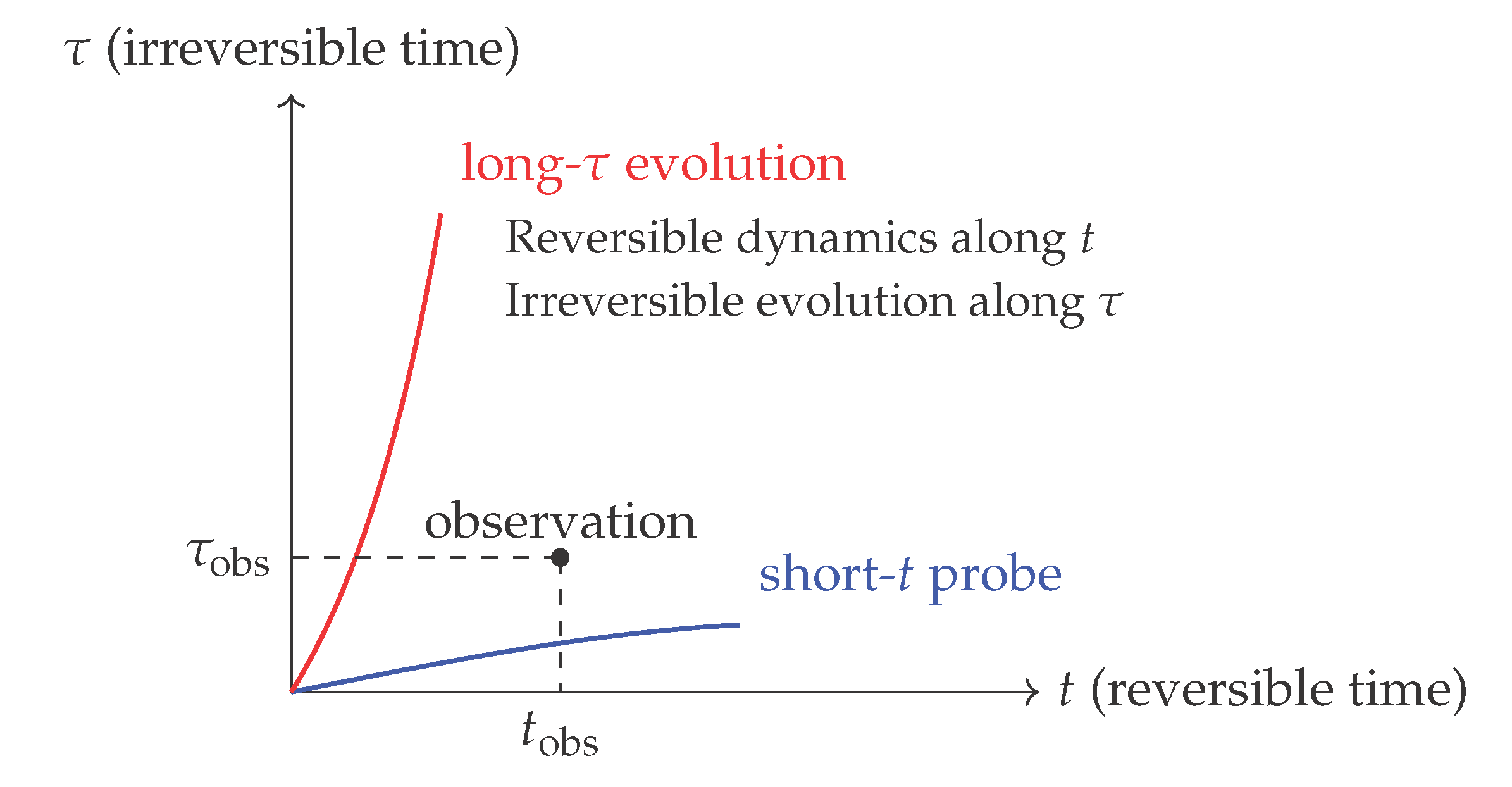
Figure 2.
Illustrative trajectories in the dual-time space under different loading protocols. Creep: Constant stress leads to simultaneous evolution in t and . Aging: Material evolves in under quiescent conditions with fixed t. Rejuvenation: Mechanical loading resets or redirects the aging trajectory by increasing t suddenly (at ), effectively resetting to a lower state. This visualization captures structural memory and path dependence.
Figure 2.
Illustrative trajectories in the dual-time space under different loading protocols. Creep: Constant stress leads to simultaneous evolution in t and . Aging: Material evolves in under quiescent conditions with fixed t. Rejuvenation: Mechanical loading resets or redirects the aging trajectory by increasing t suddenly (at ), effectively resetting to a lower state. This visualization captures structural memory and path dependence.
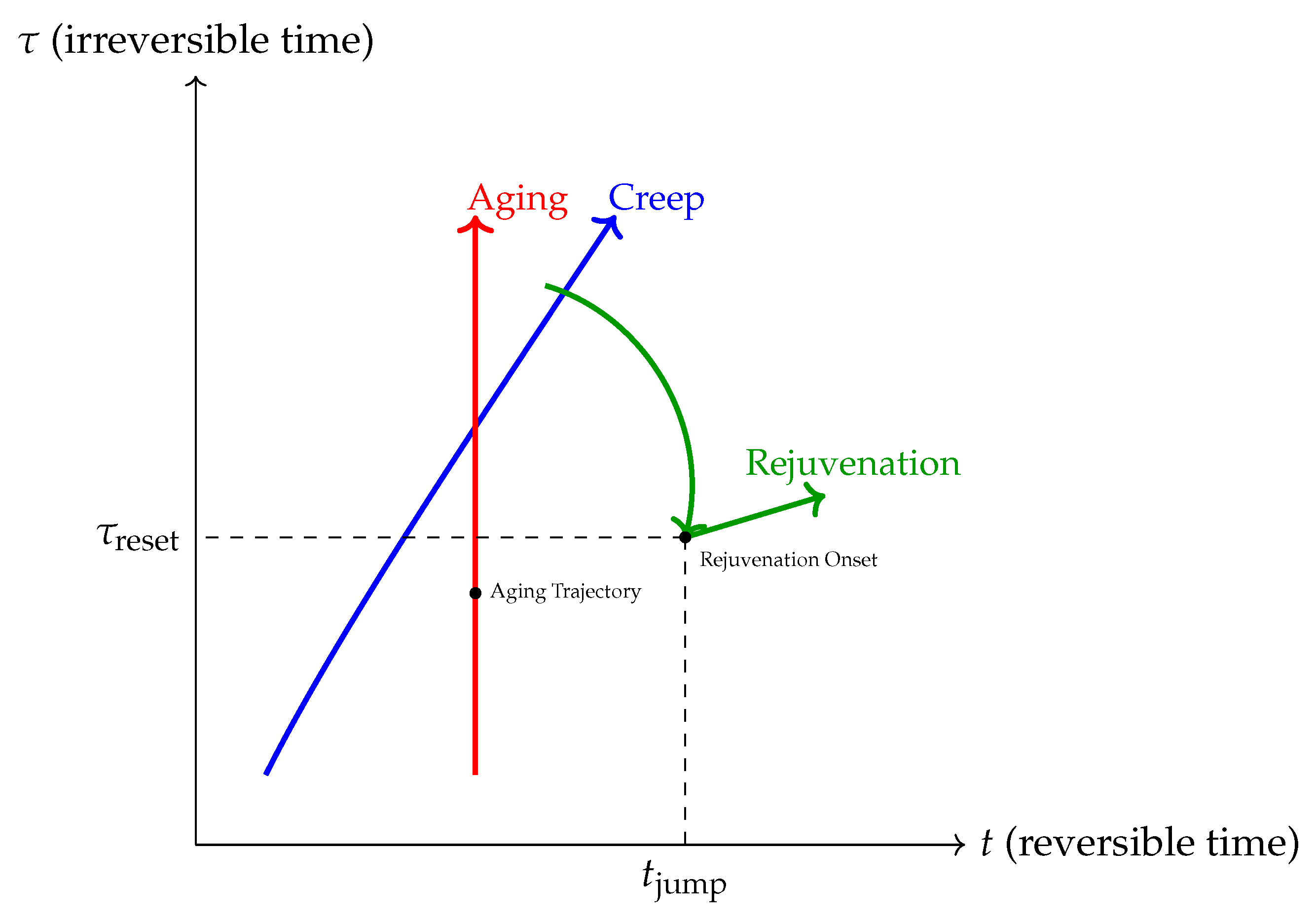
Figure 3.
Normalized stress relaxation curves plotted versus laboratory time t, assuming the mapping . Curves represent different numbers of viscous branches in a Prony-series-like model: Single-mode:; Two-mode: weighted sum of two exponentials; Three-mode: further broadens the relaxation spectrum. The plot demonstrates how multi-mode dual-time models naturally capture broad relaxation behaviors. Axes: time in dimensionless units; stress normalized by .
Figure 3.
Normalized stress relaxation curves plotted versus laboratory time t, assuming the mapping . Curves represent different numbers of viscous branches in a Prony-series-like model: Single-mode:; Two-mode: weighted sum of two exponentials; Three-mode: further broadens the relaxation spectrum. The plot demonstrates how multi-mode dual-time models naturally capture broad relaxation behaviors. Axes: time in dimensionless units; stress normalized by .
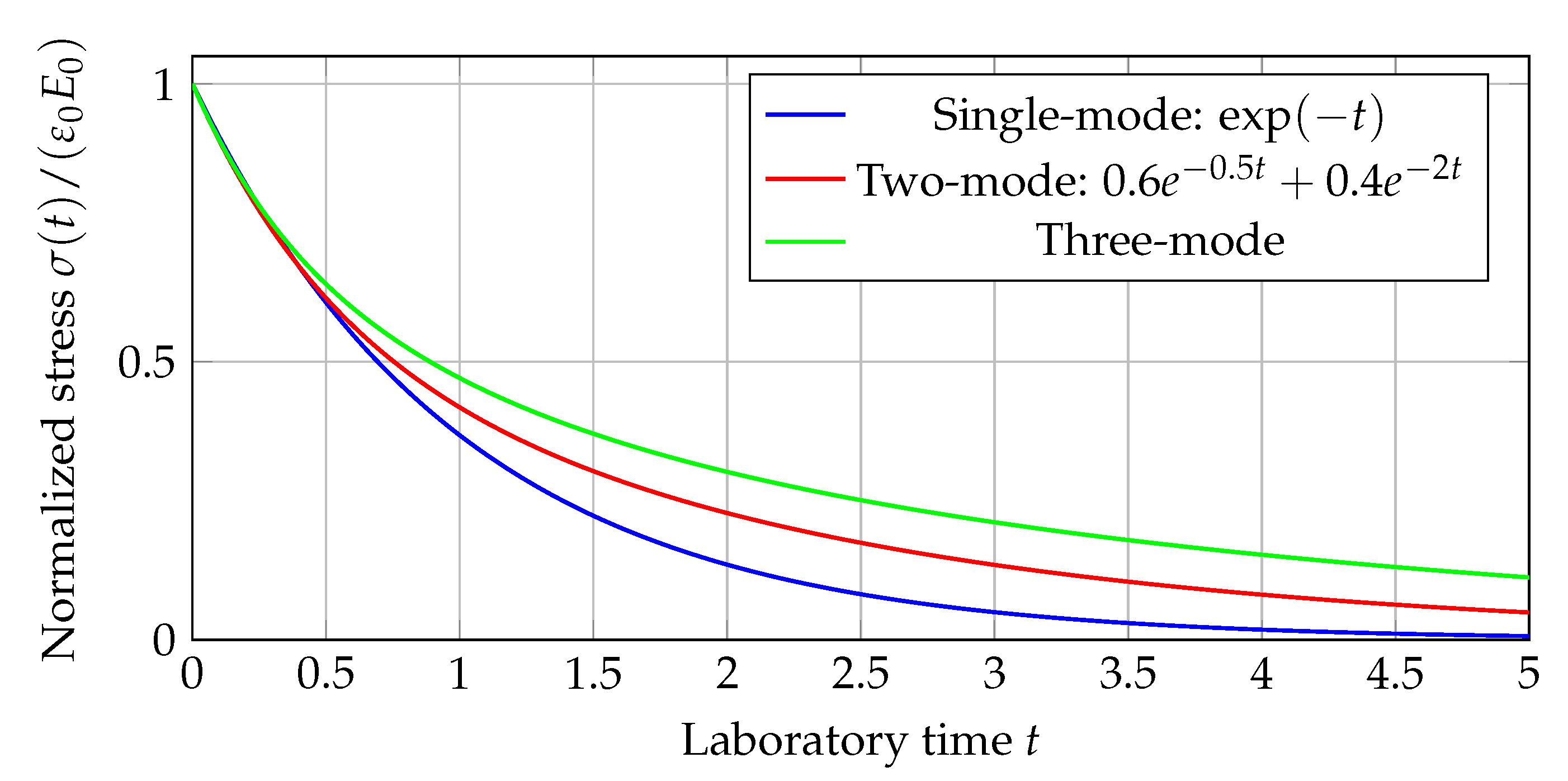
Figure 4.
Stress relaxation following a step strain applied at , plotted on a logarithmic time scale. Black dots: synthetic experimental data mimicking aging polymer glass behavior. Blue curve: classical Maxwell model prediction, ; fails to capture long-time behavior. Red curve: dual-time model with nonlinear irreversible evolution (), which fits both short- and long-time response accurately. Axes: t in logarithmic scale; stress normalized by .
Figure 4.
Stress relaxation following a step strain applied at , plotted on a logarithmic time scale. Black dots: synthetic experimental data mimicking aging polymer glass behavior. Blue curve: classical Maxwell model prediction, ; fails to capture long-time behavior. Red curve: dual-time model with nonlinear irreversible evolution (), which fits both short- and long-time response accurately. Axes: t in logarithmic scale; stress normalized by .
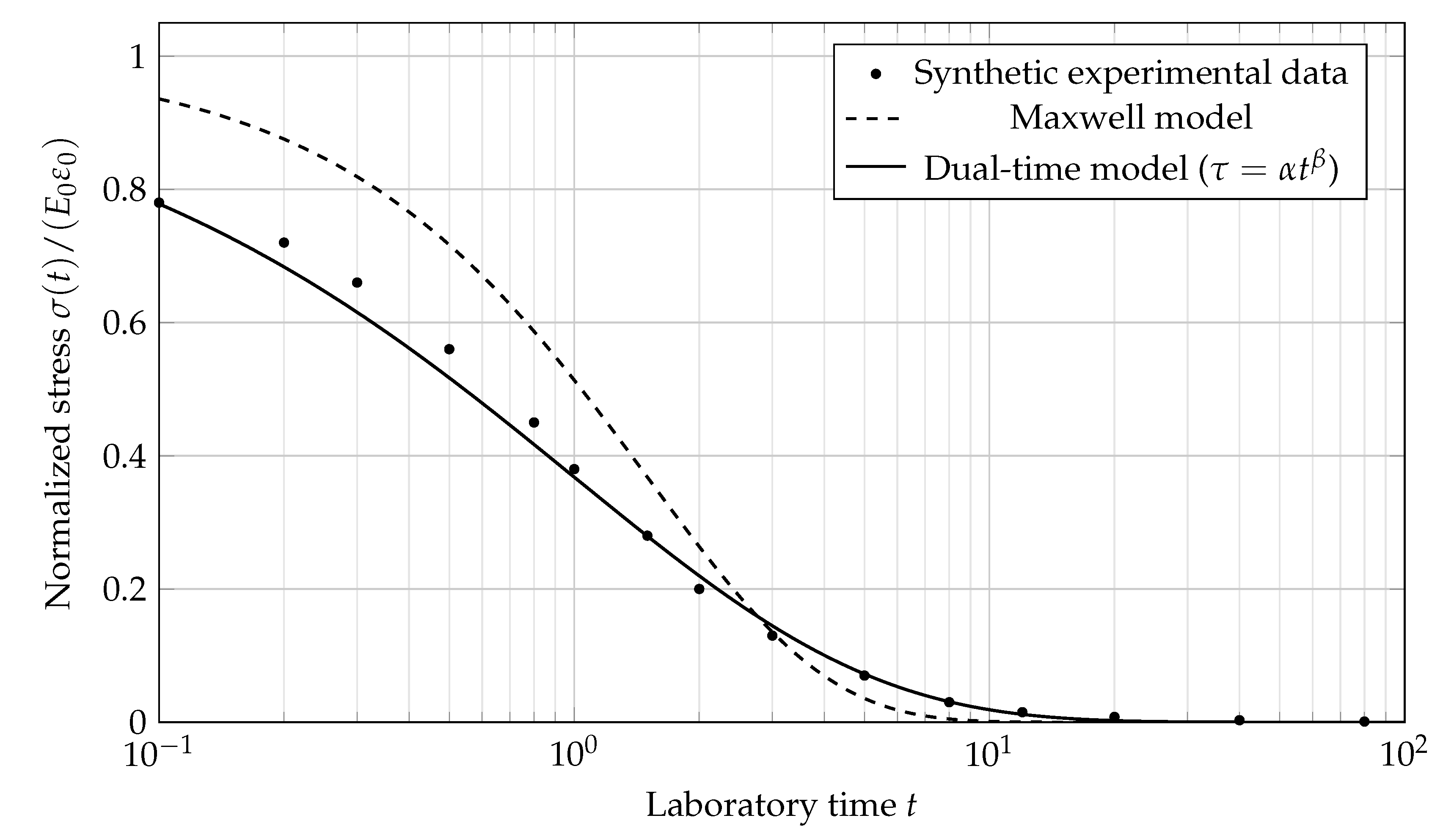

Table 1.
Model comparison for stress relaxation fitting. The dual-time model with nonlinear irreversible time evolution provides the best fit, as indicated by lower AIC and BIC values, while also capturing aging behavior through the sublinear exponent .
Table 1.
Model comparison for stress relaxation fitting. The dual-time model with nonlinear irreversible time evolution provides the best fit, as indicated by lower AIC and BIC values, while also capturing aging behavior through the sublinear exponent .
| Model | Parameter | Value |
|---|---|---|
| Maxwell | ||
| AIC | ||
| BIC | ||
| Dual-time (Linear ) | ||
| 1 | ||
| AIC | ||
| BIC | ||
| Dual-time (Nonlinear ) | ||
| AIC | ||
| BIC | ||
| Best Fit? | Yes |
Disclaimer/Publisher’s Note: The statements, opinions and data contained in all publications are solely those of the individual author(s) and contributor(s) and not of MDPI and/or the editor(s). MDPI and/or the editor(s) disclaim responsibility for any injury to people or property resulting from any ideas, methods, instructions or products referred to in the content. |
© 2026 by the author. Licensee MDPI, Basel, Switzerland. This article is an open access article distributed under the terms and conditions of the Creative Commons Attribution (CC BY) license.
Copyright: This open access article is published under a Creative Commons CC BY 4.0 license, which permit the free download, distribution, and reuse, provided that the author and preprint are cited in any reuse.


