
Submitted:
26 January 2026
Posted:
27 January 2026
You are already at the latest version
Abstract
Learning media in the era of Society 5.0 has undergone considerable and rapid development. Previously, teachers delivered learning materials through non-digital media, such as books or through direct teacher-student interaction in the classroom. However, in this era of globalization, the learning process now has a wider range of reference sources to prevent monotony. Nowadays, character values can be taught more easily and enjoyably, not only through classroom and social learning, but also through films. Therefore, various subjects, especially character values, may be difficult to absorb properly. Therefore, the film Merah Putih (2009), set in a historical context and depicting the values of struggle and patriotism, can serve as an alternative learning medium for students in Pancasila Education. This research aims to explore the nationalist values contained in Merah Putih through a postcolonial analysis, focusing on the relationship between indigenous people defending their independence and the Dutch colonialists. Postcolonialist theory served as a reference in the analysis of the Merah Putih manuscript and interviews with the filmmakers. The results indicate that the film aims to educate, both implicitly and explicitly, about the values of national character.
Keywords:
film
; learning media
; postcolonial
; Indonesia
; Dutch
1. Introduction
TTraditional learning environments often place the teacher at the center of learning, with the teacher as the primary source of information and students in a passive role as mere recipients (Minalla, 2023; Sukasih et al., 2020). This approach is no longer relevant because it can limit student engagement in the learning process. This can hinder the development of critical thinking, creativity, and problem-solving skills (Sukasih et al., 2020; Garrick, 2018; Bahadur & Akhtar, 2021). When students listen and take notes, their participation in meaningful discussions or interactive learning activities tends to decrease, resulting in a lack of deeper engagement (Garrick, 2018). The flipped classroom approach has been widely implemented in various educational contexts, particularly during the COVID-19 pandemic when online learning dominated educational activities. Learning media such as films can significantly enhance the impact of the flipped classroom approach. Video-based learning can improve student learning outcomes and active participation compared to entirely in-person learning (Riza, 2024).
The benefits of classroom learning with audiovisual media stimulate students’ thinking, helping them better understand the material. Several previous studies have shown that the use of audiovisual learning media in teaching can increase student motivation and engagement. A study by (Chen & Chuang, 2021) showed that students who learned through video lessons showed a 25% increase in material comprehension compared to traditional teaching methods. Using audio-visual media in education has been proven effective in increasing student motivation and engagement. This media makes learning more engaging and helps students better understand the material (Nuraini, 2023).
Current learning methods are widely stimulated through a variety of learning resources. Take, for example, President Prabowo's 2025 policy. The government provided smart TVs to schools to address teacher shortages in remote and isolated areas. President Prabowo argued that with smart TVs, teachers would be able to present more engaging learning materials without the constraints of distance (Faturahman, 2025). However, the rapid advancement of technology has also led to the displacement of existing societal values. Foreign cultural values can erode the Indonesian nation's ideology, Pancasila. People now prefer learning foreign languages over Indonesian, especially regional languages. An identity crisis is a significant problem for this nation. Knowledge of other countries seems more interesting than discussing one's own country. Furthermore, the development of divisive ideologies that prioritize the needs of one's own group or region over those of other groups within the Indonesian nation can divide the nation. Because the destruction of a nation begins with the decline of its character, even though this weakness/destruction can be temporarily covered up by external progress and external strength, it is basically no longer "rooted" in the soul of the nation (Mustari, 2011).
One way individuals learn about character is through school. Character education aims to shape attitudes and instill values/norms in individuals. In schools, character education is taught through Pancasila Education (PP). PP subjects teach the importance of norms and the application of attitudes such as politeness, honesty, mutual cooperation, responsibility, national defense, patriotism, love of the homeland (nationalism), and much more. Therefore, in this rapidly developing world, people still lack awareness of the importance of patriotic values. This is possible because love for one's country can be understood through, among other things, film, which can be used as a learning medium, both directly and indirectly.
Due to modern developments, the field of education can teach patriotism in a more flexible and engaging way. An alternative medium for conveying national values is film. Film, easily perceived visually, is highly influential in conveying national values and attitudes through mobile devices and television broadcasts. This alternative learning model breaks up monotony and allows students to exchange opinions through reports of what they watch. Because film is a medium for conveying moral messages and norms that are easy for the mind to process and understood by various groups, it combines visuals and audio.
Character values can be indirectly embedded in a film and significantly influence its audience. This is due to the filmmaker's ideological elements, namely: cultural, social, and psychological elements, the film's language delivery, and elements that engage or stimulate the audience's imagination. From there, a film's ideology will penetrate society. Ideology is a system of ideas expressed in communication. According to Jorge Larrain in Nurpratikno, ideology is divided into two meanings: first, ideology is perceived positively as a worldview that articulates the values of a particular social group to defend and advance its interests. Second, negatively, ideology is seen as a form of false consciousness, namely a need to perpetrate deception by distorting people's understanding of social reality (Nurpratikno, 2014).
According to (Costa, 2018) recent summary of the debate on the importance of patriotic education, published in the International Handbook of Philosophy of Education, makes a series of distinctions that are useful for understanding some differences between countries, but does not provide sufficient clarity for readers from a post-colonial perspective. She begins by distinguishing between the possible objects of patriotic/nationalist attachment. He distinguishes between attachment to an institutionalized political system, which he calls ‘patriotism’.
Education has an image of being serious and rigid, but people are more interested when character values are presented through film. Because films capture existing realities or central issues in society and project them onto the screen, they can also bring viewers into the experience of the actors/players in the story (Kuswandi, 1996). The experience of watching a film requires precise depictions during filmmaking, which are incorporated into the narrative. Character education need not be monotonous. Character education can also be achieved through film, a medium for conveying messages from directors and producers who wield significant influence over society. Therefore, the right storyline and message are the ideas of the filmmaker, who has a specific purpose in each creation.
In the film Merah Putih, the fighters are depicted in difficult times during the Dutch military aggression in Indonesia in 1947. The film Merah Putih is an Indonesian historical fiction drama released in 2009 and the first part of the "Trilogi Merdeka" series, the first trilogy of struggle films in Indonesia. This film was directed by Yadi Sugandi and released with the slogan "For freedom they unite". This film stars, among others, Lukman Sardi, Donny Alamsyah, Darius Sinathrya, Zumi Zola, Teuku Rifnu Wikana, Rahayu Saraswati, Rudy Wowor, and Astri Nurdin. Merah Putih was released in cinemas nationwide on August 13, 2009, in the Bioskop 21 and Blitzmegaplex networks (Tribunnews, 2019). This film highlights the struggle of Indonesian fighters against the Dutch and their allies on the grounds of wanting to take prisoners of war and still trying to control Indonesia after Japan's surrender to the Allies. The character values of patriotism have served as the foundation for preserving independence, a theme depicted in the film "Merah Putih." The plot further demonstrates the great and magnificent struggle of the Indonesian nation. The cooperation and struggle of every person who died on the battlefield was a priceless price for the lives of every Indonesian citizen, forevermore.
Through this film, the author aims to describe hybrid identity in postcolonial theory, focusing on the idea of nationalism. According to Young, nationalism is "a kind of language," a form and a strategy. Ideology is often associated with this strategy, especially during the anti-colonial struggle, so that nationalism can combine cultural diversity and the diversity of tribes for a purpose, and then build a sense of nationhood after independence. (Young, 2001). So this study has a problem formulation: how is the depiction of the Pancasila nationalist discourse in the 2009 film Merah Putih?
2. Theoritical Framework
Since the 1990s, philosophers of education have engaged in debates over curricular moves aimed at instilling a sense of national identity among pupils. These debates have often emerged in response to curricular changes in the teaching of national history, national literature, or civic values (R. A. Azada-Palacios, 2022). The resurgence of far-right movements and the nationalist shift of many governments around the world (e.g., in the United States, Brazil, Japan, and India) have made the topics of previous debates relevant again in many contexts. However, the terms of these previous discussions have not been formulated universally. Given the geographic location of most scholars involved in these debates, these discussions usually assume Western and Eurocentric conceptions of nationhood and national identity as fixed, which are not very useful in other contexts, especially in the post-colonial era.
Therefore, the importance of teaching the concept of nationalism in the context of a nation’s shared identity is emphasized. In this study, the character of nationalism was described in the early post-independence period, which emphasized cultural identity as a unifying force for the nation. Postcolonial studies examine the various consequences of colonialism, both during the occupation period and after the colonizers have left the colony, yet colonial culture and influence persist. Colonization, in essence, is not merely the practice of one nation to control another nation's territory through war and violence, but also through political, cultural, and economic hegemony that persists to this day (Fajar, 2011: 180).
Postcolonialism is generally defined as a theory that emerged after most formerly colonized countries achieved independence. Postcolonialism reflects an awareness of and a critique of colonialism. The postcolonial approach also draws on disciplines such as philosophy, cultural studies, politics, literature, the social sciences, sociology, and feminism. This theory provides an important perspective on the impact and consequences of colonialism, as well as on critiquing colonial discourse itself (Anggraini, 2019).
In the post-independence era, the foundation of togetherness established by the nation's founders faced challenges such as declining public morality, the erosion of nationalist values, neglect of national identity, increasing inter-ethnic, racial, and religious conflict, and the growing threat of national disintegration. National integration is crucial to a nation’s development and survival, especially in the early days of independence. By viewing the nation as a community, all members are responsible for its security and development (Hyunju Lee, 2021). For (Bhabha, 1994) the concept of hybridity reveals that cultures not only mix but also transform one another, a process we can call ‘cultural mixing', so that the analysis of the film through the postcolonial concept can describe the process of cultural mixing, which does not hinder the integration of the nation through national identity in this film. This integration then sparks nationalism based on solidarity. Therefore, this film depicts citizens as a community loyal and devoted to the nation and recognizing the identity of each region as a unifying force.
Studies on the struggle for independence show that it was often preceded by increased expression of indigenous culture (identity) to affirm or strengthen the colonized nation's cultural identity, as a means of eliminating the hegemony of the colonizer's culture. This is the critique of postcolonial thought on identity representation: prioritizing or restoring an oppressed culture as the true identity of a nation once influenced by imperial processes (Lutfi, 2024). Therefore, in the post-independence era, maintaining independence can be considered a form of nationalism, as individuals and the collective, especially in Indonesia, must re-fight the colonizers who seek to re-dominate their former colonies.
Then, in the post-independence struggle, there is an attitude of patriotism that can foster a sense of love for the homeland, which is part of nationalism in the lives of society, the nation, and the state (Nursamsi & Jumardi, 2022). In the film Merah Putih, the Indonesian people's struggle with the spirit of nationalism transcends ethnicity, religion, age, gender, or social status. This film has many moral messages that can trigger the spirit of every Indonesian, including the actors. Considering the plot of this film is a historical event about the struggle for independence. Student who have been greatly affected by globalization and fairly rapid social mobility can be something that can educate the public about the meaning of an attitude of sensitivity, sacrifice, unity between fellow human beings, love of the homeland, defending the country, patriotism, tolerance, diversity, mutual trust, and becoming a person who can better understand the meaning of history and the value of the Unitary State of the Republic of Indonesia is a non-negotiable price as their national identity. According to (Miller, 2007) posits that national identity is, for most, an essential component of personal identity; therefore, many students come to school with some degree of a sense of belonging to their nation.
Film is a cultural product separate from literary works, but it has a narrative dimension, namely a story that can be analyzed from a literary perspective. Film is a literary work, but it has dimensions that can be brought closer to or linked to literary studies. Films have genres that become distinctive characteristics of their screenings. The unique issues raised can attract audiences to the film; they can be based on a person's true story or the author's imagination (Marsyanda & Suryani, 2025).
In the context of colonialism, this film reveals the dynamics of power, social injustice, and the struggles faced by colonized communities. This film authentically depicts the struggle to maintain independence, highlighting community solidarity and cultural diversity as a national identity. Through the depiction of the main characters and their interactions with the surrounding environment, this film shows resistance to colonial power through unity in society. Therefore, in audio-visual-based learning, it is suitable when combined with learning techniques such as Discovery Learning, Inquiry Learning, Contextual Teaching and Learning, Value Clarification Technique, and Problem-Based Learning. It will be very suitable to describe the value of nationalism not only in the context of learning history, but also in terms of the attitude and character of nationalism in Indonesia.
3. Method
The methodology of this research, as indicated by its title, is descriptive qualitative research. Qualitative analysis emphasizes the analysis of process and meaning. The research process used is based on theories relevant to the problems discussed in this study. This study uses content analysis to examine the character values in the film Merah Putih (2009) and presents the findings descriptively and explanatorily. The content analysis approach can be used to analyze objects in various forms of communication, including print, news from radio, video, television, and other forms of documents. Analysis is used to pay attention to and interpret communication delivered through print and digital media. The meaning of communication in content analysis is seen from the content of communication, both verbal and non-verbal, through text analysis.
According to Bernard Berelson, as cited in Jalaludin Rahmat, content analysis is: "Content analysis is a research technique that for the systematic and objective of the manifest content of communication..." (Rahmat, 1999). The content analysis approach is a systematic, objective technique for researching communication content. Then, content analysis in qualitative form is divided into four types of approaches, the first is discourse analysis which focuses on particular phenomena presented by the author of the text, the second is rhetorical analysis which focuses on how the message is delivered and its impact both in the short and long term, the third is ethnographic analysis which leads to qualitative anthropology and the fourth is conversation analysis, namely the analysis of sound recordings which are analyzed into collaborative construction.
Figure 1.
Research Conceptual Framework by Author.
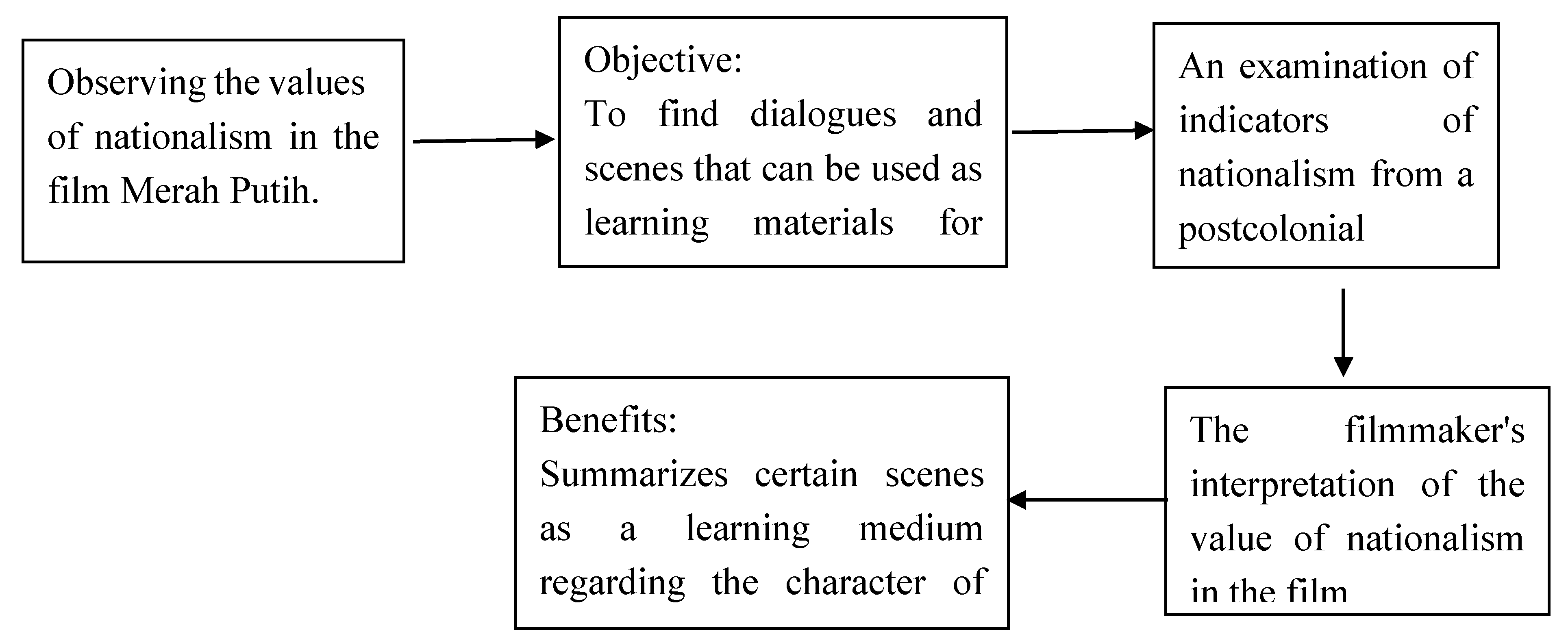
This research was conducted by observing, recording, and seeking meaning from the script of the film Merah Putih as the primary data, video transcripts of reunion interviews with the cast of Merah Putih, and interviews with the cast and associate producers of Merah Putih as additional supporting data. Therefore, the researcher used content analysis, which led to relational content analysis. In other words, the ideational core is a symbol that gains meaning through its connections to other symbols. Content analysis is usually used for verification analysis. Research involves paying attention to specific symbols, classifying data according to specified criteria, and then making predictions based on the analysis.
The text analysis used to study the dialogues in this study is a branch of text semiotics that specifically examines text as a product of language use in the form of a collection and combination of signs. Thwaites describes the model for text analysis as follows:
Figure 2.
Thwaites model analysis (Piliang, 2004).

Research that pays attention to certain symbols, classifies the obtained data using certain criteria, and then makes predictions based on the data analysis. This process involved collating data relevant to each code and theme. Such codes and themes can, generally speaking, be identified in an inductive (data-driven) or deductive (theory-driven) manner (Braun and Clarke 2006). This can be seen in the following chart.:
Figure 3.
Figure 3. Research data analysis process by Author.

4. Result
The film "Merah Putih" is a historical fiction drama film set against the backdrop of the First Dutch Military Aggression in 1947. Directed by Yadi Sugandi, the film was written by Connor Allyn and Rob Allyn. The 108-minute film stars several well-known Indonesian actors, including Darius Sinathriya, Lukman Sardi, Doni Alamsyah, Teuku Rifnu, Zumi Zola, and many others. The film premiered in Indonesian cinemas on August 13, 2009, with Indonesian as the primary language.
The film Merah Putih tells the story of the struggle of five Indonesian fighters amidst the Dutch onslaught during the first military aggression in 1947. These fighters all have different backgrounds, ranging from professions, tribes, races, statuses, and religions; their differences are stark. The five people are Amir (Lukman Sardi), Marius (Darius Sinathriya), Thomas (Donny Alamsyah), Zumi Zola (Soerono) and Dayan (Teuku Rifnu). The story in this film begins with them registering to enter the dormitory to become officers. They must train and work hard every day to prepare themselves to guard the newly independent country. During their time in the dormitory, Thomas and Marius often quarrel. During their time at the academy, they are trained in discipline, ranging from weapons use and self-defense to physical training and map reading.

Table 1.
List of cast and characters of the film Merah Putih.
| Number | Actor/Actress | Role | Character |
|---|---|---|---|
| 1 | Lukman Sardi | Amir | Protagonist |
| 2 | Darius Sinathrya | Marius | Protagonist & Antagonist |
| 3 | Donny Alamsyah | Thomas | Protagonist |
| 4 | Zumi Zola | Soerono | Protagonist |
| 5 | Teuku R. Wikana | Dayan | Protagonist |
| 6 | Rahayu Saraswati | Senja | Protagonist |
| 7 | Astri Nurdin | Melati | Protagonist |
| 8 | Rudy Wowor | Mayor Van Gaartner | Antagonist |
| 9 | Joe Sims | Sersam De Graffe | Antagonist |
| 10 | David John Watton | Kapten Schaeffer | Antagonist |
| 11 | Suharto | Kapten Taufik | Protagonist |
| 12 | Denis | Riman | Protagonist |
| 13 | Anto Galon | Topan | Protagonist/Antagonist |
| 14 | Kholig P | Gunaryo | Protagonist |
| 15 | Hengky Solaiman | Ayah Thomas | Protagonist |
4.1. Subsection
After diligently training at the academy, Amir and Soerono were promoted to lieutenant by Captain Taufik. Shortly after completing their training at the academy, they were treated to a party where they reunited with their families, and those looking for partners were allowed to do so that night. However, while the party was in progress, Dutch troops launched a surprise attack from the forest. Those who had just graduated as officers had to immediately evacuate the people there and prepare for war with the Dutch that very night. They fought with all the troops and all the weapons they had. Until Soerono realized that his brother could not be found, he left his troops to look for him. Realizing that their troops were defeated at that time, Amir ordered the troops to retreat, but Soerono was still nowhere to be found, which finally led Thomas to look for Soerono because they accidentally met Senja, Soerono's sister.
It was already midday, and the remaining troops had gathered at the river. Marius, who arrived, felt depressed and wanted to leave immediately, but was refused by Lieutenant Amir. Marius was caught leaving Soerono alone when he was shot in the forest, so Marius and Thomas argued again. Gunfire suddenly rang out because their troops had been spotted by the Dutch, who were combing the river. Lieutenant Amir asked half of his troops to leave and the other to hold back so that the Dutch would not reach the nearby village immediately. Dayan warned the villagers to evacuate immediately, while Thomas and his friends stole Dutch weapons. The villagers flatly refused Dayan and Amir's invitation to evacuate, so they left without any villagers. Shortly after, the Dutch killed all the villagers and continued to pursue the remaining Indonesian troops. After a while, they gathered the remaining troops. Then Amir asked his wife to return temporarily to her mother's house by sunset.
Amir took the remaining troops to see the village and saw that it had been destroyed by the Dutch. Almost everyone was dead, leaving only the survivors who were in the fields. They, through the remaining residents, devised a strategy to counterattack the Dutch. They planned to intercept the logistics vehicles carrying gasoline for the Dutch trucks. They prepared for the Dutch arrival by intercepting them at the bridge. Many local villagers were invited by Mr. Gunaryo to join the fight against the Dutch, and a major battle ensued between the Dutch troops and the remaining local residents. Many Dutch casualties fell due to the sudden attack. Eventually, the Dutch were defeated, and all their logistical supplies were burned.
4.2. Construction of Nationalism after Indonesian Independence
In studying ideology as national identity, the criteria for nationalism can be applied to the attitudes and values of nationalism examined in the film Merah Putih, which focuses on several points, including pride in the love of the homeland and a willingness to sacrifice for the nation.
4.2.1. The Struggle to Defend the Country
The sacrifices of the Indonesian people in the post-independence period were no less severe than those during the struggle for independence from Japan. The enormous sacrifices, including lives and property, are clearly visible from the beginning of the film. This begins with documentary footage of the Dutch aggression during the Dutch East Indies, with the allies attempting to reoccupy the Dutch East Indies, and the murder of Thomas's family, leaving him with nothing. The findings section presents dialogues that demonstrate the willingness and efforts of both officers and civilians to sacrifice for the nation's interests. This is evident in a dialogue fragment from a sudden battle between Indonesian and Dutch troops that occurred after the officers graduated from the academy. Lieutenant Amir, seeing the situation as hopeless, orders his troops to retreat. A different story is seen when Captain Taufik urges them to fight the invaders to the death. In scene 26, Captain Taufik says, "And surrender our country to the Dutch? They have no right to anything from us. Come on, attack, Merdeka, or die! Forward!"
Captain Taufik, their leader and trainer at the academy, always taught them to be totally committed to defending their country and nation. This was evident, even until the very end, when Captain Taufik sacrificed his life and body for the Indonesian people. Their fallen trainer motivated them to persevere and plan a counterattack against the Dutch forces. Riman, Amir's student, also set an exemplary example during his time as a teacher. He joined the youth movement that directly resisted the Japanese invaders and was ultimately killed by indiscriminate Japanese fire. Riman's message to Amir is deeply ingrained, as in the following dialogue: "How can you teach when others are fighting for your freedom, too?" (Riman)
This dialogue between Riman and Amir demonstrates that the struggle we experience today is the result of the sacrifices of fighters of all ages and professions. Whether young or old, everyone joined in the struggle for national independence. It is hoped that, by portraying the heroes in the film "Red and White," the public, especially the younger generation, will understand that the struggle is not solely the responsibility of adults or older people. Rather, the spirit of nationalism can be understood and practiced by anyone, at any time.
Table 2.
Scene 5 part 2.
| Dialogue | Connotation | Denotation |
|---|---|---|
| Amir: How can I call myself a man if I don't fight? (Duration 7':33" - 7':37") |
Amir tried to convince his wife to become an officer, despite his background as a high school teacher. Amir believed that an independent Indonesia was worth fighting for, especially since he needed to protect his family and many others. | On the terrace of his house, Amir continued to convince his wife that he could join the struggle by becoming a candidate officer to fight against the colonialists. |
| Analysis | Amir's dialogue convinced his wife to believe in the struggle, including the methods he used to provide understanding and explanation. Amir attempted to present arguments to build his wife's confidence that the struggle he was undertaking for the nation was crucial at that time. | |
Table 3.
Scene 26.
| Dialogue | Connotation | Denotation |
|---|---|---|
| Captain Taufik: Listen! With God's blessing, nothing can stop us. Amir: With great respect, sir, we must retreat to the river and hold our ground there. Captain Taufik: And surrender our country to the Dutch? They have no right to anything from us. Let's attack Merdeka or die! Advance! (Duration 51':40" – 51'-59") |
In a tight spot as the Dutch continued to attack the Indonesian troops, Captain Taufik, their trainer at the academy, tried to convince them that they could definitely win the battle as long as they relied on Allah. | The sudden battle with the Dutch in the forest at night weakened the Indonesian army, resulting in many casualties that night. Among the remaining People's Army troops, Amir's forces encountered Captain Taufik's forces. |
| Analysis | According to the author, Captain Taufik's direct dialogue inspired the fighters and the audience. The character-building methods demonstrated included exemplary behavior and appreciation. Captain Taufik then advanced to the battlefield after providing an understanding of the struggle and setting an example for his students, willingly giving his life for the Indonesian nation. | |
Table 4.
Scene 36.
| Dialogue | Connotation | Denotation |
|---|---|---|
| Amir: Riman! Lately, I've noticed you've been daydreaming and skipping school. And I see your hands are covered in bruises and scars. Riman: I joined the youth movement, sir! (Duration 1:17:28-1:17:47) |
In Lieutenant Amir's flashbacks, it's clear that the reason he became an officer was because of the exemplary attitude and actions of his student, Riman. Despite his youth, his determination, passion, courage, and hard work for the nation were evident. | Amir flashback to his student Riman's fighting spirit in class while he was teaching high school students. Amir asks about Riman's scar, but Riman wisely answers that he fought for the Indonesian nation through the youth movement. |
| Analysis | Riman's participation in the youth movement served as an example for Amir, leading him to diligently practice to maintain independence, despite his youth. Modeling and appreciation are often not limited to elders or teachers; teachers can also learn positive lessons from their students' progress, fostering a reciprocal learning process. | |
Table 5.
Scene 39.
| Dialogue | Connotation | Denotation |
|---|---|---|
| Riman: How can you teach when others are fighting for your freedom too? (Duration 1:18’-25”-1:18’:30) |
After his flashback, Lieutenant Amir recalled Riman's words from his time. That the struggle to maintain independence must be fought together and in collaboration. If others are fighting, we must also fight. Not just waiting and remaining silent while the country is in trouble, but also taking an active stance is necessary to achieve more tangible results. | Back to the present when he was in the middle of the forest but Amir was still haunted by Riman's voice which was still in his memory about his student's question. |
| Analysis | The method of character-building for nationalism demonstrated in Riman's dialogue is by providing Amir with an understanding and role model of the importance of struggle for each individual. It's noteworthy that Riman tells his teacher, who also had the same obligation as himself, that participating in the youth movement was also a form of exemplary behavior by fighting to the last drop of blood. Therefore, the struggle belongs not only to the young or the elderly, but to everyone who desires to live freely in this country. | |
Table 6.
Scene 44.
| Dialogue | Connotation | Denotation |
|---|---|---|
| Amir: What about you, sir? Are you willing to fight the people who killed your wife? Gunaryo: I'd be offended if you didn't ask me to join. (Duration 1:30':25"- 1:30':30) |
The remaining troops from their academy were very few, and their weapons were extremely limited. Furthermore, the endless number of Dutch troops hampered their progress. When inviting Mr. Gunaryo (the remaining villager) to join the fight, this demonstrated that the struggle was not solely for officers; civilians also played a role in resisting the invaders. | The remaining People's Army troops regrouped in the forest and discussed plans to counterattack the Dutch, accompanied by local residents who had survived the massacre. |
| Analysis | This demonstrates Lieutenant Amir's leadership qualities, acquired during his time at the academy. He encourages citizens to stand in solidarity and sacrifice for the nation. The character-building method used is understanding and explanation. Mr. Gunaryo's willingness to participate emphasizes the importance of all levels of society participating in the struggle to maintain independence and supporting one another (gotong royong). | |
4.2.2. Culture and Identity
Patriotism in Indonesian society is closely associated with the third principle of Pancasila. Unity is sought for all people without discrimination. This patriotism, grounded in the other principles of Pancasila, serves as a guide for those who possess it. The depiction of Pancasila in the film clearly demonstrates that from the moment they enlist as officers, they come from diverse ethnicities, cultures, and social backgrounds.
Table 7.
Scene 13.
| Dialogue | Connotation | Denotation |
|---|---|---|
| Soerono: Our children will fight against the farmers of Java and Sulawesi. Who will win? The Dutch! (Duration 28:13 – 28:36) |
Marius and Thomas had been constantly bickering over trivial matters since they first enrolled at the academy. This was due to their differences in social status and ethnicity. It was a commonplace in the early days of the republic. But Soerono's leadership emerged when, in a chaotic situation, while others simply watched, he stepped forward to reprimand the two men. | Soerono tried to break up a fight between Thomas and Marius, which stemmed from their unresolved dispute earlier that day. That night, the barracks became too chaotic, as Marius and Thomas refused to reconcile, even though Thomas had been punished by digging ditches and not eating dinner. |
| Analysis | Soerono, witnessing their argument, attempted to intervene, as their seemingly endless bickering continued. The character-building method that emerged from Soerono's dialogue was one of reprimand and sanction. According to the author, Soerono's intention was to reprimand and discipline the impulsive behavior of Thomas and Marius. He also intended to raise awareness among all officers that they were on the same side, namely Indonesia. The reprimand was delivered in short, clear terms. Thus, Soerono conveyed the message that unity is a sign of belonging to the nation. | |
Table 8.
Scene 16.
| Dialogue | Connotation | Denotation |
|---|---|---|
| Soldiers (Singing): Independent Indonesia! Republic of Indonesia~ (Duration 30':39" -30':47") |
Their daily training, using weapons and even physical exercises like running, is accompanied by the national anthem from the film's music director. In this scene, the prospective officers run while singing the national anthem and cheering. The training, performed with the national anthem, aims to convey the characters' enthusiasm to the audience. | Running is part of the training for these prospective officers. During their time at the academy, they are shown running while singing the national anthem "Indonesia Merdeka Republik Indonesia!" (Cheers for Joy) while running around the camp, carrying the Red and White flag. |
| Analysis | From the author's perspective, the method used to instill the warrior character through their training was through habituation. This strengthened their daily training spirit, fueled by the habit of singing songs about the dream of 100% independence for their beloved nation. All their struggles on the battlefield were possible thanks to their perseverance and habituation in their training. | |
Table 9.
Scene 43.
| Dialogue | Connotation | Denotation |
|---|---|---|
| Marius: Overcome them? Have you forgotten what happened yesterday? Thomas: Are you going to hand this country over to the Dutch? Is that what you want? (Duration 1:28’:20” – 1:28’:35”) |
Marius explained the Dutch's planned scheme to divide the Republic and weaken Indonesia's defenses. Thomas's courage prevented him from surrendering without confronting the Dutch troops. | Amir's troops inspected the nearby village they had warned about. It turned out the village had been ravaged by the Dutch, with almost no survivors, except for those who weren't there at the time. Amir then questioned the surviving villagers about where the Dutch might have gone. |
| Analysis | Thomas's unyielding attitude, according to the author, is a form of nationalism that fosters a sense of shared obligation to safeguard the nation, so unity and opinions must be aligned from the start. Character formation compels Marius to join the struggle, even in urgent situations. The method that emerges from Thomas's dialogue is a method of reprimand. Because Thomas questions Marius's value of willingness to sacrifice for the nation, which is not total, his behavior is considered deviant, namely giving up so quickly. | |
Table 10.
Scene 52.
| Dialogue | Connotation | Denotation |
|---|---|---|
| Lieutenant Amir: I'm a teacher, he (pointing at Thomas), he's your farmer who slaughters! We're just little people who want to live in peace in our own country! (Duration: 1:43':34" – 1:43':53") |
Lieutenant Amir threatened Major Van Gaartner's life by killing one of the remaining Dutch soldiers. This caused Major Van Gaartner to feel that the Indonesian troops were not soldiers but butchers. Amir was angry that the Dutch only cared about themselves while many more Indonesian civilians died during the Dutch Military Aggression. This led to people of all professions taking up arms against the colonialists in their own country. | The People's Army defeated the Dutch end route to their headquarters. Lieutenant Amir then demanded that the Dutch troop leader, Major Van Gaartner, name the location of their logistics delivery. They threatened him with the death of the only surviving Dutch soldier. The Dutch troop captain then declared the People's Army to be butchers. |
| Analysis | According to the author, the character values developed through this dialogue utilize internalized values in character formation, demonstrated through harsh reprimands and sanctions. Furthermore, the characters' basic understanding of their struggle to achieve peace in their own country, free from colonial rule, is evident. Amir points out that he and his friends were forced to do so in order to live peacefully in their own country. | |
The characters of Marius and Thomas in the film "Merah Putih" (Red and White) create numerous conflicts not only for themselves but also for their friends. It's no surprise that their fights and quarrels make their training and rest conditions inadvisable. Characters like Soerono, Marius's close friend, demonstrate wisdom by mediating and reminding Marius not to constantly compete with Thomas. Soerono realizes that if they aren't united, facing enemy forces will be difficult. For example, in scene 13, Soerono intervenes between Thomas and Marius during a fight in the barracks with the following dialogue: "City boy versus farmer, Java versus Sulawesi. Who will win? The Dutch!" Soerono understands that they are at war, and unity is crucial for victory. He also understands that they all come from diverse ethnicities and backgrounds. His assertiveness demonstrates that, while you may come from different backgrounds, if you clash, the winner will not be Indonesia but the Dutch.
During their time at the Academy, they are required to develop discipline to prepare themselves for the harsh battlefield. Their training, in addition to physical training, agility, and mental toughness, also involves lectures on struggle and frequent singing of the national anthem during their training sessions, as seen in scene 16. The daily training of these prospective officers is continuous and well-structured, building physical strength and learning defense techniques against enemies at both long and close range. Listening to and singing the national anthem also fuels their enthusiasm. This motivates them to train and prepare for combat.
Seemingly trivial actions, such as breaking up fights or disputes, demonstrate a sense of responsibility in maintaining peace. Furthermore, the value of unity inherent in setting aside personal egos for a greater or better common goal can be achieved. It is hoped that, through the example of understanding the unity and essence of the national spirit of the characters in the film "Merah Putih", the audience can foster a more peaceful, calm social life.
In essence, teaching patriotism in schools has both positive consequences, in which students can interpret national defense as a spirit of love for the country, and negative consequences, such as students who uphold the country while denigrating other cultures. One classic solution to this tension is to distinguish between ethnic nationalism, which is depicted as potentially dangerous and a source of unjust or illiberal actions towards others because of its essentialism, and civic nationalism, which is described as more in line with liberal values. There is a growing consensus among theorists that discussions of nationalism must go beyond the civic/ethnic dichotomy; however, the usefulness of the dichotomy remains evident in its continued use in educational research on national identity and nationalism in schools (e.g. Hung, 2014; Ozga, 2017; Siebers, 2019). Therefore, the character to be formed must be directed by the teacher so that the desired character learning outcomes can be achieved in line with the target.
4.2.3. Script Construction in Pancasila Education Learning
- a
- Schematic
Schematics is the author's strategy for conveying messages by emphasizing certain parts first and then leaving them last. Overall, the film "Red and White" is divided into five parts.
- Part One: The opening of the film, which features a documentary depicting the conditions in Indonesia in 1947, when Dutch troops had taken control of parts of Indonesia.
- Part Two: The film begins with Thomas's family being killed by Dutch troops, with only Thomas managing to escape. The production company and the cast of "Red and White" are also mentioned during Thomas's escape. Thomas then flees to Java and attends a People's Army school.
- Part Three: Scenes 1 through 57. From the beginning, the film's story is explained, as the People's Army undergoes rigorous training and then resists the Dutch attempts to seize power.
- Part Four: Scenes 24-26 show the attack and resistance of newly inaugurated officers, who must be prepared to fight the Dutch, who suddenly attack and evacuate the visitors. Many officers are killed, including their trainer, Captain Taufik. Very few of the remaining People's Army troops survive, but the story continues as they plan a counterattack.
- Part Five: The film ends when the remaining People's Army troops, along with local residents, fight and sabotage a Dutch logistics vehicle. The Indonesian troops then triumph and capture Major Van Gaartner, who is taken to the Dutch headquarters with the remaining Indonesian troops.
- b
- Background and Details
Judging from the explanation and intent of the dialogues that have been described regarding the settings in Sulawesi and Java (the academy, the forest where they fought and hid, the valley, hill, and village where they fought). In addition to these places, events, and their attitudes in facing problems that arose during the fight against the Dutch are also described, including the impression described above, namely the dialogue of the characters. Then, in the microstructure, the attitudes that reflect the characters' traits are also explained in detail, such as Amir, who is a leader, prioritizes public interests, and demonstrates determination. Thomas, who is easily angered, is brave, likes to rush, but is not selfish. Marius is reckless, slow, likes to complain, and is fearful. Dayan is a mediator who loves peace, is loyal, and thinks of the interests of many people. Pronouns that have cultural meanings also appear, such as the words Mas (Term for Amir from Melati), Ngana (you in Manadonese), Syuksama (Thank you in Balinese), and wong cilik (little person in Javanese).
4.3. Construction of Nationalism from Filmmakers’Point of View
The author asked several questions regarding the values of nationalism in the film, including the script and his views on film and nationalism in education. From the beginning, this film was intended to raise young people's spirits of nationalism. According to (Yadi Sugandi, 2021), the film Merah Putih clearly depicts young people who become officers but are suddenly attacked by the Dutch. The author also asked for his opinion on the script, which was originally written in English by foreigners (Connor Allyn and Rob Allyn). However, he said that this was not a problem because the scriptwriters had already explored the meaning of Pancasila before writing the script. According to him, the problem would have arisen if he (an Indonesian) had not been the director.
This is because outsiders may not understand how to convey the values of Pancasila and collective life in Indonesia, given the vast cultural differences. According to Yadi Sugandi, the film "Red and White" is a highly suitable learning medium because fostering nationalism requires first understanding the country's history. Today's youth are sometimes indifferent to their country due to advances in the internet and technology, unlike in his time when nationalism was quite strong, and their focus was on their hometowns. However, today, borders between countries are no longer present, and foreign infiltration makes it easier for the younger generation to be influenced and undermine the nation's ideology. He also stated that fostering a sense of nationalism must begin within the family. By loving one's family through small groups, greater unity will emerge. Young people must remember that they have fellow countrymen throughout Indonesia. National life, grounded in Pancasila and Bhinneka Tunggal Ika, is the key to Indonesia's current unity and must be instilled in the younger generation.
On Monday, June 21, 2021, the author conducted a live interview with the actress who played Senja in the film Merah Putih at her office in Crown Palace, Tebet. Rahayu Saraswati is also an associate producer on Merah Putih. Rahayu Saraswati's grandfather is the older brother of the hero the film honors. From her perspective, the character of Senja initially lacked a nationalist character. This was due to Senja's past, where her parents died because of the villagers, leaving her devastated. The villagers called them Dutch stooges, which made her indifferent to Indonesia. The unexpected event when her younger brother died in Indonesia changed her understanding and harbored a grudge against the Dutch. Thus, the process she experienced, the social circumstances, and her participation in the war led her to develop a nationalist attitude and character shaped by her circumstances and desire for revenge.
Furthermore, during the process, Senja realized that people from various walks of life participated in defending the country. Although the concept of nationalism was not fully understood by all the fighters, they did know they were fighting for a common goal: freedom from colonialism. This film also teaches us about understanding the struggles of the heroes. It is very important for us to remember their services, but we must also remember those of our ancestors who fell even in the era long before independence. According to Mrs. Rahayu Sarawati, we can appreciate the heroes' services by fully understanding what they fought for. We must realize that the free life we have is made possible by the services of the heroes. Maybe now we are not as free, for example, in terms of finances, where some sectors are still controlled by foreigners, but the heroes have actually fought so that we can have the freedom today to determine our own life steps.
According to (Rahayu Saraswati Interview, 2021) because Indonesia still has limited films with themes and stories about the struggles of nationalists, this film is an important educational resource for the younger generation, especially in Civics. Although inspired by a true story, the characters and locations are not entirely accurate, but the film can inspire young people to emulate the nationalist character depicted in it. Rahayu Saraswati's message to the younger generation is that they will be inspired by the film's central message, Pancasila. She also describes Bhineka Tunggal Ika (Unity in Diversity), as conveyed by Soerono when separating Marius and Thomas in the barracks. "Whoever is happy when we are divided is the colonizer. If we fight among ourselves, the enemy wins." Furthermore, the fact that this film is based on a true story reminds us that the young people of that era fought for our freedom, and they are our relatives.
5. Conclusions
This section is not mandatory but can be added to the manuscript if the discussion is unusually long or complex. The values of nationalism contained in the film Merah Putih, after being reduced and analyzed, revealed that the characters exhibit a) Pride in the Indonesian nation, namely in any situation, especially during the struggle in the film's setting or in the current situation. This teaches that the contribution we give to the country will be very helpful, and that is a matter of pride. b) Willingness to sacrifice for the nation is shown by the courage and understanding of the characters about the essence of a struggle for the benefit of the country. c) A sense of love for the homeland or unity that shows the importance of unity to achieve victory against the enemy or achieve common goals. d) Accepting diversity, which means not discriminating, as exemplified by the progress of the cadets, but they work together to help each other crush the Dutch. e) Prioritizing public interests at any time and in any time prioritizing common interests is very important so that norms can continue to run and society can live well if they maintain peace together. 1. The influence of character values brought by this film on the student learning process, with the sensitivity of teachers to discuss the application of relevant nationalism values , can be applied in the present. The findings from observations of the film content and interviews, including influences on character learning, include: a) Grateful for Independence (Proud of the Indonesian Nation). Independence was obtained at great cost through the fighters' struggle. Awareness must also be taught that independence is not simply the result of our own efforts but a gift from God Almighty. Therefore, attitudes that can be adopted at this time are to apply cultural and social values through behavior such as mutual respect, being willing to help others, especially those who are struggling during the pandemic, and to distance oneself from the negative currents of progress. The attitude of Solidarity (Unity and Prioritizing Public Interests) is shown by the cadets, who are diverse yet still fight together. Because in modern times like now, Indonesian culture is quite a lot that should unite the nation and remain solid in facing obstacles such as Covid-19 and divisive ideologies c) Appreciating the Services of Heroes and Instilling Moral Values (Willing to Sacrifice for the Nation) The services of heroes will always be remembered, and we must always remember them. Heroes are living examples of the willingness to sacrifice their lives and bodies for the nation. This value must be preserved to strengthen the nation's foundations for future generations. Memories of our ancestors can inspire us to fight for the nation. Emphasizing this is expected to motivate students and teachers to adopt heroic attitudes. Teaching this can begin with small steps, such as maintaining a clean environment, working together, helping disaster victims, and more.
Acknowledgments
The corresponding author would like to express her sincere gratitude to the Ministry of Finance of the Republic of Indonesia and the Indonesia Endowment Fund for Education (LPDP) for providing the scholarship and financial support that made this research and publication possible. The corresponding author also thanks other authors for their cooperation in developing this article.
References
- Anggraini, A. E. Posmodernisme dan Poskolonialisme dalam Karya Sastra; Jurnal Bahasa Dan Sastra; Pujangga, 2019; pp. 59–70. [Google Scholar]
- Azada-Palacios, R. A. Hybridity and national identity in post-colonial schools. Educational Philosophy and Theory 2022, 54(9), 1431–1441. [Google Scholar] [CrossRef]
- Bhabha, H. K. The location of culture; Routledge, 1994. [Google Scholar]
- Braun, V.; Clarke, V. Using thematic analysis in psychology. Qual. Res. Psychol. 2006, 3(2), 77–101. [Google Scholar] [CrossRef]
- Costa, M. V. Smeyers, P., Ed.; Patriotism and nationalism. In International handbook of philosophy of educa- tion; Springer International, 2018; pp. 1389–1400. [Google Scholar]
- Chen, H.-L.; Chuang, Y.-C. The effects of digital storytelling games on high school students’ critical thinking skills. Journal of Computer Assisted Learning 2021, 37(1), 265–274. [Google Scholar] [CrossRef]
- Dj, Nursamsi; Jumardi, Jumardi. Peran Guru dalam Menanamkan Sikap Nasionalisme terhadap Peserta Didik Sekolah Dasar; Jurnal Basicedu, 2022; vol. 6, no. 5, pp. 8341–8348. [Google Scholar] [CrossRef]
- Fajar, Yusri. Negosiasi Identitas Pribumi dan Belanda dalam Sastra Poskolonial Indonesia Kontemporer. Jurnal Literasi 2011, 1(2), 178–186. [Google Scholar]
- Faturahman, A. A. Fakta-fakta Distribusi Smart TV yang Jadi Program Prioritas Prabowo; From TEMPO, 14 September 2025; Available online: https://www.tempo.co/politik/fakta-fakta-distribusi-smart-tv-yang-jadi-program-prioritas-prabowo-2069570.
- Garrick, R. Flipped classroom video analytics. ASEE Annual Conference and Exposition, Conference Proceedings, –June; ASEE, 2018. [Google Scholar]
- Huberman, M. Analisis data kualitatif buku sumber tentang metode-metode baru; Jakarta; UIP, 1992. [Google Scholar]
- Hung, C. Y. Teachers' perceptions of national identity in the English and Taiwanese citizenship curricula: Civic or ethnic nationalism? Research in Comparative and International Education 2014, 9(2), 197–212. [Google Scholar] [CrossRef]
- Kuswandi, W. Komunikasi Massa Sebuah Analisis Media Televisi; Jakarta; Rineka Cipta, 1996. [Google Scholar]
- Lee, Hyunju. John Dewey and Global Citizenship Education: Beyond American and Postcolonial Nationalism in an Age of Cultural Hybridity; Education and Culture, 2021; Vol. 37: Iss. 1, p. Article 9. [Google Scholar] [CrossRef]
- Lutfi, M. KAJIAN POSTKOLONIALISME SAJAK-SAJAK CHAIRIL ANWAR; Jakarta; EBIZ, 2024. [Google Scholar]
- Marsyanda, P.; Suryani, I. Hibriditas Tokoh Utama Ipuy dalamFilmLovely ManSutradara Teddy Soeriaatmadja Kajian: Poskolonial Homi K. Bhabha. Jurnal Pendidikan Bahasa 2025, 412–419. [Google Scholar] [CrossRef]
- Miller, D. On nationality; Oxford University Press, 2007. [Google Scholar]
- Minalla, A. A. The effect of shifting to student-centered learning: Implementing student-centered reading. Journal of Curriculum and Teaching 2023, 12(4), 107–115. [Google Scholar] [CrossRef]
- Mustari, M. NILAI KARAKTER: Refleksi Untuk Pendidikan.; Yogyakarta; Laksbang Pressindo, 2011. [Google Scholar]
- Nuraini, S. Bridging Theory and Practice: Implementation of Audio-Visual Media in Teaching. In AJME; 2023. [Google Scholar]
- Nurpratikno, R. REPRESENTASI REMAJA MODERN DALAM FILM TERRITORIAL PISSINGS (ANALISIS SEMIOTIK PADA FILM TERRITORIAL PISSINGS KARYA JASON ISKANDAR); 2014; p. 6. [Google Scholar]
- Ozga, J. Kantasalmi, K., Holm, G., Eds.; Education and nationalism in Scotland: Nationalism as a governing resource. In The state, schooling and identity: Education dialogues with/in the Global South; Palgrave Macmillan, 2017; pp. 25–40. [Google Scholar] [CrossRef]
- Piliang, Y. A. Seniotika Teks: sebuah pendekatan analisis teks; Mediator, 2004; pp. 198–199. [Google Scholar]
- Rahmat, J. Penelitian Komunikasi.; Bandung; Rosdakarya, 1999. [Google Scholar]
- Saraswati, Rahayu. ”Merah Putih Filmmaker Interview”. Privat Interview;Tebet. 2021. Available online: https://tinyurl.com/wawancaraIbuRahayuSaraswati.
- Riza, M. D. The Effect of Video-Based Flipped Classroom Strategy on Students’ Performance and Participation. In IJMSE; 2024. [Google Scholar]
- Siebers, H. Are education and nationalism a happy marriage? Ethno-nationalist disruptions of education in Dutch classrooms. British Journal of Sociology of Education 2019, 40(1), 33–49. [Google Scholar] [CrossRef]
- Sukasih, S.; Laila, A.; Yunus, G. A. P. The influence of flipped model on learning achievement: An analyze of students school engagement. In Proceedings of the International Conference on Industrial Engineering and Operations Management; 2020; Vol. 59, pp. 3296–3301. [Google Scholar]
- Tribunnews. FILM - Merah Putih (2009). 2019. Available online: https://www.tribunnewswiki.com/2019/08/01/film-merah-putih-2009.
- Sugandi, Yadi. ”Merah Putih Filmmaker Interview”; Privat Interview; Jakarta, 2021; Available online: https://drive.google.com/file/d/1HIk5AS9ZtrvbRseBCA3cznWkIhkJDm6P/view?usp=drivesdk.
- Young, R J C. Postcolonialism: An historical introduction; London; Blackwell, 2001. [Google Scholar]
Disclaimer/Publisher’s Note: The statements, opinions and data contained in all publications are solely those of the individual author(s) and contributor(s) and not of MDPI and/or the editor(s). MDPI and/or the editor(s) disclaim responsibility for any injury to people or property resulting from any ideas, methods, instructions or products referred to in the content. |
© 2026 by the authors. Licensee MDPI, Basel, Switzerland. This article is an open access article distributed under the terms and conditions of the Creative Commons Attribution (CC BY) license (http://creativecommons.org/licenses/by/4.0/).
Copyright: This open access article is published under a Creative Commons CC BY 4.0 license, which permit the free download, distribution, and reuse, provided that the author and preprint are cited in any reuse.


