
Submitted:
26 January 2026
Posted:
27 January 2026
You are already at the latest version
Abstract
Cucurbiturils (CB[n]) are rigid glycoluril-based macrocyclic hosts with defined cavities that form high-affinity host–guest complexes in aqueous solutions. This review examines cucurbituril-based supramolecular polymer gels as functional composite materials, integrating synthetic chemistry with materials science perspectives. We systematically cover (1) the synthesis and functionalization of cucurbiturils tailored for gel applications, including classical acid-catalyzed condensation and modern green methodologies; (2) fundamental design principles for incorporating CB[n] as dynamic crosslinkers in polymer networks; (3) structure–property relationships governing mechanical behavior, self-healing capacity, and stimuli-responsiveness; and (4) contemporary applications in biomedical engineering, soft electronics, and environmental remediation. Emphasis is placed on how molecular-scale host–guest interactions translate to macroscopic composite properties. The review concludes with perspectives on scalable synthesis, processing integration, and future directions in supramolecular composite materials.
Keywords:
cucurbituril
; supramolecular polymer gel
; host–guest crosslinking
; self-healing composite
; dynamic network
; functional material
1. Introduction
Polymer gels are three-dimensional networks of crosslinked polymer chains swollen with solvent, and they occupy a unique position in materials science as soft, water-rich composites [1]. Traditional covalent crosslinking provides mechanical stability but often results in brittle, non-healable materials with limited functional tunability [2]. Supramolecular approaches, wherein reversible non-covalent interactions serve as dynamic crosslinks, offer an alternative paradigm: gels that can self-assemble, self-heal after damage, respond to external stimuli, and be readily processed [3]. Among the toolbox of supramolecular crosslinkers, cucurbiturils have emerged as exceptional hosts due to their rigid macrocyclic architecture, aqueous solubility, and ability to bind diverse guests with high affinity and selectivity [4,5].
Cucurbiturils (CB[n]) are methylene-bridged glycoluril macrocycles with pumpkin-shaped cavities and carbonyl-lined portals [6]. Their homologues—primarily CB [5] through CB [10]—differ in cavity volume and binding properties, enabling tunable host–guest chemistry [7]. When functionalized and incorporated into polymer networks, cucurbiturils act as reversible crosslinkers that connect polymer chains through dynamic 1:1 or ternary inclusion complexes [8,9]. The resulting supramolecular gels combine the mechanical tunability of traditional hydrogels with the functional versatility of supramolecular systems, making them attractive for biomedical applications, soft actuators, sensors, and smart coatings [10,11].
This review synthesizes current knowledge on cucurbituril-based polymer gel composites, from synthetic chemistry to applications. We examine how the molecular design of cucurbiturils, the selection of guest functionalities, and polymer backbone architecture jointly determine macroscopic gel properties. By situating cucurbituril gels within the broader context of composite materials science, we highlight how supramolecular interactions can be engineered to achieve desired mechanical, healing, and responsive behavior.
Importantly, this review frames cucurbituril-based supramolecular gels explicitly as functional composite materials, where dynamic host–guest interactions govern interfacial mechanics, load transfer, and macroscopic performance.
2. Synthesis and Functionalization of Cucurbiturils for Gel Design
2.1. Classical Acid-Catalyzed Synthesis
Cucurbituril synthesis relies on the condensation of glycoluril (2,4-diimidazolidinone) with formaldehyde under strongly acidic conditions, typically using concentrated hydrochloric or sulfuric acid at elevated temperatures [12]. The general stoichiometric reaction is:
This reaction proceeds through the formation of methylene bridges between adjacent glycoluril units, ultimately yielding a homologous series of macrocycles. The distribution of homologues (typically CB [5]–CB [8], with minor amounts of CB [9]–CB [10]) depends critically on reaction conditions including acid concentration, temperature, stoichiometry, and reaction time [12,13]. Isolation of individual homologues generally employs ion-exchange chromatography and crystallization, which remain the standard methods for obtaining pure CB [6], CB [7], and CB [8] at preparative scale [13,14].
2.2. Green and Improved Synthetic Routes
To address the harshness of classical synthesis and its environmental impact, alternative acidic media and controlled-condition approaches have been developed. Ethan-1,2-diyl bis (hydrogen sulfate) (EDSA) serves as a “green” reaction medium that facilitates cucurbituril formation under milder, less corrosive conditions while maintaining or improving yields [15]. Hydrothermal synthesis, in which the condensation occurs in sealed vessels at elevated pressure and temperature, allows fine-tuning of solubility and intermediate concentrations, thereby favoring specific homologues such as CB [7] and CB [8,16]. Mixed-solvent systems and ionic liquids have also shown promise in controlling homologue distribution and improving reproducibility [17].
These improved methodologies are particularly relevant for gel applications because they expand access to specific CB[n] sizes with high purity and reproducibility, essential for designing composites with consistent properties [18].
2.3. Functionalization Strategies
Functionalized cucurbiturils are key to incorporating CB[n] into polymer networks. Three major synthetic routes are employed:
Pre-functionalized glycoluril precursors: Glycoluril molecules bearing substituents on the imidazolidinone backbone are synthesized prior to macrocyclization. When condensed with formaldehyde under standard conditions, the substituents are retained within the macrocycle, yielding CB[n] derivatives with embedded functional groups [19]. This approach allows direct incorporation of reactive handles, hydrophobic anchors, or charged groups into the macrocycle itself.
Post-functionalization of CB[n]: Preformed cucurbiturils are chemically modified after macrocyclization. A landmark example is oxidation to perhydroxyCB[n]:
The resulting hydroxyl-substituted macrocycles can be further derivatized—for instance, converted to azides for clicking chemistry or to amines for polymer conjugation [20]. While the macrocycle inertness makes post-functionalization challenging, its selectivity often favors the desired substitution pattern [21].
“X+1” and acyclic oligomer strategies: Acyclic CB-type oligomers (e.g., glycoluril hexamers or nonamers) are prepared synthetically and then reacted with functionalized monomeric units to close the macrocycle while installing specific substituents [22]. This approach provides exceptional control over substitution patterns and enables access to mono- and hetero-functionalized CB[n] derivatives that would be difficult to obtain via classical condensation.
3. Design Principles of Cucurbituril-Based Supramolecular Polymer Gels
3.1. Network Architecture via Host–Guest Crosslinking
The primary design principle is to use cucurbituril hosts as reversible molecular glue connecting polymer chains. Depending on the CB[n] size and choice of guest, different network topologies and mechanical properties can be achieved [8,9].
CB [6] and CB [7] systems: These smaller macrocycles form strong, well-defined 1:1 inclusion complex with cationic guests (ammonium salts, viologen groups) or aromatic guests (adamantyl, naphthyl) grafted onto polymer chains [9]. Each CB-guest pair acts as a discrete dynamic crosslink with high binding constants (K_a ~ 10³–10⁸ M⁻¹, depending on guest and solvent), yielding gels with substantial elastic modulus and relatively slow stress-relaxation [23].
CB [8] systems: CB [8] can simultaneously bind two different guest molecules in a ternary complex, commonly pairing complementary aromatic moieties—an electron-rich (e.g., pyrene, 1,5-dimethoxynaphthalene) and an electron-deficient (e.g., 4,4’-bipyridine, paraquat) component [9,24]. A single CB [8] can bridge two polymer chains through this ternary linkage:
This ternary mode allows construction of dense, well-connected networks with tunable stiffness based on guest stoichiometry and CB [8] concentration [24,25].
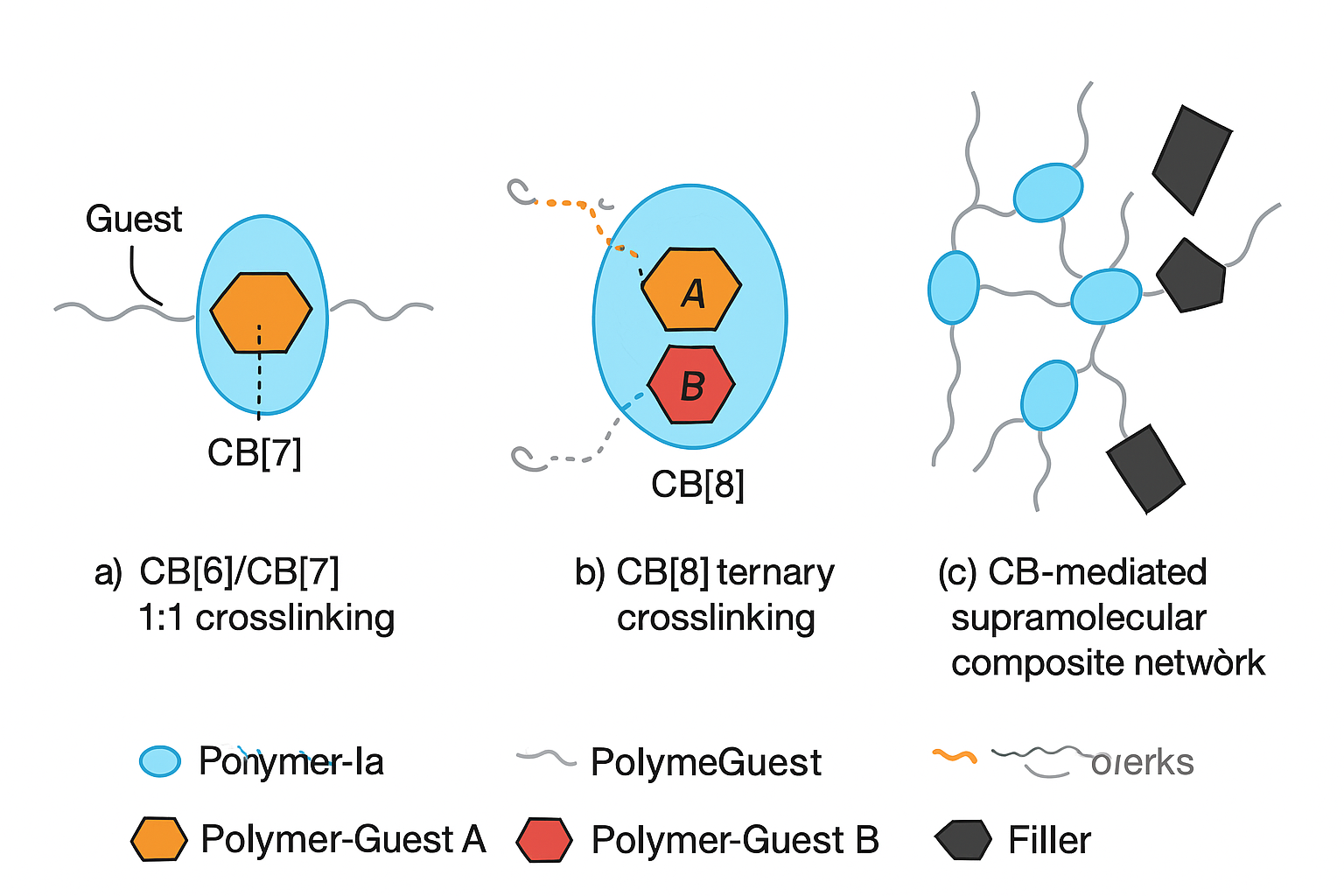
The fundamental supramolecular crosslinking mechanisms used in cucurbituril-based composites are summarized in Scheme 1 and Table 1.
Scheme 1 illustrates the fundamental supramolecular crosslinking modes employed in cucurbituril-based polymer gel composites.
(a) CB [6]/CB [7]-mediated 1:1 host–guest crosslinking, where a single cucurbituril forms a reversible junction with one guest-functionalized polymer chain, resulting in discrete dynamic crosslinks with defined binding lifetimes.
(b) CB [8]-mediated ternary crosslinking, in which one CB [8] macrocycle simultaneously accommodates two complementary aromatic guest moieties (electron donor and electron acceptor) attached to different polymer chains, generating highly dynamic and mechanically robust junctions.
(c) CB-mediated supramolecular composite network, highlighting the role of cucurbiturils as reversible interfacial connectors between polymer chains and secondary fillers (e.g., nanofibres or nanoparticles), thereby enhancing load transfer, toughness, and self-healing behavior in composite materials.
3.2. Dynamic Bonding and Self-Healing
A defining feature of supramolecular gels is the reversibility of host–guest complexes, which underlies self-healing behavior [26]. Under mechanical stress, dynamic crosslinks can break, dissipate energy, and prevent catastrophic failure. Upon removal of stress or application of a healing stimulus (heat, light, chemical addition), the network reforms, restoring mechanical integrity [27].
The lifetime of a crosslink is governed by the dissociation rate constant, which depends on binding affinity: stronger complexes relax more slowly and provide sustained mechanical recovery, while moderately binding systems enable rapid healing and injectability (shear-thinning) [10]. The density of reversible crosslinks and their distribution throughout the network also influence the extent of healing and the rate of recovery [27].
CB-based gels have demonstrated remarkable self-healing efficiency. For example, CB [8]-crosslinked hydrogels incorporating aromatic guest pairs can recover 80–95% of their initial elastic modulus within 24 hours following mechanical damage [28]. This performance exceeds many conventional covalent and other supramolecular networks, largely due to the high binding affinity and rapid reassociation kinetics of CB-guest pairs in aqueous media [29].
3.3. Multistimuli Responsiveness
By embedding stimuli-responsive elements into guest molecules or the polymer backbone, CB-based gels can be engineered to undergo reversible changes in crosslink density and macroscopic properties in response to external cues [30].
pH-responsive systems: Amines, imidazoles, and carboxylic acids undergo protonation/deprotonation within physiological pH ranges, modulating their binding to CB[n]. For instance, CB [7] binds strongly to protonated ammonium groups but much weaklier to neutral amines [30]. Thus, a CB [7]/amine-functionalized polymer gel can soften upon raising pH, enabling controlled release of encapsulated drugs.
Redox-responsive systems: Viologen and other electron-accepting groups undergo one- or two-electron reduction, causing dramatic changes in their electrostatic and host-binding properties. Redox-active CB [8] ternary systems can switch between “on” (fully crosslinked) and “off” (partially decrosslinked) states upon application of electric potential, useful for electroresponsive soft actuators [31].
Photo-responsive systems: Incorporating azobenzene or other photochromic groups allows light-triggered isomerization that alters guest binding, enabling photo-controlled sol–gel transitions and light-patterned mechanics [32].
3.4. Polymer Backbone Selection and Topology
The nature of the polymer backbone profoundly influences gel formation kinetics, final network structure, and mechanical properties [11,33].
Flexible linear polymers (e.g., poly (ethylene glycol), PEG): When functionalized with high grafting densities of guest groups, these yield dense, stiff networks with high elastic moduli (G’ ~ 100–1000 Pa upward) [9,28]. However, the viscoelastic character of the backbone can lead to faster stress relaxation compared to more rigid polymers.
Semi-rigid and branched polymers: Dendrimers, star-shaped polymers, and bottlebrush architectures introduce topological complexity that can enhance network interconnectivity and alter mechanical behavior [34]. Branched structures often yield tougher composites with higher failure strains due to multiple stress-transfer pathways.
Biopolymers (e.g., gelatin, hyaluronic acid): Natural biopolymers offer biocompatibility and cell-responsive behavior, making them attractive for tissue engineering. When functionalized with CB[n] guest groups, they form injectable supramolecular hydrogels with mechanical properties tuned to mimic native tissues [35].
3.5. Composite Design: Integration with Secondary Fillers
Many contemporary CB-based hydrogels incorporate secondary fillers—nanoparticles, nanofibres, or conducting additives—to achieve multifunctional composites [11,36]. Cucurbituril host–guest interactions can improve filler dispersion through favorable interfacial interactions, act as noncovalent bridges between rigid inclusions and the soft matrix or enable mechano-responsive behavior. For instance, nanofibrillated cellulose (NFC) dispersed in a CB -crosslinked polymer matrix exhibit enhanced mechanical properties and improved self-healing compared to the gelatin–NFC composite alone, owing to the additional reversible crosslinking provided by CB [8,28].
4. Structure–Property Relationships in CB-Based Supramolecular Gels
4.1. Rheological Characterization
Viscoelastic behavior is fundamental to understanding and predicting the performance of supramolecular gels. Frequency-sweep oscillatory rheology reveals the storage modulus (G), loss modulus (G”), and loss tangent (tan δ), providing insight into the elastic vs. viscous character of the network [37].
CB-based gels typically exhibit G’ > G” at low frequencies, confirming gel-like behavior, with G’ decreasing as frequency increases due to the finite lifetime of dynamic crosslinks [37]. The crossover frequency (ω*, where G’ = G”) is inversely related to the crosslink lifetime [38]. Faster-relaxing gels (weaker binding or lower CB concentration) show crossover at higher frequencies, while stronger systems relax slowly [9].
Temperature-dependent rheology further elucidates binding dynamics: as temperature increases, dissociation rates accelerate, causing G’ to decrease and loss behavior to increase, reflecting faster network rearrangement [39].
4.2. Mechanical Properties and Failure Behavior
Compression and tension tests quantify gel stiffness, toughness, and failure modes. CB [6]- and CB [7]-crosslinked gels often exhibit elastic moduli in the range of 1–100 kPa, while CB [8]-based systems can reach higher values (10–500 kPa) owing to denser crosslinking via ternary complexes [25,28].
Toughness and energy dissipation: Supramolecular gels excel in toughness metrics because reversible crosslinks can break and reform, dissipating mechanical energy without permanent damage [27]. Fracture toughness (K_IC) and strain energy density at rupture are often one to two orders of magnitude higher in supramolecular vs. covalently crosslinked gels of similar modulus, a phenomenon called “property-to-property synergy” [27,40].
Strain-induced crystallization and strain-hardening: Some CB-functionalized polymer gels exhibit strain-hardening, wherein the stress required to continue stretching increases at large deformations. This can arise from partial crystallization of the polymer backbone or from network reorganization that increases effective crosslink density [40].
4.3. Swelling and Solvent Uptake
Equilibrium swelling degree (the mass ratio of swollen to dry gel) is governed by the polymer–solvent interaction parameter (χ), crosslink density, and the osmotic environment [33]. In aqueous media, most CB-based hydrogels swell substantially (swelling ratio 5–20), but with reversible crosslinks, swelling is tunable: increasing CB[n] or guest concentration decreases swelling ratio, while adding competing guests (molecules with higher binding affinity than the polymer’s guests) increases it [35].
This tunability is exploited in controlled-release applications: by modulating ionic strength or pH, one can reversibly alter swelling and thus control the release rate of encapsulated drugs [30].
5. Applications of Cucurbituril-Based Polymer Gel Composites
An overview of representative applications of cucurbituril-based polymer gel composites is provided in Table 2.
5.1. Biomedical Engineering and Drug Delivery
CB-based supramolecular hydrogels have attracted considerable interest in therapeutic and regenerative medicine [35].
Injectable gels for minimally invasive delivery: CB [8]-crosslinked gels exhibit reversible sol–gel transitions under shear and can be injected through fine needles, after which they rapidly recover their network structure [28]. This property enables delivery of encapsulated cells, proteins, or drugs to localized tissue sites with minimal invasiveness.
Self-healing tissue scaffolds: The dynamic nature of CB crosslinks allows gels to undergo localized damage without losing overall integrity, extending the functional lifetime of implanted scaffolds [35]. Gel properties such as stiffness and permeability can be matched to target tissues—soft gels (G’ ~ 1–10 Pa) for neural tissue, stiffer gels (G’ ~ 100–1000 Pa) for cartilage—by tuning CB[n] type and concentration [35].
Controlled drug release: pH- or redox-responsive CB systems can release cargoes on demand when exposed to the chemical microenvironment of diseased tissue. For example, a CB [7]/amine-guest gel that destabilizes under acidic conditions mimics the response profile needed for tumor-targeted drug delivery [35].
5.2. Soft Robotics and Actuators
Supramolecular hydrogels have emerged as materials for soft actuators and robotic systems, leveraging their ability to undergo reversible property changes [32].
Electroresponsive actuators: CB [8] ternary gels crosslinked by redox-active viologens can change stiffness upon applied electric potential [31]. Such materials can be fabricated as thin films or fibers and cycled between contracted and relaxed states, enabling artificial muscles or grippers [28].
Photo-actuated systems: Incorporating azobenzene guests enables light-controlled modulation of gel properties. Blue light triggers trans→cis isomerization, weakening CB [8] binding; UV light reverses the process [32]. Layered structures of photo-responsive CB gels have been demonstrated for light-driven crawling robots and shape-morphing devices [32].
5.3. Soft Electronics and Sensors
The combination of stretchability, self-healing, and stimulus-responsiveness makes CB-based gels attractive for wearable electronics and chemical sensors [36].
Conductive hydrogels: Incorporating conducting polymers (e.g., polyaniline, PEDOT) or carbon-based fillers (graphene, nanotubes) into CB-crosslinked hydrogels yields conductive composites that remain flexible and can be stretchable [36]. The reversible crosslinks allow mechanical deformation without breaking electrical pathways, and self-healing can restore conductivity after local damage [36].
Chemical sensors: CB-based hydrogels can be functionalized with receptors or dyes that respond to analytes (glucose, ions, proteins). The hydrogel matrix provides a biocompatible medium, while the supramolecular network can amplify binding signals through cooperative effects or by modulating gel swelling [28].
5.4. Separation and Environmental Remediation
CB-based gels have been adapted for removal of pollutants and toxic species from aqueous solutions [4].
Adsorption composites: CB[n] macrocycles have high affinity for many cationic and aromatic contaminants. When immobilized in gel matrices—either by covalent tethering or by supramolecular integration—they form functional composites for water treatment [4]. The gel format allows easy recovery (simple filtration) and potential regeneration by adjusting pH or competing guest concentration [8].
Responsive separation matrices: pH- or redox-responsive CB gels can selectively bind and release target molecules, enabling separations (e.g., protein purification) that can be triggered on demand [30].
6. Outlook and Future Directions
6.1. Scalable Green Synthesis
While modern synthesis methods have improved over classical protocols, scaling CB[n] production to industrial levels remains challenging. Future work should prioritize (1) development of catalytic methodologies that reduce acid consumption and corrosion, (2) continuous-flow synthesis compatible with manufacturing scales, and (3) green media (non-aqueous solvents, alternative catalysts) that eliminate hazardous waste [15,17].
6.2. Advanced Processing and 4D Printing
Integration of CB-based supramolecular chemistry with modern processing techniques—3D and 4D printing, electrospinning, microfluidic templating—could enable fabrication of complex geometries and programmable, shape-changing structures [34]. The dynamic nature of CB crosslinks makes these materials particularly suited for responsive 4D printing, wherein the fourth dimension is time-dependent shape change driven by stimuli [3].
6.3. Multi-Component Adaptive Composites
Future supramolecular composite materials will likely leverage CB[n] not only as primary crosslinkers but also as responsive interfacial agents connecting multiple phases (polymers, nanoparticles, cells). Hierarchical assembly of CB-mediated structures could yield self-organizing, self-diagnosing materials capable of adapting to changing mechanical or chemical demands [35].
6.4. Mechanistic Understanding and Modeling
Quantitative models linking molecular-scale host–guest binding kinetics to macroscopic network mechanics and healing behavior remain underdeveloped. Advances in molecular dynamics simulation, coupled with experimental studies of crosslink dynamics under load, will improve predictive design of CB-based composites with target properties [38,39].
7. Conclusions
Cucurbituril-based supramolecular polymer gels represent a mature yet rapidly evolving class of composite materials that elegantly unite supramolecular chemistry with materials science. The rigid, well-defined structure of CB[n] hosts, combined with facile synthetic tuning of guests and polymer backbones, enables precise engineering of network properties—stiffness, self-healing, and stimuli-responsiveness—at multiple length scales. The review has traced the evolution from CB[n] synthesis through design principles to contemporary applications spanning biomedicine, soft electronics, and environmental technologies.
Key advances—improved green syntheses, sophisticated functionalization strategies, and integration with secondary fillers—continue to expand the functional palette of these materials. Realizing the full promise of supramolecular gels will require coordinated efforts in synthetic chemistry (scalable, green production of specific CB[n] hosts), materials science (rational network design guided by modeling), and processing innovation (3D/4D printing, continuous manufacturing). The supramolecular approach to composite design, embodied by cucurbituril gels, portends a future in which dynamic, reversible, and responsive materials form the basis of adaptive technologies across healthcare, robotics, and environmental remediation.
Author Contributions
Conceptualization, [Zhaxybayeva A.]; literature review, [Zhaxybayeva A.]; writing—original draft prepa-ration, [Zhaxybayeva A.]; writing—review and editing, [Zhaxybayeva A.]; visualization, [Zhaxybayeva A.]. All authors have read and agreed to the published version of the manuscript.
Funding
This research received no external funding.
Data Availability Statement
No new data was created in this review. Readers are referred to the cited literature for original experimental data and datasets.
Acknowledgments
The authors declare that there are no acknowledgments to report.
Conflicts of Interest
The authors declare no conflict of interest.
References
- Peppas, N.A.; Hilt, J.Z.; Khademhosseini, A.; Langer, R. Hydrogels in biology and medicine: From molecular principles to bionanotechnology. Adv. Mater. 2006, 18, 1345–1360. [Google Scholar] [CrossRef]
- Appel, E.A.; del Barrio, J.; Loh, X.J.; Scherman, O.A. Supramolecular polymeric hydrogels. Chem. Soc. Rev. 2012, 41, 6195–6214. [Google Scholar] [CrossRef]
- Aida, T.; Meijer, E.W.; Stupp, S.I. Functional supramolecular polymers. Science 2012, 335, 813–817. [Google Scholar] [CrossRef]
- Assaf, K.I.; Nau, W.M. The aqueous supramolecular chemistry of cucurbiturils, pillararenes and deep cavity cavitands. Chem. Soc. Rev. 2015, 44, 394–418. [Google Scholar] [CrossRef]
- Kim, K.; Selvapalam, N.; Oh, D.H. Cucurbiturils—A New Family of Host Molecules. J. Incl. Phenom. Macrocycl. Chem. 2004, 50, 31–36. [Google Scholar] [CrossRef]
- Mock, W.L.; Shih, N.Y. Structure and selectivity in the complexation of neutral substrates by cucurbituril. J. Org. Chem. 1986, 51, 4440–4446. [Google Scholar] [CrossRef]
- Lagona, L.; Mukhopadhyay, P.; Chakrabarti, S.; Isaacs, L. The cucurbit[n]uril family. Angew. Chem. Int. Ed. 2005, 44, 4844–4870. [Google Scholar] [CrossRef]
- Barrow, S.J.; Kasera, S.; Rowland, M.J.; del Barrio, J.; Scherman, O.A. Cucurbituril-based molecular recognition. Chem. Rev. 2015, 115, 12320–12406. [Google Scholar] [CrossRef]
- Zhou, W.-L.; Lin, W.; Chen, Y.; Dai, X.-Y.; Liu, Z.; Liu, Y. Multivalent supramolecular assembly with ultralong organic room temperature phosphorescence, high transfer efficiency and ultrahigh antenna effect in water. Chem. Sci. 2022, 13, 573–579. [Google Scholar] [CrossRef] [PubMed]
- Rodell, C.B.; Kaminski, A.L.; Burdick, J.A. Rational design of network properties in guest–host assembled and shear-thinning hyaluronic acid hydrogels. Biomacromolecules 2013, 14, 4125–4134. [Google Scholar] [CrossRef] [PubMed]
- Hoare, T.R.; Kohane, D.S. Hydrogels in drug delivery: Progress and challenges. Polymer 2008, 49, 1993–2007. [Google Scholar] [CrossRef]
- Day, A.I.; Arnold, A.P.; Blanch, R.J. A Method for Synthesizing Partially Substituted Cucurbit[n]uril. Molecules 2003, 8, 74–84. [Google Scholar] [CrossRef]
- Cox, C.J.T.; Hale, J.; Molińska, P.; Lewis, J.E.M. Supramolecular and molecular capsules, cages and containers. Chem. Soc. Rev. 2024, 53, 10380–10408. [Google Scholar] [CrossRef] [PubMed]
- Cao, L.; Šekutor, M.; Zavalij, P.Y.; Mlinarić-Majerski, K.; Ghiviriga, I.; Isaacs, L. Cucurbit [7]uril·guest inclusion complexes. Angew. Chem. Int. Ed. 2014, 53, 988–993. [Google Scholar] [CrossRef]
- Assaf, K.I.; Nau, W.M. Cucurbiturils: From synthesis to high-affinity binding and catalysis. Chem. Soc. Rev. 2015, 44, 394–418. [Google Scholar] [CrossRef]
- Kim, J.; Jung, I.S.; Kim, S.Y.; Lee, E.; Kang, J.K.; Sakamoto, S.; Yamaguchi, K.; Kim, K. New cucurbituril homologues: Syntheses, isolation, and X-ray crystallographic structures. J. Am. Chem. Soc. 2000, 122, 540–541. [Google Scholar] [CrossRef]
- Isaacs, L.; Witt, D.; Lagona, L.; Mukhopadhyay, P.; Chakrabarti, S. Click chemistry and cucurbiturils. In Functional Supramolecular Architectures; Schmitt, J.-L., Strable, E., Eds.; Wiley-VCH: Weinheim, Germany, 2003; pp. 233–259. [Google Scholar]
- Lee, J.W.; Samal, S.; Selvapalam, N.; Kim, H.-J.; Kim, K. Cucurbituril homologues and derivatives: Synthesis, characterization, and applications. Acc. Chem. Res. 2003, 36, 621–630. [Google Scholar] [CrossRef] [PubMed]
- Lecorché, P.; Jacquot, A.; Bardelang, D.; Tóth, G.; Parella, T.; Ricoux, R.; Roux, G.; Milet, A.; Herson, P.; Fensterbank, L.; et al. Challenges and opportunities for functionalized cucurbiturils for biomedical applications. JACS Au 2023, 3, 1923–1946. [Google Scholar] [CrossRef]
- Kim, K.; Selvapalam, N.; Ko, Y. H.; Park, K. M.; Kim, D.; Kim, J. Functionalized cucurbiturils and their applications. Chem. Soc. Rev. 2007, 36, 267–279. [Google Scholar] [CrossRef]
- Kégl, T.R.; Kégl, T. Cavitands: Structure, Recognition, and Function in Supramolecular Chemistry. ChemTexts 2025, 11, 16. [Google Scholar] [CrossRef]
- Scherman, O.A.; Rowland, M.J.; Martinez-Martinez, A.J.; Walker, S.A.; Tsai, H.C. Supramolecular polymers built by cucurbituril-mediated host–guest interactions. In Supramolecular Polymer Chemistry; Harada, A., Takashima, Y., Eds.; Wiley-VCH: Weinheim, Germany, 2012; pp. 145–176. [Google Scholar]
- Appel, E.A.; Biedermann, F.; Rauwald, U.; Jones, S.T.; Zayed, J.M.; Scherman, O.A. Supramolecular cross-linked networks via host–guest complexation with cucurbit [8]uril. J. Am. Chem. Soc. 2010, 132, 14251–14260. [Google Scholar] [CrossRef]
- Harada, A.; Takashima, Y.; Nakahata, M. Supramolecular polymeric materials via cyclodextrin-guest interactions. Acc. Chem. Res. 2014, 47, 2128–2140. [Google Scholar] [CrossRef] [PubMed]
- Wu, D.; Wang, J.; Du, X.; Cao, Y.; Ping, K.; Liu, D. Cucurbit [8]uril-based supramolecular theranostics. J. Nanobiotechnol. 2024, 22, 235. [Google Scholar] [CrossRef]
- Cordier, P.; Tournilhac, F.; Soulié-Ziakovic, C.; Leibler, L. Self-healing and thermoreversible rubber from supramolecular assembly. Nature 2008, 451, 977–980. [Google Scholar] [CrossRef] [PubMed]
- Yin, H.; Liu, F.; Abdiryim, T.; Liu, X. Self-Healing Hydrogels: From Synthesis to Multiple Applications. ACS Mater. Lett. 2023, 5, 1787–1830. [Google Scholar] [CrossRef]
- Drozdov, A.D.; Christiansen, J.D. Structure–Property Relations in Linear Viscoelasticity of Supramolecular Hydrogels. RSC Adv. 2021, 11, 16860–16880. [Google Scholar] [CrossRef] [PubMed]
- Li, Z.; Hao, J.; Lu, Y.; Hu, W.; Jiang, H.; Zhou, B.; Yang, H.; Kang, W.; Sarsenbekuly, B. Tunable macroscopic self-healing of supramolecular gel through host–guest inclusion. Phys. Fluids 2024, 36, 113126. [Google Scholar] [CrossRef]
- Appel, E.A.; Loh, X.J.; Jones, S.T.; Biedermann, F.; Dreiss, C.A.; Scherman, O.A. Ultrahigh-Water-Content Supramolecular Hydrogels Exhibiting Multistimuli Responsiveness. J. Am. Chem. Soc. 2012, 134, 11767–11773. [Google Scholar] [CrossRef]
- Ooi, H.W.; Kocken, J.M.M.; Morgan, F.L.C.; Malheiro, A.; Zoetebier, B.; Karperien, M.; Wieringa, P.A.; Dijkstra, P.J.; Moroni, L.; Baker, M.B. Multivalency Enables Dynamic Supramolecular Host–Guest Hydrogel Formation. Biomacromolecules 2020, 21, 2208–2217. [Google Scholar] [CrossRef]
- Appel, E.A.; Biedermann, F.; Rauwald, U.; Jones, S.T.; Zayed, J.M.; Scherman, O.A. Light-Induced Transformation from Covalent to Supramolecular Polymer Networks. ACS Macro Lett. 2025, 14, 169–175. [Google Scholar] [CrossRef]
- Cardellini, A.; Caruso, C.; Rijns, L.; Dankers, P. Y. W.; Pavan, G. M.; Perego, C. Monomer exchange dynamics in ureido–pyrimidinone supramolecular polymers via molecular simulations. J. Mater. Chem. B 2025, 13, 14326–14337. [Google Scholar] [CrossRef]
- Baghali, M.; Ziyadi, H.; Di Martino, A. Engineering Smart Hydrogels for Intelligent Drug Delivery. Polym. Bull. 2025, 82, 2287–2328. [Google Scholar] [CrossRef]
- Dong, R.; Pang, Y.; Su, Y.; Zhu, X. Supramolecular Hydrogels: Synthesis, Properties and Their Biomedical Applications. Biomater. Sci. 2015, 3, 937–954. [Google Scholar] [CrossRef] [PubMed]
- Hu, J.; Zhang, G.; Liu, S. Enzyme-responsive polymeric assemblies, nanoparticles and hydrogels. Chem. Soc. Rev. 2012, 41, 5933–5949. [Google Scholar] [CrossRef]
- Winter, H.H.; Chambon, F. Analysis of linear viscoelasticity of a crosslinking polymer at the gel point. J. Rheol. 1986, 30, 367–382. [Google Scholar] [CrossRef]
- Rubinstein, M.; Colby, R.H. Polymer Physics; Oxford University Press: New York, NY, USA, 2003. [Google Scholar]
- Kadic, M.; Bückmann, T.; Schittny, R.; Gumbsch, P.; Wegener, M. Pentamode Metamaterials with Independently Tailored Bulk Modulus and Mass Density. Phys. Rev. Appl. 2014, 2, 054007. [Google Scholar] [CrossRef]
- Ducrot, E.; Chen, Y.; Bulters, M.J.H.; Sijbesma, R.P.; Creton, C. Toughening Elastomers with Sacrificial Bonds and Watching Them Break. Science 2014, 344, 186–189. [Google Scholar] [CrossRef]
Scheme 1.
Cucurbituril-mediated supramolecular crosslinking mechanisms in polymer composite networks.
Scheme 1.
Cucurbituril-mediated supramolecular crosslinking mechanisms in polymer composite networks.
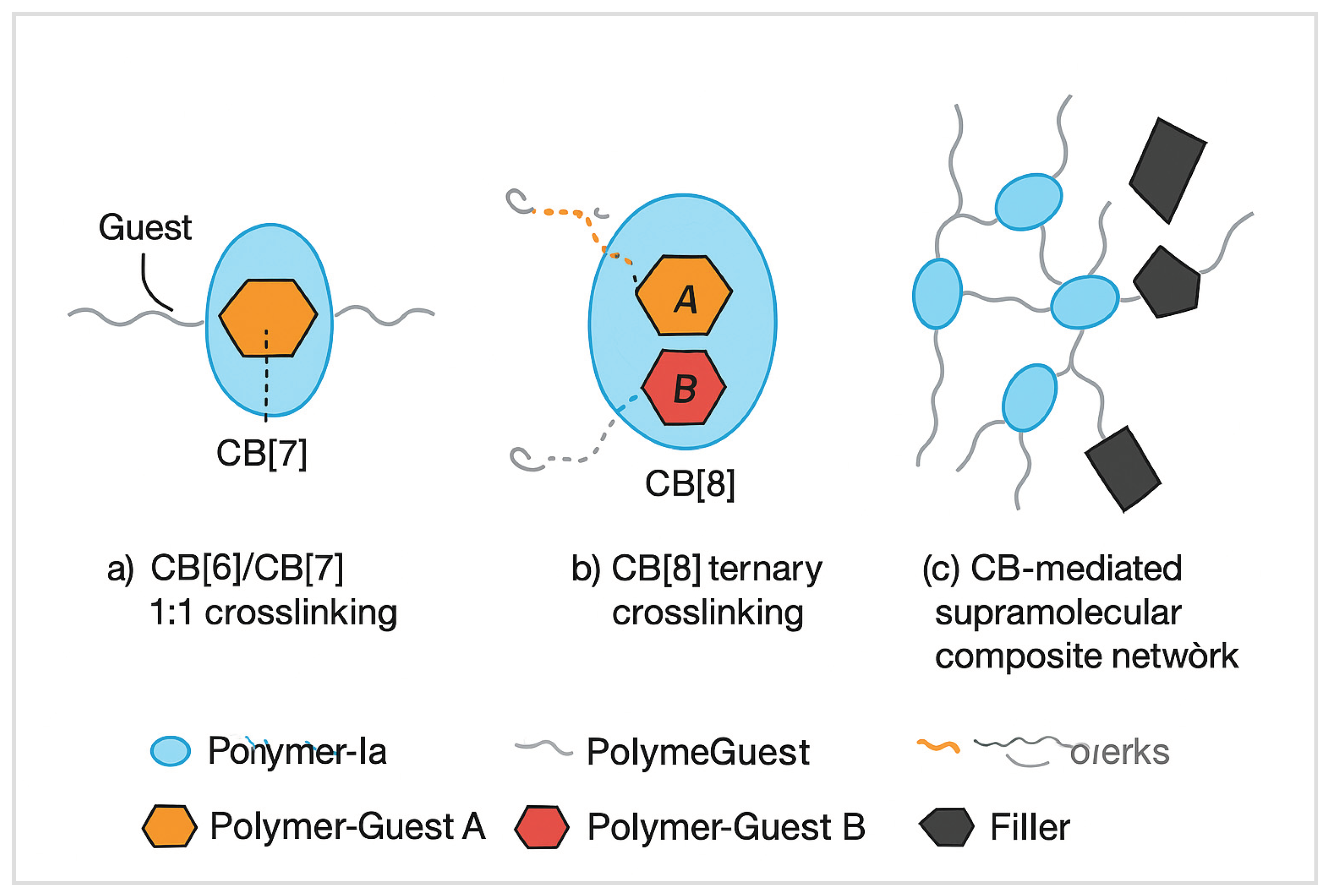

Table 1.
Cucurbituril-Based Supramolecular Crosslinking Systems and Resulting Composite Properties.
| CB[n] | Host–Guest Binding Mode | Typical Guest Units | Polymer Matrix | Mechanical properties (G′ / E) | Key Composite Features | Ref. |
|---|---|---|---|---|---|---|
| CB [6] | 1:1 inclusion complex | Alkylammonium, diammonium | PEG, polyacrylamide | G′ ≈ 10–10³ Pa | Stable but relatively slow relaxation; good dimensional stability | [8,23] |
| CB [7] | 1:1 inclusion complex | Adamantyl, ammonium, aromatic cations | PEG, gelatin, hyaluronic acid | G′ ≈ 10²–10⁴ Pa | High binding affinity, enhanced toughness, moderate self-healing | [9,14,30] |
| CB [8] | Ternary complex (1:2) | Donor–acceptor aromatic pairs | PEG, chitosan, hybrid matrices | G′ ≈ 10³–10⁵ Pa | Dense reversible crosslinking; excellent self-healing and energy dissipation | [24,25,28] |
| CB [8] + fillers | Host–guest + physical filler interaction | Aromatic-functional fillers | Nanocomposites (NFC, CNTs, graphene) | E ≈ 10–500 kPa | Improved load transfer, crack resistance, multifunctionality | [28,36] |
Table 2.
Cucurbituril-Based Supramolecular Polymer Gel Composites: Applications and Functional Advantages.
Table 2.
Cucurbituril-Based Supramolecular Polymer Gel Composites: Applications and Functional Advantages.
| Application Area | Composite Components | CB[n] Role | Stimulus / Function | Composite Advantage | Ref. |
|---|---|---|---|---|---|
| Biomedical scaffolds | Biopolymer + CB[n] | Dynamic crosslinker | pH, redox | Self-healing, injectability, tissue-matching mechanics | [35] |
| Injectable drug carriers | PEG/CB [8] networks | Ternary junctions | Shear, pH | Shear-thinning, rapid recovery, controlled release | [28,30] |
| Soft robotics | Polymer + CB [8] + redox guest | Switchable crosslinks | Electric potential | Reversible stiffness modulation | [31] |
| Soft electronics | Polymer + CNT/graphene + CB[n] | Interfacial binder | Mechanical damage | Self-healing conductivity | [36] |
| Environmental remediation | Gel + CB[n] | Selective adsorption sites | pH, competing guests | Regenerable composite sorbents | [4,8] |
Disclaimer/Publisher’s Note: The statements, opinions and data contained in all publications are solely those of the individual author(s) and contributor(s) and not of MDPI and/or the editor(s). MDPI and/or the editor(s) disclaim responsibility for any injury to people or property resulting from any ideas, methods, instructions or products referred to in the content. |
© 2026 by the authors. Licensee MDPI, Basel, Switzerland. This article is an open access article distributed under the terms and conditions of the Creative Commons Attribution (CC BY) license (http://creativecommons.org/licenses/by/4.0/).
Copyright: This open access article is published under a Creative Commons CC BY 4.0 license, which permit the free download, distribution, and reuse, provided that the author and preprint are cited in any reuse.


