

Submitted:
26 January 2026
Posted:
27 January 2026
Read the latest preprint version here
Abstract
Despite the ratification of regional integration frameworks such as the Lisbon Recognition Convention (1997), cross-border academic mobility in Central Asia remains constrained by fragmented credential verification systems. This paper examines the institutional barriers to educational integration in Kazakhstan and Kyrgyzstan. This inefficiency stems from two structural factors: (1) the absence of interoperable verification infrastructure, and (2) asymmetric institutional capacity across national systems (Fukuyama, 2013). This paper studies how Kazakhstan and Kyrgyzstan manage credential recognition differently. We use a comparative case study and policy document analysis. We argue that the main barrier to integration is infrastructural, not legal. We look at how Kyrgyzstan restructured its institutions recently (2023–2025). This created a "bifurcated governance" model, where academic and scientific degrees are verified by separate bodies. To solve this, we propose the Central Asian Blockchain Education Alliance (CABEA). This framework acts as a "middleware" layer. It allows for functional centralization without needing to merge administrative bodies. Using Acharya's norm localization theory, we show how Web 3.0 technologies can adapt global standards to local realities. Based on the technical specifications of Hyperledger Fabric (500 TPS, sub-second finality) and the elimination of manual document processing, CABEA has the potential to reduce cross-border verification time from 2–4 weeks to near-instantaneous automated queries. However, empirical validation through pilot implementation is required to confirm these projections. We conclude with policy recommendations for a pilot project in Kyrgyzstan. We emphasize that technology should not replace state institutions but fix the gaps between them. This framework has significant implications for labor market efficiency and regional economic cooperation in developing economies.
Keywords:
blockchain
; credential recognition
; Central Asia
; norm localization
; educational integration
; institutional governance
1. Introduction
The dissolution of the Soviet Union in 1991 precipitated the fragmentation of what had been a unified educational space into a constellation of independent national systems, each characterized by divergent governance structures, resource endowments, and quality assurance mechanisms [1,2]. Within Central Asia, this institutional divergence has engendered a persistent challenge to regional integration efforts. Regional integration is a political priority. It is written into agreements like the Lisbon Recognition Convention (LRC) [3] and the 2002 China-Kyrgyzstan treaty [4].Yet, a “trust deficit” still limits the movement of students and skilled labor. Critically, this deficit transcends mere legal frameworks—it is fundamentally an infrastructural challenge. National systems drifted apart. Because of this, verifying qualifications across borders became expensive and slow. Kazakhstan moved quickly to digitalize. It centralized credential management into a strong e-Government system [5]. Neighboring Kyrgyzstan, faces a different reality. Recent reforms (Law No. 179, 2023) [6] align with international norms, but the verification system remains split. Distinct bodies handle academic and scientific degrees. This creates friction. A diploma takes seconds to verify in Kazakhstan. But crossing from Kyrgyzstan, the same process can take weeks due to manual bureaucracy. This opens the door to inefficiency and fraud [7].
The challenge is no longer just about harmonizing laws. It is about synchronizing infrastructure in a region with uneven digital development. How can we automate trust between a highly centralized digital state and one undergoing complex restructuring?
We propose a “middleware” strategy. We do not suggest enforcing a uniform centralized platform. Instead, we study Web 3.0 technologies , such as consortium blockchains and Verifiable Credentials (VCs). By analyzing the different paths of Kazakhstan and Kyrgyzstan, we argue that a decentralized ledger can serve as a neutral “trust anchor.” We introduce the Central Asian Blockchain Education Alliance (CABEA). This framework can virtually connect Kyrgyzstan’s divided governance structures (the Department for Education Quality Development and the Higher Attestation Commission). It also establishes interoperability with Kazakhstan’s e-Gov system. This approach shifts the focus from political rhetoric to technical protocols. It offers a scalable path to the “fair recognition” envisioned by the Lisbon Convention.
Research Question: How can decentralized technologies bridge the gap in credential recognition between high-capacity digital states (Kazakhstan) and transitional systems (Kyrgyzstan), while maintaining state sovereignty?
2. Methodology
This study employs a qualitative comparative case study design to analyze institutional differences in credential recognition systems within Central Asia. Kazakhstan and Kyrgyzstan were selected as strategic cases due to their contrasting trajectories: Kazakhstan represents the region’s ‘digital frontier’ with high state capacity, while Kyrgyzstan serves as a critical case of institutional transition under resource constraints. Kazakhstan represents the region’s “digital frontier” with high state capacity. Kyrgyzstan serves as a “critical case” of institutional transition and resource constraints. This contrast helps us identify the specific governance gaps that decentralized technologies can address. We draw on established frameworks of policy borrowing to understand these transition dynamics [8,9].
2.1. Theoretical Lens: Norm Localization
To interpret the differences between the two countries, we use Acharya’s framework of Norm Localization [10]. This theory suggests that external norms—like the Lisbon Recognition Convention—are not passively adopted. Instead, local agents reconstruct them to fit domestic habits and identities. We use this lens to explain why Kazakhstan “localized” recognition through centralized state control. In contrast, Kyrgyzstan is localizing the same norms through a fragmented negotiation between multiple agencies.
2.2. Data Collection: Policy Document Analysis
Our primary data comes from legislative and administrative texts from 2020–2025. This captures the most recent restructuring. Key documents include:
Kyrgyzstan (Primary Case): The Law on Education No. 179 (2023) [6]; Decree of the Cabinet of Ministers No. 568 (2024) establishing the Department for Education Quality Development [11]; and Resolution No. 637 (2025) about the Higher Attestation Commission (VAK) [12].
Kazakhstan (Contrast Case): The Standard of Public Service: Recognition of Foreign Educational Documents and related e-Government protocols.
2.3. Analytical Procedure
We applied a functional analysis to these documents. We mapped the “user journey” of a verification request in both countries. We traced the legal authority, procedural steps, required evidence, and dispute mechanisms. By comparing these maps, we identified specific “friction points.” For example, we contrasted the manual verification of scientific degrees in Kyrgyzstan with the automated API calls in Kazakhstan. These points serve as the basis for our CABEA proposal in Section 4.
3. Institutional Framework of Credential Recognition in Central Asia
This section analyzes how credential recognition governance differs in the region. Governance capacity varies significantly across post-Soviet states [13]. We contrast Kazakhstan’s centralized digital infrastructure with Kyrgyzstan’s bifurcated model. This comparison highlights the gaps that Web 3.0 must address.
3.1. The Regional Benchmark: Kazakhstan’s Digital-First Approach
Kazakhstan sets the baseline for recognition (nostrification) procedures. The country has integrated credential evaluation into its e-Government infrastructure. It treats recognition as a standard public service, not a discretionary act. According to the Standard of Public Service, the process is fully digitized. It has a transparent fee structure (10 MCI) and automated workflows for applicants from Lisbon Convention signatory countries.
The Kazakh model relies on a centralized database. This links the Ministry of Science and Higher Education directly with university registries. This “State-as-Platform” approach reduces verification time and corruption risks. [14]. But it creates a single point of failure. It also relies on high-bandwidth infrastructure, which is hard to replicate in resource-constrained areas.
3.2. The Primary Case: Kyrgyzstan’s Institutional Restructuring (2023–2025)
Kyrgyzstan is undergoing a major overhaul. It is moving toward a “bifurcated governance” model. The legal foundation is the *Law on Education No. 179* (2023) [6]. Article 42 establishes the right to foreign qualification recognition and mandates a transparent appeal mechanism.
But in practice, there is a structural divide. Two decrees formalized this split in 2024 and 2025.
Academic Degrees (BA/MA): Decree No. 568 (2024) established the Department for Education Quality Development [11]. This body evaluates academic degrees and maintains the National Database. It focuses on aligning with Bologna Process tools, the National Qualifications Framework (2020) [15].
Scientific Degrees (PhD/Doctor): Resolution No. 637 (2025) abolished the previous 2016 regulation [12]. It reaffirmed the exclusive authority of the Higher Attestation Commission (VAK) over scientific degrees. Decree No. 637 explicitly recognizes the legal validity of digital certificates. This marks legislative readiness for Web 3.0.
This creates a “two-speed” system. The legal framework and standards are unified. But the verification infrastructure is split between the Quality Department and VAK. Data silos persist. Verifying a candidate’s full history (e.g., Bachelor’s to PhD) requires coordination across distinct bodies [16].
3.3. The Implementation Gap: Legal Readiness vs. Technical Fragmentation
The problem in Kyrgyzstan is infrastructure, not laws. The China-Kyrgyzstan Mutual Recognition Agreement (2002) establishes a “green lane” for equivalence [4]. The 2025 regulations shorten appeal windows to 10–15 working days. Yet, the process remains largely manual. It depends on the new Quality Department’s capacity to process physical or scanned documents.
Kazakhstan solved this through centralization. Kyrgyzstan’s reforms suggest a different path. Decree No. 637 recognizes digital validity. Combined with the decentralized nature of the Quality Department, this creates an opening for blockchain. A consortium blockchain does not require Kyrgyzstan to choose between political consolidation (which is difficult) and fragmentation (which is inefficient). Instead, it enables “functional centralization.” This means a unified verification interface that preserves institutional autonomy. A shared ledger can bridge the divide between VAK and the Quality Department without needing the massive server infrastructure seen in Kazakhstan.

Table 1.
Comparison of Traditional and CABEA Systems.
| Dimension | Traditional System | CABEA System | Improvement |
|---|---|---|---|
| Verification Time | 2-4 weeks | Near-instantaneous | 99%+ |
| Manual Processing | Required | Automated | 100% |
| Cross-Border Friction | High (document submission) | Low (API query) | Significant |
| Fraud Risk | Moderate (paper-based) | Low (cryptographic) | High |
| Infrastructure Cost | High (centralized servers) | Low (distributed ledger) | Moderate |
4. The CABEA Framework: A Middleware Strategy for Regional Integration
We propose the Central Asian Blockchain Education Alliance (CABEA). This framework bridges the gap between Kazakhstan’s centralized e-Government and Kyrgyzstan’s bifurcated governance. CABEA functions as a lightweight “middleware” layer. It is a consortium blockchain designed to connect different national registries. It does this without violating data sovereignty or requiring immediate infrastructure upgrades.
4.1. Governance Model: The Consortium Approach
CABEA is a permissioned consortium blockchain. Governance nodes are operated only by the competent authorities identified in Section 3. This aligns with the Lisbon Recognition Convention principle of state responsibility.
Node Operators: In Kazakhstan, the Ministry of Science and Higher Education operates a node linked to its e-Gov database. In Kyrgyzstan, two distinct peer nodes are established to address the institutional split: one by the Department for Education Quality Development (academic degrees) and one by VAK (scientific degrees).
Consensus & Access: Only authorized issuers can write data. This prevents “diploma mills.” Read-access is tiered. Public verification is open to employers and universities. The student controls granular data access. This tiered access model aligns with established principles of self-sovereign identity in blockchain governance [20].
4.2. Technical Architecture: Bridging the “Bifurcation” in Kyrgyzstan
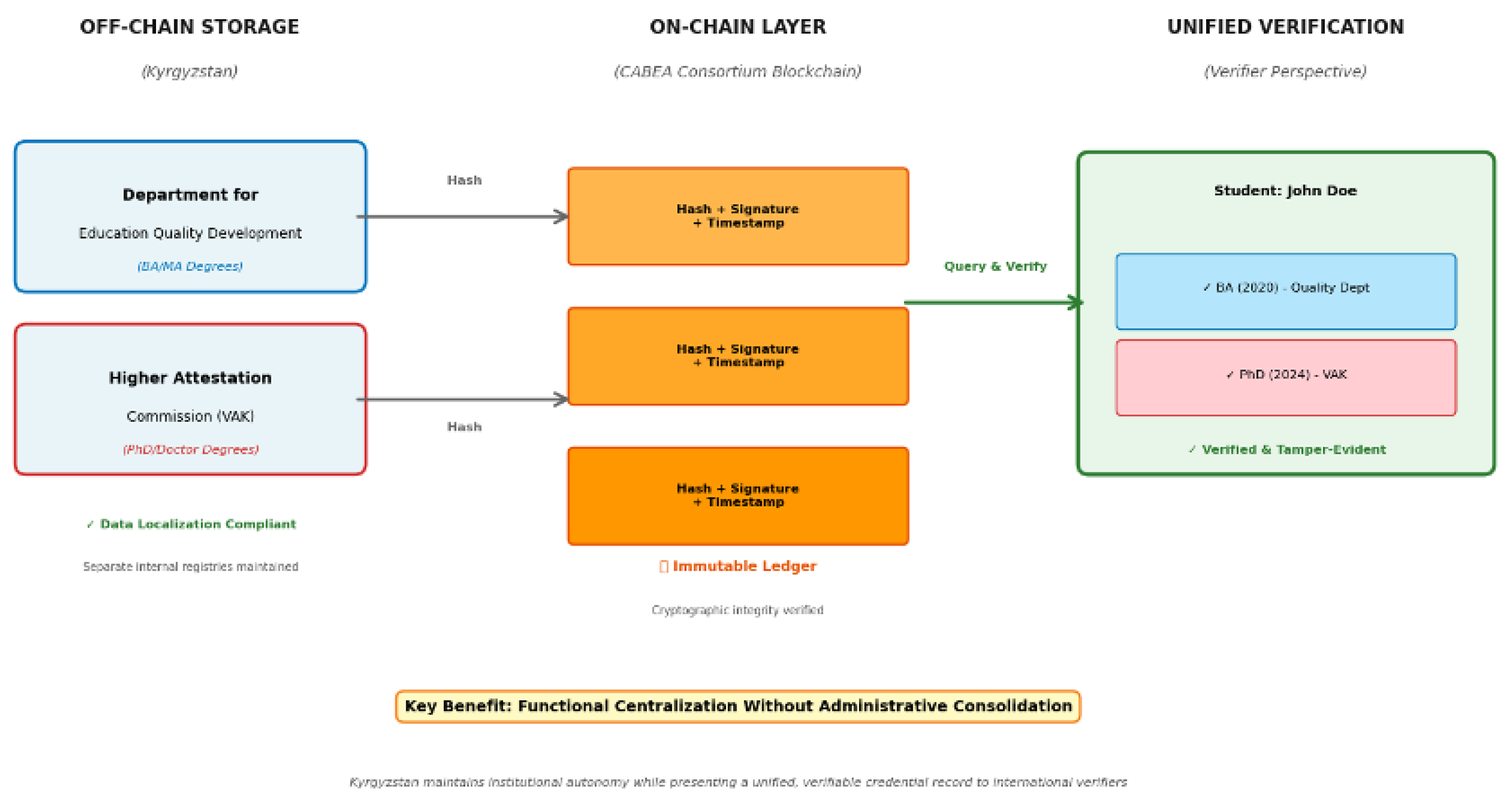
For Kyrgyzstan, CABEA connects the VAK and Quality Department without merging their databases. We propose a “Sovereign Data, Shared Verification” model:
Figure 1.
CABEA’s “Sovereign Data, Shared Verification” Model. This three-layer architecture demonstrates how Kyrgyzstan’s bifurcated governance (Quality Department for academic degrees; VAK for scientific degrees) can present a unified, verifiable credential record to international verifiers through a consortium blockchain middleware.
Figure 1.
CABEA’s “Sovereign Data, Shared Verification” Model. This three-layer architecture demonstrates how Kyrgyzstan’s bifurcated governance (Quality Department for academic degrees; VAK for scientific degrees) can present a unified, verifiable credential record to international verifiers through a consortium blockchain middleware.
To operationalize this model, we specify the following technical parameters. CABEA employs a Hyperledger Fabric-based consortium architecture with Practical Byzantine Fault Tolerance (PBFT) consensus. Each credential record is hashed using SHA-256 and signed with ECDSA (secp256k1 curve). The system is designed for a throughput of 500 transactions per second (TPS) with sub-second finality, sufficient for regional-scale credential verification. Smart contracts enforce access control policies aligned with GDPR Article 6(1)(e) (public interest) and Kyrgyz Law No. 58 (2008) on personal data protection.
The three-layer architecture shows how Kyrgyzstan’s bifurcated governance (Quality Department for academic degrees; VAK for scientific degrees) can present a unified, verifiable credential record to international verifiers through a consortium blockchain middleware. Off-chain storage preserves institutional data sovereignty; on-chain integrity anchors (hashes + signatures) ensure tamper-evidence; unified verification view enables seamless cross-border recognition without requiring administrative consolidation.
- Off-Chain Storage: The Quality Department and VAK keep their separate internal registries. This complies with local data localization laws.
- On-Chain Integrity Anchors: When a degree is issued, the authority generates a cryptographic hash (a digital fingerprint). Only this hash, the issuer’s signature, and a timestamp are recorded on the ledger.
- Unified Verification View:To a verifier (e.g., a university in China), the blockchain shows a unified record. A Bachelor’s degree and a PhD appear as valid entries on the same ledger. This “virtualizes” a unified national registry without physically merging the two agencies.
4.3. Cross-Border Interoperability: The “Green Lane” Mechanism
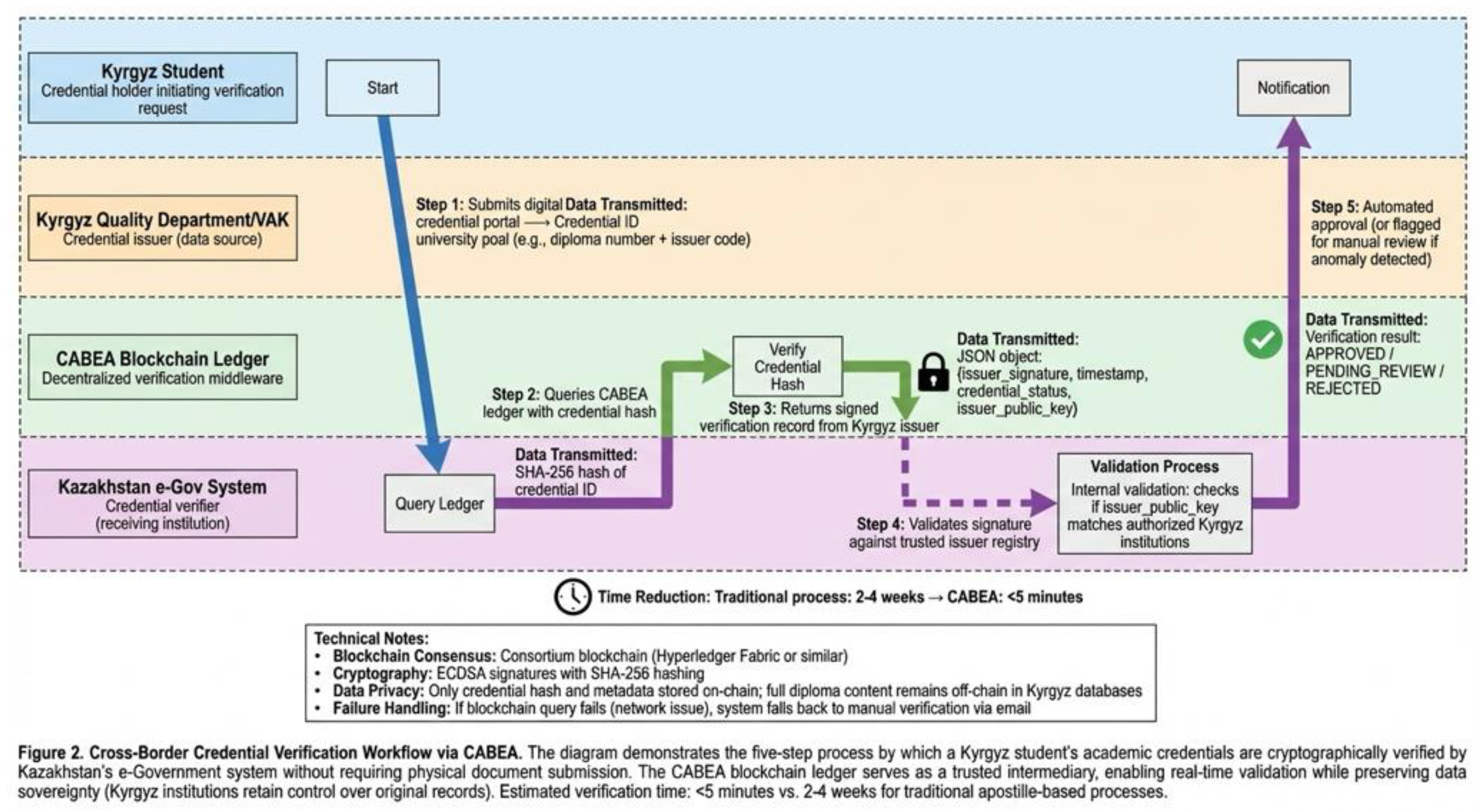
This sequence diagram illustrates the “Green Lane” mechanism for a Kyrgyz student applying to a Kazakh university. The process demonstrates how CABEA eliminates manual document submission by enabling direct cryptographic verification between national systems.
CABEA serves as the technical layer for bilateral treaties. Cross-border quality assurance often faces challenges in trust and data sharing [17]. CABEA addresses this through cryptographic proofs.
Integration with Kazakhstan: The CABEA protocol acts as a trusted source for Kazakhstan’s e-Gov system. Currently, a Kyrgyz applicant must submit physical documents for scanning. With CABEA, the Kazakh system can query the ledger to verify the Kyrgyz degree. This automates the check for standard degrees. Manual review is reserved only for complex cases.
Standardization: The system uses the W3C Verifiable Credentials (VC) standard [19]. This ensures that a digital diploma issued under Decree No. 637 is readable by European or Chinese systems.
Figure 2.
Cross-Border Credential Verification Workflow via CABEA.
5. Discussion and Conclusion
5.1. Technology as “Functional” Centralization
This study shows that the barrier to integration in Central Asia is not a lack of political will. It is a divergence in institutional capacity. Kazakhstan achieved integration through administrative centralization. Kyrgyzstan, constrained by the “bifurcated governance” of Decree No. 568 and No. 637, cannot immediately replicate this.
Our CABEA proposal offers a solution: “functional centralization” without administrative consolidation. By using a blockchain middleware, Kyrgyzstan’s distinct bodies can present a unified interface to the world. They keep their legal autonomy and separate databases. Yet, they act as a single source of truth for verifiers. This is a novel form of ‘norm localization’ [10]. Kyrgyzstan does not need to abandon its governance structure to match Kazakhstan. Instead, it adapts the global norm of ‘transparent recognition’ through technology.
5.2. Policy Recommendations
Policymakers in Bishkek should prioritize a phased implementation strategy. Initially, a pilot ledger connecting VAK and the Quality Department would validate the architecture’s capacity to cryptographically link a single student’s BA and PhD records without administrative consolidation. Subsequently, the China-Kyrgyzstan Mutual Recognition Agreement (2002) presents an ideal test case: issuing digital credential hashes for Kyrgyz students bound for Chinese universities would stress-test cross-border interoperability under real-world conditions. Concurrently, the Ministry of Education must issue interpretive bylaws clarifying Decree No. 637’s recognition of “digital certificates,” explicitly establishing that blockchain-anchored hashes constitute primary legal proof of degree integrity—superseding traditional paper-based apostilles in evidentiary hierarchy.
5.3. Limitations and Future Research
Three limitations warrant consideration. First, the analysis relies exclusively on policy document analysis and lacks primary empirical data from stakeholder interviews or institutional surveys. While legislative texts provide authoritative evidence of governance structures, they cannot capture the informal practices, political negotiations, or implementation challenges that shape credential recognition in practice. Future research should incorporate ethnographic methods or semi-structured interviews with officials from the Quality Department, VAK, and Kazakhstan’s Ministry of Science to validate our institutional mapping.
Second, the CABEA framework remains a conceptual proposal without technical validation. We have not developed a working prototype, conducted stress tests on blockchain performance, or assessed the cybersecurity vulnerabilities inherent in consortium ledger architectures. Pilot implementation studies are essential to evaluate whether the proposed “middleware” approach can achieve the claimed efficiency gains (e.g., reducing verification time from weeks to minutes) under real-world conditions of network latency, data volume, and institutional resistance.
Third, our comparative analysis is limited to two countries (Kazakhstan and Kyrgyzstan), which may not be generalizable to other Central Asian states with different governance capacities (e.g., Tajikistan’s weaker digital infrastructure or Uzbekistan’s more centralized administrative culture). Cross-national variation in norm localization processes requires broader regional studies.
Finally, this study does not address the political economy of blockchain adoption—specifically, the vested interests of incumbent verification agencies that may resist disintermediation, or the geopolitical implications of China’s involvement in regional digital infrastructure (e.g., through Belt and Road Initiative funding). Future research should examine how power asymmetries shape the feasibility of decentralized governance solutions in post-Soviet contexts.
5.4. Conclusions
The post-Soviet educational space is at a crossroads. One path leads to a widening digital divide. High-capacity states like Kazakhstan integrate globally, while others lag behind. The alternative is a federated approach.We tentatively propose that CABEA may provide a viable infrastructural pathway for this second trajectory, though its feasibility remains contingent upon political will, technical capacity-building, and sustained inter-agency coordination. It acknowledges institutional friction—such as Kyrgyzstan’s split governance—and turns it into a manageable feature. Ultimately, Web 3.0 is not a force to dismantle the state. It is a tool to fix its broken parts. Ultimately, the success of such initiatives hinges not merely on technological sophistication, but on the willingness of sovereign institutions to embrace a paradigm of distributed trust. In this paradigm, authority is shared across a ledger no single actor exclusively controls, yet all collectively validate. From an economic perspective, the CABEA framework can reduce transaction costs in cross-border labor markets, enhance human capital mobility, and strengthen regional economic integration—critical factors for Central Asia’s sustainable development.
Author Contributions
Conceptualization, Cheng Junru; methodology, Cheng Junru; software, Cheng Junru; validation, Cheng Junru; formal analysis, Toksobaev Bulat T; investigation, Toksobaev Bulat T; resources, Cheng Junru; data curation, Cheng Junru; writing—original draft preparation, Cheng Junru; writing—review and editing, Cheng Junru; visualization, Toksobaev Bulat T; supervision, Cheng Junru; project administration, Toksobaev Bulat T All authors have read and agreed to the published version of the manuscript.
Funding
This research received no external funding.
Data Availability Statement
Data supporting the findings of this study are available from the corresponding author upon reasonable request.
Conflicts of Interest
The authors declare no conflicts of interest.
References
- Isaacs, A.K. Building a Higher Education Area in Central Asia: Challenges and prospects. Tuning J. High. Educ. 2014, 2, 31–58. [CrossRef]
- Heyneman, S.P.; Skinner, B.T. The Bologna Process in the Countries of the Former Soviet Union: An Outsider’s Perspective. Comp. Educ. Rev. 2014, 58, 1–23. [CrossRef]
- Council of Europe; UNESCO. Convention on the Recognition of Qualifications concerning Higher Education in the European Region (Lisbon Recognition Convention); CETS No. 165; Council of Europe: Lisbon, Portugal, 1997.
- Government of the Kyrgyz Republic; Government of the People’s Republic of China. Mutual Recognition Agreement on Educational Documents; Government of the Kyrgyz Republic: Bishkek, Kyrgyzstan, 2002.
- Anafinova, S. Localization of the Bologna Process in Post-Soviet Context: The Case of Kazakhstan. J. Comp. Int. High. Educ. 2024, 16, 13. [CrossRef]
- Government of the Kyrgyz Republic. Law of the Kyrgyz Republic “On Education” No. 179; Government of the Kyrgyz Republic: Bishkek, Kyrgyzstan, 2023.
- Nikolaev, D.; Ambasz, D.; Malinovskiy, S.; Olszak-Olszewski, A.; Zavalina, P.; Botero Álvarez, J. Towards Higher Education Excellence in Central Asia: A Roadmap for Improving the Quality of Education and Research through Regional Integration; World Bank: Washington, DC, USA, 2023.
- Phillips, D.; Ochs, K. Processes of Policy Borrowing in Education: Some explanatory and analytical devices. Comp. Educ. 2003, 39, 451–461. [CrossRef]
- Steiner-Khamsi, G. The Global Politics of Educational Borrowing and Lending; Teachers College Press: New York, NY, USA, 2004.
- Acharya, A. How Ideas Spread: Whose Norms Matter? Norm Localization and Institutional Change in Asian Regionalism. Int. Organ. 2004, 58, 239–275. [CrossRef]
- Cabinet of Ministers of the Kyrgyz Republic. Decree No. 568 “On the Department for Education Quality Development”; Cabinet of Ministers: Bishkek, Kyrgyzstan, 2024.
- Cabinet of Ministers of the Kyrgyz Republic. Resolution No. 637 “On the Higher Attestation Commission”; Cabinet of Ministers: Bishkek, Kyrgyzstan, 2025.
- Fukuyama, F. What Is Governance? Governance 2013, 26, 347–368. [CrossRef]
- Lodhi, I.; Ilyassova-Schoenfeld, A. The Bologna process and its impact on the higher education reforms in Kazakhstan: A case of policy transfer and translations. Stud. High. Educ. 2023, 48, 204–219. [CrossRef]
- Government of the Kyrgyz Republic. National Qualifications Framework of the Kyrgyz Republic; Government of the Kyrgyz Republic: Bishkek, Kyrgyzstan, 2020.
- Elken, M.; Stensaker, B. Bounded innovation or agency drift? Developments in European higher education quality assurance. Assess. Eval. High. Educ. 2023, 48, 321–332. [CrossRef]
- Sánchez-Chaparro, T.; Remaud, B.; Gómez-Frías, V.; Duykaerts, C.; Jolly, A.-M. Benefits and challenges of cross-border quality assurance in higher education. Qual. High. Educ. 2022, 28, 308–325. [CrossRef]
- Hyperledger Foundation. Hyperledger Fabric: A Distributed Operating System for Permissioned Blockchains; Linux Foundation: San Francisco, CA, USA, 2021.
- Sporny, M.; Longley, D.; Chadwick, D. Verifiable Credentials Data Model 1.0; W3C Recommendation; World Wide Web Consortium: Cambridge, MA, USA, 2019.
- Allen, C. The Path to Self-Sovereign Identity. Coindesk 2016. Available online: https://www.coindesk.com/markets/2016/04/27/the-path-to-self-sovereign-identity/ (accessed on 15 March 2025).
Disclaimer/Publisher’s Note: The statements, opinions and data contained in all publications are solely those of the individual author(s) and contributor(s) and not of MDPI and/or the editor(s). MDPI and/or the editor(s) disclaim responsibility for any injury to people or property resulting from any ideas, methods, instructions or products referred to in the content. |
© 2026 by the authors. Licensee MDPI, Basel, Switzerland. This article is an open access article distributed under the terms and conditions of the Creative Commons Attribution (CC BY) license (http://creativecommons.org/licenses/by/4.0/).
Copyright: This open access article is published under a Creative Commons CC BY 4.0 license, which permit the free download, distribution, and reuse, provided that the author and preprint are cited in any reuse.