
Submitted:
23 January 2026
Posted:
26 January 2026
You are already at the latest version
Abstract
Volunteer tourism has garnered growing attention across fields, allowing tourists to both consume and co-produce tourism services. In agriculture, however, this remains underexplored, despite a worsening farm labour shortage due to ageing populations and a lack of successors, particularly in industrialized nations. This issue threatens farm productivity and food security. This paper addresses this research gap by examining paid volunteer tourism platforms in Japan. It presents a framework highlighting the co-creation of local tourism demand and analyzes wage determinants across 138 farms. Results show that corporate farms engaged in direct sales offer higher wages, especially when prices are elevated or locations are remote, suggesting wage premiums reflect labour shortages. Accommodation and Wi-Fi provision depend on farm finances and unused facilities. Organic and GAP-certified farms offer lower wages due to higher production costs, despite producing valueadded goods. As it meets the needs of both farmers and volunteers, its prevalence is expected to increase.
Keywords:
farm volunteer tourism
; paid volunteer
; emerging type of rural tourism
; rural Japan
; labour shortage
; platform
1. Introduction
A notable trend in rural tourism is its evolution toward directly benefiting both farmers and visitors through farm-based participation. This shift is largely driven by ageing and depopulation in rural communities, accompanied by a lack of successors, which has led to severe labour shortages in the agricultural sector, particularly in industrial countries. In this context, farm activities that engage volunteers to support elderly farmers or address workforce deficits are attracting growing attention, particularly among urban residents who combine rural tourism experiences with meaningful contributions.
[1] highlighted the importance of volunteer tourism as a means of addressing labour shortages, focusing on its socio-economic implications. [2] examined the roles and benefits farm volunteers gain from participating in operations at suburban farms in Japan.
This emerging form of rural tourism differs from conventional models focused solely on consumption; instead, it emphasizes participatory, paid volunteerism on farms and reflects a co-creative approach to agricultural production and other economic benefits to destination communities. It is especially appealing to urban dwellers seeking innovative ways to engage with rural communities and contribute to their sustainability.
To facilitate connections between farmers and interested volunteers, new matchmaking platforms have emerged that specialize in farm-based paid volunteer tourism. These platforms offer a novel structure within rural tourism, helping address the challenges of labour shortages while offering urban participants the opportunity to earn income through agricultural volunteer work.
Despite its growing relevance, limited research has explored this emerging model, as later discussed in the literature review. To bridge this research gap, the present study focuses on a paid volunteer platform operating within Japan’s farming sector.
First, it proposes a conceptual framework to capture the co-creative nature of paid volunteer tourism. Second, it investigates the determinants of farm wages—an area lacking national statistical data—in order to identify effective factors for developing this form of rural tourism. Finally, the paper offers policy recommendations aimed at supporting the growth and sustainability of farm volunteer tourism.
2. Literature Review
Volunteer tourism has gained increasing attention as an emerging area of study since the early 2000s ([3,4,5,6]). [7] conducted a comprehensive review of the field, identifying future research directions and emphasizing the need for a unified and cohesive theoretical foundation. [8] also reviewed earlier literature on volunteer tourism. [9] explored how destination and organizational attributes influence both volunteers’ and managers’ perceptions of volunteer motivations. [8] presented an analytical framework aimed at enhancing the monitoring and evaluation of volunteer tourism programs. [10], from a managerial perspective, examined volunteer tourism’s impact on host communities and advocated transitioning from top-down volunteerism to a co-creative approach—an idea integrated into this paper’s conceptual framework, which is explained in the following section.
In the context of cross-border volunteer tourism, [11] assessed the criteria used by NGOs to select destinations and how these organizations utilize tourist activities and place imagery to market locations and attract volunteers. [12] further examined promotional materials and found that prospective volunteers predominantly use the internet to identify opportunities.
Students are often considered ideal candidates for volunteer tourism, prompting both conceptual and empirical studies. [13] proposed a conceptual framework for student volunteering. [14] analyzed managerial factors influencing student volunteer organizations, while [15] examined the role of universities in facilitating student volunteer tourism through co-creation experiential learning programs.
In terms of disaster-related volunteerism, [16] analyzed volunteer support in tsunami-affected regions of Japan using a time series model, highlighting the short-term role of volunteers prior to full-scale public restoration efforts. However, their study did not address farm-based volunteerism.
Research on volunteerism within rural tourism contexts remains largely limited to the WWOOF domain, despite growing potential beyond WWOOF ([1][22]). WWOOF, an international network, connects volunteer tourists with organic farms, providing opportunities for engagement in farming in exchange for meals and accommodation. It can be said that this farm volunteer program set a good example for the development of farm volunteer programs globally.
Urban agriculture has also been investigated, with emphasis on volunteer participation due to its proximity to consumers ([2,23,24]). [25] explored how urban food cultivation reflects a lifestyle blending consumption and production. [26], using hierarchical regression analysis, identified attitudes as the strongest predictor of Malaysian youth participation in voluntary urban agriculture programs. [27] examined numerous donor-supported farmer-to-farmer extension (F2FE) initiatives in Kenya through a volunteer farmer–trainer model. These examples demonstrate the multifaceted nature of volunteer tourism in agriculture, encompassing farmers, students, consumers, and international participants.
[28] explored the sustainability impacts of volunteer tourism in rural Vietnamese communities through semi-structured interviews, concluding that local community involvement in decision-making is critical. In contrast, [29], studying an organic farming project in Costa Rica, found limited material contributions due to volunteer tourism being predominantly subordinate to tourism demands. This finding suggests the balance between volunteer work and tourism behaviour. [30,31] examined how variations in dairy farmers’ attitudes toward educational activities for schoolchildren and families significantly influenced managerial efficiency, not considering those of volunteers from outside the local community. Let us summarize the results:
First, existing studies offer both affirmative and critical evaluations of volunteer tourism, cautioning against overly optimistic expectations and emphasizing the need to examine the specific roles played by volunteers. Second, the concept of “co-creation” presents a valuable lens for the development of volunteer tourism and needs to incorporate this concept into building a conceptual framework. Second, the concept of “co-creation” provides a valuable lens for advancing volunteer tourism and warrants integration into the development of its conceptual framework. Third, to the authors’ knowledge, no prior research has investigated nationwide platforms that connect volunteers with farms, particularly those involving paid volunteer models, from an economic standpoint. This study aims to address that gap.
3. Conceptual Framework
Paid volunteers differ from both conventional workers—who primarily seek income—and pure volunteers—who participate without monetary compensation. The motivations of paid volunteers encompass both farm assistance and leisure activities. The monetary component enhances their motivation, making them a distinct category of participants in rural labour markets. This study presents a conceptual framework in which farmers respond to labour shortages by engaging paid volunteers. We posit the existence of a paid volunteer market, which is a plausible assumption given the presence of privately operated platforms for paid volunteer tourism in this country. For analytical simplicity, we consider three primary actors: farmers, paid volunteer tourists, and the platform that facilitates their interaction.
The platform provides mutual benefits by connecting farmers with volunteers. For farmers, it offers an effective mechanism to alleviate labour shortages, thereby contributing to the sustainability of farm operations and local agricultural viability. For paid volunteers, it enables interactions with local communities, minor earnings to offset travel expenses, and opportunities to engage in tourism activities. By performing a matching function, the platform reduces search costs on both sides.
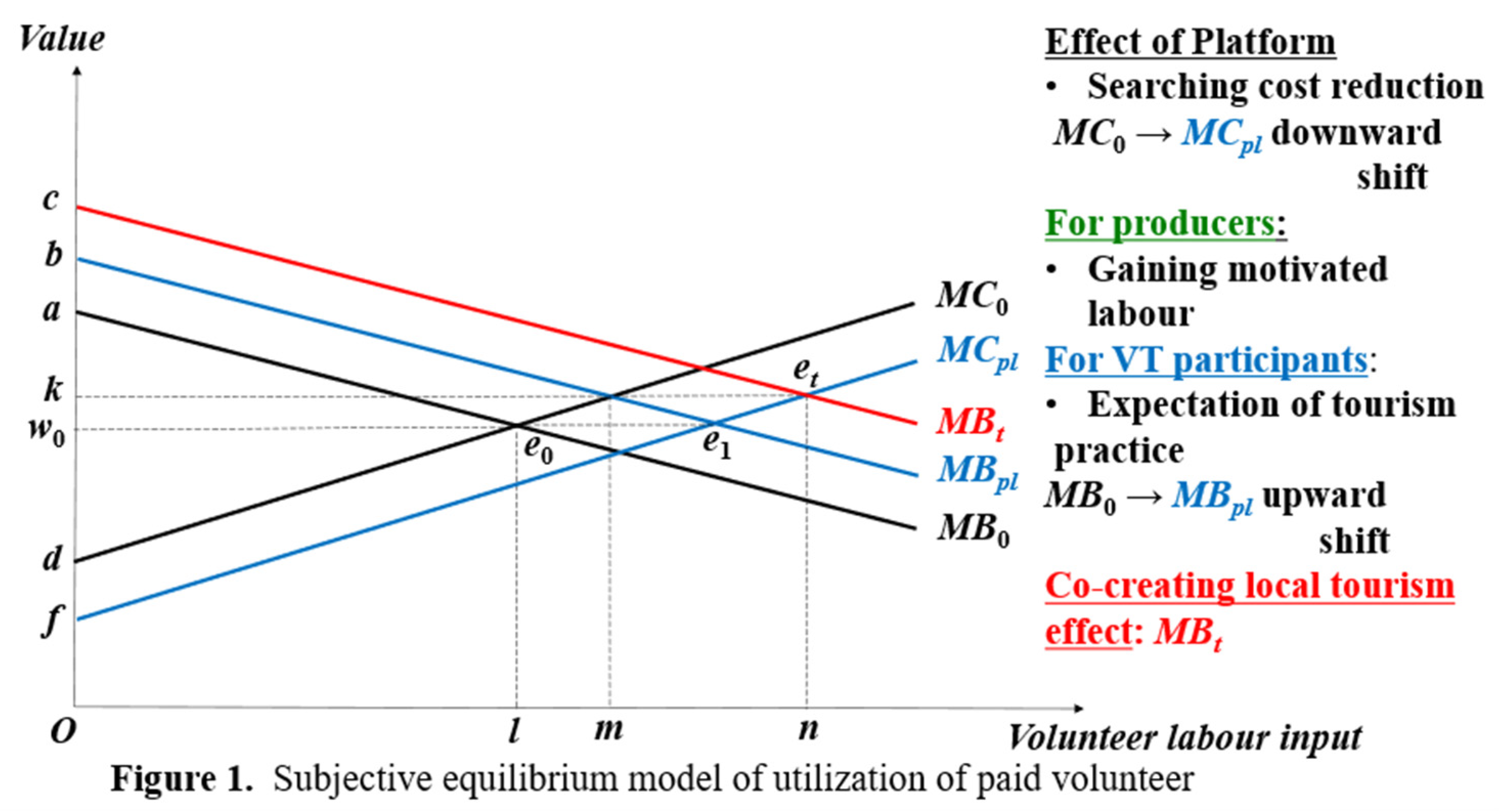
When farmers opt to utilize paid volunteers, we introduce a subjective equilibrium model to describe their decision-making process. In Figure 1, the horizontal axis represents volunteer labour input, while the vertical axis indicates value, ceteris paribus. The downward-sloping curve illustrates the marginal benefit (MB) that farmers derive from paid volunteer labour, which typically declines with increasing activity levels—consistent with microeconomic principles.
For volunteers, participating in farm work helps subsidize their travel costs while enabling them to experience local tourism. Platforms specializing in paid volunteer tourism facilitate these matches. Although paid volunteers are legally entitled to at least the
minimum wage, they may accept lower compensation than regular employees due to the additional utility derived from the tourism experience. Farmers may offer higher wages in regions with more severe labour shortages.
The upward-sloping marginal cost (MC) curve reflects the expenses incurred in utilizing paid volunteers—such as farm operation costs and accommodation or meal provisions. Typically, volunteers bear their own travel costs, while farmers may offer lodging and food depending on their individual policies. As volunteer activity increases, associated costs rise, in line with standard microeconomic assumptions. Paid volunteers contribute to agricultural activities such as production, processing, and sales—particularly beneficial in rural areas facing acute labour constraints.
In the absence of a platform, the equilibrium wage rate (w0) and labour input (On0) are determined at the intersection of MB0 and MC0, marked as point e0. At this equilibrium, total surplus is represented by area ade0. Farmers pay w0, with their surplus depicted by the upper rectangle (aw0e0), while volunteer surplus is shown by the lower rectangle (de0w0), reflecting their dual benefit of income and tourism engagement.
Introducing the platform yields two key effects. First, the MC curve shifts downward from MC0 to MCpl due to reduced search costs. Second, the MB curve shifts upward from MB0 to MBpl, driven by improved information and reduced uncertainty for the farm side to use paid volunteers. The new equilibrium, at point e1, results in greater total surplus, represented by triangle bfe1 (bfe1 > ade0).
Moreover, paid volunteer tourism has co-creative features in two domains. First, volunteers engage in collaborative agricultural work with farmers, reflecting supportive rather than purely economic motivations, unlike hired labour. Second, volunteers stimulate local tourism demand in the destination area. While their farm duties mirror those of hired labour, their underlying motivations generate co-creative dynamics that extend beyond the farm.
This co-creation effect is captured by the MBt curve, representing tourism externalities. The vertical distance between MBpl and MBt reflects the positive spillovers that volunteer activity generates for local tourism, which generates food consumption and economic benefits to the local economy. Farmers, by using the platform, indirectly contribute to this tourism demand, while volunteers directly foster it through their presence and participation.
Thus, the platform plays a central role in enabling this co-creation process between volunteers and farmers. While the surpluses themselves are not directly observable, this conceptual framework guides the empirical investigation into wage determinants as disclosed by the platform, from the farmers’ perspective.
3. Trend of Farm Volunteers
Although nationwide statistics on farm volunteers are not available, limited data have been released by the Tokyo Metropolitan Government, offering partial insights into farm volunteer trends within the prefecture. Despite the constraint, these data provide a useful approximation of broader patterns.
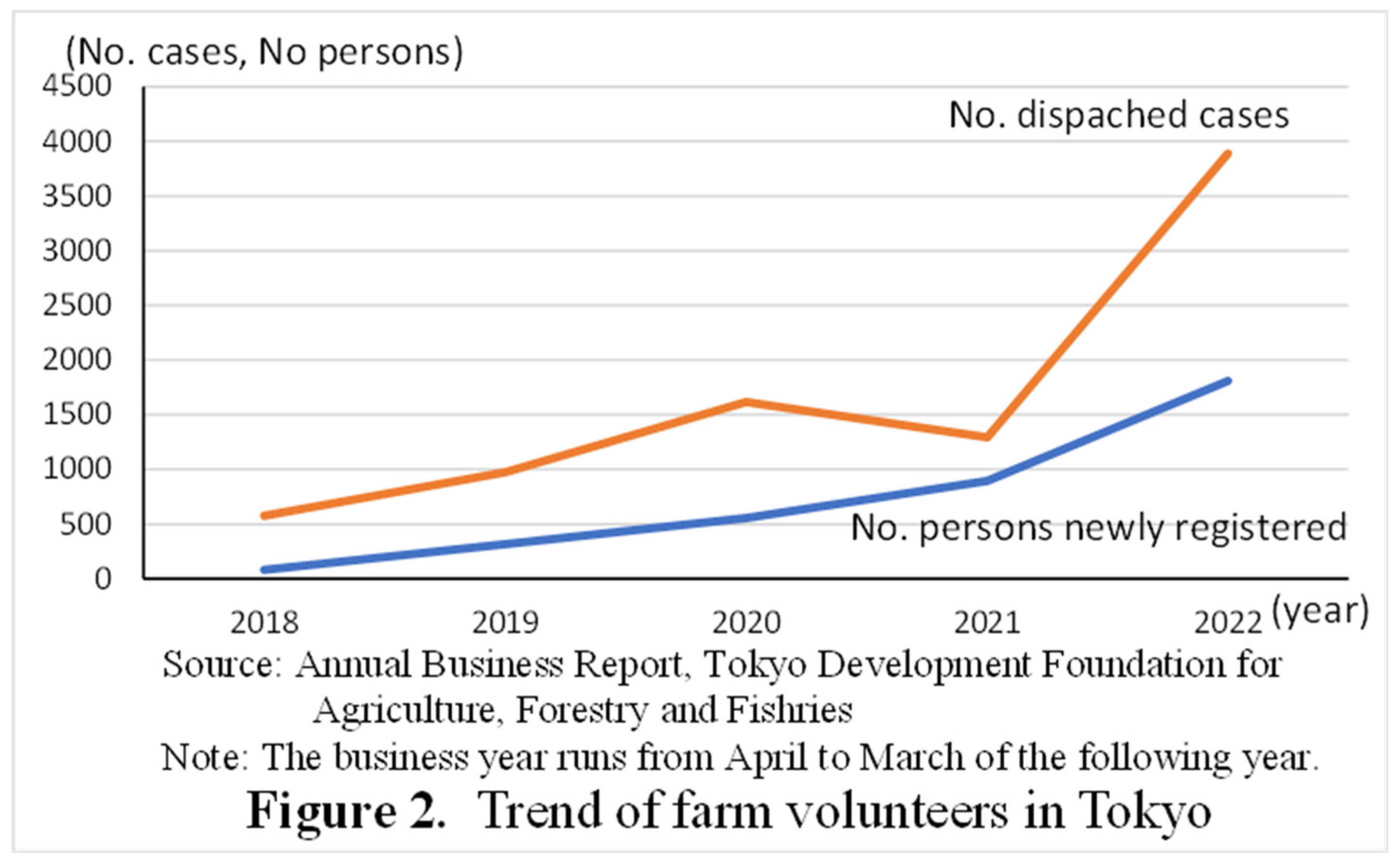
Figure 2 presents the trend in farm volunteer activity in Tokyo, depicting two key indicators: the number of newly registered volunteers and the number of dispatch cases. While registrations have steadily increased, dispatch cases rose sharply following the COVID-19 pandemic. This pattern suggests a growing demand for farm volunteers. The researchers identify both temporary and structural drivers behind this increase. Temporarily, demand surged due to the post-pandemic recovery of the demand for the food service industry, including restaurants, bars, and hotels. Structurally, the ageing farm population and ongoing depopulation of rural communities continue to intensify labour shortages.
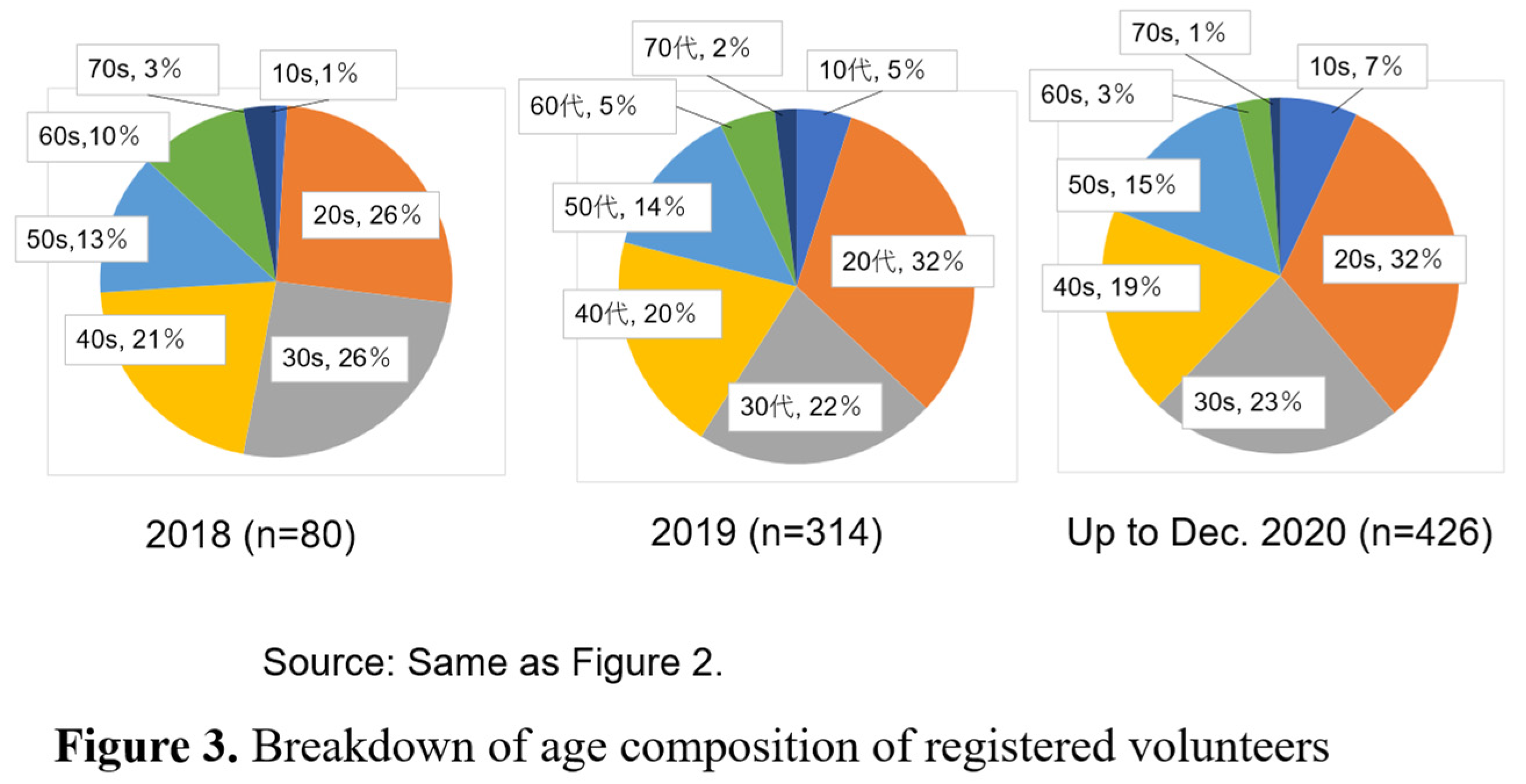
Figure 3 details the age composition of newly registered volunteers from 2018 to 2020. A wide generational spread is evident, with individuals in their twenties registering most actively. However, registration does not necessarily translate into participation.
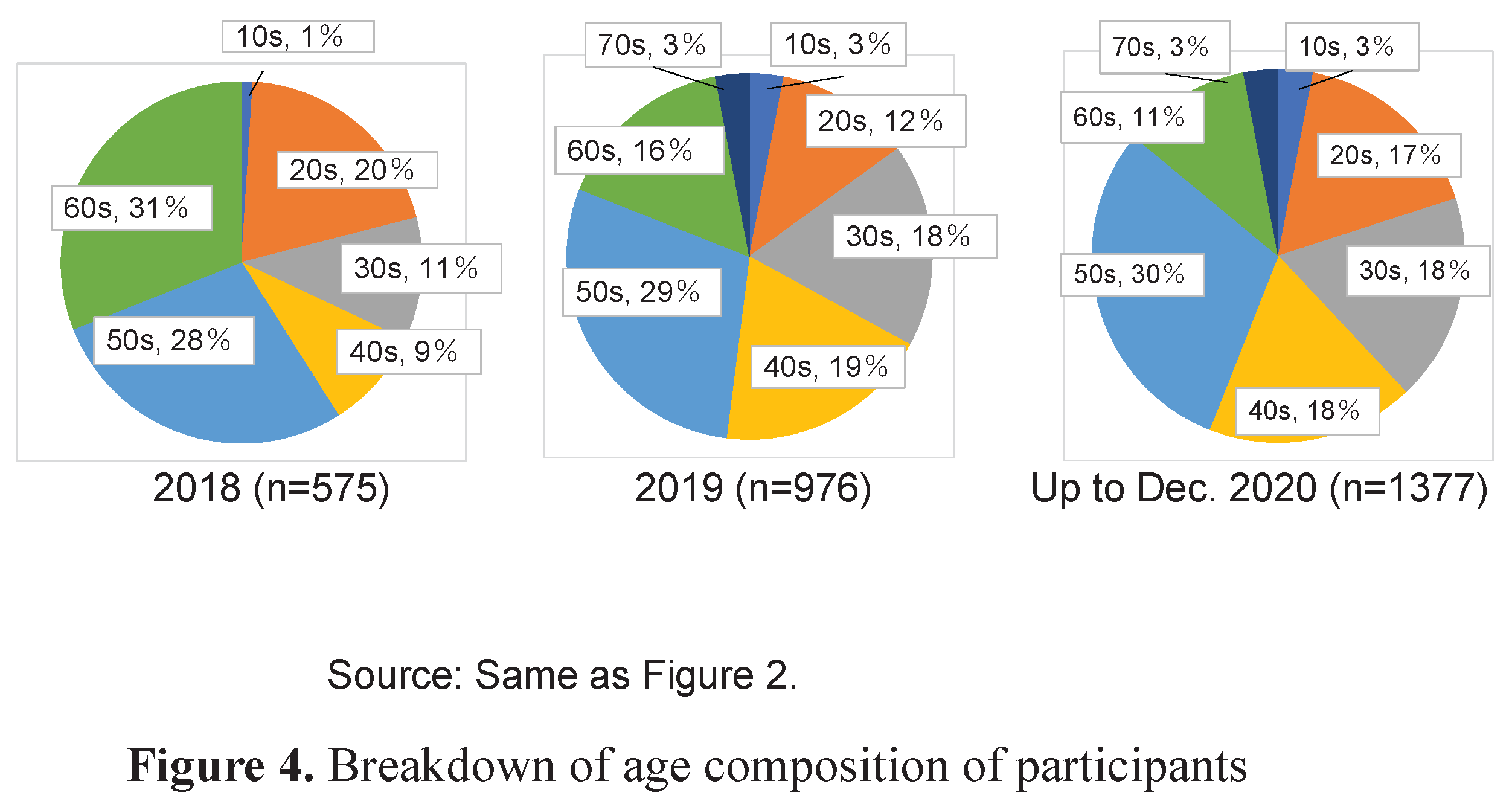
Figure 4 illustrates the age composition of actual program participants, revealing a generational shift: older individuals in their fifties and sixties formed the majority in 2018, whereas younger cohorts dominated in 2020. Compared with registration data, actual participants tend to be younger. Due to the lack of more recent data, interpretations should be made cautiously.
4. Data and Methodology
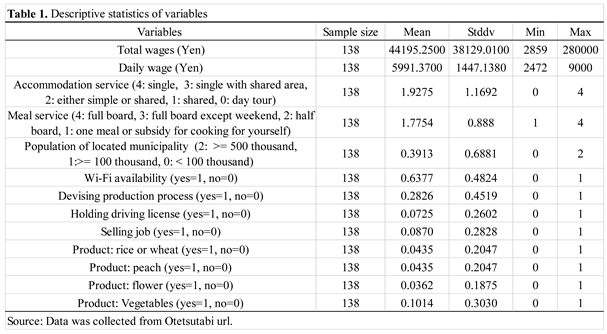
The dataset was obtained from the website of Otetsutabi, a paid volunteer tourism platform established in 2018 by a young female entrepreneur. Despite its brief operational history, the platform has received several awards and garnered significant public attention. It provides detailed information on the timing and nature of farm work, as well as the terms and conditions offered to paid volunteers. In principle, transportation and meal costs are not covered, although some farms do provide meals. Minimum wage standards are legally upheld. The survey period spanned from September to November 2022, encompassing data from 138 farms, of which 115 were corporate entities.
To investigate wage determinants, the researchers employed three models estimated via Ordinary Least Squares (OLS), supplemented with bootstrap sampling to address the limited sample size and potential heteroscedasticity. Model 1 uses daily wages as the dependent variable, whereas Models 2 and 3 focus on total wages, each with distinct sets of explanatory variables.
For Model 1, the explanatory variables include: Main product categories: rice/wheat, peach, flower, and vegetable (binary: yes = 1, no = 0), engagement in direct sales (yes = 1, no = 0), serving as a proxy for earning capacity, and requirement for volunteers to hold a driving license (yes = 1, no = 0).
Model 2 examines three service offerings provided to volunteers: accommodation service, meal service, and Wi-Fi service. The details are as follows. Accommodation availability (five levels): Individual room = 4, partially shared individual room = 3, individual or shared room = 2, shared room = 1, and day trip only (no accommodation) = 0. Meal service availability (four levels): Full board = 4, full board excluding weekends = 3, half board = 2, meal expenses subsidized or self-cooking supported = 1. The most common service was subsidy/self-cooking, with 62 cases, followed by half board, with 56 cases. Full board was uncommon. Wi-Fi availability (binary: yes = 1, no = 0).
Model 3 captures destination and farm-specific characteristics that may appeal to volunteers: Population of destination municipality, distinctive farming practices, and an appealing point for volunteers. The details are as follows. Population of the municipality (three tiers): ≥ 500,000 residents = 2, ≥ 100,000 residents = 1, and < 100,000 residents = 0. Distinctive farming practices: organic and/or GAP (Good Agricultural Practice) certified (yes = 1, no = 0). Volunteer’s driving license possession (yes = 1, no = 0).
Descriptive statistics for all variables are presented in Table 1. The diagnostics indicate no irregularities, affirming the robustness of the dataset. Bootstrap techniques were employed, as noted, to strengthen inference given the modest sample size and variance concerns.
5. Results and Discussion
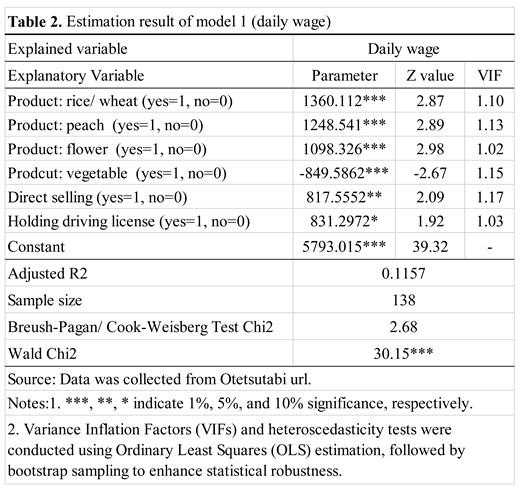
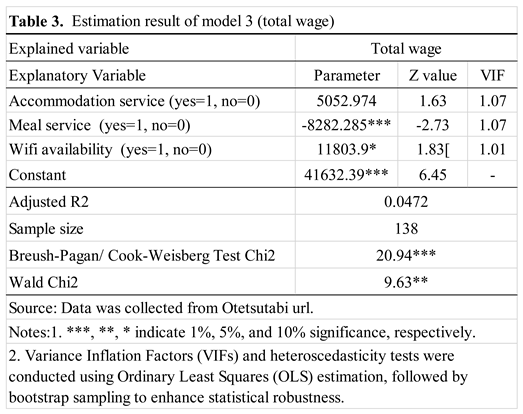
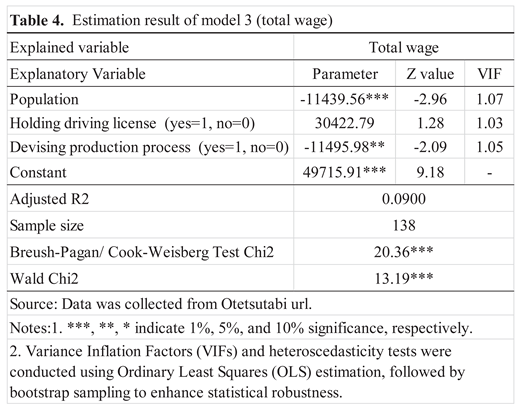
Table 2, Table 3 and Table 4 present the results of the three estimation models. Variance Inflation Factors (VIFs) were consistently low—around unity—indicating no multicollinearity concerns. All three models are suitable for interpretation.
Table 2 shows the results of Model 1, which analyzes daily wages. Each product-related parameter was statistically significant at the 1% level. The largest positive coefficient was observed for rice/wheat, followed by peach and flower. In contrast, the coefficient for vegetables was negative, suggesting that vegetable farms tend to offer lower wages due to their labour-intensive nature and higher demand for workers than that of other products. Additionally, farms engaged in direct selling and volunteers with a driving license exhibited positive coefficients, significant at the 5% and 10% levels, respectively. These results imply that direct selling increases farm revenue, enabling higher wage payments, while licensed volunteers contribute more effectively to operations.
Summary of Model 1: Direct selling plays an important role in increasing revenue and supporting higher daily wages. Volunteers who hold a valid driving license tend to receive higher compensation, reflecting anticipated contributions and potentially offsetting travel and tourism-related expenses.
Table 3 reports the results of Model 2, focusing on total wage determinants related to farm-provided services. The accommodation service parameter was not statistically significant, reflecting its widespread availability (offered by 90.6% of farms). In contrast, meal service and Wi-Fi availability were significant at the 1% and 10% levels, respectively. Notably, the signs of the coefficients differed: meal service was negative, whereas Wi-Fi availability was positive. The negative meal service coefficient indicates that meal-related costs were likely deducted from the total wages offered.
Summary of Model 2: Accommodation did not influence wage levels due to its prevalence. However, meal service negatively affected total wages, mainly when volunteers prepared meals themselves or received subsidies. These findings suggest that accommodation, meals, and network connectivity are standard provisions factored into wage structures.
Table 4 provides the results of Model 3, which emphasizes destination characteristics and production practices. The population variable had a negative and significant coefficient (1%), indicating that farms in less populated, remote areas tend to offer higher wages to attract volunteers. Interestingly, organic farming and GAP certification were also negatively associated with total wages (5% significance). Although these practices typically command premium prices, they incur higher costs, and their benefits are not always reflected in domestic market prices—unlike European and North American contexts.
Summary of Model 3: Farms in smaller municipalities offer higher wages as an incentive. Organic and GAP-certified farms, despite their perceived market value, may face profitability constraints that suppress total wage offerings.
Collectively, the models reveal nuanced insights into wage determination.
Daily wages are influenced by product type, operational practices (e.g., direct selling), and volunteer attributes (e.g., driving license).
Total wages reflect a broader range of factors—destination characteristics, farm practices, and service provisions. Negative wage determinants include meal costs and high-cost production systems like organic and GAP farming.
Given the ageing farm population and the rise in direct-to-consumer online sales, accelerated by COVID-19, demand for farm volunteers is likely to continue growing. Paid volunteers who combine agricultural work with local tourism represent a lifestyle model that bridges urban and rural experiences. The Ministry of Internal Affairs and Communication (MIC), Japan, encourages growth in the segment of “non-native individuals who maintain ongoing relationships with rural areas”—a profile that paid volunteers increasingly match.
Platforms that facilitate paid volunteer tourism serve an effective function in recruiting individuals interested in rural heritage and agricultural engagement. Volunteers value both fair compensation and meaningful tourism experiences. As shown in our analysis, farms engaged in direct selling tend to offer higher wages due to improved profitability. Enhancing farm business performance is, therefore, key to attracting volunteers through more competitive wages and services.
Finally, platforms may foster a divergence between farms that successfully utilize volunteers and those that do not. This dynamic must be considered when designing recruitment strategies for paid volunteer programs.
6. Conclusion
Farm volunteer tourism is gaining attention as a potential solution to Japan’s chronic agricultural labour shortages. This study addresses a relatively unexplored area—paid farm volunteer tourism—which presents a novel form of rural tourism bridging urban engagement with rural revitalization. It aligns voluntary farm work with income-earning opportunities in rural areas.
The researchers developed a conceptual framework incorporating subjective equilibrium, externalities, and co-creation perspectives. These dimensions have not previously been integrated into this topic. The framework illustrates how volunteers and farmers jointly generate positive externalities in local tourism demand through platform-mediated interactions. In other words, the platform acts as a catalyst for co-creation between both parties, enabling the emergence of destination-level tourism demand.
Empirical analysis using regression models—based on data from a Japanese platform—revealed several wage-determining factors. Farms that produce high-value crops and engage in direct sales tend to offer higher wages. Farms in less-populated municipalities also pay more, which is likely to offset severe labour shortages. In contrast, farms adopting organic or GAP-certified practices offer lower wages, likely due to elevated production costs not fully reflected in domestic market prices. Similarly, farms that provide meal services tend to deduct meal-related costs from total compensation, leading to lower wages. Provision of accommodation and Wi-Fi varies depending on farm resources and infrastructure.
Looking ahead, farm volunteer tourism is poised for growth, driven by increasing labour demand and the rise of direct online sales—trends accelerated by the COVID-19 pandemic. While the current volunteer pool is predominantly domestic, the resurgence of inbound tourism indicates future opportunities for international participation. Platforms will need to accommodate this shift by addressing cross-border volunteer demand and facilitating a more inclusive rural tourism market. However, this expansion may widen the disparity between farms that benefit from volunteer participation and those that do not, making user feedback from both volunteers and farms increasingly critical.
To prepare, farm operators must enhance their capacity to engage effectively with international volunteers. Capacity-building support and policy intervention should be considered to promote sustainable farm-volunteer partnerships.
Finally, several avenues remain for future research. As some influential data were not publicly available on the platform, complementary methods such as questionnaire surveys and in-depth case studies—targeting both farmers and volunteers—are needed. Further investigation into participant profiles, actual tourism behaviours, and the generation of external economies for local communities will also provide richer insights into the broader impacts of paid farm volunteer tourism.
Author Contributions
Conceptualization, supervision, and funding acquisition, Yasuo Ohe; methodology, software, data curation, investigation, and writing—original draft preparation, Takaya Hirayama; validation, writing—review and editing, Yasuo Ohe; visualization, Takaya Hirayama and Yasuo Ohe. All authors have read and agreed to the published version of the manuscript.
Funding
This research was funded by the Grant-in-Aid (KAKENHI), No. 24K03189 and No. 25K15710, provided by the Japan Society for the Promotion of Science (JSPS).
Conflicts of Interest
The authors declare no conflicts of interest.
References
- Terry, W. Solving labor problems and building capacity in sustainable agriculture through volunteer tourism. Annals of Tourism Research 2014, 49, 94–107. [Google Scholar] [CrossRef]
- Ando, Y.; Ohe, Y. Econometric study on the relationship between satisfaction and participation of farm-support volunteers: evidence from Abiko, Chiba. Journal of Rural Economics 2016, 87(4), 418–423. [Google Scholar]
- Wearing, S. Volunteer Tourism: Experiences That Make A Difference; CABI, 2001. [Google Scholar]
- Benson, A.M. Volunteer Tourism: Theoretical Frameworks and Practical Applications; Routledge: London, UK, 2010. [Google Scholar]
- Wearing, S.; McGehee, N.G. Volunteer tourism: a review. Tourism Management 2013, 38, 120–130. [Google Scholar] [CrossRef]
- Butcher, J.; Smith, P. Volunteer Tourism: The lifestyle politics of international development; Routledge: London, UK, 2015. [Google Scholar]
- McGehee, N.G. Volunteer tourism: evolution, issues and futures. Journal of Sustainable Tourism 2014, 22(6), 847–854. [Google Scholar] [CrossRef]
- Taplin, J.; Dredge, D.; Scherrer, P. Monitoring and evaluating volunteer tourism: a review and analytical framework. Journal of Sustainable Tourism 2014, 22(6), 874–897. [Google Scholar] [CrossRef]
- Grimm, K.E.; Needham, M.D. Moving beyond the “I” in motivation: attributes and perceptions of conservation volunteer tourists. Journal of Travel Research 2011, 51(4), 488–501. [Google Scholar] [CrossRef]
- Hernandèz-Maskivker, G.; Lapointe, D.; Aquino, R. The impact of volunteer tourism on local communities: a managerial perspective. International Journal of Tourism Research 2018, 20(5), 650–659. [Google Scholar] [CrossRef]
- Keese, J.R. The Geography of Volunteer Tourism: Place Matters. Tourism Geographies 2011, 13(2), 257–279. [Google Scholar] [CrossRef]
- Grimm, K.E.; Needham, M.D. Internet promotional material and conservation volunteer tourist motivations: a case study of selecting organizations and projects. Tourism Management Perspectives 2012, 1, 17–27. [Google Scholar] [CrossRef]
- Cunha, J.; Mensing, R.; Benneworth, P. A conceptual framework to understand student volunteerism. Tertiary Education and Management 2018, 25, 31–44. [Google Scholar] [CrossRef]
- Konno, M.; Izumiya, M.; You, G. Factors determining the management system of student volunteer farming organizations: market and non-market relationships in agricultural labor markets. The Agricultural Marketing Journal of Japan 2021, 29(4), 1–7. [Google Scholar]
- Rodrigues, H.; Abreu, C. Voluntourism – can universities shape the present into a future? Journal of Marketing for Higher Education 2023, 35(2), 1–22. [Google Scholar] [CrossRef]
- Fukui, M.; Ohe, Y. Assessing the role of social media in tourism recovery in tsunami-hit coastal areas in Tohoku, Japan. Tourism Economics 2017, 26(5), 776–791. [Google Scholar] [CrossRef]
- Burns, G.; Kondo, T. An analysis of WWOOF activities in Japan: facilitating new social development. The Japanese Journal of Rural Economics 2015, 17, 82–87. [Google Scholar] [CrossRef]
- Miller, M.C.; Mair, H. Volunteer experiences on organic farms: a phenomenological exploration. Tourism Analysis 2015, 20(1), 69–80. [Google Scholar] [CrossRef]
- Mostafanezhad, M. Organic farm volunteer tourism as social movement participation: a Polanyian political economy analysis of World Wide Opportunities on Organic Farms (WWOOF) in Hawai‘i. Journal of Sustainable Tourism 2016, 24(1), 114–131. [Google Scholar] [CrossRef]
- Wengel, Y. Discourses of volunteer farm tourism in Nepal: a methodological approach to worldwide opportunities on organic farms. Journal of Tourism Adventure 2018, 1(1), 95–105. [Google Scholar] [CrossRef]
- Pollard, W.; Rajendran, D.; Sendjaya, S.; Neesham, C. Organisational culture and effectiveness in ecotourism: the case of World-Wide Opportunities on Organic Farms Australia (WWOOF Australia). Asia Pacific Journal of Tourism Research 2023, 28(2), 111–126. [Google Scholar] [CrossRef]
- Nordbø, I.; Mykletun, R.J.; Segovia, J.; Segovia-Pérez, M. Push and pull motivations of international voluntary workers on organic farms (the WWOOFers). Current Issues in Tourism 2021, 26(1), 137–152. [Google Scholar] [CrossRef]
- Yagi, H.; Murakami, M. A study for clarifying the effect of farm volunteers to the urban farm: case study of a multi-cropping farm. Japanese Journal of Farm Management 2003, 41(1), 100–103. [Google Scholar]
- Kitagawa, M.; Hattori, T. The role of the volunteer for supporting farming as a bearer of an urban agriculture land. Water. Land and Environmental Engineering 2014, 82(2), 11–14. [Google Scholar]
- Dobernig, K.; Stagl, S. Growing a lifestyle movement? Exploring identity-work and lifestyle politics in urban food cultivation. International Journal of Consumer Studies 2015, 39(5), 452–458. [Google Scholar] [CrossRef]
- Tiraieyari, E.; Krauss, S.E. Predicting youth participation in urban agriculture in Malaysia: insights from the theory of planned behavior and the functional approach to volunteer motivation. Agriculture and Human Values 2018, 35, 637–650. [Google Scholar] [CrossRef]
- Kiptot, E.; Franzel, S. Developing sustainable farmer-to-farmer extension: experiences from the volunteer farmer–trainer approach in Kenya. International Journal of Agricultural Sustainability 2019, 17(6), 401–412. [Google Scholar] [CrossRef]
- Tran, T.N.; Tran, T.H.T. Sustainability outcomes of volunteer tourism in rural communities: empowerment and the role of volunteer tourism organizations. Journal of Hospitality and Tourism Insights 2024, 8(5), 1740–1760. [Google Scholar] [CrossRef]
- Zavitz, K. J.; Butz, D. Not that alternative: short-term volunteer tourism at an organic farming project in Costa Rica. An International Journal for Critical Geographies 2011, 10(3), 412–441. [Google Scholar]
- Ohe, Y. Educational tourism in agriculture and identity of farm successors. Tourism Economics 2018, 24(2), 167–184. [Google Scholar] [CrossRef]
- Ohe, Y. Investigating farmer’s identity and efficiency of tourism-oriented diversification. Tourism Economics 2022, 28(2), 535–558. [Google Scholar] [CrossRef]

 |
 |
 |
 |
Disclaimer/Publisher’s Note: The statements, opinions and data contained in all publications are solely those of the individual author(s) and contributor(s) and not of MDPI and/or the editor(s). MDPI and/or the editor(s) disclaim responsibility for any injury to people or property resulting from any ideas, methods, instructions or products referred to in the content. |
© 2026 by the authors. Licensee MDPI, Basel, Switzerland. This article is an open access article distributed under the terms and conditions of the Creative Commons Attribution (CC BY) license (http://creativecommons.org/licenses/by/4.0/).
Copyright: This open access article is published under a Creative Commons CC BY 4.0 license, which permit the free download, distribution, and reuse, provided that the author and preprint are cited in any reuse.


