

Submitted:
21 January 2026
Posted:
23 January 2026
You are already at the latest version
Abstract
Digital Twin (DT) technology has become a critical component of smart city evolution, providing real-time analytics, predictive modelling, and operational efficiency enhancements. The goal of this paper is to explore the opportunities and barriers for a city-wide data exchange platform to establish the principles for a Federated DT (FDT) development to serve the integration of sector-specific DT applications to create a cohesive urban intelligence framework. The paper investigates the topic of federated data exchange in a smart city context and how interoperability among the use cases of DTs can be achieved. Two system architectures for a Data Exchange Platform have been explored, including layered and composable FDT approaches. The composable architecture has been chosen for the platform implementation to ensure interoperability, scalability, and security in real-time data exchange. The composable architecture is essentially a microservices-driven framework with self-contained components that have clear functionalities and provides the greatest flexibility for future development of the FDT Data Exchange Platform. By employing a range of microservices, the composable architecture can ensure modularity, scalability, and flexibility, making it easier to manage, update, and extend the platform to accommodate additional DTs for evolving city needs, urban management and decision-making. However, this comes at the cost of increased issues around security and governance of interfaces. The platform has been tested by 5 DTs designed by 4 Universities located in Birmingham, UK and Ulsan, South Korea. For the design of the platform, nine common elements have been identified as “building blocks” analysing the DT use cases in a sandbox environment called the Diatomic Azure DT Development Platform. These common building blocks are 3D Visualisation, Asset Management, Predictive Analytics, Artificial Intelligence, Machine Learning, Authorisation Methods, Access Control, API, and Sensors. These building blocks have been later validated by the use cases presented by 8 SMEs developing DTs. The initial results confirm that the identified building blocks are sufficient for the development of DTs to create a generic city-wide data exchange platform. These results provide insights for DT adoption by de-risking investment and targeted resources required for smart city development. The scope of this paper is limited with smart city applications but the proposed FDT system architecture should be applicable to any domain.
Keywords:
digital twins
; federated data exchange
; smart cities
; system architecture
1. Introduction
The first Digital Twin (DT). concept came after the launch of the National Aeronautics and Space Administration (NASA) Apollo 13 in April 1970, right after an explosion in the oxygen tanks critically damaging the spacecraft. The rescue mission by NASA involved creation of physically duplicated systems at ground level to match the spacecraft in orbit and used these physical twins to train astronauts and mission controllers in every mission scenario to mitigate multiple failures in reality [1]. Since then, DTs have been becoming predominantly virtual rather than physical. As a result, driven by remarkable industrial attention, DTs have flourished and ripened in many domains including aeronautics, healthcare, urban planning and agriculture. There is a growing interest from the software engineering and the software architecture communities that have proposed software architectural solutions for DTs.
[2] proposed the first definition of DTs as information-mirroring models of physical assets. Accordingly, a physical system has a virtual representation and the DT facilitates the information flow between the virtual and physical systems. The two systems enable a continuous synchronisation of the virtual to the physical part and vice versa. Thus, a DT can be considered a virtual instance of physical assets capable of continuously mirroring them. In essence, a DT duplicates physical objects (people, objects, spaces, systems, processes, etc.) in the real world into digital objects in the digital world, and provides various simulations for solving problems in the real world, or for correction and improvement [3].
Following the notable industrial adoption of DTs [e.g., [4,5,6,7,8]], there has been a growing need to connect them. [1] stated that although there is a lack of widely accepted reference architectural solutions for DTs, most of them are built using a combination of the layered and service-oriented patterns and address quality attributes of maintainability, performance efficiency, and compatibility. However, there is no current research addressing when and under which conditions what data governance style should be employed by City Councils, Transport Authorities, Hospitals, Emergency Services, and other organisations to facilitate data sharing. [9] stated that various proposals to achieve collective work between DTs have been investigated, however, more research is required to develop and validate appropriate mechanisms to ensure the successful deployment of federation in complex real-world cases that require collaboration among individual systems.
In this paper, our goal is to investigate the opportunities and barriers for a common data exchange model so that DTs can be connected with the aim of creating a generic data exchange platform that enables the reconfiguration of data from multiple sources. This may generate greater insights for DT adoption for decision making and de-risking investment and targeted resources. A generic data exchange platform could increase the capture and re-use of data from various systems and IoT devices. Federation may reduce the need for individual case-specific data exchange platforms for transforming data and increase the ability for open data platforms to share and exchange data irrespective of its initial configuration. However, there is a key question that comes to mind: what are the common building blocks in a tech stack that are required for the development of a range of DTs to operate a generic city-wide data exchange platform.
In the remaining sections of this paper, we will first review the current state of DTs, Data Exchange, and IoT, and then, investigate existing standards, data models, data governance and interoperability issues in DTs. After analysing the common components of a range of DTs, we propose a system architecture for federation. We then conclude with producing a set of recommendations for the development of Federated DT (FDT) systems. The scope of the review of data exchange models is limited with smart city applications but the proposed FDT system architecture should be applicable to any domain.
2. Digital Twins
As cities expand and their challenges become more complex, there is a growing need for cities to become smarter in leveraging their increasingly connected technologies to address these challenges. Through the strategic application of digital innovations, urban areas can enhance their resilience, efficiency, and overall liveability, contributing to a more sustainable future [10]. At the core of the smart city concept are DTs of the urban environment and the entities and systems within it. These DTs must be able to interact to fully unlock their potential, otherwise they will be siloed with relevant data and insights from one twin unused by others. The goal of the smart city is a convergence between IoT, DTs, and AI to manage effectively the complex systems, resources and assets encountered in the urban space [11]. DTs must connect with their physical twin and client applications in order to transfer data.
According to BS ISO/IEC 30173:2023 Digital Twin—Concepts and terminology, a digital twin is a “digital representation… of a target entity… with data connections that enable convergence between the physical and digital states at an appropriate rate of synchronization”. A typical example of a Digital Twin (DT) application may be a wind turbine (physical twin). The wind turbine may have sensors measuring various operational parameters, such as rotation speed, power generated, temperature, etc. The data from these sensors can be used to update a virtual model (the virtual twin). For example, this model can be used for monitoring to inform control of the wind turbine, or simulations could be run to determine how the wind turbine will perform under different conditions, given its current state. A simple 4-layer architecture in Figure 1, illustrates the multiplicity of data connections required in a Federated Digital Twin (FDT) system. Traditionally, this has been achieved using a variety of communication protocols and data formats, which introduces problems of interoperability.
International Digital Twin Case Studies
As demonstrated in Table 1, there is an extensive use of CityGML for data representation by the International digital twins and other OGC standards, such as GeoJSON. Table 1 consolidates the technical details, integration strategies, data exchange mechanisms, and applications of DTs in Singapore [13,14,15,16], Helsinki [17,18,19], Amsterdam [20,21,22,23], Berlin [24,25,26,27], and Dubai [28,29,30]. There is a diversity of approaches to integration of DTs, including centralised and federated approaches. In these DTs, data exchange is mostly through APIs.
3. Data Exchange
Data can come from a variety of sources and in a variety of formats. Data of relevance to a Smart City Digital Twin could include traffic data, condition of built infrastructure, temperature and air quality measurements, and many more. The data being produced may be event-driven (e.g., an alert that water-level has exceeded a threshold) or may be regularly sampled (e.g., the river height every hour). Even if the data is regularly sampled it might not be transmitted as soon as it is available, it may be aggregated or processed before being sent. This may be to reduce the volume of data transported or that the processed data is more useful than the raw data. Data exchange may involve real-time or “live” data, or archived data. The OPC UA framework for automation in manufacturing, provides device interfaces for accessing archived data as well as subscribing to specific data streams from devices at the desired rate of update. There is also an interface component for subscribing to event notifications from a device.
FDTs may support various communication types to facilitate real-time data transmission, processing, and decision-making. The three potential primary communication modes in an FDT are as following [31]:
1. Physical-to-Physical (P2P): P2P communication occurs between physical objects, such as IoT devices, sensors, actuators, and edge devices.
2. Physical-to-Virtual (P2V): P2V communication connects a physical object with its digital twin, enabling real-time data exchange between the physical and virtual environments.
3. Virtual-to-Virtual (V2V): V2V communication occurs entirely within the virtual environment, where multiple DTs interact and share data to coordinate decisions, simulate scenarios, and optimize operations.
These are distinct contexts for data exchange, where the data exchanged may be different. For instance, two digital twins may share data in the form of predicted operational parameters that are not directly observable in their physical twins. Whereas physical twins are most likely to share data on their current state with their digital twin. A key question is whether the Physical and Digital twins make their data available through web interfaces, which may take the form of APIs to them or Linked Data published by them. In automated manufacturing, the communication between physical devices is often required to be high-speed and there is a trade-off between the amount of context that can be provided and the speed of communication. This transfers more generally to the DT case, where the DT may be required to be updated in near real time [32].
3.1. Metadata
Despite the heterogeneity of data sources and formats as seen in the use cases, there are common elements that a receiving system would need to use incoming data correctly. The first is to understand the syntax of the data, so that it may be parsed/loaded. Secondly, it is necessary to know the meaning of the data (semantics)—what the data is, what units is it recorded in, and which device/sensor produced it, etc. This is usually included as metadata. The other important thing to know is when the data was recorded/synthesised.
- Data format (syntactic)—is the data JSON, XML, etc.?
- What is this data? e.g. Temperature in degrees Celsius.
- Timestamp—when was the data recorded/apply to?
- ID—which device/sensor produced this data?
- Location—where was this data recorded? Important for georeferencing.
Further fields may indicate the quality or validity of the data, allowing the receiving system to determine whether to use the data for its own purposes, or not. This theme will be developed further in the Interoperability section of this paper (in Section 6).
3.2. Comparisons Between Data Exchange Formats: JSON Vs XML
Table 2 lists general characteristics of two popular data exchange formats, JSON vs XML. Both are human and machine readable. As the schemas are flexible, required metadata can be added to support semantic interoperability. JSON originated in the need to encode JavaScript Objects hence the name JavaScript Object Notation for web traffic. However, JSON is now a widely used data format beyond its original context, with wide support across systems and programming languages. The JSON syntax is standardised in ISO/IEC 21778:2017. XML (Extensible Markup Language) was similarly defined for storing and transmitting data via the web. However, XML has a document focus as opposed to the data focus of JSON. This may be a disadvantage with sensors, etc. producing large quantities of numerical data, as XML does not support arrays.
3.3. Internet-of-Things (IoT)
The Internet-of-Things is simply the network of devices that connect to the internet to exchange information, which may include receiving commands to carry out physical actions if the device is so capable. Digital Twins are part of the Internet-of-Things (IoT) and therefore there is much commonality in the architecture with the use case of Digital Twins. Many of the problems faced in the creation of a platform for DTs are the same as those that have been faced for IoT generally. Of particular interest are the problems of:
- Interoperability—there are a plethora of communication protocols and data formats that make it difficult for devices to collaborate.
- Security—due to the connected nature of IoT devices they are exposed to possible cyberattacks.
- Privacy—IoT devices often collect personal and sensitive data.
- Scalability—as the number of IoT devices in the system increases, there is additional device management, network traffic and data to be processed.
- Data Management—IoT devices may generate large amounts of data that need to be processed, stored and analysed.
These are all problems that must also be addressed in a Federated Data Exchange Architecture for Digital Twins.
A model architecture of a typical IoT system is given below in Table 3. This architecture illustrates the data journey from the physical device to its use in applications and the decisions made using those applications. At different levels of the architecture different formats and protocols are used and these can vary between devices creating challenges with interoperability. The example formats/protocols are not intended to be exhaustive in Table 3. At the perception layer data must be encoded digitally (e.g., JSON), placed in an application level messaging protocol (e.g., HTTP), which must then be transported over the internet (e.g., IPv6/TCP) or other network, to where will be processed and used in applications.
4. Data Exchange for Digital Twins
ISO 23247-4:2021 Automation systems and integration—Digital twin framework for manufacturing, Part 4: Information Exchange is the only published ISO standard for data exchange for DTs. It is specific to the manufacturing context and recommends using protocols such as MTConnect and OPC-UA for edge device communication and HTTP/REST APIs for communication to user entities of the DT. Asset Administration Shell is suggested as the data model for describing digital twins, which can be encoded in various formats, e.g., JSON, XML, RDF (The Resource Description Framework, a method to describe and exchange graph data).
Data exchange comes with issues of verifiability: how do we know that the data came from the presumed source? How do we know that the data was not altered? A related issue is selective disclosure: How do we share some parts of our data to some parties and not others? Verification of the data source is important. Data should not be altered, once shared. Data parsing for sharing with interested parties must be possible. Distributed ledger (blockchain) technologies have been suggested as solutions to the issue of verifiability of data exchanged in the DT ecosystem. [35] aimed to solve the problems of verifying integrity, traceability, and data ownership across the many interacting units of a smart city with their SIGNED framework. Their framework has 2 key components a Traceability Layer to track digital assets, and a digital wallet to manage cryptographic credentials and verification for those assets. The blockchain is deployed in the Traceability Layer to hold a registry of verifiable public keys and public addresses that can be used for data exchange. There is some momentum to using blockchain in securing IoT; and Siemens has recently partnered with Minima to embed blockchain into IoT devices, so that data integrity, and communication can be verified cryptographically2.
5. Data Governance
Data governance plays a critical role in ensuring the security, integrity, and usability of data within the FDT architecture. The key objectives are:
- Data Security: Protect sensitive information from unauthorised access, breaches, and tampering.
- Data Privacy: Comply with regulations (e.g., GDPR) to protect individuals’ data and ensure lawful data handling.
- Data Integrity: Ensure that data exchanged among DTs is accurate, consistent, and reliable.
- Transparency and Accountability: Define clear roles and responsibilities for data ownership, processing, and oversight.
- Interoperability and Standards: Establish protocols and standards to enable seamless data exchange between heterogeneous systems.
Nine key Data Governance Framework Components have been identified:
- Role-Based Access Control (RBAC): a fundamental mechanism that ensures only authorised users or systems can access specific data. It enforces access rules based on predefined roles and responsibilities.
- Blockchain for Security and Traceability: provides tamper-proof, decentralised ledger capabilities to enhance trust and security in data transactions.
- Data Quality Management: Ensuring high-quality data is critical for the effectiveness of DTs. Poor-quality data can lead to flawed decision-making and loss of stakeholder trust.
- Privacy Preserving Mechanisms: FDTs often handle sensitive personal or operational data, making privacy a top priority.
- Interoperability and Standardisation: For a federated system to function effectively, it must facilitate data exchange among DTs, each potentially operating on different standards and formats.
- Data Encryption: ensures that data remains secure during transmission and storage.
- Data Life Cycle Management: Governance policies should address how data is created, shared, stored, archived, and ultimately deleted.
- Monitoring and Auditing: Continuous monitoring ensures the platform remains compliant and secure.
- Stakeholder Engagement and Training: The success of data governance relies on informed and engaged stakeholders.
By addressing these governance components in detail, the FDT platform will establish itself as a secure, transparent, and efficient data ecosystem, driving the successful implementation of smart city initiatives. The following tools in Table 4 have been identified for potential use for implementing Governance functions:
5.1. Governance Recommendations
- Data Sovereignty Compliance: Ensure all governance policies align with UK-specific regulations on data sovereignty and public sector data sharing.
- Regular Review and Updates: Establish a governance review cycle to adapt to emerging technologies, regulations, and city needs.
- Transparency with Citizens: Develop public-facing documentation to explain how data is collected, used, and protected, fostering trust in the system.
5.2. Role-Based Access Levels for the FDT Platform
As identified above, Role-Based Access Control (RBAC) is essential for assuring security data privacy on the FDT platform. Seven Roles and their requirements have been identified for a Smart City FDT Platform, as shown in Table 5. Each role is designed to ensure operational efficiency, data integrity, and compliance with governance policies while fostering collaboration among public and private sectors, academic institutions, and the public.
6. Interoperability for Digital Twins
When data is exchanged between systems it is necessary that the receiving system can interpret the data it has received for those systems to be interoperable. Interoperability of DTs has been identified as a key challenge in smart cities and healthcare frameworks [36]. Interoperability, according to the Oxford Dictionary of Computer Science 7th Edition, is “The ability of systems to exchange and make use of information in a straightforward and useful way; this is enhanced by the use of standards in communication and data format.” As data are heterogeneous in sources, attributes, formats, and protocols, it is necessary to standardise communication and formats to ensure interoperability between DT components [37].
[38] used the Level of Conceptual Interoperability Model (LCIM) to quantify the degree to which systems are interoperable (Table 1). It is a scale that runs from no interoperation, up to complete awareness of other systems. The LCIM is a ladder in that the higher levels cannot be obtained unless the lower levels have been reached first. The level of desired interoperability implies what information is required to by the digital twins. In the Applications Layer for IoT, the protocols listed carry the formats from the Perception layer. Together these allow reaching Level 2 (Syntactic) of LCIM, as the data is exchanged in known formats, but the meaning of the data (i.e., semantics) is not. An example of achieving Level 3 (Semantic) is the OPC-UA standard (an interoperability framework). This standard defines “domain-specific information models” for more than 60 types of industrial equipment, These models standardise the types of information that each equipment type can provide. They are defined by committees and therefore take time to develop and, as stated before, are domain-specific. However, this is a solution to reach semantic interoperability.

Table 1.
The Level of Conceptual Interoperability Model (LCIM) Levels (Adapted from [39]).
Table 1.
The Level of Conceptual Interoperability Model (LCIM) Levels (Adapted from [39]).
| Level | Type | Description | Common Premise |
|---|---|---|---|
| 6 | Conceptual | Interoperating systems at this level are completely aware of each others information, processes, contexts, and modeling assumptions. | conceptual model |
| 5 | Dynamic | Interoperating systems are able to re-orient information production and consumption based on understood changes to meaning, due to changing context as time increases. | execution model |
| 4 | Pragmatic | Interoperating systems will be aware of the context (system states and processes) and meaning of information being exchanged. | workflow model |
| 3 | Semantic | Interoperating systems are exchanging a set of terms that they can semantically parse. | reference model |
| 2 | Syntactic | Have an agreed protocol to exchange the right forms of data in the right order, but the meaning of data elements is not established. | data structure |
| 1 | Technical | Have technical connection(s) and can exchange data between systems | communication protocol |
| 0 | None | N/A | N/A |
Manufacturing is the most advanced domain in terms of Digital Twin ISO standardisation with ISO 23247-1:2021, however it is in the early stages of adoption and not all frameworks in that domain implement all the functionalities mandated in the standard [40]. As there is not the same degree of standardisation in other domains, and as there are a wide variety of possible domains, this promotes investigation into possible general solutions. This leads to some questions:
- What level of interoperability do we require?
- What information on the data from a DT (i.e., metadata) do we require for the required level?
- Does that metadata need to be in the data exchange format for discoverability?
For data from one digital twin to be usable by another, it is necessary to reach at least Level 3 (Semantic) of the LCIM ladder. The aim is therefore to achieve semantic interoperability as a minimum.
6.1. OASC MIMs
Open Agile Smart Cities (OASC)3 is a global network of cities and communities that supports the digital transformation of local administration. It includes the UK’s Connected Places Catapult as a partner. The OASC MIMs 2024 (Minimal Interoperability Mechanisms) framework, focuses on developing a “minimal but sufficient level of interoperability for data, systems, and services specifically in the context of smart city solutions.” The MIMs framework has 10 (incomplete) levels with suggested “mechanisms” to achieve those levels. Of interest here are MIM1—Context Information, MIM2—Data Models, and MIM7—Places).
ETSI NGSI-LD, SensorThings API and LDES (Linked Data Event Streams) were suggested as mechanisms to fulfil the requirements in MIM1. The suggested mechanisms for satisfying the requirements in MIM2 (other than where referencing another MIM), is to use those from standard data models. The list given is intended to be updated, but currently includes the ISO 5087 series of standards for the City Data Model; NGSI-LD compliant data models; oneM2M base ontology (SAREF-compatible); Core vocabularies of ISA2/Interoperable Europe based on Single Digital Gateway Regulation; DTDL based on JSON-LD; and spatial/spatio-temporal data based on MIM7 recommendations. The first MIM7 requirement is to expose Geospatial data through a standards-based web service. The second is for sharing geospatial data an interoperable way using the open standards for data encoding (GeoJSON, GML, GeoPackage, City GML and CityJSON) and the OGC API and OGC SensorThings API for access (MIM7—Places | OASC MIMs 2024, n.d.).
To summarise, the MIMs emphasise the use of open standardised formats and semantic descriptions for machine interoperability; and making the data accessible through web-based APIs. The data exchange formats and architecture, should be aligned with the OASC MIMs, as these will enable interoperability.
6.2. Semantic Interoperability
Different data sources will have different data formats and even those with the same function, e.g., temperature monitoring, may report that data in different ways (e.g., Fahrenheit or Celsius, XML or JSON). For these data to be usable by applications, this heterogeneity has to be overcome. Hence, a common understanding of the data is imperative, thus enabling semantic interoperability. There is a range of semantic interoperability solutions that could be used for data from smart cities. [41] list 64 semantic interoperability solutions.
It is essential for semantic interoperability that the data is labelled with metadata, which is of a standardised type, using a common controlled vocabulary of standardised terms. The data and metadata must also be structured in a standardised way called using structural rules called a schema. For example, the Open Geospatial Consortium (OGC) ESPRESSO project4 aimed to develop “shared semantics and vocabularies” as part of their conceptual Smart City Information Framework. This framework will use CityGML as a reference data model, which was commonly used in the international smart city use cases previously examined.
One of the key enabling technologies for achieving semantic and higher interoperability is ontologies. To use the definition of [41]: Ontologies “are collections of computer-readable term definitions of domain or application-specific knowledge, specifying sets of instances/data (concepts/classes), their properties, and binary relationships between them. They are used to obtain and explicitly represent not only domain, but also- and cross-domain knowledge”. The ontology specifies the structure of knowledge relationships (meanings) in a formal way [42]. This is different to a vocabulary that only specifies allowable terms and not the relations between them, and schemas that specify the data structure/format. A taxonomy is a hierarchical classification that specifies “is a” or parent-child relationships, e.g., thermometer is a sensor. Its semantic structure is less rich than a full ontology, which can include relations such as “part of”, etc.
Knowledge graphs represent the actual data and its relationships in an ontology. Hence, appropriate ontologies enable LCIM Levels 4-6. OGC also specifies a number of ontologies that could be used in a smart city data exchange framework, including those for sensor network measurements. There are multiple ways in which knowledge representations, such as knowledge graphs can be applied in DTs (see Figure 2). Knowledge Representations (KR) in Figure 2 can be specialised locally to layers or across layers (multi-layer).
As [41] stated, there are a wide range of ontological models that apply to cities, covering City infrastructure (roads, etc.); Environmental Data (weather, air quality, etc.); Social and economic data (demographics, economic indicators, etc.); Services and resources (availability of health, education, energy and water, etc.); Events and incidents (festivals, traffic accidents, etc.); Buildings and Spaces (floor plans, capacities, etc); City Government (organisation, officials, policies); Real-time data (traffic, public transit schedules, etc.). They point out that there are a variety of relevant existing ontologies that are unstandardised and may have gaps in coverage and overlap with others (many will have models for sensors and devices). They suggest aligning ontologies used to minimize overlap allowing for “more efficient data sharing and integration between different systems…”.
6.2.1. Semantic Annotation
This is the process of adding semantic metadata to data resources (archival or streaming). According to [41] most semantic annotation methods focus on mapping sensor information to an established ontology using a specific mapping language. The added annotations are machine readable, enabling systems to comprehend what the data is from the supplied metadata.
6.2.2. Semantic Queries and Reasoning
To fully utilise the data being collected in a Smart City it is important to be able to query and reason over all the data in the city model. This enables decision and policy making informed by all the available sources. For example, Knowledge Graphs in RDF format is queried using SPARQL (or derivatives such as GeoSPARQL for geospatial data in RDF). W3C list 32 reasoners for OWL, an open-source example is Apache Jena5.
6.2.3. Limitations of Ontologies for Smart Cities
7. Approaches to Semantic Interoperability
As stated by [41]: “An important issue that remains unresolved in the development of Internet of Everything (IoE)-enabled smart cities, is how to facilitate a common understanding of data and messages exchanged between entities described by different ontologies in order to establish semantic interoperability. To the best of our knowledge, today there is a lack of well-established frameworks that focus on the automated semantic translation of data and communication messages, mostly based on effective ontological alignments, despite the fact that this issue has been raised for many years” They point out there are currently 2 main approaches to semantic interoperability using ontologies by smart city platforms:
- i)
- reusing standard ontologies, e.g., SOSA/SSN6 for sensor networks and actuators
- ii)
- defining their own monolithic smart-city ontology, e.g., STAR-CITY, CityPulse.
Another important consideration is the maturity level of the proposed solution.
7.1. Semantic Technologies Useful in the Smart City Context
7.1.1. JSON
IEEE 2888.1-2024 [44] specifies JSON as the syntax for data exchange. This standard defines the vocabulary, data formats and APIs for communicating with sensors. The schema provides the JSON syntax for specifying (“interfacing”) sensor data, for brevity it will not be reproduced here. In addition to the root schema, there are schemas for numerous sensor types, some of which will have utility in the smart city domain. These include cameras, temperature, pressure, humidity, wind, gas (that could be used for air quality), GPS, and generic cases. The same standard also specifies a JSON format for describing (“recognizing”) sensor capabilities. This is intended to enable interoperability by describing a sensor’s capabilities. So, the “interfacing” and “recognizing” formats are used together to provide the relevant semantic information and context to understand the sensor measurements.
7.1.2. RDF
Resource Description Framework (RDF) is a W3C standard7 for representing and exchanging relational data on the Web. RDF is based on semantic triples of the type subject-predicate-object. RDF triples encode relationships, such as Sensor 1-measures-temperature. The RDFS (S for Schema) extension is used for describing ontologies and written in XML. RDF can then be used to represent data according to the schema. OWL the Web Ontology Language extends RDFS with additional features. SPARQL is a semantic query language to query RDF databases. It is a semantic query language based on querying the graph structure of RDF. There is also C-SPARQL or Continuous-SPARQL designed to query streams of RDF data. OWL and RDF are the most common formats for storing data in knowledge graphs for DTs, according to the systematic review of [43].
7.1.3. Linked Data
Linked Data is data available on the Web that uses typed links to connect data from different sources (Bizer, Heath and Berners-Lee, n.d.). Linked Data uses the Resource Description Format (RDF) to make typed statements about the world. Linked Data uses HTTP URIs (Universal Resource Identifiers) as names for things and RDF/SPARQL to return information. The links create a “Web of Data”. If this data is accessible openly on the web, then it is called Linked Open Data (LOD). Related technologies are Linked Open Vocabularies (LOD)8, which encourages reuse of vocabularies (many of which are ontologies), and Linked Open Reasoning (LOR), to make rule-based inferences on LOD. An application of this is in the sensor domain [45].
7.1.4. JSON-LD
JSON-LD extends JSON to the Linked Data context9. It is designed to be lightweight and help JSON data interoperate on the Web. There can be ambiguity in the meaning of JSON property names from different sources, e.g., “measurement”: 30 could mean a temperature of 30 degrees or windspeed of 30 mph. JSON-LD solves this problem by introducing contexts using an “@Context” property whose value is a URL that points to a document that provides the context of the field names. The context also allows developers to use short property names, as these are disambiguated by the context. JSON-LD also introduces the property “@id” whose value is a URI and hence is a unique identifier for the entity. This allows entities with the same short names, e.g., “Sensor 1” to be disambiguated through their @id, which is unique. Another key property is “@Type” which gives the entity a type, e.g., “Bus”. There are other useful features of JSON-LD for semantic annotation, but these are the key features. JSON-LD is also convertible to RDF.
7.1.5. GeoJSON
GeoJSON is an open format for encoding collections of simple geographical features, using JSON [46]. The geometry types expressible in GeoJSON are: Point, LineString, Polygon, MultiPoint, MultiLineString, MultiPolygon and GeometryCollection. GeoJSON uses the WGS84 datum, which is the same as the GPS satellite navigation system.
7.1.6. CityGML
A key element of a digital twin of a city is the 3D city modelling. The Open Geospatial Consortium’s (OGC) CityGML is the most established data format and semantic information model for the representation of 3D urban objects [37]. It was used by all the international DT case studies (listed in Table 1 in Section 2.1). CityGML 3.0 has improved integration with Building Information Modelling (BIM), including support for dynamic data from sensors and simulations. OGC City Geography Markup Language (CityGML) Part 2: GML Encoding Standard, details the XML-based encoding scheme for data exchange. CityGML is not an ontology, but there are ontologies based on CityGML, such as CityOWL. Interestingly this was generated automatically from the UML description of CityGML [47].
CityJSON is another OGC standard that is a lighter weight encoding of CityGML 3.0 and was designed to be easier to use, specifically in the development of the APIs. According to the standard, using JSON instead of the XML-based GML compresses files by a factor of 6 and simplifies their structure. Hence, there is a significant benefit to using CityJSON assuming the little-used features from CityGML that were not included are not needed. These 2 formats are the most established data formats for 3D city models [37].
7.1.7. Other OGC Standards
Other than the CityGML based formats and standards, certain OGC formats could be useful in the Smart City DTs. These including the SOSA/SSN ontology for sensor networks, e.g., for air quality measurements and the following web services and APIs listed in Table 8:
7.1.8. Smart Data Models10
FIWARE Foundation, IUDX, TM Forum and OASC are collaborating to encourage the adoption of common data models across multiple domains, including smart cities. These models have a schema that defines the format of NGSIv2 or NGSI-LD payloads.
7.1.9. DTDL
Microsoft uses the (open) Digital Twin Definition Language (DTDL) across its Azure platform for IoT and DTs11. They have committed with Siemens to unify DTDL with the “IOT, Thing Description” standard. DTDL is a language for describing models and interfaces for IoT DTs and is used to create ontologies for DTs. DTDL supports complex interlinking of resources and semantic annotation [48]. A Smart Cities Ontology for Digital Twins, was adapted by Microsoft in collaboration with Open Agile Smart Cities (OASC) from the NGSI-LD encoding of smart city open models from Smart Data Models. There is also a separate DTDL based ontology for Smart Buildings.
7.1.10. Smart City Ontologies
A systematic review of ontologies relevant to smart cities is given in [53]. These include ontologies specifically for urban planning, public administration, economics, energy, sensors, traffic, environments, security and privacy, risk management, health, social systems, crisis management. This illustrated the large range of ontologies available. Focusing here on smart city specific, ontologies. ETSI, the European Telecommunications Standards Institute, has published an ontology for Smart cities that is a European Standard: SAREF4CITY (Figure 3), which is an extension to the SAREF reference ontology for IoT [49].
Km4City, another city ontology, was developed to interconnect Florence and the Tuscany region. It operates over 9 domains: Administration; Street Guide; Points-of-Interest; Local Public Transport; Sensors; Temporal; and Metadata. However, Km4City was not produced by a standards organisation. SAREF and Km4City both apply the ontology reuse strategy to some degree. Standards-based sub-ontologies are listed in Table 2.
Table 2.
Standards-based sub-ontologies reused by smart city ontologies.
| Ontology | Description | Integrated Ontology |
|---|---|---|
| oneM2M ontology | Ontology for IoT and machine to machine interoperability. | SAREF |
| W3C SKOS ontology | Represents knowledge organisation systems. | SAREF |
| OGC and W3C SOSA/SSN ontology | Describes sensors and their observations. | SAREF, Km4City |
| OGC and W3C Time ontology | Describes temporal concepts. | SAREF |
| OGC GeoSPARQL vocabulary | Ontology for geographic information representation | SAREF, Km4City |
7.1.11. Next Generation Service Interface-Linked Data (NGSI-LD)
In a separate stream to the SAREF ontology development, ETSI have also developed NGSI-LD, which is a REST based API ecosystem for accessing context data, as demonstrated in Figure 4. The NGSI-LD cross-domain informational model, that can be mapped to the SAREF ontology. NGSI-LD standardises the property graphs data model and provides a standardised API. ETSI suggests an architecture for an NGSI-based smart city platform that makes explicit the need for semantic functions and is based around the NGSI-LD Context Broker and the NGSI-LD API. The broker through the NGSI-LD API returns NGSI-LD Entity information to consumers. Entities are the information representative of something in the real world (e.g., a bus). NGSI-LD can be serialised using JSON-LD.
Annex A of (GR CIM 020—V1.1.1—Context Information Management (CIM); NGSI-LD; Guidelines for the deployment of Smart City and Communities data platforms, n.d.) provides advice on using NGSI-LD data in a CityGML-based 3D environment. It is explicitly not mapping NGSI-LD attributes to CityGML objects or vice versa. NGSI-LD. NGSI-LD supports all the GeoJSON geometry types: Point, LineString, Polygon, MultiPoint, MultiLineString, MultiPolygon and GeometryCollection in the information model. NGSI-LD is incompatible with common GIS systems such as ArcGIS, OpenGIS, QGIS and Geoserver. However, connectors to the NGSI-LD context broker have been developed.
SAREF ontologies can be mapped to the NGSI-LD data model and then serialised for transport using JSON-LD. This provides a full solution for exchange of data representable in those ontologies. There are also relevant SAREF extensions (in addition to SAREF4CITY) including the SAREF4BLDG which is based on Industry Foundation Classes (IFC). IFC is standardised in ISO 16739:2013 Industry Foundation Classes (IFC) for data sharing in the construction and facilities management industries”. However, this solution does not cover the models of building structure and the generally accepted standard for this is CityGML.
8. DIATOMIC Digital Twin Use Cases
As a step towards an FDT implementation, an open standard digital twin platform has been developed within 2023-2025 UKRI West Midlands Innovation Accelerator project Diatomic (Digital InnovAtion TransfOrMatIve Change) UK Accelerator (App no:10055175 PCR number: 52454). There are five Digital Twin Use cases developed by Connected Places Catapult partners: Aston University, Birmingham City University, the University of Birmingham in the United Kingdom and the University of Ulsan in South Korea. The regional FDT model focused on Birmingham Smart City concept, integrates these DTs using the Diatomic-Azure Digital Twin platform which is a sandbox for generic DT development. These DTs operate independently but collectively contribute to a federated system, enabling data sharing, insights generation, and informed decision-making across the network. Figure 5 presents a hexagonal architecture, a software architectural design pattern which aims at loosely-coupled interchangeable components. Adaptors provide interoperability between components. This is the current DIATOMIC-Azure architecture of the FDT Platform for Birmingham Smart City. Three layers have been demonstrated as Domain Model, Domain Services and API & Admin Services. Connections are possible using four sets of APIs including Functional APIs, Event & UI APIs, Admin APIs, and Data APIs.
The DTs have heterogeneous data inputs, involving sensor data, LiDAR point clouds, camera imagery and geographical information. There are significant commonalities across the use cases. Table 10 includes descriptions of the DT use cases with mappings to the nine common elements identified in this project. These common elements called “building blocks” are listed below:
|
|
9. System Architecture for a Federated Data Exchange Platform in Smart Cities
This section presents the potential system architectures for the FDT Data Exchange Platform that can be used in a Smart City. The development of an FDT data exchange platform for Birmingham City, as an example, involves integrating three existing DTs, developed by Aston University, the University of Birmingham, and Birmingham City University using Diatomic-Azure platform, with scalability to accommodate future reginal and international use cases. The architectures are designed to ensure interoperability, scalability, and security in real-time data exchange to improve urban management and decision-making for future DTs. By employing a range of microservices in the proposed architectures, the platform aims to ensure modularity, scalability, and flexibility, making it easier to manage, update, and extend the platform to accommodate future DTs and evolving city needs.
9.1. Layered Federated Digital Twin Architecture
The layered FDT architecture in Figure 6 is similar to the layered IoT architecture in Table. This is as expected as the FDT architecture is built on top of IoT. The layered architectural model, NEXUS (Networked Exchange of Unified Systems) [55] comprises the following layers:
- Data sources and physical system layer,
- Middleware and Integration Layer,
- Data Layer,
- Enablement Layer,
- DT Layer,
- Federation Layer, and
- Application Layer.
These layers have been described in Table 11.
9.2. Composable Federated Digital Twin Architecture
The Composable Architecture in Figure 7 is essentially a microservices-driven framework with self-contained components that have clear functionalities. Specifically, individual services or “building blocks” operate independently but interoperate through APIs. The same features are present as in the layered architecture, but there is increased flexibility in their communication, compared to the layered design.
9.3. Comparison of Architectures
Table 12 provides a comparative list to evaluate proposed system architectures [56,57]. The Layered architecture may use services/microservices within layers, but layers have distinct responsibilities, i.e., the separation of concerns is by layer. The composable architecture has a significant benefit in that it is highly flexible and customisable and scalable by design. This comes at the cost of increased issues around security and governance of interfaces. There are approaches including Zero Trust Architecture (ZTA) to mitigate these issues, but further work is needed to ensure a secure design such as with a distributed ledger technology. By requiring authentication for every request, ZTA minimizes the risk of data breaches, even if a user or device within the network is compromised. The assumption of “breach” ensures no implicit trust is given, limiting attackers’ lateral movement.
9.4. Implementation of a Federated Digital Twin Platform
The layered architecture in Figure 6 with some composability of services within layers has been developed using the Siemens IoT and Digital Twin products to build the Diatomic-Azure Data Exchange platform. Table 13 lists the Siemens products that can be used in each architectural layer that may allow interoperability between DTs.
Extensive use of a single vendor’s components can facilitate interoperability between the components, but can lead to vendor lock-in if proprietary protocols are used, especially between layers. This makes it more difficult to change components, which can result in pricing vulnerability and increased switching costs. Vendor lock-in can lead to a reliance on the vendor to implement new features, which ties development to their roadmap. The reduction in flexibility to be able to change modules, can limit the ability to use best in class technologies if they are not provided by the vendor. Therefore, there is a need to explore other solutions.
Figure 6 demonstrates the system architecture of the Diatomic Azure DT development platform with a subset of Azure building blocks used by the DTs developed by the Birmingham universities. The Azure Building Blocks is a command line tool and set of Azure Resource Manager templates designed to simplify deployment of Azure resources. Authoring a set of simplified parameters to specify settings for Azure resources, the command line tool merges these parameters with best practice defaults to produce a set of final parameter files that can be deployed with the Azure Resource Manager templates. Azure building blocks include fundamental components forming a hierarchy for governance, billing, and access control, enable scalable and secure cloud solutions. Data is shared with arrange of users using an Open Data Platform Client and platform users using a Single Pane Glass UI Framework as the interface.
Figure 6.
The system architecture of the Diatomic Azure DT development platform with building blocks.
Figure 6.
The system architecture of the Diatomic Azure DT development platform with building blocks.
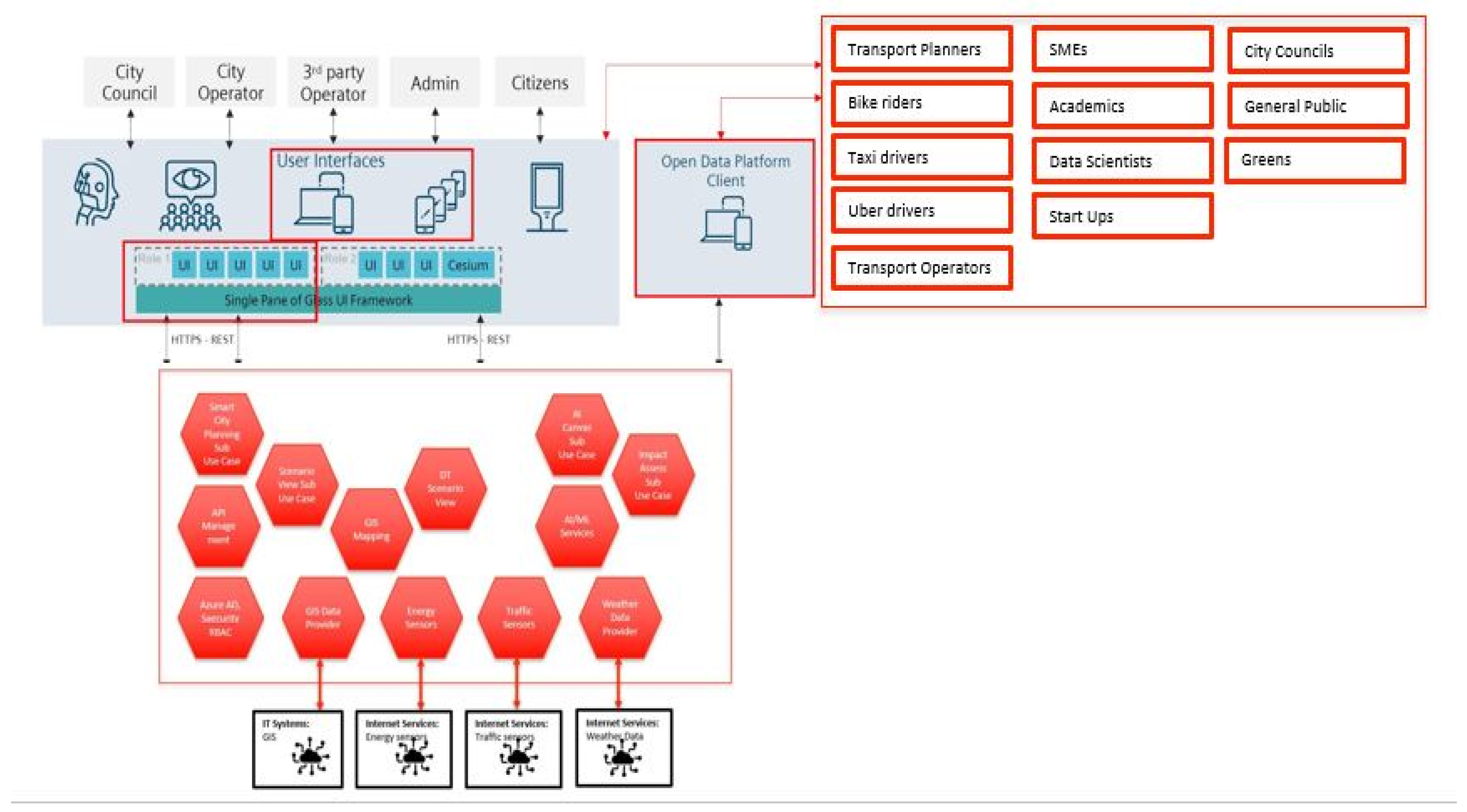
Architectural Considerations for Semantic Interoperability
The proposed architecture’s translation services are responsible for interoperability. An approach taken by South Korea’s City Data Hub uses NGSI-LD as a common data model for its internal data representation [54] demonstrated in Figure 8.
The advantage of using NGSI-LD as a common data model is that it is not necessary to be able to directly convert from every format into every other format. It is only necessary to have convertors for each format to, and from, the common data model. The common data model is then used for processes internally to the smart city platform. In the City Data Hub, adaptors to NGSI-LD in the Data Ingest Module, convert between standardised APIs and NGSI-LD. The City Data Hub separates the common data model in NGSI-LD from the semantic data (reflecting the smart city ontology) encoded in RDF in the Semantics module. This represents a separation of format translation (syntactic) and semantic annotation (which is only applied to LOD). As Birmingham is twinned with Ulsan in South Korea, which is part of the Korean Smart City Network12, there may be opportunities for learning from those cities’ experiences using NGSI-LD and smart city ontologies. As stated previously NGSI-LD data model is capable of representing the SAREF-based ontologies, hence using the NGSI-LD API would fulfil the requirements for a semantic interoperability service. FIWARE maintain an open source NGSI-LD API solution13.
10. Conclusion
In this paper, we have investigated the topic of federated data exchange in a smart city context and how interoperability among the use cases of DTs can be achieved. We are identified nine common elements as “building blocks” in the regional DTs, currently implemented in the Diatomic Azure DT Platform in West Midlands. These are 3D Visualisation, Asset Management, Predictive Analytics, Artificial Intelligence, Machine Learning, Authorisation Methods, Access Control, API, and Sensors. The building blocks identified have been further validated with use cases of 8 SMEs working on the development of a range of DTs. We also proposed a system architecture for federated data exchange, including layered and composable FDT approaches. Our recommendations for Federated Data Exchange are listed in Table 14.
Data exchange in the context of Digital Twins has a number of challenges. Chief among these challenges is how to ensure that the data is understandable by machines (not just processable). There is an understanding in the community that using open standards as much as possible to facilitate interoperability and avoid duplication of effort. However, outside of the manufacturing domain, the ISO standardisation process is embryonic. It is therefore important to use other international standards, such as the European-region ETSI where available, until ISO standards are available. NGSI-LD and related semantic technologies such as DTDL, seem to be emerging as standards, especially in the smart city domain. There is a multiplicity of open ontologies useful for smart cities, including those for sensors, environmental, traffic, governance, etc. These can be reused as part of a semantic interoperability solution.
The SAREF ontologies maintained by ETSI may be preferred, as they are maintained by an EU-supported standards organisation and are therefore a de facto European standard and interoperable with NGSI-LD. FIWARE, who maintain the implementation of NGSI-LD and smart data models, claim more than 400 cities use their solutions [51]. This likely makes their use a de facto smart cities standard and should be considered for the semantic interoperability components of a Smart City Digital Twin.
The composable architecture provides the greatest flexibility for future development of the FDT Data Exchange Platform. There is a need for a semantic service to broker the data exchange, such as NGSI-LD, that serves data according to a common format with common understanding. Where necessary, connectors can be used to translate into other formats such as for display in the application layer. Using JSON-based formats as far as possible for data transmission, allows the data to be human and machine readable with various levels of formal semantics applied, e.g., based on an ontology or a schema (as required). JSON has the advantage of a data-focus, as opposed to XML’s document focus.
We plan to continue the project by investigating pros and cons of various vendor solutions for federated data exchange in DTs, and explore the uptake of the current Diatomic-Azure DT platform by SMEs in West Midlands to develop a smart city eco-system.
Acknowledgments
This project has been sponsored by 2023-2025 UKRI West Midlands Innovation Accelerator project Diatomic (Digital InnovAtion TransfOrMatIve Change) UK Accelerator, Application number: 10055175 PCR number: 52454, Competition: Innovation project commission West Midlands: research and development—Amendment 1, Institutional Grant and 2025-2026 UKRI Innovate UK Council Reference: TS/U004618/1 DIATOMIC (Digital InnovAtion TransfOrMatIve Change) Application number: 10157662, Competition name: Innovation project commission West Midlands—Extension, 1 April 2025–31 March 2026. Author is grateful to Dr Adam Miller and Dr Seif Nasri for the preparation of this article.
| 1 | Consumer-centric protocols not listed. |
| 2 | |
| 3 | |
| 4 | |
| 5 | |
| 6 | |
| 7 | |
| 8 | |
| 9 | |
| 10 | |
| 11 | |
| 12 | |
| 13 |
References
- Ferko, E.; Bucaioni, A.; Behnam, M. Architecting digital twins. IEEE Access 2022, 10, 50335–50350. [Google Scholar] [CrossRef]
- Grieves, M. PLM Initiatives [Powerpoint Slides]. Paper Presented at the Product Lifecycle Management Special Meeting, University of Michigan Lurie Engineering Center. Virtually Intelligent Product Systems: Digital and Physical Twins. 2002. Available online: https://www.researchgate.net/publication/334599683_Virtually_Intelligent_Product_Systems_Digital_and_Physical_Twins (accessed on 30 March 2025).
- Baek, M.-S. Digital Twin Federation and Data Validation Method. In Proceedings of the 2022 27th Asia Pacific Conference on Communications (APCC), Jeju Island, Republic of Korea, 19–21 October 2022; pp. 445–446. [Google Scholar]
- Parri, J.; Patara, F.; Sampietro, S.; Vicario, E. JARVIS, A Hardware/Software Framework for Resilient Industry 4.0 Systems. In Software Engineering for Resilient Systems; Springer: Cham, Switzerland, 2019; pp. 85–93. [Google Scholar]
- Zheng, P.; Sivabalan, A.S. A generic tri-model-based approach for product-level digital twin development in a smart manufacturing environment. Robot. Comput.-Integr. Manuf. 2020, 64, 101958. [Google Scholar] [CrossRef]
- Schroeder, G.N.; Steinmetz, C.; Rodrigues, R.N.; Henriques, R.V.B.; Rettberg, A.; Pereira, C. A Methodology for Digital Twin Modeling and Deployment for Industry 4.0. Proc. IEEE 2020, 109, 556–567. [Google Scholar] [CrossRef]
- Ciavotta, M.; Alge, M.; Menato, S.; Rovere, D.; Pedrazzoli, P. A Microservice-based Middleware for the Digital Factory. Procedia Manuf. 2017, 11, 931–938. [Google Scholar] [CrossRef]
- Harrison, R.; Vera, D.A.; Ahmad, A. A Connective Framework to Support the Lifecycle of Cyber–Physical Production Systems. Proc. IEEE 2021, 109, 568–581. [Google Scholar] [CrossRef]
- Vergara, C.; Bahsoon, R.; Theodoropoulos, G.; Yanez, W.; Tziritas, N. Federated Digital Twin. In Proceedings of the 2023 IEEE/ACM 27th International Symposium on Distributed Simulation and Real Time Applications (DS-RT), Singapore, 4–5 October 2023; pp. 115–116. [Google Scholar] [CrossRef]
- Cheshmehzangi, A.; Ardakani, S.P. Embracing the Digital Twin Paradigm for Urban Sustainability. In Digital Twin Computing for Urban Intelligence; Ardakani, S.P., Cheshmehzangi, A., Eds.; Springer Nature: Singapore, 2024; pp. 1–11. [Google Scholar] [CrossRef]
- Zarrabi, H.; Doost Mohammadian, M.R. Fusion of Digital Twin, Internet-of-Things and Artificial Intelligence for Urban Intelligence. In Digital Twin Computing for Urban Intelligence; Ardakani, S.P., Cheshmehzangi, A., Eds.; Springer Nature: Singapore, 2024; pp. 77–92. [Google Scholar] [CrossRef]
- IEEE Std 2888.3-2024; IEEE Standard for Orchestration of Digital Synchronization Between Cyber and Physical Worlds. IEEE: New York, NY, USA, 2025; pp. 1–26. [CrossRef]
- Dassault Systèmes. Virtual Singapore: Building the World’s First 3D Digital Twin of a Nation. Available online: https://www.3ds.com/insights/customer-stories/virtual-singapore.
- Tech.gov.sg. 5 Things to Know About Virtual Singapore. Available online: https://www.tech.gov.sg/media/technews/5-things-to-know-about-virtual-singapore.
- National Research Foundation Singapore. Virtual Singapore. Available online: https://www.nrf.gov.sg/programmes/virtual-singapore.
- VentureBeat. How Singapore Created the First Country-Scale Digital Twin. 2020. Available online: https://venturebeat.com/business/how-singapore-created-the-first-country-scale-digital-twin/.
- Hämäläinen, M. Urban development with dynamic digital twins in Helsinki city. IET Smart Cities 2021, 3, 201–210. [Google Scholar] [CrossRef]
- City of Helsinki. Smart Kalasatama—Smart City District of Helsinki. Available online: https://fiksukalasatama.fi/en/smart-city/.
- Forum Virium Helsinki. The Final Report on Smart Kalasatama. 2023. Available online: https://forumvirium.fi/en/publication/smartkalasatama-final-report/.
- Amsterdam Smart City. Home—Amsterdam Smart City. Available online: https://amsterdamsmartcity.com.
- Nelen & Schuurmans. Flood Early Warning in a 3D Digital Twin. Available online: https://nelen-schuurmans.nl/en/case/flood-early-warning-in-a-3d-digital-twin/.
- Bee Smart City. Amsterdam Smart City: A World Leader in Smart City Development. 2022. Available online: https://www.beesmart.city/en/smart-city-blog/smart-city-portrait-amsterdam.
- Via Smart Cities®. Smart City Amsterdam. 2021. Available online: https://www.viasmartcities.com/amsterdam-smart-city/.
- Adlershof Technology Park. Digital Twins in Adlershof: Optimising Urban Systems. Available online: https://www.adlershof.de/en/news/digital-twins.
- Siemens Sustainability Magazine. Siemensstadt Square: Building a Digital Twin for Sustainable Urban Development. 2022. Available online: https://sustainabilitymag.com/articles/siemens-a-glimpse-of-the-sustainable-city-of-the-future.
- TU Berlin. Digital Twin Applications in Transportation: Predicting Wheel Wear in Rolling Stock. Available online: https://www.tu.berlin/en/schienenfzg/research/research-projects/digital-twin.
- Hochschule für Technik und Wirtschaft Berlin. Digital Twin as a Key Component in Smart Environments: International Summer School Programme. Available online: https://www.htw-berlin.de/en/international/intercultural-exchange/international-summer-schools/digital-twin-as-a-key-component-in-smart-environments.
- Dubai Municipality. Dubai Here: Comprehensive Geospatial Information and Maps. 2020. Available online: https://www.dm.gov.ae/2020/06/28/dubai-municipality-launches-e-system-dubai-here-for-comprehensive-geospatial-information-and-maps/.
- Dubai Municipality. Geospatial Maps for Smarter Urban Planning. 2024. Available online: https://www.dm.gov.ae/dubai_more/geospatial-maps-for-smarter-urban-planning-and-building/.
- Asite. 5 Mega Projects in the Middle East Making the Most of Digital Twins. 2021. Available online: https://www.asite.com/blogs/5-mega-projects-in-the-middle-east-making-the-most-of-digital-twins.
- Wu, Y.; Zhang, K.; Zhang, Y. Digital Twin Networks: A Survey. IEEE Internet Things J. 2021, 8, 13789–13804. [Google Scholar] [CrossRef]
- Wang, K.; Wang, Y.; Li, Y.; Fan, X.; Xiao, S.; Hu, L. A review of the technology standards for enabling digital twin. Digital Twin 2022, 2, 4. [Google Scholar] [CrossRef]
- Goyal, G.; Singh, K.; Ramkumar, K.R. A detailed analysis of data consistency concepts in data exchange formats (JSON & XML). In Proceedings of the 2017 International Conference on Computing, Communication and Automation (ICCCA), Greater Noida, India, 5–6 May 2017; pp. 72–77. [Google Scholar] [CrossRef]
- Navani, D.; Jain, S.; Nehra, M.S. The Internet of Things (IoT): A Study of Architectural Elements. In Proceedings of the 2017 13th International Conference on Signal-Image Technology & Internet-Based Systems (SITIS), Jaipur, India, 4–7 December 2017; pp. 473–478. [Google Scholar] [CrossRef]
- Pervez, Z.; Khan, Z.; Ghafoor, A.; Soomro, K. SIGNED: Smart cIty diGital twiN vErifiable Data Framework. IEEE Access 2023, 11, 29430–29446. [Google Scholar] [CrossRef]
- Mazzetto, S. A Review of Urban Digital Twins Integration, Challenges, and Future Directions in Smart City Development. Sustainability 2024, 16, 8337. [Google Scholar] [CrossRef]
- El-Agamy, R.F.; Sayed, H.A.; ALAkhatatneh, A.M.; Aljohani, M.; Elhosseini, M. Comprehensive analysis of digital twins in smart cities: A 4200-paper bibliometric study. Artif. Intell. Rev. 2024, 57, 154. [Google Scholar] [CrossRef]
- Ferko, E.; Bucaioni, A.; Pelliccione, P.; Behnam, M. Analysing Interoperability in Digital Twin Software Architectures for Manufacturing. In Software Architecture; Tekinerdogan, B., Trubiani, C., Tibermacine, C., Scandurra, P., Cuesta, C.E., Eds.; Springer Nature: Cham, Switzerland, 2023; pp. 170–188. [Google Scholar] [CrossRef]
- Wang, W.; Tolk, A.; Wang, W. The Levels of Conceptual Interoperability Model: Applying Systems Engineering Principles to M&S. arXiv 2009. [Google Scholar] [CrossRef]
- Ferko, E.; Bucaioni, A.; Pelliccione, P.; Behnam, M. Standardisation in Digital Twin Architectures in Manufacturing. In Proceedings of the 2023 IEEE 20th International Conference on Software Architecture (ICSA), L’Aquila, Italy, 13–17 March 2023; pp. 70–81. [Google Scholar] [CrossRef]
- Pliatsios, A.; Kotis, K.; Goumopoulos, C. A systematic review on semantic interoperability in the IoE-enabled smart cities. Internet Things 2023, 22, 100754. [Google Scholar] [CrossRef]
- Uschold, M. Ontology and database schema: What’s the difference? Appl. Ontol. 2015, 10, 243–258. [Google Scholar] [CrossRef]
- Karabulut, E.; Pileggi, S.F.; Groth, P.; Degeler, V. Ontologies in digital twins: A systematic literature review. Future Gener. Comput. Syst. 2024, 153, 442–456. [Google Scholar] [CrossRef]
- IEEE Std 2888.1-2023; IEEE Standard for Specification of Sensor Interface for Cyber and Physical Worlds. IEEE: New York, NY, USA, 2024; pp. 1–143. [CrossRef]
- Gyrard, A.; Serrano, M.; Jares, J.B.; Datta, S.K.; Ali, M.I. Sensor-based Linked Open Rules (S-LOR): An Automated Rule Discovery Approach for IoT Applications and its use in Smart Cities. In Proceedings of the 26th International Conference on World Wide Web Companion, Perth, Australia, 3–7 April 2017; pp. 1153–1159. [Google Scholar] [CrossRef]
- Butler, H.; Daly, M.; Doyle, A.; Gillies, S.; Hagen, S.; Schaub, T. RFC 7946: The GeoJSON Format. USA: RFC Editor. 2016. [Google Scholar]
- Vinasco-Alvarez, D.; Samuel, J.; Servigne, S.; Gesquière, G. Towards an Automated Transformation of an nD Urban Data Model to a Computational Ontology Network: From UML to OWL, From CityGML 3.0 to “CityOWL”. ISPRS Annals of the Photogrammetry, Remote Sensing and Spatial Information Sciences 2024, X-4-W4-2024, 231–238. [Google Scholar] [CrossRef]
- Jacoby, M.; Usländer, T. Digital Twin and Internet of Things—Current Standards Landscape. Appl. Sci. 2020, 10, 6519. [Google Scholar] [CrossRef]
- TS 103 410-4—V2.1.1—SmartM2M; Extension to SAREF; Part 4: Smart Cities Domain, n.d.
- GR CIM 020—V1.1.1—Context Information Management (CIM); NGSI-LD; Guidelines for the deployment of Smart City and Communities data platforms, n.d.
- Beyer, A.; Chernikova, K.; Panfilis, G.D.; Korneev, O.; Sapia, T.; Tejado, Á. FIWARE4CITIES, 6th ed.; FIWARE Foundation e.V.: Berlin, Germany, 2024. [Google Scholar]
- MIM7—Places|OASC MIMs 2024. Available online: https://mims.oascities.org/mims/oasc-mim7-places (accessed on 17 March 2025).
- De Nicola, A.; Villani, M.L. Smart City Ontologies and Their Applications: A Systematic Literature Review. Sustainability 2021, 13, 5578. [Google Scholar] [CrossRef]
- Jeong, S.; Kim, S.; Kim, J. City Data Hub: Implementation of Standard-Based Smart City Data Platform for Interoperability. Sensors 2020, 20, 7000. [Google Scholar] [CrossRef] [PubMed]
- Dowlatabadi, J.Z.; Nasri, S.; Kavakli, M. NEXUS (Networked EXchange of Unified Systems) for Data Exchange in a Federated Smart City Digital Twin: A Case Study on Twin Cities. In Proceedings of the 23rd IEEE International Conference on Smart City, Exeter, UK, 13–15 August 2025; pp. 1–10. [Google Scholar]
- Kavakli-Thorne, M. Comparative Analysis of System Architectures for Federated Data Exchange. In Proceedings of the 2025 International Workshop on Intelligent Systems (IWIS), Ulsan, Republic of Korea, 21–24 July 2025; pp. 1–6. [Google Scholar] [CrossRef]
- Kavakli, M.; Dowlatabadi, J.Z. System Architectures for Data Exchange in a Regional Federated Digital Twin: A Case Study on Birmingham Smart City. In Proceedings of the ICVARS 2025, 2025 International Conference on Intelligent Computing and Virtual & Augmented Reality Simulations (ICVARS), Birmingham, UK, 25–27 July 2025; pp. 43–49. [Google Scholar]
Figure 1.
The basic architecture block diagram for digital synchronisation [12].
Figure 1.
The basic architecture block diagram for digital synchronisation [12].
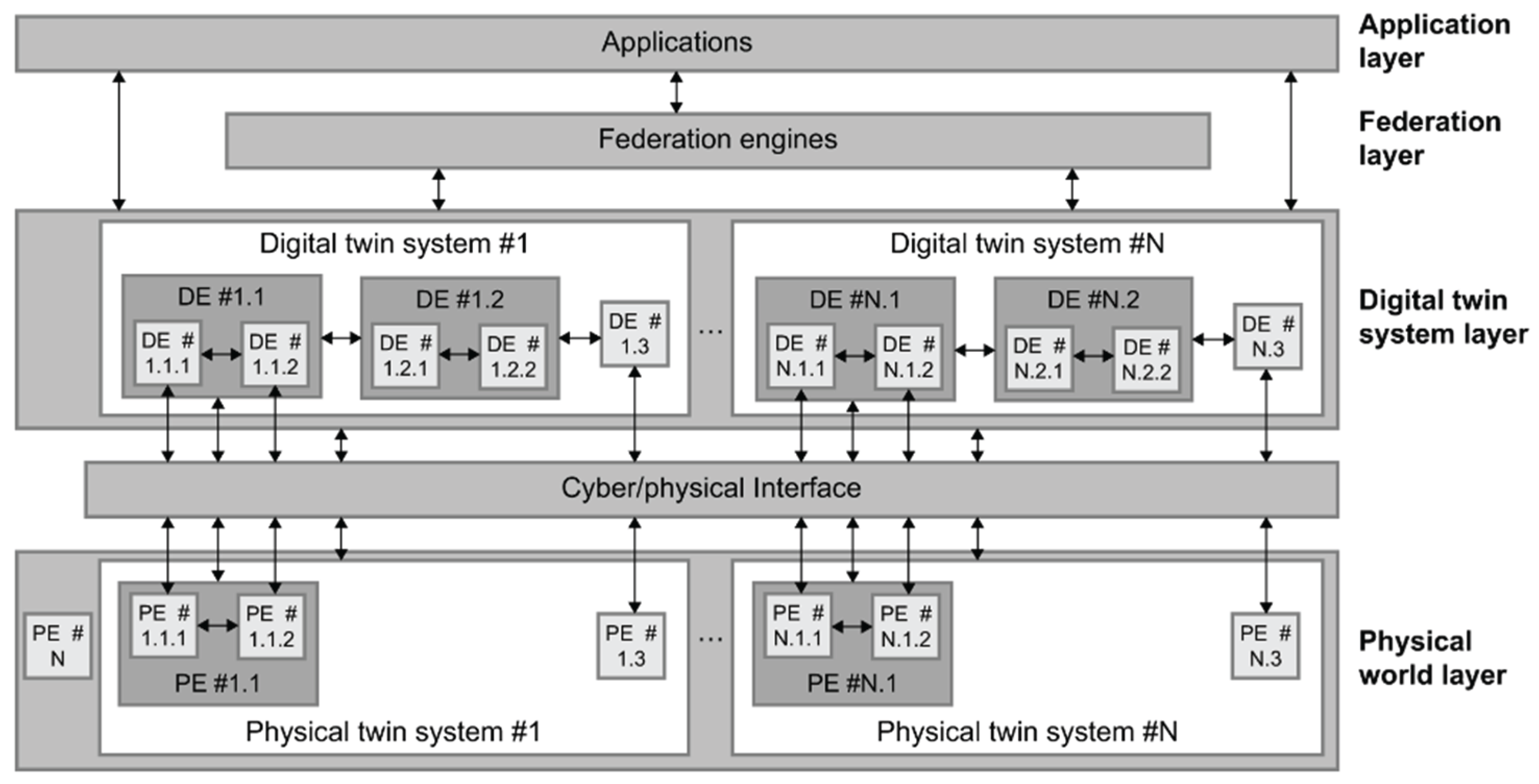
Figure 2.
Reference layered architecture for Digital Twins [43].
Figure 2.
Reference layered architecture for Digital Twins [43].
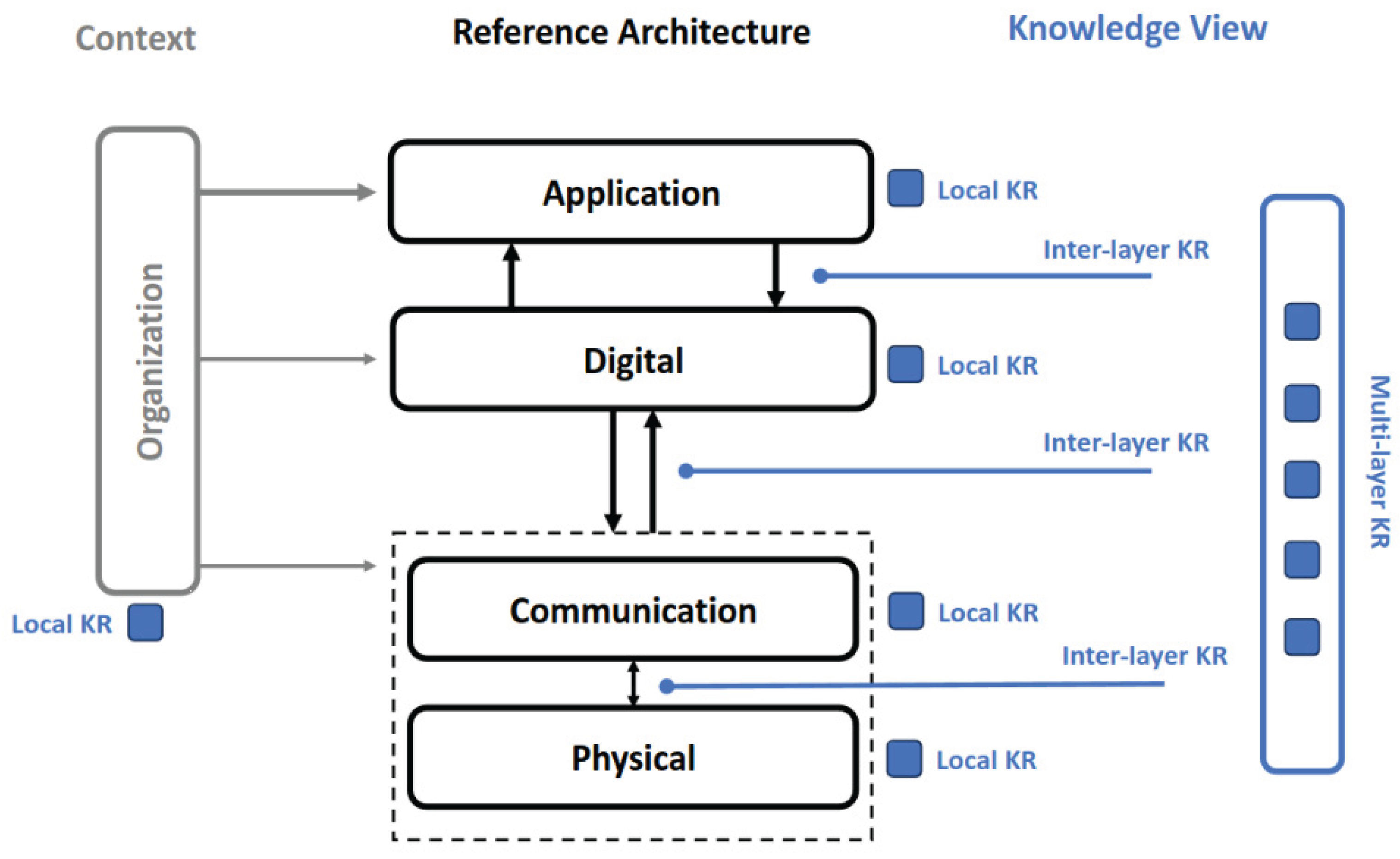
Figure 3.
The SAREF4CITY ontology overview. Taken from [49].
Figure 3.
The SAREF4CITY ontology overview. Taken from [49].
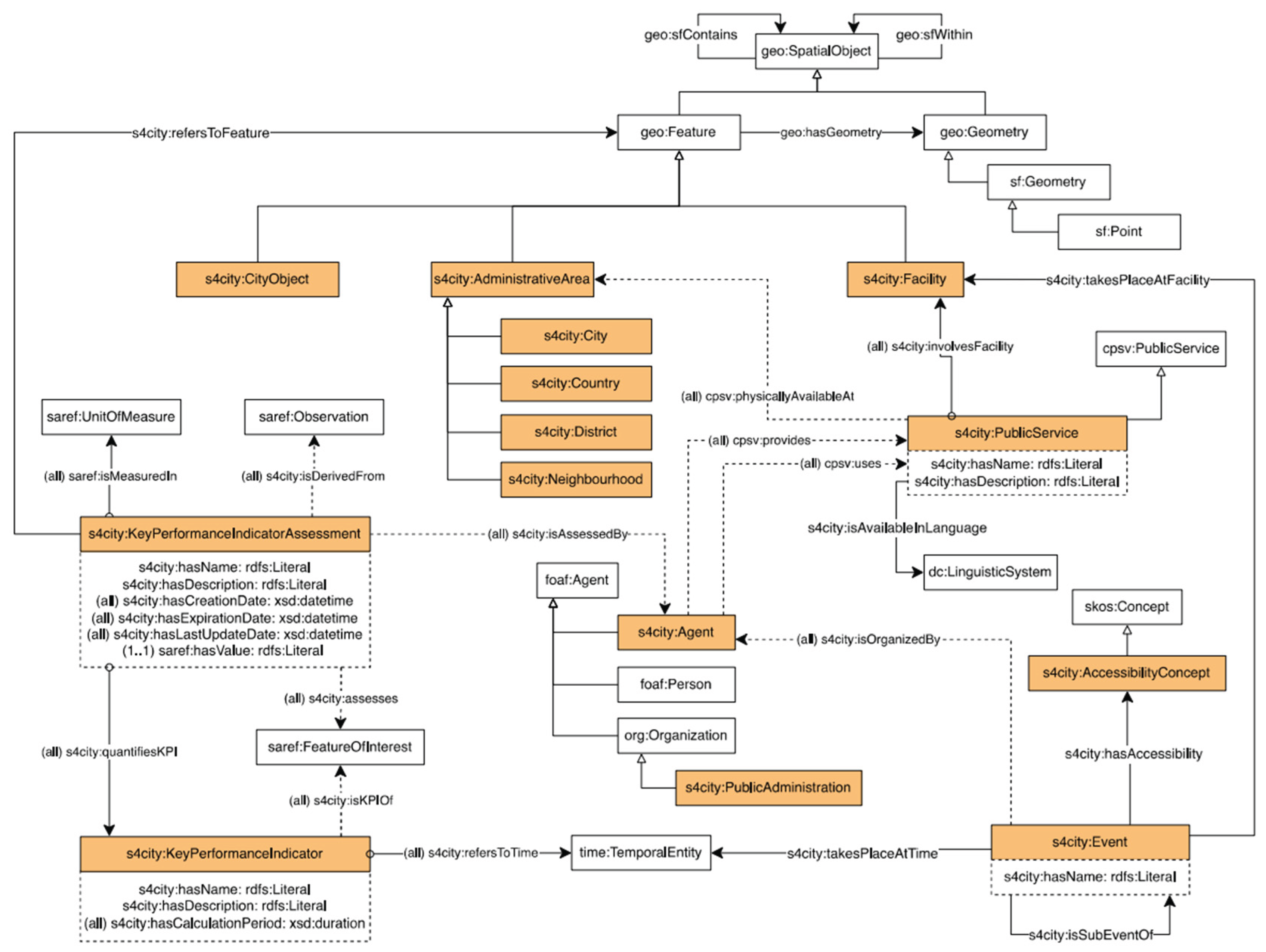
Figure 4.
The architecture of the ETSI NGSI-LD smart city platform [50].
Figure 4.
The architecture of the ETSI NGSI-LD smart city platform [50].
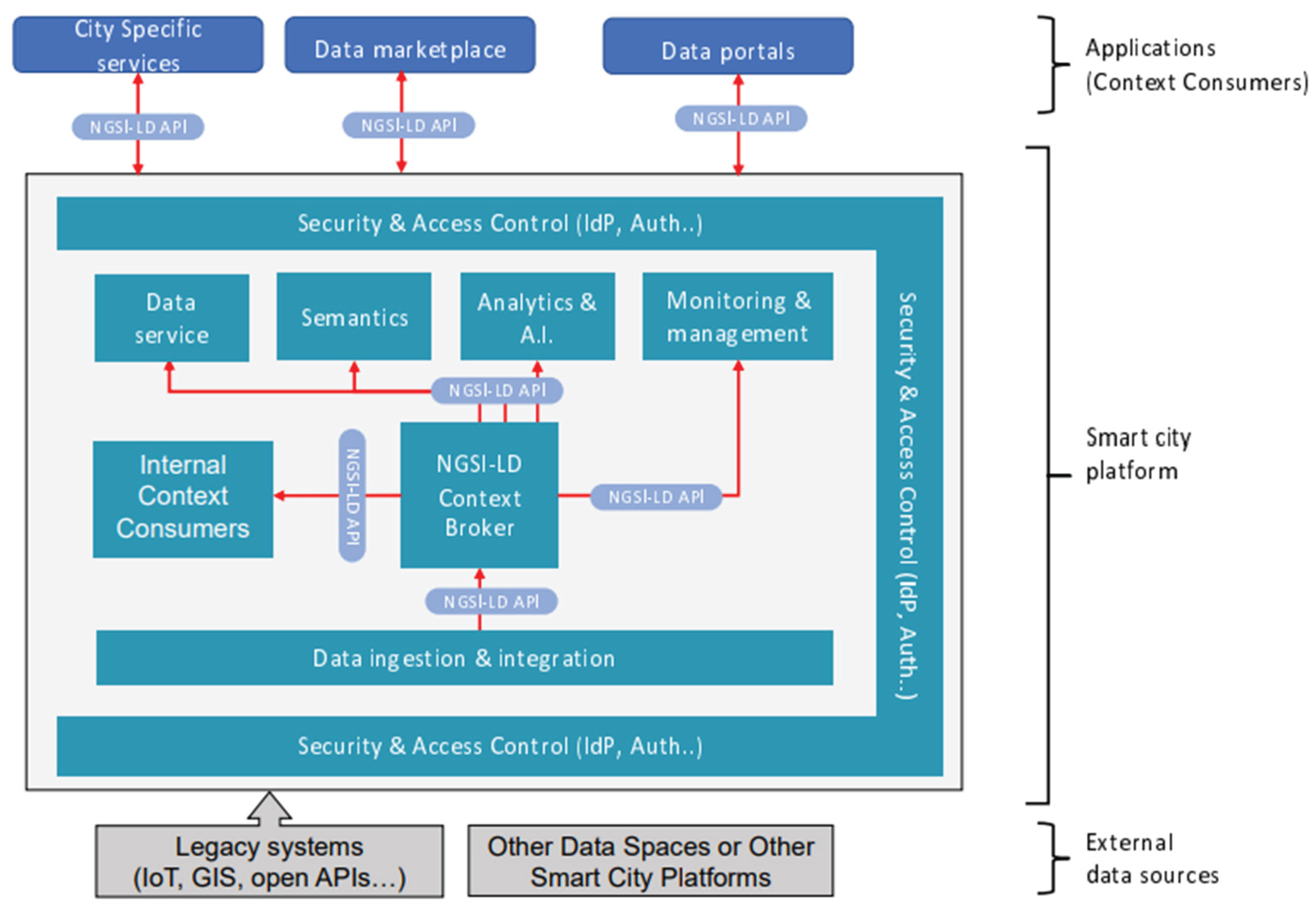
Figure 5.
The standard building blocks for a layered-composable architecture.
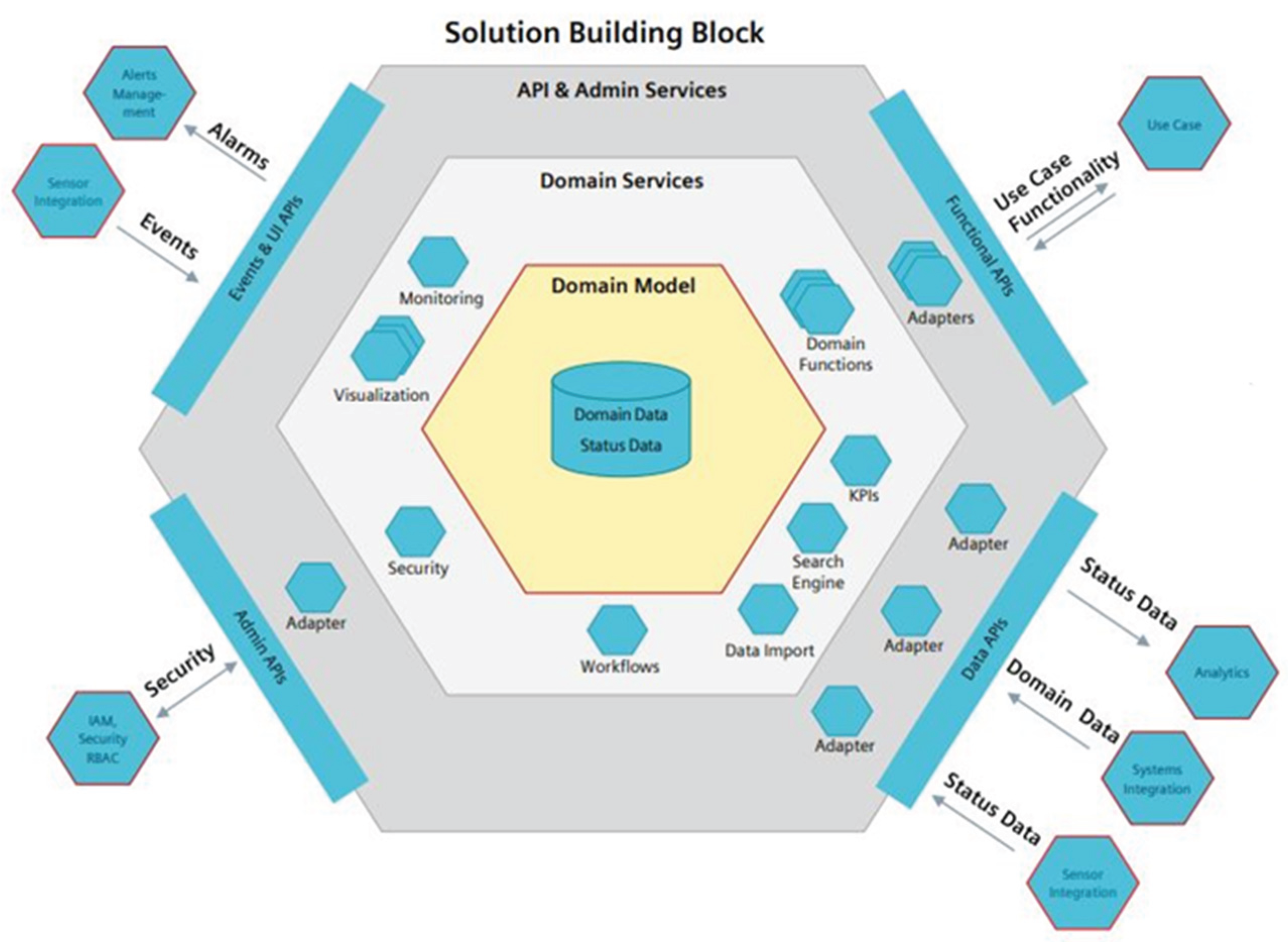
Figure 6.
High-Level Proposed Layered Architecture for Birmingham’s FDT data exchange platform.
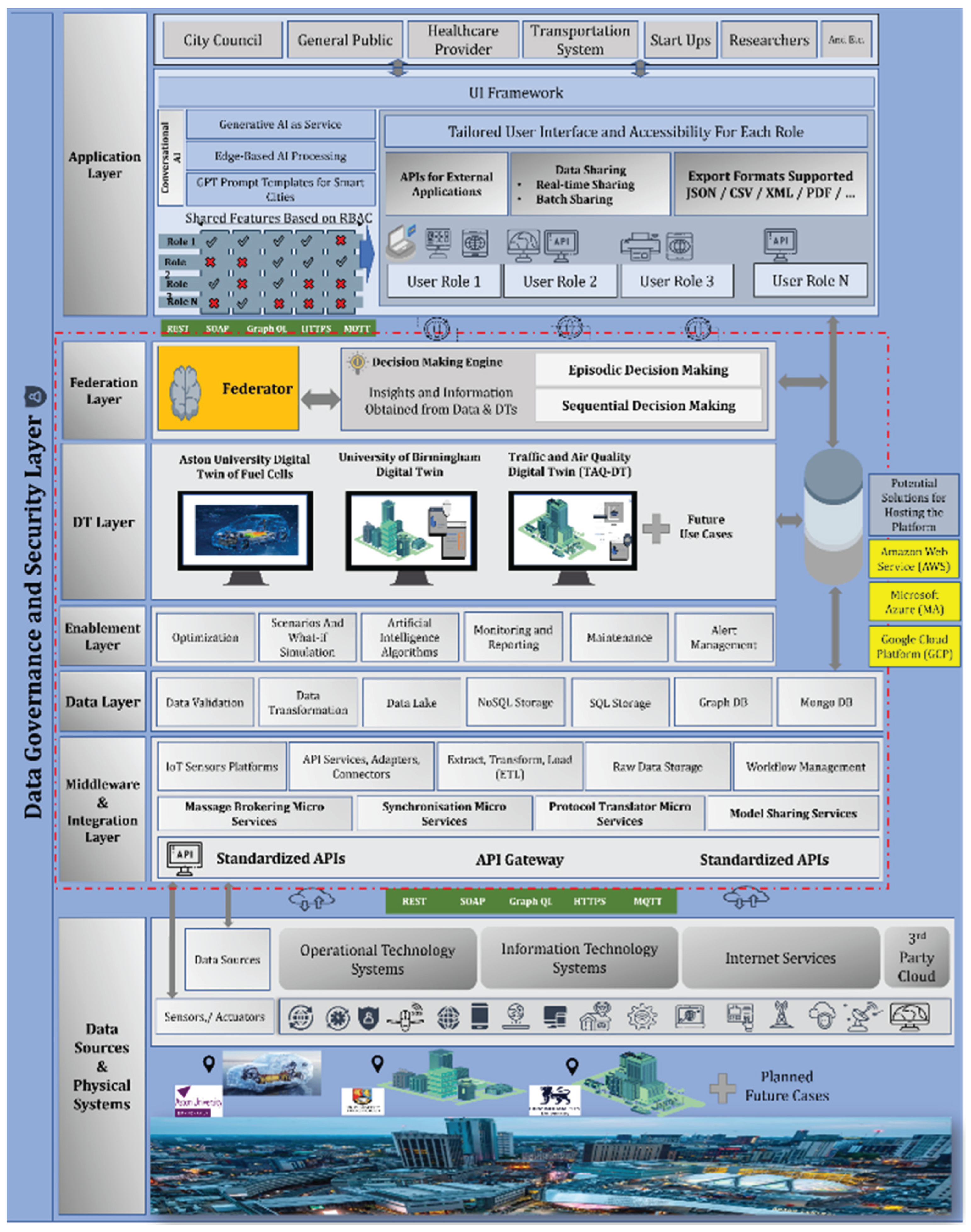
Figure 7.
High-Level Proposed Composable Architecture for Birmingham’s FDT data exchange platform.
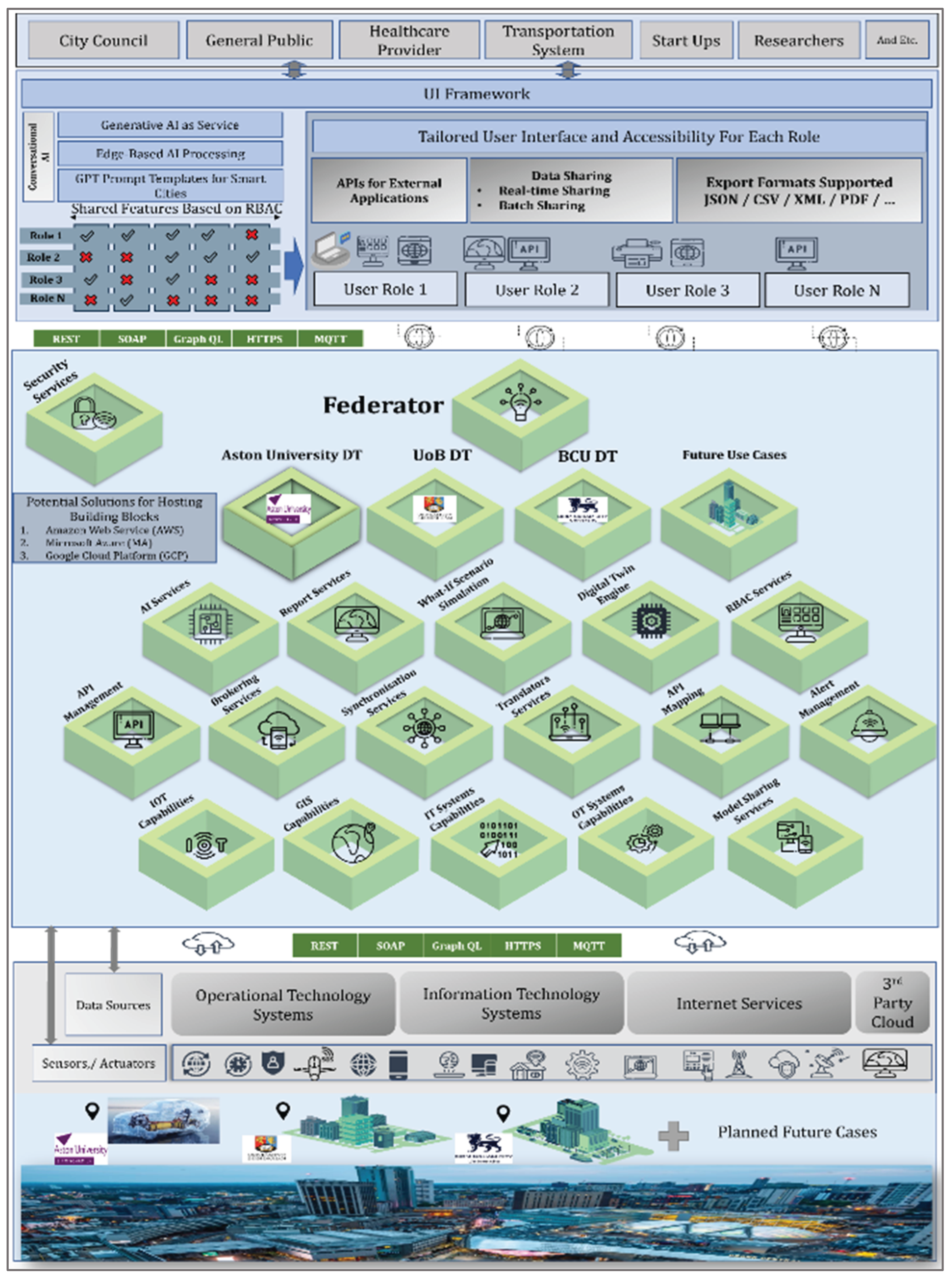
Figure 8.
City Data Hub high-level architecture with data flows [54].
Figure 8.
City Data Hub high-level architecture with data flows [54].
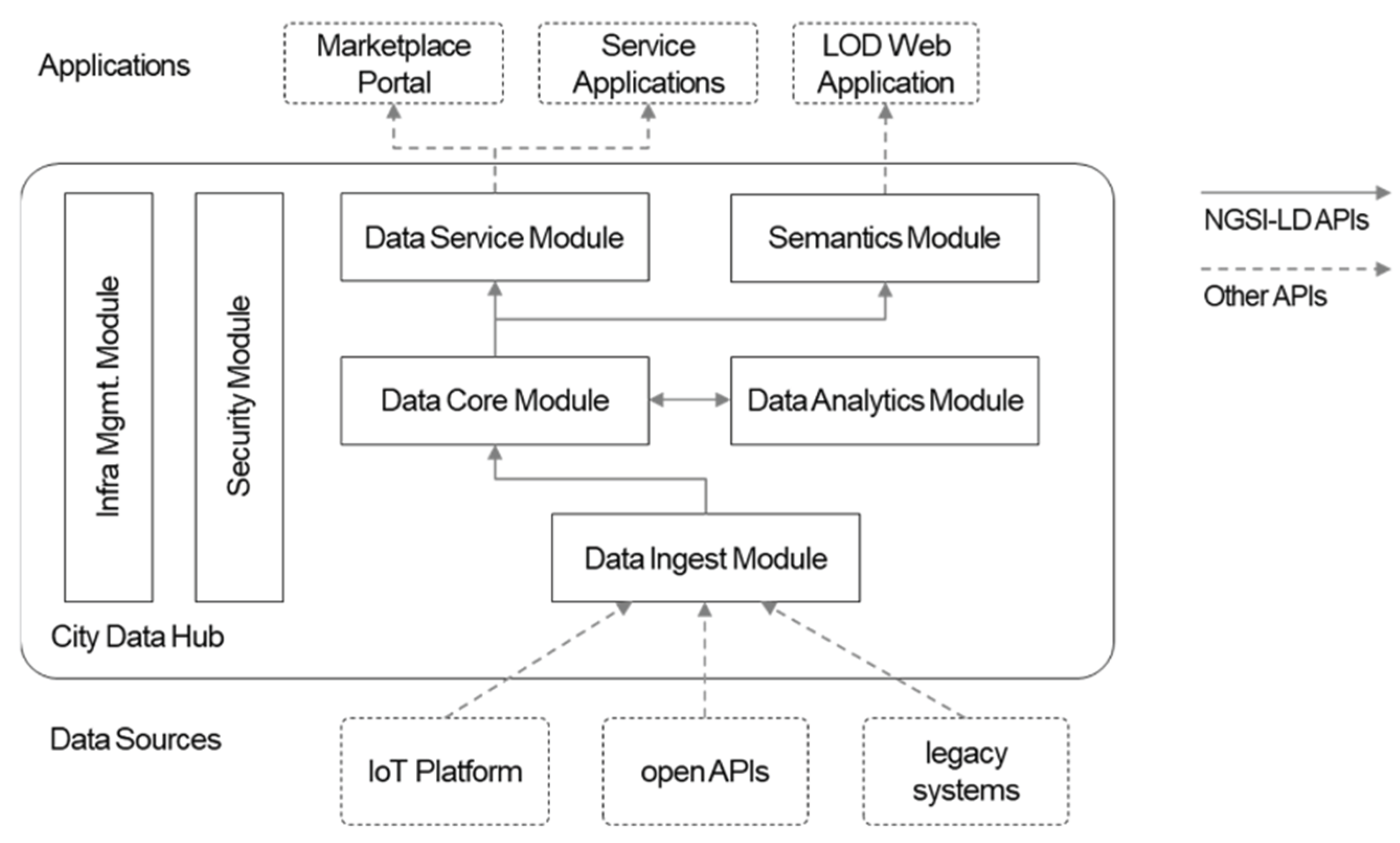
Table 1.
Applications of digital twins in Dubai, Singapore, Helsinki, Amsterdam, and Berlin.
| Aspect | Dubai | Singapore | Helsinki | Amsterdam | Berlin |
|---|---|---|---|---|---|
| Data Sources | IoT sensors, drones, GIS, BIM, satellite imagery | IoT devices, GIS, BIM, real-time sensors, 3DEXPERIENCE platform | IoT sensors, GIS, CityGML, GeoJSON | IoT sensors, LiDAR, GIS, environmental monitoring systems | IoT devices, BIM, CityGML, industrial datasets |
| Data Standards | CityGML, BIM, ISO/TC 211 standards | OGC standards, BIM, proprietary 3DEXPERIENCE formats | CityGML for semantic 3D modelling, GeoJSON for real-time data | CityGML, INSPIRE directive for environmental data, GeoJSON | CityGML, BIM, proprietary predictive models |
| Processing Framework | Cloud and edge computing; real-time IoT data integration | Hybrid cloud-edge architecture for real-time and historical data analysis | Distributed edge computing processes local IoT data with cloud-based aggregation | Edge computing for real-time processing; cloud systems for predictive simulations | Federated architecture; cloud systems for large-scale dataset processing |
| Integration Approach | Centralized data hub via Dubai Here platform; multi-agency collaboration | Federated model integrating data across agencies; geospatial and cross-domain interoperability | Open data portals and APIs for multi-stakeholder access | Real-time data fusion from sensors, APIs, and standardised formats | Secure federated systems with industrial and urban planning integration |
| AI and Analytics | Predictive maintenance, dynamic traffic flow optimization | AI-driven disaster modelling and urban energy demand forecasting | AI for demand-response energy management and urban layout optimisation | AI-powered traffic optimisation; advanced flood risk modelling | AI-enhanced predictive maintenance for transport and industrial systems |
| Citizen Engagement Tools | Participatory planning dashboards and AR/VR integration | Public platforms for viewing and commenting on urban developments | Open Cities Planner for visualisation and participatory design | Interactive geospatial platforms for city-wide projects | Innovation labs involving community-focused applications |
| Data Exchange Mechanisms | APIs for integration with private sector tools and external data providers | Dashboards for cross-agency data sharing; federated geospatial systems | APIs and open standards promote public-private collaboration | APIs and INSPIRE-compliant data formats for environmental and transport data exchange | APIs and secure channels for industrial-to-urban data exchange |
| Applications | Infrastructure monitoring, traffic optimization, Expo 2020 metaverse integration | Disaster preparedness, integrated urban planning, transport network optimization | Energy monitoring, urban heat island mitigation, real-time public feedback | Flood risk modelling, multimodal traffic control, urban sustainability | Predictive rail maintenance, transport logistics, Siemensstadt industrial optimisation |
| Key Achievements | Real-time traffic flow adjustments; Expo 2020 operational efficiency | Unified city-scale model for urban governance and disaster resilience | 10% energy savings in Kalasatama; congestion reduction through demand management | 15% congestion reduction; improved flood resilience | Reduced infrastructure downtime; energy-efficient urban industrial projects |
| Challenges | Scalability to city-wide systems; ensuring IoT data privacy and security | Balancing data privacy with public accessibility; expanding AI capabilities | High costs of real-time data collection; scaling digital twins city-wide | Handling diverse datasets from environmental, transport, and water systems | Harmonising industrial and urban datasets; enhancing predictive analytics |
| Future Directions | Integration with metaverse for immersive urban experiences; climate adaptation | Expanding autonomous vehicle testing; improving AI for decision-making | Scaling renewable energy integration; improving heat island mitigation | Advanced climate adaptation models; autonomous public transport | Extending Siemensstadt’s industrial digital twin to broader urban applications |
Table 2.
Comparison of XML and JSON. Adapted from [33].
Table 2.
Comparison of XML and JSON. Adapted from [33].
| XML | JSON |
|---|---|
| Relatively difficult for machines to parse. | Relatively easy for machines to parse. |
| Tags are used to define data which results in increased payload size. | Key value pairs are used to define data which amounts to lesser payload size and better indexing. |
| Moderate performance in data exchange in web service applications | High performance. |
| XML does not support data types and arrays. | JSON includes data types and arrays. |
| Not as light and fast as JSON | Faster and lighter than XML |
| XML being document oriented focusses on the structural component of data (lots of tags). | JSON being data oriented is the lightweight version of XML. |
To ensure integrity of the communicated data, [33] recommend using a one-way (i.e., cryptographic) hash function such as the SHA family as opposed to a simple checksum as there are more collisions for checksum algorithms. That is to say different data is more likely to give the same checksum, so integrity of the data after transmission is less sure. If the data has the same cryptographic hash when received as transmitted then data integrity has been maintained during the transmission. To secure the data exchanged from being changed together with the cryptographic hash (or checksum), it is important that the whole message including the hash is encrypted during transmission.
Table 3.
The IoT 5- layer architecture [34].
Table 3.
The IoT 5- layer architecture [34].
| Level | Layer | Description | Example formats/Protocols |
|---|---|---|---|
| 1 | Perception/Physical | This is the foundation of IoT systems, consisting of sensors, actuators, and devices that collect data or execute commands. It is the interface of the physical and the digital. | JSON, XML, CSV, CBOR, various binary formats |
| 2 | Network/Transport | This layer connects the perception layer to the middleware layer. Usually, via the internet. | IPv6, UDP, TCP |
| 3 | Middleware/Processing | This layer processes the raw data from the perception layer, e.g., filtering or preprocessing. The aim is usually to reduce the volume of data. | |
| 4 | Applications | This layer defines the applications that uses the processed data. These applications may provide insights or control. Examples are smart homes, smart cities, smart health, etc. | HTTP, MQTT, Websocket, AMQP, CoAP, LwM2M, XMPP, DDS (Data Distribution service), SMS/SMPP, SSI (Simple Sensor Interface), OCPP (Open Charge Point Protocol), IEC 62056-21, OBD2/CAN, OPC-UA, Wireless M-bus1 |
| 5 | Business | This layer acts as a manager for IoT system and is focused on strategic decision-making. |
Table 4.
Potential Tools for implementing DT governance functions.
| Solution | Description |
|---|---|
| Keycloak | Identity and access management for RBAC. |
| Hyperledger Fabric | Blockchain framework for secure and traceable data sharing. |
| Apache Atlas | Data governance and metadata management. |
| IBM Guardium | Comprehensive data protection and encryption solution. |
Table 5.
Summary of role-based responsibilities, access levels, and restrictions, by User.
| User Type | Responsibilities | Access Level | Restrictions |
|---|---|---|---|
| DT Owners | • Manage the development, data input, and maintenance of their DTs (e.g., traffic, air quality, energy). • Ensure data quality, security, and compliance with FDT governance policies. • Share relevant data with the FDT platform for aggregated insights and decision-making. • Define access permissions and data-sharing agreements for their DT. |
• Full access to their DT’s raw and processed data. • Permission to manage connections between their DT and the FDT. • Limited access to aggregated insights from other DTs. |
• Cannot access raw data from other DTs. • Must adhere to federation standards for data sharing and interoperability. |
| DT Developers | • Develop and maintain DT infrastructure, APIs, and data exchange mechanisms. • Implement predictive models and analytics tools to enhance DT functionalities. • Test and validate DT integrations within the FDT. |
• Access to testing environments and anonymised or simulated datasets. • No direct access to live or sensitive data unless explicitly authorised. |
• Limited to development environments. • No access to operational data without explicit authorisation. |
| FDT Council Administrators | • Define and enforce federation-wide data governance policies. • Oversee data-sharing agreements and ensure compliance with regulations (e.g., GDPR). • Manage access permissions and monitor system performance. |
• Full access to aggregated data and administrative tools. • Limited access to individual DTs’ raw data, permitted only during emergencies. |
• Cannot modify individual DTs without coordination. • Access limited to aggregated outputs. |
| Service Providers | • Utilise processed insights for operational improvements (e.g., route planning, energy grid adjustments). • Provide data to the FDT while ensuring quality and compliance with security standards. |
• Access to domain-specific processed insights. • No access to sensitive or raw data from other DTs. |
• Limited to operational insights. • Restricted from accessing raw data from other domains. |
| Academic Researchers | • Use anonymised datasets to conduct research and build models. • Collaborate with DT owners for access to specific datasets when needed. • Publish findings that align with smart city initiatives. |
• Read-only access to anonymised historical and processed datasets. • No access to real-time or sensitive data without explicit approval. |
• Restricted to non-sensitive data. • Access must comply with ethical and regulatory standards. |
| Public Users | • Use publicly available data to plan routes, monitor pollution, or make other personal decisions. • Provide feedback on public tools and services. |
• Read-only access to aggregated, pre-approved data (e.g., traffic maps, air quality indexes). • No access to backend systems or raw data. |
• Limited to aggregated, non-sensitive data. • No interaction with the FDT backend. |
| Cross-Domain Users | • Harmonise data from multiple DTs for simulations and city-wide optimisations. • Use aggregated insights to predict and manage cross-domain scenarios. |
• Access to aggregated, harmonised data from multiple DTs. • Restricted access to raw data, authorised only for specific use cases. |
• Limited to aggregated cross-domain insights. • Heavily restricted access to raw data. |
Table 7.
Limitations of Ontologies for Smart Cities raised by [41] with our suggested mitigations.
Table 7.
Limitations of Ontologies for Smart Cities raised by [41] with our suggested mitigations.
| Issue | Description | Potential Mitigation |
|---|---|---|
| Limited Coverage | existing ontologies may not cover all relevant concepts and areas, and may not be able to accurately represent the complexity and diversity of urban systems | It may be required to use a combination of ontologies, or extend ontologies to cover required concepts. |
| Lack of Standardisation | different ontologies for smart cities may use different terminologies, concepts, and relationships, making it difficult to share and integrate data between different systems and stakeholders | To select standard ontologies, or when not possible, the most commonly used ontologies in the domain. |
| Lack of maintenance | existing ontologies (schema) may not be able to handle large amounts of data (instances), or adapt to new data sources and technologies, or incorporate new concepts and relationships as urban systems evolve | To select ontologies that are both suitable for large amounts of data and sufficiently flexible to future-proofed and are being maintained or are open to maintenance by us. Centralised governance at the city-level will ensure that ontologies are updated responsibly. |
| Lack of Scalability | existing ontologies may not be kept up-to-date with the most recent changes and developments in the city, leading to outdated information |
Centralised governance at the city-level will ensure that ontologies are updated responsibly. |
| Inadequate representation of context | existing ontologies may not be able to represent the context in various situations, such as social and cultural dimensions of a city in ontologies that focus solely on physical and technological aspects, or ignoring the interdependencies and relationships between different domains and systems in the city, such as transportation, energy, and environmental sustainability | Initially physical and technological aspects will be the focus of the Digital Twin program. However, this could be extended to socio-economic aspects in the future. The intention is to model the interactions between the domains and systems in the city, hence the desire for semantic interoperability. |
| Lack of privacy and security measures | existing ontologies may not have adequate measures to protect sensitive information and ensure that data is only shared with authorized parties | Use of data will be governed by stringent Role-Based Access Control (RBAC). |
Table 8.
OGC web service APIs.
| Data Formats | Description |
|---|---|
| Web Map Service (WMS) | Serves raster maps via web applications |
| Web Feature Service (WFS) | Enables access to vector geospatial data. (OGC recommends using the OGC API—Features, instead |
| Web Coverage Service (WCS) | Supports retrieval of large geospatial datasets |
| Sensor Things API | Standard for integrating IoT sensor data with digital twins |
Table 3.
Mapping of Building Blocks to DTs.
| DT 1 | Aston University Fuel Cell Digital Twin | |
|---|---|---|
| This DT aims at improving the operational performance, efficiency, and durability of hydrogen fuel cells (HFC). The Fuel Cell DT addresses challenges in fuel cell maintenance, degradation, and real-time performance management, providing a comprehensive solution for condition-based monitoring and predictive maintenance. A predictive maintenance model estimates data for each component and degradation, repair and maintenance processes are simulated (Amaitik et al., 2024). | ||
| 3D Visualisation | 3D visualization supports real-time performance management and monitoring of the Fuel Cell Electric Vehicles as they move through the city. Visual tools and reporting features help users analyse performance trends over time, supporting decision-making for maintenance scheduling, fleet management, and resource allocation. | |
| Asset Management | The DT enhances asset management by improving the durability and operational efficiency of HFC. | |
| Predictive Analytics | Utilising predictive analytics, the system detects early signs of performance issues, enabling operators to carry out timely maintenance, reduce unexpected breakdowns, and lower overall maintenance costs. | |
| Artificial Intelligence | An integrated optimisation tool within the twin dynamically adjusts operational parameters based on real-time data, mitigating issues like overheating or water imbalances to enhance fuel cell performance and longevity. | |
| Machine Learning | Machine learning algorithms help the DT predict maintenance needs and monitor hydrogen fuel cell conditions in real-time. | |
| Authorisation Methods | Authorisation methods ensure secure access to DT systems monitoring HFC performance. | |
| Access Control | Access control mechanisms protect sensitive data and functionalities within HFC DT platform. | |
| API | APIs allow integration of the DT with other systems for monitoring and predictive maintenance of hydrogen fuel cells. The digital twin is hosted on an online platform that enables remote access, real-time monitoring, and data sharing across teams and stakeholders. | |
| Sensors | Sensors collect real-time data for the DT to monitor HFC conditions and support predictive maintenance. | |
| DT 2 | Birmingham University Digital Twin (Tyseley Park DT) | |
| The Birmingham University’s Tyseley Park DT has been designed to support Birmingham’s ambitions as a leading digital city. It aims to integrate real-time sensor data, data visualisation, and predictive analytics to enhance urban planning, energy and emissions management, traffic control, and other smart city applications. | ||
| 3D Visualisation | A 3D rendered model of the district was created to allow for the overlay of data, supporting data-driven urban planning and smart city development. Visualisation based on Cesium and the Unreal Engine. | |
| Asset Management | The DT enhances asset management by optimizing energy and urban infrastructure, systems and usage. | |
| Predictive Analytics | Predictive analytics in the DT enables proactive decision-making for traffic control, energy management, and city planning. | |
| Artificial Intelligence | Artificial Intelligence powers the DT to enhance smart city applications like energy optimization and traffic regulation. | |
| Machine Learning | Machine learning helps the DT analyse real-time sensor data for improved urban planning and predictive management. | |
| Authorisation Methods | Authorisation methods ensure secure access to the DT for managing smart city infrastructure. | |
| Access Control | Access control mechanisms safeguard critical data within the DT to protect smart city operations. | |
| API | APIs facilitate the integration of the DT with various urban management systems for data exchange. | |
| Sensors | Sensors provide real-time data to the DT, enabling enhanced monitoring and optimization of smart city functions. | |
| DT 3 | DT 3: Birmingham City University’s Traffic and Air Quality Digital Twin (TAQ-DT) | |
| This project combines AI, machine learning, and IoT to provide real-time insights, predictive analytics, and decision-making tools for city planners and operators. The TAQ-DT operates across different DT levels, from basic descriptive models to comprehensive, predictive systems. It aims to support Birmingham’s Clean Air Zone (CAZ) initiative by tracking and managing traffic and air quality in real-time. | ||
| 3D Visualisation | “Single Pane of Glass” UI framework helps city planners analyse traffic and air quality data for better decision-making. | |
| Asset Management | The TAQ-DT enhances asset management by optimizing urban resources to support Birmingham’s Clean Air Zone initiative. | |
| Predictive Analytics | Predictive analytics in the TAQ-DT enables real-time forecasting of traffic patterns and air quality levels. | |
| Artificial Intelligence | Employs AI to support real-time monitoring, decision-making, predictive analytics, and traffic flow optimisation. | |
| Machine Learning | Machine learning in the TAQ-DT refines predictive models to enhance traffic flow and air quality management. | |
| Authorisation Methods | Authorisation methods ensure secure access to real-time insights and predictive tools within the TAQ-DT. | |
| Access Control | Access control mechanisms protect sensitive traffic and environmental data processed by the TAQ-DT. | |
| API | APIs enable integration of the TAQ-DT with city planning and environmental monitoring systems. | |
| Sensors | Integrates data from multiple sources, including traffic and air quality sensors, GIS, and IoT devices | |
| DT 4 | Ulsan University’s Traffic Simulation Digital Twin | |
| Ulsan Traffic Simulation DT collects real human driving data using cameras and develops a learning-based driving model. By integrating learning-based model into a driving simulator, this project overcome the issue of the traditional rule-based models, which fail to imitate human-driving behaviour. | ||
| 3D Visualisation | 3D visualization in the Ulsan Traffic Simulation DT enhances traffic simulations by visually representing real-world driving behaviours. | |
| Asset Management | The DT can be used to optimize traffic management assets and fleet management for e.g., public transport vehicles. | |
| Predictive Analytics | Predictive analytics in the DT helps forecast driving behaviours and traffic patterns to enhance autonomous vehicle development. | |
| Artificial Intelligence | Artificial Intelligence enables the DT to model real-world driving behaviours, overcoming limitations of traditional rule-based driving simulations. | |
| Machine Learning | Machine learning in the DT allows for the development of learning-based driving models trained on real human driving datasets. | |
| Authorisation Methods | Authorisation methods ensure secure access to the DT’s simulation models and driving data. | |
| Access Control | Access control mechanisms protect sensitive datasets, including vehicle trajectories and sensor outputs, within the DT. | |
| API | APIs facilitate the integration of the DT with driving simulators, enabling real-time data exchange. | |
| Sensors | Camera, LiDAR, GPS, Accelerometers, steering, braking, etc. provide real-world driving data. | |
| DT 5 | Aston University’s Smart Campus Digital Twin | |
| This project aims to develop a Smart Campus at Aston University using drones to obtain data for visualisation. Aston University’s Smart Campus Digital Twin specifically targets campus-wide decarbonization, traffic monitoring and congestion management, maintenance, and disaster preparedness and emergency response. Drones were used to create high-resolution geospatial mappings and 3D modelling of buildings. | ||
| 3D Visualisation | The Smart Campus DT at Aston University utilizes drone-based high-resolution geospatial mapping and 3D modelling for campus visualization. | |
| Asset Management | The DT enhances asset management by using drones to monitor and maintain campus infrastructure, detecting issues before they become critical. | |
| Predictive Analytics | Predictive analytics in the DT helps forecast maintenance needs and potential infrastructure failures using real-time drone data. Dynamic simulations of disaster scenarios can be used to prepare and train first-responders. | |
| Artificial Intelligence | AI processes drone-collected data to improve infrastructure maintenance, disaster preparedness, and congestion management. | |
| Machine Learning | Machine learning models analyse drone sensor data to detect structural deformations, cracks, and temperature variations in campus infrastructure. | |
| Authorisation Methods | Authorisation methods ensure secure access to geospatial data and predictive analytics in the Smart Campus DT. | |
| Access Control | Access control mechanisms protect sensitive drone-captured data, such as real-time traffic monitoring and 3D building models. | |
| API | APIs enable integration of drone-generated data with the Smart Campus DT for real-time visualization and analysis. | |
| Sensors | Sensors, including cameras, LiDAR, and multi-spectral sensors, collect high-resolution data for accurate 3D campus modelling and analysis. | |
Table 11.
Description of layers for the layered architecture.
| Layer | Description |
|---|---|
| Data Sources and Physical Systems | This is composed of i) the wide range of sensors and IoT devices capable of collecting real-time data deployed in the smart city or acting in response to commands. ii) the data from Information Technology (IT) and Operational Technology (OT) systems (such as industrial control systems). |
| Middleware and Integration | The middleware and integration layer facilitates data processing workflows, ensuring real-time updates and secure data transmission. Acting as an intermediary, this layer manages protocol translation, data synchronization, and secure data exchange between the platform layers (Lu et al., 2021; O’Connell et al., 2023). |
| Data | The Data Layer incorporates several key services to ensure that incoming data from IoT sensors, middleware processes, and DTs is properly, transformed, and stored for effective processing and decision-making. |
| Enablement | Acts as the driving force behind FDTs, extending their core functionalities by integrating advanced computational techniques, AI-driven intelligence, and decision-support capabilities. This layer is built upon the Data Layer, leveraging validated and transformed data to enhance optimization, analytics, predictive modelling, and intelligent automation within the FDT ecosystem. |
| DTs | The Birmingham City DTs. These DTs operate independently but collectively contribute to a federated system, enabling data sharing, insights generation, and informed decision-making. |
| Federation | This layer governs the management of the entire federated ecosystem, ensuring collaboration and effective decision-making among interconnected DTs. It facilitates the continuous updating of shared virtual models while preserving the confidentiality of data generated by individual DTs. |
| Application | The application layer consists of components that distribute processed data to external applications and stakeholders. Specifically, this layer utilizes the processed data and insights from DTs for monitoring, analysis, and decision-making across various smart city domains. This is served to the user through dashboards, reports, APIs, etc. |
| Data Governance and Security | In the proposed data exchange the data governance layer consists of microservices that handle authentication, authorization, and data encryption to ensure secure data sharing. These microservices these are but not limited to: Role-based access control (RBAC), Blockchain security microservice, and Encryption microservice. |
Table 4.
Comparison of Layered and Composable architectures.
| Architecture | ||
|---|---|---|
| Feature | Layered | Composable (microservices) |
| Modularity | There is separability of concerns by layers. The layers also have internal modules/services. | Very high. Uses independent reusable components. |
| Flexibility & Customisation | Limited by layers. Layers may use vendor-specific technologies, limiting scope to replace/modify them. Layers may be tightly-coupled with changes to one layer impacting others. | Should be higher as components are smaller and interacting through APIs. However, there are more opportunities for issues due to larger numbers of components and APIs. |
| Scalability & Distributed Load | Cloud-based microservices within layers can shift load. However, communication must go through layers, which can introduce overhead. | Cloud-based microservice components can easily distribute loads as required. |
| Security & Data Governance | As access is controlled through the layers, the attack surface is lower. Communication between layers is simpler to understand and therefore easier to secure. | Larger attack surface, due to the larger number of interacting components all with web interfaces. This may be mitigated through Zero-Trust Architecture (ZTA). The complexity of the possible interactions between components may make understanding the security context difficult. However, modularity may prevent security breach in one module affecting others (Kuruppuarachchi, Rea and McGibney, 2023). |
| Integration | The focus is generally on APIs between layers, reducing the complexity of system integration. | Due to the larger number of interacting components the complexity of the system is higher, with increased governance requirements to ensure adherence to APIs and standards. |
Table 13.
Siemens Solutions Mapped to the Architecture Layers.
| No. | Layer | Siemens Solution | Application in the Framework |
|---|---|---|---|
| 1 | Physical System Layer | Siemens Industrial Edge | Connects to smart city infrastructure (e.g., sensors, traffic lights, power grids). |
| 2 | Communication Layer | MindConnect | Ensures secure IoT connectivity, supporting multiple protocols (MQTT, OPC-UA, 5G). |
| 3 | Digital Twins Layer | COMOS | Manages digital twin lifecycle and modeling for city infrastructure. |
| 4 | Middleware + Integration Layer | MindSphere, Simatic IT UA, Opcenter | Ensures standardized data formats, API integration, and security mechanisms. |
| 5 | Federation Layer | MindSphere AI, Mendix | Manages AI-driven decision-making and federated learning. |
| 6 | Application Layer | MindSphere Dashboards, Mendix | Provides real-time dashboards and analytics for smart city management. |
Table 14.
Recommendations for Federated Data Exchange.
| No. | |||
|---|---|---|---|
| Architecture | •Using a composable architecture will enable high flexibility, customisability and scalability. •To avoid vendor lock-in, there is a need to explore other FDT and DT solutions. |
||
| Data Exchange and Interoperability | •Use international standards for data exchange where available, to facilitate data exchange and promote interoperability. oJSON is specified as a sensor interface by IEEE 2888.3-2024. oStandardised APIs should be used for data exchange. •Non-repudiability of data once shared. This enables the data to be verified after it has been used. oBlockchain technology can enable this. •The aim of data Exchange in the FDT system is to enable semantic interoperability. It is therefore necessary to provide data with semantic information. •Following the OASC MIMs [52] recommendations for smart city interoperability where defined. •ETSI NGSI-LD for as information model capable of representing ontologies and recommended in MIM1. oMIM1 recommended alternatives for sensor data include OGC SensorThings API and LDES. •OGC’s CityGML is recommended as the most established data format and semantic model for 3D urban objects. •OGC’s CityGML and GeoJSON for geospatial encodings as these are standard formats and recommended in MIM7. •Data should be labelled with metadata, which follows a schema and uses a controlled vocabulary of standard terms. •Ontologies should be preferred for specifying data models, as these are more expressive than schemas and enable cross-domain interoperability and semantic reasoning. •Reusing open standard ontologies mitigate many of the limitations of using and maintaining ontologies and is preferable to developing a custom monolithic ontology (duplicating effort). •Aligning ontologies to minimize overlap for efficient data sharing and integration. •The SAREF and SAREF4City ontologies are recommended as they reuse standard open ontologies and are standardised by ETSI and part of the Rolling Plan for ICT standardisation in Europe: Data Interoperability (RP2025). It is also recommended for MIM2. MIM2 recommended alternatives: oNGSI-LD compliant city data models, e.g., from Smart Data Model initiative. oDTDL ontologies for smart cities and buildings are recommended by MIM2 as they are supported in Azure (and are also based on Smart Data Models). oISO/IEC 5087 City Data Model (in development) could be a suitable ontology. oCore vocabularies of former ISA2 (now Interoperable Europe) |
||
| Data Governance | •Data Sovereignty Compliance: Ensure all governance policies align with UK-specific regulations on data sovereignty and public sector data sharing. •Regular Review and Updates: Establish a governance review cycle to adapt to emerging technologies, regulations, and city needs. •Transparency with Citizens: Develop public-facing documentation to explain how data is collected, used, and protected, fostering trust in the system. •Implementation of stringent Role-based Access Control (RBAC) based around the 7 roles in Table 5. |
||
Disclaimer/Publisher’s Note: The statements, opinions and data contained in all publications are solely those of the individual author(s) and contributor(s) and not of MDPI and/or the editor(s). MDPI and/or the editor(s) disclaim responsibility for any injury to people or property resulting from any ideas, methods, instructions or products referred to in the content. |
© 2026 by the authors. Licensee MDPI, Basel, Switzerland. This article is an open access article distributed under the terms and conditions of the Creative Commons Attribution (CC BY) license (http://creativecommons.org/licenses/by/4.0/).
Copyright: This open access article is published under a Creative Commons CC BY 4.0 license, which permit the free download, distribution, and reuse, provided that the author and preprint are cited in any reuse.


