

Submitted:
08 January 2026
Posted:
23 January 2026
You are already at the latest version
Abstract
Greenhouse gas (GHG) emissions from sanitary waste (SW) are not usually quantified in institutional inventories, which limits the ability to assess its management and associated carbon footprint. This study establishes emission factors (EF) for SW generated in a higher education institution (HEI), focusing on toilet paper. In 2022, 19 sanitary waste sources were monitored, obtaining a per capita generation of 3.02 g person⁻¹ day⁻¹ and an annual total of 356.87 kg of SW. Samples were characterized through proximate and elemental analyses, applying stoichiometric calculations for two disposal-site degradation pathways: Aerobic: 310 kg CO₂e t⁻¹, Anaerobic: 5,990 kg CO₂e t⁻¹. The weighted emission for the SW mixture was 1,124 kg CO₂e t⁻¹. Based on an estimated annual mass of 1.12 t yr⁻¹, emissions ranged from 0.35 to 6.71 t CO₂e yr⁻¹ depending on the scenario, here emissions could be reduced by over 90% when aerobic degradation or controlled methane capture predominates. The results suggest that separating SW at its point of generation and ensuring that it undergoes aerobic or energy-recovery treatment processes can limit its contribution to institutional GHG inventories. Having material-specific EF enables quantitative comparison among management strategies and guides continuous-improvement decisions.
Keywords:
waste generation
; greenhouse gases
; higher education
; public health
; toilet paper
1. Introduction
Inadequate disposal of solid waste generates multiple environmental and public health impacts, including odor emissions, leachate formation, pathogen proliferation, and greenhouse gas (GHG) release. GHG emissions are a major international concern due to their environmental, economic, and social implications. Waste generation is influenced by socioeconomic factors, consumption habits, collection services, and sociocultural conditions. While the waste sector contributes a relatively small share of global GHG emissions, interest in quantifying its contribution and identifying effective mitigation strategies has increased substantially.
Globally, municipal solid waste (MSW) generation is estimated at 5.5 million t day⁻¹, with per capita values ranging from 0.11 to 4.54 kg person⁻¹ day⁻¹ [1]. In Mexico, MSW generation reaches approximately 120,128 t d⁻¹, with a national per capita average of 0.944 kg person⁻¹ day⁻¹, and about 72% of this waste is disposed of in sanitary landfills [2]. In Tabasco [3], MSW generation totals 2,471 t d⁻¹, corresponding to 0.867 kg person⁻¹ day⁻¹, yet only 2.31% is properly managed, highlight persistent challenges relative to national and international standards [3]. Regarding GHG emissions, the waste sector contributes 160,471 Gg CO₂-equivalent (CO₂e) globally (5% of total emissions) [1], 29,029 Gg CO₂e in Mexico (4.41%) [2], and 1,093 Gg CO₂e in Tabasco (3.13% of state emissions) [3].
MSW typically consists of inorganic materials with economic value (plastics, metals, paper, electronics) and organic fractions that are less studied yet environmentally relevant, such as sanitary waste (SW). Li et al. [4] report the annual per capita consumption of toilet paper (TP) and its variation according to economic and demographic factors. Reported annual TP consumption in some countries includes in the United States 22.68 kg, 12.57 kg in Eastern Europe, 10.83 kg in Japan, 4.20 kg in Latin America, 2.90 kg in China, and 0.40 kg in Africa. These values suggest an average TP generation of approximately 0.017 kg person-1 day-1, with a median of 0.012 kg person⁻¹ day⁻¹.
Sanitary waste (SW) generated in restroom facilities poses health risks due to the presence of persistent enteric pathogens, requiring appropriate treatment technologies. Pathogens such as Bacteroides, Faecalibacterium and Prevotella [5], which are associated with gastrointestinal diseases including salmonellosis, hepatitis, ascariasis, giardiasis, rotavirus, exhibit high environmental persistence [6]. Therefore, appropriate treatment methods, ranging from sanitary landfill disposal to incineration and wastewater treatment are required. In wastewater systems, cellulose from TP can be hydrolyzed and metabolized, contributing 25.5 ± 0.6% CH₄ from 2.02 g COD L⁻¹ day⁻¹ [7]. Although landfilling remains the primary disposal method, TP decomposes slowly because of its cellulose content and low nitrogen and phosphorus levels [8]. Bridle et al. [9] reported that unbleached paper degrades 2.8 times faster than bleached paper after six months, indicating that environmental conditions and the deposition of organic matter (feces and urine) strongly influence the degradation process.
An understudied aspect of SW is its contribution to GHG emissions, which requires standardized estimation methods to establish management targets and performance indicators. Clabeaux et al. [10] indicate that assessing GHG emission sources can guide the formulation of mitigation objectives, strategies, and policies to reduce GHG emissions in public and private sectors. Emission factors (EF) are a methodological tool that enables practical and cost-effective quantification of emissions, expressed in mass units (kg or t) as CO₂e per unit of material, product, or service [11].
Although higher education institutions (HEI) are often associated with environmental conservation, not all integrate sustainability criteria; however, their role is essential in training citizens committed to the SDGs [12]. Several HEI have applied EF to estimate the CO₂e emissions generated or reduced from their waste management. Documented cases include the following institutions: the University of the Philippines Cebu, which reported 61.8 t CO₂e yr⁻¹ (equivalent to 11.1%) in the waste sector [13]; Pertamina University (Indonesia), reporting 14.08 t CO₂e yr⁻¹ [14]; and the Technological University of Pereira (Colombia), with 41.8 t CO₂e yr⁻¹, which represents 0.50% of its emissions [15]. Cooper et al. [16] determined that the EF of Imperial College London (Department of Chemical Engineering) is 0.989–1.042 kg CO₂e t⁻¹ of waste. At the University of Cape Town (South Africa), Letete et al. [17] reported emissions of 278.9 kg CO₂e t⁻¹ from paper waste (paper towels, office paper, and toilet paper).
Other studies highlight the case of the University of Haripur (Pakistan), with emissions of 16,909 kg CO₂e yr⁻¹ from inorganic waste, of which 750 kg CO₂e yr⁻¹ corresponded to paper [18]; University Technology Malaysia, where Kamyab et al. [19] reported emissions of 0.111 t CO₂e t⁻¹ from MSW composting; Bournemouth University (United Kingdom), with emissions of 129–154 kg CO₂e from food waste [16]; and Yildiz Technical University (Turkey), where Guvenc et al. [20] reported 52.4 t CO₂e from food waste. Finally, Hernández et al. [21] estimated factors of 167–757 kg CO₂e t⁻¹ for plant waste and 655–3,292 kg CO₂e t⁻¹ for food waste at Juárez Autonomous University of Tabasco (Mexico), determining a net reduction of 750 t CO₂e yr⁻¹ from material recovery and organic waste treatment.
Therefore, it is necessary to have specific EF for each waste or by-product, enabling more accurate estimation of their impact on GHG emissions in contexts such as HEI. Moreover, available information on CO₂e emissions from SW remains limited. In this regard, the objective of this study is to estimate EFs through stoichiometric calculations and to determine GHG emissions equivalent to SW generated and managed at the Academic Division of Biological Sciences (DACBiol-UJAT) during 2022.
2. Materials and Methods
2.1. Waste Management at CATRE
The study area corresponded to the university community of DACBiol-UJAT (Tabasco, Mexico). The campus operates a Waste Collection and Treatment Center (CATRE), which receives solid waste generated from academic and administrative activities. Waste originates from classrooms, administrative and faculty offices, laboratories (excluding hazardous laboratories), the library, auditoriums, computer centers, cafeterias, points of sale, and restroom facilities.
Waste management begins at designated collection points, where custodial staff gather the material. The waste is then transported to CATRE according to pre-established collection schedules. Upon arrival, the waste is identified, quantified, recorded, separated, and either treated on-site or sent for final disposal through the institutional collection service, as shown in Figure 1.
Sanitary waste (SW) generation was recorded during two academic semesters in 2022: Semester 2022-1 (February–July) and Semester 2022-2 (August–January 2023). Quantification was performed using a digital scale (model HW-200KVWP; capacity: 200 kg; resolution: 50 g). Records were initially documented in a physical logbook and subsequently transferred to digital format for statistical analysis.
The average daily generation (Gd) was calculated from the total annual generation (GSW), considering the effective working days in the year (Def), according to equation (1):
where GSW is the total SW generated during 2022 (kg), Def is the number of effective working days, and Gd is the average daily generation (kg day⁻¹). Per capita generation (Gpc) was calculated by dividing the daily generation (Gd) by the total campus population (Pt) during 2022, as shown in Equation (2):
where Gpc is expressed as grams per person per day.
2.2. Stoichiometric Calculations of Sanitary Waste Emission Factors
Representative SW samples were collected following the quartering method established in NMX-AA-015-1985 for solid waste. Subsamples of 10 g were subjected to proximate analysis according to ASTM D2974 to determine moisture (105 °C, 24 h), volatile solids (550 °C, 2 h), and ash content (800 °C, 1 h). Fixed carbon content was subsequently calculated by difference.
Elemental composition (C, H, N, and S) was determined using oven-dried samples analyzed with a Perkin Elmer® PE2400 CHNS/O elemental analyzer. Oxygen content was calculated by difference, subtracting the sum of C, H, N, S, and ash from 100% on a dry-weight basis, as shown in Equation (3).
The elemental composition data was used to derive empirical chemical formulas of the form CaHbOcNdSe. Elemental percentages were converted to molar ratios, and formulas were normalized to one mole of nitrogen and one mole of sulfur, following the method of Tchobanoglous et al. [22], where these elements are treated as limiting nutrients during biological degradation.
Stoichiometric calculations were performed to estimate the theoretical maximum gas production during aerobic and anaerobic biological degradation, using the equations proposed by Tchobanoglous [22]. Aerobic conversion was estimated using equation (4), and anaerobic conversion applying Equation (5):
Methane (CH₄) and carbon dioxide (CO₂) were converted to CO₂e units using their respective global warming potential (GWP) values reported by the IPCC (GWP₁₀₀ = 28 for CH₄), as expressed in equation (6):
Emission factors (EFs) for aerobic and anaerobic degradation were calculated by dividing the theoretical gas production (CO₂e) by the annual mass of sanitary waste generated (GSW), as definedin Equations (7a) and (7b).
Total GHG emissions were then estimated by multiplying the annual SW generation (GSW) by the respective aerobic or anaerobic emission factor (EF), as shown in Equation (8), yielding values expressed in t CO₂e yr⁻¹.
2.3. Emissions Balance
2.3.1. Reference Mass and Annual Extrapolation
The reference mass (RM) was projected from the SW recorded during the effective sampling days in 2022 (DFM). To obtain an annual estimate, an extrapolation factor () was calculated based on the ratio between total operational days (), a sampling days, as expressed in Equation (9). The annual reference mass () was then obtained by multiplying the by the annual SW generation (), as expressed in Equation (10):
The reference mass was subsequently used to estimate emissions based on the stoichiometrically calculated EF for each degradation pathway.
2.3.2. Three Emission Scenarios Were Evaluated
- Scenario A – Anaerobic degradation without CH₄ capture
This scenario assumes complete anaerobic degradation with no methane capture. Total emissions (SA) were obtained by multiplying the anaerobic EF by the annual SW reference mass, as expressed in Equation (11):
- 2.
- Scenario B – Anaerobic degradation with 75% CH₄ capture and combustion
In this scenario, 75% of methane is assumed to be captured and oxidized to CO₂, following IPCC standard practice for landfills with venting/flare systems. The remaining 25% of CH₄ retains its original GWP (28). A resulting EF was calculated using equation (12), and scenario B emission (SB) were obtained using Equation (13).
- 3.
- Scenario C – Predominantly aerobic degradation (complete oxidation)
This scenario assumes that SW undergoes primarily aerobic degradation. Total emissions () were calculated by multiplying the aerobic EF by the annual reference mass of SW, as expressed in Equation (14):
3. Results and Discussion
Figure 2 shows the distribution of SW generation sources within DACBiol-UJAT, highlighting the 19 facilities equipped with restroom services that contributed to the measurements conducted in this study.
A total of 23 waste generation sources were identified across the campus; however, only 19 of them included sanitary facilities and were therefore incorporated considered in the SW analysis.
3.1. SW Generation
In 2022, the total MSW generation at DACBiol-UJAT was 17.96 t. While the academic calendar included 251 operational days, only 204 were considered effective working days, and SW entries to CATRE were recorded on 80 of those days (Figure 3a).
Annual SW generation was 356.87 kg yr⁻¹, equivalent to 7.5% of the total MSW generation. The average monthly generation was 35.69 ± 23.20 kg (n = 10), and the daily generation was 4.46 ± 2.97 kg (n = 80). Considering a campus population of 1,477 individuals, the per capita generation was 3.02 g person⁻¹ day⁻¹.
The annual reference mass (ARM) extrapolated from effective sampling days was 1.12 t yr⁻¹, obtained using the extrapolation factor described in Equation (9).
Comparison with other cases may be limited due to differences in institutional activities, student populations, and the number of effective operational days. Aguilar-Virgen et al. [23] reported a generation of 18.20 kg week⁻¹ in a building with 80 resident students (0.0325 kg person⁻¹ day-1), while Smyth et al. [24] reported 2.10 t week⁻¹ of MSW at a Canadian university, with paper towels accounting for 13% of the total. These values underscore the variability in SW generation patterns across HEIs.
Statistical Analysis of Temporality
The results were analyzed using parametric and non-parametric statistical tests. Figure 3b and Figure 3c, and 3d show the one-way ANOVA results of SW generation behavior over different time periods.
Daily SW generation showed no significant differences between weekdays (Kruskal-Wallis test, p = 0.149). In contrast, one-way ANOVA revealed statistically significant differences across months (p = 0.006), particularly in April, which showed the largest deviation.
Post hoc Bonferroni analysis grouped the months into three statistically distinct clusters: Group A (March, July, August, November), Group B (April), and Group AB (May, June, September, October, and December). April formed an independent cluster due to its markedly higher SW values.
The semester-based analysis showed no statistically significant differences (p = 0.908). Overall, temporality did not exhibit a statistically significant effect on SW generation, despite variations observed on specific days and months (Figure 3).
3.2. Limitations in Quantification
A recurring limitation in the quantification process was the frequent mixing of sanitary waste (SW) with the remaining municipal solid waste (MSW). For biosafety reasons, CATRE personnel were restricted from handling MSW bags that contained visible SW, which reduced the amount of usable data and introduced uncertainty in daily records.
To mitigate this issue, waste bags arriving from each sanitary facility were required to include an inner secondary bag designated exclusively for SW, ensuring proper segregation and minimizing data loss during subsequent measurements.
3.3. Emission Factors (EF) Calculated from SW
Table 1a summarizes the proximate and elemental composition of SW, whereas Table 1b shows the empirical chemical formulas derived from these data. These formulas were used to estimate the theoretical stoichiometric production of CO₂ and CH₄ under aerobic and anaerobic conditions (Table 1c).
Elemental composition values (C, H, O, N, S) were generally consistent with those reported for toilet paper and similar cellulose-based materials [7,8]. However, nitrogen and sulfur contents were lower than values reported for fecal matter, particularly nitrogen (5.4% in Kim et al. [8]), which is expected since the samples consisted primarily of toilet paper with limited fecal contamination. This composition directly influenced the stoichiometric gas yields and, consequently, the emission factors reported in Table 2.
CO₂ has a global warming potential (GWP₁₀₀) of 1; therefore, its mass in metric tons is numerically equivalent to its CO₂e (Table 1c). Although the stoichiometric production of CO₂ was higher than that of CH₄, methane dominates the total climate impact under anaerobic conditions due to its higher GWP₁₀₀ (28), as established by the IPCC [11]. When this conversion factor is applied, anaerobic degradation results in estimated total annual emissions of 7.887 t CO₂e.
Table 2 presents the stoichiometrically derived emission factors (EF), expressed as kilograms of CO₂e per metric ton of sanitary waste (kg CO₂e t⁻¹ SW), for both aerobic and anaerobic degradation pathways.
Aerobic degradation produced an EF of 841.95 kg CO₂e t⁻¹ SW, whereas anaerobic degradation yielded a substantially higher EF of 7,041.97 kg CO₂e t⁻¹ SW due to methane production. This difference illustrates the strong influence of the selected degradation pathway on the climate impact of SW.
Using the weighted average of the aerobic and anaerobic EFs (3,941.96 kg CO₂e t⁻¹ SW), annual emissions for the 1.12 t of SW generated in 2022 were estimated at 4.41 t CO₂e. As expected, aerobic degradation produced the lowest emissions, whereas anaerobic conditions resulted in substantially higher values due to methane formation.
The annual emission estimate of 4.41 t CO₂e is higher than values reported by other HEIs. Letete et al. [17] reported 1.2 t CO₂e yr⁻¹ for paper waste at the University of Cape Town using life cycle assessment methods, while Aguilar-Virgen et al. [23] recorded 0.297 t CO₂e yr⁻¹ in a university residence in Mexico, and Ullah et al. [18] reported 0.75 t CO₂e yr⁻¹ for paper waste in Pakistan. These differences arise from variations in methodological approaches, waste composition, and the use of stoichiometric methane potentials in the present study, which tend to produce conservative (higher) emission estimates compared to field-based measurements.
3.4. Emission Scenario
In Mexico, NOM-083-SEMARNAT-2003 mandates biogas collection and flaring systems in landfills receiving more than 100 t day⁻¹ of waste, with the objective of reducing GHG emissions from disposal sites. Within this regulatory context, three hypothetical emission scenarios were developed based on the estimated annual sanitary waste (SW) generation and the methane management approach applied in each case. These scenarios represent contrasting degradation pathways and allow evaluation of relative climate impacts under different CH₄ control strategies. The results of each scenario are described below.
- Scenario A – Anaerobic degradation without CH₄ capture
- 2.
- Scenario B – Anaerobic degradation with 75% CH₄ capture and combustion
- 3.
- Scenario C – Predominantly aerobic degradation (complete oxidation)
The results of the three scenarios were presented in a comparative bar chart (Excel® 2021), using a common vertical axis (t CO₂e yr⁻¹) to highlight the relative magnitude (Figure 4). No additional moisture degradation factors were applied, as the EFs already incorporate the actual water content in the stoichiometric calculations.
When comparing the scenarios, the following observations were made:
- Scenario A represents complete anaerobic degradation without methane capture. Under this condition, emissions reached 7.89 t CO₂e yr⁻¹, the highest among the modeled scenarios due to uncontrolled methane CH₄ release.
- Scenario B assumes 75% methane capture and flaring, following IPCC recommendations for controlled landfill operations. This scenario resulted in emissions of 2.59 t CO₂e yr⁻¹, corresponding to a 67% reduction relative to Scenario A. The remaining 25% of methane, assumed to remain uncaptured, accounts for the residual climate impact.
- Scenario C, which assumes predominantly aerobic conditions, resulted in emissions of 0.943 t CO₂e yr⁻¹, representing an 88% reduction compared with Scenario A. Because aerobic degradation does not generate methane, emissions are limited to stoichiometrically released CO₂ released during oxidative decomposition.
Across the three scenarios, methane was the primary driver of GHG emissions under anaerobic conditions, accounting for approximately 95% of total CO₂e due to its high GWP. Even small methane releases can therefore generate substantial climate impacts. Partial methane capture (Scenario B) considerably mitigates emissions, while aerobic treatment (Scenario C) nearly eliminates methane formation, limiting emissions to CO₂ derived from stoichiometric oxidation. These results are consistent with previous studies reporting the dominant role of methane control in reducing waste-sector emissions [16,17,18,19,20].
4. Conclusions
This study estimated emission factors (EF) for sanitary waste (SW) generated at a higher education institution (HEI) using a stoichiometric approach. The results showed that SW, although representing a relatively small fraction of total municipal solid waste (MSW), can contribute measurably to greenhouse gas (GHG) emissions depending on the degradation pathway.
Aerobic degradation resulted in an EF of 310 kg CO₂e t⁻¹, whereas anaerobic degradation produced an EF of 5,990 kg CO₂e t⁻¹ due to methane formation. Scenario analysis indicated that aerobic treatment or methane capture and combustion may reduce emissions by more than 90%.
The use of material-specific EFs allows a more accurate comparison between waste management strategies and supports the quantitative integration of SW into institutional GHG inventories. These results emphasize the relevance of source separation and the adoption of appropriate treatment technologies to minimize emissions from sanitary waste.
Although the study was conducted at a single HEI, the proposed methodology is applicable to similar institutional contexts and can support improvements in waste management and emission accounting.
Supplementary Materials
The following supporting information can be downloaded at the website of this paper posted on Preprints.org.
Author Contributions
Sampling-stoichiometric calculations and manuscript writing (GGC), Stoichiometric calculations statistical testing-manuscript review (JASO), Stoichiometric calculations statistical testing-manuscript review (JRLC), Gravimetric and elemental analysis of working samples (GHG), Scenario calculations (AJPR), Manuscript review (GNN), Manuscript review (MCCD).
Acknowledgments
To DACBiol, for funding the elemental analyses at an accredited laboratory in Mexico.
Conflicts of Interest
The authors declare no conflicts of interest.
Abbreviations
The following abbreviations are used in this manuscript:
| ARM | Annual reference mass |
| GHG | Greenhouse gases |
| MSW | Municipal solid waste |
| WWTP | Wastewater treatment plant |
| TP | Toilet paper |
| SW | Sanitary waste |
| DISS | Landfill sites |
| OFMSW | Organic fraction of municipal solid waste |
| HEI | Higher education institution |
| EF | Emission factors |
| GWP | Global Warming Potential |
| IPCC | Intergovernmental Panel on Climate Change |
| kg | kilogram |
| t | tonne |
| y | year |
| CO2e | Carbon dioxide equivalent |
| Gg | Gigagrams |
| Mt | Megatons |
References
- S. Kaza, L. C. . Yao, P. Bhada-Tata, and F. Van Woerden, “What a Waste 2.0: A Global Snapshot of Solid Waste Managment to 2050,” 2018.
- Secretaría de Medio Ambiente y Recursos Naturales (SEMARNAT), “Diagnóstico Básico para la Gestión Integral de los Residuos 2020,” Ciudad de México, México, 2020.
- Secretaría de Recursos Naturales y Protección Ambiental del Estado de Tabasco, “Programa estatal de acción ante el cambio climático del estado de Tabasco,” 2011.
- S. Li, Z. Wu, Z. Wu, and G. Liu, “Enhancing fiber recovery from wastewater may require toilet paper redesign,” Journal of Cleaner Production, vol. 261, p. 121138, 2020. [CrossRef]
- K. F. Al, J. E. Bisanz, G. B. Gloor, G. Reid, and J. P. Burton, “Evaluation of sampling and storage procedures on preserving the community structure of stool microbiota: A simple at-home toilet-paper collection method,” Journal of Microbiological Methods, vol. 144, pp. 117–121, Jan. 2018. [CrossRef]
- C. Schönning et al., “Microbial risk assessment of local handling and use of human faeces,” Journal of Water and Health, vol. 5, no. 1, pp. 117–128, Mar. 2007. [CrossRef]
- R. Chen et al., “Methanogenic degradation of toilet-paper cellulose upon sewage treatment in an anaerobic membrane bioreactor at room temperature,” Bioresource Technology, vol. 228, pp. 69–76, Mar. 2017. [CrossRef]
- J. Kim, J. Kim, and C. Lee, “Anaerobic co-digestion of food waste, human feces, and toilet paper: Methane potential and synergistic effect,” Fuel, vol. 248, pp. 189–195, Jul. 2019. [CrossRef]
- K. L. Bridle and J. B. Kirkpatrick, “An analysis of the breakdown of paper products (toilet paper, tissues and tampons) in natural environments, Tasmania, Australia,” Journal of Environmental Management, vol. 74, no. 1, pp. 21–30, Jan. 2005. [CrossRef]
- R. Clabeaux, M. Carbajales-Dale, D. Ladner, and T. Walker, “Assessing the carbon footprint of a university campus using a life cycle assessment approach,” Journal of Cleaner Production, vol. 273, p. 122600, 2020. [CrossRef]
- Intergovernmental Panel on Climate Change (IPCC), “Waste,” in 2019 Refinement to the 2006 IPCC Guidelines for National Greenhouse Gas Inventories, Geneva, Switzerland, 2019.
- J. G. García-Arce, C. A. Pérez-Ramírez, and B. E. Gutiérrez-Barba, “Objetivos de desarrollo sustentable y funciones sustantivas en las instituciones de educación superior,” Actual. Investig. Educ., vol. 2, p. 045012, 2021.
- A. Cortes, L. dos Muchangos, K. J. Tabornal, and H. D. Tolabing, “Impact of the COVID-19 pandemic on the carbon footprint of a Philippine university,” Environmental Research: Infrastructure and Sustainability, vol. 2, no. 4, p. 045012, 2022. [CrossRef]
- B. Ridhosari and A. Rahman, “Carbon footprint assessment at Universitas Pertamina from the scope of electricity, transportation, and waste generation: Toward a green campus and promotion of environmental sustainability,” Journal of Cleaner Production, vol. 246, p. 119172, Feb. 2020. [CrossRef]
- M. Varón-Hoyos, J. Osorio-Tejada, and T. Morales-Pinzón, “Carbon footprint of a university campus from Colombia,” Carbon Management, vol. 12, no. 1, pp. 93–107, 2021. [CrossRef]
- J. Cooper et al., “The Carbon Footprint of a UK Chemical Engineering Department – The Case of Imperial College London,” Procedia CIRP, vol. 116, pp. 444–449, 2023. [CrossRef]
- T. C. M. Letete, N. W. Mungwe, M. Guma, and A. Marquard, “Carbon footprint of the University of Cape Town,” Journal of Energy in Southern Africa, vol. 22, no. 2, pp. 2–12, May 2011. [CrossRef]
- I. Ullah, I. ud Din, U. Habiba, U. Noreen, and M. Hussain, “Carbon footprint as an environmental sustainability indicator for a higher education institution,” International Journal of Global Warming, vol. 20, no. 4, p. 277, 2020. [CrossRef]
- H. Kamyab et al., “Greenhouse Gas Emission of Organic Waste Composting: A Case Study of Universiti Teknologi Malaysia Green Campus Flagship Project,” Jurnal Teknologi, vol. 74, no. 4, May 2015. [CrossRef]
- S. Y. Guvenc, S. Canikli, E. Can-Güven, G. Varank, and H. E. Akbas, “The carbon footprint of a university campus. Case study of Yildiz Technical University,Davutpaşa Campus, Turkey,” Visions for Sustainability, vol. 2023, no. 20, pp. 189–221, 2023.
- G. Hernández Gerónimo, J. R. Laines Canepa, I. Ávila Lázaro, and J. A. Sosa Olivier, “Cálculos estequiométricos de factores de emisión para estimar emisiones fugitivas de gases de efecto invernadero en un centro de acopio de residuos sólidos,” Revista Internacional de Contaminación Ambiental, vol. 0, pp. 165–179, 2022. [CrossRef]
- G. Tchobanoglous, H. Theisen, and S. Vigil, Gestión Integral de Residuos Sólidos. McGRAW-HILL, 1994.
- Q. Aguilar-Virgen, P. Taboada-González, E. Baltierra-Trejo, and L. Marquez-Benavides, “Cutting GHG emissions at student housing in Central Mexico through solid waste management,” Sustainability (Switzerland), vol. 9, no. 8, pp. 1–12, 2017. [CrossRef]
- D. P. Smyth, A. L. Fredeen, and A. L. Booth, “Reducing solid waste in higher education: The first step towards ‘greening’ a university campus,” Resources, Conservation and Recycling, vol. 54, no. 11, pp. 1007–1016, Sep. 2010. [CrossRef]
Figure 1.
Waste management at CATRE of DACBiol (Source: own elaboration).
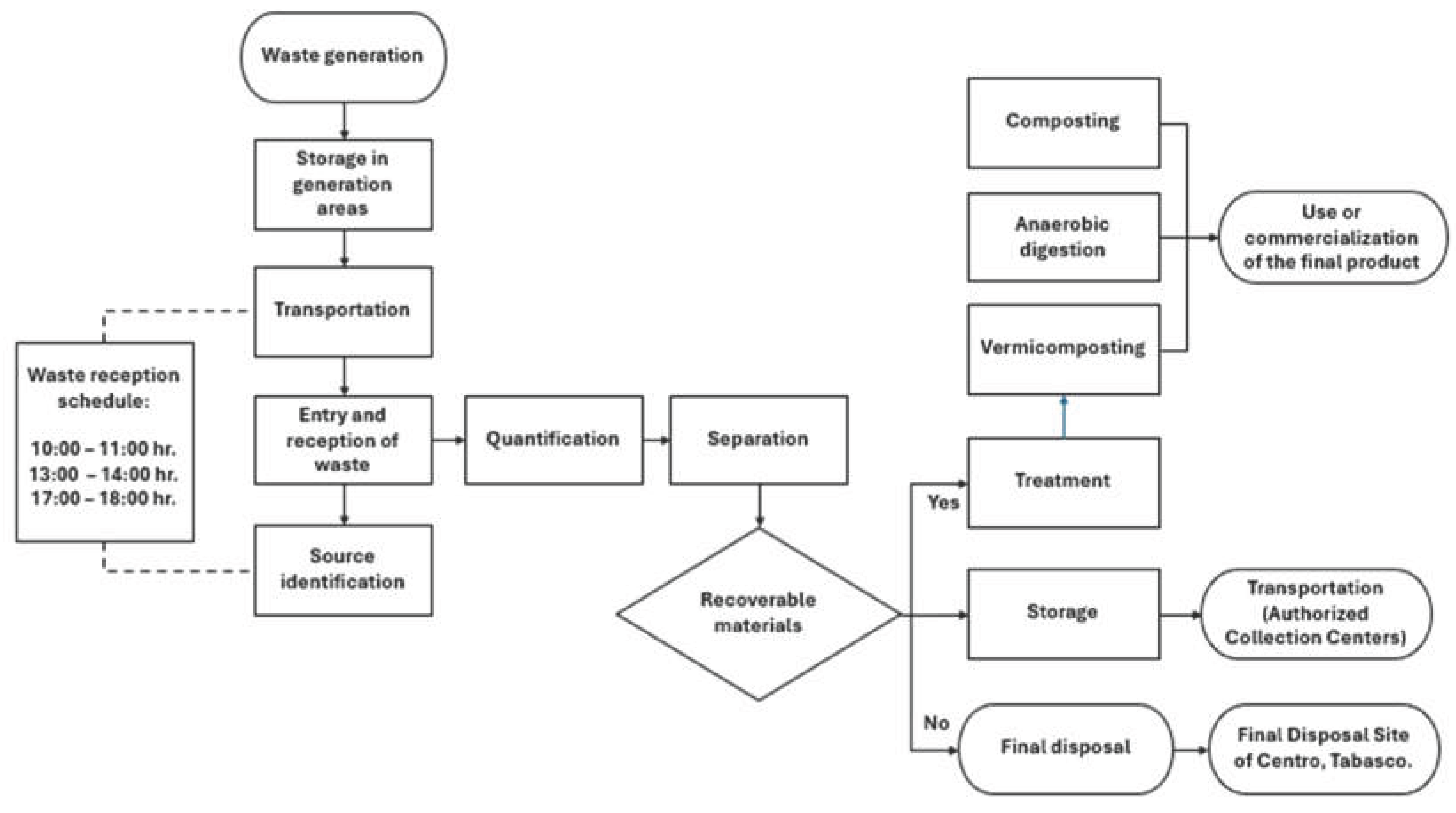
Figure 2.
Generation sources with sanitary facilities at DACBiol-UJAT. (Source: DACBiol-UJAT).
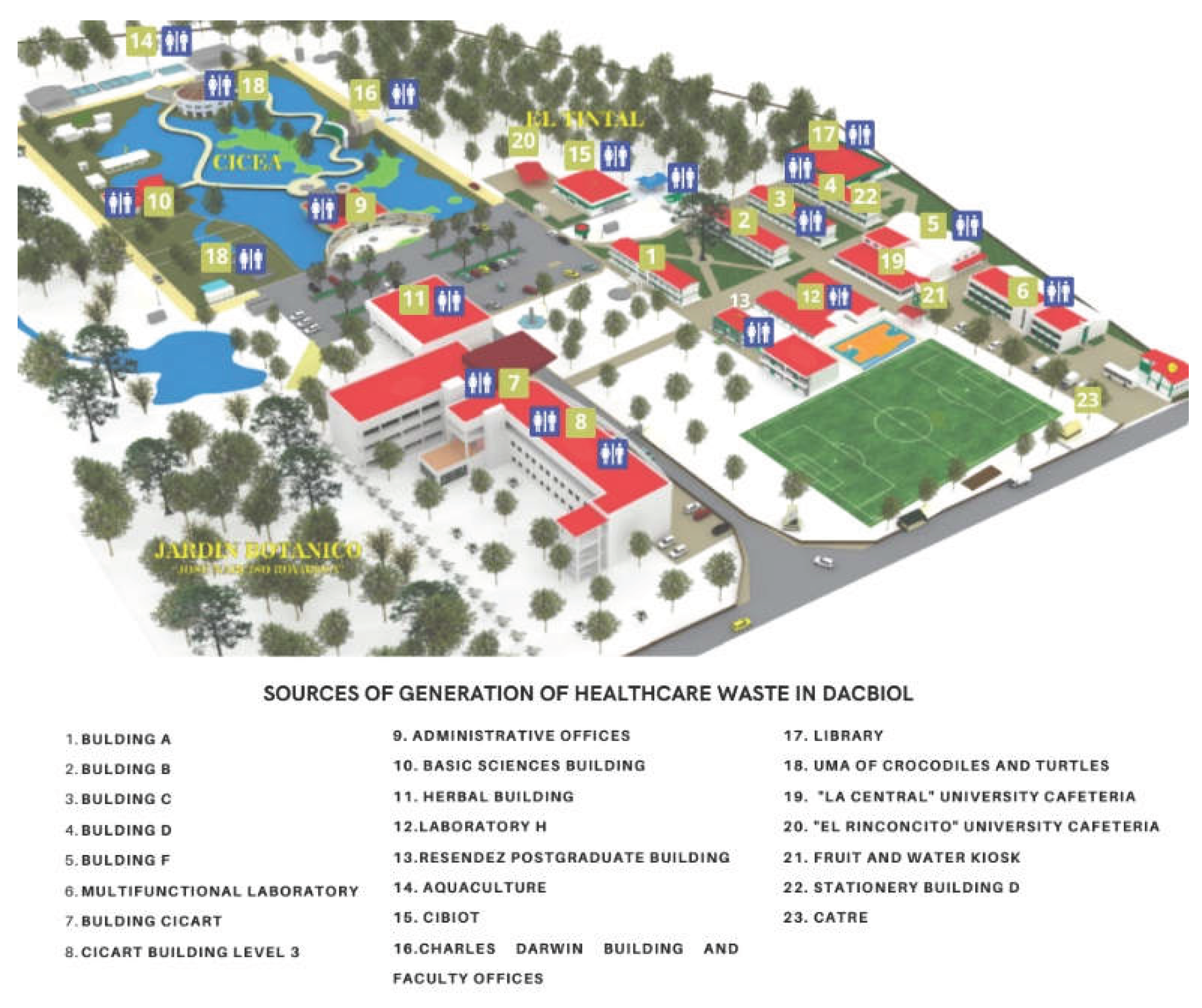
Figure 3.
SW generation at DACBiol during 2022; a) Daily SW generation and average; b) Weekly average SW generation; c) Monthly average SW generation; d) SW generation by semester period.
Figure 3.
SW generation at DACBiol during 2022; a) Daily SW generation and average; b) Weekly average SW generation; c) Monthly average SW generation; d) SW generation by semester period.
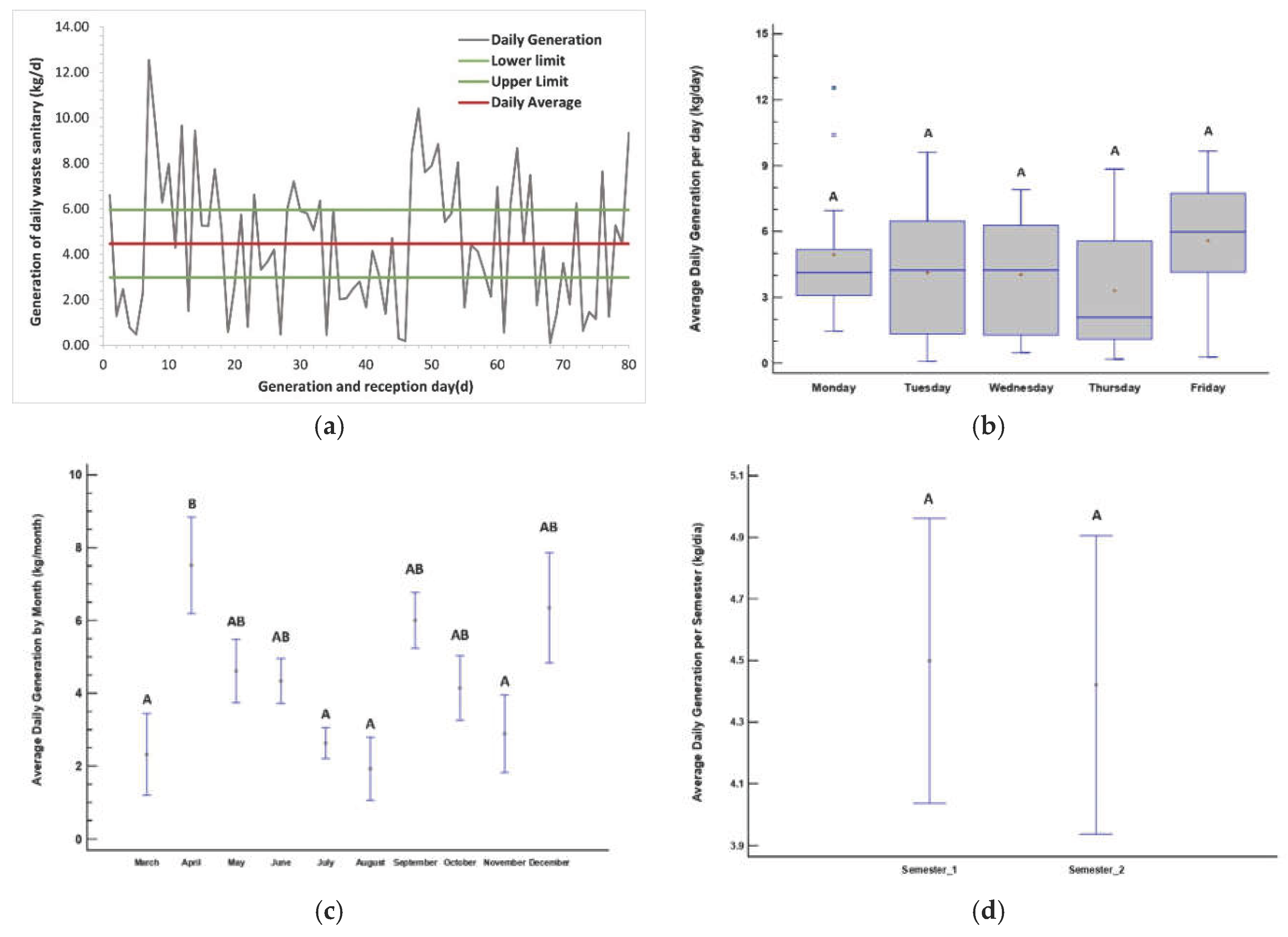
Figure 4.
Estimated emissions from the annual SW generation for each scenario type (aerobic and anaerobic, with and without methane utilization).
Figure 4.
Estimated emissions from the annual SW generation for each scenario type (aerobic and anaerobic, with and without methane utilization).
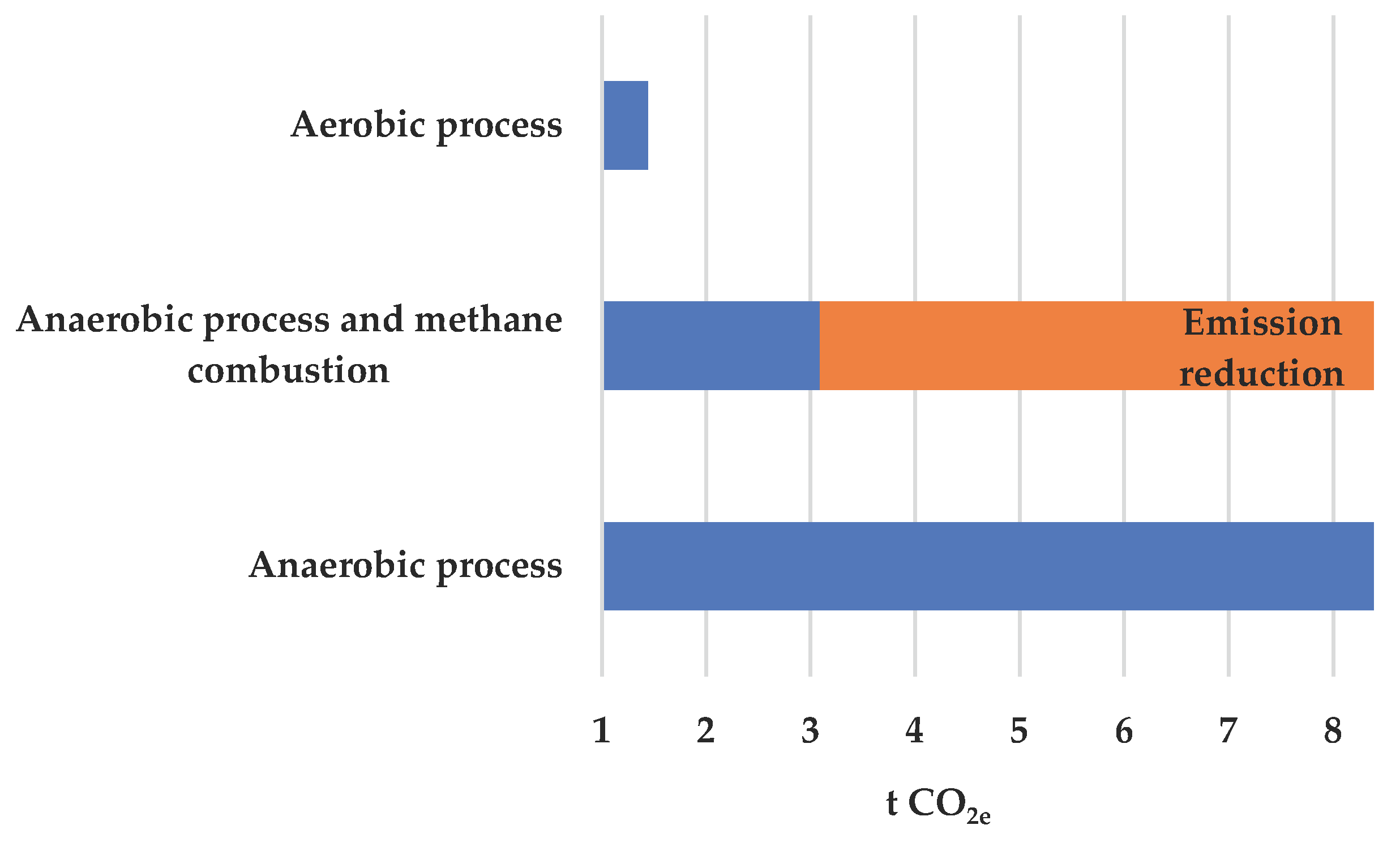

Table 1.
Table should a Proximate and Ultimate Composition of Sanitary Waste.
| a | Analytics (%) | Elementals (%) | |||||||||||||
| Moisture | Volatile Matter | Fixed Carbon | Ash | C | H | O | N | S | |||||||
| 9.78 ± 7.17 | 91.28 ± 1.42 | 2.39 ± 1.10 | 6.31 ± 1.53 | 42.08 ± 0.03 | 6.26 ± 0.01 | 50.44 | 0.96 ± 0.08 | 0.25 ± 0.02 | |||||||
| b | Process | Chemical Formulas | Condition | ||||||||||||
| Aerobic | Without sulfur; with water | ||||||||||||||
| Anaerobic | With sulfur; with water | ||||||||||||||
| c | Theoretical Gas Production (CO₂ and CH₄) and Their CO₂e Equivalence | ||||||||||||||
| Process | GEI | Generated (t/year) | PCA [22] | t CO2e | tCO2e year-1 | ||||||||||
| Aerobic | CO2 | 0.9429 | 1 | 0.9429 | 0.9429 | ||||||||||
| Anaerobic | CO2 | 0.7387 | 1 | 0.7387 | 7.8870 | ||||||||||
| CH4 | 0.2553 | 28 | 7.1482 | ||||||||||||
Table 2.
Calculated EF and Ranges for Sanitary Waste.
| Process | EF (kg CO2e t-1 SW) |
|---|---|
| Aerobic | 841.95 |
| Anaerobic | 7,041.97 |
Disclaimer/Publisher’s Note: The statements, opinions and data contained in all publications are solely those of the individual author(s) and contributor(s) and not of MDPI and/or the editor(s). MDPI and/or the editor(s) disclaim responsibility for any injury to people or property resulting from any ideas, methods, instructions or products referred to in the content. |
© 2026 by the authors. Licensee MDPI, Basel, Switzerland. This article is an open access article distributed under the terms and conditions of the Creative Commons Attribution (CC BY) license (http://creativecommons.org/licenses/by/4.0/).
Copyright: This open access article is published under a Creative Commons CC BY 4.0 license, which permit the free download, distribution, and reuse, provided that the author and preprint are cited in any reuse.


