
Submitted:
20 January 2026
Posted:
21 January 2026
You are already at the latest version
Abstract
Educational sustainability necessitates a holistic development paradigm where academic resilience and physical literacy are mutually reinforcing. Within the framework of the United Nations Sustainable Development Goals (specifically SDG 3: Good Health and Well-being and SDG 4: Quality Education), this study investigates the predictive capacity of kinesthetic profiles—encompassing both intelligence and learning styles—on sports at-titudes and academic achievement among adolescents. Employing a quantitative cross-sectional design, data were collected from a substantial sample of 695 adolescents. The regression analyses revealed a critical pedagogical distinction: unlike kinesthetic in-telligence, the kinesthetic learning style emerged as the paramount predictor of sports at-titudes (β=.612), explaining a substantial 42.3% of the total variance. Furthermore, a sig-nificant positive correlation was identified between kinesthetic traits and academic per-formance, challenging the traditional dichotomy between physical and cognitive devel-opment. These findings advocate for a strategic paradigm shift from "one-size-fits-all" in-struction to kinesthetic-based pedagogies that align with students' sensory preferences. Consequently, integrating movement-oriented strategies into curricula is proposed not merely as an instructional choice, but as a vital sustainable education strategy to foster both academic excellence and the lifelong physical and mental well-being of the next generation.
Keywords:
adolescent
; sustainability
; education
; kinesthetic intelligence
; learning styles
; attitude towards sports
; academic achievement
; physical education
1. Introduction
Learning is widely recognized as the process of knowledge construction through lived experiences. According to Dunn and Dunn [1], individuals develop idiosyncratic pathways for acquiring and retaining new information. Several scholars, including Kolb [2], Dunn [3], Fleming [4], and Reichmann and Gracha [5], have introduced learning style theories that empower educators to better understand the diverse profiles of their students. Fleming [4] identifies four dominant learning modalities: Visual (V), Aural (A), Read/Write (R), and Kinesthetic (K). While visual learners gravitate toward diagrams and charts, and aural learners prefer auditory stimuli such as lectures or group discussions, kinesthetic learners thrive on physical experiences and hands-on, practical approaches. These individuals favor materials that offer concrete experiences to achieve meaningful learning. By engaging in tangible activities—such as drawing or clay modeling—kinesthetic learners can effectively transform short-term experiences into long-term memory, facilitating recall during assessments or practical applications.
Another pivotal framework highlighting individual differences is Gardner’s [6] Theory of Multiple Intelligences. This educational paradigm aims to identify and cultivate an individual's unique talents and latent powers by emphasizing that intelligence manifests in diverse domains. Central to this theory is the concept of Bodily-Kinesthetic Intelligence, which characterizes individuals who possess superior control over their physical movements to achieve specific objectives. This intelligence encompasses coordination, limb dexterity, balance, flexibility, strength, and speed. It is most prominently observed in athletes, actors, dancers, and artisans who utilize the entire body or specific body parts to express ideas or accomplish complex tasks. In essence, kinesthetic intelligence utilizes the body as a primary tool for problem-solving and understanding.
There is a compelling premise that individuals with dominant kinesthetic profiles—whether expressed as a learning style or an intelligence type—exhibit more positive attitudes toward sports and physical activity. Physical activity and sports are inherent components of human life, and contemporary global policies largely align in their promotion. Early engagement in play often serves as the precursor to formal sports participation, which later evolves into a stable attitude influenced by both hereditary factors and the environment. Attitude, defined as a socially acquired predisposition to behave in a certain way toward specific events or objects, determines the lifelong dimension of an individual's relationship with sports. In this study, attitude toward sports is examined through three sub-dimensions: interest in sports, living with sports, and active sports participation.
In the context of contemporary pedagogical discourse, educational sustainability transcends the mere preservation of resources, focusing instead on the holistic development of learners to ensure long-term physical, cognitive, and psychological well-being. A sustainable educational model necessitates an inclusive curriculum that recognizes diverse learning modalities—particularly kinesthetic profiles—as essential drivers of student engagement and 'Quality Education' (UN Sustainable Development Goal 4). Recent literature suggests that when educational environments fail to align with students' sensory preferences, the resulting disengagement poses a threat to the sustainability of lifelong healthy habits. For instance, studies indexed in prestigious databases (SSCI/SCI) emphasize that fostering a synergy between physical literacy and academic resilience is critical for maintaining students' motivation in the post-pandemic era. By investigating how kinesthetic intelligence and learning styles predict sports attitudes and academic achievement, this study contributes to the framework of educational sustainability by proposing a more resilient and movement-oriented approach to adolescent development.
1.1. Current Study and Hypotheses
Built upon identified gaps in the literature, this study aims to elucidate the interplay between kinesthetic intelligence, kinesthetic learning styles, and sports attitudes during adolescence. Given the multi-dimensional nature of sports attitudes, we investigate these connections through a comprehensive and integrative lens. Based on a rigorous review of the literature, the following hypotheses were formulated:
- H.a: Significant positive correlations exist between kinesthetic learning and kinesthetic intelligence (H.a1.1), academic achievement (H.a1.2), physical activity duration (H.a1.3.1; H.a1.3.2), and the sub-dimensions of sports attitude (H.a1.4.1; H.a1.4.2; H.a1.4.3).
- H.b: Significant differences will emerge in kinesthetic intelligence, learning styles, and sports attitudes based on gender (H.b1) and athletic license status (H.b2).
- H.c: Dominant kinesthetic intelligence and learning styles in adolescents will significantly and positively predict attitudes toward sports.
2. Materials and Methods
2.1. Participants and Procedure
A cross-sectional design was utilized to examine the relationships between kinesthetic intelligence, kinesthetic learning styles, and attitudes toward sports among adolescents. Data collection took place during the first half of 2021, in the period following the peak of the pandemic. The study population consisted of 1,217 adolescents attending high schools in a district with a population of approximately 40,000 in Muğla, Turkey. By considering variables such as gender, grade level, and school type, systematic and maximum variation sampling methods were employed to reach 840 potential participants.
Based on rigorous inclusion and exclusion criteria, the sample was restricted to individuals aged 14–18 (excluding 42 participants aged 19 and above) and those who consented to participate (excluding 77 individuals whose parents did not provide formal consent). This resulted in a final sample of 771 participants; however, after data cleaning, 695 valid responses were retained for analysis. This sample size meets the requirements specified by Cohen et al. [7].
Ethical approval was obtained from the Muğla Sıtkı Koçman University Health Sciences Ethics Committee (No: 210108). In accordance with the Declaration of Helsinki, no financial compensation was provided to the participants. Participants were invited via school administrations following research permission granted by the Republic of Turkey Ministry of National Education. Data were collected through printed forms following informational sessions conducted in face-to-face meetings scheduled with school administrations.
The sociodemographic variables examined included gender, grade level, school type, academic field, academic achievement, daily mandatory light physical activity duration, weekly voluntary vigorous physical activity duration, and participation in official sports competitions. Other core variables were kinesthetic intelligence, kinesthetic learning style, and attitudes toward sports, as detailed below. Data forms and sets were collected by the researchers at the end of the meetings. The collected data were anonymized immediately upon completion, preventing any further link to the participants; due to this anonymization process, data could not be withdrawn after submission.
It was assumed that the sample group was sufficient to represent the research population, that the information obtained from accessible sources reflected objectivity, and that the questionnaire forms were completed objectively by the participants.
2.2. Measures
2.2.1. Learning Styles Scale
In this study, the Learning Styles Scale, developed and validated for Turkish-speaking populations by Gökdağ [8], was utilized with the developer's permission. The scale comprises three dimensions: auditory, visual, and kinesthetic. This research specifically focused on the kinesthetic learning dimension, which consists of 10 items (e.g., “I want to work with tools in the classroom,” “While solving a problem, I think by moving or moving objects”). The scale employs a five-point Likert-type format ranging from 1 (Strongly Disagree) to 5 (Strongly Agree). In the current study, the Cronbach’s alpha coefficient was calculated as .802, demonstrating high internal consistency.
2.2.2. Attitude Toward Sports Scale
The “Attitude Toward Sports Scale,” developed by Şentürk [9], was used to measure participants' attitudes. This 25-item Likert-type scale yields a total score ranging from 25 to 125, where higher scores indicate a more positive attitude toward sports. All items are positively phrased; thus, no reverse scoring was required. The scale consists of three sub-dimensions: “Interest in Sports,” “Living with Sports,” and “Active Sports Participation”. Reliability analysis for the present study showed excellent internal consistency for the overall scale (α=.947) and its sub-dimensions: interest in sports (α=.904), living with sports (α=.818), and active sports participation (α=.803).
2.2.3. Multiple Intelligences Inventory
The inventory developed by Saban [10] is a Likert-type instrument consisting of eight sections. For this research, the Bodily-Kinesthetic Intelligence domain was examined. Items were rated on a five-point scale from 0 (Not at all suitable for me) to 4 (Completely suitable for me). Permission for the use of the data collection tool was obtained via individual email communication. The internal consistency of the data in this study was confirmed with a Cronbach’s alpha of .73.
2.2.4. Personal Information Form
A demographic form was developed by the researchers to record participants' characteristics, including gender, academic achievement (grade point average), daily or weekly physical activity duration, and participation in official sports competitions. It should be noted that in Turkey, an athletic license is required to participate in official sports competitions. Additionally, students' academic success is evaluated on a 100-point scale. Physical activity durations were determined through self-reported markings on a provided chart.
2.2.5. Data Analysis
All statistical analyses were conducted using IBM SPSS software version 27.0 (SPSS, Inc., Chicago, IL, USA). The sample size of 695 participants provided a robust basis for the assumption that the sample means of analyzed variables would follow a normal distribution [11]. Furthermore, literature suggests that parametric tests maintain robustness even when the normality assumption is not perfectly met [12]. Descriptive statistics included frequencies and percentages for categorical variables, while means and standard deviations were used for continuous variables. Pearson correlation analyses were performed to examine the relationships between kinesthetic intelligence, kinesthetic learning style, and attitudes toward sports in adolescents. Finally, multiple linear regression analyses were conducted to identify unique predictors among these factors, with the significance level set at p < .05.
3. Results
3.1. Descriptive Characteristics of the Sample
The study sample consisted of 695 adolescents, including 301 males (43.3%) and 394 females (56.7%). The mean age of the participants was 15.9 years (SD=1.8), ranging from 14 to 18. Regarding athletic involvement, 326 participants (46.9%) held an official athletic license, while 369 (53.1%) did not.
An analysis of the sociodemographic characteristics of the study group reveals a mean age of 15.9 years. The sample is characterized by a predominance of female students, who constitute 56.7% (n = 394) of the total participants. Regarding athletic involvement, 46.9% (n = 326) of the adolescents held an official athletic license, while 53.1% (n = 369) reported no such athletic affiliation (see Table 1).
The average academic achievement (GPA) was found to be 86.95 out of 100 (SD=11.15). Participants reported an average of 35.59 minutes of mandatory light physical activity per day and a weekly average of 120.73 minutes of voluntary vigorous physical activity. Descriptive statistics for physical activity levels and academic achievement are presented in Table 2.
Mean scores for the primary scales revealed that adolescents had a kinesthetic learning style average of 3.36 (SD=0.75) and a kinesthetic intelligence average of 3.56 (SD=0.65). Regarding the sub-dimensions of sports attitude, mean scores were 3.41 for "interest in sports," 3.31 for "living with sports," and 3.19 for "active sports participation". Detailed mean scores are provided in Table 3.
3.2. Correlation Analyses and Hypothesis Testing (H.a)
Pearson correlation analyses were conducted to test Hypothesis H.a11. A significant positive correlation was identified between kinesthetic intelligence and kinesthetic learning style (r=.699, p<.001). Kinesthetic learning style exhibited significant positive relationships (p<.05) with academic success (r=.126), daily physical activity (r=.162), weekly voluntary physical activity (r=.304), and all sub-dimensions of sports attitude.
Similarly, kinesthetic intelligence showed significant positive correlations with academic success (r=.106), physical activity durations, and sports attitudes. Academic achievement was also positively correlated with physical activity frequency and sports attitudes, except for the relationship between academic success and weekly voluntary physical activity (p=.088). Consequently, all components of Hypothesis H.a were supported except for H.a3.1.2. (see Table 4).
3.3. Comparative Analyses Based on Gender and Athletic License (H.b)
No significant gender-based differences were found in kinesthetic learning style (p=.096) or kinesthetic intelligence (p=.363), leading to the rejection of hypotheses H.b1.1 and H.b1.2. However, males scored significantly higher than females in all sub-dimensions of sports attitude (p<.001), supporting hypothesis H.b1.3. Additionally, females demonstrated significantly higher academic success (M=87.70) than males (M=85.97, p=.043), while males reported significantly higher physical activity durations. Significant differences were observed based on athletic license status. Licensed athletes demonstrated higher levels of kinesthetic learning styles (M=3.54 vs M=3.21, p<.001) and kinesthetic intelligence (M=3.63 vs M=3.49, p=.007). Furthermore, licensed athletes exhibited significantly more positive attitudes toward sports and higher physical activity frequencies (p<.05), supporting hypotheses H.b2.1 and H.b2.2. No significant difference was found in academic success based on license status (p=.078) (see Table 5 and Table 6).
3.4. Predictive Power of Kinesthetic Profile on Sports Attitude (H.c)
Multiple linear regression analysis was performed to determine how kinesthetic learning style and kinesthetic intelligence predict attitudes toward sports. The results indicated that the combination of kinesthetic learning style and kinesthetic intelligence significantly predicted sports attitude (R=.651, R2=.423, p<.001).
Table 7 presents the results of the regression analysis regarding the prediction of attitudes towards sports based on kinesthetic learning style and kinesthetic intelligence sub-dimensions. When examining the pairwise and partial correlations between the predictor and dependent variables, it was found that there are positive and high-level relationships between kinesthetic learning style and kinesthetic intelligence sub-dimensions and students' attitudes towards sports.
Figure 1.
Path analysis model of the predictive power of kinesthetic profile on attitude toward sports in adolescents. (Note: Values are standardized β coefficients; R2=,423; *** p<,001).
Figure 1.
Path analysis model of the predictive power of kinesthetic profile on attitude toward sports in adolescents. (Note: Values are standardized β coefficients; R2=,423; *** p<,001).
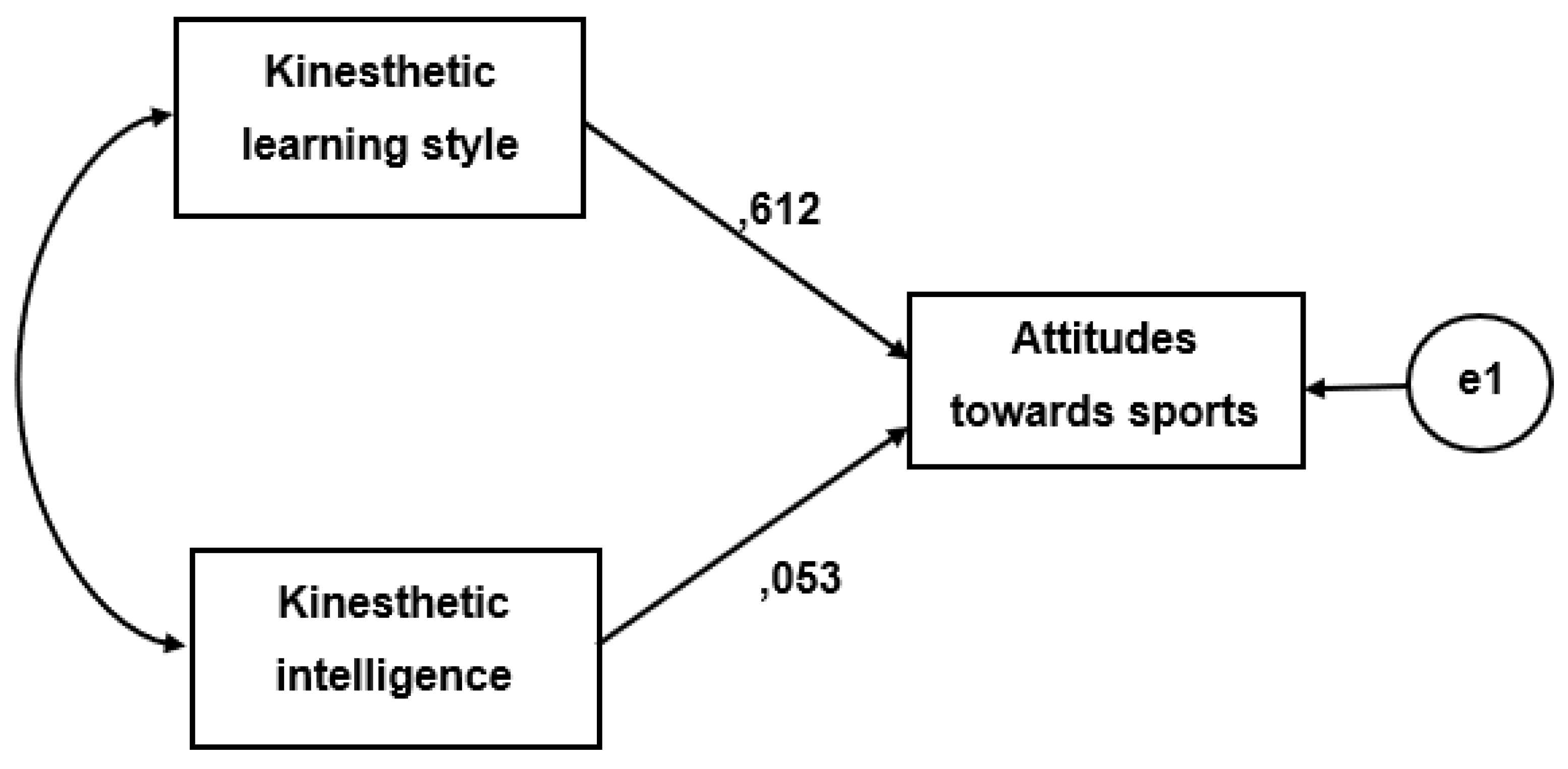
These variables collectively explained approximately 42.3% of the total variance in adolescents' attitudes toward sports. Examination of the standardized coefficients revealed that kinesthetic learning style was a significant and powerful predictor (β=.612, p<.001), whereas kinesthetic intelligence did not provide a significant independent contribution to the model (β=.053, p=.189). These findings support Hypothesis H.c, confirming that a dominant kinesthetic profile positively influences attitudes toward sports in adolescents.
4. Discussion
4.1. Relationships Between Variables
4.1.1. Kinesthetic Learning and Kinesthetic Intelligence (H.a1.1)
Wardoyo and Utanto [13] examined how kinesthetic intelligence practices are integrated into educational settings by evaluating student engagement, learning effectiveness, and instructional implementation strategies. Their findings emphasize the potential of kinesthetic intelligence to foster inclusive and dynamic learning environments and recommend that educators incorporate movement-based strategies into instructional practices to better address diverse learning needs. The results indicate that students with higher levels of bodily–kinesthetic intelligence tend to participate more actively in kinesthetic learning activities, and that such learning environments significantly support both cognitive and psychomotor learning processes.
Similarly, Gunawan et al. [14] investigated the implementation of a thematic learning model grounded in kinesthetic intelligence. The study focused on methodologies designed to positively influence students’ learning behaviors through movement-oriented strategies. The findings demonstrate that kinesthetic intelligence-based learning activities strengthen kinesthetic learning behaviors and contribute to increased active participation, learning retention, and motivation toward academic tasks.
Another study explored the relationship between multiple intelligence preferences and learning styles, with particular emphasis on bodily–kinesthetic intelligence and specific dimensions of the kinesthetic learning style [15]. The thesis findings revealed a statistically significant relationship between bodily–kinesthetic intelligence and kinesthetic learning style, suggesting that these constructs function as complementary dimensions within individual learning preferences.
Denig [16] examined the theoretical connections between Gardner’s conceptualization of bodily–kinesthetic intelligence and learning styles, including kinesthetic learning. The study clarifies that although bodily–kinesthetic intelligence and kinesthetic learning do not occupy the same conceptual domain, they represent interrelated constructs that complement one another within the learning process and should be jointly considered in pedagogical applications.
Bazan-Perkins and Santibanez-Salgado [17] investigated the relationship between kinesthetic learning preferences and academic achievement and learning outcomes, highlighting the link between kinesthetic learning and cognitive processes within activity-based educational contexts. Their findings suggest that individuals with kinesthetic learning preferences are able to structure learning outcomes more effectively, potentially reflecting underlying bodily–kinesthetic cognitive capacities.
Budin et al. [18] statistically examined the relationship between kinesthetic intelligence levels and students’ learning styles—particularly kinesthetic learning style—in relation to academic performance. The results indicate that individuals with higher kinesthetic intelligence tend to prefer kinesthetic learning styles more strongly, demonstrating a meaningful overlap between intelligence profiles and learning approaches.
Şener and Çokçalışkan [19] aimed to identify middle school students’ multiple intelligence profiles and learning styles, examine whether these structures differ by gender, and explain the relationships between learning styles and intelligence types. One of the key findings of the study revealed a positive and statistically significant relationship between kinesthetic learning style and kinesthetic intelligence.
In the present study, a positive and statistically significant relationship was identified between kinesthetic learning and kinesthetic intelligence, thereby confirming Hypothesis H.a1.1. The literature generally indicates a moderate yet meaningful association between bodily–kinesthetic intelligence and kinesthetic learning preference, suggesting that kinesthetic intelligence functions as an individual characteristic that enhances the effectiveness of kinesthetic learning activities. However, given the differences in measurement instruments and theoretical foundations, these constructs should not be treated as directly equivalent but rather as distinct yet mutually supportive psycho-educational structures.
4.1.2. Kinesthetic Learning and Academic Achievement (H.a1.2)
Augustine et al. [20] examined the relationships between various learning styles, including kinesthetic learning style, and academic achievement in mathematics and information technology courses. Their findings indicated that both visual and kinesthetic learning styles were positively associated with academic achievement.
Abah et al. [21] implemented kinesthetic learning methods in mathematics instruction and reported significant increases in both academic achievement and interest levels among students exposed to kinesthetic learning approaches.
Agaba and Sendagi [22] investigated the relationship between middle school students’ learning styles—including auditory and kinesthetic—and academic achievement. The results demonstrated that kinesthetic learning style exhibited a strong positive association with academic achievement.
Vaishnav and Chirayu [23] analyzed the relationship between visual, auditory, and kinesthetic learning styles and academic achievement among secondary school students, reporting a high positive correlation between kinesthetic learning style and academic achievement.
Similarly, Rani [24] examined the relationship between students’ perceptual learning styles and academic achievement and found a high correlation between kinesthetic learning style and academic success.
In contrast, Liew et al. [25] examined the relationship between medical students’ VARK learning styles and examination performance and reported that although kinesthetic learning style was prevalent among students, it did not significantly predict academic achievement. Almigbal [26] likewise investigated VARK learning styles among medical students and found high rates of kinesthetic preference but no statistically significant relationship with academic achievement.
In the present study, a positive and statistically significant relationship was found between kinesthetic learning and academic achievement, thus confirming Hypothesis H.a1.2. While numerous studies associate kinesthetic learning style with academic achievement, others suggest that kinesthetic learning represents a preference rather than a direct determinant of academic success. Although the VARK learning style model remains widely used, it is important to acknowledge ongoing critiques within the scientific community regarding its predictive power for academic achievement.
4.1.3. Kinesthetic Learning and Physical Activity (Attitudes Toward Sport) (H.a1.3; H.a1.4)
Varman et al. [27] systematically reviewed the effectiveness of experiential learning interventions aimed at improving physical activity knowledge, attitudes, and behaviors among school-aged children. Meta-analytic findings indicated that experiential learning interventions—such as game-based physical activities and goal-setting techniques—exerted moderate to high effects on children’s physical activity behaviors, knowledge levels, and attitudes.
Petrigna et al. [28] conducted a systematic review evaluating the effects of movement-integrated academic lessons on learning outcomes, physical activity levels, and cognitive development in school-aged children. The findings demonstrated that movement-integrated academic instruction increased total physical activity duration and motor skills while also positively influencing learning performance and academic achievement.
Boyliyeva [29] examined the classroom implementation of kinesthetic, movement-based learning activities in primary education and their contributions to students’ cognitive, emotional, and social development. The analyses revealed that participation in movement-oriented learning activities significantly enhanced learning-related attention, memory retention, and classroom interaction, positioning physical activity as an active component of learning processes.
Matsuura et al. [30] compared kinesthetic experience-based learning methods with model-based instructional approaches in university physical education courses, focusing on balance ability and social relationships. The results indicated that physical activities implemented through kinesthetic learning processes yielded greater improvements in balance ability and self-evaluation and social relationship scores, highlighting the enriching role of physical activity in learning experiences.
In the present study, a positive and statistically significant relationship was found between kinesthetic learning and physical activity, thereby confirming Hypotheses H.a1.3 and H.a1.4. The literature generally suggests that physical activity and kinesthetic learning strategies complement one another and that movement-based learning activities positively influence cognitive and psychomotor outcomes, particularly among school-aged children. Experiential learning and movement-based education not only enhance physical activity levels but also contribute to deeper learning processes.
4.1.4. Kinesthetic Intelligence and Academic Achievement (H.a2.1)
Kaya et al. [31] examined the relationship between bodily–kinesthetic intelligence and academic achievement among higher education students in physical education and sports programs. Correlation analyses revealed a positive and statistically significant relationship between bodily–kinesthetic intelligence and academic achievement.
Budin et al. [18] investigated mechanical engineering students and identified a significant relationship between kinesthetic intelligence and academic performance, with statistical associations observed between learning styles, kinesthetic intelligence levels, and academic outcomes.
Lozano-Blasco et al. [32] conducted a meta-analysis reviewing studies on the relationships between intelligence types and academic achievement. While general intelligence types demonstrated moderate positive associations with academic achievement, the analysis also indirectly addressed multiple intelligence models, including bodily–kinesthetic intelligence.
Ahvan and Pour [33] examined the relationship between Gardner’s multiple intelligence profiles and academic achievement among high school students, reporting that bodily–kinesthetic intelligence exhibited a statistically significant positive correlation with academic achievement.
Baba and Güçlü [34] explored the relationship between bodily–kinesthetic intelligence and academic achievement alongside psychological variables such as emotional intelligence and locus of control. Despite the multivariate structure of the study, a positive relationship between kinesthetic intelligence and academic achievement was identified.
In the present study, a positive and statistically significant relationship was found between kinesthetic intelligence and academic achievement, confirming Hypothesis H.a2.1. Although several studies report positive associations—particularly in sport- and physical education-related samples—there is no universally accepted scientific consensus that kinesthetic intelligence strongly predicts academic achievement in general educational contexts. The relationship is typically moderate and varies depending on sample characteristics. Moreover, kinesthetic intelligence is often conflated with learning styles; however, educational psychology research suggests that the direct impact of learning styles on academic achievement remains limited.
4.1.5. Kinesthetic Intelligence and Physical Activity (H.a2.2)
Güner and Kalkavan [35] examined the relationship between university students’ bodily–kinesthetic intelligence levels and sedentary behaviors, assessing the mediating role of enjoyment derived from physical activity. The findings revealed significant positive relationships between bodily–kinesthetic intelligence and enjoyment of physical activity, with enjoyment fully mediating the effect of kinesthetic intelligence on reducing sedentary behavior.
Koçak [36] investigated the relationship between sports attitudes and bodily–kinesthetic intelligence levels among sports science students, also examining the role of regular physical activity participation. The results indicated a strong positive correlation between sport-related attitudes and bodily–kinesthetic intelligence, with regularly active students exhibiting higher kinesthetic intelligence levels.
Gülünay and Savaş [37] explored the relationship between physical activity participation levels and bodily–kinesthetic intelligence among university preparatory students and examined the effects of these variables on foreign language learning achievement. The findings revealed a moderate positive relationship between physical activity participation and bodily–kinesthetic intelligence, with physical activity significantly influencing language achievement and kinesthetic intelligence showing a weak but positive association with learning success.
Ubago-Jimenez et al. [38] examined the relationships between physical activity engagement and multiple intelligence domains—particularly bodily–kinesthetic intelligence—among university students. The results indicated that students who regularly engaged in physical activity demonstrated higher bodily–kinesthetic intelligence scores.
In the present study, a positive and statistically significant relationship was found between kinesthetic intelligence and physical activity, thereby confirming Hypothesis H.a2.2. The literature indicates that bodily–kinesthetic intelligence is positively associated with physical activity participation and sport-related attitudes. Enjoyment of physical activity and regular engagement appear to play key roles in reducing sedentary behaviors and supporting kinesthetic intelligence. Studies focusing on the educational and cognitive impacts of physical activity suggest that bodily–kinesthetic intelligence interacts with physical activity behaviors within learning contexts.
4.1.6. Academic Achievement and Physical Activity (H.a3.1; H.a3.2)
Bilgin et al. [39] examined the relationships among physical activity level, health-related physical fitness, academic achievement, and academic self-concept among eighth-grade students. The results revealed positive but weak correlations between physical activity and both academic achievement and academic self-concept, while health-related physical fitness was positively associated with academic achievement.
Garcia-Jimenez [40] investigated the relationship between extracurricular physical activity habits and academic performance among elementary school students. The findings demonstrated that students who engaged in extracurricular physical activity exhibited significantly higher academic averages than their sedentary peers.
Alvarez-Bueno et al. [41] conducted a meta-analysis evaluating the effects of physical activity interventions on academic achievement and classroom behaviors among school-aged children and adolescents. The results indicated that physical activity programs improved classroom behavior and exerted positive effects on mathematics, reading, and overall academic achievement.
Nalbant and Kaya [42] systematically reviewed randomized controlled studies published between 2010 and 2020 that examined the effects of physical activity on academic achievement. The review concluded that physical activity positively influences academic achievement and should be integrated into school curricula as an innovative educational approach.
Elish et al. [43] conducted a longitudinal study examining the relationship between objectively measured school-day physical activity and academic achievement among elementary school students in the United States. Although the findings did not provide strong evidence for a direct relationship, the authors emphasized that longitudinal designs may reveal context-dependent effects over time.
Wang and Zhang [44] argue that physical literacy is not limited to motor skills but is also a sustainable educational component that enhances adolescents' academic resilience and self-efficacy. This study directly supports our finding of a “positive relationship between academic achievement and physical activity”.
Our findings regarding the synergy between physical activity and academic achievement are consistent with recent literature in the field of educational sustainability [44,45]. Moreover, the emphasis on student attitudes as a driver for sustainable engagement [46] supports our model where kinesthetic learning style acts as a primary predictor of sports orientation.
In the present study, a positive and statistically significant relationship was found between academic achievement and physical activity/sport participation, confirming Hypotheses H.a3.1 and H.a3.2. The literature generally suggests that physical activity and sport exert either positive or neutral effects on academic achievement, with the magnitude and direction of effects varying by age group, measurement methods, and activity type. Meta-analyses and systematic reviews largely support the association between physical activity and positive performance-related outcomes.
4.2. Differences Across Variables
4.2.1. Gender Differences
Şener and Çokçalışkan [19] examined middle school students’ multiple intelligence profiles and learning styles, exploring gender differences and the relationships between these constructs. The analyses revealed moderate positive relationships between learning styles and intelligence types and identified statistically significant gender differences in certain learning styles and intelligence domains. Specifically, girls demonstrated higher mean scores than boys in kinesthetic learning style and kinesthetic intelligence.
In contrast, a study conducted in Iran by Sarabi-Asiabar et al. [47] investigated the relationship between learning style preferences and gender among medical students and found that male students exhibited a higher tendency toward kinesthetic learning style than female students.
Meneviş and Özad [48] examined whether multiple intelligence types differed by age and gender among high school students, reporting gender-based differences across several intelligence domains, including bodily–kinesthetic intelligence, with girls generally exhibiting higher intelligence scores.
Karagülmez Sağlam and Doğan [49] examined multiple intelligence profiles among physical education teacher candidates and found that certain intelligence types, including bodily–kinesthetic intelligence, demonstrated higher mean scores among male students.
In the present study, no significant gender differences were observed in kinesthetic learning or kinesthetic intelligence among adolescents, leading to the rejection of Hypotheses H.b1.1 and H.b1.2. While the literature indicates that kinesthetic learning and intelligence variables may vary by gender, findings remain inconsistent across educational levels and contexts. Moreover, studies specifically focusing on the intersection of kinesthetic learning, kinesthetic intelligence, and gender remain limited, highlighting the need for further quantitative research.
4.2.2. Differences Based on Physical Activity and Sport Participation
Erturan and Göde [50] aimed to compare bodily–kinesthetic intelligence attainment levels of fourth-grade primary school students according to sport participation status and gender. The findings, based on student, teacher, and parent perceptions, indicated no statistically significant differences in bodily–kinesthetic intelligence attainment levels between students who participated in sports and those who did not.
Zayed et al. [51] aimed to compare multiple intelligence profiles—particularly bodily–kinesthetic intelligence—between individuals who regularly participated in sports and those who did not. The results demonstrated that sport participants exhibited higher mean scores in bodily–kinesthetic, social, emotional, and naturalistic intelligence domains; however, statistically significant differences were observed only in bodily–kinesthetic and emotional intelligence.
The quantitative study conducted by Gülünay and Savaş [37] examined the relationship between physical activity participation levels and bodily–kinesthetic intelligence among university preparatory class students. The findings revealed a moderate positive relationship between physical activity participation and bodily–kinesthetic intelligence and indicated that students engaged in sports achieved higher mean scores in bodily–kinesthetic intelligence.
In another study, Karagülmez Sağlam and Doğan [49] reported that although intelligence profiles did not differ significantly according to sport type (individual versus team sports), individuals who participated in sports exhibited noticeable—albeit statistically small—positive tendencies in bodily–kinesthetic intelligence scores.
In the present study, it was hypothesized that adolescents’ kinesthetic intelligence, kinesthetic learning style, and attitudes toward sport would differ according to possession of a sport license (H.b2). A review of the literature suggests that sport participation demonstrates positive tendencies in relation to bodily–kinesthetic intelligence and kinesthetic learning-related intelligence profiles in some studies. In particular, differences have been observed when comparing bodily–kinesthetic intelligence scores of athletes and non-athletes. However, not all studies have reported statistically significant differences across all age groups or sample types; for example, in certain age groups or sample characteristics, no significant differences have been identified between sport participation status and kinesthetic intelligence scores. Consequently, although the relationship between sport participation and intelligence profiles is not universally established in the literature, positive tendencies in bodily–kinesthetic intelligence have been reported in specific contexts, particularly among individuals engaged in regular sport practice.
4.3. Determinants of Attitudes Toward Sport
Şenel and Yıldız [52] examined the relationship between bodily–kinesthetic intelligence levels and sportsmanship tendencies among students enrolled in schools of physical education and sport. The primary aim of the study was to reveal the relational structure between intelligence profiles, sport participation behaviors, and attitudes toward sport. The findings indicated that students with higher bodily–kinesthetic intelligence levels exhibited stronger sportsmanship behaviors—such as respect for rules, sense of responsibility, and respect for opponents—suggesting that kinesthetic intelligence is associated with cognitive–motivational characteristics that support sport-related behaviors.
Gülünay and Savaş [37] reported that physical activity participation levels were associated with higher bodily–kinesthetic intelligence scores and that physical activity contributed positively to students’ mental–physical learning capacity and sport-related cognitive performance, although not directly to sportsmanship behaviors.
Although Erturan and Göde [50] did not identify statistically significant differences between sport participation and bodily–kinesthetic intelligence, their findings support the hypothesis that sport practice provides a context that enriches kinesthetic awareness and motor skill experience.
Another study conducted by Tekin [53] examined the relationship between sport participation status and multiple intelligence domains—including bodily–kinesthetic intelligence—among secondary school students. The findings revealed that students who participated in sports demonstrated more favorable profiles in bodily–kinesthetic intelligence and other intelligence domains (e.g., logical and visual intelligence) compared with non-participating peers, indicating that sport participation may support both cognitive and motor intelligence profiles.
Lopez-Valenciano et al. [45] emphasize that physical activity is a sustainable intervention tool for the mental well-being of adolescents in the post-pandemic period. This provides a critical basis for understanding the attitudes towards sport of the large sample reached in our study.
In the present study, kinesthetic learning style and kinesthetic intelligence together explained approximately 42% of the total variance in attitudes toward sport. Accordingly, it can be concluded that the predominance of kinesthetic intelligence and kinesthetic learning styles among adolescents positively influences attitudes toward sport, thereby confirming Hypothesis H.c. Previous research has predominantly examined the relationship between sport participation and bodily–kinesthetic intelligence and has reported positive tendencies regarding the role of sport in supporting kinesthetic intelligence and learning-related behaviors. Several studies have also identified positive associations between kinesthetic intelligence and constructs such as sport attitudes and sportsmanship, indicating that individuals who engage in sports exhibit more pronounced kinesthetic intelligence-related behavioral characteristics. Although not all findings directly support the conclusion that sport participation enhances kinesthetic intelligence, strong evidence suggests that engagement in sport supports kinesthetic awareness and motor learning processes.
4.4. Theoretical Integration
4.4.1. The Role of Self-Determination Theory (SDT)
The findings of this study, particularly the potent predictive power of kinesthetic learning styles on sports attitudes (β= .612, p < .001), can be profoundly elucidated through the lens of Self-Determination Theory (SDT). SDT posits that optimal development and well-being are contingent upon the satisfaction of three innate psychological needs: autonomy, competence, and relatedness. Our results suggest that adolescents who favor kinesthetic modalities—learning through movement and tangible interaction—experience a heightened sense of competence when engaged in physical activities. When the educational environment or sports setting aligns with their dominant kinesthetic profile, these individuals are more likely to internalize their motivation, transitioning from extrinsic pressures to intrinsic valuing of sports. The robust 42.3% variance explained in sports attitudes highlights that kinesthetic congruence acts as a catalyst for autonomous motivation. By fostering an environment that mirrors their preferred learning style, educators satisfy the need for competence, thereby cultivating a more enduring and positive attitude toward long-term physical engagement.
Research by García-Richart et al. [46] shows that developing a sustainable attitude in physical education is based on self-determined motivation, and the predictive power of kinesthetic preferences on attitude in our study is consistent with these findings.
4.4.2. Achievement Goal Theory (AGT) and Academic Synergy
Furthermore, the significant positive correlation between kinesthetic learning styles, physical activity, and academic achievement (α = .802 for style consistency) provides empirical support for Achievement Goal Theory (AGT). AGT distinguishes between task-involved (mastery) and ego-involved goals. Our data indicates that kinesthetic learners, who thrive on hands-on experiences, may naturally lean toward mastery-oriented goals in physical domains. The synergy found between academic success and physical activity frequencies suggests that the self-regulatory skills acquired through movement-based mastery are transferable to broader cognitive tasks. This "cross-domain transfer" implies that a kinesthetic profile does not merely facilitate motor skill acquisition but also enhances the perceived competence and task persistence required for academic excellence. Unlike the non-significant independent effect of kinesthetic intelligence (β= .053), the dominance of the kinesthetic style underscores that the process of learning through movement is more critical for shaping goal orientations and achievement outcomes than innate potential alone.
4.4.3. Intelligence as Potential vs. Style as Action
A noteworthy finding of this study is the disparity between the predictive powers of kinesthetic intelligence and kinesthetic learning style. While these two constructs are significantly correlated (r=.699), our regression model indicates that only the kinesthetic learning style serves as a significant predictor of sports attitudes (β=.612, p<.001), whereas kinesthetic intelligence does not provide an independent contribution (β=.053, p=.189). This phenomenon can be explained by the conceptual distinction between innate potential and active preference. Kinesthetic intelligence represents a biological and cognitive capacity—a latent potential for movement and coordination. In contrast, a kinesthetic learning style reflects the individual's internalized preference for processing information through physical engagement and 'doing.' Our results suggest that for adolescents, the mere possession of physical-cognitive potential (intelligence) is insufficient to shape psychological attitudes toward sports; rather, it is the deliberate choice and habit of engaging with the world through movement (style) that fosters a positive sports orientation. This distinction underscores the importance of pedagogical interventions: while intelligence may be relatively stable, learning styles are more malleable and can be nurtured through kinesthetic-rich educational environments to promote lifelong physical literacy.
4.4.4. Gender Disparity and Sustainable Sports Policies
Our findings highlight a critical gender paradox that warrants attention within the framework of social sustainability: while female adolescents demonstrated significantly higher academic achievement (M=87.70) compared to their male counterparts (M=85.97, p=.043), they exhibited lower scores across all sub-dimensions of sports attitude (p<.001). From a sustainable development perspective, this discrepancy suggests that current educational and athletic infrastructures may not be sufficiently tailored to sustain the physical engagement of high-achieving female students. To mitigate this gap and align with SDG 5 (Gender Equality), sustainable sports policies should move beyond 'one-size-fits-all' approaches and implement gender-specific strategies. Such interventions could include the integration of kinesthetic-rich curricula that validate diverse movement expressions and the creation of non-competitive, mastery-oriented sports environments that appeal to the psychological profiles of female adolescents. By fostering a synergy between their proven academic competence and physical literacy, educational systems can ensure that the health and well-being of female youth are sustained alongside their intellectual growth, thereby building a more equitable and resilient future generation.
4.5. Limitations and Future Directions: Addressing Causality
While the current study provides robust evidence for the predictive role of kinesthetic profiles on sports attitudes, its cross-sectional design warrants a nuanced interpretation regarding causality. A primary concern in such designs is the potential for bidirectional causality: while a dominant kinesthetic learning style may foster a more positive attitude toward sports, it is equally plausible that early and intense socialization into sports environments reinforces kinesthetic modalities as the primary pathway for learning.
To address this "chicken-and-egg" dilemma, we frame our findings within Bandura’s [54] concept of Reciprocal Determinism. This perspective suggests that the adolescent’s kinesthetic profile, their physical environment, and their sports-related behaviors operate as interacting determinants that influence each other bidirectionally. The substantial explanation of variance (R2 = .423) observed in our model indicates a powerful synergy between these factors rather than a unidirectional causal arrow.
Furthermore, the non-significant effect of kinesthetic intelligence as an independent predictor (β= .053) compared to the dominance of kinesthetic style (β= .612) suggests that the process of engagement (style) is more critical for attitude formation than innate potential (intelligence). This distinction strengthens our argument that educational interventions focused on kinesthetic pedagogy can proactively shape sports attitudes, even before a stable "intelligence" trait is solidified. Future research employing longitudinal or cross-lagged panel designs is essential to untangle these developmental trajectories and confirm the temporal precedence of kinesthetic styles in cultivating lifelong physical literacy.
5. Conclusions
This study provides compelling empirical evidence that adolescents’ kinesthetic profiles—specifically their learning styles—are powerful predictors of their attitudes toward sports and physical engagement. Our findings reveal that kinesthetic learning styles alone explain a substantial 42.3% of the variance in sports attitudes, underscoring the necessity of movement-based pedagogical alignment in secondary education.
From the perspective of Educational Sustainability, these results advocate for a shift toward "Quality Education" (UN Sustainable Development Goal 4). By integrating kinesthetic modalities into the general curriculum, educational systems can foster a more inclusive and effective learning environment that transcends traditional sedentary models. Such an alignment not only enhances student engagement but also supports the Sustainability of Public Health (SDG 3) by cultivating lifelong positive attitudes toward physical activity during the critical developmental stage of adolescence.
Furthermore, the significant positive correlation between kinesthetic profiles and academic achievement (r=.126, p=.001) suggests that physical literacy is not a competitor to cognitive success but rather a fundamental pillar of it. This synergy is crucial for building sustainable school climates that prioritize the holistic well-being of the "post-pandemic generation".
In conclusion, prioritizing kinesthetic pedagogy is a strategic investment in the sustainable development of youth. Policy-makers and educators should move beyond treating physical education as an isolated discipline and instead embed kinesthetic principles across the educational spectrum to ensure a healthier, more active, and academically successful future generation.
6. Patents
There are not patents resulting from the work reported in this manuscript.
Author Contributions
Conceptualization, G.E. and H.E.S.; methodology, G.E. and H.E.S.; software, H.E.S.; validation, H.E.S.; formal analysis, H.E.S.; investigation, G.E. and H.E.S.; resources, G.E.; data curation, G.E.; writing—original draft preparation, G.E.; writing—review and editing, G.E. and H.E.S.; visualization, G.E.; supervision, H.E.S.; project administration, G.E. and H.E.S.; funding acquisition, G.E. and H.E.S. All authors have read and agreed to the published version of the manuscript.
Funding
This research received no external funding.
Institutional Review Board Statement
Ethical approval was obtained from the Muğla Sıtkı Koçman University Health Sciences Ethics Committee (No: 210108). In accordance with the Declaration of Helsinki, no financial compensation was provided to the participants. Participants were invited via school administrations following research permission granted by the Republic of Turkey Ministry of National Education. Data were collected through printed forms following informational sessions conducted in face-to-face meetings scheduled with school administrations.
Informed Consent Statement
Informed consent was obtained from all subjects involved in the study.
Data Availability Statement
You can access the data collection tool for this study via this link; https://forms.gle/Zaedeqqs4BsZuQ9YA; You can access the data obtained from this study via this link; https://docs.google.com/spreadsheets/d/10pkY4ER5x4zMRT-Yj7-0HVxyI-pYnVTAdwp3aHm0aZ4/edit?usp=sharing
Conflicts of Interest
The authors declare no conflicts of interest. The funders had no role in the design of the study; in the collection, analyses, or interpretation of data; in the writing of the manuscript; or in the decision to publish the results.
References
- Dunn, R.; Dunn, K. Research Based On The Dunn and Dunn Learning-Style Model; Staff Development Materials, Learning Styles Network; St. John's University: New York, NY, USA, 2001. [Google Scholar]
- Kolb, D.A. Learning styles and disciplinary differences. In The Modern American College; Chickering, A.W., Ed.; Jossey-Bass: San Francisco, CA, USA, 1981; pp. 232–255. [Google Scholar]
- Dunn, R.; Griggs, S.A. Practical Approaches to Using Learning Styles in Higher Education; Bloomsbury Academic: London, United Kingdom; ISBN, 2000. [Google Scholar]
- Fleming, N.D. I'm different; not dumb. Modes of presentation (VARK) in the tertiary classroom. In Research and Development in Higher Education; Zelmer, A.C., Ed.; HERDSA: Campbelltown, Australia, 1995; Volume 18, pp. 308–313. [Google Scholar]
- Riechmann, S.W.; Grasha, A.F. A Rational Approach to Developing and Assessing the Construct Validity of a Student Learning Style Scales Instrument. J. Psychol. 1974, 87, 213–223. [Google Scholar] [CrossRef]
- Gardner, H. Multiple Intelligences: The Theory in Practice; Basic Books: New York, NY, USA, 1993. [Google Scholar]
- Cohen, J. Statistical Power Analysis for the Behavioral Sciences, 2nd ed.; Lawrence Erlbaum Associates: Hillsdale, NJ, USA, 1988. [Google Scholar]
- Gökdağ, M. Cooperative learning in social studies teaching, learning styles, academic achievement and gender relations. Ph.D. Thesis, Dokuz Eylul University, Izmir, Turkey, 2004. [Google Scholar]
- entürk, H.E. Attitude towards sports scale: Development, validity and reliability. CBU J. Phys. Educ. Sports Sci. 2015, 7, 8–18. [Google Scholar]
- Saban, A. Evaluation of computer and technology supported course materials developed according to multiple intelligence theory. Selcuk Univ. Ahmet Kelesoglu Educ. Fac. J. 2011, 31, 15–34. [Google Scholar]
- Kwak, S.G.; Kim, J.H. Central limit theorem: the cornerstone of modern statistics. Korean J. Anesthesiol. 2017, 70, 144–156. [Google Scholar] [CrossRef]
- Rasch, D.; Guiard, V. The robustness of parametric statistical methods. Psychol. Sci. 2004, 46, 175–208. [Google Scholar]
- Wardoyo, T.H.; Utanto, Y. Exploring The Implementation of Kinaesthetic Intelligence Among Students. Physiother. Heal. Sci. (PhysioHS) 2025, 8, 14–22. [Google Scholar] [CrossRef]
- Gunawan, S.; Syifa, M.; Irianto, D.M.; Sukardi, R.R. Investigates The Implementation of Kinesthetic Intelligence-based Thematic Learning: A Case Study in Elementary School's Second-Grade. Equat. Sci. J. 2023, 1, 1–8. [Google Scholar] [CrossRef]
- Tekiner, A. The relationship between perceptual and social learning styles and multiple intelligences and their effects on English proficiency of Turkish young adults learning English as a foreign language. Master's Thesis, Middle East Technical University, Ankara, Turkey, 2005. [Google Scholar]
- Denig, S.J. Multiple intelligences and learning styles: Two complementary dimensions. Teach. Coll. Rec. 2004, 106, 96–111. [Google Scholar] [CrossRef]
- Bazán-Perkins, B.; Santibañez-Salgado, J.A. Relationship between the learning gains and learning style preferences among students from the school of medicine and health sciences. BMC Med Educ. 2025, 25, 1–6. [Google Scholar] [CrossRef] [PubMed]
- Budin, S.; Othman, N.L.A.; Ismail, S. A Study on Learning Styles and Academic Performance in Relation with Kinesthetic, Verbal and Visual Intelligences. Int. J. Educ. Pedagog. Sci. 2016, 10, 3063–3068. [Google Scholar]
- ener, S.; Çokçalışkan, A. An investigation between multiple intelligences and learning styles at secondary school: Gender differences. J. Educ. Train. Stud. 2018, 6, 128–136. [Google Scholar]
- Augustine, B.; Sawiri, J.D.; Kusi, P.; Iddrisu, A. Relationship and impact of learning styles on students’ academic achievement. Int. J. Multidiscip. Stud. Innov. Res. 2021, 5, 392–398. [Google Scholar]
- Abah, J.; Chinaka, T.W.; Ogbiji, E.O. Effect of Kinesthetic Learning on Students’ Interest and Achievement in Mathematics. Math. Educ. J. 2024, 8, 120–136. [Google Scholar] [CrossRef]
- Agaba, E.; Sendagi, M. RELATIONSHIP BETWEEN ACCOMMODATING LEARNING STYLE AND ACADEMIC ACHIEVEMENT OF SECONDARY SCHOOL STUDENTS IN KAMWENGE DISTRICT, UGANDA. A CROSS-SECTIONAL STUDY. SJ Educ. Res. Afr. 2025, 2, 12–12. [Google Scholar] [CrossRef]
- Vaishnav, R.S.; Chirayu, K.C. Learning style and academic achievement of secondary school students. Voice Res. 2013, 1, 1–4. [Google Scholar]
- Rani, K. Relationship of Perceptual Learning Styles and Academic Achievement among High School Students. i-manager's J. Sch. Educ. Technol. 2016, 11. [Google Scholar] [CrossRef]
- Liew, S.-C.; Sidhu, J.; Barua, A. The relationship between learning preferences (styles and approaches) and learning outcomes among pre-clinical undergraduate medical students. BMC Med Educ. 2015, 15, 1–7. [Google Scholar] [CrossRef]
- Almigbal, T.H. Relationship between the learning style preferences of medical students and academic achievement. Saudi Med J. 2015, 36, 349–355. [Google Scholar] [CrossRef] [PubMed]
- Varman, S.D.; Jones, R.A.; Kelly, B.; Hammersley, M.L.; Parrish, A.-M.; Stanley, R.; Cliff, D.P. The effect of experiential learning interventions on physical activity outcomes in children: A systematic review. PLOS ONE 2023, 18, e0294987. [Google Scholar] [CrossRef] [PubMed]
- Petrigna, L.; Thomas, E.; Brusa, J.; Rizzo, F.; Scardina, A.; Galassi, C.; Verde, D.L.; Caramazza, G.; Bellafiore, M. Does Learning Through Movement Improve Academic Performance in Primary Schoolchildren? A Systematic Review. Front. Pediatr. 2022, 10, 841582. [Google Scholar] [CrossRef]
- Boyliyeva, D. Utilizing kinesthetic activities in primary education: Enhancing learning through movement. Ment. Enlight. Sci. Methodol. J. 2024, 2024, 34–38. [Google Scholar]
- Matsuura, Y.; Kokubu, M.; Sakairi, Y. Effects of Versatile Kinesthetic Experiences on Balance Ability and Interpersonal Relationships. Psychol. Rep. 2021, 125, 1145–1164. [Google Scholar] [CrossRef] [PubMed]
- Kaya, H.B.; Karakaş, G.; Gizdem, S. Examination of bodily/kinesthetic intelligence and academic achievements of physical education and sports school students. CBU J. Phys. Educ. Sports Sci. 2015, 10, 66–74. [Google Scholar]
- Lozano-Blasco, R.; Quílez-Robres, A.; Usán, P.; Salavera, C.; Casanovas-López, R. Types of Intelligence and Academic Performance: A Systematic Review and Meta-Analysis. J. Intell. 2022, 10, 123. [Google Scholar] [CrossRef] [PubMed]
- Ahvan, Y.R.; Pour, H.Z. The correlation of multiple intelligences for the achievements of secondary students. Educ. Res. Rev. 2016, 11, 141–145. [Google Scholar] [CrossRef]
- Baba, H.; Güçlü, M. The Effect of The Kinesthetic Intelligence, The Emotional Intelligence and Interior-Exterior Control College of The Students in Physical Education and Sport Academy to Their Academic Achivement. Online J. Recreat. Sport 2015, 4, 1–13. [Google Scholar]
- Güner, O.; Kalkavan, A. The mediating role of enjoyment of physical activities in the relationship between bodily/kinesthetic intelligence and sedentary behavior among university students. Gümüşhane Univ. J. Health Sci. 2025, 14, 1585–1596. [Google Scholar]
- Koçak, Ç. The relationship between attitude towards sports and bodily-kinesthetic intelligence in university students of sport science. Phys. Educ. Stud. 2019, 23, 147–154. [Google Scholar] [CrossRef]
- Gülünay, Y.İ.; Savaş, S. An investigation of the effects of intelligence type and physical activity participation level on foreign language learning achievement in university preparatory class students. Int. Online J. Educ. Teach. 2022, 9, 234–249. [Google Scholar]
- Ubago-Jiménez, J.L.; Zurita-Ortega, F.; Román-Mata, S.S.; Puertas-Molero, P.; González-Valero, G. Impact of Physical Activity Practice and Adherence to the Mediterranean Diet in Relation to Multiple Intelligences among University Students. Nutrients 2020, 12, 2630. [Google Scholar] [CrossRef] [PubMed]
- Bilgin, E.; Bulca, Y.; Demirhan, G. Relationships Between Physical Activity Level, Health-Related Fitness, Academic Achievement, and Academic Self-Concept. Egitim Ve Bilim. Sci. 2020, 45, 311–325. [Google Scholar] [CrossRef]
- Garcia-Jimenez, J.V. Physical activity and academic performance in students from same primary education school. Pedagog. Phys. Cult. Sports 2023, 27, 378–385. [Google Scholar] [CrossRef]
- Álvarez-Bueno, C.; Pesce, C.; Cavero-Redondo, I.; Sánchez-López, M.; Garrido-Miguel, M.; Martínez-Vizcaíno, V. Academic Achievement and Physical Activity: A Meta-analysis. Pediatrics 2017, 140, e20171498. [Google Scholar] [CrossRef] [PubMed]
- Nalbant, S.; Kaya, D. The effect of physical activity on academic achievement: A systematic review. J. Phys. Educ. Sports Stud. 2025, 17, 71–87. [Google Scholar] [CrossRef]
- Elish, P.N.; Bryan, C.S.; Boedeker, P.J.; Zhu, W.; Moffett, K.; Van Campen, K.; Pontifex, M.B. The longitudinal association between objectively-measured school-day physical activity and academic achievement in US elementary school students. Int. J. Behav. Nutr. Phys. Act. 2022, 19, 90. [Google Scholar] [CrossRef]
- Wang, C.; Zhang, L. Physical Literacy and Academic Resilience among Adolescents: The Mediating Role of Physical Activity and Self-Efficacy. Sustainability 2024, 16, 845. [Google Scholar]
- Lopez-Valenciano, A.; Suarez-Iglesias, D.; Sanchez-Lastra, M.A.; Ayan, C. Impact of Physical Activity Programs on the Mental Health and Sustainable Well-Being of Adolescents in the Post-Pandemic Era. Sustainability 2023, 15, 3125. [Google Scholar]
- García-Richart, J.; Castillo, I.; Balaguer, I. Sustainable Physical Education: Analysis of Student Attitudes and Their Relationship with Self-Determined Motivation. Sustainability 2023, 15, 8912. [Google Scholar]
- Sarabi-Asiabar, A.; Jafari, M.; Sadeghifar, J.; Tofighi, S.; Zaboli, R.; Peyman, H.; Salimi, M.; Shams, L. The Relationship Between Learning Style Preferences and Gender, Educational Major and Status in First Year Medical Students: A Survey Study From Iran. Iran. Red Crescent Med J. 2014, 17, e18250. [Google Scholar] [CrossRef]
- Meneviş, I.; Özad, B.E. Do Age and Gender Influence Multiple Intelligences? Soc. Behav. Pers. Int. J. 2014, 42, 9S–19S. [Google Scholar] [CrossRef]
- Sağlam, Ç.K.; Doğan, E. Multiple intelligence profiles of physical education teacher candidates. Front. Psychol. 2025, 16, 1459051. [Google Scholar] [CrossRef]
- Erturan, A.G.; Göde, O. Comparison of bodily/kinesthetic intelligence levels of fourth grade primary school students according to gender and sport participation status. J. Sports Sci. (Note: English title used for international journal). 2008, 19, 23–34. [Google Scholar]
- Zayed, K.; Al-Adawi, S.; Al-Kalbani, Q. Dominant Types of Multiple Intelligences in Oman: Sport Practitioners vs Non-Practitioners. Athens J. SPORTS 2023, 10, 9–18. [Google Scholar] [CrossRef]
- enel, E.; Yıldız, M. The investigation of bodily/kinesthetic intelligence and sportspersonship orientation of students in school of physical education and sport. Int. Ref. Acad. J. Sports Health Med. Sci. 2016, 1, 1–8. [Google Scholar]
- Tekin, M. Investigation of the relationship between creativity and multiple intelligence areas of students who do and do not do sports in secondary education. Nigde Univ. J. Phys. Educ. Sports Sci. 2008, 2, 206–214. [Google Scholar]
- Bandura, A. Social Foundations of Thought and Action: A Social Cognitive; Prentice-Hall: Englewoods Cliffs, NJ, USA, 1986. [Google Scholar]

Table 1.
Sociodemographic characteristics of the sample.
| Variables | M | SD | |
| Age | 15,9 | 1,8 | |
| Min. | 14 | - | |
| Max. | 18 | - | |
| Group | N | % | |
| Gender | Male | 301 | 43,3 |
| Female | 394 | 56,7 | |
| Athletic involvement | Yes | 326 | 46,9 |
| No | 369 | 53,1 | |
| Total | 695 | 100,0 | |
Table 2.
Frequency of physical activity and academic achievement.
| Adolescents (N=695) | ||||
| Min. | Max. | M. | Std.D. | |
| Academic achievement (Grade point average) | 35 | 100 | 86,95 | 11,153 |
| Daily mandatory physical activity frequency (minute) | 5 | 60 | 35,59 | 18,952 |
| Weekly voluntary physical activity frequency (days) | 0 | 5 | 2,09 | 1,841 |
| Daily voluntary physical activity frequency (minute) | 0 | 120 | 38,72 | 34,074 |
| Weekly voluntary physical activity frequency (minute) | 0 | 600 | 120,73 | 146,424 |
Table 3.
Mean scores of the sample on the scales and sub-dimensions.
| Adolescents (N=695) | ||||||
| Min. | Max. | M. | Std.D. | |||
| Kinesthetic learning style | 1,00 | 5,00 | 3,3649 | ,75164 | ||
| Kinesthetic intelligence | 1,00 | 5,00 | 3,5564 | ,65450 | ||
| Attitude toward sports | ||||||
| ..interest in sports | 1,00 | 5,00 | 3,4077 | ,92988 | ||
| ..living with sports | 1,00 | 5,00 | 3,3106 | ,99651 | ||
| ..active sports participation | 1,00 | 5,00 | 3,1897 | 1,00520 | ||
Table 4.
Correlation findings related to the study's problem statement (H.a).
| 1. K. style | 2. K. intelligence | 3. (GPA) | ||
| 1. Kinesthetic learning style | r | — | ||
| p | — | |||
| 2. Kinesthetic intelligence | r | ,699 | — | |
| p | ,000* (H.a1.1) | — | ||
| 3. Academic success (GPA) | r | ,126 | ,106 | — |
| p | ,001* (H.a1.2) | ,005* (H.a2.1) | — | |
| 4. Daily mandatory physical activity frequency (minute) | r | ,162 | ,086 | ,087 |
| p | ,000* (H.a1.3.1) | ,023* (H.a2.2.1) | ,022* (H.a3.1.1) | |
| 5. Weekly voluntary physical activity frequency (minute) | r | ,304 | ,142 | ,065 |
| p | ,000* (H.a1.3.2) | ,000* (H.a2.2.2) | ,088 (H.a3.1.2) | |
| 6. interest in sports | r | ,625 | ,483 | ,137 |
| p | ,000* (H.a1.4.1) | ,000* (H.a2.3.1) | ,000* (H.a3.2.1) | |
| 7. living with sports | r | ,617 | ,443 | ,105 |
| p | ,000* (H.a1.4.2) | ,000* (H.a2.3.2) | ,005* (H.a3.2.2) | |
| 8. active sports participation | r | ,596 | ,415 | ,114 |
| p | ,000* (H.a1.4.3) | ,000* (H.a2.3.3) | ,003* (H.a3.2.3) |
*p<,05.
Table 5.
Comparison of variable means by gender.
| Gender | N | M | St.D. | df | t | p | H | |
| Kinesthetic learning style | Male | 301 | 3,4193 | ,77362 | 693 | 1,669 | ,096 | (H.b1.1) |
| Female | 394 | 3,3234 | ,73267 | |||||
| Kinesthetic intelligence | Male | 301 | 3,5306 | ,67902 | 693 | -,910 | ,363 | (H.b1.2) |
| Female | 394 | 3,5761 | ,63530 | |||||
| Interest in sports | Male | 301 | 3,6297 | ,88360 | 693 | 5,620 | ,000* | (H.b1.3.1) |
| Female | 394 | 3,2382 | ,92973 | |||||
| Living with sports | Male | 301 | 3,5277 | ,95615 | 693 | 5,111 | ,000* | (H.b1.3.2) |
| Female | 394 | 3,1447 | ,99600 | |||||
| Active sports participation | Male | 301 | 3,4308 | ,97483 | 693 | 5,648 | ,000* | (H.b1.3.3) |
| Female | 394 | 3,0055 | ,99015 | |||||
| Academic achievement | Male | 301 | 85,97 | 12,739 | 693 | -2,028 | ,043* | |
| Female | 394 | 87,70 | 9,721 | |||||
| MPA (min/day) | Male | 301 | 37,26 | 19,863 | 693 | 2,034 | ,042* | |
| Female | 394 | 34,31 | 18,147 | |||||
| VPA (min/week) | Male | 301 | 157,48 | 171,817 | 693 | 5,922 | ,000* | |
| Female | 394 | 92,66 | 116,198 |
*p<,05.
Table 6.
Comparison of variable averages according to athletics license.
| License | N | M | St.D. | df | t | p | H | |
| Kinesthetic learning style | Yes | 326 | 3,5411 | ,74066 | 693 | 5,951 | ,000* | (H.b2.1) |
| No | 369 | 3,2092 | ,72743 | |||||
| Kinesthetic intelligence | Yes | 326 | 3,6279 | ,68099 | 693 | 2,720 | ,007* | (H.b2.2) |
| No | 369 | 3,4932 | ,62431 | |||||
| Interest in sports | Yes | 326 | 3,7301 | ,84184 | 693 | 9,079 | ,000* | (H.b2.3.1) |
| No | 369 | 3,1230 | ,91183 | |||||
| Living with sports | Yes | 326 | 3,6646 | ,89748 | 693 | 9,335 | ,000* | (H.b2.3.2) |
| No | 369 | 2,9977 | ,97581 | |||||
| Active sports participation | Yes | 326 | 3,5383 | ,91771 | 693 | 9,086 | ,000* | (H.b2.3.3) |
| No | 369 | 2,8817 | ,97925 | |||||
| Academic achievement | Yes | 326 | 87,74 | 10,848 | 693 | 1,764 | ,078 | |
| No | 369 | 86,25 | 11,385 | |||||
| MPA (min/day) | Yes | 326 | 37,70 | 19,684 | 693 | 2,771 | ,006* | |
| No | 369 | 33,73 | 18,103 | |||||
| VPA (min/week) | Yes | 326 | 155,06 | 165,272 | 693 | 5,952 | ,000* | |
| No | 369 | 90,41 | 119,765 |
*p<,05.
Table 7.
Results of standard multiple regression analysis regarding the prediction of attitude towards sport by kinesthetic style and intelligence (H.c.).
Table 7.
Results of standard multiple regression analysis regarding the prediction of attitude towards sport by kinesthetic style and intelligence (H.c.).
| Variable | B | St. D. B | β | t | p | Pairwise r | PartialR |
| (Constant) | ,563 | ,148 | 3,807 | ,000 | |||
| Style | ,745 | ,049 | ,612 | 15,175 | ,000 | ,500 | ,438 |
| Intelligence | ,074 | ,056 | ,053 | 1,314 | ,189 | ,050 | ,038 |
| R=,651 | R2=,423 | ||||||
| F(2, 692)=253,903 | p=,000 | ||||||
Disclaimer/Publisher’s Note: The statements, opinions and data contained in all publications are solely those of the individual author(s) and contributor(s) and not of MDPI and/or the editor(s). MDPI and/or the editor(s) disclaim responsibility for any injury to people or property resulting from any ideas, methods, instructions or products referred to in the content. |
© 2026 by the authors. Licensee MDPI, Basel, Switzerland. This article is an open access article distributed under the terms and conditions of the Creative Commons Attribution (CC BY) license (http://creativecommons.org/licenses/by/4.0/).
Copyright: This open access article is published under a Creative Commons CC BY 4.0 license, which permit the free download, distribution, and reuse, provided that the author and preprint are cited in any reuse.


