

Submitted:
17 January 2026
Posted:
19 January 2026
You are already at the latest version
Abstract
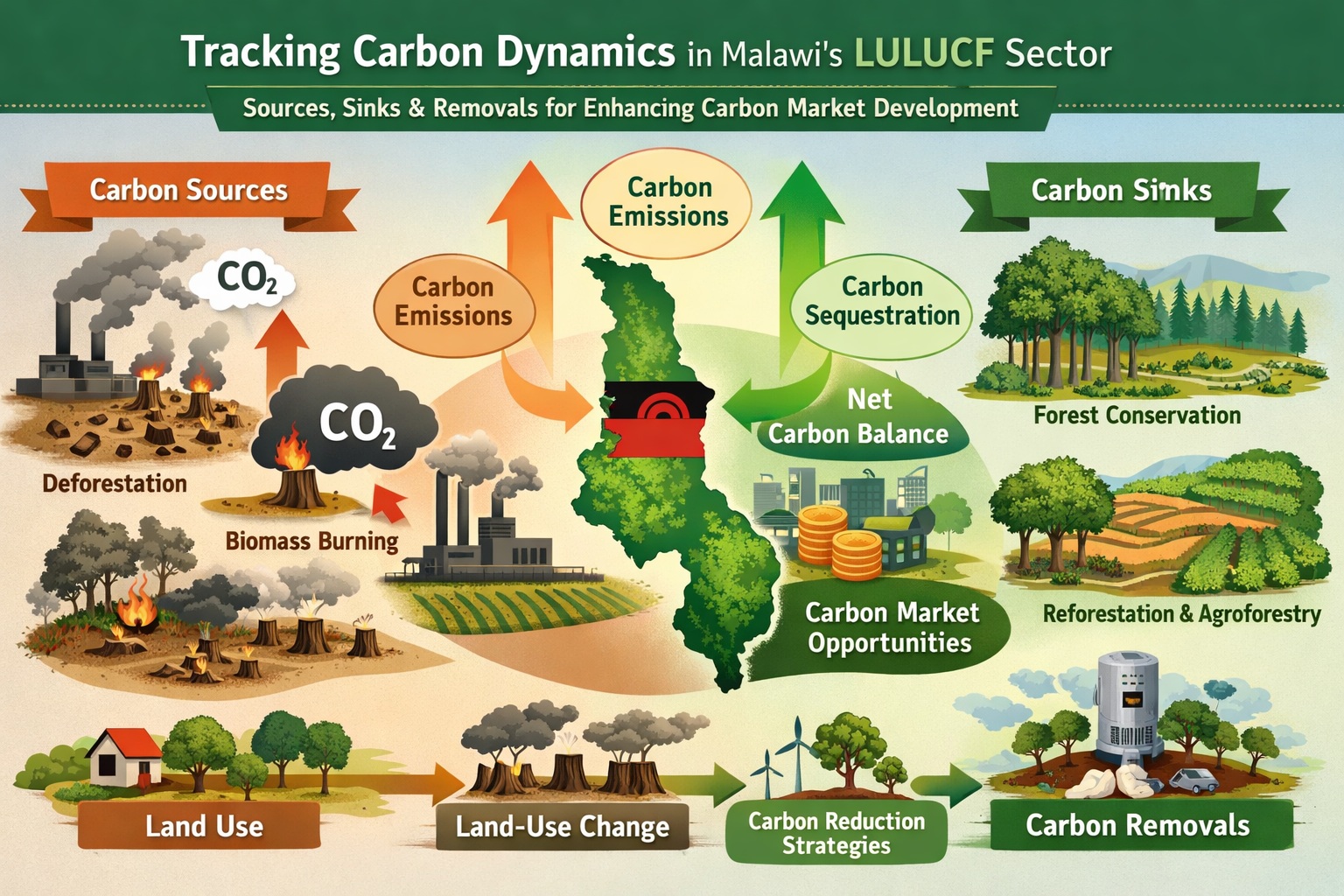
Accurately tracking carbon dynamics by sources, sinks, and removals in Malawi’s Land Use, Land-Use Change, and Forestry (LULUCF) sector is critical for understanding the country’s contribution to global greenhouse gas (GHG) balances and for guiding effective climate policy. A study was conducted to track carbon dynamics by sources, sinks, and removals in Malawi’s LULUCF sector for the period 2018-2022 to enhance carbon market development. Carbon Stock Change Approach following the Intergovernmental Panel on Climate Change (IPCC) guidelines were employed. The approach integrated forest inventory data, and Earth Observations from Sentinel-2 Multispectral Imager and ALOS-PALSAR-1. Activity datasets were categorised into land classification schema sources of, Forestland, Cropland, Grassland, Wetland, and Settlement. Monte Carlo uncertainty analysis at a 95% confidence level was applied to assess data reliability and estimate uncertainties in emissions and removals. The results revealed that total emissions from the LULUCF sector declined by 10.29%, primarily due to reduced deforestation rates and increased forest regrowth. Forestland contributed the largest proportion of emissions (79.08%), followed by cropland (9.70%) and wetlands (8.50%). In contrast, the Grassland and Settlement categories contributed the lowest, 2.60% and 0.12%, respectively. Forest conversion to other land uses decreased, while natural regeneration and afforestation initiatives enhanced carbon removals. The overall uncertainty level was low, 4.16%. This greatly enhances Malawi’s ability to participate in carbon markets, report transparently under climate conventions, and attract climate finance with reduced risk. Finally, the study also contributes to Malawi’s first biennial transparency report (BTR1) and fourth national communication (NC4) to the United Nations framework convention on climate change under the Paris agreement.
Keywords:
LULUCF
; greenhouse gas
; sinks and sources
; removals
; pathways
; carbon market
Copyright: This open access article is published under a Creative Commons CC BY 4.0 license, which permit the free download, distribution, and reuse, provided that the author and preprint are cited in any reuse.


