

Submitted:
12 April 2023
Posted:
13 April 2023
You are already at the latest version
Abstract
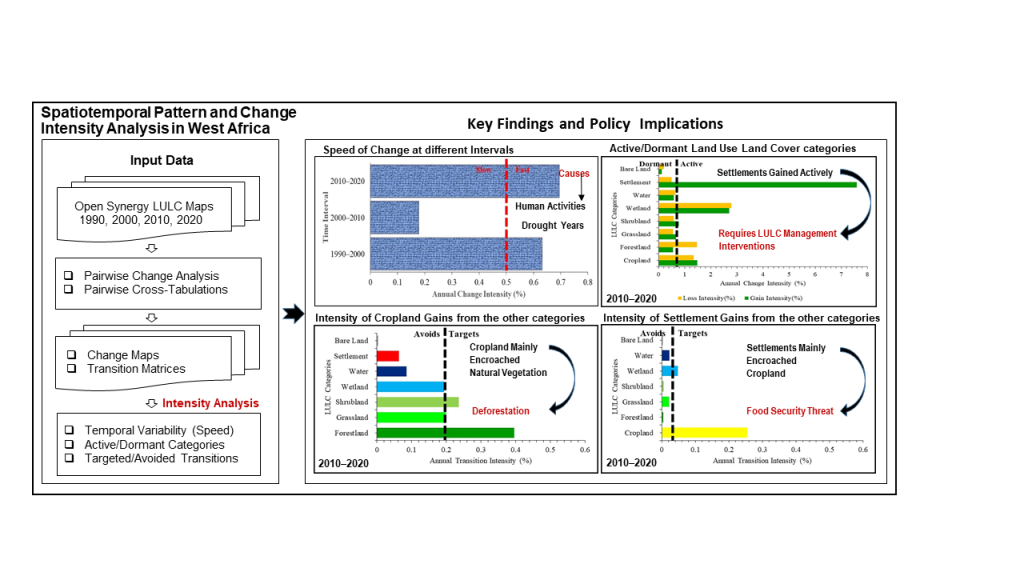
Land Use /Land Cover (LULC) change is a major global concern and a topic of scientific debate. In West Africa, the key among the past changes is the loss of natural vegetation related to changes in different Land Use/Land Cover (LULC) categories, e.g., water bodies, wetland and bare soil. However, not all detected changes in these LULC categories are relevant for LULC change management intervention in a resource-constrained continent, as a massive change in the dominant LULC types may be due to errors in the LULC maps. Previous LULC change analysis detected large discrepancies in the existing LULC maps in the Africa continent. Here we applied an open and synergistic framework to update and improve the existing LULC maps at every five years intervals from 1990 to 2020 in West Africa at a finer spatial resolution of 30m. Next, we detected spatial temporal pattern in past and present LULC changes with the intensity analysis framework in the periods of 1990–2000, 2000–2010, and 2010–2020. A faster annual rate of overall transition was detected in 1990–2000 (first period) and 2010–2020 (recent period) than in 2000–2010 (middle). We observed consistent gains in rangeland (shrubland and grassland) in all the periods, which confirms the observed re-greening of rangeland in the West Africa continent. By contrast, forestland areas experienced consistent losses for the entire periods, which indicate deforestation and degradation. As regards cropland, a net loss was observed in the drought period and net gains in the subsequent periods. The settlement category also gained actively in all periods. Net losses of wetland and bare land categories were also observed in all the periods. We observed net gains in water bodies in 1990–2000 and net losses in the last period. We highlighted the active forestland losses as systematic and hence a clarion call for an intervention. The simultaneous active gross loss and gain intensity of cropland raises food security concern and must send an early warning signal to policy makers that the food security of marginal geographic locations is under threat despite the massive expansion of cropland observed in this study area. The intensity analysis framework was vital to identify the settlement category as relevant for LULC change management intervention across time and space in West Africa instead of focusing on dynamics of all the LULC categories that may be irrelevant and hence a cost effective LULC change management approach. Policies to control the expansion of settlements will indirectly regulate the expansion of cropland field because we observed that as settlement encroached on cropland, simultaneously cropland encroached on natural vegetation to meet the food security requirements of the inhabitants.
Keywords:
Natural Vegetation
; Intensity Analysis
; Spatial Patterns
; Systematic Transitions
; Random Transitions
; West Africa
1. Introduction
The normal functioning of the global earth system has been altered in recent years by the abrupt and systematic changes of its various components [1,2]. The impacts of the current anthropic activities on the earth system are multiple and widespread. Land Use/Land Cover (LULC) change is a reliable indicator of the combined impacts of climate and anthropic activities on the Earth system [3,4]. The severe drought of the 1970s and the 1980s in Africa is a classic example of how climate and anthropic activities may threaten natural vegetation growth, water bodies and other natural resources with subsequent impacts on food security, economic livelihood and social wellbeing of the people [5,6,7,8].
Primarily, the investigations into the complex interactions between human and the LULC system are often centered on understanding the patterns and processes of LULC changes at different spatial-temporal scales. Such investigations are necessary to understand the mechanism of change and serve as a major pathway to predict the possible rate of change in the future. They are also useful for developing and implementing policies in response to changes at different spatial scales [9].
In LULC change analysis, it is important to understand whether the detected changes are related to large fractional abundance or size of the categories at the initial period or to understand whether transitions are more likely for a particular category [9,10,11]. Supposing the changes in a given category are non-uniform (systematic), it is crucial to understand how the area covered by a category (i.e. its size), the rate of change, and the gross losses and gains of that category vary over time. Aldwaik and Pontius Jr.[9] defined the ratio of change size over the size of the total area where the change occurred as the “change intensity”.
According to Pontius Jr. et al. [12] and Braimoh [11], even a massive transition between the dominant LULC classes in a landscape is likely to be a random process of change, i.e., for example, the gaining LULC categories may replace the losing categories proportionally to the initial abundance. Any deviation from these random processes of change is defined as systematic transitions. Systematic LULC transitions are such that a given LULC category preferentially avoids or targets some specific and unique developmental LULC categories for transitions. Understanding these mechanisms may offer useful information about the active and dormant categories, i.e., categories with change intensities above or below the uniform intensity line respectively. The information about the “dormant” and “active” transitions is useful to characterize spatial patterns and processes in the LULC transitions [9]. The characterization of these signals is critical for land managers to target management interventions towards actively changing LULC categories, instead of focusing on complex dynamic processes that may be cost intensive. This is crucial in a resource constrained countries as in the case of West Africa [9,13,14,15,16,17,18,19,20].
Basically, “dormant” transition means that the changes observed for a given category e.g., natural vegetation was less than expected based on the initial size. Whilst “active” transition means the changes observed for e.g., natural vegetation were more than the expected changes based on the initial size [9]. In addition, when the ultimate goal of LULC transitions analysis is to model the underlying drivers, it is crucial to understand whether the pattern and processes leading to the observed transitions are stationary across time and space. Essentially, the stationarity here means that the detected pattern of change at one time interval is the same as the pattern of change in a different time interval [21]. Aldwaik and Pontius Jr. [9] defined stationarity to mean that the intensity of a category’s gain/loss is either greater or less than the uniform line for all intervals. Here, if the intensities for all the time intervals reside on one side, i.e., either above or below the uniform intensity line, then the change is considered as stationary.
Despite the growing number of LULC change analyses at different spatial scales in West Africa and the entire continent at large, there are still gaps in the initial characterization of the change process [22,23,24]. Thus, issues such as variation in the change pattern at different moments in time, among the categories, and across the different transitions remained unanswered. Understanding how the intensity of a category’s transitions varies across the other categories is of a paramount importance in land use change management, as large transitions do not necessarily mean that the landscape systematically changed to require LULC change management interventions [9].
Detailed analyses of spatial patterns from a transition matrix produced from a cross tabulation of two or more LULC maps at a given moment is required to characterize the spatial pattern and processes within and across the categories to interpret the temporal changes. A transition matrix contains vast information that can be useful if properly mined. It forms the basis of many LULC change analyses. The logic of it will be illustrated in detail in the methodology section, while other literature provides a broad background [25,26,27,28,29]. According to Aldwaik and Pontius Jr. (2012) [9], some important signals such as systematic and random transitions or uniform processes at different points in time cannot be captured by a simple direct comparison of the entries in the transition matrix but in- depth analysis of these matrices can unravel the key change processes [22,23,24].
Based on the entries in a transition matrix, Pontius Jr. et al. [12] proposed a method to analyze LULC transitions with respect to the size of the LULC categories to identify systematic signals of transitions. This approach has been advanced by Aldwaik and Pontius Jr. [9] to offer an accounting framework (“intensity analysis”) for linking the detected LULC patterns with the underlying processes that cause the transitions and to understand environmental change in different time intervals. The intensity analysis approach by Aldwaik and Pontius Jr. [9] analyzes LULC transitions at three levels, i.e., interval (examines the variation in changes between different periods), category (examines variation in changes between different LULC categories) and transition (examines variation in changes between different LULC transitions). Thus, at the interval level, the total change in each time interval is analyzed to examine how the size and annual rate of change vary across time intervals. The category level measures how the size and intensity of both gross losses and gross gains vary across space. The transition level examines a particular transition to understand how the size and intensity of the transition varies among categories available for that transition. This level of analysis can pinpoint the categories that are intensively avoided or targeted for a transition when a given category loses or gains.
The major strength of the intensity analysis approach is that it makes transitions at different points in time comparable by taking into account the duration of the intervals. This approach can provide a simple explanation of differences in magnitude of a specific transition, e.g., natural vegetation to cropland, in two or more time intervals. In addition, in some instances, detected LULC transitions may be affected by errors in the datasets, especially if the magnitude of the error is greater than the detected transition. Intensity analysis concept addresses this major issue by estimating an error matrix along with the intensity of the LULC transitions [15,30].
The intensity analysis technique facilitates also the detection of stable transitions, i.e., stationarity of the changes over the time intervals, across categories and among transitions. Intensity analysis reveals information that gives the foundation to interpret correctly the estimated transitions. Intensity analysis links LULC patterns and processes with underlying drivers and helps to understand the mechanisms of change. This is necessary in examining the complex interaction between human activities and the environment at different levels of spatial aggregations [31,32,33].
Apart from the research gaps in characterizing the long-term patterns and processes of LULC Change in Africa, other challenges in the study of LULC change and the driving mechanisms in Africa are the lack of synthesis assessment, the deficiency of long term and finer resolution monitoring datasets and the inadequate focus on the dynamic process [34]. Although, an array of studies on LULC change have been conducted at different scales in the past decades, inconsistent conclusions often appeared in different studies which can be attributed to data gaps, shortage of integrated investigations and assessment over the whole region [35].
According to our global survey, there are existing long-term LULC maps over the Africa continent. Some of these LULC data are ; the Global land cover 30 m[36], Finer Resolution Observation and Monitoring of Global Land Cover (FROM_GLC) data and LULC maps ( https://doi.org/10.5067/MODIS/MCD12Q1.006) produced from Moderate-Resolution Imaging Spetroradiometre), MERIS (Medium Resolution Imaging Radiometer (MODIS) [37], European Space Agency Climate Change Initiative (ESA_CCI) LULC data (http://maps.elie.ucl.ac.be/CCI/viewer/download/ESACCI-LC-QuickUserGuide-LC-Maps_v2-0-7.pdf of the datasets), and recently Copernicus Sentinel data [38].
However, the classification accuracy and the inconsistency between different products hinder the spatially explicit monitoring of the patterns and processes underlying LULC change in Africa. The existing LULC products are usually at relatively low spatial resolution (300-2000m) and insufficient for detailed analysis of past and present patterns and processes in LULC change over the continent [39]. Some high spatial resolution LULC datasets are available but are not up to date, i.e., they are limited to specific regions and periods (e.g., European Space Agency (ESA) 20m) and hence can partly capture the LULC dynamics on the continent.
The Landsat series satellite imagery provide continuous global observations with a spatial resolution at 30m since 1980s, which is valuable for studying the patterns and processes, i.e., spatiotemporal configuration of LULC change over the African continent [40,41]. Comprehensive LULC monitoring is prerequisite for understanding the driving mechanisms and environmental impact. To conduct long-term LULC research, it is essential to produce LULC products at regular intervals [37,38]. Here, we used updated finer resolution LULC maps developed from synergistic fusion of historical Landsat imageries, existing multi-source LULC data and very high resolutions satellite imagery in google earth engine cloud computing platform to characterize the patterns and process in the past and present LULC change from 1990 to 2020 in West Africa
The specific aims of the research were to apply the intensity analysis framework by Aldwaik and Pontius Jr. (2012) [9] to:
- 1)
- Identify the time intervals with the slowest and fastest annual rate of change.
- 2)
- Identify the LULC categories that were relatively dormant or active in a given interval, i.e., to examine the LULC categories that gained/lost more or less than expected.
- 3)
- Examine the LULC categories that were avoided or targeted by a given LULC category for a transition in a given interval.
We detected LULC changes in three intervals (1990-2000, 2000-2010 and 2010-2020). Further, we estimated and compared the variability of the rate of change by category and the temporal variability of gains and losses in these periods.
2. Materials and Methods
2.1. Study Area
The study was undertaken in western part of Sub-Saharan Africa. The area is located between 4°N-18°W (lower left) and 18°N-24°E (upper right) (see Figure 1). The total size of the area covered by this study was nearly 8x10⁶ km2, which is about a quarter of the total size of Africa. The sub-continent is characterized by five broad bioclimatic zones (Saharan, Sahelian, Sudanian, Guinean, and Guineo-Congolian) as a result of the distinctive variation in the rainfall pattern and the vegetation [42].The research article by Asenso Barnieh et al. [22] gives a comprehensive account of the study area (West Africa).
2.2. Datasets
The LULC datasets were produced by Zhao et al [43] of Tsinghua University and some of the authors of the current manuscript. To produce the datasets, we developed and applied an open and synergistic framework to combine multiple thematic LULC datasets (e.g., European Space Agency Climate Change Initiative (ESA_CCI)[44], Finer Resolution Observation and Monitoring of Global Land Cover (FROM_GLC)) [40] and other EO LULC data available in Google Earth Engine (GEE) cloud-computing platform). The open and synergistic framework combines information from supervised land cover classification of finer resolution satellite imagery and LULC information aggregated from existing multiple thematic LULC maps and other LULC information in (GEE) cloud computing platform. Here, 30m Landsat surface reflectance dataset, the Shuttle Radar Topography Mission (SRTM) digital elevation model (DEM), ESA-CCI land cover maps, and three recent single-type land cover datasets (Global Artificial Impervious Area (GAIA)[45], GLAD Forest [46], JRC Global Surface Water (JRC_GSW) [47]) were the main input datasets for the supervised LULC classification.
The outputs were nine major land cover types, i.e., cropland, forest, shrubland, grassland water, wetland, tundra, impervious surface and bare land (See Figure 1). The major algorithm for the classification of these datasets was the Random Forest Classifier, followed by estimation of class probabilities. Cross validation of samples was undertaken to measure the accuracy of the classification. The dataset was further improved by applying a spatial temporal consistency model known as “Markov a Posterior Random Fields (MAP-MRF”). The overall accuracy of the maps was about 75% [43].
The temporal coverage of the final dataset from 1990 to 2020 covered the whole globe. The datasets from 2011 to 2020 can be obtained from the GEE platform by using the image collection snippet; projects/ee-fgp-annual-4/assets/fgp-annual30_2011-2020. The datasets from the year 1990 to 2020 covering only the Sahel-Sudano Guinean region in Africa (0° and 30°N) are available at https://doi.org/10.11888/Terre.tpdc.272021. The analysis in this paper is restricted to the western part of Africa ( 4°N-18°N and 18°W-24°E ) to make the results comparable to LULC transitions analysis in our previous study [22]. The datasets were generated at five years intervals. The analysis in this paper was conducted at ten years (decade) intervals to minimize spurious changes and inter-annual variability that may be introduced by residual noise in the input time series. The subsequent sections of this paper and the article by Zhao et al [43] give details of the entire process for the development of the LULC data.
2.3. Re-classification of the Multi-Source LULC Data
To develop the long term historical LULC dataset, the open synergistic framework with improved validation procedure was applied to fuse LULC information from supervised land cover classification of historical Landsat imagery, other finer resolution satellite imagery in GEE and reclassifying of existing LULC data in Africa [43]. The exiting LULC data were acquired from multi-sources, i.e., ESA-CCI-LULC[44], FROM_GLC[40] and, single cover LULC maps, e.g., forest cover [46], Global Artificial Impervious Area (GAIA) [45] and JRC Global Surface Water [47]. The open synergistic framework has three major steps. Namely; LULC change detection with the exiting LULC maps to detect disagreement in the data for quality improvement, new LULC classification with historical Landsat archives and other finer resolutions EO data in GEE and finally, fusion of the information from the existing LULC maps and classified Landsat imagery by data aggregation and mosaicking [43].
2.3.1. Land Use Land Cover Change Detection
We compared the spatial locations of existing LULC data to detect disagreement in terms of spatial locations, which is an indication of possible errors in the multi-source LULC data. The major input data for this analysis was the ESA_CCI LULC maps [44]. The ESA_CCI LULC maps of 17classes were aggregated into only nine LULC types, i.e., cropland, forest, shrubland, grassland, water, wetland, tundra, impervious surface and bare land) by grouping similar LULC types into the same categories (see Table 1). Only eight of these LULC types, i.e., all the LULC types excluding tundra were present within the study area in West Africa.
The rationale of the aggregation was to harmonize the classification scheme of FROM-GLC with the ESA-CCI LULC maps. A change detection algorithm was applied to two LULC map pairs in the two different sources of data for a given year. Thus, the ESA-CCI-LULC maps over 6 years (1992, 1995, 2000, 2005, 2010, and 2015) were compared with the corresponding LULC maps in the FROM-GLC LULC maps by considering two LULC maps adjacent in terms of years ( i.e., 1992 to 1995, 1995 to 2000, 2000 to 2005, 2005 to 2010, 2010 to 2015). The LULC change locations were used as a mask for the subsequent analysis. Another change detection was also conducted with the GAIA datasets over 40 years at six time-intervals (1992–1995, 1995–2000, 2000–2005, 2005–2010, and 2010–2015). The change locations detected by the ESA_CCI data were combined with the LULC change locations detected by GAIA data to produce the final LULC change areas, i.e., disagreement between datasets.
2.3.2. Development of a new Land Cover Classification
The LULC cover maps over 40 years at 5 years intervals at 30m spatial resolution were generated by applying parallel/distributed computing techniques and machine learning algorithms. To generate the LULC maps, training samples were created with the ecoregion’s layer of the continent to train the classifier [48]. A fish net of 10x10 grid size was created. The area of the 14 biomes in each grid cell was estimated. The grids were categorized into groups based on the biome with the largest fractional abundance in each grid. Based on that, 12 training regions were obtained for the entire globe. Figure 2 of the article published by Zhao et al. [43] displayed the results for the 12 training regions, and the names of the corresponding biomes for each of the 12 training regions are also shown in Table 3 of the same article[43].
Next, the training region boundaries based on the eco-region layer [48] were used to filter the training samples. Variable percentage of the training samples were defined for different LULC types to reduce the samples and to ensure they were evenly distributed in the classification regions. Here, samples in other regions were used to compensate for the LULC with less than 100 samples. This was to ensure the required amount of quantity. Input feature sets were created based on spectra, phenology and terrain properties to delineate different LULC types. All the bands of Landsat imagery, together with Normalized Difference Vegetation Index (NDVI) and Normalized Difference Water Index (MNDWI) were used to calculate the required percentage.
The Landsat observations available each year, i.e., 1990, 1995, 2000, 2005, 2010 and 2015) and in each 5-year periods, i.e., 1988–1992, 1993–1997, 1998–2002, 2003–2007, 2008–2012, and 2013–2017, 2017-2020 were also calculated. We maintained the completeness of the Landsat observations by filling in the missing data gaps by percentiles of the spectra bands that were derived from the 5 year period as the training features. These analyses were performed in the GEE cloud computing platform. Next, the training set and feature sets were used to develop a Random Forest classifier by setting number of trees at 100 to identify the LULC types (cropland, forest, shrubland, grassland, water, wetland, tundra, impervious surface and bare land) in the locations of the LULC changes that were detected in the ESA-CCI datasets in 1990, 1995, 2000, 2005, 2010 and 2015.
2.3.3. Data Aggregation and Mosaicking
After the LULC types at the LULC change locations had been mapped, the classified maps, the FROM_GLC 2017 LULC map and the single-type LULC products, i.e., forest, urban and water bodies respectively for four periods were mosaicked to produce the open synergistic LULC Maps at five years intervals. This procedure ensured spatial and temporal consistency of the land cover types. The outputs were nine major land cover types, i.e., cropland, forest, shrubland, grassland, water, wetland, tundra, urban areas/settlement and bare land) for the entire globe and only eight LULC types in the West Africa sub-continent. The synergistic framework improved the accuracy of the LULC maps by eliminating differences due to misclassification of the individual LULC datasets from multiple sources.
2.4.Validation of the Land Use/ Land Cover Datasets
The validation samples by Li [49]was used to assess the accuracy of the LULC datasets. The results from the accuracy assessments of the six maps were around 75% and the accuracy for change area detection was over 70%. Details of the accuracy assessment of the 2015 map can be referred from Zhao et al. [43].
We assessed the consistencies of the final datasets we used for the analysis which covered only the extent of West Africa (herein referred as WAv2-30 m) with the two major global LULC datasets we used as input data for the synergistic data development, i.e., ESA-CCI-LC [44] and FROM-GLC_250 m [40]. We compared the statistics of the spatial distributions of cropland and forestland areas of the aforementioned datasets against the Food and Agriculture Organization (FAO)’s national level LULC statistics (http://www.fao.org/faostat/en/#data/RL). The LULC maps in the year 2000 were used for this comparison. We estimated the root mean squared error (RMSE) of cropland and forestland areas from each dataset against the national level cropland and forestland statistics provided by the FAO (http://www.fao.org/faostat/en/#data/RL).
When the national level forestland and cropland estimates of the FAOSTATS were merged into a single reference data, the relative RMSE estimates were 112.4%, 70.25, and 54.8% for ESA-CCI-LC, FROM-GLC_250m and WAv2-30 m respectively. This suggests that the LULC datasets we generated from the opened synergistic approach have better agreement with the FAOSTATS. In some cases, the FAOSTATS are also limited in terms of completeness of the national statistics (http://www.fao.org/faostat/en/#data/R). This may partly explain the large relative RMSE we obtained for the LULC data.
2.5. Development of a Transition Matrix
The WAv2 LULC maps from 1990 to 2020 were analyzed for changes in different time intervals, i.e., 1990–2000, 2000–2010 and 2010–2020. The LULC maps in each year pair were cross-tabulated to generate a transition matrix (see Table 2). These matrices had eight LULC categories each, i.e., cropland, forestland, shrubland, grassland, water, wetland, settlement and bare land). The sizes and intensities of changes in these LULC categories were analyzed in terms of interval, category, and transitions, following the intensity analysis framework proposed by Aldwaik and Pontius Jr. [9]. We divided each entry in the transition matrices by the extent of the study area to obtain the fractional abundance of each transition to facilitate the estimation of the uniform change intensities. This conversion was applied to changes in each time interval, specifically, 1990–2000, 2000-2010, 2010–2020) in the case of this study.
2.6. The intensity Analysis Framework
The analyses were based on the mathematical notations and equations developed by Aldwaik and Pontius Jr. [9,18] in an excel spreadsheet which can be obtained free from www.clarku.edu/∼rpontius and the transition matrices we generated (see Table 2). The mathematical notations and equations are listed in Table 3 and Table 4 respectively. We conducted the intensity analysis at three levels (intensity, categories and transition).
Firstly, we calculated the change intensity for each interval and compared the observed rate with the uniform rate that would have occurred if the annual changes were distributed uniformly across the entire time extent. We then identified the time intervals with the slowest and fastest annual rate of change. Secondly, we calculated the intensity of gross losses and gains for each category and compared the results i.e., the observed change intensities with a uniform intensity of annual change that would occur if the changes within each interval were distributed uniformly over the entire spatial extent. The LULC categories that were relatively dormant or active were identified. Thirdly, we calculated the observed intensity of each transition and compared the observed intensity of each transition with a uniform intensity among the categories available for those transitions. The categories that were avoided or targeted by a given category for a transition were identified. We indicated a transition of a category as random when the rate of change was proportional to the initial abundance of a category and systematic when it specifically targeted or avoided a particular category for a transition [9]. Detailed intensity analysis at three levels are explained below:
2.6.1. Identification of the time intervals with the slowest and fastest annual rate of change
To understand the variation in the intensity of change in different time intervals, the annual rate of change on the landscape was estimated for each time interval by applying Equation (1) in Table 4. This facilitated comparison of changes in different periods of time as proposed by Runfola and Pontius Jr. [50]. The Equation (1) takes into account the duration of each interval to give one rate of change per time interval at each level of spatial aggregation. The results from Equation (1) for each time interval were compared with a constant annual rate (uniform change intensity) estimated for all the time intervals combined, i.e., from the initial time point to the final time point of the entire analysis by applying Equation (2). The Equation (2) yields one uniform rate for the entire temporal extent of the study. If in Equation (1) remains unchanged for the entire temporal coverage, will be equalled to U in Equation (2) which is the uniform annual rate. According to Aldwaik and Pontius Jr. [9] , this logic holds for the analysis at all the other levels of intensity analysis. The annual rate of change for a given interval is considered slow if it is lower than the uniform rate and fast when higher than the uniform annual rate U obtained by Equation (2).
2.6.2. Identification of the LULC categories that were relatively dormant or active
The intensities of annual gross losses and gains in each category at each time interval were analyzed to understand how the magnitudes of loss and gain intensities varied across space and time. These were calculated for each category in each time interval by applying Equations (3) and (4) respectively and the outputs were compared with the uniform intensity of annual change in each time interval (t), i.e., the value obtained by applying Equation (1). This information was crucial to understand which category was relatively dormant or active in a given interval. Here, there is a linkage between the interval and category level analysis. In Equations (3) and (1), =, when equal gains are obtained for all the. Similarly, in Equations (4) and (1), = when equal losses are obtained for all. Annual loss or gain intensity below the estimated uniform change intensity for a given category indicates a relatively dormant category. Likewise, annual loss or gain intensity above the estimated uniform change intensity for a given category indicates a relatively active category. This analysis was essential to detect stable patterns in the annual loss and gain intensity for each category.
2.6.3. Examination of the LULC categories that were avoided or targeted for transitions
To determine which transition was relatively intensive in a given interval, each transition, e.g., forestland transition to cropland was analyzed to understand the variation in magnitude and intensity. The patterns of gains and losses of the categories n and m respectively were analyzed (see Table 3 for description of notations n and m). The observed intensities of each transition were compared with the uniform intensity, i.e., the average over all transitions.
The transition intensity level of analysis yields two sets of outputs. One output is gains of category n from other categories and another is the loss of category m to other categories. Taking for instance, the pattern of gain of category n, the analysis was essential, e.g., to identify why the transition from natural vegetation to cropland was larger than the mean magnitude of cropland gains. Aldwaik and Pontius Jr. [9] attributed such transitions to the fact that natural vegetation area at the initial time may be larger than the other categories and hence if cropland gain was distributed proportionally across the landscape, more natural vegetation areas may transition to cropland than to any other category. Another explanation offered by Aldwaik and Pontius Jr. [9] was that cropland gains might systematically target natural vegetation rather than the other LULC types.
Therefore, based on the estimated gross gain of category n, Equation (5) and (6) were applied to understand whether the gains in the individual categories, in particular, natural vegetation were due to a random or a systematic process. The analysis provided more information about the categories which were intensively avoided or targeted by category n for transitions in a given time interval. Based on the observed gross gain of category n, Equation (5) yields a single result for each time interval t that is the uniform intensity of transitions to category n, i.e., the mean gain of category n across the landscape. The in Equation (5) will be equalled to in Equation (6) for all, when the gains in n were distributed uniformly across the landscape, i.e., under a random process of gain. The observed intensities of the transitions from category to category for all categories were determined by Equation (6). This yielded a single result for each category per time interval. Here, it must be noted that category n could only gain from categories that were not n at the initial time interval and therefore if the gains in category n were uniform across the landscape, that means the gains in category n is proportional to the initial extent of those other categories. The transition from category m to category n is stationary if category n either targets or avoids m in all the time intervals.
The loss intensity for each category was estimated with Equations (7) and (8) based on the estimated gross loss of category m. This analysis revealed the other categories that systematically avoided or targeted losing to category m. Here, the assumption was that it was impossible for category m to lose at the location it occupied at the end of the time interval. The Equation (7) yielded the uniform intensity of the transitions from category m to all other categories for a given interval. The output from Equation (8) is the intensity of the transition from category m to category j for all the nonm categories for each time interval. for all j if the loss in category m to the other categories was uniform. The intensities in all the time intervals were examined to identify stable (stationary) transitions. Based on the losses of category m, a transition was considered stationary when category m is either avoided by category n for all the time intervals or targeted by category n for all the time intervals. The intensity analysis at the transition level presented in this section differs from Markov transition analysis as the proportion of each LULC transition in a Markov matrix is estimated by Equation (9).
3. Results
3.1. Identification of the time intervals with the slowest and fastest annual rate of change
The highest annual rate of change (0.69%) was observed in 2010–2020, followed by 1990–2000 (0.63%). The lowest annual rate of change intensity was observed in 2000–2010, i.e. 0.18%, which was below the mean annual rate change, thus indicating a slower process of change during this period (see Figure 2).
3.2. Identification of the LULC categories that were relatively dormant or active in a given interval
At the category level, settlement, cropland and wetland both gained and lost actively in 1990–2000. Water bodies actively gained in extent, while the loss intensity was dormant in the same period. During 2000-2010, cropland, grassland, shrubland and settlement actively gained in extent. The remaining LULC were dormant in gaining, while forestland and wetlands showed some active losses. During 2010–2020, cropland, settlements and shrubland actively gained, while some wetlands actively gained in extent in some areas and actively lost in other areas. The extent of the remaining LULC categories did not change significantly during this period, as they were dormant in gaining and losing at the same time. Settlements showed the highest annual gain intensity, i.e., 5.53%, 2.60% and 7.60% respectively in .1990–2000, 2000–2010 and 2010–2020 (Figure 3 and Figure 4).
During the three periods, settlements and cropland were active gainers whilst bare land and forestland were dormant. The gain intensities of these four LULC categories were stationary. The annual gain intensities of the remaining LULC categories were not stationary. As regards losses, only wetlands was an active loser throughout the entire periods, i.e., stationary. All the other LULC categories were either active losers or dormant losers in one or more periods, i.e., non-stationary (see Figure 3 and Figure 4).
The two LULC maps in Figure 1 compare the initial situation in 1990 (a) with 2020 (b) in West Africa. Figure 4 shows the loss and gain intensities of the various LULC categories every 10 years. The sum of the loss and gain intensities, with sign, of each category gives a decadal net change (%). For the entire period (1990–2020), the net change was negative (loss) for forestland, wetland and bare land. The net change was positive (gain) for the remaining categories, i.e. cropland, settlement, shrubland and grassland (Table 5). The net gains in rangeland, i.e. shrubland and grassland, are of a paramount importance as previous studies [22,23,24] on the continent detected consistent losses in natural vegetation categories except herbaceous vegetation. Figure 5 shows the locations of natural vegetation gains (greening/new growth) for 1990–2020 in West Africa.
We observed that almost all the categories gained and lost simultaneously (Figure 3 and Figure 4). As regards the net change in 1990–2000, 2000–2010, and 2010–2020, forestland, bare land, wetland had net losses. The net change was a gain for all the remaining LULC categories, except cropland, which had a net loss in 1990–2000. For 2000–2010, gains recorded by cropland, grassland, shrubland and settlements. The remaining categories, i.e. wetlands, water bodies, forestland and bare land experienced losses. The entire period (1990–2020) saw expansion of water bodies accompanied by vegetation (shrubland, grassland) recovery (Figure 1 and Figure 5).
3.3. Examination of the LULC categories that were avoided or targeted for a transitions
As regards the fractional abundance of transitions, the focus was on the gaining categories. More importantly natural vegetation, i.e. grassland and shrubland gains from the remaining LULC categories. Previous LULC change analysis in West Africa revealed consistent losses in natural vegetation areas [22,23,24]. We also focused on settlement and cropland gains from the remaining categories, as they were active in all the three periods. Figure 6 shows concurrent losses and gains of the LULC categories in West Africa through time. Figures 7 through 10 illustrate the annual transition intensities of the major LULC categories. The annual transition intensity for each major gaining category is expressed as % of the initial size of the losing category involved in the transition. Likewise, the annual transition intensity for each major losing category is expressed as % of the final size of the gaining category involved in the transition. Details of the specific transitions are presented in the subsequent sections.
3.3.1. Shrubland, Grassland, Cropland and Settlement Gains
Shrubland targeted gaining from cropland and forestland only in 1990–2000 and 2010–2020. In the former period, the annual shrubland gains from cropland and forestland were 0.64% and 0.47% respectively. These gains were above the uniform annual transition rate of 0.27%. In 2000–2010, shrubland targeted gaining from forestland (0.27%) and wetland (0.23%). These annual rates of change were above the uniform annual rate of transition, i.e. 0.1%. In the last period, approximately 0.55% and 0.82% of the gains in shrubland were due to encroachment on cropland and forestland respectively. The uniform transition rate for this period was 0.30% (Figure 7).
Grasslands mainly replaced wetland (0.66%), settlement (0.56%), cropland (0.46%) and bare land (0.26%) in the first period, i.e., 1990–2000. These amounts were above the uniform annual rates of transitions (0.24%) for that period. In the period 2000–2010, only wetlands (0.25%), bare land (0.22%) and water bodies (0.11%) lost in extent to grasslands. These annual rates of change were above the uniform annual transition rate (0.08%). In the last period, i.e., 2010–2020, wetland (0.84%), cropland (0.46%), settlement (0.31%), water bodies (0.25%) and bare land (0.24%), targeted losing in extent to grassland. The uniform annual rate of transition for this period was 0.24% (Figure 8).
Settlements gained significantly during all the periods (Figure 9). In 1990–2000, these annual gains were at the expense of cropland (0.03%), grasslands (0.006%) and wetlands (0.009%). Similarly, in 2000–2010, cropland (0.015%), grassland (0.0035%) and wetlands (0.0085%) were targeted for transitions by settlement. The remaining categories were avoided for transitions by settlements. In 2010–2020, settlement targeting gaining from cropland (0.25%) and wetland (0.05%) only. The uniform annual transition rates were 0.005%, 0.0032% and 0.04% for 1990–2000, 2000–2010 and 2010–2020 respectively.
During 1990–2000 in West Africa, cropland targeted gaining from grassland (0.21%), shrubland (0.21%), wetland (0.20%) and settlement (0.05%) annually. The remaining LULC categories were avoided for replacement by cropland. In 2000–2010, the annual gains in cropland were mainly at the expense of wetland (0.16%), forestland (0.13%) and grassland (0.04%). In 2010–2020, shrubland (0.24%) was also targeted for transitions in addition to grassland (0.2%), wetland (0.193%) and forestland (0.04%). The uniform annual transition rates were 0.15%, 0.04% and 0.19% for 1990–2000, 2000–2010 and 2010–2020 respectively (Figure 10).
3.3.2. Forestland, Wetland, Water Bodies and Bare land Losses
Overall, in 1990–2000, the losses in forestland were mainly due to encroachment by wetland (0.76%), shrubland (0.23%), water bodies (0.18%), settlements (0.18%) and cropland (0.15%). In 2000–2010, forestland targeted losing in extent to cropland (0.16%), shrubland (0.13%) and settlements (0.11%), against a uniform rate of transition of about 0.08%. In 2010–2020, forestland was targeted for encroachment by wetland (0.69%), cropland (0.44%), and shrubland (0.37%).
In 1990–2000 wetlands targeted losing in an extent to water bodies (0.09%), settlements (0.005%), and forestland (0.002%). In 2000–2010, wetlands targeting losing to water bodies (0.007%), settlement (0.003%), forestland (0.0015%) and cropland (0.0007%). In 2010–2020, wetlands lost to water bodies (0.08%), settlement (0.004%), forestland (0. 003%) and grassland (0.001%).
Likewise, in 1990–2000, water bodies targeted losing to settlements (0.1%), wetland (0.062%), forestland (0.01%), cropland (0.0035%) and grassland (0.00313%), against a uniform annual rate of transition of about 0.0023%. However, in 2000–2010, only wetlands (0.04%), grassland (0.002) and settlement (0.0012%) targeted water bodies for transitions. These annual transitions rates were above the uniform annual transition rates of 0.00063%. In 2020– 2020, water bodies targeted losing in an extent to wetlands (1.064%), settlements (0.021%), forestland (0.0063%), grassland (0.0043%) and cropland (0.0034%). These annual transition rates were above the uniform annual transition rate (0.0029%).
In the case of bare land, losses were mainly due to an encroachment by grassland and settlement. The annual transition rates of bare land to settlements were (0.27%), (0.36%) and (0.15%) in 1990–2000, 2000–2010 and 2010–2020 respectively. In the same periods, the annual transition rates of bare land to grassland were 0.27%, 0.18% and 0.16% respectively, which were higher than the uniform annual rates of transitions, i.e. 0.09%, 0.07% and 0.06% respectively.
4. Discussion
4.1. Identification the time intervals with the slowest and fastest annual rate of change
The study took into an account the duration of the different time intervals and examined the sizes and intensities of LULC change to carry out a detailed analysis of stationarity of the observed transitions. At the interval level, we detected a faster annual rate of total change in the period of 1990–2000 and 2010–2020. We linked our findings with the coupling of the severe drought and human activities, e.g., the expansion of artificial water bodies to meet irrigational requirements. We observed gains in the area extent covered by water bodies despite the preceding drought years and the massive concurrent expansion of settlements in parallel with croplands in recent period (2010–2020).
The concurrent losses and gains of the LULC categories, we detected at the category level of our analysis may also explain the reason why we detected a faster annual rate of total change in the period of 1990–2000 and 2010–2020 at the interval level in West Africa. Thus, a deeper analysis at the category level revealed more changes in the periods of 1990–2000 and 2010–2020., i.e., we observed both active losing and gaining intensities for categories hypothesized to be dormant losers and active gainers. For example, in reality, the category of settlement is a dormant loser, active gainer and a persistence category in different period. However, here, we observed that in different regions, the settlement category was both an active gainer and a loser during the period in 1990–2000, i.e., soon after the severe drought spells. The category of settlement losing actively in the aforementioned periods could be linked with possible errors in the datasets, as the accuracies of the LULC data we used for the analysis was not 100%. The overall accuracy of the LULC datasets was about 75% [43].
We attributed these findings to the fact that farmers in West Africa's rural areas live very close to farmlands, forest and other vegetation areas. It is common to mix up the RS mapping of small thatch settlements, croplands, forests and other vegetation [51]. Therefore, the deviation of the settlement loss from the uniform intensity might be partly due to systematic errors in the LULC datasets.
This confirms the explanation by Aldwaik and Pontius Jr. (2013) [15] that errors in the LULC categories may influence the results from the transition analysis. The results from this analysis are in agreement with the LULC analysis we conducted with the USGS LULC maps at three time periods (1975–2000, 2000–2013 and1975–2013 ) in West Africa [52]. In the aforementioned previous study[52], we observed larger categorical exchange between the LULC categories in the drought period (1975–2000) than the period between 2000 and 2013.
4.2. Identification of the LULC categories that were relatively dormant or active in a given interval
The results revealed settlement, cropland, forestland and wetland categories as the major active categories. At the initial stage (1990) of the LULC transition (1990–2000 and 2000–2010, 2010–2020) analyses, shrubland and grassland constituted a greater proportion of the total land area in the study area. Therefore, if changes were distributed uniformly across the landscape, shrubland and grassland were expected to lose more than any other category. Nevertheless, the intensity analysis revealed that in 1990–2000, shrubland and grassland categories in some regions were dormant losers and in other regions were active gainers. In 2000–2010, both two categories (shrubland and grassland) were slightly active gainers and dormant losers in different periods. In the later interval (2010–2020), grassland was a dormant loser and gainer, whilst shrubland was a dormant loser and a slightly active gainer. Here, the dormancy of grassland and shrubland may be due to their large persistence, which was included in the intensity analysis[9].
The influence of the large dormant categories such as grassland and shrubland in the case of this study on the transitions intensity has been underlined by Aldwaik and Pontius Jr. (2012) [9] and Quan et al. (2019)[16]. According to Aldwaik and Pontius Jr. (2012) [9] and Quan et al. (2019), if for instance, grassland accounts for a larger proportion of the landscape and does not change over time, then its presence in the analysis implies that all the other non-grassland categories will be active than normal [16]. This may indicate that loss or gain of a category at the final stage of a transition could be explained by its largest size at the initial stage and whether the category avoided transition from the remaining categories or it was targeted for a transition. According to Aldwaik and Pontius Jr. (2012) [9], in some instances, a large dormant category plays a minimal role in the total change. A typical example is water body. But then, it is crucial to include water bodies in LULC change analysis in a setting where “humans convert water to land via infill or convert land to water via dams” which is the case in this study area (West Africa) [14].
Aldwaik and Pontius Jr. (2012) [9] recommended that, to minimize the influence of a large dormant category on the intensity analysis, categories which bring a large persistence into the analysis must be eliminated. Shrubland and grassland dormancy in losing may be explained by positive human activities interventions such as famer led natural regeneration initiative and the great green wall policy in West Africa [53]. In addition, we detected transitions of cropland fields into grassland and shrubland, which may also indicate abandonment of some cropland fields in West Africa[54] triggered by the declining food prices and migration of farmers accounted for that [55]. Though we observed net gains in cropland fields in the middle and last periods, this category was involved in large exchange, i.e., both the gross losses and gains were active during the first and last periods (1990–2000 and 2010–2020). The exchange between cropland and the remaining LULC categories was to the extent that net change for this category was negative (net loss) in the first period (1990–2000). The current finding is an exception because net gains have been consistently observed for cropland category by all the previous LULC change analysis over the continent at all the temporal periods of analysis [22,23,24]. The simultaneous active gross loss and gain intensities of cropland fields in 2010–2020 (later period), raises Food Security concerns and must send an early warning signal to policy makers that the Food Security of some marginal geographic locations is under threat despite the massive expansion of cropland observed in this area.
The net gains in the categories of shrubland, grassland and water bodies during the 1990–2020 period confirm the long term contested re-greening in West Africa [53,56,57]. By contrast, previous LULC analyses on the continent revealed net losses in the other vegetation category, i.e., shrubland and grassland in the case of this study [22,23,24]. The differences in temporal resolutions of the LULC datasets we used for this and previous analysis might have accounted for the contrasting results.
With regards the stationarity of the categories, the pattern of gains in the settlement category was consistent throughout the intervals, i.e., the settlement category demonstrated stationarity in actively gaining, whilst the remaining LULC categories depicted un-stationarity. We attributed this finding to population growth and the quest for urban expansion on the continent [58].
4.3. Examination of the LULC categories that were avoided or targeted for transitions
The analyses of the entire transition processes gave a clearer view of the development that led to the massive expansion of cropland in the second and last periods (2000–2010 and 2010–2020), as we observed replacement of shrubland and grassland by cropland. The comprehensive analysis at the transition level revealed that cropland systematically targeted shrubland, grassland, forestland, and wetlands for transitions. This may be attributed to high nutrient values of natural vegetation and wetlands sites to support crop growth. It may also indicate spatial dependence as a given category may tend to replace any neighboring category on the landscape [13]. Therefore, Pontius Jr. (2019) [13] suggested visual examination of the maps to confirm the influence of spatial dependence on transitions among categories. In the case of this study, visual examination of the LULC maps and field analysis suggest that farmers live in close proximity of natural vegetation, e.g., forestland and other vegetation (shrubland, grassland etc.) areas and hence the likelihood of natural vegetation transitions to cropland may increase.
Concurrently, settlements mainly targeted cropland for transitions. Cropland replacement by settlements was one of the observed systematic transitions pronounced on the landscape due in part to the easiness of conversion, i.e., less labor and lower costs involved. In addition, farmers prefer to change unproductive cropland to settlement rather than to transform productive natural vegetation field, which could be used for productive farming into settlements. Huang et al. (2018)[14], also found a large and systematic transition from cropland to settlements which according them, visual examination of the patterns in the maps revealed outward expansion of settlement patches to encroach cropland. In the case of the replacement of forestland by settlement, this may be associated with the fact that urbanization in West Africa is more localized in the forest rich humid areas and as explained by Pontius Jr. (2019) [13] and evidenced by Huang et al. (2018)[14], LULC categories may target the closest neighboring cells for replacement. Cropland targeted natural vegetation for transitions and settlements targeted cropland, which confirms the assertion that urbanization threatens cropland fields.
We observed forestland replacement by shrubland and cropland, which indicates land degradation and deforestation respectively. In the forest rich areas, this may be attributed to the rapid rise in population and economic growth and the quest to fulfil the food security of the people. Simultaneously, we observed isolated gains in the area covered by forestland during1990–2020. Some areas previously covered by shrubland were consistently replaced by forestland at all the temporal scales (1990–2000 and 2000–2010, 2010–2020). This might have been due in part to the implementation of Land Use Management policies such as the farmer managed natural resources rehabilitation program, which saw re-planting of trees on degraded landscape [53].
Though the use of the intensity analysis framework we employed for this analysis (see section 2.6) has not been fully explored to link patterns with process on the African landscape, the results from this analysis is consistent with other LULC change analysis on the continent[22,23,24]. Many of such results suggest that human induced LULC change is accelerating over time as they were all active gainers [22,23,24]. The sizes of the LULC transitions can be seen in the traditional Markov transition matrix. However, deeper examination is required to link patterns with processes as intensity analysis probes the transition matrix to reveal the matrix’s detailed patterns [13].
The influence of class aggregation in the development of the LULC maps on the analysis must be given a careful consideration as 17 LULC types were aggregated into only nine LULC classes [22]. The analysis of original LULC types and aggregated LULC may be sensitivity to aggregation of the category.
5. Conclusion
This study bridged the LULC data gaps by fusing useful information from existing multi-source LULC data with the information from very high-resolution data in GEE cloud-computing platform.This reduced the discrepancies in theLULC datasets and improved on their accuracies. The study is the first attempt to use long term and up to date finer resolution (30m) LULC data in a synergistic approach for LULC change analysis in West Africa. We analyzed the spatial patterns and processes in LULC categories on the landscape of West Africa by using historical LULC data and unified intensity analysis framework at three levels, i.e., interval, category and transition. We detected faster annual rate of transitions in 1990–2000 and 2010–2020 and linked with the severe drought of the 1970s and the 1980s and intensive human activities in recent year. Like the previous LULC transition analysis on the sub-continent, we found simultaneous losses and gains of the LULC categories, which indicate spatial reallocation of the categories. In the case of cropland, both the active loses and gains are a cause of policy concern as the massive gains threaten conservation of natural vegetation whilst the loses as a result of encroachment by the settlement category may threaten the food security of the growing and vulnerable population.
The analysis at the transition level highlighted the dormancy of shrubland and grassland in losing despite being targeted for transition by the actively gaining categories such as cropland. Introduction of some LULC change management policies (REDD+, Farmer Managed Natural Regenerative Initiative and so forth) in the sub-continent might have slowed down loss of rangeland (shrubland and grassland). The net gains in shrubland and grassland (re-greening) were due in part to replanting and on the other hand, degradation of forestland as we observed massive replacement of forestland by shrubland and grassland. We also observed encroachment of the settlement, cropland, water bodies and wetland categories on forestland, which indicate deforestation. Deforestation is often associated with fires that release large amounts of carbon dioxide (CO2) into the atmosphere that may further hinder climate change mitigation on the continent. Additional effort is therefore required to curb forest degradation and deforestation on the sub-continent despite the relative gains of rangeland we observed on this landscape. Geo-spatial land planning and buffer zones are urgently needed to protect pristine forest and other natural resources on the continent.
The results suggest that the LULC transitions in West Africa were not only due to the larger fractional abundance of some categories at the beginning of the transition but also due to systematic targeting by actively gaining LULC categories. Our results indicated that LULC changes on the landscape of West Africa are both systematic, i.e., under the influence of human and random, i.e., driven by natural factors depending on the type of transition.
The study highlighted important signals in the pattern of the LULC transitions and may serve as a foundation to link the observed pattern with explanatory variables to understand the processes underlying the intensive gains of settlements. The current transitions may greatly affect biodiversity, carbon stock enhancement, and food security of the people. Agroforestry, community led land rejuvenation activities, alternative livelihoods and diversification of income may present good opportunities to protect the environment and reduce the susceptibility of the human system to shock. The intensity analysis served as a basis to focus LULC management interventions towards the actively changing categories, e.g., settlements and cropland expansions instead of focusing on the entire dynamic processes that may be cost intensive. The study is the first LULC change analysis to document consistent net relative gains (re-greening) in rangeland in West Africa from 1990 to 2020.
Author Contributions
Conceptualization: B.A.B., L.J., M.M.; L.Y.; E.N.; and A.T.K.B.; data curation: B.A.B.; L.Y.; E.N.; and A.T.K.B.; formal analysis: B.A.B., L.J., M.M.; LY.; E.N.; and A.T.K.B funding acquisition: L.J. and M.M.; investigation: B.A.B., L.J., M.M.; L.Y.; E.N.; and A.T.K.B methodology: B.A.B., L.J., M.M.; LY.; E.N.; and A.T.K.B project administration: L.J. and M.M.; resources: L.J. and M.M.; software: B.A.B.; validation: B.A.B.; visualization: B.A.B.; writing—original draft: B.A.B.; writing—review and editing: B.A.B., L.J., M.M., LY.; E.N.; A.T.K.B ; M.J., J.Z., Y L., Y.Z. and A.B. All authors have read and agreed to the published version of the manuscript.
Funding
This research was jointly funded by the Open Research Program of the International Research Center of Big Data for Sustainable Development Goals (Grant No. CBAS2023ORP05), the Key Collaborative Research Program of the Alliance of International Science Organizations (Grant No. ANSO-CR-KP-2022-02), Natural Science Foundation of China project (Grant No. 41661144022), the Chinese Academy of Sciences President's International Fellowship Initiative (Grant No. 2020VTA0001), the MOST High Level Foreign Expert Program (Grant No. G2022055010L), the Chinese Government Scholarship Council (CSC) (Grant No. 2018SLJ023247) and the Deutscher Akademischer Austauschdienst (DAAD) Climate Research for Alumni and Postdocs in Africa, 2021 (Grant No. 57560641).
Data Availability Statement
The datasets for this analysis is available at https://doi.org/10.11888/Terre.tpdc.272021.
Acknowledgments
Authors are grateful to Pontius Jr. for sharing some useful materials. All the authors wish to express their appreciation for the support provided in many ways by the many staffs of AIR-CAS and Tsinghua University. We also appreciate the contributions by the staffs at EORIC-UENR in Ghana.
Conflicts of Interest
The authors declare no conflict of interest. The funders had no role in the design of the study; in the collection, analyses, or interpretation of data; in the writing of the manuscript; or in the decision to publish the results.
References
- Lambin, E.F.; Geist, H.J.; Lepers, E. Dynamics of land-use and land-cover change in tropical regions. Annu. Rev. Environ. Resour. 2003, 28, 206–216. [CrossRef]
- Turner, A.B.L.; Meyer, W.B.; Skole, D.L. Global Land-Use/Land-Change: Towards an Integrated Study. Integr. Earth Syst. Sci. 2009, 23, 91–95.
- Ehlers, E.; Krafft, T. Earth System Science in the Anthropocene; Ehlers, E., Krafft, T., Eds.; Springer: Berlin Heidelberg, Germany, 2016; Vol. 53; ISBN 9788578110796.
- Steffen, W.; Sanderson, A.; Tyson, P.; Jäger, J.; Matson, P.; Moore III, B.; Oldfield, F.; Oldfield, F.; Department of Geography, University of Liverpool, UK Richardson, K.; Oldfield, F.; et al. Global Change and the Earth System: a Plane under Pressure; Springer: Heidelberg, 2005; ISBN 9783540265948.
- Nicholson, S.E.; Tucker, C.J.; Ba, M.B. Desertification, drought, and surface vegetation: An example from the West African sahel. Bull. Am. Meteorol. Soc. 1998.
- Hulme, M. Climatic perspectives on Sahelian desiccation : 1973 1998. Glob. Environ. Chang. 2001, 11, 19–29.
- Tucker, C.J.; Dregne, H.E.; Newcomb, W.W. Expansion and contraction of the Sahara Desert from 1980 to 1990. Science (80-. ). 1991, 253 (5017), 299−301.
- Nicholson, S.E. Land surface-atmosphere interaction: physical processes and surface changes and their impact. Prog. Phys. Geogr. 1988, 12, 36–65.
- Aldwaik, S.Z.; Pontius, R.G. Intensity analysis to unify measurements of size and stationarity of land changes by interval, category, and transition. Landsc. Urban Plan. 2012, 106, 103–114. [CrossRef]
- Versace, V.L.; Ierodiaconou, D.; Stagnitti, F.; Hamilton, A.J. Appraisal of random and systematic land cover transitions for regional water balance and revegetation strategies. Agric. Ecosyst. Envrionment 2008, 123, 328–336. [CrossRef]
- Braimoh, A.K. Random and systematic land-cover transitions in northern Ghana. Agric. Ecosyst. Environ. 2006, 113, 254–263. [CrossRef]
- Pontius Jr., R.G.; Shusas, E.; McEachern, M. Detecting important categorical land changes while accounting for persistence. Agric. Environ. 2004, 101, 251–268. [CrossRef]
- Pontius Jr., R.G. Component intensities to relate difference by category with difference overall. Int J Appl Earth Obs Geoinf. 2019, 77, 94–99. [CrossRef]
- Huang, B.; Huang, J.; Gilmore, R.; Jr, P.; Tu, Z. Comparison of Intensity Analysis and the land use dynamic degrees to measure land changes outside versus inside the coastal zone of Longhai , China. Ecol. Indic. 2018, 89, 336–347. [CrossRef]
- Aldwaik, S.Z.; Pontius Jr., R.G. Map errors that could account for deviations from a uniform intensity of land change. Int. J. Geogr. Inf. Sci. 2013, 27, 1717–1739. [CrossRef]
- Quan, B.; Pontius Jr., R.G.; Song, H.; Quan, B. Intensity Analysis to communicate land change during three time intervals in two regions of Quanzhou City , China two regions of Quanzhou City , China. GIScience Remote Sens. 2019, 1–16. [CrossRef]
- Akinyemi, F.O.; Pontius Jr., R.G.; Braimoh, A.K. Land change dynamics : insights from Intensity Analysis applied to an African emerging city Land change dynamics : insights from Intensity Analysis. J. Spat. Sci. 2017, 8596, 1–15. [CrossRef]
- Gyöngyi, O.; Gilmore, R.; Jr, P.; Kumar, S.; Szabó, S. Intensity Analysis and the Figure of Merit ’ s components for assessment of a Cellular Automata – Markov simulation model. Ecol. Indic. 2019, 101, 933–942. [CrossRef]
- Huang, J.; Gilmore, R.; Jr, P.; Li, Q.; Zhang, Y. Use of intensity analysis to link patterns with processes of land change from 1986 to 2007 in a coastal watershed of southeast China. Appl. Geogr. 2012, 34, 371–384. [CrossRef]
- Pontius, R.G.; Gao, Y.; Giner, N.M.; Kohyama, T.; Osaki, M.; Hirose, K. Design and Interpretation of Intensity Analysis Illustrated by Land Change in Central Kalimantan, Indonesia. 2013, 351–369. [CrossRef]
- Akinyemi, F.O.; Ikanyeng, M.; Muro, J. Land cover change effects on land surface temperature trends in an African urbanizing dryland region. City Environ. Interact. 2019, 4, 100029. [CrossRef]
- Asenso Barnieh, B.; Jia, L.; Menenti, M.; Zhou, J.; Zeng, Y. Mapping Land Use Land Cover Transitions at Different Spatiotemporal Scales in West Africa. Su 2020, 12, 8565. [CrossRef]
- Vittek, M.; Brink, A.; Donnay, F.; Simonetti, D.; Desclé, B. Land Cover Change Monitoring Using Landsat MSS/TM Satellite Image Data over West Africa between 1975 and 1990. Remote Sens. 2014, 6, 658–676. [CrossRef]
- Brink, A.B.; Eva, H.D. Monitoring 25 years of land cover change dynamics in Africa : A sample based remote sensing approach. Appl. Geogr. 2009, 29, 501–512. [CrossRef]
- Han, J.H.; Cao, X., Y.; Imura, H. Evaluating land-use change in rapidly urbanizing China: Case study of Shanghai. J. Urban Plan. Dev. 2009, 135, 166–171.
- Gergel, S.E.; Turner, M.G. Learning landscape ecology: A practical guide to concepts and techniques.; Springer US: New York, NY, 2000;
- Romero-Ruiz, M.H.; Flantua, S.G.A.; Tansey, K.; Berrio, J.C. Landscape transformations in savannas of northern South America: Land use/cover changes since 1987 in the Llanos Orientales of Colombia. Appl. Geogr. 2011, 32, 766–776.
- Munsi, M.; Malaviya, S.; Oinam, G.; Joshi, P.K. A landscape approach for quantifying land-use and land-cover change (1976–2006) in middle Himalaya. Reg. Environ. Chang. 2010, 10, 145–155.
- Mertens, B.; Lambin, E. Land-cover-change trajectories in southern Cameroon. Ann. Assoc. Am. Geogr. 2000, 90, 467–494.
- Enaruvbe, G.O.; Pontius Jr., R.G. Influence of classification errors on Intensity Analysis of land changes in southern Nigeria. Int. J. Remote 2015, 36, 244–261. [CrossRef]
- Shafizadeh-Moghadam, H.; Minaei, M.; Feng, Y.; Pontius Jr., R.G. GlobeLand30 Maps Show Four Times Larger Gross than Net Land Change from 2000 to 2010 in Asia. Int. J. Appl. Earth Obs. Geoinf. 2019, 78, 240–248. [CrossRef]
- Estoque, R.C.; Murayama, Y. Intensity and Spatial Pattern of Urban Land Changes in the Megacities of Southeast Asia. Land use policy 2015, 48, 213–222. [CrossRef]
- Feng, Y.; Tong., X. Dynamic Land Use Change Simulation Using Cellular Automata with Spatially Nonstationary Transition Rules. GIScience Remote Sens. 2018, 55, 678–698. [CrossRef]
- Karlson, M.; Ostwald, M. Remote sensing of vegetation in the Sudano- Sahelian zone : A literature review from 1975 to 2014. J. Arid Environ. 2015, 124, 257–269. [CrossRef]
- Mbow, C.; Brandt, M.; Ouedraogo, I.; Leeuw, J. De; Marshall, M. What Four Decades of Earth Observation Tell Us about Land Degradation in the Sahel? Remote Sens. 2015, 7, 4048–4067. [CrossRef]
- National Geomatics Center of China Global Land Cover Dataset (GlobleLand30m) Product Description Available online: http://www.globallandcover.com/GLC30Download/index.aspx) (accessed on Dec 6, 2018).
- Friedl, M.A.; Sulla-Menashe, D.; Tan, B.; Schneider, A.; Ramankutty, N.; Sibley, A.; Huang, X. MODIS Collection 5 global land cover: algorithm refinements and characterization of new datasets. Remote Sens. Environ. 2010, 114, 168–182. [CrossRef]
- Tateishi, R.; Uriyangqai, B.; Al-Bilbisi, H.; Ghar, M.A.; Tsend-Ayush, J. Kobayashi, T.; Kasimu, A.; Hoan, N.T.; Shalaby, A.; Alsaaideh, B.; Enkhzaya, T.; et al. Production of global land cover data-GLCNMO. Int. J. Digit. Earth 2011, 4, 22–49.
- Ruelland, D.; Tribotte, A.; Puech, C.; Dieulin, C. Comparison of methods for LUCC monitoring over 50 years from aerial photographs and satellite images in a Sahelian catchment. Int. J. Remote Sens. 2011, 32, 1747–1777.
- Gong, P.; Wang, J.; Yu, L.; Zhao, Y.; Zhao, Y.; Liang, L.; Niu, Z.; Huang, X.; Fu, H.; Liu, S.; et al. Finer resolution observation and monitoring of global land cover: First mapping results with Landsat TM and ETM+ data. Int. J. Remote Sens. 2013, 34, 2607–2654. [CrossRef]
- Yu, L.; Wang, J.; Gong, P. Improving 30 m global land-cover map FROM-GLC with time series MODIS and auxiliary data sets : a segmentation-based approach. Int. J. Remote Sens. 2017, 34, 5851–5867. [CrossRef]
- Church, R.J. West Africa: a study of the environment and of man’s use of it; Longman’s, Green and Co., Ltd, 1966;
- Zhao, J.; Yu, L.; Liu, H.; Huang, H.; Wang, J. Towards an open and synergistic framework for mapping global land cover. Peer J 2021, 1–18. [CrossRef]
- ESA-CCI-LC Land Cover CCI Product User Guide Version 2.0 Available online: http://maps.elie.ucl.ac.be/CCI/viewer/download/ESACCI-LC-QuickUserGuide-LC-Maps_v2-0-7.pd (accessed on Dec 6, 2017).
- Gong, P.; Li, X.; Wang, J.; Bai, Y.; Chen, B.; Hu, T.; Liu, X.; Xu, B.; Yang, J.; Zhang, W.; et al. Annual maps of global artificial impervious area (GAIA) between 1985 and 2018. Remote Sens. Environ. 2020, 236, 111510. [CrossRef]
- Hansen, M.; Potapov, P.; Moore, R.; Hancher, M.; Turubanova, SA Tyukavina, A.; Thau, D.; Stehman, S.; Goetz, S.; Loveland, T. High-resolution global maps of 21st-century forest cover change. Science (80-. ). 2013, 342, 850–853.
- Pekel, J.-F.; Cottam, A.; Gorelick, N.; Belward, A. High-resolution mapping of global surface water and its long-term changes. Nature 2016, 540, 418–422.
- Dinerstein, E.; Olson, D.; Joshi, A.; Vynne, C.; Burgess, N.D Wikramanayake, E.; Hahn, N.; Palminteri, S.; Hedao, P.; Noss, R. An ecoregion-based approach to protecting half the terrestrial realm. Bioscience 2017, 67 (6), 534–545. [CrossRef]
- Li, C.; Gong, P.; Wang, J.; Zhu, Z.; Biging, G.S.; Yuan, C.; Hu, T.; Zhang, H.; Wang, Q.; Li, X.; et al. The first all-season sample set for mapping global land cover with Landsat-8 data. Sci. Bull. 2017, 62, 508–515. [CrossRef]
- Runfola, D.S.M.; Pontius Jr., R.G. Measuring the temporal instability of land change using the Flow matrix. Int. J. Geogr. Inf. Sci. 2013, 27, 1696–1716. [CrossRef]
- Comité Inter-états de Lutte contre la Sécheresse dans le Sahel (CILSS) Landscapes of West Africa – A Window on a Changing World.; United States Geological Survey: Garretson, SD, United States, 2016;
- Asenso Barnieh, B.; Jia, L.; Menenti, M.; Jiang, M.; Zhou, J.; Lv, Y.; Zeng, Y.; Bennour, A. Quantifying spatial reallocation of land use / land cover categories in West Africa. Ecol. Indic. 2022, 135, 108556. [CrossRef]
- Sendzimir, J.; Reij, C.P.; Magnuszewsk, P. Rebuilding Resilience in the Sahel : Regreening in the Maradi and Zinder Regions of Niger. Ecol. Soc. 2011, 16. [CrossRef]
- Reij, C.; Tappan, G.; Smale, M. Agroenvironmental Transformation in the Sahel:Another Kind of “Green Revolution”; 00914; IFPRI: Washington DC-USA, 2009;
- Costa, F.; Cabral, A.I.R.; Lagos, F. Land cover changes and landscape pattern dynamics in Senegal and Guinea Bissau borderland Land cover changes and landscape pattern dynamics in Senegal and Guinea Bissau borderland. Appl. Geogr. 2017, 82, 115–128. [CrossRef]
- Olsson, L.; Eklundh, L.; Ardo, J. A recent greening of the Sahel — trends , patterns and potential causes. J. Arid Environ. 2005, 63, 556–566. [CrossRef]
- Dardel, C.; Kergoat, L.; Hiernaux, P.; Mougin, E.; Grippa, M.; Tucker, C.J. Re-greening Sahel: 30 years of remote sensing data and field observations (Mali, Niger). Remote Sens. Environ. 2014, 140, 350–364. [CrossRef]
- Aniekwe, S.; Igu, N. A Geographical Analysis of Urban Sprawl in Abuja, Nigeria. J. Geogr. Res. 2019, 02, 13–19. [CrossRef]
Figure 1.
Land Use Land Cover (LULC) maps in: (a) 1990 and (b) 2020 showing the extent of the study area (West Africa) and spatial distribution of the various LULC categories. The area demarcated with brown outline is the extent of the Sahel/arid eco-region. .
Figure 1.
Land Use Land Cover (LULC) maps in: (a) 1990 and (b) 2020 showing the extent of the study area (West Africa) and spatial distribution of the various LULC categories. The area demarcated with brown outline is the extent of the Sahel/arid eco-region. .
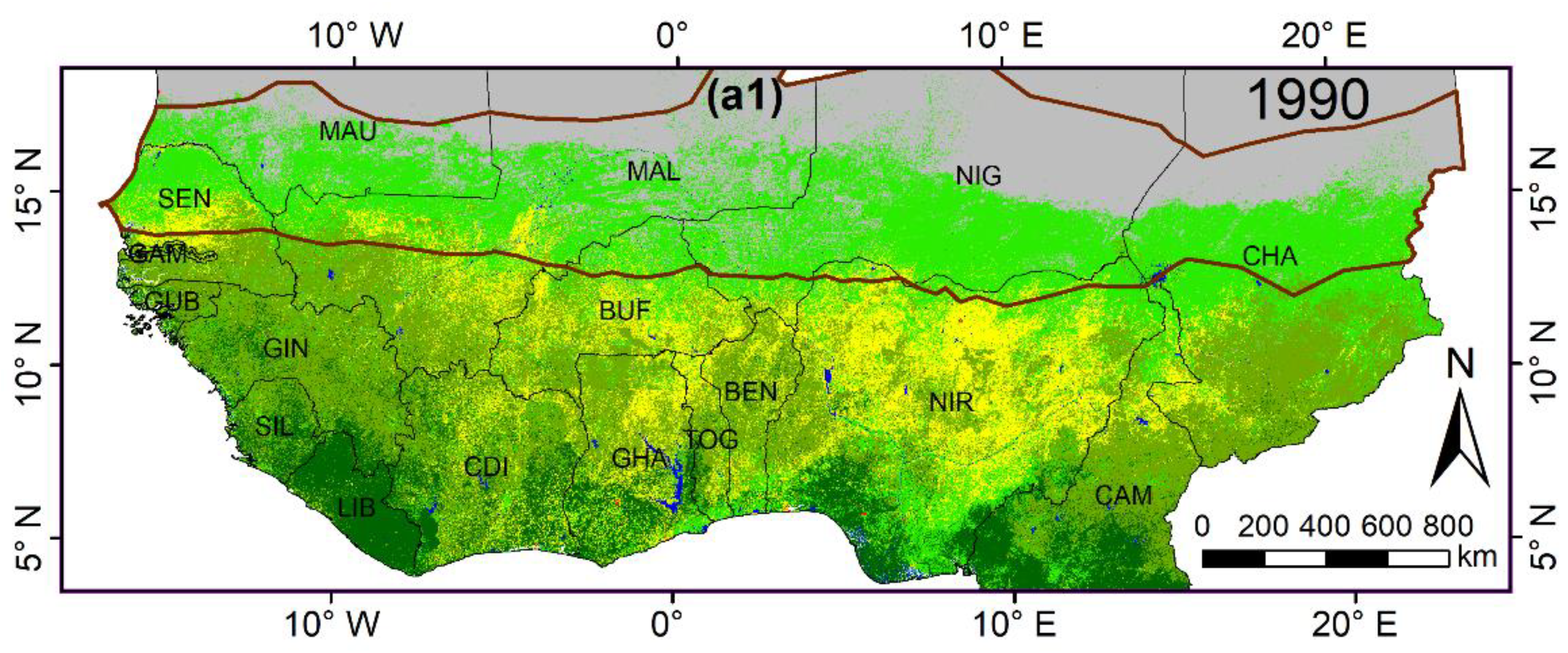
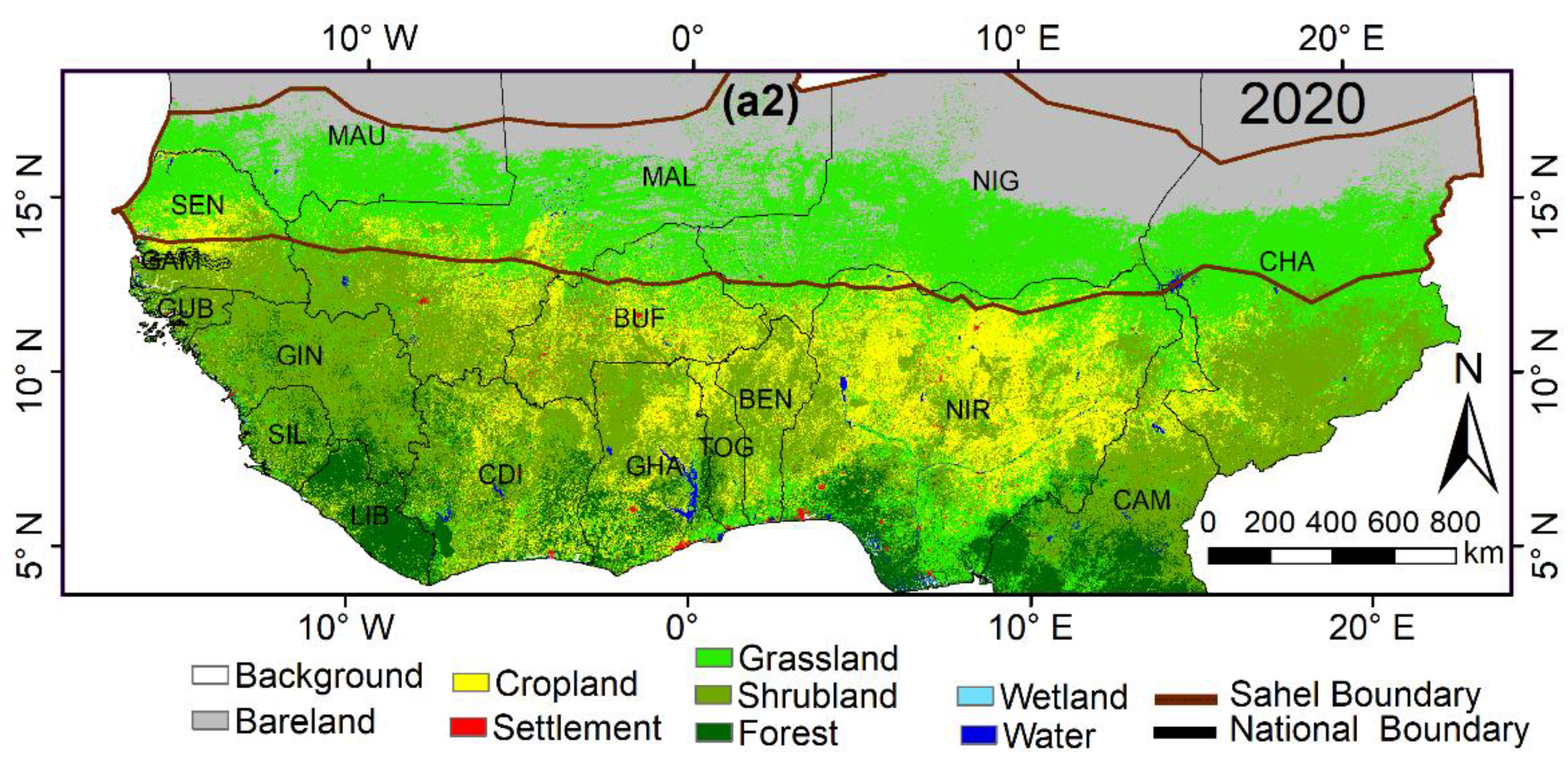
Figure 2.
Time intensity analysis for three time intervals: 1990–2000 and 2000–2010, 2010–2020 . Annual change intensities expressed as % per annum within each time interval respectively for West Africa.
Figure 2.
Time intensity analysis for three time intervals: 1990–2000 and 2000–2010, 2010–2020 . Annual change intensities expressed as % per annum within each time interval respectively for West Africa.
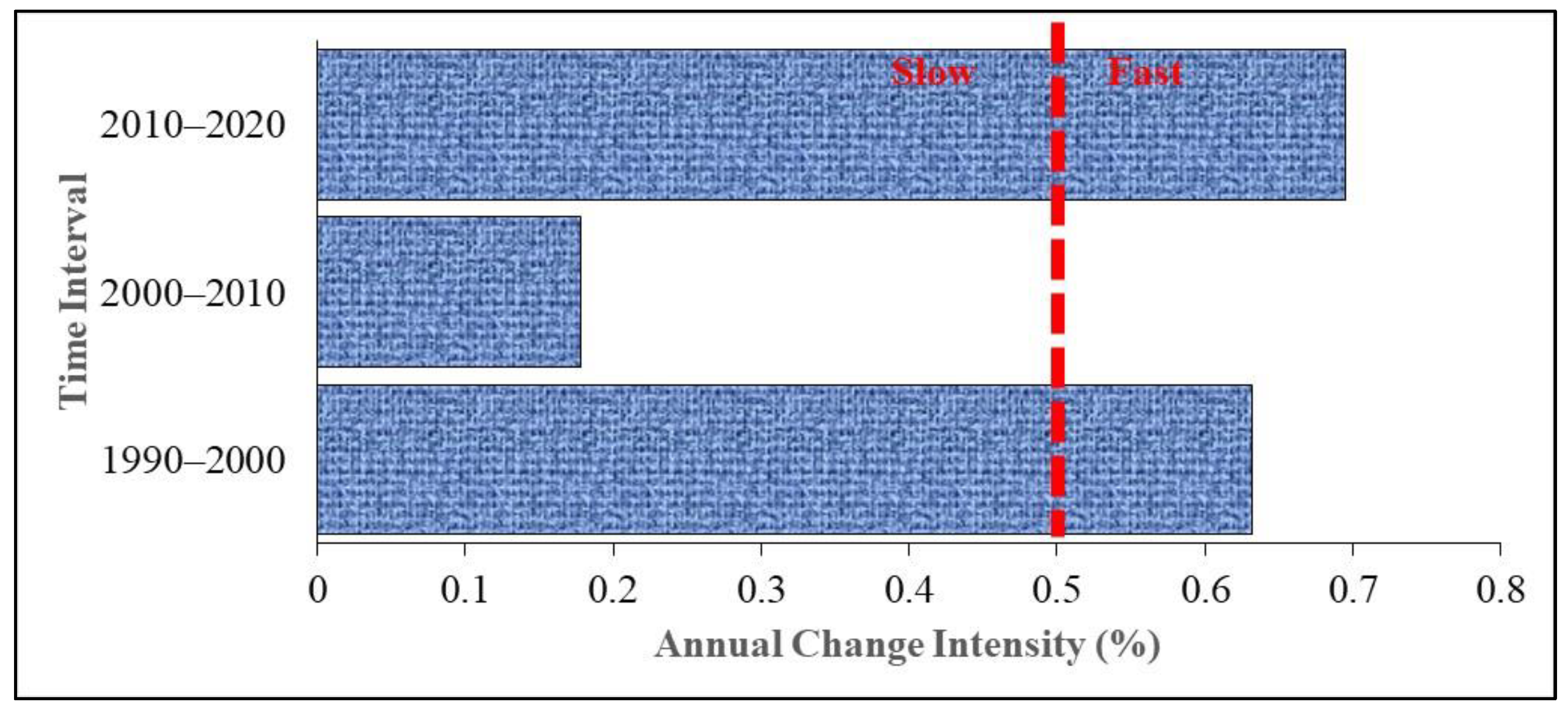
Figure 3.
Category annual intensities of gross gains and losses for 1990–2000 (a), 2000–2010 (b) and 2010–2020 (c) in West Africa. The two vertical dashed lines passing through the Figures illustrate the uniform line for each time-interval at the category intensity level.
Figure 3.
Category annual intensities of gross gains and losses for 1990–2000 (a), 2000–2010 (b) and 2010–2020 (c) in West Africa. The two vertical dashed lines passing through the Figures illustrate the uniform line for each time-interval at the category intensity level.
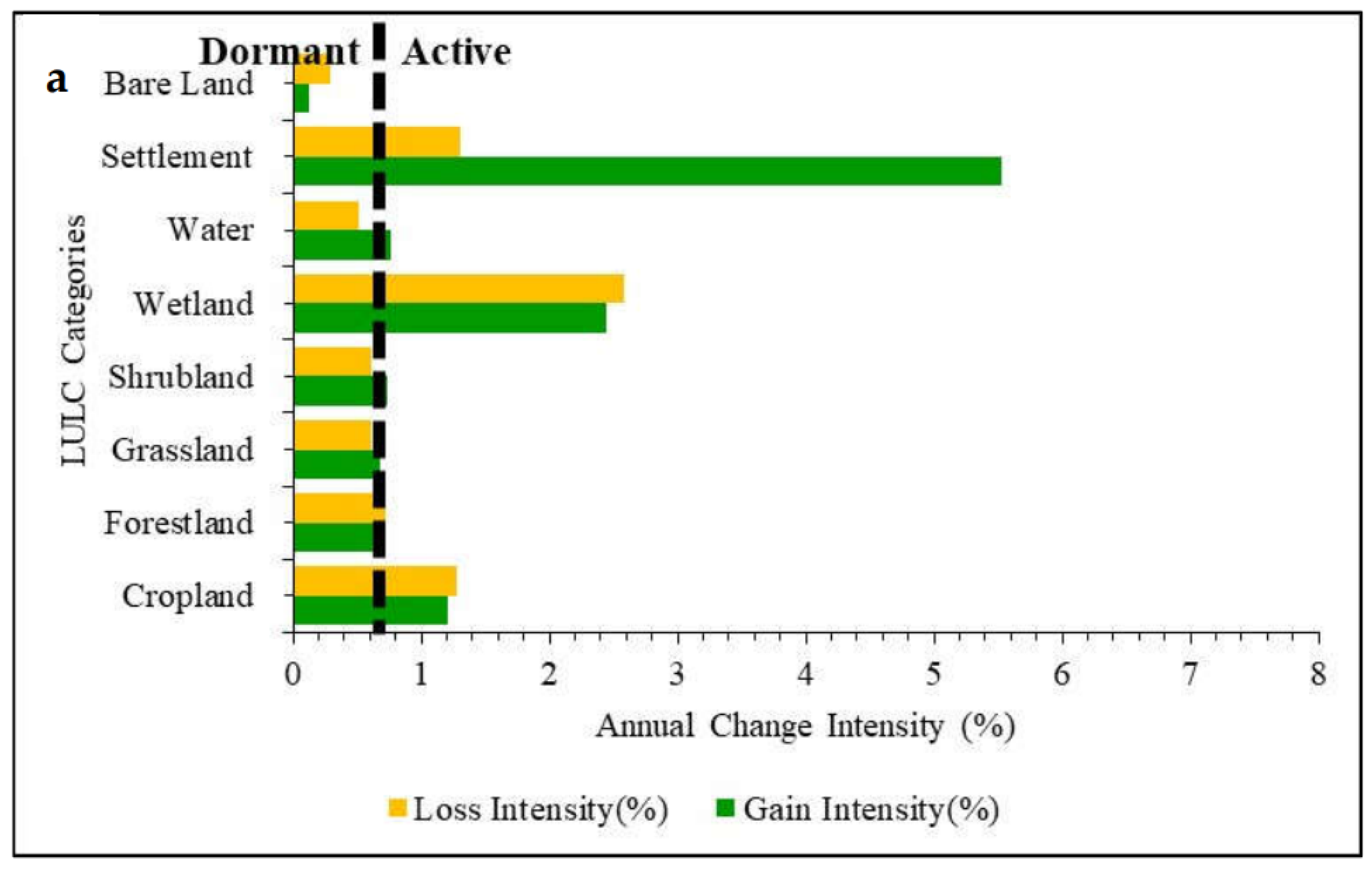
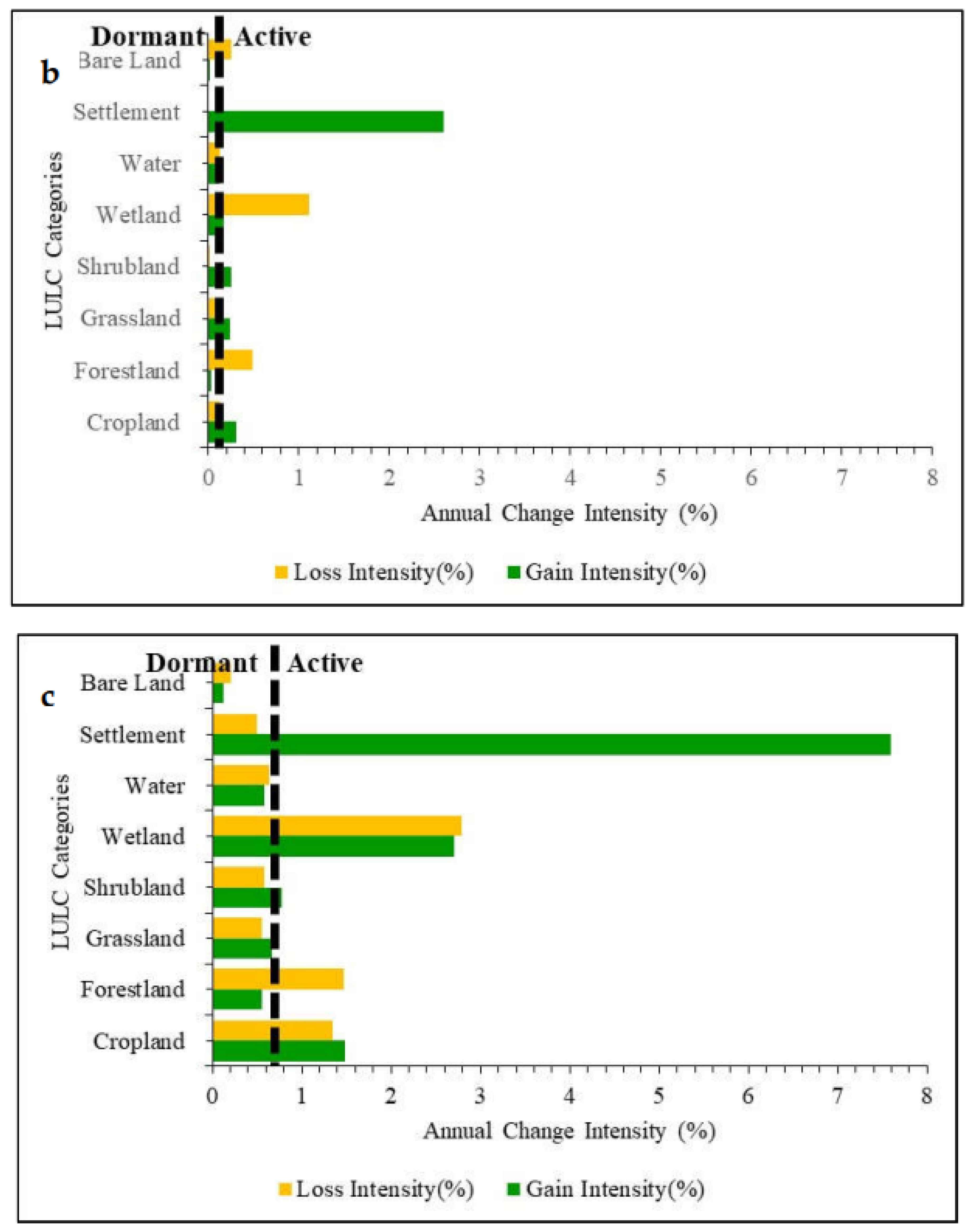
Figure 4.
Category intensities of gross gains and losses for 1990–2000 (a), 2000–2010 (b), 2010–2020(c), and 1990–2020 (d) in West Africa. The two vertical dashed lines passing through the bars illustrate th uniform line for each time interval.
Figure 4.
Category intensities of gross gains and losses for 1990–2000 (a), 2000–2010 (b), 2010–2020(c), and 1990–2020 (d) in West Africa. The two vertical dashed lines passing through the bars illustrate th uniform line for each time interval.

Figure 5.
Land Use Land Cover Change Map of West Africa showing geo-spatial locations of natural vegetation (shrubland, grassland and forestland) gains during the period of 1990–2020. The new growth excludes intra categorical transitions between the natural vegetation groups, e.g., shrubland gains from forestland, grassland gains from forestland, shrubland gains from grassland, and vice versa.
Figure 5.
Land Use Land Cover Change Map of West Africa showing geo-spatial locations of natural vegetation (shrubland, grassland and forestland) gains during the period of 1990–2020. The new growth excludes intra categorical transitions between the natural vegetation groups, e.g., shrubland gains from forestland, grassland gains from forestland, shrubland gains from grassland, and vice versa.
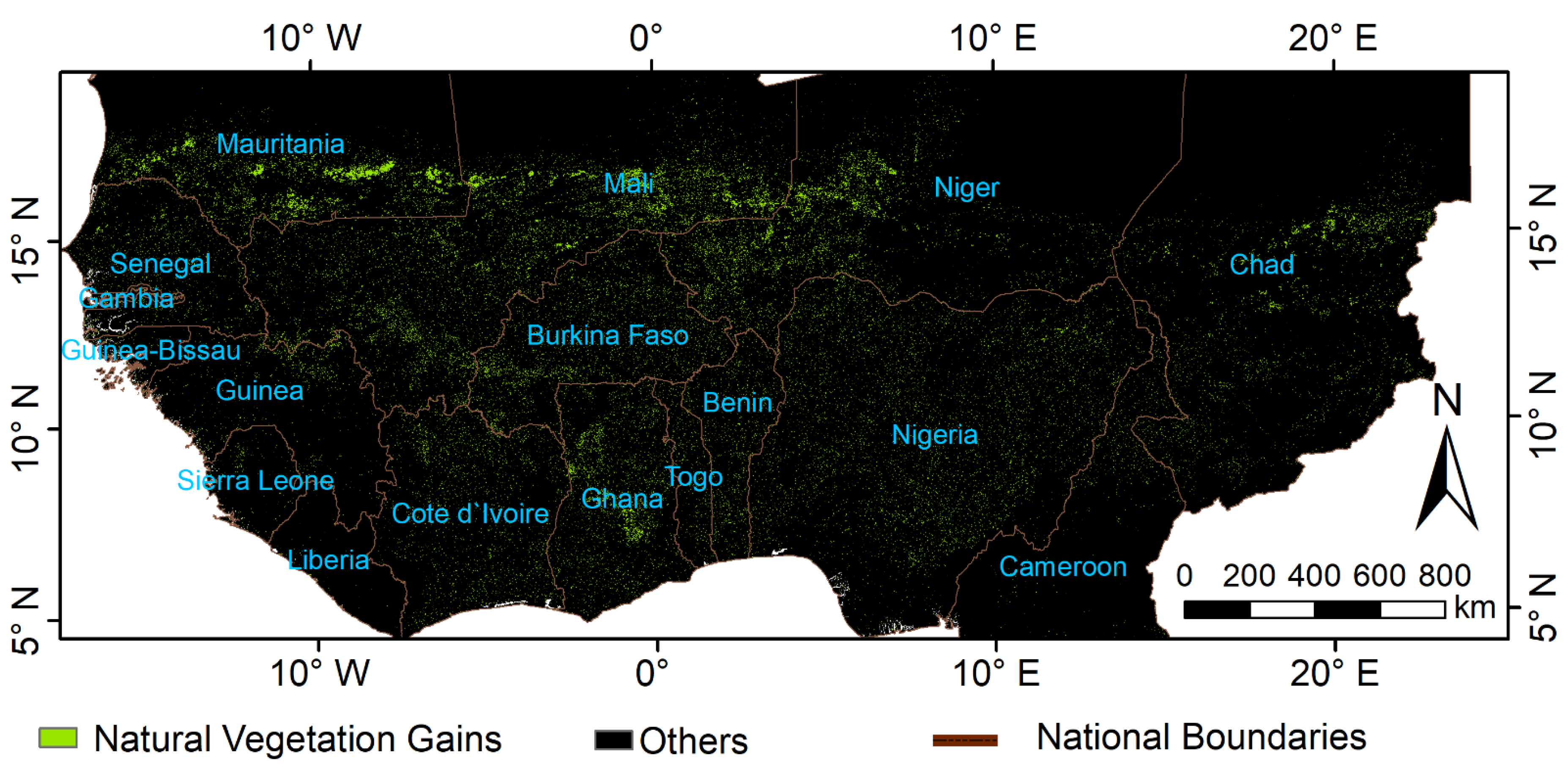
Figure 6.
Concurrent gains and losses of the LULC categories in West Africa in 1990–2000 (a), 2000–2010 (b), and (2010–2020) (c) and 1990–2020 (d). The rows are the initial categories and the columns are the subsequent categories. The bars represent the amount of LULC transitions in terms of area extent from the initial time point to the final time point at each interval for each LULC category. When a category gains more than losses for a given period, then the net change (quantity) is positive (net gain), and vice versa.
Figure 6.
Concurrent gains and losses of the LULC categories in West Africa in 1990–2000 (a), 2000–2010 (b), and (2010–2020) (c) and 1990–2020 (d). The rows are the initial categories and the columns are the subsequent categories. The bars represent the amount of LULC transitions in terms of area extent from the initial time point to the final time point at each interval for each LULC category. When a category gains more than losses for a given period, then the net change (quantity) is positive (net gain), and vice versa.
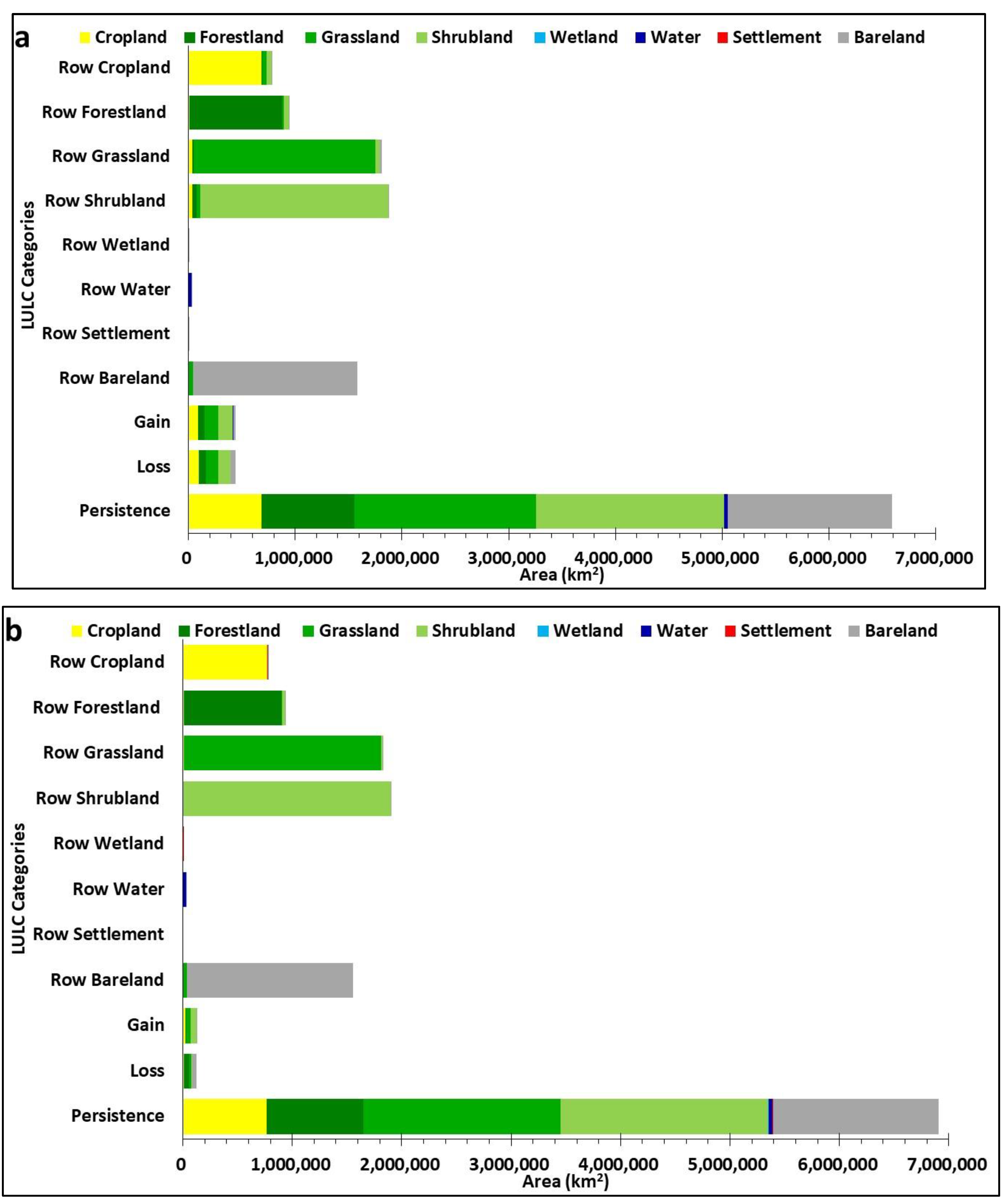
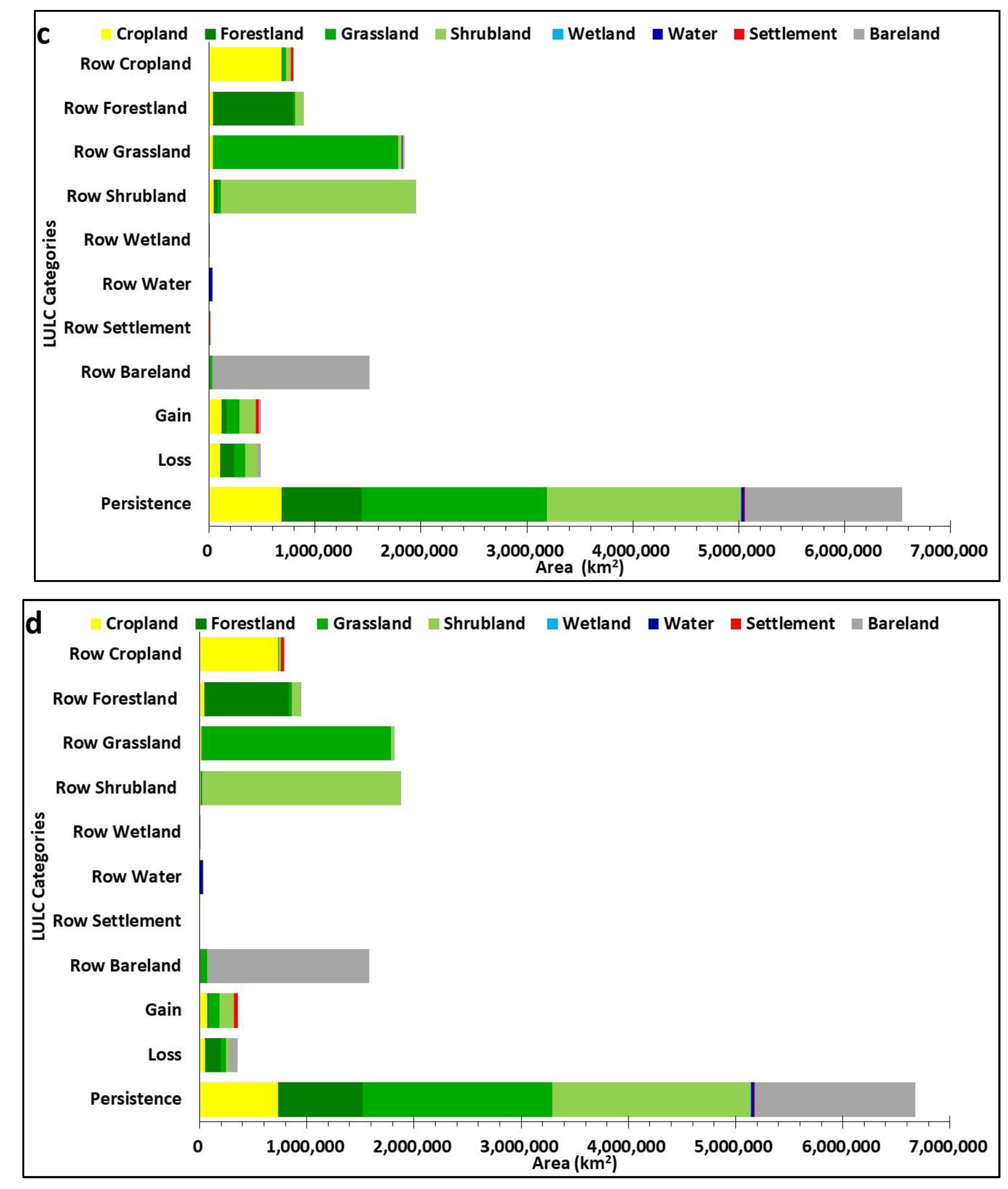
Figure 7.
Annual transition intensities of shrubland gains. The Sub-Figures a, b, c represent annual transition intensities in 1990–2000, 2000–2010, 2010–2020 respectively. The bars that extend above and below the uniform intensity line indicate intensive and dormant systematic transitions respectively. The bars ending at the uniform line indicate random transition.
Figure 7.
Annual transition intensities of shrubland gains. The Sub-Figures a, b, c represent annual transition intensities in 1990–2000, 2000–2010, 2010–2020 respectively. The bars that extend above and below the uniform intensity line indicate intensive and dormant systematic transitions respectively. The bars ending at the uniform line indicate random transition.
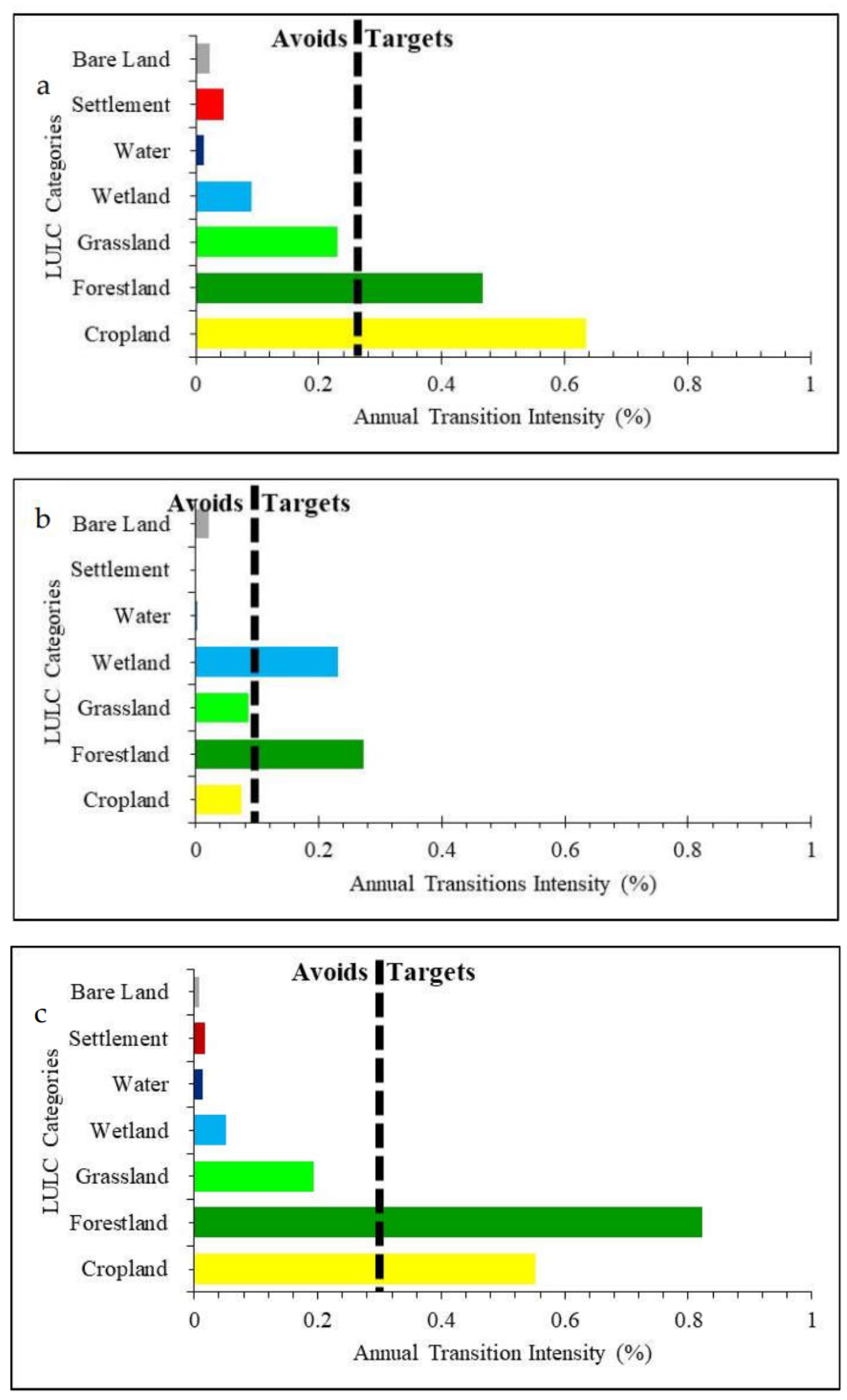
Figure 8.
Annual transition intensities of grassland gains. The Sub-Figures a, b, c represent annual transition intensities in 1990–2000, 2000–2010, 2010–2020 respectively. The bars that extend above and below the uniform intensity line indicate intensive and dormant systematic transitions respectively. The bars ending at the uniform line indicate random transition.
Figure 8.
Annual transition intensities of grassland gains. The Sub-Figures a, b, c represent annual transition intensities in 1990–2000, 2000–2010, 2010–2020 respectively. The bars that extend above and below the uniform intensity line indicate intensive and dormant systematic transitions respectively. The bars ending at the uniform line indicate random transition.
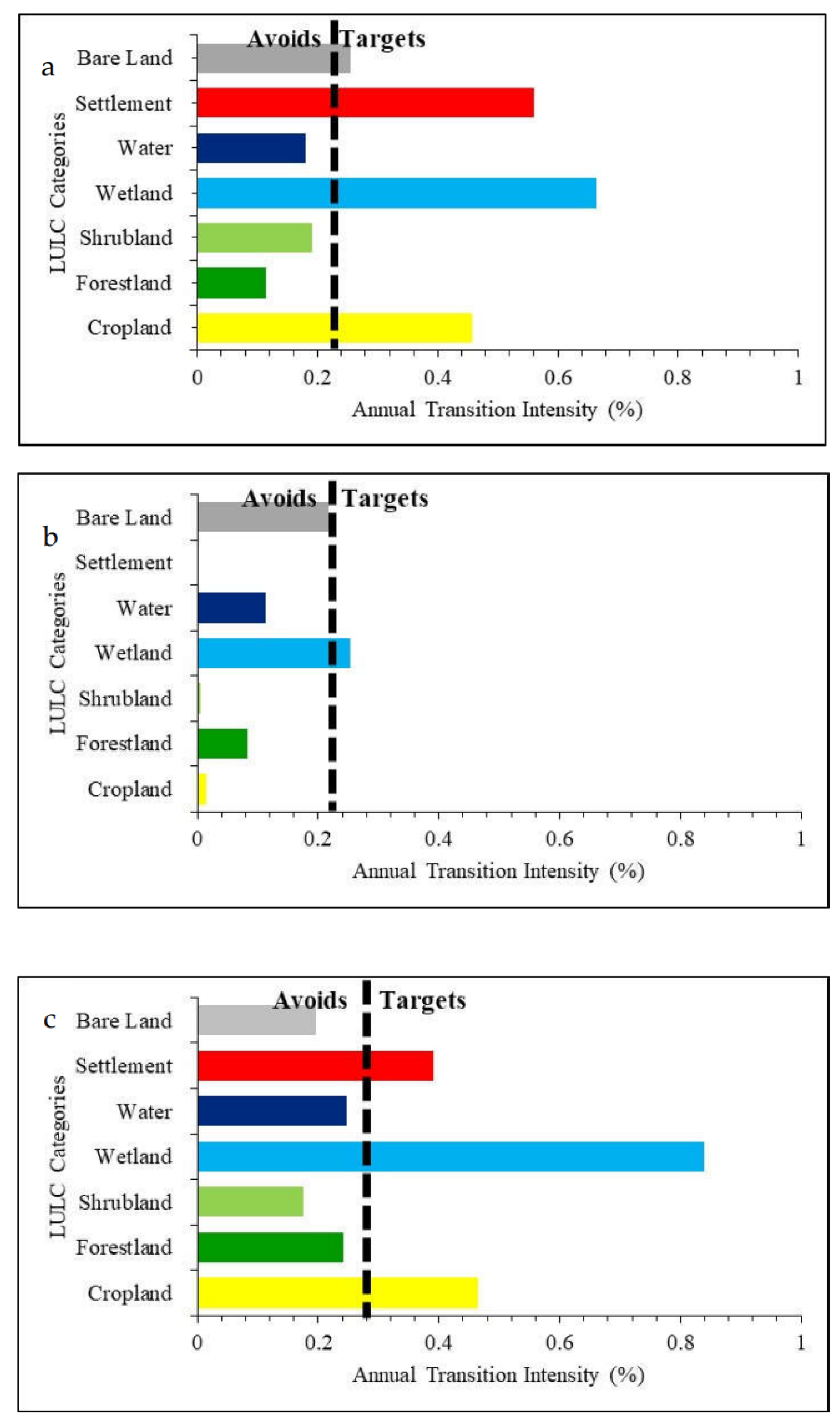
Figure 9.
Annual transition intensities of settlement gains. The Sub-Figures a, b, c represent annual transition intensities in 1990–2000, 2000–2010, 2010–2020 respectively. The bars that extend above and below the uniform intensity line indicate intensive and dormant systematic transitions respectively. The bars ending at the uniform line indicate random transition.
Figure 9.
Annual transition intensities of settlement gains. The Sub-Figures a, b, c represent annual transition intensities in 1990–2000, 2000–2010, 2010–2020 respectively. The bars that extend above and below the uniform intensity line indicate intensive and dormant systematic transitions respectively. The bars ending at the uniform line indicate random transition.
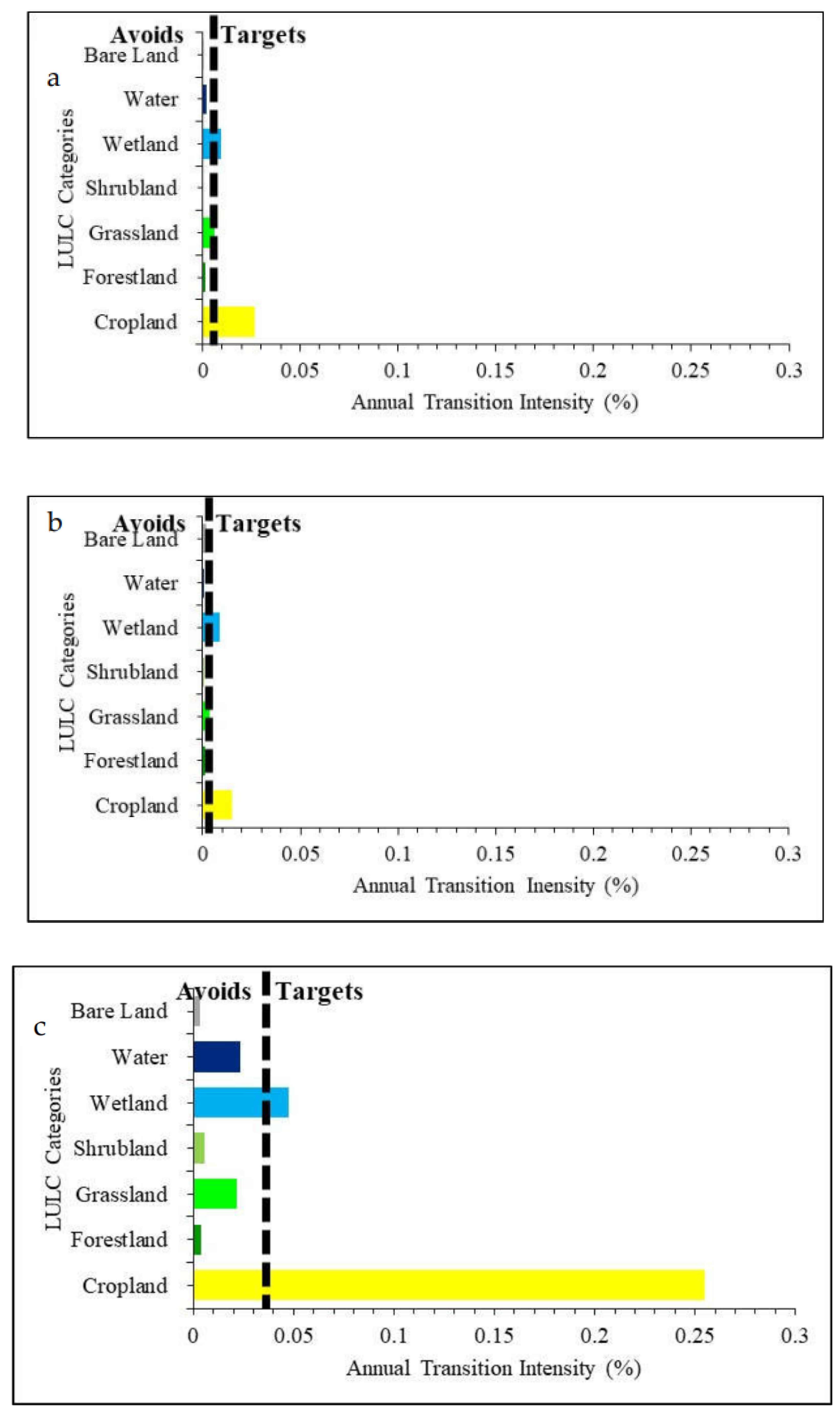
Figure 10.
Annual transition intensities of cropland gains. The Sub-Figures a, b, c represent annual transition intensities in 1990–2000, 2000–2010, 2010–2020 respectively. The bars that extend above and below the uniform intensity line indicate intensive and dormant systematic transitions respectively. The bars ending at the uniform line indicate random transition.
Figure 10.
Annual transition intensities of cropland gains. The Sub-Figures a, b, c represent annual transition intensities in 1990–2000, 2000–2010, 2010–2020 respectively. The bars that extend above and below the uniform intensity line indicate intensive and dormant systematic transitions respectively. The bars ending at the uniform line indicate random transition.
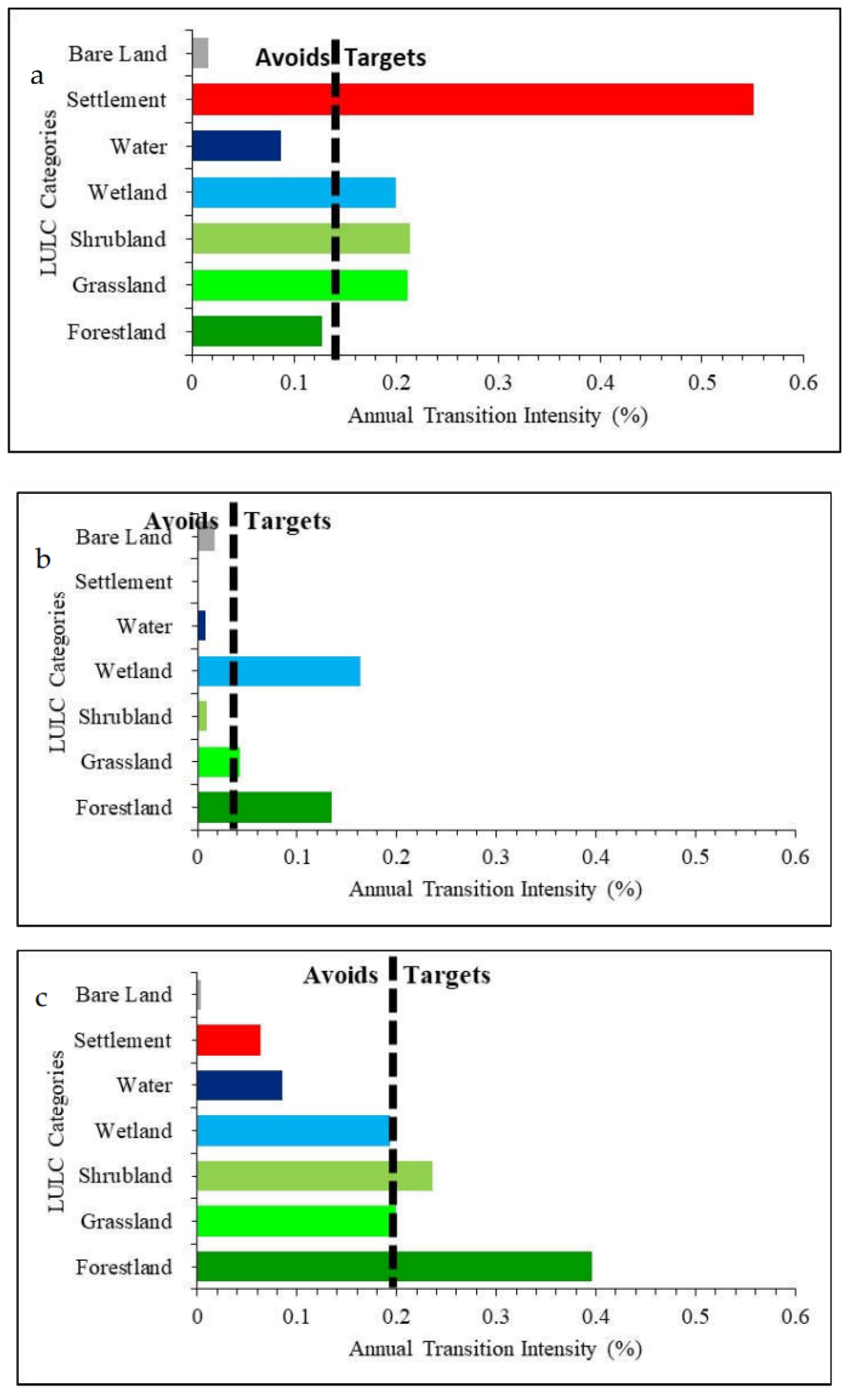

Table 1.
Classification schemes crosswalk strategies [43].
Table 1.
Classification schemes crosswalk strategies [43].
| FROM GLC | ESA-CCI |
| Cropland | Rainfed cropland, irrigated/post-flooding cropland |
| Mosaic cropland (>50%)/natural vegetation (tree, shrub, herbaceous cover), | |
| Mosaic cropland/natural vegetation (tree, shrub, herbaceous cover) (>50%) | |
| Forest | Tree cover, broadleaved, deciduous, closed to open (>15%), |
| Tree cover, needle leaved, evergreen, closed to open (>15%), | |
| Tree cover, needle leaved, deciduous, closed to open (>15%), | |
| Tree cover, mixed leaf type (broadleaved and needle leaved), | |
| Mosaic tree and shrub (>50%)/herbaceous cover | |
| Grassland | Mosaic tree and shrub/herbaceous cover (>50%), grassland, |
| Shrubland | Shrubland |
| Wetland | Tree cover flooded with fresh/ brackish water/saline, |
| Shrub or herbaceous cover flooded with fresh/saline/brackish water | |
| Water | Water bodies |
| Impervious surface | Urban areas/Settlements |
| Bare land | Sparse vegetation (tree, shrub, herbaceous cover) (<15%), Bare areas |
Table 2.
The Transition matrix from cross-tabulation of Land Use Land Cover (LULC) maps from 1990 to 2020 at a decadal interval (1990 –2000, 2000–2010, 2010–2020).
Table 2.
The Transition matrix from cross-tabulation of Land Use Land Cover (LULC) maps from 1990 to 2020 at a decadal interval (1990 –2000, 2000–2010, 2010–2020).
| Areas (km2) | ||||||||
|---|---|---|---|---|---|---|---|---|
| LULC Categories | Cropland | Forestland | Grassland | Shrubland | Wetland | Water | Settlement | Bareland |
| Period (1990–2000) | ||||||||
| Cropland | 683079.7 | 11425.1 | 35915.9 | 49784.1 | 78.5 | 318.7 | 2077.3 | 447.8 |
| Forestland | 11912.5 | 871949.0 | 10700.1 | 43885.1 | 266.2 | 592.7 | 118.1 | 40.3 |
| Grassland | 38283.2 | 10058.5 | 1701829.6 | 41800.1 | 230.3 | 998.7 | 1099.8 | 18927.6 |
| Shrubland | 40121.7 | 38255.9 | 35852.0 | 1760458.1 | 38.6 | 95.1 | 94.9 | 847.4 |
| Wetland | 71.3 | 266.4 | 236.2 | 32.1 | 2639.0 | 304.7 | 3.4 | 5.8 |
| Water | 274.2 | 499.2 | 571.4 | 38.9 | 216.0 | 30011.8 | 6.3 | 27.2 |
| Settlement | 183.1 | 12.0 | 186.4 | 15.0 | 0.8 | 2.2 | 2892.9 | 32.8 |
| Bareland | 2375.1 | 55.2 | 40396.0 | 3594.0 | 25.0 | 149.3 | 172.8 | 1533969.7 |
| Period (2000–2010) | ||||||||
| Cropland | 766466.1 | 1626.2 | 1139.2 | 5778.0 | 8.6 | 110.6 | 1179.4 | 12.0 |
| Forestland | 12584.7 | 886525.1 | 7709.2 | 25592.9 | 11.6 | 79.6 | 92.2 | 31.5 |
| Grassland | 7814.3 | 550.0 | 1800830.4 | 15678.6 | 7.3 | 91.9 | 651.1 | 93.6 |
| Shrubland | 1689.9 | 688.6 | 874.0 | 1896309.1 | 3.1 | 17.9 | 26.8 | 6.1 |
| Wetland | 57.3 | 136.6 | 88.5 | 81.5 | 3107.2 | 25.5 | 3.0 | 0.1 |
| Water | 24.5 | 15.6 | 369.6 | 13.4 | 12.8 | 32104.8 | 1.1 | 3.1 |
| Settlement | 0.0 | 0.0 | 0.0 | 0.0 | 0.0 | 0.0 | 6469.4 | 0.0 |
| Bareland | 2652.8 | 27.6 | 33754.7 | 3438.4 | 11.0 | 85.0 | 314.2 | 1514015.4 |
| Period (2010–2020)) | ||||||||
| Cropland | 684571.6 | 5625.1 | 36765.2 | 43704.5 | 59.2 | 221.4 | 20149.2 | 174.8 |
| Forestland | 35172.1 | 758458.0 | 21447.7 | 73246.4 | 214.2 | 564.6 | 357.1 | 4.2 |
| Grassland | 36678.5 | 6528.8 | 1742692.8 | 35766.6 | 216.0 | 737.1 | 4029.5 | 18086.8 |
| Shrubland | 45865.7 | 31791.0 | 34090.9 | 1833569.1 | 14.6 | 40.5 | 1133.7 | 377.8 |
| Wetland | 61.2 | 252.22 | 264.9 | 16.3 | 2277.7 | 269.2 | 15.0 | 0.8 |
| Water | 276.1 | 503.0 | 801.6 | 43.8 | 332.3 | 30387.6 | 75.4 | 23.3 |
| Settlement | 55.7 | 3.5 | 341.6 | 14.3 | 0.6 | 7.6 | 8301.5 | 7.1 |
| Bareland | 509.5 | 0.8 | 29709.5 | 1067.0 | 6.0 | 47.7 | 523.9 | 1482297.0 |
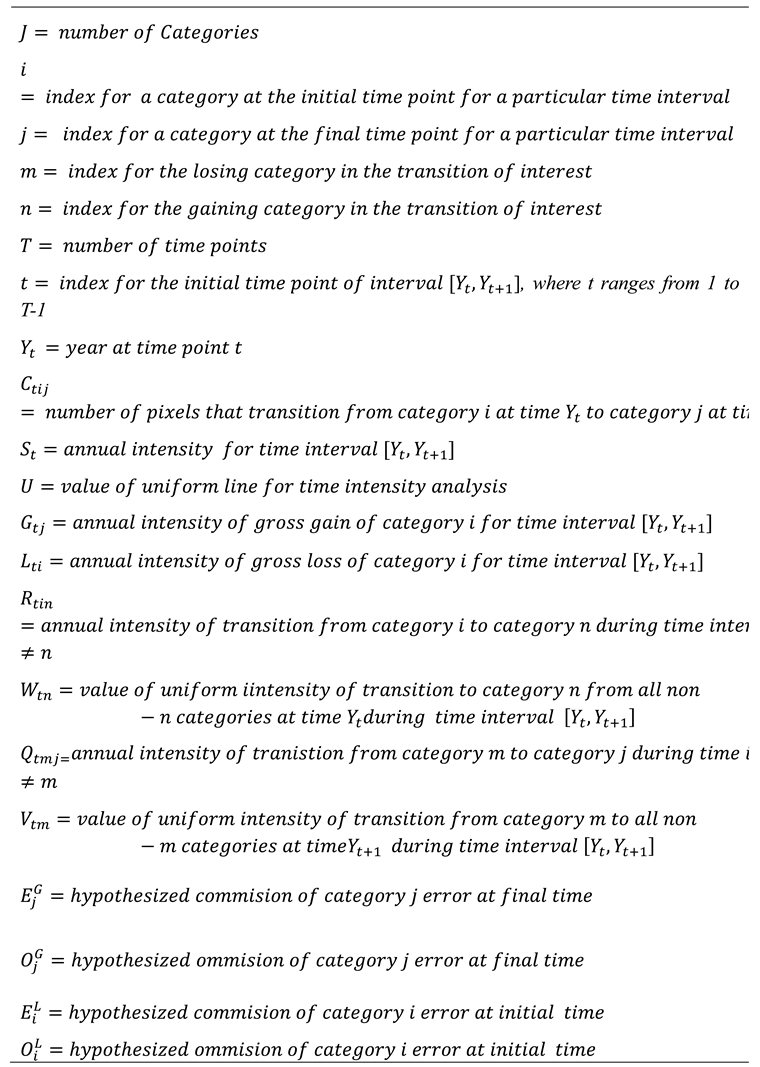
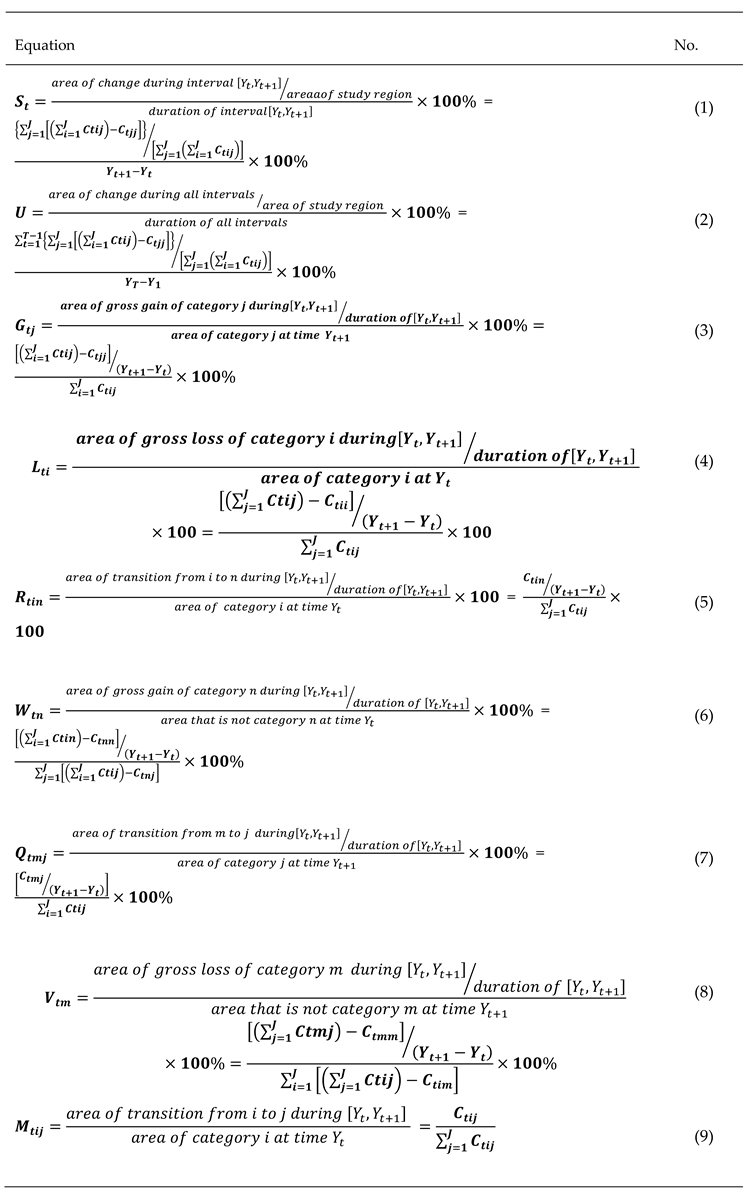
Table 5.
The relative net change for the Land Use Land Cover (LULC) categories during 1990–2000, 2000–2010, 2010–2020 and 1990–2020 in West Africa.
Table 5.
The relative net change for the Land Use Land Cover (LULC) categories during 1990–2000, 2000–2010, 2010–2020 and 1990–2020 in West Africa.
| Period | 1990-2000 | 2000-2010 | 2010-2020 | 1990-2020 | |
| LULC Category | Net Change (%) | Net Change (%) |
Net Change (%) |
Net Change (%) | |
| Cropland | -0.87 | 1.89 | 1.48 | 2.50 | |
| Forestland | -0.74 | -4.62 | -9.70 | -14.51 | |
| Grassland | 0.68 | 1.03 | 1.15 | 2.83 | |
| Shrubland | 1.26 | 2.43 | 2.04 | 5.62 | |
| Wetland | -1.81 | -9.65 | -1.16 | -12.33 | |
| Water | 2.55 | -0.09 | -0.52 | 1.95 | |
| Settlement | 48.57 | 25.96 | 74.75 | 90.39 | |
| Bareland | -1.67 | -2.58 | -0.87 | -5.05 |
Disclaimer/Publisher’s Note: The statements, opinions and data contained in all publications are solely those of the individual author(s) and contributor(s) and not of MDPI and/or the editor(s). MDPI and/or the editor(s) disclaim responsibility for any injury to people or property resulting from any ideas, methods, instructions or products referred to in the content. |
© 2023 by the authors. Licensee MDPI, Basel, Switzerland. This article is an open access article distributed under the terms and conditions of the Creative Commons Attribution (CC BY) license (http://creativecommons.org/licenses/by/4.0/).
Copyright: This open access article is published under a Creative Commons CC BY 4.0 license, which permit the free download, distribution, and reuse, provided that the author and preprint are cited in any reuse.


